
Matador Network's Blog, page 1417
January 25, 2018
Ski film pioneer Warren Miller dies
Ski icon and action-sports filmmaking pioneer Warren Miller died Wednesday at his home in Oscas Island, WA. He was 93. Throughout his career, Miller filmed, produced, or was part of over 500 ski films and earned legendary status with his annual feature-length ski film. Miller’s work served for many as the annual kick-off to ski season, shown in ski clubs and theatres around the world each November and December. For many years, Miller toured the films himself. His voice became immortalized as he narrated each show, eventually moving into recording his narrations for the films themselves.
Miller’s family posted the following statement to his Facebook page:
“We are saddened to share the news that our beloved Warren passed away peacefully at the age of 93 at his home on Orcas Island, WA. While this is a time of profound loss, we are comforted that Warren’s life touched so many. Warren made the extraordinary seem accessible, and his legacy of freedom, humor, and adventure endures through all of you. Whether you saw his movies, read his books, or met him on the slopes, he considered you to be part of his family. Your love meant the world to him. For those who are able, ski your favorite run or do something else you love in Warren’s memory.”
Miller sold his film company in 2007, but the brand continues to put out annual ski films and continue its touring legacy. He is survived by his wife, Laurie, and four children. 
Follow Matador on
Vimeo
Follow Matador on
YouTube

More like this: Ski film goes 3D in ‘Light The Wick’


20 of the world's staple ingredients
Cuisine is a tricky thing to define. While we all have fairly universal ideas about what Indian food looks and tastes like, being able to describe and replicate that flavor requires a deeper knowledge of the local ingredients found in India. Using noodles doesn’t necessarily mean you are preparing Italian cuisine, but adding sauce made from San Marzano heirlooms and grated parmesan might put you on the right track. With that in mind, Kitchen Cabinet Kings put together a list of the most important staple ingredients of the most populated countries in the world.

Photo: Kitchen
Cabinet Kings
More like this: What type of cuisine are you? (QUIZ)

uber's flying and autonomous cars
Uber is taking new steps to demonstrate its drive to conquer the world’s transportation economy.
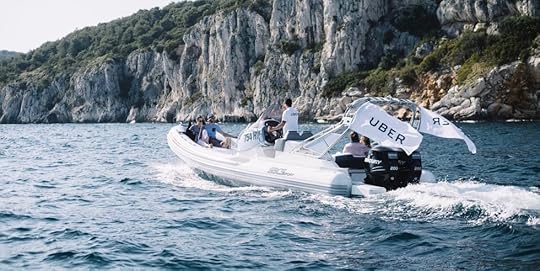
During the summer of 2017, the multi-billion dollar company based in San Francisco launched UberBOAT, a boat taxi service that is only available in Croatia (for now). You can use UberBOAT to connect to over 1,000 islands in the Adriatic Sea for around $400-500 USD, or rent a boat for the entire day for a little more than $1,000 USD.
Courtesy of UBER
But bringing a taxi app to the high seas is far from the only thing the mega-company has planned for the world.
Speaking amidst the World Economic Forum event in Davos, Switzerland, Uber CEO Dara Khosrowshahi made several statements indicating that both flying and autonomous taxis will be available the very near future. On Tuesday, the CEO told Bloomberg Editor-in-Chief John Micklethwait, “We will have autonomous cars on the road, I believe, within the next 18 months. Not as a test case but as a real case out there.”
While Khosrowshahi admitted that these first cars will probably not be fully autonomous, “for five percent of cases (in certain cities), everything is going to fall into place and we will send an autonomous car.” He believes that fully autonomous cars everywhere is still “10 to 15 years” away, but will happen faster as these cars begin to “learn the city.”
If that news isn’t big enough, Khosrowshahi also made statements about flying cars (eh, more like sexy helicopters), which he says will be integrated into Uber services in only “5 to 7 years.” Unlike your standard airplane, UberAir vehicles will operate within urban areas. Uber is currently working out the kinks of providing a mass helicopter service, which include achieving a quiet, vertical take-off. “There will be people flying around Dallas, Texas. I think it’s going to happen within the next ten years,” Khosrowshahi told an audience at the DLB tech conference in Munich.
“We’ll always be a company that makes big, bold bets and takes big risks”, the CEO told Bloomberg.
More like this: How traveling by car is changing under Millennials (INFOGRAPHIC)

Photographer's minimalist bag
I thought I was a lightweight traveler. Then I had a kid. Having a baby — and a budget — forced my travels into a minimalist lifestyle whether I liked it or not. So, as I stared into our overweight bags just an hour before we had to leave for the airport to begin a three-month trip to Mexico, I realized: holy shit, kids need a lot of stuff. It was a physical reminder that babies change everything; there was no room left for my old “life” in these bags. So, this isn’t a piece about baby travel gear — it’s actually about my gear. In this case, while we were going as a family to Mexico for three months, I still had to work, shoot, and keep up from the road. What made the cut? What didn’t?
Before a baby, I traveled for photography, a lot. Workshops, speaking gigs, press trips, personal trips, you name it. I run a company called The Giving Lens, work here at Matador, speak for Sony, teach online, and get out to shoot my own stuff, too. Working from the road requires me to have photography gear and a portable office — and it all needs to be carry-on because like hell I am putting all that out of my sight. By the way, twice so far this trip, our bags have not arrived, so never, ever send your important (and expensive) tech under a plane.
Let’s start with my office.
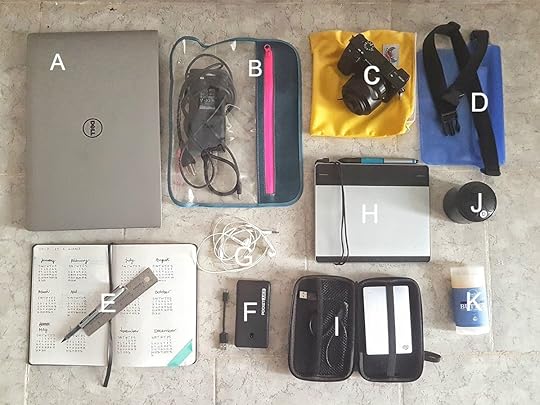
A. The first thing you’ll notice is that I don’t have a MacBook. You can close your mouth now. I have a Dell XPS 15″ laptop with i7 brains. I need 15″ if I’m working from the road long term, as I am used to my 27″ back home. This Dell has a touchscreen and has been upgraded to 32gb ram so I can work on photos and video with ease.
B. The Dell’s power bar, inside a water-resistant bag that also protects from sand, dust, and sticky fingers (that would be the baby). I use this bag to bring my phone to the beach, along with my notebook, and it keeps both sand free.
C. My camera. In this case, it’s a Sony a6300. It’s sitting on wet bags. Wet bags are usually used for dirty diapers or clothes to get them home without ruining anything else in your bag — they keep wet stuff in. I have multiple large versions — check the video below — but while this small version is actually meant for snacks, I find it’s a perfect fit for my camera. As good as it is at keeping wet stuff in, it is equally good at keeping wet/sandy/sticky stuff out. I’ll talk more about my camera soon but I now always keep it inside a bag like this, because I can chuck it in my purse, backpack, stroller, etc. and back again without worrying about sand and scratches.
D. This blue bag is 100% waterproof and this is what I use to take my cell phone, keys, and money on the ocean with me so that I don’t have to worry about what is onshore (assuming I did not bring my laptop to the beach, which people only do when they’re posing for a photo to make it look like they’re working at the beach. Have you ever worked in full sun? It’s the pits. No thanks.). I would not call this piece essential to my office but if my phone got stolen my lifeline to the outside world would be gone. Ever had the wifi go down, and had a deadline? I have. And data tethering has saved my butt. So, yeah, keeping the phone safe is pretty vital for me.
E. Bullet Journal. Either you love it or never heard of it. For me, it is a system that lets the chaos in my head make its way to paper without having to form ten different types of lists. This is amplified on the road when I am also constantly hearing of places to visit, restaurants or bars to check out, or otherwise adding to all the noise in my head — which consists of deadlines, emails, endless tasks, budgeting, networking, marketing, and now about a million things related to raising up a small human. A blank journal and good pens = essential.
F. Portable battery. This sucker can charge my phone and my camera and recharges in an afternoon. For so many reasons — work, safety, my kid, photo opps — I can’t have my phone die on me during the day.
G. Really, really good headphones with a mic, for taking calls and blocking out distractions.
H. Wacom Intuos Touch. This little tablet comes with a pen — seen on top — and is my “mouse.” I have a much larger, cushier version at home but this little guy does the job on the road. For one, I get repetitive motion pain using touchpads all day on a laptop. A normal mouse is a fine alternative but the Intuos is slim, and holding a pen is much easier on my hand joints than a mouse or a touchpad. It also has hotkeys you can assign as shortcut keys to just about anything, and they can be modified for different applications. The shortcuts I have for web browsing are different from the shortcuts I assigned to photo editing, for example. Which leads me to the second reason I love this little guy: editing photos with a pen is the shit. You get much more creative control.
I. Hard drive. I opt for 4gb. It lives inside a hard shell which often is found inside one of my 3 water-resistant/waterproof bags. My images are part of my work and keeping them safe is a priority. My images live here and are uploaded to my Amazon Prime account when I have good wifi, as well as living on an SD card for as long as possible. Pro tip: I rarely keep my used SD cards and my hard drive together, so if one bag is stolen or lost, at least I have the other.
J. Bluetooth speaker. Cause this mama needs a groove to really dig into work.
K. Cocoa butter stick. Wholly unrelated to the rest. Just one of my favorite items ever.
So that’s part one. That’s my office. When I get set up I look like this:
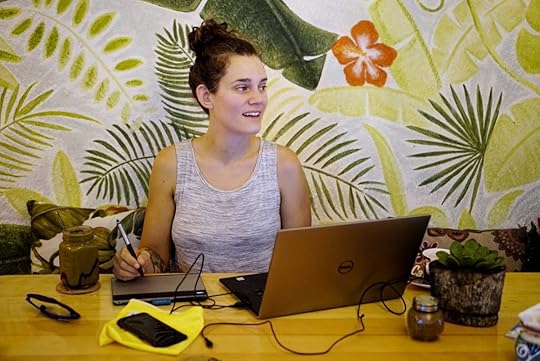
Which makes nomad life look good, no? Here’s what it actually looks like pulled back:
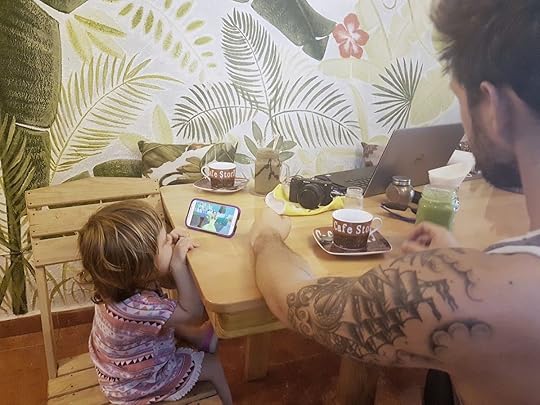
But that’s just my reality. Working away from my home desk is tough (Boo hoo, right?). It’s hard to focus when there are carne asada and a cold cerveza waiting for you. It’s also really hard to focus with a kid coloring on your leg. But I digress. All of the above helps me get into a working mindset from anywhere in the world, without too much bulk.
The second half of my set up is my camera bag.
I used to look like this when I traveled for photography:
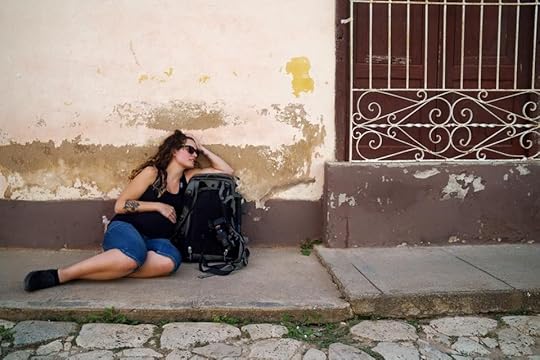
That’s in Cuba, exhausted from lugging that bag of gear all over Havana — at least 20lbs of gear. Though, I was also carrying another 20lbs in my belly, as I am six months pregnant in this photo. For comparison, here’s what made the cut this trip:
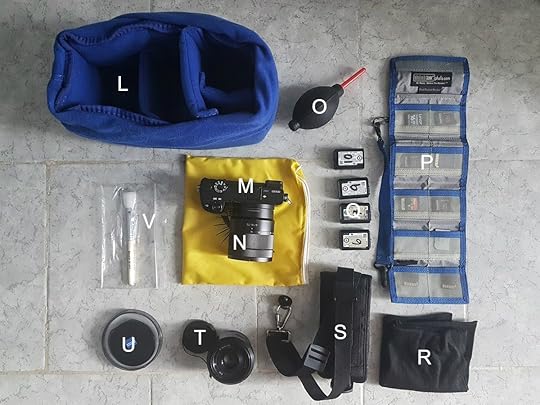
At home and on former trips I have the Sony a7rii and about 6 lenses, a carbon fiber tripod, filters, and more — it can fill a bag the size of a carry-on suitcase. I could have brought it all, but I no longer have the drive to haul all of that around any longer. I don’t have the same hunger to do that as I did when I was a fresh-faced travel photographer. In fact, part of the reason I switched from Canon to Sony was that all the weight was taking its toll on my body — and my creativity. Switching to mirrorless helped bring the weight down a ton, but for this trip, all that gear still felt a bit hefty for space, and like a creative hindrance.
Have you ever heard of lens anxiety? It’s when you have too many options and can’t make a decision, and before you know it the moment is gone. I didn’t want that on this trip, and I was already juggling work and traveling with a baby so I knew it would happen. So, instead, I removed the temptation, and in doing so, also removed the weight. Here is what I did bring:
L. Camera insert. Rather than buy a camera bag, I bought this adjustable little home for it that I can put into any bag and cinch shut. Camera bags often just beg to be stolen, unless they’re really worn in, and I also now need space for beach items, sunscreen, baby stuff, etc. A dedicated camera bag just wasn’t worth it for this trip.
M. My Sony a6300, a cropped sensor mirrorless camera. It is 24 megapixels, crazy fast focusing, can shoot 11 frames per second, and sensitive up to 51,200 ISO. It can also shoot 4k video and 1080px footage. Before I had a kid I didn’t do much video but now that I have her, and I have her in Mexico, I can’t really stop. It has incredible focus-tracking, which you can see in little green dots bouncing across the screen as your subject (ahem, child) runs towards you. It has focus-peeking, whereby I hit a button and can see everything that is sharp outlined in red. It has wifi to send images to my phone, for sending back home or getting high-quality images online fast.
N. The lens on my a6300 here is 16-70mm f/4. 16-24mm is great for landscapes and big wide scenes, while 24-50mm is perfect for street scenes, environment portraits, and semi-close compositions, while 50-70mm is great for portraits. Of course, you can do many different things at any of these lens lengths if you know what you’re doing. I find 16-70mm suit travel perfectly as you may shoot a landscape and turn around and shoot a portrait. It’s so handy when you just don’t know what’s next. This whole set up is insanely lightweight but powerful.
O. Dust blower. Don’t ruin that pretty little sensor by getting it all gunked up.
P. SD cards. All sizes from 16gb to 64gb. Bring many, so you aren’t always clearing them.
Q. Batteries.
R. Headband. Also works as lens wipe, face protector (dust, sand, bugs), some sun protection, forehead mop, and eye mask (for sleeping, not for shooting). For me, it keeps the insane amount of hair I have from blowing into my photos.
S. Black Rapid strap. Because hanging a scratchy camera strap around your neck all day sucks. Padded, and has a pocket for a wipe and an SD card.
T. A 35mm f/1.8 portrait lens. This is the cropped sensor version of the 35mm lens. It’s uber light but still gets me epic portraits and creamy backgrounds.
U. Circular Polarizer. This is a tool for when shooting in bright light, to tone down harsh reflections and bring color back to a scene — especially with water.
V. A sensor brush, in a protective sleeve, which I put inside a ziplock bag. This is for when the blower, above, isn’t doing the trick.
I can shove all of that into the blue camera insert, and shove that into any bag I want — especially a banged up bag that doesn’t look like it’s got expensive gear inside — and away I go. Like this:
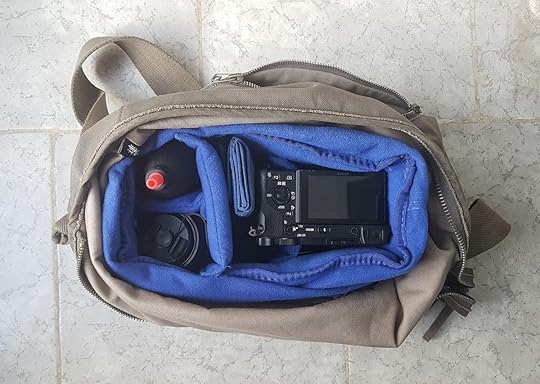
And believe it or not, even in this mediocre sized shoulder bag I can fit the camera insert and some extras: my bikini, sunscreen, small towel, wallet, phone, portable battery, and a bottle of water. Oh, and a diaper, a baby’s sunhat, and a cold can of Pacifico.
Note: not pictured, by accident, is a small travel tripod like this one.
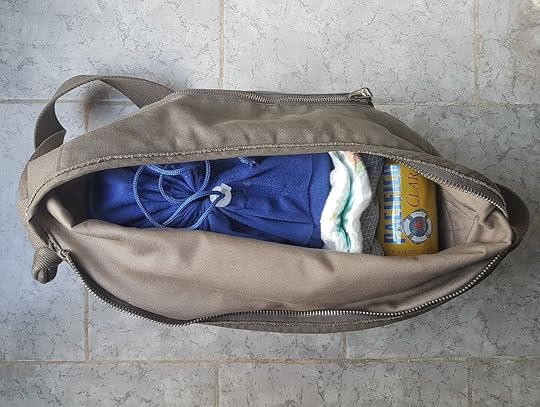
I can fit all of this — and much more — into one bag. I could actually fit everything from both pictures into that shoulder bag, but it would be very heavy for one shoulder to bear. However, everything fits easily into this lightweight Hershel backpack (which weights nothing at all and folds super flat for packing) and then some. Here’s proof:
If you didn’t catch it all, I got all my laptop gear, and all my camera gear in there, plus a bag of daily essentials like sunscreen, diapers, sunglasses, a muslin blanket (normally for babies, it also works as a towel, blanket, shade, and scarf), and a bathing suit. Now, it’s not groundbreaking to be able to fit all of that into one backpack, per se, but bare in mind I used to have a bag larger than this for just my camera gear. Also, I rarely set out for a day ready to work, take photos, and go to the beach. But if I had to, I could.
Items not pictured that I am super happy to have:
An Amazon account for backing up photos AND because Mexico has Amazon Prime now
A Netflix account and a Chromecast
A Spotify account so you can download music to take on the go
The LectroFan Micro, a super small but very powerful white noise machine for sleeping that doubles as a spare Bluetooth speaker
Gorilla Tape to fix anything
Power bars to expand any outlet into multiple plugs and USB ports
Approximately 90 different charging cords because you will lose 89 of them before the trip is over
A cell phone case that has a flip-stand
Airbnb rentals set up for laptop workspaces and tripled checked have reliable wifi
Co-working spaces found in major cities, like The Nest here in Playa del Carmen, or Convivo in Oaxaca, where we are heading next.
Having a child forced me to rethink what was absolutely required to get work done abroad. Gone is my favorite travel pillow, hello travel crib. Goodbye massive bag of lenses, hello diapers and wet wipes. See you later cute sundresses, and welcome aboard white noise machine, blackout curtain, and favorite stuffed animal. That said, I am successfully doing my work from Mexico, my baby sleeps all night long, and we all get tacos for dinner, so in the end, everyone is winning.
More like this: Travel photographers: carry a notebook
Psicobloc in Park City, Utah
Psicobloc (pronounced psycho-block) is a form of climbing, also known as deep-water soloing, where climbers spider around boulders over deep water (or in this case a wall) without ropes. Psicobloc means psycho-bouldering in Spanish. I agree, it is a little psycho.
At the Utah Olympic Park in Park City, there’s a 55-foot wall built over a pool for exactly this purpose. Climbers from all over the world convene here to psicobloc. Built for competition, this wall hosted the first US psicobloc competition in 2013. In subsequent years, the event has been held in the summer (obviously) as a 3-day climbing event.
Both professionals and amateurs compete, racing each other to the top of the 55-foot wall with a 26-foot overhang that drops climbers into the Park’s ski-jump training pool. The public is invited to attend this exciting event. Check the Psicobloc Masters website for 2018 dates.
Deep-water soloing has its roots in Mallorca, Spain. In the 1970s, Miquel Riera sought out better, harder climbs in his local area of Palma. He and his friends soon discovered routes along the sea cliffs that were untapped and didn’t require climbing equipment. The risk is minimal, being that water will catch your fall, so most routes are high-difficulty where climbers of all experience levels can challenge their abilities.
In the 1980s, sport climbing overshadowed DWS, but psicobloc ramped up in popularity with the release of a couple films in the early 2000s. Now it’s a spectator sport with a hefty winner’s purse at the Utah Olympic Park.
How to get there
The wall is located in the Utah Olympic Park just outside of downtown Park City.
What to consider
The wall is only open in the summer, what with winter being so frozen.
It’s open to the public and day passes can be purchased from at the Olympic Park.
If you just want to spectate, consider taking a tour.
Since your only exit is over a pool, you’ve got to be able to swim.
More like this: Rock climbing in Mallorca, Spain: An amazing deep-water soloing destination

Things that inevitably happen to you when you move overseas for love
Living overseas for love generally consists of doing embarrassing things in front of in-laws due to cultural misunderstandings, and consoling oneself with copious amounts of wine. But luckily language slips and bureaucratic mixups are offset by filmic airport reunions with your partner and having the best travel companion to explore your new country with.
Here’s more you will inevitably experience if you move abroad for love.
1. You’ll spend the first few months exploring your new country with your partner.
Through some strong rose-tinted glasses.
2. And finally meet the in-laws.
Social etiquette in your own country is hard enough.
3. You’ll undoubtedly make an awkward language faux pas in front of the new family.
One letter can be all it takes to go from family friendly to X-rated.
4. And then need an escape after meeting them.
Did someone say “wine glass that holds a whole bottle of wine”?
5. You’ll have a real experience the first time you attempt to deal with bureaucracy without your partner.
There’s a strong chance you’ll register under a false identity…
6. You quickly find out your new country doesn’t sell your favorite brands.
Care packages needed!
7. You’ll have arguments in two languages.
Which rarely make sense.
8. But also developing a secret language that no one else will ever understand.
Particularly as you use it to comment on your partner’s personal hygiene in front of all their friends.
9. This will be the norm when you meet your partner in the airport after a trip home.
You’re definitely worthy of inclusion in Love Actually’s opening sequence.
10. You’ll meet your partner’s friends and have absolutely no idea what they’re saying.
Just smile and laugh.
11. Your partner will attempt to console you after you bungle yet another social interaction.
The cheek kiss can go so horribly wrong if you lunge the wrong way.
12. When you see what’s required to get citizenship.
And wonder why you didn’t choose a country with citizenship by marriage.
13. When home friends come to visit.
And you pack your partner off to stay with relatives for a few days.
14. Your home friends’ reactions when you moan about your terrible life abroad.
Which is actually pretty great.
15. After time you’ll figure out a way to call home which doesn’t require a bank loan.
And doesn’t have a 3-minute delay.
16. And someone will compliment your language skills.
But then you can’t talk for the rest of the night in case you make a mistake.
17. Then you suddenly realize you’ve got this.
And you don’t need your partner to help you with everything. Unless it’s opening prosecco bottles, which is terrifying.

Save money on trip to Seoul
Like South Korea’s flag, Seoul is twofold: loud and humble, overwhelming and friendly, burgeoning and contained, cheap and expensive. Spend a single night out “Gangnam Style,” and you’ll wake up wondering how you spent a flight ticket’s worth on Budweiser and taxi fare. But, just as travelers’ experiences in this city of over 10 million people vary wildly, so do the prices of goods, travel expenses, and food. To explore the medley of Seoul without saying “Annyeonghi Gasayo” (Goodbye!) to your budget, check out these five tips from a Seoul insider that follow.
1. Buy a T-Money card.
Taxi fares in Seoul are usually less expensive than New York City fares, but there’s an even cheaper way to explore the city: take public transportation. Before you shudder at the thought of unknown sticky substances on bus straps and musty subway corridors, know that Seoul’s public transportation is an immaculate miracle. The capital city’s railways and highways are clean, timely, and totally affordable.
If you’re staying for just a few days, you can purchase tickets at the machines next to subway turnstiles. But if you’re staying for a week or longer, you should snag a T-Money card at Korean convenience stores in tourist-heavy areas or near subway exits. The cards themselves cost under a few bucks, and you can refill them for use on the subway, on the bus, or in a taxi. Use a T-Money card to transfer, and you’ll even get a little discount.
2. Trade pet-sitting for accommodation.
Seoul has plenty of budget-friendly hostels and homestays to choose from. But, if you’re lucky, you can get out of paying anything at all for accommodations. Seoul is home to many foreign English teachers, and just like you, they love a good vacation. But some foreigners who’ve lived here for years have pets they can’t travel with. Search for Facebook groups such as, “Pet-Sitting Network – South Korea” or become a house sitter to see if you can trade pet- or house-sitting services for accommodations during your stay.
3. Stick to Americanos.
If you’re a coffee-addict, consider switching to espresso while exploring Seoul. In fact, if you order a “coffee” in Korea, you’ll either be served a pricey “drip coffee” or a cheap Americano. To be sure you’re not accidentally charged for the former, it’s best to order a cheap Americano to begin with. Visit coffee chains like Paik’s Coffee, Mammoth Coffee, and Coffee Man for cheaper coffee, and choose places like Coffee Bean and Tea Leaf, Starbucks, A Twosome Place, and Holly’s Coffee only when you’re ready to splurge.
4. Eat Korean-style.
The tip “eat locally,” applies to many travel destinations when on a budget, but in Seoul, it’s especially true. Restaurants serving up Korean-style food are often inexpensive and plentiful because they serve dishes meant for sharing. Plus, you’ll get a variety of free banchan (side dishes) that vary by restaurant and season. Korean restaurant chains, such as School Food or Robot Kimbap, offer OK prices, but the local, often unnamed, shops always have the best prices (and the best food!). At many of these Korean-style restaurants, you can get a bowl of bibimbap (a dish of rice, vegetables, ground meat, egg, and spicy sauce) for under 4 USD or a roll of kimbap for under 2 USD.
If you’re feeling adventurous, dive into one of the plentiful street foods, like tteokbokki (a rice-cake dish slathered in spicy chili paste), Korean egg bread, or mandu (Korean dumplings). These dishes are usually under 3 USD and sometimes cost just a few coins in change. Namdaemun, one of Korea’s oldest marketplaces, is home to snaking alleys full of these culinary gems.
5. Don’t rack up bar tabs.
A word you thought you’d never hear again post-college, “pre-gaming,” or drinking before going out into the night’s adventures, will save you a ton of money in Seoul.
Beer and soju at convenience stores is dirt cheap (though sometimes Korean beer also tastes like dirt.) But if you wait until you’re inside a club or bar to order spirits and booze, you might end up paying $6 for just a Budweiser.
Alternatively, skip the club and bar scene altogether, and just drink at the tables outside of the convenience store with some friends for superb people-watching. Remember that drinking on the streets of Seoul is legal and quite common, especially in the foreigner community.
If drinking at a convenience store isn’t your ideal Friday night, consider a bottle bar instead. In Korea, most places that serve beer consider alcohol an accompaniment to food. So, if you walk into a “chimaek” shop (a chicken and beer shop) and order beer without buying food, you’ll get a glare from the shop owner at best. Alternatively, bottle bars have a serve-yourself policy, and although they offer food, booze is the focus.
More like this: 11 Seoul street foods and where to find them
Why I haven't quit my job to travel
I could feel the anger rising like a volcano through the center of my chest. I couldn’t look at my email inbox anymore without wanting to throw something to shatter my screen. My client, who I had been working with for many months, had sent yet another condescending email throwing me under the bus. “Why in the world do I put up with this?” I asked myself for the 100th time.
I decided to take a walk to clear my head and took my phone with me for moral support. I needed some mindless stimulation and Instagram was the perfect candidate. I scrolled through photo after photo of tanned women with glistening hair looking out onto a large body of water or expanses of emerald green fields. I felt that yearn coming, that yearn to be right where they were. Instagram, for all its benefits, has created this constant desire to be somewhere other than where we currently are. It’s escapism at its most blatant. I chanced upon a post set in Bali with the caption: “I am working from the beach, where are you working from?” Great. Just what I needed right then, to feel even more terrible about my plight. Why, I ask myself, haven’t I quit the job that requires me to come into an office instead of lounging on a beach chair?
I’ve asked myself this question many times over the last 10 years. I thrive when I travel; it seems I am a better version of myself when I travel, more inspired, less burdened, more open and curious.
But as much as I have thought about it, I haven’t taken the leap to quit my office job in pursuit of a life on the road and it has been a conscious choice. Here is why.
1. I enjoy what I do for a living.
It’s important to distinguish reasons why you might want to quit your current job. If you hate your job and find yourself wishing you were doing anything else, then you need to fix that as soon as possible. Adults spend over a third of their waking hours working and there is absolutely no good reason to stay in a job you detest. Every time I have found myself in that position, I have put all my energy into changing the situation.
If you, however, just find yourself frustrated by certain aspects of your job, then it’s not the time to quit just yet. Every job has its grueling parts, even the ones that are done on a beach. Ask any digital nomad and they will likely relate to the opening scene where I describe being frustrated by a client, or other feelings of inadequacy, stress, and under-appreciation.
Take 10 minutes to write down the last 3 awesome things that happened at your job. Then the last 3 frustrating things. If the frustrating things outweigh the awesome things, it might be time to reconsider what you devote a third of your life’s time and energy to.
2. I found myself wanting to travel to escape.
Every time I have more deliberately thought about quitting my job and traveling full-time, it has been to escape reality: terrible jobs, gut-wrenching breakups, my inner demons. It can feel nice to detach and restart somewhere new for a few days or even weeks; however, if that is your plan for longer than a few weeks, know that at some point your escape will become your reality. Your bright spots and your ugly ones will find you wherever you go. You can escape from the desk that brought you so much grief at your job or the wine bar you used to spend your weekends with your ex, but you can’t escape the resentment or pain it filled you with. Travel, not to escape, but to redefine your reality.
3. I want to build a sustainable lifestyle.
There is something inherently sexy about the idea of no longer being chained to a desk or a home. Of being mobile and shifting base from a beach in Bali to a village in Italy to the mountains in Ecuador. Of never feeling bound by anything or anyone. But that freedom comes at a cost of building things more meaningful and sustainable. As someone who has unintentionally moved to a different city or country every couple of years of my life, I have come to realize that sometimes it is harder to stay than to leave, to stay committed and stick it out even if there is no immediate gratification. To assemble something that endures, you have to stay awhile.
4. I see travel not as the end, but as a means to the end.
Travel has and always will leave me less jaded, a delightful reminder of the unexplored and unimagined. It inspires me to stay curious, to be less judgmental of what I don’t intuitively understand and pushes me to the edge of my comfort zone. The lessons I learn when I travel are only as meaningful as how I incorporate them into my everyday life. If I can’t learn to be more curious in the most mundane of moments, to be less judgmental of the people in my own life, and challenge myself to be uncomfortable in the endeavors that matter, what use are these lessons?
For some people, quitting their office jobs to travel the world is their true calling. But it doesn’t have to be for you. Find your own reasons based on your own values to define the right path for yourself; even if it is not the most Instagram-worthy decision.
More like this: We need to stop pretending travel will fix all our problems
Costa Rica's laziest animal
It’s 8:30 in the morning, and the birds are out in force in Tirimbina Reserve in Costa Rica’s northern lowlands. The early morning rain put a damper on their dawn activities, and now dozens of species are busy in the canopy reclaiming what is left of the morning.
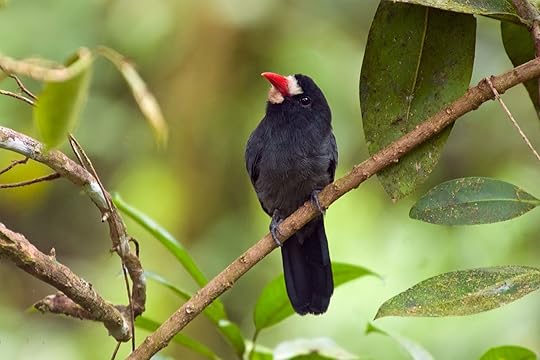
Standing on the 110-meter-long suspension bridge, 35 meters above the forest floor, we are right in the midst of all the action. We watch the adorable white-fronted nun birds, as they snatch insects in flight and return to their perches with the legs and wings of their prey still sticking out of their bright red beaks.
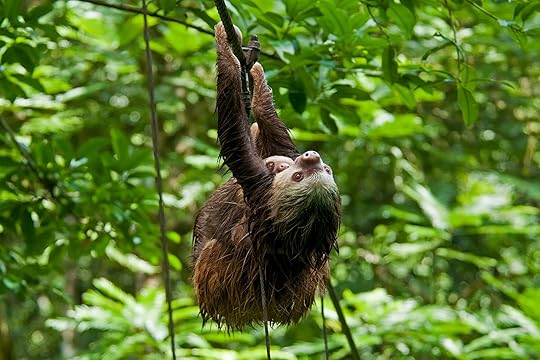
We are so intent on the birds that I get a fright when, out of the corner of my eye, I see a large shape approaching us along the support cable of the bridge. I turn around, and my fright is replaced with amazement and disbelief — a soaking wet and shaggy Hoffmann’s two-toed sloth is steadily climbing across the bridge.
It weaves its way around the vertical cables of the bridge, and as it swings sideways, we see the reason for its extra shaggy look — there is a young baby clinging to its belly. And even with the extra weight of the baby, the sloth is making impressive progress along the bridge.
I am used to thinking of sloths as slow and lethargic animals. After all, they generally whiz around at the speed of 240 meters an hour.
Yet the sloth approaching us along the bridge is anything but slow. She expertly navigates the inconvenient terrain, determined to get to the forest on the other side of the bridge, despite the three of us standing in her way.
Without breaking her stride, she passes above our heads and soon reaches the other end of the bridge. Once she is level with the trees, she starts looking for a way to climb onto them, but there are only thin and wobbly lianas within her reach.
We are certain she will change her mind. There seems to be no way for such an ungainly animal to make this delicate crossing. But she proves us wrong. Without much hesitation, she grabs the closest liana, lifts herself up and with just a couple of movements she maneuvers herself onto the firm branches.
Once in the safety of the leafy canopy, she lets her young go for a little wander. She must need a rest after such an epic adventure.
It is hard to tell what disturbed her and inspired the risky and energy-demanding crossing in broad daylight, but judging by how wet her coat is we assume that she was in a hurry to get to a sunny spot to dry out and warm up.
What’s so special about sloths?
According to the Scientific American, sloths have the slowest metabolic rate of any animal on earth. Their diet of leaves and shoots is low in calories, and their digestion rate is the slowest among mammals. It can take a sloth up to a month to digest a meal. And since eating more is not the answer, sloths evolved to do less and to conserve as much energy as they can.
To accommodate their leisurely lifestyle, sloths developed a suite of extraordinary behavioral and physiological adaptations.
To begin with, they can regulate their body temperatures by about 5 degrees Celsius to match the temperature of their environment. So, instead of burning extra energy to keep themselves warm, sloths prefer to bask in the sun to warm up. This explains the speedy bridge crossing that we witnessed in Tirimbina.
Never moving far from their food supply, sloths spend most of their lives hanging upside-down in the forest canopy. They sleep, eat, mate, and give birth hanging upside down.
Over time their internal organs have shifted to accommodate the upside-down lifestyle. Even their hair is parted along the stomach and flows from belly to back to allow the rainwater to run off.
Sloths’ fur has special groves to house algae. Their sedentary lifestyle allows algae to grow, which gives their fur a greenish tint that helps them blend with their environment and avoid predators.
Apart from the algae, a sloth’s shaggy coat is home to an entire ecosystem of invertebrates, some of which are not found anywhere else. These peculiar friendships help sloths to appear quite unappetizing to the potential predators.
Unfortunately, no adaptations have prepared sloths for the ever-expanding human population and our impact on the environment. While not threatened with extinction, sloths fall victim to habitat loss across their range.
Lucky for sloths, Costa Rica values its biodiversity, with 25% of the country’s land set aside as protected areas to safeguard the wildlife from deforestation, logging, and poaching.
Costa Rica’s sloths and where to see them
There are two species of sloths in Costa Rica: Hoffmann’s two-toed sloth, and the brown-throated three-toed sloth. The Hoffmann’s two-toed sloth is the rarer of the two. It is a nocturnal animal, and you will have the best chance of spotting it on a guided night walk in Tirimbina or Monteverde National Parks, or at La Selva Biological Station.
The brown-throated sloth is active during the day and one of the best places to see it is Manuel Antonio National Park. You could either take your chances of spotting it on your own or join a guided walk that departs regularly from the ticketing office.
All the photos are the author’s. The videos are Ruth Lichter and Peter Mammoliti’s.
More like this: Photo guide to Costa Rica’s most incredible animals

How to speak Philadelphian

What’s an ATM? Never heard of it.
2. Pock-A-Book

Your grandmother passed this on to you.
3. Crowns

The 64 pack was the best.
4. ‘Lantic Siddy

Wanna go down the shore? Maybe we can play the slots while were there.
5. Wooder Ice

This is surely one of the foods on the Philly food pyramid.
6. Slice-ah-plain

I like to get mine from Lorenzo’s or Rosa’s.
7. Jimmies

No ice cream cone is complete without them.
8. Flarda

It seems like everyone in Philly makes a home here at some point.
9. Senner Siddy

Downtown doesn’t exist here.
More like this: 15 signs you were born and raised in Philadelphia
Matador Network's Blog

- Matador Network's profile
- 6 followers

