
Anne R. Allen's Blog, page 55
November 23, 2014
8 Bogus "Rules" New Writers Tell Each Other
by Anne R. Allen
We get lots of questions from new writers who have spent time in forums and online writers' groups where they've been given advice by other newbies. Some of that advice is fine, but a whole lot is dead wrong.
Unfortunately, the wrong stuff is usually delivered with the most certainty.
That's because the most ignorant people are generally the most sure of themselves. This phenomenon has been scientifically proved. It's called The Dunning-Kruger Effect. Nobel Prize winners David Dunning and Justin Kruger of Cornell University did a study in 2000 that proves the least competent people really are the most likely to overestimate their own competence.
I remember feeling perfectly confident I knew everything worth knowing at age four. Then I went to school and it ruined everything.
I do still encourage the use of critique groups and beta readers as a first step in learning the ins and outs of the craft and business of writing, but keep in mind that most of what you hear in a critique group needs to be taken with a grain of salt. And now, with the rise of social media, the chances of getting bad or misleading information has increased exponentially.
So make sure you cross-reference if a suggestion for a change goes against what you've observed or heard from respected authorities.
Some of these "rules" are pretty comical—the opposite of what the publishing industry considers good writing. I have a feeling some frustrated new writer may have made them up to justify bad writing habits.
When in doubt, ask a professional or look it up. There are many, many good books that teach the basics of how to write fiction. One of my favorites is How to Write a Damn Good Novel by James N. Frey (not the James Frey who who wrote the bogus memoir.) I also like The First Five Pages by Noah Lukeman (nice and short). Screenwriters' bibles Story by Robert McKee, and Save the Cat by Blake Snyder are great for story structure, and of course every writer's library should have a copy of The Elements of Style.
If you have a favorite nuts-and-bolts writing book, do tell us about it in the comments.
I hope you'll pass this post on to new writers who may be led astray by "the blind leading the blind" syndrome that can happen in social media.
Here are eight bogus "rules" I've heard recently.
1) When writing something inspired by your own life, every incident must be told exactly as it happened, or somebody will sue you.
If you know somebody is likely to sue you if you include them in a memoir, it's safest to disguise them with a name-change. Better yet, fictionalize your story. For advice on how to fictionalize a "true story," read Ruth Harris's great post on the subject from earlier this month.
But even if you're writing a memoir or a piece of creative nonfiction, you still have to craft it into a story with an arc. That's a story with an inciting incident, conflict, and resolution. That's never going to be exactly "the way it really happened," because real life is a meandering journey, not a tidy story. Plus real life has lots of boring bits. Do NOT include them if you want anybody to read your book.
A memoir has to tell a story. That means it has dialogue and scenes. You can't help putting less than accurate words in people's mouths unless you recorded every word ever said to you.
For advice on how much "truth" to put into a memoir, here's an enlightening post from Jane Friedman: How True and Factual Does Your Memoir Have to Be?
She points out how subjective all memory is, so no one person's memory is going to provide 100% absolute provable facts.
2) Novels can not contain contractions.
This one floored me. A writer had been told this by an "editor". (Which shows you should carefully vet freelance editors. As I said last week, anybody can call herself an editor, so do your research before you hire somebody.)
If you follow this editor's advice, every person in your novel will sound like Star Trek's Mr. Spock.
People who speak English as a first language (and are not robots or space aliens) use contractions. If your characters don't use them, your novel or memoir had better be set in a robot colony or the planet Vulcan.
3) "Said" is boring. Use more energetic tags like "exclaimed","growled", and "ejaculated."
Whoever thought up this one is treading dangerously close to Tom Swifty territory.
"Said" is invisible to the reader. Any other dialogue tag draws attention to itself. Use other tags judiciously, the way you do with exclamation marks. You do use exclamation marks judiciously, don't you!!?
4) In a memoir, everyone in your life must be given equal time.
Somebody has been telling memoirists that even if they were personal friends with Elvis, the king shouldn't get any more space in a memoir than Great Aunt Myrtle Mae, if the two people were "equally a part of your life."
Sorry. Unless you're writing an autobiography for your family's eyes only, this is the worst advice possible.
First, a memoir is not an autobiography. Autobiographies are a chronology of a life from the cradle to now. Nobody's likely to read them unless they're written by heads of state, tech moguls, or members of the Rolling Stones.
A memoir should be the story of a particular incident or related series of incidents in your life that will be of interest to the general public. Maybe how you overcame a disability, had Elvis's love child, or invented Post-It Notes.
So unless your Great Aunt Myrtle Mae was Elvis's date for the prom, or a crazed fan who broke into Graceland and stole a leather jumpsuit in which she wants to be buried, only give her a walk-on part in your story.
A lot more people want to read about Elvis than want to read about how much you loved your Auntie. Sorry, but that's the way human beings work. We've always been suckers for royalty.
5) Head-hopping is necessary if you have more than one character in a scene.
You don't need to tell us what everybody is thinking in every scene. That only confuses the reader. Good writers can show the reactions of other characters through the eyes of the scene's point-of-view character.
After all, you're seeing your entire life through the eyes of one point-of-view character: you. And you probably know what's going on. Or think you do.
Learn to use body language, facial expressions, and dialogue to let us know how key characters are relating to the action.
The exception is a story told from an omniscient point of view, which is not the same as head-hopping. Omniscient POV uses a god-like voice that knows everything. You'll often see it in high fantasy, which is told in a "bard's" storytelling voice.
An omniscient voice also works well in a humor novel, because it makes the story sound like a stand-up comedy routine. Carl Hiaasen does this brilliantly. So does Dave Barry.
But be aware omniscient POV in most genres seems old-fashioned, is hard to pull off, and is often taboo with agents.
For a hilarious take on the omniscient narrative voice, here's a brilliant video by Nick Offerman in which the characters in a Western movie rebel against that all-knowing narrator.
For a great overview of POV, read this post from Kristen Lamb: Point of View: How to find the perfect voice for your story. It's a must-read for anybody having POV issues (and most newbies do.)
6) All internal monologue must be put in italics.
I've even seen this in guidelines from small publishers. It's not wrong, but it's not the norm.
Putting internal monologue in italics is a convention that comes from mid-20th-century pulp fiction. You especially see it in thrillers. Some literary authors, like William Faulkner, also experimented with it. Some contemporary authors like to use italics to show alternate points of view. I've seen both Terry McMillan and Marian Keyes do this. They're both brilliant authors, and they used the device well.
But italics are on their way out. I've seen agents say in their guidelines they won't read anything that's italicized. That's probably because italics are harder to read and cause havoc with electronic formatting, especially for ebooks.
These days, writers generally use the "deep third person" point of view that allows for inner monologue without dialogue tags. Here's a great post on deep point of view from Rhay Christou at Writers on the Storm.
7) Good writers never use sentence fragments: all characters must speak (and think) in perfect English.
Oh. My. God. If all your characters speak in complete sentences, they'll sound as if they're living inside a school book report.
Where they're probably cohabiting with those Vulcans from #2.
Even Jane Austen's characters speak in sentence fragments. Shakespeare's do to, as in: "But Soft!"
When you write a novel (or a memoir or a play), your aim is to to present realistic characters, not impress your third grade teacher.
I've met some people who insist that even fictional five-year-olds must have a perfect understanding of the subjunctive mood and never, ever mistake a gerund for a gerundive.
Do I have to say why this is a recipe for snoozerific, inauthentic, bad fiction?
Or farce. It could make a pretty funny farce. Otherwise, do not listen to these people.
Nobody uses perfect grammar when they speak. Not even Ph.Ds. (My parents both had Ph.Ds: one in English and the other in Classics, so trust me on this.)
The rules for writing fiction are very different from the rules for writing a scholarly essay. If you confuse them, you're going to end up with a pompous, comical mess.
8) Never use the word "was."
This is my unfavorite piece of writing advice and you see it everywhere. I wrote a whole post about the "was police" in 2012. They're wrong. Using the verb "to be" in any tense is perfectly fine.
"Was" is not always "passive." The past tense of the verb "to be" is also used in creating the past progressive tense in English.
Passive: "The book was read by me..." Passive voice tends to sound pretentious and annoying. (But sometimes the passive voice is necessary, so don't try to eliminate it entirely. )
Past Progressive: "I was reading the book when some idiot came in and told me the word 'was' is taboo for writers."
If you change the construction to "I read the book" instead of "I was reading the book" you have no sense of timeline. It would be dumb.
Yes, doing a search for "was" is a handy tip for self-editing. It helps to weed out passive construction (when it needs weeding.) A "was" search can also pinpoint lazy writing habits like starting descriptive passages with "there was." But there's nothing intrinsically wrong with the word. People go way over the top with their hatred of the past tense of the verb "to be."
Let it be.
What about you, Scriveners? Do you have a favorite nuts-and-bolts writing guide? Have you heard any of this bad advice? What's the worst piece of advice you've been given about writing? How do you react when somebody tells you, with great conviction, something you know to be wrong?
BOOK OF THE WEEK
Sherwood Ltd is only 99c for two weeks!
It's #2 in the series, but can be read as a stand-alone.
This is the one where Camilla Randall a.k.a. "The Manners Doctor" goes to England.
She and Plantagenet will be returning to England in book #5, coming up in the spring: So Much for Buckingham, which will tackle the controversies surrounding Richard III, the way Sherwood Ltd deconstructs the Robin Hood myth
At Amazon US, Sherwood Ltd is 99c, at Amazon UK, it's 75P, at Amazon CA it's $1.13, Amazon AU it's $1.12 and Amazon IN it's 49 rupees (yes, India gets a special deal.) And in all international Amazon stores. Here's the link to the International Amazon Landing page.
It is also 99c at NOOK
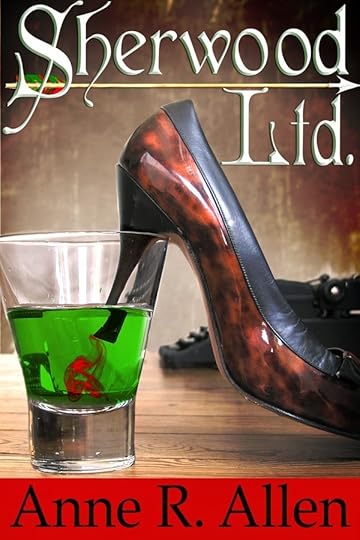
[She] finds herself caught up in a web of intrigue, and has no idea who in this surreal world of latter day outlaws she can trust; who are the villains, who are the heroes, and who are both?
…it’s a wonderful spoof full of absurd synchronicities with the Robin Hood legend, incongruous happenings, over-the-top yet fully believable characters and a whole series of twists to the plot. I was particularly impressed by the excellent background details; this US author reproduces the speech patterns of various sections of UK society perfectly."…from a review by UK reviewer "Mary Ann."
And Food of Love is now available as an audiobook, narrated by C.S. Perryess
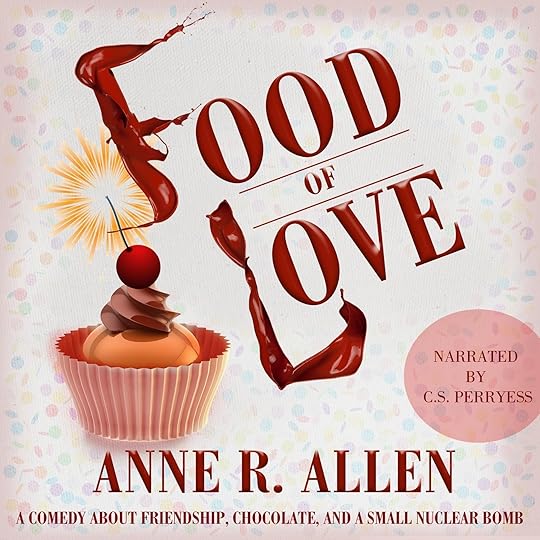
Part thriller and part screwball romantic comedy, Food of Love tells the story of Regina, a former supermodel, now princess of a tiny European principality, who has lost her skeletal figure and finds herself threatened by an unknown assassin.
Fearing her royal husband wants to kill her now that she's not model-thin, she seeks protection from her estranged African-American foster sister, conservative Christian television pundit, Rev. Cady Stanton.
Reverend Cady has some serious weight and romantic issues of her own, compounded when an "accident" intended for Regina leaves her temporarily blind. But when Regina is declared dead and Cady's seventy-year old secretary is wrongly arrested for smuggling a small nuclear bomb to the funeral, Cady takes control.
With the help of a porn mogul, a Russian spy, a rap diva and her fierce hairdresser-girlfriend, Cady is able to save Regina, restore the bomb to its proper owners, and unearth the long-buried family secrets that hold the key to her own happiness.
OPPORTUNITY ALERTS
Looking for an alternative to Goodreads? BookBzz is a brand new site where you can present your books in an attractive online format. It comes with a "Tell a Friend" Book Marketing and Reviews Engine and audience management system and you can (optionally) gateway to other marketing services (reviews engine, price and discount management, newsletters, reward promotions and affiliate programs).
VIGNETTE WRITERS, here's a contest for you! The Vine Leaves Vignette Collection Contest. The prize is for a collection of vignettes and poetry up to 20,000 words. Fee $25. Prize is $500, publication by Vine Leaves Press (paperback and eBook), 20 copies of the paperback, worldwide distribution, and promotion through the Vine Leaves and staff websites. It will be judged by an editor from Simon and Schuster. Deadline February 28, 2015.
THE MEADOW NOVELLA PRIZE $15 ENTRY FEE. The winner of the contest will receive $500 and publication in the annual print edition of the journal. Submissions should be between 18,000 and 35,000 words. Deadline February 1, 2015.
WALKER PERCY PRIZE IN SHORT FICTION $15 ENTRY FEE. Winner receives $1,000 and publication in New Orleans Review. All finalists considered for publication. Enter previously unpublished original stories up to 7,500 words. Deadline December 31st
Writers’ Village International Short Fiction Contest: $24 entry fee. Prizes of $1600, $800, $400 and $80. A further ten Highly Commended entrants will receive a free entry in the next round. Professional feedback provided for all entries! Any genre: up to 3000 words. Deadline December 31st.
SCHNEIDER FAMILY BOOK AWARDS: NO ENTRY FEE. These awards honor an author or illustrator for a book that embodies an artistic expression of the disability experience for child and adolescent audiences. Three awards of $5000 each will be given annually in each of the following categories: birth through grade school (age 0-10), middle school (age 11-13) and teens (age 13-18). May be fiction, biography, or other form of nonfiction. Deadline December 1, 2014.
We get lots of questions from new writers who have spent time in forums and online writers' groups where they've been given advice by other newbies. Some of that advice is fine, but a whole lot is dead wrong.
Unfortunately, the wrong stuff is usually delivered with the most certainty.
That's because the most ignorant people are generally the most sure of themselves. This phenomenon has been scientifically proved. It's called The Dunning-Kruger Effect. Nobel Prize winners David Dunning and Justin Kruger of Cornell University did a study in 2000 that proves the least competent people really are the most likely to overestimate their own competence.
I remember feeling perfectly confident I knew everything worth knowing at age four. Then I went to school and it ruined everything.
I do still encourage the use of critique groups and beta readers as a first step in learning the ins and outs of the craft and business of writing, but keep in mind that most of what you hear in a critique group needs to be taken with a grain of salt. And now, with the rise of social media, the chances of getting bad or misleading information has increased exponentially.
So make sure you cross-reference if a suggestion for a change goes against what you've observed or heard from respected authorities.
Some of these "rules" are pretty comical—the opposite of what the publishing industry considers good writing. I have a feeling some frustrated new writer may have made them up to justify bad writing habits.
When in doubt, ask a professional or look it up. There are many, many good books that teach the basics of how to write fiction. One of my favorites is How to Write a Damn Good Novel by James N. Frey (not the James Frey who who wrote the bogus memoir.) I also like The First Five Pages by Noah Lukeman (nice and short). Screenwriters' bibles Story by Robert McKee, and Save the Cat by Blake Snyder are great for story structure, and of course every writer's library should have a copy of The Elements of Style.
If you have a favorite nuts-and-bolts writing book, do tell us about it in the comments.
I hope you'll pass this post on to new writers who may be led astray by "the blind leading the blind" syndrome that can happen in social media.
Here are eight bogus "rules" I've heard recently.
1) When writing something inspired by your own life, every incident must be told exactly as it happened, or somebody will sue you.
If you know somebody is likely to sue you if you include them in a memoir, it's safest to disguise them with a name-change. Better yet, fictionalize your story. For advice on how to fictionalize a "true story," read Ruth Harris's great post on the subject from earlier this month.
But even if you're writing a memoir or a piece of creative nonfiction, you still have to craft it into a story with an arc. That's a story with an inciting incident, conflict, and resolution. That's never going to be exactly "the way it really happened," because real life is a meandering journey, not a tidy story. Plus real life has lots of boring bits. Do NOT include them if you want anybody to read your book.
A memoir has to tell a story. That means it has dialogue and scenes. You can't help putting less than accurate words in people's mouths unless you recorded every word ever said to you.
For advice on how much "truth" to put into a memoir, here's an enlightening post from Jane Friedman: How True and Factual Does Your Memoir Have to Be?
She points out how subjective all memory is, so no one person's memory is going to provide 100% absolute provable facts.
2) Novels can not contain contractions.
This one floored me. A writer had been told this by an "editor". (Which shows you should carefully vet freelance editors. As I said last week, anybody can call herself an editor, so do your research before you hire somebody.)
If you follow this editor's advice, every person in your novel will sound like Star Trek's Mr. Spock.
People who speak English as a first language (and are not robots or space aliens) use contractions. If your characters don't use them, your novel or memoir had better be set in a robot colony or the planet Vulcan.
3) "Said" is boring. Use more energetic tags like "exclaimed","growled", and "ejaculated."
Whoever thought up this one is treading dangerously close to Tom Swifty territory.
"Said" is invisible to the reader. Any other dialogue tag draws attention to itself. Use other tags judiciously, the way you do with exclamation marks. You do use exclamation marks judiciously, don't you!!?
4) In a memoir, everyone in your life must be given equal time.
Somebody has been telling memoirists that even if they were personal friends with Elvis, the king shouldn't get any more space in a memoir than Great Aunt Myrtle Mae, if the two people were "equally a part of your life."
Sorry. Unless you're writing an autobiography for your family's eyes only, this is the worst advice possible.
First, a memoir is not an autobiography. Autobiographies are a chronology of a life from the cradle to now. Nobody's likely to read them unless they're written by heads of state, tech moguls, or members of the Rolling Stones.
A memoir should be the story of a particular incident or related series of incidents in your life that will be of interest to the general public. Maybe how you overcame a disability, had Elvis's love child, or invented Post-It Notes.
So unless your Great Aunt Myrtle Mae was Elvis's date for the prom, or a crazed fan who broke into Graceland and stole a leather jumpsuit in which she wants to be buried, only give her a walk-on part in your story.
A lot more people want to read about Elvis than want to read about how much you loved your Auntie. Sorry, but that's the way human beings work. We've always been suckers for royalty.
5) Head-hopping is necessary if you have more than one character in a scene.
You don't need to tell us what everybody is thinking in every scene. That only confuses the reader. Good writers can show the reactions of other characters through the eyes of the scene's point-of-view character.
After all, you're seeing your entire life through the eyes of one point-of-view character: you. And you probably know what's going on. Or think you do.
Learn to use body language, facial expressions, and dialogue to let us know how key characters are relating to the action.
The exception is a story told from an omniscient point of view, which is not the same as head-hopping. Omniscient POV uses a god-like voice that knows everything. You'll often see it in high fantasy, which is told in a "bard's" storytelling voice.
An omniscient voice also works well in a humor novel, because it makes the story sound like a stand-up comedy routine. Carl Hiaasen does this brilliantly. So does Dave Barry.
But be aware omniscient POV in most genres seems old-fashioned, is hard to pull off, and is often taboo with agents.
For a hilarious take on the omniscient narrative voice, here's a brilliant video by Nick Offerman in which the characters in a Western movie rebel against that all-knowing narrator.
For a great overview of POV, read this post from Kristen Lamb: Point of View: How to find the perfect voice for your story. It's a must-read for anybody having POV issues (and most newbies do.)
6) All internal monologue must be put in italics.
I've even seen this in guidelines from small publishers. It's not wrong, but it's not the norm.
Putting internal monologue in italics is a convention that comes from mid-20th-century pulp fiction. You especially see it in thrillers. Some literary authors, like William Faulkner, also experimented with it. Some contemporary authors like to use italics to show alternate points of view. I've seen both Terry McMillan and Marian Keyes do this. They're both brilliant authors, and they used the device well.
But italics are on their way out. I've seen agents say in their guidelines they won't read anything that's italicized. That's probably because italics are harder to read and cause havoc with electronic formatting, especially for ebooks.
These days, writers generally use the "deep third person" point of view that allows for inner monologue without dialogue tags. Here's a great post on deep point of view from Rhay Christou at Writers on the Storm.
7) Good writers never use sentence fragments: all characters must speak (and think) in perfect English.
Oh. My. God. If all your characters speak in complete sentences, they'll sound as if they're living inside a school book report.
Where they're probably cohabiting with those Vulcans from #2.
Even Jane Austen's characters speak in sentence fragments. Shakespeare's do to, as in: "But Soft!"
When you write a novel (or a memoir or a play), your aim is to to present realistic characters, not impress your third grade teacher.
I've met some people who insist that even fictional five-year-olds must have a perfect understanding of the subjunctive mood and never, ever mistake a gerund for a gerundive.
Do I have to say why this is a recipe for snoozerific, inauthentic, bad fiction?
Or farce. It could make a pretty funny farce. Otherwise, do not listen to these people.
Nobody uses perfect grammar when they speak. Not even Ph.Ds. (My parents both had Ph.Ds: one in English and the other in Classics, so trust me on this.)
The rules for writing fiction are very different from the rules for writing a scholarly essay. If you confuse them, you're going to end up with a pompous, comical mess.
8) Never use the word "was."
This is my unfavorite piece of writing advice and you see it everywhere. I wrote a whole post about the "was police" in 2012. They're wrong. Using the verb "to be" in any tense is perfectly fine.
"Was" is not always "passive." The past tense of the verb "to be" is also used in creating the past progressive tense in English.
Passive: "The book was read by me..." Passive voice tends to sound pretentious and annoying. (But sometimes the passive voice is necessary, so don't try to eliminate it entirely. )
Past Progressive: "I was reading the book when some idiot came in and told me the word 'was' is taboo for writers."
If you change the construction to "I read the book" instead of "I was reading the book" you have no sense of timeline. It would be dumb.
Yes, doing a search for "was" is a handy tip for self-editing. It helps to weed out passive construction (when it needs weeding.) A "was" search can also pinpoint lazy writing habits like starting descriptive passages with "there was." But there's nothing intrinsically wrong with the word. People go way over the top with their hatred of the past tense of the verb "to be."
Let it be.
What about you, Scriveners? Do you have a favorite nuts-and-bolts writing guide? Have you heard any of this bad advice? What's the worst piece of advice you've been given about writing? How do you react when somebody tells you, with great conviction, something you know to be wrong?
BOOK OF THE WEEK
Sherwood Ltd is only 99c for two weeks!
It's #2 in the series, but can be read as a stand-alone.
This is the one where Camilla Randall a.k.a. "The Manners Doctor" goes to England.
She and Plantagenet will be returning to England in book #5, coming up in the spring: So Much for Buckingham, which will tackle the controversies surrounding Richard III, the way Sherwood Ltd deconstructs the Robin Hood myth
At Amazon US, Sherwood Ltd is 99c, at Amazon UK, it's 75P, at Amazon CA it's $1.13, Amazon AU it's $1.12 and Amazon IN it's 49 rupees (yes, India gets a special deal.) And in all international Amazon stores. Here's the link to the International Amazon Landing page.
It is also 99c at NOOK
.jpg)
[She] finds herself caught up in a web of intrigue, and has no idea who in this surreal world of latter day outlaws she can trust; who are the villains, who are the heroes, and who are both?
…it’s a wonderful spoof full of absurd synchronicities with the Robin Hood legend, incongruous happenings, over-the-top yet fully believable characters and a whole series of twists to the plot. I was particularly impressed by the excellent background details; this US author reproduces the speech patterns of various sections of UK society perfectly."…from a review by UK reviewer "Mary Ann."
And Food of Love is now available as an audiobook, narrated by C.S. Perryess

Part thriller and part screwball romantic comedy, Food of Love tells the story of Regina, a former supermodel, now princess of a tiny European principality, who has lost her skeletal figure and finds herself threatened by an unknown assassin.
Fearing her royal husband wants to kill her now that she's not model-thin, she seeks protection from her estranged African-American foster sister, conservative Christian television pundit, Rev. Cady Stanton.
Reverend Cady has some serious weight and romantic issues of her own, compounded when an "accident" intended for Regina leaves her temporarily blind. But when Regina is declared dead and Cady's seventy-year old secretary is wrongly arrested for smuggling a small nuclear bomb to the funeral, Cady takes control.
With the help of a porn mogul, a Russian spy, a rap diva and her fierce hairdresser-girlfriend, Cady is able to save Regina, restore the bomb to its proper owners, and unearth the long-buried family secrets that hold the key to her own happiness.
OPPORTUNITY ALERTS
Looking for an alternative to Goodreads? BookBzz is a brand new site where you can present your books in an attractive online format. It comes with a "Tell a Friend" Book Marketing and Reviews Engine and audience management system and you can (optionally) gateway to other marketing services (reviews engine, price and discount management, newsletters, reward promotions and affiliate programs).
VIGNETTE WRITERS, here's a contest for you! The Vine Leaves Vignette Collection Contest. The prize is for a collection of vignettes and poetry up to 20,000 words. Fee $25. Prize is $500, publication by Vine Leaves Press (paperback and eBook), 20 copies of the paperback, worldwide distribution, and promotion through the Vine Leaves and staff websites. It will be judged by an editor from Simon and Schuster. Deadline February 28, 2015.
THE MEADOW NOVELLA PRIZE $15 ENTRY FEE. The winner of the contest will receive $500 and publication in the annual print edition of the journal. Submissions should be between 18,000 and 35,000 words. Deadline February 1, 2015.
WALKER PERCY PRIZE IN SHORT FICTION $15 ENTRY FEE. Winner receives $1,000 and publication in New Orleans Review. All finalists considered for publication. Enter previously unpublished original stories up to 7,500 words. Deadline December 31st
Writers’ Village International Short Fiction Contest: $24 entry fee. Prizes of $1600, $800, $400 and $80. A further ten Highly Commended entrants will receive a free entry in the next round. Professional feedback provided for all entries! Any genre: up to 3000 words. Deadline December 31st.
SCHNEIDER FAMILY BOOK AWARDS: NO ENTRY FEE. These awards honor an author or illustrator for a book that embodies an artistic expression of the disability experience for child and adolescent audiences. Three awards of $5000 each will be given annually in each of the following categories: birth through grade school (age 0-10), middle school (age 11-13) and teens (age 13-18). May be fiction, biography, or other form of nonfiction. Deadline December 1, 2014.


November 16, 2014
Feel Like Popping Your Editor? Keep Calm and Read This.
Most writers know we require editors. The need for editing is drummed into us from the time we venture into our first writing class, blog, or forum. We know if we're offered a contract, we'll be assigned an in-house editor, and if we self-publish, we'll want to hire a freelancer.
These days, agents do a lot of editing too. (This is done on their own time before a book is sold, so it's one of the big pluses of having an agent.)
We've heard for years about the fantastic symbiotic relationships superstar authors have with their beloved editors.
So when we finally get an editor to take us on—either on a freelance basis or assigned by our publishing house—we might imagine the editing process will be all Kumbaya and hugs.
We picture getting our pages back from our wonderful editor covered with positive comments and little hearts. Maybe they'll catch a few typos and suggest we embellish the story of the house elves getting into the mulled wine for a few more pages and ask for a little more of the mechanics involved in the sex scene with the three-headed trolls from Alpha Centauri.
And perhaps they'll mention it's one of the most entertaining, well-written books ever.
Or not.
The truth is your pages are probably going to come back bleeding with red ink. Or yellow highlighter and little multi-color comments if your editor uses Word to edit the way mine does.
"Wha....???!" you say as you wipe tears from your keyboard and reach for the chocolate and/or vodka. "But this is polished stuff. I worked years on this. How dare he say I need to cut it down to 100,000 words and eliminate half the house elves? I NEED 47 named elves to show the chaos that reigns in the House of Nevermorish!"
Welcome to the club.
All authors have to go through the process. The truth is that the glorious stories we have in our rich imaginations don't usually make it onto the page in the first try.
But as writers we can only see the work as it exists in our heads.
Unfortunately editors see the actual pages. And so will readers. That's why we need to go through this.
Without readers, we're just crazy people making up stories.
(And if you're doing NaNo right now, keep on being crazy. It's the crazy that makes it all happen!)
But the editor is our bridge from our own fantasy of brilliance to the reality of actually entertaining our readers.
Judy Probus is a new author whose first book debuted in January of 2014. Today she tells us about her own journey through the editing process.
I'm glad to see she's using some of the material her editor made her take out for a supplemental book of related stories. A lot of what you take out of one book can be used in another: either as a novella with backstory about your world or characters, or a series of short stories. Those eliminated elves might be able to star in a whole series of their own. These days, we have lots of options. No writing is wasted.
But before you plunge into the editing process, here are some tips for choosing a freelance editor:
Tip #1: Try a critique group, beta reader, or self-editing software first.
Judy took a raw, never-workshopped manuscript to a professional freelance editor for a complete developmental edit. You can save money by first doing some self-editing using editing software (which Ruth Harris discusses here), workshopping your book in a critique group, or sending it out to beta readers (check out Jami Gold's great post on betas here.)
Those methods can soften the blow considerably, so maybe you won't feel the way Judy did when you get your first edits, although I think almost all published writers have felt that way at times.
Tip #2: Know what kind of edit you need.
Judy needed a complete developmental edit. Some authors need a line edit, and some only want proofreading/copy-editing. For a breakdown of the types of editing available, and how much they cost, here's a helpful post from author/editor Meghan Ward
Tip #3: Get a sample edit.
Anybody can call him/herself an editor. Many may know grammar, but not the conventions of writing fiction. That type can be great for proofreading, but not for developmental edits like Judy's.
Or they may be English majors who don't understand genre fiction who will try to turn your fast-paced thriller into a bad imitation of Karl Ove Knausgaard.
A sample can help you see if the editor is the right fit for you and your genre.
Tip #4 Look for red flags.
These days there are probably more people making money off new writers than there are people making money from their own writing, so watch out for these red flags. (For more on editing scams, see Writer Beware.)
Bad grammar on the webpage: Don't laugh. I've seen people who claim to be editors who don't know where apostrophes go. You don't want to pay them your hard-earned money.
Lots of testimonials from unknown, unpublished authors. A good editor will want to let you know about successful clients, and the site will probably include some testimonials, but if there are pages and pages of over-the-top praise from people who who are unGooglable and haven't been published anywhere, you could be in scammer territory.
A recommendation from one writer you know is better than praise from 100 unknowns (especially if they're fictitious.)
False claims. Scam editing services often tell newbies that agents don't accept work that hasn't been professionally edited. That's not true. In fact, if you've hired an editor, don't mention it in your query. They want to see your work, not your editor's.
If you're referred by a publisher or agency. This scam isn't so big in the age of self-publishing, but there are still bogus agents and vanity publishers who own "editing" services and use one to feed the other. People caught in their web not only get bad editing, but the "agent" won't represent them to anything but scammy, high priced vanity publishers. (Sometimes the "agent", "editor" and "publisher" are one and the same.)
Vagueness. If an editor won’t give you a firm pricing scale or a list of clients and a resume, you want to move on. Here's a link to the standard pricing for editing as given by the Editorial and Freelancers Association.
Condescension. Everybody makes typos. If an editor says stuff like, "Obviously you're too stupid to know that a sentence ends with a period, not a comma," or "the article 'the' is not spelled "teh"; you need to go back to kindergarten, kitteh," you should run. Disrespectful remarks of any kind should send you out the door. There is NO place for verbal abuse in the editor/author relationship.
But sometimes simple truth can sting. Especially if you've been working in a self-protected bubble like Judy. But if you listen and learn, you can work your way through it to a popular book, the way she did....Anne
What my Editor Did that Made me Want to Pop Him (and why that’s a good thing)
by Judy Probus
While I wrote the first draft of my Middle Grade fantasy, ImagiNation Unveiled: The Hidden Realm, my anxiety skyrocketed every time I thought about having it edited.
The mere idea evoked emotions similar to how I feel when I watch the scene in Indiana Jones and the Last Crusade where Jones steps off a ledge into thin air, hoping not to plunge to his death.
You see, in the early days of writing my story, I guarded it from strangers.
For a couple years, I created and lived in my own writing world. In it, I invented my characters, sharpened my writing skills, and developed the plot.
On occasion, I invited my husband in to read bits and pieces of the story that I was especially proud of or to talk through parts I was particularly hung up on. But for the most part, the story lived in a temperature-controlled, highly protected environment. As you can imagine, working in this environment was rewarding because it gave my imagination the opportunity to run wild and free.
When I put a period on the last sentence in the story, I wanted to throw a party and wait for a standing ovation. Yes, there’s no doubt it was an accomplishment worth celebrating. But there was also an elephant in the same room my story was locked in, which was that my story was indeed locked in a room!
My inner voice finally spoke up and vetoed my desire to claim I had reached the finish line. “Yo, writing warrior, you forgot something. Hold up and get a grip. Before the story becomes a book, you need a kick-butt and objective editor to proofread your text, lest you reveal all of your unintentional errors to the world!”
I had to come to grips with the fact I had been experimenting in a vacuum. I knew I had to open myself up to criticism if I wanted to grow as a writer and develop the story, but the thought of doing so was terrifying.
Nevertheless, like a courageous little Hobbit, I ventured out of my writing hole on a personal quest to find an editor who would rival Indiana Jones’ search for the holy grail. While sifting through my options on the Internet, to my surprise, an editor crossed my path via a mutual acquaintance.
I met Matt Langan, a technology entrepreneur and editor, when ImagiNation Unveiled: The Hidden Realm was two-thirds complete.
(Anne here. I'm not sure this is the best path for everybody. I think it's generally better to wait to hire an editor until after the book is complete. That's because you can't usually write the best opener until you've written the end of the story, and each rewrite will cost money. But obviously it can work, as it did for Judy.)
After an initial read, he decided to edit twenty pages at a time.
At first I was thrilled. But then when he returned the first twenty pages covered in red ink… I was devastated.
I returned home to vent to my dog, Buster. I paced, I ranted, and yes, I cursed once. I assumed I hired a madman for an editor. I found his directness and honesty offensive and assumed that we would never get through the text without parting ways on unfriendly terms!
Later that night, I took a deep breath and I read through the text he had pored over again.
While churning over each and every one of Matt’s comments, I realized that Matt devoted a substantial amount of time and thought to his critique of my fledgling manuscript, a true mark of a professional interested in realizing the story’s potential.
I asked myself, “Isn’t that the caliber of editor you were hoping for?”
So, I swallowed my bruised pride and scurried back to my laptop to make corrections while Matt put the next twenty pages under his editing microscope.
And so it went until over 400,000 words were shaved back to approximately 130,000.
Once a week, Matt and I met to discuss the next twenty pages. Sometimes we agreed, sometimes we didn’t, but we always maintained respect for one another’s abilities and the desire to create a top-shelf story.
During the editing process, Matt did more than find grammatical errors. He challenged me to rethink, rework, reimagine, and reinvent to the best of my capability. He never allowed me to slump into mediocrity.
Sometimes in the beginning, Matt’s candor got on my nerves, but when I realized it came from an honest attempt to better my story, I began to see things in a new light. I realized I wasn’t angry at him… I was just feeling the growing pains associated with getting better.
Sure enough, as the ink changed back from red to black and the story became tighter and faster, grunts changed to grins.
Three grueling edits and rewrites later (to date, Matt has read the book more than nine times), our working relationship and zeal for the project grew stronger. After we sent the manuscript to beta readers in several states and received unanimous thumbs up responses from them, I made a final sweep through the text before the story was published.
When positive reviews came across the wire from Amazon and reputable sites like NarniaFans and MuggleNet, the fire we went through together seemed like a cool fall Kentucky morning.
Below are some of the rigors and rewards Matt and I encountered during the editing process.
If you are an author, my wish is that by sharing my experience, I can help you feel more comfortable with the path you’re on or even inspire you to raise the bar and accept nothing but the best from your editor.
To my fellow readers, I hope the following thoughts make you feel as if you were peeking over my shoulder during the process so you can further appreciate the effort that authors put into crafting the final stories your imaginations love so much…
Rigors of Editing
● The most challenging part of the editing process for the writer is to remain objective and open to constructive criticism. The writer must set aside any emotional attachment to the story that may have been forged with the characters during the write and analyze the story in a new light.● The editor’s largest challenge is to amend the text for details with the eyes of a hawk and the objective nature of a detective.● Depending on the length of the story, the time-consuming process can take weeks or months. Quality cannot be rushed. If you’re committed to excellence, adopt a long-term perspective.● Editing a novel is an eye-crossing, hair-tugging, one-page-at-a-time agony.● Never settle. Always be willing and able to rewrite a scene over and over again until it feels just right.● Red ink can be harsh on the writer’s eyes. Dear editor, please use another color.● Toss your ego. It hinders progress like a series of speed bumps in the road.● Editor and writer need to stay objective, tactful, open-minded, on point, and professional. The writer and editor’s personalities must be compatible.● During the editing process, it’s important that the editor respects the writer’s voice/style. The writer must stay true to the characters’ voices when amending the text.● Despite differences of opinion, stay strong through honest and open communication.
Rewards of Editing
● The reader’s version of the story is purged of extraneous words, grammar errors, disjointed scenes, and typos.● Keen inspection of the text requires concentration and attention to every detail that results in a stronger text.● The editing process unearths and polishes previously undiscovered diamonds in the rough.● It challenges the writer/editor to perform at their highest levels.● A worthwhile editor wields a merciless iron quill, an asset to be cherished.● Iron is forged from fire. A good story is forged from fired up exchanges between editor and the writer.● The write/edit collaboration doesn’t require an office. A coffee shop chat will produce powerful insight for both editor and writer.● When you work on a book, many people will question you (strangers, friends, even family members). Although a good editor will question elements of your story, they will never question you as an author or human being. A great editor may not start as your friend, but he or she will become one. He or she should be there to bring clarity to your vision when you’re second-guessing yourself, inspire you when you’re stuck, and celebrate your breakthroughs.● Striving for excellence requires dedication, sweat, and teamwork. There are no shortcuts, which means eventually there is no greater feeling of satisfaction upon reaching the conclusion of the process.
One of the best writing tips I ever read warned against using your family or friends to edit the story. I agree.
What started out as a rocky working relationship between Matt and me developed into a rock-solid friendship and professional relationship. I am extremely fortunate and happy to have met such a dedicated and diligent editor. I can only hope every writer finds a similar editor and friend.
PS: I know finding a terrific editor can be extremely challenging, which is why I put together a list of editors I’ve either personally worked with or have heard very good things about from writers I trust - you can see that list here. Just so you know, I’m exclusively offering this to Anne’s readers. I expect these editors might be overwhelmed with requests for work (and they deserve it) as a result of this post, so I apologize if this link is taken down shortly after it goes live. If you want to work with them, I recommend reaching out to them quickly...Judy
What about you, Scriveners? Have you reached the editing stage with your work? What has your experience been? Do you have an editor you'd like to recommend? Do you have any bad editor horror stories to share?
BOOK OF THE WEEK ImagiNation Unveiled: The Hidden Realm
a Middle Grade fantasy by Judy Probus

Digital and print copies are available on Amazon.com also at Amazon UK, Amazon CA
A once peaceful planet is under siege by an evil sorceress, an exiled member of the royal family, and the growing army they wield.
In a last ditch effort to put an end to the evil, a crystal wizard scans the solar system for help. He pinpoints three earthlings he thinks have the unique traits needed to complete a secret mission to find the three pieces of the Crystal Heart, a mysterious weapon that was broken and scattered throughout the ImagiNation centuries ago.
As if the task isn’t tough enough as it is, the earthlings are the Edwards siblings who are only 8, 11 and 17 years old. And they would have to fly to the four corners of the alien planet where magic, danger, and fantastical creatures lurk. But even if they succeed in their quest for the Crystal Heart, they’ll have to use it in an epic battle that seems destined to take place on the Crystal Castle’s lawn.
Notable reviews"I think this could have the potential to be this generation's answer to The Never Ending Story." - NarniaFans.com
"A fascinating fantasy novel ... Reading this book felt very much like I was watching an episode of Avatar meets Indiana Jones in space." - MuggleNet.com
Judy Probus is the author of the adventure fantasy novel ImagiNation Unveiled: The Hidden Realm and its supplement, full of backstories, character descriptions and illustrations. Her husband Bill and extended family reside in Kentucky, “the unbridled state” – a perfect place and state of mind for a writer of adventure fantasy tales. Discover Judy’s imagination and what inspires her to write at ImagiNationUnveiled.com.
OPPORTUNITY ALERTS
NPR SELECTED SHORTS CONTEST . First Prize is $ 1000, plus a scholarship for a 10 week course at the Gotham Writers' Workshop. Your story will be read to a national audience by a well-known actor. Deadline March 15, 2015
Looking for an alternative to Goodreads? BookBzz is a brand new site where you can present your books in an attractive online format. And once listed, for bookbzz.com to promote them for you. Listing is quick and easy... and it's free (and always will be, they promise!). Despite being simple to use it has some sophisticated marketing tools built in. It comes with a "Tell a Friend" Book Marketing and Reviews Engine and audience management system and you can (optionally) gateway to other marketing services (reviews engine, price and discount management, newsletters, reward promotions and affiliate programs).
WALKER PERCY PRIZE IN SHORT FICTION $15 ENTRY FEE. Winner receives $1,000 and publication in New Orleans Review. All finalists considered for publication. Enter previously unpublished original stories up to 7,500 words. Deadline December 31st
Writers’ Village International Short Fiction Contest: $24 entry fee. Prizes of $1600, $800, $400 and $80. A further ten Highly Commended entrants will receive a free entry in the next round. Professional feedback provided for all entries! Any genre: up to 3000 words. Deadline December 31st.
First Crime Novel Competition: Sponsored by Minotaur Books (St. Martins) and Mystery Writers of America. Prize: $10,000 advance. Open to any author who has not published a novel (self-published novels OK). Must have a murder or other major crime at the center of the novel's plot. Deadline December 15th, 2014
SCHNEIDER FAMILY BOOK AWARDS: NO ENTRY FEE. These awards honor an author or illustrator for a book that embodies an artistic expression of the disability experience for child and adolescent audiences. Three awards of $5000 each will be given annually in each of the following categories: birth through grade school (age 0-10), middle school (age 11-13) and teens (age 13-18). May be fiction, biography, or other form of nonfiction. Deadline December 1, 2014.
New York Times Pulp Fiction Contest. They want 150 words of your best pulp noir. To submit, and read the other hilarious entries, visit their website. But HURRY. Contest ends at midnight, New York time, on Friday, November 21.
November 9, 2014
Is Talent Overrated? 8 Things that are More Important than Talent for Writing Success
by Anne R. Allen
I often run into new writers who want to be reassured they have talent. They sometimes ask me to read some fledgling work in hopes I'll pronounce them "talented."
I always decline. (A wise author never goes there.) It's not simply that I can't fit one more thing into my already jam-packed schedule—it's also that I have no way of telling if people have talent.
I can only tell if they have skills. And if they don't have skills—which they probably don't if they're newbies—their job is to acquire some, not rely on some stranger's opinion of what abilities they were born with.
In fact, sometimes I think the most insulting thing you can say to an author is, "you're so talented," although I know I've said it myself, intending to praise.
But when most of us say an artist is "talented," we actually mean "skilled".
Lots of people are born with creative gifts—but very few have the ambition and determination to use those gifts to create anything meaningful. Many talented people sit around in cafés and talk about the great art they're going to create someday.
But skilled people are more likely to be at home actually creating it.
I believe everybody comes into this world with certain talents, and the talents you're born with will probably determine the path you take in life (assuming you live in a society where you're allowed to choose.)
You find out what your talents are by what you're drawn to. Nobody else can tell you that.
But even if you do have loads of talent, that and five bucks will get you a Venti Caffe Mocha. What you need is talent plus skills.
And acquiring skills takes time.
I have known lots of wannabe writers who sabotaged themselves with magical thinking about their own talent. Usually some teacher or mentor told them early on that they were gifted in some way, and this made them feel special.
Feeling special is great, if it motivates you to work hard and acquire skills.
But unfortunately, for a lot of people, this "special" feeling either makes them feel entitled to a fast-track to success, or it paralyzes them with fear they can't live up to the promise.
This is because so many people believe talent alone is all that's required to be good at something.
It seems to be true of writers more than musicians, visual artists, or athletes. I suppose because there's a prevailing feeling that "anybody can write." But that's simply not true. Nobody's born knowing how to write strong, compelling prose. You need to study and practice.
What aspiring violinist wouldn't take violin lessons? What painter doesn't learn how to mix and apply paint to canvas? What golfer doesn't constantly work to perfect a golf swing?
But writers think we can hit a hole-in-one on our first day on the course without so much as a lesson.
Some seem to feel too entitled to bother to study the craft and business of writing at all, and others seem embarrassed to admit how much they don't know.
It's as if they think they're betraying that talent by going out and learning how to use it.
Agent Jo Unwin, talking to the Bookseller in October said something I don't think I've heard voiced before: "it seems to me that the people who find it easy to submit to agents aren’t necessarily the best writers." She added: "Some people feel more entitled to write than others."
I recognize the two types of writers she's talking about. And I fear I may have once been in the ranks of the "entitled." I queried way too soon and expected agents to recognize my talent even though I hadn't studied enough about the marketplace to know what today's readers are looking for.
I'd spent most of my life reading the classics and shunning the bestsellers my academic family considered "beneath" them. And yet I wanted agents to see my work as the next bestseller.
Obviously I still had a lot of skills to acquire.
Mostly I learned them the hard way. But you don't have to—if you put the idea of your "special artistic talent" aside and work on other things that are more likely to steer you onto the road to success.
8 Attributes That are More Important than Talent for Writing Success
1) Drive
To become successful writers, we need the determination to overcome the obstacles our subconscious will erect for us. Sitting down and actually putting those first words on a page can be one of the toughest things you'll ever face.
Our fired-up NaNoWrimos out there are showing that determination. Good for you!
We all need the courage to put butt in chair (or if you're super-health-conscious, get behind one of those standing desks) and start typing words. And make sentences of those words. (Why sentences? Here's a hilarious piece from the New Yorker on how (not) to write a sentence: guaranteed to make you laugh.)
After that, you have to make the sentences into stories. With characters. Who are not all idealized versions of you. Stories with scenes in which something happens. Something that propels the reader into the next scene.
Sounds easy. But many "talented" people never get there. I have known tons of talented sentence writers who never learned to write a story. On occasion they may write poetic, reflective vignettes. Usually about sitting in cafés. But anything more would take away from their sitting-in-cafés time.
They lack drive.
These days we also need the drive to build a social media presence and author platform while we're learning craft, or all those lovely stories won't reach readers.
2) Passion
You need to be in love with writing. You have to fall in love with the process itself: not just your characters and story and what's going on in your head. Not just the praise you get from your critique group or your readership. You need to adore the day-to-day work of putting the story on the page.
If you don't feel the passion, your reader won't either.
3) Listening Skills
This may be the most important ability of all. If you can't listen to other people—and work to truly understand them—your stories will be flat and repetitive.
If you only write about yourself and your own thoughts and experiences, you'll bore your readers silly. You also won't have much to say. As Nikki Giovanni said, "If you wrote [only] from experience, you'd get maybe one book, maybe three poems. Writers write from empathy."
You need to tell stories about other people. How do you find out about other people? By zipping your own lips and listening to them. And caring about what you hear.
This is true of listening to your fellow writers, too. Sometimes they can give you insanely stupid advice—more on that in a future post—but usually you can get some pretty solid tips.
4) The Desire to Learn
I'd say about 50% of wannabe writers don't actually want to learn to write. They want to BE writers, but they don't want to acquire the skills to do it effectively.
I've actually heard newbies say stuff like, "I don't need to read a book about how to write. I got A's in English all through high school and I'm a great speller."
There's a word for people who think they know everything already: ignorant.
Writing is like any other craft. You need to learn the rules. And then practice, practice, practice until they are second nature to you.
I love to quote Somerset Maugham's great observation about writing rules: "There are three rules of writing. Unfortunately, nobody knows what they are."
But actually we do know what some of the rules are—up to a point. We have rules for grammar, spelling and word use. (They're slightly different for fiction writing—more on that in another post.)
There are also some fairly firm rules about point of view, story arc, and character development. And the necessity of conflict. Not to mention believable dialogue and non-snooze-inducing inner monologue. We need to learn them.
We also need to learn to make the words flow on the page without sounding as if we're robots, illiterates, or pretentious asshats.
Plus we need to learn these rules tend to evolve according to changes in the marketplace and new technology.
Those aren't "talents" you're born with. They are skills you have to learn.
5) The Ability to be Alone
I suspect a lot of those café sitters are simply extroverts who have a tough time being alone.
I'm not saying you have to be an introvert to be a good writer. Many great novels have been written by extroverts. Many have even been written in cafés.
But these are people who are actually writing, not talking about it. And when they write, they're creating their own "alone" space. You can't write without it.
And no matter where your "room" is, you have to be able to tolerate your own company.
Columnist Michael Ventura wrote an iconic essay on the subject for The Sun literary magazine over two decades ago, called The Talent of the Room, and it is all still true:
"Writing is something you do alone in a room. Copy that sentence and put it on your wall because there’s no way to exaggerate or overemphasize this fact. It’s the most important thing to remember if you want to be a writer. Writing is something you do alone in a room."...Michael Ventura
6) Understanding of the Marketplace
You wouldn't open a dress shop or a hardware store without visiting a lot of similar retail establishments. And you wouldn't open a restaurant without noticing what other restaurants are located nearby.
Publishing is a business, and if you want to sell a product, you need to know what's selling and what customers are buying.
This means reading the books on the bestseller list. Or at least knowing about them. You don't need to read a one-off viral phenomenon like 50 Shades of Grey as much as you need to read the writers who top the list consistently. Especially bestsellers in your genre. It's the only way to understand what readers are expecting right now in terms of style and content.
It's also important to read the classics, of course. If you don't know what has gone before, you're going to waste a lot of time re-inventing the wheel.
Mostly you need to read, period. As Stephen King said...and I keep repeating:
"If you want to be a writer, you must do two things above all others: read a lot and write a lot. There's no way around these two things that I'm aware of, no shortcut."...Stephen King
7) Gratitude
If you reject information that's offered to you, and stubbornly cling to bad writing habits—or take lessons as personal insults, you're in for a grim time.
It's good to remember that every failure—as well as every success—can be an opportunity for growth and a way to acquire the skills you need to succeed.
When some beta reader sends you back your ms. bleeding with comments about your misuse of commas, this is not the time to stage a temper tantrum. It's time to buy a grammar book and learn something about that pesky punctuation mark.
You should also be glad you now know why all those agents rejected your pages. Maybe your story is great, but they saw 20 misplaced commas in the first page and hit delete.
I'm not saying you should be grateful for every pointless, mean review, or the idiot critique that is only about the critiquer's agenda.
And I'm not saying a little wallowing in hurt and anger isn't therapeutic when we're in the stage of gathering rejections or getting those first one-star reviews. (Yes, everybody gets them.)
But after that, figure out what you've learned (sometimes, of course, what you've learned is that the world is full of asshats whose opinions are based on ignorance and/or malice, but that's important stuff to learn, too.)
Then be grateful, accept the lesson and move on to the next level.
8) Persistence
You knew I was going to say this, right? Yeah, there are thousands of Internet memes with inspirational messages like, "The difference between success and failure is persistence."
Things get to be clichés for a reason. People think they're worth repeating.
Here are some of the more popular ones:
Many of life’s failures are people who did not realize how close they were to success when they gave up. Thomas Edison
A successful man is one who can build a firm foundation with the bricks that others throw at him. David Brinkley
Our greatest glory is not in never falling, but in rising every time we fall. Confucius
Failure is just a resting place. It is an opportunity to begin again more intelligently. Henry Ford
It’s not how many times you fall down, it’s how many times you get back up. Unknown
Is Talent Important?
Sure. Talent helps. But less talented people who are willing to work and learn are more likely to succeed than wildly talented people who aren't willing to put in the time to acquire skills.
In a 2008 essay titled The Myth of Talent, photographer Craig Tanner said,
"Conventional wisdom says that it is not enough to dream. You need talent. And definition of talent lifted straight from the dictionary describes talent as 'a natural ability of a superior quality'. In other words, you either have it or you don't. I call this cultural flaw in our self-awareness the Myth of Talent. And buying into this dead end myth about ourselves is where it goes wrong for many people – particularly people who have a dream of becoming an artist."
His essay argues that the real talent is indeed skill, which can be acquired, and is not not an accident of birth. "the truth about talent is this – talent is a set of skills you develop over time through desire."
What about you, Scriveners? Have you ever worried whether you have the "talent" to be a writer? Were you told you were talented and found it hard to live up to the title? Have you known wildly talented people who never produced anything meaningful?
BOOK OF THE WEEK
ROXANNA BRITTON: A BIOGRAPHICAL NOVEL by Shirley S. Allen (my mom)(1921-2013)
A woman who had such determination that she published a novel at age eighty-five and another at age eighty-nine.
"Jane Austen meets Little House on the Prairie"
The true tale of a powerful woman who pioneered the American West: Anne's great-great grandmother, Roxanna Britton, born in Western Reserve, Ohio in 1833. This gripping novel based on Roxanna's extraordinary life was written by Anne's mother, novelist and scholar, Shirley S. Allen.
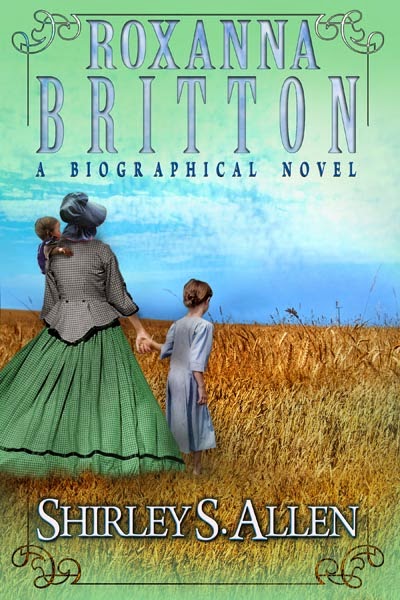
Widowed as a young mother, Roxanna breaks through traditional barriers by finding a husband of her own choice, developing her own small business, and in 1865, becoming one of the first married women to own property. We follow her through the hard times of the Civil War to the Great Chicago Fire of 1871 to a homestead in Nebraska to her final home in Elsinore, California.
"This has become one of my all time favorite stories of "real" people. Ms. Allen's adept use of dialogue and her clear eye for drama and suspense kept me compulsively turning the pages. Her evocation of a bygone era, rich with descriptive details--the historical Chicago fire is one vivid example--is absolutely brilliant. I will never forget Sanny and her family, especially her struggle and her daughters' struggle to become individuals in a male dominated world.
"But it is family that triumphs in the end; and the need for it to survive resonates most deeply in my mind and heart. An excellent novel that I highly recommend to anyone who enjoys reading true stories about people who not only overcome adversity with grace and integrity but through strength of character also prevail. Well done, Ms. Shirley Allen!"...author Ann Carbine Best
Roxanna Britton is available as an ebook at Amazon US, Amazon UK, Amazon CA, Kobo, Nook, iTunes, Inktera, and Scribd.
OPPORTUNITY ALERTS
Looking for an alternative to Goodreads? BookBzz is a brand new site where you can present your books in an attractive online format. And once listed, for bookbzz.com to promote them for you. Listing is quick and easy... and it's free (and always will be, they promise!). Despite being simple to use it has some sophisticated marketing tools built in. It comes with a "Tell a Friend" Book Marketing and Reviews Engine and audience management system and you can (optionally) gateway to other marketing services (reviews engine, price and discount management, newsletters, reward promotions and affiliate programs).
WALKER PERCY PRIZE IN SHORT FICTION $15 ENTRY FEE. Winner receives $1,000 and publication in New Orleans Review. All finalists considered for publication. Enter previously unpublished original stories up to 7,500 words. Deadline December 31st
Writers’ Village International Short Fiction Contest: $24 entry fee. Prizes of $1600, $800, $400 and $80. A further ten Highly Commended entrants will receive a free entry in the next round. Professional feedback provided for all entries! Any genre: up to 3000 words. Deadline December 31st.
First Crime Novel Competition: Sponsored by Minotaur Books (St. Martins) and Mystery Writers of America. Prize: $10,000 advance. Open to any author who has not published a novel (self-published novels OK). Must have a murder or other major crime at the center of the novel's plot. Deadline December 15th, 2014
SCHNEIDER FAMILY BOOK AWARDS: NO ENTRY FEE. These awards honor an author or illustrator for a book that embodies an artistic expression of the disability experience for child and adolescent audiences. Three awards of $5000 each will be given annually in each of the following categories: birth through grade school (age 0-10), middle school (age 11-13) and teens (age 13-18). May be fiction, biography, or other form of nonfiction. Deadline December 1, 2014.
MUSEUM OF WORDS MICRO FICTION CONTEST : NO ENTRY FEE. The competition is for very short fiction pieces of up to a maximum of 100 words. The winner will receive a prize of $20,000, with three runners-up each receiving $2,000. This contest is open to writers from all countries and entries are accepted in four languages: English, Spanish, Arabic and Hebrew. All stories entered must be original and unpublished. The last Museum of Words contest attracted 22,571 entries from writers in 119 countries. Deadline November 23, 2014.
November 2, 2014
How to Turn "Real Life" into Bestselling Fiction...and a Word about Memoirs
by Ruth Harris
Writing a novel based on the lives of real people is much more than simply recounting their story—even if it’s a whizz-bang, humdinger of a story.
The challenge is turning real people and real events into fiction.
Having no guidelines at the time I wrote Decades, I figured it out as I went along. I made plenty of mistakes along the way but had several advantages even I wasn’t aware of.
1) Master the abc’s of craft.
It’s basic but bears repeating: learn the nuts and bolts of creating compelling fiction. Decades was my first “big book,” but prior to writing it, I had been writing professionally for over ten years—free-lance blurb writing, articles for men’s adventure magazines and for women’s magazines. I also wrote original paperbacks, mostly Gothic romance and romantic suspense, under a variety of pseudonyms.
In the process—and hardly intending to—I learned how to write action, emotion, and sex, how to grab a reader from the first sentence and how to create a cliffhanger. That knowledge of the craft would be the invaluable underpinning of the novel.
2) The Rashomon effect.
Real life—and coincidence—provided me with the initial spark for what would become the story of an extra-marital affair and a marriage in crisis. The coincidence was that I happened, quite by accident, to know each of the three people involved, two much better than the third.
The three were: a successful but restless husband, the shy, insecure, rich girl he marries on his way up, and a fashion editor who becomes “the other woman.” Two of them confided “their” versions, giving me two different points of view and invaluable perspective.
None of them knew—nor did I at the time—that years later, haunted by their story, I would turn their dramas into fiction.
3) Beware the “it really happened” trap.
In writing a novel based on real life, I faced the same challenges a writer does with any novel—the need to create believable characters and a dramatic plot—with the added twist of having to structure the formlessness and irresolution of everyday life into the demands of a novel.
Knowing the “real people” turned out to be both a blessing and a hurdle, a limitation and a spring board. I found that the real events that seemed so compelling when told to me often either fell flat in fiction or else were quite literally unbelievable.
After getting bogged down over and over because I kept thinking “it really happened” was important, it eventually dawned on me that ignoring “it really happened” was even more important.
The incidents and encounters I invented served the demands of a novel much better.
4) Privacy and liberation.
Of course I changed names but, as I began to write, I realized I had to go further and change initials, too. It wasn’t enough to change John Doe into Jack Dawson. The initials “JD” kept triggering unwanted memories of the real person and interfering with the creation of a believable fictional character.
A radical name change—to Mark Saint Clair, for example—guaranteed JD’s privacy and, from a writer’s point of view, had the secondary effect of freeing me from any reminders of the real John Doe/Jack Dawson.
The liberating consequence was that I felt free to change the husband’s ethnicity, physical appearance, the details of his childhood, and entirely fictional military and educational experience. I made him taller, handsomer and more successful than he really was, changed his profession, and invented a fictionally significant relationship with his daughter.
5) Help your reader relate.
The fashion editor was a stylish Manhattan single woman who led a hectic, quite glam social life. In the novel, I wanted a character more representative of everyday experience so fun and gossipy fashion-world details went mano a mano with the delete button and lost.
Instead, I portrayed a woman more characteristic of her times who marries young, has two kids, goes thru a drab, depressed, is-this-all-there-is? period. She divorces the husband who was her college boy friend and, as opportunities for women opened up in the late 1950s and early 1960s, learns (the hard way) how to conduct herself in a challenging and competitive business world.
Each of the other characters received a similar makeover. I invented parents for the fictional wife, created a sexual history for her emblematic of post-World War II cultural attitudes, and gave her a talent even she didn’t recognize—a talent that, in the end, rescues her.
6) The geographical imperative.
The events took place mainly in Manhattan but, as my draft took shape, I realized the setting was too limited and that I needed to give my characters breathing room.
The characters in Decades do live in Manhattan, but I added important scenes set in Florida, Nantucket, and the Caribbean.
Using different settings helped me show how the characters behaved away from their usual routines. Trust me, a week in the Caribbean with a wife is much different from a week in the Caribbean with a girlfriend in the middle of a steamy affair! For the novelist, pure gold.
7) Raise the stakes.
Almost any “real life” story by its nature, tends to be limited to the people directly involved and their immediate circle. (Unless your story is about someone you know who happens to be President of the United States whose actions have global consequences.)
As I drafted the novel and its plot and characters took shape, I wanted to show how the consequences of what started out as a casual affair between consenting adults affected people not directly involved.
I ultimately created a teen-aged daughter torn between her charming, straying father, her loyal, devastated mother, and the come-hither lure of contemporary culture, in this case, the go-go Sixties.
8) Theme and variations.
The final element that transformed real life into fiction occurred to me as I was halfway through an early draft and paused to write what passed for an outline to the end (outlines aren’t exactly my strong suit!).
I realized that the age difference between the married couple, the younger “other woman,” and the teen-aged daughter led naturally to portraits of three transformational, mid-20th Century decades. That realization gave me a theme that supported the fiction—and the title.
By the time I was finished with my makeovers, plot twists, and search for a more substantial framework for the story, the characters had taken on their own, living, breathing albeit fictional lives. The plot moved with its own energy to a far different conclusion from the one in real life, and I was able to portray massive cultural and social changes that readers could relate to in an entertaining and story-appropriate way.
I certainly didn’t plan any of it in advance. All I knew when I began was that life had handed me a fascinating story. The false starts, tough decisions, and dead ends ultimately led to an international bestseller that explored dramatic personal dynamics set against an era of tumultuous social and cultural change, the repercussions of which we still feel today.
Wasn’t easy but definitely worth it.
A few words about writing a memoir.
Unlike fiction in which the reader has no expectation of a “true story,” the memoir promises the opposite: an approximation of real life. The decisions the writer of a memoir must make come down to "how much do I want to reveal" and, considering the vagaries of memory, "how far can I deviate from the truth?"
Jane Friedman addresses some questions memoirists must answer in How True and Factual Does Your Memoir Have to Be?
If you want to tell your own story but are undecided about whether to present it as a memoir or a novel, Leslie Lehr lays out the advantages of each.
Dana Sitar, author of This Artists’ Life, details seven mistakes to avoid when writing a memoir.
My DH, Michael Harris, required fifty years to write his bestselling memoir, The Atomic Times , about his experiences as a young soldier assigned to “observe” the US H-bomb tests. In an interview on this blog, he explains what took so long and discusses the importance of voice, perspective, and POV.
What about you, Scriveners? Have you tried to write fiction based on real characters and situations? How did it work for you? Have you been thinking of writing a memoir and wondered how much you could bend the truth? Have you found you got hung up in "the way it really happened?"
BOOK OF THE WEEK
DECADES : 2014 edition revised by the author for today's reader.
And it's FREE!!
"The songs we sang, the clothes we wore, the way we made love. Absolutely perfect!" ...Publisher's Weekly
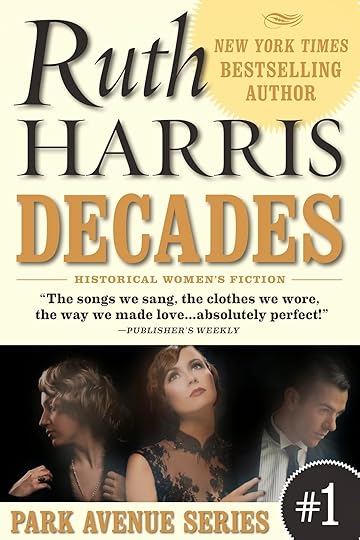
Kindle | iBooks | Nook | Kobo | GooglePlay
THREE WOMEN. THREE DECADES. Spanning the years from the optimistic post-War 1940s to the Mad Men 1950s and rule-breaking "Make Love, Not War" 1960s, DECADES is about three generations of women who must confront the radical changes and upended expectations of the turbulent decades in which they lived.
Evelyn, talented but insecure, is a traditional woman of the Forties. She is a loyal and loving wife and mother whose marriage and family mean everything to her.
Nick, handsome and ambitious, a chameleon who changes with the changing times, is her successful but restless husband.
Joy, their daughter, confused and defiant, a child of the Sixties, needs them both but is torn between them.
Barbara is the other woman, younger than Evelyn, accomplished but alone. She is a transitional woman of the Fifties who wonders if she can have everything--including another woman's husband.
DECADES, sweeping in scope yet intimate in detail, is the emotional, compelling story of family, marriage, crisis, betrayal and healing.
OPPORTUNITY ALERTS
WALKER PERCY PRIZE IN SHORT FICTION $15 ENTRY FEE. Winner receives $1,000 and publication in New Orleans Review. All finalists considered for publication. Enter previously unpublished original stories up to 7,500 words. Deadline December 31st
Writers’ Village International Short Fiction Contest: $24 entry fee. Prizes of $1600, $800, $400 and $80. A further ten Highly Commended entrants will receive a free entry in the next round. Professional feedback provided for all entries! Any genre: up to 3000 words. Deadline December 31st.
SCHNEIDER FAMILY BOOK AWARDS: NO ENTRY FEE. These awards honor an author or illustrator for a book that embodies an artistic expression of the disability experience for child and adolescent audiences. Three awards of $5000 each will be given annually in each of the following categories: birth through grade school (age 0-10), middle school (age 11-13) and teens (age 13-18). May be fiction, biography, or other form of nonfiction. Deadline December 1, 2014.
JANE LUMLEY PRIZE FOR EMERGING WRITERS NO ENTRY FEE. The Prize is awarded annually to a writer who has not published a full length book of poetry or prose. This year is poetry. The winner will receive a prize of $300 and will be featured in Issue 6 of the Hermeneutic Chaos Literary Journal. Deadline November 30th.
to be published in January 2015. Publication will also be awarded to the first two semi-finalists. In addition, all the entries will be considered for publication. Deadline November 30
MUSEUM OF WORDS MICRO FICTION CONTEST : NO ENTRY FEE. The competition is for very short fiction pieces of up to a maximum of 100 words. The winner will receive a prize of $20,000, with three runners-up each receiving $2,000. This contest is open to writers from all countries and entries are accepted in four languages: English, Spanish, Arabic and Hebrew. All stories entered must be original and unpublished. The last Museum of Words contest attracted 22,571 entries from writers in 119 countries. Deadline November 23, 2014.
Writing a novel based on the lives of real people is much more than simply recounting their story—even if it’s a whizz-bang, humdinger of a story.
The challenge is turning real people and real events into fiction.
Having no guidelines at the time I wrote Decades, I figured it out as I went along. I made plenty of mistakes along the way but had several advantages even I wasn’t aware of.
1) Master the abc’s of craft.
It’s basic but bears repeating: learn the nuts and bolts of creating compelling fiction. Decades was my first “big book,” but prior to writing it, I had been writing professionally for over ten years—free-lance blurb writing, articles for men’s adventure magazines and for women’s magazines. I also wrote original paperbacks, mostly Gothic romance and romantic suspense, under a variety of pseudonyms.
In the process—and hardly intending to—I learned how to write action, emotion, and sex, how to grab a reader from the first sentence and how to create a cliffhanger. That knowledge of the craft would be the invaluable underpinning of the novel.
2) The Rashomon effect.
Real life—and coincidence—provided me with the initial spark for what would become the story of an extra-marital affair and a marriage in crisis. The coincidence was that I happened, quite by accident, to know each of the three people involved, two much better than the third.
The three were: a successful but restless husband, the shy, insecure, rich girl he marries on his way up, and a fashion editor who becomes “the other woman.” Two of them confided “their” versions, giving me two different points of view and invaluable perspective.
None of them knew—nor did I at the time—that years later, haunted by their story, I would turn their dramas into fiction.
3) Beware the “it really happened” trap.
In writing a novel based on real life, I faced the same challenges a writer does with any novel—the need to create believable characters and a dramatic plot—with the added twist of having to structure the formlessness and irresolution of everyday life into the demands of a novel.
Knowing the “real people” turned out to be both a blessing and a hurdle, a limitation and a spring board. I found that the real events that seemed so compelling when told to me often either fell flat in fiction or else were quite literally unbelievable.
After getting bogged down over and over because I kept thinking “it really happened” was important, it eventually dawned on me that ignoring “it really happened” was even more important.
The incidents and encounters I invented served the demands of a novel much better.
4) Privacy and liberation.
Of course I changed names but, as I began to write, I realized I had to go further and change initials, too. It wasn’t enough to change John Doe into Jack Dawson. The initials “JD” kept triggering unwanted memories of the real person and interfering with the creation of a believable fictional character.
A radical name change—to Mark Saint Clair, for example—guaranteed JD’s privacy and, from a writer’s point of view, had the secondary effect of freeing me from any reminders of the real John Doe/Jack Dawson.
The liberating consequence was that I felt free to change the husband’s ethnicity, physical appearance, the details of his childhood, and entirely fictional military and educational experience. I made him taller, handsomer and more successful than he really was, changed his profession, and invented a fictionally significant relationship with his daughter.
5) Help your reader relate.
The fashion editor was a stylish Manhattan single woman who led a hectic, quite glam social life. In the novel, I wanted a character more representative of everyday experience so fun and gossipy fashion-world details went mano a mano with the delete button and lost.
Instead, I portrayed a woman more characteristic of her times who marries young, has two kids, goes thru a drab, depressed, is-this-all-there-is? period. She divorces the husband who was her college boy friend and, as opportunities for women opened up in the late 1950s and early 1960s, learns (the hard way) how to conduct herself in a challenging and competitive business world.
Each of the other characters received a similar makeover. I invented parents for the fictional wife, created a sexual history for her emblematic of post-World War II cultural attitudes, and gave her a talent even she didn’t recognize—a talent that, in the end, rescues her.
6) The geographical imperative.
The events took place mainly in Manhattan but, as my draft took shape, I realized the setting was too limited and that I needed to give my characters breathing room.
The characters in Decades do live in Manhattan, but I added important scenes set in Florida, Nantucket, and the Caribbean.
Using different settings helped me show how the characters behaved away from their usual routines. Trust me, a week in the Caribbean with a wife is much different from a week in the Caribbean with a girlfriend in the middle of a steamy affair! For the novelist, pure gold.
7) Raise the stakes.
Almost any “real life” story by its nature, tends to be limited to the people directly involved and their immediate circle. (Unless your story is about someone you know who happens to be President of the United States whose actions have global consequences.)
As I drafted the novel and its plot and characters took shape, I wanted to show how the consequences of what started out as a casual affair between consenting adults affected people not directly involved.
I ultimately created a teen-aged daughter torn between her charming, straying father, her loyal, devastated mother, and the come-hither lure of contemporary culture, in this case, the go-go Sixties.
8) Theme and variations.
The final element that transformed real life into fiction occurred to me as I was halfway through an early draft and paused to write what passed for an outline to the end (outlines aren’t exactly my strong suit!).
I realized that the age difference between the married couple, the younger “other woman,” and the teen-aged daughter led naturally to portraits of three transformational, mid-20th Century decades. That realization gave me a theme that supported the fiction—and the title.
By the time I was finished with my makeovers, plot twists, and search for a more substantial framework for the story, the characters had taken on their own, living, breathing albeit fictional lives. The plot moved with its own energy to a far different conclusion from the one in real life, and I was able to portray massive cultural and social changes that readers could relate to in an entertaining and story-appropriate way.
I certainly didn’t plan any of it in advance. All I knew when I began was that life had handed me a fascinating story. The false starts, tough decisions, and dead ends ultimately led to an international bestseller that explored dramatic personal dynamics set against an era of tumultuous social and cultural change, the repercussions of which we still feel today.
Wasn’t easy but definitely worth it.
A few words about writing a memoir.
Unlike fiction in which the reader has no expectation of a “true story,” the memoir promises the opposite: an approximation of real life. The decisions the writer of a memoir must make come down to "how much do I want to reveal" and, considering the vagaries of memory, "how far can I deviate from the truth?"
Jane Friedman addresses some questions memoirists must answer in How True and Factual Does Your Memoir Have to Be?
If you want to tell your own story but are undecided about whether to present it as a memoir or a novel, Leslie Lehr lays out the advantages of each.
Dana Sitar, author of This Artists’ Life, details seven mistakes to avoid when writing a memoir.
My DH, Michael Harris, required fifty years to write his bestselling memoir, The Atomic Times , about his experiences as a young soldier assigned to “observe” the US H-bomb tests. In an interview on this blog, he explains what took so long and discusses the importance of voice, perspective, and POV.
What about you, Scriveners? Have you tried to write fiction based on real characters and situations? How did it work for you? Have you been thinking of writing a memoir and wondered how much you could bend the truth? Have you found you got hung up in "the way it really happened?"
BOOK OF THE WEEK
DECADES : 2014 edition revised by the author for today's reader.
And it's FREE!!
"The songs we sang, the clothes we wore, the way we made love. Absolutely perfect!" ...Publisher's Weekly

Kindle | iBooks | Nook | Kobo | GooglePlay
THREE WOMEN. THREE DECADES. Spanning the years from the optimistic post-War 1940s to the Mad Men 1950s and rule-breaking "Make Love, Not War" 1960s, DECADES is about three generations of women who must confront the radical changes and upended expectations of the turbulent decades in which they lived.
Evelyn, talented but insecure, is a traditional woman of the Forties. She is a loyal and loving wife and mother whose marriage and family mean everything to her.
Nick, handsome and ambitious, a chameleon who changes with the changing times, is her successful but restless husband.
Joy, their daughter, confused and defiant, a child of the Sixties, needs them both but is torn between them.
Barbara is the other woman, younger than Evelyn, accomplished but alone. She is a transitional woman of the Fifties who wonders if she can have everything--including another woman's husband.
DECADES, sweeping in scope yet intimate in detail, is the emotional, compelling story of family, marriage, crisis, betrayal and healing.
OPPORTUNITY ALERTS
WALKER PERCY PRIZE IN SHORT FICTION $15 ENTRY FEE. Winner receives $1,000 and publication in New Orleans Review. All finalists considered for publication. Enter previously unpublished original stories up to 7,500 words. Deadline December 31st
Writers’ Village International Short Fiction Contest: $24 entry fee. Prizes of $1600, $800, $400 and $80. A further ten Highly Commended entrants will receive a free entry in the next round. Professional feedback provided for all entries! Any genre: up to 3000 words. Deadline December 31st.
SCHNEIDER FAMILY BOOK AWARDS: NO ENTRY FEE. These awards honor an author or illustrator for a book that embodies an artistic expression of the disability experience for child and adolescent audiences. Three awards of $5000 each will be given annually in each of the following categories: birth through grade school (age 0-10), middle school (age 11-13) and teens (age 13-18). May be fiction, biography, or other form of nonfiction. Deadline December 1, 2014.
JANE LUMLEY PRIZE FOR EMERGING WRITERS NO ENTRY FEE. The Prize is awarded annually to a writer who has not published a full length book of poetry or prose. This year is poetry. The winner will receive a prize of $300 and will be featured in Issue 6 of the Hermeneutic Chaos Literary Journal. Deadline November 30th.
to be published in January 2015. Publication will also be awarded to the first two semi-finalists. In addition, all the entries will be considered for publication. Deadline November 30
MUSEUM OF WORDS MICRO FICTION CONTEST : NO ENTRY FEE. The competition is for very short fiction pieces of up to a maximum of 100 words. The winner will receive a prize of $20,000, with three runners-up each receiving $2,000. This contest is open to writers from all countries and entries are accepted in four languages: English, Spanish, Arabic and Hebrew. All stories entered must be original and unpublished. The last Museum of Words contest attracted 22,571 entries from writers in 119 countries. Deadline November 23, 2014.
October 26, 2014
Is Perfectionism Slowing Your Writing Process? 7 Ways NaNoWriMo Can Help
by Anne R. Allen
We've all met those people who think their sojourn on earth is meant to be a fault-finding mission. They can spot lint on your jacket at fifty paces, provide a litany of your imperfections whenever there's a lull in the conversation, and be counted upon to tell you why your pumpkin pie will never be as good as Grandma's.
They usually have a work of art in their heads that is the greatest thing ever. But it will forever remain in their heads, because they never actually create it. Instead, they spend their days finding fault with other people's creations.
We have lots of words to describe these people: "perfectionist", "persnickety", "finicky"…and of course, "lonely." That's because not a lot of folks like these people. They especially don't like themselves. All this stuff they're doing to you, they do to themselves, only worse.
Unfortunately, most writers have some perfectionist in us.
I have a lot. Both my parents were perfectionists, and they raised me to be one too. Pair that with an inherited predisposition to anxiety, and you have a recipe for creative paralysis.
I wanted to be a writer from the time I could hold a crayon, but I never wrote seriously until I was nearly forty. Even then, the process was excruciating, because I'd write and rewrite every chapter for months.
NaNoWriMo (National Novel Writing Month) wasn't around when I was trying to write through the barriers of perfectionism I'd set up for myself, but I created my own crazy writing challenge by pitching a serialized novel to a local entertainment weekly. The San Francisco Chronicle had success serializing Armistead Maupin's iconic Tales of the City in the 1970s, and I was a huge fan. So I figured, why not do a similar thing in the 1990s?
I certainly was no Armistead Maupin, but The New Times editor, the visionary and much-missed late Steve Moss, decided to take a chance on my project. I was kind of blown away when he actually liked my pitch. I agreed to write a serial mystery novella set on the Central Coast, incorporating current events into the storyline, providing a 1000 word chapter every week for 30 weeks. It appeared on the back side of Rob Brezsny's "Free Will Astrology" column in the classified section.
No edits. No going back to fix anything. I had to write an episode a week—based on a very sketchy outline—and pray it would all come together.
It did, kind of, and I even got paid. Coming up for Air made as much money as a lot of first novels do these days.
But everybody who knew anything about writing told me I was insane. And I was. It was a reckless gamble. I don't know what made me do it, except maybe pure desperation.
I'd been dropped by an agent after my first novel had been on submission for nearly a year—and three readers at Bantam loved it—before it got killed in an editorial meeting.
I'd been so close. And I wanted to be a published novelist that much.
My crazy stunt didn't get me another agent and it sure didn't get my poor, almost-accepted-at-Bantam novel published. Somebody told me the rocket scientists at Vandenberg Air Force Base read me faithfully every week, but I'm not sure I got much of a readership in the general population.
Still, I count it as a success. It gave me confidence. I felt I could call myself a writer. Even though I made a lot of rookie mistakes and the story had some serious point-of-view issues.
But I had kicked my perfectionism in the butt.
Soon after that, I let my imagination soar and started writing the novel that would become The Lady of the Lakewood Diner . I was on my way to a career.
But I do not recommend that you do this at home, kids.
Enter NaNoWriMo.
I do recommend NaNoWriMo instead.
But first: only join the NaNo crowd if...
1) You have the time. Don't do it if your job or family or health will suffer. Make a schedule allowing for plenty of sleep, exercise, and eating healthy food.
2) You are not prone to depression. There's new data suggesting that people prone to depression can be plunged into an episode by long periods of cerebral activity. If you have a tendency to depression, be wary of any kind of writing marathon. (I battle depression and anxiety, so I'm speaking from experience here.)
3) You've talked out your plans with your family and friends. Your disappearance for a month can cause serious family rifts. Especially if you're counting on other people to feed you and take care of your needs. NaNo is fun and has benefits, but is not worth jeopardising your support system. And it's probably a really bad idea for parents of young children.
4) It suits your personality. If the whole idea of NaNo fills you with revulsion, dismiss all the pressure to join in. Some writers are sprinters and some are marathoners. Only you know how your muse works.
For people who aren't suited for it, but have some extra time, I suggest National Novel READING Month. The official NaNoREADMo is December 15-January 15, but there's no reason you can't do one for yourself in November. More on that below, and I'll be discussing it more in a future post.
What is NaNoWriMo?
For the uninitiated: NaNoWriMo is the National Novel Writing Month project. Started in 1999 by a San Franciscan named Chris Baty—and 21 of his verbally ambitious friends—it challenges you to write a complete novel in a month. That month is November.
Entering the contest—now run by Mr. Baty's non-profit outfit, the Office of Letters and Light—is free. Anybody who finishes 50,000 words by midnight November 30th is a winner. You can get a nifty badge for your blog or website, but mostly completion of your novel is its own reward.
To become eligible for the honor—and an official "Wrimo"—you register at www.nanowrimo.org so you can have your word count verified at the end of the month, and on November 1, start writing.
Crazy? Absolutely. But all fiction writing is crazy.
But…don't they write a lot of crapola?
Yup. And that's the point. (And at least your rotten rough draft won't be sitting there in the newsstands like mine.)
And it's all about creating that awful first draft. If you don't have one, you'll never have a fabulous final draft.
As Anne LaMott wrote in her classic book for writers, Bird by Bird , "The only way can get anything written at all is to write really, really shitty first drafts."
NaNo forces you to get that dung onto the page.
Here are some benefits:
1) No time to agonize over your first chapter.
You've read endless carping on blogs like this one about how the first chapter has to hook the reader, introduce all the major themes and plot elements, begin with the world's most enticing sentence, end with an even more exciting sentence, etc. But when you're writing your first draft, none of that matters.
You're introducing yourself to your characters and their world. You can worry about your reader when you start editing next January.
2) No frittering away time on excessive research.
If you're one of those writers who has procrastinated for years, piling up reams of historical and biographical detail, this is your chance to actually write the book. (I plead guilty to this one. I've been doing research for over a year on my next Camilla book, where Plantagenet meets the ghost of Richard III near Sheffield. It's sure is easy to get lost down the research rabbit hole.)
Thing is, most of those details would bore our readers silly if we actually put them in the novel, anyway.
You're better off writing the book first and figuring out later whether your reader needs to know what they used for toilet paper in 14th century England or what kind of underpants Richard III wore.
3) No time to censor yourself.
You can't afford to agonize over whether your brother–in-law/former teacher/ex-girlfriend will recognize him/herself. Or if your mom will read between the lines and figure out you weren't really at that church teen retreat the time you and your buddies took off for Mardi Gras.
Besides, you'll be amazed how characters and situations inspired by real life take off on their own and create an alternate reality.
Ruth Harris will be writing on the subject of creating fiction from real life next week. A must-read post!
4) You won't be tempted to save your best ideas for later.
New writers are often terrified they'll run out of ideas. But it's amazing how many more will show up once you're in "the zone".
5) You'll give up trying to control the process.
If the story goes somewhere you didn't expect it to go, or you can't stick to your outline, you'll have to run with it. When your muse is talking, you can't take the chance of annoying her for even a couple of days.
6) You'll have a great excuse for skipping the family Thanksgiving
You can avoid all those relatives whose politics make you despair for the future of the human race. I have a secret suspicion this is why Chris Baty and friends invented it in the first place.
7) It's fun—and a great way to meet other writers all over the world.
Look in the NaNo website forums for online and in-person discussions and groups.
If you decide to jump into the craziness, here are the NaNo rules:
1) Register at www.nanowrimo.org before November 1.
2) Write a novel (in any language) 50,000+ words long between November 1 and November 30. "Novel" is loosely defined. They say "If you consider the book you're writing a novel, we consider it a novel too!"
3) Start from scratch. Previously written outlines and character sketches are OK—and highly recommended—but this can't be a work in progress. (Although if you have a WIP you want to give it a push, you can do your own version of NaNo without the badge competition.)
4) Be the sole author. Although you can use the occasional quotation.
5) Write more than one word. No repeating the same one 50,000 times.
6) Upload your novel for word-count validation to the site between November 25 and November 30.
Chances are pretty good you aren't going to write a polished, publishable novel in four weeks (although Charles Dickens is said to have written A Christmas Carol in six, four of which were in November, so there's some precedent).
So PLEASE don't start querying agents or consider self-publishing until you do a serious, in-depth revision. You'll just clog the pipeline and make the agents cranky—or feed into the myth of the self-publishing "tsunami of crap"—which isn't good for any of us.
And if/when you do query, it's not wise to reveal that the book began at NaNo—unfortunately, a lot of participants send off the unedited crapola. Also, most agents won't look at a novel of less than 70,000 words, so even the Dickenses among you will have further work to do.
My advice, based on what successful WriMos have told me, is to let the book sit in December and then on January 1st let your inner persnickety perfectionist out to play and start polishing that puppy.
Then, maybe your book will have the success of NaNo Novels Water for Elephants, by Sara Gruen, Wool, by Hugh Howey, The Night Circus, by Erin Morgenstern, The Darwin Elevator, by Jason M. Hough, Fangirl, by Rainbow Rowell, and 90 other successful novels that started at NaNo .
Perfectionism can be a gift when used in the right way, of course. Perfectionists make fabulous proofreaders and editors. Also surgeons, accountants, pilots, butlers and a host of other professions. A whole lot of people could use a little more perfectionism, as anybody who spends a lot of time online can testify.
But it can also be a debilitating disease, and I don't mean to make light of its unhealthy side. It's considered an anxiety disorder and is related to OCD.
So if your perfectionism is more serious than just a case of writing slow-down or overediting-itis, do get some help. You'll have more friends and a happier life if you can keep that inner persnickisaurus at bay. Here's a test from Psychology Today that can help you find out if you have perfectionism disorder.
But if you have mild perfectionism that's thwarting your muse the way mine did, NaNoWriMo might just be the cure you need. For more great tips on NaNo (including how to take care of your body) check out Monique McDonell's collection of tips on her blog.
NaNoREADMo
For those of you who aren't planning to spend November at the keyboard, wearing your fingers down to the knuckles, may I suggest an alternative? It may not help your perfectionism, but it is guaranteed to help your writing.
Conduct your own National Novel READING Month. Or join the folks at NaNoREADMo on Facebook who plan a National Reading Month in December. You can follow their Twitter hashtag #NaNoREADMo.
Two weeks ago I held a contest to see who recognized lines from the top 20 bestselling novels. Only one person entered. I chose books by mega-selling authors with very recognizable styles. But most people said they'd never heard of them. This does not bode well. Writers need to READ.
"If you want to be a writer, you must do two things above all others: read a lot and write a lot. There's no way around these two things that I'm aware of, no shortcut."...Stephen King
What about you, Scriveners? Are you going to take the NaNo challenge this year? Or would you rather try NaNoREADMo? Have you ever done NaNoWriMo? Did you try it and find it wasn't for you? Do you fight an inner perfectionist?
BOOK OF THE WEEK
Whether you're jumping on the NaNo bandwagon or not, new writers need a handbook for navigating the treacherous waters of today's fast-changing publishing business without being driven stark raving bonkers by all the conflicting information.
Amazon #1 bestseller Catherine Ryan Hyde and I have just the book to do it. It's HOW TO BE A WRITER IN THE E-AGE: A SELF-HELP GUIDE.
The ebook is now on an Amazon Countdown: only 99c on Amazon US (Also on sale at Amazon UK) for the next week. The sale price will disappear at Midnight on Halloween. Woooooo.
It's also on sale in paper at Amazon US, and Amazon UK. It's on sale right now for $10.75 and £8.75
Here's what a nice UK reviewer named David said about the book. We like his "just the good parts" style.
Wow.
I could end the review there... but I have a few more words.
This e-guide is both reader and writer friendly, and I could not put it down. This book was SO helpful.
OPPORTUNITY ALERTS
Writers’ Village International Short Fiction Contest: $24 entry fee. Prizes of $1600, $800, $400 and $80. A further ten Highly Commended entrants will receive a free entry in the next round. Professional feedback provided for all entries! Any genre: up to 3000 words. Deadline December 31st.
SCHNEIDER FAMILY BOOK AWARDS: NO ENTRY FEE. These awards honor an author or illustrator for a book that embodies an artistic expression of the disability experience for child and adolescent audiences. Three awards of $5000 each will be given annually in each of the following categories: birth through grade school (age 0-10), middle school (age 11-13) and teens (age 13-18). May be fiction, biography, or other form of nonfiction. Deadline December 1, 2014.
MUSEUM OF WORDS MICRO FICTION CONTEST : NO ENTRY FEE. The competition is for very short fiction pieces of up to a maximum of 100 words. The winner will receive a prize of $20,000, with three runners-up each receiving $2,000. This contest is open to writers from all countries and entries are accepted in four languages: English, Spanish, Arabic and Hebrew. All stories entered must be original and unpublished. The last Museum of Words contest attracted 22,571 entries from writers in 119 countries. Deadline November 23, 2014.
TENNESSEE WILLIAMS LITERARY FESTIVAL SHORT FICTION CONTEST $25 ENTRY FEE. Submit a short story, up to 7000 words. Grand Prize: $1,500, plus airfare (up to $500) and accommodations for the next Festival in New Orleans, VIP All-Access Festival pass for the next Festival ($500 value), plus publication in Louisiana Cultural Vistas magazine. Contest is open only to writers who have not yet published a book of fiction. Deadline November 16th.
GLIMMER TRAIN VERY SHORT FICTION AWARD $15 fee. Maximum length: 3,000 words. 1st place wins $1,500, publication in Glimmer Train Stories, and 20 copies of that issue. 2nd place wins $500 (or, if accepted for publication, $700 and 10 copies). 3rd place wins $300 (or, if accepted for publication, $700 and 10 copies). Deadline October 31.
We've all met those people who think their sojourn on earth is meant to be a fault-finding mission. They can spot lint on your jacket at fifty paces, provide a litany of your imperfections whenever there's a lull in the conversation, and be counted upon to tell you why your pumpkin pie will never be as good as Grandma's.
They usually have a work of art in their heads that is the greatest thing ever. But it will forever remain in their heads, because they never actually create it. Instead, they spend their days finding fault with other people's creations.
We have lots of words to describe these people: "perfectionist", "persnickety", "finicky"…and of course, "lonely." That's because not a lot of folks like these people. They especially don't like themselves. All this stuff they're doing to you, they do to themselves, only worse.
Unfortunately, most writers have some perfectionist in us.
I have a lot. Both my parents were perfectionists, and they raised me to be one too. Pair that with an inherited predisposition to anxiety, and you have a recipe for creative paralysis.
I wanted to be a writer from the time I could hold a crayon, but I never wrote seriously until I was nearly forty. Even then, the process was excruciating, because I'd write and rewrite every chapter for months.
NaNoWriMo (National Novel Writing Month) wasn't around when I was trying to write through the barriers of perfectionism I'd set up for myself, but I created my own crazy writing challenge by pitching a serialized novel to a local entertainment weekly. The San Francisco Chronicle had success serializing Armistead Maupin's iconic Tales of the City in the 1970s, and I was a huge fan. So I figured, why not do a similar thing in the 1990s?
I certainly was no Armistead Maupin, but The New Times editor, the visionary and much-missed late Steve Moss, decided to take a chance on my project. I was kind of blown away when he actually liked my pitch. I agreed to write a serial mystery novella set on the Central Coast, incorporating current events into the storyline, providing a 1000 word chapter every week for 30 weeks. It appeared on the back side of Rob Brezsny's "Free Will Astrology" column in the classified section.
No edits. No going back to fix anything. I had to write an episode a week—based on a very sketchy outline—and pray it would all come together.
It did, kind of, and I even got paid. Coming up for Air made as much money as a lot of first novels do these days.
But everybody who knew anything about writing told me I was insane. And I was. It was a reckless gamble. I don't know what made me do it, except maybe pure desperation.
I'd been dropped by an agent after my first novel had been on submission for nearly a year—and three readers at Bantam loved it—before it got killed in an editorial meeting.
I'd been so close. And I wanted to be a published novelist that much.
My crazy stunt didn't get me another agent and it sure didn't get my poor, almost-accepted-at-Bantam novel published. Somebody told me the rocket scientists at Vandenberg Air Force Base read me faithfully every week, but I'm not sure I got much of a readership in the general population.
Still, I count it as a success. It gave me confidence. I felt I could call myself a writer. Even though I made a lot of rookie mistakes and the story had some serious point-of-view issues.
But I had kicked my perfectionism in the butt.
Soon after that, I let my imagination soar and started writing the novel that would become The Lady of the Lakewood Diner . I was on my way to a career.
But I do not recommend that you do this at home, kids.
Enter NaNoWriMo.
I do recommend NaNoWriMo instead.
But first: only join the NaNo crowd if...
1) You have the time. Don't do it if your job or family or health will suffer. Make a schedule allowing for plenty of sleep, exercise, and eating healthy food.
2) You are not prone to depression. There's new data suggesting that people prone to depression can be plunged into an episode by long periods of cerebral activity. If you have a tendency to depression, be wary of any kind of writing marathon. (I battle depression and anxiety, so I'm speaking from experience here.)
3) You've talked out your plans with your family and friends. Your disappearance for a month can cause serious family rifts. Especially if you're counting on other people to feed you and take care of your needs. NaNo is fun and has benefits, but is not worth jeopardising your support system. And it's probably a really bad idea for parents of young children.
4) It suits your personality. If the whole idea of NaNo fills you with revulsion, dismiss all the pressure to join in. Some writers are sprinters and some are marathoners. Only you know how your muse works.
For people who aren't suited for it, but have some extra time, I suggest National Novel READING Month. The official NaNoREADMo is December 15-January 15, but there's no reason you can't do one for yourself in November. More on that below, and I'll be discussing it more in a future post.
What is NaNoWriMo?
For the uninitiated: NaNoWriMo is the National Novel Writing Month project. Started in 1999 by a San Franciscan named Chris Baty—and 21 of his verbally ambitious friends—it challenges you to write a complete novel in a month. That month is November.
Entering the contest—now run by Mr. Baty's non-profit outfit, the Office of Letters and Light—is free. Anybody who finishes 50,000 words by midnight November 30th is a winner. You can get a nifty badge for your blog or website, but mostly completion of your novel is its own reward.
To become eligible for the honor—and an official "Wrimo"—you register at www.nanowrimo.org so you can have your word count verified at the end of the month, and on November 1, start writing.
Crazy? Absolutely. But all fiction writing is crazy.
But…don't they write a lot of crapola?
Yup. And that's the point. (And at least your rotten rough draft won't be sitting there in the newsstands like mine.)
And it's all about creating that awful first draft. If you don't have one, you'll never have a fabulous final draft.
As Anne LaMott wrote in her classic book for writers, Bird by Bird , "The only way can get anything written at all is to write really, really shitty first drafts."
NaNo forces you to get that dung onto the page.
Here are some benefits:
1) No time to agonize over your first chapter.
You've read endless carping on blogs like this one about how the first chapter has to hook the reader, introduce all the major themes and plot elements, begin with the world's most enticing sentence, end with an even more exciting sentence, etc. But when you're writing your first draft, none of that matters.
You're introducing yourself to your characters and their world. You can worry about your reader when you start editing next January.
2) No frittering away time on excessive research.
If you're one of those writers who has procrastinated for years, piling up reams of historical and biographical detail, this is your chance to actually write the book. (I plead guilty to this one. I've been doing research for over a year on my next Camilla book, where Plantagenet meets the ghost of Richard III near Sheffield. It's sure is easy to get lost down the research rabbit hole.)
Thing is, most of those details would bore our readers silly if we actually put them in the novel, anyway.
You're better off writing the book first and figuring out later whether your reader needs to know what they used for toilet paper in 14th century England or what kind of underpants Richard III wore.
3) No time to censor yourself.
You can't afford to agonize over whether your brother–in-law/former teacher/ex-girlfriend will recognize him/herself. Or if your mom will read between the lines and figure out you weren't really at that church teen retreat the time you and your buddies took off for Mardi Gras.
Besides, you'll be amazed how characters and situations inspired by real life take off on their own and create an alternate reality.
Ruth Harris will be writing on the subject of creating fiction from real life next week. A must-read post!
4) You won't be tempted to save your best ideas for later.
New writers are often terrified they'll run out of ideas. But it's amazing how many more will show up once you're in "the zone".
5) You'll give up trying to control the process.
If the story goes somewhere you didn't expect it to go, or you can't stick to your outline, you'll have to run with it. When your muse is talking, you can't take the chance of annoying her for even a couple of days.
6) You'll have a great excuse for skipping the family Thanksgiving
You can avoid all those relatives whose politics make you despair for the future of the human race. I have a secret suspicion this is why Chris Baty and friends invented it in the first place.
7) It's fun—and a great way to meet other writers all over the world.
Look in the NaNo website forums for online and in-person discussions and groups.
If you decide to jump into the craziness, here are the NaNo rules:
1) Register at www.nanowrimo.org before November 1.
2) Write a novel (in any language) 50,000+ words long between November 1 and November 30. "Novel" is loosely defined. They say "If you consider the book you're writing a novel, we consider it a novel too!"
3) Start from scratch. Previously written outlines and character sketches are OK—and highly recommended—but this can't be a work in progress. (Although if you have a WIP you want to give it a push, you can do your own version of NaNo without the badge competition.)
4) Be the sole author. Although you can use the occasional quotation.
5) Write more than one word. No repeating the same one 50,000 times.
6) Upload your novel for word-count validation to the site between November 25 and November 30.
Chances are pretty good you aren't going to write a polished, publishable novel in four weeks (although Charles Dickens is said to have written A Christmas Carol in six, four of which were in November, so there's some precedent).
So PLEASE don't start querying agents or consider self-publishing until you do a serious, in-depth revision. You'll just clog the pipeline and make the agents cranky—or feed into the myth of the self-publishing "tsunami of crap"—which isn't good for any of us.
And if/when you do query, it's not wise to reveal that the book began at NaNo—unfortunately, a lot of participants send off the unedited crapola. Also, most agents won't look at a novel of less than 70,000 words, so even the Dickenses among you will have further work to do.
My advice, based on what successful WriMos have told me, is to let the book sit in December and then on January 1st let your inner persnickety perfectionist out to play and start polishing that puppy.
Then, maybe your book will have the success of NaNo Novels Water for Elephants, by Sara Gruen, Wool, by Hugh Howey, The Night Circus, by Erin Morgenstern, The Darwin Elevator, by Jason M. Hough, Fangirl, by Rainbow Rowell, and 90 other successful novels that started at NaNo .
Perfectionism can be a gift when used in the right way, of course. Perfectionists make fabulous proofreaders and editors. Also surgeons, accountants, pilots, butlers and a host of other professions. A whole lot of people could use a little more perfectionism, as anybody who spends a lot of time online can testify.
But it can also be a debilitating disease, and I don't mean to make light of its unhealthy side. It's considered an anxiety disorder and is related to OCD.
So if your perfectionism is more serious than just a case of writing slow-down or overediting-itis, do get some help. You'll have more friends and a happier life if you can keep that inner persnickisaurus at bay. Here's a test from Psychology Today that can help you find out if you have perfectionism disorder.
But if you have mild perfectionism that's thwarting your muse the way mine did, NaNoWriMo might just be the cure you need. For more great tips on NaNo (including how to take care of your body) check out Monique McDonell's collection of tips on her blog.
NaNoREADMo
For those of you who aren't planning to spend November at the keyboard, wearing your fingers down to the knuckles, may I suggest an alternative? It may not help your perfectionism, but it is guaranteed to help your writing.
Conduct your own National Novel READING Month. Or join the folks at NaNoREADMo on Facebook who plan a National Reading Month in December. You can follow their Twitter hashtag #NaNoREADMo.
Two weeks ago I held a contest to see who recognized lines from the top 20 bestselling novels. Only one person entered. I chose books by mega-selling authors with very recognizable styles. But most people said they'd never heard of them. This does not bode well. Writers need to READ.
"If you want to be a writer, you must do two things above all others: read a lot and write a lot. There's no way around these two things that I'm aware of, no shortcut."...Stephen King
What about you, Scriveners? Are you going to take the NaNo challenge this year? Or would you rather try NaNoREADMo? Have you ever done NaNoWriMo? Did you try it and find it wasn't for you? Do you fight an inner perfectionist?
BOOK OF THE WEEK
Whether you're jumping on the NaNo bandwagon or not, new writers need a handbook for navigating the treacherous waters of today's fast-changing publishing business without being driven stark raving bonkers by all the conflicting information.
Amazon #1 bestseller Catherine Ryan Hyde and I have just the book to do it. It's HOW TO BE A WRITER IN THE E-AGE: A SELF-HELP GUIDE.
The ebook is now on an Amazon Countdown: only 99c on Amazon US (Also on sale at Amazon UK) for the next week. The sale price will disappear at Midnight on Halloween. Woooooo.
%2B(1).jpg)
It's also on sale in paper at Amazon US, and Amazon UK. It's on sale right now for $10.75 and £8.75
Here's what a nice UK reviewer named David said about the book. We like his "just the good parts" style.
Wow.
I could end the review there... but I have a few more words.
This e-guide is both reader and writer friendly, and I could not put it down. This book was SO helpful.
OPPORTUNITY ALERTS
Writers’ Village International Short Fiction Contest: $24 entry fee. Prizes of $1600, $800, $400 and $80. A further ten Highly Commended entrants will receive a free entry in the next round. Professional feedback provided for all entries! Any genre: up to 3000 words. Deadline December 31st.
SCHNEIDER FAMILY BOOK AWARDS: NO ENTRY FEE. These awards honor an author or illustrator for a book that embodies an artistic expression of the disability experience for child and adolescent audiences. Three awards of $5000 each will be given annually in each of the following categories: birth through grade school (age 0-10), middle school (age 11-13) and teens (age 13-18). May be fiction, biography, or other form of nonfiction. Deadline December 1, 2014.
MUSEUM OF WORDS MICRO FICTION CONTEST : NO ENTRY FEE. The competition is for very short fiction pieces of up to a maximum of 100 words. The winner will receive a prize of $20,000, with three runners-up each receiving $2,000. This contest is open to writers from all countries and entries are accepted in four languages: English, Spanish, Arabic and Hebrew. All stories entered must be original and unpublished. The last Museum of Words contest attracted 22,571 entries from writers in 119 countries. Deadline November 23, 2014.
TENNESSEE WILLIAMS LITERARY FESTIVAL SHORT FICTION CONTEST $25 ENTRY FEE. Submit a short story, up to 7000 words. Grand Prize: $1,500, plus airfare (up to $500) and accommodations for the next Festival in New Orleans, VIP All-Access Festival pass for the next Festival ($500 value), plus publication in Louisiana Cultural Vistas magazine. Contest is open only to writers who have not yet published a book of fiction. Deadline November 16th.
GLIMMER TRAIN VERY SHORT FICTION AWARD $15 fee. Maximum length: 3,000 words. 1st place wins $1,500, publication in Glimmer Train Stories, and 20 copies of that issue. 2nd place wins $500 (or, if accepted for publication, $700 and 10 copies). 3rd place wins $300 (or, if accepted for publication, $700 and 10 copies). Deadline October 31.
October 19, 2014
Living with Robot Overlords: How to Survive in Our Cyborg World
by Anne R. Allen
Everybody tells us that to succeed as writers in the e-age, we need to be active in social media. And once we get the hang of it, most of us find it a lot of fun. Cyberspace can feel like a big old playground for writers. Look! I can type something on my little keyboard in the privacy of my own home and reach 100,000 people.
Yes, we had over 100,000 hits on the blog in the last month—and that doesn't count the several thousand who read the blog in their inboxes and rss feeds. Thanks guys, we love you!
You can also publish books and reach appreciative readers without groveling for decades to get your work read by some unpaid 20-something intern in NYC who thinks books with protagonists over thirty are, like, totally gross.
You can go on Facebook, Google Plus, Twitter, Pinterest, LinkedIn, etc. and meet people from all over the world. And make friends. Some of whom may even buy your books.
You can get paid—sometimes rather handsomely—for said books. Every. Single. Month. Without all the waiting. And pleading. And filing of lawsuits.
It's all so darn wonderful.
Until something goes wrong.
Which it does with fair regularity. Funny how nobody talks about that part. But here's the thing: out here in Cyberia, you're dealing with robots—technically, lines of code called algorithms—not actual people, and robots are dictatorial and merciless.
And in charge.
I got a little reminder recently when a blogfriend contacted me on Facebook to say she had some new craft items posted on Pinterest. I've always avoided Pinterest—I'm sure it's lovely—but it's one more time-suck that I can't fit into my overwhelmed life.
(Ruth Harris says she's afraid "overwhelmed" has become the new normal. I have to agree. And I think robots are partly to blame. They were supposed to make our lives easier. Instead they keep us on hold for hours, interrupt us with scammer phone calls at all hours of the day and night, and demand six passwords before we're allowed to sneeze.)
Anyway, there I was, hoping to take a look at my friend's craft items on Pinterest. Since I wanted a quick browse, I clicked on a handy button that said, "sign in with Facebook".
KAPOW!!
My computer went nuts. It was like it had been taken over by the Borg from Star Trek. A window came up that said something like:
"Welcome to Pinterest. Resistance is futile. You have been assimilated."
I clicked away, totally freaked.
Later I went to check my email and found over 50 emails from my FB friends, either saying they were now following my "pins" on Pinterest, or "I think Pinterest is a waste of time. Stop spamming me with these emails."
You guessed it. Clicking on that one "sign in with Facebook" button had automatically, without my knowledge or consent, signed me up for Pinterest and sent emails to all 744 of my Facebook friends, telling them I was now enslaved to Pinterest and wanted them to be too.
Yikes.
I know this kind of stuff happens every day, and younger people will say it's my own stupid fault. When anything goes wrong in Cyberia, it is always the fault of the user, because robots don't make mistakes. If you don't have the secret robot-whisperer decoder ring, you deserve whatever happens to you.
But I'm old. I grew up at a time when businesses didn't view seller-customer relationships as adversarial. Marketing meant enticing customers, not bullying them.
And there were actual humans in charge.
Sometimes I fear the CEOs of these big companies are like Mickey Mouse in the classic Sorcerer's Apprentice scene (based on the Goethe poem of the same name) from Disney's Fantasia. It's the one where junior-wizard Mickey conjures up 1000s of animated brooms with buckets to do his grunt work, but totally loses control of them. Here's the link to the Fantasia scene on You Tube.
I often wonder if the people in charge are as clueless as Mickey about the powers they've unleashed.
I certainly can't single out Facebook and Pinterest for blame in hijacking me. Every big online site is built with the same semi-sociopathic mindset: any human who wanders by is prey. The job is to trick us into doing something we don't want to do by making us feel ignorant and powerless.
Which means we often feel as if we live in a world invented by Mad Men's Don Draper and run by Dr. Who's Cybermen.
And maybe we do.
I didn't know Google was reading my mail until the time I mentioned in a note to my neighbor that I saw she'd had a new refrigerator delivered. For weeks, everywhere I went online, I was hit with a barrage of ads for refrigerators.
I also learned the hard way that you should never tweak your LinkedIn profile, because if you change one word—say change "mystery" to "comic mystery"—messages will go out to every person you've connected with on LinkedIn—including your boss at your day job—ordering them to all congratulate you on your "new job".
And forever after, on that day, you will receive "congratulations on your work anniversary" emails from all your contacts who have been instructed by the robots to send them.
And like Facebook, LinkedIn does sneaky things to get you to share your email address book with them. Once they have it, they will save the cached list forever and use it try to get those people to join up. That means that whenever you visit, even 15 years later, you'll see pop-ups saying that your stalker ex-boyfriend, your deceased Aunt Marlene, and that awful hairdresser who made you like Dana Carvey's Church Lady—all want to connect with you on LinkedIn today.
The fact this stuff might get you fired or scare you into to calling the police to enforce that restraining order does not matter to them.
Because you're human, and they're not.
And then there's the way they always try to get you to "endorse" people from a menu of ridiculous options. The robots ask something like, "Do you endorse Anne R. Allen in hedge-fund management, raising alpacas, ghostwriting, or pole dancing?" So people choose ghostwriting, since it's the most likely option. It just happens to be wrong. This gets me lots of emails from people wanting a ghostwriter who end up disappointed.
So does anybody at these companies care that this stuff is creepy, time-wasting, misleading and invasive?
Nope.
Because nobody is doing this stuff. It's all done by the bots. Like Mickey Mouse's relentless brooms.
Most of us are impacted by out-of-control robots these days. And it's not just the NSA bots reading your email and flying robots shooting up third world weddings. The dangers are everywhere.
Huge retailers and banks are getting hacked because nobody seems to be in control of the tech they're dependent upon. And even if they're not hacked, they're riddled with errors nobody seems to be able to fix. I spent two hours in my insurance agent's office last week while she was on the phone with six people who gave her six different answers because their robots were unable to communicate with each other. She says tech glitches on her company's website have tripled her workload in the last year.
And for writers, the impact can be devastating. I've spent most of the last two weeks on the phone on hold, trying to reach tech support humans after some robot has tried to mess up my life.
Robots vs. Authors
Authors who self-publish or publish with a smaller press without a tech department can have their careers destroyed by a simple glitch (or any malevolent troll who knows how to fool the robots.)
Here are some things that have happened to me or authors I know:
Something goes wrong with your blog and half your readers can't comment because of some robot feud/bullying going on between Blogger/Google and WordPress. (Sorry guys. I do not know how to fix this problem. If anybody knows, do tell me!) All your email from Amazon is suddenly thrown into spam and you lose super-important business communications. No matter how many times you report it as "not spam," it's still relegated to the spam folder, where it doesn't show up for days. (Apparently Google's robots are also feuding with Amazon's.)Your book gets pirated and Amazon threatens to ban you for life because the pirates are underselling them—but you have no idea who or where the pirates are or how to force them to stop stealing your book.You get reported for spam by a troll on FaceBook or Google Plus for a simple announcement on your own page and you're frozen out of your account.Somebody reports you for a typo or "objectionable material" for using a correct but uncommon word and your bestselling book loses its "buy" button and you no longer have an income until you rewrite the book according to some illiterate's standards.The bestseller you were counting on to pay the mortgage goes from 1000 sales a day to zero, even though you're doing all the same stuff to promote it and you have great reviews. Somebody leaves a review of your cozy mystery saying they hate it because the hero tortures little girls and uses foul language. Only there's no male protagonist, no little girls and the worst word anybody uses is "flibbertigibbet."You publish a paper version of an ebook and try to link them so the reviews show up on both pages. All the reviews disappear for two weeks and your sales stop.
Some of these problems can be solved, and some can't.
Mostly we need to BE AWARE they can happen, so we can back up often and stay diversified. If one site's robots turn on you, at least you'll have books on other sites.
Complacency and naiveté are the enemies here.
How to Survive the Giant Data-Squid
German journalists seem to be more aware of perils of technobot dictators than the rest of us. They've invented a wonderful word for the companies whose bots and algos have taken over our lives:
"Datenkraken"
The word means something like "giant data-squid," and for me it conjures up an image of some devil-offspring of Dr. Who's Daleks and the Kraken from Clash of the Titans.
The Germans have noticed that while we've been frantically busy posting selfies to Facebook, taking sides in the Amazon/Hachette standoff, and Tweeting about Kim Kardashian's butt, somebody decreed—
"Release the Kraken. You will be exterminated."
The Cylons are winning, people! (I figured we needed a Battlestar Galactica reference as long as we're doing a SciFi mash-up here. You didn't know I was a secret SciFi nerd did you?)
So do we all give up on our careers and/or hitch a ride on a TARDIS to take us back to the 20th century?
Or maybe we should find an old mimeograph machine, copy our books in that weird-smelling purple ink, put the pages in three-ring binders and hawk them on street corners?
Probably not altogether practical solutions.
But we need to go into this with our eyes open. Don't think that because the Cyberworld is so easy to get into that you will have smooth sailing the whole way.
And one thing we can do is collect information on how to get past the robots and reach the humans.
It turns out that instead of having a panic attack/temper tantrum (usually my first instinct) we need to take a deep breath and go on a hunt for flesh-and-blood earthlings.
Solution #1 Search for a Human Being
For Amazon problems, I've had good luck reaching humans through Author Central "help." You hit "contact us" at Author Central "help" and choose a category. Then you will be allowed to choose another subcategory and perhaps a third. Then they will ask if you want to contact them by email or telephone. Since I'm a phonophobe, I usually choose email, and I generally have a response in a matter of hours and a solution from an actual human within a day or two.
Of course, sometimes the email people (still underlings, although mortal) can't solve something, so they turn you back over to the robots with a dead-end, canned message that says something like, "It is not our policy to remove reviews that refer to authors as 'tiny-brained pinheads'. Contact us again and your computer will explode, you tiny-brained pinhead."
Then it's time to get on the phone. Don't yell. They get yelled at all day. Shock them by being nice and asking how "we" can solve the problem. Amazing how well that can work. I've found that Amazon people are generally polite and helpful on the phone. Sometimes if they make a mistake, they'll even call you and apologize.
That happened this week. The robots sent me a rather startling email on Wednesday I knew wasn't meant for me, and yesterday a very nice young man phoned from Seattle to personally apologize for the robots' behavior.
So you can reach a human for Amazon help...unless you're trying to get them to remove negative reviews. The Zon will not remove a negative review unless it obviously breaks the Terms of Service, and they may remove good ones that break the ToS if you get pushy.
I've had some luck with Facebook by contacting them through Appeals@Facebook.com. They don't care if they've solved your problem and they don't respond, but sometimes when you write them with a request, the problem will magically disappear a few weeks later.
And Twitter, strangely enough, likes you to contact them via the good old U.S. Snail. I was able to deactivate an account by writing to Twitter, Inc. c/o: Trust & Safety/ 1355 Market St., Suite 900/ San Francisco, CA 94103
I haven't tried to contact LinkedIn, because they do such creepy stuff I fear further contact might make it worse—like making eye contact with that weird guy who sings off-key Abba songs every morning on the bus.
I have no idea how to reach anybody at Google. But I've thought of sneaking into their Mountain View offices posing as a vegan caterer or a massage therapist.
On the other hand, Google's robots tend to be very good at what they do. Somebody tried to hack this blog this week and the Google bots caught them before they did any damage and immediately alerted me to change my password.
Still, it would be nice to know how to find a mortal being when necessary. Has anybody out there figured out how to get through to earthlings at the Big G? If so, please share.
Solution #2: Look for a Human Being Who Is Impacted By the Problem
If the regular channels don't work, go higher up. Don't demand to talk to a supervisor. Go to the website and find somebody whose job depends on the company's reputation. Preferably somebody close to the top of the food chain.
I learned this trick from my uncle, whose grandfather founded a major American manufacturing empire. My Uncle Don taught me that when you have trouble with a company, it's a waste of breath to get mad at the underlings.
You should call the sales department—the guys directly impacted by the company's reputation. And if that doesn't work, send a registered letter to the CEO.
This has worked for me a number of times. When I found some crazy stuff on my credit report and couldn't get help from the usual channels, I called a salesman for Experian. Five minutes later, all the bogus stuff was deleted.
And when I was sick and tired of ATT's useless robot voice-mail, I sent a nice note via registered mail to a head honcho at the central office. A few days later his secretary called me—she thought my letter was a hoot—and fixed everything.
And just last week, after being on hold for over an hour with my bank's tech department, I hung up and wrote a nice note to the manager of my local branch. He phoned the next day and connected me with the proper person and said he'd forward my letter to his boss.
Hooray for the U. S. Postal Service! Yes, it's often the fastest way to get results these days.
Solution #3: Escape to the Real World
Take some human time. That's what I'm going to do. I often spend five or more hours a day answering emails, Tweets, FB posts, Google Plus and reading and commenting on blogs.
Jessica Bell, who guested last week, said on FB last week that she has the same problem. Lots of people chimed in. We've all become slaves of the Datenkraken.
So as of this week, I'm going to declare Thursdays my offline days.
No social media. No email. I'm going to be:
1) Working on my WIP
2) Reading books
3) Hanging out with flesh-and-blood earthlings of various species.
I need to get my life back to human speed, or my doctor says I'm going to be a casualty in this war with the Cylons. I'll bet you'll be healthier if you take a day off too.
Scriveners, if any of you have had luck reaching helpful humans in Cyberia, our readers would love to hear about it. If you have an e-address or phone number for them, do include it! If you've had nothing but encounters with Cybermen, Cylons and the Borg, tell us about that too. At least we can commiserate about living with robot overlords.
Contest Winners!
The answers to last week's chapter endings contest were 1) B, 2) E, 3) A 4) C 5) D
The winner of the first part of the contest is Romance author and book reviewer Suzie Quint.
Suzie got every one right. She's also the only one who entered. Suzie, email me at annerallen dot allen at gmail dot com for your prize.
I was kind of shocked that nobody else entered this part of the contest. I thought all writers would be aware of the styles of James Patterson and Dan Brown. And the New Yorker says "only 21 people in the country haven't read Gone, Girl." Plus Kate Atkinson and Catherine Ryan Hyde are two of the best writers working today as well as being mega-sellers. Reading one of their books is like taking a master class in writing. Try it!
Remember that to succeed in the business of selling novels, you need to know what novels are selling.
Writers who are in the query process absolutely need to do market research in the bestseller list, and indies will do better if they know the competition, too.
The winner of the best last sentence of your first chapter, chosen by Amazon #1 Bestseller Catherine Ryan Hyde is Suzanne Purvis.
Suzanne, contact me at annerallen dot allen at gmail dot com for your prize.
BOOK OF THE WEEK
NOW IN PAPERBACK! Only $10.79
Here's an appropriately Halloweeny book. It's #1 in the Camilla Randall comedy-mysteries--a wild comic romp set at writers’ conference in the wine-and-cowboy town of Santa Ynez, California. When a ghostwriter’s plot to blackmail celebrities with faked evidence leads to murder, Camilla must team up with a cross-dressing dominatrix to stop the killer--who may just be a ghost--from striking again.
Here's a great review from Sandy Nathan that got eaten by the robots, but now is BACK!
Ghost Writers is set in a writers' conference in Santa Ynez Valley, where I've lived for twenty years. Nothing makes me angrier than reading a book set in my home Valley that gets everything wrong. Like where the roads are, how to get from here to there, what the Valley feels and lives like. One famous writer I know actually did this: bollixed up the whole place.
But not Anne R. Allen! This book is hysterically funny AND accurately depicts the Valley. Anne Allen gets it right, down to the dollar bills stuck on the ceiling of the Maverick Saloon. It was so fun to read as she called out one Valley landmark after another. Allen got the local denizens right, too, the crazy characters that roam our streets.
Speaking of which, Ms. Allen's literary characters are pretty crazy/zany by themselves. I love Camilla Randall, her ditzy, former debutante heroine, and all the rest. The action gets pretty frenetic when dead bodies start showing up. I heartily recommend this book. I can hardly wait to read the rest of the series.
Ghostwriters in the Sky is available in e-book for only $2.99 at Amazon US, Amazon UK, Amazon CA, iTunes, Kobo, Inktera, and at Barnes and Noble for NOOK.
OPPORTUNITY ALERTS
Looking for an alternative to Goodreads? BookBzz is a brand new site where you can present your books in an attractive online format. And once listed, for bookbzz.com to promote them for you. Listing is quick and easy... and it's free (and always will be, they promise!). Despite being simple to use it has some sophisticated marketing tools built in. It comes with a "Tell a Friend" Book Marketing and Reviews Engine and audience management system and you can (optionally) gateway to other marketing services (reviews engine, price and discount management, newsletters, reward promotions and affiliate programs).
Writers’ Village International Short Fiction Contest: $24 entry fee. Prizes of $1600, $800, $400 and $80. A further ten Highly Commended entrants will receive a free entry in the next round. Professional feedback provided for all entries! Any genre: up to 3000 words. Deadline December 31st.
SCHNEIDER FAMILY BOOK AWARDS: NO ENTRY FEE. These awards honor an author or illustrator for a book that embodies an artistic expression of the disability experience for child and adolescent audiences. Three awards of $5000 each will be given annually in each of the following categories: birth through grade school (age 0-10), middle school (age 11-13) and teens (age 13-18). May be fiction, biography, or other form of nonfiction. Deadline December 1, 2014.
MUSEUM OF WORDS MICRO FICTION CONTEST : NO ENTRY FEE. The competition is for very short fiction pieces of up to a maximum of 100 words. The winner will receive a prize of $20,000, with three runners-up each receiving $2,000. This contest is open to writers from all countries and entries are accepted in four languages: English, Spanish, Arabic and Hebrew. All stories entered must be original and unpublished. The last Museum of Words contest attracted 22,571 entries from writers in 119 countries. Deadline November 23, 2014.
TENNESSEE WILLIAMS LITERARY FESTIVAL SHORT FICTION CONTEST $25 ENTRY FEE. Submit a short story, up to 7000 words. Grand Prize: $1,500, plus airfare (up to $500) and accommodations for the next Festival in New Orleans, VIP All-Access Festival pass for the next Festival ($500 value), plus publication in Louisiana Cultural Vistas magazine. Contest is open only to writers who have not yet published a book of fiction. Deadline November 16th.
GLIMMER TRAIN VERY SHORT FICTION AWARD $15 fee. Maximum length: 3,000 words. 1st place wins $1,500, publication in Glimmer Train Stories, and 20 copies of that issue. 2nd place wins $500 (or, if accepted for publication, $700 and 10 copies). 3rd place wins $300 (or, if accepted for publication, $700 and 10 copies). Deadline October 31.
Everybody tells us that to succeed as writers in the e-age, we need to be active in social media. And once we get the hang of it, most of us find it a lot of fun. Cyberspace can feel like a big old playground for writers. Look! I can type something on my little keyboard in the privacy of my own home and reach 100,000 people.
Yes, we had over 100,000 hits on the blog in the last month—and that doesn't count the several thousand who read the blog in their inboxes and rss feeds. Thanks guys, we love you!
You can also publish books and reach appreciative readers without groveling for decades to get your work read by some unpaid 20-something intern in NYC who thinks books with protagonists over thirty are, like, totally gross.
You can go on Facebook, Google Plus, Twitter, Pinterest, LinkedIn, etc. and meet people from all over the world. And make friends. Some of whom may even buy your books.
You can get paid—sometimes rather handsomely—for said books. Every. Single. Month. Without all the waiting. And pleading. And filing of lawsuits.
It's all so darn wonderful.
Until something goes wrong.
Which it does with fair regularity. Funny how nobody talks about that part. But here's the thing: out here in Cyberia, you're dealing with robots—technically, lines of code called algorithms—not actual people, and robots are dictatorial and merciless.
And in charge.
I got a little reminder recently when a blogfriend contacted me on Facebook to say she had some new craft items posted on Pinterest. I've always avoided Pinterest—I'm sure it's lovely—but it's one more time-suck that I can't fit into my overwhelmed life.
(Ruth Harris says she's afraid "overwhelmed" has become the new normal. I have to agree. And I think robots are partly to blame. They were supposed to make our lives easier. Instead they keep us on hold for hours, interrupt us with scammer phone calls at all hours of the day and night, and demand six passwords before we're allowed to sneeze.)
Anyway, there I was, hoping to take a look at my friend's craft items on Pinterest. Since I wanted a quick browse, I clicked on a handy button that said, "sign in with Facebook".
KAPOW!!
My computer went nuts. It was like it had been taken over by the Borg from Star Trek. A window came up that said something like:
"Welcome to Pinterest. Resistance is futile. You have been assimilated."
I clicked away, totally freaked.
Later I went to check my email and found over 50 emails from my FB friends, either saying they were now following my "pins" on Pinterest, or "I think Pinterest is a waste of time. Stop spamming me with these emails."
You guessed it. Clicking on that one "sign in with Facebook" button had automatically, without my knowledge or consent, signed me up for Pinterest and sent emails to all 744 of my Facebook friends, telling them I was now enslaved to Pinterest and wanted them to be too.
Yikes.
I know this kind of stuff happens every day, and younger people will say it's my own stupid fault. When anything goes wrong in Cyberia, it is always the fault of the user, because robots don't make mistakes. If you don't have the secret robot-whisperer decoder ring, you deserve whatever happens to you.
But I'm old. I grew up at a time when businesses didn't view seller-customer relationships as adversarial. Marketing meant enticing customers, not bullying them.
And there were actual humans in charge.
Sometimes I fear the CEOs of these big companies are like Mickey Mouse in the classic Sorcerer's Apprentice scene (based on the Goethe poem of the same name) from Disney's Fantasia. It's the one where junior-wizard Mickey conjures up 1000s of animated brooms with buckets to do his grunt work, but totally loses control of them. Here's the link to the Fantasia scene on You Tube.
I often wonder if the people in charge are as clueless as Mickey about the powers they've unleashed.
I certainly can't single out Facebook and Pinterest for blame in hijacking me. Every big online site is built with the same semi-sociopathic mindset: any human who wanders by is prey. The job is to trick us into doing something we don't want to do by making us feel ignorant and powerless.
Which means we often feel as if we live in a world invented by Mad Men's Don Draper and run by Dr. Who's Cybermen.
And maybe we do.
I didn't know Google was reading my mail until the time I mentioned in a note to my neighbor that I saw she'd had a new refrigerator delivered. For weeks, everywhere I went online, I was hit with a barrage of ads for refrigerators.
I also learned the hard way that you should never tweak your LinkedIn profile, because if you change one word—say change "mystery" to "comic mystery"—messages will go out to every person you've connected with on LinkedIn—including your boss at your day job—ordering them to all congratulate you on your "new job".
And forever after, on that day, you will receive "congratulations on your work anniversary" emails from all your contacts who have been instructed by the robots to send them.
And like Facebook, LinkedIn does sneaky things to get you to share your email address book with them. Once they have it, they will save the cached list forever and use it try to get those people to join up. That means that whenever you visit, even 15 years later, you'll see pop-ups saying that your stalker ex-boyfriend, your deceased Aunt Marlene, and that awful hairdresser who made you like Dana Carvey's Church Lady—all want to connect with you on LinkedIn today.
The fact this stuff might get you fired or scare you into to calling the police to enforce that restraining order does not matter to them.
Because you're human, and they're not.
And then there's the way they always try to get you to "endorse" people from a menu of ridiculous options. The robots ask something like, "Do you endorse Anne R. Allen in hedge-fund management, raising alpacas, ghostwriting, or pole dancing?" So people choose ghostwriting, since it's the most likely option. It just happens to be wrong. This gets me lots of emails from people wanting a ghostwriter who end up disappointed.
So does anybody at these companies care that this stuff is creepy, time-wasting, misleading and invasive?
Nope.
Because nobody is doing this stuff. It's all done by the bots. Like Mickey Mouse's relentless brooms.
Most of us are impacted by out-of-control robots these days. And it's not just the NSA bots reading your email and flying robots shooting up third world weddings. The dangers are everywhere.
Huge retailers and banks are getting hacked because nobody seems to be in control of the tech they're dependent upon. And even if they're not hacked, they're riddled with errors nobody seems to be able to fix. I spent two hours in my insurance agent's office last week while she was on the phone with six people who gave her six different answers because their robots were unable to communicate with each other. She says tech glitches on her company's website have tripled her workload in the last year.
And for writers, the impact can be devastating. I've spent most of the last two weeks on the phone on hold, trying to reach tech support humans after some robot has tried to mess up my life.
Robots vs. Authors
Authors who self-publish or publish with a smaller press without a tech department can have their careers destroyed by a simple glitch (or any malevolent troll who knows how to fool the robots.)
Here are some things that have happened to me or authors I know:
Something goes wrong with your blog and half your readers can't comment because of some robot feud/bullying going on between Blogger/Google and WordPress. (Sorry guys. I do not know how to fix this problem. If anybody knows, do tell me!) All your email from Amazon is suddenly thrown into spam and you lose super-important business communications. No matter how many times you report it as "not spam," it's still relegated to the spam folder, where it doesn't show up for days. (Apparently Google's robots are also feuding with Amazon's.)Your book gets pirated and Amazon threatens to ban you for life because the pirates are underselling them—but you have no idea who or where the pirates are or how to force them to stop stealing your book.You get reported for spam by a troll on FaceBook or Google Plus for a simple announcement on your own page and you're frozen out of your account.Somebody reports you for a typo or "objectionable material" for using a correct but uncommon word and your bestselling book loses its "buy" button and you no longer have an income until you rewrite the book according to some illiterate's standards.The bestseller you were counting on to pay the mortgage goes from 1000 sales a day to zero, even though you're doing all the same stuff to promote it and you have great reviews. Somebody leaves a review of your cozy mystery saying they hate it because the hero tortures little girls and uses foul language. Only there's no male protagonist, no little girls and the worst word anybody uses is "flibbertigibbet."You publish a paper version of an ebook and try to link them so the reviews show up on both pages. All the reviews disappear for two weeks and your sales stop.
Some of these problems can be solved, and some can't.
Mostly we need to BE AWARE they can happen, so we can back up often and stay diversified. If one site's robots turn on you, at least you'll have books on other sites.
Complacency and naiveté are the enemies here.
How to Survive the Giant Data-Squid
German journalists seem to be more aware of perils of technobot dictators than the rest of us. They've invented a wonderful word for the companies whose bots and algos have taken over our lives:
"Datenkraken"
The word means something like "giant data-squid," and for me it conjures up an image of some devil-offspring of Dr. Who's Daleks and the Kraken from Clash of the Titans.
The Germans have noticed that while we've been frantically busy posting selfies to Facebook, taking sides in the Amazon/Hachette standoff, and Tweeting about Kim Kardashian's butt, somebody decreed—
"Release the Kraken. You will be exterminated."
The Cylons are winning, people! (I figured we needed a Battlestar Galactica reference as long as we're doing a SciFi mash-up here. You didn't know I was a secret SciFi nerd did you?)
So do we all give up on our careers and/or hitch a ride on a TARDIS to take us back to the 20th century?
Or maybe we should find an old mimeograph machine, copy our books in that weird-smelling purple ink, put the pages in three-ring binders and hawk them on street corners?
Probably not altogether practical solutions.
But we need to go into this with our eyes open. Don't think that because the Cyberworld is so easy to get into that you will have smooth sailing the whole way.
And one thing we can do is collect information on how to get past the robots and reach the humans.
It turns out that instead of having a panic attack/temper tantrum (usually my first instinct) we need to take a deep breath and go on a hunt for flesh-and-blood earthlings.
Solution #1 Search for a Human Being
For Amazon problems, I've had good luck reaching humans through Author Central "help." You hit "contact us" at Author Central "help" and choose a category. Then you will be allowed to choose another subcategory and perhaps a third. Then they will ask if you want to contact them by email or telephone. Since I'm a phonophobe, I usually choose email, and I generally have a response in a matter of hours and a solution from an actual human within a day or two.
Of course, sometimes the email people (still underlings, although mortal) can't solve something, so they turn you back over to the robots with a dead-end, canned message that says something like, "It is not our policy to remove reviews that refer to authors as 'tiny-brained pinheads'. Contact us again and your computer will explode, you tiny-brained pinhead."
Then it's time to get on the phone. Don't yell. They get yelled at all day. Shock them by being nice and asking how "we" can solve the problem. Amazing how well that can work. I've found that Amazon people are generally polite and helpful on the phone. Sometimes if they make a mistake, they'll even call you and apologize.
That happened this week. The robots sent me a rather startling email on Wednesday I knew wasn't meant for me, and yesterday a very nice young man phoned from Seattle to personally apologize for the robots' behavior.
So you can reach a human for Amazon help...unless you're trying to get them to remove negative reviews. The Zon will not remove a negative review unless it obviously breaks the Terms of Service, and they may remove good ones that break the ToS if you get pushy.
I've had some luck with Facebook by contacting them through Appeals@Facebook.com. They don't care if they've solved your problem and they don't respond, but sometimes when you write them with a request, the problem will magically disappear a few weeks later.
And Twitter, strangely enough, likes you to contact them via the good old U.S. Snail. I was able to deactivate an account by writing to Twitter, Inc. c/o: Trust & Safety/ 1355 Market St., Suite 900/ San Francisco, CA 94103
I haven't tried to contact LinkedIn, because they do such creepy stuff I fear further contact might make it worse—like making eye contact with that weird guy who sings off-key Abba songs every morning on the bus.
I have no idea how to reach anybody at Google. But I've thought of sneaking into their Mountain View offices posing as a vegan caterer or a massage therapist.
On the other hand, Google's robots tend to be very good at what they do. Somebody tried to hack this blog this week and the Google bots caught them before they did any damage and immediately alerted me to change my password.
Still, it would be nice to know how to find a mortal being when necessary. Has anybody out there figured out how to get through to earthlings at the Big G? If so, please share.
Solution #2: Look for a Human Being Who Is Impacted By the Problem
If the regular channels don't work, go higher up. Don't demand to talk to a supervisor. Go to the website and find somebody whose job depends on the company's reputation. Preferably somebody close to the top of the food chain.
I learned this trick from my uncle, whose grandfather founded a major American manufacturing empire. My Uncle Don taught me that when you have trouble with a company, it's a waste of breath to get mad at the underlings.
You should call the sales department—the guys directly impacted by the company's reputation. And if that doesn't work, send a registered letter to the CEO.
This has worked for me a number of times. When I found some crazy stuff on my credit report and couldn't get help from the usual channels, I called a salesman for Experian. Five minutes later, all the bogus stuff was deleted.
And when I was sick and tired of ATT's useless robot voice-mail, I sent a nice note via registered mail to a head honcho at the central office. A few days later his secretary called me—she thought my letter was a hoot—and fixed everything.
And just last week, after being on hold for over an hour with my bank's tech department, I hung up and wrote a nice note to the manager of my local branch. He phoned the next day and connected me with the proper person and said he'd forward my letter to his boss.
Hooray for the U. S. Postal Service! Yes, it's often the fastest way to get results these days.
Solution #3: Escape to the Real World
Take some human time. That's what I'm going to do. I often spend five or more hours a day answering emails, Tweets, FB posts, Google Plus and reading and commenting on blogs.
Jessica Bell, who guested last week, said on FB last week that she has the same problem. Lots of people chimed in. We've all become slaves of the Datenkraken.
So as of this week, I'm going to declare Thursdays my offline days.
No social media. No email. I'm going to be:
1) Working on my WIP
2) Reading books
3) Hanging out with flesh-and-blood earthlings of various species.
I need to get my life back to human speed, or my doctor says I'm going to be a casualty in this war with the Cylons. I'll bet you'll be healthier if you take a day off too.
Scriveners, if any of you have had luck reaching helpful humans in Cyberia, our readers would love to hear about it. If you have an e-address or phone number for them, do include it! If you've had nothing but encounters with Cybermen, Cylons and the Borg, tell us about that too. At least we can commiserate about living with robot overlords.
Contest Winners!
The answers to last week's chapter endings contest were 1) B, 2) E, 3) A 4) C 5) D
The winner of the first part of the contest is Romance author and book reviewer Suzie Quint.
Suzie got every one right. She's also the only one who entered. Suzie, email me at annerallen dot allen at gmail dot com for your prize.
I was kind of shocked that nobody else entered this part of the contest. I thought all writers would be aware of the styles of James Patterson and Dan Brown. And the New Yorker says "only 21 people in the country haven't read Gone, Girl." Plus Kate Atkinson and Catherine Ryan Hyde are two of the best writers working today as well as being mega-sellers. Reading one of their books is like taking a master class in writing. Try it!
Remember that to succeed in the business of selling novels, you need to know what novels are selling.
Writers who are in the query process absolutely need to do market research in the bestseller list, and indies will do better if they know the competition, too.
The winner of the best last sentence of your first chapter, chosen by Amazon #1 Bestseller Catherine Ryan Hyde is Suzanne Purvis.
Suzanne, contact me at annerallen dot allen at gmail dot com for your prize.
BOOK OF THE WEEK
NOW IN PAPERBACK! Only $10.79
.jpg)
Here's an appropriately Halloweeny book. It's #1 in the Camilla Randall comedy-mysteries--a wild comic romp set at writers’ conference in the wine-and-cowboy town of Santa Ynez, California. When a ghostwriter’s plot to blackmail celebrities with faked evidence leads to murder, Camilla must team up with a cross-dressing dominatrix to stop the killer--who may just be a ghost--from striking again.
Here's a great review from Sandy Nathan that got eaten by the robots, but now is BACK!
Ghost Writers is set in a writers' conference in Santa Ynez Valley, where I've lived for twenty years. Nothing makes me angrier than reading a book set in my home Valley that gets everything wrong. Like where the roads are, how to get from here to there, what the Valley feels and lives like. One famous writer I know actually did this: bollixed up the whole place.
But not Anne R. Allen! This book is hysterically funny AND accurately depicts the Valley. Anne Allen gets it right, down to the dollar bills stuck on the ceiling of the Maverick Saloon. It was so fun to read as she called out one Valley landmark after another. Allen got the local denizens right, too, the crazy characters that roam our streets.
Speaking of which, Ms. Allen's literary characters are pretty crazy/zany by themselves. I love Camilla Randall, her ditzy, former debutante heroine, and all the rest. The action gets pretty frenetic when dead bodies start showing up. I heartily recommend this book. I can hardly wait to read the rest of the series.
Ghostwriters in the Sky is available in e-book for only $2.99 at Amazon US, Amazon UK, Amazon CA, iTunes, Kobo, Inktera, and at Barnes and Noble for NOOK.
OPPORTUNITY ALERTS
Looking for an alternative to Goodreads? BookBzz is a brand new site where you can present your books in an attractive online format. And once listed, for bookbzz.com to promote them for you. Listing is quick and easy... and it's free (and always will be, they promise!). Despite being simple to use it has some sophisticated marketing tools built in. It comes with a "Tell a Friend" Book Marketing and Reviews Engine and audience management system and you can (optionally) gateway to other marketing services (reviews engine, price and discount management, newsletters, reward promotions and affiliate programs).
Writers’ Village International Short Fiction Contest: $24 entry fee. Prizes of $1600, $800, $400 and $80. A further ten Highly Commended entrants will receive a free entry in the next round. Professional feedback provided for all entries! Any genre: up to 3000 words. Deadline December 31st.
SCHNEIDER FAMILY BOOK AWARDS: NO ENTRY FEE. These awards honor an author or illustrator for a book that embodies an artistic expression of the disability experience for child and adolescent audiences. Three awards of $5000 each will be given annually in each of the following categories: birth through grade school (age 0-10), middle school (age 11-13) and teens (age 13-18). May be fiction, biography, or other form of nonfiction. Deadline December 1, 2014.
MUSEUM OF WORDS MICRO FICTION CONTEST : NO ENTRY FEE. The competition is for very short fiction pieces of up to a maximum of 100 words. The winner will receive a prize of $20,000, with three runners-up each receiving $2,000. This contest is open to writers from all countries and entries are accepted in four languages: English, Spanish, Arabic and Hebrew. All stories entered must be original and unpublished. The last Museum of Words contest attracted 22,571 entries from writers in 119 countries. Deadline November 23, 2014.
TENNESSEE WILLIAMS LITERARY FESTIVAL SHORT FICTION CONTEST $25 ENTRY FEE. Submit a short story, up to 7000 words. Grand Prize: $1,500, plus airfare (up to $500) and accommodations for the next Festival in New Orleans, VIP All-Access Festival pass for the next Festival ($500 value), plus publication in Louisiana Cultural Vistas magazine. Contest is open only to writers who have not yet published a book of fiction. Deadline November 16th.
GLIMMER TRAIN VERY SHORT FICTION AWARD $15 fee. Maximum length: 3,000 words. 1st place wins $1,500, publication in Glimmer Train Stories, and 20 copies of that issue. 2nd place wins $500 (or, if accepted for publication, $700 and 10 copies). 3rd place wins $300 (or, if accepted for publication, $700 and 10 copies). Deadline October 31.
October 12, 2014
How to Write Chapter Endings That Make Readers Want to Turn the Page
Chapter endings. We don't hear as much about them as we do about beginnings, do we?
But compelling chapter endings are just as important to writing success as grabby beginnings. Especially in these days of the "Look Inside" feature on most retail sites.
These days, a book can sink or fail on the strength of the "Look Inside" and how much it makes the reader want to go on—when going on means actually, um, paying for the book.
Just for grins, I decided to check the "Look Inside" of some of the most popular novels right now, and checked the last sentence of the first chapters. I thought some of them were typical of that author's style, but others were surprising. So I came up with...
A "Chapter Ending" Contest
I chose some random books from Amazon's top twenty bestseller list and copied the ending of the first chapters from the "Look Inside".
Can you match the ending of the first chapter to the book title or author?
If you get the right combination of numbers and letters, you'll be eligible to win a copy of HOW TO BE A WRITER IN THE E-AGE, written by one of those top-20 bestsellers, Catherine Ryan Hyde (with a little help from moi). Or you can choose POLISH YOUR FICTION (see below), by our guest, Jessica Bell.
And to make the contest even more fun, add your own chapter ending sentence or sentences (up to 40 words).
Catherine Ryan Hyde herself will pick the best one (think how cool that would look in a blurb or query!) More below.
Stop by next week to find out if you've won. I'll have the answers and the winner's names in next Sunday's blogpost
The Bestsellers
1) Inferno by Dan Brown,
2) Life after Life by Kate Atkinson.
3) Gone, Girl by Gillian Flynn
4) Take me With You by Catherine Ryan Hyde
5) Burn by James Patterson and Michael Ledwidge
The First Chapter Endings
A) I felt an immediate, intense need to get inside. By the time I'd gone twenty feet, my neck bubbled with sweat. The sun was still an angry eye in the sky.
You have been seen.
My gut twisted and I moved quicker. I needed a drink.***
B) Earlier tonight, her original mission had gone horribly awry. The coo of a single dove had changed everything.
Now she had come to make it right.
***C) "I'll be up," August said. "Just knock."
Then he spent the rest of the day wondering how big a mistake he had actually made.***
D) "This isn't a drill, gentlemen," she said, looking up at the Bennett safe house, growing rapidly now on the flat screen. "Welcome to life and death."***E) Around the table, guns were pulled from holsters and pointed at her. One breath. One shot.
Ursula pulled the trigger.
Darkness fell.
***And now here is some great advice on how to write your own chapter endings from Australian writing teacher and author Jessica Bell, editor of the IndieStructible Anthology and author of a great series of writing books. She's going to tell us how to write chapter endings that will make those readers plunk down their hard-earned cash to read what comes next.
HOW TO WRITE CHAPTER ENDINGS THAT MAKE READERS WANT TO TURN THE PAGE by Jessica Bell
A good chapter ending is like having one mouthful of your favourite food left on your plate, but not yet feeling full, so you go for seconds ... and we hope, thirds, and fourths.
The key to a great chapter ending is to introduce a new conflict.
It doesn’t have to be much; a hint of what is to come in the next chapter will suffice. Nor does it have to be anything groundbreaking. It could be as simple as revealing something that changes readers’ opinion about a significant character, or reveals a new motive. Or it could be as complex as hinting at the conclusion to the story, but not revealing enough information for the reader to be entirely sure that’s the case.
In other words, end with something that poses a new question, or hints at an answer, for the reader.
You may think it’s difficult to do this at the end of every chapter. If so, your chapters might be too short. Could you be mistaking the end of a scene for the end of a chapter?
Chapters do not need to end where a scene ends. You can have multiple scenes in a single chapter. Most authors divide their scenes with a line space, or a centered symbol such as three asterisks.
I advise you comb through your manuscript to locate all the turning points in your story and reorganize your chapters so they end where the turning points begin. On some occasions it might simply be a case of rearranging your sentence order to give your chapter endings more punch.
Have a look at the following examples and consider how much more powerful the second version is as a chapter ending.
Weak chapter ending:
I stare at my computer screen, clenching my teeth, flexing my fists under the desk. I click my email closed to reveal a shot of me and Celeste as teenagers in our murky green school uniforms, her feathery blonde hair teased high enough to nest squirrels, my fringe gelled into a wave big enough to surf through.
It was three weeks before I decided to skip tryouts for the football team because she told me she was pregnant and wasn’t sure if it was mine. She blew cigarette smoke into my mouth, in the hope I might get turned on and forget about it.
Strong chapter ending:
I stare at my computer screen, clenching my teeth, flexing my fists under the desk. I click my email closed to reveal a shot of me and Celeste as teenagers in our murky green school uniforms.
She’s blowing cigarette smoke into my mouth, her feathery blonde hair teased high enough to nest squirrels, my fringe gelled into a wave big enough to surf through. It was three weeks before I decided to skip tryouts for the football team.
Because she told me she was pregnant.
And wasn’t sure if it was mine.
What does the second example do? It ends on something that is bound to change readers’ opinion of Celeste. And not only Celeste. It could also change readers’ opinion about the narrator.
For example, the reader might have more sympathy for him now and want to read on to see if he receives any concrete evidence regarding his paternal status.
Sure, the first example triggers this reaction too, but it’s definitely weaker.
Why? Because this new information is hidden between distracting description, and it makes it sound like something the narrator just thought to mention because he was reminded of it.
But by isolating those last two sentences in the strong example, not only does this new information have a more powerful impact, but it also shows it has great significance to the plot.
Here’s a checklist so you can polish your own chapter endings
1. Do your chapter endings pose a new question, or hint at an answer to a question related to your plot?
2. If not, locate the turning points in your story and end your chapters there.
3. If necessary, rearrange the sentence order so that the most impactful information is the last thing you read.
Jessica Bell is a contemporary fiction author, poet and singer/songwriter/ guitarist and the Publishing Editor of Vine Leaves Literary Journal as well as the director of the Homeric Writers’ Retreat & Workshop on the Greek island of Ithaca. She makes a living as a writer/editor for English Language Teaching Publishers worldwide, such as Pearson Education, HarperCollins, MacMillan Education, Education First and Cengage Learning. Connect with Jessica online: Website | Retreat & workshop | Blog | Vine Leaves Literary Journal | Facebook | Twitter
How about you, Scriveners? How are your chapter endings? Do they leave your reader hanging on the proverbial cliff? Do you have any questions for Jessica?
The Contest
Choose Part #1 or Part #2 or both.
Part #1: In your comment, match the numbers of the books to the letter of the quote you think belongs, in this format 1) A, 2) B, etc.
We'll have the answer in next week's post.
If there's more than one winner I'll go to Random.org and choose a winner.
We will gift that winner with a copy of the ebook HOW TO BE A WRITER IN THE E-AGE
Part #2 Give us the ending (up to 40 words) of your own WIP's first chapter (or segment, if it's a short story.)
We will gift a second copy of HOW TO BE A WRITER IN THE E-AGE to the author of the best final sentence of your first chapter.
For either prize, Jessica has generously offered a copy of POLISH YOUR FICTION from Jessica if you prefer, or if you already have HOW TO BE A WRITER.
NOTE: If you have a WordPress blog, do NOT sign in with your WordPress ID. Google will have a hissy fit. They demand a Google ID because they are a big tech company and can get away with whatever they *&%# want. If you have gmail or are on Google Plus, you have a Google ID. If that doesn't work, send it to me in an email and I'll post it.
Amazon #1 Bestseller Catherine Ryan Hyde will judge.
Entries close on Thursday, October 16th at Midnight, Pacific Time
Winners will be announced on this blog on Sunday, October 19th. You will have one week to claim your prize. Contact me at annerallen dot allen at gmail dot com to get your book.
***
BOOK OF THE WEEK
Want more advice on how to self-edit your manuscript? Check out Jessica’s new release:
Polish Your Fiction: A Quick & Easy Self-Editing Guide.
Kindle US Kindle UK Kindle CA iBooks Kobo Nook Kindle AUS
Are you ready to publish or submit to a literary agent? You might be. But is your manuscript as squeaky clean as you think? This book will help turn your manuscript into a shiny book. With more than ten years’ experience as an editor and author of both fiction and nonfiction, Jessica Bell offerstried and tested advice on the quickest and easiest ways to polish different areas of Writing Style, Consistency of Prose, Grammar, Punctuation, Typography, and Layout.
Each section is armed with a numbered checklist for moments when you need that “at-a-glance” reminder and nifty Microsoft Word tricks that will save you time. At the end of the book there are also magnificent accounts of editorial mistakes other authors have made during their careers, to show you that no matter how many times a book is edited, something always slips through—so don’t be so hard on yourself!
OPPORTUNITY ALERTS
Writers’ Village International Short Fiction Contest: $24 entry fee. Prizes of $1600, $800, $400 and $80. A further ten Highly Commended entrants will receive a free entry in the next round. Professional feedback provided for all entries! Any genre: up to 3000 words. Deadline December 31st.
SCHNEIDER FAMILY BOOK AWARDS: NO ENTRY FEE. These awards honor an author or illustrator for a book that embodies an artistic expression of the disability experience for child and adolescent audiences. Three awards of $5000 each will be given annually in each of the following categories: birth through grade school (age 0-10), middle school (age 11-13) and teens (age 13-18). May be fiction, biography, or other form of nonfiction. Deadline December 1, 2014.
TENNESSEE WILLIAMS LITERARY FESTIVAL SHORT FICTION CONTEST $25 ENTRY FEE. Submit a short story, up to 7000 words. Grand Prize: $1,500, plus airfare (up to $500) and accommodations for the next Festival in New Orleans, VIP All-Access Festival pass for the next Festival ($500 value), plus publication in Louisiana Cultural Vistas magazine. Contest is open only to writers who have not yet published a book of fiction. Deadline November 16th.
For NEW WRITERS! THE FICTION DESK NEWCOMER'S PRIZE ENTRY FEE £8. First prize £500, second prize £250. Short fiction from 1,000 - 5,000 words. Writers should not have been previously published by The Fiction Desk, and should not have published a novel or collection of short stories in printed form. Deadline October 31st.
GLIMMER TRAIN VERY SHORT FICTION AWARD $15 fee. Maximum length: 3,000 words. 1st place wins $1,500, publication in Glimmer Train Stories, and 20 copies of that issue. 2nd place wins $500 (or, if accepted for publication, $700 and 10 copies). 3rd place wins $300 (or, if accepted for publication, $700 and 10 copies). Deadline October 31.
October 5, 2014
Do Authors Obsess Too Much About Book Reviews?
by Anne R. Allen
Whether we're newbies or superstars, traditional or self-publishers, pretty much all authors stress about reviews: getting them…and surviving them.
Getting Reviews is Tough
From the time our first book launches, we're told our number one job is to get reviewed. We send out ARCs, desperately query book bloggers and give away as many books as possible in hopes that some kind soul will write a few lines saying how they liked the book.
Some authors also use the new pricey book review sites—the ones where you have to pay $30 a month to be listed on a site that gives away free copies to people who probably won't review anyway.
Or they pay to get reviewed at Kirkus ($400-$550) or Publisher's Weekly ($149). (These are not illegal like paid online "customer reviews," but many experts, like Joel Friedlander, consider them a bad idea.)
For a report from the review-chasing front, here's a great post from Molly Greene that includes her experiences with one paid review site. (Spoiler alert: it wasn't all Kumbaya and rainbows.)
We start out hoping for a bunch of rave reviews from big name book blogs or prestigious print journals, but after 100s of rejections from overwhelmed sites, we're grateful for a lukewarm mention on a blog with a readership of two people and a parakeet.
And then there's the biggie: getting reviews on the all-important retail and reader sites.
Nothing looks sadder than a naked, unreviewed book on Amazon or Goodreads. So we plead for people to accept free copies of our pricey, expensive-to-mail paper books on Goodreads and give away as many ebooks as we can on Amazon and Smashwords.
Some desperate authors even cross ethical lines. This is dumb and can get you kicked off Amazon permanently, so don't succumb to temptation to do stuff like:
Paying review mills or somebody at Fivrr to churn out generic one-line 5-stars. Trading reviews. Establishing "sock puppet" accounts for ourselves so we can review our own books and/or trash other people's. People do these things because they're told they gotta, gotta, gotta get those reviews. They've probably heard that they need a certain number of Amazon raves—maybe it's fifty, or a hundred, nobody's quite sure—to make the bestseller lists and get promoted by the algorithms. (A myth: more on that below.)
But we all try to reel in as many reader reviews as possible, begging everyone we meet to read the book and write something. Anything. Preferably something nice.
Only mostly they don't.
Most sales and giveaways generate very few reviews. Lots of scammers use Goodreads and other sites to get free hard copies they can sell on EBay. And the few who do write reviews can be downright nasty.
There's a bizarre reviewer subculture in the Amazon-Goodreads jungle that revels in giving nasty reviews to books they haven't read. It's a game for them. They'll glance at a few lines in the free "look inside" sample or simply reword other negative reviews. They often buy and return an ebook within minutes so they can get a "verified review" stamp on their one-word one-star.
The motivation of these people isn't entirely clear to me, but apparently some are competing to rack up a lot of review numbers—some write dozens per day—which can make them eligible to get free products to review. Others are playing Amazon like a videogame. The rest are just mean people who must be having terrible lives.
But the thing is, none of this stuff is helpful to readers looking for their next read. The abuse also hurts the reputation of genuine reviewers and sends authors into despair.
Surviving Bad Reviews is Tougher
The first time you get a snarky, negative review, it feels like a personal attack. When somebody says cruel things about the baby you've spent years bringing into the world, you hurt in a way that's impossible to convey to non-writers.
You'll be overwhelmed with the urge to punch out the reviewer and/or run away to live out your days in some Unibomber cabin.
But the truth is, bad reviews only mean one thing: you're a published author.
All successful authors get terrible reviews. Every. Single. One. Here's a hilarious sampler of one-star Amazon reviews of classics from the Huffington Post.
But Bad Reviews Don't Always Bring Down Sales.
In fact, bad reviews can actually stimulate buying.
It happened to me.
I got a swarm of one-stars on my buy page for my Camilla Mysteries Boxed Set as "punishment" for standing up for a bullied writer on a high profile publishing blog. Probably not a wise thing to do at the time my mother was dying and I'd been diagnosed with a breast tumor, but I thought I was in a safe place when I wasn't (there are no safe places).
Even though the blogger wisely deleted the troll-infested thread almost immediately, the mean girl army had already been deployed and had orders to swarm.
"Swarming" a buy page with one-star fake reviews is a major sport on Amazon. It has even happened to the Zon itself. Its new Fire phone has over 1500 one-stars, apparently as a protest from Greenpeace, who don't like Amazon's environmental policies.
But when it's just you and you're already stressed this stuff can be pretty upsetting. I dreaded booting up my computer every morning for months. I knew better than to go to Goodreads, the native habitat of that particular denomination of meanies, but I had to go to Amazon occasionally.
Each time I had a new review it would be one or two stars, containing a veiled personal attack that also showed the reader hadn't read anything but the "look inside".
Then a weird thing happened.
My sales started to climb. And climb. After a couple of weeks, it hit the bestseller list in humor.
One day I woke up and found I was ahead of five Janet Evanovich titles and my favorite humor book of all time, Douglas Adams' Hitchhiker's Guide to the Galaxy.
The book sold over 2000 copies that month and stayed on the bestseller list for half a year.
Thanks, Mean Girls!
Of course if I'd reacted online to the bullying, the attacks would have escalated and might have done damage to my career. (The Manners Doctor is going to do that in the next Camilla mystery with hilarious results).
I knew better than to acknowledge these people in any way after having a run-in with them a few years before when they took offense to this blog. The gang still wields power. Several well-known authors who have reacted publicly to their cruelty have been the recipients of nasty backlash. But I have reason to hope the power of the review bullies may be diminishing.
For one thing, your own target readers will probably read between the lines, which is what I assume mine did.
Plus negative customer reviews that stress what some people consider a book's flaws may give other readers a reason to buy.
"This book is unrealistic and went by so fast it was exhausting" can get somebody who loves a fast, funny read to press the buy button.
"There's bad language and too much sex" can be a ringing endorsement to somebody who's looking for some racy entertainment.
But I think a lot of people have stopped paying attention to customer reviews entirely. Lots of retail sites, like Kobo, don't have them. Besides the bullying and swarming and paid review scandals, there are other issues:
Lots of customer reviews are just plain dumb. Reviewers seem to misspell everything on purpose and compete for the most idiotic remarks. And of course some people goof on them for comic effect. Clever humor writers use them for some pretty hilarious stuff.Amazon doesn't even require 20 words any more and B & N never did. I saw a one-star review on a popular book last week that just said, "ewww". Goodreads actually encourages people to "review" books they haven't read.Spoilers. Amazon no longer requires "spoiler alert" tags, so the nasties are having a great time giving away plots in order to ruin somebody else's read. Review trolls often give the plot of an entirely different book, and that isn't forbidden either, according to authors who have complained. I heard from one writer last month who got a review that faulted him for writing about a "hero who left his pregnant wife for a whore." Thing is, the hero wasn't married and nobody was pregnant. No sign of a sex worker, either. Somebody going through a rough divorce was apparently using online reviews for therapy. Would Amazon remove the review? Nope.
Are Reviews as Important as We Think?
There was a time when one review—the kind written in the New York Times Book Review or The New Yorker—could make or break a book.
But these days, book discovery happens in hundreds of ways, online and off, and studies show reviews aren't high on the list.
I think many readers have figured out they're better off not reading them at all.
As author Barbara Morgenroth said on The Passive Voice earlier this week,
"The flavor has been chewed out of the review gum. Reviews are like freebies/free days–they don’t work like they used to. Abuse will kill off almost everything."
I fear she's right. In a study reported by Smashwords' Mark Coker two years ago, only 7% of readers reported they browsed and read online reviews before they bought a book. And I think the number has only diminished with the abuse.
So how do people discover books now?
The old fashioned way: word of mouth.
A friend recommends a book she thinks you'd like. You go to the store, maybe check the cover, blurbs, and a page or two, and unless something is horribly off-putting, you buy it. Because you've already decided you wanted to read it because of your friend's recommendation.
Usually the store is online these days (although there's also been a resurgence of the independent bookstore) but our basic buying habits haven't changed that much.
I know it's true of me. I never browse around Amazon looking for a random book. I go and search for a specific title or author.
Coker's survey said the same thing. Even in the digital age, word of mouth is what sells books. 29% of readers—by far the highest percentage—bought based on recommendations from friends in forums, blogs and message boards.
Plus, in spite of all the rumors that spread in indie-land about how you can't get on a bestseller list without X number of reviews, plenty of books with only a handful—even if some are one-stars—make the bestseller lists.
Again, I know this from personal experience.
My "prequel" Camilla comedy, The Best Revenge hit the humor bestseller list last spring and stayed there until I changed publishers last month. It only has 14 reviews, including a couple of one-stars from my little friends. But it was in the top 10,000 on Amazon for six months. Why? It's one of my oldest books and I think word-of-mouth buzz took that long to reach critical mass.
(Not that I wouldn't be eternally grateful for some more reviews for The Best Revenge. The one thing nice reviews are guaranteed to do is raise the author's spirits. And more reviews would allow me to advertise in the bargain newsletters. Unfortunately a new publisher and ISBN puts your book back at square one.)
Alternatives to the Review-Go-Round
So what if we all let up on the review pressure for a while and start simply recommending books to our friends?
Rather than lament the fact the online reviews don't work any more, Barbara Morgenroth suggests we start a movement to "tell a friend" about books we enjoy.
She put together these two lovely photos for readers to share on FB and other social media sites to spread the word.
Here's what I suggest an author can do:
1) Before a book comes out, or after a "soft launch," offer it to selected fans and a few reviewers you've established a friendship with. Always write a warm, personal email, not a mass mailing, ever. (Asking for a review is like querying an agent. A mass-mailing gets an automatic "no.")
2) After you get 20 or so reviews, stop worrying about it. Yes, you need between 10 and 20 reviews to be eligible for the bargain book newsletters like Fussy Librarian, KND, and ENT—and BookBub wants thousands, but more are not necessary to make good sales. Bookbub has become so expensive that lots of authors aren't breaking even on it anymore, so maybe that will be a blessing.
(And if you see that a book you love has only a handful of reviews, do write one. Every helpful review fights the the abuse of reviews and scores a point for the good guys.)
3) Promote your books in other ways, like guest blogposts, spotlights and interviews.
4) Present a helpful, pleasant persona on your chosen social media sites. Keep promos to less than 20% of your interactions. Be a friend, and you'll make some. Then they might read and recommend your books.
5) Build your readership with a helpful (not just promotional) blog or newsletter. Obviously I personally prefer a blog, but as long as people actually sign up for a newsletter or mass mailing it can be a good alternative. But they must choose to subscribe and you must provide a way to unsubscribe, always. Don't assume your readers have nothing to do but promote your books for you.
6) Recommend books you love…and spread the word about "tell-a-friend."
7) Put all that energy you were using to beg for reviews into writing your next book.
8) Keep chocolate and/or wine handy when reading your own reviews...and your fingers off the keyboard!
In fact, really successful writers advise us not to read our reviews at all. I can't say I take their advice, because the nice reviews really brighten my life, but I try not to take the snarky ones to heart. And some negative ones are actually helpful.
But we'd probably be better off if we all followed Laurell K. Hamilton's advice. She said on Goodreads recently,
"I seldom, if ever, read reviews…I've found that even good reviews can mess with my muse and me, so I've learned that simply not reading is the only sane way to go."
I am not telling readers not to write reviews!
The world still needs book reviews. I'm simply saying as writers, we shouldn't obsess. We can live with fewer than we think.
NOTE: In-depth book blog reviews are very different from most customer reviews on retail and reader sites. A book blog review is more like telling a friend. Book blog reviewers are some of the hardest working people around, and I encourage them to hang in there, in spite of idiotic mass-mailings and entitled, rude authors and publicists. (They contact me, too, because I officially have a "book blog," and they drive me nuts.)
If we stop obsessing, book bloggers' lives will be easier too.
And remember that every time you put on your reader hat and write a sensible, honest customer review, you are fighting the abuse and giving real reviews more power and credibility.
What about you, Scriveners? Do you obsess about reviews? Are you influenced by them? Do you write them? Do you tell your friends about a book when you've finished it? To start this ball rolling, why don't you recommend a book you've enjoyed recently in the comments?
I'm going to start by sharing a "tell-a-friend" book. I've been meaning to write a review and hadn't got around to it.
BOOKS OF THE WEEK
TELL-A-FRIEND BOOK: The Goddaughter
Award-winning mystery author Melodie Campbell is Canada's "Queen of Comedy" according to the Toronto Sun. She's one of the funniest people I know. How do I know her? She comments regularly on this blog! I liked her comments and went to Amazon and bought the first book in her series. Her "Goddaughter" Gina Gallo is the Mafia princess version of my own loopy sleuth, Camilla Randall. Want great laughs and a fast-paced plot? You can count on Melodie's books. (And Melodie will be a presenter at the L.A. Bouchercon in November.)
The Goddaughter is the first in Melodie's Goddaughter series. (Her Rowena paranormal series is hilarious as well.) And it's only $2.99 right now on Amazon US and Amazon CA. Also available at NOOK and Kobo
THE BEST REVENGE: Now only 99c!
This week I'm re-launching The Best Revenge, the prequel to the Camilla Randall Mysteries, with my new publisher, Kotu Beach Press (Mark Williams international has closed its doors.) It sure would be nice to get the sales started up again. So if you know anybody who likes funny mysteries: TELL A FRIEND!
THE BEST REVENGE : How it all began! When Camilla Randall, a 1980s New York debutante, is assaulted by her mother’s fiancé, smeared in the newspapers by a sexy muckraking journalist, then loses all her money in the Savings and Loan Scandal, she seeks refuge with her gay best friend in California. But her friend has developed heterosexual tendencies and an inconvenient girlfriend, so Camilla has to move in with wild-partying friends. When a TV star ends up dead after one of their parties, Camilla is arrested for his murder. She must turn to a friendly sanitation worker, a dotty octogenarian neighbor and the muckraking journalist who ridiculed her—who also happens to be her boss.
The Best Revenge is on sale for only 99c at Amazon US and Amazon UK, Amazon CA, Smashwords, Apple, Kobo and NOOK.
OPPORTUNITY ALERTS
Writers’ Village International Short Fiction Contest: $24 entry fee. Prizes of $1600, $800, $400 and $80. A further ten Highly Commended entrants will receive a free entry in the next round. Professional feedback provided for all entries! Any genre: up to 3000 words. Deadline December 31st.
SCHNEIDER FAMILY BOOK AWARDS: NO ENTRY FEE. These awards honor an author or illustrator for a book that embodies an artistic expression of the disability experience for child and adolescent audiences. Three awards of $5000 each will be given annually in each of the following categories: birth through grade school (age 0-10), middle school (age 11-13) and teens (age 13-18). May be fiction, biography, or other form of nonfiction. Deadline December 1, 2014.
TENNESSEE WILLIAMS LITERARY FESTIVAL SHORT FICTION CONTEST $25 ENTRY FEE. Submit a short story, up to 7000 words. Grand Prize: $1,500, plus airfare (up to $500) and accommodations for the next Festival in New Orleans, VIP All-Access Festival pass for the next Festival ($500 value), plus publication in Louisiana Cultural Vistas magazine. Contest is open only to writers who have not yet published a book of fiction. Deadline November 16th.
For NEW WRITERS! THE FICTION DESK NEWCOMER'S PRIZE ENTRY FEE £8. First prize £500, second prize £250. Short fiction from 1,000 - 5,000 words. Writers should not have been previously published by The Fiction Desk, and should not have published a novel or collection of short stories in printed form. Deadline October 31st.
GLIMMER TRAIN VERY SHORT FICTION AWARD $15 fee. Maximum length: 3,000 words. 1st place wins $1,500, publication in Glimmer Train Stories, and 20 copies of that issue. 2nd place wins $500 (or, if accepted for publication, $700 and 10 copies). 3rd place wins $300 (or, if accepted for publication, $700 and 10 copies). Deadline October 31.
Whether we're newbies or superstars, traditional or self-publishers, pretty much all authors stress about reviews: getting them…and surviving them.
Getting Reviews is Tough
From the time our first book launches, we're told our number one job is to get reviewed. We send out ARCs, desperately query book bloggers and give away as many books as possible in hopes that some kind soul will write a few lines saying how they liked the book.
Some authors also use the new pricey book review sites—the ones where you have to pay $30 a month to be listed on a site that gives away free copies to people who probably won't review anyway.
Or they pay to get reviewed at Kirkus ($400-$550) or Publisher's Weekly ($149). (These are not illegal like paid online "customer reviews," but many experts, like Joel Friedlander, consider them a bad idea.)
For a report from the review-chasing front, here's a great post from Molly Greene that includes her experiences with one paid review site. (Spoiler alert: it wasn't all Kumbaya and rainbows.)
We start out hoping for a bunch of rave reviews from big name book blogs or prestigious print journals, but after 100s of rejections from overwhelmed sites, we're grateful for a lukewarm mention on a blog with a readership of two people and a parakeet.
And then there's the biggie: getting reviews on the all-important retail and reader sites.
Nothing looks sadder than a naked, unreviewed book on Amazon or Goodreads. So we plead for people to accept free copies of our pricey, expensive-to-mail paper books on Goodreads and give away as many ebooks as we can on Amazon and Smashwords.
Some desperate authors even cross ethical lines. This is dumb and can get you kicked off Amazon permanently, so don't succumb to temptation to do stuff like:
Paying review mills or somebody at Fivrr to churn out generic one-line 5-stars. Trading reviews. Establishing "sock puppet" accounts for ourselves so we can review our own books and/or trash other people's. People do these things because they're told they gotta, gotta, gotta get those reviews. They've probably heard that they need a certain number of Amazon raves—maybe it's fifty, or a hundred, nobody's quite sure—to make the bestseller lists and get promoted by the algorithms. (A myth: more on that below.)
But we all try to reel in as many reader reviews as possible, begging everyone we meet to read the book and write something. Anything. Preferably something nice.
Only mostly they don't.
Most sales and giveaways generate very few reviews. Lots of scammers use Goodreads and other sites to get free hard copies they can sell on EBay. And the few who do write reviews can be downright nasty.
There's a bizarre reviewer subculture in the Amazon-Goodreads jungle that revels in giving nasty reviews to books they haven't read. It's a game for them. They'll glance at a few lines in the free "look inside" sample or simply reword other negative reviews. They often buy and return an ebook within minutes so they can get a "verified review" stamp on their one-word one-star.
The motivation of these people isn't entirely clear to me, but apparently some are competing to rack up a lot of review numbers—some write dozens per day—which can make them eligible to get free products to review. Others are playing Amazon like a videogame. The rest are just mean people who must be having terrible lives.
But the thing is, none of this stuff is helpful to readers looking for their next read. The abuse also hurts the reputation of genuine reviewers and sends authors into despair.
Surviving Bad Reviews is Tougher
The first time you get a snarky, negative review, it feels like a personal attack. When somebody says cruel things about the baby you've spent years bringing into the world, you hurt in a way that's impossible to convey to non-writers.
You'll be overwhelmed with the urge to punch out the reviewer and/or run away to live out your days in some Unibomber cabin.
But the truth is, bad reviews only mean one thing: you're a published author.
All successful authors get terrible reviews. Every. Single. One. Here's a hilarious sampler of one-star Amazon reviews of classics from the Huffington Post.
But Bad Reviews Don't Always Bring Down Sales.
In fact, bad reviews can actually stimulate buying.
It happened to me.
I got a swarm of one-stars on my buy page for my Camilla Mysteries Boxed Set as "punishment" for standing up for a bullied writer on a high profile publishing blog. Probably not a wise thing to do at the time my mother was dying and I'd been diagnosed with a breast tumor, but I thought I was in a safe place when I wasn't (there are no safe places).
Even though the blogger wisely deleted the troll-infested thread almost immediately, the mean girl army had already been deployed and had orders to swarm.
"Swarming" a buy page with one-star fake reviews is a major sport on Amazon. It has even happened to the Zon itself. Its new Fire phone has over 1500 one-stars, apparently as a protest from Greenpeace, who don't like Amazon's environmental policies.
But when it's just you and you're already stressed this stuff can be pretty upsetting. I dreaded booting up my computer every morning for months. I knew better than to go to Goodreads, the native habitat of that particular denomination of meanies, but I had to go to Amazon occasionally.
Each time I had a new review it would be one or two stars, containing a veiled personal attack that also showed the reader hadn't read anything but the "look inside".
Then a weird thing happened.
My sales started to climb. And climb. After a couple of weeks, it hit the bestseller list in humor.
One day I woke up and found I was ahead of five Janet Evanovich titles and my favorite humor book of all time, Douglas Adams' Hitchhiker's Guide to the Galaxy.

The book sold over 2000 copies that month and stayed on the bestseller list for half a year.
Thanks, Mean Girls!
Of course if I'd reacted online to the bullying, the attacks would have escalated and might have done damage to my career. (The Manners Doctor is going to do that in the next Camilla mystery with hilarious results).
I knew better than to acknowledge these people in any way after having a run-in with them a few years before when they took offense to this blog. The gang still wields power. Several well-known authors who have reacted publicly to their cruelty have been the recipients of nasty backlash. But I have reason to hope the power of the review bullies may be diminishing.
For one thing, your own target readers will probably read between the lines, which is what I assume mine did.
Plus negative customer reviews that stress what some people consider a book's flaws may give other readers a reason to buy.
"This book is unrealistic and went by so fast it was exhausting" can get somebody who loves a fast, funny read to press the buy button.
"There's bad language and too much sex" can be a ringing endorsement to somebody who's looking for some racy entertainment.
But I think a lot of people have stopped paying attention to customer reviews entirely. Lots of retail sites, like Kobo, don't have them. Besides the bullying and swarming and paid review scandals, there are other issues:
Lots of customer reviews are just plain dumb. Reviewers seem to misspell everything on purpose and compete for the most idiotic remarks. And of course some people goof on them for comic effect. Clever humor writers use them for some pretty hilarious stuff.Amazon doesn't even require 20 words any more and B & N never did. I saw a one-star review on a popular book last week that just said, "ewww". Goodreads actually encourages people to "review" books they haven't read.Spoilers. Amazon no longer requires "spoiler alert" tags, so the nasties are having a great time giving away plots in order to ruin somebody else's read. Review trolls often give the plot of an entirely different book, and that isn't forbidden either, according to authors who have complained. I heard from one writer last month who got a review that faulted him for writing about a "hero who left his pregnant wife for a whore." Thing is, the hero wasn't married and nobody was pregnant. No sign of a sex worker, either. Somebody going through a rough divorce was apparently using online reviews for therapy. Would Amazon remove the review? Nope.
Are Reviews as Important as We Think?
There was a time when one review—the kind written in the New York Times Book Review or The New Yorker—could make or break a book.
But these days, book discovery happens in hundreds of ways, online and off, and studies show reviews aren't high on the list.
I think many readers have figured out they're better off not reading them at all.
As author Barbara Morgenroth said on The Passive Voice earlier this week,
"The flavor has been chewed out of the review gum. Reviews are like freebies/free days–they don’t work like they used to. Abuse will kill off almost everything."
I fear she's right. In a study reported by Smashwords' Mark Coker two years ago, only 7% of readers reported they browsed and read online reviews before they bought a book. And I think the number has only diminished with the abuse.
So how do people discover books now?
The old fashioned way: word of mouth.
A friend recommends a book she thinks you'd like. You go to the store, maybe check the cover, blurbs, and a page or two, and unless something is horribly off-putting, you buy it. Because you've already decided you wanted to read it because of your friend's recommendation.
Usually the store is online these days (although there's also been a resurgence of the independent bookstore) but our basic buying habits haven't changed that much.
I know it's true of me. I never browse around Amazon looking for a random book. I go and search for a specific title or author.
Coker's survey said the same thing. Even in the digital age, word of mouth is what sells books. 29% of readers—by far the highest percentage—bought based on recommendations from friends in forums, blogs and message boards.
Plus, in spite of all the rumors that spread in indie-land about how you can't get on a bestseller list without X number of reviews, plenty of books with only a handful—even if some are one-stars—make the bestseller lists.
Again, I know this from personal experience.
My "prequel" Camilla comedy, The Best Revenge hit the humor bestseller list last spring and stayed there until I changed publishers last month. It only has 14 reviews, including a couple of one-stars from my little friends. But it was in the top 10,000 on Amazon for six months. Why? It's one of my oldest books and I think word-of-mouth buzz took that long to reach critical mass.
(Not that I wouldn't be eternally grateful for some more reviews for The Best Revenge. The one thing nice reviews are guaranteed to do is raise the author's spirits. And more reviews would allow me to advertise in the bargain newsletters. Unfortunately a new publisher and ISBN puts your book back at square one.)
Alternatives to the Review-Go-Round
So what if we all let up on the review pressure for a while and start simply recommending books to our friends?
Rather than lament the fact the online reviews don't work any more, Barbara Morgenroth suggests we start a movement to "tell a friend" about books we enjoy.
She put together these two lovely photos for readers to share on FB and other social media sites to spread the word.
Here's what I suggest an author can do:
1) Before a book comes out, or after a "soft launch," offer it to selected fans and a few reviewers you've established a friendship with. Always write a warm, personal email, not a mass mailing, ever. (Asking for a review is like querying an agent. A mass-mailing gets an automatic "no.")
2) After you get 20 or so reviews, stop worrying about it. Yes, you need between 10 and 20 reviews to be eligible for the bargain book newsletters like Fussy Librarian, KND, and ENT—and BookBub wants thousands, but more are not necessary to make good sales. Bookbub has become so expensive that lots of authors aren't breaking even on it anymore, so maybe that will be a blessing.
(And if you see that a book you love has only a handful of reviews, do write one. Every helpful review fights the the abuse of reviews and scores a point for the good guys.)
3) Promote your books in other ways, like guest blogposts, spotlights and interviews.
4) Present a helpful, pleasant persona on your chosen social media sites. Keep promos to less than 20% of your interactions. Be a friend, and you'll make some. Then they might read and recommend your books.
5) Build your readership with a helpful (not just promotional) blog or newsletter. Obviously I personally prefer a blog, but as long as people actually sign up for a newsletter or mass mailing it can be a good alternative. But they must choose to subscribe and you must provide a way to unsubscribe, always. Don't assume your readers have nothing to do but promote your books for you.
6) Recommend books you love…and spread the word about "tell-a-friend."
7) Put all that energy you were using to beg for reviews into writing your next book.
8) Keep chocolate and/or wine handy when reading your own reviews...and your fingers off the keyboard!
In fact, really successful writers advise us not to read our reviews at all. I can't say I take their advice, because the nice reviews really brighten my life, but I try not to take the snarky ones to heart. And some negative ones are actually helpful.
But we'd probably be better off if we all followed Laurell K. Hamilton's advice. She said on Goodreads recently,
"I seldom, if ever, read reviews…I've found that even good reviews can mess with my muse and me, so I've learned that simply not reading is the only sane way to go."
I am not telling readers not to write reviews!
The world still needs book reviews. I'm simply saying as writers, we shouldn't obsess. We can live with fewer than we think.
NOTE: In-depth book blog reviews are very different from most customer reviews on retail and reader sites. A book blog review is more like telling a friend. Book blog reviewers are some of the hardest working people around, and I encourage them to hang in there, in spite of idiotic mass-mailings and entitled, rude authors and publicists. (They contact me, too, because I officially have a "book blog," and they drive me nuts.)
If we stop obsessing, book bloggers' lives will be easier too.
And remember that every time you put on your reader hat and write a sensible, honest customer review, you are fighting the abuse and giving real reviews more power and credibility.
What about you, Scriveners? Do you obsess about reviews? Are you influenced by them? Do you write them? Do you tell your friends about a book when you've finished it? To start this ball rolling, why don't you recommend a book you've enjoyed recently in the comments?
I'm going to start by sharing a "tell-a-friend" book. I've been meaning to write a review and hadn't got around to it.
BOOKS OF THE WEEK
TELL-A-FRIEND BOOK: The Goddaughter
Award-winning mystery author Melodie Campbell is Canada's "Queen of Comedy" according to the Toronto Sun. She's one of the funniest people I know. How do I know her? She comments regularly on this blog! I liked her comments and went to Amazon and bought the first book in her series. Her "Goddaughter" Gina Gallo is the Mafia princess version of my own loopy sleuth, Camilla Randall. Want great laughs and a fast-paced plot? You can count on Melodie's books. (And Melodie will be a presenter at the L.A. Bouchercon in November.)

The Goddaughter is the first in Melodie's Goddaughter series. (Her Rowena paranormal series is hilarious as well.) And it's only $2.99 right now on Amazon US and Amazon CA. Also available at NOOK and Kobo
THE BEST REVENGE: Now only 99c!
This week I'm re-launching The Best Revenge, the prequel to the Camilla Randall Mysteries, with my new publisher, Kotu Beach Press (Mark Williams international has closed its doors.) It sure would be nice to get the sales started up again. So if you know anybody who likes funny mysteries: TELL A FRIEND!
.jpg)
THE BEST REVENGE : How it all began! When Camilla Randall, a 1980s New York debutante, is assaulted by her mother’s fiancé, smeared in the newspapers by a sexy muckraking journalist, then loses all her money in the Savings and Loan Scandal, she seeks refuge with her gay best friend in California. But her friend has developed heterosexual tendencies and an inconvenient girlfriend, so Camilla has to move in with wild-partying friends. When a TV star ends up dead after one of their parties, Camilla is arrested for his murder. She must turn to a friendly sanitation worker, a dotty octogenarian neighbor and the muckraking journalist who ridiculed her—who also happens to be her boss.
The Best Revenge is on sale for only 99c at Amazon US and Amazon UK, Amazon CA, Smashwords, Apple, Kobo and NOOK.
OPPORTUNITY ALERTS
Writers’ Village International Short Fiction Contest: $24 entry fee. Prizes of $1600, $800, $400 and $80. A further ten Highly Commended entrants will receive a free entry in the next round. Professional feedback provided for all entries! Any genre: up to 3000 words. Deadline December 31st.
SCHNEIDER FAMILY BOOK AWARDS: NO ENTRY FEE. These awards honor an author or illustrator for a book that embodies an artistic expression of the disability experience for child and adolescent audiences. Three awards of $5000 each will be given annually in each of the following categories: birth through grade school (age 0-10), middle school (age 11-13) and teens (age 13-18). May be fiction, biography, or other form of nonfiction. Deadline December 1, 2014.
TENNESSEE WILLIAMS LITERARY FESTIVAL SHORT FICTION CONTEST $25 ENTRY FEE. Submit a short story, up to 7000 words. Grand Prize: $1,500, plus airfare (up to $500) and accommodations for the next Festival in New Orleans, VIP All-Access Festival pass for the next Festival ($500 value), plus publication in Louisiana Cultural Vistas magazine. Contest is open only to writers who have not yet published a book of fiction. Deadline November 16th.
For NEW WRITERS! THE FICTION DESK NEWCOMER'S PRIZE ENTRY FEE £8. First prize £500, second prize £250. Short fiction from 1,000 - 5,000 words. Writers should not have been previously published by The Fiction Desk, and should not have published a novel or collection of short stories in printed form. Deadline October 31st.
GLIMMER TRAIN VERY SHORT FICTION AWARD $15 fee. Maximum length: 3,000 words. 1st place wins $1,500, publication in Glimmer Train Stories, and 20 copies of that issue. 2nd place wins $500 (or, if accepted for publication, $700 and 10 copies). 3rd place wins $300 (or, if accepted for publication, $700 and 10 copies). Deadline October 31.
September 28, 2014
BLOCK-BUSTING: 14 Never-Fail Tricks Every Writer Needs to Know
by Ruth Harris
Stuck?
Can’t get there from here?
Something’s wrong but you don’t know what.
You’re chasing your tail in an endless loop with no off-ramps in sight.
You’re stalled out at a dead end in a dark, scary forest.
Happens to every writer and no one knows why, but your book—and you—have come to a screeching halt. You’re out of ideas, out of gas, and you and your manuscript are stranded in a dead zone.
The (boring) characters zombie-walk through the plot. Oh! There’s a plot? What plot? You can’t make sense of what you’ve created or, if you can, you wonder why you thought having your MC fall into a cootie-infested tar pit on the far side of the Planet Ding-Dong was a good idea in the first place.
You look in the mirror and ask yourself Now what? but you have no answer. Despair and panic set in. Self doubt gnaws. Maybe like Stephen King throwing away the manuscript for Carrie, you’re poised to Select All and hit the delete button.
Get a grip.
The book is your book. The characters are your characters. The plot is your plot. You created this mess—which means that you have the answer. You just don’t know it. At least not right now.
Whether it’s a glitch or a gully, here are are fourteen ways to get that book—and yourself—going again. Some are quick and easy. Others take time and effort. Some are probably familiar. Others might be new to you.
In my (long) experience, at least one of them will help get you going again so think of this as a punch list. If one strategy doesn’t work, try another. And then another. Don’t give up until you find the one that gets you moving again.
1. A body in motion is a mind in motion.
Get up, move around and do something physical. Almost anything. Old advice but, time and time again, movement jolts the fatigued brain and gets it moving again.
Take a walk.Fold laundry.Pull weeds.Hit the gym.Walk the dog.Do the dinner prep.Get on your bike.Run a few errands.
Lots of writers including me find that mild diversion combined with a physical component that gets you out of your chair and away from the computer screen allows that blocked thought or idea to emerge from the dark pool of the unconscious.
2. Brainstorm.
With a trusted friend/colleague/partner. On the phone. Via email or even twitter. Over dinner. With a glass of wine or a verboten calorie-dense dessert.
Chances are in the course of conversation, either you or your friend, cyber or otherwise, will come up with a clue or maybe even the answer and at least nudge you closer to making forward progress.
3. Begin at the beginning. Again.
The beginning is often where the problem resides. Perhaps you’ve told too much (often my own problem)—or not enough. Re-read carefully, more than once if necessary, question everything as you read, make notes, and the solution that was out of reach might reveal itself.
Maybe you need to move a scene, a paragraph or delete some dialogue if, like me, you’ve told too much and have left yourself nowhere to go.
If, on the other hand, you’ve skimped on the set up, you might need to add material that you know but your reader doesn’t.
4. Reverse Outline.
Steve Jobs said that you can only make sense of thing when you look back. SJ was right about a lot of things (Gee. Really?) and his observation certainly applies to writers and manuscripts-in-trouble.
The online writing lab at Purdue University offers a useful guide to reverse outlining which will help you clarify the weedy tangle in which you’re enmeshed yourself.
5. Mini changes-big results.
Maybe all you need to do is see your book in a different font or on a different screen or in a different place.
If you’ve been working on your laptop, read your manuscript on a tablet. Or vice versa.
Work at home? Go to a coffee shop and take another look at that ms. Work in a coffee shop? Go to the park and give it another shot.
Write in Times Roman? Switch to Helvetica or even Comic Sans. Increase the font size or decrease it because sometimes the simplest change up makes all the difference and will let you see the stumbling block in a way you didn’t before.
6. Analyze your characters.
You don’t need to be Dr. Freud, but perhaps there are too many and some of them need to be combined. Or maybe there are too few or too sketchily presented and require expansion and amplification. Do you need new characters or do the existing ones require a makeover?
Do you need an antagonist? A buddy? A helper? A mentor? A liar? A betrayer? A shape-shifter? A dog, a cat, a robot, a refugee from another century?
Does the good guy suddenly do a switcheroo? The bad guy turn out to have a heart of gold? Maybe a male character should be female (or vice versa)? (That particular trick bailed me out of a big-ass mess in Brainwashed.)
We’re talking fiction here so you are free to invent whatever/whoever you need to energize your book and yourself.
7. Plot Rehab.
If too much happens, you have a clutter problem that will confuse your readers (and maybe yourself) and needs to be streamlined and clarified.
Not enough happens? Add incidents and possibilities. Don’t worry about going too far because you can always modify later. The point is to get from not enough to just right.
A mind-mapping app like Scapple (Mac only, $15, 30-day free trial) or FreeMind (FREE and available for Windows/Mac/Linux) can be useful and help you see connections you might have missed. For more choices, LifeHacker lists the five best mind-mapping apps.
To take another, more structured approach, a beat sheet like Blake Snyder’s Save The Cat can help you bring order to the chaos. The ever-inspiring Jami Gold lists solutions to plotting dilemmas that will help whether you’re a plotter or pantser.
8. Take a second look at the setting.
Is your setting, real or invented, working for you? Victorian London, contemporary Shanghai, a remote planet in alternate galaxy all have their place in fiction and should be thoughtfully exploited.
If your setting is meh, your book will be, too.
Downton Abbey wasn’t a raging success just because of the plot and characters. Mad Men didn’t hook viewers only because of the booze, cigs and sex. Ditto Game of Thrones and Scandal.
In all of these super successes, the setting is as important as the characters and, in a way, becomes a character itself. Make sure your setting is doing some of the heavy lifting for you.
9. Do some more research.
Some writers hate research, others (like me) love it. I couldn’t have written A Kiss At Kihali without the Internet. Newspaper articles about poaching and the near-extinction of rhinos and elephants initially triggered my interest but I needed much, much more info to write the book.
Thanks to Google, I got the scoop about African animal orphanages, criminal poaching gangs, wildlife conservation, Kenyan weddings, elephant and rhino veterinary, animal psychology and communication.
Whatever you want to research, odds are the Internet can come to your rescue. No more trudging to the library—everything available in the comfort of your own computer.
Live sources are invaluable. People love to talk about what they do. All you have to do is ask. Tap your network, pick up the phone and introduce yourself, send an email.
Research is a goldmine of info and inspiration, often invaluable when you find yourself stuck. Use it.
10. Rethink genre.
The book you started as a romance has somehow veered off into darker territory and all of a sudden you’ve run out of gas. Or else you began what you thought was going to be a mystery but suddenly it’s giggles and guffaws and you’re lost and have no idea what to do next.
No wonder you’re stuck. Lots of times writers don’t know what they’re doing until they do it and books have a way of taking on a life of their own no matter what the clueless, lowly writer might have in mind.
If you step back and reconsider, you might realize your romance is really Gothic Romance or Romantic Suspense. If that’s the case (and it’s entirely possible), the book will come into sharp focus again and you will have a route out of the doldrums.
If your mystery turns into a giggle-fest, you might have a comedy-mystery instead of the complicated puzzle you originally had in mind.
Be flexible. A rose is a rose is a rose until, all of a sudden, it’s an orchid. Or even poison ivy. For a writer, roses, orchids and poison ivy all come brimming with possibility.
11. Write the blurb and/or log line.
Both require concentration and, at least IME, need to be constantly reviewed, rethought and rewritten. The blurb and log line will strip your book down to essentials. In the process, you will gain a clear focus and perhaps even a renewed perspective on your work.
At minimum, you will come away with an elevator pitch. (For more on how to write loglines and blurbs, check Anne's post on Hooks Loglines and Pitches and Ruth's Tips for Writing that Killer Blurb.)
12. Writing prompts.
They’re all over the net, they’re free and they can jolt you out of your doldrums. Just the right word or push in a new direction can make the difference. Choose from random subjects, first lines, random dialogue and quick plot generators.
Writer’s Digest lists hundreds of prompts to help get you out of your funk.
For an irreverent approach, there are writing prompts “that don’t totally suck” to help you get moving again.
13. Sleep Perchance To Dream.
If you’re stuck, chances are you’re preoccupied or even obsessed with your dilemma. You’re running in circles and getting nowhere except frustrated. Why not let your unconscious do the work while you sleep?
I’m still surprised at how often I wake up with the answer to a block that’s been bugging me. I’m also often surprised by how shockingly obvious the solution is in retrospect.
Duh.
How come I didn’t figure it out a week ago? How come the answer came to me when I was asleep? Maybe a psychiatrist could explain it but my own conclusion is that’s just the way the unconscious works.
Take advantage!
14. Run A Spell Check.
I know this might sound weird, but sometimes seeing words—your own words—in isolation and out of context can trigger new ideas.
I have no idea how or why this works.
Perhaps it’s the repetitive aspect or maybe the alternate suggestions spell check kicks up but the simple act of going through your manuscript in this disjointed way can give you a new perspective and a new idea.
What about you, Scriveners? Have you tried any of these tricks to get a book's momentum going again? I've done the spell-check thing and it works for me too! ( I thought I'd invented it myself.) And getting outside for a walk always helps. I think I do most of my writing when I'm walking around Los Osos. People see me chanting the stuff to myself so I won't forget, and I'm sure my neighbors think I'm totally nuts. What works for you when your WIP is stalling out?....Anne
BOOK OF THE WEEK
Based on secret, real-life psychiatric experiments conducted by the CIA. Zeb Marlowe, a scarred survivor of the experiment, and Jai Jai Leland, the beautiful widow of a man who didn’t survive, must stop a nuclear threat that puts the world's security at risk.
Amazon US | Amazon UK | Amazon CA | NOOK | iBooks | Kobo | GooglePlay
ONLY 99c for a limited time!
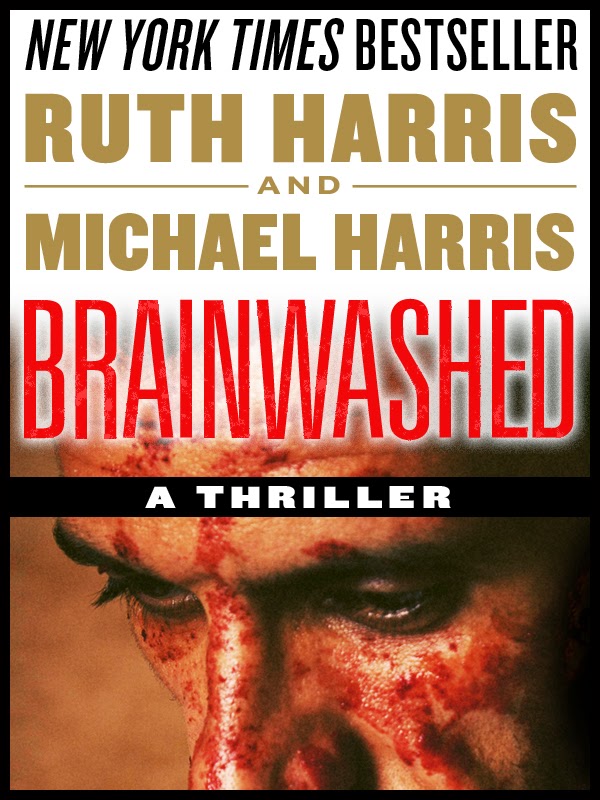
With a plot that hurtles forward at electric speed, BRAINWASHED takes place on the beautiful islands of the Caribbean, in Damascus and Ireland, the Philippines, Canada, Washington, DC--and in an underground torture chamber located on Victor Ressid's secluded private estate.
"BRAINWASHED delivers the goods: thrills, gut-churning suspense, nightmarish terror. Ruth and Michael Harris have delivered another great read and sure bestseller. I dare you to put it down!" --Bob Mayer, former Green Beret and million-copy bestselling author of AREA 51
OPPORTUNITY ALERTS
SCHNEIDER FAMILY BOOK AWARDS: NO ENTRY FEE. These awards honor an author or illustrator for a book that embodies an artistic expression of the disability experience for child and adolescent audiences. Three awards of $5000 each will be given annually in each of the following categories: birth through grade school (age 0-10), middle school (age 11-13) and teens (age 13-18). May be fiction, biography, or other form of nonfiction. Deadline December 1, 2014.
TENNESSEE WILLIAMS LITERARY FESTIVAL SHORT FICTION CONTEST $25 ENTRY FEE. Submit a short story, up to 7000 words. Grand Prize: $1,500, plus airfare (up to $500) and accommodations for the next Festival in New Orleans, VIP All-Access Festival pass for the next Festival ($500 value), plus publication in Louisiana Cultural Vistas magazine. Contest is open only to writers who have not yet published a book of fiction. Deadline November 16th.
For NEW WRITERS! THE FICTION DESK NEWCOMER'S PRIZE ENTRY FEE £8. First prize £500, second prize £250. Short fiction from 1,000 - 5,000 words. Writers should not have been previously published by The Fiction Desk, and should not have published a novel or collection of short stories in printed form. Deadline October 31st.
GLIMMER TRAIN VERY SHORT FICTION AWARD $15 fee. Maximum length: 3,000 words. 1st place wins $1,500, publication in Glimmer Train Stories, and 20 copies of that issue. 2nd place wins $500 (or, if accepted for publication, $700 and 10 copies). 3rd place wins $300 (or, if accepted for publication, $700 and 10 copies). Deadline October 31.
Writer's Digest Popular Fiction Awards . Choose from Romance, Thriller, Crime, Horror, Science-Fiction and Young Adult. 4,000 words or less. The $25 entry fee is steep, but the grand prize is $2500 plus a trip to the annual conference, and the prestige is awesome. Deadline October 15th.

September 21, 2014
10 Things that Red-Flag a Newbie Novelist
by Anne R. Allen
Beginning novelists are like Tolstoy's happy families. They tend to be remarkably alike. Certain mistakes are common to almost all beginners. These things aren't necessarily wrong, but they are difficult to do well—and get in the way of smooth storytelling
They also make it easy for professionals—and a lot of readers—to spot the unseasoned newbie.
When I worked as an editor, I ran into the same problems in nearly every new novelist's work—the very things I did when I was starting out.
I think some of the patterns come from imitating the classics. In the days of Dickens and Tolstoy, novels were written to be savored on long winter nights or languid summer days when there was a lot of time to be filled. Detailed descriptions took readers out of their mundane lives and off to exotic lands or into the homes of the very rich and very poor where they wouldn't be invited otherwise.
Books were expensive, so people wanted them to last as long as possible. They didn't mind flipping back and forth to find out if Razumihin, Dmitri Prokofitch, and Vrazumihin were in fact, all the same person. They were okay with immersing themselves in long descriptions and philosophical digressions before they found out what happened to Little Nell.
The alternative was probably staring at the fire or listening to Aunt Lavinia snore.
But in the electronic age...not so much. Your readers have the world's libraries at their fingertips, and if you bore them or confuse them for even a minute, they're already clicking away to buy the next shiny 99c book.
Whether you're querying agents and editors or you're planning to self-publish, you need to write for the contemporary reader. And that means "leaving out the parts that readers skip" as Elmore Leonard said.
Agents and readers aren't going to want to wade through a practice novel. They want polished work.
All beginners make mistakes. Falling down and making a mess is part of any learning process. But you don’t have to display the mess to the world. Unfortunately easy electronic self-publishing tempts us to do just that.
But don't. As I said two weeks ago, it takes the same amount of time to learn to write as it did before the electronic age.
Here are some tell-tale signs that a writer is still in the learning phase of a career.
I'm not saying these things are "wrong". They're just overdone or tough for a beginner to do well.
1) Show-offy prose
Those long, gorgeous descriptions that got so much praise from your high school English teacher and your critique group can unfortunately be a turn-off for the paying customer who’s digging around for some kind of narrative thread or reason to care.
People read novels to be entertained, not to fulfill the needs of the novelist. If you're writing because you crave admiration, you're in the wrong business. The reader's right to a story—not the novelist's ego—has to come first.
If there's no story, no amount of verbal curleques will keep the reader interested. Give us story first, and then add embellishments. But not too many.
Also, even though it may be really fun to start every chapter with a Latin epigraph from Ovid's Metamorphoses, unless it’s really important to the plot, this will probably annoy rather than impress readers.
Ditto oblique references to Joyce's Ulysses or anything by Marcel Proust. People want to be entertained, not take a World Lit quiz. (And yes, I went there myself. Originally, every chapter title of The Gatsby Game was a quote from F. Scott Fitzgerald. Nobody cared.)
2) Head-hopping
Point of view is one of the toughest things for a new writer to master. Omniscient point of view is the hardest to do well, because it leads to confusion for the reader.
But a lot of beginners write in omniscient because they haven't mastered the art of showing multiple characters' actions through the eyes of the protagonist.
But be aware that third-person-limited narration (when you're only privy to the thoughts and feelings of the protagonist) is the norm in modern fiction (with first person a close second in YA.) If you use anything else, your writing skills need to be superb or you'll leave the reader confused and annoyed.
And you'll red-flag yourself as a beginner.
3) Episodic storytelling
I think nearly every writer's first novel has this problem. Mine sure did.
I could never end it, because it didn’t actually have a single plot. It was a series of related episodes, like a TV series—the old fashioned kind that didn't have a season story arc.
Critique groups often don’t catch this problem, if each episode has a nice dramatic arc of its own.
Every piece of narrative has to start with an inciting incident that triggers ALL the action in the story, until it reaches a satisfying resolution at the end. It's called a story arc.
If you don't have a story arc, you don't have a novel. You have a series of linked stories or vignettes. But novel readers want one big question to propel them through the story and keep them turning the pages.
The writer who blogs as Mooderino has a great post on why we want to avoid episodic narrative, even though it worked with some classics like Alice in Wonderland.
4) Info-dumps and "As you Know Bob" conversation
When the first five pages of a book are used for exposition—telling us the names of characters, what they look like, what they do for a living, and details of their backstories—before we get into a scene, you know you're not dealing with a professional.
Exposition (background information) needs to be filtered in slowly while we're immersed in scenes that have action and conflict. This takes skill. The kind that comes with lots of practice.
Another big clue is info-dumping in conversation, often called "as-you-know-Bob":
"As you know, Bob, we're here investigating the murder of Mrs. Gilhooley, the 60-year-old librarian at Springfield High School, who may have been poisoned by one Ambrose Wiley, an itinerant preacher who brought her a Diet Dr. Pepper on August third…."
Thing is, Bob knows why he's there. He's a forensics expert, not an Alzheimer's patient. Putting this stuff in dialogue insults the reader's intelligence, since nobody would say this stuff in real life. (In spite of the fact you hear an awful lot of it on those CSI TV shows.)
5) Mundane dialogue and transitional scenes that don't further the action.
All that “hello-how-are-you-fine-and-you-nice-weather” dialogue may be realistic, but it’s also snoozifying.
Readers don’t care about “realism” if it doesn’t further the plot. As James Patterson, the bestselling author in the world says, "realism is overrated." Readers want "just the good parts."
That also means skipping the trip from the police station to the crime scene and the lunch breaks when nothing happens except the MC doing some heavy musing and doughnut chomping.
Ditto the endless meetings or arguments where people come to decisions after tedious deliberation. Those are an exception to the rule of "show don't tell." Let us know the outcome, not the snoozerific details.
Just make a break in the page and plunge us into the next scene.
6) Tom Swifties and too many dialogue tags
The writer who strains to avoid the word “said” can rapidly slide into bad pun territory, as in the archetypal example from the old "Tom Swift" boys' books: "'We must run,' exclaimed Tom swiftly."
They were turned into a silly game in the 1960s, promoted by Time Magazine, which invited the public to submit outrageous Tom Swifties like:
"Careful with that chainsaw," Tom said offhandedly.
"I might as well be dead," Tom croaked.
So we don't want to go there by accident. Bad dialogue tags may have crept into your consciousness at an early age from those Tom Swift, Nancy Drew and Hardy Boys books. The books were great fun—I adored them myself—but they were written by a stable of underpaid hacks and although the characters are classic, the prose is not.
"Said" is invisible to the reader. Almost any other dialogue tag draws attention to itself.
Very often the tag can be eliminated entirely. This allows your characters to speak and THEN act, rather than doing the two simultaneously.
Not so swift:
"We must run," exclaimed Tom swiftly.
Better, but awkward.
"We must run!" said Tom, sprinting ahead."
Best:
"We must run!" Tom sprinted ahead.
7) Mary Sues
A Mary Sue is a character who’s a stand-in for the writer’s idealized self, which makes the story a wish-fulfillment fantasy for the author, but a snooze for the reader.
Mary Sue is beautiful. Everybody loves her. She always saves the day. She has no faults. Except she’s boring and completely unbelievable. For more on this, check out the post on Mary Sue and her little friends I wrote last month.
8) Imprecise word usage and incorrect spelling and grammar
Unfortunately, agents and the buying public aren't your third grade teacher; they won’t give you a gold star just to boost your self-esteem.
Spelling and grammar count. Words are your tools.
If you don’t know the difference between lie and lay or aesthetic and ascetic and you like to sprinkle apostrophes willy-nilly amongst the letters, make sure you find somebody who's got that stuff under control before you self-publish or send off your ms. to an agent.
Nobody is going to "give you a break" because it's your first novel. Practice novels belong in a drawer, not the marketplace. If people are spending their money and time on your book, they deserve to have a professional product.
Electronic grammar checks can only do so much. And they’re often wrong. Buy a grammar book. Take an online course. Not everybody was a good student in elementary school, but you'll need to brush up on your skills if this is going to be your profession. Even a good editor can’t do everything.
9) Clichéd openings
People who read a lot (like agents and editors) have seen some things so often they immediately get turned off. Even if it's a perfectly good idea. The problem comes when a whole bunch of people have had the same good idea before you.
The most common is the “alarm clock” opening—your protagonist waking up—the favorite cliché of all beginning storytellers, whether short story, novel, or script. There’s a hilarious video on this from the comedians at Script Cops They say, “78 % of all student films start with an alarm clock going off.”
Here are some other openers too many writers have done already:
Weather reports: it's fine to give us a sketch of the setting, but not more than a sentence or two.Trains, planes and automobiles: if your character is en route and musing about where he’s been and where he’s going, you’re not into your story yet. Jump ahead to where the story really starts.Funerals: a huge number of manuscripts—especially memoirs—start with the protagonist in a state of bereavement. If you use this opening, make sure you've got a fresh take.Dreams: we're plunged into the middle of a rip-roaring scene, only to find out on page five that it's only a dream. Readers feel cheated."If only I’d known…" or "If I hadn't been..." starting with the conditional perfect seems so clever—I used to love this one—but unfortunately a lot of other writers do too.Personal introductions: starting with "my name is…" has been overdone, especially in YA.Group activities: don’t overwhelm your reader with too many characters right off the bat. Internal monologue: don’t muse. Bring in backstory later.The protagonist looking in the mirror describing herself: In fact, you don't need as much physical description of the characters as you think. Just give us one or two strong characteristics that set them apart. Let the reader's imagination fill in the blanks.Too much action: Yes, the experts keep telling us to start with a bang. But if too much banging is going on before we get to know the characters, readers won't care. If you use one of these openers in an especially clever and original way, you may get away with it. But be aware they are red flags, and many people won't go on to find out what a great story you have to tell.
For more on this, Jami Gold has a great post this week on how to avoid cliches in your opener.
10) Wordiness
There’s a reason agents and publishers are wary of long books. New writers tend to take 100 words to say what seasoned writers can say in 10. If your prose is weighty with adjectives and adverbs or clogged with details and repetitive scenes, you’ll turn off readers as well.
Remember a novel is a kind of contract between writer and reader. If you are writing to fulfill your own needs, not those of the reader, you're breaking that contract. They'll feel cheated. And they will probably let you know.
If you’re still doing any of these things, RELAX! Enjoy writing for its own sake a while longer. Read more books on craft. Build inventory. You really do need at least two manuscripts in the hopper before you launch your career.
And hey, you don’t have to become a marketer just yet. Isn’t that good news?
For more on this, Sarah Allen has a great post this week on Top 7 Mistakes that Make Your Writing Look Unprofessional.
How about you, scriveners? What mistakes did you make when you were starting out? As a reader, what amateurish red flags make you start to feel nervous about buying a book?
BOOK OF THE WEEK
I have a new boxed set! My three Boomer Books are now available in one boxed set. The intro price is only 99c!
That's 33c a book!
Available at Amazon US, Amazon UK, Amazon CA, Inktera, Nook, Kobo, and Scribd (iTunes coming soon.)
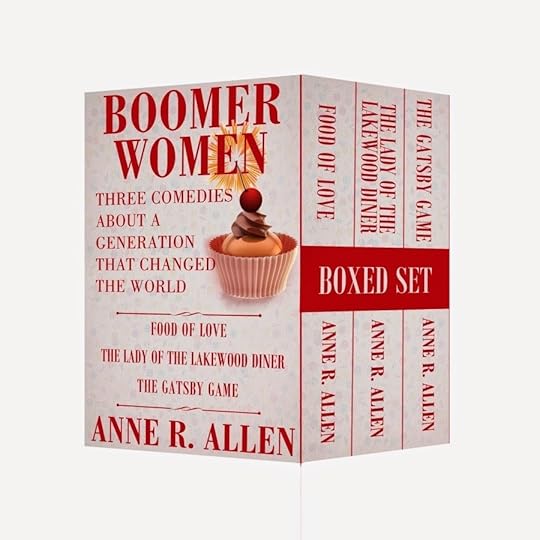
The Boomer Women Trilogy
The Leaders of the Twenty-First Century was the original title for the manuscript that branched into three and became Food of Love, The Lady of the Lakewood Diner and The Gatsby Game. It would be a terrible title, of course, because it sounds too dry and pretentious for a bunch of comedies.
But the phrase has excellent comic credentials. It comes from Mickey Mouse himself. The original Mickey Mouse Club TV program always signed off with the inspiring proclamation that the show was "dedicated to you, the leaders of the twenty-first century!"
When my little girlfriends and I giggled in our basement "rec rooms," mesmerized by the addictive new show, it never occurred to us the announcer wasn't talking to us as much as to our brothers. We didn't see any women leaders around us, but somehow, the magic of Disney was going to propel us all to new heights. My best friend planned to be a doctor and I wanted to be a famous writer. Or maybe princess of the world.
The heroines of these three novels, Congresswoman Rev. Cady Stanton, Princess Regina of San Montinaro, diner owner Dodie Hannigan Codere, rock star Morgan le Fay, and sporting goods CEO Nicky Conway are powerful yet vulnerable (and I hope funny) women who represent those Baby Boomer women who watched the Mickey Mouse Club with me.
Our mothers, who fought WWII on the home front only to be lured out of the workplace to a life of suburban housewifery, often saw our generation as entitled and self-involved. But as my character Dodie Hannigan said in the first version of the manuscript:
"We're called Boomers, but it wasn't us that did the booming—that was our parents. We just showed up nine months later and got plunked in front of those brand new TVs."
We were born at the dawn of the television age to become Madison Avenue's most coveted "target demographic." Advertising campaigns and kid-centric programming made us the first generation to be given a collective identity separate from family or community.
And for good or ill, they made us who we have become: women who have demanded to be treated as equals by the other half of the human race.
I know it's still something of a taboo to write novels—especially romantic comedies—about women "of a certain age," but Boomer women have been breaking rules since the Mickey Mouse Club proclaimed our destiny. I hope you'll enjoy their stories.
OPPORTUNITY ALERTS
SCHNEIDER FAMILY BOOK AWARDS: NO ENTRY FEE. These awards honor an author or illustrator for a book that embodies an artistic expression of the disability experience for child and adolescent audiences. Three awards of $5000 each will be given annually in each of the following categories: birth through grade school (age 0-10), middle school (age 11-13) and teens (age 13-18). May be fiction, biography, or other form of nonfiction. Deadline December 1, 2014.
TENNESSEE WILLIAMS LITERARY FESTIVAL SHORT FICTION CONTEST $25 ENTRY FEE. Submit a short story, up to 7000 words. Grand Prize: $1,500, plus airfare (up to $500) and accommodations for the next Festival in New Orleans, VIP All-Access Festival pass for the next Festival ($500 value), plus publication in Louisiana Cultural Vistas magazine. Contest is open only to writers who have not yet published a book of fiction. Deadline November 16th, 2014.
For NEW WRITERS! THE FICTION DESK NEWCOMER'S PRIZE ENTRY FEE £8. First prize £500, second prize £250. Short fiction from 1,000 - 5,000 words. Writers should not have been previously published by The Fiction Desk, and should not have published a novel or collection of short stories in printed form. Deadline October 31st.
GLIMMER TRAIN VERY SHORT FICTION AWARD $15 fee. Maximum length: 3,000 words. 1st place wins $1,500, publication in Glimmer Train Stories, and 20 copies of that issue. 2nd place wins $500 (or, if accepted for publication, $700 and 10 copies). 3rd place wins $300 (or, if accepted for publication, $700 and 10 copies). Deadline October 31, 2014.
RIVER TEETH'S BOOK PRIZE for Literary Nonfiction. The $27 ENTRY FEE is a little steeper than we usually list, but this is for a full book-length manuscript. River Teeth's editors and editorial board conduct a yearly national contest to identify the best book-length literary nonfiction. The winner will receive $1,000 and publication. Deadline October 15, 2014.
Beginning novelists are like Tolstoy's happy families. They tend to be remarkably alike. Certain mistakes are common to almost all beginners. These things aren't necessarily wrong, but they are difficult to do well—and get in the way of smooth storytelling
They also make it easy for professionals—and a lot of readers—to spot the unseasoned newbie.
When I worked as an editor, I ran into the same problems in nearly every new novelist's work—the very things I did when I was starting out.
I think some of the patterns come from imitating the classics. In the days of Dickens and Tolstoy, novels were written to be savored on long winter nights or languid summer days when there was a lot of time to be filled. Detailed descriptions took readers out of their mundane lives and off to exotic lands or into the homes of the very rich and very poor where they wouldn't be invited otherwise.
Books were expensive, so people wanted them to last as long as possible. They didn't mind flipping back and forth to find out if Razumihin, Dmitri Prokofitch, and Vrazumihin were in fact, all the same person. They were okay with immersing themselves in long descriptions and philosophical digressions before they found out what happened to Little Nell.
The alternative was probably staring at the fire or listening to Aunt Lavinia snore.
But in the electronic age...not so much. Your readers have the world's libraries at their fingertips, and if you bore them or confuse them for even a minute, they're already clicking away to buy the next shiny 99c book.
Whether you're querying agents and editors or you're planning to self-publish, you need to write for the contemporary reader. And that means "leaving out the parts that readers skip" as Elmore Leonard said.
Agents and readers aren't going to want to wade through a practice novel. They want polished work.
All beginners make mistakes. Falling down and making a mess is part of any learning process. But you don’t have to display the mess to the world. Unfortunately easy electronic self-publishing tempts us to do just that.
But don't. As I said two weeks ago, it takes the same amount of time to learn to write as it did before the electronic age.
Here are some tell-tale signs that a writer is still in the learning phase of a career.
I'm not saying these things are "wrong". They're just overdone or tough for a beginner to do well.
1) Show-offy prose
Those long, gorgeous descriptions that got so much praise from your high school English teacher and your critique group can unfortunately be a turn-off for the paying customer who’s digging around for some kind of narrative thread or reason to care.
People read novels to be entertained, not to fulfill the needs of the novelist. If you're writing because you crave admiration, you're in the wrong business. The reader's right to a story—not the novelist's ego—has to come first.
If there's no story, no amount of verbal curleques will keep the reader interested. Give us story first, and then add embellishments. But not too many.
Also, even though it may be really fun to start every chapter with a Latin epigraph from Ovid's Metamorphoses, unless it’s really important to the plot, this will probably annoy rather than impress readers.
Ditto oblique references to Joyce's Ulysses or anything by Marcel Proust. People want to be entertained, not take a World Lit quiz. (And yes, I went there myself. Originally, every chapter title of The Gatsby Game was a quote from F. Scott Fitzgerald. Nobody cared.)
2) Head-hopping
Point of view is one of the toughest things for a new writer to master. Omniscient point of view is the hardest to do well, because it leads to confusion for the reader.
But a lot of beginners write in omniscient because they haven't mastered the art of showing multiple characters' actions through the eyes of the protagonist.
But be aware that third-person-limited narration (when you're only privy to the thoughts and feelings of the protagonist) is the norm in modern fiction (with first person a close second in YA.) If you use anything else, your writing skills need to be superb or you'll leave the reader confused and annoyed.
And you'll red-flag yourself as a beginner.
3) Episodic storytelling
I think nearly every writer's first novel has this problem. Mine sure did.
I could never end it, because it didn’t actually have a single plot. It was a series of related episodes, like a TV series—the old fashioned kind that didn't have a season story arc.
Critique groups often don’t catch this problem, if each episode has a nice dramatic arc of its own.
Every piece of narrative has to start with an inciting incident that triggers ALL the action in the story, until it reaches a satisfying resolution at the end. It's called a story arc.
If you don't have a story arc, you don't have a novel. You have a series of linked stories or vignettes. But novel readers want one big question to propel them through the story and keep them turning the pages.
The writer who blogs as Mooderino has a great post on why we want to avoid episodic narrative, even though it worked with some classics like Alice in Wonderland.
4) Info-dumps and "As you Know Bob" conversation
When the first five pages of a book are used for exposition—telling us the names of characters, what they look like, what they do for a living, and details of their backstories—before we get into a scene, you know you're not dealing with a professional.
Exposition (background information) needs to be filtered in slowly while we're immersed in scenes that have action and conflict. This takes skill. The kind that comes with lots of practice.
Another big clue is info-dumping in conversation, often called "as-you-know-Bob":
"As you know, Bob, we're here investigating the murder of Mrs. Gilhooley, the 60-year-old librarian at Springfield High School, who may have been poisoned by one Ambrose Wiley, an itinerant preacher who brought her a Diet Dr. Pepper on August third…."
Thing is, Bob knows why he's there. He's a forensics expert, not an Alzheimer's patient. Putting this stuff in dialogue insults the reader's intelligence, since nobody would say this stuff in real life. (In spite of the fact you hear an awful lot of it on those CSI TV shows.)
5) Mundane dialogue and transitional scenes that don't further the action.
All that “hello-how-are-you-fine-and-you-nice-weather” dialogue may be realistic, but it’s also snoozifying.
Readers don’t care about “realism” if it doesn’t further the plot. As James Patterson, the bestselling author in the world says, "realism is overrated." Readers want "just the good parts."
That also means skipping the trip from the police station to the crime scene and the lunch breaks when nothing happens except the MC doing some heavy musing and doughnut chomping.
Ditto the endless meetings or arguments where people come to decisions after tedious deliberation. Those are an exception to the rule of "show don't tell." Let us know the outcome, not the snoozerific details.
Just make a break in the page and plunge us into the next scene.
6) Tom Swifties and too many dialogue tags
The writer who strains to avoid the word “said” can rapidly slide into bad pun territory, as in the archetypal example from the old "Tom Swift" boys' books: "'We must run,' exclaimed Tom swiftly."
They were turned into a silly game in the 1960s, promoted by Time Magazine, which invited the public to submit outrageous Tom Swifties like:
"Careful with that chainsaw," Tom said offhandedly.
"I might as well be dead," Tom croaked.
So we don't want to go there by accident. Bad dialogue tags may have crept into your consciousness at an early age from those Tom Swift, Nancy Drew and Hardy Boys books. The books were great fun—I adored them myself—but they were written by a stable of underpaid hacks and although the characters are classic, the prose is not.
"Said" is invisible to the reader. Almost any other dialogue tag draws attention to itself.
Very often the tag can be eliminated entirely. This allows your characters to speak and THEN act, rather than doing the two simultaneously.
Not so swift:
"We must run," exclaimed Tom swiftly.
Better, but awkward.
"We must run!" said Tom, sprinting ahead."
Best:
"We must run!" Tom sprinted ahead.
7) Mary Sues
A Mary Sue is a character who’s a stand-in for the writer’s idealized self, which makes the story a wish-fulfillment fantasy for the author, but a snooze for the reader.
Mary Sue is beautiful. Everybody loves her. She always saves the day. She has no faults. Except she’s boring and completely unbelievable. For more on this, check out the post on Mary Sue and her little friends I wrote last month.
8) Imprecise word usage and incorrect spelling and grammar
Unfortunately, agents and the buying public aren't your third grade teacher; they won’t give you a gold star just to boost your self-esteem.
Spelling and grammar count. Words are your tools.
If you don’t know the difference between lie and lay or aesthetic and ascetic and you like to sprinkle apostrophes willy-nilly amongst the letters, make sure you find somebody who's got that stuff under control before you self-publish or send off your ms. to an agent.
Nobody is going to "give you a break" because it's your first novel. Practice novels belong in a drawer, not the marketplace. If people are spending their money and time on your book, they deserve to have a professional product.
Electronic grammar checks can only do so much. And they’re often wrong. Buy a grammar book. Take an online course. Not everybody was a good student in elementary school, but you'll need to brush up on your skills if this is going to be your profession. Even a good editor can’t do everything.
9) Clichéd openings
People who read a lot (like agents and editors) have seen some things so often they immediately get turned off. Even if it's a perfectly good idea. The problem comes when a whole bunch of people have had the same good idea before you.
The most common is the “alarm clock” opening—your protagonist waking up—the favorite cliché of all beginning storytellers, whether short story, novel, or script. There’s a hilarious video on this from the comedians at Script Cops They say, “78 % of all student films start with an alarm clock going off.”
Here are some other openers too many writers have done already:
Weather reports: it's fine to give us a sketch of the setting, but not more than a sentence or two.Trains, planes and automobiles: if your character is en route and musing about where he’s been and where he’s going, you’re not into your story yet. Jump ahead to where the story really starts.Funerals: a huge number of manuscripts—especially memoirs—start with the protagonist in a state of bereavement. If you use this opening, make sure you've got a fresh take.Dreams: we're plunged into the middle of a rip-roaring scene, only to find out on page five that it's only a dream. Readers feel cheated."If only I’d known…" or "If I hadn't been..." starting with the conditional perfect seems so clever—I used to love this one—but unfortunately a lot of other writers do too.Personal introductions: starting with "my name is…" has been overdone, especially in YA.Group activities: don’t overwhelm your reader with too many characters right off the bat. Internal monologue: don’t muse. Bring in backstory later.The protagonist looking in the mirror describing herself: In fact, you don't need as much physical description of the characters as you think. Just give us one or two strong characteristics that set them apart. Let the reader's imagination fill in the blanks.Too much action: Yes, the experts keep telling us to start with a bang. But if too much banging is going on before we get to know the characters, readers won't care. If you use one of these openers in an especially clever and original way, you may get away with it. But be aware they are red flags, and many people won't go on to find out what a great story you have to tell.
For more on this, Jami Gold has a great post this week on how to avoid cliches in your opener.
10) Wordiness
There’s a reason agents and publishers are wary of long books. New writers tend to take 100 words to say what seasoned writers can say in 10. If your prose is weighty with adjectives and adverbs or clogged with details and repetitive scenes, you’ll turn off readers as well.
Remember a novel is a kind of contract between writer and reader. If you are writing to fulfill your own needs, not those of the reader, you're breaking that contract. They'll feel cheated. And they will probably let you know.
If you’re still doing any of these things, RELAX! Enjoy writing for its own sake a while longer. Read more books on craft. Build inventory. You really do need at least two manuscripts in the hopper before you launch your career.
And hey, you don’t have to become a marketer just yet. Isn’t that good news?
For more on this, Sarah Allen has a great post this week on Top 7 Mistakes that Make Your Writing Look Unprofessional.
How about you, scriveners? What mistakes did you make when you were starting out? As a reader, what amateurish red flags make you start to feel nervous about buying a book?
BOOK OF THE WEEK
I have a new boxed set! My three Boomer Books are now available in one boxed set. The intro price is only 99c!
That's 33c a book!
Available at Amazon US, Amazon UK, Amazon CA, Inktera, Nook, Kobo, and Scribd (iTunes coming soon.)
.jpg)
The Boomer Women Trilogy
The Leaders of the Twenty-First Century was the original title for the manuscript that branched into three and became Food of Love, The Lady of the Lakewood Diner and The Gatsby Game. It would be a terrible title, of course, because it sounds too dry and pretentious for a bunch of comedies.
But the phrase has excellent comic credentials. It comes from Mickey Mouse himself. The original Mickey Mouse Club TV program always signed off with the inspiring proclamation that the show was "dedicated to you, the leaders of the twenty-first century!"
When my little girlfriends and I giggled in our basement "rec rooms," mesmerized by the addictive new show, it never occurred to us the announcer wasn't talking to us as much as to our brothers. We didn't see any women leaders around us, but somehow, the magic of Disney was going to propel us all to new heights. My best friend planned to be a doctor and I wanted to be a famous writer. Or maybe princess of the world.
The heroines of these three novels, Congresswoman Rev. Cady Stanton, Princess Regina of San Montinaro, diner owner Dodie Hannigan Codere, rock star Morgan le Fay, and sporting goods CEO Nicky Conway are powerful yet vulnerable (and I hope funny) women who represent those Baby Boomer women who watched the Mickey Mouse Club with me.
Our mothers, who fought WWII on the home front only to be lured out of the workplace to a life of suburban housewifery, often saw our generation as entitled and self-involved. But as my character Dodie Hannigan said in the first version of the manuscript:
"We're called Boomers, but it wasn't us that did the booming—that was our parents. We just showed up nine months later and got plunked in front of those brand new TVs."
We were born at the dawn of the television age to become Madison Avenue's most coveted "target demographic." Advertising campaigns and kid-centric programming made us the first generation to be given a collective identity separate from family or community.
And for good or ill, they made us who we have become: women who have demanded to be treated as equals by the other half of the human race.
I know it's still something of a taboo to write novels—especially romantic comedies—about women "of a certain age," but Boomer women have been breaking rules since the Mickey Mouse Club proclaimed our destiny. I hope you'll enjoy their stories.
OPPORTUNITY ALERTS
SCHNEIDER FAMILY BOOK AWARDS: NO ENTRY FEE. These awards honor an author or illustrator for a book that embodies an artistic expression of the disability experience for child and adolescent audiences. Three awards of $5000 each will be given annually in each of the following categories: birth through grade school (age 0-10), middle school (age 11-13) and teens (age 13-18). May be fiction, biography, or other form of nonfiction. Deadline December 1, 2014.
TENNESSEE WILLIAMS LITERARY FESTIVAL SHORT FICTION CONTEST $25 ENTRY FEE. Submit a short story, up to 7000 words. Grand Prize: $1,500, plus airfare (up to $500) and accommodations for the next Festival in New Orleans, VIP All-Access Festival pass for the next Festival ($500 value), plus publication in Louisiana Cultural Vistas magazine. Contest is open only to writers who have not yet published a book of fiction. Deadline November 16th, 2014.
For NEW WRITERS! THE FICTION DESK NEWCOMER'S PRIZE ENTRY FEE £8. First prize £500, second prize £250. Short fiction from 1,000 - 5,000 words. Writers should not have been previously published by The Fiction Desk, and should not have published a novel or collection of short stories in printed form. Deadline October 31st.
GLIMMER TRAIN VERY SHORT FICTION AWARD $15 fee. Maximum length: 3,000 words. 1st place wins $1,500, publication in Glimmer Train Stories, and 20 copies of that issue. 2nd place wins $500 (or, if accepted for publication, $700 and 10 copies). 3rd place wins $300 (or, if accepted for publication, $700 and 10 copies). Deadline October 31, 2014.
RIVER TEETH'S BOOK PRIZE for Literary Nonfiction. The $27 ENTRY FEE is a little steeper than we usually list, but this is for a full book-length manuscript. River Teeth's editors and editorial board conduct a yearly national contest to identify the best book-length literary nonfiction. The winner will receive $1,000 and publication. Deadline October 15, 2014.


