
Cynthia Sally Haggard's Blog: Cynthia Sally's Blog, page 44
January 25, 2021
KATHERYN HOWARD THE SCANDALOUS QUEEN by Alison Weir, narrated by Rosalyn Landor
Before I begin this review about Alison Weir’s latest historical novel about the six wives of Henry VIII, I would like to commend Recorded Books for doing a fantastic job of cutting the audio tapes so that the story flows seamlessly without any ugly jerks (which is what happens when no space is given between one section and the next.) I also want to compliment narrator Rosalyn Landor for her outstanding achievement in conveying the personality of the characters. She does a very good Henry VIII (he always sounds as if he’s making a speech) and conveys the youth and beauty of Katheryn, with the beauty of her voice. So I highly recommend this piece as an audiobook.
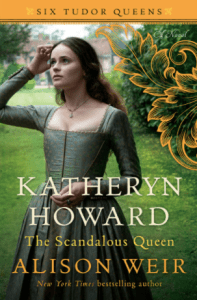 Now to the way in which Alison Weir chose to tell her tale. Of course I have great respect for the amount of research that she always does as well as her narrative style, which has become more compelling over the years. But I have to say I was somewhat disappointed in the tale she chose to tell. IMHO there is a much more compelling and darker narrative about Katheryn Howard, the tragic fifth wife of Henry VIII, which Ms. Weir just plain ignored.
First of all, it is my understanding that we are not quite sure when Katheryn Howard was born. Ms. Weir chooses the traditional date of 1521 and places her birth in the month of February, which would make her 19 when she married Henry in July 1540. However, other sources suggest that she was born in 1523 or 1524, possibly in late November (St. Katherine’s Day is November 25) which would have made her 15 or 16 when she married Henry.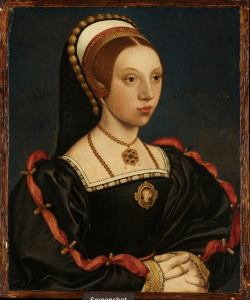
The other issue has to do with her upbringing in her grandmother’s establishment. Poor Katheryn lost her mother in 1528 when she was very young, and her father was a feckless sort who was constantly away (he spent several years in Calais, France.) So she was shipped off to her father’s stepmother Agnes Howard, Dowager Duchess of Norfolk. This seemingly was a wonderful opportunity for Katheryn, who was a poor relative. Unfortunately, Agnes had many poor female relatives in her establishment, and she may have considered them to be an undue burden as it was her duty to find husbands for them all AND to give them dowries. For whatever reason, Agnes preferred to spend her time at court, and let these women while away their existence in a kind of gilded captivity, as they were unable to do anything with their lives while husbandless. As many of them realized that Agnes was NOT going to find them husbands, they took it upon themselves to find men, whom they would invite into the “Maiden’s Chamber” (where they all slept) late at night, entertain them with stolen food and wine, and of course one thing led to another…
This situation was ripe for child abuse, especially as Katheryn was much younger than many of these women, but Ms. Weir chose to treat Katheryn as a typical teenager with raging hormones who willingly acquired one lover after another. However, there is a darker story to be told. It is possible that Katheryn was an unwilling victim of these much older men (some of whom were in their late twenties or early thirties) and that she may have been raped and abused first by her music master Henry Mannox, then by her cousins Francis Dereham and Thomas Culpeper.
If this scenario were true, then Katheryn’s story is a tragic tale of child abuse followed by forced marriage to a man who was over 30 years her senior, a heady rush to power followed by blackmail on the part of her rapists who brought her (and themselves down.) Predictably this story ends on the chopping block both for Katheryn and her tormenters. This unspeakable tragedy also explains why Katheryn was so eager to see husband Henry VIII when her world came tumbling down in early November 1541 (when she was 16 or 17.) But Henry never heard about her child abuse, because his guards dragged her away screaming.
I was so hoping that Alison Weir would devote her powers of research to this story, which has been proposed by historians Retha M. Warnicke and Conor Byrne. But it was not to be. Three stars.


January 24, 2021
Reading Sundays: THE WAYWARD DAUGHTER (Part 2) a short story by Cynthia Sally Haggard
When Papa quit farming and became a manure salesman, my family thrived. It was the secret to our wealth. We were finally able to leave New Hampshire and make a better life for ourselves in Europe. I lifted my eyes to meet their questioning looks.
“New Hampshire is a place of such quiet simplicity,” I remarked.
“It sounds charming.” Louisa turned the page of her sketchbook, showing another flower, this time a Tiger Lily.
“It must be a hard thing for a mother to have to leave her child,” Letitia remarked, putting her teacup down.
“Indeed,” I murmured, scrutinizing Louisa’s pencil sketch, my mind focused on where it should go in the garden.
Laura Mollington, who was seated next to me, tittered. “We’re talking about your child, Mary Emelin, dear.”
I was so taken aback that I stared at her for several moments. But her large gray eyes never left my face. I have a bad habit of letting my mouth hang open when I’m surprised, and as her expression changed from curiosity to disapproval, I shut my mouth, my cheeks warming as I did so.
Lucy Alvanley put her hand on my arm. “We heard that you had to leave your child back in America when your husband died.”
“But I don’t…didn’t have a husband in New Hampshire,” I stuttered. “Nor a child.”
They looked at me speculatively, the expressions on their faces ranging from sympathy, through doubt to outright condemnation. I turned to Letitia Capenhurst, whose expression conveyed the most condemnation. “Who told you?” As soon as the words left my lips, I wished I’d used another phrase. For didn’t my question suggest that what they believed was true and that I was hiding a secret?
“Why, I heard it from Charlotte,” she replied bridling.
My heart sank. Charlotte Helsby was a retired lady, recently widowed. She was the very image of propriety and I scarcely knew her.
I turned to Louisa Bretton. “You don’t believe it, do you?”
She raised her dark head from her sketch pad and paused, her eyes full of sympathy.
“Charlotte never gossips,” remarked Laura Mollington. The others nodded agreement.
 Not for the first time I wished I weren’t so foreign, or that I found it easier to make friends amongst the standoffish English, or that I were back in America. What could I say? No-one knew me well enough to believe me. These ladies had no idea how lucky they were with their lives of privilege, their family connections and close friends. They had no idea what it was like to be on the outside, and saw no reason why they should make special allowances for the foreigner. Indeed, most English people treated foreigners with the greatest suspicion. It was no surprise, therefore, looked at from that angle, why these ladies might believe such an outlandish tale. The room sighed around me as the silence lengthened. Suddenly, I couldn’t bear it any more.
“But it’s not true!” I exploded. “It’s a pack of lies.”
My loud words reverberated around that quiet room.
“Dear, dear,” murmured Lucy Alvaney. “There’s no need to shout.”
I hung my head, and in that moment I knew I’d lost them. Well-bred ladies never shouted, whatever the provocation. What was wrong with me? I knew better than to show a display of temper in a London drawing-room. But I’d had too many difficulties in my life recently, and there is nothing more frustrating than trying to declare your innocence before a hostile audience. [To be continued.]
January 22, 2021
Diane Zahler’s THE THIRTEENTH PRINCESS
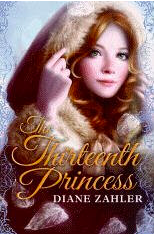 THE THIRTEENTH PRINCESS is a re-telling of THE TWELVE DANCING PRINCESSES. Set in a place which sounds vaguely German in a time that sounds vaguely like the Middle Ages, we meet Zita, the charming and delightful heroine of this tale. Red-haired Zita is the youngest (and 13th) daughter of the King. But he banishes his daughter to the kitchens because her birth caused the death of his beloved wife. Zita toils in the kitchens, learning to cook, and learning to hunt for plants that she needs for the dishes that Cook makes. Gradually, over the years, she learns that she is indeed a princess and sneaks visits to her 12 sisters, who allow her to sleep with them in their chamber.
In early adolescence she meets a boy of around her age, and a witch. At around this time, her twelve sisters begin to ail. They become pale, their slippers are in tatters and they sink into a near-coma. Zita is at her wit’s end. But with her courage and determination and the help of her friends everything ends on a mostly happy note.
Although the book has some weaknesses – the twelve princesses are almost identical and the ending is a bit perfunctory – nevertheless this is a fast, easy read that is sure to delight young girls. Four Stars.
January 20, 2021
THE MIDNIGHT DANCERS by Regina Doman
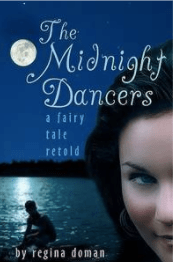 THE MIDNIGHT DANCERS is a retelling of THE TWELVE DANCING PRINCESSES set in contemporary times. Paul is a soldier who saves an older man’s life in a situation that sounds just like the recent war in Iraq or Afghanistan. Grateful, the older man asks him to come visit whenever he is in town. He reveals that he has six daughters and six step-daughters, and is worried about them. He wonders whether Paul, a young man, would be willing to help. Paul makes a promise to do what he can.
The rest of the story is told from the point-of-view of Rachel, the eldest daughter. We see 17-year-old Rachel cooking and cleaning, child-minding, aided by her sisters and step-sisters. The parents are religious and strict and every day disappears into a sea of domestic chores. Of course, the girls feel restless. Of course, they would like some fun.
Things begin to happen when one of the sisters discovers a secret passageway that leads to some stairs descending to a private beach. From there, the sister see an enticing island. They manage to persuade some local boys to bring them over in boats, where they meet a mysterious young man named Michael. But what does Michael want?
And that is as far as I will go with the plot, so as not to spoil it for everyone. I didn’t think I was going to enjoy this story, because the beginning of it is cluttered up with everyday triviality which makes it seem superficial. In fact, this novel has unexpected depths to it, so if the beginning puts you off, my advice is to persevere. You won’t be disappointed. 4 stars.
January 18, 2021
CLAIMED BY THE ENEMY by Shauna Roberts
Author Shauna Roberts knows how to tell a story. Within pages we meet the two protagonists (Princess Nindalla and farm-boy Ur-Sag-Enki) and know that these two strangers will become important to one another one day. Fast forward 15 years to the beginning of Chapter Two and Ms. Roberts’ powerful writing puts us into the sounds, smells and sights of the Akkadian army taking the city of Susa. We see Princess Nindalla about to give birth as the army breaches the walls and enters. Within her birthing hut, she has only a dim idea of what is happening. Everyone has deserted her, until a young man walks in. This is shocking as traditionally men were not allowed to be present while women give birth. But there is no-one else to help, and so he does.
Thus do Princess Nindalla and Ur-Sag-Enki finally meet.
What follows is a completely engrossing tale about the life and times of Ancient Sumeria during the period of Sargon of Akkad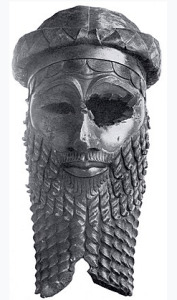 (aka Sargon the Great) circa 2334 BCE. Highly recommended. Five Stars.
January 17, 2021
Reading Sundays: THE WAYWARD DAUGHTER (Part 1) a short story by Cynthia Sally Haggard
West Kensington, London
October 1913
I don’t know what to do. People are talking about me, saying I was married before I married Spencer. They say that I left my family, my husband and child, back in New Hampshire, where I was born; that I abandoned my American family to travel to England and marry Spencer Thornton Treffry, a scion of one of the oldest families in England. They imply that my first husband is currently living, and therefore I am a bigamist and a whore, a heartless mother, the sort who would abandon her children to make a better life for herself elsewhere.
I heard this today during a meeting of the gardening committee. We are fortunate, my family and I, to live in one of those London squares which surrounds its own private garden. My actual family, Spencer, my four daughters and son, live on the Eastern side of the square, with a front parlor that gives onto the garden, drinking in the afternoon light. This morning I was seated in Louisa Bretton’s parlor on the North side of the square, with the other ladies, discussing which plants we should put in for the Spring. Louisa had made pencil sketches of the flowers she thought suitable, and was passing them around. I remember looking at a sketch of a lilac that was different from what one usually finds in English gardens, a lighter violet with more open flowers, and shaking my head.
“This reminds me of the kind of lilacs that used to grow in Mamma’s garden in Lisbon, New Hampshire,” I remarked.
“You still miss your country then.” Letitia Capenhurst looked at me over her teacup.
Instinctively, I stiffened, as usual finding her hard to read. She was soft-spoken, a small, plump, woman, with beautifully turned hands and fingers, tiny and perfect. From the outside, she looked harmless enough. There was nothing outré in her appearance, yet her soft voice had a way of giving words an odd emphasis, suggesting a faultfinding quality that belied her harmless words.
I gave a faint smile. “You must think me very foolish. I’ve been here for over twenty years, yet I miss it still. Not the cold winters of course, or the…” I paused. I didn’t want these London ladies to know how poor we really were. How could I tell them how empty the land was of people, and consequently that we had to do everything ourselves? How could I tell them that we lived in a log cabin shack with a tin roof that leaked every time it rained? How Papa tried his best to wrest a living from the stony soil of New Hampshire, how Mamma would make up all our clothes from cheap leftover material, how she cooked all our food, how we often subsisted on porridge and soup? I certainly couldn’t tell them that the gold my family found lay not in rich relatives or advantageous marriages, but in something far more earthy and ordinary…manure. No, no, no. This was not suitable talk for a London drawing-room. When Papa quit farming and became a manure salesman, my family thrived. It was the secret to our wealth. We were finally able to leave New Hampshire and make a better life for ourselves in Europe. I lifted my eyes to meet their questioning looks. [To be continued.]
January 15, 2021
Alan Bradley’s THE GOLDEN TRESSES OF THE DEAD (FLAVIA #10.)Narrated by Jayne Entwistle
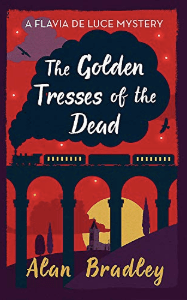 As in the last book, THE GRAVE’S A FINE AND PRIVATE PLACE, Flavia is growing up. Unfortunately, (or fortunately) this means that she is not quite the smarty-pants of yore, learning to shut her mouth and acquire a demure shield, behind which she can hide her “wicked” thoughts. Some readers will find this disappointing. They also might find her very evident crush on Dogger irritating and disappointing. But you can’t write about teens without having surging hormones making their appearance.
In this volume, eldest sister Ophelia/Feely is finally getting married. Middle sister Daphne is hiding in a book. So the only one to provide any kind of foil to Flavia (apart from Dogger) is little cousin Undine (Miss de Luce The Younger, as Flavia calls her.) Of course, Undine is exactly like Flavia, or as Flavia was when younger, and provides some of the humor of the book. But somehow the bite of the earlier volumes is gone. Flavia is now only 14 (or 12) and there are many more years to go before she finally reaches her maturity. Does that mean that every volume from now on will include crushes on Dogger, Cynthia Richardson (the vicar’s wife) and Antigone?
I hope not. Four stars.
January 13, 2021
Alan Bradley’s THE GRAVE’S A FINE AND PRIVATE PLACE (FLAVIA DE LUCE #9), narrated by Jayne Entwistle
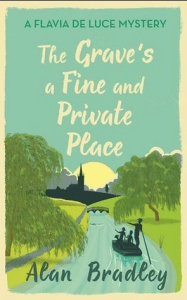 As so many readers do, I love Flavia, so was very happy to get hold of this volume. I heard it on audiobook, so my experiences may have been a little different from those who actually read a hard copy. I agree the plot was a bit thin at times, and yes, it made no sense that Mr. Nightingale (the undertaker) would actually murder Orlando because his funeral business was going bust. Especially as he really didn’t need to. From what I was able to glean, Orlando had come back to the riverbank, to the place where he’d tipped the poisoned chalice into the river two years before. Finally feeling remorse at his responsibility for the deaths of four people (including his father, who probably knew what was going on, and sacrificed himself to the hangman’s noose to save his irresponsible and feckless son) actually swallowed the cyanide BEFORE Nightingale pushed him into the river, causing him to drown (as the cyanide had not yet taken effect.)
So the cause of Orlando’s death was unnecessarily silly. OTOH, I liked the fact that Flavia is beginning to grow up, and I also liked Dogger’s character development. It made absolute sense to me that with the death of his old master (Flavia’s father) to whom he acted as valet, he should now embark on a more interesting phase of his life. I loved the idea of the detective agency, and thought it was marvelous that Flavia generously included all her relatives in the enterprise, except for eldest sister Ophelia/Feely, who is leaving home to become a married lady.
As this volume gave me several enjoyable hours, I would rate it at four stars.
January 11, 2021
A perfect example of how to hook the reader (U IS FOR UNDERTOW)
I don’t know when I first started reading the Kinsey Millhone series, but I was hooked by A IS FOR ALIBI, and have enjoyed the subsequent series enormously. It takes a lot of work and talent to write one successful book. But to have produced twenty-six really good reads is amazing.
I hadn’t read Sue Grafton for a long time, but I happened to be in a doctor’s office recently when I noticed U IS FOR UNDERTOW 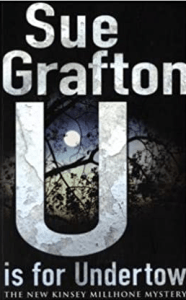 sitting on the floor under a chair. I picked it up and was immediately hooked. For those of you reading this now who want to be writers, pick up this book and read the beginning, then study it. It is a prefect example of how to hook a reader.
Now I am not really a reader of mysteries, but I left my doctor’s appointment dying to know what happened next, so I immediately bought it on Amazon and read it in about a day. This novel is about a character who may be suffering from an implanted memory. Or he might be telling the truth. At the beginning, it’s really not clear which, but Kinsey Millhone is determined to find out, and there is a very dramatic scene at the end in which she saves someone’s life. Which I won’t say more about so as not to spoil the story.
In any event, because the protagonist of this story is so unreliable, Ms. Grafton has to layer in other people’s points of view, so that the reader can make sense of what is going on. Again, if you want to write yourself, study these passage carefully as they are a good example of how to use this technique successfully. (Many new writers find this hard to do right).
If you love mysteries, read this book! Five stars.
January 10, 2021
Reading Sundays: THE NON-AFFAIR (Part 10) a short story by Cynthia Sally Haggard
“Caroline.” Father stood in the doorway of his study holding The Baltimore Sun, as I arrived home.
“I was right all along, not letting you stay at university. It is no place for respectable young women.”
I stared up into his unreadable face as he placed the paper into my hands.
“I believe this concerns one of your professors.”
The study door clicked shut behind him.
Alone in the sitting room, I leaned over the pages of The Sun.  There he is, a hazy, indefinite image, placed above the fold on the first page. I am shocked to discover that he’s only twenty-nine, nine years older than I am. I scan the page. Dr. Szczepanski, a brilliant young scholar in the Sociology department, is up for tenure, but will probably lose his job.
He is the father of an illegitimate child.
The pages slide to the ground as the back of my neck prickles. How did I miss this? I retrieve the pages, staring at the blurry words. There is a picture of a faint young woman, someone I vaguely recognize. Of course, it’s the glowering secretary. I squint at the picture, but the woman doesn’t even look particularly beautiful. Why in the world would someone like Professor Szczepanski risk everything for her?
My mind spins How could he have done it, the lecherous bastard? Could’t he keep his hands to himself? I start as I realize that he almost never touched me. I bend my head to the article, which states that although Dr. Szczepanski hasn’t openly disputed the young woman’s claim, nevertheless he is refusing to marry her. It goes on to mention that there is no dispute about Dr. Szczepanski’s conduct. He was caught red-handed with her, upon his desk.
A surge of lava-like emotion wells up in my chest, spreading fingers throughout me like thick blood oozing from a wound. I try to imagine myself back in his office. His desk squats there, a looming shadow, a barricade against an unkind world. Those who ignored the desk’s covert message to keep out, those who sat down and leaned across to chat, passed his test of friendship.
As I did.
The secretary must have been even bolder.
I sit there forever, trying to make sense of it. I thought I was special, I thought I was his star, I thought I was his protegée. I press my lips together. It is time I took charge of my life. The Sociology Department was small. Was it gossipy? Did his colleagues think that I was the one having the affair with him? Because of course, in a sense, I was. It was an Affair of the Heart. But unlike most such affairs, this one wasn’t physical.
Our currency had been glances, and silences.
THE END
The Non-Affair first appeared in The Scarlet Leaf Review.
Cynthia Sally's Blog

- Cynthia Sally Haggard's profile
- 129 followers

