
Cynthia Sally Haggard's Blog: Cynthia Sally's Blog, page 43
February 10, 2021
Kate Elizabeth Russell’s MY DARK VANESSA narrated by Grace Gummer
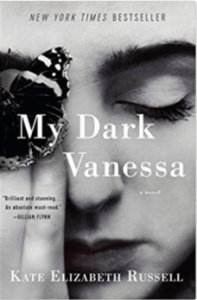 This story, about the abuse of vulnerable 15-year-old Vanessa Whye by her 42-year-old English teacher Jacob Strane, is not easy to read. It brought some people to tears.
It made me furious.
Fifteen-year-old Vanessa is bright, ambitious, gifted. She is a scholarship student at Browick, a private boarding school in Maine. Unlike most of her peers, she studies hard and gets excellent grades, especially in English.
One day, Mr. Strane calls her up to his desk. This seems entirely natural as she is his best student. He invites her to sit down next to him so that they can talk about her work. The other students are bent over an assignment they have to redo as their first efforts were below par. All, except for Vanessa, whose first effort was declared “perfect” by her demanding professor. As Vanessa has nothing to do, he embarks on a friendly chat about a poem she has just written. As they talk, he marks it up with comments. But behind that enormous desk, his other hand reaches out to touch her knee. He rewards her perfect assignment with groping. After all, he needs to assess her boundaries. Is she skittish? Does she flinch at first touch? Is she likely to scream? But Vanessa doesn’t react, and so he continues to groom her for his eventual assault on her in his bed.
With that first boundary crossing, Strane spins his dark web to entrap Vanessa, a friendless teenager whose parents are absent.
When they are found out, Vanessa, in a bid to save Strane, avers that she lied about the relationship, stating that it was she who put about the rumor they were having an affair. The powers-that-be at Browick brand Vanessa as troubled (true). They say she committed an ethics violation by lying about her professor, that she deserves to be expelled. Then they force her to apologize for lying, in public, to her classmates (who are allowed to pelt her with questions).
The genius aspect of this book is how un-clichéd everything is. Just when you think things cannot possibly get any worse, Vanessa refuses to help herself. While they are packing up her dorm room, her mother discovers the photo showing Strane with his arm around her daughter. Vanessa hadn’t lied about the relationship after all. But she refuses her mother’s offer of marching back to the Headmaster’s office to set things straight. Her mother is baffled. “Why are you protecting him?”she asks. “He hurt you.”
Vanessa’s reply? “He didn’t.”
At that point her father reappears, finished with the task of packing Vanessa’s belongings into his truck, and the mother decides to become complicit in Vanessa’s scheme to protect Strane. The father realizes something is off, but when he asks about it, his wife tells him that everything is fine. He doesn’t push.
And so Vanessa is expelled from Browick. She is just 16 years old.
The father, not knowing what really happened, believes that Browick had a valid reason for kicking his daughter out, while Vanessa’s mother is in a bind. She did know what happened, but her teenaged daughter has rebuffed her attempts to help her. And so both parents let this matter drop,
In the fall, Vanessa starts a new high school, a public school, completely different from tony Browick. She makes one friend, Charley, who leaves after a couple of months. Left to her own devices, friendless, Vanessa stops eating lunch in the cafeteria, preferring instead to eat pie at a local diner. But she studies hard and gains entrance to Atlantica College, a private liberal-arts college located just outside Bar Harbor, Maine.
On her first day of college, she walks into English class where Professor Henry Plough is waiting. Coolly, she corrects another student on Nabokov. Professor Plough watches with a faint smile. She becomes his best student. When the other, ill-prepared students don’t participate, Plough has Vanessa to turn to, who is always prepared, always insightful, always brilliant. He invites her into his office, invites her to call him “Henry,” gives her extra time, flirts and jokes around, incidentally neglecting to tell her he is married…to a woman who works as a counselor at Browick.
And so Henry comes to learn about her previous relationship with Strane. He asks her about it. Naturally, he is horrified. He comforts her (with words.) But he does more, so much more. Outside the men’s room at Browick, Henry, the Knight in Shining Armor, confronts Strane, accusing him of rape. Strane, furious, partly because he is being accused of sexual assault by at least one other female student, hurls his enormous body into his boxy blue car and drives to Vanessa’s college apartment, where he bursts in, startling Vanessa and her female roommate. The roommate leaves and Vanessa bravely faces the situation alone, managing to calm Strane down. His reward for his atrocious and terrifying behavior? He gets to have sex with Vanessa. Again and again…
Vanessa’s college years are coming to an end and Henry thinks she should apply to graduate school. He writes a strong letter of recommendation. He uses his influence so that she can have a job as his research assistant while she spends the year applying. But Vanessa, exasperated by Henry’s ill-judged attack on Strane (which she had to pay for), confronts him over the existence of his wife. Henry is startled, but he explains. Disgusted, and realizing her life as his research assistant will be a funnel that will lead her ultimately into his bed (his wife was a former student), Vanessa rejects him. She rejects the research position. She rejects graduate school. She leaves for Portland, the main town in Maine, to work a series of thankless jobs in windowless, airless offices. She drinks. She smokes pot. She inhabits a trash-filled apartment, hooking up with unsuitable men she doesn’t like.
At the end of this horrible, gut-wrenching, infuriating saga, Vanessa finally stops punishing herself. She leaves her dreary job and gets a front desk position at an upscale hotel. She acquires a therapist. She makes tentative overtures to Taylor Birch, whose accusations against Strane finally brought him down. Most of all, she acquires a dog, who provides her with the love she so desperately needs, as well as the opportunity to make new friends
Although MY DARK VANESSA is Kate Elizabeth Russell’s first novel, it does not read as debut fiction, perhaps because it took the author 18 years to write. Five stars.


February 8, 2021
A SONG FOR ARBONNE by Guy Gavriel Kay, narrated by Euan Morton
I love Guy Gavriel Kay’s work, having read the FIONAVAR TAPESTRY, TIGANA, YSABEL, UNDER HEAVEN and RIVER OF STARS. Granted, A SONG FOR ARBONNE is an earlier work, and the author becomes more accomplished as he hones his craft.
But I have to say that I found SONG FOR ARBONNE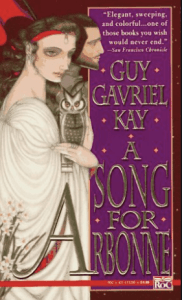 disappointing. I was unsure as to why Lissot (sp? – I only heard this book) was so much of a focus of this story, when she didn’t seem to have much to do with the events at hand. The only relevance she seemed to have was that she developed a crush on Blaise, one of the main characters, who appears to be a humble solider from Gorhault, only to turn into the Heir Presumptive to the throne.
If Lissot had had something more interesting to do rather than climbing over walls, and flirting with Blaise, I could have understood why there was so much focus on her. But her presence didn’t work with the arc of the story.
Perhaps this novel might have been improved if it had been told solely from Lissot’s point of view, so that we could enjoy seeing how she became the preeminent troubadour of the day, and what she thought about the troubling events surrounding her. Instead, too much time was spent amongst nobles caught in a Game of Thrones struggle for power. Three stars.
February 7, 2021
Reading Sundays: THE WAYWARD DAUGHTER (Part 4), a short story by Cynthia Sally Haggard
Fourteen-year-old Jessica was already proficient with her needle, and had persuaded me to buy one of those new-fangled Singer sewing machines to make our sewing go more quickly. How fortunate I was with this daughter! Dear Jessie quietly took upon herself the lion’s share of the sewing, and also the business of minding the younger children, eleven-year-old Beryl, nine-year-old Sylvia and our youngest, seven-year-old Bevil, my son and the apple of my eye. Why wasn’t she my eldest daughter, for she certainly acted the part? Instead of which, my eighteen-year-old daughter Stephanie, who should have been helping me with the chores, who should have been accompanying me when I paid calls, who should be offering to mind the children had gotten – I mean got – into the habit of disappearing, often for hours on end, leaving no message and giving me no clear idea of her whereabouts. I really couldn’t go after her myself, I had too much to do. Besides it would be undignified for me to go chasing after my eldest daughter around London…
The front door banged open and someone rustled into the vestibule. I rose and opened the door a crack. Stephanie had collapsed into a chair and was easing her muddy boots off her feet. They were a size too small, so that she could appear to have the delicately turned feet that were so fashionable. As I gazed at her, my heart contracted in sorrow. 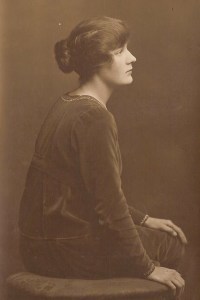 My daughter was a lovely young woman, tall, well-grown, with a creamy complexion and thick blond hair pinned up into a bun that peeked out from underneath her hat. She wore a long straight skirt that just cleared the tops of her ankle boots, and over that wore a hip-length pea coat. Just now, she was rising from her chair, and gazing at herself in the mirror as she unpinned her hat.
I took this opportunity to open the door wide. “Stephanie, where have you been?”
“Out.” She spoke into the mirror with her back turned.
I waited, my arms folded while she put her hat on the hat-stand and unbuttoned her coat. Finally, she turned around.
“That’s not an answer and you know it.”
“Excuse me.” She made to pass but I blocked her way.
“I’m your mother Stephanie, and I’m waiting for you answer my question. Where have you been?”
“I’ve been visiting friends, haven’t I?”
“Who are they?”
“Let me pass.”
“Stephanie!”
“I’m nearly nineteen and it’s none of your bloody business.”
“Stephanie, that’s no way to speak to your mother. There’s no need to be so vulgar.”
She gave me a shove and ran upstairs.
I followed her to the large front bedroom Spencer had insisted on giving her for her own exclusive use, which meant that the three other girls had to share a room. Just as I reached the door, she slammed it in my face.
“Stephanie!” I turned the doorknob expecting it to open, only to find it locked.
“Stephanie! Open that door immediately!”
There was silence.
“Stephanie!”
Silence. I stood outside that door, seething. What should I do? If I banged on the door or shouted that would be undignified, and I’d already blotted my copybook enough for one day. I cringed as I thought of my loss of control in front of those ladies at the gardening committee.
I slowly descended the stairs and entered the empty parlor, going to the window to gaze out. I could feel cold tendrils of air coming in under the gaps in the sash windows. It was getting cold. I rummaged around in my sewing basket and found some fingerless woolen mittens to keep my hands warm. [To be continued.]
February 6, 2021
I am rolling out a new version of THWARTED QUEEN…
Everyone,
Just wanted to let you know about some exciting changes that are happening! 
As you may know I spent some time after graduating from Lesley learning how to record and edit audio files, making audio version of both of my novels, THWARTED QUEEN and FAREWELL MY LIFE. These versions came out in the Fall of 2019 on Audible. Unfortunately, they did not sell well.
I was able to persuade the wonderful folks at ACX to remove both novels so that I could put out new versions. Last summer, I hired Findaway Voices to produce the audiobook for TQ with the fabulous Diana Croft.
The audio version of THWARTED QUEEN is currently available if you click on these links:







 I expect it to be available on Audible by mid March. Stay tuned!
Because I was bringing out a different audio version for TQ, I decided to re-brand the novel, and was lucky enough to find Tim Barber of Dissect Designs to help me. I hope you enjoy the new covers to TQ, with their fresh color palette.
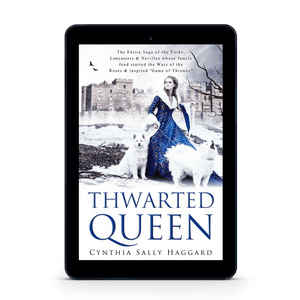
Kindle version of Thwarted Queen
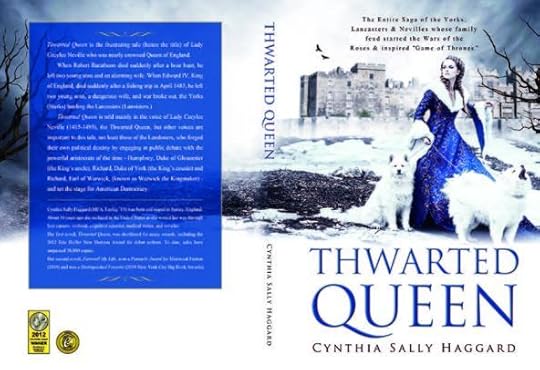
Paperback version of THWARTED QUEEN with its wraparound cover
I also took the opportunity to upload new ebooks, using Kindle Create to produce a more professional-looking better-formatted version. Both ebook and paperback version are now available on Amazon.
As that was so successful, I am now turning my attention to FAREWELL. I have hired Tim to do a new cover design, and am in the process of finding a narrator for the audiobook with Findaway Voices. Lastly, I am working with Girl Friday Productions, a talented team of marketers, to help me relaunch this novel.
Thanks to Orna Ross of ALLi (the Alliance for Independent Authors) for recommending Findaway Voices, and for inspiring me to get off my tush and try and turn these novels into a success!
Stayed tuned for the new audiobooks, and for the rollout of a new edition of FAREWELL MY LIFE.
Am crossing my fingers that everyone is staying well and safe. 
Cynthia
February 5, 2021
Jodi Picoult’s PERFECT MATCH narrated by Carol Monda, Susan Bennett and Michele O. Medlin
 By this, her ninth novel, it is clear that Jodi Picoult is fascinated by the law and lawyers. Her courtroom scenes take up more and more of her novels, and in this one, about a prosecutor gone awry, we seem to spend almost every waking minute of this novel in the courtroom. (If Jodi Picoult were not such a talented novelist, she probably would have made a formidable prosecutor herself.)
Again, Ms. Picoult tackles tough issues. We see a family brought to its knees by child molestation. We see the shortcomings of the law which attempts to deal with this tragedy. We see the bizarre and heart-rending custom of putting young children through a competency hearing to see if they are able to take the stand. (I don’t believe this is the custom in the UK, where I am from. There, it is just assumed that a young child should not be subjected to such an ordeal.) We see a prosecutor typically frustrated by the limits of the law, and exhibiting typically black-and-white thinking (which is dangerous.)
In short, we have a gripping narrative with well-drawn characters. Jodi Picoult pulls off this feat even with characters who are not likable, including the protagonist, that bane of every novelist, the unlikable female protagonist. Most readers are going to hate this person, but Ms. Picoult makes her believable, tragic, and very very compelling. Five stars.
February 3, 2021
Jodi Picoult’s SALEM FALLS narrated by Julia Gibson
This is Jodi Picoult’s eighth novel, so she has her formula down pat: select an issue, build interest by immersing the reader in time and place, grab the reader’s emotions by having compelling characters, solve the problems via the courthouse, which means that nearly all her novels end with a courtroom drama.
This was true in THE PLAIN TRUTH, her seventh novel. It is also true in SALEM FALLS.  Like Katie Fisher in THE PLAIN TRUTH, Jack St. Bride, is wrongly accused. Like Katie Fisher, Jack St Bride has complications to deal with which make his situation all the more dire. While Katie’s complications included being Amish, and having no memory of what happened to her baby (she was asleep when he disappeared), Jack’s include being a stranger in a close-knit New England village, and being a convicted rapist.
Somehow, Jack (like Katie) gets out of his predicament, but Jodi Picoult is such a good writer it is not at all obvious that he will be saved from his fate of spending the rest of his life in prison. Five Stars.
February 1, 2021
THE PLAIN TRUTH by Jodi Picoult, narrated by Christina Moore and Suzanne Toren
Before I begin reviewing this seventh novel by Jodi Picoult, I would like to say how much I enjoyed the narration of this book. Christina Moore and Suzanne Toren were pitch perfect in conveying the way Americans normally speak in the present day (hard-boiled and harsh) with the way that the Amish speak (slow, sweet and German-accented.) In addition, Simon & Schuster Audio did a superlative job with the production and editing, so that it was easy to sit back and become totally absorbed in this very interesting tale.
First off, how I love Jodi Picoult’s punning titles! After the opaque and too-long title of her first novel (SONGS OF THE HUMPBACK WHALE) we then had HARVESTING THE HEART (about a cardiologist and his neglected wife) PICTURE PERFECT (the story of a Hollywood actor who is secretly abusing his wife) and KEEPING FAITH (a divorce story where the fought-over child is named Faith.)
Now we have THE PLAIN TRUTH, which seemed simple enough to me until I realized that this tale of an Amish community in Lancaster County Pennsylvania is about people who live “plain.” Meaning that they are honest to a fault, take responsibility for their sins (both real and imagined) and try to live a Christian life.
So when gentle, sweet Katie Fisher, aged 18, is accused of murdering her baby, the ripples of that accusation shock everyone who has known her in this close-knit community. Many who know her well (her brother and suitor) state that this is impossible. People who know her less well (the “Englischers” as the Amish call them,) see plenty of reason why she would want to kill.
I am not going to give away the plot so as not to spoil this for those of you who want to experience this piece. I will only say that from the beginning I have been struck by the empathy of Ms. Picoult’s writing. It is stunning that she was able to get under the skin and into the minds of a community of people who think and see things very differently from your average American living in Philadelphia (or any big city) in the 1990s. Five stars.
January 31, 2021
Reading Sundays: THE WAYWARD DAUGHTER (Part 3), a short story by Cynthia Sally Haggard
I hung my head, and in that moment I knew I’d lost them. Well-bred ladies never shouted, whatever the provocation. What was wrong with me? I knew better than to show a display of temper in a London drawing-room. But I’d had too many difficulties in my life recently, and there is nothing more frustrating than trying to declare your innocence before a hostile audience.
What was I going to do? Who could be spreading these rumors? I looked around the room. Kind-hearted Louisa Bretton wouldn’t stoop to that kind of thing, and apparently neither would the respectable widow Charlotte Helsby. That left Letitia Capenhurst, Laura Mollington and Lucy Alvaney. Any one of those ladies might derive entertainment from smearing my reputation. What was I going to do about it?
* * * * *
 I returned home, took off my hat, muffler and coat, for the days were growing chill, and entered the parlor. The fire was burning low in its grate, and so I rang the bell, for Lizzy to stoke it up.
“Where is everyone?” I asked as she appeared.
“Miss Jessica has taken Miss Beryl and Miss Sylvia out to Kensington Gardens with Mr. Bevil.”
“Where is Stephanie?”
“I don’t know, Madam.”
“Didn’t you see her go out?”
“No, Madam.”
Lizzy knelt on the floor, using poker and tongs to get the fire going. I sighed. Of course she wouldn’t have seen Stephanie go out, because she was either in the kitchen cooking, in the basement doing laundry, or else around the house cleaning. Although my husband was a scion of an old landowning family from Cornwall, he had gone through his inheritance of 20,000 pounds while still a young man, and now was obliged to work in a bank. For our daughters’ sakes we rented accommodation that faced a private square in Kensington, to give them a smart address. As a result we could only afford this one servant, and my lively family of seven kept poor Lizzy busy from dawn to dusk.
“Is there anything else you need, Madam?” Lizzy rose and dusted the soot from her apron.
“No, thank you.” I dismissed her with a wave of my hand as I sank deep down into an armchair. For the thousandth time I wondered if I should call upon my four daughters to do more. But this was London, not New Hampshire, and it was apparently unthinkable that they should learn to cook or do the household chores. Believe me, I was sorely tempted to ask them to help. It was only shame at our circumstances and the opprobrium of others that prevented me from doing so. My daughters were Treffrys, descendants of one of the oldest families of England, who could trace their lineage all the way back to the Battle of Crécy in 1346, when Sir John de Treffry had been knighted on the field of battle by King Edward himself. Ever since then, the head of the family was always known as “de Cressy Treffry.” Therefore, despite the fact that we were not wealthy, it was my duty to bring my daughters up as ladies so that they could marry well. Enlisting their help to do the household chores was frowned upon as no gentleman would want a girl with work-roughened hands.
So I compromised, teaching them everything I knew about dressmaking, fine embroidery and the sewing of straight seams so that they could run up sheets, curtains, pillow-cases and cushions. Fourteen-year-old Jessica was already proficient with her needle, and had persuaded me to buy one of those new-fangled Singer sewing machines to make our sewing go more quickly. How fortunate I was with this daughter! Dear Jessie quietly took upon herself the lion’s share of the sewing, and also the business of minding the younger children, eleven-year-old Beryl, nine-year-old Sylvia and our youngest, seven-year-old Bevil, my son and the apple of my eye. Why wasn’t she my eldest daughter, for she certainly acted the part? [To be continued.]
January 29, 2021
KATHERINE HOWARD, HENRY VIII’s SLANDERED QUEEN by Conor Byrne
KATHERINE HOWARD, HENRY VIII’s SLANDERED QUEEN is not an historical novel. It is a work of history that studies the sexual politics of the Henrician court in the 1530s (the era of Queen Anne Boleyn) and the 1540s (when Katherine Howard became Queen.) Unlike the two historical novels I read recently, Alison Weir’s KATHERYN HOWARD, THE SCANDALOUS QUEEN and Gareth Russell’s YOUNG AND DAMNED AND FAIR, this volume gives the best explanation of Katherine’s actions, especially her seemingly foolhardy relationship with Thomas Culpeper, which led to her downfall in November 1541.
It is not easy to tell exactly when Katherine was born, as even high-born women in the Tudor era did not necessarily have their births recorded. However, a few facts narrow down her age. First, there is a portrait of a lady from the workshop of Hans Holbein, owned by the Metropolitan Museum of Art, showing a member of the Tudor court from around 1540.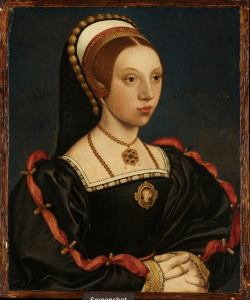 Just to the sitter’s left one can just make out a statement about her age: Etatis Suae xvii (her age 17). As I’ve said in previous posts, this young woman looks much more like the teenaged beauty who so captivated Henry VIII, with her fun-loving ways, her wide-eyed innocence and those luscious lips, than the portrait I grew up with, showing a grim young woman whose age is given as 21.
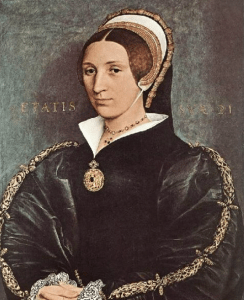 This portrait is probably a depiction of Elizabeth Seymour, who was born in around 1518, and was around 21 when it was painted in 1539. For some reason, many historians and historical novelists (like Alison Weir) have glommed onto this portrait, believing it to be of Katherine Howard. And this has encouraged them to believe that Katherine was 19 when she met Henry VIII, and 21 when her reign came to an end.
Another interesting fact is that Katherine Howard’s relatives did NOT apply for a place for her at the court of Anne Boleyn, when Anne was Henry VIII’s second wife between 1533 and 1536. (This would have been a natural thing to do as Anne Boleyn and Katherine Howard were cousins.) If Katherine was born in 1524 or 1525 (rather than 1521 as Alison Weir has it) then she would have been either 8 or 9 in 1533, and 11 or 12 in 1536. In other words, she would have been TOO YOUNG to be appointed a “maiden” in the household of Queen Anne Boleyn, as such appointments went to girls who were 13 years old at least. When Katherine was eventually appointed as maiden to Queen Anne of Cleves in November 1539, she joined her cousins Katherine Carey (born in 1524) and Mary Norris (born in 1526), suggesting she was born around that time.
IMHO, Katherine was born around St. Katherine’s Day (November 25) in 1524, which meant that she had just turned 15 when Henry VIII met and fell in love with her at the end of 1539. This is confirmed by the anonymous author of The Chronicle of Henry VIII, who stated that she was 15 when she met Henry. In addition, many at Henry’s court commented on her youth, describing her as a “young girl” or “young lady.” If she was 15 by the end of 1539, she would have been about 9 years younger than Henry’s daughter Mary.
This book further confirms the abuse Katherine received in the unchaperoned atmosphere of her step-grandmother’s household. Henry Manox, her music teacher (appointed in 1536,) fondled her private parts (and boasted about it) for 2 years, when she would have been 11 going on 12. Francis Dereham raped her in 1538, when she was 13 going on 14, and thereafter controlled and manipulated her into agreeing that they were “married,” even though Katherine disliked his “attentions” and psychological abuse. In November 1539, Katherine was delighted to go to court, in part because she could finally get away from Dereham. At court, she met Thomas Culpeper, one of Henry VIII’s Gentlemen of the Privy Chamber, who stood high in favor with Henry.
All the books I have read recently say that Katherine did not know Culpeper before she went to court, and they claim that she fell in love with him in the spring of 1541, and began an affair in the summer when she and Henry went on royal progress around the North of England.
This baffles me. Assuming that Katherine was not totally stupid, and not suicidally naive, she must have known that Queens who misbehaved could be beheaded, like her cousin Queen Anne Boleyn, who was executed on the grounds that she had been sleeping with various gentlemen of the court (including her own brother.) Katherine must have known that having private meetings with Culpeper at night and behind closed doors would put her in great danger, even though they were chaperoned by one of her ladies-in-waiting, Lady Jane Rochford.
So why did she do it?
According to Conor Byrne, the reason is because Culpeper learned about her unsavory past, and was using it to manipulate her into granting him gifts, money and power. Just like Dereham, he tried to control her. In response, Katherine desperately tried to get him to promise her that he would NOT talk about her past. (Thus the private conversations behind closed doors at night.)
To add fuel to the fire, Henry VIII had been seriously ill in the spring of 1541, which must have had many wondering what would happen to pretty young Katherine once she became widowed, as she would have been extremely wealthy. Naturally, such men as Thomas Culpeper and Francis Dereham wanted to get their paws onto her money, as they would have had complete control over it once they married her.
Another element to this perfect storm was the fact that Francis Dereham became Katherine’s personal secretary, because her step-grandmother asked it of her as a favor, presumably so that Katherine could keep a watchful eye on him. Unfortunately, Dereham was indiscreet, and no sooner had he arrived at court than he started bragging about his affair with the Queen. Which is how Culpeper must have heard about it in the spring of 1541.
With such a past, there was no way poor Katherine was ever going to be safe, as the men of the time regarded women with the greatest contempt, seeing them as out-of-control, emotional, irrational, and most importantly naturally lustful. (According to the mores of the time, women wanted to be raped.)
Katherine was executed not because she actually did anything wrong, but because Thomas Culpeper told his interrogators that he intended to have sex with her, and because Henry VIII, devastated, the laughing-stock of Europe, his manly pride bruised and bloodied, believed that she could have had an affair with Culpeper and could have continued her affair with Dereham.
There was no trial for Katherine (unlike her cousin Anne Boleyn). When she died on 13 February 1542, Katherine was probably only 17.
January 27, 2021
YOUNG & DAMNED & FAIR by Gareth Russell, narrated by Jenny Funnell
I read this volume about Queen Catherine Howard, after reading Alison Weir’s THE SCANDALOUS QUEEN. I was so baffled by Catherine’s poor choices, especially given that she was married to a paranoid monster in the shape of Henry VIII, that I sought out another opinion (so to speak).
I found it in this volume, Gareth Russell’s take on this tragic young woman. As I said in an earlier post, I do NOT believe that Catherine was 19 when she married Henry VIII in July 1540 as Alison Weir would have it. As we are not certain of her date of birth, it typically is given as somewhere between 1518 and 1527. Mr. Russell puts her date of birth in 1523 (which is what her Wikipedia entry has.) That means she was either 16 or 17 when she married Henry, depending on when she was born. For example, if she was born on St. Katherine’s Day (November 25) in 1523, that would have made her 16 in July 1540.
(Given that we seem to be talking about a very young woman between the ages of 16 – when she married Henry – and 18 – when she was executed – a recent article from the New York Times about risk-taking behavior amongst teens was particularly apposite. I provide the link here in case anyone is interested.)
Catherine’s age is NOT helped by the usual portrait of her looking a lot older than a teenager. When I was growing up, I was told that this portrait was of Catherine, aged 21 (as the portrait says: Etatis Suae 21.) However, the young woman pictured looks somber and old-for-her-age. She doesn’t seem like the vivacious fun-loving Catherine whose favorite pastime was dancing. Mr. Russell believes this to be a portrait of Elizabeth Seymour, younger sister of Queen Jane Seymour, who was born around 1518 and would therefore have been 21 in either 1539 or 1540.
It was only by experiencing this volume that I learned that there is another possible portrait of Catherine, this one from New York. Just to the sitter’s left one can just make out her age in Roman Numerals, and it says 17 (xvii.)
To my eye, this young woman has that kind of innocent sexuality that attracts men. Although she looks demure in this portrait, it is much easier to understand why this wide-eyed innocent with the luscious lips was so attractive that she could captivate King Henry, who was devastated when he learned the truth about her.
So what is “the truth” about her? It isn’t easy to say. Listening to the testament read by narrator Jenny Funnell, which was taken down during the proceedings against her, it seems pretty clear that Catherine was lying at least part of the time. It does beggar belief that she and Thomas Culpepper – one of her admirers – were only talking behind locked doors. It also seems pretty clear that she had made some sort of promise to Francis Dereham (another smitten young man) that he took as a plight troth (i.e. a promise to marry at some future date.) What a pity she lied about that as that plight troth might have saved her.
On the other hand, given that she wounded Henry VIII’s considerable vanity and made him a laughing-stock throughout Europe, perhaps the blood sacrifice of her death on 13 February 1542 was the only thing that would appease him.
If you are interested in this least-known of Henry’s queens, read this book. It is excellent! Five stars.
Cynthia Sally's Blog

- Cynthia Sally Haggard's profile
- 129 followers

