
Cynthia Sally Haggard's Blog: Cynthia Sally's Blog, page 42
February 28, 2021
Reading Sundays: THE WAYWARD DAUGHTER (Part 7), a short story by Cynthia Sally Haggard
That was the end of piano lessons, as Miss Richardson informed me she was not going to continue trying to teach a band of unruly girls. Spencer, amused, had said that Stephanie was just naturally mischievous. Yes, it was a pity about the piano lessons, but we couldn’t afford them any way.
I got up. I was going to have to deal with Stephanie myself.
* * * * *
The next day, I waited in the parlor with the door open a crack until I heard Stephanie creep down the stairs and rustle around in the vestibule. I went in through the kitchen, and up the back stairs.
“Jessie, dear.” I knocked on door of the room my three younger daughters shared and opened it. Beryl and Sylvia were away at school. “Stephanie is leaving.”

Jessica Treffry Dean (1898-1990), my great-aunt Jess at the age of around 14.
Jessie quickly put on her hat and coat that were lying on her bed in readiness.
“Don’t let her out of your sight.”
She nodded, waved and disappear in Stephanie’s wake.
I went into the parlor and smiled, it seemed for the first time in a long time. Dear, dear Jessie, she was such a contrast to Stephanie. Jessica had been sensible and level-headed even when she was a tiny child. She was utterly reliable, and I knew she would tell me the truth. More to the point, I knew that Spencer would find it very hard to ignore her.
The hours ticked past and eventually darkness crept over the quiet garden. Just as the evening mists were beginning to rise, the front door opened and Jessie appeared, out of breath and crying. My heart curled into a ball and began its drubbing as I rushed towards her.
She couldn’t speak, so I went into the kitchen and made her a hot lemon and honey drink to which I added the smallest dash of brandy. I made her sit in my chair while I poked at the fire.
“She was so angry.” Jessie gulped for air. “She shouted at me, accusing me of being your spy.”
My heart clenched in my throat. Poor Jessie. Indeed I had used her as a spy. I’d been so desperate about Stephanie it had never occurred to me that I might be harming Jessie.
“I’m sorry, darling.” I sat down next to her. “I shouldn’t have made you do it.”
“It’s all right, Mother.” Jessie sipped her drink. Even when she was upset and out of breath, she still behaved like a lady.
Gradually, it all came out, about how Jessie had followed her sister all the way to Lucy Alvanley’s, where she met a handsome young man named Will. Jessie didn’t know his surname, or how old he was, except that she thought he was a little bit older than Stephanie.
After a couple of hours of waiting in the cold outside, the door to the Alvanley’s home opened, and Stephanie and Will appeared. Jessie followed them all the way to the bus-stop and got on the bus with them. She said they didn’t see her because they were kissing. Stephanie and Will were in back of the bus, which has a platform where one can get on and off, while Jessie was further down in the middle wedged amongst a crowd of shoppers.
Expecting Stephanie and Will to jump off the bus between bus-stops, she gradually edged her way down the bus and that is when Stephanie noticed her. When Jessie tried to follow them as they jumped off the bus, Stephanie shouted at her, embarrassing her so much that she stayed on that bus. The last she saw of them, they were weaving through traffic, making for the sidewalk, talking loudly about going to a dance-hall.
I rose, folding my arms tightly across my bosom. “Oh no,” I moaned.
“I’m sorry, Mother.”
I turned to her. “Jessie, dear, you did what you could. Now, I think you should go upstairs, change your clothes and try to get warm. We’ll be having supper presently.”
I stared at the fire after she left. I needed to speak to Spencer about this, but he was away, on some business to do with his bank. I didn’t expect him back for a week. [To be continued.]


February 26, 2021
THE HORSE, THE WHEEL & LANGUAGE: How Bronze-Age Riders from the Eurasian Steppes shaped the Modern World by David W. Anthony
 I found this book absolutely fascinating. Like many readers, I was drawn in by the first part of the book, by the first several chapters which deal with the linguistics issues of Proto-Indo-European (PIE).
It is remarkable that:
scientists know when it was spoken ~ between (roughly) 4500 BCE and 2500 BCEscientists know where it was spoken ~ in the Pontic-Caspian Steppes, between the Black and Caspian seas.It was fascinating to see how these people gradually transformed the steppes from a barrier between East & West (impossible to walk amongst waist-high grass) to a 6,000-mile trade route, by means of domesticating sheep, riding horses, inventing wheels, wagons, carts and chariots so that impenetrable grass became a highway for trade, which eventually became the Silk Road in the Middle Ages.
I was also fascinated to learn about the parallels between the RIG VEDA (Anonymous) and THE ILIAD (“Homer”). Yes, it is a university-level book, but fascinating nonetheless, and a very useful source of knowledge about life in the Steppes, Central Asia, Eastern Europe and the Middle East between 6000 BCE and 1600 BCE. Five stars.
February 24, 2021
Philippa Gregory’s DARK TIDES (FAIRMILE #2) narrated by Louise Brealey
It is always a pleasure to watch the havoc one person can create amongst people, especially people who are far too polite for their own good. In TIDELANDS, that person was James Summer. Handsome, charming, young, he wins the love of Alainor – a woman in her late twenties with two children, and an abusive husband who has either died or disappeared. Alainor reciprocates his love, but she is a herbalist, some might say a White Witch, some of her neighbors said worse. This is 1648, people believe in witchcraft, and when James discovers that Alainor is to be tried as a witch with a little trial drowning, James abandons her to almost certain death fearing for his family name.
Alainor is saved by Alys, her 15-year-old daughter, who abandons her marriage plans in order to take her mother away from Sealsea Island (now known as Selsey Bill). Both women are pregnant, Alainor with James’ child and Alys with her fiancee’s. During the course of this novel it is never made clear whether Alainor actually gave James a son and heir, a daughter and heiress, or lost the baby.
Fast forward 21 years to 1670, when DARK TIDES  opens, and James (now known at Sir James Avery) still handsome, charming and now rich, returns to Alainor to persuade her to be his wife. But he is far too conscious of the “great gift” he is to bestow upon her, and Alainor wants nothing to do with him. Her dunk in the village mill-pond has left her with weak lungs and painful memories. And so James never finds out from Alainor or her daughter Alys if any of the unborn babies of 1648 are his heirs. The children, Johnny and Sarah, think they are twins. Johnny has just finished his apprenticeship as a clerk and wants to join the East India Company. Sarah has just finished her apprenticeship as a milliner, and neither young person seems suited for the life that Sir James has in mind for them.
Sir James, accustomed to getting his own way and frustrated by Alainor’s steadfast refusal to accept any help from him, is hanging around this modest warehouse on the wrong side of the river, when the Glamor Puss appears in the shape of Italian widow Livia, married to Alainor’s son Robert who graduated as a doctor from the University of Padua. Livia, exotic, dressed to the nines, clearly out of place on this greasy wharf, immediately sinks her claws into Sir James Avery as he is the only wealthy person around in this sour corner of London. She is a dealer in antiquities. Her first husband (an Italian count) was a collector of taste. She has a warehouse full of this lovely stuff, which is now in vogue in London since the restoration of King Charles II. She throws herself on Alainor’s family, claiming poverty (which her silken skirts belie) telling a tale of how her darling Roberto (her second husband, and Alainor’s son) was sunk somewhere in the dark tides of Venice.
Charming, flirtatious, with an unearthly beauty, Livia is an expert liar. Most people believe her. The only person who does not is Alainor, and when she hatches a plan to send her grand-daughter Sarah to Venice to find out what is really going on, the engine of the novel really starts.
Like many readers, I am a fan of Philippa Gregory, but I agree with most of them that this is not her best book. The first book in the series was successful because it focused on Alainor’s story, and milked it for tension. This volume suffers from a subplot set in North America in the 1670s, when the colonists and the Native Americans were readying themselves for war. This part of the story had almost nothing to do with the main plot-line, except for the fact that the protagonist in the North American tale was Ned Ferryman, Alainor’s brother.
Some readers enjoyed experiencing Livia’s come-uppance at the end of this volume, but for me, the person who had the punishment meted out was Sir James, who found himself stuck in a loveless marriage that he had brought on himself. For me, this was a fitting punishment for the man who ruined Alainor’s life, abandoned her to her fate while she was carrying his child, and fled from her family, who included two innocent children, including the boy he had been tutoring. I enjoyed reading about the miserable life he is sure to have with his new bride Livia, who will give him a run for his money, as he is far too polite (and guilt-ridden) to protest at anything she does. Or says. Four stars.
February 22, 2021
Philippa Gregory’s TIDELANDS (FAIRMILE #1), narrated by Louise Brealey
 You might think that after writing 15 novels about the Tudors and the Plantagenets, author Philippa Gregory would be spent. You would be wrong. TIDELANDS, set in Selsey Bill on the marshy southern tip of Sussex, England during the 1640s, (a time when England was plunged into a Civil War) is wonderful.
This is a story of poor people scratching a living from the inhospitable (and dangerous) marshes. It is a story of ambition, family feeling and fear. It is the story of a poor woman with healing skills, who despite her success in saving many women from death in childbed, is treated with a great deal of suspicion.
People are not kind to outsiders, especially poor women who have to struggle on without a husband to protect them. When a handsome young man inserts himself into her life, Alinor’s precarious existence becomes perilous indeed. Highly recommended. Five stars. #philippagregory #tidelands
February 21, 2021
Reading Sundays: THE WAYWARD DAUGHTER (Part 6), a short story by Cynthia Sally Haggard
“Well then.” Spencer smiled at me. “They’re nice people, perfectly respectable.”
I turned to her. “Have you been going out with any young men?”
A faint flush crawled up her neck as she turned slightly in her seat away from me and continued to smile at her father.
I clenched my hands under my skirts and tried to calm down, but she annoyed me so much.
“That is completely unacceptable,” I shouted. “What are you trying to do? Ruin your reputation? I’ve told you over and over again that if you want to meet a young man, you must take a chaperone.”
Finally, she managed to turn her head just enough to flick a look at me.
“You, I suppose.” Her words were as bright and sharp as a knife’s blade.
There was a pause. I opened my mouth to say something, but Spencer forestalled me.
“Stephanie, my dear, your mother is quite right about this. We both want you to be happy, but there are certain things you must at least pay lip service to.”
“But I do, Daddy,” exclaimed Stephanie. “I never see these young men alone, I’ve always got company.”
“All right, all right.” Spencer planted a kiss on her forehead. “Just be careful my dear, and don’t hesitate to come to me if you need anything.”
“I won’t, Daddy.” Stephanie favored her father with a charming smile, before blowing him an air-kiss and leaving the room.
He chuckled. “Well then,” he remarked turned to me.
“We haven’t solved anything,” I pointed out. “Stephanie still thinks she can do as she pleases.”
“Mary, my dear, I think you just have to trust her more. She’s a young lady now and old enough to know what she’s doing. I think you need to pay her the compliment of trusting her judgement.”
He opened the door.
“But how can I do that when she consistently shows that she lacks judgement?”
But he’d gone. I sat there in my chair, feeling like a pot of thick soup on the simmer. I got up and paced around.
If only I could prove to Spencer that I was right about Stephanie, perhaps he would take a sterner line. I stood with one elbow on the mantlepiece gazing into the mirror as a sudden thought struck me, something I should have told Stephanie in front of Spencer. I should have told her that if she continued visiting young men without a chaperone, not only would she ruin her reputation, she’d ruin her sisters’ as well.
I sank into my chair and put my head in my hands. No respectable gentleman would marry my girls if they believed them to be fast. And I didn’t believe for a moment that Stephanie would show good judgement in the way she conducted herself amongst her friends. She’d always been a mischievous girl, always defiant, always disruptive, the bane of governesses and the various teachers I employed at one time or another. I remember once when Sylvia was having a piano lesson, how Stephanie dangled a puppet on a string  from her bedroom, which was just above the parlor. She jerked it up and down, making Sylvia laugh so hard she couldn’t continue. That was the end of piano lessons, as Miss Richardson informed me she was not going to continue trying to teach a band of unruly girls. Spencer, amused, had said that Stephanie was just naturally mischievous. Yes, it was a pity about the piano lessons, but we couldn’t afford them any way.
I got up. I was going to have to deal with Stephanie myself. [To be continued.]
February 19, 2021
VANISHING ACTS by Jodi Picoult narrated by Julia Gibson (Delia), Jonathan Davis (Eric), Jim Jenner (Andrew), Robert Ramirez (Fitz) and Sharon Washington (Elise)
 I love Jodi Picoult’s punning titles and I loved the way this novel began with the protagonist, Delia, six years old, being part of her father’s magic act: “The first time I disappeared I was six years old,” she says in the memorable opening line.
Delia Hopkins lives in New Hampshire with her widowed father Andrew, daughter Sophie and bloodhound Greta. She performs search-and-rescue operations. Too early on in the novel, the climax arrives, in the shape of a policeman coming to arrest Andrew Hopkins, a well-thought-of, well-liked pillar of the small New Hampshire town in which they live. His crime? Kidnapping Delia when she was 4 years old.
What a pity this climax arrived so early, as it squandered the tension that could have been milked from that event. Of course, this novel would have benefited from being cut up and reorganized, so that the reader doesn’t realize exactly what happened to Delia, or why, until two-thirds of the way through the novel.
As this is a Jodi Picoult novel, it will surprise no-one that it ends up in a courtroom. Some readers have complained about a couple of story threads that were not really necessary to the story, such as the prison interlude (inflicted upon Andrew as he awaits trial) or the Native American episode (when the characters first arrive in Arizona.) However, the prison interlude raises the stakes sky-high for Andrew, who knows he will be murdered if he returns to jail. And IMHO, the Native American episode was the most enjoyable part of the book, as I loved the character of Ruth-Anne, who brought out the best in Delia.
Which brings me to the character of the protagonist, Delia Hopkins. True to most Jodi Picoult heroines, she is somewhat boyish, free from artifice, plain-spoken, strong-minded, and has an interesting job. She adores her daughter Sophie. She is close to her father, Andrew. So what’s not to like about her?
As the novel wound on, and more characters were introduced I found Delia increasingly annoying, to the point where I just wished she would go away. There is a three-way relationship with Delia (naturally) being courted by two extremely handsome young men (Eric and Fitz), who for the most part behave extremely well. Each of them is obsessed with her. Each vies for her attention. Each has loved Delia for most of their lives, for 20 years, since they were friends together in the local public school.
Although Jodi Picoult paints a convincingly portrait of Delia’s beauty (raven-dark hair, brown eyes, which some cover artists have ruined by showing a girl in blond plaits), I honestly think there has to be something very special about a woman who can hold the attention of TWO men like Eric and Fitz for such an astoundingly long time.
But Delia is both boring and bratty. It becomes increasingly obvious there is very little nuance in the way Delia thinks about things. (At 32, she is still childishly self-absorbed.) She finally meets her mother Elise. That first meeting is “perfect,” matching her childishly high expectations. But after her father defensively drops the bombshell that his ex-wife was an alcoholic, Delia turns nasty. She marches back to her mother’s house and confronts her in the rudest possible way, showing little empathy or compassion for a woman who has experienced a devastating loss, but has managed to remain sober for 25 years.
Her mother behaves perfectly, but Delia is always bristly and rude. Of course, the author tries to make Delia more likable with her “revelation” that Elise’s boyfriend Victor molested her when she was four years old, a piece of information that manages to save Andrew from prison. But this tidbit just seems too convenient to be true, a useful ploy to rescue likable Andrew from almost certain death.
So when, near the end of the novel, this love-triangle finally shifts, it is hard to be interested. As one reviewer put it, these two men have loved Delia “soggily” since childhood, and I can’t for the life of me think why. There is nothing about Delia that is elevated or inspiring. She is not kind-hearted. She is not spiritual. She is not especially insightful. She doesn’t display much emotional intelligence. In short, she has little to recommend her except that author Jodi Picoult wants her to be beloved. But wishing doesn’t usually make things so. Three stars.
February 17, 2021
Jodi Picoult’s MY SISTER’S KEEPER narrated by Richard Poe, Julia Gibson, Barbara McCulloh, Tom Stechschulte, Carol Monda, Jennifer Ikeda & Andy Paris
 MY SISTER’S KEEPER, her eleventh novel, is the work that made Jodi Picoult famous. Jodi Picoult uses the formula that has worked so well in many other novels – American family in small-town America, with at least one very accomplished parent, highly-intelligent kids who ask lots of questions, a contemporary issue that is currently gripping the nation, which slides into tragedy, ending with courtroom drama plus a surprising twist. Along the way, we often get supernatural happenings, bizarre events and lots of emotion on the page which makes the reader really care about the characters. In addition, Jodi Picoult depicts mothers who are always obssessed with at least one child, strong women, weaker (or more restrained) men. There is always a love story (often another strand) and at least one sex scene.
This is not to say that Jodi Picoult’s writing is not wonderful, that her plots are not extremely well thought-out, that she focuses on people caught in the pincer of tragedy along with moral quandaries and human failings. But what made this book disappointing for me was the pedestrian writing.
Having read ALL of Ms. Picoult’s eleven novels at this point, I know she can write beautifully. (My favorite Jodi Picoult novel THE PLAIN TRUTH attests to that.) But I also know that she is a writer on contract, that she writes her novels in the space of a gob-smacking nine months, that she is a mother and a busy person in general.
So, I’m going to take one star off what is otherwise a riveting novel, with a twisted ending that I personally liked, reflecting as it does the ironies of life, plus that old adage “be careful what you wish for.” Four Stars.
February 15, 2021
SECOND GLANCE by Jodi Picoult narrated by George Guidall
I have read all of Jodi Picoult’s novels from SONGS OF THE HUMPBACK WHALE up to SECOND GLANCE,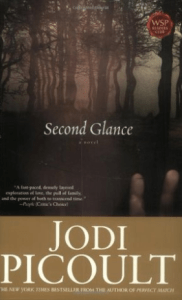 her tenth novel, and I have to say that out of all ten of them I liked this one the least.
It was an enormous problem that the beginning part of the novel was so slow, and gave little sense of direction of where the novel was headed. Was it a Ghost Story? Was it an historical novel about the Eugenics Movement in Vermont in the early 20th century? It was really hard to tell what was going on.
I nearly abandoned the book several times, and only kept at it, telling myself that Jodi Picoult was a marvelous writer & I would be rewarded by my dedication.
The book definitely improved once Eli appeared on the scene, because it picked up speed. But there were still too many problems. Ross, the Ghost Hunter was just not that interesting, and his scenes in which he’s creeping around empty houses were…boring, not creepy, because the author kept letting us know that nothing exciting was going to happen, which ruined the tension. The whole thing about Cecilia Price and her relationship with her unspeakable husband was similarly lacking in tension.
I am not sure why this novel fell so flat. IMHO it was not at all up to Ms. Picoult’s usual standards. The only reason I can come up with is that she was engaged in writing her next novel, MY SISTER’S KEEPER, which made her an international star. Two stars.
February 14, 2021
Reading Sundays: THE WAYWARD DAUGHTER (Part 5), a short story by Cynthia Sally Haggard
I slowly descended the stairs and entered the empty parlor, going to the window to gaze out. I could feel cold tendrils of air coming in under the gaps in the sash windows. It was getting cold. I rummaged around in my sewing basket and found some fingerless woolen mittens to keep my hands warm. I went to stand in front of the fire, rubbing my arms to try and generate some heat. The house was silent and oppressive, the only sounds coming from the hiss and crackle of wood burning in the fireplace. I felt like screaming. I wanted to ball my hands into fists and smash something. I shuddered as I looked at the panes of glass and imagined myself doing it. But of course, I couldn’t do such a thing. I sank into my chair. My temper was getting worse, which was no surprise as Stephanie’s behavior towards me was worsening. She seemed to take delight in goading me to lose my temper, especially if her father were around. I closed my eyes and tried to breathe more slowly. At least, Spencer would be coming home soon. I must compose myself and wait quietly for him, just as a lady should. I picked up a book. 
I must have fallen asleep because I didn’t hear the parlor door squeak open until Spencer poked his head around it. He entered, smiling.
“Mary Emelin, my dear.” He pecked each cheek. “How was your day?”
I shook my head as I tried to smile. “Unfortunately, not good. I need to talk to you about Stephanie.” Briefly, I described our interaction.
Spencer rang the bell and asked Lizzy to tell Stephanie that her father wished to speak with her.
I heard quick steps, then she appeared. Ignoring me, she went to her father and kissed him on the cheek.
“Daddy, how are you?”
“Not bad, not bad,” replied Spencer chuckling. “Fair to middling.”
She giggled.
He patted her arm. “Sit down my dear, we need to talk.” He cleared his throat as he eyed me. “Your mother is worried about you.”
Her smile vanished as her features hardened into that mulish obstinacy I knew so well. She turned the corners of her mouth down, folded her hands in her lap and stared at a point just in front of her, her eyes growing cold.
Spencer glanced from her to me and shook his head, passing his hand through his hair. “I understand that you’ve got into the habit of going out without letting your mother know where you are.”
“It’s none of her business!” exploded Stephanie.
He paused for a moment. “And worst of all, when she asks you about it, you won’t reply. What do you have to say about that, young lady?”
Stephanie smoothed her skirts and smiled up at him. “Daddy, I’m nearly nineteen. I can look after myself, you know that. Yes, it’s true that I like to go out and visit my friends, but why shouldn’t I?”
“Which friends are these?”
Stephanie rattled off a list of names, all people that Spencer and I knew.
“Well then.” Spencer smiled at me. “They’re nice people, perfectly respectable.”
I turned to her. “Have you been going out with any young men?”
A faint flush crawled up her neck as she turned slightly in her seat away from me and continued to smile at her father.
I clenched my hands under my skirts and tried to calm down, but she annoyed me so much. [To be continued.]
February 12, 2021
A well-crafted plot twist (THE THIEF)
 THE THIEF is a YA novel by Megan Whelan Turner that is an example of a well-crafted plot twist. When doing this kind of structure, you need to have two storylines: the A story, which is what the reader thinks the story is about and the B story, which is what it actually is about. It is helpful to either have a protagonist who is as clueless as the reader, or one who doesn’t share his thoughts until the reveal.
SPOILER ALERT: If you have NOT read this novel and would like to, please do NOT read ahead as this review is a spoiler.
Ms. Whelan Turner tells this story from the point-of-view of the thief, known chiefly to us as “Gen”, who appears to be a low-life criminal plucked from the city jail to do a job for the Magus. The assumption being that once the job is done, he’ll be sent back to the jail, or to the gallows, or on his way.
Throughout the novel, Ms. Turner drops hints that Gen is not quite as he seems. He is well-educated enough to be able to tell stories about gods and goddesses. He is well-educated enough to be able to critique another’s sword play. He is also very good at horsemanship, although he pretends in the beginning that he knows nothing of it.
More hints come towards the end of the novel:
The magus and I were nearly knee to knee, ahead of the others. I dragged the reins of my horse over to one side, and it stumbled into the horse beside it. I brushed shoulders with the magus for just a moment and then turned the horse on its haunches and drove it with my heels back toward the trees on the streambank. As a branched passed overhead, I grabbed it, using my free hand, and pulled myself up into the tree. …(156)
They dragged the bodies out of the water, while I sat forgotten in the tree. I carefully rebraided my hair and watched. When the dead men were laid out on the bank, the magus remembered me. (158)
At the moment of the twist, Ms. Whelan Turner gets out of the reader’s way by using language that is crisp and clear:
The room fell quiet. The soldiers around the magus, Sophos, and me stepped hastily aside. Once the queen saw us, she dropped her hand.
“Oh,” she said in irritation and perfect understanding. “It’s you, Eugenides.” (203)
Four stars.
Cynthia Sally's Blog

- Cynthia Sally Haggard's profile
- 129 followers

