
Cynthia Sally Haggard's Blog: Cynthia Sally's Blog, page 39
April 16, 2021
Kate Quinn’s MISTRESS OF ROME (EMPRESS OF ROME #1) narrated by Elizabeth Wiley
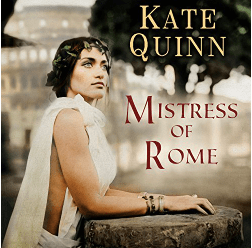 Before I talk about this stunning debut novel, I would like to give a shout-out to the narrator, Elizabeth Wiley. Our pleasure in the audiobook experience is so dependent on the narrator. Recently, I was listening to something that was completely spoiled by the narrator’s strange way of pronouncing various words. (It was such a jarring experience.) However, my pleasure in Kate Quinn’s novel was considerably enhanced by Ms. Wiley’s narration. She gave a pitch-perfect rendition of Lepida Pollia, that conveyed all the entitlement, avarice, and superficial charm of a spoiled rich kid. I loved hearing the dialogues between Lepida and her slave Thea, as Thea’s voice conveyed a subtext of subversive laughter, which she could never have expressed without being beaten & abused. (It is also a nice touch that both young women are the same age – 14 years old – at the start of the novel, so that the fortunes of rich and poor girls are well contrasted.)
This novel has several points of view, which gives a richness and depth to this book. We see the Roman world of 82CE through the eyes of Lepida, and her slave. We are immersed in the world of gladiators, Praetorian guards, senators and their families. We see the games. We see the gladiators training. We see supper parties in the triclinium. We even see the Emperor Domitian.
Ms. Quinn has managed to write a powerful narrative that is not ruined by too many characters, or lack of tension. She knows how to pace a novel. She knows how to milk incidents for tension. And oh, is she good at plot twists! I loved the hours I spent being immersed in this world. Five stars.


April 14, 2021
THE LION & THE ROSE by Kate Quinn, narrated by Leila Birch (Carmelina), Maria Elena Infantino (Giulia) & Ronan Vibert (Leonello)
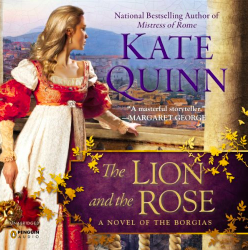 THE LION & THE ROSE really made this duology. I already loved THE SERPENT & THE PEARL, where Carmelina is making her crostata, marzipan & tortes, Giulia is running downstairs gossiping & laughing while Leonello sits in a corner cleaning his nails with various daggers, but THE LION & THE ROSE which solved the mysteries, soothed wounded hearts and gave people hope was really my favorite.
There were some stunning scenes, where Giulia is publicly humiliated by the Pope, where Juan Borgia meets his end, where Carmelina meets various spine-chilling dangers, and where the characters come together to hoodwink a greedy prioress.
If you love historical novels, read these two. You won’t be disappointed, Five stars. #katequinn #theserpentandthepearl #thelionandtherose
April 12, 2021
THE SERPENT & THE PEARL by Kate Quinn, narrated by Leila Birch (Carmelina), Maria Elena Infantino (Giulia) & Ronan Vibert (Leonello)
Kate Quinn is such a talented writer. 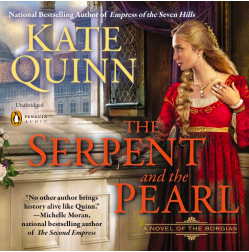 THE SERPENT & THE PEARL (the first in a duology about the Borgia Pope Alexander VI in 1490s Rome) begins with a sniff. Carmelina is a cook, and she follows her nose quite literally. Immediately we are grabbed by the point-of-view of this hurricane of a woman who whips all the men of the kitchen into shape.
But Carmelina is not a one-dimensional hurricane. She has a past. She has done something so dreadful, that if she were caught, her punishment would be so unbearable that the thought of it makes her dissolve with fear. Carmelina does very well for herself, becoming the favorite cook of Giulia Farnese, the teenaged mistress of 60-something Pope Alexander VI aka Rodrigo Borgia. Giulia has a sweet tooth and is particularly fond of Carmelina’s tortes. Everything is peaches & cream for Carmelina, until Giulia’s bodyguard Leonello (based on Tyrion Lannister) puts two and two together, and realizes that Carmelina is an escaped nun.
These three POV characters are wonderfully vivid, and so enjoyable. Giulia is luscious, sweet & extremely good at managing Rodrigo Borgia. Carmelina’s prickliness and tart tongue hides real terror. And Leonello, with his spiteful tongue would normally turn everyone off, were it not for the fact that his lines are so good, and his intelligence so gripping. Minor characters are also delineated in sure strokes, such as Cesare Borgia who trails menace in his wake.
The only problem I had with this novel is that it is a bit repetitive. We open with the wedding feast of Giulia Farnese, which is marvelous. But too soon, we are embroiled in the wedding feast of Lucrezia Borgia. Why was it necessary to portray TWO wedding feasts in such detail?? I think this volume would have been improved if Lucrezia’s wedding could have been edited or cut as I’m don’t think it contributed much to the story and the information it did provide would have been more useful elsewhere in the novel. Four stars.
April 11, 2021
Reading Sundays: THE END OF CHILDHOOD (Part 3), a short story by Cynthia Sally Haggard
“Your father is busy,” she replied after a clipped silence. “You may blame his absence on the Emperor Napoleon.” There was a short pause. “You know who he is, don’t you child?”
Maria nodded.
Mrs. Clayton leaned back in her chair, and picked up her work. “Your father is helping to ensure that we will have a victory that will keep us all safe.” She glanced at me, noticing me for the first time. “What are you staring at Susan? I need that pillow finished today.”
“Yes, Madam,” I murmured, bending my head to my work. True, we were fighting the French and had been doing so for many years. But was there more to this than Mrs. Clayton chose to say? Did Mr. Clayton find his wife as cold as I did? Despite the goings-on in the bedchamber which made Mrs. Clayton breed each year, they didn’t seem to be close. They didn’t hold hands, exchange gossip, or laugh together. When they saw each other, it was only at dinner, which occurred in the formal dining room with its elaborately set table. The porcelain,

By the beginning of the 19th century, sugar sculptures were replaced by porcelain figurines which could be arranged in intricate pastoral scenes and, unlike sugar sculptures, had the advantage of being non-perishable.
the silver candle-sticks, silver ware, silver cruet bowls gleamed coldly and proudly, a mirror for the Claytons, husband and wife, who sat facing each other, their heads held high, with a vast table in between keeping them apart.
* * *
Mr. Clayton departed for his estates in Staffordshire a week after his wife’s confinement. He spent the entire summer there, staying well into September to supervise the harvest. But Sam the footman told us in a whisper to expect the master home today. The clock hand

Grandfather Clock by Caleb Pitt of Frome Somerset, which dates circa 1780.
crawled to eleven o’clock, then carriage wheels groaned up the hill and rolled to a stop. Maria flew out of her seat, disappearing into the foyer while I followed at a more sedate pace.
“Papa!” she called, her voice echoing in the marble foyer.
“Who is this?” he said to his daughter as I appeared. “Do I know you young lady?”
Maria giggled, her pale face gathering color.
“Would this young lady like to know what I have in my pockets?”
[To be continued.]
April 9, 2021
A BRIGHTNESS LONG AGO by Guy Gavriel Kay narrated by Simon Vance
 This volume is very similar to CHILDREN OF EARTH AND SKY, but whereas CHILDREN takes place in around 1478, i.e. around 25 years AFTER the fall of Constantinople (Sarantium), BRIGHTNESS takes place in 1453, the year that Constantinople/Sarantium falls.
There are other similarities. Like CHILDREN, BRIGHTNESS has a young aristocratic woman who flouts society’s norms. But instead of a fake marriage and unexpected power as Eldest Daughter at a Jadd Sanctuary, this young woman murders someone, wins a dangerous horse race, and dies defending her family with a sword.
Then we have the naive young man. In CHILDREN, he is a painter. In BRIGHTNESS, we have the son of a tailor, whose brilliance led to his education at a famous school, followed by his employment at the court of an aristocrat who is so nasty, his nickname is “The Beast.”
The grouping of five people (the usual number for GGK’s novels) is rounded out by another adventurous young woman, this time a healer who likes to travel, and two warlords who are at each other’s throats.
Despite the bloodthirsty nature of the times (1400s Italy and the Balkans) this is a quiet novel like CHILDREN. Again, author Guy Gavriel Kay spends a great deal of ink musing about the role of chance in a person’s life (something NOT appreciated by most people) and about the nature and meaning of life in general. It is these ponderings that give both novels their quiet air, despite all the fighting, murdering and general mayhem of 15th century Europe.
IMHO, this is NOT GGK at his best. I found the musings too predictable, and of course they slowed the story down. My favorite GGK novels are TIGANA and YSABEL (because of their wonderful characters) and UNDER HEAVEN and RIVER OF STARS (because the real historical events that underpin these stories give the narrative arc a spine.)
By contrast, CHILDREN and BRIGHTNESS ramble. Four stars.
April 7, 2021
Guy Gavriel Kay’s CHILDREN OF EARTH & SKY narrated by Simon Vance
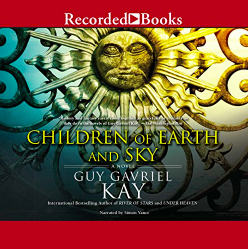 It is 1478. The great city of Sarantium (Byzantium/Constantinople) was sacked 25 years ago by the Ashurites (Muslims) and is now called Ashuria (Istanbul). The Council of Twelve of the Republic of Seressa (La Serenissima/Venice) are sending a spy to Ashuria, in the shape of a young artist, who is ostensibly painting the portrait of the Caliph in the Western Style, and two spies to Dubrava (Dubrovnik) in the shape of a soi-disant married couple, a doctor and his “wife.” The doctor will be ministering to patients in Dubrava. His “wife” will be working for the council of twelve.
These plans seem suitably devious & Machiavellian. Until it becomes obvious that they fool no-one, including the owner of the ship they are using to travel on to Dubrava, and the young painter.
Of course, there are adventures. The ship is a couple of days from Seressa, when it is boarded by sea-pirates, including an angry young woman seeking vengeance for the destruction of her village. Enter Danica Gradič. A thousand miles to the East, in Ashuria, a young warrior called Davos kills another trainee by devilish cleverness. He is elevated, at age 14, to the ranks of the Janneys (Janissaries.)
And so our characters, painter Pietro, fake wife Leonora, warrior Danica, her brother Davos/Nevin and the merchant (whose name I cannot spell as I only HEARD this on audiobook) join forces for a dark adventure that criss-crosses the Balkans, the land between Venice and Istanbul.
It will seem strange to say that this is a quiet novel, as a lot of it is made up of various fights. But it is so. Guy Gavriel Kay’s characters appear one by one, they interest us, and then they fade away. As is typical for a Guy Gavriel Kay novel, there is a good deal of philosophizing on the meaning of life and the role of chance. Near the end of this volume, the characters die, mostly peacefully. The ending is serene. Four stars.
April 5, 2021
THE LAST LIGHT OF THE SUN by Guy Gavriel Kay, narrated by Holter Graham
Hmmm. The trouble with trying to write a review about Guy Gavriel Kay is that he is a talented author who has written some wonderful novels – TIGANA, YSABEL, UNDER HEAVEN & RIVER OF STARS – so when he doesn’t meet the high bar of that work, it is inevitable that we are going to feel disappointed.
I didn’t think the SARANTINE MOSAIC was his strongest work, but it was saved by several well-drawn characters such as the mosaicist Crispin, the Emperor Valerius II, his Empress Alixana, Emperor Valerius III and his wives Styliane & Gisel. Unfortunately, the same cannot be said for THE LAST LIGHT OF THE SUN.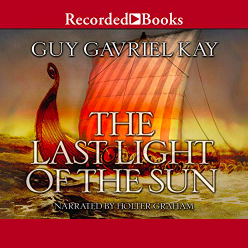
I loved how this story opened. I loved how a young man one morning (very early) blearily stole a fabulous horse just before the funeral rites of its august master (at which it would have been burned alive). This act causes great agitation amongst the community, as the funeral has to be postponed. What makes the theft even odder is that it occurs on a small island. So the authorities are bound to find the thief aren’t they?
We then are transported into a different location, with different characters and different problems. How I loved the feisty princesses, daughters of King Aeldred (based upon Alfred the Great) with their booted feet and judicious kicks that shows they can deal with any young man who bothers them.
But we aren’t allowed to know these characters well because the story cuts back and forth between the Erlings/Vikings (the story of the young man with the horse), the Anglcyn/English court of King Aeldred (the story of the princesses and their brothers) and the Cyngaels/Welsh. It ends with three marriages, one for each of these communities.
Of course the writing is magnificent, but this novel lacked a spine. There were far too many characters, and even though I enjoyed being interrupted by minor characters whose lives were so deftly laid before us, I did find it confusing (particularly as an audio listener) to keep straight Bern (the young man with the horse) from Brynn (a Welsh lord) from Brand (a captain of one of the Viking ships.)
What a pity that this novel drifted on with its predictable fights, petty jealousies and quarrels, without a clear focus to guide it. Three stars.
April 4, 2021
Reading Sundays: THE END OF CHILDHOOD (Part 2), a short story by Cynthia Sally Haggard
Mr. Clayton nodded briefly, but his blue eyes hardened as he stared at his wife.Suddenly, he caught sight of me. There was something about his smile I did not care for. Nevertheless, I felt duty bound to put on my best smile for Mr. Clayton. As the only surviving child of John Lee, Master Shipwright of the King’s Navy,
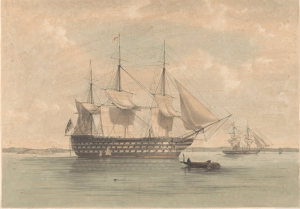
HMS Caledonia 1808
I was expected to behave well towards the gentleman who had bestowed his charity by taking me, the best friend of his daughter Maria, into his home. Papa had taken me there, saying that it was a great honor to be brought up with the Landed Gentry, with a family such as the Claytons who could trace their lineage all the way back to William the Conqueror.
“It will great improve your marriage prospects, my girl,” Papa had remarked, squeezing my arm and smiling. It was the first time I’d seen him smile since Mama’s death. “My pretty charmer will surely find someone to love her amongst the fancy folk, she will be brought up as a lady.”
And that was how my life with the Claytons began.
Like me, Maria was the only surviving child of the family, which consisted of a mean-mouthed mother who was continually ill, and a reserved father who was often out of the house visiting his beloved dockyards. Not that Mr. Clayton actually worked. Unlike Papa, who was a Master Shipwright, John Clayton Esquire was a gentleman, and gentlemen didn’t work for a living, having land to support their families. Nevertheless, Mr. Clayton spent hours making drawings for the British Navy of new kinds of ships; for there was talk of war against the French Emperor Napoleon.
Generally, Maria and I didn’t pay much attention to grownup talk, yet as April 1808 turned into May and rumors began of a new war with Spain,

Battle of Talavera, 28 July 1809
Maria timidly asked her mother why her father was spending less and less time with us.
I sat in my corner embroidering a cushion for Mrs. Clayton’s bedchamber. As usual, she behaved as if I were invisible, not acknowledging my presence by even so much a glance.
Mrs Clayton’s face sagged into its now-familiar grooves of disappointment as she took in her daughter’s question.
“Your father is busy,” she replied after a clipped silence. “You may blame his absence on the Emperor Napoleon.” There was a short pause. “You know who he is, don’t you child?”
Maria nodded. [To be continued.]
April 2, 2021
Kate Quinn’s THE HUNTRESS narrated by Saskia Maarleveld
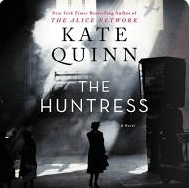 How I loved THE HUNTRESS, Kate Quinn’s study in evil! We are in Boston, Massachusetts. It is the spring of 1946. The Second World War has just ended, when Jordan McBride is introduced to her stepmother-to-be Annaliese Weber, a pretty woman with a chic taste in clothes, a warm smile and a charming 4-year-old named Ruth. But 17-year-old Jordan is suspicious. A young photographer, she is used to looking very carefully at the people around her, and one day she surprises Annaliese in a photo with a wolfish expression at odds with her usual warm smile. Who is she?
Ian Graham, a 40-something British War Correspondent who has witnessed the horrors of Omaha Beach, lost the brother he loved to Die Jägerin, the huntress, a woman notorious for murdering people (including 6 children.) Ian is on a mission to find this woman, and so he hunts the huntress to bring her to justice, with multilingual sidekick and professional flirt Anthony Ratmonovsky.
Nina Borisovna Markova grew up trapping animals and surviving the brutal cold of Lake Baikal, Siberia. At 19, she sees a plane for the first time and falls in love. By the time the war is nearly over, she has become a Soviet pilot with 600 bombing raids under her belt. Despite her stellar service, despite all of her awards, she is denounced, because her out-of-control (and mad) father says unflattering things about Comrade Stalin. Facing arrest, Nina takes her beloved plane Rusalka and flies west, eventually running out of fuel over Poland. There, she burns the plane to cover her trail and sets off into the woods, where she meets escaped prisoner Sebastian Graham, who has injured his leg.
Kate Quinn braids these three narratives together into a complex and wonderful novel. Her characters literally jump off the page. How I loved Nina, who is so wild, so primal, and who, under her glowers and prickles, suffers from a broken heart. Then there is very proper Ian Graham, who possesses, under his starched collars and ties, a wild heart. Lastly, there is Jordan, who is far too observant and candid for anyone’s comfort. Jordan, who destroys Thanksgiving with her trenchant observations, and nearly destroys her father’s marriage.
Highly recommended for its stellar research and complex characters. Five stars. #katequinn
March 31, 2021
Kate Quinn’s THE ALICE NETWORK narrated by Saskia Maarleveld
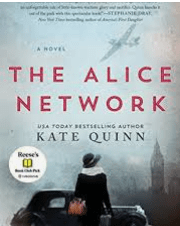 Kate Quinn’s THE ALICE NETWORK is superb. Like many historical novels today, this one has a braided narrative, alternating between 1915 and 1947.
Nineteen-year-old Charlotte “Charlie” Sinclair is looking for her much-loved cousin Rose, who disappeared in 1944. She travels all the way from New York to Limoges, France, to a restaurant called “Le Lethé,” where Rose worked.
Twenty-two-year-old Evelyn “Eve” Gardner is bored with being a woman in 1915 England, and so applies to be a spy in Northern France. Once there, she talks herself into a job as a waitress at “Le Lethé” in Lille, France.
Both places are frequented by German officers, so Eve can gather scraps of information in 1915 Lille, and Rose can garner tidbits for her friends in the French Résistance in 1940s Limoges.
Unlike many readers, I found both threads of the story strong. I enjoyed getting to know Charlie and the disreputable friends she finds in London on her way to France: Finn, an ex-convict with empathy and a charming Scottish burr, and Eve, now a 54-year-old drunk suffering from PTSD. This thread of the story, in which these three unlikely characters wander through France, provided much-needed relief to the unrelieved tragedy of the 1915 story, in which 22-year-old Eve faces unspeakable hardship, abuse and grief as she struggles to do her duty for the country she loves. Five stars. #katequinn #thealicenetwork
Cynthia Sally's Blog

- Cynthia Sally Haggard's profile
- 129 followers

