Stephen Tow's Blog, page 6
November 30, 2012
November 27 Seattle Rock Class
We spent the first 10 minutes or so talking about the Fastbacks, one of my favorite Seattle bands and the subject of a chapter addendum. The students also had to listen to four of their songs: “K Street,” “Trouble Sleeping,” “Set Me Free,” (a Sweet cover), and “3 Boxes.” As I expected, about half the class dug the music, and the other half kind of shrugged their shoulders. The Fastbacks have good songs with hooky melodies. If you want to hear major musical innovation or sparkling vocals, you should move on. Nonetheless, the students seemed to appreciate the band’s DIY ethic and longevity. They also enjoyed reading and talking about the Fastbacks’ experiences opening for Pearl Jam in the ’90s.
Next, we chatted about chapter 7 from my book: “England is Sending an Emissary!” That chapter focuses on Seattle in 1989 and ’90…when the once tiny music scene had begun to reach commercial viability. So, we spent the next 15 minutes weighing in on art versus commerce, and what exactly constitutes “selling out.” By that point, Soundgarden had moved on to a major label, slowly changing their sound to appeal to a metal market. Their transition was handled so deftly that the band managed to score riches while maintaining their street credibility. As one of my students put it, “they got to have their cake and eat it, too.”
We talked about other bands beginning to receive attention, notably Mudhoney, Nirvana, and Mother Love Bone…again focusing on each band’s approach to the business side of music, and attempting ascertain why MLB (and their successors in Pearl Jam) faced the scenester’s accusations of “sell-out!” while the other bands did not. I don’t think the students totally got the attitude of punk communities back then…which was not to embrace stardom. MLB, and later PJ, wanted to become rock stars. And lo and behold, it happened for them. “How dare they?” my students asked in jest.
Next, Abbie presented on the London punk scene of the ’70s, focusing on the Pistols, Clash, and Damned and giving us an idea of just how shocking those bands were back then. Next, Jenna talked about the UK “new metal” community of the ’80s, distinguishing itself from forebears like Black Sabbath. She mentioned people like Iron Maiden and Venom as examples of the newer, proggier, showier bands that influenced American groups like Metallica.
Finally, we readied ourselves for the main event, a chat via Skype with the Walkabouts’ Carla Torgerson and Michael Wells. Gabrielle led the questioning and did a fine job. I think my favorite question and answer related to Carla’s time canning salmon in Alaska (really.) Back in 1984, Carla had ventured there to make some money for college and ran into Chris Eckman, another guitar player who found himself in a similar position. Together, they formed the Walkabouts, which would later include Michael on bass.
In any event, Gabrielle asked Carla about her years canning salmon during summers, an experience that intrigues us on the East Coast. Carla talked of long days standing in the cold canning salmon, and how she learned to empathize with workers in manufacturing plants all over the world.
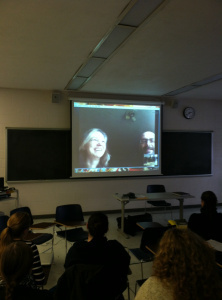
(Carla and Michael from the Walkabouts chat with my class via Skype from Seattle)



November 29, 2012
Seattle Rock n Roll Weekend: Day Two
Woke up around 9…pretty good since I fell asleep at 3. Headed down to my favorite Seattle breakfast place: CJ’s in Belltown. As I sat down, I took off my Philadelphia Eagles cap and placed it on the table. The host walked by, pointed to it and said, “Nick Foles!” Foles would be making his first start for the injured Michael Vick that day…so of course we had a conversation about how badly the team sucks this year. The host apparently hails from South Jersey.
As I left CJ’s, talking more Eagles football with the host, a couple overheard us and said, “Hey, we’re from Philly.” Apparently, they’re from Lansdale, PA, my old stomping grounds. Weird. Anyway, I headed from CJ’s over to Ballard to meet up with my third contact, Cat Butt’s James Burdyshaw. Burdyshaw, a huge fan of ’60s Motown and Soul (actually ’60s anything), has formed a group called the Soulvation.
I arrived at James’ apartment around 11. He still had to finish getting ready, so he asked me if I’d like to hear some music while I waited. “Sure,” I said. “Any requests?” he asked. “Anything except hip hop and country,” I responded. He put on some old Motown. That sounded great to me, especially after the hip hop and country barrage I usually hear at home.
We headed over to the band’s rehearsal space in South Seattle. (Sort of funny…we drove around for what seemed like forever, ending up under the highway in an area filled with warehouses and little else. I asked James if this was going to be a mob hit. He laughed.) After we arrived at the space and met the rest of the band, I inserted earplugs and waited. Like Rob Morgan’s GUM, the Soulvation does covers, but they concentrate on James’ ’60s Motown/Stax fascination. I bopped around as the Soulvation played, taking photos along the way. One song with a killer riff (I’m a sucker for a great riff) really did it for me, and I asked James about it. “Love’s Gone Bad,” was done first by Kris Clark, and then covered by the Underdogs…both for Motown. The Soulvation played it the Underdogs’ way, which features that driving riff that could work in a rock, garage, or soul format (afterward I found the song and added it to my iPhone…that riff could go on forever as far as I’m concerned.)
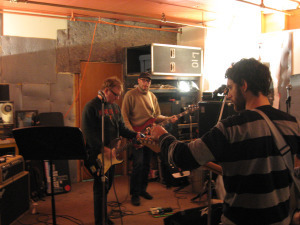
(James Burdyshaw, left, and two other members of the Soulvation. The bass player, center, [forgot his name] is also from Philly.)
Following the practice, I took James back to Ballard and we had a coffee before saying good-bye. I had scheduled a dinner with producer Steve Fisk (whom I had interviewed twice over the phone), and we met at a little Thai/Vietnamese place in the neighborhood. Steve said some complimentary things about the book…although he mentioned he had found a couple of mistakes. He said he’d get back to me about them (I will fix them for the tenth anniversary edition.) I told Steve I couldn’t stay too long since I was about to go see Alice Cooper with Rob and Kevin from the Squirrels. Steve said something to the effect that they were the perfect guys to go to that show with.
After finishing my meal, I headed over to Rob Morgan’s place a few blocks away (apparently, all the cool Seattle people live in Ballard.) We got into Kevin’s car, and he drove us down to Tacoma to see Mr. Cooper.
Alice was amazing…but I think I enjoyed Rob’s reactions most of all. When Alice took the stage, Rob smiled and clapped his hands like a kid who had just met Santa for the first time. I think he grinned the entire show. At the finale, as Alice’s band finished up amidst explosions and confetti, Rob exclaimed, “That’s how it’s done!”
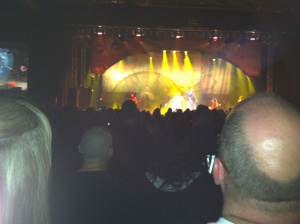
(An admittedly horrible cell phone shot of Alice Cooper in Tacoma, WA, November 18, 2012.)
I’ll leave you with one more random story from this trip. I had an early flight home the next day, and took the train back from the airport. As my stop approached, I asked the gentleman sitting next to me to get up so I could exit. He basically said not to worry since he was getting off at the same stop. I said, “Ok, but you’re not going to change your mind and make me climb over you, right?” He said no, and then we both had a good laugh over what could become good sitcom fodder. We then talked a little Monty Python before he told me I should see Silver Linings Playbook, which apparently features the same quirky humor. What a great way to end a great trip.


November 28, 2012
A huge thank you to our Seattle music guest speakers
Thank you to all who took time this semester to chat with my students:
Rob Morgan of the Squirrels
Leighton Beezer of the Thrown Ups
Laura Weller-Vanderpool of Capping Day
Gary Minkler and Rich Riggins of Red Dress
Bruce Pavitt of Sub Pop Records
Carla Torgerson and Michael Wells of the Walkabouts
Thank you all so much.

The Walkabouts’ Carla and Michael talk with the class yesterday.


November 25, 2012
11/27 Seattle Rock Class Schedule
Our theme will revolve around “Art versus Commerce” as Seattle’s music scene reaches kind of a maturity in 1989. Some people, notably Soundgarden, Mother Love Bone, and Mudhoney, began getting recognition, while others did not. We will talk about what can happen to the creative process when serious money becomes a real possibility.
1:40 to 1:45…Intro/Outro by me.
1:45 to 1:55…I talk about the Fastbacks (reading and music.)
1:55 to 2:10…Shanae and Kristy lead the discussion on Chapter 7 from my book.
2:10 to 2:30…Abbie talks about the London punk scene of the ’70s; Jenna presents on London metal in the ’80s.
2:30 to 2:55…Q&A via Skype with the Walkabouts’ Carla Torgerson and Michael Wells led by Gabrielle.

(The Walkabouts.)


November 22, 2012
Seattle Rock n Roll Weekend: Day One
(Given it’s Thankgiving and I feel like crap sitting in my hotel room…I figured I’d make myself useful and post something about last weekend.)
Now that my book has been out for over a year, I admitted to my wife that I would find other excuses to visit Seattle. So when I found out my friend Rob Morgan (Pudz/Squirrels) had formed a new band along with Rod Moody (Swallow, also was in Deranged Diction with Pearl Jam’s Jeff Ament) and Damon Titus (the Enemy), I knew I had my excuse. Calling themselves the GUM, Rob’s band would debut on Saturday, November 17 at Darrell’s Tavern in Shoreline, WA. This collective would cross the early Seattle punksters with the later grunge kids. And, since Rob would front the GUM, I knew they would place fun at a premium. As an added bonus, Tom Price’s (U-Men) Desert Classic would play the same bill.
My plane touched down late Saturday morning, after a six hour flight from Philly. I love Seattle, but this is what you get here in November: rain, cold, followed by more rain…and chill. After picking up my bag and rental car, I headed to Belltown to meet up with fellow writer Dave O’Leary at the legendary Two Bells Bar & Grill. Dave wrote a semi-autobiographical novel called Horse Bite. Told in the first person, Dave’s book takes the reader on a life-discovering journey, with Seattle’s bars and coffee houses serving as backdrops. In any event, Dave’s friend and editor Clint Brownlee joined us for a few beers.
After Clint left, Dave and I ordered up some awesome burgers at Two Bells and continued to talk…and the beers kept coming. (Memo to self: you are now old. You cannot drink more than a couple of beers in the middle of the day—especially after a cross-country flight on little sleep—and expect to function later. Repeat. You are now old.) Dave is working on a new novel, as am I (a non-fiction-fiction tale about a fictional band.) I said farewell to Dave, then headed back to my hotel in the University District.
My head hit the pillow around 3. I think I woke up at 7…I’m not sure. Ever sleep too long during the day and wake up not having any idea where or when you are? After shaking the cobwebs and realizing I was not in nineteenth-century Stockholm, I headed up to the gig at Darrell’s, located about 15 minutes north of the hotel.
Every time I head to Seattle, I have to check in with a few people. Rob makes one, and I would soon say hi to him. Then I located number two sitting at the bar: one Leighton Beezer. Leighton, like Rob, has his place within Seattle music mythology. His Thrown Ups helped define the essence of grunge with free improvisation mixed in with sludgy, loud guitars. That band also, at times, featured Mudhoney’s Mark Arm and Steve Turner. In any event, Leighton and I chatted as we waited for the bands to start.
After the opening act, a sort of artsy post-punk band called Aaiiee, the GUM took the stage. Now if you know Rob, his band will play covers, and you also know he will entertain you…that is, if you let him. Don’t expect cool Soundgarden songs. He will play stuff that hipsters would sneer at…the Monkees, Shaun Cassidy, whatever. His Squirrels would mash up “Silent Night” with Black Sabbath’s “Black Sabbath,” for example. So, everything’s fair game…make sure to bring your sense of humor and leave your pretense at the door.
Wearing a bright red Monkees shirt (of course), Rob bounced around as the GUM began to rock out. I started bopping up and down as I scanned the crowd. Smiles all around.

(From left: Rob, guitarist Damon Titus, drummer Vic Hart, bassist Casey Allen, guitarist Rod Moody.)
During the set, my third Seattle contact, Jack Endino, came over and said hello. Then, I turned next to me and said hi to Lee Lumsden. Don’t know Lee? Read my fucking book, please. Lee, along with Rob, Jim Basnight, Neil Hubbard, and a few others, essentially created Seattle’s punk rock scene back in the ’70s. As we chatted, Kyle Nixon of Solger stopped by. I was not prepared for what would happen next.
At first, Kyle talked about wanting to blow off some steam given a family member’s serious health issues. Then, he kissed Lee on the cheek. Then he kissed me on the cheek. Okay, no big deal. Then, came the unexpected. He grabbed my head and planted one on me…apparently that’s what Kyle does. I had no idea. I felt like Jerry Seinfeld, after he had just been kissed by Kramer. (So, I kissed a guy. And it sucked. After I complained about it on Facebook, Jack Endino commented: “Getting kissed by Kyle Nixon is part of the deal, Steve. You gotta suck it up.”) See my list below of things I would rather do than kiss Kyle Nixon.
After filing sexual harassment charges online, I proceeded to enjoy the rest of the GUM’s set. This band…we found ourselves singing along to tunes like Frankie Avalon’s “Muscle Beach Party,” (watching Rod Moody play and sing that was priceless…reminded me of Richard Gere singing while dancing down stairs in Chicago.) and the Bay City Rollers’ “Saturday Night.” Trust me, only a band with Rob in it can pull this off. Mr. (no longer Captain) Morgan jumped around the stage, then ventured out into the crowd as he sang. Rob was clearly in his element.

(Rob Morgan directs the GUM in front of the stage while Damon plays guitar.)

(Rod travels to another dimension during the GUM’s finale.)
The audience, consisting mostly of middle aged punk rockers, showed its appreciation for the GUM with rousing applause. One more band to go. Nobody could possibly follow that, right? No band could, unless it happens to be the Tom Price Desert Classic. Playing a bluesy version of Sonics-inspired garage rock, the Desert Classic flat out rocked.

(Ladies and Gentlemen: the Tom Price Desert Classic)

After saying good-bye to everyone, and picking up my spiffy GUM shirt, I headed back to the hotel and hit the sack around 3 am. Day One…a success.

10 Things I’d Rather Do Than Kiss Kyle Nixon
1) Watch the Disney Channel for 24 hours straight, having my eyes propped open with toothpicks.
2) Go a One Direction concert.
3) Use an airplane bathroom after a heavyset man emerges, when he had previously consumed an egg salad sandwich and bean burrito.
4) Go to Disney World.
5) Root for the Dallas Cowboys…no scratch that, I’d rather kiss Kyle Nixon.
6) Grade papers.
7) Watch any of the Twilight movies.
8) Eat vegan.
9) Eat a hot dog with ketchup on it.
10) Sing Christmas carols.
11) Fondle Richard Nixon.


November 20, 2012
A Whirlwind Seattle Rock n Roll Weekend
This is just a tease. Repeat. This is just a tease. I will post a summary of this past weekend’s activities with Seattle crazies after Thanksgiving. Much to report, though…great bands on Saturday night, lunch and beers with fellow writer Dave O’Leary, rehearsal session with James Burdyshaw’s current project, dinner with producer Steve Fisk, and an Alice Cooper show on Sunday. In the meantime, I will leave you with a couple of photos.

(The GUM, November 17, 2012 at Darrell’s Tavern, Shoreline, WA.)

(The Tom Price Desert Classic, same night.)


November 14, 2012



Late ’80 Seattle Grunge and Beyond, 11/13/12 Class
I’d have to say I enjoyed yesterday’s class immensely, up to and including our Q&A with Sub Pop Records founder Bruce Pavitt. Nearly everyone contributed to the discussions, and we even had two guests stop by for the Q&A.
First, we chatted about late ’80s Seattle music, with students listening to the following songs before class:
Mudhoney, “Touch Me I’m Sick.”
Nirvana, “Spank Thru,” “School.”
TAD, “Helot.”
Skin Yard, “Hallowed Ground.”
The Posies, “Blind Eyes Open.”
Jack Endino, “Sideways Savannah.”
Gas Huffer, “Night Train to Spokane.”
Reactions? Well, I think Mudhoney, TAD, and Skin Yard kind of scared them. We talked about the “sell” Sub Pop created with TAD…about these scary backwoodsmen who want to invade your homes and murder your children. I think they got the whole twisted Seattle hyperbole, especially understanding the warmth and intelligence of people like TAD’s Kurt Danielson.
Students talked most about the Endino track, which appears on his first solo offering, Angle of Attack. “Sideways Savannah” is an instrumental, and began in Endino’s basement when he and drummer extraordinare Greg Gilmore began pounding on carefully laid out two-by-fours. Once they finished the percussion track, Endino added drums, bass, and guitar. The result, as one student put it, sounds “African.” I would go with Asia, given Greg’s visits to Indonesia, but regardless, I think the class got the diversity and experimentation then going on in the Seattle music community.
Next, Emily finished up her presentation on ’60s San Francisco psyche talking about the Jefferson Airplane and Grateful Dead. (Side note: the Dead’s American Beauty makes my Desert Island Top 10 List.) Nicole followed with ’90s Atlanta rap, which provided a nice contemporary counterpoint to the LA gangsta scene (although…and I didn’t know this…Atlanta generated Ice T.)
Finally, the main event, a chat with Bruce Pavitt, founder of Sub Pop records, and tastemaker within the Seattle music community. I had not interviewed Bruce for my book, although I had attempted to make contact. I asked him for an interview upon spotting him at the 2008 Sub Pop 20 Fest. Unfortunately, he thought I wanted to bother him with an interview there. (With the volume of the music, he couldn’t hear that I wanted to do a phoner at a later time.) Afterward, I saw him sort of eyeing me during Green River’s set…I think he thought I was a stalker (I’m not one…really…I just looked weird wearing my Geezerfest shirt.) Later, I sent him a copy of my book. He said nice things about it, and graciously agreed to chat with my class.
Students, led by Morgan, asked some wonderful questions about his long career championing independent music. Morgan inquired about Bruce’s days at Evergreen State College, and he responded by talking about his early Sub/Pop fanzines, then his moving to Seattle, writing for the Rocket, and putting out Sub Pop 100 (1986) and Green River and Soundgarden EPs (1987.)
Bruce talked about his interest in national independent music scenes, until he realized he had a vibrant one in his own backyard, particularly after the 1986 release of Deep Six. That LP, put out by C/Z Records’ Chris Hanzsek, featured rough early recordings by Green River, the Melvins, Malfunkshun, Skin Yard, and Soundgarden (and a track by the amazing U-Men.)
One student mentioned yesterday’s release of the new Soundgarden record, King Animal, and asked what Bruce thought of it. He mentioned he had only heard one track, but nonetheless liked it. Bruce talked about growing up with Soundgarden’s guitar player Kim Thayil in suburban Chicago…and about how Kim basically lived at his house, even dating two of his sisters.
Another student asked Bruce about the origin of the word “grunge.” I kind of braced myself, because in my book I mention Bruce first using the word in an ad for a Green River record, in the April 1988 issue of the Rocket. Afterward, the Seattle media picked up the term to describe everyone from Mudhoney to Swallow to Nirvana. My fear was that Bruce might provide a different version of events, and fortunately for me and my tenuous credibility, he backed my story. As far as where he came up with the word itself, Bruce couldn’t recall specifics. No one can. Regardless, he felt the term did squarely apply to bands like TAD and Mudhoney, in terms of their raw musical styles and raggety fashion sense.
A student then asked him why certain bands “make it” and others don’t. Bruce kind of put it like this…he said, when it comes to the music industry, justice does not exist. Some immensely talented bands get nowhere, while other mediocre acts become enormously famous. In addition to the music itself, a lot of it depends on timing, luck, and the quality of the recordings.
Finally, I inquired about Bruce’s new book, Experiencing Nirvana: Grunge in Europe, 1989 (like the Soundgarden record, also released the day of our chat with Bruce…weird.) Experiencing Nirvana provides a rare photographic journal of the band’s time in Rome, culminating in London with the legendary Sub Pop Lame Festival show that December. You can find Bruce’s book on iTunes and order it here: https://itunes.apple.com/us/book/experiencing-nirvana-grunge/id575827071/

(Sub Pop Records founder Bruce Pavitt chats with my class via Skype.)


November 11, 2012
November 13 Seattle Rock Music Class
Topic: Grunge and beyond: Seattle in the late ’80s.
Special Guest: Sub Pop Records founder Bruce Pavitt via Skype.
Text: Tow, chapters 5 and 6.
Music: Mudhoney: “Touch Me I’m Sick;” Nirvana: “Spank Thru,” “School;” TAD: “Helot;” Skin Yard: “Hallowed Ground;” the Posies: “Blind Eyes Open;” Jack Endino: “Sideways Savannah;” Gas Huffer: “Night Train to Spokane.”
Schedule (all times US EDT)
1:40 to 1:45…Intro by me
1:45 to 1:55…completion of Emily’s presentation on the San Francisco ’60s psyche scene
1:55 to 2:05…Nicole presents on ’90s Atlanta rap scene
2:05 to 2:25…Julia and Samantha K lead the discussion on the music and reading.
2:25 to 2:30…Outro by me
2:30 to 2:55…Q&A via Skype with Bruce Pavitt, led by Morgan.
Bruce Pavitt mini bio
Bruce began his music life with a small fanzine called Sub/Pop at Evergreen State College in Olympia, Washington. There, he pursued his passion for uncovering music scenes not named London and New York. After putting out three cassette compilations at Evergreen, he moved to Seattle where he began to write a column for the Rocket, Seattle’s monthly music paper. In 1984, he formed a record label called Bombshelter and put out an EP by the U-Men (the world’s greatest band.) Later, he founded Sub Pop Records, turning it into a full-time entity in 1988 with partner Jonathan Poneman. Up to that point, the label had put out two EPs by fledgling bands Green River and Soundgarden. By 1989, Sub Pop had become Seattle’s premier independent label, featuring grunge acts like Mudhoney, TAD, and Nirvana.



November 8, 2012
November 6 Seattle Rock class recap
Ever have one of those days where everything seems off? Tuesday was like that for me. I arrived late to my first class, because PENNDOT decided to remove a road detour sign making me believe a certain bridge had been completed…which of course it wasn’t. Later, I stepped in dog shit. Yes, it was that kind of day.
The Seattle class went well enough, but losing the October 30 session to Hurricane Sandy threw off our rhythm. We chatted about the Boston and New York scenes of the ’80s, discussing bands like the Pixies, the Lemonheads, Dinosaur Jr, and Sonic Youth. The students seemed to really like Dino Jr, surprising the hell out of me. I think that band’s combo of distorted guitar mishmash and hooky melody connected with them. Sonic Youth ellicited an expected reaction: half the class loved their weird, arty constructions; the other half found them boring.
Next (and here comes a weird part), Kelly began to talk about the Memphis scene of the ’50s. How is that weird, might you ask? Well, she was supposed to present last week, but I rearranged the schedule and pushed her back two weeks after the 10/30 class was canceled. Kelly never got my email about the scheduling change because she lost power.
It gets weirder. As she began to talk about the Memphis rockabilly scene, I found myself in the midst of a Groundhog Day. “Didn’t she already do this?” I thought to myself. “I know I’ve heard this before.” I began to look around to see if I could spot Needlenose Ned Ryerson. Later when I got home, I realized Kelly had submitted a draft of her paper (students have to prepare an essay on the same music scene they presented on in class) that I had read a couple of weeks prior.
Finally, Gary Minkler and Rich Riggins of Red Dress joined us, via Skype, for a Q&A with the students. Abbie led the questioning about that unique band’s career, including musical style, the sublime interaction between guitar players John Olufs and Pete Pendras, musical influences, and crazy opening stage acts including a hula dancer and a snake charmer (I think a snake charmer…the sound cut out at times, thus adding to the day’s overall annoyance.) Maya (sp?) the pitbull joined Gary and Rich, adding to the students’ enjoyment. Overall, we greatly appreciated the Red Dress guys providing us with an insider’s view of their wonderful band.

(From left, Red Dress’ Rich Riggins, Maya the pit bull, and Gary Minkler join us from Seattle.)