Trudy Myers's Blog, page 43
August 31, 2014
2014 World Con Report
This year’s World Science Fiction Convention was held in London, England. We don’t normally go it is overseas, but we decided if we were going to do any traveling, it was time to get started. I won’t go into details about our trip to get there, except that a storm in Atlanta (Georgia) made our trip an endurance battle.The convention was held in a huge convention center located in the dock area on the Thames River. There were several hotels in the immediate area, but they were expensive, and by the time I had figured out our plan early this spring, I couldn’t find one in the area that had a room available for our entire stay. We wanted to do some site-seeing, too, so I found a cheaper hotel closer to London Central... and only 4 or 5 blocks from a major underground station.London doesn’t have street signs like America. The names of some streets are on the side of the corner building, if you are lucky. Some streets are no wider than an American alley. It made reading my map difficult, especially after our marathon of non-sleeping to get there. When we finally paused and asked for directions at a cafe, we had turned a block too early.I had been told that European hotel rooms are smaller than American, but when we finally got to ours, we were stunned. The room was the size of the bed with about a foot of ‘walking space’ on 3 sides and an attached bathroom that’s smaller than ours at home (which is definitely ‘dinky’). There were no chairs, no table, no drawers or shelves to put your clothes. Very claustrophobic! The first thing I did was fall on the bed and sleep for 15 hours.We figured out the underground system and crammed 4 days of site seeing into 3. We didn’t have time to do the Jack the Ripper Walking Tour, but eventually I realized our hotel was IN his ‘hunting area’. (How exciting!) We weren’t afraid to ask questions, so it wasn’t difficult to add a ‘Docks Light Rail’ route to our pattern to get to and from the convention center, but it did mean we were riding the underground during the morning rush hour. Crammed like sardines.The convention itself was good. There were a couple of space organizations giving lots of science panels, which always seemed to be over-crowded. Many times, people got turned away because all the chairs were full, and sometimes that wasn’t a science panel, either. There were times when I had to go to my 3rd choice of a panel, because both of the first 2 choices were full.The convention had registered over 10,000 people, but on any given day, there were about 5 or 6,000 people in attendance.Food and drink was probably over-priced, since it was all brought in by businesses within the convention center, but we were dealing in Pounds, so it was hard to say. I can’t say any of it was good.Registration had a looooooong line every morning, but seemed efficient when my turn came. The freebie table, however, was way too small. This one table had fliers, books, business cards, book marks, pens and who knows what else, all jumbled together because there wasn’t room to lay things out nicely. As soon as somebody tried to organize an area so their items could half-way be seen, somebody else came along and slapped down a stack of... something right in the middle of it.To sum up London: metropolitan, crowded, fast paced, efficient mass transportation, confusing; but if you can get a local to slow down, they will answer questions. As an introvert, I was stressed because it was so cramped, which I couldn’t escape, but I lived through our 10 9 days there.LonCon3, the 2014 World Science Fiction Convention, was also crowded, but fun. Some things could have been better, like more freebie tables, or more room for photographers of the costumes in the costume contest, or a better method of presenting art workshops. (In the art show area was too noisy, especially without a microphone, and only those in the front of the crowd got to see what the artist was doing.) But they did have tables and chairs in the hallways, as well as water coolers.
Make a note; there are no water fountains in London. You are expected to buy your drinking water.
Make a note; there are no water fountains in London. You are expected to buy your drinking water.


August 20, 2014
Giant Extinction
For a long time, some people have blamed man for the extinction of such ice age wonders as the woolly mammoth and the woolly rhinoceros. To them, I guess ‘man’ was ‘the great killer’, killing animals right and left, indiscriminately, and with no thought to the consequences.That never seemed quite fair to me. Yes, I know that white men came to the Americas and slaughtered whole herds of buffalo just because they could. There are stupid people in the world, after all. But those men had guns. And although large, American buffalo are not giants.True, the American buffalo is only slightly smaller in size than the woolly rhinoceros, but the rhinoceros weighed quite a bit more - as much as 3.5 tons compared to the 1 ton for the largest and heaviest American buffalo. And a woolly mammoth could easily stand twice as tall as a human and weigh 6 tons.There were no guns during the last ice age. Man had spears, arrows, knives and possibly a couple other men to help him kill these giants. Would you like to pit your skills with such ancient types of weapons against a modern elephant or rhinoceros?I doubt if ice age men saw such hunts as sport. Hunting was a necessity to feed the tribe, and if they could find some rabbits, fish, fowl or other animals smaller than a woolly giant, I’m sure they would have been happy to carry those home. Don’t get me wrong; humans probably did kill some of the giants, but I personally think they would have rather avoided such a dangerous practice.Scientists have been studying the flora that could be found during the last ice age, as well as the stomach and feces contents of frozen woolly animals. It seems the ground where these creatures roamed was covered in wildflowers that were high in protein. But when the weather warmed up, the flowers died off, leaving only grasses that could not satisfy the giants’ nutritional needs.
And so the woolly giants followed the lead of those wildflowers and died off.
And so the woolly giants followed the lead of those wildflowers and died off.
August 13, 2014
Hot Tempers
In 2012, researchers concluded that the hot dry weather produced in some countries by El Nino contributedto unrest and conflict.I can’t say that I actually stopped to think about it before I read about that research, but I can say that I’m not terribly surprised, if that’s the case. It seems to have been known for a long time that Hot Temperatures produce Hot Tempers. People get uncomfortable and they start to look for someone to take it out on.So, throw some poverty, political instability and inequality into the pot with the Hot Temperatures, and tempers really start to boil. This is not the Way Things Are Supposed To Be! Maybe people figure things couldn’t possibly get worse than they are, so they might as well try to change things. And pretty soon, things have escalated into some kind of war.If the climate as a whole is warming up, this doesn’t bode well for the human race. The article I read purported that this strife was more likely to occur in the poorest of nations, and the wealthy countries went relatively unscathed. But how long would that stay true?For instance, there’s been a lot of talk in the US recently about financial inequality and instability; bigotry and intolerance have reared their ugly heads again. In Nebraska, the daytime temperature can easily top out at 100-110 degrees in August, and everybody virtually runs from air-conditioned work place to air-conditioned car to air-conditioned home.Now, imagine the temperature heading for 120, and air conditioners that can’t keep up with the demand, or power plants that can’t keep up, producing brown outs. I really don’t think it would take very long for grumblings about the 1% to become angry outcries.
And that means Trouble, my friend. Trouble. With a capital T.
And that means Trouble, my friend. Trouble. With a capital T.
August 6, 2014
Going to Mars
Every once in a while, I happen across a bit of information that indicates The Future Is On Its Way! It doesn’t seem to be arriving in a way that’s logical or methodical (to me), but I’m not in charge of these things.I would have thought it logical to build the space station into an actual way station, possibly even a place to build things like space ships. They could be ‘launched’ without having to battle their way out of the Earth’s gravity.They could be built with resources mined from the moon, which has much less gravity, so getting those materials into space would take less fuel. That would mean there would need to be some kind of working colony on the moon, to provide workers for the mine, and possibly for refining the materials, or even making the pieces for the space ship. And, of course, to care for the support systems for the workers; the food (garden), air and water supplies.Eventually, some of that mining could be moved to the asteroid belt. More stations could be built out there, as way stations/refineries/colonies. From there, it seems it would be relatively easy to move on to Mars.I know, I’m talking old school science fiction stories. Well, a lot of the science fiction authors I read as a young person were also scientists, so they tended to think these things out logically.Instead, I find articles about thousands of people being whittled down to a handful of colonists for Mars. (How are they getting there? Where will they live? How many supplies will they need to take with them? I haven’t heard anything about any of that.)The space station humans worked so hard to create is all but forgotten. Same with the moon. A warp-speed ship is being designed, even though no one knows how to create warp speed.The latest article I saw is about NASA’s plan to create one component of rocket fuel on Mars. No humans required. Although, once those humans did arrive, they could breath the component, since the robots NASA plans to send will be converting carbon dioxide into oxygen. The other component needed for rocket fuel - hydrogen - was mentioned in the article, but as an after-thought. As if all the colonists would need to do is run down to the local grocery store and get some.I’m excited by the prospect of humans going to Mars and that someone is thinking far enough ahead to spend time designing a warp-speed ship. BUT I really think these things need a support system behind them. Otherwise, we are just asking for failure. One tiny little failure could doom a colony that had to rely on Earth for help. It would still take time for help to arrive from an asteroid colony, but not as much time.
Okay. We’ve taken a couple baby steps into space. Now we’re reaching for the big shiny toy in the next room, completely ignoring all the not-as-shiny toys between us and there.
Okay. We’ve taken a couple baby steps into space. Now we’re reaching for the big shiny toy in the next room, completely ignoring all the not-as-shiny toys between us and there.
July 30, 2014
Anticipated Cars
Anticipated Cars
When I was a kid, the next anticipated ‘improvement’ to cars would be hovercars. ‘The Jetsons’ cartoons also seemed to promise flying cars, but we figured they had to float before they could fly.Floating cars were on our doorstep... almost. But they never arrived. Loooong before I could drive, I asked my dad what was taking so long to get hovercars ‘off the ground’. Now, dad was a mechanic, with no formal schooling beyond high school, but his answer made sense to my less-than-10-years-old brain. The layer of air under the car had to support the car’s weight, so they had designed a rubber skirt around the bottom to keep the air from dispersing. However, they couldn’t control the car’s height precisely enough to keep the skirt touching the ground. I’ve accepted that explanation for over half a century.Eventually, we stopped hearing about hover cars.These days, the big thing is cars that drive themselves. Sounds good!You see, I rather routinely drive to Orlando 2-4 times a year. In my car trunk, I have my suitcase, my husband’s luggage, my laptop, my cpap... sometimes I even take my sewing machine. Hubby flies down after a few days, and all he needs to bring is a bag of books to read and his cpap. By driving down, we don’t have to rent a car.This is a 22-hour drive, straight through, but I can’t do that. I can’t even manage 11 hours of driving - between boredom and highway hypnosis - so it takes 3 days to get there. I love Orlando, but the drive is dreaded.If the car drove itself, I could read, write, crochet, or just enjoy the scenery. The trip could be as enjoyable as the destination.I imagine other transportation methods would undergo changes, if cars drove themselves. Flying is expensive, especially with luggage, so people may decide to use their car. Trains are as expensive as flying, take at least as long as driving, and the route might not be as direct, so why not take the car? As for buses... well, some things might not change that much.Bring on the self-driving car! While you’re at it, make them electric, solar-powered, and re-chargeable in a few minutes, with plenty of recharge stations around the country.
Then we could really get somewhere.
When I was a kid, the next anticipated ‘improvement’ to cars would be hovercars. ‘The Jetsons’ cartoons also seemed to promise flying cars, but we figured they had to float before they could fly.Floating cars were on our doorstep... almost. But they never arrived. Loooong before I could drive, I asked my dad what was taking so long to get hovercars ‘off the ground’. Now, dad was a mechanic, with no formal schooling beyond high school, but his answer made sense to my less-than-10-years-old brain. The layer of air under the car had to support the car’s weight, so they had designed a rubber skirt around the bottom to keep the air from dispersing. However, they couldn’t control the car’s height precisely enough to keep the skirt touching the ground. I’ve accepted that explanation for over half a century.Eventually, we stopped hearing about hover cars.These days, the big thing is cars that drive themselves. Sounds good!You see, I rather routinely drive to Orlando 2-4 times a year. In my car trunk, I have my suitcase, my husband’s luggage, my laptop, my cpap... sometimes I even take my sewing machine. Hubby flies down after a few days, and all he needs to bring is a bag of books to read and his cpap. By driving down, we don’t have to rent a car.This is a 22-hour drive, straight through, but I can’t do that. I can’t even manage 11 hours of driving - between boredom and highway hypnosis - so it takes 3 days to get there. I love Orlando, but the drive is dreaded.If the car drove itself, I could read, write, crochet, or just enjoy the scenery. The trip could be as enjoyable as the destination.I imagine other transportation methods would undergo changes, if cars drove themselves. Flying is expensive, especially with luggage, so people may decide to use their car. Trains are as expensive as flying, take at least as long as driving, and the route might not be as direct, so why not take the car? As for buses... well, some things might not change that much.Bring on the self-driving car! While you’re at it, make them electric, solar-powered, and re-chargeable in a few minutes, with plenty of recharge stations around the country.
Then we could really get somewhere.
July 23, 2014
Death Mask
A few days ago, I had a cast made of my head. I have costumes I want to make, and they all require a mask, partial mask, or prosthetics, so I needed a copy of my head to make such things and be sure they would fit.The procedure took about 2 hours to get the cast of my head, and was done by a friend who has done this procedure many times, and two assistants. I was afraid I would experience claustrophobia as they layered items onto me.We’d had a discussion beforehand on how to ‘deal’ with my long hair. I gathered it at the nape of my neck, and it trailed down my spine. They put a bald cap over my head, trimmed it, and glued it down. They left the back of the bald cap as long as possible, to cover as much hair as it could.They applied plastic wrap to my shoulders and upper back, because the procedure is messy, and there was still hair to protect. Tiny ear plugs would let them get as much ear detail as possible. I could still hear, but not as well. Now they put mold release on my face and neck. I had to close my eyes for that, and keep them closed until the procedure was done. I was beginning to lose some contact with the world.Silicon liquid had to be mixed and applied to my head before it solidified. That is a matter of a few minutes for each small batch. If they tried to mix it all up at once, a large portion of it would set before it could be applied. As they covered my ears, their voices became more muffled. When they covered my eyes, my little world became darker. A 10 or 15 minute wait let the silicon ‘cure’ enough to go on.The final layer was plaster bandages. Again, I lost some ability to hear, and my world definitely went black. And another wait for the plaster to set. Have you ever worked with plaster? It warms as it dries. It was hard to stay awake. However, since I still had some hearing, and the workers frequently touched my arms to get my attention before they asked me a question (“How are you doing?”), and I had an arranged method of responding (thumbs up for okay), I didn’t experience any claustrophobia.They pulled the plaster outer mold off, and then the inner silicon mold. We had started at 10 am, it was now noon, and we had a ‘negative’ mold and a support case for it.After the materials had cured some more, our friend showed us how to make the positive casting. By 2 pm, we had a one duplicate head. It looked just like me.It was ugly.After a good night’s sleep, I figured out why I had such a strong negative reaction to it. Looking at it was like looking at myself, dead. There is no life in this resin head. It cannot smile, move its eyebrows, or open its eyes. It’s the same reaction I have when viewing a body at a funeral. I had heard of death masks; now I own a Death Head. I can deal with it.
How about you, would you like to have your very own Death Head? What would you do with it?
How about you, would you like to have your very own Death Head? What would you do with it?
July 16, 2014
Can Dinosaurs Be New?
One of my Junior High science projects was a ‘diorama’ and report on dinosaurs. I carefully carved my 3 chosen specimen from Ivory soap bars and painted the inside of a cardboard box to be their home.That was so long ago, the dinosaurs I carved out and reported on were the stegosaurus, tyrannosaurus rex, and the... brontosaurus. Nobody talks about brontos anymore. It’s kind of like they never existed. Actually, they never did. Somehow, somebody stuck the wrong head on another dino’s body, and nobody caught it until-- Well, I don’t know when they figured it out, sometime between my science project and the time my kids went into their ‘dinosaur’ stage.Since then, there have been tons of dinosaurs and other creatures discovered. Instead of a world inhabited by a handful of giant, scaly lizards, we can now picture a world inhabited by any number of lizards, fish, insects, some mammals, and birds. Even some reptiles that disguised themselves as birds.Take, for instance, the one I read about this week; the Changyuraptor yangi. It was covered in feathers, including foot-long tail feathers. It was a reptile, and it couldn’t fly. It mighthave been able to glide, or as one scientist put it, “... if you pushed them out of a tree, they'd fall pretty slowly.”This despite being described as having 4 wings. Really? No, not exactly. The feathered forelimbs were somewhat akin to a bird’s wings. The backlimbs were also feathered, in such a way that they looked like wings. Lots of feathers, but not a bird.The Changyuraptor was discovered in China, which seems to be THE place for any self-respecting feathered reptile to have lived. Stegosaurs lived in Western America some 25-30 million years earlier. Since they had armour instead of feathers, I guess they couldn’t aspire to live in China. T.Rex and their relatives seemed to live where-ever they wanted.
I’m glad I didn’t have to try to carve 4 ‘wings’ and feathers on a creature for my science project. Still, my hackles rise a little when I see a headline about a ‘NEW’ dinosaur being discovered. Whatever their form, dinosaurs aren’t ‘new’. Their dead body has been sitting in the ground for millions of years. It’s not their fault if we’ve only just found them.
I’m glad I didn’t have to try to carve 4 ‘wings’ and feathers on a creature for my science project. Still, my hackles rise a little when I see a headline about a ‘NEW’ dinosaur being discovered. Whatever their form, dinosaurs aren’t ‘new’. Their dead body has been sitting in the ground for millions of years. It’s not their fault if we’ve only just found them.
July 9, 2014
Nomads
One of the panels I’ve given at several conventions this year has been “Where did the first Americans Come From?” In that panel, we discuss 6 different theories held by various scientists, from the one most of them agree is most likely to the one most people ridicule.In doing my research for that panel-and just generally reading up on science subjects that spark my interest-I have arrived at one conclusion about humans and our ancestors... We have been nomads pretty much as long as we’ve been hominins. An article I read this past week has done much to confirm that, in my mind.The article was actually about the Tibetan people and how they can thrive in the rarified atmosphere of the high altitudes where they live. Genetic studies have shown that most Tibetans (and a much lower percentage of the Han people in China) have an archaic gene. Not a mutant gene. An archaic gene inherited from a type of human that no longer exists.This dead species of human is called the Denisovans. They are believed to have been related to-but distinct from-The Neanderthals (also extinct). And scientists probably would not know anything about the Denisovans at all, if someone had not found a single finger bone and 2 teeth in a Siberian cave. DNA study of those 41,000-year-old bones showed they belonged to people who were not Neanderthals, but definitely not modern human, either.A genetic study of the Tibetan and Han people revealed they had inherited just enough Denisovan genetics to have the ability to up the production of hemoglobin in their blood. This increases their ability to get enough oxygen to their cells in an environment where most of us would have a tough time, due to lack of oxygen.So, in order for the more modern humans to have bred with Denisovans (or the Neanderthals, for that matter) those earlier versions must have not just left Africa at some earlier time, but spread out across all of Eurasia. After all, Siberia is just about as far away from Africa as they could have gone. And later groups of hominins and humans would have exchanged DNA as they moved into the area, or passed through the area, or whatever.
If humans were not naturally nomads, they might never have left Africa, and then where would we be? Well, I guess we might all still be in Africa.
If humans were not naturally nomads, they might never have left Africa, and then where would we be? Well, I guess we might all still be in Africa.
July 2, 2014
Fact Follows Fiction
Hey, remember that last Star Trek tv show? The one that was a ‘predecessor’ to the Original Series, and thus to all of the Star Trek shows? Earth had just built its first warp-drive spaceship, and sent Capt Archer out to explore the galaxy with a Vulcan First Officer.I recently stumbled across a news article that pretty much blew my mind and made me think of that show. It seems NASA scientists are designing a warp-drive space ship. Yes, the disk-shape that is so familiar to Trek fans is part of the design. And yes, it is called Enterprise. The IXS Enterprise, to be exact.
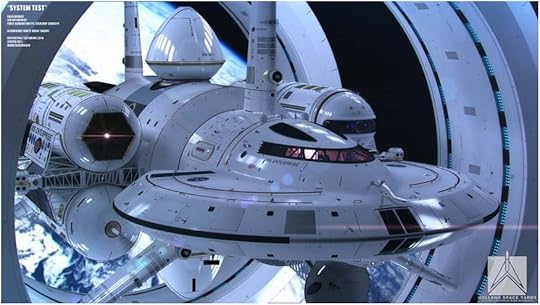
I’m not sure how well they can design a warp-drive ship when they haven’t figured out warp drive yet. How much room will they need for engines / warp drive, and how will that equipment need to be distributed around the ship? In the meantime, scientists are working on warp drive. They think they’ve found a possible ‘loophole’ in the Law of Relativity (which says you can’t go faster than light.) I can’t really explain this ‘loophole’ because the physics are way over my head, but just the thought that they are exploring the possibility is exciting!Of course, this isn’t the first time that the fiction of Star Trek has become real life fact. If the first ST show hadn’t had those cute flip-top communicators, we might not have cell phones. Their electronic ‘clip-boards’ might well be a predecessor of ipads and ereaders. Cloaking devices? Almost perfected, although not yet ready to be used on starships. And 3-d printers could be a step toward replicators.Next week - or maybe next month - I expect to hear that some scientist thinks he can make transporter beams. Although, I’m kind of with Dr McCoy on that one. I’m not sure I want my atoms ripped asunder and then reassembled in a new place.
How about you? What science fiction technology would you like to see them start on?
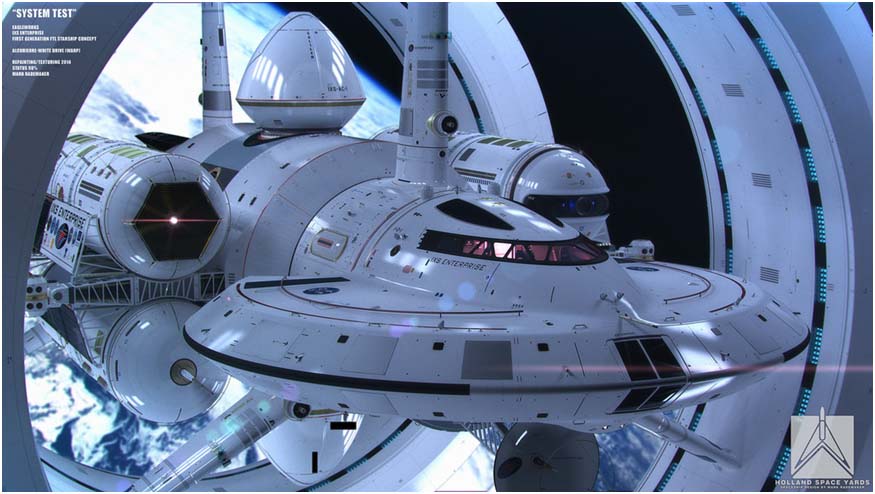
I’m not sure how well they can design a warp-drive ship when they haven’t figured out warp drive yet. How much room will they need for engines / warp drive, and how will that equipment need to be distributed around the ship? In the meantime, scientists are working on warp drive. They think they’ve found a possible ‘loophole’ in the Law of Relativity (which says you can’t go faster than light.) I can’t really explain this ‘loophole’ because the physics are way over my head, but just the thought that they are exploring the possibility is exciting!Of course, this isn’t the first time that the fiction of Star Trek has become real life fact. If the first ST show hadn’t had those cute flip-top communicators, we might not have cell phones. Their electronic ‘clip-boards’ might well be a predecessor of ipads and ereaders. Cloaking devices? Almost perfected, although not yet ready to be used on starships. And 3-d printers could be a step toward replicators.Next week - or maybe next month - I expect to hear that some scientist thinks he can make transporter beams. Although, I’m kind of with Dr McCoy on that one. I’m not sure I want my atoms ripped asunder and then reassembled in a new place.
How about you? What science fiction technology would you like to see them start on?
June 26, 2014
1 + 1 =
Last week, I talked about where I get ideas for my stories. I’m continuing that, because I thought I’d walk you through a ‘new’ idea, so you could get a glimpse of ‘my brain at work’.A few days ago, Hub and I went to the movies. We don’t go often, and when we do, we tend to see 2 movies. This time, we saw “Edge of Tomorrow”, followed by “Maleficent”. Something of a mixed bag.In “Edge of Tomorrow”, the Earth is invaded by aliens, and the Hero - a military reporter - pisses off a general, then finds himself on the front line with no training. He survives long enough to get the safety off his weapon and kill an alien that kills him. He awakens the previous morning, assigned to the front lines without training. Each time he dies, he returns to the previous day. Just as in “Ground Hog Day”, the Hero must figure out what he needs to do differently to get out of this time loop.“Maleficent” is the tale of Sleeping Beauty told from the point of view that Maleficent was not evil, just mis-understood; portrayed as evil by humans who related the story after the fact. I have often heard that villains don’t see themselves as evil, so this re-telling did not scar my psyche too badly.The next morning, I had (some) memories of an interesting dream that involved people, each with some super-human power. There were 2 groups, unable to agree and constantly battling. When they died, they eventually returned to life, but not necessarily on the same side as before.I took the bones of this dream and added different bits and pieces to see what happened. Reincarnation and exceptional people. Did they remember their previous lives, that they were ‘special’? I decided they did, but not until adulthood, when flashes of memory would start coming to them. They not only might change sides in the Big Argument, whatever it was, they might not have the same power, either.I chose a protagonist, during a life when he lived a few decades. Now, what kind of setting? Science fiction? That was too broad. Modern paranormal? No, they’d just be another group of comic book characters.Fantasy post-apocalyptic! In a world where magic and the fey exist, cities and castles were reduced to rubble during the Great War. Generations later, the War Magic is finally beginning to dissipate from these places.I sketched out the basic story line in half a page of 20-pt font, devoted another page to other background info, like names and special Talents, and started my rough draft. I have 2000 words done, which is not bad for 2 days of stolen moments. I don’t have an outline, because I haven’t answered some important questions. I’m stumbling around, creating background and conflict as I go, which is how I originally wrote (before I figured out what an outline was), and many others do.And another story is started.
Like I needed another character whispering in my ear, another story to be written! I can hear my characters laughing, and my muse asking, “Who said an author’s life was orderly?”
Like I needed another character whispering in my ear, another story to be written! I can hear my characters laughing, and my muse asking, “Who said an author’s life was orderly?”