Trudy Myers's Blog, page 40
March 26, 2015
New Moon
Have you ever come across someone who did not grasp a concept that you have understood since... as long as you can remember?Recently, I discovered a friend knew there were phases to the moon, but could not understand that that meant the moon was not always in the sky at night. It’s true. Let me try to draw a picture.
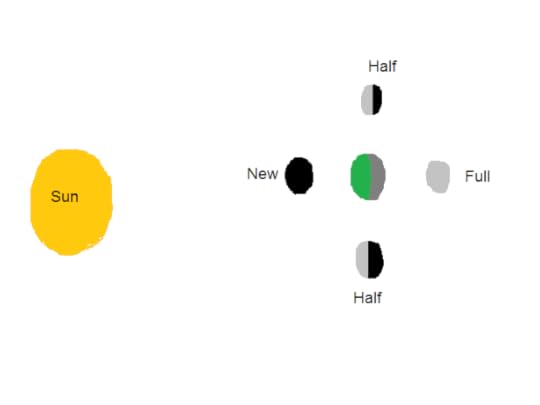
(Okay, that’s what kind of drawing you get when you turn me loose with Microsoft’s ‘Paint’ for half an hour.)I hope you can recognize the sun, Earth, and then four positions of the moon around the Earth. Each moon position shows what the moon would look like from Earth. So, when the Earth is ‘between’ the sun and the moon, we see a Full Moon; sunlight is reflected from the entire face that we see. When the moon is sitting roughly on the Earth’s orbit, we would see a Half Moon; sunlight is reflected from half the surface that faces Earth. When the moon is ‘between’ the sun and Earth, we see a New Moon; sunlight is reflected from the side we don’t see, and the side facing Earth is dark. We can all agree on that, right?Now, to me, just looking at this picture makes it obvious that the New Moon is in the sky roughly the same time as the sun. Therefore, the moon is in the sky during the day, not at night.You’ve seen the moon during the day, haven’t you? I’ve seen it many times.But if you don’t want to believe me or this picture, here are some rising and setting moon times for Omaha NE I’ve looked up on the internet (Daylight Savings Time):March 26, 2015 Half Moon, roughly Rise 10:56 AM (morning) Set 12:47 AM (after midnight)April 4, 2015 Full Moon Rise 7:18 PM Set 6:08 AMApril 10, 2015 Half Moon, roughly Rise 12:56 AM (after midnight) Set 10:09 AMApril 18, 2015 New Moon Rise 5:42 AM Set 7:16 PMNow, on April 18, 2015, in Omaha, the sun will rise at 6:40 AM and set at 8:07 PM, so, yes, the moon will be in the sky at roughly the same time as the sun.So, if you are reading (or writing) a story, and in a scene set at 1:00 AM, the New Moon is not reflecting enough light to help the hero find his way down the alley... Of course it won’t. Not only is it a New Moon, and not reflecting light at the Earth, it’s not even in the sky at 1 AM! It’s on the opposite side of the world, appearing during daylight.
Any questions?

(Okay, that’s what kind of drawing you get when you turn me loose with Microsoft’s ‘Paint’ for half an hour.)I hope you can recognize the sun, Earth, and then four positions of the moon around the Earth. Each moon position shows what the moon would look like from Earth. So, when the Earth is ‘between’ the sun and the moon, we see a Full Moon; sunlight is reflected from the entire face that we see. When the moon is sitting roughly on the Earth’s orbit, we would see a Half Moon; sunlight is reflected from half the surface that faces Earth. When the moon is ‘between’ the sun and Earth, we see a New Moon; sunlight is reflected from the side we don’t see, and the side facing Earth is dark. We can all agree on that, right?Now, to me, just looking at this picture makes it obvious that the New Moon is in the sky roughly the same time as the sun. Therefore, the moon is in the sky during the day, not at night.You’ve seen the moon during the day, haven’t you? I’ve seen it many times.But if you don’t want to believe me or this picture, here are some rising and setting moon times for Omaha NE I’ve looked up on the internet (Daylight Savings Time):March 26, 2015 Half Moon, roughly Rise 10:56 AM (morning) Set 12:47 AM (after midnight)April 4, 2015 Full Moon Rise 7:18 PM Set 6:08 AMApril 10, 2015 Half Moon, roughly Rise 12:56 AM (after midnight) Set 10:09 AMApril 18, 2015 New Moon Rise 5:42 AM Set 7:16 PMNow, on April 18, 2015, in Omaha, the sun will rise at 6:40 AM and set at 8:07 PM, so, yes, the moon will be in the sky at roughly the same time as the sun.So, if you are reading (or writing) a story, and in a scene set at 1:00 AM, the New Moon is not reflecting enough light to help the hero find his way down the alley... Of course it won’t. Not only is it a New Moon, and not reflecting light at the Earth, it’s not even in the sky at 1 AM! It’s on the opposite side of the world, appearing during daylight.
Any questions?


March 18, 2015
Sorry
There isn't a blog today, not really.
We attended our first convention this past weekend, and I am now dealing with a case of con crud. Who knew that when the doc said, "Rinse your sinuses every day for the rest of your life," he actually meant EVERY day?
Headache, drainage, coughing, sore throat, hoarseness. And that's today. Yesterday was worse, and that's the day I should have written and edited a blog.
I'm going back to bed, and hopefully will be even better tomorrow, when I can start thinking. About next week's blog, among other things.
We attended our first convention this past weekend, and I am now dealing with a case of con crud. Who knew that when the doc said, "Rinse your sinuses every day for the rest of your life," he actually meant EVERY day?
Headache, drainage, coughing, sore throat, hoarseness. And that's today. Yesterday was worse, and that's the day I should have written and edited a blog.
I'm going back to bed, and hopefully will be even better tomorrow, when I can start thinking. About next week's blog, among other things.
March 12, 2015
Strangers vs Relatives
I do free-lance editing, and there are differences between editing the work of a stranger and editing the work of a relative, like a spouse.Some things stay the same; I am always careful not to make changes just to suit my style. I haven’t written this manuscript; it belongs to somebody else. But I don’t have problems taking out unnecessary commas, or putting one in where it is needed; of keeping verb tense consistent; of changing ‘shuttered’ to ‘shuddered’ when a character is cold - of making sure they really are saying what they intended to say.When I edit, I try to give some guidelines to help them improve as a writer, so I won’t have to work so hard with their next manuscript. If I want them to change a sentence, paragraph, or scene, I explain why, and give at least one example of how (I think) it could be improved.Strangers, so far, have been pretty easy to convince. Relatives... not so much.There have been other challenges when editing for a relative that - so far - have not happened with a stranger. Like the time I was editing a 400+ page manuscript, and asked my relative to clarify/change a paragraph on page 151. He had already changed that paragraph and had apparently given me the wrong version of his manuscript. I had to start over.Another time, I explained to a relative that when a planet’s moon is in the ‘new’ phase, it is (relatively) between the sun and planet, and so would not be in the sky at 1 AM, the middle of the night. I don’t think he believed me.The difference might be a matter of perception. To the author who doesn’t know me, I am an editor, one who respects him/her as an author, and they listen and return that respect, especially if they are fairly new. To the relative, I am a sister, cousin, parent, daughter, or even a spouse. Yes, I’m intelligent, but they are, too, and while they love me, they don’t necessarily view me as knowing what I’m talking about.
Despite the challenges of editing the work of either a stranger or a relative, I would rather do that than edit my own work! Because in that case, I turn into an idiotic despot... on both sides.
Despite the challenges of editing the work of either a stranger or a relative, I would rather do that than edit my own work! Because in that case, I turn into an idiotic despot... on both sides.
March 5, 2015
Help Wanted
Oh, the hassles of being a writer in this day and age! A couple years ago, I faced my growing frustration with submitting my work, only to get a “No, thank you” response. Everybody tells writers not to take it personally, but after a few years, you start wondering what is wrong with your writing. And the truth is, there might not be anything wrong with it, it’s possible you just aren’t hitting that market with that story at the right time.A lot of authors - even established authors - were going into self-publishing, so... why not? Could it be any worse? A friend said she would help.But then the novel we were going to start with (Cali) was accepted by a different small press. Great news! But it left us looking for a different novel to publish. I had a couple in the clean-up stage, but most were in the rough draft or 2nd draft stage. So we took on my husband’s sf novel (The Stone Builders) as our first publication. [Side note; since he agreed to this several months ago, he has finished a 2nd novel and started a 3rd. Apparently, he just needed some encouragement.]I am no longer ‘just’ an author and free-lance editor, I am a publisher. I learned how to prepare manuscripts and format them, and I knew artists to hire for book covers. Editing can be time-consuming, but I was prepared for that. The big problem is the marketing involved!We were trying to learn marketing even before we made this decision, because most marketing is left to the author anyway. But to be effective, we need to post on Facebook, Twitter, Goodreads, Pinterest, and any other appropriate social media outlets. Unfortunately, trying to do all of this has left me with no time to write, and my friend is more technology-challenged than I am. Plus, it’s driving us crazy, trying to come up things to say and learn how post in various websites. Therefore,Help Wanted: Social media handler. Someone to help decide what to post, when and where to post it, and do the posting. Knowledge and/or willingness to learn is more important than experience. Help Wanted: Freelance Editor/proofreader. Knowledge of American English grammar, spelling, vocabulary and punctuation a necessity. I do not want to be the final editor of my own work.The pay for either position is crummy, since we are just getting started. Both positions are ‘as needed’. If interested in either, contact Tommee@MoonPhazePublishing.com
I think we’ve tapped the talents of family members as far as we can. If you (or someone you know) wants to break into one of these fields, this just might be the opportunity!
I think we’ve tapped the talents of family members as far as we can. If you (or someone you know) wants to break into one of these fields, this just might be the opportunity!
February 26, 2015
Bubble Colony
Now that we’ve visited the moon a few times, nobody is talking about setting up a moonbase. Everybody seems to want to move on to colonizing Mars. But you know what? Venus is a lot closer.Earth’s orbit is 93,000,000 miles from the sun. Mars’ orbit is 141,600,000 miles from the sun. The closest Mars and Earth can get is about 48,600,000 miles, while the furthest away they get is 234,600,000. Venus is 67,000,000 miles from the sun, so the closest Earth gets to it is 26,000,000, and the furthest away Venus gets is 160,000,000. So yes, it’s about half the distance to get to Venus as it is to get to Mars.Why is nobody clamoring to colonize Venus?At first glance, Venus does not seem very welcoming. Oh, sure, it has about the same amount of gravity as Earth, but that’s the only thing that might be called ‘welcoming’. Its atmosphere is carbon dioxide and nitrogen, with clouds of sulfuric acid droplets. There may be trace amounts of H2O and HO in the atmosphere, but don’t expect to go outside without a space suit. The corrosive atmosphere is so dense, no probe that landed on Venus lasted longer than a couple hours. If the acid doesn’t get you, the pressure will. That pressure is the same as being 1.5 miles deep in the ocean. And that’s assuming you don’t land in a volcano, because the surface is highly volcanic.The atmosphere is the cause of runaway greenhouse effect, and the surface of Venus is about 900°F. Venus rotates backwards, so the sun rises in the west and sets in the east, but it rotates so slowly, a ‘day’ (single rotation) on Venus is 243 Earth days, while it only takes 225 Earth days to complete a circuit around the sun. That would take some getting used to. And despite Venus’ slow rotation, the top lay of clouds whip around it in about 4 Earth days, at speeds of 225 (or more) miles an hour.Ready to make it your home yet?There are people considering how it could be done. They don’t see a colony on Venus’ surface, however; they envision an enclosed ‘station’ that floats 30 miles above Venus’ surface, where the pressure is about the same as sea level on Earth. The temperature would be about 160°F, but that would be relatively easy to deal with. And being below that top layer of clouds, it might be pushed around the globe, but not at hurricane speeds.That doesn’t sound so bad. Maybe they could devise a way to grow plants on the outside walls to change some of the carbon dioxide into oxygen. If enough of that happened, the greenhouse effect could start to calm down, the temperature might lower, and those racing high-level winds would slow down. Who knows, maybe it would be possible to establish a base on Venus’ surface... in a few millennia.
Ready to ship out yet? Or are you waiting for the ship to Europa?
Ready to ship out yet? Or are you waiting for the ship to Europa?
February 18, 2015
Here There Be Dwarves
I’ve been looking into this ‘Dwarf Planet’ issue. I was not happy to have Pluto no longer be a ‘real planet’, but decided maybe it made sense to have another classification for those items in our system that did not quite fit the definition of ‘planet’. Of course, they devised that definition so that it would exclude Pluto, because another body they did not want to consider as a planet was roughly the same size as Pluto. Or so it seems.Still, it works, as long as they use the definition of ‘dwarf planet’ consistently, right? But, are they?Mercury is a planet (now called a Classic Planet). It’s about twice the size of Pluto, so... They had to put the dividing line somewhere, right?Eris is further out than Pluto, and may or may not be as large. The diameters for these two said Pluto was slightly larger, but each had a margin of error. So, if Eris is larger than they think, and Pluto is smaller than they think, then they could be the same size, or Pluto could be slightly smaller. Ergo, if one is a dwarf planet, it makes sense that the other is also.I had never heard of Makemake or Haumea until I started this research, but they have both been named dwarf planets. Their diameters are each a bit more than half of Pluto’s.One rule of the definition of a dwarf planet is that it must have enough mass to pull itself into a roughly spheroid shape. It has been postulated that these bodies would need a diameter of at least 400 km before that was likely. I was surprised to read, then, that Haumea was not a sphere - its diameter through the equator is much longer than its diameter through the poles. The explanation (excuse?) was that Haumea rotates so fast, it has warped into a flattened shape.So far, Ceres is the only asteroid to be named a dwarf planet. Its diameter is less than 1,000 km, but it is the largest asteroid. There are at least 3 other asteroids that are over that minimum diameter of 400 km, and so far as I have been able to discover, they are at least roughly spherical.There are also 10 or more heavily bodies beyond the orbit of Pluto that are currently under consideration for being Dwarf Planets.And that brings us to Charon. Long known as - and even now considered - Pluto’s moon, I suggest it be named a Dwarf Planet. Charon’s diameter is slightly less than half of Pluto’s, considerably larger than Ceres’. Yes, there are plenty of big moons in our system, but none of them are so large in relation to the planet they circle. And, technically, Charon does NOT revolve around Pluto. With this division of mass between them, both Charon and Pluto revolve around a point that is between them.At least one astronomer has suggested that Pluto and Charon be considered a double Dwarf Planet. I definitely agree. Name Diameter (km) # Moons Mercury 4,879 0 Pluto 2,368 5 Eris 2,326 1 Makemake 1,430 0 Haumea* 1,300 2 2007 OR10 1,280
Charon 1,207
Sedna 1,000
Orcus 946
Ceres 942 0 2002 MS4 934
2005 UQ513 920
2007 UK126 880
Salacia 854
Quaoar 844
Ixion 804
Varuna 700
Pallas 544
Vesta 525
Hygiea 431
* NOT spherical
Charon 1,207
Sedna 1,000
Orcus 946
Ceres 942 0 2002 MS4 934
2005 UQ513 920
2007 UK126 880
Salacia 854
Quaoar 844
Ixion 804
Varuna 700
Pallas 544
Vesta 525
Hygiea 431
* NOT spherical
February 12, 2015
What Takes so Long?
What takes so long from an editor accepting a manuscript for publication and the book appearing in book stores? The process can take months or even years with a ‘Big Boy’ publisher.Yet, there are exceptions: Books about some political scandal can appear days after the scandal comes to light; Biographies of a celebrity can be bought within a week of their death. So it can be done faster. Why isn’t it?Small press and self-publishing don’t take that much time. How do they do it?
Editing
. Every manuscript needs an editor. It may be the rare exception that only needs one comma added and one numeral (like 9) spelled out (into nine), but no publisher knows that until an edit is done. With the Big Boys, sometimes the editor who decides which manuscript to purchase is also expected to edit those manuscripts. Obviously, an established author’s manuscript will be edited before those by new authors. Small presses don’t publish as many books, and often use free lance editors, who fit their assignment into their schedule in order to meet their deadline. In my case, I ask for a month (and occasionally wish I had two).
Cover Art
. This is, apparently, the next step for the Big Boys, because nothing else can happen without the pretty picture for the front. Of course this takes time, from concept through several renditions until it is ‘just right’. And then, it’s sent to somebody else to put the type (title, author, etc.) on it, and that may take several attempts before it is deemed ‘acceptable’. Remember, the Big Boys have many of these being done at the same time. Small presses, again, may work with free lance artists, who may even put the type on. Or they might use a stock photo, which takes even less time.
Reviews
. I never paid attention to these myself, so I was surprised at how much emphasis is placed on getting them. In the past, reviewers expected to receive a printed book, complete with cover art, that they could read. This would be monthsbefore the book was officially published. Some still want it done this way, but others accept e-files of the book. Some small presses don’t get reviews early enough to quote them on the back of the book, so that cuts some time off the process.
Sales Materials
. This seems to be a long, drawn-out ordeal for the Big Boys. Each book must get added to their catalog, the sales teams must be trained in how to best pitch it to the book stores... Many small presses don’t pitch to book stores, because the book stores won’t carry them. Therefore, their efforts for one book are simply added to the marketing of all the others they have available. Add it to their catalog and website, mention it in the newsletter and their social media comments. They might create fliers to send to gatherings of likely readers. A typical Big Boy book stays on the shelf about 6 weeks. A small press may never ‘discontinue’ a book.
Is being published by a Big Boy worth wasting all that time? What do you think?
Is being published by a Big Boy worth wasting all that time? What do you think?
February 4, 2015
Thoughts on Electric Cars
A power company in Missouri will be installing close to 100 vehicle power-up plugs in Northwest Missouri and the Kansas City area. “That’s nice,” was my thought. “Now, if I had an electric car, my home charge would (probably) get me to Kansas City, and that charge would get me close to St Louis. But there’s still a long distance between St Louis and Florida. I wonder if any other power companies will do the same? St Louis? Paducah? Nashville? And so on? And how far out of my way would I need to go for one of these power-ups?”As an author, I’m an ideas person. I have to be. I have to come up with ideas about characters, plot, scenes, everything. When I write science fiction, I don’t know exactly how thing works, I just have to be convincing.Why has everybody been designing electric cars that are good for running around your home town, but not for traveling? I like to travel. If I could do both in an electric car, I would be scrounging up pennies to get one. Instead, I had to opt for a car that got decent gas mileage on the hiway.I keep hearing about ‘tweaks’ some car company has made - like when you apply the brakes, a slight charge is trickled back into your battery.Why stop there?Here’s some ideas I wish SOMEbody would incorporate into an electric car. 1. Solar panels. They’re being put everywhere else, why not on the car’s roof, trunk lid, hood... even the fenders, doors, sides and bumpers! They don’t have to be big and clunky; they can be small and flexible. (I’m not in favor of alternating colors into a checkerboard, but maybe that’s just me.) Trickle that power into a spare or already-discharged battery, and you’ll get further before you have to pause and charge up all the batteries.2. Wind power. Windmills are good enough to put in the fields, why not put some tiny ones on the car? A few unobtrusive intake slots, and again, you’ve got some electricity to trickle into the batteries. Just moving down the street, a vehicle has air sliding past it, why not use it?3. Human power. For those times when the sun isn’t out, or you find yourself way out in the middle of nowhere with dead batteries, this would be your backup. Open up a panel - perhaps in the dash in front of the passenger seat - and out pops cycle pedals. If you could change the position of the pedals, you could either use your legs or your arms. Just pedal away to charge your batteries so you can get further down the road.I actually use these ideas in some stories set in the not-too-distant future.
Okay, talk to me. What improvement would you like made to today’s electric cars?
Okay, talk to me. What improvement would you like made to today’s electric cars?
January 28, 2015
Aliens Among Us
The other day, I read an article in Popular Science that scientists have discovered alien life. And they didn’t find it on some other planet, a moon or an asteroid; they found it right here on Earth.Now, don’t get your nerves tied in knots. They found bacteria that is definitely alive, but isn’t life as we know it. Yeah, that old disclaimer. How many times have we heard some scientist say, “Well, if we do find life on ____, it certainly won’t be life as we know it.”?And they didn’t even have to go off this world to find examples of life as we don’t know it.When I was growing up, some of my favorite authors wrote about all sorts of aliens, from 3-legged, 3-gendered crabs to creatures where the male was about 1/8th the size of the female, attached himself to her, and his only purpose was to father children. And some tried to imagine creatures that didn’t use biology as we knew it, rock creatures that could move through the soil of their planet, crystals, intelligent energy.I found them all great fun to read.What’s so alien about this bacteria they’ve discovered? It doesn’t have the type of biology we are familiar with. It doesn’t eat carbohydrates or protein, and it doesn’t expel the type of waste products an animal or plant would. One strain eats electricity, or rather, electrons. Another expels electrons as waste.Yes, there are probably several types of these ‘alien’ bacterium. Based on this article, at least two strains have been named, with one graduate student trying to culture at least 20 more. Even that has to be done differently, because it doesn’t grow on petri dishes. You have to supply an electrode of some kind. Or something that they would see as food.They aren’t really aliens. They are part of Earth’s eco-system, and have been for billions of years. But they are alien from us, even more than the creatures that grow in the super-heated vents of water rising from underwater volcanoes.That old phrase, ‘life as we know it’, always did irritate me. We would be on a different planet, so why would we expect to find Old MacDonald and Betsy the cow? Why not keep our minds open to all sorts of possibilities, and just see what’s out there?
Something a little smarter than bacteria, I hope.
Something a little smarter than bacteria, I hope.
January 21, 2015
Pluto & Company
Sometimes, reading science fills my imagination.Remember when Pluto was declared NOT a planet? Mercury is also tiny, I objected. Turns out, Pluto’s diameter is half of Mercury’s. They are both small, but that is a significant difference. Still, they have decided Pluto IS a planet, although they stuck ‘dwarf’ in front. I didn’t realize that until today.Pluto has a moon. Charon is big enough, compared to Pluto, that it doesn’t revolve around Pluto; they both revolve around a point between them. Weird. I don’t know of any other planet & moon that does that. Today, I discovered Pluto has 4 additionalmoons. Way to go, Pluto!There are other dwarf planets in our system, way out in the nether regions, so Pluto is not alone. At least 3 have names. Our system has more planets than the 9 I grew up learning about.Pluto has an atmosphere. What? How can it? It’s so tiny, so little gravity, so cold- Some times. When Pluto gets closer to the sun (it comes within Neptune’s orbit), some of the surface thaws into a thin atmosphere, mostly nitrogen with methane and carbon monoxide for flavor. When it’s not that close, that atmosphere freezes and falls to the ground.In 2006, NASA launched a probe for Pluto. It woke up in December 2014, and is seeing if it needs to correct its trajectory. In July 2015, it will reach a point 6,000 miles from Pluto, and it will snap pictures and take readings as fast as it can. At some point after that, it will send its observations to Earth. Just think, if you had snuck onto that spacecraft just before it launched, you’d... Well, you’d be dead, because it wasn’t built for passengers, but your body would almost be there to not see it for yourself!The most interesting bit of today’s research was that frozen dwarf planets may be the most numerous type of planet in the universe. Really?I figure we should set up bases on/in ours. Why would we want to? Once we figure out how to colonize Pluto and its cohorts, we would know how to colonize frozen dwarf planets in other systems; to study, to serve as a base, a stepping stone.Yeah, when I dream, I can dream big. I got that from the science fiction I read as a kid.
What do you think? If you were designing a colony for Pluto, would you build on the surface or dig inside?
What do you think? If you were designing a colony for Pluto, would you build on the surface or dig inside?