David Pilling's Blog, page 81
March 21, 2013
Work in progress
I want to talk a little about my latest book, which I am in the last stages of editing and revising. I posted a short preview of it on here a few weeks ago, and thought it was time for something more meaty.
The working title is "Caesar's Sword: The Red Death" and the story is set outside my usual medieval timeframe. I wanted to stretch my wings a little and try to write something set during the Late Roman era. The Roman Empire is a popular subject in fiction these days, but most writers tend to stick to the 'classical' era of the first and second centuries AD. I thought it worth having a go at writing a tale set during the reign of Justinian I (527-565).
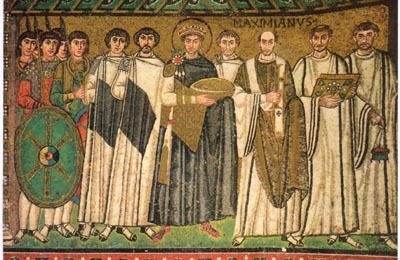 The Ravenna mosaic, showing Emperor Justinian I and his court
Justinian's reign was, to put it mildly, a dramatic one. By this time the Empire had split in half and most of the Western Empire had been conquered by various 'barbaric' peoples. The last Emperor of the West, Romulus Augustus, had been deposed and packed off into exile in 476. However, the Eastern half of the Empire, including Asia Minor and the vital breadbasket of Egypt, was still intact and ruled from Constantinople (modern-day Istanbul). It was threatened by enemies on all sides, and Justinian inherited a realm that was beginning to crumble under the relentless pressure.
Hero-worship is unfashionable these days, especially in the study of history, but it does seem that the Empire was saved, and to some extent restored, by the actions of one man. This was Flavius Belisarius, a brilliant general whom Justinian employed as a sort of firefighter, sending him to one trouble-spot after another. Belisarius was a complex and tragic figure, and a superb character to portray in fiction.
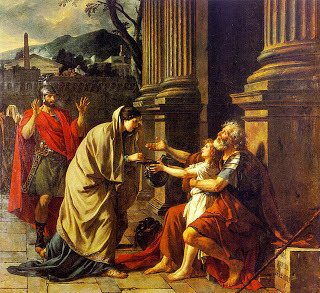 Belisarius begging for alms on the streets of Constantinople
I prefer to keep famous historical characters in supporting roles, because essentially there is nothing unpredictable about their fate: the details of their lives and careers are known, and cannot be changed to any great extent. So Belisarius and Justinian and the rest of the glittering imperial court had to be happy with playing second fiddle to my main character.
This is Coel ap Amhar ap Arthur, grandson of 'King' Arthur, or rather the Dux Bellorum who defeated the Saxons at Mount Badon and protected Britain against barbarian invasions for over twenty-one years. At the beginning of my story Arthur is dead or vanished, his armies smashed at the Battle of Camlann, where the arch-traitor Medrauat was also killed.
Arthur's son and Coel's father, Amhar, is a curious figure mentioned only briefly in Welsh legend:
“There is another wonder in the country called Ergyng. There is a tomb there by a spring, called Llygad Amhar; the name of the man buried in the tomb was Amhar. He was the son of the warrior Arthur, who killed him there and buried him.”
- The Historia Brittonum
Why Arthur has killed his own son is not explained. I thought there was something delightfully dark and mysterious about Amhar's fate, and decided to provide my own explanation in the novel.
So what does a British warrior-prince and a descendent of Arthur have to do with the later Roman Empire? And what's all this about "Caesar's Sword"?? Stay tuned to find out....
The working title is "Caesar's Sword: The Red Death" and the story is set outside my usual medieval timeframe. I wanted to stretch my wings a little and try to write something set during the Late Roman era. The Roman Empire is a popular subject in fiction these days, but most writers tend to stick to the 'classical' era of the first and second centuries AD. I thought it worth having a go at writing a tale set during the reign of Justinian I (527-565).
The Ravenna mosaic, showing Emperor Justinian I and his courtJustinian's reign was, to put it mildly, a dramatic one. By this time the Empire had split in half and most of the Western Empire had been conquered by various 'barbaric' peoples. The last Emperor of the West, Romulus Augustus, had been deposed and packed off into exile in 476. However, the Eastern half of the Empire, including Asia Minor and the vital breadbasket of Egypt, was still intact and ruled from Constantinople (modern-day Istanbul). It was threatened by enemies on all sides, and Justinian inherited a realm that was beginning to crumble under the relentless pressure.
Hero-worship is unfashionable these days, especially in the study of history, but it does seem that the Empire was saved, and to some extent restored, by the actions of one man. This was Flavius Belisarius, a brilliant general whom Justinian employed as a sort of firefighter, sending him to one trouble-spot after another. Belisarius was a complex and tragic figure, and a superb character to portray in fiction.
 Belisarius begging for alms on the streets of Constantinople
I prefer to keep famous historical characters in supporting roles, because essentially there is nothing unpredictable about their fate: the details of their lives and careers are known, and cannot be changed to any great extent. So Belisarius and Justinian and the rest of the glittering imperial court had to be happy with playing second fiddle to my main character.
This is Coel ap Amhar ap Arthur, grandson of 'King' Arthur, or rather the Dux Bellorum who defeated the Saxons at Mount Badon and protected Britain against barbarian invasions for over twenty-one years. At the beginning of my story Arthur is dead or vanished, his armies smashed at the Battle of Camlann, where the arch-traitor Medrauat was also killed.
Arthur's son and Coel's father, Amhar, is a curious figure mentioned only briefly in Welsh legend:
“There is another wonder in the country called Ergyng. There is a tomb there by a spring, called Llygad Amhar; the name of the man buried in the tomb was Amhar. He was the son of the warrior Arthur, who killed him there and buried him.”
- The Historia Brittonum
Why Arthur has killed his own son is not explained. I thought there was something delightfully dark and mysterious about Amhar's fate, and decided to provide my own explanation in the novel.
So what does a British warrior-prince and a descendent of Arthur have to do with the later Roman Empire? And what's all this about "Caesar's Sword"?? Stay tuned to find out....


March 20, 2013
The White Hawk on Goodreads
...and at last, I have figured out how to use widgets!
Three paperback copies of Book One of my Wars of the Roses saga, The White Hawk, are now up for grabs on Goodreads. Just click on the icon below to enter...
.goodreadsGiveawayWidget { color: #555; font-family: georgia, serif; font-weight: normal; text-align: left; font-size: 14px; font-style: normal; background: white; } .goodreadsGiveawayWidget img { padding: 0 !important; margin: 0 !important; } .goodreadsGiveawayWidget a { padding: 0 !important; margin: 0; color: #660; text-decoration: none; } .goodreadsGiveawayWidget a:visted { color: #660; text-decoration: none; } .goodreadsGiveawayWidget a:hover { color: #660; text-decoration: underline !important; } .goodreadsGiveawayWidget p { margin: 0 0 .5em !important; padding: 0; } .goodreadsGiveawayWidgetEnterLink { display: block; width: 150px; margin: 10px auto 0 !important; padding: 0px 5px !important; text-align: center; line-height: 1.8em; color: #222; font-size: 14px; font-weight: bold; border: 1px solid #6A6454; -moz-border-radius: 5px; -webkit-border-radius: 5px; font-family:arial,verdana,helvetica,sans-serif; background-image:url(http://www.goodreads.com/images/layou... background-repeat: repeat-x; background-color:#BBB596; outline: 0; white-space: nowrap; } .goodreadsGiveawayWidgetEnterLink:hover { background-image:url(http://www.goodreads.com/images/layou... color: black; text-decoration: none; cursor: pointer; } Goodreads Book Giveaway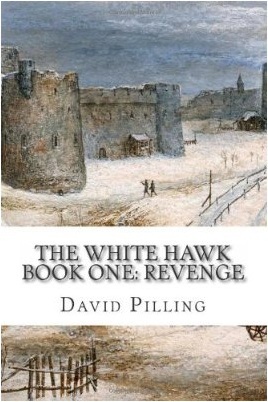 The White Hawk by David Pilling
Three paperback copies of Book One of my Wars of the Roses saga, The White Hawk, are now up for grabs on Goodreads. Just click on the icon below to enter...
.goodreadsGiveawayWidget { color: #555; font-family: georgia, serif; font-weight: normal; text-align: left; font-size: 14px; font-style: normal; background: white; } .goodreadsGiveawayWidget img { padding: 0 !important; margin: 0 !important; } .goodreadsGiveawayWidget a { padding: 0 !important; margin: 0; color: #660; text-decoration: none; } .goodreadsGiveawayWidget a:visted { color: #660; text-decoration: none; } .goodreadsGiveawayWidget a:hover { color: #660; text-decoration: underline !important; } .goodreadsGiveawayWidget p { margin: 0 0 .5em !important; padding: 0; } .goodreadsGiveawayWidgetEnterLink { display: block; width: 150px; margin: 10px auto 0 !important; padding: 0px 5px !important; text-align: center; line-height: 1.8em; color: #222; font-size: 14px; font-weight: bold; border: 1px solid #6A6454; -moz-border-radius: 5px; -webkit-border-radius: 5px; font-family:arial,verdana,helvetica,sans-serif; background-image:url(http://www.goodreads.com/images/layou... background-repeat: repeat-x; background-color:#BBB596; outline: 0; white-space: nowrap; } .goodreadsGiveawayWidgetEnterLink:hover { background-image:url(http://www.goodreads.com/images/layou... color: black; text-decoration: none; cursor: pointer; } Goodreads Book Giveaway
The White Hawk by David Pilling Giveaway ends April 16, 2013.
See the giveaway details at Goodreads.
Enter to winMarch 13, 2013
And the winner of the Blog Hop comp is..
....Mallory Anne-Marie Forbes of Mallory Heart Reviews :) Two free ecopies of The Best Weapon shall be winging their way to her shortly!
March 11, 2013
George RR Martin, the Wars of the Roses and me...
I want to talk a little about what influenced me to write The White Hawk, which will be available as a free download on Amazon on Wednesday and Thursday this week. Since this is my blog, I shall!
By God, I love the power.
Besides my lifelong passion for medieval history, and the more recent desire to divert that passion into writing fiction (the other option being re-enactment, and standing in a muddy field in a suit of armour pretending to be the Duke of Somerset ain't my thing), the major inspiration was "A Song of Ice and Fire", George R.R.Martin's brilliant fantasy series.
 Some free advertising
There are many good reasons to love this series, but for me it is the power politics and vicious intrigue between the various 'Houses' of Westeros that make the books so compelling. Frank Herbert pulled off a similar trick with the Great Houses of Atreides and Harkonnen in the first couple of Dune novels.
Westeros is essentially a late medieval environment, and the noble families of Stark and Lannister etc are fantasy versions of the medieval dynasties that fought like rabid dogs over the crowns of England and France in the Middle Ages. The bloodstained doings of the Plantagenets and Capets seem to be particular inspirations, no more so than the vicious round of aristocratic infighting remembered as The Wars of the Roses.
This era has always provided ideal breeding grounds for fiction, and I'm by no means the first author to have the bright idea of writing a series of novels set during the period. I did want to avoid writing about the various kings and nobles, or at least relegate them to secondary roles. The answer was to invent a fictional family.
Thus the Boltons were born. The obvious template for them was the Pastons, the real-life Norfolk family who left an invaluable record of their time in the form of the famous Paston Letters. This remarkable cache of letters provide us with a snapshot of minor English gentry and their trials and aspirations during the late fifteenth century.
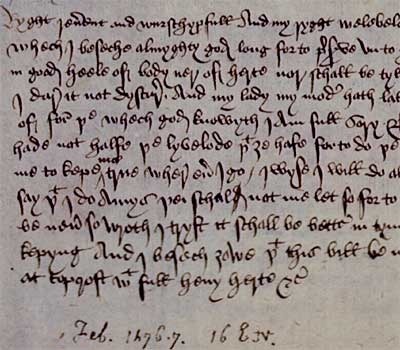
One of the Paston letters
The Boltons are from a similar background to their real-life counterparts, though they have their home in Staffordshire rather than Norfolk. Like the Pastons, they have their sights set on climbing the social ladder.
They also have a number of problem sons. Richard, the eldest, is vengeful and unstable, and his brother James a corrupt and drunken cleric with a taste for local widows. Their mother, Dame Elizabeth, has her hands full keeping the family together. Dynastic civil wars are repeated on a local level, and the Boltons frequently find themselves having to defend their property and their lives. The Boltons often make terrible mistakes, fall in love with the wrong people, and fight on the wrong side during many of the epic set-piece battles fought to decide the future of England.
Book One of the planned three-part series climaxes with the Battle of Towton. This was a holocaust of a battle, perhaps the most dreadful slaughter ever committed on English soil, in which a significant percentage of adult males in England were massacred.
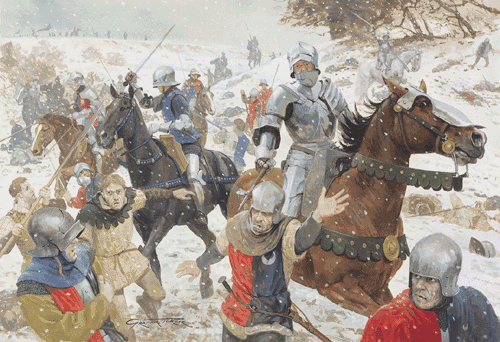
The Battle of Towton. Nowhere near as much fun as it looks.
This delightful affair was fought on a freezing hillside in Yorkshire in the middle of a snowstorm. To describe the sheer uncompromising horror and brutality of Towton was a major challenge, and hopefully I managed to convey it to some degree. The result of the battle has a major impact on the fortunes of the Boltons, as well as the kingdom in general, as readers can discover in Book Two...
Below is a link to the Kindle and paperback versions of the book, with the splendid cover art for the Kindle version done by my good friend and co-writer Martin Bolton:
The White Hawk on Kindle and paperback
Please feel free to email me with any questions or comments at Davidpilling56@hotmail.com
March 8, 2013
Welcome one and all – who may be reading this - to The Sp...

Welcome one and all – who may be reading this - to The Spectrum of Speculative Fiction Blog Hop!
First, the rules of the competition. I have two FREE ebook copies of our epic fantasy novel, “The Best Weapon”, on offer to give away to two lucky readers. You can enter to win by placing a comment after this post. I will draw the winners after March 12th, and promptly dispatch two shiny digital copies of the book via email - as Kindle, Mobi, PDF, or whatever digital format the winners prefer.
At the foot of this post is a link - click on it to access the list of other contributors to this blog hop. Lots of fab blogs and websites to browse, and more prizes to be won.
First, though, I would like to bend your ears and eyes a little about my thoughts on writing speculative as opposed to historical fiction. I write in both genres, more often in the latter. I must be slightly masochistic, because historical fiction places much more responsibility on the writer. An author of historical fiction has a duty to be as accurate as possible, and to make sure he or she has done as much research as possible before setting pen to paper (or fingers to the keyboard). Not everyone shares this opinion, and there is an argument that plot is more important than precise historical accuracy. It is always tempting to bend the facts a little, especially if particularly awkward ones threaten to get in the way of the narrative.
Hard cheese. Simply making things up isn’t good enough, unless the writer is doing it to fill gaps in our knowledge: for instance, in my novel “Folville’s Law” I had King Edward II and his favourite, Hugh Despenser, captured by members of the notorious Folville gang. We don’t know the identities of the men that finally ran the hapless monarch and his favourite to earth, so I thought it was reasonable to say that the Folvilles were involved. There is also a nasty recent tendency in some recent fiction for certain medieval queens to be portrayed as adulteresses, in order to suit alternative theories on the legitimacy of various kings. As Father Ted might have said, down with this sort of thing!
Speculative fiction, on the other hand, can be much more fun. One is free to invent new worlds, and to manipulate events as one chooses. This requires much more exercise of the imagination than a historical setting, where the world is already laid out on a plate for the author to feast on. The creation of The World Apparent, the fantasy-world setting in The Best Weapon, was a hugely enjoyable process stimulated by a great many beer-drinking marathons with my good friend and co-writer, Martin Bolton.
Our world map gradually took shape, first traced by my wavering forefinger in a puddle of stale beer, and then scribbled on a blank leaf inside an exercise book pilfered from the office stationery cupboard. I’m no artist, and at first The World Apparent resembled something one might see deposited on a pavement outside a kebab house after midnight. Fortunately, Martin took over the artistic duties, and being a talented draughtsman he came up with the rather splendid map below:

We started work on the book in the dying days of winter 2009. It was a brisk winter, that one, and the timber wolves never left off scratching at the door of my dingy London flat. The onset of spring found me slumped in an armchair with the curtains drawn, sucking forlornly at an empty bottle of Tesco's finest blended gutrot and trying to type the last few chapters with shuddering, nicotine-stained fingers.. I hadn't eaten a proper meal since the previous October and refused to see anyone except Martin, who brought me ale and cuddles and cheap biscuits. At last our combined efforts paid off, and THE BEST WEAPON was spawned:
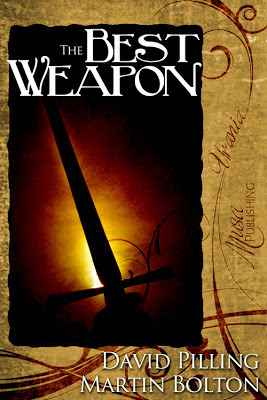
"The best weapon against an enemy is another enemy...
Two young men, born on opposite ends of the world, are inexorably drawn together by forces outside their control or understanding. Created and manipulated by demonic forces, they must take charge of their own destiny and seek to prevent the very disaster they are supposed to bring about. As their world slides into war and chaos, they are faced with the ultimate question: can men do without Gods?"
To further whet your appetite, here is the link to the book on Musa's website:
The Best Weapon
The book was swiftly followed by a host of mini-sequels, the "Sorrow" series, Parts 1-6 of which have been released by Musa. The World Apparent has proved a fertile hunting ground, and there is much more to come...
Link to blogs/websites:
Click here to enter your link and view this Linky Tools list...
March 4, 2013
The White Hawk on Goodreads
I have three free paperback copies of Book One of the "The White Hawk" on offer as a free giveaway on Goodreads. The competition starts on March 16th and ends on April 16th: just enter at the link below and a brand new shiny paperback copy of the book could be on its way to you in April!
The White Hawk on Goodreads
The White Hawk on Goodreads
March 3, 2013
The Spectrum of Speculative Fiction...
On March 8th the "Spectrum of Speculative" fiction Blog Hop is due to begin: this will feature lots of blog posts by spec fiction authors at Musa Publishing (including myself, of course) and there are prizes of free books to be won.
I will be offering two free ebook copies of "The Best Weapon", the epic fantasy novel I co-wrote with my good friend Martin Bolton. See the blurb at Musa's website below:
The Best Weapon
And I hope to see you all on March 8th!
March 1, 2013
Sticking the feathers back on The White Hawk...
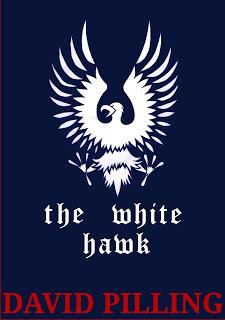
Book One of my intended trilogy set during The Wars of the Roses, The White Hawk, has just been revamped slightly (a new cover, designed and painted by my good friend and sometime co-writer Martin Bolton) and re-published via the folks at Draft2Digital: this means the book is now available as an ebook on Barnes & Noble and Kobo as well as on Amazon. I also hope to soon make it available on itunes.
See below for the new cover, a link to the book on Amazon, a plot description and a couple of nice reviews taken from Goodreads!
Links:
Amazon
Barnes & Noble
Kobo
Reviews:
"The White Hawk takes place during fifteenth century in England and explores two rivals-Lancaster and York-who is at civil war with each other and is tearing the country apart. Henry VI is king and is unable to prevent these tragic events. He has no stomach for politics and is too weak to fight. This story also, follows the Bolton's, a family who is caught up in this civil war and struggles to survive. They are loyal to the house of Lancaster and as the story begins with a battle scene-lives are lost, families are torn apart and revenge for the death of love ones takes hold and bad decisions are made and more lives are destroyed.
One of the first things about, “The White Hawk” that I was impressed with was the opening scene-a battle-very dramatic and detailed. Pilling gives you a clear picture of war, revenge and continuous political instability throughout this period. As the plot unfolds and his characters come to life-I was enthralled in such a way- I found myself holding my breath and clinching my teeth anticipating what is going to happen to next.
Pilling gives the reader a tremendous amount of history and he depicts medieval history brilliantly. One can tell he does his research and takes his findings seriously. I highly recommend this absorbing book to anyone who enjoys this period of time and who is looking for well-written historical fiction.
- Stephanie Hopkins (link to my interview with Stephanie on her blog: Interview)
"Mr. Pilling approached me a while back asking if he could write a guest post to promote his book, The White Hawk Book One: Revenge. What he told me of the story piqued my interest as a former history major and general history nerd, and so I accepted (the post can be viewed on my blog at astheplotthickens.blogspot.com). He also offered to send me a free copy of the ebook so I could read and review it. Of course I'm never going to turn down a free book, especially when the story catches my eye and the author is such a nice guy.
It took me awhile to actually get around to reading the book, thanks to my Kindle deciding to go missing, but when I was finally able to start reading, I got sucked right in. The White Hawk is set during the Wars of the Roses, and tells the story of the feud between the houses of Lancaster and York. Though it's not a period in history I'm overly familiar with, I could tell right away that Mr. Pilling did his research. Over the course of my reading, I went back and did some research of my own on certain points that intrigued me, and as a former history major, I must say that it's some damn good historical fiction.
The characters are very well written and have believable motivations, and I found myself falling in love with the Boltons right away, particularly Mary. I was reminded of George R. R. Martin's A Song of Ice and Fire, not so much by the content of the story or the writing, but because it tells the story from multiple points of view from each faction, a technique that I, personally, quite like. A lot of characters in one story can put off some readers (and that's one reason it takes me so long to get through A Song of Ice and Fire), but Mr. Pilling does a wonderful job of pulling everything together. I was never once confused by who was who or which house fought for which side.
Some people tell me that they don't like historical fiction because it seems so dry, but this definitely isn't the case with The White Hawk. The story moves very quickly and sucked me right in, and it was never dry at all. Despite the huge range, both in time and geography, no part of the story seems disconnected from the rest.
Overall, I highly recommend this book to anybody that has even a passing enjoyment for historical fiction, a story with plenty of action and a bit of political intrigue, and well-written characters. Fair warning, though--the ending will definitely make you crave part two! Pilling gives the reader a tremendous amount of history and he depicts medieval history brilliantly. One can tell he does his research and takes his findings seriously. I highly recommend this absorbing book to anyone who enjoys this period of time and who is looking for well-written historical fiction."
- Jennifer White
See below for the new cover, a link to the book on Amazon, a plot description and a couple of nice reviews taken from Goodreads!

Links:
Amazon
Barnes & Noble
Kobo
Reviews:
"The White Hawk takes place during fifteenth century in England and explores two rivals-Lancaster and York-who is at civil war with each other and is tearing the country apart. Henry VI is king and is unable to prevent these tragic events. He has no stomach for politics and is too weak to fight. This story also, follows the Bolton's, a family who is caught up in this civil war and struggles to survive. They are loyal to the house of Lancaster and as the story begins with a battle scene-lives are lost, families are torn apart and revenge for the death of love ones takes hold and bad decisions are made and more lives are destroyed.
One of the first things about, “The White Hawk” that I was impressed with was the opening scene-a battle-very dramatic and detailed. Pilling gives you a clear picture of war, revenge and continuous political instability throughout this period. As the plot unfolds and his characters come to life-I was enthralled in such a way- I found myself holding my breath and clinching my teeth anticipating what is going to happen to next.
Pilling gives the reader a tremendous amount of history and he depicts medieval history brilliantly. One can tell he does his research and takes his findings seriously. I highly recommend this absorbing book to anyone who enjoys this period of time and who is looking for well-written historical fiction.
- Stephanie Hopkins (link to my interview with Stephanie on her blog: Interview)
"Mr. Pilling approached me a while back asking if he could write a guest post to promote his book, The White Hawk Book One: Revenge. What he told me of the story piqued my interest as a former history major and general history nerd, and so I accepted (the post can be viewed on my blog at astheplotthickens.blogspot.com). He also offered to send me a free copy of the ebook so I could read and review it. Of course I'm never going to turn down a free book, especially when the story catches my eye and the author is such a nice guy.
It took me awhile to actually get around to reading the book, thanks to my Kindle deciding to go missing, but when I was finally able to start reading, I got sucked right in. The White Hawk is set during the Wars of the Roses, and tells the story of the feud between the houses of Lancaster and York. Though it's not a period in history I'm overly familiar with, I could tell right away that Mr. Pilling did his research. Over the course of my reading, I went back and did some research of my own on certain points that intrigued me, and as a former history major, I must say that it's some damn good historical fiction.
The characters are very well written and have believable motivations, and I found myself falling in love with the Boltons right away, particularly Mary. I was reminded of George R. R. Martin's A Song of Ice and Fire, not so much by the content of the story or the writing, but because it tells the story from multiple points of view from each faction, a technique that I, personally, quite like. A lot of characters in one story can put off some readers (and that's one reason it takes me so long to get through A Song of Ice and Fire), but Mr. Pilling does a wonderful job of pulling everything together. I was never once confused by who was who or which house fought for which side.
Some people tell me that they don't like historical fiction because it seems so dry, but this definitely isn't the case with The White Hawk. The story moves very quickly and sucked me right in, and it was never dry at all. Despite the huge range, both in time and geography, no part of the story seems disconnected from the rest.
Overall, I highly recommend this book to anybody that has even a passing enjoyment for historical fiction, a story with plenty of action and a bit of political intrigue, and well-written characters. Fair warning, though--the ending will definitely make you crave part two! Pilling gives the reader a tremendous amount of history and he depicts medieval history brilliantly. One can tell he does his research and takes his findings seriously. I highly recommend this absorbing book to anyone who enjoys this period of time and who is looking for well-written historical fiction."
- Jennifer White
February 25, 2013
...and we have a winner!

I'm very happy to announce - slightly late, for which I apologise - that the winner of the free copy of my book, The Half-Hanged Man, is Stephanie Renee dos Santos! Many thanks to all of you who entered the Hearts Through History Blog Hop competition, and a shiny brand new copy of the book shall be winging its way to Stephanie very soon :)
February 9, 2013
The Valentine's Blog Hop!

It's here - "Hearts through History,", the Valentine's Blog Hop, is now live and in progress! I, along with all the other lovely authors listed at the bottom of this post, will be talking about our favourite mushy Valentines-themed anecdotes from history, as well as hosting free giveaways for you, you lucky souls, to win.

Henry VIII (reigned 1509-47) in his pre-pies era
As an author (hem hem) I don't usually 'do' mush, preferring to concentrate on the savage politics of history, and the awesome sword-swinging, But one item did catch my eye the other day. It is number fifteen of a set of private letters King Henry VIII sent to Anne Boleyn while he was in the process of wooing her and divorcing his first wife, Catherine of Aragon.
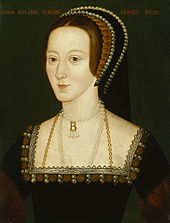
Anne Boleyn, when she was still the apple of Hal's eye
The letter is of a very personal nature, and is interesting because it gives us some real insight into the King's thoughts, and the depth of his feelings for Anne. Transcribed from the wonky-looking Tudor English, it reads as follows:
"Mine own sweetheart, this shall be to advise you of the great loneliness that I find here, since your departure, for I assure you I think the time longer since your departing now than I was wont to consider a whole fortnight. I think your kindness and my fervour of love causes it for otherwise I would not have thought it possible that for so a little a time could grieve me. But now that I am coming towards you I think my pains are half-released and I am also right well comforted in so much that my book makes substantially for my matter, in the reading whereof I have spent above four hours this day, which causes me now to write this short letter to you at this time by cause of some pain in my head. Wishing myself especially of an evening in my sweetheart's arms, whose pretty breasts I trust shortly to kiss. Written with the hand of him that was, is, and shall be yours by his will..."
It's a charming letter, all the more since it was written by a man generally considered to be a gross tyrant. This was the Henry of the late 1520s/early 1530s, when he was still quite an athletic and handsome man, and before he started to degenerate into the cruel, obese caricature of legend. His decline can perhaps be dated to the moment his marriage to Anne Boleyn turned sour, the heartless and vindictive manner in which he had her framed on all sorts of false charges, and finally executed. The letter above, and the others in the set, give us a precious insight into the man before he became a monster.
As a giveaway I am offering a FREE paperback copy of The Half-Hanged Man, my tale of an English mercenary captain set during the high point of the Hundred Years War. Please see reviews and the blurb etc below:
The Half-Hanged Man on Amazon
You can enter for the giveaway by leaving a comment on this post below. If interested, get posting!
Below is a list of the other Hop participants. Please click on the links to go to the various blogs and websites of the authors listed.
1) Random Bits of Fascination - Maria Grace
2) Me! - David Pilling website
3) Sally Smith O'Rourke
4) Daryholic Diversions (Barbara Tiller Cole)
5) Faith, Hope and Cherrytea
6) Roseanne Lortz
7) Sharon Lathan
8) Debra Brown
9) www.heyerwood.com - Lauren Gilbert
10) Regina Jeffers
11) Ginger Myrick
12 Anna Belfrage
13) Grace Elliott
14) Nancy Bilyeau
15) Wendy Dunn
16) E.M. Powell
17) Georgie Lee
18) Deborah Swift
19) Kim Rendfeld
20) Sherry Gloag
21) Lori Crane
22) Karin Aminadra
23) Heidi Ashworth
24) Stephanie Renee Dos Santos