Carol Rivers's Blog, page 2
July 4, 2014
Ella’s Zoolab! (Young Writers)

This is the second of my posts to celebrate our YOUNG WRITERS.
Some of you may remember my blog entitled ‘Almost’, posted way back in March. The short story was quite stunning and the author allowed me to publish her work with permission of ‘St Edward’s RC CE VA School’ in Parkstone, Dorset.
This month I have an article written by Ella Bardsley, Year 7, from ‘St Edward’s RC CE VA School’ in Parkstone, Dorset. I’m very happy to encourage all young writers. But the literary talent from St Edward’s is truly awesome. Ella’s facts and figures are original and written with flair. I’m very excited to give you:
“Zoolab comes to St Edward’s!”
On the 19th May we had an awesome opportunity to hold a Madagascar Hissing Cockroach! Heather, the Zoolab Leader, came to visit us and we were able to meet and hold many exotic creatures. We learnt all about their habitats, lifestyles and defences.
We discovered that Speedy, a 15 year old Giant African Land Snail, had 10,000 teeth which are called radula. Did you know that snail slime is a good moisturiser for human skin! Speedy is native to Africa and can grow up to 7 inches in length! Kimberley, the huge Tarantula, comes from Chile. We were not allowed to hold the hairy spider as she can throw hair off her legs causing irritation to your skin. Colin, the Tree Frog, was kept in a travel box as he had very sensitive skin. Heather told us that this cold blooded critter comes from the Rain Forest. Curious Colin had sticky feet pads so that he can climb up trees. He has no muscles in his throat and he can’t swallow food , therefore, his amazing eyeballs pop out of their sockets and travel down to his throat and push the food to his stomach…..Wow!
We learnt an incredible fact about the Giant African Millipede. This dark brown critter has 240 legs and when it molts it can increase to 750 legs! Satin, the Corn Snake, was a friendly reptile and it was red and orange with black markings. We learnt its natural habitat is the desert.
The baby Gerbil was lively in our session as it was passed around the group. This mammal has long whiskers and thick fur which prevents it from getting sun burnt in the desert and keeps it warm at night. The Madagascar Hissing Cockroach was an extraordinary critter. This chap’s appetite is far from fussy and can eat anything except metal, plastic and glass! The cockroach can hold its breath for 45 minutes. It can be frozen up to two years and it can live up to two weeks without a head! This speedy critter can reach 10 mph.
We really enjoyed our Zoolab visit. Heather had been a Zoolab leader for 4 years and she was helpful and gave us so many weird and wonderful critter facts. It was an exciting and interactive session which we would recommend to everyone!
Thank you, Ella!










June 26, 2014
Affairs, romances, intrigues and adventures

Never read a book set in the wartime era? Don’t fancy pages of drab, unvaried uniforms and regulation service wear? Plots that are almost as dour? Well, let me try to change your mind! I write about women who were at their most resourceful during the two World Wars. While the men went to battle, the women used their ingenuity in the most cunning and sexy of ways. Eyebrow pencil for drawing seams down bare legs, barrage balloon material was silky and some of it could be made into underwear and dresses. Coupons were only necessary if you bought new garments. Many in the East End of London (my writing turf) had cut their teeth on the market stalls decades before rationing. As for service wear, just think of those sizzling nipped-in waists and wiggly bottoms! The tighter the buttoned up tunic and slimmer the skirt, the more sensual the discovery beneath. Factories insisted on overalls and turbans; the Land Army favoured shirts, trousers and wellies. But perfume was still available. In the pub, GI’s provided the cosmetics that couldn’t be found on the shelves. It was all curving eyebrows, lashings of mascara and full, red lips to complement the flutter of long, teasing eyelashes. The female sex found themselves to be a renewed and exciting breed. Women turned their hands to driving, building, flying, labouring, mechanics, engineering, plumbing and wiring, virtually anything a man could do. And somehow they still looked feminine into the bargain. In the absence of husbands, lovers, brothers and fathers, the fair sex gained confidence and independence. No wonder there were affairs, intrigues, romances and adventurous liaisons! So if you haven’t tried reading a wartime novel, why not give it a go? COCKNEY ORPHAN and A WARTIME CHRISTMAS might just be what you’re looking for. If you’re tempted, please visit
www.carolrivers.com or AMAZON for more information.




May 31, 2014
Book Prize: June Competition Notification

JUNE COMPETITION
It’s June and time for the summer competition. As many of you know, I write about East Enders – the cockney communities who came before the EastEnders of Albert Square in Walford. I set my East End families on the real Isle of Dogs (map above), Whitechapel, Limehouse, Poplar and surrounding hamlets, pre 1960. My family dramas are gritty stories and always include a heroine who will not be brow-beaten by the crime bosses and heart-rending poverty of the time. My wartime stories also reveal a whole raft of sub-plots simmering below the surface of the bombed and broken East End. So I have one question for you to answer. In one hundred words or less, name your favourite Carol Rivers book and explain the reason for your choice. One hundred words is the maximum, but if you can convey your message in less, that’s brilliant. Visit my website www.carolrivers.com and click on the link NEWS & COMPETITIONS. Here you will find all the information you need to enter. Good luck and happy writing!




May 19, 2014
June Competition

I thought it would be fun to have a competition next month in June, a beautiful time of year, with so many colours in nature. I try to give a natural flavour of the beauty and vibrancy of London’s docklands as I write and I have created my own community on the Isle of Dogs, from the knowledge I have of my own East End family. They are all ‘Islanders’ as you will read on these newly created web pages. I was brought up re-living the sights and sounds of the great River Thames – no matter where we moved – the East End was always with us. So my question will relate to some of my fictional East End characters, streets and places. I can’t wait to read the entries and discover the winner. So be sure to visit www.carolrivers.com in June when I’ll have all the details ready and waiting for you. The prize will be a copy of one of my published books, (your choice) signed and delivered to you, with an announcement of your win in my blog. Hopefully, you’ll join me here in a few weeks time – until then, happy reading!




March 13, 2012
Master of the art of adaptions

Question; would you like to see your book turned into a TV drama?
Answer; yes, if the book was given to the master of the art of adaptation, Andrew Davies!
This extraordinarily clever writer knows exactly what it takes to make a success of screenplays. Pride and Prejudice, Middlemarch, Vanity Fair, Wives and Daughters and Tipping the Velvet are just some of his works, my own personal favourite being Tipping the Velvet. A wonderful, enthralling and brave novel, Andrew made the very best of the historical detail and brought the characters to life on screen. Along with the amazing costumes and attention to detail, the moments of visual drama are unequalled in Andrew's hands. "Ripping bodices, heaving bosoms, breeches and cavorting in carriages – it's all in a day's work for Andrew Davies," we are told and it's the absolute truth. British television's master of literary adaptation has us all in the palm of his hand. One thing he did say in an interview that has stuck with me and it's something I remind myself of each day as I write. Our stories should come out of our characters, as we invest our feelings in someone for 'the journey' – so that we take the journey with them. And isn't that what escapism is? Going on the adventure, riding the surf, swimming with dolphins, scaling the heights and testing our strengths. These are the outward actions of what's really going on inside. Our feeling…emotions, these are what make up our lives. We have so many fine dramas on television and sometimes don't realize that many of them are adaptations from novels. For any aspiring writer, there are truly great mentors in the world of TV. Andrew Davies for one. Very soon we'll be seeing another new drama on ITV, called Titanic. This is a brand new four-part adaptation, written by Julian Fellowes to commemorate the 100th anniversary of the doomed voyage. Will this be Downton Abbey at sea? If it is, the formula must certainly work as we are hooked into the character's motivations as the ship hits the iceberg and begins to sink. We never tire of the jaw-dropping tensions in our British dramas. It's thanks to our top-notch screenwriters, like Andrew Davies and Julian Fellowes who make it all possible. Not that my books would ever be good enough to be considered for a screenplay – but a girl can dream – and watch bucketfuls of TV drama at the same time!
February 27, 2012
Submerged submarine …

I was feeling a little sorry for myself yesterday; for a month I've been wrestling with revisions. Timeframe, character, plot, pace and dialogue, all has to be changed. When I was a kid, I remember pulling a thread from the middle of my jumper and watching the rest of the jumper unravel. Novel writing is the same. Corrections in the first chapters, have repercussions throughout. And my story – as usual a hefty saga – had already undergone many of my own rewrites. And now, it hadn't even reached my editor's desk. The initial revisions are from my agent, with whom I have forged a long and trusted professional relationship. So why do I feel as though I'm entombed in a distressed submarine on the seabed, minus the crew? Perhaps because I have only myself to work out the problems and make the ship buoyant again. Otherwise I'm doomed. The worst is yet to come when these (hopefully) adequate repairs reach my editor. Meanwhile, I am left with vice-like self-doubt, shredded confidence and a terror of writing. I plunge into research for the next contracted book, the air so refined in my submarine, that I'm convinced that this unwritten novel will also be an insurmountable task. I see but don't see, read but don't read, make plans and plots that kaleidoscope into failure. And then, THEN, something heavenly happens. A sonar voice breaks through; there's an interview with Philip Pullman on the telly. I emerge from my sealed chamber and low and behold, what happens next shifts my consciousness totally. The master writer tells us that it's nothing at all for his first chapter to be changed 14 times – before it even leaves his desk. Editing, sculpting, honing again and again, was how he created such a believable Lyra in his stunning "Golden Compass" novels. Edit, edit, edit. I love this man. I love the rest of the interview. He inspires me, fuels me, uplifts me. What am I whinging about? I'm in the privileged position of having professional critique so how lucky is that? If I have to jump through the hoop dozens more times, I know that eventually, I'll lift off from the seabed and rise slowly to the surface. When that hatch opens (and the story is accepted) I shall gasp in the oxygen, sun, light and warmth. All the painstaking edits will be worth it. Writing is editing. Editing and more editing. It's only that. Why do I keep forgetting? Philip, thank you for reminding me.
February 20, 2012
East End Jubilee
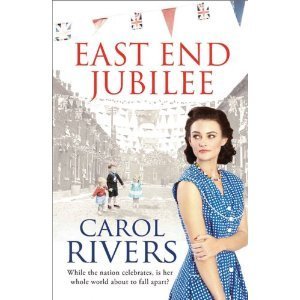
Coming in May
The Queen took the throne on February 6 1952 and her coronation took place on June 2 1953. To celebrate 60 years of the Queen's reign, her Diamond Jubilee will take place in 2012. Rose of Ruby Street was a very popular book when it was first published and stands the test of time. So with a fresh title "East End Jubilee" and gorgeous new cover, the book will be on the shelves approximately May/June of this year. To see why this book will be perfect for the time and setting, read on:
June 2nd, 1953. The residents of Ruby Street in London's East End are celebrating the new Queen's coronation. It's a day of joy and laughter, a new beginning for a nation still in the grip of rationing, still suffering the aftermath of the Blitz. But for Rose Weaver, the day ends in tragedy when her husband Eddie is arrested on suspicion of theft. It's only the first of several shocks as Rose discovers some unpleasant facts about the man she married eight years before, the man she thought she knew so well. Struggling to provide for herself and her two daughters, Rose realises that she'll need the help of family, friends and the good neighbours of Ruby Street if she's to have any chance of pulling through. And when a handsome salesman knocks at her door, it's hard to resist temptation.
February 12, 2012
I'll Come to Thee By Moonlight
Valentine Day's Love Poem
The Highwayman
by Alfred Noyes
THE wind was a torrent of darkness among the gusty trees,
The moon was a ghostly galleon tossed upon cloudy seas,
The road was a ribbon of moonlight over the purple moor,
And the highwayman came riding—
Riding—riding—
The highwayman came riding, up to the old inn-door.
He'd a French cocked-hat on his forehead, a bunch of lace at his chin,
A coat of the claret velvet, and breeches of brown doe-skin;
They fitted with never a wrinkle: his boots were up to the thigh!
And he rode with a jewelled twinkle,
His pistol butts a-twinkle,
His rapier hilt a-twinkle, under the jewelled sky.
Over the cobbles he clattered and clashed in the dark inn-yard,
And he tapped with his whip on the shutters, but all was locked and barred;
He whistled a tune to the window, and who should be waiting there
But the landlord's black-eyed daughter,
Bess, the landlord's daughter,
Plaiting a dark red love-knot into her long black hair.
And dark in the dark old inn-yard a stable-wicket creaked
Where Tim the ostler listened; his face was white and peaked;
His eyes were hollows of madness, his hair like mouldy hay,
But he loved the landlord's daughter,
The landlord's red-lipped daughter,
Dumb as a dog he listened, and he heard the robber say—
"One kiss, my bonny sweetheart, I'm after a prize to-night,
But I shall be back with the yellow gold before the morning light;
Yet, if they press me sharply, and harry me through the day,
Then look for me by moonlight,
Watch for me by moonlight,
I'll come to thee by moonlight, though hell should bar the way."
He rose upright in the stirrups; he scarce could reach her hand,
But she loosened her hair i' the casement! His face burnt like a brand
As the black cascade of perfume came tumbling over his breast;
And he kissed its waves in the moonlight,
Oh, sweet, black waves in the moonlight!
Then he tugged at his rein in the moonliglt, and galloped away to the West.
He did not come in the dawning; he did not come at noon;
And out o' the tawny sunset, before the rise o' the moon,
When the road was a gypsy's ribbon, looping the purple moor,
A red-coat troop came marching—
Marching—marching—
King George's men came matching, up to the old inn-door.
They said no word to the landlord, they drank his ale instead,
But they gagged his daughter and bound her to the foot of her narrow bed;
Two of them knelt at her casement, with muskets at their side!
There was death at every window;
And hell at one dark window;
For Bess could see, through her casement, the road that he would ride.
They had tied her up to attention, with many a sniggering jest;
They had bound a musket beside her, with the barrel beneath her breast!
"Now, keep good watch!" and they kissed her.
She heard the dead man say—
Look for me by moonlight;
Watch for me by moonlight;
I'll come to thee by moonlight, though hell should bar the way!
She twisted her hands behind her; but all the knots held good!
She writhed her hands till her fingers were wet with sweat or blood!
They stretched and strained in the darkness, and the hours crawled by like years,
Till, now, on the stroke of midnight,
Cold, on the stroke of midnight,
The tip of one finger touched it! The trigger at least was hers!
The tip of one finger touched it; she strove no more for the rest!
Up, she stood up to attention, with the barrel beneath her breast,
She would not risk their hearing; she would not strive again;
For the road lay bare in the moonlight;
Blank and bare in the moonlight;
And the blood of her veins in the moonlight throbbed to her love's refrain .
Tlot-tlot; tlot-tlot! Had they heard it? The horse-hoofs ringing clear;
Tlot-tlot, tlot-tlot, in the distance? Were they deaf that they did not hear?
Down the ribbon of moonlight, over the brow of the hill,
The highwayman came riding,
Riding, riding!
The red-coats looked to their priming! She stood up, straight and still!
Tlot-tlot, in the frosty silence! Tlot-tlot, in the echoing night!
Nearer he came and nearer! Her face was like a light!
Her eyes grew wide for a moment; she drew one last deep breath,
Then her finger moved in the moonlight,
Her musket shattered the moonlight,
Shattered her breast in the moonlight and warned him—with her death.
He turned; he spurred to the West; he did not know who stood
Bowed, with her head o'er the musket, drenched with her own red blood!
Not till the dawn he heard it, his face grew grey to hear
How Bess, the landlord's daughter,
The landlord's black-eyed daughter,
Had watched for her love in the moonlight, and died in the darkness there.
Back, he spurred like a madman, shrieking a curse to the sky,
With the white road smoking behind him and his rapier brandished high!
Blood-red were his spurs i' the golden noon; wine-red was his velvet coat,
When they shot him down on the highway,
Down like a dog on the highway,
And he lay in his blood on the highway, with the bunch of lace at his throat.
February 6, 2012
Happy Birthday Mr Dickens: Master at Baddies
This week marks the 200th anniversary of Charles Dickens's birth. He was a writer most of us have read as some point, or seen his books dramatized or listened to an audio of his works. So apart from taking a great pleasure in joining in with the virtual celebrations, I'm holding one of my own. Here at my workplace, with the blink and wink of technology around me, I sit quietly, thinking of this great man. The body of mouth-watering stories he gave us is vast. I concentrate on one, Great Expectations, and visualize Pip and his meeting with the convict, Abel Magwitch, on the marsh. This was always my favourite scene, before the book got going. And I've drawn from the "feeling" many times, as I've written The Baddie. Millions of writers, actors and dramatists have done the same as I and I'll wager that Charles Dickens has been recalled by the power of thought to this earth, so frequently, that he now treads a red ethereal carpet to our minds, souls and spirits. So today, I'm thanking him for being such a great mentor. He wrote with gut instinct and that's what I admire and envy the most. Pip had trust in a man he hardly knew. The Baddie who was to change his life after only a short but unforgettable meeting. This trust was the premise of an incredible story. Pip also placed his trust in a young woman, Estella, who, haunted by her past, was in danger of becoming a Baddie. However, through love and compassion, the Baddie is transformed and brought into the light. So Charles, thank you for this one aspect of the written word that had helped me through many dark hours of plot construction. So much more of course in his writing, to be grateful for. But, with the book I shall have published this year in May, The Baddie returns in EAST END JUBILEE. Like Dickens's heart-stoppingly brilliant character of the lost convict, I create Eddie Weaver, husband to young Rose and devoted father, as a man seeking to make his family's life better, but unable to stick to the letter of the law. And now I'm smiling as I close this blog. I'm just a rookie at all this stuff and can't hold a candle to the Great Man's thinking. But I do have access to my imagination and like to believe it is there that we meet and discuss all The Baddies down the ages. Once again, Happy birthday Charles Dickens. And thank you.
January 16, 2012
The Connection Between Past and Present
 The Amazon promotion of EAST END ANGEL was very rewarding. I enjoyed feedback from so many readers and realize just how wonderful technology is. The Kindle and its kind are bringing readers ever closer to discovering new authors and fresh talent and in my case, the Carol Rivers novels. For those interested in the thrills and spills of family dramas, my stories are set before the 1960′s and continue back to the Great War. Writing these books has taught me that the connection between past and present is remarkable. I would say, breathtaking.
It's great to be finishing a book at the beginning of a New Year, knowing that very soon I will be submitting it to my editor. But I have very happy memories of October of 2011, when my last book IN THE BLEAK MIDWINTER, was published in hardback, paperback and Kindle and crept into the Sunday Times chart.
IN THE BLEAK MIDWINTER is set in 1919 and tells of a family in London's East End, suffering the traumatic effects of the Great War. As I have written before, the specific issue is of soldiers deserting the front line and the attitude of society towards their unfortunate families. Digging deep into the subject, some of the personal testimonies I researched were heartrending. They also mirrored similar accounts of our troops and their families in the most recent of wars like Iraq and Afghanistan.
What was once called shell shock is now known as post-traumatic stress disorder (PTSD). Now at least, PTSD is recognized as a serious condition and can be treated, whereas in 1919 it was viewed with contempt and shunned. When these young men couldn't function, they were classed as deserters or malingerers. Some were executed, a tragic injustice. I hope the story will help to enlighten readers as the novel unfolds.
The book I am about to complete draws a similar link between past and present. It involves the promise of celebrity and fame sought by youngsters of the 1930′s and the dangers of unscrupulous opportunists using these young people for their own gain. History repeats itself in a never-ending cycle. Fame and fortune, war and glory, are now transformed by technology. But always, the emotions remain the same.
With each book I've tried to capture some of these emotions. And most importantly, I believe that no matter how hopeless a situation may seem, it's always possible for love and the strength of family and friends to redeem us in the end. Perhaps, this most of all, is a message that, with my writing, I would like to take into the New Year!