Quinn McDonald's Blog, page 86
October 15, 2012
Losing Control with Creative Play
This weekend I spent time tempting people into creative play at the Women’s Expo in Phoenix, doing make-and-takes for Arizona Art Supply. The (clever) theme at the booth was using art supplies in unexpected ways, and attracted a lot of curious would-be artists, DIY, and yes, people who got their hair chalked with pan pastels.
 I love watching people approach creative play–some people jump right in, some people want detailed instructions. In each case, I explained that the techniques (and resulting postcards) would require giving up control.
Several people left. “If I give up control, who knows what will happen,” one said, walking quickly away. Aren’t you interesting in knowing? Something scary? Embarrassing? Shedding clothes and skipping down the expo? Because nothing like that happened to the people who stayed.
I had two favorite moments: One mother brought her son, and explained he has autism. I felt great empathy for the child, who was about eight, because the exhibition hall was a cacophony of sound, lights, movement, and I hoped he was not overwhelmed. After he chose his colors, I asked him if he would like to spray the water, or if he would like me to do it. He took the bottle, pointed it and  sprayed me in the face. It was completely accidental, I’ve done this myself, not locating the nozzle direction. He looked curious, and then at his mother, who looked horrified. He then became agitated and I assured him it was fine with me. I then squirted myself and said, “This cools me off.” He looked dubious.
He applied the paint with great precision, made the paper sandwich, but stalled at the step where he rubbed the paper. Thinking the texture of the paper might be unpleasant, I handed him a paint bottle to use as a brayer. He loved this, meticulously rubbing the paper.
Then came the big reveal–peeling the two pieces of paper apart. His face was surprised, and a tiny smile crept across his face. I told him he could take them home and he checked with his mom. Once they were dry he picked up one in each hand. Later, as I crossed the hall, I saw him again, walking with his head down and his art clutched to his chest. It made my day. Art heals. Or at least, makes you happy.
 The second happy-maker was a beautiful woman who sat down and asked where the brushes were. “There aren’t any,” I explained, “This is done with ink and water and a voluntary surrender of control.” Seriously, she nodded followed the few directions, and created the most controlled uncontrolled piece I’d seen. Turquoise and black ink in wonderful proportions, delicate and powerful. Before I could ask to photograph it, she said, softly, “Is this art?” I answered, “Only you can decide, but it looks like it to me.” She smiled, took the card and vanished into the crowd.
There were some rocky moments, I didn’t please everyone, but these two people, who let art into their lives and were delighted, made my day.
—Quinn McDonald is a certified creativity coach who teaches what she knows.
Filed under: Coaching, In My Life, Raw Art Journaling Tagged: creativity coaching, women's expo phoenix



October 14, 2012
But I Don’t Want To!
We all live in a hopeful universe which we scan for signs. Almost every day, no matter what time, if I check in at Facebook or Twitter, there is a post telling me what The Universe wants me to know. Lucky for me, these messages from the Universe are all positive and encouraging. I’d be frightened if I read one that said, “The Universe wants you to know that it is tired of your snarky and petty self putting on those red satin Daisy Dukes and Christian Laboutin stilettos and prancing in front of you, causing trouble. The Universe may chase the both of you down the street with a lightning bolt.”

The universe as i found it when I showed up.
The Universe, lucky for me, has not replaced my conscience. Some days I don’t want to do the work. Some days I want to be lazy. Some days I procrastinate. And I am absolutely sure I should be putting off getting the work done. With a dram more imagination, I’d make up a story that The Universe wants me to sleep in, indulge my indolent side, and take it easy. I could believe it so easily, especially if The Universe added that it wanted me to eat more chocolate.
Then there is the other side of me, the one that grabs me by the ear (this is the very difficult part, me grabbing myself by the ear–very bad leverage) and drags me to my desk to get to work. The Universe is silent on this matter. This is my work to do. If I don’t do it, it won’t get done. I can choose not to do it, but it is no one’s desire but my own.
For years, I’ve said that we create our own reality. I believe that. Keep a gratitude journal, and you will start to see more things to be grateful about. Want The Universe to give you a sign and it will. Just be very careful about the meaning you assign to it. Make sure you know the difference between a pat and a nudge.
Years ago, First Born was a camp counselor. One of the campers wanted to go out in the pouring rain without rain gear. First Born reminded him. “But I don’t waaaaannnt to!” whined the camper. First Born was flummoxed, having been raised by a Mom where that phrase was not an argument and wasn’t brooked.
The phrase became a catch phrase around the house for work that was unpleasant but was to be done without questioning or argument–scrubbing burnt lasagna pans, folding and putting away laundry, writing thank-you cards after a birthday haul. Promptly.
My Universe doesn’t engage in idle chatter much these days. Although, when I see dawn come up with dramatic rosy clouds and those delicious fresh temperatures I am so delighted with, I’m pretty sure it’s sending me a sign that it’s going to be a good day. If I make it so.
—Quinn McDonald lives in several universes at the same time. She is writing a book on the Inner Critic.
Filed under: Coaching, In My Life, Recovering Perfectionists Tagged: belief, getting the work done, The Universe


October 13, 2012
Saturday Hop
Saturday and Sunday (October 13 and 14, 2012) I’ll be at the Women’s Expo in Phoenix. It’s at the Convention Center, 5th St, between Washington and Jefferson. Arizona Art Supply will be hosting me, so I’ll be at their booth making Postcards from the Other Side of Your Brain. They are colorful and abstract, ready to send when you leave.
Join me at 11:30 a.m. and 1:30 p.m. on Saturday and at 11:30 on Sunday and have fun!
If you aren’t in Phoenix, it’s time to catch up on some creativity:
Want to print on metal foil? You’ll need digital grounds–and here’s how to use Golden’s Digital Ground
You can make these thank-you notes with younger children–or yourself.
From simple to amazing, this cut-paper collage (and tutorial) will amaze you and maybe inspire you to try it.
Have a great weekend!
Filed under: Creativity, Tutorials Tagged: Arizona Art Supply, cut paper, thank-you cards, Women's Expo


October 12, 2012
The Stitch-Ripper for Your Life
A stitch ripper is a hand device that people who sew use. People who are learning to sew use it a lot. There are several different styles, but the idea is the same–you use it to cut the threads in a line of sewing that need to be taken out. They are also called seam rippers.

Dritz makes this popular seam ripper.
After ripping out the stitches from the front, I learned that if you flip the project over and pull out the bobbin stitching, you do a lot less damage to the fabric and make the sewing thread come out in longer pieces, making opening a mistake faster.
And then, because I wonder about odd things, I wondered if it wouldn’t be a great idea to have a stitch-ripper for your life. Don’t like the way a project at work is turning out? Flip over your whole team and pull the thread that holds together poor thinking and wrong conclusions.
Don’t like the plot line in your story? Flip it over and find out what emotional stitching got tangled up in the logic thread and pull it out.
Unhappy with the direction your relationship is heading? Look at the other side carefully and see if the ideas, goals, dreams you both share are lined up right, There might be a wrinkle in the relationship that sounds similar to, “I’d really love that person if only s/he would change for me.” Time for the seam ripper.
I hate making mistakes, and I hate using the seam ripper, because undoing work isn’t fun and the stitch ripper requires some skill in itself–you can’t be too fast or vicious with it. But knowing that no emotion is final helps me open the old to make room for something fresh and different.
-–Quinn McDonald doesn’t sew, so she has to know how to use a stitch ripper.
Filed under: Creativity, In My Life Tagged: creativity coaching, seam ripper of the soul


October 11, 2012
Coaching: Be Prepared
Many coaches do sample sessions that are demos. It’s the same demo every time, with every one who wants to try it out. I’m sure it works for them, but it doesn’t work for me. My sample sessions are real coaching sessions–a full hour of coaching, real questions, and real follow-up work. (I used to call it homework, but too many clients feared it.)

It’s a hard hike from rim to rim of the Grand Canyon. But worth it!
And yes, I charge for that sample coaching. It’s real work, and I charge a fee that is refunded if the person becomes a client. That way, everyone wins. A sample costs less than a regular coaching session. I get paid for my time, and the client gets a deal for the first month of coaching.
I used to do free samples, but one month, when I crunched the numbers, I had spent 20 unpaid hours coaching. Free coaching sounds like fun, and people who had no real interest in coaching tried it out without the intention of changing their lives or doing the work.
What most people don’t understand is that coaching is hard work. For me, sure, but I meant for the client. The first session is often a huge relief–the first step, the admission that something is wrong, the rush of possibility. It’s easy to think that initial excitement will happen every time. But it doesn’t. Pretty soon you are setting goals and figuring out how to get there, how to overcome your own resistant, how to get out of your own way. And it takes work. While you are supported and encouraged, it’s still work. Hard work. And that takes courage.
Of course, the results are satisfying, too. Hard work shows up as moving ahead, getting unstuck, and enjoying your creative work. But there is hard work ahead, and a lot of it.
I’ve been coaching for almost 10 years now (just three months away!) and I’ve seen the most amazing success stories. People who overcame incredible odds to make meaning, to create a new career, to write books, to leave or stay with a spouse. I’ve witnessed great courage, stolid determination and heart-blossoming discoveries. And yes, I’ve experienced a few people who expected me to do all the heavy lifting, doing the work that they don’t want to tackle. It doesn’t work that way.
After the first rush of success, after the first feeling of elation, coaching is like art–it’s hard, sometimes slow work. But there is nothing like it to reach a goal, make a change, or live your own life of success and joy.
—Quinn McDonald is a coach and has a coach. That’s just sensible.
Filed under: Creativity Tagged: creativity coaching, the work of coaching


October 10, 2012
Ideas Like Fireflies
“Set your ideas into the wild.” It was just a sentence fragment I read on a blog today, but now, hours later, it still resonates. What a wonderful image–taking your ideas and setting them free against an autumn sky, to soar away.
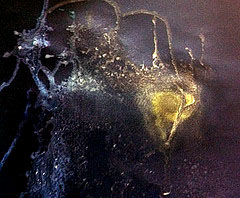
The memory of fireflies, Ink on paper. © Quinn McDonald
You lose control over them, but you never really were in control of your ideas. You just kept them, like fireflies in a jar, until you had filled your eyes with wonder, and then you let them go, because they weren’t really yours to begin with. But you never forgot the glow in the dark and the churn of comfort and power you got from opening that jar and having the fireflies crawl to the rim, lift their wings and blink up into the grassy-smelling dark night.
Our ideas are ours to nourish, marvel over, and set free into the wild. You write a book, you teach a class and your ideas float across space and time, to be caught, transformed and set free again, in different spaces and different times. You may not even recognize it when it comes back, but as it passes you on the street, dressed in a suit and formal with design, you’ll smell a hint of summer grass and catch a slight wink of light, and the memory will still be there.
The experience of recognition, the experience of power and joy, that makes setting free your ideas all the more worthwhile.
–Quinn McDonald has a jar of ideas on her desk. She remembers it once held fireflies.
Filed under: Creativity, Nature, Inside and Out, The Writing Life Tagged: fireflies, memories of creativity, owning ideas


October 9, 2012
Soy-Silk Roving

This is the original color–bright, with a nice sheen.
After I purchased the soy roving (also called faux silk roving), I wanted to make a sheet of it. As a papermaker, making a sheet of soy paper seemed a good first step. Following directions suggested by Traci and Rosaland, I bought both nylon net and tulle, created a soy sandwich, using textile medium, and let it dry.
Tips:
If you try this, get the roving wet, but not so wet that it makes puddles on your protective plastic sheet. It will take forever to dry.
Nylon netting is easier to remove, but tulle doesn’t leave any netting marks.
Do the wetting process on a plastic bag to contain the mess.
Textile medium is sticky and doesn’t easily wash off your hands. Gloves are helpful.

Edge of sheet.
I deliberately made a thin sheet, to avoid a felt-like texture. After it dried, I peeled off the nylon netting and tulle (two separate pieces) and looked at the result. It had a plastic feel, and a stiff hand. Frankly, as a first experiment, I wasn’t happy with the result. I’ll try it again, with more water to dilute the textile medium (I used half and half) and a thicker sheet. But the plasticky hand was off-putting for me.
I’m going to try to paint this sheet with Lumiere and inks to see what happens. I can also sew it onto a sparkly fabric background for more visual interest.
In the photo on the right, you can see the impression left by the nylon netting.

There are faint impressions of the nylon netting in the finished sheet.
This disappears when you heat set it (between parchment papers).
What else can this soft, lovely fiber do? I pulled off thin strands and draped them on a watercolored sheet that I had painted with glue. I like this interesting effect, although it is still very rough. I could see this method working really well on fabric with over-stitching.
Next experiment: I can also see the “sandwich” being made from water-soluble fusible webbing instead of netting.

Fiber glued onto watercolored paper.
After the webbing is ironed in place, I’ll stitch over in free-form patterns. (OK, I have to learn to do that, too). Once the soy roving is stitched down, I can wash the webbing away. That should give me a more thread-like hand and still stiffen the material some.
The roving also comes in white, and I think using a lot of white and a little color would make a very interesting sheet.
Let me know if you’ve ever used this roving for something other than sheet-making.
–Quinn McDonald is a writer and artist.
Filed under: Links, resources, idea boosts, Tutorials Tagged: art experiments, soy roving, soy silk


October 8, 2012
Call for Contributions: Inner Hero Book
Inner Hero Book Call for Entries
You know I’m writing a book on the Inner Critic. Actually, it’s about finding your Inner Hero and confronting the Inner Critic using the persona of your Inner Hero.

Image printed on fabric, then stitched to paper. Original image © Bo Mackison, 2011.
An important part of the book is to include art from people who love to do creative work and encourage others. Not famous people, but experimenters and explorers. If that’s you, today is the day to start planning. The Inner Hero Art Journal: Mixed Media Conversations with Your Inner Critic is going to include artwork from a variety of people, and today is the day I’m asking for contributors.
About the book:
The book has five example chapters. Each chapter has a separate art technique and a writing technique.
In the book, I’ll be creating a series of double-sided, loose-leaf journal pages with art on one side and writing on the other.
You will be submitting either an art sample or a writing sample.
These are the chapters and techniques in the book
Inner Hero Name
Art Technique
Writing Technique
The scribe
Ink as paint (abstract)
Free writing
The tarot-reader
Paper mosaic
Alike and Different
The alchemist
Printing on fabric (combines paper + fabric)
Guided visualization
The gardener
Botanicals in artwork
Tools (What tools do you use to inspire yourself?)
The wise woman
Combining techniques
Using aphorisms, proverbs, folk sayings and quotes.

Ink used as paint. Abstract, © Quinn McDonald
Update: Please follow the instructions below, even though they are long. Do not submit both art and writing. It’s your choice, don’t ask me to decide. Please pay close attention to sending your contact information (#5) and how to handle the subject line (#6) below.
What you need to do now:
1. Choose an inner hero name/technique you would like to work with from the chart above. For each persona, there is a corresponding art or writing technique. The Inner Hero you choose will determine the technique. Choose only one–art or writing.
2. For art submitters: Send two low-resolution images showing a sample of your work. Work you like to do is best. It’s not necessary to show the kind of technique you are going to do. These images are just samples. The purpose of these samples is to help the publishers see your work.
3. For writing submitters: Submit a 100-word to 150-word writing sample. (Please no more than that). You can copy it from your blog or something you have written, or you can write a sample piece just for this. Do not send a link to a site, and do not send an edited sample from a published piece. I want to see your own writing in the email.
4. You can read FAQs about art techniques and writing by clicking on this link: FAQ It is a pdf, and you will need Adobe reader. Download it here for free.
.
5. Once you have decided what you want to submit, send me the email with the samples, your full name, phone number and mailing address to Innerherobook@gmail.com I will not share this information with anyone, it is simply providing me several ways to contact you.

Paper mosaic. © Quinn McDonald, 2011
6. In the subject line put the name of the inner hero and what technique you are choosing.
For example, if you want to use natural objects in your submission, and you want to submit writing, you will put Gardener/Writing in the subject line.
If you want to be the Alchemist and work on fabric and paper, put Alchemist/Art in the subject line.
You may choose the last chapter, combining techniques, but you must list the specific art techniques you will be using in the body of the email. “Combining” here means art techniques.
7. The email with samples is due on October 21, 2012 by midnight Eastern time. Remember, these are just low-res samples of your work, not finished pieces.
8. If your work is chosen, you will receive another email by mid-November. Final artwork photos are due by December 31, 2012. You will not send in artwork, you will send in photos. More information will be sent to the people who are chosen for submissions.

Botanical pear collage. ©Quinn McDonald, 2012.
Fine print you should know:
1. There is no guarantee you will get chosen. Even if you are chosen, you may get cut at the last minute. I have absolutely no control over this, and it is not a judgment against you. It’s a matter of book pages and design.
2. You won’t get paid for your work. ( I wish you would.) On the other hand, if your piece is chosen, you will be in a published book that I am working hard to make popular. You will have bragging rights to be a published artist or writer.
3. You will be asked to sign a permission slip that says the work is entirely owned by you—that you are not using someone else’s work. In other words, any photos, phrases, artwork was done by you. If you rip pages from a magazine for collage, they cannot be recognizable.
If you are using quotes, they must be in the public domain (this includes proverbs, folk sayings from your country, or quotes from ancient books, such as writing from the Buddha, Rumi, the Bible or Q’ran).
4. You will own the copyright to your work. However, North Light may use your image in advertising, or in subsequent editions of the book, or in translated books.
If you have any questions, send them to the email address in Item 5, above, with the word Questions in the subject line. I will try to answer the questions quickly. Please read the FAQs first. I’m so happy to be able to include a big variety of meaning-making art in the book!
Filed under: Creativity, Inner Critic, The Writing Life Tagged: art journaling, call for entries


October 7, 2012
Reconsidering the To-Do List
Growing up, I was taught to do the work first, have fun later. It became a habit, one that worked fairly well over time. Change and feed the baby first, then make and eat your own lunch. Do the laundry before you sit down to read a book, so you’ll have clean clothes to wear. Clean the house before you go to the movies so you won’t have to clean the house at night, waking the neighbors (in an apartment).

Could be my to-do list, but it’s a photo of Jack Kerouac’s novel “On the Road” which, after two years of research, he wrote in three weeks on a roll of teletype paper.
That “work first, fun later” became so ingrained, the habit became part of my way of thinking. I never questioned it. Now it’s time to question that way of thinking.
First consideration: art is work. If I think of creative time as fun, it will always come last, when I’m tired and not ready for deep creative work. Creative work is part of my life, and needs to be honored as an important part of my life.
Second consideration: Consider the time something will take. It might be worthwhile to do something that takes a short time and it fun between two items that take a longer time. For example, I love stopping by the library to look at their sale books. These $1-$4 bargains are great for artwork. It makes sense to go to the library between getting gas and picking up pet food, since the library is between these two points. Putting it off for another time wastes gas and makes me more likely to do the chores.
Third consideration: Priorities trump labels. There are boring chores that can be done while watching TV. The other day, I realized that I had accumulated a huge amount of spam and pingbacks on my website. These can’t be erased all at once, but only 20 at a time. Because I have a special offer up on my website (for readers of Quilting Arts magazine’s October/November issue), I didn’t want 3,300 comments to distract people to spam sites. I immediately began to erase them. But wait–not so fast–this is something that is mindless. I can do it while I’m doing the laundry, waiting for the floor to dry, or while watching the national news. Best of all, I can combine listening to an audio book or podcast late at night, when I’m too tired to do deep creative work.
Looking at my to-do list with a fresh eye to priorities, time and labels is a good way to create a new schedule for fall, when my morning walk starts to be at later times (walking at dawn is no longer a 4:30 a.m. start, it’s closer to 6:00 a.m.) and I have creative time before my walk.
Let me know if you are going to changing your schedule. It might be an interesting experiment.
–Quinn McDonald is a creativity coach and a writer. She also teaches what she knows.
Filed under: Creativity, In My Life, Recovering Perfectionists Tagged: creativity coaching, setting priorities, to-do lists


October 6, 2012
Saturday Stroll
When I was a mother of a young child, Saturdays were always so hectic–errands like the grocery store, hardware store, and probably kids’ clothing department in a store, and certainly the cleaners (we wore suits to work every day in those years, and the dry cleaning smell was part of my life).

Busy mom, for the site by the same name. See the link to tips for busy moms at the end of the blog post.
Now Saturdays are different. When you own your own business, you stay away from stores on Saturday, choosing mid-afternoon on weekdays, when stores are empty and errands take half the time. This week was busy with a lot of driving and teaching, and that means a Saturday of cleaning house (you never outgrow that), making hummingbird food, and refilling feeders (after cleaning them, too) and then. . . studio time.
If you need a creative boost, here are some articles you may have missed, and places you can explore:
Bubble backgrounds are fun, easy and you can do them with your kids or grandkids. For teachers, try making the bubble pages, then having the kids write wishes in the bubble spaces. For younger kids (or you–I love doing this), create the background, let it dry, then color it in.
I love making paper mosaics of all kinds. This one is literal but still a lot of fun. You can put it right into our journal, there are tips to keep the page from curling. I like to help you avoid all my mistakes.
Make yourself a virtual kaleidoscope. No peeking through a tiny tube, and lots of fun to change the visuals. To save you time, you drag the pieces you want into the moving virtual kaleidoscope, on the left. Your visual shows up on the one on the right.
Tired of hugely realistic video games? Here’s one of the early ones that requires using the arrow keys on your computer. No joystick, no fingers. Still fun. Zefrank’s old-fashioned puzzle game is fun to play–move the rocket through the gears.
And finally, want to sound profound at your next meeting? An entire site of useful things to say–in Latin.
The photo above is from a site that has tips for busy moms. So you’ll have time to come back here and play!
Have a creative, inventive weekend.
–Quinn McDonald is writing her second book. She’s amazed at the information she didn’t put in the original outline.
Filed under: Creativity, Journal Pages, Links, resources, idea boosts Tagged: creative fun, creative play, creative play for kids