
Andrew Scott's Blog, page 41
July 30, 2012
rebellitor:
ff-365:
Fantastic Four #49 by Stan Lee & Jack...
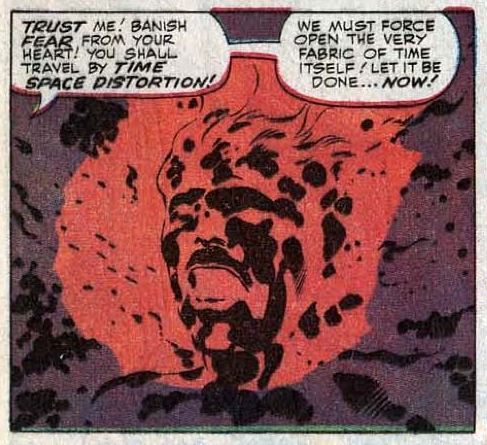
Fantastic Four #49 by Stan Lee & Jack Kirby
Pretty much my daily writing ritual.


June 27, 2012
June 21, 2012
Anthology preview
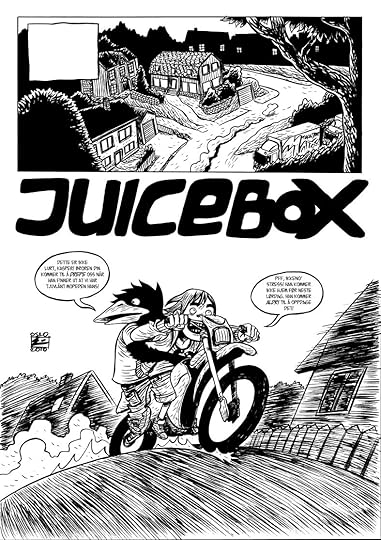
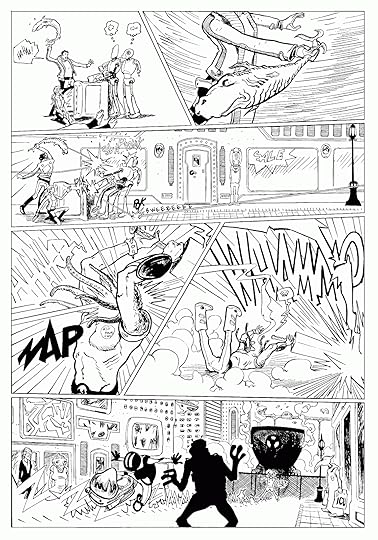
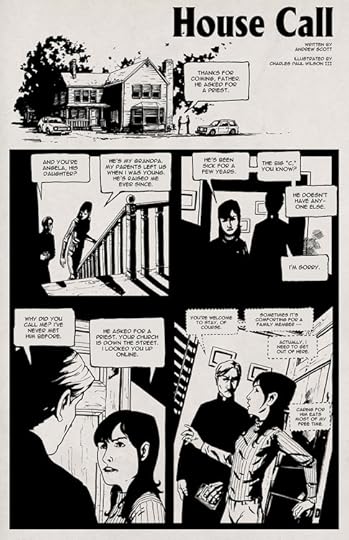
With artist Ed Herrera, I am making plans to publish a small comics anthology (fewer than 52 pages) featuring the work of two outstanding Norwegian artists, Håvard S. Johansen and Sigbjørn Lilleeng, as well as a story drawn by Charles Paul Wilson III, artist of The Stuff of Legend.
The official publication date will be later this year. I want to tease just a few of the pages, though, to give you a taste of the good work that awaits.
June 20, 2012
To the Board of Trustees of Purdue University:
The reaction to the news that Mitch Daniels will become Purdue’s next president has been mixed, to say the least, and understandably so—no standing governor or high-level politician has ever been appointed to a major university’s highest office while serving out the remainder of his term. While politics and academia can never be fully separated, it is a slap in the face to half of your students, faculty, employees, and alumni to appoint a political figure during such a fractured time in our country’s political discourse.
This decision reveals a number of biases on your part, or perhaps you simply no longer care about appearances, which is far more troubling. Didn’t Mr. Daniels appoint or confirm a majority of the trustees on this Board? His administration’s policies and decisions have made mountains of trouble for the presidents of all state universities in Indiana, including President Córdova at Purdue—isn’t that also a conflict of interest, to dirty the floor and then come knocking with a broom for sale?
Further, Mr. Daniels promoted Western Governors University, an online diploma mill, and insisted that more and more Ivy Tech credits be transferrable to Indiana universities. Now, some Ivy Tech courses are outsourced to online instructors outside the state. These are just two decisions among many which have already damaged the quality of higher education—not just at Purdue, but around Indiana.
Purdue has been an enormous part of my identity for nearly twenty years. I met my wife in its classrooms, learned the tools of my trade from the inspiring and dedicated professors in the College of Liberal Arts, and became an engaged citizen while there. With this hiring decision, you have forced me to evaluate my core principles as an educator and citizen. As such, I can no longer donate money to the university, by any means, directly or indirectly; I can no longer participate in any spectator-related university activity in person or via television; I cannot even step foot on campus, unless it is to honor in person one of the excellent educators I mentioned above, without feeling the sting of this decision. In short, I can no longer support the university. My Purdue clothing will be boxed up or donated, even if it means I have to walk around naked.
When Mr. Daniels finally steps down from this position—or if, mercy upon us, you decide to change course tomorrow and do not appoint him—I will reevaluate my decision. Until then, I am saddened to think of the fundraising brick my wife and I purchased and engraved with our names and year of graduation, which can be found at the north end of Ross-Ade Stadium, a place where we communed every time we attended a home football game. Or perhaps my lament is just a sentimental feeling for another time, one that slips ever away from us, when I could sing “Hail Purdue” and stand behind words like “ever grateful, ever true,” content that the university would honor that faith and devotion.
Sincerely,
Andrew Scott
Postscript:
A Facebook friend considers this move a break in my “faith and devotion” to Purdue. I responded:
My politics will never likely align with those of university presidents. But to choose an active politician—not even someone a few years removed from office, but a man who will still be the governor of the state for six more months, who just a few weeks ago was still being talked about as a potential VP candidate—is itself a highly politicized move, one that, like it or not, will upset a sizable portion of the greater Purdue community.
I think Daniels has been bad for higher education, and I object to many of his other moves. But he’s not the king of evil, and I’m not trying to demonize him. I’m glad he’s not really a social conservative, and I am incredibly happy he cleaned up the BMV. But this smells bad, doesn’t it?
Again, it has little to do with my own politics, ultimately. When a university becomes an obviously politicized place and is led by someone with a clear agenda above and beyond the singular best interests of a university community, then what you find is trouble of all kinds. On his own wall, Kevin said that most of the people objecting to this hire are educators. How can anyone affiliated with Purdue University, though, look at Daniels’s track record regarding higher education and be excited about the future? Several articles have pointed to his own education as proof that he has an academic background—not that he’s taught, or worked with students in some capacity, or even led a department, college, school, or whatever. Just that he went to college. That’s enough for some people, apparently.
I worry, though, that the “team” mentality in American politics, which is reinforced by the false dichotomy of the two-party system, keeps individuals from honestly assessing decisions like this. Just as in the 2000 Presidential race, when the governor of the disputed state just happened to be the brother of one of the candidates, this selection process is tainted, at the very least, and likely even corrupt. A certain amount of disillusionment must follow something like this, albeit on a much smaller scale.
June 18, 2012
a teaser from a work in progress
Courtney Elizabeth Mauk, author of the forthcoming Spark, tagged me in a Facebook note about this, and I decided to play along.
The Game of Seven. The challenge is to post seven lines from an unpublished work of fiction, and most people choose their present Work in Progress. Specifically, you would:
Go to page 7 or 77 in your current manuscript
Go to line 7
Post on your blog or Facebook page the next 7 lines, or sentences, as they are – no cheating
Tag 7 other authors to do the same
While Kool-Aid Lou dusted the well bottles and the news of hate prattled on above us, I learned that a family of Mexican immigrants living together in a dilapidated rental on the city’s eastside—less than two miles from the house I was raised in, and where Mama still lived—were executed, one at a time, their bodies scattered throughout the house, and a few of them with hands tied behind their backs with duct tape. A man in his thirties. Two women in their late twenties, one of them likely the man’s wife. Was the other woman his sister? Her sister? A family friend? Nobody knew.
I’m going to invite seven authors to do the same.
rebellitor:
A Joyce one would have been quite fine: Yes I said...
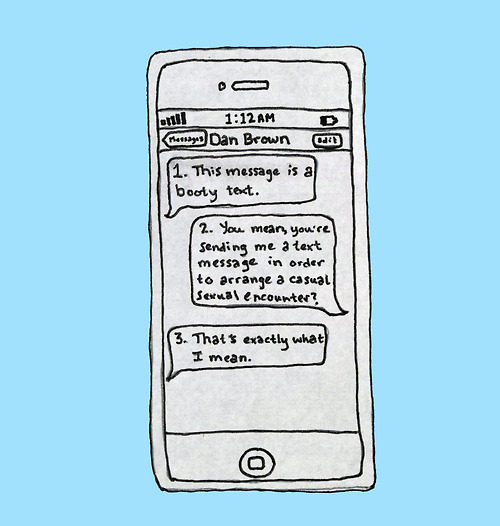
Dan Brown
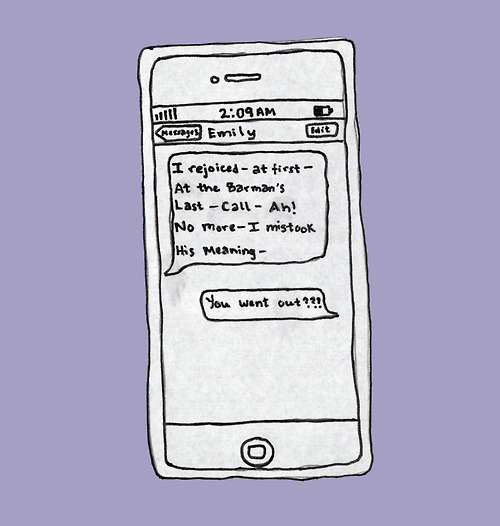
Emily Dickinson
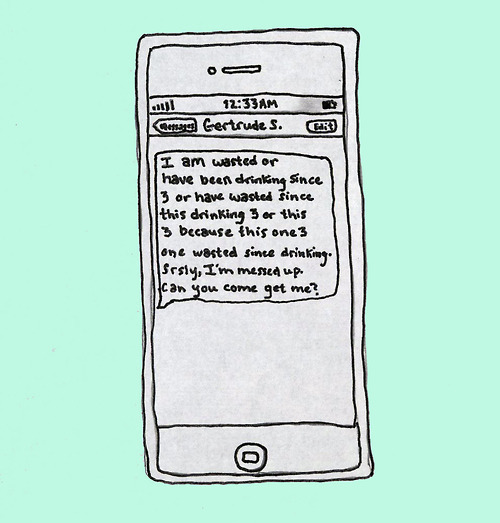
Gertrude Stein
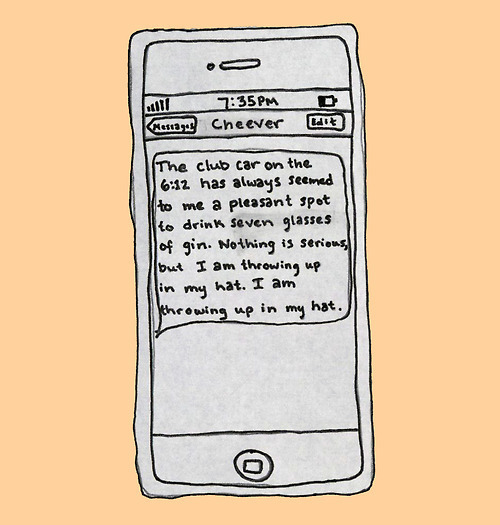
John Cheever
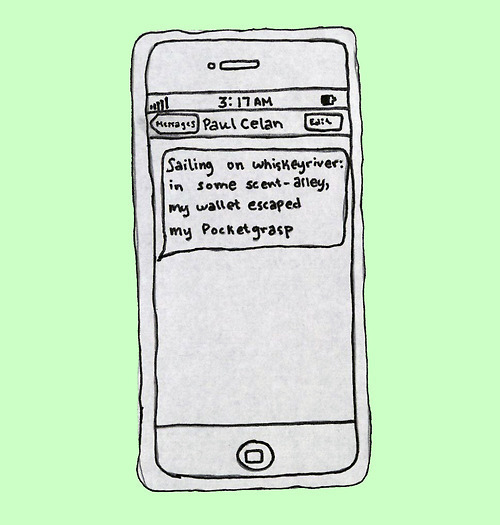
Paul Celan
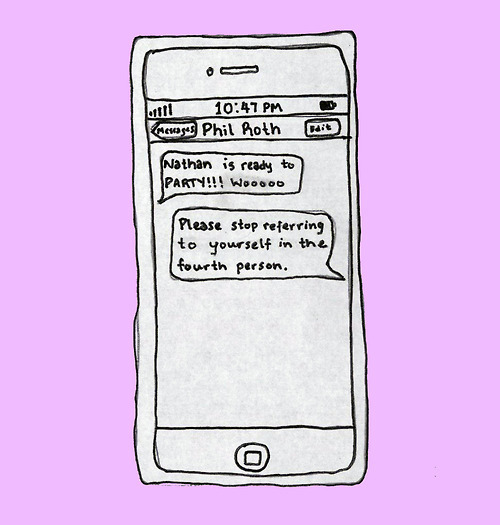
Philip Roth

Sappho
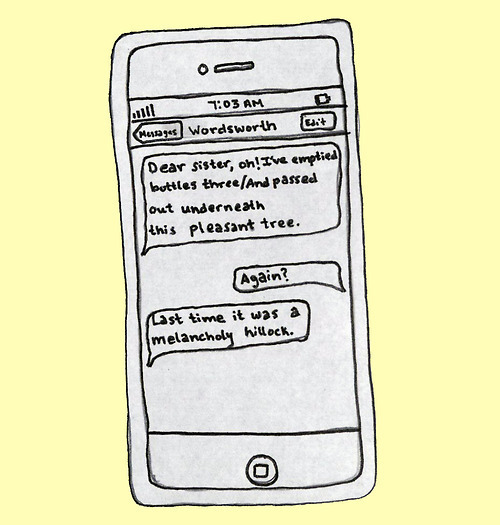
William Wordsworth
A Joyce one would have been quite fine: Yes I said Yes I said FUCK I ALREADY TOLD YOU THAT…
Drunk texts from famous authors.
June 1, 2012
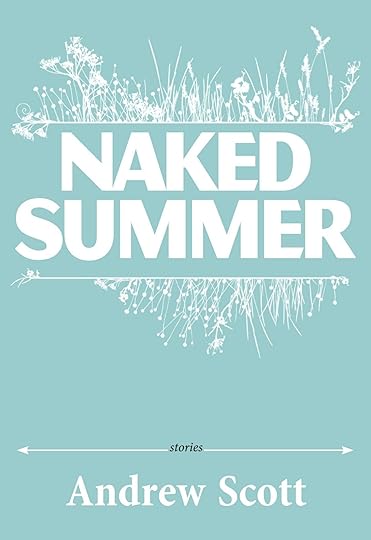
Happy Birthday to NAKED SUMMER
Naked Summer’s official publication date was June 1, 2011, which means my baby is now a year old. It’s a cute little thing, hobbling around the living room, bumping into sharp corners. I still haven’t bought those safety caps for the electrical outlets.
Yesterday my book said its first words: “I wish I was a novel…”
Wow. That one hurt.
Nevertheless, I want to celebrate, so I’m giving away a big-ass box of various books and literary journals to someone who buys (or has already bought) my book. To enter, all you have to do is e-mail me proof that you have, in fact, bought Naked Summer.
You: Like a receipt?
Me: No, no—that’s no fun. Just a photo of you holding my book. If you bought an e-version, a photo of you holding the e-reader with my book onscreen. Something like that.
andrew9976 [at] yahoo [dot] com
But get those entries in soon. The deadline is Friday, June 8. And good luck!
May 28, 2012
Interview for Andrew's Book Club
Andrew’s Book Club (2009-2011) promoted short story collections, with a preference given to debut authors and authors early in their careers. When Naked Summer was published, a few of the authors whose titles I’d selected agreed to ask me a question about my own book. Now that the Andrew’s Book Club website is no more, I’ve archived that interview here.
Victoria Patterson: Naked Summer is your first book. What is your background as a writer?
I’m one of those weirdos who majored in creative writing. I took creative writing classes in high school. I have a B.A. and an M.F.A. in creative writing. I learned a lot from an army of writer-teacher mentors who were generous with their time. I became a reader, really, in those classes, or a more serious reader. The undergraduate program at Purdue was rigorous. I took craft and theory classes and workshops, and also served as the first undergraduate intern for the Sycamore Review. When I helped edit an undergraduate magazine, my first move was to beg grad students to submit their work, assuring them that I wouldn’t ask for First North American Rights—something I had to learn about in order to address their concerns—which is how a tiny photocopied zine we made for almost no money wound up publishing a poem that would later appear on the back cover of American Poetry Review. This also forged for me an identity: a writer who also edits the work of other writers.
Then I met a girl, a fiction writer. We’d both applied to graduate programs in creative writing. We thought, well, maybe we’ve got something big here, so we decided, after dating for about three months, to pack up and move across the country together. But which program? Ultimately, the powerhouse trio of writers who were then teaching at New Mexico State—Kevin McIlvoy, Antonya Nelson, Robert Boswell—won out, and it didn’t hurt that I also got to take a class with Don Kurtz, author of South of the Big Four, one of my favorite novels, who taught Spanish at NMSU and served on my thesis committee. I worked about 30-40 hours a week editing Puerto del Sol, too, which was its own learning experience.
Everything after that is just the slow crawl of forward movement.
Tracy Winn: Why stories? Where do they come from? (Dreams? Muse? The old grind?) What is it about short stories that suit you personally?
William Trevor talks about “the art of the glimpse” in short stories, which nicely sums up my attraction to them. I like stepping into characters’ lives for intense moments. I like shapeliness. Short stories, even more than novels, demand a concise understanding of the occasion for narrative. The short story is a tighter rope to walk. As a writer I’m drawn to balance and precision.
Sometimes my stories emerge from images, from bits of language, an interesting phrase I’ve overheard in public. Sometimes the title comes first. They’re usually not autobiographical, but when they are, I mangle them into something new and hopefully not recognizable. And because I work on them for so long, I usually forget what I’ve taken for my fictive purposes, and from where. For me, stories come from the grind.
Midge Raymond: How did you decide which stories to include in Naked Summer? What’s been the most surprising part of the publishing process?
The most surprising part of the publishing process was how much say I had in how the book looks. Kevin Watson at Press 53 approved the cover designed by my wife, Victoria Barrett—the girl I moved across the country with. Victoria is an excellent fiction writer, and also the editor/publisher of Engine Books, so she knows her way around graphic design software. But, later in the process, we offered to typeset the book to alleviate some traffic jams in Press 53’s schedule. I don’t think many authors get to have this much control of the final product.
The stories I ended up with are all set in Indiana, mostly around Tippecanoe County, where I’m from. The book is, in its way, an outgrowth of my M.F.A. thesis. During the nine years between finishing the degree and having the book in hand, the manuscript evolved, but the core of the book is easily found in that thesis. I removed one story, which wasn’t set in Indiana, as the stories in Naked Summer are, and that became the chapbook I mentioned. I pulled another story after adapting it into a screenplay—when 14 pages became 114 pages, I realized it probably wasn’t really a short story. For a while, I thought it might become a novel, but now it’s a 100-plus page monster that I guess I have to call a novella, part of another longer project I’ll work on in the next few years. Finally, I ditched a third story from the the thesis after an agent said she didn’t like it. It just felt right. A story good enough to be published on its own might not fit into the overall design of a book.
Dylan Landis: Is this truly your first book, or are there others in the drawer? And I’d love to know a few short-story writers who really move you. And what you’ve learned from them, if you’re so inclined.
Naked Summer is my first book, but during its making, I also tried writing other books. Those other books have now been put aside while I unearth a novel I previously abandoned and buried. That said, I wish I had an actual drawer where I could put these works-in-progress. It’s not very sexy to say they’re on a hard drive.
Andre Dubus is one of my favorite writers. Raymond Carver, too, though unlike many of his fans, I prefer his post-Lish work. Stories like “Errand” and “Call If You Need Me” now matter more to me than his earliest stories, even if those great stories are what drew me in, all those years ago. Do I risk sounding like Mr. Obvious if I also include John Cheever, Alice Munro, and the rest? I studied with a story writer, Antonya Nelson, whose work moves me. She’s up there with William Trevor, as far as I’m concerned. And then so many story collections, such as Richard Ford’s Rock Springs, or Toni Cade Bambara’s Gorilla, My Love. In terms of story collections that aren’t themed or linked in any way, one of my favorites is The Night in Question by Tobias Wolff.
I also love going back to books by writers who’ve disappeared, sometimes intentionally, from the public’s view. Thom Jones, for instance, or Ralph Lombreglia. Edward P. Jones was off the radar for a long time, and we readers who loved Lost in the City wondered if he’d ever publish another book. One of my favorite writers closer to my age is Paul Yoon. There’s no shortage of excellence in the short story today. I’ve learned from all of them that the story is a vibrant form, and a necessary one, and that time spent writing or reading a short story is a good use of one’s hours. And that every story is a coming of age story, in its way, as well as a mystery.
Samuel Ligon: Which story in Naked Summer feels most complete to you? Which story are you most satisfied with? Which story was the most difficult to take to its final, finished state?
I suppose the title story was the most difficult, since it came to life as a 18-pager in the first person, and ended up at more than fifty pages in the third person a few years later, and then needed several more years of brewing to get where it’s at now. Handling so many scenes across several months of narrative time was something new, and helped me begin to transition to writing novels, too. It’s a different skill set, compared to a tiny story that takes place during a short span of time, such as “Sums and Subtractions,” which unfolds while the protagonist gets a haircut, or “The Hypnotist,” which takes place during a night of entertainment at the local high school. Several readers have told me that “All That Water” is their favorite story, for whatever that’s worth, and there’s satisfaction in that, for sure.
The story that still feels most complete is “Lost Lake,” the oldest story in the bunch. It was the first story I ever submitted. I sent it to five magazines the summer before I started grad school, and put my New Mexico address on the SASE, even though I hadn’t moved there yet. This meant there were five rejection letters waiting for me. Two were form rejections, but there was also a long handwritten note from The New Yorker, another long handwritten note from Story (R.I.P.), and a fairly typical typed letter from The Atlantic. This was encouraging, out of the gate, but ultimately frustrating, as the story never found a home, though I submitted it to a wide range of magazines and journals over the years. Esquire sent a long note about how great it was, perfect ending, all of that, and how they looked forward to my “literary career,” but it was still just another rejection. I let my ego interfere, too, assuming that since I’d come so close at places like The New Yorker or Esquire, small quarterlies from universities would surely want it. They didn’t. I ended up changing the title (barely) by changing the name of the golf course in the story, to help underscore some of the mystical, weirder elements at work.
It’s been a long road.
Laura van den Berg: What’s one short story you think everyone in the solar system should read, and why?
Right now, with intergalactic relations in the balance, I’ll kindly suggest that every being in the solar system should read James Baldwin’s “Sonny’s Blues,” which is about the essential need to really listen to one another, especially those you purport to love. The known universe needs more of that.
May 8, 2012
Revision, Renovation, Revision, Renovation
Our back deck is huge—about 400 sq. ft.—but it’s never been cared for; we moved in six years ago and it was already in rough shape. Since then, we’ve only done the bare minimum out there, such as screwing down errant planks. We had other things to do first, like completely flip every room in our house.
Today I pulled up many of the old planks and put down new ones. I had to cut some of the new boards to size first, and this task has taken all damn day. I love it. I’m working in pieces, so the job is about 40% done, I’d say.
I also used this opportunity to move around under the deck, since several planks were exposed, and spread a ton of newspapers(*) to cover the muddy edges underneath, where weeds, honeysuckle, and baby redbud trees try to grow. This method is supposed to keep down the weeds, and it’s out of sight, anyway. But without doing something, the weeds eventually grow into sight.
Every time I do this kind of work, I think about the unseen work of writing, too, all the scaffolding and foundational work that disappears once a project is close to finished. It’s especially fitting now, since I’ve just started summer break, which is when I try to get a lot of writing done.
Writing has at least one advantage over the home improvement stuff: I’ve never fallen through the missing planks of a story and cut my legs all to hell, jammed a few fingers, and raised bruises on my arms the size of Cadbury eggs. On the other hand, I sure do love to use a crowbar.
Score one for the old deck today, but I’ll win in the end.
*New York Times Sunday edition, if you must know. We’re the liberal elite, didn’t you hear?
April 18, 2012
4/28: Reading @ Newburyport Literary Festival
I’ll be reading on April 28 — a Saturday morning — at the Newburyport Literary Festival in Newburyport, Massachusetts. There’s a fundraising dinner the night before, with a party at house of one of my favorite writers, and I get to be listed alongside some of the finest authors around. Seriously, just have a look at this page and tell me who doesn’t belong…
In the afternoon, Victoria Barrett will be part of a cool panel featuring a few writers and their editors. At some point we’re going to eat lobster rolls and clam chowder with Myfanwy Collins. Before we come home, we’ll see a Red Sox game at Fenway, in the storied ballpark’s celebratory 100th year.
This is shaping up to be the best weekend ever, right?
Andrew Scott's Blog

- Andrew Scott's profile
- 9 followers

