
Jon Gordon's Blog, page 5
March 3, 2014
9 Ways to Be a Great Team Member
While watching the Oscars I noticed that almost every award winner said they couldn’t have done it without their team, family, and the support of others. The fact is no one achieves success alone. We all need a great team to accomplish great things. We are at our best when we are surrounded by those who want the best for us and when we are bringing out the best in others. In this spirit I want to share 9 ways to be a great team member.
1. Set the Example – Instead of worrying about the lack of performance, productivity and commitment of others you simply decide to set the example and show your team members what hard work, passion and commitment looks like. Focus on being your best every day. When you do this you’ll raise the standards and performance of everyone around you.
2. Use Your Strengths to Help the Team – The most powerful way you can contribute to your team is to use your gifts and talents to contribute to the team’s vision and goals. Without your effort, focus, talent and growth the team won’t accomplish its mission. This means you have an obligation to improve so you can improve your team. You are meant to develop your strengths to make a stronger team. Be selfish by developing you and unselfish by making sure your strengths serve the team.
3. Share Positive Contagious Energy – Research shows emotions are contagious and each day you are infecting your team with either positive energy or negative energy. You can be a germ or a big dose a Vitamin C. When you share positive energy you infectiously enhance the mood, morale and performance of your team. Remember, negativity is toxic. Energy Vampires sabotage teams and complaining is like vomiting. Afterwards you feel better but everyone around you feels sick.
4. Know and Live the Magic Ratio – High performing teams have more positive interactions than negative interactions. 3:1 is the ratio to remember. Teams that experience interactions at a ratio equal or greater than 3:1 are more productive and higher performing than those with a ratio of less than 3:1. Teams that have a ratio of 2:1, 1:1 or more negative interactions than positive interactions become stagnant and unproductive. This means you can be a great team member by being a 3 to 1’er. Create more positive interactions. Praise more. Encourage more. Appreciate more. Smile more. High-five more. Recognize more. Energize more. Read more about this at www.FeedthePositiveDog.com
5. Put the Team First – Great team players always put the team first. They work hard for the team. They develop themselves for the team. They serve the team. Their motto is whatever it takes to make the team better. They don’t take credit. They give credit to the team. To be a great team member your ego must be subservient to the mission and purpose of the team. It’s a challenge to keep our ego in check. It’s something most of us struggle with because we have our own goals and desires. But if we monitor our ego and put the team first we’ll make the team better and our servant approach will make us better.
6. Build Relationships – Relationships are the foundation upon which winning teams are built and great team members take the time to connect, communicate and care to build strong bonds and relationships with all their team members. You can be the smartest person in the room but if you don’t connect with others you will fail as a team member. (Tweet This) It’s important to take the time to get to know your team members. Listen to them. Eat with them. Learn about them. Know what inspires them and show them you care about them.
7. Trust and Be Trusted - You can’t have a strong team without strong relationships. And you can’t have strong relationships without trust. Great team members trust their teammates and most of all their team members trust them. Trust is earned through integrity, consistency, honesty, transparency, vulnerability and dependability. If you can’t be trusted you can’t be a great team member. Trust is everything.
8. Hold Them Accountable – Sometimes our team members fall short of the team’s expectations. Sometimes they make mistakes. Sometimes they need a little tough love. Great team members hold each other accountable. They push, challenge and stretch each other to be their best. Don’t be afraid to hold your team members accountable. But remember to be effective you must built trust and a relationship with your team members. If they know you care about them, they will allow you to challenge them and hold them accountable. Tough love works when love comes first. Love tough.
9. Be Humble - Great team members are humble. They are willing to learn, improve and get better. They are open to their team member’s feedback and suggestions and don’t let their ego get in the way of their growth or the team’s growth. I learned the power of being humble in my marriage. My wife had some criticism for me one day and instead of being defensive and prideful, I simply said, "Make me better. I’m open. Tell me how I can improve." Saying this diffused the tension and the conversation was a game changer. If we’re not humble we won’t allow ourselves to be held accountable. We won’t grow. We won’t build strong relationships and we won’t put the team first. There’s tremendous power in humility that makes us and our team better.
In addition here are a few of my favorite sayings about being a great team member.

Your team doesn’t care if you are a superstar. They care if you are a super team member. (Tweet)
You have to work as hard to be a great teammate as you to do be a great player. (Tweet)
Many teams communicate but the great ones connect. Great teams form bonds of trust that strengthen relationships and the team. (Tweet)
What did I miss? What would you add to this list? I value your input and suggestions. Share your suggestions for being a great team member by leaving a comment below, or on Facebook, or Twitter.
-Jon





February 23, 2014
Celebrate Success
Each night before my children go to bed I ask them what their success of the day is. The idea came from a story I read about the Olympic gymnast, Bart Connor. Turns out 9 months before the 1984 Olympics he tore his bicep muscle. They said he would never make it back in time to compete in the Olympics. But not only did he make it back, he won two gold medals.
When Charlie Jones, the television broadcaster, was interviewing him, he asked Bart how he did it. Bart thanked his parents. Charlie Jones said, “Come on Bart, everyone thanks their parents when they win a gold medal.” Bart told Charlie that this was different. He said, “Every night before bed my parents would ask me what my success was. So I went to bed a success every night of my life. I woke up every morning a success. When I was injured before the Olympics, I knew I was going to make it back because I was a success every day of my life.” Talk about a confidence booster.
Since engaging in this practice with my children I can attest it works. I also know it works because I share this story in my keynotes and hear great stories from people all the time who are doing this with their children.
I also know it works for adults in businesses, schools, and organizations because when we focus on what people are doing right, they do more things right. It’s the simple, powerful message in the classic book The One Minute Manager and it’s an important part of the work I do with organizations.
Teams and organizations that focus on and celebrate success create more success. Success becomes ingrained in the culture and people naturally look for it, focus on it and expect it. That’s why certain football coaches and business leaders are always successful. They implement systems and principles that create a culture that celebrates and expects success and this drives behavior and habits that create successful outcomes.
So how do we put this into practice? The ideas are endless but here are few: If you are in sales have a sales meeting each week (in person or by phone) and share success stories. If you are in management recognize people and their success throughout the year. Not just during annual meetings. Celebrate the small wins as much as the big wins. Celebrate successful projects and implementations. As a leader you’ll want to praise people and reinforce successes that shine a spotlight on important goals and growth initiatives. For your own personal growth, keep a daily and weekly success journal. Write down your success of the day. Do this for 30 days and you’ll see amazing results.
What we focus on shows up more in our life. If we look for and celebrate success we’ll see more of it. [Tweet That]
It works for Olympic athletes, children and us.
How do you and your team celebrate success? Share your thoughts by leaving a comment below.

February 20, 2014
Positive Leadership Shareable Quotes
Here are several positive leadership and success quotes from Jon Gordon that you can read and share.
People follow the leader first and the leader’s vision second. [Tweet That]
Trust is the force that connects people to the leader and his/her vision. [Tweet That]
Leadership is not just about what you do but what you can inspire, encourage and empower others to do. [Tweet That]
A leader brings out the best within others by sharing the best within themselves. [Tweet That]
“Most anyone can stand adversity, but to test a man’s character give him power.” – Abraham Lincoln [Tweet That]
“Rules without Relationship Leads to Rebellion.” – Andy Stanley [Tweet That]
Lead with optimism, enthusiasm and positive energy, guard against pessimism and weed out negativity. [Tweet That]
Leaders inspire and teach their people to focus on solutions, not complaints. [Tweet That]
Great leaders know that success is a process not a destination. [Tweet That]
Don’t tell the world your mission statement. Show the world you are on a mission. [Tweet That]
I believe you become great when you help others become great. [Tweet That]
We don’t get burned out because of what we do. We get burned out because we forget why we do it. Purpose keeps you fresh. [Tweet That]
Communication builds trust. Trust generates commitment. Commitment fosters teamwork. Teamwork delivers results. [Tweet That]
It’s easy to be average. It’s hard to be great. But it’s well worth the effort. [Tweet That]
3 things you can control every day: 1. Attitude 2. Effort 3. Actions to be a great teammate. [Tweet That]
You need to work as hard to be a great teammate as you do to be a great player. [Tweet That]
How you see the world determines the world you see. [Tweet That]

February 17, 2014
Where There Is a Void Negativity Will Fill It
In my work with people and organizations I’ve found that when there is a void of clear and positive communication people start to assume the worst and act accordingly. Employees not only want to be seen and heard but they also want to see and hear. The same goes for customers, citizens of countries, athletes, teachers and parents, students and everyone.
At the root, it’s all about fear. When we are uncertain, fear and negativity creep in and dominate our thoughts, behavior and actions. This leads to a lack of trust, productivity, focus, teamwork and success. Instead of taking positive actions to thrive we go into survival mode and just try to survive.
Recently I heard from a President of a company who read Soup and told me how he gathered all of his colleagues and employees and shared a new vision for the future. He identified the challenges they experienced in the past, their current status, the direction they were headed in the future and why they were going to be successful. He filled the void with positive communication and positive energy.
You and I must do the same. Regardless of our situation we must consistently fill the void with positive communication. Leaders, I encourage you to get on the phone or personally meet with your company as often as possible and share your vision for the future and progress along the way.
Managers, communicate to your team. Meet both individually and collectively. If you are a virtual team, schedule a daily call or skype and spend ten minutes communicating and connecting. Talk about your vision and goals. Talk about hot topics. Discuss progress and challenges and share inspiration and motivation as often as possible.
Sales people, talk to your customers. Call them up. Meet with them. Ask about their fears and issues. Show them a positive vision for the future and explain how you are positioned to help them get there. Help them solve their challenges. The more you communicate with them the more they will trust you.
If you always fill the void with communication then negativity and fear can’t breed and grow.
Now more than ever, communicate with your organization, communicate with your team, and communicate with your customers. Great communication helps build trust. Trust generates commitment. Commitment fosters teamwork and customer loyalty. Teamwork and customer loyalty deliver great results.
It all starts with communication. Communicate, fill the void and you’ll prevent negativity from filling it.
“Where there is a void, negativity will fill it. Communicate!” Tweet That

February 10, 2014
Lead with Your Strengths
Vince Lombardi once hosted a four day football clinic for coaches and devoted two full days to just one play, the Power Sweep. If you know football history Vince Lombardi and the Green Bay Packers won five league championships, including the first two Super Bowls because of that one play.
The Utah Jazz only ran eight plays during the years they were an NBA powerhouse in the 90’s. Carl Malone and John Stockton ran the pick and roll so well they were almost unstoppable. The Utah Jazz had a culture of execution.
I recently met one of Canada’s top military strategist and historian, Dr. Angelo Caravaggio who told me that Alexander the Great won his three major battles because of one maneuver; a right flank.
In-N-Out Burger has become wildly successful and created a huge cult following with just a few menu items that they do amazingly well.
Apple has made billions of dollars with just a few products that are wonderfully designed and easy to use.
In a world that says you have to provide more choices, create more products, run hundreds of plays and be everything to everyone if you want to be successful, there is something very powerful about simplicity, clarity and leading with your strengths.
There are a million things you can choose to do each day. There are many of the latest and greatest fads that you can partake in. You possess many weaknesses that you can choose to focus on. But I want you to know that you and your team will be at your best when you develop and lead with your strengths.
Everyone including Green Bay’s competition knew the Power Sweep was coming and yet they still couldn’t stop it. Coach Lombardi and his team developed a strength that became an unstoppable force of positive momentum and so will you when you identify, develop and lead with your strengths.
What are your strengths? What do you do best? What are your best selling products? Where can you be the strongest? What do you want to become known for?
Once you know the answers to these questions then you’ll want to spend your time, energy, focus, practice and effort simplifying, mastering the fundamentals, developing your strengths and creating a culture of execution.
The more time you spend developing and leading with your strengths the more you will become known for them. The stronger your strengths become the greater impact you will have.
The world doesn’t need another average business. The world doesn’t need an average you. The world needs your BEST YOU. And when you lead with your strengths you can share YOUR BEST with the world.

February 3, 2014
And the Winner Is…
I don’t know yet.
I’m writing this the morning of the Super Bowl.
But even if I knew who won the game I still believe it’s too early to tell who the real winner is.
Sure you can call yourself a Super Bowl champion for the rest of your life but the bigger questions are: What will you champion during your life? What will you do with the influence you have? What difference will you make?
I believe the purpose of sports is to develop us into better human beings. After all, when the game is over and the lights are no longer shining on us, winners will make a far greater difference off the field than they do on the field.
Does that mean we shouldn’t compete or strive to be our best? Of course not. The goal of sports is to make us better human beings. Playing sports taught me to work hard, overcome adversity, rejection and my own self doubts and fears to keep striving towards my dreams. I believe playing sports prepared me to do the work I do now.
After The Energy Bus was rejected by 30+ publishers I didn’t give up because in sports I had experienced failure and rejection numerous times. I had learned years ago not to let someone else’s opinion of me, define me.
The media makes it seem like the game is everything. They act as if winning or losing will be all that defines you. But I have found that real winners don’t let themselves be defined by whether they won or lost. Real winners learn from their losses and become better people in the process.
Where I live we recently hosted two of the greatest lacrosse players on the planet. Rob Pannell and Max Siebald were both winners of the Tewaaraton Trophy (Lacrosse’s version of the Heisman). Both will represent Team USA this year in the World Games. Both played at Cornell. Both play for the NY Lizards, a professional lacrosse team. Yet, when they spoke to the young players at their lacrosse clinic both Max and Rob shared how they were better people because of the losses they experienced on ESPN. Max talked about losing to Syracuse in the 2009 National Championship after leading by a goal with 13 seconds left. Rob shared how he would have given up his Tewaarton trophy for a shot to play in a national championship after losing to Duke in the final four this year. Both failed to win a national championship and they shared how losing these big games made them more humble, passionate and committed players and coaches now.
I saw Max and Rob’s humility and commitment on display as they worked with the young lacrosse players in our area. They weren’t just big names who showed up to say, “Here I am, who wants an autograph?” They were humble, caring leaders who were really focused on helping the kids improve and all the parents and kids were blown away. (By the way if you have lacrosse in your area I highly recommend you bring them in. www.maximumlacrossecamps.com)
I dare anyone to call these guys losers because they didn’t win a national championship. They have become even bigger winners in life who are developing a new generation of winners.
So the real winner to me is not the winner of a game but the one who transforms their win or loss into an opportunity to make a greater positive difference.

January 27, 2014
Excellence or Success
A few weeks ago I had the opportunity to speak to all the student-athletes and coaches at the University of Nebraska. (Here’s an article about my talk.)
In my talk I shared that the best of the best make their life and work a quest for excellence and that there is a difference between success and excellence.
Success is often measured by comparison to others. Excellence, on the other hand, is all about being the best we can be and maximizing our gifts, talents and abilities to perform at our highest potential.
We live in a world that loves to focus on success and loves to compare. We are all guilty of doing this. However, I believe that to be our best we must focus more on excellence and less on success. We must focus on being the best we can be and realize that our greatest competition is not someone else but ourselves.
For example, coaching legend John Wooden often wouldn’t tell his players who they were playing each game. He felt that knowing the competition was irrelevant. He believed that if his team played to the best of their ability they would be happy with the outcome. In fact, John Wooden never focused on winning. He had his team focus on teamwork, mastering the fundamentals, daily improvement and the process that excellence requires. As a result he and his teams won A LOT.
A focus on excellence was also the key for golfing legend Jack Nicklaus. His secret was to play the course not the competition. He simply focused on playing the best he could play against the course he was playing. While others were competing against Jack, he was competing against the course and himself.
The same can be said for Apple’s approach with the iPod, iPhone and iPad. When they created these products they didn’t focus on the competition. Instead they focused on creating the best product they could create. As a result, rather than measuring themselves against others they have become the measuring stick.
We have a choice as individuals, organizations and teams. We can focus on success and spend our life looking around to see how our competition is doing, or we can look straight ahead towards the vision of greatness we have for ourselves and our teams. We can look at competition as the standard or as an indicator of our progress towards our own standards. We can chase success or we can embark on a quest for excellence and focus 100% of our energy to become our best… and let success find us.
Ironically, when our goal is excellence the outcome and byproduct is often success.
Do you agree that there is a difference between success and excellence? Leave a comment below.

January 20, 2014
Everybody Can Be Great – Dr. Martin Luther King Jr.
In honor of Dr. Martin Luther King Day, I wanted to share one of my favorite MLK quotes:
“Everybody can be great because everybody can serve.” -Dr. Martin Luther King Jr.
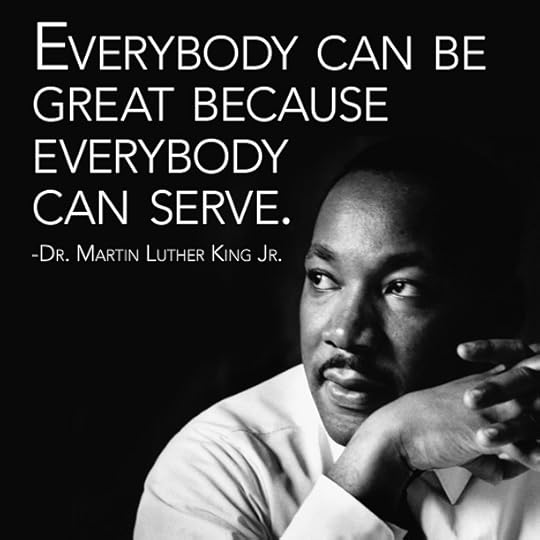
Share this quote on Twitter Here.
Share this image on Pinterest:

January 19, 2014
Powerful Moments
You know who they are. You see them every day.
They exist in the spaces between our busy lives.
He’s the security guard that stands between the world outside and your office inside.
She’s the register person between your groceries and your car.
She’s the bank teller between you and your money.
The train conductor. Dry cleaner. Secretary. The waiter between you and your lunch.
Even your sweet faced children who stand between the front door and your bedroom when you arrive home from work.
They are the familiar faces we see every day. They are the people we spend time with, even for brief moments that make life more meaningful, more connected, more real.
They are the people we encounter between where we were and where we are going.
At various times during your day they stand right before you, here and now.
And I have a theory that says how we treat the people in between our busy lives is directly related to our happiness.
For how we treat the people in between where we were and where we are going is indicative of how we live in the present moment.
Unfortunately I’ve noticed that as a society we are becoming more comfortable ignoring others. It’s a common practice on the NYC subways but even during my walks in Ponte Vedra Beach I will say hi to people and they just walk right past me without acknowledging that I exist.
If you walk right past the security guard at work without saying hello because you are just too busy then you are not in the present moment. If busyness and stress prevent you from connecting with your co-workers when you arrive at work then you are not in the present moment. And it is during the present moment where happiness, relationships, love and life are created.
To live life fully, then, is to make the most of the time in between where you were and where you are going and the best way to make sure you are doing this is to create meaningful interactions with the people in between. When you really think about it we all represent the people in between for we all live between the lives of each other-connected by phones, cars, roads, trains, oceans, planes, the internet and most of all love and energy.
So share your kindness, time, energy and compassion. Don’t let the seemingly insignificant moments slip away for in reality they mean everything. We are all the people in between and when we recognize the significance of each other we also feel it and experience it inside ourselves.
Will you take advantage of these powerful moments? Leave a comment below.

January 13, 2014
5 Things to Do Instead of Complain
One of the biggest threats to building a great team and organization is complaining. When we complain we focus on everything else but being our best. Complaining actually costs the economy billions of dollars in lost productivity and it will sabotage the morale, engagement and culture of your team if you let it.
So this week I want to encourage you to go on a complaining fast. Not because it will make everyone around you happier, although it will, but because it will help you experience more joy, peace, success, positive relationships and better teamwork. Then I want to encourage you to ask your team, company, school organization, and family to a do a complaining fast as well. Try it for just 21 days.
Believe me; I know a lot about complaining. I use to be a professional complainer and found that it not only sabotages your own happiness and success but the success of your team and family. I realized we complain for two main reasons. 1. We feel powerless. 2. It’s a habit. I decided to break the habit and when I stopped complaining I started to create the life that I wanted. Let’s face it, if you are complaining, you’re not leading.
To help you break out of a “complaining” rut here are five things you can do instead of complain. These tips will help you realize you are not powerless. You have the power to choose your beliefs and actions. And in your focus on the positive instead of the negative you’ll find the faith, strength and confidence to take on life’s challenges and identify the solutions to your complaints.
1. Practice Gratitude. Research shows that when we count three blessings a day, we get a measurable boost in happiness that uplifts and energizes us. It’s also physiologically impossible to be stressed and thankful at the same time. Two thoughts cannot occupy our mind at the same time. If you are focusing on gratitude, you can’t be negative. You can also energize and engage your coworkers by letting them know you are grateful for them and their work.
2. Praise Others. Instead of complaining about what others are doing wrong, start focusing on what they are doing right. Praise them and watch as they create more success as a result. Of course, point out their mistakes so they can learn and grow, but make sure you give three times as much praise as criticism.
3. Focus on Success. Start a success journal. Each night before you go to bed, write down the one great thing about your day. The one great conversation, accomplishment, or win that you are most proud of. Focus on your success, and you’ll look forward to creating more success tomorrow.
4. Let Go. Focus on the things that you have the power to change, and let go of the things that are beyond your control. You’ll be amazed that when you stop trying to control everything, it all somehow works out. Surrender is the answer.
5. Pray. Scientific research shows that daily prayer reduces stress; boosts positive energy; and promotes health, vitality, and longevity. When you are faced with the urge to complain or you are feeling stressed to the max, stop, be still, plug-in to the ultimate power, and recharge.
Watch free No Complaining Videos with your team.
Are you going to do the 21 day complaining fast? Leave a comment below.

Jon Gordon's Blog

- Jon Gordon's profile
- 680 followers

