
Terri Windling's Blog, page 230
January 17, 2012
Motivation
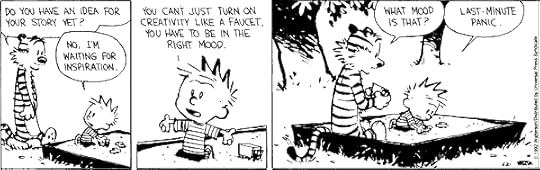
A question today: What gets you to your writing desk or drawing board or rehearsal room or whever else it is that you create your art? I don't mean on those magical days when everything is flowing so well that a herd of elephants couldn't keep you away...but on all the rest. What gets you to into the studio, what overcomes distraction and procrastination, what helps you to put brush to canvas and pencil to page -- even on those days when you're tired, or stale, or fearful, or worried about a dozen other things?
"For me," says Bill Watterson (creator of Calvin and Hobbes), "it's been liberating to put myself in the mind of a fictitious six year-old each day, and rediscover my own curiosity. I've been amazed at how one ideas leads to others if I allow my mind to play and wander."
And for you....?


January 15, 2012
Tune for a Monday Morning
To start off the week with a bit of pure magic: "Bubble" by King Creosote & John Hopkins, from their CD Diamond Mine, with an animation directed by Elliot Dear @ Binklink. (I'm grateful to Julia for recommending it in last week's comments.) In some areas of viewing, this video comes with an ad you have to skip through ('sorry about that), but I promise it's worth it. It's a beautiful song, a beautiful animation...and I love the black Tilly dog....
January 12, 2012
The joy of books
(Animation and music credits on the YouTube page here.)
"Books are the bees which carry the quickening pollen from one to another mind. " - James Russell Lowell
"Books can be dangerous. The best ones should be labeled 'This could change your life.' " - Helen Exley
"I suggest that the only books that influence us are those for which we are ready, and which have gone a little farther down our particular path than we have yet got ourselves." - E.M. Forster
"A good book should leave you... slightly exhausted at the end. You live several lives while reading it. " - Wiliam Styron
"A good novel tells us the truth about its hero; a bad novel tells us the truth about its author." - G.K. Chesterton
"All good books are alike in that they are truer than if they had really happened and after you are finished reading one you will feel that all that happened to you and afterwards it all belongs to you; the good and the bad, the ecstasy, the remorse and sorrow, the people and the places and how the weather was." - Ernest Hemingway
"There are books so alive that you're always afraid that while you weren't reading, the book has gone and changed, has shifted like a river; while you went on living, it went on living too, and like a river moved on and moved away. No one has stepped twice into the same river. But did anyone ever step twice into the same book?" - Marina Tsvetaeva
" 'Tell me what you read and I'll tell you who you are' is true enough, but I'd know you better if you told me what you reread." - François Mauriac (So true!!!)
If you love books, then chances are that, like me, you also love words and sentences and the rhythms they make in your mind and on the page. If so, I recommend Theodora Goss's latest blog post, which you'll find here.
January 11, 2012
The bond we share
"There is no ready vocabulary to describe the ways in which artists become artists, no recognition that artists must learn to be who they are (even as they cannot help being who they are.) We have a language that reflects how we learn to paint, but not how we learn to paint our paintings. How do you describe the [reader to place words here] that changes when craft swells to art?
"Artists come together with the clear knowledge that when all is said and done, they will return to their studio and practice art alone. Period. That simple truth may be the deepest bond we share. The message across time from the painted bison and the carved ivory seal speaks not of the differences between the makers of that art and ourselves, but of the similarities. Today these similarities lay hidden beneath urban complexity -- audience, critics, economics, trivia -- in a self-conscious world. Only in those moments when we are truly working on our own work do we recover the fundamental connection we share with all makers of art. The rest may be necessary, but it's not art. Your job is to draw a line from your art to your life that is straight and clear."
- David Bayles & Ted Orland (Art and Fear)
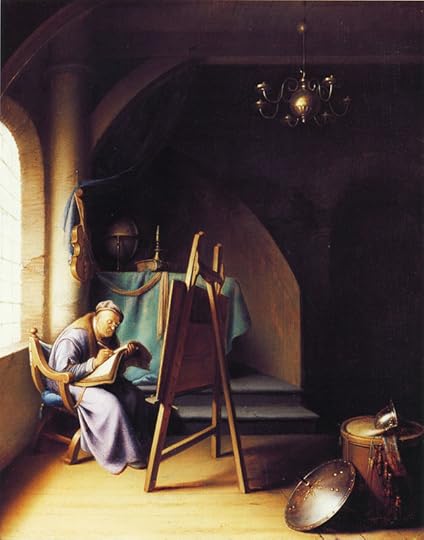
Image above: "Man Writing by an Easel" by the Dutch painter Gerard Dou (1613-1675)
January 10, 2012
A winter ramble
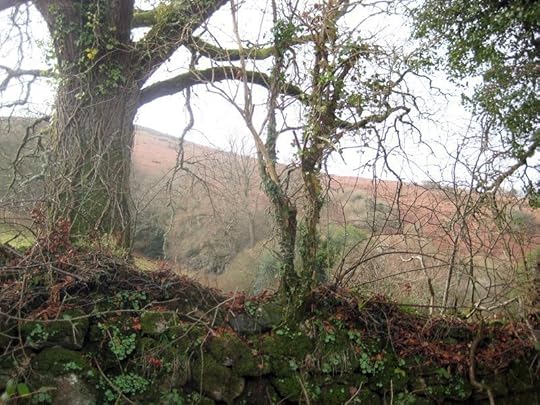
Down the lane to the village Commons. . .
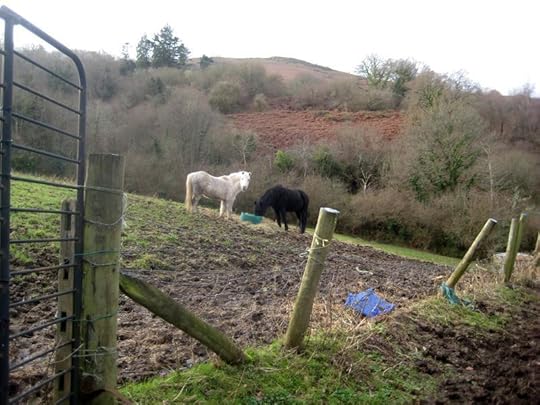
. . .past horses black and white. . .
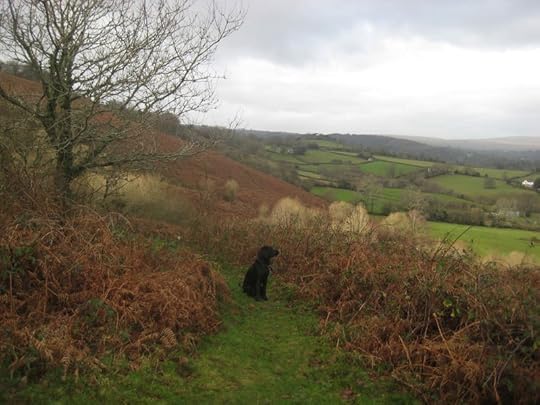
. . . to a winding path where Tilly surveys her domain with satisfaction and delight.
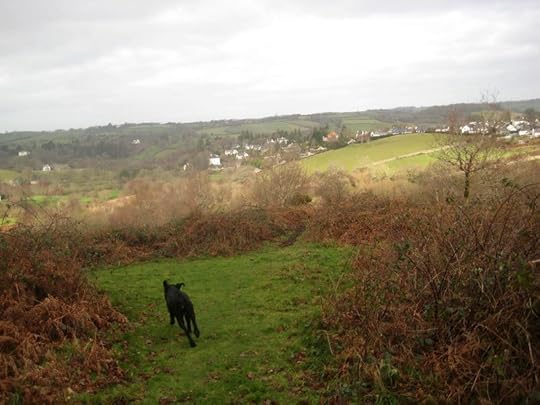
Then she's off. . .
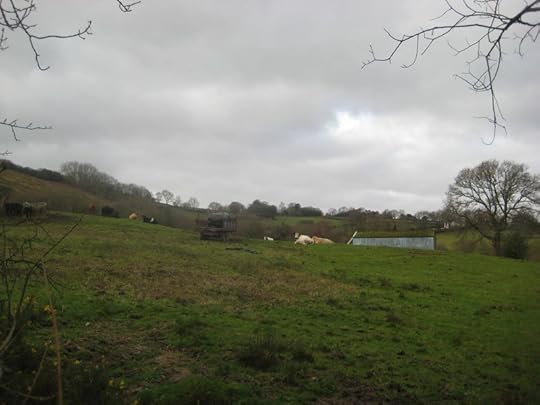
. . . tearing past the cow fields. . .
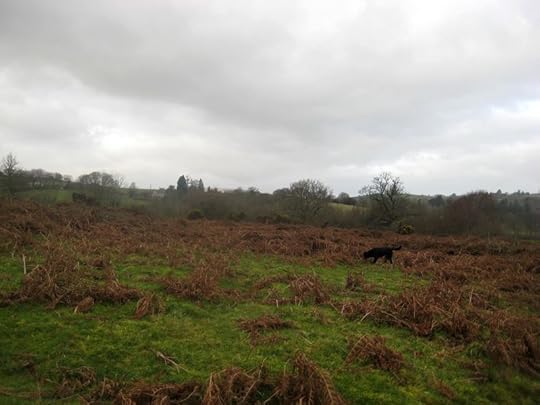
. . . prowling though the bracken. . .
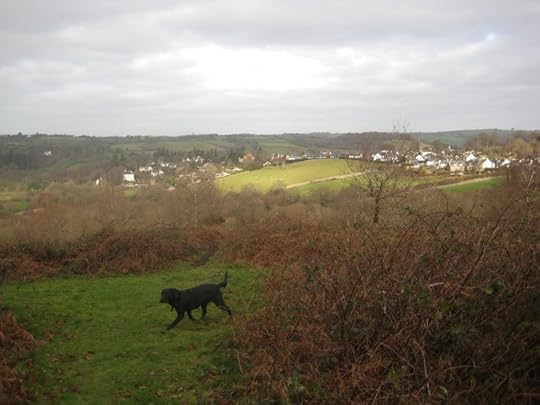
. . . prancing over the green with joy.
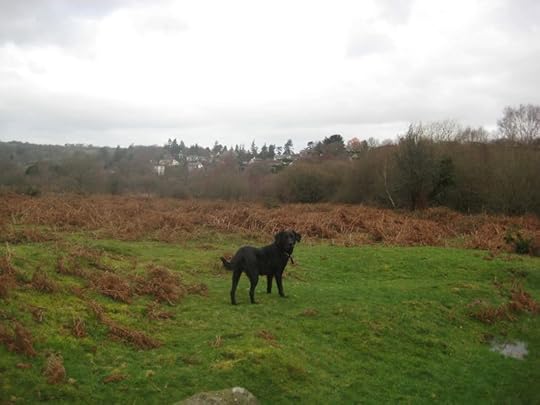
This is Tilly's idea of heaven: black birds above, green grass below, and a sea of rich smells to to travel through. She follows her nose. . . and I follow Tilly. . . and this is my idea of heaven too.
January 9, 2012
Desiring Dragons
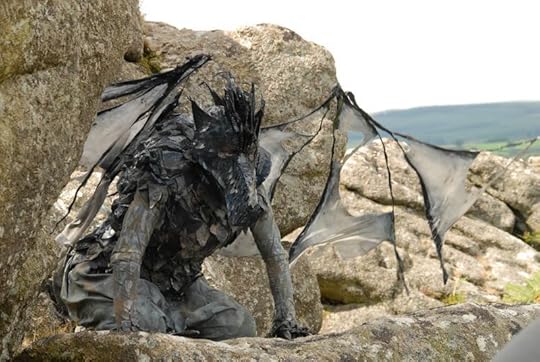
"I desired dragons with a profound desire. Of course, I in my timid body did not wish to
have them in the neighborhood . . . .But the world that contained even the imagination of Fáfnir
was richer and more beautiful, at whatever the cost of peril." -- J.R.R. Tolkien
I had intended to write this post last Tuesday, on the 120th birthday of J.R.R. Tolkien...but I'm only just emerging from three weeks of winter flu, and I'm behind on everything at the moment. And so, one week late: Happy Birthday Professor John Ronald Reuel Tolkien! Thank you for telling your magical tales. . . which in turn gave birth to the Adult Fantasy genre as we know it, for which I am grateful indeed.
Some Tolkien reading and viewing on the web:
* Anthony Lane discusses "The Hobbit Habit" in a lovely article first published in The New Yorker back in 2001. Lane says:
"There's no two ways about it, Tolkien fans are a funny bunch. I should know, for I was one of them. Been there, done that, read the book, gone mad. I first took on The Lord of the Rings at the age of eleven or twelve; to be precise, I began it at the age of eleven and finished at the age of twelve. It was, and remains, not a book that you happen to read, like any other, but a book that happens to you: a chunk bitten out of your life."
Indeed.
* Peter Gilliver discusses Tolkien and the Bestiarium of Fantasy in a recent post on Wordnik.
* Alison Flood discusses Tolkien and the Nobel Prize in The Guardian.
* The BBC archive has an odd and interesting little film that includes footage of Professor Tolkien interviewed in Oxford in 1968.
* Flavorwire has posted a collection of vintage Tolkien covers from around the world -- and there are more covers are here, on The Literary Ominvore.
* Tolkien's premier illustrator, Alan Lee, is interviewed here (in the Journal of Mythic Arts archives) and here (more recently, on the John Barleycorn blog). Alan says:
"I first read The Lord of the Rings and The Hobbit when I was eighteen. It felt as though the author had taken every element I'd ever want in a story and woven them into one huge, seamless narrative; but more important, for me, Tolkien had created a place, a vast, beautiful, awesome landscape, which remained a resource long after the protagonists had finished their battles and gone their separate ways. In illustrating The Lord of the Rings I allowed the landscapes to predominate. In some of the scenes the characters are so small they are barely discernible. This suited my own inclinations and my wish to avoid, as much as possible, interfering with the pictures being built up in the reader's mind, which tends to be more closely focussed on characters and their inter-relationships. I felt my task lay in shadowing the heroes on their epic quest, often at a distance, closing in on them at times of heightened emotion but avoiding trying to re-create the dramatic highpoints of the text."
* Also in the JoMA archives: Ari Berk's gorgeous poem "Lords of the Ring; and my essay/memoir, "On Tolkien and Fairy-stories."
And here's Tolkien himself, discussing Fantasy as a literary form in a letter to W.H. Auden:
"For my present purpose I require a word which shall embrace both the Sub-Creative Art in itself, and a quality of strangeness and wonder in the Expression, derived from the Image: a quality essential to fairy-story. I propose, therefore, to arrogate to myself the powers of Humpty-Dumpty, and to use Fantasy for this purpose: in a sense, that is, which combines with its older and higher use as an equivalent of Imagination the derived notions of 'unreality' (that is, of unlikeness to the Primary World), of freedom from the dominion of 'observed fact,' in short of the fantastic. I am thus not only aware but glad of the etymological and semantic connexions of fantasy with fantastic: with images of things that are not only 'not actually present,' but which are indeed not to be found in our primary world at all, or are generally believed not to be found there. But while admitting that, I do not assent to the depreciative tone. That the images are of things not in the primary world (if that indeed is possible) is, I think, not a lower but a higher form of Art, indeed the most nearly pure form, and so (when achieved) the most Potent.
"Fantasy, of course, starts out with an advantage: arresting strangeness. But that advantage has been turned against it, and has contributed to its disrepute. Many people dislike being 'arrested.' They dislike any meddling with the Primary World, or such small glimpses of it as are familiar to them. They, therefore, stupidly and even maliciously confound Fantasy with Dreaming, in which there is no Art; and with mental disorders, in which there is not even control; with delusion and hallucination.
"But the error or malice, engendered by disquiet and consequent dislike, is not the only cause of this confusion. Fantasy has also an essential drawback: it is difficult to achieve. . . . Anyone inheriting the fantastic device of human language can say the green sun. Many can then imagine or picture it. But that is not enough -- though it may already be a more potent thing than many a 'thumbnail sketch' or 'transcript of life' that receives literary praise.
"To make a Secondary World inside which the green sun will be credible, commanding Secondary Belief, will probably require labour and thought, and will certainly demand a special skill, a kind of elvish craft. Few attempt such difficult tasks. But when they are attempted and in any degree accomplished then we have a rare achievement of Art: indeed narrative art, story-making in its primary and most potent mode."
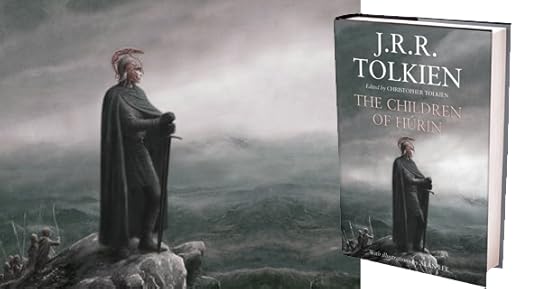
Pictures: Above, a dragon on a hilltop near our village (performed by our daughter Victoria during the filming of "The Laidley Worm of Spindleston Heugh" by the Chagford Filmmaking Group). Below, The Children of Huirin cover art by Alan Lee. Howard posed for this painting a few years ago, wearing a helmet and holding a broom in place of a sword in the back garden of my old cottage.
January 8, 2012
Tunes for a Monday Morning
Today, two tunes from singer/songwriter, poet, and actor Johnny Flynn, performing with his band The Sussex Wit. Above: "Barnacled Warship." Below: "Howl." Both songs are from his second album, Been Listening.
For more Johnny Flynn, try his duet with Laura Marling: "The Water." And his duet with his sister Lillie Flynn: "Amazing Love."
January 6, 2012
No post today, folks. Typepad is misbehaving and won't ...
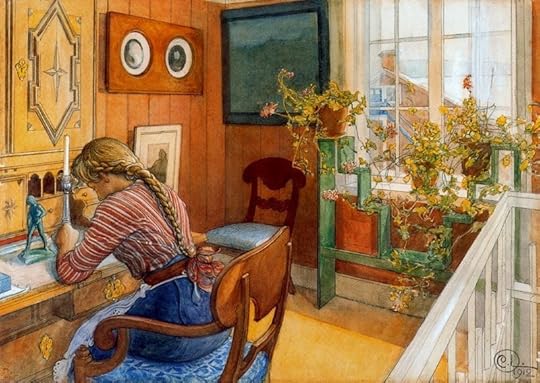
No post today, folks. Typepad is misbehaving and won't give me access to the post I prepared for you. (Even getting this short post up has taken a lot of time and patience.) I'll be back on Monday, and presumably Typepad will have fixed its platform problems by then. Have a good weekend!
January 4, 2012
The dogs in our lives
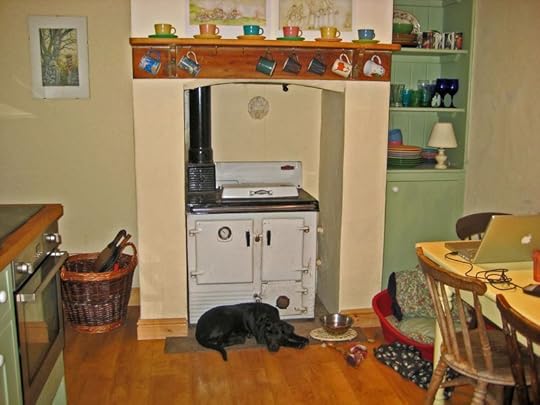
Having only recently converted from dog-agnostic to passionate dog-lover (when Tilly came tumbling into our lives two years ago), I know that the latter state can be a bit perplexing to non-dog-owning friends. In a writer's life, where time is precious, sacred, and always in too-short supply, why on earth (I imagine them wondering) would one willingly take on the care of such a time-consuming, attention-demanding creature?
There are many possible answers to that question (as every dog-lover knows), but for me, this quote from Marjorie Garber captures the essence of sharing ones home with a furry companion of the canine persuasion:
"The dogs in our lives, the dogs we come to love and who (we fervently believe) love us in return, offer more than fidelity, consolation, and companionship. They offer comedy, irony, wit, and a wealth of anecdotes, the 'shaggy dog stories' and 'stupid pet tricks' that are commonplace pleasures of life. They offer, if we are wise enough or simple enough to take it, a model for what it means to give your heart with little thought of return. Both powerfully imaginary and comfortingly real, dogs act as mirrors for our own beliefs about what would constitute a truly humane society. Perhaps it is not too late for them to teach us some new tricks."
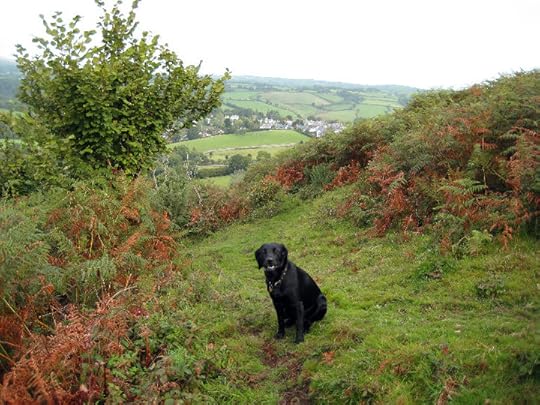 Pictures: Tilly snoozing by the warmth of the kitchen hearth, and grinning toothily on the hill behind our house, "offering comedy, irony, and wit."
Speaking of "the writer's life," I recommend "25 Things Writers Should Stop Doing," an excellent list of New Year's resolutions, by Chuck Wendig at Terribleminds. I particularly like item 25, which reminds me of Sheryl Sandberg's provocative question: What would you do if you weren't afraid? (discussed in a previous post).
And there's a short but terrific interview with Jane Yolen on the Horn Book site.
January 3, 2012
The Past in Color
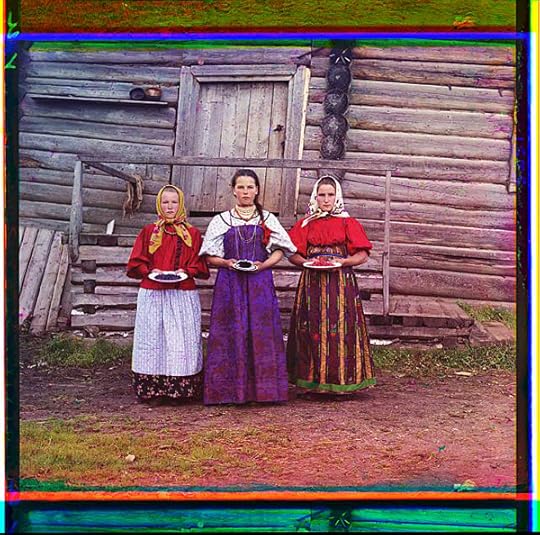
We've grown so used to historical photographs in black-&-white or sepia tones that even in our imaginations the past seems to be an entirely different world than ours. Two collections of historical photographs in color shake us out of this mind set, providing a clearer window to the past as it was actually lived:
The picture above, and the next three pictures below, are 100-year-old color photographs from the Russian Empire. They were taken between 1906 and 1912 by Sergei Mikhailovich Prokudin-Gorskii, a former chemist who pioneered a way of capturing color using color-filtered plates of colored glass.
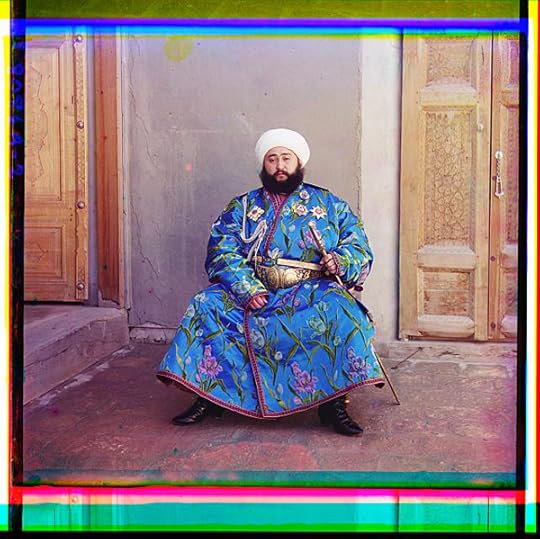
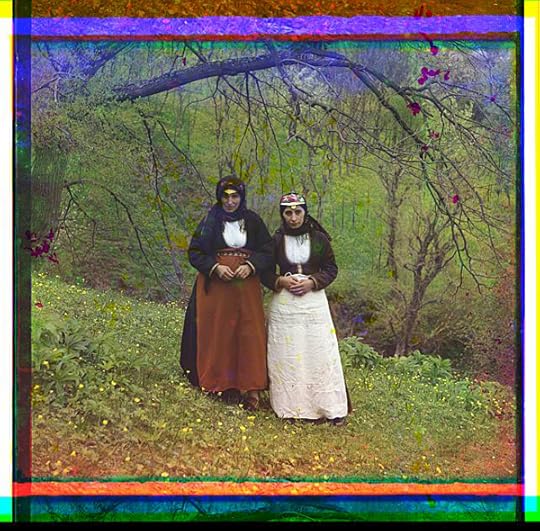
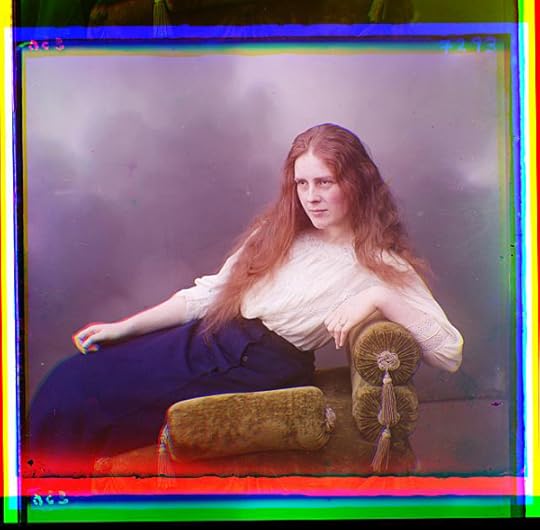
More of Prokudin-Gorskii's extraordinary photographs can be viewed here, on Flavorwire.
Next are color photographs depicting rural and small town American life during the Depression. The pictures were taken between 1939 and 1943 by photographers from the Farm Security Administration/Office of War Information.
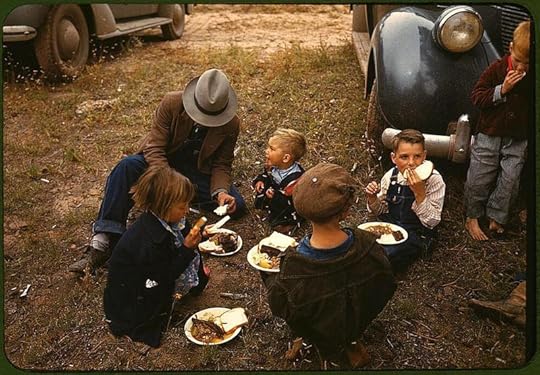
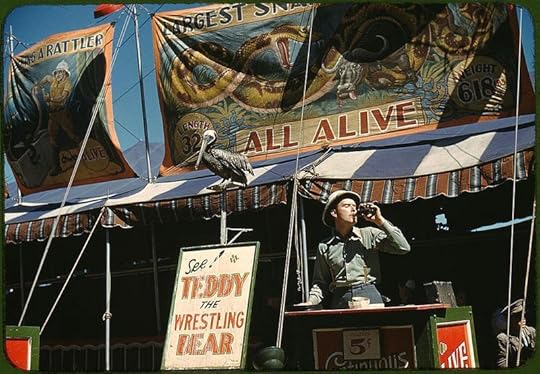
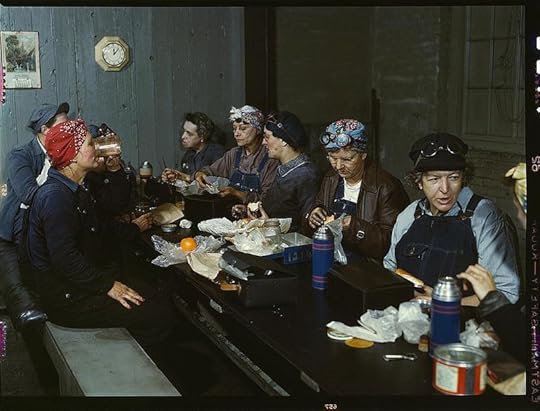
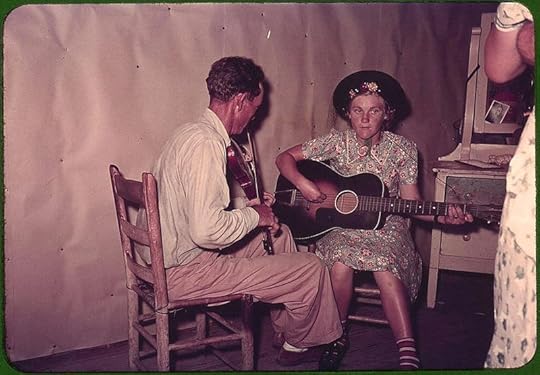
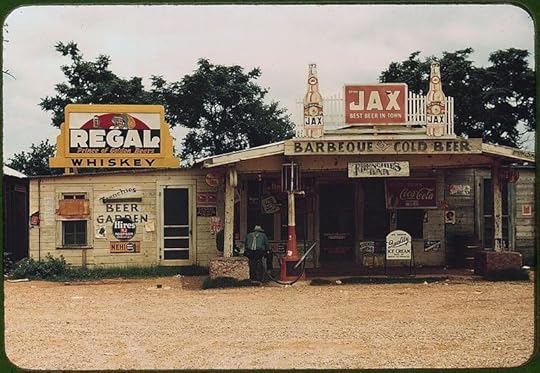
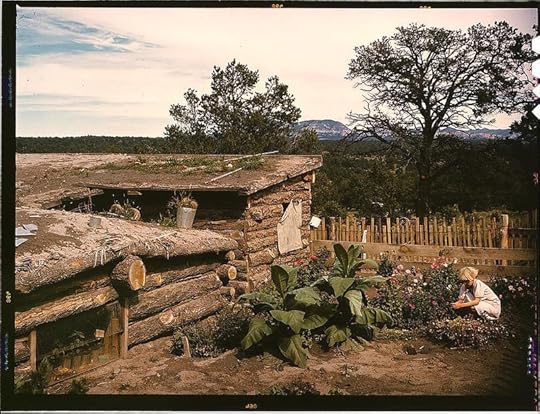
More photos from the "America in Color" collection can be viewed here, on the Denver Post's site.
Terri Windling's Blog

- Terri Windling's profile
- 710 followers

