Michelle Ule's Blog, page 77
November 21, 2014
Biddy Chambers, Widow (Who was Biddy Chambers Part 3)
This is the third and final segment of Who is Biddy Chambers? Here are parts One and Two.

Biddy and Kathleen circa 1920; photo courtesy Wheaton College Special Collections Library
What became of Oswald Chambers‘ widow?
Biddy Chambers was a young woman when her husband died of complications after an emergency appendectomy.
A hard working talented mother with a young child, she stayed on in Egypt ministering at the YMCA camp at Zeitoun until the war’s end. She and the five-year-old Kathleen returned to England to live out the rest of their lives.
She left behind a piece of her heart:
“On our last day, we went out to Old Cairo, to the place from which one is never far in spirit. And in the beauty and solitude which reign there, we thanked God for all the knowledge of Himself that had come to us during the years in Egypt.”
She took with her voluminous notes taken down in her fast shorthand during Oswald Chambers’ many lectures. She had need of them.
They returned to England on July 3, 1919 and at first lived with Biddy’s mother and sister. Friends visited and encouraged Biddy to continue publishing Oswald’s messages. Many followed up with financial gifts to make that happen. Biddy took to her typewriter and books compiled by “B.C.” and listed as being written by Oswald Chambers began to appear.
In 1922, Biddy and Kathleen moved to Oxford. She became a “licensed lodging house keeper,” for university students. She usually had four and her days revolved around fixing tea first thing in the morning, cooking lunch and dinner. Kathleen noted she often had a German girl living with her to help with the house keeping tasks. In between, Biddy sat at her typewriter and complied more notes and answered the mail.
She received some 40 letters a day and answered them all. When Biddy later moved to the Muswell Hill area of north London, she’d receive mail addressed to “Mrs. Oswald Chambers, London.” It all found its way to her!
During the Oxford years she was part of a preaching circuit and would travel into the countryside to speak at Sunday services. Oswald himself though her “very good with Psalms.”
Biddy’s days were punctuated as well by folks stopping by to converse or pray with her. She didn’t see these visits as a distraction.and spent a lot of time making and serving tea, listening and praying.
Kathleen spoke of Biddy’s real interests:
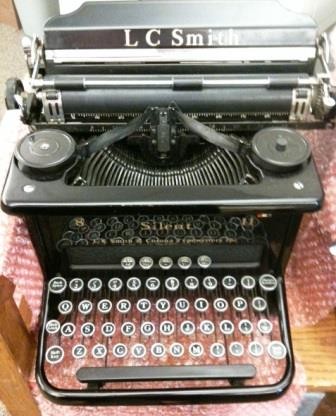
My Utmost for His Highest was typed on this typewriter.
“The notes were not as important to her as others. They were never more important than her home. She didn’t talk much about the books.”
In the mid 1920s, Biddy began to work on a collection of daily readings gleaned from all of Oswald’s talks, according to David McCasland in Oswald Chambers: Abandoned for God. First published in 1927, My Utmost for His Highest has never been out of print and has been translated into 39 languages.
“Without her work, Oswald’s words would never have existed on paper or in published form. Even so, she put Oswald’s name on the cover, She saw herself as a channel through which his words were conveyed to others. That was her way.”
In 1929 Kathleen Chambers was sent to boarding school in Scotland and Biddy moved to Muswell Hill to help care for her aging mother. She lived there the rest of her life.
Kathleen became a nurse, but she and her mother remained very close. “She was my best friend,” Kathleen recalled. “I could tell her anything.” Kathleen also noted she had to come into her own relationship with Christ, “It’s a handicapped to be brought up in a Christian home. You imagine you know more than you do.”
The London years were spent compiling more books from Oswald’s notes, eventually reaching thirty titles. (All of his books have been collected into a large volume The Complete Works of Oswald Chambers.) A group came together to support her and continues to this day: The Oswald Chambers Publications Association.
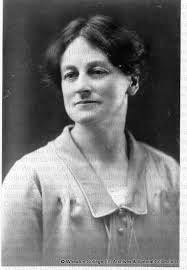
Biddy Chambers; photo courtesy Wheaton College Library Special Collections
Like her late husband, Biddy had wide interests. She enjoyed poetry and prose and read The Daily Telegraph daily. “She was a very political animal,” Kathleen said. “She went every year to the Academy for exhibitions of artist’s new portraits and landscapes.” She enjoyed concerts and hosted Bible studies in her home. Biddy played the piano, rode bikes, took walks and played tennis.
Biddy Chambers never remarried.
“She was never hurried; she was relaxed and often said, ‘let’s see what God does next.” Kathleen remembered. “Life was not easy for my mother. She had to fight for everything, but her life was hid with Christ in God . . . She never questioned anything God did, ever. Completely unperplexed and unperturbed. She may have been puzzled, but never desperate. If God allowed something to happen, he would be there in the middle of it and beside us no matter what happened.”
Biddy Chambers died in 1966 at the age of 82, knowing she had given her utmost talents for God’s highest good.
Tweetables
What happened to Oswald Chambers’ widow? Click to Tweet
Who wrote My Utmost for His Highest after Oswald Chambers died? Click to Tweet
What did Mrs. Oswald Chambers do after his death? Click to Tweet
The post Biddy Chambers, Widow (Who was Biddy Chambers Part 3) appeared first on Michelle Ule, Author.


November 18, 2014
Biddy Chambers in Egypt (Who was Biddy Chambers? Part 2)

Chambers Family, Egypt 1917; courtesy Wheaton College Library Special Collections
Who was Biddy Chambers? You can read part 1 here.
Biddy Chambers not only was the wife of Oswald Chambers, but she also served with him in Egypt during World War I.
Oswald was accepted as a chaplain in the YMCA as the first year of WWI drew to a close. He and Biddy shut down the Bible Training College in Clapham Common, London, took a holiday to Scotland and then Oswald sailed to Alexandria in October 1915.
Biddy and daughter Kathleen stayed behind until the British Expeditionary Forces (BEF) gave them permission to join Oswald outside of Cairo. Biddy, Kathleen and trusted friend Mary Riley sailed to Egypt in December.
Oswald had constructed a bungalow for them at the Egypt General Mission compound adjacent the Zeitoun army camp, seven miles north of Cairo.
They settled right into ministry work.
Conditions, however, were simple and Biddy was in charge of housekeeping. She had several native men to assist in the outdoor cooking, but the rest was up to her and Mary.
The sandy compound alongside the two story Egypt General Mission, consisted of the bungalow, several large “huts” made of reeds and eventually a triangular tent where Oswald spent time in prayer and study before his nightly lectures. She typed up copies of his diary and sent them back to the family and supporters in England.
Biddy dressed in a long sleeved white shirtwaist and dark skirt. She wore a pith helmet in the hot Egyptian sun. Most surprisingly, she kept her little girl clean and neat, often with a large ribbon in her hair.
Kathleen, herself, was a ministry draw for soldiers far from home.
Biddy joined Oswald in the lecture hut each night where she took down, verbatim, everything he said.

Bungalow; courtesy Wheaton College Special Collections library
While every day life had its challenges, the Chambers family did have time for fun. Biddy and Oswald visited the pyramids several times–at least once traveling by camel. They enjoyed taking tea at Shepheard’s Hotel and their favorite restaurant was Groppis in Cairo.
They spent one summer closer to the Suez Canal at Ismailia Camp, where Mary Riley and Biddy ran a weekly canteen that served tea, cookies and cakes. The two women had several soldiers and Egyptian helpers, but the first “free tea,” brought 400 men.
Throughout her stay in Egypt, Biddy Chambers ran a home open to hospitality and visitors. She never knew how many to expect for dinner, so cooked plenty. They hosted supper parties that prompted one visiting chaplain to write of them “taking place with such hilarity as might have shocked the respectably religious into believe what the Jews believed of the Apostles on the Day of Pentecost!”

Photo courtesy Wheaton College Library Special Collections
During those busy years, she and Oswald found time alone in the late evening after the camp shut down. They would walk out into the desert under the bright stars most nights.
Over the four and a half years Biddy spent at Zeitoun a variety of former students from the Bible Training College came out to Egypt to minister with the YMCA camps. Biddy oversaw romances, heartbreak and wrote many, many letters.
She also ran a menagerie for her pre-school aged daughter, though she had lots of assistance from soldiers homesick for their own children. Kathleen, the little girl in the YMCA camp, was a great favorite.
Through it all, she maintained her own personal relationship with God, writing out her prayers in shorthand, and drawing on the deep faith implanted in her soul. She needed it in November, 1917.
Oswald Chambers’ death
Oswald Chambers’ signature reference to being “broken bread and poured out wine,” well described him in the fall of 1917. The war dragged on, but there were hopes the BEF could take Jerusalem (which they did in December 1917). Oswald, however, worked himself pretty much to death to ensure the spiritual and physical well-being of the soldiers he loved. After an emergency appendectomy from which he seemed to rally (and with much prayer at the YMCA camp), Oswald Chambers died on November 15, 1917.
(I’ve written in detail about his death here.)
Biddy and Kathleen attended the military burial the next day in the Old Cairo cemetery. Immediately afterwards they let with old friend Eva Spinks to spend two weeks mourning at Luxor.
When she returned to the Zeitoun camp, the YMCA asked her to stay on. She agreed, leading the Sunday morning service every other week and continued to serve the free teas.
In January, 1918 the booklet she and Oswald had been preparing, Baffled to Fight Better, was released. Copies were given through their friends and the YMCA for free. Biddy began putting together monthly leaflet sermons, taken from her copious notes. The leaflets were sent out monthly until July, 1918, when the YMCA resident secretary William Jessop asked if the YMCA could take over the responsibility for monthly printing and distribution.
For the following 10 months, the YMCA printed 10,000 copies of Oswald’s talks given at Zeitoun, and they were sent to camps in Egypt, Palestine and France.

Photo courtesy Wheaton College Library Special Collections
Biddy had a dearth of material, as she wrote to her sister:
“I feel as if I will never come to an end of my wealth of notes. . . The Sermon on the Mount is in hand being reprinted, and I have got the calendar of sayings all ready . . . the next book will be Shadow of an Agony . . . I feel how much benefit I have got still from my old legal days, I mean getting into the habit of perfecting a thing by typing and retyping.” (From Oswald Chambers: Abandoned to God)
While World War I ended on November 11, 1918, Biddy stayed on while the troops demobilized. She and Kathleen, along with several friends, returned to England in June, 1919.
While she may not have known what the future held, Biddy trusted her God.
As Kathleen said of her mother years later, “She was never hurried; she was relaxed and often said, ‘Let’s see what God does next..”
Tweetables
Biddy Chambers in Egypt Click to Tweet
Mrs. Oswald Chambers serves in the YMCA Click to Tweet
How did Mrs. Oswald Chambers help her husband in Egypt? Click to Tweet
Who was Biddy Chambers? Part 3 will run on Friday.
The post Biddy Chambers in Egypt (Who was Biddy Chambers? Part 2) appeared first on Michelle Ule, Author.
November 16, 2014
Miralee Ferrell: 12 Brides of Christmas

The poignant tale of a young woman who waited five years for her sweetheart to return home is the background of Miralee Ferrell’s The Nativity Bride, part of the Twelve Brides of Christmas Collection.
A devoted young woman who cared for her mother rather than follow after the man she loved, Deboarah’s heart springs to life when he returns for a brief visit. Once there, love flames anew but, as usual, misunderstandings abound.
What can a beautifully carved nativity set have to do with it?
And will she make a choice to love in spite of circumstances?
Set in beautiful Goldendale, Washington, The Nativity Bride‘s hero Curt is an honorable man struggling with a difficult past. Will he be able to overcome his disappointments to find happiness?
The Nativity Bride releases November 17. You can order the book here.
Miralee’s sequel follows the couple and friends to a nearby town. The Dogwood Blossom Bride will be available, ebook only on June 29, 2015.
Who is Miralee Ferrell?
Miralee’s an avid reader and has a large collection of first edition Zane Grey books, which inspired her desire to write fiction set in the Old West. She rides horseback with her adult daughter and lives with her husband on 11 acres along the Columbia River in southern Washington.
Miralee is branching out into something new, a series of middle-grade girls’ horse novels titled Horses and Friends. The first book, A Horse for Kate, releases March 1, 2015, with each succeeding book releasing every four months after. These books will have an emphasis on friendship, horses, adventures, and will contain high moral values and lessons for kids woven into the story line.
 For more information about Miralee, please visit her website: miraleeferrell.com
You can also find her on
Facebook
Twitter
The Nativity Bride can be ordered here.
For those of you who prefer to read on paper rather than in pixels, The Nativity Bride is part of Christmas Wedding Bells , a collection sold in select Walmart stores nation-wide.
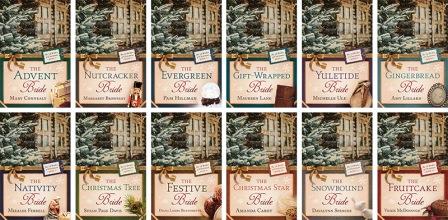
Got them all?
The post Miralee Ferrell: 12 Brides of Christmas appeared first on Michelle Ule, Author.
November 14, 2014
Who was Biddy (Mrs. Oswald) Chambers? Part I

Photo courtesy Wheaton College Special Collections
If you are a fan of the devotional My Utmost for His Highest, you have one person to thank: Biddy Chambers.
The wife of teacher and evangelist Oswald Chambers, Biddy was the person who put that famous devotional together.
But who was she to be able to organize a book that has not been out of print since 1927?
The widow of a great man.
The Lady Superintendant of a Bible College.
A YMCA worker in Egypt during World War I.
The mother of one child.
A woman who aspired to be secretary to the Prime Minister of England and thus became an extraordinary whiz at shorthand.
Perhaps most importantly, a woman who followed closely after her God–no matter where, and through what difficulties, he took her.
Early years
Born Gertrude Hobbs in 1884 England, “Truda” suffered annual bouts of bronchitis as a child, thus limiting her time in school. Determined to excel and one day be secretary to the Prime Minister of England, she studied shorthand in Pittman’s Correspondence School.
According to Oswald Chambers biographer David McCasland in Oswald Chambers: Abandoned to God:
“Knowing that many young men and women could take shorthand, she decided to outdistance the field in speed and accuracy . . . [her mother and sister] took turns reading articles and book selections as Gertrude transcribed them into shorthand. Not to content to function like a machine, Gertrude listened for the sense and context of what was read. Along with speed and accuracy, she sought understanding as well.”
Her daughter Kathleen Chambers described Biddy as being “very clever,” and noted she “was brilliant at shorthand.” Her speed was alleged to be 250 words per minute–which is faster than people speak.
She took her first job in Woolwich Arsenal, Ken, working for General Sir William Morris. Eventual she became a secretary to a barrister (attorney) in Lincoln’s Inn Fields. She typed legal briefs without mistakes.
In 1908 her friend Marian invited Truda (some called her Gertie) to join her in working in the United States, they could live at the same New York boarding house.
Truda decided to go.
Meeting Oswald Chambers
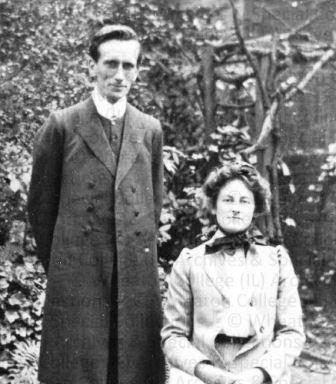
Oswald and Biddy; photo courtesy Wheaton College Special Collections library
Truda met Oswald Chambers in 1905 when he spoke for a week at Eltham Park Baptist church near London. While he struck up a friendship with the Hobbs family, Oswald was focused on traveling to the US and Japan with his friend Juji Nakada. His brother Arthur attended the church and when Truda decided to travel to the United States in May 1908,, her mother knew Oswald was on the same ship. She wrote and asked him to keep an eye on her daughter.
I’ve written about that trip in this blog post: Oswald Chambers Finds a Wife.
Oswald had a sister named Gertrude, and suggested the nickname (he liked to give people in his inner circle nicknames) Beloved Disciple, or B.D. for short. That quickly became Biddy.
Biddy was twenty-four years old, with soft brown hair, twinkling blue eyes and a friendly smile. She reached to Oswald’s chin and had “an infectious chuckle,” according to her daughter. An intelligent lover of animals and children, she was well read, played the piano and liked to walk. She rose early in the morning to pray, shorthanding all her prayers into and exercise book that she threw away when it was full.
“She was a person who was always very mindful of others’ creature comforts. It was very important to her to have a home,” Kathleen recalled.
(Kathleen’s reflections come from a video she made discussing her mother and in Searching for Mrs. Oswald Chambers: One Woman’s Quest to Uncover the Truth by Martha Christian)
They wrote and visited each other in the US and became engaged in late 1908. You can read about Oswald and Biddy Chambers’ Solemn Promise here.
They wed May 24, 1910.
The Bible Training College
The next year, Biddy became the Lady Superintendant of the Bible Training College when Oswald became the principal. It was here that she began to take notes of everything Oswald said in his lectures.
As McCasland explained:
“Biddy . . . took shorthand notes of Oswald’s lecture. If they used Biblical Psychology as a topic for the correspondence course, she could type explanatory pages and lesson outlines . . . It kept her stenographic skill sharp and helped focus her attention on what he said. Shorthand was her way of listening.”
At the Bible Training College, Biddy kept the ledger up to day, typed letters, oversaw the cooking, took care of visitors and sat over many tea pots. The Bible Training College was busy every day with lectures, praying and the coming and going of some 24 live-in students. With Oswald busy lecturing, grading correspondence courses or traveling, Biddy assumed a large responsibility for the smooth operation and peace of mind at the school.
Their only child, Kathleen Marian Chambers was born at the college on May 24, 1913.
At holidays, she joined her husband and friends in Scotland where they hiked the hills and worshiped God out of doors.
All of this was excellent preparation for what came next in their lives. You can read the next installment on Tuesday.
Who was Mrs. Oswald Chambers? Click to Tweet
What skills were required to write My Utmost for His Highest? Click to Tweet
What was Oswald Chambers’ wife like? Click to Tweet
The post Who was Biddy (Mrs. Oswald) Chambers? Part I appeared first on Michelle Ule, Author.
November 11, 2014
Saying Farewell to a Veteran

St. Peter’s Chapel at Mare Island
On this Veterans Day in 2014, I’m remembering a veteran whose memorial service I attended last week.
Ninety year-old Chet Bienkowski led a long and successful life, starting when America went to war in December 1941. He enlisted in the Navy a month later and served out of Hawai’i on diesel submarines.
Some of you will remember 20% of American submarines left Pacific ports never to return.
I knew Chet years ago when he’d visit his family, my neighbors, on O’ahu. We’d chat on the banks of Pearl Harbor about his experiences–hair raising and detailed. I loved talking with a man who had first hand knowledge of life during the war, not far from where we lived.
Chet stayed in the Navy after the war and continued riding submarines and fixing them. Once he retired, he went to work at Mare Island Naval Shipyard, still fixing subs, and in his free time overhauled the USS Pampanito (SS-383), which tourists can visit in San Francisco. A friend of his told me last week that Chet’s proudest moment was when they got the boat’s diesel engines to run again after years of inactivation. (The Pampanito was used in the film Down Periscope–I movie I do not recommend if you are looking for accuracy about submarine life.).
The services took place at St. Peter’s Chapel at Mare Island. My husband and I lived there at the start of his military career and that jewel of a chapel–filled with Tiffany stained glass windows–was our church home. We were excited to return, having not been in the chapel for a very long time.
Like many military chapels, it’s designed to accommodate both the Catholic mass and Protestant worship services. The window’s stories are taken from the Bible and gleamed bright on that sunny Saturday.
I’d forgotten how beautiful the chapel was, and arrived early to take photos.
We weren’t the only people arriving early, Chet was active in the local Submarine Veteran’s Association, and many of his friends were there in their distinctive blue vests bearing patches and pins of the various boats. I hadn’t seen the vest since Hawai’i and it gave me pause. These “dolphin wearers” never forget the submariners who did not return from the sea.
The A-frame ceiling of the chapel remembers them as well. I’ve written other posts about the loss of both The USS Thresher and the USS Scorpion. The Submarine Veteran’s Association has placed plaques remembering those nuclear  submarines still “plowing the seas.”
I had to blink back tears when I took the photos.
But more tears flowed during the service, when several veterans rang a ships bell and named each WWII submarine “still on patrol.” As the list went on and on, the enormity of the loss hit me all over again. Fifty-two submarines never returned from operations in the Pacific.
(The naval chapel at Pearl Harbor remembers one submarine each Sunday).
Because my husband wears dolphins, too, submarines losses are tough for me to think about. (Indeed, when I read Tom Clancy‘s novel Red Storm Rising, I had to set the book aside for a couple days when the USS Boston was sunk in the story. I knew the CO’s wife of the USS Boston and it felt way too close to home, even in a fictional story).
The older sub vets told stories about Chet, remembering his good humor, dedication to the job and hard work. It was fun to hear their stories.
But it was sobering to realize how few of them are left.
Of the 16 million men and women who fought during World War II, only a little more than a million of them are still alive; 555 die every day. The US census department expects the last one to die by 2036. (The last American veteran of WWI died in 2012 at the age of 110).

Chet and Rosemarie Bienkowski, and son
If we want to hear their stories, we need to hurry.
I like to remember how much Chet enjoyed his military life. He traveled to Hawai’i to visit his grandchildren and always flew Space-A (Space Available) out of Travis Air Force Base. On one of his final visits, to celebrate the 50th anniversary of the ending of World War II, Chet flew on a refueling tanker plane escorting the Blue Angels across the Pacific Ocean. He grinned when he described how he looked out the porthole to watch the pipe reach out to refuel the Blue Angels in flight.
He loved telling the story and I loved hearing about it from him.
This veterans day, make sure you stop and listen to the veterans that surround you. You don’t have to overwhelm them with gratitude–most veterans I know considered their service just part of their life.
But listen to their stories before they’re gone.
I’m glad I heard Chet’s.

Tweetables
Saying good bye to a veteran at a beautiful Navy chapel. Click to Tweet
This Veterans Day listen to their stories before they’re gone. Click to Tweet
52 submarines never returned from WWII patrols. Click to Tweet
The post Saying Farewell to a Veteran appeared first on Michelle Ule, Author.
Veterans Day and Red Poppies

Tower of London, September 2014, by David Kronberg
November 11 is Veteran’s Day in the United States, the day originally designated in 1919, to honor those who have served in the armed forces.
President Woodrow Wilson designated that particular day because the belligerent powers signed an armistice to halt World War I on November 11, 1918 at 11 o’clock in the morning. For that reason, it was originally called “Armistice Day.”
My husband, a US Navy veteran, likes to point out Veterans Day is NOT the same as Memorial Day (celebrated the last Monday in May). “Memorial Day remembers those who lost their lives defending the United States. Veteran’s day is just to honor those who have served,” he reminds us most years.
(Note: there is no apostrophe in Veterans Day. Wikipedia explains: “While the holiday is commonly printed as Veteran’s Day or Veterans’ Day in calendars and advertisements [spellings that are grammatically acceptable], the United States government has declared that the attributive (no apostrophe) rather than the possessive case is the official spelling.”)
While the United States remembers its veterans this week, other countries around the world are also acknowledging the men and women who served. Great Britain honors its soldiers with Remembrance Day. Red poppies are handed out, often with copies of the famous poem, In Flanders Field by John McCrae. You know how it begins:
In Flanders fields the poppies blow
Between the crosses, row on row,
That mark our place; and in the sky
The larks, still bravely singing, fly
Scarce heard amid the guns below.
Red poppies became a symbol of remembrance from the war–the red symbolizing all the blood spilled in death. This year, 2014, the United Kingdom has memorialized the 800,000+ deaths from their country during World War I by “spilling” red ceramic poppies from The Tower of London. You can see what the moat looked like in September, 2014 in the photo above.
Poppies grow all over the world, but became associated with the dead of World War I because they grew up so quickly over ground churned up by battles. If you were in London this week, you’d probably be handed a red poppy like the one I received last year, to pin to your lapel. 
Our church on Sunday recognized all the veterans in the congregation by having them stand and be acknowledged. I was surprised by how many we have, including one woman who served in the Navy in the 1970’s–well before women became as plentiful in the service as they are now. (And the stories she can tell . . . ).
Our military ministry committee (which has sent letters and cards to service men and women around the globe the last five years), put together a album telling our veterans’ stories with photos. The album sat on a table beside the narthex doors and featured photos of the service members and other patriotic decorations. Many of us stopped to look through it.
We fly our flag on November 11 to honor my husband, but also those family members who have served in the armed forces. Most of them are dead dead now– though none in my family have been killed in uniform since Captain Henry Arthur Dial of the North Carolina militia in 1753. (French and Indian War).
Serving in the armed forces made a difference in the lives of my family.
As a genealogist, I’ve learned some eight ancestors assisted the patriots in the American Revolution. One of my ancestors was a Lieutenant Colonel in the Confederate States Army–at the same time distant cousin Abraham Lincoln was the president of the United States.

Pvt. Antonio Ruvolo 1918
My grandfather, Antonio Ruvolo earned his American citizenship by serving in the US Army during World War I. You can read more about his surprising story here.
My uncles Joseph Duval and Claude Duval both became skilled electricians in the service and spent the rest of their lives working in electronics, computers and other communication technology.
My father-in-law Louis Ule also served during the waning months of World War II.
My father, Bennett Duval, was a lieutenant during the Korean War–arriving on an aircraft carrier the day the war ended.
My husband, of course, served as a submarine officer for 20 years.
Americans learned a hard lesson following the Viet Nam War. So many veterans of that war were not welcomed home that many of us felt ashamed. Since the First Gulf War, we’ve changed and now veterans are greeted with respect and honor.
I’m thankful for that change.

Lt Bennett Duval, USNR
Most of the veterans I know will tell you they don’t need to be feted or honored; they were just doing their job.
But I’ll say thanks anyway to them.
And I’ll thank God that the red poppy is not pertinent to my family’s history.
Tweetables
Veterans Day and Red Poppies, what it means. Click to Tweet
Remembering a family of veterans on Veterans Day. Click to Tweet
Why no apostrophe in Veterans Day? Click to Tweet
The post Veterans Day and Red Poppies appeared first on Michelle Ule, Author.
November 9, 2014
Amy Lilliard: 12 Brides of Christmas

Amy Lilliard’s first historical novella starts out with a common problem but her heroine Maddie seeks an unusual solution in The Gingerbread Bride.
Maddie’s weakness is lack of trust in God. As a result, “she’s so desperate to find love that she grows impatient and takes matters into her own hands.”
The results, of course, backfire in a curious way involving a Christmas gingerbread man.
Set in Arkansas‘ Ozarks following the Civil War, The Gingerbread Bride features a zany young woman, the voice of reason in her older sister and a lonely young man, Harlan, invited to Christmas dinner.
The Gingerbread Bride ebook releases November 11. You can order it here.
Amy enjoyed writing the story because of the close relationship between Maddie and her sister Grace.
“It made me miss my own sisters. We don’t live close, but we always have each other’s back—even when we mess up,” she said. A history major in college, Amy was always intrigued by this time period, “a nation rebuilding, still growing and pushing westward, settled, but still a little wild.”
During the writing of the novella she researched the location and period clothing, but also mistletoe traditions and when they started, Christmas trees in America, Christmas cookies, and wedding cakes. “The idea that everyone is one of God’s children grew out of the story itself,” Amy added. Christmas in the Lilliard household involves a big meal served around a fancy set table.
” But what makes the celebration different from year to year is we tend to invite anyone and everyone to come eat with us. It seemed natural to me that the pastor would invite Harlan to dinner. He has no family close and needs to be with others on Christmas Day. Family can mean so much more than those joined by blood or marriage.”
The Gingerbread Bride’s sequel, The Wildflower Bride, opens at a wedding and features the blooming romance between the best man and maid of honor.
When the maid of honor, Grace, catches the wilflower bouquet, the loving bride is convinced Grace will marry next. But how will that come about with such a best man?
The Wildflower Bride releases as an ebook only on July 13, 2015.
Amy has enjoyed working on The Twelve Brides of Christmas Collection. “I feel so blessed to be a part of such a wonderful and talented group of authors. I have made some great friends.”
Who is Amy Lilliard?
Published author, expert corn bread maker, and Squirrel Princess. Amy is a native of Mississippi who currently lives in Oklahoma with her husband and son.
For more information about Amy, please visit her website: amywritesromance.com
You can also find Amy on
The Gingerbread Bride can be ordered here.
For those of you who prefer to read on paper rather than in pixels, The Gingerbread Bride is part of The Heartland Christmas, a collection sold in select Walmart stores nation-wide.
Got them all?
The post Amy Lilliard: 12 Brides of Christmas appeared first on Michelle Ule, Author.
November 7, 2014
Challenges with Setting: Yuletide Bride

The Yuletide Bride presented me with both challenges and interesting parameters when I went in search of its setting.
Since the original title was “Eleven Pipers Piping,” and those pipers played a role in the inspirational romance, I needed to find the right setting where the pipers could get their instruments.
As in, a place where the reeds grew that enabled them to build their reed flutes
I first consulted with my friend Linda Livingstone who has made native American style flutes in the past. Here’s a sample of her work:
Beautiful, isn’t it?
But these were flute-like recorders made of reeds, suitable for children.
So, I hunted reed flutes and found plenty of spots that showed me how.
I was attracted to this page, which explained how to make a bamboo flute. I used this one as the basis for the reed pipes made in The Yuletide Bride.
If you examine that link, you’ll see it’s for a bamboo flute. So, where in the United States does bamboo, or thick enough reed, grow for my story?
Did I mention there’s a snow storm?
I spent a lot of time on weather and topological web sites, hoping to find a place that could accommodate both needs. Linda helped me look and made suggestions–she’s driven across the United States more recently than I have.

Reed flute: COLLECTIE TROPENMUSEUM (Wikipedia)
We finally settled in the southeastern corner of Nebraska which is warm enough to grow reeds, but liable to have a snowstorm now and then.
What a relief!
Setting is important for any story, of course, but the location has to be realistic–it needs to work with your story line.
I’ve not been through Nebraska in 17 years, but I remember a pretty countryside of rolling hills in some sections and lots of corn. Tornadoes travel through now and then, which became important for the sequel, The Sunbonnet Bride (releasing as an ebook in July, 2015).
Because I hadn’t been there lately, however, I turned to literature, specifically a book written about the same time and setting as The Yuletide Bride: Willa Cather‘s O Pioneers.
A sweet love story of breaking the wild prairie, Cather includes vivid descriptions of the countryside and the types of plants grown there. Land is central to Cather’s writing and it helped me “see” my own setting better. Some of the birds in my two Nebraska stories came from Cather’s descriptions.
I also remembered Laura Ingalls Wilder‘s stories of life on the prairie and nodded to them in several places. The big sky, the gentle creeks, the reeds growing along the riverbanks. It all appears in my work, as well.
“Farmers worked their fields preparing for the harvest. A torrent of jackrabbits scattered as they passed. Calling birds sailed on the wing as the sun rose slowly in the eastern sky.”
Nebraska is a beautiful place. You can see photos of it on my Pinterest board: The Yuletide Bride
What comes to mind when you think of prairie lands? Click to Tweet
Reed flutes and snowstorms–oh my! Click to Tweet
To read more about the setting and how the eleven pipers piped their way to a Christmas wedding, purchase a copy of The Yuletide Bride–now on sale for just 99 cents.
Today’s the last day for the Rafflecopter raffle: win one of five copies of The Yuletide Bride OR the grand prize, all twelve copies of The 12 Brides of Christmas (the first five downloaded immediately, the remaining seven novellas at weekly intervals until Christmas!) Contest ends at midnight, November 7, 2014. Enter here:
a Rafflecopter giveaway
The post Challenges with Setting: Yuletide Bride appeared first on Michelle Ule, Author.
November 3, 2014
Yuletide Bride: The Bagpipes

I’ve written before about my affection for bagpipes, but they knew no bounds until I wrote my Christmas novella, The Yuletide Bride.
Bagpipes play a central role in the story and are part of its charm (in my opinion).
Kate comes from a Scottish family now living in Nebraska, 1874. While hunting in her grandmother’s old chest, she stumbles upon a curious deerskin bag:
Kate struggled to contain the bundle of old leather and wooden sticks as she lifted it out. She peered closer and saw round holes in one of the sticks. Turning the bundle over, four wooden tubes jutted out the back of what appeared to be a flattened sack covered in the MacDougall plaid. One stick had small holes on the capped end and the other three tubes had knobby endings.
Well, how would you describe bagpipes? Click to Tweet
She struggled with the sticks and the bag, eventually with a little help from her father, figuring out how to blow the instrument. As an experienced reed flute piper, she had an idea of how it worked:
“The short mouthpiece smelled musty and reedy, but when she blew into it, the bag expanded under her arm. She blew and blew to fill the bag until her lungs ached and she felt dizzy. A squawk sounded and Mama’s hands flew to her cheeks.”
Among other things, she needed a new reed.
Our hero, an accomplished fiddler, had trouble being enthusiastic:
“Ewan winced as Kate blew into the bagpipes. The scolding harsh sound grated on him as she wavered the tone trying to find a clear note.”
She stuck to it, however, and by the end of the story . . . well, you’ll have to read it to find out yourself!
Like Kate, I’m a musician. I can play the flute, recorder, clarinet, and most importantly for this project both the bassoon and the oboe–double reed instruments, just like the bagpipes.
Sort of.
To add versimilitude to the story, I decided to try my mouth on the bagpipes.
Fortunately, I know a former North American clan chief and I appealed to him for assistance with the bagpipes. Click to Tweet
Bill plays the bagpipes, loves bagpipe bands, has traveled many times to Scotland and is a very clever and enthusiastic man.
He was happy to bring out his bagpipes and let me try to play.
We struggled a bit because I needed to be Kate–seeing a confusing jumble for the first time and trying to figure it out.
Bill tried to help me.
It was a lot harder than I expected–particularly given my musical experience.
But it was awfully funny, too.
You can see it and hear it (hold your hands near your ears) here:
(You can see how hard Bill tried to help me, including kibbutzing from the family!)
You can purchase The Yuletide Bride, for only 99 cents, here.
It’s part of the 12 Brides of Christmas Collection.
If you’d like a chance at winning a copy of The Yuletide Bride OR the entire Twelve Brides of Christmas Collection, enter here:
The post Yuletide Bride: The Bagpipes appeared first on Michelle Ule, Author.
October 30, 2014
Michelle Ule’s Yuletide Bride: 12 Brides of Christmas
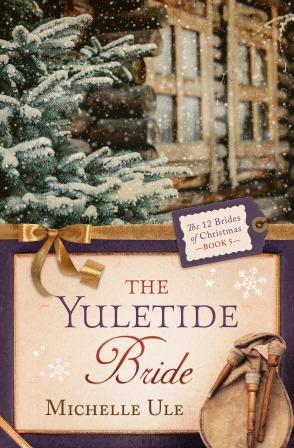
I’ve been writing about the 12 Brides of Christmas ebook sale this Advent season, because I’ve written one of the novellas myself!
I love the rhyme and the pun of these words: The Yuletide Bride by Michelle Ule.
What could be better than that?
How about a short novella story that features a young man working hard to save up the incredible sum of $70 to win the hand of his young sweetheart in 1874 Nebraska?
What if we mix in pan pipes, bagpipes, a fiddle and an unhappy teamster who could never understand mathematics? Click to Tweet
Barbour Publishing first approached a handful of writers about putting together this innovative collection around the infamous Christmas carol, The Twelve Days of Christmas. We were asked to choose one of those days, come up with an alternate title and write a story.
I figured most writers would aim for “five golden rings,” so I steered in a different direction, to one of the more obscure titles: 11 Pipers Piping.
They’re in The Yuletide Bride.[image error]
You just have to look for them.
The Yuletide Bride releases as an ebook only on November 3.
You can buy it here for ONLY 99 cents! BUY
I’ve been a musician since I received a piano for Christmas when I was six. I studied piano all through school and eventually extended my love for music to the woodwinds. After a short detour into percussion, I’ve learned to play the flute, clarinet, oboe, bassoon, alto recorder and alto saxophone.
At our current church, I sing in the soprano section of the choir and play in a woodwind ensemble (clarinet–everyone’s favorite instrument!) once a month.
Since I also dance four days a week, you can say that music runs through my life all the time!
For this Christmas novella, I wanted to write a fun story that incorporated those eleven pipers and that also touched on a theme pertinent to many these days: making enough money to live on.
Ewan faces the biggest challenge of his life when his longtime sweetheart’s father asks him to prove himself capable of supporting Kate. He has to earn $70 by her Christmas birthday, or he’ll give her hand in marr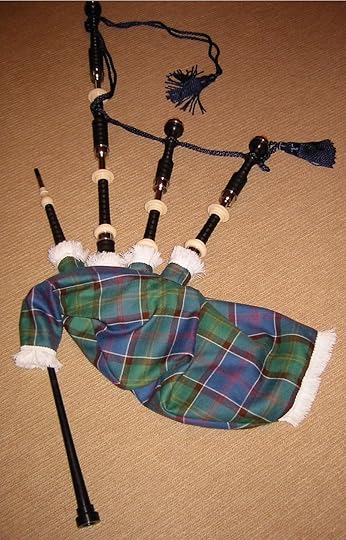 iage to a local banker.
Kate, for her part, learns what it means to be a helpmeet as she watches and tries to help Ewan earn the money for their future.
And then there’s the bagpipes . . .
I didn’t do any particular research while working on this book other than an attempt to play the bagpipes owned by my friend Bill Cummings, former North America clan chief for the Cummings line. We’ve got a video of me attempting to be a gawk, er, sound out of the pipes and it was fun to try.
In terms of Christmas celebration on the prairies of Nebraska–chosen because it was one place where reeds grew where it might snow at Christmastime–I relied on the stories told me by my grandmother of her family’s childhood, and also what I read in Laura Ingalls Wilder‘s Little House books. The striped candy Ewan associates with Christmas is a direct nod to young Laura.
I’m a genealogist and my massive family history (available in the Library of Congress and featuring more than 900 end note citations) is suitably called Pioneer Stock. I love the stories I unearthed about my family as I wrote that book before Ancestry.com was invented–so I did all the library-visiting research myself. While my mother was born in Sicily, my father’s ancestors first arrived in north American in 1627 Maryland. I loved researching and writing about their lives set against American history.
I have an entire page on my website devoted to my genealogy. Check it out if you think you might be related to me!
The Yuletide Bride is the first of two parts of a story concerning the MacDougall family. In writing this first Christmas novella, I discovered one of the seemingly “throw away” characters, actually had more poignancy and heft to him than I realized. I’m delighted Malcolm will have a story of his own in next summer’s The Sunbonnet Bride, releasing on July 20, 2015 as an ebook.
The Sunbonnet Bride takes place six months after Christmas when a calamity affects a local town and Ewan and Malcolm ride to the rescue—while a fair maiden wonders who she’d rather wed: a bumbling et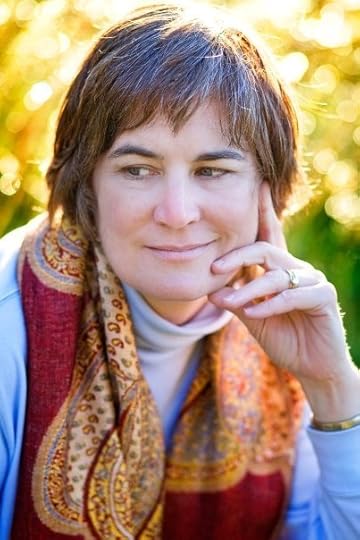 hical man or a handsome banker who may not realize the implications of bending what’s right closer to wrong.
I hope you enjoy these Christmas novellas!
For quarterly information on Michelle’s writing and to keep tabs on what’s happening, subscribe to her email newsletter, by clicking here: newsletter subscription.
Who is Michelle Ule?
Michelle Ule is the author of five novellas and a Navy SEAL novel, including The Dogtrot Christmas which appeared in the New York Times best-selling A Log Cabin Christmas Collection (with Margaret Brownley) and last year’s best-selling A Pioneer Christmas Collection (co-authored with Vickie McDonough and Margaret Brownley!). A native of San Pedro, California, she played in the UCLA band and every year bakes a Ule log for her family’s Christmas celebration. She lives in northern California these days where she writes, reads and plans the next trip to an exotic location.
You can learn more about Michelle and read her twice-a-week blog at www.michelleule.com
You can also find her on
She has a Yuletide Bride Pinterest board, along with one about all the authors of The 12 Brides of Christmas.
You can buy The Yuletide Bride here: BUY
For those of you who prefer to read on paper rather than in pixels, The Yuletide Bride is part of White Christmas Brides , a collection sold in select Walmart stores nation-wide.
Got them all?
The post Michelle Ule’s Yuletide Bride: 12 Brides of Christmas appeared first on Michelle Ule, Author.