Michelle Ule's Blog, page 75
April 21, 2015
Agrigento, Sicily in my mind

Temple of Juno. Photos by Michelle Ule
Agrigento, Sicily is the closest I’ve come to seeing Greek temples.
Because Greek temples are there!
We visited on a glorious day in March where the sky was blue to infinity, the better to show off the burnt sienna colors of the columns.
Amazing.
Our mouths hung open looking at columns that have stood for a very long time.
We visited after a crash course in Greek temples at the British Museum in London (home of the Elgin marbles which are from the Athens Acropolis). We’d heard the best spot to see preserved Greek ruins were in Sicily–which the Greeks used as their bread basket a couple millenium ago.
Wikipedia will explain some basic history on Agrigento:
“Agrigento was founded on a plateau overlooking the sea, with two nearby rivers, the Hypsas and the Akragas, and a ridge to the north offering a degree of natural fortification. Its establishment took place around 582-580 BC and is attributed to Greek colonists from Gela, who named it Akragas.”
It’s located on the western side of Sicily on a hill overlooking the Mediterranean Sea. These temples are in Doric style and the large area is a World Heritage Site.
The Temple of Juno is at the top of the hill and very impressive–you can see it from the road leading across the island and I’m sure from the sea.
The Valle di Templi (Valley of Temples) is part of the Archaelogical Area of Agrigento. The modern city climbs the hills to the north and you can just glimpse it from this photo. Imagine the views from up there!
The columns are huge: sandstone over brick. Each stone is about 24 inches tall. 
Impressive as the Temple of Juno is, the bigger prize is further down the hill: the Temple of Concordia.

Wikipedia, again, explains why:
Due to its good state of preservation, the Temple of Concordia is ranked amongst the most notable edifices of the Greek civilization existing today. . . . The exterior and the interior of the temple were covered by polychrome stucco. The upper frame had gutters with lion-like protomes, while the roof was covered by marble tiles.
At one point it was used as a Christian church and adapted accordingly.
You’ll notice in the photo on the right a figure of what looks like a fallen angel.
It’s a 2011 bronze sculpture by Igor Mitoraj: Ikaro Caduto
Icarus fallen-Sicily is thought by many to be the setting of many Greek myths. Icarus would have attempted to fly off the cliffs near here.
The park continues down a hill along what feels like an appian way!
Columns abound, descriptions of the worship that was held there and how it was conducted. As the Valley of the Temples website explains:
“Ancient Akragas , in its hey-day, was a flourishing cultural centre: it gave the world Empedocles, the pre-socratic philosopher, whose concept of matter as divided into four elements- Earth, Air, Fire and Water- was the foundation of science for many centuries to come. The city attracted poets like Simonides and Pyndar who described it as “the most beautiful of mortal cities”. In Roman times, Agrigento was visited by Cicero in search of evidence of pro-consul Verres’ abuse of power and later described by Virgil in the Eneid.”

You can take tours, bring your lunch and spend a fascinating day among ruins.
We walked among it all silent and reflective. Twenty-five hundred years ago this area was filled with priests, priestesses and worshippers. On a beautiful spring day, we heard the birds call, the bees hum and our souls marvel.
Haunting, evocative and simply beautiful.

Tweetables
A spring walk among Greek temples in Sicily! Click to Tweet
Wandering Agrigento’s temples on a spring day Click to Tweet
The best place to see Greek temples? Sicily. Click to Tweet
The post Agrigento, Sicily in my mind appeared first on Michelle Ule, Author.


April 17, 2015
Walking to the Top of St. Peter’s Basilica
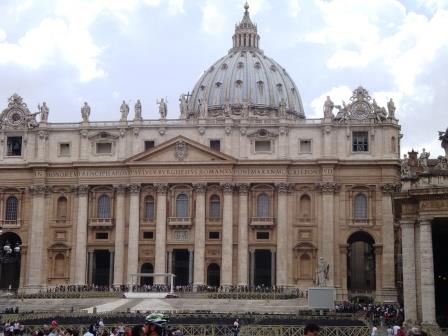
Note those statues in front of the dome
Traveler’s Tales: We’re recently returned from a trip to Europe where we climbed to the top of St. Peter’s Basilica in Rome.
I’ve done it before, but this time I took photos and have descriptions in case anyone wants to know what it’s like.
The dome was designed by Michelangelo and has looked over Rome for a very long time. If you can climb on a beautiful day like we did, you’ll be happy you did.
First you have to get through the security line and into St. Peter’s proper.
The day we were there, the week before Holy Week, the line was lengthy. We stood in line 70 minutes just to put our possessions through the metal detector.
We made good use of the time by listening to Rick Steve’s podcast about St. Peter’s on my phone. Indeed, others in line listened in!
Once through, we went directly to the duomo climb. We debated a moment between taking the elevator to the part of the roof where the tall apostles and Jesus look over St. Peter’s square.
It’s 551 steps to the very top, but you can avoid 231 if you ride the elevator.
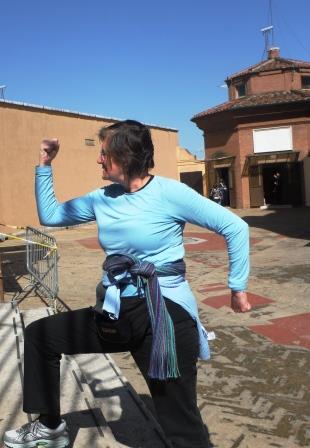
Moderately fit and ready to go. The elevator exit is to the right.
We hiked up.
I’m a moderately fit middle-aged woman, and I was prepared–you’ll notice I had to tie my sweater around my waist. We had anticipated poor weather that day and were pleasantly surprised!
The steps begin pretty easily–which is deceptive–and quickly become more challenging.
Taking the elevator saves you some heavy breathing, but the steeper stairs, of course, begin as you climb around the dome.
You can follow our climb:

Not bad here, but then we encountered a slanting dome:

You start leaning into the dome as you climb.
This was my third climb. In 1985, the interior of the stairs was simply plaster and covered in graffiti. I paused at one spot and burst out laughing: “Kilroy was here!”
After a while, you get a break and can walk out onto a narrow platform, hedged in with a thick fence, to view the floor below. We’re above the main altar, of course, and this is a view you don’t see from below!
Mass was about to begin and you can see the folks sitting in the pews. Note how tiny they look!
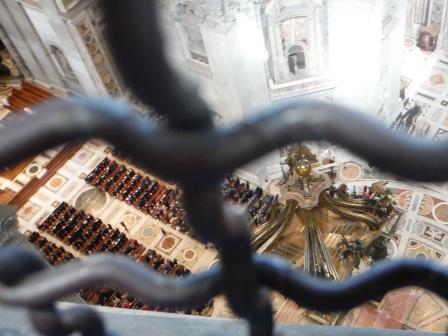
This platform, which goes around most of the interior rim, also allows you to see some of the decoration close up. The art is beautiful and large so it can be seen from down below.
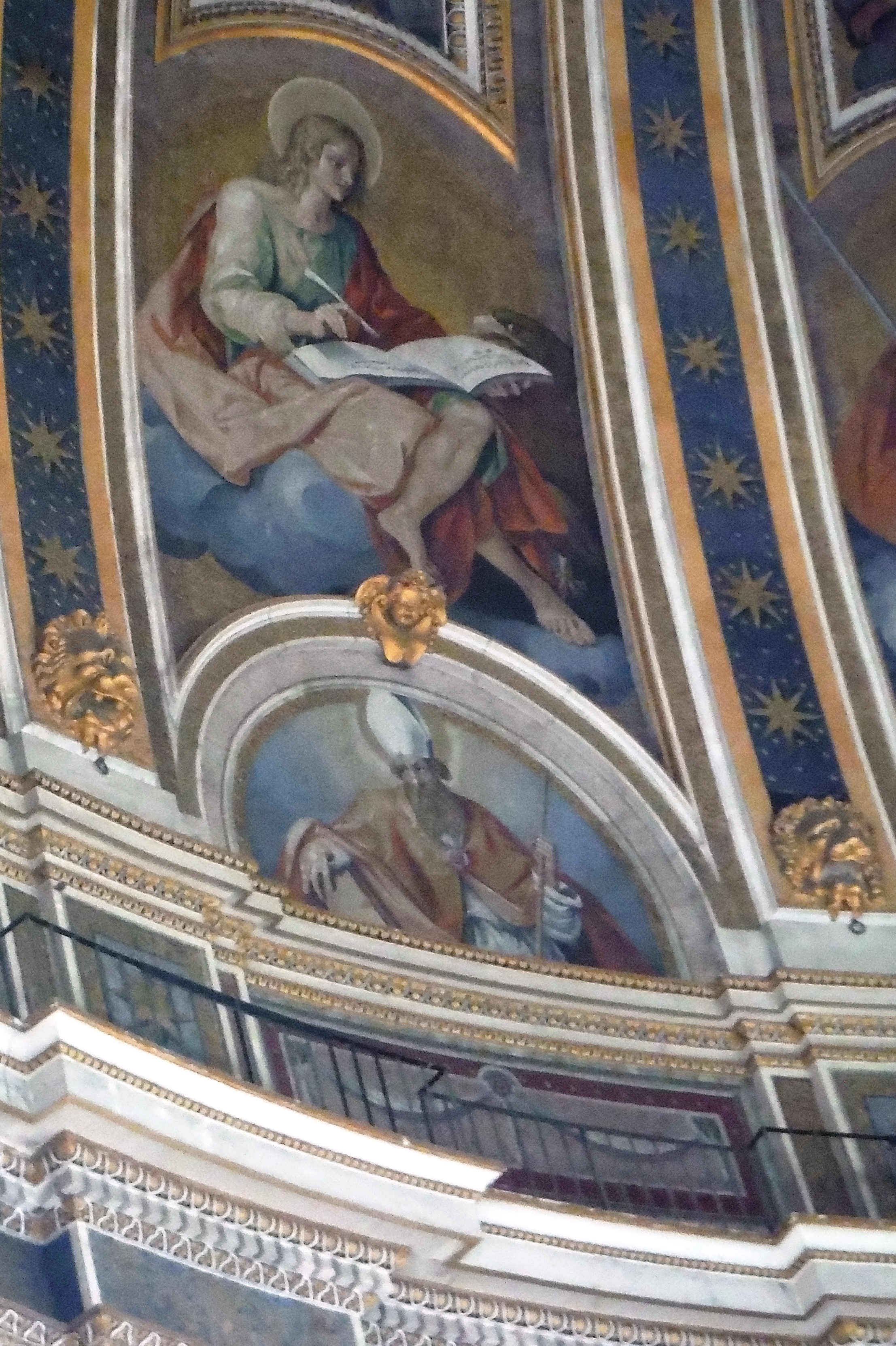
Interior dome artwork
Some of it is mosaic, which I didn’t realize from the floor of the basilica.
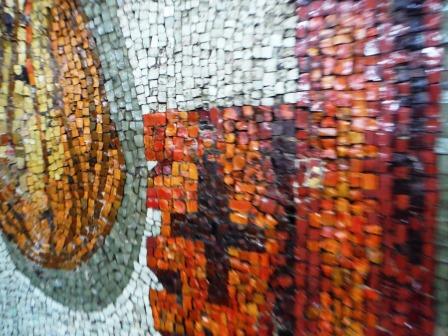
Once we caught our breath, we returned to the stairs, which only grew narrower. Slit windows occasionally appear with a tiny platform that allows tired climbers to admire the view–and let faster hikers by.
When you get to the twisting narrow final curved staircase, you’re thankful for that rope handle!

Many of us clutched that rope!
Success!
The climb took us 20 minutes.
The views are spectacular!
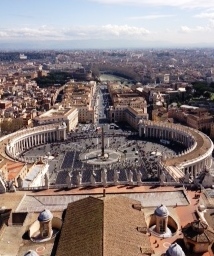
Well worth the climb.
Of course, once you’ve had your fill of the view–and for us that was when a group of red-faced German tourists finally arrived and their tour guide used a microphone to explain all–you get to climb down again!
Another 320 steps down and you’re back on the roof with plenty of room to move around and breath the clean air.
We spent a little time on the roof behind those tall apostles (see the first photo and notice how small they look)
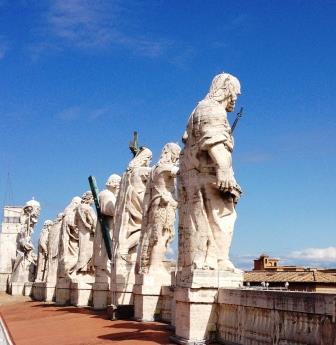
Jesus is the one with the halo and staff
They’re not really small.
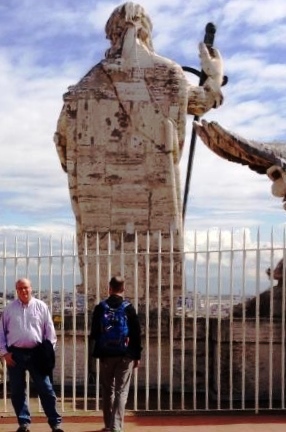
The man on the left is 6’1″
A gift shop awaits you up here, a place to fill your water bottle and a bathroom. It’s a good spot to catch your breath and prepare for the final climb down, which isn’t bad. You can also take an elevator from here.
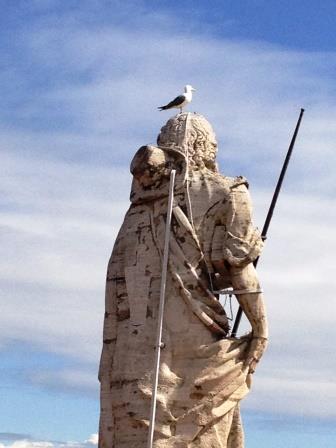
We laughed at the pigeon, first.
We continued walking down wide comfortable stairs and exited onto the floor of St. Peter’s basilica itself. Mass was being conducted at the main altar and ethereal singing filled the splendid cathedral.
The perfect ending to a glorious hike.
Tweetables
551 steps up and you, too, could be on the top of St. Peter’s dome. Click to Tweet
How long does it take to climb St. Peter’s dome? Click to Tweet
Photos from a woman’s climb up St. Peter’s Click to Tweet
The post Walking to the Top of St. Peter’s Basilica appeared first on Michelle Ule, Author.
April 14, 2015
How to Make Death Easier on the Kids

Grammy’s pitcher given to me.
A friend commented on my last post that her death was going to be hard on her kids because she had so many things to go through.
It reminded me that my mom called when she was sixty to say she and my father had been putting their affairs in order, “just in case.”
Since three of my grandparents were still alive at the time, I thought her actions premature.
“We want to make our deaths easier for you kids,” she explained, noting she did not expect the plans to deployed for years.
She died, unexpectedly, four years later.
My paternal grandmother outlived her son.
You never know when death will come.
We were fortunate our parents had most things in place before their deaths.
It’s one of the best gifts they gave us.
When you’re an emotional wreck, the way we were when our mother dropped dead after teeing off at the golf course four days before Christmas, not having to think too hard about the next steps, can help.
Here are four ways parents can make their deaths easier on their kids.
1. Write a will or establish a trust.
Because my parents and my in-laws had already made decisions about their property, we were spared having to figure out some of their basic desires.
I am not a lawyer and you need to check with your own areas concerning legal matters, but in the state of California at that time, having a trust meant we did not have to go through probate.
That saved us money, time and grief.
The trust explained where everything was and valued any expensive items they owned (in Los Angeles, that was the house).
Because they had all written wills and established a trust, they had a lawyer who was very helpful in providing a check off sheet for us to follow.
A corollary is to keep information updated. By the time my grandmother died at 93, everyone she planned to serve as a pallbearer or to sing at her services, was dead.
The sons, grandsons and even great-grandsons filled in and I gave the eulogy.
2. Let your kids know ahead of time what you want done with your body.

Lace from the other Grammy
Three of our parents did this well. When I asked my father point blank what he wanted if the worst happened while he was in surgery, he told me to open my mother’s casket and toss him in.
That wasn’t helpful.
Another time, he told me to have his body cremated and the ashes sent to the Navy to dispose.
My husband has had that duty and didn’t like it.
In the end, my brother and I made the arrangements a month before he died, and he’s buried in the crypt below my mother.
The Navy sent a flag.
3. Sort through your possessions and at least make notes.
My mother had a box of beautiful lace items her mother had made.
Because Mom had gone through it with me, I knew what the aging linens were and why they were significant.
She wrote up a list of her jewelry with the valuation–which meant we knew what things were worth and what she owned (when we went looking for it).
Mom put her photograph albums in order–though she didn’t label much.
LABEL YOUR PHOTOGRAPHS!
Some people put stickers or notes on the back of furniture, noting to whom the possessions should go and why.
Telling the stories is best–and that’s why I know why the little glass pitcher my grandmother gave me is significant.
(She carried it and an egg to the storefront and could get it filled with kerosene when she was a child).
4. Clear your emotional accounts and make sure everyone knows to whom family valuables should go.
My mother didn’t expect to die when she went to play golf one beautiful day. But her relationships were in good order and while we grieved, we didn’t have regrets.
Don’t leave your kids with regrets. Tell them what they need to hear from you, now.
My cousin spent the last year of her too-short life as the executor for her mother’s estate. My aunt had labeled gifts to family members.
Among the last things Joan did was send me a piece of china my aunt had set aside for me.
I still have the wrapping paper with my name written on it in her hand. I can’t bring myself to throw it away.
I don’t think we’re ever really old enough to lose a parent. The hole in our family’s fabric was shredded when my mother died.
It took us a long time to find our way to a mom-less life. We still miss her.
But I don’t have regrets about her. We were in a good place, emotionally, with each other when she died. She had given me everything I needed to be a good mother, wife, friend, daughter, sister.
By putting their house in order early, our parents gave us a wonderful gift: we could grieve together without snipping over the possessions left behind.

Thanks, Mom, for putting the photo albums together.
Peace of mind in a family is priceless.
Many families have issues with each other that seem insurmountable.
Do everyone a favor. Make peace with each other, just like it says in Romans 12:18:
“If it is possible, as much as it is up to you, be at peace with all men.”
The kids will thank you for it.
Tweetables
4 tips to making your death easier for your kids. Click to Tweet
Do the work: prepare for your death so your kids can grieve cleanly. Click to Tweet
How to prepare for death for your family. Click to Tweet
The post How to Make Death Easier on the Kids appeared first on Michelle Ule, Author.
January 2, 2015
Advent: Enter the Magi

Magi from the east (Photo credit: Wikipedia)
Many of us grew up with nativity stories that included camels bearing magi to greet the newborn king in the manger.
That’s true–sort of. Let’s look at the passage and rethink the story from a different angle.
Magi= wise men, seers, learned astronomers. Matthew 2:1-18 tells us they came from the east to Jerusalem.
East of Jerusalem at that time (much like today), the land stretched barren and relatively unpopulated. The “east” probably would have included the area of the fertile crescent, and that center of learning Babylon.
While we do not know, exactly, who these magi/kings/seers were, we can surmise they were wealthy–or at least had wealthy patrons–to have made such a journey carrying their infamous gifts of gold, frankincense and myrrh.
They saw a “star” in the sky, determined it marked something important, gathered together what they needed and headed west–on a journey that probably took some time.
The text explains their motivation through their surprised question when they arrived in a somnolent Jerusalem not celebrating:
“Where is He who has been born King of the Jews? For we have seen His star in the East and have come to worship Him.”
This is what they they knew: they were seeking a male, he was born, he was the King of the Jews, they wanted to worship him and they had seen his star.
Whatever that star was, and there are plenty of suggestions–see Christianity Today or Reasons to Believe, it was something extraordinary that prompted such an enormous response when travel was complicated, dangerous and took a long time.
The magi may or may not have had access to the Hebrew Scriptures, but the fact they understood whom they were seeking and why, suggests they believed a significant event had occurred.
Why are magi included in the nativity story?

The Adoration of the Magi by Bonifazio de Pitati (Wikipedia Commons)
It adds an historic element to the story–it sets the time, during Herod’s rein; it indicates even those who were not Jewish understood the significance; it demonstrates the emptiness of temple worship at the time, and helps us understand Herod and his scribes were not reliable witnesses.
Indeed, Herod’s corrupt kingdom administration had influenced the temple authorities in their refusal to act in accordance with the Hebrew texts.
The magi’s visit also lets us see Jesus did not remain forever in a stable. His family moved on to a dwelling and as we see next time, Joseph was still getting dreams from God.
What’s interesting about the Matthew passage is that while the narrator is omniscient, the opening scene at Herod’s court is basically told from the point of view of folks in Jerusalem, not the magi themselves.
The magi made no pretense about why they had come. They would have traveled in an entourage of servants and guards–probably on camels, which you can read about here.
When they arrived in Jerusalem, they expected the town to be buzzing about that new king. Instead, nothing.
But their question inspired others in that Judean hill country that must have remembered all the fantastic things that happened–Zacharias in the temple, the shepherds, Anna and Simeon.
The questions eventually reached Herod’s court and he, though only half-Jewish, understood something momentous had happened.
Maybe a minor temple priest’s story, shepherds and the others, were insignificant to a man under Rome’s authority, but obviously wealthy magi from afar seemed to know something he didn’t–and expected him to have answers.
Before calling the magi in to confer in private, he called together all his priests and scribes–the people who should have informed him of this coming, and asked them.
They knew the answer, anyone trained in the Hebrew Scriptures could have pointed him to the answer.
“In Bethlehem of Judea, for thus it is written by the prophet: ‘But you, Bethlehem, in the land of Judah, Are not the least among the rulers of Judah; For out of you shall come a Ruler Who will shepherd My people Israel.”
If you were the king, wouldn’t you be angry you didn’t know the “usurper” to your throne had been born not a few miles away?

English: Herod the Great Suomi: Herodes Suuri (Photo credit: Wikipedia)
He called in the magi. Herod needed to know when this king had been born.
Perhaps the star the magi had followed had not been apparent in the Judean hill country; that may be the reason the local authorities missed its appearance. (Did no one report about the angels appearing to shepherds? Were shepherds considered unreliable authorities?)
The magi, having no reason to suppose a half-Jewish ruler would not share in their excitement, gave him the date.
Herod thanked them and sent them on their way, covering his only duplicity with the suggestion they return to him and tell him where the babe was, so he could worship him, too.
“And he sent them to Bethlehem and said, “Go and search carefully for the young Child, and when you have found Him, bring back word to me, that I may come and worship Him also.”
Do you really think he didn’t send spies to follow the magi? After the magi left Herod,
“behold, the star which they had seen in the East went before them, till it came and stood over where the young Child was. When they saw the star, they rejoiced with exceedingly great joy.”
I wonder if the star had disappeared from sight, and it only reappeared after their meeting with Herod. Regardless, they followed it again to the house where Jesus was living with Mary and Joseph. They entered and worshiped that new born king, giving him their gifts–valuable items if sold.
Like Joseph, they were responsive to the leading of the Holy Spirit and when they we were warned in a dream, they returned to their home country a different way, without reporting in to Herod.
Interestingly, it was that same night that Joseph got his next dream.
The feast of the Three Wise Kings is celebrated on Epiphany–January 6.
Tweetables
What did the 3 magi know that Herod did not? Click to Tweet
Why was Herod surprised by the magi? Click to Tweet
Who were the 3 magi and why did they go to Jerusalem? Click to Tweet
The post Advent: Enter the Magi appeared first on Michelle Ule, Author.
December 30, 2014
Advent: Simeon and Anna

Anna at the presentation of Jesus (right), from Giotto, Chapel of Scrovegni. (Photo credit: Wikipedia)
So who were Simeon and Anna in the Advent story?
Lovers of God who were given the gift of seeing him in the flesh–when Jesus was six weeks old.
After Jesus’ birth in the possible-stable in Bethlehem, chances are good he and his parents were shifted to a better spot for a newborn and his mother. If a baby had been born in your garage and placed in a cardboard box you wouldn’t have left him there, would you?
Eight days after his birth, he was circumcised as was the custom of his time in the Jewish faith. (Luke 2:21). According to the Life Application Bible, “circumcision symbolized the Jews’ separation from Gentiles and their unique relationship with God.”
The family then settled down for Mary to recover.
Forty days after Jesus’ birth, Mary and Joseph took their baby boy to the temple in Jerusalem, a seven mile or so walk uphill. By Jewish law, Mary was considered “unclean” during those forty days and would have been secluded–she could not enter the temple. After those forty days, parents were expected to bring their baby to the temple along with a sacrifice for a sin offering.
The sin offering traditionally was a lamb, but in the case of poor families who could not afford a lamb, they could bring “a pair of turtledoves or two young pigeons.” The temple priest would sacrifice the animals/birds and declare the mother clean once more. (Leviticus 12:1-8)
Joseph, obviously, was not a wealthy man and brought two birds.
Simeon

Simeon in the Temple (Rembrandt–Wikipedia Commons)
Jerusalem’s temple was a gathering place for the devout. Daily, priests performed sacrifices. Animals were sold in the outer courtyards, for those sacrifices, other commerce took place. The High Priests were politically connected and for many, temple worship was a ritual or tradition more than a truly worshipful experience.But God always allows for a remnant of true believers to find him when they seek him and among those individuals were the ancient Anna (see below) and Simeon, “a man in Jerusalem . . . just and devout, waiting for the Consolation of Israel.” (Luke 2: 25)
It does not say he was a member of the priesthood, but he knew God had promised a Messiah who would comfort his people (Isaiah 12:1).
In addition, Simeon had had an encounter with the Holy Spirit–not an angel:
the Holy Spirit was upon him. And it had been revealed to him by the Holy Spirit that he would not see death before he had seen the Lord’s Christ. So he came by the Spirit into the temple.”
Fascinating. God sent the Holy Spirit when Jesus left the earth–to live in his people. How is it Simeon had been filled with that Holy Spirit?
To give glory and recognize the Son of God–just as John the Baptist did when he leapt in his mother’s womb.
God gave this righteous man a promise: he would not die before the Messiah returned.
That probably would be enough to keep me in the temple worshiping and waiting!
And then one day, while Simeon was going about his business of worshiping God a young family entered and the Holy Spirit ignited Simeon–who took the child into his arms:
“Lord, now you are letting your servant depart in peace, according to your word: For my eyes have seen Your salvation which You have prepared before the face of all peoples, a light to bring revelation to the Gentiles, and the glory of your people Israel.”
Such a blessing, and yet another reminder to Mary and Joseph that God was with them and the child was from Him. Did they need any more reassurance God had sent this child and his purpose in so doing?
Simeon continued, though, and gave the pondering mother a little more to think about:
“Behold, this child is destined for the fall and rising of many in Israel, and for a sign which will be spoken (yes, a sword will pierce through your own soul also), that the thoughts of many hearts may be revealed.”
What did that even mean?
Mother tend to focus on the horror of a child being pierced by a sword, and Mary lived to see that happen to Jesus but the second clause may be more pertinent: God looks at our hearts and so judges. Jesus provides the means by which God can look at us, despite our sin.
What had started out as an obedient trip to the temple had turned into something extraordinary.
And there was one more prophecy to come.
Anna

Anna the Prophetess (Rembrandt–Wikipedia Commons)
Luke records Anna was a prophetess, the daughter of Panuel (face of God) of the tribe of Asher (whose land was located in the hill country west of Galilee).Probably married at a young age, it appears her husband died seven years after the wedding and she spent the next 84 years in the temple fasting and worshipping God with prayers night and day.
She was “of a great age,” probably in the neighborhood of 105 years!
“Prophetess” suggests she was unusually close to God–and thus able and willing to proclaim God’s truth. When she came across Jesus, “she gave thanks to the Lord and spoke of Him to all those who looked for redemption in Jerusalem.”
She saw Jesus after Simeon and focused on what his purpose was in coming–to redeem his people from sin.
Note she spoke about him to those who were looking for their Messiah–not necessarily the religious authorities.
It had been a fascinating time of unprecedented change and unusual occurrences in the temple–surely some understood the significance of what had happened.
Within the previous 18 months Zacharias had lost his voice and seen an angel while making the sacrifice. God had intervened in a miraculous way and Zechariah’s elderly and barren wife Elizabeth had given birth to a child. Shepherds reported that angels had appeared to them and told of the newborn king. The countryside was rife with stories and discussion–what could God be up to?
Simeon and Anna recognized the truth and pointed to the Savior of the World.
Those who had eyes to see, must have wondered, prayed, given thanks and waited–what would happen next with this extraordinary child?
Tweetables
Anna and Simeon: prophets of God in the temple. Click to Tweet
What would you have done with such prophecies at your child’s baptism? Click to Tweet
How many needed to proclaim God’s truth about Jesus? Click to Tweet
The post Advent: Simeon and Anna appeared first on Michelle Ule, Author.
December 26, 2014
The Night Sky, the Shepherds and the Savior
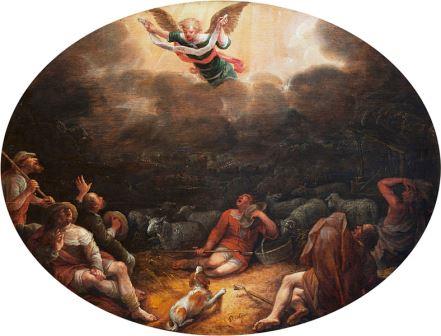
Annunciation to the Shepherds by David Collins (Wikipedia Commons)
For those who live in cities where the night sky is a mere reflection back of the lights, stars and galaxies may not be as common as they are to others.
People like shepherds who spend time away from city lights, often far from civilization, who have plenty of time on their hands.
Or maybe even pilots cruising the night sky above the clouds as they wing their way from point to point.
Before the electric light, though, the expanse of the heavens closed in as night spread across the sky and prickled darkness with dots of lights: stars and planets clustering into constellations and galaxies.
When the night is dark, they seem closer–almost like a cold blanket tossed overhead.
To me, the heavens are exotic and distant and while I can recognize a few constellations, for the most part they’re unknown holes poked into the ceiling of night. I love to see them, but they’re anonymous to me.
My son, however, is an astronomer. I asked him how he viewed the sky–were they all friends he recognized instantly?
“Stargazer” laughed:
“When I look at the sky, I seek my bearings immediately. I find a well-known star like Polaris, and that tells me where I am. From there, I can recognize almost anything.”
(Indeed, a member of his former boy scout troop never got over spending an evening in the High Sierras listening to Stargazer as he described the wheeling stars and told their stories.)
Familiarity with the night sky is central to several important aspects of the nativity story. Men who spent most nights staring at the stars were completely familiar with what went where and when. They were uniquely situated, once they found Polaris, to see unusual changes in the night sky. Two groups in particular were affected: astronomers in the east often known as magi, and simpler men: shepherds watching their flocks by night.

A view of the night sky near Sagittarius, enhanced to show better contrast and detail in the dust lanes. The principal stars in Sagittarius are indicated in red. (Photo credit: Wikipedia)
On the night of Christ’s birth, Luke tells us
there were in the same country shepherds living out in the fields, keeping watch over their flock by night. And behold, an angel of the Lord stood before them, and the glory of the Lord shone around them, and they were greatly afraid.”
As was his custom, the angel told them not to be afraid and then passed on the extraordinary news that the Messiah they’d been expecting forever had been born that day in the city of David.
It’s important to remember the hill country around Jerusalem had been filled with news of extraordinary events–the priest Zachariah had been struck dumb while serving in the Jerusalem temple. The elderly man returned home and his elderly wife, known to be barren, had become pregnant and produced a child some months before. While likely not privy to details, this particular group of men were watching over their sheep when an angel appeared.
As soon as the angel finished announcing his extraordinary news, a multitude of the heavenly host praising God joined him.
Were they angels in the sky?
Stars dancing in the heavens?
Incredible movement where movement should not have been?
The text is not clear, but it did note that “when the angels had gone away from them into heaven,” the shepherds headed into Bethlehem to see what the heavenly host were singing about.
“Gone away into heaven,” meaning up into the night sky?
Maybe.
But something extraordinary happened to those citizens that night.
When we’re out camping or far from city lights and I look up into the night sky, sometimes I can see the cloudy blur of stars that marks the Milky Way Galaxy. My Stargazer laughs at me–he knows those stars and planets well.
I try to imagine what the night sky looked to those shepherds 2000 years ago.
They must have seen something unusual.
Well, how else would you describe the arrival of their savior and ours into the world?
Tweetables
Shepherds watching the sky to see something new and completely different. Click to Tweet
The night sky, the shepherds, and the savior of the world. Click to Tweet
(On a completely unrelated subject, did you ever wonder why it is that astronomers and pilots–people who spend a lot of time staring at the night sky–rarely have reported seeing UFOs? Astrophysicist Hugh Ross has an interesting answer and you can read about it in his book Lights in the Sky and Little Green Men!)
The post The Night Sky, the Shepherds and the Savior appeared first on Michelle Ule, Author.
December 23, 2014
Advent: Merry Christmas 2014
 A Strange Christmas Carol for Him
Christmas carols ring through my soul and cheer up each Advent season. Don’t you love the faint whispers of angels singing while shopping in crowded stores?
The concept of the Christ child as Savior of the world, while known in theory, became true in practice for me during my fifteenth Christmas. I’d begun reading the Bible that fall and suddenly I saw connections all around in December.
I heard Handel‘s Messiah and viewed It’s A Wonderful Life for the first time that year.

Cover of Georg Friedrich Händel
I’d never sung in four-part harmony until I attended Trinity Lutheran Church. Gloria rang through my heart and soul for the first time and I delighted to soar up to those high notes.
We’ve all got favorite Christmas carols, but one that has meant much to me for many years is 4Him’s 1993 “Strange Way to Save the World,” told from Joseph’s perspective. The chorus says it best:
Why me? I’m just a simple man of trade?
Why Him, with all the rulers in the world?
Why here inside a stable filled with hay?
Why her, she’s just an ordinary girl?
Now I’m not one to second guess what angels have to say
But this is such a strange way to save the world.
Everyone knows Mary is the heroine of the Christmas story, after God himself, but this song reminds me of Joseph’s faith–and really, mine, too, that God would choose such a curious way to save you and me.
Christmas carols, the music, lights and presents, all are just a small reflection of the truly amazing event which happened when God poured himself into the innocent, feeble body of an infant and presented him to a young woman and a perhaps nervous man to raise.
Jesus is the reason for the season–and God chose ordinary people, in an ordinary time and place, to leave his mark for all humanity.
The full blog post, including all the lyrics to Strange Way to Save the World is here: http://michelleule.com/2013/12/17/strange-carol-christmas/
The post Advent: Merry Christmas 2014 appeared first on Michelle Ule, Author.
December 21, 2014
Vickie McDonough: 12 Brides of Christmas
[image error]
Vickie McDonough’s The Fruitcake Bride will finish up the 12 Brides of Christmas ebook series on December 22. The story should be fully seasoned and rich by then!
The author of many novels set in the old west, particularly in Texas, Vickie McDonough had no problem choosing a time period for her 14th novella.
“I love reading novels set in the late 1800’s, and it’s the time period that most of the books I’ve written are set in, so when I started brainstorming ideas for The Fruitcake Bride, it was natural for me to set my novella in 1890.”
She chose her subject matter from a list of titles provided by Barbour Publishing. “I figured not too many people would want to write The Fruitcake Bride story. Being how I’m a little fruity, I thought I’d take a stab at it. I was thrilled when my editor loved my story idea.”
Vickie started with the idea of a young pastor headed west to prepare a home for his prospective bride before she joined him. Along the way, he encountered a problem: a troublesome woman named Prudy with designs on him!
Vickie was surprised by Prudy’s strong personality. “She’s a bit of a Nellie Olson from Little House on the Prairie type of character.” She wasn’t originally in the story, “but I needed more conflict. Prudy more than a little graciously added that as she popped in, bent on marrying the preacher—the same man my heroine is engaged to,” Vickie said.
You can purchase the final 12 Brides of Christmas novella, The Fruitcake Bride, here.
Prudy gets her own story in The County Fair Bride, and she changes a lot. Clay and Karen and others from The Fruitcake Bride also will appear in the next novella.
The County Fair Bride releases as an e-book only on June 1, 2015.
Spiritual themes run strong in this novella collection.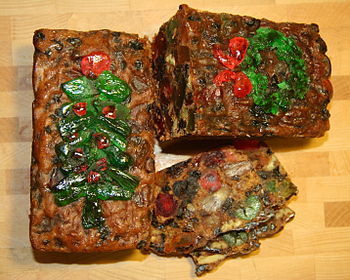
“Karen, my heroine has lots of doubts that she is the right woman for Pastor Clay. They’ve been friends for many years, but their engagement is rushed when her aunt dies. Karen isn’t sure she is cut out to be a pastor’s wife. She prays a lot and seeks God’s will to be sure she’s not making a mistake.
“Clay never doubts his love for Karen, and he ends up being a good example of how God’s love for us is so strong and everlasting.”
Given her past books, research for this novella wasn’t too difficult for Vickie. She merely had to ensure Advent, Texas was a fictional town and examine fruitcake recipes. In terms of her characters, she feels they reflect her stubbornness, faith in God and concern to do the right thing.
Vickie is the descendant of early 1700’s pioneer from Germany who emigrated to the Lancaster area of Pennsylvania and later traveled west to Kansas and Oklahoma. “I am quite enamored with books about settling in the Old West, but if I had a chance to live in the 1800’s, I’d have to decline. I’m too much a creature of comfort—and I’d have to wear dresses.”
Vickie is thrilled to be working with “such a great cast of authors and is excited to hear what the readers think of the 12 Brides of Christmas Collection.”
She’d like to invite all those reading this interview to sign up for her newsletter to keep up with her book news. Click on this link to sign-up: http://www.vickiemcdonough.com/www.vickiemcdonough.com/Newsletter_Sign-up.html
Who is Vickie McDonough? Click to Tweet

Vickie McDonough is the author of 33 novels and novellas, including two books in the Texas Trails: Morgan Family series, The Texas Boardinghouse Brides, The Pioneer Promises series and A Pioneer Christmas Collection. Vickie has been married 39 years and she and her husband live in Oklahoma and have four grown sons.
She’s the blogger on the tenth of each month at Heroes, Heroines and History.
For more information about Vickie and her books, visit her website: www.vickiemcdonough.com
You can also find her on
You can purchase The Fruitcake Bride, here.
For those of you who prefer to read on paper rather than in pixels, The Fruitcake Bride is part of The Heartland Christmas Brides, a collection sold in select Walmart stores nation-wide.

Got them all?
This is the final week to purchase individual ebooks for 99 cents. All twelve stories will be collected into one volume next September and, appropriately, titled The Twelve Brides of Christmas!
Sequels to all twelve stories in this collection will be sold as ebooks starting in June, 2015. Watch for them on the www.12Brides.com website for more information!
Merry Christmas!
The post Vickie McDonough: 12 Brides of Christmas appeared first on Michelle Ule, Author.
December 19, 2014
2 Josephs: Many Dreams

Joseph Dreams of Stars by Owen Jones (Wikipedia Commons)
My recent study of Joseph of Nazareth left me pondering how often God uses dreams in the lives of Biblical characters.
Which, of course, led me to two of the most famous dreamers: Joseph of Nazareth and, Joseph, the son of Jacob.
(Joseph of Nazareth, by the way, also was the son of a Jacob).
Dreams are what prompted the comparison, but a closer inspection showed many other similarities between the two men.
(I’m grateful to the Rev. Francis J. Peffley for many of these observations. You can read his post here.)
The Old Testament Joseph’s story can be found all through the second half of the book of Genesis (chapters 37-50). Joseph of Nazareth is predominately mentioned in the New Testament books of Luke and Matthew.
OT Joseph is perhaps best remembered as the next to youngest son of the patriarch, Jacob/Israel, while the NT Joseph was the step-father of Jesus. Both played significant roles in Christianity.

Rembrandt: Joseph Interprets Dreams
OT Joseph and DreamsOT Joseph’s dreams began early. As a young man, he dreamed his ten older brothers would one day bow down to him. With the brashness of nearly the baby youth, he told them of this dream.
The brothers didn’t like their pipsqueak younger brother lording things over them, so they arranged to have him sold into slavery.
What those brothers meant for evil, God ultimately used for good in their lives. Joseph had to go through a number of difficulties first, however.
Through it all, he worshiped the God who knew him and his family well. God provided other dreams–though not explicitly to Joseph.
While in prison, Joseph correctly interpreted the dreams of two fellow prisoners. Years later, he was called to do the same for Pharaoh–correctly interpreting his dream.
Pharaoh rewarded Joseph with the role of vizier, which is why Joseph could care for his family years later during a famine.
NT Joseph and Dreams
God used an angel sent to NT Joseph in dreams to direct Joseph into steps needed to care for the coming Messiah.
Different from the OT Joseph who heard from God, NT Joseph listened to an angel. Joseph ultimately had four dreams: the first confirming Mary was pregnant by the Holy Spirit, the second after a visit by the Wise Men sent the Holy Family fleeing to Egypt.
Years later following King Herod‘s death, NT Joseph was visited again by an angel in a dream and told they could return to Israel. While on the way home, God sent a fourth dream advising them to return to the Galilee region.
NT Joseph didn’t need to be told twice by those angels!
Father Peffley noted both Josephs came from royal lineage, descending from Abraham. They both were asked to trust God’s word in unusual events.
OT Joseph had to wait many years to see the fulfillment of his dream–and was sent to prison for choosing to follow’s God’s path and not sleep with his employer’s wife.
NT Joseph coped with an unexpected pregnancy, the murderous threat of a blood-thirsty King and the unlikely parallel of being sent to Egypt for shelter.
Both Josephs’ families flourished as a result of their time in Egypt.
While the OT Joseph ended up saving his clan’s lives as a result of being vizier of Egypt and thus having food during a famine, the NT Joseph assisted in preparing the Messiah: to save the world.
And what does their name mean?
Joseph = God will add.
For the OT Joseph, God added power, might, food, and a family.
God used the NT Joseph to add a savior to the world.
Tweetables
Surprising comparisons of the OT and the NT Josephs Click to Tweet
What did the OT and NT Josephs have in common? Click to Tweet
Two Josephs, 2 dreams, one God’s glory. Click to Tweet
The post 2 Josephs: Many Dreams appeared first on Michelle Ule, Author.
December 16, 2014
Advent: Who was Joseph?

George de la Tour‘s St. Joseph the Carpenter (Wikipedia Commons)
As we enter the third week of Advent, my Bible study has turned to Joseph, the husband of Mary, the mother of Jesus.
So, who was this man and how did he find himself in an impossible situation orchestrated by God?
The book of Matthew gives us a genealogy and several interesting points about him.
A descendant, like Mary, of the great King David, Joseph was a carpenter–which could be interpreted as mason or builder. He made things with his hands, which would be typical of the time!
He lived in Nazareth, a fairly insignificant town not far from a trade route, in the hills southwest of the Sea of Galilee. Archaeological research suggests Joseph may have worked in the nearby city of Sepporis which was being rebuilt at the time.
The text does not tell us how old Joseph was, but certainly he would have been much older than his devout bride. He could support himself and a family. He probably had memorized the first five books of the Bible–the Torah–and undoubtedly was a devout Jew.
He entered into a betrothal with Mary–who was a devout young woman.
At that time, Jewish marriage had several stages. The family agreed to the union; the couple announced their betrothal (similar to an engagement, but the relationship could only be broken through death or divorce. No physical relationship allowed). This stage usually lasted a year, some thought to ensure the bride was not pregnant. Finally, they were married and lived together with all rights and privileges.
Matthew 1:19 describes Joseph as being a “just” or “righteous man.”
We do not know when Mary approached him to reveal her pregnancy. Some believe Mary’s trip to Elizabeth was an attempt to avoid an “honor” killing because of the pregnancy. We have no record of who told Joseph–Mary or a member of her family. The Scriptures say only “before they came together, she was found with child by the Holy Spirit.”
What would “she was found with child by the Holy Spirit” mean to Joseph?
“Joseph her husband, being a just man, and not wanting to make her a public example, was minded to put her away secretly. 20 But while he thought about these things . . .”
Because of his character and undoubtedly because he wanted to marry Mary, he thought–prayed?–about what to do with this pregnancy. He probably had chosen the young woman because of her chastity and her devotion to God, but now circumstances suggested he might have misjudged her character. Who was she really?
Imagine how Joseph must have weighed what he thought he knew with evidence that called his understanding into question.
Would Mary have used the term “Holy Spirit?”
Joseph was within his rights to divorce her or call for her stoning. He decided to bestow grace, to not add to her shame, by “putting her away secretly.” Perhaps the pregnancy would not last, perhaps the child would be stillborne. Joseph was trying to shelter Mary from shame.

Rembrandt: Joseph’s Dream
But he was a devout man, still turning things over in his mind when the supernatural happened to him.“Behold, an angel of the Lord appeared to him in a dream, saying, “Joseph, son of David, do not be afraid to take to you Mary your wife, for that which is conceived in her is of the Holy Spirit. 21 And she will bring forth a Son, and you shall call His name Jesus, for He will save His people from their sins.”
Don’t you think it’s interesting that the angel appeared to Joseph in a dream?
Zacharias and Mary met the Angel Gabriel, but this godly man only dreamed about the angel. (Note Elizabeth never saw an angel, but did have the experience of her babe in utero being filled with the Holy Spirit!)
How did Joseph know this was true?
The angel knew his name and his lineage. He spoke to Joseph’s fear. He corroborated what Mary must have said about the Holy Spirit.
Perhaps most significantly, the angel used the name “God will save,” and explained what he would save “His people from their sins.”
The angel just told Joseph Mary carried the Messiah–the one Jews had been waiting for, so full of anticipation that they always set a place for the Messiah at the Passover meal.
The Angel Gabriel did not tell Mary the baby she carried would save God’s people from sin.
She probably knew that’s why the Messiah was promised, but the angel-in-a-dream spelled out the baby’s significance to a devout man who needed reassurance of the value of his personal sacrifice.
He finished off the explanation by sending this Jew back to the Isaiah passage he would have known:
“Behold, the virgin shall be with child, and bear a Son, and they shall call His name Immanuel,” which is translated, “God with us.”
Not only would that baby save the world, his presence was a definitive sign the God Joseph worshiped, would be with him.
Joseph and shame
The decision to embrace Mary and wed her despite this pregnancy would have reflected poorly on Joseph’s character in the small village.
The assumption would have been that Joseph and Mary violated their betrothal when Mary became pregnant. (Remember? That’s why the year between betrothal and marriage).
Joseph sacrificed his personal integrity when he married Mary. But he did so knowing the end: God’s glory.
Truly, he was a man of God and a worthy sinner in need of that step-son.
By all accounts further in Scripture, the people of Nazareth never suspected Jesus was anyone but Joseph’s son. God placed him in that family to shelter him, to nurture him in humanity, so that when he did arrive on the Israeli stage 33 year years later, he came as fully man and fully God.
In part because of the obedience, grace and humility of a carpenter from a small town in the hills.
Tweetables
Who was Joseph, husband to Mary, in the nativity story? Click to Tweet
How Joseph of Nazareth dealt with the shame of Mary’s pregnancy. Click to Tweet
What would “she was found with child by the Holy Spirit” mean to Joseph? Click to Tweet
The post Advent: Who was Joseph? appeared first on Michelle Ule, Author.