
Michelle Ule's Blog, page 74
May 26, 2015
Introducing The 12 Brides of Summer

Available the first of each summer month in batches of three novellas for $2.99 each
The same dozen authors who provided The 12 Brides of Christmas e-book collection last fall for Barbour Publishing, have teamed up again for summer 2015.
Appropriately titled The 12 Brides of Summer Collection, this season the e-books will be released in groups of three at the value price of $2.99 for three novellas.
To provide a consistent reading experience for the summer, the triple-novella collections will be released on the first of the month.
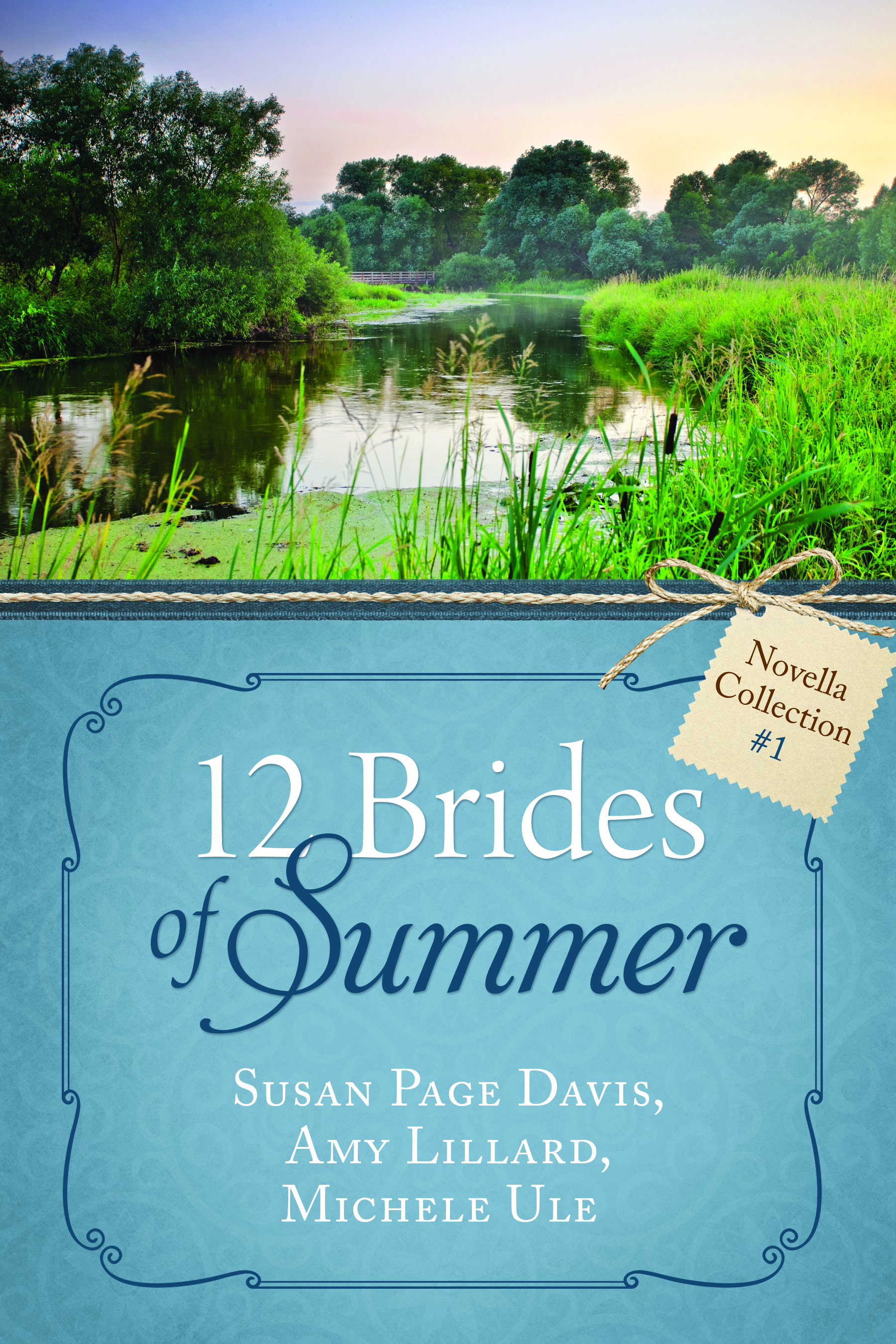
Collection #1, featuring Blue Moon Bride by Susan Page Davis; The Sunbonnet Bride by Michelle Ule; and The Wildflower Bride by Amy Lilliard, will release June 1.
July 1 will see the release of Collection #2 with The Bride Rides Herd by Mary Connealy; The Fourth of July Bride by Amanda Cabot; and The Summer Harvest Bride by Maureen Lang.
Margaret Brownley’s Dog Days of Summer; Miralee Ferrell’s The Dogwood Blossom Bride, and Pam Hillman’s The Lumberjack’s Bride will release as Collection #3 on August 1.
The end of summer, September 1, will feature Vickie McDonough’s The County Fair Bride, Diana Brandmeyer’s The Honey Bride and Davalynn Spencer’s The Columbine Bride.
For a description of each story, please see Barbour Publishing’s 12 Brides website: www.12Brides.com
With just a few exceptions, the stories are all linked to tales from last Christmas. The 12 Brides of Christmas novellas are still available for 99 cents, in case you want to do some early reading,here.
 All twelve summer novellas feature romances set across the western half of the United states, from central Illinois to the Ozark Mountains of Arkansas to Goldendale, Washington, between the years 1851- 1897.
You catch glimpses of fascinating periods in America: novellas set at the building of a controversial grist mill; bandits on the Union Pacific Railroad; a lumber camp in Mississippi and two romances based in Cheyenne, Wyoming.
The themes explored include tools for making a living, an engagement of convenience, dealing with separations, handling a herd of children, independence, accepting help and interpreting God’s will.
The novellas include inspirational elements, a lively cast of characters, country dances, town celebrations and even unusual weather.
Perfect for a glass of lemonade and a summer’s day!
Watch for information about the authors and individual stories on this website every month!
(For those readers who want to own all twelve stories at once–The 12 Brides of Summer novellas will be published in one deluxe volume, in summer 2016.)
Tweetables:
Introducing the #12Brides of #Summer! Click to Tweet
12 more #novellas for summer 2015! Click to Tweet
Novella sequels and more for #12Brides of Summer Click to Tweet
The post Introducing The 12 Brides of Summer appeared first on Michelle Ule, Author.


May 22, 2015
What’s a Novella and Why do Readers Like Them?
My most recent novella series
As an author with five published novellas to her credit, I’ve been pondering the lure of a novella.
Why do people like to read them?
Novellas are shorter works of fiction, usually ranging between 15,000 and 30,000 words– or about 60 to 120 “standard sized” pages.
While short stories, on the other hand, have ranged as high as 15,000 words, they’re generally found in the 3500-7000 word lengths these days.
The ability to write an effective novella or a short story, is all a matter of word choices and the writer’s skill in telling a full story in few words.
According to the Online Classes website,
“Within the space of a few pages, an author must weave a story that’s compelling, create characters readers care about and drive the story to its ultimate conclusion — a feat that can be difficult to accomplish even with a great degree of savvy.”
Some of the greatest short story writers of the last century included Ernest Hemingway, Flannery O’Connor and, of course, O. Henry.
Many are familiar with the famous quote, attributed to several people, including Blaise Pascal:
“I have made this longer than usual because I have not had time to make it shorter.”
(He actually wrote this in French).
A novella is not exactly a lengthy short story–a short story doesn’t usually have chapters while a novella requires character growth over multiple chapters.
There’s time in a novella to complete a character arc and even include minor characters.
I’ve had to plot my novella carefully to make sure I get in everything I want.
Indeed, while writing The Gold Rush Christmas for A Pioneer Christmas Collection, I had so much story to include, I counted every single word, as did my editor, a number of times to make sure I stayed at 20,000. It was a hard task, as evident in this post.
Why do people like to read novellas?
A well-written novella will provide the reader with the same satisfaction as reading a complete novel, but in less time and with fewer complications and plot twists.
Since there’s not a lot of room, descriptions are kept to a minimum, as are secondary characters.
The writer must write “tighter” and the word choices can be richer than when you have far more pages and time to tell the story.
Novellas have been particularly popular at Christmas the last five or six years, probably because it’s a busy time of year.
It’s not as hard to make the time commitment to read a novella as it is to a full novel.
The novellas in the collections I’ve written for take about an hour to read–or as I like to point out, about as long as it takes you to sip your way through a warm beverage.
Some people like the variety of stories found in novella collections, just as they did in the twentieth century when short story magazines were popular.
 Novella collections generally revolve around a theme. My A Log Cabin Christmas Collection included nine stories that included log cabins and Christmas.
Simple and easily explained by the title.
J.D. Salinger‘s Franny and Zoey and Raise High the Roofbeams, Carpenters, published in the 1960s,include stories about the Glass family in slim volumes.
I think it would be interesting to read a collection about the same town or the same family, with novellas written by different authors.
E-readers
Many believe novellas are popular because of their ease in publication through e-books.
They’re relatively simple to put together and produce for e-readers.
Some publishing houses have begun asking debut authors to produce a novella prior to the release of their novel–so as to give a little back story and to provide a feel for the writer before the full length novel is published.
In fall 2014, Barbour Publishing undertook an experiment to see if a collections of e-book-only novellas released at weekly intervals would be of interest to readers during the busy Christmas season.
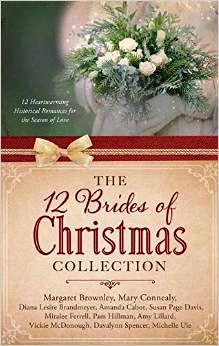
I wrote The Yuletide Bride as my contribution to The 12 Brides of Christmas Collection–a dozen novellas priced at 99 cents each. (Which means you could purchase that cup of warm beverage and a novella for about $5 for a winter break!)
The novellas were popular, but a bit frustrating for readers who did not own an e-book reading device.
To solve that issue, The 12 Brides of Christmas Collection will be published as a deluxe edition book in October 2015.
As part of the experiment, Barbour is also producing a series of sequels to The 12 Brides of Christmas Collection, also releasing first as ebooks this summer and then next year as a book, appropriately called The 12 Brides of Summer.
I’m hoping that people who enjoyed The Yuletide Bride, and certainly the ones who told me they wanted the story to go on much longer, will enjoy its sequel The Sunbonnet Bride!
Readers will always flock to a good story–no matter its length.
To a writer, however, can there be any better music then the reader response: “I didn’t want it to end?”
Tweetables
What is a novella? Click to Tweet
Why are novellas popular? Click to Tweet
What’s the difference between a novella and a short story? Click to Tweet
The post What’s a Novella and Why do Readers Like Them? appeared first on Michelle Ule, Author.
May 19, 2015
May I Borrow Your Accent?
 Are you guilty of accent borrowing?
I am.
I was mortified the day I attended a training session and sat beside a woman from Australia. We chatted happily until the session began and the instructor asked the dozen of us for an introduction.
My neighbor said her name, and added that while she was from Sydney, she was delighted to be in California.
I gave my name, newly arrived from Connecticut.
The instructor eyed me. “Are you Australian also?”
I put my hand to my mouth, mortified. I’d spoken in the accent of the woman sitting beside me.
To be fair, I didn’t mean to borrow her accent, I’ve just lived in so many places that I’ve unconsciously picked up native inflections.
I grew up in Los Angeles; we don’t have accents there.
But even I can hear the “ooww” leftover from our time in New England, where houses flattened to “howses” and going out turned into “owwt.”
You understand it, eh?
(We lived near Canada for four years, I picked that up, too).
I can rattle Hawai’ian words with the best of them–you just pronounce all the vowels–and while no one would mistaken me for a native, I sound like a kamaiana.

In my experience, an imitative accent has never made a difference with these two.
I’ve never picked up pidgin, however, and when I’m in the southern United States I carefully avoid slipping into their accent.
I really don’t want to make someone think I’m making fun of them by starting to sound the same way when I’m obviously not from their linguistic group!
For what it’s worth, I apparently have a pretty good Spanish accent and experience has shown I’m expected to understand far more than I do because of that accent.
But why me?
I’ve pondered this often, and the only conclusion I’ve reached is musical.
I’ve been a musician since I was six years old–sounds and tones are important to my ear.
I spent a lot of time mastering the clear tone on my clarinet–I can’t abide a fuzzy sound.
So, I assumed that was why I picked up accents like germs whenever I’m in the company of people who speak a little differently than I do.
Especially in English.
Convergence
Research at UC Riverside, however, indicates a possible reason for my . . . ever-evolving accents:
“People who interact with a person with a different accent subconsciously mimic their twang because they want to ’empathise and affiliate’ with their conversation partner.”
That sounds a lot better than embarrassing theft.
(It’s also, apparently, similar to feeding a baby with a spoon. Think how often you licked your own lips while trying to get an infant to eat off a spoon!)
“Humans are incessant imitators,” said Prof Lawrence Rosenblum, a psychologist who led the study:
“We intentionally imitate subtle aspects of each other’s mannerisms, postures and facial expressions.
“We also imitate each other’s speech patterns, including inflections, talking speed and speaking time.”
“Sometimes we even take on the foreign accent of the person to whom we are talking, leading to embarrassing consequences.”
I’ll say.
This type of accent issue has an official name:
“When two speakers become more similar in their speech this is called convergence or accommodation (opposite: divergence). This can occur on all levels of language, phonetics and phonology, syntax, semantics, and pragmatics. When mutual intelligibility is not an issue, accomodation mainly occurs when speakers like each other or want to appear likeable.”
Singing
The problem also can occur from vocal music. Growing up listening to Julie Andrews sing My Fair Lady or The Sound of Music tracks, I imitate her accent when I sing the songs!
Similarly, while seeing the musical Wicked in London, I knew something was odd about the performance, but couldn’t put my finger on it until intermission while listening to others in the audience speak.
The performers were speaking their lines with a British accent, but singing the songs with an American accent!
I’m glad to know I’m not the only one.
Funny, how it all seems to stem from wanting to be popular . . .
Tweetables
May I borrow your accent and other absurdities? Click to Tweet
Adopting another accent for admiration not fun. Click to Tweet
Stealing your accent? No, it’s all about empathy and convergence. Click to Tweet
The post May I Borrow Your Accent? appeared first on Michelle Ule, Author.
May 15, 2015
Can Anything Good Come of Failure?

If at first you don’t succeed . . .I don’t know about you, but I don’t like failure.
I don’t know about you, but I don’t like failure.
I don’t like to fail and I don’t like watching other people fail.
But in conversation lately, I’ve been thinking about the good that can come from failure.
It just depends on how you look at it.
Definitions are always helpful.
1. omission of occurrence or performance; specifically : failing to perform a duty or expected action
2. lack of success
None of that sounds very promising.
But failure doesn’t necessarily have to end in a negative outcome.
Disaster or turning point?
What if you looked at failure as a turning point?
Rather than throwing yourself on the floor and bewailing the failure, what if you acknowledged the disappointment, accepted the loss, and chose to see the moment as an opportunity to start afresh, learn something and/or try again in a different way?
Thomas Edison famously said,
“I have not failed 10,000 times. I have not failed once. I have succeeded in proving that those 10,000 ways will not work. When I have eliminated the ways that will not work, I will find the way that will work.”
He doggedly persisted in trying to invent the incandescent light bulb and one day succeeded.
Rather than torturing himself at what he had not accomplished, Edison turned the idea on its head and focused on finding a different way to achieve his goal.
As a Christian, I believe God has ordained the years of my life and the life path for me to follow that will bring Him the most glory.
[image error]
(Wikipedia)
Sometimes people fail me. Sometimes I fail to live up to my own expectations.
I may disappoint God, I may sin (defined as “miss the mark”), but I always have the opportunity to confess that sin, be forgiven and start over again.
God’s mercies are new every morning.
Ramifications of my failures may turn up the next morning as well, but I have a choice as to how I will react.
Will I allow the failures and disappointments to define me, or will I see them as opportunities to change?
How do you know this is bad?
Several different friends recently were turned down from a life change they were excited about making. They had prayed. They were willing to sacrifice their lives and work hard for God.
The powers that be told them “Not yet. We’ll give you a certain amount of time to get your affairs in order, and then you can come back and ask us again.”
They were crushed.
I was disappointed with them, but also gratified for both groups.
There were problems. Not crucial yet, but easier to handle if they were dealt with before either parties launched out onto their sacrifice to God.
When the opportunity arises again they’ll be healthier and in better financial shape. The powers making the decisions were not being cruel, they were ensuring these well-meaning folks would be better situated to succeed.
All three friends felt like failures for having their lack-of-self-control result in their applications being dismissed.
But by focusing on what needs to be repaired, they will be stronger when the right time comes.
Expect failures, but don’t fear them.
A naval officer friend used to tell his men not to hide failure from him. Since failure inevitably would come to light, didn’t it make more sense to deal with it before it became a larger issue?
Before lives were on the line?
One of my parenting books advised us to look for opportunities for our children to fail when they were young and to let them fail.
“Let them fail when the cost is less expensive,” was the admonition.
Our task was to help them recognize the failure, brainstorm ways to overcome the problem and encourage them to try again.
Failure is inevitable in their lives. They needed to learn how to pick themselves up, brush themselves off and start all over again.
(We could help, but not save).
A child who is afraid to fail becomes timid.
Some high tech companies in California’s Silicon Valley famously allow their knowledge workers opportunities to try hard things without fear of penalty.
For a time Google allowed some workers to spend up to 20% of their time tinkering on possible inventions.
Some ideas flopped, some succeeded–like gmail.
These companies recognized their employees could never come up with new innovations unless they were given an opportunity to try.
[image error]
( Wikipedia)
Fear of failure can paralyze.
Feeling like a failure can send you off in the wrong direction.
Ultimately, success lies in how you deal with failure.
Without accepting the possibility of failure, some of our greatest inventions never would have occurred.
Is a light bulb going off in your mind right now?
Tweetables
Failure or a new opportunity? Click to Tweet
A child who is afraid to fail becomes timid. Click to Tweet
What if you looked at failure as a turning point instead of a loss? Click to Tweet
The post Can Anything Good Come of Failure? appeared first on Michelle Ule, Author.
May 12, 2015
The Power of the (Kid) Translator

Andraz made an excellent translator
We spent several days recently with relatives in Slovenia and were awed by the power of the translator.
Two family members speak English well enough to feel comfortable as translators: thirty-something Tjasa (Tee-ah-sha), who is a working mom, and 16 year-old Andraz (And-draws), who attends school.
Tjasa’s husband also speaks English, but they weren’t available most of the time we were there: two evenings and a day.
A full day.
With distant relatives to visit on the family farm.
Andraz managed well the first night until Tjasa was able to join us.
He’d been studying the language for seven years and spoke beautifully, for all he brushed off our compliments.
(Note: Tjasa told us she learned to speak English from watching cartoons in English as a child. She speaks several other languages as well–like many Europeans)
We quickly fell right into chatting and only occasionally did a puzzled look cross his face, “I’m sorry I don’t understand.”
For the three Americans who come from a household that delights in word games, puns and irony, we had to cool it and slow down.
Andraz did very well, regardless.
We told his parents so, and they beamed with pride, as they should.
The full day, our relatives solved part of the problem by taking us to visit the world famous Postojna Caves where we took a tour in English!
A brilliant solution to a tricky problem.

Plenty becomes understandable when you have potica!
(Most of the other tourists with us on the tour were Japanese!)
Andraz got out of school early enough to join us on the family farm, where his language skills were put through their paces, translating between his grandparents, great-aunt and us (one husband, one adult son and me).
We were very impressed.
He kept it up until met Tjasa at her house and she took over so he could do his homework.
Later, he translated for us again and I marveled at how fluid he seemed.
Several times, though, I wondered if he was telling us the whole story . . .
Dangers for Kid Translators
Immigrant children to the United States can be presented with challenges when they serve as interpreters. Some children, however, are forced into roles they may not be mature enough to handle–at the doctor’s office, say, interpreting adult ailments and then physician’s questions.
As their language skills grow, child interpreters sometimes take on more adult roles because they are their parents’ sole conduit to society. Officials begin to address their questions to the children, rather than the parent needing translation.
A recent article in the New York Times, gave a humorous example of the challenges a perfectly intelligent American mother has run into with her children who have lived their entire lives in France and thus recognize her errors.
Pamela Druckerman decided just to embrace the embarrassment as her children corrected her, often.
She noted a concern for one French preschool teacher with working-class Chinese parents:
“In such families, the parents can quickly become infantilized, as their 5-year-old serves as an interpreter and eventually fills out forms for them.”
In Slovenia, where the language was incomprehensible to me, we swung our heads back and forth as Andraz interpreted–between him and his parents and grandparents.
I wasn’t sure if I should look at them while he spoke, or look at him. It got a bit confusing, but we all smoothed over the awkwardness with smiles, nods and another round of potica–a Slovenian cross between strudel and nut bread.
The morning we left, alas, we had no translator, just watches, sorrowful looks and suitcase packing.

Google translate help!
Fortunately, that morning the Internet was working, and I was able to access Google translate.
Maria and I had a typing “conversation,” while breakfast cooked.
My admiration for her and her family, her pleasure in having us, didn’t need many words.
But the Ipad translator . . . well, it helped . . and didn’t require a kid at all.
Tweetables
The power of a (kid) translator Click to Tweet
Challenges for children acting as translators Click to Tweet
A little potica never hurts while translating in Slovenia Click to Tweet
The post The Power of the (Kid) Translator appeared first on Michelle Ule, Author.
May 8, 2015
WWI Slang and You

The Guardian U.K.
My Zumba teacher employed some World War I slang this morning as one of our dancers hurried out to work.
“Good luck in the trenches!”
The class all laughed, as did I, but my mind didn’t follow Becky out the door.
Instead, it hunkered down at the word and I marveled at how events from 100 years ago still live in our daily lives.
The trenches, of course, were where soldiers lived in inhuman conditions fighting a ghastly war.
The worst place to be with death on the line every single minute–snipers watching 24 hours a day for a helmet or face to peek over the top.
Speaking of “over the top,” that comes from WWI as well.
Funk holes
It’s slang for clambering out of that trench and heading to the battlefield.Webster’s defines it this way: “going beyond what is expected, usual, normal, or appropriate.”
That surely is a description of climbing out of the relative safety of a trench to head across No-Man’s Land.
(No-man’s land, a description we use today of a place no one should visit).
Some of the slang and words are surprising.
“Having a chat,” today means getting together for a little conversation. In WWI slang it referred to small groups of trench soldiers examining each other and their clothing to kill the “chatt,” a Hindi word for parasite, in this context, lice.
And that word “sniper,” comes from the British Army discussions of sharpshooting. A snipe, the bird, is the hardest one to hit, thus a sniper is someone with keen eyesight and skill to hit even the merest hint of a head peeking out of trench.
Non-dirigible air balloons, the “Tommie” soldiers also called them German sausages.
How about a “cushy” job?
British Army again, slang for “pleasure” from the Hindi.
Here on the west coast, we’ve got Ocean Villas.
According to Julian Walker in Trench Talk: Words of the First World War:
“Mangling French place-names was surely one of the most creative forms of language to come out of the conflict. Auchonvillers became Ocean Villas, Mouquet Farm became Moo Cow Farm, Ploegsteert became Plug Street, and Ypres became the famous Wipers.”
 Here are a few more with the root of their slang definitions:
A-1: The British War Office created an ABC system of classification for the Department of Recruiting. Each category was then graded in a scale of 1 to 3. A-1 men were considered fit for the army overseas.
Basket case: Devised by the Americans, it referred to men whose upper and lower limbs were blown off and had to be carried via a basket by other soldiers away from the field.
Crummy-–itchy from louse bites.
Dud: a shell that did not explode, thus anything of dubious value–something anticipated that did not go off.
Funk: Funk holes were excavated openings on the front walls of trenches where soldiers could retire when not on duty. You could understand why they might be in a funk, or depressed, while sitting in a mud hole waiting for the whistle calling them into battle.
Nose dive: A description of fighter pilots’ tactic of bearing down on the enemy from above.
Pushing up daisies: dead an buried. Soldiers had many euphemisms for death including “going west.”
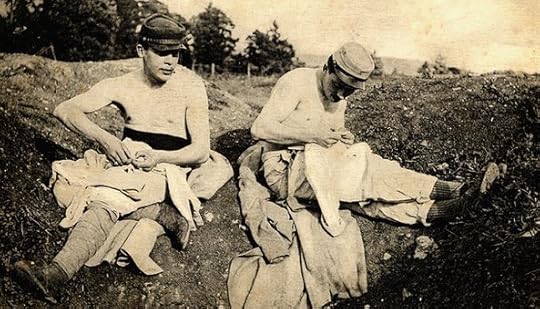
French soldiers having a chat
Trip wire: No man’s land was cluttered with wires and soldiers carried wire cutters to get through. A trip wire was designed to set off a trap or an alarm.
Up Against the Wall: standing before a wall before a firing squad. Soldiers were executed for desertion or cowardice often during WWI.
Zero hour: the time of attack.
Tweetables
Having a chat–what does it really mean?– and other WWI slang Click to Tweet
Modern slang taken from WWI Click to Tweet
The WWI meaning of crummy Click to Tweet
The post WWI Slang and You appeared first on Michelle Ule, Author.
May 5, 2015
Lion hunting in Europe: a Traveler’s Tale
 I’d been reading about lions in the Bible before I went to Europe and I met a lot of paintings, statues and references to them when I got there.
Indeed, the more I thought about it, I wondered if they were rampant across the continents two thousand and more years ago, something like vicious rats with teeth and claws.
Certainly, the king of the jungle appeared in many coats of arms of real kings.
The whimsey struck me and so I took photos whenever I encountered their images. Here are a few.

Of course you expect to see lions at Rome’s Colosseum. They killed a lot of wild animals there.
According to the colosseum website:
“During just one festival in 240 AD a staggering: 2,000 gladiators, 70 lions, 40 wild horses, 30 elephants, 30 leopards, 20 wild asses, 19 giraffes, 10 antelopes, 10 hyenas, 10 tigers, 1 hippopotamus and 1 rhinoceros were slaughtered. So many wild beasts were killed in the Colosseum and other Roman arenas that some exotic animals became virtually extinct.”
 The Assyrians liked to kill lions, too. From an entire room about hunting lions at the British Museum, we have friezes showing lions fighting for their lives.
Lion hunting was considered the sport of kings. The carvings were so well done, I had to look away at the one depicting dying lions.

Lions did exist in Europe in ancient times. Thought to be about the size of African lions, rather than Asiatic lions which usually lacked abdominal and lateral manes, according to Wikipedia.
 They stood about four feet high at the shoulders and weighed about 400 pounds.
Cave paintings in France show depictions of what is known, now, as a “cave lion,” but they died out long ago.
Homer wrote about them in Greece, but Dio Chrysostom, a Greek writer, claimed they were extinct by the first century, AD.
Their carvings turned up in the Vatican museum, where the lion wasn’t lying down with the lamb, he was eating it!
And they were everywhere in Venice–where the coat of arms is a lion with wings, who obviously never existed.
The winged lion is a symbol of the city as a representation of St. Mark–for whom St. Mark’s Basilica and San Marco square is named. Tradition has it that the bones of the  apostle are buried in Venice.
“Venetian tradition states that when St. Mark was traveling through Europe, he arrived at a lagoon in Venice, where an angel appeared to him and said “May Peace be with you, Mark, my evangelist. Here your body will rest.”
“This (possibly apocryphal) tradition was used as justification by Rustico da Torcello and Bon da Malamocco in 828 for stealing the remains of St. Mark from his grave in Alexandria, and moving them to Venice, where they were eventually interred in the Basilica of St. Mark.”

Various pictures, statues, drawings and stuffed animals depicting the Venice lion are for sale all over the island. One is even used in cartoon format to teach visitors how to use the walkways erected in San Marcos square when the water is high (or when it’s raining as it was during our visit).
We ran into a lion in Salzburg as well–another example of the king of the kingdom represented to ennoble the government. Of course a bench may not have been the best example of what he had in mind!

I enjoyed the whimsy of hunting for lion sightings all over the continent (I have many more photos). It meant I had to keep a sharp eye out and quick fingers.
It also amused me–all those big cats in such a cold place!
Tweetables
Lion hunting in modern day Europe Click to Tweet
Amusing to see all those lions in Europe Click to Tweet
Assyrian lions and their Venice cousins Click to Tweet
The post Lion hunting in Europe: a Traveler’s Tale appeared first on Michelle Ule, Author.
May 1, 2015
Cultivating Thanks with Kelly James, the Leader of the Band

Kelly was always a dapper dresser.
I learned something about thanks my second year of college and the lesson came, from of all people, the band director Kelly James.
Kelly, as we called him, had been the band director for many years by the time I arrived in his clarinet section, and since I wasn’t a brass player (the UCLA band is known as having a “solid gold sound”), I didn’t catch his eye very often.
Which was probably just as well. The band had only been integrated with women two years before I arrived. Kelly wasn’t sure we should be there.
During his last years at UCLA, Kelly was also the Marching Band Consultant at Disneyland, which brought with it some perks. We marched down Disneyland’s Main Street all three years it took me to graduate from college.
Playing in a band is a glorious experience and the players in the UCLA band were terrific musicians. That solid gold sound swelled through and took over the band room whenever we played.
A wall of pure sound moved toward listeners, coursing through the body in a physical way that set your feet to tapping and your bones to thrilling.
I loved the band.
And when Kelly cut us off, the wall of music stopped on a dime, like a switch going off between dark and light.
You could hear a pin drop, or a spit valve, in the silence that loomed after that cut off.
Truly magnificent.
So, one day early in the fall as we were practicing he cut us off and surveyed the entire 200 member band.

My spot one year was the last one on the straight U line.
He reminded me of a wise, truculent owl. With his blonde-white hair combed straight back, his beaky nose and his round pre-Harry Potter glasses, he stared with an unblinking gimlet eye.
We waited.
These sudden cut offs usually meant he needed to shout,”Klingbeil!” at a lanky curly headed trombonist.
Kent often dropped something.
But this day he looked around and then began to speak in a calm, musing voice.
(I wasn’t taking notes, but this is what has stayed with me and changed my life.)
“It’s always important to give thanks when you see something well done.
Too many people go through life without stopping to appreciate artistry–whether it be in music, costumes, art, anything.
But I think it’s important to admire and appreciate things well done.”
We were college students in the 1970’s. We shifted in our chairs.
He raised his conductor arms for silence.
“You never know if you’ll be the only person who tells someone ‘thank you.'”
He’d never spoken to us like this before–it was always about the sound or the arrangement or marching orders or “Klingbeil!”
Kelly smiled.
“I was at Disneyland this summer, walking about the park and I stopped to admire the artistry that went into everything in the park, whether the buildings, the gardens, even the Disney characters.
Pluto was nearby and I stared at the tall character. I admired his floppy ears, his pink tongue hanging out and how well put together the costume was for a child to really think it was Pluto.
And while I stood there, Pluto shifted several times and then from deep within, a voice said, “Good afternoon, Mr. James.”
We all laughed.
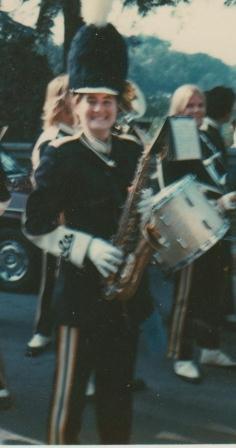
Rose parade 1976. Playing sax that year.
Kelly waved at one of those trombone players (I don’t think it was Klingbeil), who stood up and took a bow.
(Saxophonist Bill Whipple tells me it was Andy Nemitz).
Kelly conducted the UCLA Marching Band at the Cal football game in Berkeley (where he went to college) in 1980 and while there suffered a stroke. He never recovered.
Those who had loved him–and cantankerous and exasperating though I often found him, I loved him–always appreciated that he died with his baton in hand, as it were.
The University of California obituary read as follows:
“Kelly James was more than a band director. Above all he was an educator. His concern was for something far greater than the band, it was for the growth and development of his students.
“He touched the lives of all his students with his sincere interest in them. During his professional career he was mentor and friend to thousands of young people, always urging them to be the very best that they could be.”
I will playing Sons of Westwood in my coffin, my fingers moving up and down the clarinet as they did so many times while I marched in the band (and played in the basketball band as well). But of all the things I learned at UCLA, Kelly’s lesson about stopping to appreciate and to give thanks to those who make it possible, was the most important.
I cultivate that attitude of gratitude–giving thanks–every single day.
In the UCLA Marching Band archives, I found a picture taken at a basketball game in Pauley Pavilion.
I’m the girl in the second row on the left. Kelly James is standing in the right hand corner.

Thanks, Mr. James. I appreciate the lesson you taught me many, many years ago.
Tweetables
Learning about appreciation and thanks from Kelly James, the leader of the band Click to Tweet
Profound lessons from the UCLA Marching Band’s conductor. Click to Tweet
The band director teaches us how to appreciate and give thanks. Click to Tweet
The post Cultivating Thanks with Kelly James, the Leader of the Band appeared first on Michelle Ule, Author.
April 28, 2015
World War I in 2015 Salzburg, Austria

Tod als Panzerfahrer (Death on a tank) drawing by Karl Reisenbichler 1918
After spending two years researching and writing about World War I, I traveled to Europe on a family vacation, which took us to Salzburg, Austria.
During those two years, I’d noticed a dearth of information about the war from the Austro-Hungarian/German side. When crawling through Pinterest looking for WWI photos, few of them seemed to be from German or Austrian sources (The Triple Alliance, including Italy).
I thought that odd at the time and still wonder about it, though more photos have turned up in the last six months .
Because the Allies, particularly England, France and the United States, were on the “winning” side in that war to end all wars, their side is more predominately displayed in the US, at least.
I only read English well, so books printed in the UK or the US are my primary sources of information.
I understand I’m biased.
But it bothered me all the same. I trained as a journalist–I want to know both sides of the story.

A possible explanation from the exhibit as to why I’ve heard so little of the Austrian side
So many people were swept up into events beyond their control and the German people were on the verge of starvation in November 1918, if not already there in some cases.
Humanity and the need to protect and love is the same, no matter in which side of a war zone you live.
Still, I wasn’t really thinking about it until we wandered into the Salzburg Museum–a beautiful museum devoted to the town’s history.
Up a floor from the main entrance, we visited an exhibit about what I had been seeking: War, Trauma, Art. Salzburg and the First World War.
(Unfortunately, it closed April 10, 2015)
So what? Didn’t they start the war?
Here we walked step by step through the war–much as we had done at London’s Imperial War Museum–seeing how it built up, how the residents of Salzburg were affected and the people’s reactions as the war continued year after year.
Propaganda, of course, was used by both sides during the war, but it’s helpful to get a feel for how the Austrians and Germans saw Europe in 1915.

(You can view more than 1600 photos, charts and diagrams on my Pinterest WWI board: https://www.pinterest.com/michelleule...)
Enthusiasm was drummed up in countless ways, including patriotic items used daily.

Photos of German leaders with their signatures.
A Catholic nation, Austria fell in with its leaders. Soon, religious belief was mixed in with patriotism. (I tell my Bible study ladies the words God, power and money do not belong together and when someone presents them like that–run away)
Fervor reigned and the exhibit had another, chilling quote.
But the exhibit went on to catalogue the suffering experienced by the people of Salzburg as troops gathered, rationing began and the people began to understand the horrors of war.
We saw summer photos of soldiers enjoying their families; read about the military hospitals and “angels in white” nurses.
The Triple Alliance had cases of shell shock; women were forced to become independent and support their families; children were sent to scavenge for food.
Daily life was hard, even for the aggressor nations.
Most Americans don’t realize battles were fought in the Alps and Dolomites (If you’re familiar with Ernest Hemingway’s A Farewell to Arms you’ve been introduced to the war in northern Italy).  Many soldiers froze to death as they lived in trenches dug in ice high on mountain tops.
Like the Triple Entente (Britain, France and Russia) artists, the Triple Alliance also produced fearsome works that evoked the sadness and horror of war. People were starving in Germany and Salzburg. Men were dying in massive numbers. The Germans and Austrians were pressed from both sides with their navies bottled in port.
All telegrams to north America went through London–the Triple Alliance had difficulty getting their propaganda out to the rest of the world.
 Would we have believed it? Should we have believed it? Who was the aggressor and responsible?
The war swung in the balance many times between August 1914 and November 1918.
The Triple Alliance did not want to lose, which is why they threw everything at France in the spring of 1918–desperate to conquer France before the game-enders arrived: American soldiers.
And when the armistice was signed and the armies went home, life was grim in Austria.

I’m an American. My grandfather was a soldier in the American army during World War I.
I will always think of the war as a crime–no matter which side you were on.
Sometimes it helps to remember pain, suffering, love and courage are universal truths.
Tweetables
Thoughts on WWI from the Austrian side. Click to Tweet
Why are there so few Pinterest photos of the German side of WWI? Click to Tweet
A glimpse of WWI humanity at the Salzburg Museum Click to Tweet
The post World War I in 2015 Salzburg, Austria appeared first on Michelle Ule, Author.
April 24, 2015
Guilt: True or False?
By Joseph Baker (Wikimedia)
How can you tell if you are experiencing true guilt or false guilt?
That’s been a tormenting question my entire Christian life.
I was raised in a church setting and among well-meaning folks who used shame and guilt to control children.
As a dutiful first born, I imbibed those notions deep within. I continually felt guilty about one thing or another.
The most freeing aspect of giving my heart to Jesus was the knowledge that finally, I had something constructive to do with my guilt.
For me, a way to get rid of guilty feelings was enormous.
Liberating.
Freeing.
Joyous.
It didn’t mean I wasn’t guilty of sin or making a mistake. It meant that Jesus was my advocate with God who would speak on my behalf and through whose death on the cross I was/am/and always will be forgiven.
Note: that does not mean I no longer sin. I does not mean I no longer have to apologize for mistakes, sins, poor choices, bad behavior or other errors.
It also does not mean I no longer feel guilt.
I feel guilty all the time.
But it gives me a tool to analyze that guilt into two categories: true or false.
That, for me, is the key to freedom.
What is guilt?
The dictionary defines it well:
1.the fact or state of having committed an offense, crime, violation, or wrong, especially against moral or penal law; culpability:
2. a feeling of responsibility or remorse for some offense, crime, wrong,etc., whether real or imagined.
3. conduct involving the commission of such crimes, wrongs, etc.
The Bible tells us all have sinned and fallen short of the glory of God, so we all experience guilt in one form or another.

(Indeed, to not feel guilt or remorse over a bad behavior is another problem!)
Take a look, however, at that second definition at the end: “whether real or imagined.”
That’s what false guilt is, taking on responsibility for something you did not do.
What does false guilt feel like?
For me, it’s a feeling of shame, lethargy, fear; my stomach tightens and I want to hide. I’m afraid to face whomever I’ve offended and panic to “make things right” overwhelms.
I hate feeling guilty. I’ll do anything to make that gut-wrenching feeling go away, including apologize for things I did not do.
The problem is, I’m so conditioned to assuming responsibility that guilt feelings, now, require analysis.
I ask these questions:
* Who is responsible for this action/outcome/behavior?
* Have I intentionally done anything to bring this feeling on myself?
* Am I in the wrong here?
* Have I done anything that requires an apology?
* Where is the guilt coming from?
* Does anyone I trust think I’m guilty?
Christians know that Satan is an accuser and a liar, and he likes nothing better than to twist believers up into knots of false guilt. Knowing that fact, it’s important I not fall into the trap.
The problem with false guilt is, even if I confess or apologize, I don’t feel any better. No burden is lifted. I’m still tied up.
That’s because no burden needed to be lifted. There wasn’t anything there. I was focused on the wrong thing–my guilt–when I wasn’t guilty.
Because I don’t feel better, I assume there is something else I haven’t confessed and I take off on that rabbit trail hunting for something, anything, I can confess and have the feeling lifted.
No dice.
Shame often will set in, along with nervousness and that hunted feeling.
False guilt steals my joy, my peace and can lead to damaging my relationships–because it’s based on a lie.
 True guilt can be a gift.
When I have done someone wrong or sinned against God, I feel guilty again.
You know, that shoulder hunching, not looking at others, unsettled feeling.
I’m aghast I did something and want to apologize immediately to make that pain go away.
And when I do, God who is faithful and just will forgive me my sins and cleanse me from all unrighteousness. (1 John 1:9)
Author Paul Coughlin writes about the elements of a real apology and how that can assuages guilt. It takes humility and courage to examine your own heart:
“There are four parts to a real apology that recognizes guilt 1. Acknowledging the offence 2. Offering an explanation 3. Expressing remorse 4. Offering reparation. When apologies fail, at least one of these parts is missing. The most common failing is not acknowledging the offense.”
True guilt leads to confession, forgiveness and restoration of relationships.
With that restoration, we’re free.
Tweetables
Dealing with true and false guilt. Click to Tweet
How to tell the difference between true and false guilt. Click to Tweet
Analyzing the difference between true and false guilt. Click to Tweet
The post Guilt: True or False? appeared first on Michelle Ule, Author.



![[image error]](http://commons.wikipedia.org/wiki/File:Tikkataulu.JPG)
![[image error]](http://commons.wikipedia.org/wiki/File:Gluehlampe_01_KMJ.png)
![[image error]](http://commons.wikimedia.org/wiki/File%3ACanadian_soldiers_in_trench_France_1917_LAC_3194258.jpg)
![[image error]](http://commons.wikimedia.org/wiki/File%3ASalem_witch2.jpg)