
Michelle Ule's Blog, page 72
July 31, 2015
The Hunt for Red October and My Family
 We watched my favorite submarine movie last night, The Hunt for Red October, with our daughter who was not born when the book and movie came out.
As my husband was serving on a nuclear submarine in the Atlantic Ocean at the time the book first appeared, he told her a story about the verisimilitude of that book and how it affected his life.
In a funny way, of course.
I’m not sure how long they had been underway in 1984, but it was shortly after the Naval Institute Press published their first ever novel.
The commanding officer (CO) of the boat got the first copy, in hardcover, which looked just like the photo.
One morning, the CO gathered the officers around the ward room table and began reviewing that day’s operations.
He hadn’t spoken long when the men began looking among themselves with furrowed brows.
Someone cleared his throat. “Sir?”
“Yes?”
“Could you go over that again, please?”
The skipper stared at him, then passed his hand across his eyes. “Maybe those aren’t our orders. Maybe that was in the book last night.”
Eyebrows went up. What book was that?
Everyone volunteered to be the next person to read The Hunt for Red October!
We bought our hardback copy as soon as my husband returned and I peppered him with questions–here for the first time I could read a relative insider’s look at my husband’s job.
I’d been on his boats, of course, but always stopped to stare at the door leading to “back aft” where the reactor powered the boat through the water keeping America safe for democracy. We were never allowed in the engineering spaces.
The Hunt for Red October gave me a description of his experiences that, hard though it was, I cherished.
The book came in handy, too, the following Christmas when my mother-in-law came to spend the holidays.

This was not my husband’s boat, though it could have done this. (Photo from Pastor Ian’s blog)
She’d hoped to see her son for the first time in over a year, but the boat got a special mission just before the holiday, and he was off.
Her adorable grandsons and I tried to make up for the deficiency, but really, she was disappointed.
The problem for us was she didn’t understand submarine life.
As Christmas approached, she kept saying things like, “What time do you think he’ll call on Christmas day?”
“He won’t be calling on Christmas day.”
She couldn’t believe the United States Navy would be so cruel. “Surely, they’ll let him call.”
I tried to be gentle. “He’s sitting on the bottom of the Atlantic Ocean, Mary. There’s no way he can call.”
“Oh, they’ll pull into port.”
“No.”
The toddlers watched, wondering, “Daddy?”
I had to be stern with them. “Daddy’s out to sea. He’s not coming home until January, remember?”
Every morning they scribbled a big X on a calendar. I’d marked the days on the calendar long past my husband’s anticipated return, to give them something to do and help understand time.
The four year-old turned the page and saw how many boxes it would be. He showed his grandmother.
She still had trouble believing it. “How could they not have a phone on the boat?”
I bought her a copy of The Hunt for Red October for Christmas.
She never asked foolish submarine questions again.
Side Note: be careful what you say to military kids. We know you don’t mean it, but you can make things challenging for the poor parent left behind.
The Hunt for Red October eventually became a movie we loved, of course, starting with the opening music:
My husband really likes this scene because when we saw it on the big screen, he could hear a familiar deep hum, which is the sound a submarine makes going through the water.
I love hearing the Soviet singers!
(When we lived in Seattle, Brad Eaton of KING-FM occasionally woke us up to this music!)
While there are many great scenes in the movie, my personal favorite is when the USS Dallas saves the day!
(Our next door neighbor served on the USS Dallas–it’s the first Los Angeles class submarine I ever toured. Coming from my husband’s tiny Skipjack class submarines, it felt gigantic–until he built a Trident!)
I love it when American submarines are heroes!
(You may be wondering what my husband’s favorite submarine movie is, since The Hunt for Red October is his second favorite.
The answer? Das Bot.)
Tweetables
The Hunt for Red October and one Navy family Click to Tweet
How a book nearly torpedoed a submarine operation. Click to Tweet
A Navy wife remembers The Hunt for Red October Click to Tweet
The post The Hunt for Red October and My Family appeared first on Michelle Ule, Author.


July 28, 2015
Exercise and the Writer’s Body

These ARE my dancing shoes!
You already know the value of regular exercise, but I’m going to explain how exercise has been so good for this particular writer’s body.
In late 2009, my hands stopped working effortlessly.
Simple things I’d done my whole life hurt, badly.
I couldn’t turn doorknobs without pain.
Scissors were a nightmare.
I could no longer hold a needle well enough to sew.
Forget weeding for more than a few minutes.
Hand brakes on the bicycle were impossible.
My hands–the one part of my body I had thanked God for many times– had become an enemy.
The doctor tried tendonitis remedies.
No luck.
Months of physical therapy made little difference.
Indeed, the only thing that made the pain go away was two weeks of vacation in Europe–but my husband said I couldn’t just live there the rest of my life.
What on earth had happened to me?
The specialist tossed up the x-rays, shook his head and pronounced his verdict in a cold hard voice: arthritis at the base of both thumbs. No cure. Good day.
Dismissed in a mere five minutes, I left in tears.
My self-worth was in tatters.
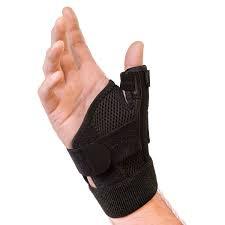
My mitts are just like this
I bought thumb guards, calling them my “mitts,” and wore them every night.
I bought an electric can opener for the first time. I bought other hand-easing tools for my kitchen.
I read up on arthritis and started taking B-6 for my joints, not to mention glucosamine.
Thank God I could still type and sort-of play my clarinet. But what about the rest of my resourcefulness?
I wasn’t ready to become a memsahib with servants (nor could I afford them beyond the house cleaner to make the bed).
I determined I would be positive about this situation.
My life as I’d lived it might be over, but there was plenty I could still be thankful for: I could walk, swim, pay a kid to work in the yard, buy clothes.
The kitchen adaptable tools gave me hope.
The unexpected relief.
While I’ve walked an hour a day, four to five days a week for 28 years, walking was no longer enough for weight control.
So, on 1/11/11, I followed a friend’s lead and joined a health club.
I needed to lose weight but I also wanted to move more–I was starting to feel stiff all the time from sitting at the computer.
This gym had a Zumba class, along with other fitness classes.
I started dancing at 6 am, five mornings a week.
Two days a week we lifted weights in the exercise class.
I wore my mitts–I could not compromise what little was left of my hands with a heavy weight.
(Four and a half years later, I still only lift five pound weights max; but I don’t wear my mitts anymore.)
Within a year, my hands didn’t hurt as much.
I didn’t flinch at turning doorknobs.
I could cut paper with scissors again–I didn’t need the adapting tool.
Sewing is still problematic; but I haven’t tried a bike again.
I can pick up a 4.5 bag of sugar with one hand now, but I usually use two.
What made the difference?
[image error]
(Photo credit: Wikipedia)
All we can figure is exercise, that dancing, has caused the fluids to move into my hands.
I think it’s the movement, the blood flow and the activity.
Because while I walked religiously before, (and still walk several days a week) I didn’t use my hands when I walked.
The only difference between now and 2009 is the weights and the arm movements while I dance.
Arthritis in the thumbs, hopefully, will never afflict you.
Tendonitis may be a part of the writer’s life (I still struggle with aching forearms if I’m not careful).
Writers spend hours sitting at our desks; but we need to keep moving for our hands, our bodies and our minds–not to mention our creativity!
I’m so grateful for the difference exercise has made in my quality of life, and for that reason I’ll be dancing and exercising as long as possible.
Tweetables
Exercise and the writer’s body Click to Tweet
Dancing to improve the hands Click to Tweet
Writer physical problems and a solution. Click to Tweet
The post Exercise and the Writer’s Body appeared first on Michelle Ule, Author.
July 24, 2015
Exercise and the Writer’s Mind
This is NOT my class! (Photo: Wikipedia)
The woman who teaches my exercise class had her eye on me yesterday.
“You need to keep your mind engaged on what you’re doing here, not on what’s happening after you leave class,” she said.
I laughed.
I’m notorious for missing a step because while my body is dancing zumba, my mind is often elsewhere.
I’ve written before about the odd places that come to mind while I’m dancing, but this particular class has also been a source of inspiration, too many times.
For example, today’s blog post. 
There’s something about the increased blood flow to the mind while exercising which, for me, seems to spark ideas.
I’ve plotted novels in this class.
(Okay, so it involved a fitness instructor, but it’s still a good idea).
I’ve prayed for people while dancing.
(I don’t know why my friend Mumsee with her 13 children come to mind while I dance, but there it is).
I’ve contemplated my work in progress while doing a “jazz square.”
(Should I use a grasshopper attack or a tornado to advance the story?)
And the best day of all, while driving home I solved a major problem with my World War I novel.
(If only Anne could come help with the Spanish flu, wouldn’t that smooth the story? Where did that thought come from? Of course Anne could come!)
Science has shown a link between exercise and creativity. See articles here, here and here.
How?
“Researchers noted that regular exercise seems to be associated with improved divergent and convergent thinking, which are considered the two components of creative thinking; the former involves thinking of multiple solutions for one problem, while the latter involves thinking of one solution for a problem.
“Exercising on a regular basis may thus act as a cognitive enhancer promoting creativity in inexpensive and healthy ways,” study researcher Lorenza Colzato, a cognitive psychology at Leiden University in the Netherlands, said in a statement.”
Why?
According to this article, physiological changes prompt the difference:

This is neither me nor my dog; but you get the picture!
“Exercise can literally change your brain to get your creative juices flowing. When you work out, your body flushes out cortisol, the hormone that helps trigger the “fight or flight” response when you’re stressed, and which also shuts down brain functions for creativity and problem-solving, explains Pierce J. Howard, PhD, managing director of research and development at the Center for Applied Cognitive Studies in Charlotte, North Carolina, and author of The Owners Manual for The Brain: Everyday Applications from Mind-Brain Research.
“Meanwhile, your pituitary gland releases endorphins, which can produce the feel-good “runners high.” Exercise also promotes the growth of new nerve cells and synapses through elevating levels of neurotrophins (a chemical that fosters the growth of new nerve endings) and by increasing oxygen in the blood, which helps provide mental energy.”
What type and how much exercise makes you more creative?
Any exercise, and half-an hour is sufficient.
For many years, I walked my dog an hour a day. I don’t know how many scenes I completely figured out–plot, issues, descriptions and even dialogue–particularly on one spot about 30 minutes into the walk.
I could almost anticipate when everything would suddenly make sense.
I then spent the next half an hour clarifying, cleaning up and trying to remember what I’d figured out, as I completed the circuit around the neighborhood!
I went directly to the keyboard as soon as I got in the door from my walk.
(As an additional benefit, the worn out dog then slept the day away and I wasn’t bothered by incessant requests to let her in and out!)
Some researchers contend that a mere half-hour of exercise is enough to spur on hours of creativity.
For me, any amount of movement helps.

THIS was my tired dog.
So, if you don’t want to do it for your body? Why not consider exercising for your art?
Tweetables
Exercise to boost your mind. Click to Tweet
Want to boost your creativity? Click to Tweet
The benefits of exercise on creativity. Click to Tweet
Lacking creativity? Get up and move! Click to Tweet
The post Exercise and the Writer’s Mind appeared first on Michelle Ule, Author.
July 21, 2015
What Belongs in a Modern Hope Chest?
 The concept of a modern hope chest came to us about 20 years ago.
You know what a hope chest is, don’t you? Here’s a definition:
A hope chest, also called dowry chest, cedar chest or glory box is a chest used to collect items such as clothing and household linen, by unmarried young women in anticipation of married life.
Hope chests, traditionally, were used to store up items that a woman would need someday for her home. 200 years ago, it would be filled with linens, embroidered cloths, dish towels, pillows, maybe even woven blankets–usually something a woman or the women in her family made specifically for when she married.
Today, a hope chest–for men or women–really isn’t as necessary as it once was when fabric had to be made. Now, anyone can visit a local store and pick up whatever is needed to make a life together, at least in the United States.
Indeed, wedding registries take the role once filled by relatives, friends and hardworking folks focused on building a household.
But my husband and I recognized long ago that possessions for a “hope chest,” were not so important.
Instead, we think skills and character preparation can serve a couple much better than neatly hemmed antimacassars.
When our children graduated from high school, we gave them all rudimentary tool chests–our daughter’s was pink–that contained a simple hammer, screw drivers, jeweler’s screwdrivers (for their computers), a tape measure and other items we have at home that they might need in a dorm room or apartment.
(Our nine nieces got the same tool kit, which one refers to as her “Barbie tools.”)
When they graduated from college or got married, my husband purchased a “real” tool chest–gray metal– and gave them saws, wrenches, electric drills and other items they would need when they moved into the “real” world.
They’ve all thanked us for their tools and put them to use.
%2C_cassone%2C_1450-90_ca..JPG)
This is an Italian version of a hope chest, a cassone, from the 15th century. It’s been a popular idea for a long time!
But in the knowledge-based United States, we think other things are needed in a modern hope chest.My husband required the children to do their taxes starting in high school.
They learned how to change a tire on the car, as well as check the fluids and air pressure (I may have taught them some of these skills as cub scouts).
They were given free reign in the kitchen in high school–sons and daughter alike–and are all pretty good cooks.
They can all do their own laundry, work in the yard and balance their accounts.
(Notice I did not say checkbook. They don’t really use a checkbook except in extreme situations).
As a former budget counselor, I explained about the difference between a need and a want.
We taught them how to question whether something was a good deal or a bad deal. My husband demonstrated on every used car they bought (they only bought used cars) how to tell if the engine was well taken care of or not.
One of my sons complained he never learned how to iron a shirt as he prepared for a job interview. I couldn’t really explain over the phone, but promised I’d demonstrate during his next visit!
We taught them how to value members of the opposite sex–particularly in the dating years–and how to be courteous to old and young alike.
They all babysat at one time or another–sometimes each other.
I mention all this because we’ve met many people over the years and across the country who don’t have skills like these. They don’t know how to hammer a nail, don’t understand how to do their taxes, would never think of buying a used car and certainly don’t know how to paint a room.
We all need skills like these.
Even I, a disaster waiting to happen with tools, know how to find a stud, turn off the water valve on the toilet and can even tighten the handles on my pots and pans.
I didn’t have the tools to do those type of household chores before I got married.
I used my husband’s tool box as my hope chest, too.
What types of skills and tools do you think are needed in a hope chest for adulthood?
Tweetables
Items all folks need for their adult hope chests. Click to Tweet
What belongs in a modern hope chest? Click to Tweet
Are hope chests outdated? How about tool boxes? Click to Tweet
The post What Belongs in a Modern Hope Chest? appeared first on Michelle Ule, Author.
July 17, 2015
Amanda Cabot: Summer Brides

Amanda Cabot’s The Fourth of July Bride will appear in the second The 12 Brides of Summer Novella Collection, releasing, appropriately on July 1.
A sequel to her The Christmas Star Bride, the new novella returns readers to Esther’s bakery –the site of Esther’s Christmas romance with Jeremy, a portrait painter.
Amanda enjoyed coming up with a summer romance to match.
“I had so much fun with Jeremy and Esther that I wanted to include them in this story. As readers know, Jeremy paints portraits in Esther’s bakery, so I started asking myself, ‘Who else would want a portrait painted, and who else would be in the bakery?’ One question led to another, and before I knew it, Naomi and Gideon had come to life.”
Set in Amanda’s adopted hometown of Cheyenne, Wyoming in the 1880s,
“The Fourth of July Bride takes place about six months after The Christmas Star Bride’s final scene, and – as you might expect – the weather has changed. So, too, have Esther and Jeremy. They’re expecting a blessed event, and that’s caused all kinds of changes in their lives.”
Jeremy is still painting in a corner of the bakery and, in this case, is working on a portrait of the handsome and wealthy bachelor Gideon Carlisle. Gideon’s mother back east is after him to settle down and he hopes a painting will convince her he’s doing fine and doesn’t need a bride.
Gideon enjoys sitting for the portrait and likes passing the time with the beautiful Naomi who works at the bakery.
For her part, Naomi is smitten, but waiting for Gideon to make a move. She’s worried about money and when Gideon comes up with an interesting proposition to meet her need, she agrees even as her heart breaks. Can he really be so blind? What will his mother think when she comes to visit in time for the fourth of July?
Will there be fireworks?
You’ll have to read The Fourth of July Bride to find out!
Amanda enjoyed writing about Cheyenne, having already written two full-length novels about this time period: Waiting for Spring and With Autumn’s Return. (Several characters from Waiting for Spring make a cameo appearance in The Fourth of July Bride.)
“It’s fun to bring Cheyenne in the 1880s to life for my readers, because not many people realize that the cattle barons made Cheyenne the wealthiest city per capita in the country or that we had the only opera house west of the Mississippi.”
While Amanda enjoys writing historical fiction, she’s recently branched out into more contemporary stories. See her website for more details.
You can purchase The 12 Brides of Summer Collection #2 featuring Amanda’s The Fourth of July Bride, Mary Connealy’s A Bride Rides Herd and Maureen Lang’s The Summer Harvest Bride, here.
Who is Amanda Cabot?
Amanda Cabot is the author of more than thirty novels, including the CBA bestseller Christmas Roses and Waiting for Spring.
She write about her life on her website, and notes the following:
“No doubt about it, I’ve been blessed. I had parents who nurtured my love of reading and have a husband who’s not just my best friend but who’s driven tens of thousands of miles to help me research books and who, after all these years, still hasn’t lost his sense of humor, even when dinner is late because I have “just one more scene” to write.”
For more information about Amanda, please visit her website or read her blog.
You can also find her on
 Some select Walmart stores will be carrying physical copies of Prairie Summer Brides–a four-novella collection of stories from this series featuring the 12 Brides of Summer novellas written by Margaret Brownley, Amanda Cabot, Vickie McDonough and Michelle Ule starting June 9.
The ebook versions of The 12 Brides of Summer will be available in four ebooks with three stories in each. One will release the first of each summer month beginning in June and continuing in July, August and September. Mark your calendars for the first of the month, because you won’t want to miss a single one.

The entire 12 Brides of Summer Collection (all four volumes) will be released in summer 2016 in a deluxe print edition.
And for those looking for a complete collection of The 12 Brides of Christmas novellas, they’ll be published in one book in October 2015.

Releasing October 1, 2015. You can preorder at
http://amzn.to/1FclW0u
The post Amanda Cabot: Summer Brides appeared first on Michelle Ule, Author.
July 14, 2015
Four Ways I use Goodreads
 Are you on Goodreads?
How do you use it?
Does it feel like just one. more. social media thing to keep track of in your free time?
Or is it a helpful tool?
I’m of mixed mind, but I do use it in four ways:
1. As a research tool
While I was working on my World War I novel, I read a lot of World War I novels. As I’ve written elsewhere, historical novels can be valuable research aids.
(Someone pointed out that if you’re interested in political history, you should read history books. If you’re interested in social history, you should read historical novels.)
Goodreads has a listopia feature I used to discover books that might give me insight into the various venues of my story.
It also enabled me to see what The Great War books focused on–to improve my own novel, in terms of setting and stereotypical ideas (which I didn’t want in my story).
For people who are just looking for books on a subject that’s caught their interest, listopias are very helpful.
2. As a marketing tool.
I’ve run book giveaway contests on Goodreads in the past and will be running one in late August.
Releasing October 1, 2015. You can preorder at
http://amzn.to/1FclW0
I also use those lists when putting together the comparison section on a book proposal my agent presents to publishers.
(Publishers always want to know similar books to yours and how your story differs from the famous.)
3. To double-check my instincts about a book.
Just last week, I read a best-selling book about a subject area I’ve researched. I waited six months on the library hold list to get a copy to read.
As it happened, I got the large print edition (it often has a shorter queue at my library), but that made for a very thick book.
Indeed, I’m not sure if that affected how I reacted, but the beginning seemed to go on and on. More than one-third of the way through the book and the ship hadn’t even left the dock yet!
The book was meticulously researched, but I got tired of the details which bogged down the story.
I had a hard time believing all the hype I’d seen about this book.
But was I the only person who thought this book dragged?
I turned to Goodreads where nearly 2600 people had reviewed the book.
36% gave it five stars. 43% gave it four.
I would have given it a three. So, I looked at the one star reviews, the two star reviews (an editor I respect gave it only two stars) and finally the three stars–and there I found my people!
This comment mirrored my thoughts:
“I guess there’s a fine line between context and filler, and the author tended to err on the latter. All in the interest of “setting the scene,” of course. But tangents about the contemporary annual sales ritual over men exchanging winter hats for straw boaters is an example of how the actual point of the story got delayed unnecessarily . . . .
It didn’t really work for me, since a lot of the narrative delaying tactics read like it had been cribbed from a “events that happened” page on Wikipedia.”
What a relief. Someone agreed with me.
I give it three stars and I sleep fine.
Though I do still wonder why World Magazine thought it one of the best books of the year . . . .
What did I miss?
4. To learn what a book was about!
I have a degree in English Literature from UCLA. I should be able to figure out novels, but sometimes the deeper meanings elude me.
Life after Life by Kate Atkinson is another thick book, rich with imagery and language usage. I could appreciate the writing, but I kept getting confused by the circuitous style.
Halfway through I hunted up the Goodreads page and spent an hour reading the reviews–including the spoilers.
I didn’t read all 16,000 comments, but the many I did read–across the star spectrum–confirmed that what I liked many people liked and what I found bewildering, many people found bewildering.
I actually felt better about the book once my confusion was confirmed by other readers!
End thoughts?
For me, Goodreads is a tool and a literature evaluation service. I appreciate it.
And maybe someday I’ll remember to post a list of all the books I’ve read . . . !
How do you use Goodreads?
Tweetables
Four uses for Goodreads Click to Tweet
Using Goodreads to explain the story! Click to Tweet
Confirming my opinion of a best seller through Goodreads. Click to Tweet
The post Four Ways I use Goodreads appeared first on Michelle Ule, Author.
July 10, 2015
Maureen Lang: Summer Brides
Maureen Lang’s The Summer Harvest Bride takes readers to a unique part of rural 1851 Illinois where a grist mill is being built.As included in the second The 12 Brides of Summer ebook novella collection, it’s a companion to her Christmas novella The Gift Wrapped Bride.
Pretty Sally, the shy young girl who played Mary in the nativity pageant, has grown up in the intervening three years and settled into a small town west of Chicago with her farming parents.
Still timid, she’s caught the eye of the mayor’s son–who is quite a catch in the small town.
Her sister Alice wants Sally to be happy, but she’s not sure the mayor’s son is the right man.
The status quo changes for Sally the day Lukas Daughton arrives with his father and brothers to build a controversial grist mill.
Suddenly the thought of “settling” for a marriage to someone who never once made her pulse speed makes Sally reconsider her future.
But can the townspeople, and Sally, trust men from far away with such an outlandish and expensive plan–especially when they won’t be around to see if it works?
Can a timid woman take a risk for a handsome man she wants to trust?
And will a traveling builder change his life for the love of a pretty girl?
Themes and Research
Maureen’s theme in The Gift-Wrapped Bride was one of forgiveness and grace. Her characters learned God could really change people if they let him.
Maureen took a different tack in The Summer Harvest Bride:
“I wanted to explore the idea that even though we might be comfortable, it might not be where God wants us. Not only is the placement of the mill in question (a comfortable spot, or a risky one?), but Sally must decide if safety found in following the apparently inevitable path is better than taking a risk, even if it results in a broken heart.”
A grist mill is an unusual setting for a story and not one Maureen had set out to use, but as happens with writers, the research caught her imagination.
“I was looking for something else when I came across the familiar name of one of the few working grist mills still in Illinois not far from where I grew up. That led me to another site about a recently built replica of another grist mill a little farther west.

Look at the size of that wheel!
Grist mills were necessary and farmers traveled from all over to use them, but this mill had a different twist to its location.
“The man who built the Franklin grist mill wanted to build the mill where it was most convenient for the town instead of right on a river bank. He engineered a plan to divert water from the spring head to fill his mill pond.
Some people in the town thought it was foolish to build a mill so far from the river. He proved them all wrong! I love a story like that, especially when it’s true.”
Maureen quickly arranged for a tour.
“I was fascinated to learn the local population contributed their time and money to completely rebuild a grist mill originally considered controversial because it didn’t sit right on the river.
They dug a trench from a nearby river’s fountainhead to fill their own mill pond. The more I learned about how some people in the town didn’t think the grist mill could run so far from the river—even though the actual placement would be more convenient to the town—the more my own story began to take shape.”
She enjoyed learning about the mill so much, she included as much information about it as The Summer Harvest Bride novella could hold!
“Being on scene helped in the writing. I always love putting the pieces of a story together, especially when I have some visuals to go along with my story. . . . .
It’s so much easier to envision my characters when I know what they would have seen. It makes everything come alive for me.”
To learn about Sally’s life in Chicago before her move to the small town,check out The Gift-Wrapped Bride, still available for only 99 cents here.
You also might enjoy Maureen’s recent Indie title: The Cranbury Papermaker, available here.
You can purchase The 12 Brides of Summer Collection #2 featuring Amanda’s The Fourth of July Bride, Mary Connealy’s A Bride Rides Herd and Maureen Lang’s The Summer Harvest Bride, here.
Who is Maureen Lang?

The author of a dozen books, Maureen Lang has been writing since childhood.
She lives with her family in the Midwest.
You can learn more about Maureen and her books at her website: www.maureenlang.com
She regularly blogs on the Christians Read website.
You can also find her on
 Some select Walmart stores will be carrying physical copies of Small-Town Summer Brides–a four-novella collection of stories from this series featuring the 12 Brides of Summer novellas written by Pam Hillman, Diana Brandmeyer, Maureen Lang and Amy Lillard starting June 30.
The ebook versions of The 12 Brides of Summer will be available in four ebooks with three stories in each. One will release the first of each summer month beginning in June and continuing in July, August and September. Mark your calendars for the first of the month, because you won’t want to miss a single one.
The entire collection will be released in summer 2016 in a deluxe edition book.
And for those looking for a complete collection of The 12 Brides of Christmas novellas, they’ll be published in one book this October 2015.
Releasing October 1, 2015. You can preorder at
http://amzn.to/1FclW0u
The post Maureen Lang: Summer Brides appeared first on Michelle Ule, Author.
July 7, 2015
God’s Grace and the Power of Offensive Prayer
 What is offensive prayer?
Accent the first syllable, please.
OFF-ensive. Like in football. Taking offensive action is to act in a positive direction toward your goal.
I coined the phrase, I think, for myself a long time ago while in college.
God showed his grace toward me by acting in a positive manner that I couldn’t manage myself–sort of like a football team moving the ball down the field toward a goal.
My goal was muddy. I confessed that to God. He moved the ball.
Here’s the story, followed by how I’ve adapted offensive prayer ever since to a variety of circumstances.
Headstrong or just infatuated?
My freshman year in college I became madly infatuated with an inappropriate young man.
I spent a lot of time with him, even while I knew such behavior was wrong for a variety of reasons.
But it was so much fun. We had such a good time together, even if we only saw each other three days a week.
Music was involved, travel, fun.
But I was playing with fire and I knew it.
One day I sat down in my dorm room to pray, as usual.
On that particular day, however, my prayers seemed to hit the ceiling and bounce back at me.
There was no sense of connecting to God. It felt like a one-way communication and one of us, the more significant one, wasn’t listening.
Indeed, it felt like God was ignoring me.
In a previous post, I talked about my ease in praying with God, the casual intimacy that was similar to Tevye in Fiddler on the Roof.
Nothing like that was happening on this particular day, sitting at my desk with my Bible open.
“So, what’s the deal, Lord?”
I didn’t have to wait long before the guilty understanding grew that while I thought I was having fun with the Mad Infatuation, and I was, someone who loved me was unhappy.
I knew better.
I knew He knew that I knew better.
I stared at the wall and thought that one through. If God knew that I knew that God knew I knew, was there any point in pretending otherwise?
I was quite familiar with 1 Chronicles 28: 9b:
“The Lord searches all hearts and understands all the intent of the thoughts. If you seek Him, He will be found by you; but if you forsake Him, He will cast you off forever.”
A sobering passage.
Was the Mad Infatuation worth it?
There was only one way to find out. I needed to acknowledge what both God and I knew to be going on. Why pretend He didn’t know when I knew He did?
I tried to explain:
“Here’s the deal, Lord. I know this isn’t right, that it contradicts what I’ve been taught and believe, but I’m just having so much fun.
If you’ll give me a few weeks, I know it will run it’s course and then I’ll be fine. I promise.
I just can’t help myself.”
The mood lightened some and while the confession wasn’t quite complete, it did open the discussion some.
Or so I thought.
The next day when I saw the Mad Infatuation, he walked right past me.
I called after him.
He ignored me.
Indeed, he went from being warm and friendly one day to cold and distant the next day.
I couldn’t believe it.
What happened?
Can you guess what I did?
I pretty much made a fool of myself.
For a few weeks.
I realized, however, what had happened pretty early on. I had told God I couldn’t control myself, I needed help.
He took me up on the request.
While He wasn’t going to shame me into obedience, there were two people involved.
God worked on the other person’s heart and I was safe.
It didn’t take me long to recognize the grace of that prayer.
The Lord cared enough for me, that He intervened to protect me from myself–just as I had asked.
Offensive Prayer
In the years since, I’ve taken that concept of offensive prayer and applied it to similar circumstances in the lives of people I care about.
Maybe this person couldn’t control themselves in a relationship that defied Scripture. Maybe that person wouldn’t listen to loved ones when they confronted with the truth.
We try.
But sometimes, a choice is too well dug-in to respond to reason.
So, we turn to offensive prayer.
“Lord, you know the state of this person’s heart and what they’re doing. I’m going to ask that you be at work in the heart of the other person involved. Make that heart grow cold. Reveal truth. Make yourself a force that can’t be held at bay. Work in the hearts of both to your glory.”
Offensive prayer for me all those years ago was full of grace.
It’s really intended as the prayer God will always answer: “thy will be done.”
Even when some of us are resisting bending our knee.
All those years ago, I felt chagrinned and embarrassed, but in the end, I knew the truth.
I am now, and I was then, thankful.
Tweetables
What is offensive prayer? Click to Tweet
If God can’t work in your heart, why not the other party’s? Click to Tweet
How grace and offensive prayer go together. Click to Tweet
The post God’s Grace and the Power of Offensive Prayer appeared first on Michelle Ule, Author.
July 3, 2015
Mary Connealy: Summer Brides
A Bride Rides Herd is the perfect title for Mary Connealy’s The 12 Brides of Summer novella.
Betsy Tanner is busy riding herd on a number of children and Matt steps in to help–since he’s related to them, too.
While not a sequel to last Christmas’ The Advent Bride, A Bride Rides Herd follows up on stories from several of Mary’s full length novel series and two books in particular: Calico Canyon and Husband Tree.
Mary couldn’t help herself.
“Once I thought of revisiting the old families from the Lassoed in Texas series, the Montana Marriages series and the Sophie’s Daughters series, I just got really excited. I love all of those folks!”
Mary explained how the stories all fit together. Fans will recognize and be excited to see what happens next:
“The first born son of Grace Reeves (Daniel already had five sons when Grace married him) finds and married The Husband Tree heroine Belle Tanner’s youngest daughter, Betsy.
Matt Reeves and Betsy Harden run the gauntlet of ranching and childcare (Betsy’s babysitting for three little girls with way too much Reeves blood flowing in their veins), because Betsy’s big sister Sarah married Mark Reeves and left Betsy to babysit while Mark and Sarah went on a cattle drive.
Matt and Betsy fall in love right under the drawn gun of famously overprotective Belle and Silas Harden.”
Obviously, the story is set in the same American west as Mary’s other books and that’s pretty much where it resembles her Christmas story.
“It’s similar in the sense it’s in the American west. And there are children running amok through the stories and there are plenty of sparks flying. But this is a more true western, set on a ranch, than The Advent Bride novella.”
The Advent Bride is available for 99 cents here.
You can purchase The 12 Brides of Summer Collection #2 featuring Amanda’s The Fourth of July Bride, Mary Connealy’s A Bride Rides Herd and Maureen Lang’s The Summer Harvest Bride, here.
Who is Mary Connealy?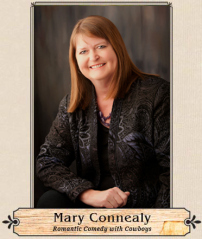
Rita Finalist Mary Connealy writes romantic comedy with cowboys. She has been a finalist for a Christy Award and Inspirational Readers Choice Awards and a two time winner of the Carol Award.
Mary has over three quarters of a million books in print. She is the author of 41 books, including Now and Forever, the newly released book #2 of the Wild at Heart series, Kincaid Brides series, Trouble in Texas Series, also; Lassoed in Texas, Montana Marriages, and Sophie’s Daughters series and many other books.
A teacher and mother of four grown daughters, Mary lives on a ranch in eastern Nebraska with her very own romantic cowboy hero.
You can find her in a variety of places:
Facebook
Twitter
Seekerville;
Petticoats & Pistols
My Blog
My Website
My Newsletter

Available ONLY in select Walmart stores
Some select Walmart stores will be carrying physical copies of Old West Summer Brides–a four-novella collection of stories from this series featuring the 12 Brides of Summer novellas written by Mary Connealy, Susan Page Davis, Davalynn Spencer and Miralee Ferrell starting July 14.
The ebook versions of The 12 Brides of Summer will be available in four ebooks with three stories in each. One will release the first of each summer month beginning in June and continuing in July, August and September. Mark your calendars for the first of the month, because you won’t want to miss a single one.
The entire collection will be released in summer 2016 in a deluxe edition book with actual pages.
And for those looking for a complete collection of The 12 Brides of Christmas novellas, they’ll be published in one book this October 2015.
Releasing October 1, 2015. You can preorder at
http://amzn.to/1FclW0u
.
The post Mary Connealy: Summer Brides appeared first on Michelle Ule, Author.
June 30, 2015
How I Learned to Pray from a Russian Jewish Peasant
Albrecht Dürer – Study of an Apostle’s Hands
How did you learn to pray?
I learned from a Russian Jewish peasant named Tevye.
I grew up in a household in which God and religious beliefs were not discussed.
The church I attended as a child specialized in formalized prayer–and I learned those because I was interested in God.
But I had questions about how to pray–the where and how–that were not answered by a tight-lipped parent raising children in a decided non-God discussing household.
So I was left to myself, mostly.
As a teenager, I met Jesus as a personal savior at a Lutheran church, which was much better about prayer, including what I considered “freelance” prayer–spoken aloud without a script.
I listened and tried to adapt, but had trouble figuring out just how and with what attitude I could pray with the God who had come alive in such an extraordinary way in my life.
I found my answer in a stage play made into a movie, Fiddler on the Roof, which you can see in the first one minute of this clip:
I love how Tevye addresses God. He’s natural, practical, to the point and chats with the easy familiarity of someone who has walked with God a long time.
He’s expressing his faith within a Jewish context, of course, but it’s real and in my life has been just as applicable.
I talk to God the same way, with a sense of irony, occasional desperation, humor, pleas and confidence I’m heard by the God who created me just this way.
I shared this ideas with our youth group last week, hoping to impress upon them that prayer is a conversation with God.
I asked them some questions about this clip:
How does Tevye address God?
What is his attitude?
Is he irreverent?
If you were God, how would you respond to him?
What can we learn about prayer from this man?
Finding Different Words
They struggled with these questions, but sat up straighter as I had them read select passages from Eugene Peterson‘s paraphrase The Message. 
(They laughed when I pointed out another Bible study teacher at our church refers to Peterson’s version as “the dude Bible.”)
Philippians 4:6-7
“Don’t fret or worry. Instead of worrying, pray. Let petitions and praises shape your worries into prayers, letting God know your concerns.”
Psalm 145:18:
“God’s there, listening for all who pray for all who pray and mean it.”
1 John 5:14:
“How bold and free we then become in his presence, freely asking according to his will, sure that he’s listening.”
My point to those young people was when they went to pray, I wanted them to be honest like Tevye–to tell God all that was on their hearts, even if it was ridiculous (“Could I have a parking place?”), or you are angry (“Why did this happen to me?”), or if you wanted to complain (“I don’t understand how you could let this happen.”).
If you pattern some of your method of prayer after Tevye’s intimacy–that you can tell God anything–the words flow better, and your ears may be better able to see when he answers.
At least that’s what I learned from watching a Russian Jewish peasant pray.
Tweetables
How I learned to pray from Fiddler on the Roof Click to Tweet
Tevye and Eugene Peterson: prayer tutors Click to Tweet
Teaching teenagers to pray to God with intimacy Click to Tweet
The post How I Learned to Pray from a Russian Jewish Peasant appeared first on Michelle Ule, Author.



![[image error]](http://commons.wikipedia.org/wiki/File:Push_Hands-close_up.jpg)
![[image error]](http://commons.wikipedia.org/wiki/File:US_Army_51674_aerobathon_knight.jpg)
![[image error]](http://commons.wikimedia.org/wiki/File%3AAlbrecht_D%C3%BCrer_-_Study_of_an_Apostle's_Hands_(Praying_Hands)_-_WGA07062.jpg)