Michelle Ule's Blog, page 67
January 19, 2016
An Italian Immigrant Story
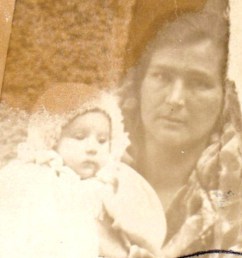
Fortunata, 30; the baby, 2 months.
My mother was an Italian immigrant.
That’s her in the passport photo.
Mom’s the baby.
My grandmother, Fortunata, is the heroine.
Or the crazy woman, depending on your perspective.
If Fortunata looks a little stressed, keep in mind her baby was only two months old. Her other children were nine and eighteen months.
They was leaving in two weeks to travel to 1931 America where her hardworking immigrant husband Antonio waited.
None of the four travelers spoke English.
Good luck.
Her oldest daughter, Rosa, remembered the excitement of leaving her unhappy grandparents and homeland in Milazzo. Family brought gifts, many tears and hopes Fortunata wasn’t out of her mind.
None of them had ever left the northeastern corner of Sicily before.

SS Roma; the Italians turned her into an aircraft carrier in WWII!
Fortunata and her young family rode a Sicilian carrota to Messina, ferried across the strait and caught a train to Naples.
Once the foursome reached Naples and made their way to the docks, the SS Roma swallowed them up. No surprise, almost as soon as the ship set sail, Fortunata’s adrenaline disappeared.
Sea sickness overtook her historically queasy stomach and she couldn’t keep down any food, nor even get out of bed to care for the children.
Someone learned how sick Fortunata was, and arranged for her to go into the infirmary with all three children, where they remained for the entire voyage.
“The only thing I really remember about the trip was being very sick and hearing the hospital nurse yelling at Franco to leave the bed pans alone,” Rosa said.
The ship landed at Ellis Island on April 6, 1931. Rosa remembered seeing the Statue of Liberty.
US officials allowed Antonio on board ship to help his family through customs.
As American citizens ((because my grandfather was a naturalized US citizen, the whole family were automatically US citizens), their inspection was cursory–which was a miracle.
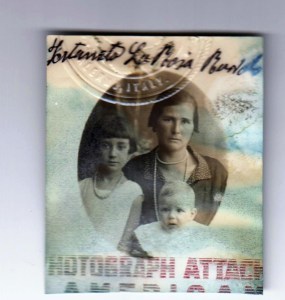
Rosa, 9; Franco 18 months.
Fortunata had hidden a bottle of champagne in the baby’s diaper as they went through customs.
Antonio was furious when she pulled it out–far from the docks. Had the customs agents found the bottle, the entire family would have been deported back to Sicily in Prohibition-era New York.
Fortunata’s immigrant experience bears little resemblance to many coming to America today–though it’s important to note she was an American citizen traveling on a US passport.
Her children were cared for, her family welcomed.
Once reunited with her husband, the family boarded a train and rode it across the country to San Bernardino, California.
This time, of course, Antonio could help with the children.
My family all benefited from Fortunata’s courage in setting off from the only home she knew and sailing across an ocean to a land where she didn’t know the language.
As for me, I’ve travelled the world with infants myself–always on an airplane. I can’t imagine spending two weeks on a ship with three young children and feeling poorly–even if, like Fortunata, my husband was on the other end waiting for me!
What challenges did the immigrant ancestors–even if it includes your mother–meet as they moved to the new world?
Tweetables
An Italian family immigrates to America in 1931 Click to Tweet
An Italian woman’s courage, taking 3 kids to 1931 America. Click to Tweet
Smuggling champagne in a baby’s diaper. Click to Tweet
The post An Italian Immigrant Story appeared first on Michelle Ule, Author.


January 15, 2016
Bagpipes in the WWI Trenches
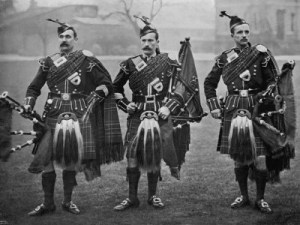 Did you know the bagpipes played an important role for the British army during World War I?
2500 bagpipe players were in the trenches with their men.
The pipers played the clarion call to arms to the men of the British Expeditionary Forces and thus were usually the first ones “over the top.”
They stood in full view of the German lines, playing their instrument, marching through “no-man’s land” without any sort of ammunition but their sound.
The bagpipe players carried no cutting devices when they encountered barbed wire. Enemy fire mowed them down just as effectively as they killed advancing troops.
600 pipers were wounded, 500 bagpipe players died while rallying the troops into battle.
They received an extra penny a day to play their pipes.
For the most part, the bagpipes skirled out the regimental tunes to get the men moving, tunes such as Highland Laddie, Bluebonnets Over the Border, and the Minstrel Boy. You can hear twenty tunes here.
Some of the more famous bagpipe rallying tunes, The Battle of the Somme and The Bloody Fields of Flanders were written in the trenches on site.
Astonishing.
The last bagpipe player survivor from World War I was Harry Lunan of the 5th Gordon Highlanders. He took part in the assault on High Wood in July 1916.
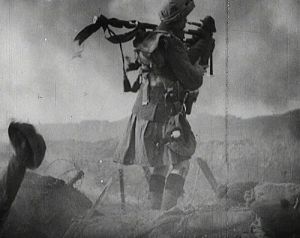
Look closely–he’s facing the battle and smoke comes from shells
He described the experience as an honor:
“You were scared, but you just had to do it, they were depending on you.
In the first assault he played the tune Cock o’ the North.
‘I played my company over the bloody top, right into the German trenches. It was stupid as hell…Men falling all around me, falling dead…it was bloody horrible.”
“I just played whatever came into my head, but I was worried about tripping on the uneven ground, which interrupted my playing. The enemy fire was murderous, the men were falling all around me. I was lucky to survive. Hearing the pipes gave the troops courage.”
Lunan’ playing caused a variety of reactions from the non-British troops:
The French enjoyed the pipes, they couldn’t get enough. They would sing French tunes and I would play them. The Germans were scared of the bloody pipes.’
Lunan died in Canada in 1994, age 98 years-old.
England still has a piper school for the military located south of Edinburgh.
For more information, view this excellent one hour film, Pipers of the Trenches, and contemplate the courage of one brand of musician.
Tweetables
Who knew about WWI bagpipers leading men over the top? Click to Tweet
Extraordinary courage: bagpipe players in WWI. Click to Tweet
Bagpipes in WWI trenches. Click to Tweet
The post Bagpipes in the WWI Trenches appeared first on Michelle Ule, Author.
January 12, 2016
Old Photos and the Restoration Process
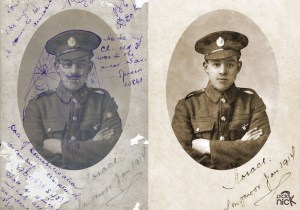
Before and after scans of a restored old photo
Some of us are good at restoring old photos using Photoshop, and some of us only can admire their work.
I’m in the admiring category.
That’s been particularly true when I wrote a novel set during World War I and first caught glimpses of colorizations of very old photos from the war.
Like many, I was intrigued. How was it done? How skilled do you have to be at Photoshop to pull off some of the restorations I’ve admired?
Fortunately, photo restorer Nick Harris contacted me and agreed to be interviewed.
A British graphic artist by trade, Nick became interested in using his years experience with Photoshop after he restored a photo for his grandparents.
“I found it really satisfying bringing them [the photos] back to life. I then went on to helping others and restoring those precious moments for their future generations to enjoy.
“I really enjoy the reactions I get when they see their restored photo. I’ve even had people say it brought them to tears when they thought their severely damaged photo was beyond repair. Old photos will only continue to deteriorate so it is vital they are saved before it is too late.”
Nick generally spends several hours to restore a black and white photo, while obviously, “the greater the damage the longer it can take.”
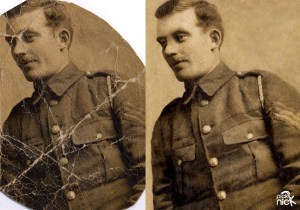
A damaged sepia photo looks nearly modern when restored
He uses a large graphics tablet for the restoration process, as well as colourising photos, and explained that using a stylus gives him accuracy and control as he works on a photo.
Some of the photos are 100 years old, particularly the WWI shots. Nick noted the photo at right,
“This sepia photo [on the right] needed a lot of of missing areas recreated, but I am really pleased with the result. One of my favourite restores [at the top of the post] is a funny one, a WWI photo that had been defaced!”
In addition to black and white photo restoration, Nick also can turn black and white photos into color. A fascinating three-minute video on his website demonstrates just how he does it. You can see it here.
In looking at WWI colorized photos of French soldiers, I was surprised at how vividly blue their uniforms were.
Nick explained some restorations require research into what the original colors were, explaining “if there are particular uniforms or medals in the photo and I know their position or rank I do some internet research,” to make sure he gets the colors correct. But “many times the shades of gray will indicate the original colors,” particularly with skin tones.
“I usually ask the customer to let me know the colours. If a colour is unknown I will look at the tones of the grey and use a bit of artistic licence,” he said.
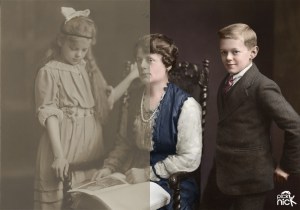
Amazing how more “real” the people appear when colorized!
Colorizing black and white or sepia photos can take around three to four hours, and even longer in a detailed photo, but the changes and how the photo tells its story are profound. “I really brings a dull photo to life,” he said.
What should you do if you’ve got old photos?
As I’ve indicated before, scan them before they get lost or further damaged and then share those scans with your family.
Nick suggests handling them as little as possible and keeping them stored in a clean, dry place.
Once they’re digitized, of course, they can be enhanced, restored and colorized if you so desire.
But if they are not scanned, that choice isn’t even available.
We’re really happy for the work Nick did for us, and for the generosity of so many others who have shared family photos–even when they don’t even know us.
Take care of your photographic heritage!
Nick restored an old photo for me and we got a much better glimpse of my husband’s great-grandmother. You can see the difference here: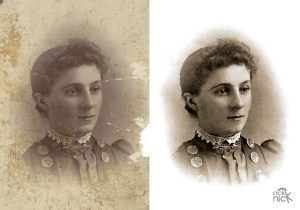
And, he very kindly made a video showing how he did it!
Tweetables
Photo restoration: how and why Click to Tweet
Amazing how more real an old photo looks when colorized! Click to Tweet
How can old photos be saved? Click to Tweet
If you’ve got photos you’d like restored, consider looking at Nick’s photo restoration service.
The post Old Photos and the Restoration Process appeared first on Michelle Ule, Author.
January 8, 2016
The London Blitz and Oswald Chambers’ Books
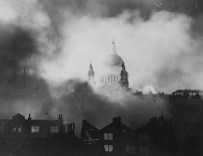
Many people have seen this famous photo of St. Paul’s Cathedral wreathed in smoke following the London Blitz of December, 1940.
What you may not know is that all that smoke is not the cathedral, but the burning of London’s book warehouses.
Among those buildings destroyed were warehouses containing all the unsold copies of the Oswald Chambers canon then in print.
Six months before at the June 1940 quarterly meeting of the Oswald Chambers Publication Association (OCPA), members discussed a letter from their book printer and warehouse manager. Simpkin Marshalls, the book distributor, had written to warn them contents of the warehouses were not insured by Simpkin Marshall, and that they should obtain their own insurance.
Similarly, the printer Butler and Tanners advised them the books on hand at their office, along with the printing moulds [what Americans would call printing plates], did not fall under their insurance and thus needed to be insured by the OCPA
The OCPA minutes note,
“After some discussion it was decided that, in accordance with the teaching in the books, the stock should not be insured. If fire should occur at Simpkins, no claim would be made and they should be informed.”
According to David McCasland in Oswald Chambers: Abandoned to God:
“One of Oswald’s abiding concerns had been to heed God’s ruling and never keep an enterprise going just because it was doing well . . .Oswald had often said, ‘When God finishes something, it must be finished.'”
The German blitzkrieg of London began in September 1940. On December 29, St. Paul’s Cathedral and the area around it was fire bombed.
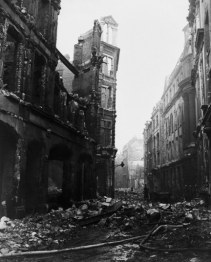
Simpkin Marshall’s building is on the left
Thanks to the sharp eyed fire watchers, some located at the top of the dome, the cathedral survived.
But not the neighborhood.
William Kent described the disaster in The Lost Treasures of London:
“Simpkin Marshall, Ltd, the greatest distributor of English books in the world, carrying the largest comprehensive stock, lost approximately four million books when their premises . . . were entirely destroyed by the incendiary bombs of the enemy.
“This disastrous fire eliminated everything. All the old records of the business going back a hundred and thirty years were destroyed; and most important of all, the great cataloguing system, the only one of its kind in the world, dating back for a hundred and fifty years.”
Ultimately, Simpkin Marshall, Ltd. went out of business.
But what of the 40,000 copies of Chambers’ books?
Gone.
According to McCasland:
“In her typical way, Biddy [Chambers–Oswald was long dead] remained unperturbed. When news came of the burned books, she put down her teacup, turned to Kathleen and said, calmly, ‘Well, God has used the books for His glory, but now that is over. We’ll wait and see what God will do now’. . . God was in control, and He would make His way plain.”
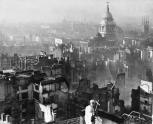
by H. Mason (Wikipedia Commons)
The OCPA, with Biddy much involved, went to prayer. They had to wait a few months for information about what, if anything, Simpkin Marshall could do to help. In the meantime, they took solace that the German versions of the books had been purchased by folks in Switzerland and were safe.
Their printer had printing plates from several books and could print them. 2500 copies of My Utmost for His Highest had been printed but not bound yet–and thus were not destroyed.
Readers wrote asking for more books, and Biddy and the OCPA knew God was not finished, yet, with the messages in Oswald’s books.
That famous blitz photo of St. Paul’s doesn’t look the same to me now that I know it is not only a testament to St. Paul’s surviving, but of the burning of London’s unsold books.
4 million copies were destroyed in one night–far more than the Nazis oversaw in the 1933 Berlin book burning.
Tweetables
The London Blitz, St. Paul’s and 4 million books. Click to Tweet
How the London Blitz nearly ended Oswald Chambers’ books. Click to Tweet
The books of Oswald Chambers destroyed in London’s Blitz Click to Tweet
The post The London Blitz and Oswald Chambers’ Books appeared first on Michelle Ule, Author.
January 5, 2016
Technology and Sharing MY Voice
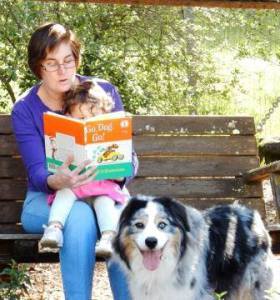
Making a memory for both the grandchild AND a dog!
I’ve spent the last month grappling with technology so as to share my voice with my family.
A box of old tapes discovered earlier this year enabled me to hear my parent’s voices once again, if only for a snippet. You can read that post here.
A further investigation into the box turned up a dozen or so tapes of me reading aloud The Chronicles of Narnia–all seven books.
I’d forgotten about them, but there they were and an idea formed.
I can’t get back much, if any more, of my parent’s lost voices, but I could give my grandchildren a gift.
Technology, if I could either master it (ha!) or find someone to help, could provide a wonderful Christmas present, if I do say so myself.
And the bonus on this?
My then seven-year old daughter was learning to read the year I read those books aloud to her.
We hear her piping voice sounding out the chapter titles.
Very sweet.

These are the tools I used
This is how I made the technology transfer from audio tapes to MP3s to CDs:
First we had to find a tape player.
I found one on the side of the road when a neighbor put out electronics for recycling. She let me have it.
We followed a variety of steps, using a auxiliary audio cord and my technology-savvy family members could manage just fine. You can read about the steps here.
It all felt too complicated to me. I finally bought a device called Ion Tape Express. With some coaching from my nuclear engineer husband, PhD son and the aforementioned daughter, even I could manage the technology!

Plugged right into my computer and came with its own headphones
Download the program (from a CD!), put in the tape, follow the two steps, press play and monitor. It even turns itself off when it reaches the end of the tape.
We had a lot of double-sided tapes. It took nearly a week to turn them all into MP3s. It did not require close monitoring; I performed lots of other duties while it worked, but I did have to stay on top of it to keep my large task on track.
Because the Ion turned off when it reached the end of the tape and I had just merrily read along all those years ago, we had some problems with continuity. While I was able to burn CDs right off my computer, ultimately the burn process went much better when all the “tracks” were shifted to Itunes.
Each book became its own playlist and then Itunes burned the entire playlist, in order, directly onto the necessary CDs–most of the books with 80 minute CDs required 4 CDs each.
Two of the taped books had corrupted files; or at least I couldn’t figure out how to put them into a correct order once we got them into Itunes.
As a result, I reread, aloud, The Lion, the Witch and the Wardrobe and Prince Caspian, directly into my phone.
They transferred easily and smoothly to Itunes.
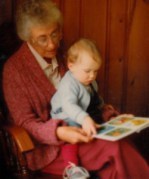
Would so love to hear her voice again!
Our grandchildren are very young; CDs are best for their age. Their parents will get the whole readings on a flash drive–so they can listen, but also so they can burn their own CDs when the children destroy what I made!
Because most cannot read yet, my husband made labels with pictures for each book, numbering the CDs.
They should be able to manage the CDs and their players, just fine.
We also, of course, gave them a complete set of the books for their own reading enjoyment–some day!
For me, remembering the joy of hearing my parents’ voices, my hope is technology will remind my adorable grandchildren for years to come, a voice of love reading a wonderful series of books.
What would you like to hear your parents or grandparents say or read once more?
Tweetables
Technology and a loved one’s voice.Click to Tweet
Transferring audio tapes to CDs for memory’s sake. Click to Tweet
Grandma’s voice reading Narnia–forever? Click to Tweet
(Note about copyright: I did NOT sell my reading of these books. In addition to burning 30 CDs of MY voice reading the books aloud to MY family –with a commentary or two–I also purchased and gave the same children all seven books.)
The post Technology and Sharing MY Voice appeared first on Michelle Ule, Author.
January 1, 2016
Recovering a Loved One’s Voice
 For a long time I never deleted the first message on my answering machine: I needed to save his voice.
One hurried day, I listened to the messages and then hit “delete all.”
I gasped and I tried to stop it.
Too late.
I felt to the floor beside the machine and sobbed.
I had just deleted my father’s voice singing Happy Birthday to me.
He was dead. He’d never sing it again.
And I knew I’d never hear his voice again.
In not saving that bit of tape, I’d lost my ability to share his voice with my children and others–so it felt like his voice, just like my mom’s, was lost forever.
I can still hear their cheerful voices in my head–my mother, father, grandparents: Mom is calling me to wake up; Dad laughing at some silly remark. My Sicilian grandmother’s voice is shrill but kind, and I still don’t recognize where my Utah grandmother got her well-loved twang.
Their voices are gone in the physical, a whispered memory in the metaphysical.
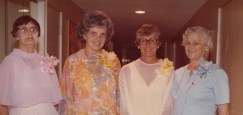
How I’d love to hear their voices again!
Two years ago while sorting through possessions, I found an audio tape marked, “Rosie Interview.”
I inserted it into the old car’s cassette deck (the only tape player we owned) and once more heard Auntie Rosie’s voice answering questions about her childhood.
I had sent them to her 25 years before while I was writing my grandfather’s biography. With three pages of questions to answer, she decided to tell the stories rather than write them down.
I’m so glad she did.
It was a special gift then but even more precious now–eight years after her death.
Her newly engaged granddaughter was having a party to celebrate and my techy-daughter figured out how to transfer the tape to an MP3 and burn audio CDs.
We made a half-dozen and she took them to the party–where the bride-to-be’s eyes filled with tears when she realized whose voice was on the CD.
Rosie’s brother and other children were also thankful to have her voice back.
I was only sorry I didn’t have a tape of the bride-to-be’s mother, and then a grudging thought flit through my mind–“what about my mother?”
Her voice went silent in 1995.
My dad’s in 2002.
All I had were echoes.
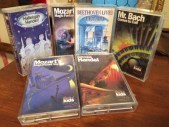
Well-worn Classical Kids tapes
Voice Serendipity?
Earlier this year I stumbled onto another unexpected box of audio tapes.
I sighed. Here was another antiquated technology I needed to deal with. (You can read about obsolete floppy disks here).
As I turned over the tapes, I remembered all the happy times I had listened to them in the car. (I love the Classical Kids Collections). So many memories!
I’d always enjoyed a Pirates of Penzance performance I’d taped off the radio. I reveled in the rollicking music and sang along. It ended just as I turned up my street. I let the tape play out and just as I reached my driveway, my father’s voice boomed.
I was crying before the garage door opened.
I hadn’t heard his voice in 13 years.
My son had used that old tape to interview Dad discussing his family history.
I only had five minutes of his voice, but I sobbed hearing him again.
And then, just a scrap of seven or eight words: my mother helping him answer a question and the tape clicked off.
Mom!
20 years!
I was a near-hysterical wreck, replaying and replaying, and each time, mom’s sentence was cut off before she was done.
Inconsequential words, but her voice just the same.
I’m crying right now.
My daughter transferred the clip to my computer and I shared it with my brothers. My parents’ voices, just a smidgen, not completely lost.
I’m so thankful, for just that much.
My point?
You’ve got a recorder on your phone. Record the people you love.
It doesn’t even matter what they’re talking about–in fact, a regular conversation can be a pleasure.
Listen to their voices, you’re going to miss them one day.
And for your children and your grandchildren–record yourself talking.
A loved one’s voice is a precious gift.
Whose voice would you like to hear today?
Tweetables
Serendipity and a lost mother’s voice. Click to Tweet
You’ve got a phone: record their voices while you can! Click to Tweet
Recovering a loved one’s voice for comfort and sharing! Click to Tweet
The post Recovering a Loved One’s Voice appeared first on Michelle Ule, Author.
December 29, 2015
6 Things I Learned from 6 Blogging Years

Written on this computer
This month marks *six years of blogging. Here are six things I’ve learned.
1. I like to blog
As a once-upon-a-time newspaper reporter, I had anticipated I’d like blogging and that has turned out to be true.
I like putting together the ideas, finding the photos, dreaming up a pseudo-clever title and interacting with folks who read my words.
(Please leave a comment or tweet!)
The best thing about a blog you own is it’s yours and you can write about anything you want.
It makes me more attentive to what happens around me, as well, because
2. A twice-a-week blog is like having an extra child.
My husband learned this early. The blog must go on, no matter what.
I haven’t missed a post in six years, though I obviously write them ahead of time if possible.
But I can never forget the blog. As I walk through my life, I’m constantly looking for blog ideas.
I carry my phone everywhere so I can take photos for potential blogs.

This picture, for example, has never appeared in a blog post.
I take a lot of photos that never end up on the blog. 
3. The oddest blog posts get plenty of readers
It doesn’t seem to matter what I write about. The days I’m in despair and can’t think of anything and just throw together a post, often end up being the ones most read.
Why?
I have no idea.
Do you?
4. Amount of time spent writing a post does not necessarily correspond to numbers of readers.
Often the posts I whiz off in under half an hour turn out to be popular–probably because I’m feeling cheeky or impassioned if I write that fast.
Posts that take me agonous periods of time to write don’t necessarily get a lot of traction.
Especially when writing the WWI posts, I make a huge effort to get the facts correct, which takes time and often involves reading many links.
The pictures, too, require special treatment.
Fortunately, I love to research and write them, otherwise there would be no point–from a “return on investment” point of view.
5. Two of my three most popular blog posts were written about Oswald Chambers and his daughter Kathleen.
I’m pleased you like them, but I’ve written twenty more!
You can click on the Oswald Chambers/World War I tab above for the complete list.
Or click here.

Oswald, Biddy and Kathleen Chambers on camels
My posts have elicited information we did not know about Oswald Chambers. This post described one of my most thrilling research moments.
Some of those posts took a long time to write, some did not. (Thus, no clue on #4)
The second most popular is the provocative: The Nudist Colony Field Trip.
I wrote it really fast on a day I couldn’t think of anything else, so I picked a funny story from my life . . .
Lots of people have liked it!
6. Even if I never publish another book, I anticipate continuing to write my blog.
I love blogging that much.
I can hardly wait to see what I’ll write about in 2016!
Happy new year to all.
Tweetables
Lessons learned from 6 years of blogging Click to Tweet
6 things I’ve learned from 6 years of blogging Click to Tweet
Blogging is like having an extra child. Click to Tweet
*I’ve actually been blogging for longer than six years thanks to writing for the Books & Such Literary Agency blog, starting in 2009. Here’s the link to my first post there.
I’ve been commenting on blogs since World Magazine‘s now-defunct blog began in 2003.
I also blog on the last Monday of the month on Novel Pastimes
The post 6 Things I Learned from 6 Blogging Years appeared first on Michelle Ule, Author.
December 25, 2015
Merry Christmas 2015

Her father’s humor: our Ule log in 2013
Merry Christmas to all.
My family is spending this week in a myriad of activities.
As members of a Lutheran Church choir, we’ll be singing the wonderful music of Christmas–in four-part harmony.
We sang a variety of songs on Sunday night at the annual Christmas concert. I’ve been playing my clarinet all season long for our Wednesday night Advent services and of course we have children in the family who want to sing lots of songs!
(One is missing her two front teeth this Christmas. You know the song right?)
My favorite Christmas album is Nat King Cole‘s, but I’ve been humming along with our local radio station the entire month, savoring the highlights!
It makes me laugh to hear angels triumphant shouts coming through stores speakers throughout December.
My husband’s family celebrates their heritage on Christmas Eve–before we go to the late service–by eating Slovenian sausage ordered from Cleveland.
Even my grandchildren savor the meat!
(I prefer the carrots and cabbage, myself!)
Everyone likes the potice (pronounced po-teet-zsa; a nut roll) and will be singing happy birthday to Jesus on Christmas day when we light a candle on our annual Ule log. (Recipe here)
(The pun is a joke, but we sure enjoy the cake!)
We’ll be playing The Game, since we’re up to twenty or more family members this holiday, and drinking sparkling champagne and apple cider.
It’s a tradition, of course, and we love it.
 Jesus is the reason for the Christmas season, and we like to remember that babe born in a manger so long ago, who grew up to be the savior of the world.
I’m beyond grateful.
I came to faith during the Advent season. I remember the contrast between light and darkness every year for that reason.
Rejoice with us!
The Savior is here!
Merry Christmas.
Michelle has written an ebook called Reflections on Advent, available to subscribers to her newsletter. If you’re interested in obtaining this free Advent gift, click on the link here.

Click to subscribe: http://eepurl.com/2l7F9
The post Merry Christmas 2015 appeared first on Michelle Ule, Author.
December 22, 2015
Happily Ever After: Defending Truth

Happily Ever After: Defending Truth
In A Pioneer Christmas Collection, Shannon McNear portrays a surprising romance between a militiaman loyal to the Crown hiding after a battle in which his side lost, and a young woman patriot in charge of her siblings when her father goes to fight in Defending Truth. “People were all just struggling to live their lives, and the politics were as upsetting and confusing as today.”
Celebrating Christmas in the cave where her hero was hiding, seemed a terrific idea, and certainly a unique one.
The rest of the story:
Micah and Truth were married, with more haste than was probably seemly, and by the next Christmas their first baby had arrived, much to the delight of her younger siblings. Several more came in due time, and while many in the Bledsoe family followed the westward migration, Micah and Truth were content to raise their family at the edge of the Watauga Valley. Micah became a respected member of the community and remained involved in home defense and negotiations with the Cherokee. Did he ever see his own siblings again? Well, that remains to be seen …
It would be a misnomer to say “they lived happily ever after,” because life is, well, life, and the frontier held very real peril even as the land became more settled. Yet Truth found more joy than she thought possible being Micah’s wife—though she always gave him more sass than proper, she was sure. Their faith was tested again as they relinquished their fourth baby back into the arms of God, but the four that came after—for a total of seven who lived to adulthood—reminded her that hope will live on as long as the sun continues to rise and set.
The real-life Anthony Bledsoe and his brothers moved west and built a fort at Bledsoe’s Lick in what would become central Tennessee. Anthony died here in 1788 as a result of Indian attack. Loving Bledsoe (“Lovin” by some accounts and thus my spelling of Loven) took his family further west, across the Mississippi, and is buried in St. Charles County, Missouri. Many of Micah and Truth’s children followed as the years went on and added their strength to what became the famous pioneer spirit of the American West.
If you would like to view photos and drawings about Defending Truth, see Shannon’s Pinterest board here.
What’s happened to Shannon?
Defending Truth was Shannon McNear‘s first published story, and it was nominated for a RITA award.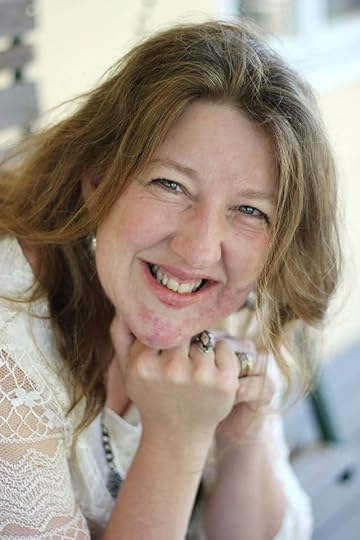
The military wife and homeschooling mother of eight has been busy since publication, caring for family and moving. Her novella The Highwayman was published in May 2015, as part of The Most Eligible Bachelor Romance Collection.
About A Pioneer Christmas Collection, Shannon wrote:
“I think the strength of Pioneer Christmas is that all of us seemed to be able to focus on a time when the celebration was simpler—no commercialism, not so much focus on the gifts.”
She had no trouble envisioning her characters moving on in life:
” I’m one of those crazy writers whose characters very much take on a life of their own … often I wish I could have written a longer story, or sequels.”
Merry Christmas!
Tweetables
What happens to a rebel and loyalist after the wedding? Click to Tweet
A patriot and a Tory living happily ever after? Click to Tweet
After Defending Truth; life in the Watauga Valley Click to Tweet
It’s the Advent season and Michelle has written an ebook called Reflections on Advent, available to subscribers to her newsletter. If you’re interested in obtaining this free Advent gift, click on the link here.
Click to subscribe: bit.ly/1yMSAAj
The post Happily Ever After: Defending Truth appeared first on Michelle Ule, Author.
December 18, 2015
Happily Ever After: A Badlands Christmas
Happily Ever After: A Badlands ChristmasAs part of A Pioneer Christmas Collection, Marcia Gruver takes us to sophisticated 1885 New York City in A Badlands Christmas, though we don’t stay there long. Inspired by the adventures of Theodore Roosevelt in the town of Medora, A Badlands Christmas shows the contrasts between festive scenes in the city and a Christmas spent in a dilapidated sod house in the middle of a brutal Dakota Territory winter.
Our poor immigrant has to live half underground!
The rest of the story when, s everal years later, Noela Nancarrow wrote a letter:
My Darling Mrs. Baumann,
Truly you are a darling, for you have shown me the greatest kindness. Securing Mum’s piano and chair for me was blessing enough, but sending her snow globe was the height of kindness. Holding it in my hands again, my joy is full. You may ship the other items immediately. Hiram has finished the house!
It’s a lovely wood frame, and though hardly the Chateau de Mores, it is home and a palace to us. Did I mention that the lumber was a wedding gift from Mr. Roosevelt? We are forever in his debt.
The house has a bedroom for Hiram and me with a view toward the rolling plains. There is a nursery, of course, and a room downstairs for the twins. The girls are walking now and such a joy—Rachel, dark-eyed and thoughtful, Cherie, fair-haired and adventurous.
I’m afraid I must postpone my visit to New York this Christmas, though we will send Beatrice in my stead. You see, the nursery won’t be empty much longer, so travel is out of the question. Hiram longs for a boy this time. If we are so blessed, we’ll call him Nathan Allen.
Father has settled into his role of Dakota farmer, and Bea as mistress of Vine House. With Hiram’s help, they expanded the soddy and added more outbuildings. This once God-forsaken land no longer seems like a bad dream. Wherever our feet trod on this blessed 160 acres feels like home. I believe, with God’s help, we’ll prove the Nancarrows are indeed a hearty breed. I have no doubt the McGregor offspring will follow suit.
Eternally grateful for your kindness,
Noela Nancarrow McGregor
What’s happened to Marcia Gruver?
After a major move from the Southeast Coastal Region of Texas to the gorgeous Texas Hill Country, Marcia put her writing on hold for a bit. However, with various plotlines, settings, and character conversations tumbling in her head, she’ll be settling down behind the keyboard in the very near future.
As to A Pioneer Christmas Collection, she wrote:
I love the unique combination of early American pioneers spending Christmas in remote places, unconventional homes, and rustic shelters—overcoming hardships while discovering the magic of Christmas.
Reading Christmas novellas awakens the spirit of the season and, in most cases, reminds me of the reason we celebrate the birth of Christ. I enjoyed writing one for much the same reasons and especially liked rubbing shoulders with the talented group of authors in A Pioneer Christmas.
Merry Christmas!
Tweetables
Theodore Roosevelt supplies the wood for a Pioneer Christmas home. Click to Tweet
Getting over the difference between New York City and Medora, ND. Click to Tweet
A chateau or a soddy? One woman learns to value the ND earth. Click to Tweet
It’s the Advent season and Michelle has written an ebook called Reflections on Advent, available to subscribers to her newsletter. If you’re interested in obtaining this free Advent gift, click on the link here.
Click to subscribe: http://eepurl.com/2l7F9
The post Happily Ever After: A Badlands Christmas appeared first on Michelle Ule, Author.