Michelle Ule's Blog, page 66
February 23, 2016
What is Bandage Rolling?
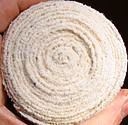
Gauze bandage roll
If you’ve read as many WWI books and war-based fiction as I have, you may be wondering “what IS bandage rolling?”
Why were women always rolling bandages and what did it have to do with war?
As a child in 20th century America, the only bandages I was familiar with were bandaids.
How do your roll those?
When we got proficient at using up all the bandaids at home, my mother started buying rolls of gauze and tape for us to use instead.
It was harder–the white tape always stuck to itself if you didn’t manage it well and homemade bandages weren’t anywhere as neat as bandaids.
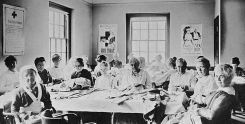
Red Cross bandage rolling 1914
You also had to wrap a lot of it around a limb to stop the bleeding.
Eventually, we learned how to cut a piece and make a pad and then tape it on–like a bandaid–but that came from trial and error.
I never once wondered how the gauze strips were rolled up until I wrote a novel about World War I and wondered how that was done.
Here’s the description from my novel, with commentary from the skeptical heroine:
Setting a hat on her head like her mother and with her mind alert to potential story ideas, Claire joined Sylvia and her smart set of friends to roll bandages for the war effort.
The half-dozen women gathered around a long polished table in a sumptuous dining room hung with portraits of ancestors. Claire would have liked to inspect the paintings, but she’d come for a purpose. “Show me what to do.”
“Wash your hands in the basin, stand at the end of the table and roll away,” Sylvia said. She and a young woman dressed in similar layers of fine silk, giggled together. Claire smoothed her hands down what she’d come to regard as her uniform: a white shirtwaist tucked into a black skirt and sensible shoes.
Four inches wide and the length of the banquet table, the soft white gauze-thin muslin rolled up easily. Claire wound the cloth as tight as possible, the strip slowly moving down the table in her direction. She tied off the three-inch thick cylinder with a piece of twine and started on the next long piece of muslin. Sylvia and her four friends worked at the table: two cutting the fabric into lengths, two laying it straight on the table and one joining Claire to roll.
The pace was leisurely, the conversation tedious: new officers ordering expensive tailored uniforms; questions about the coming season; would silk be hard to procure? Before she’d finished the fifth bandage roll, Claire knew she’d not return. Her notebook listed one question: “Do Sylvia’s friends have any meaningful ways to spend their time?”
Their frivolity galled her when she thought about Peter daily risking his life to fly flimsy wooden bi-planes.
At the other end of the spectrum, the hearty suffragettes were determined to help the war effort any way possible. A dozen women of varying ages rolled the immense pile of muslin in an hour, all the while debating how to get the vote before war’s end. Far more educated than Sylvia’s set, they applauded Claire for holding a job.
The rolled gauze, of course, made it easier to wrap around a limb or, worse, a head from the many horrific wounds suffered at the front.

Even Scarlett knew how to roll bandages.
Gauze wouldn’t cling to the open wound as much, though bandages were often made from a variety of fabric–including strips torn from petticoats if need be.
It was something constructive women could do, the bandages were always needed and some groups would pray as they rolled.
Today, the rolling is done by automatic machine and as a result, far more effective, sterile and consistent in size.
Does it carry as much love and concern?
Obviously not, but unfortunately, will always be just as necessary.
Tweetables
What IS bandage rolling? Click to Tweet
What Scarlett O’Hara has in common with the Red Cross: bandage rolling. Click to Tweet
How did women roll bandages in WWI? Click to Tweet
The post What is Bandage Rolling? appeared first on Michelle Ule, Author.


February 19, 2016
Novelists and Prayer Requests

A bolt of imagination or the answer to a prayer request? (Wikipedia)
Do novelists have an easier time with prayer requests than “normal” people?
In the sense that they can imagine God doing great and wonderful things even in the grimmest circumstances?
Do you know people like that?
Or if not a novelist like me, do you perhaps know imaginative people who often speak with confidence about what God could do?
My husband and I were discussing someone the other day and voiced hope for the individual’s dreams.
“But you know, I’ll be okay if it doesn’t happen,” I tossed off.
“Really?”
“Of course, because that means God has something else even better planned.”
(It’s easier to imagine such things when it isn’t your life.)
I’ve been thinking about young people and how challenging it is for many to get started in a job they love.
Part of my role as a parent is to encourage my children that God will provide what they need at the right time–even if they don’t recognize it.
My engineer husband is also encouraging, but doesn’t indulge in the flights of fancy I can pull out at a moment’s notice.
We were laughing about that when we realized part of my writing job is to create imaginary scenarios–the more challenging the better.
By the end of the story, my characters need to have resolved their issues, found peace and hope, and moved on to wherever God (or in a story’s case, me) decides they should go.
I can give my characters a happy ending if I want to.
With the Lord, every ending is the one He desires. He knows every hair on our heads and the number of our days.
Some of those endings are brutal and horrible, devastating, and yet the end result always can be heaven with the Lord.

Holy Spirit (Wikipedia)
In the aftermath of the 9-11 disaster in the United States, Pentagon officials invited a number of Hollywood writers and film directors to a meeting.
They wanted to pick their brains and their imaginations about potential future terrorist attacks.
The Pentagon planners realized they might have a blind spot on creativity. People who saw events from a different angle could dream up “what if” strategies they could possibly use.
Novelists can do the same with prayer requests.
I call it “turning the prism,” and looking at events from a slightly different angle.
It may seem like events could be used for evil, and hard to imagine a positive outcome. But Scripture reminds us “As far as you’re concerned, you were planning evil against me, but God intended it for good, planning to bring about the present result so that many people would be preserved alive.” (Genesis 50:20; International Standard Version)
We need to pray, yes.
But sometimes when my prayers feel stymied, I ask God to give me imagination to know how to better pray and to provide hope–both for me and the person I’m praying for.
That’s why I’m asked to be an intercessor, right?
It’s often better if I don’t know a lot. I don’t need details to pray for someone.
I need the Holy Spirit to convict me, the Bible to guide me and Jesus –always–to forgive me.
I can trust God will use my prayers and whatever the situation to his Glory.
Thanks be to God.
Tweetables
Novelists and prayer requests. Click to Tweet
Do novelists make more hopeful pray-ers? Click to Tweet
Using your imagination to pray. Click to Tweet
The post Novelists and Prayer Requests appeared first on Michelle Ule, Author.
February 16, 2016
Writing Mania’s Grip

Writing mania–mild mannered one day, blowing with energy the next. (Wikipedia)
I’m in the midst of writing mania these days.
It’s glorious.
It’s exhausting.
It’s numbing.
It’s an adrenaline high and I’ll be happy when it’s done.
What is writing mania?
Let me describe Saturday to you.
I’ve been trapped in a wild writing cycle all week long–waking early, writing for several hours, then living a “normal” day, which included writing all afternoon.
My body was giving out–mostly my eyes–by 8:15 every night, so I went to bed. My husband had a good book, so no worries.
Friday was the same. Exhausted by 8, I crawled into bed. I was so tired, I could only read five pages of the terrific The Guernsey Literary and Potato Peel Pie Society, and then I was asleep.
I woke at 2:15.
I’d hoped for something more reasonable, say, 5:15, to catch up on the week.
But the cat was on to me at 2:15, yowling and demanding food. I ignored her and tried to fall asleep again.
Little lines from the story plagued me.
I decided to pray instead.
The cat stalked all over me.
My husband slept soundly.
At 3:45 I gave up and got up.
I had something warm to drink.
Checked my email, social media, said hello to a friend in Papua New Guinea–talking on the same day for once–and had my morning devotions.
I didn’t feed the cat until the customary 5:30.
Wide awake, I went to my office upstairs.
As customary, I’d left the biography I’m writing in an easy place to dip back into.
But I’d no sooner opened it, when I got an idea for a blog post.
I wrote the blog post, including photos, tweets and all the other items necessary to make a blog post work.
Then, to my surprise, another blog post idea came up.
I wrote it.
By then, I was ready to get into my book.
I really needed to finish chapter five that weekend.
Biography writing is very time consuming. I have to check, recheck, and reexamine everything and I like to do it as I write.
An hour or so into that, another blog idea struck.
I wrote another blog post.
Then I ate breakfast, tossed in the laundry, cleaned the kitchen, kissed my husband, let the cat in and out, and drank a cup of coffee.
Back to the book.
I could only write until 11 o’clock if I wanted to get a walk in before a memorial service and then a movie date (4 o’clock showing, we knew I’d never last any longer).
Several glasses of water, a plot discussion with my husband, ANOTHER blog idea (made note of it, no writing), and returned to the last four pages of chapter five.
I finished it all at 10:50.
Dazed, astounded, so very thankful, I bounded down the stairs, kissed my husband, turned on the printer, moved the laundry, let the cat in and out, then got dressed!
My husband read the chapter.
He loved it!
By 11:15, we were out for a walk.
I turned off the computer when I got home. No matter what siren called from the keyboard and screen, I was done for the day.
I’ve had writing mania before.
While finishing my WWI novel, I knew exactly how it ended and I wrote the final 25,000 words in five days.
It’s a glorious feeling–the words poured and I could scarcely type fast enough ( I type 125 words a minute).
All the cylinders were firing and I lost track of time completely, shocked when 12 hours had passed.
When I came down off the writing mania and read through my work with critical eyes a week later, I cried.
I wept over the ending of that book–because the writing was good, yes, but also because I couldn’t believe the intensity of the ideas and that I wrote it.
Truly a marvelous, wonderful, awe-full, incredible feeling.
I’ve got 10 chapters to go on this biography–about 30,000 words.
I can hardly wait.
Though, I’d really prefer to live like a normal person, living manageable hours.
LOL.
Tweetables
Writing mania–what it looks like in real life. Click to Tweet
Living with writing mania. Click to Tweet
Writing mania–read it and weep. Click to Tweet
(Note: this is my first day back at the keyboard after Saturday. I wrote this post–which struck me before I got out of bed–in 20 minutes. The throes of writing mania may be back–but I’m going to the gym first.)
The post Writing Mania’s Grip appeared first on Michelle Ule, Author.
February 12, 2016
Bible School Students and Oswald Chambers Part III
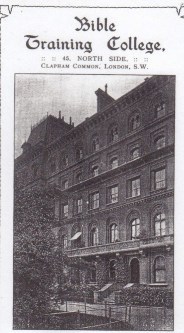 What happened to Oswald Chambers‘ Bible School (BTC) students?
What do modern students do with their Bible school training?
Many people, then and now, argue that studying the Bible is an important grounding for whatever you want to do with your life. If you know the basic truths of God’s word and how to apply them, you can take that knowledge into any study and career.
Students attend Bible school for a variety of reasons (see previous post), often in preparation for ministry or just spiritual discernment.
Many came to the BTC over four and a half years for that training. (The school ran from 1911 to 1915 when it closed because of WWI).
Five students in particular are worth considering:
Phillip Hancock was sent by a missionary board.
Jimmy Hanson felt a call to overseas missions.
Gladys Ingram dreamed of a missionary’s life.
Eva Spinks was at a crossroads with no clear vision for her future.
Gertrude Ballinger arrived for a few weeks of “spiritual refreshment” and decided she, too, had a calling to serve Christ.
All five students ended up following Oswald and Biddy Chambers to work among the ANZAC troops in Egypt during World War I.
They slaved in the desert heat, serving tea, encouraging soldiers, traveling to YMCA stations in far-flung locales and pouring out their service for the sake of the Gospel.
Once the war ended, they all ended up in Christian ministry.
Like many young people attending classes together, Phillip Hancock and Gertrude Ballinger fell in love. They became engaged while in Egypt and married there. They served as missionaries in
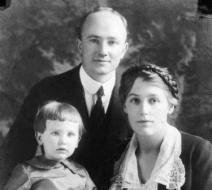
Phillip and Gertrude Hancock
Persia for many years.
Gladys Ingram met an Anglican minister and married him in 1919. A week later they sailed to India where Vyvyan Donnithorne eventually became the Anglican bishop for the entire Indian sub-continent.
Once finished in India, they moved on to China and are buried in Hong Kong.
Jimmy Hansen married fellow BTC alum Florence Gudgin and they raised their family in a grimy East End London missionary station among the worst of the worst. (The hall once was a notorious bar!) Jimmy also played a major role in later years as chairman of the Oswald Chambers Publications Association and helped Biddy Chambers produce Oswald’s books.
Eva Spinks, a charming pianist married another Anglican rector and lived her life as a pastor’s wife in England. She and her husband Stephen Pulford met in Egypt while he served as a soldier in the British Army. Stephen became a Christian as the result of Oswald Chambers’ YMCA ministry in the desert.
Their time at the BTC was well spent personally as well as spiritually. Their roles were birthed out of their love of God.
Other resident students became missionaries in, among other places, the Belgian Congo, India, Canada, France, South Africa, the United States, China, Australia, and all over the United Kingdom.
How about modern Bible school graduates? What do they end up doing besides becoming pastors?
Among the seven I interviewed, all are still faithful Christians who have taken their training in different directions:
A Deaconess in the Lutheran Church Missouri Synod, married to a pastor.
A computer systems administrator married to a pastor.
A CPA who teaches Sunday school.
An overseas missionary.
A novelist.
An international energy expert who teaches Sunday school.
An editor of Christian bestsellers.
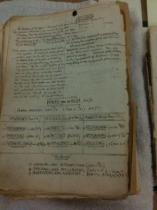
Oswald’s Bible
When the modern Bible school alumni discuss their training and its present value, they reflect on the unexpected things they learned in addition to the Bible:
“The Listening course taught me a lot about how listening well to others is a gift, an act of love. You could say it was a class on how to love others well.”
“The importance of being ME and learning what I do not want in life.”
“Cult apologetics, Christian education for adults and discipleship.”
The deaconess got all her practical training and the missionary uses Bible school education tools daily.
Bible school is only the beginning of a Christian’s walk through life. Most people study the Bible in small groups or on their own. A school can help those interested in a little more. As the missionary said:
“I wanted to study the Bible in community, in an academic atmosphere where learning is meant to result in application. Otherwise I could have just taken distance courses by myself.”
The editor agreed:
“The professors were encouraged to eat with the students and to be mentors and friends. Christianity is part of all life, not just an add-on to your education.”
Oswald Chambers most certainly would have approved.
What do you think the point of Bible school is?
Tweetables
Trained by Oswald Chambers? Then what do you do? Click to Tweet
What do people do with degrees from Bible school? Click to Tweet
What happened to Oswald Chambers’ Bible school students? Click to Tweet
Note: This is the third and last post about Oswald Chambers and his Bible Training College (BTC). You can read the first two here:
Part I Oswald Chambers and the Bible Training College
Part II: Oswald Chambers and Bible Classes
The post Bible School Students and Oswald Chambers Part III appeared first on Michelle Ule, Author.
February 9, 2016
Oswald Chambers and BTC Bible School Part 2

Oswald Chambers
When Oswald Chambers set up his Bible Training College (BTC) in 1911 he had two things in mind: training students in the Bible and how to apply the Bible‘s teachings to practical living.
His aims more than 100 years ago, ring similar to Bible schools today:
“The aim of the Bible Training College is to provide the training ground for workers who will “study” to become ‘workmen needing not to be ashamed.'”
I spoke with seven Bible school alumni about their experiences to better understand if Oswald Chambers’ BTC and goals remain just as valid now.
BTC students were headed to the mission field (several were sent by the boards for a thorough preparation), some came for personal growth and spiritual development, others because they weren’t sure what they wanted to do with their lives.
Most of the former students I talked with voiced similar reasons for attending Bible school:
“I wanted to grow in my understanding of Jesus and the Bible.”
“I had no idea what else to do and my dad was paying for it.”
“I planned on being a missionary.”
“I thought I wanted to do church work.”
Their Bible schools and seminaries included Biola, Moody, Multnomah, Concordia and several independent Bible schools in the US and Canada.
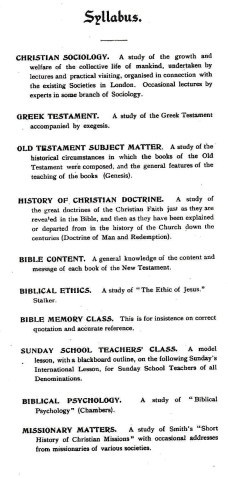
1914 BTC syllabus
Oswald taught most of the Bible courses at the BTC and his syllabus included Old Testament Subject Matter, Christian Doctrine, Biblical Ethics, Christian Habits and Biblical Psychology.
He believed missionaries needed to have a firm grounding in the basic “guide to life” provided in a close reading and comprehension of the Bible.
Bible colleges still focus on the same things.
“Bible school gave me a good foundation both in terms of knowing the Bible and applying it in my life. I came away with a good overview of the Bible historically and thematically.”
“I went to get some of my theological questions answered . . . I came away after three years . . . with far more answers that I started with but also with the understanding that answers aren’t everything and they aren’t what the Lord requires of us.”
“I learned the theological objective was to clearly explain what Scripture said.”
“I learned how to read the Bible and recognize false teaching.”
The BTC prospectus pointed out
“the spiritual life must be allowed to take root, a firm root, before it is placed in the full blaze of intellectual criticism, and (on the other hand) the indefinite amiability of the times in which we live.
“While, therefore, the intellectual and practical duties are strenuous enough, our main object is the development of spiritual insight and calibre in the students.”
To that end, Oswald led a devotional class one afternoon a week in which he met with just the enrolled students (the other classes were open to the public).
In that class, he listened and talked with the students about issues on his heart and on theirs. Oswald and his wife Biddy spent an inordinate amount of time getting to know and praying with the students who lived at the BTC. (24 at a time; 104 over the four and half years the school was open).
The goal of both the BTC and those of the Bible school my interviewees attended was the same: to see the students apply the truth of Scripture to their lives. It took more than just lecturing.
“What stuck and still sticks is the impact the teachers and students made on my life, my perspective, my relationship with God and with others . . . largely, their examples to me of what following Jesus looks like.”
“I appreciated the electives because they were smaller and had more student interaction. The instructor was a wonderful pastor whose love for God shone through everything he said.”
Like many BTC students, one modern woman gained insight and direction from Bible School:
“I gained a better understanding of the Word of God and direction in God’s calling on my life.”
Another alum remembers her Bible school with disappointment, but recognizes some good from the relationships developed there, including finding a lifelong best friend.
“I took whatever class Dr. M taught because he alone saw the downward spiral that was my life . . . I found some profs who truly cared and sought to teach me what they know. Those lessons stayed.”
In addition to the classes Oswald taught, other course work at the BTC was surprisingly modern–if current schools just give the ideas a different name.
The BTC had courses in Christian Sociology, how to read your Bible, Sunday School Teaching, Bible Memory class, Greek and corporate prayers.
Examining the BTC curriculum and modern classes demonstrates a truth all Bible students well know: The word of God doesn’t return void. The Bible is a book for all ages. You cannot apply truth to your life if you do not know what it is.
Tweetables
Comparing modern Bible school curriculum with 100 years ago. Click to Tweet
Oswald Chambers’ 1914 Bible school; surprisingly modern. Click to Tweet
The same Bible classes in 1914 and today. Click to Tweet
Part I, Oswald Chambers and a Bible College Part I can be read here.
Part III What Happened to Oswald Chambers’ BTC Students? will run on Friday.
The post Oswald Chambers and BTC Bible School Part 2 appeared first on Michelle Ule, Author.
February 5, 2016
Oswald Chambers and a Bible College Part I
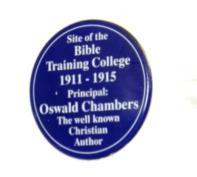
A sign marks it now.
Many people do not know Oswald Chambers ran a Bible Training College (BTC) in the four years prior to World War I.
The ideas represented in his devotional My Utmost for His Highest were first publicly aired in classes taught by Oswald at the school.
The school had been a dream for Oswald for nearly ten years. He had prayed, thought and prepared and as he spent himself in ministry for the League of Prayer, saw it grow closer to fruition.
The idea was born during his student years at The Gospel Training College in Dunoon, Scotland and honed when he visited missionary work in Japan and taught at summer camp meetings in the United States. Oswald yearned for students to learn about the Bible in both a focused study and a close residential college setting.
He always believed God’s truths were better “caught” than “taught,” as had been true in his own life.
Oswald spent the first decade of the 20th century as a lecturer for the League of Prayer–an organization focused on presenting Biblical truth and prayer to all men and women. Friends in the League liked his idea of a Bible training college and when the leadership prayed about and considered the concept, they agreed to make it possible.
In the meantime, they proposed Oswald teach a correspondence course using material pertinent to the future school.
He agreed and put in a herculean effort of writing, reading, commenting, grading and returning upwards of 4000 papers the first year.
It was a success.
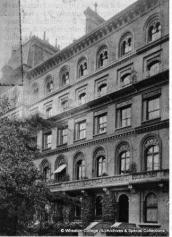
BTC 1913; Wheaton College Special Collections
Students clamored for an opportunity to study under Oswald’s guidance. Even as he graded papers, he continued a circuit ministry of speaking to League of Prayer meetings throughout northern England in late 1910. He taught a variation on his course Biblical Psychology at three cities during that time, sparking even more interest in a Bible training college.
When the time was right, a large London townhouse became available. The League of Prayer rented it and a month later, in January 1911, the Bible Training College opened with Oswald Chambers as principal and his wife Biddy as “Lady Superintendent” overseeing the residential household arrangements.
The location was excellent: across the street from Clapham Common, the largest parkland in London, with plenty available public transportation–one of the city omnibuses actually stopped in front of the house.
While the townhouse itself, one of five in an enormous six-story building looming over the neighborhood, had room for 24 students and the Chambers family, not to mention staff rooms in the basement, only one student lived in the house that first term of Spring, 1911.
Her name was Violet Richardson and she epitomized the type of student, Oswald hoped to serve.
She’d come to an understanding of who God was in her late twenties, after a life lived “unawakened, vulgar and steeped in the lore of cheap music halls and picture shows,” according to subsequent fellow student Katherine Ashe.
Born again into the kingdom of God, Violet’s change as a result of the BTC was recorded by Ashe:
“her intellect began to stir, and . . . waking the woman’s whole being into a mental perception of Beauty and of Order and of Music, [it] became a marvelous thing to watch. . . . She was very literally a new creature in a new creation.”
Richardson stayed two years at the BTC, took all Oswald’s courses, attended the prayer meetings, sang songs of joy and worked in the house as part of her residence. In sharing everyday life with men and women seeking the same Kingdom of God, Richardson learned how to view it all through the prism of God’s word.

BTC 2013; topiaries mark the spot.
What made the difference?
Exactly what Oswald expected.
Her mind became harnessed by the truths of Scripture taught in the classes and her ordinary life was challenged in a house with two dozen others required to live out those truths.
Interacting with fellow believers, warts and all, while remaining as pure as possible to the commands of Jesus, Richardson applied and experienced Christianity in action.
She went on to become a missionary in Africa following World War I.
What did Oswald Chambers teach that made such a difference in Violet Richardson’s life?
Read next Tuesday’s post for a description of the classes.
Tweetables
When Oswald Chambers runs a Bible training school: a woman’s life changes. Click to Tweet
How Oswald Chambers’ teaching changed one woman’s life. Click to Tweet
Bible lessons taught not caught? Click to Tweet
The post Oswald Chambers and a Bible College Part I appeared first on Michelle Ule, Author.
February 2, 2016
A Homeless Man and Grace

This was not the man I met.
I’m so thankful for the training I’ve received at my church for helping homeless people.
Like many, I see homeless people on the street corner looking for money, work, food, dog food, a ride.
I don’t feel comfortable stopping, particularly after reading the books that advise “don’t give homeless people money.”
The training I’ve had suggests homeless people are better cared for by professionals who can help the various needs, not just the presenting lack of housing.
The books aren’t being cruel, they’re just trying to point out I don’t have to save everyone I meet. I can do minor things, but the important work needs to be done by someone who is experienced in helping people in deep need–particularly if they have chosen to be there.
So, I donate to my local Redwood Gospel Mission, make dinner when my church houses the Nomadic Shelter, buy socks for outreaches, occasionally work at the church’s food bank’s children’s ministry and when the Holy Spirit moves me, I give people–usually families– money.
I was tempted to give the clever girl with a sign that said: “needed: dog food,” but I live in a dog-loving community and I figured someone else would respond.
But I’m troubled by it all the same.
Especially the man who stood in the dark rain on the median asking for help at night.
Last fall, I drove a friend to the Oakland airport, a trip that usually takes about 90 minutes.
That particular day, traffic scrambled everything and it took two and a half hours. She made her flight and I turned for home.
I stopped at the Starbucks on Hegenberger Avenue, figuring I needed a pick me up before hitting the road again.
The line, at 10 o’clock in the morning, was out the door. So I decided to visit Jamba Juice instead.
Not far from the juice stand was a bedraggled man; clean but obviously used to living on the streets.
He asked for help.
I actually laughed at the absurdity.
Of course I’d get hit with something like this when I’m zonkered and frustrated. Of course.
There were plenty of others he could have asked, pretty young woman, why this middle aged woman in a hurry?
Well, what would Jesus do?
He’s love him.
“If you’d like, I’m going into Jamba Juice. I’ll treat. You can have anything you want.”
His eyes lighted up. He picked up his backpack and followed me.
I opened the door for him. He looked about my age, but far more haggard and worn. (I hope).
This store was crowded, too, but I was committed.
We scrutinized the menu, side by side, but didn’t say anything.
As the line inched forward, however, I remembered my training:
“Treat homeless people as you would like to be treated. Look them in the eye. Be polite and gracious. Ask interesting questions. Don’t be afraid. Be the Gospel.”
I put cheer in my voice. “So what would you like?”
A bagel and a juice.
“What size? I’m having a medium.”
He asked for the same.
Others in line looked at us, curious.
If I’d entered with a friend, I would be chatting.
“It’s been a crazy morning on the freeway,” I said. “And now I have another couple hour’s drive home.”
He sympathized. He used to live in Sacramento.
And then, we were off in a lovely conversation.
I gave him the change from my $20 bill: “If you need something for lunch, use this.”
As we waited for the order to be filled, I told him about our weekend up in Lake County sifting ashes after the fires.
He was sympathetic to the friends who had lost a home. His brother was a firefighter, he’d heard these stories before.
I talked about the oddest thing I saw: “I was confused at first about why there were so many wires, until I remembered every electric appliance had three wires in the cord.”
This idea excited him and he explained why. After all, he was an electrician who couldn’t find work.
By the time our order was ready, we were chatting easily.
I shook his hand. He called me an angel. We went our separate ways.
I’m so glad I stopped to get something to drink and there was a long line at Starbucks.
I drove home–90 minutes–and reflected on the sweetness of my life that morning, greatly cheered myself by the kindness and grace of one man.
I’m so glad the Holy Spirit prompted me to stop and think about what Jesus would do in a situation like that.
But I’m also very thankful for Jenna, Cathleen, Matt and others at my church who have taken the time to assure us, it’s not hard to help someone in need.
It really wasn’t.
Thanks be to God.
Tweetables
A homeless man provides a lesson in grace. Click to Tweet
It’s not hard to help a homeless man in need. Click to Tweet
A casual and easy opportunity to help a homeless man. Click to Tweet
The post A Homeless Man and Grace appeared first on Michelle Ule, Author.
January 29, 2016
The Innocence of a Novelist
 A novelist can be accused of many things but innocence hardly seems likely.
It’s such a peculiar life, sitting at a desk typing stories into a keyboard and screen. Real life goes on around you, but while you’re in the story, that’s where your focus lies.
You start feeling proprietary about places and events. Whenever someone mentions the Coronado Bridge, I stand taller and bore then with facts (“did you know it’s number three for suicides in the United States?”).
I can tell you all about the Hotel del Coronado; point out fine restaurants in Coronado and discuss the challenges facing Navy SEALs in their domestic life. (Did you know they can’t carry cell phones on their mission? GPS will give them away.)
You’ve probably studied craft, may even have a critique group to review your work. Your spouse knows you’re writing and your kids do, too.
Your friends and relatives may even ask from time to time how things are going.
All of that happened to me when I wrote my novel Bridging Two Hearts.
I even blogged about the experience in a number of places. (Coronado? Maps? Kindness of Seals? Need for Massage?)
When my novel was published. I held the paperback in my hand with my name on the front cover.
Who knows how many times I’d read it, taken it apart, thought through the events and talked about the story line?
One day, Bridging Two Hearts launched into the world like an eager child and was gone. Strangers picked it up and read the story of Josh and Amy. Friends from church read it. Several relatives read the book. A group of my on-line friends read it.
And then they all began to talk to me about it.
I’m not really sure what I thought would happen. In my innocence, this extrovert hoped people would like the Navy SEAL story and gain insight into that difficult life. I expected some women would savor the scenes at the spa.
What I didn’t expect is they would talk to me about my novel.
The first time I overheard someone at church talking about “this Navy SEAL Josh and his girlfriend Amy,” my head whipped around.
“Yeah, I really liked your book,” the friend said.
Why was I shocked? Hadn’t I sold it to him?
At my launch party for the book, we set up the gelato cones and my neighbor exclaimed, “You’re not going to do that scene are you?”
How did she know?
“As soon as you invited me to the party, I bought your book. It was fun and I loved that scene.”
In all innocence, I guess I was surprised people would actually read it, much less comment. Reviewers were kind, friends sincere, and even the ones who didn’t care for a “guy romance,” were complimentary.
I got several reviews that disappointed. Several delighted me. People asked me to write another Navy SEAL story.
(I’ve got another planned).
I took six copies to Zumba on my birthday and gave them all away within minutes. Dancers nudge each other even now, “she’s the writer.”
It makes me grin like a silly woman, but it also feels odd–the people who lived in my mind for all those months of writing the book are now known to total strangers.
I’m humbled.
Surprised.
And I agree with everyone. Mrs. Admiral Martin was my favorite character, too!
Tweetables
Why was I surprised people had read my novel Bridging Two Hearts? Click to Tweet
What a surprise! My friends read my novel! Click to Tweet
Do novelists a favor–talk to them about their books and watch them flinch. Click to Tweet
Note: While Bridging Two Hearts was published three years ago, it lives on. Last week a reader wrote to thank me: Josh’s words on fear had been meaningful to her and an experience in her life.
An email like that for an author is extremely gratifying and a real blessing. If you like an author’s book, send them an email telling them–and post a short review on Amazon. Thanks!
The post The Innocence of a Novelist appeared first on Michelle Ule, Author.
January 25, 2016
Insomnia and Prayer
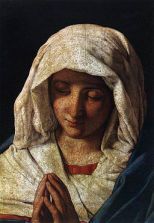
Giovanni Battista Salvi da Sassoferrato [Public domain; Wikipedia]
I’ve connected insomnia and prayer for years.
But I’m getting tired of it.
Long ago, I heard some sage person comment, “if you can’t sleep at night, pray. The devil doesn’t like it and he’ll stop harassing you so you can fall asleep.”
I tried it.
Often.
I haven’t found the saying to be true.
After seemingly days of not sleeping well–I must stress, I eventually get enough sleep to dream–I decided to stop fighting and arguing about my lack of sleep.
My friends, not to mention my poor family, are tired of hearing about my insomnia.
I’ve read countless articles. I’ve tried everything except sleeping pills and the doctor’s latest suggestion: “I’ve found that people who have trouble falling asleep have psychological issues and should deal with those.”
I’m not dealing with worry or personal problems. I just can’t get my brain to shut off.
Some of you are familiar with the problem of getting a song stuck in your head. Louie, Louie is a famous culprit.
It’s like that for me, particularly with zumba music.
The major problem is my brain doesn’t want to lie down and go to sleep. If I get up for a bathroom visit, my brain urges me to look at the clock upon my return and calculate how many hours of sleep I have left until I need to get up.
That’s not helpful.
All those wonderful articles about the problems caused by a lack of sleep?
Unfair. I’d love to get 8 hours of deep, restful sleep.

I can dream, can’t I?
I try!
I turn off the electronics an hour early. The room is dark (or I wear a mask), the air is cool, the pillow perfect, the clock turned away from the wall.
I wear socks if my feet are cold. My neighborhood is quiet. I lock up the yowling vintage cat if she’s causing trouble.
I’ve curtailed my life-long habit of reading a novel in bed. (Never nonfiction, that engages my brain too much).
I read in a chair until my eyes are sagging and then I climb into bed.
Brain jumps to alert!
This weekend I gave up and decided to embrace the insomnia as God’s call to prayer.
(Will this satisfy my brain?)
Adding prayer to the night’s agenda.
Maybe I’m the only person available to pray for a specific need: like a woman in labor or a person who is dying.
I go through the mental list of prayer needs I’ve encountered during the day.
I think about the challenges facing loved ones or Facebook friends and pray for those.
(Including some of my readers–maybe even you).
I remind God I would like to be asleep.
On nights the prayers seem to go on forever, I get to President Obama and the cabinet, Congress and others in Washington.
I remind God of what I need to do the next morning and why sleep would be a good idea.
(Bargaining; brain loves it)
And I often pray a prayer shared by my military wife/writer pal Karen Whiting. It goes something like this:
“Lord, you know my situation and all that I have to do tomorrow. Please give me the sleep I get to accomplish those goals. Amen.”
That doesn’t usually put me to sleep, but it allows me to relax. God will provide the rest for what I need the next day.
If you decide to join me in the middle-of-the-night prayers and need a guide, read my blog post Six Things to Pray About in the Middle of the Night.
The thought that makes me grateful.

Bernadette Soubirous;By abbé P. Bernadou [Public domain; Wikipedia]
When I pray in the night, I remain in bed–for when I do fall asleep.I’m warm and comfortable.
I’m not like Saint Bernadette (from the movie The Song of Bernadette). She got a call to pray, too, and awoke at 4 o’clock every morning to go to the chilly chapel and kneel on cold stone–which she did for years.
She contracted tuberculosis in her right knee–which led to her death at 35.
With the example of such a woman, I cannot complain about my insomnia.
I’ve decided to be thankful.
Tweetables
Insomnia and prayer Click to Tweet
Handling insomnia in a prayerful way. Click to Tweet
What’s the good of insomnia? Comfortable prayer time! Click to Tweet
I’ve put together a PDF booklet of all my blog posts on prayer. If you would like a copy of Thoughts on Prayer , sign up to receive my newsletter here, or just ask in the comments.
The post Insomnia and Prayer appeared first on Michelle Ule, Author.
January 22, 2016
Henry Huggins as Historical Fiction?
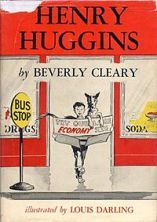 It’s a sobering moment when you realize Henry Huggins, in some camps, is considered historical fiction.
How can a book I read and loved as a child be considered . . . . historical?
Beverly Cleary‘s book was first published in 1950.
65 years ago.
In publishing circles, historical fiction is defined as “prior to the Vietnam war.”
The Vietnam war is generally believed to have started in November, 1955. Henry meets the criteria.
How can that possibly be?
Have you read it lately?
Reading Henry Huggins aloud to my children twenty years ago, I was horrified at what happened in the first two pages–and that’s because of how times has changed.
The first line tells us Henry Huggins was in third grade “and most of his grown-up front teeth were in.”
He was eight years old.
Every Wednesday after school Henry rode downtown on the bus to go swimming at the YMCA.
By himself!
On Wednesdays, “After he swam for an hour, he got on the bus again and rode home just in time for dinner.”
It’s dark at dinner time in March!
With three nickels and one dime in his pocket, he bought a chocolate ice cream cone. The dime covered his bus fare home.
[image error]
Cover of Ribsy
What if an emergency came up?
Except, as Henry Huggins fans know, something did come up: a hungry scratching dog, whom, to his surprise, he named Ribsy.
He called home to ask his mother about the dog with the only money he had left, that dime.
I don’t know what kind of woman Mrs. Huggins was in 1950. While her son convinced her he would never “ask for another thing as long as I live,” she allowed for him to bring the dog home, but didn’t have a car to pick him up.
“You’ll have to bring him home on the bus,” Mrs. Huggins said.
She didn’t ask him if that would be a problem?
Even my mother, who was in college the year Henry Huggins released, never would have suggested such a ridiculous idea to me.
But then, even my notoriously independence-encouraging teacher mother wouldn’t have sent me alone downtown on a bus to go swimming either.
She’d have suggested I go with a friend.
(Henry did see a friend, Skeeter, on the bus–but he was no help).
If you applied 21st century logic, to this book, it never would have been written.
The book continues on in charming ways that I loved as a kid but which horrified me as a parent.
My children were puzzled, too.
“He rode the city bus to go swimming? Why didn’t his mother take him?”
It would only be worse now.
In California, eight year olds still have to ride in car seats.
Imagine today’s question: “How could he have ridden the bus without a carseat or his mother?”
In 2016 United States, children aren’t allowed to play at their neighborhood playground without an adult in attendance. Taking a bus by themselves? Preposterous.
Mrs. Huggins finally acts
(For the record, in a subsequent chapter, Mrs. Huggins decides her son should not be hunting earthworms in the park at midnight by himself and joins him.)
Over the bus driver’s head shaking–“no animal can ride on a bus unless it’s inside a box– Henry finds a box and convinces Ribsy to sit in it.
People on the bus, once they realized Henry had a dog in his box, commented and complained–but no one asked him where his parents were!
For the record, by the end of the chapter Mrs. Huggins finally started to worry about her son.
Henry was struggling with the dog–prior to being thrown off the bus–when sirens force the driver to pull over.
Mrs. Huggins had called the police.
Two policemen escorted Henry and Ribsy home.
My kids laughed. They liked that idea. “Maybe Henry should have called the police himself?”
They probably would have arrested his mother.
Some wise sage once noted that if you want to learn about political events in the past, you should read history books.
But if you want to learn how the people lived their daily lives, you should read historical fiction.
Henry Huggins tells the tale of an earnest and resourceful boy given independence to learn about his neighborhood, who logically takes one step after another into . . . gallons of guppies, a pink dog, night crawlers and the morality of “finders keepers, losers weepers.”
Have you been surprised by the historical description of any of your childhood books? Like, say, the old Nancy Drews?
Tweetables
How can the book Henry Huggins be historical fiction? Click to Tweet
Historical fiction or childhood favorite? Henry Huggins. Click to Tweet
A 1950 childhood classic now historical fiction? Click to Tweet
The post Henry Huggins as Historical Fiction? appeared first on Michelle Ule, Author.