
Michelle Ule's Blog, page 65
March 26, 2016
Holy Saturday: Now What?
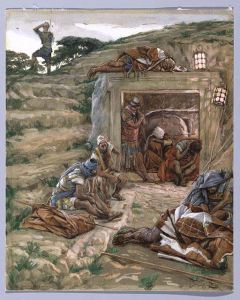
The Watch over the Tomb by James Tissot (Wikipedia Commons)
Every year on “Holy Saturday,” I wonder what Jesus was doing.
We finish Good Friday every year with a Tenebrae service, which usually leaves me silent and reflective.
I know the hallelujahs, white lillies and terrific music of Easter Sunday is coming.
(Along with breaking my annual chocolate fast with . . . plenty)
But Holy Saturday always catches me with a melancholy surprise, plus a ton of cooking.
But what happened on Holy Saturday nearly 2000 years ago?
The Romans
At least one centurian appears to have concluded Jesus must have been God.
He may have spent Saturday reviewing what happened, what he saw and wondering what next?
Others were running about with Jesus’ ragged clothing, their winnings from a dice game.
Pontius Pilate probably was getting reports of odd events–the Pharisees in disarray, the odd and sudden eclipse of the day before and peculiar stories of zombies.
_-_James_Tissot.jpg)
The Chief Priests Take Counsel Together by James Tissot (Wikipedia Commons)
Mrs. Pilate probably walked through the day with a worried frown and glances of bitterness at her husband for now paying attention to her advice.Or maybe they were all drunk.
Several, however, stood guard at the tomb.
The Pharisees
It was the Sabbath so most Jews, if not all, were laying low.
They had laws about how far they could walk, what they could eat, what they could not do.
Most required them to stay close to home.
But the Pharisees were dealing with a monumental catastrophe.
Forget Jesus, as if they could, what were they going to do about the temple?
The thick curtain that divided the holy of holies had been torn in half, top to bottom.
God was exposed to everyone who wanted to look at Him.
What on earth could they do?
Certainly it could not be repaired on the Sabbath, and this one included the Passover.
The temple courtyard was thronged with worshippers.
But those who were authorized to enter the temple couldn’t be allowed in–what would they say about the curtain?
That sniveling Judas, meanwhile, the cause of all the latest trouble had killed himself.
But at least the one man who was at the heart of their problems had been put to death.
The Disciples
Joseph of Arimathea and a few others had hastily entombed Jesus the late afternoon before–prior to the Sabbath.
_-_James_Tissot.jpg)
Two Marys watching at the tomb by James Tissot (Wikipedia Commons)
It was the Sabbath, they could do nothing but gather together.Did they worship?
Devout men and women who had thrown in their lot with the Jesus they knew was the Messiah, their emotions must have been a scramble that Holy Saturday.
They knew they needed to worship the God of Creation, and must have at least gone through the motions.
They would have said their usual prayers, sang songs, remembered God’s mercies and at least done the next thing, whatever that was, to grieve.
When the official worship time concluded and they broke for some sort of a meal, they would have told stories about Jesus, remembered the things he said, tried to make sense of what happened and debated what Jesus meant by statements like:
“I will pray the Father, and He will give you another Helper, that He may abide with you forever.” (John 14:16)
“I will not leave you orphans.” (John 14:18)
“A little while longer and the world will see Me no more, but you will see Me. Because I live, you will live also.” (John 14:19)
The Holy Spirit, whom the Father will send in My name, He will teach you all things, and bring to your remembrance all things that I said to you.” (John 14:26)
” Peace I leave with you. . . . Let not your heart be troubled, neither let it be afraid.” (John 14:27)
” You have heard Me say to you, ‘I am going away and coming back to you.” (John 14:28)
They did not understand, but they knew to pray, to give their anguish and their confusion to God.
They must have become the prayers of the dead for Jesus, not knowing what else to do, but they drew strength from one another as a body of believers.
The women followers knew Jesus’ body needed to be better prepared and thus at least discussed what they would do early the next morning. They had a plan.
For Mary, Jesus’ mother?
She had pondered God’s words long in her heart. What had happened may not have made sense, but she had lived the last 33 years trusting God for the seeming impossible.
I’ll bet she waited and pondered on Holy Saturday.[image error]
Jesus himself?
The church had two thoughts on where Jesus was on Holy Saturday.
Peter’s epistle is the only Scriptural verse:
“For Christ also suffered once for sins, the just for the unjust, that He might bring us to God, being put to death in the flesh but made alive by the Spirit, by whom also He went and preached to the spirits in prison, who formerly were disobedient.” (1 Peter 3:18-20)
Theories abound as to what Peter meant.
The “conventional” Christian thought takes us to the Apostle’s Creed:
“He suffered under Pontius Pilate, was crucified, died, and was buried; he descended to hell.”
That’s where I think Jesus was on Holy Saturday, showing himself to those who died in faith long before, who had longed to see the day when God defeated sin.
What was he doing there, most believe in Sheol, a waiting place for those eventually headed to heaven?
Bringing good news.
Beyond that, I am not wise enough to say any more.
God?
Waiting for glorification the very next day.
The Holy Spirit, of course, was already on His way.
Easter is coming and Jesus will be risen.
The very best news.
Tweetables
What was Jesus doing on Holy Saturday? Click to Tweet
Holy Saturday in Jerusalem, AD 33. Click to Tweet
The Romans, Pharisees, Disciples, Jesus and God experience Holy Saturday. Click to Tweet
The post Holy Saturday: Now What? appeared first on Michelle Ule, Author.


March 25, 2016
Tenebrae Service and Good Friday
 We observe Good Friday every year with the dramatic Tenebrae service.
This is a repost because the service is so meaningful to me and others.
Here is how we experienced the Tenebrae service several years ago.
From the Latin for shadows or darkness, Tenebrae is an ancient service that underscores the solemnity of Jesus’s last day on earth as a man.
Tenebrae services usually involve candles lit in a darkened church. The officiant reads passages of Scripture about Jesus and a hymn is sung, as one-by-one the sober acolyte extinguishes the candles until the service ends in total darkness.
As writer Carolyn Weber recounts about Tenebrae, “those of faith will extinguish candles, rather than light them, in symbolic movement toward crucifixion.”
That Good Friday the pastors wore black robes, no colorful stoles, and the lighting was turned down low. The altar had been stripped to bare wood the night before (Maundy Thursday) and the shrouded cross on the wall loomed black. Seven candles were lit on the altar and the hushed service began.
In our Missouri Synod Lutheran Church, we use the grand hymns of the faith to experience Good Friday’s melancholy emotions. We began with the soul-haunting spiritual “Were You There when they crucified my Lord . . . sometimes it causes me to tremble, tremble, tremble.”
That’s how my soul felt: trembling

By Ruiz Anglada (Wikipedia Commons)
Click to TweetThe readings began with Jesus’s experience at the last supper (Matthew 26:20-25), “the shadow of betrayal,” and proceed through the high points of his last dreadful 24-hours, ending at the tomb.
Go to Dark Gethsemane tells “all who feel the tempter’s power, Your Redeemer’s conflict see. Watch with him one bitter hour, Turn not from his griefs away, Learn from Jesus Christ to pray.”
One candle was snuffed out.
The lack of one candle’s faint glow hardly made a difference, just a softening of light. We still could read the words in our bulletin as we moved through several more passages of Scripture.
The Shadow of Desertion (Matthew 26:30-35) marked Peter’s vow to stay with Jesus no matter what will come. We sang a hymn along the lines of “Jesus, I Will Ponder Now on Your holy passion. With your Spirit me endow For such meditation Grant that I in love and faith May the image cherish Of your suffering pain, and death That I may not perish.”
The second candle, too, didn’t shed a lot of light but as the service intensified, the room felt darker, heavier, grimmer.
The Darkness of Praying Alone (Luke 22: 39-46) came next. His disciples asleep, Jesus pleaded with his Father to take the cup away–if that was His will. “O Darkest Woe! Tears, overflow! What heavy grief we carry! God the Father’s Only Son In a grave lies buried.”
The next flame was quashed.
In The Shadow of Accusation (Mark 14: 43-63 ) Judas led the Roman guards to Jesus in the Garden of Gethsemene and they hauled Jesus to the rulers. It was noticeably darker in the church now as we sang a hymn like “O Dearest Jesus, What Law Have You Broken? That such sharp sentence should on you be spoken? Of what great crime have you to make confession, what dark transgression?”

Crucifixion in Black and White by Peter Reynosa
Another candle extinguished.The Darkness of Cruxifiction (Matthew 27: 27-38) reflected on the Son of God hanging on the cross. Stricken, Smitten and Afflicted described Jesus–“see him dying on the tree. This is Christ, by man rejected; Here my soul, your Savior see. He’s the long expected prophet, David’s son, yet David’s Lord. Proofs I see sufficient of it: He’s the true and faithful Word.”
The gravity was underscored by another candle’s death. Click to Tweet
The Shadow of Death ( Luke 23: 44-49) told of Jesus’ anguished cry of triumphant: “it is finished,” and Bach’s music written 450 years ago underscored the agony: “ O Sacred Head, Now Wounded, with grief and shame weighed down, Now scornfully surrounded With thorns, your only crown. O sacred head, what glory And bliss did once combine, Though now despised and gory, I joy to call you mind.”
With this candle’s flame snuffed, the sanctuary sat in near-blackness.
The Darkness of the Tomb (John 19: 38-42) ended the service by marking the moment Jesus was laid in the tomb. The final candle was blown out. Surely He Hath Borne Our Griefs?
The church fell into total darkness and silence save for the pastors carrying the still lit Christ Candle from the sanctuary to symbolize the death of Christ–Jesus leaving the earth. The back door closed softly behind them and suddenly, seemingly out of nothing, came a dramatic
thud.
We flinched at the sound of the stone rolled shut on Jesus’s tomb.
One last song, a smidgen of hope: There is a Redeemer.
We exited in silence, trembling from the grim majesty of what we witnessed. The Son of God, died on a cross, laid in a tomb.
It is finished.
Sin and death reign no more.
But Easter Sunday morn is just around the corner.
Thanks be to God.
How do you experience Good Friday?
Tweetables:
What is a tenebrae service? Click to Tweet
What are the elements of a tenebrae service? Click to Tweet
Remember the sacred on Good Friday’s Tenebrae Click to Tweet

The post Tenebrae Service and Good Friday appeared first on Michelle Ule, Author.
March 22, 2016
Writing, Gardening and Seed Ideas
 Many years ago, a school friend wrote with a challenging question: “How’s your writing going?”
She penned (literally) her letter from San Francisco where she worked for Mother Jones Magazine.
I read her letter while sitting on a rock wall above my garden in Connecticut while my toddlers rolled around the driveway on their big wheels tricycles.
She meant her words kindly, but they pierced.
I had not planned my life the way it appeared to be going.
Like her, I had envisioned graduating from college, getting a job (hopefully involving writing or books), establishing myself in a career and then entering the ranks of the marrieds with children.
My years at UCLA were filled with books and writing (Thank you, English department and the UCLA Daily Bruin). They came to an end when I graduated a year early to marry my boyfriend and go off on the great Navy adventure.
Seven years later I lived on a rocky hillside in an old house where I tended my children and my garden on limited resources.
My husband was usually out to sea.
My daily life then was filled with writing letters to my husband and friends, reading books from the library and gardening.
And the children, of course.
But how to answer Lori’s question?
On that warm summer’s day, a breeze blew through the trees and riffled the tender leaves in my four garden beds.
The carrots barely looked like blades of grass, the tomato leaves were a gnarled leathery green, I had work to do weeding and thinning.
The robust zucchini, of course, was trying to take over.
I needed to double dig compost into the last bed to make the soil richer and better for growing plants.
Only then would it be ready for seeds, starts and, eventually, vegetables to feed us.
Preparing the soil was important.
The boys whizzed by on their plastic wheels, laughing and waving.
I glanced at the letter and then blew them a kiss.
I had work to do in the garden, but an idea to share first with my much loved writer friend.
“The writing will always be there, but I have more pressing matters right now.
I guess I see my writing life like a garden.
Now is the time to dig in compost, encourage worms and nurture the soil.
One day, all will be ready.
I’ll toss some seeds into that fine garden bed and strong plants will grow.
Likewise, I see this time in my life as digging in the compost of experience into young soil.
One day, I’ll toss in the seeds of an idea and a book will grow and flourish from my life and experiences.
Until then, just living is enough.”
I remember those words so many years later, astonished I had such wisdom in my twenties.
How did my writing garden grow?
Our children–we added two more– grew up.
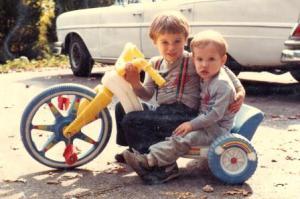 We lived such a rich life (thank you, US Navy, American taxpayers and more church members than I’ll ever be able to count), mulched with places, people, experiences and dreams, that I have an unlimited source of stories.
I’ve seen the compost, the dead matter, dug into my soul and grow into words that have reaped benefits for myself and for others.
One day the time was right.
My children were grown, my life had “settled” down and I could till the garden soil of my experiences.
It felt rich and dark and ready.
I tossed in the seeds of an idea and a novella was born.
And another, and another, and so forth.
An eighth book will snuggle onto the shelf in June while all comes to fruition in my writing.
I’m writing the most important book of my life right now.
It’s using all those experiences, dreams, disappointments, children, missing husband, and even some gardening to boot, for what I hope will be a blessing to all.
Amazing what a few seeds will do.
And a life.
Thank you for that question all those years ago, Lori.
(While no longer at Mother Jones, her writing has gone splendidly, her literal garden is beautiful and she has changed many lives for the better).
And you all will forgive me, but I’ve got a little weeding, er, editing, to do.
Tweetables
How does your garden grow to write a book? Click to Tweet
Writing, compost, gardening and words. It’s all good. Click to Tweet
Tossing the seeds of an idea into the compost of my soul=1 book. Click to Tweet
The post Writing, Gardening and Seed Ideas appeared first on Michelle Ule, Author.
March 18, 2016
Why Raise Lazarus from the Dead?

Rembrandt’s depiction
Why did Jesus raise Lazarus of Bethany from the dead?
The story has come up in my life three times this week and since this is about the time it happened nearly two thousand years ago, I thought it worth examining.
You probably know the story (found in John 11): Jesus and his disciples were out on the eastern side of the Jordan River, when Lazarus’ sisters Mary and Martha sent word Lazarus, “he whom you, love is sick.”
Jesus got the message, telling those with him,
“This sickness is not unto death, but for the glory of God, that the Son of God may be glorified through it.”
They lingered for several days. On the third day, Jesus told his disciples it was time to go back to Judea.
They protested, the Pharisees had threatened to stone Jesus if he returned to the area around Jerusalem–Bethany was nearby, basically the suburbs.
“Our friend Lazarus sleeps, but I go that I may wake him up.”
That made no sense to his disciples who argued if the man was asleep, he’d get better.
Jesus looked them square in the eye:
“Lazarus is dead. I am glad for your sakes that I was not there, that you may believe.”
Off they went, with the men now wondering 1. how Jesus knew Lazarus was dead, 2. what good it would do, then, to go to Judea and 3. would they all be stoned to death?
By the time they got to Bethany, Lazarus had been dead and in the tomb four days.

(Jesus knew Lazarus was dead, but did not tear his clothing, even though he loved him because . . . “the sickness was not unto death.” Pity the confused disciples.)
The house was crowded with people including religious authorities who had come down from Jerusalem–probably because they respected Lazarus, or they hoped to catch his close friend Jesus.
The two sisters were in mourning, but when Martha got the news Jesus was near, she went to greet him, displaying her disappointment with words:
“Lord, if you had been here, my brother would not have died. But even now I know that whatever you ask of God, God will give you.”
Jesus: “Your brother will rise again.”
Martha: “I know that he will rise again in the resurrection at the last day.”
(Note: this is what a devout Jewish woman believed before Jesus was resurrected from the dead).
Jesus replied with the Gospel:
“I am the resurrection and the life. He who believes in Me, though he may die, he shall live. And whoever lives and believes in Me shall never die. Do you believe this?”
Martha did. She left Jesus, returned to the house and whispered in Mary’s ear that Jesus had come.
As typical of Mary, she jumped up and hurried to meet him.
The Jewish mourners standing by were sympathetic, “she is going to the tomb to weep there.”
Not exactly. Mary flung herself at Jesus and chided him–“if you had been here, my brother would not have died.”
While Jesus wept in sympathy, the religious officials who had followed Mary came upon them and shook their heads.
Several sneered: “Could not this Man, who opened the eyes of the blind, also have kept this man from dying?”
They thought it a fair question.
Jesus went to the tomb and ordered the stone to be taken away.
Pragmatic Martha argued it would smell–he had been dead four days. Passover was nearly upon them, anyone opening the tomb would be unclean.
Jesus: “Did I not say that if you believed you would see the glory of God?” He thanked God and shouted, “Lazarus, come forth!”
Then what happened?[image error]
Basically, a mummy shuffled out of the tomb, arms, legs, body and head bound in woven cloth.
Lazarus would not have been able to walk well.
What would you have thought?
Even if you were a disciple, who by that time should not have been surprised by anything that happened, seeing a figure, four days a corpse, must have been shocking.
If you were a jeering Pharisee whose question had just been answered, you probably would have trouble believing your eyes.
If you were a mourner in black torn clothing, your mouth must have hung open.
And if you were Martha and Mary, seeing a loved brother brought back to life?
The joy would have been overwhelming.
Thank you, Jesus, indeed.
They hurried to unwrap him–and planned a party.
Why did Jesus raise Lazarus from the dead?
Because he loved him?
Because Martha and Mary reproached him?
Reexamine what he said to the disciples before he had official word Lazarus had died.
Jesus knew what was happening in Bethany and what he would do.
Lazarus probably was dead by the time Jesus got the message.
But Jesus saw the reason behind the death–that Jesus and God might be glorified in a public place.
If the disciples thought about it, they would have remembered Jesus raised people from the dead before–or at least the terribly ill: Peter’s mother-in-law, the ruler’s daughter, the young son of the old widow.
But never before such a large audience of skeptics.
Reaction to the Resurrection
Many of the scoffing Jews who had traveled to Bethany to comfort two mourning sisters, returned home believing in Jesus.
Others scurried back to the Temple to report on what they had seen.
The chief priests and Pharisees–who had not witnessed Lazarus’ return to life–debated about what to do next.
They decided the best course of all, lest Jesus wrest their power away, was to kill him.
I shake my head every time I read that verse. How could they have been so blind?
Did they really think they could kill a man who had just resurrected a man four days in the tomb?
And poor Lazarus. The chief priests also plotted to kill him, simply because he had been resurrected. (John 12: 9-11)
Why Raise Lazarus from the Dead?
That Jesus would be glorified.
To demonstrate the power of God over death.
To restore a loved brother to his sisters.
To draw the wavering Jews into the Kingdom of God
To set the stage for Passover in Jerusalem–where Jesus himself would die and be resurrected.
Can you think of any other reasons?
Tweetables
Why raise Lazarus from the dead? Click to Tweet
The formidable story of Lazarus raised from the dead. Click to Tweet
Missing the point: the Pharisees and Lazarus raised from the dead. Click to Tweet
The post Why Raise Lazarus from the Dead? appeared first on Michelle Ule, Author.
March 15, 2016
Rules and Rule-Making

By Dree’Ja (Wikipedia Commons)
Who should make the rules?
A scientist friend has been thinking about the question for most of a week as he reflects on a recent talk by Andrew McAfee, author of The Second Machine Age.
The scientist’s thoughts are interesting, and so I am turning this blog post over to him.
Thank you, scientist friend!
Artificial intelligence (AI) has interested me ever since I read Douglas Hofstadter‘s best seller, Gödel, Escher, Bach: an Eternal Golden Braid in the early 1980s.
In McAfee’s lecture, I was reminded that early AI consisted mostly of tedious lines of programming of “if this then that,” to allow simple problem solving.
However, today’s AI can “learn,” so the new sophisticated programs can be given simple objectives, “like maximizes a game score,” and “by trial and error learn to master the game (think Pong).”
A change has taken place in the AI community in the last decade. McAfee explained that while early AI replaced humans in repetitive task, AI is now poised to replace humans in creative work as well.
Who writes the rules?
One of McAfee’s arguments fascinated me.
He pointed out most adults find it difficult to learn a second language while children generally learn effortlessly.
From McAfee’s talk, I realized that means children are rule learners while adults are rule makers.
As a parent, one of the major challenges in raising children is when teenagers begin this transition – they start making their own rules.
A common unspoken “rule” among many teenagers is they have the right to drive the family car, but don’t have to pay for the car, insurance or gas.
They get upset when the parent points out, “Excuse me, I’m the adult (rule maker) here.”
(See the cartoon Zits for continuous irony on this subject)
We may not realize it, but we are all rule makers.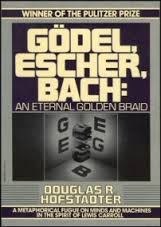
This idea has interesting consequences.
One of my driving rules is “Never be the fastest driver on the freeway – let the cop-bait pass you every now and then.”
As I’ve explained to my children, if I’m zipping in and out of traffic at 90 mph and get pulled over, I shrug– after all I was breaking my own rule.
If, however, I was going 72 miles an hour, occasionally being passed and I’m pulled over, I think the CHP is being unfair!
The patrol officer is breaking my rule! She should pull over the “real” speeders, not me.
Returning to McAfee, we’re not bothered by computers as “rule learners” since following directions is a child-like behavior.
On the other hand, AI systems creating rules bothers us.
(Think of Hal in 2001, and movies Terminator and The Matrix.)
We don’t want to interact with “adult” artificial intelligence.
Why do we make up rules?
Reality is complex and often incoherent. We make up rules so that we can deal with uncertainty.
Most adults want to administer some control over their life and circumstances–it’s a mark of adulthood.
Young children generally do not.
Parenting clashes often happen when a child starts to ask “why” and “why not?” about their own ideas.
A pioneer in AI study, Hofstadter observed:
“If we ever actually create a sentient machine it will be just as confused and mixed up as we are.”

Artificial Intelligence (John Cale album) (Photo credit: Wikipedia)
The world is complex and filled with conflicting information, paradox and unpredictable behaviors.
How people deal with the confusing world often is a measure of intelligence and maturity.
But then I remembered a passage of scripture that always bothers me. Jesus said we need to become as little children to enter the kingdom of God.
What is child-like behavior? Crying? Throwing tantrums? Acting foolish?
Or, given the above, does Jesus really mean we should be “rule learners” not “rule makers?”
Jesus condemned the Pharisees for making rules not found in Scripture.
Similarly, the book of James warns us not to judge God’s law.
Have you ever been angry at God?
Is it possible you were angry because He broke a rule you made up for Him to follow?
Let’s restate Gödel’s Incompleteness Theorem into theological terms:
“Only an infinite in time and space self-referencing being can know Truth. Any other source of knowledge would be incomplete.
Only the Great I Am’s rules are based on the reality we can’t comprehend.”
Within the Kingdom of God, I want to learn God’s rules, not make up my own.
But what about dealing with AI and computers?
I’d still rather be in charge of the rule book
Tweetables
Who should be in charge of making the rules? Click to Tweet
Godel, Escher, Bach and the Kingdom of God. Click to Tweet
Artificial Intelligence, Jesus and rules. Click to Tweet
The post Rules and Rule-Making appeared first on Michelle Ule, Author.
March 11, 2016
6 Keys to Raising a PhD

One of our sons, Stargazer, recently earned a PhD and since several people have asked me how we did it, I thought I’d share some thoughts on raising a bright child.
His PhD in Astronomy was the result of some DNA (he’s got math whizzes on both sides of the family and several generations of engineers), but mostly Stargazer’s success is the result of hard, concentrated and imaginative work.
We’re very proud of him.
Six Keys to Raising a PhD.
(Applies to both girls and boys)
1. Love him through thick and thin.
Of course Stargazer is unusual–undoubtedly like your child. We always referred to him as “the Stealth Child,” because while he was perfectly out in the open with his life, he surprised us all the time with what he knew.
Who taught him to read? When did he learn to ride a bike?
When he was being demanding, “the schedule says right here we’re having macaroni and cheese for dinner–what do you mean it’s going to be burritos?,” we overlooked anything that wasn’t logical.
(The week’s menu did say “macaroni and cheese,” it’s not anyone’s fault I didn’t have time to make it that day.)
When he had problems we were firm, but we didn’t reject him. He learned at an early age “actions have consequences.”
Even when he drove me crazy, I hugged him and prayed for him–and me.

The original copy
2. Read early and often–and across his areas of interest.
Stargazer was an infant in the snugli the first time he went to the library and he regularly visited for the rest of his childhood. When I realized what he liked, I made sure we had picture books to capture his interest, chapter books to read aloud, and all sorts of out-of-genre reading to broaden him from a total focus on Star Wars.
He heard The Little House Books and all the Narnias, as well as Lloyd Alexander’s Chronicles of Prydain read aloud to fire his imagination and teach him about life on sort-of-earth.
He practically memorized David McCullough‘s Truman, not because he necessarily was interested in the president, but because we had the book on tape and he listened to it every night before falling asleep for a couple years. That was after he wore out the tape that accompanied Adventures in the Solar System: Planetron and Me!
3. Introduce him to a spiritual life
We took all our children to church from an early age and that was important for this clever boy. His brain raced ahead of so much and he was capable of expansive thinking far beyond his age. My husband spent a lot of time discussing spiritual issues with him, answering his questions and encouraging him to keep on asking them.
We were fortunate to meet astrophysicist Hugh Ross when Stargazer was a teenager. The materials found at Reasons to Believe have been helpful to put the most recent scientific data into a context–for at least some members of our family.
It also gave me some topics to bring up in conversation–not that I personally could follow them very well.
(Note: Reasons to Believe amazes this English major).
 4. Get him outside
Some kids do well at sports, others just need to run around, but for outdoor activities, the boys scouts were beneficial for Stargazer–particularly the 100-mile hikes he did in Yosemite with his troop. For his eagle project he built fences for a local Audubon preserve.
We limited computer time until he was older–which was easier to do in his childhood. I continually sent all three of my sons outside whenever the sun shone–just as The Mother’s Almanac advised me!
Stargazer’s a cyclist, skier and triathlete. He started playing rugby in grad school.
 5. Share music with him.
Since birth Stargazer heard a lot of classical music. I’d turn the radio on at 6 am–my favorite station is King-FM out of Seattle–and not turn it off until we went to bed at night. He grew up listening to the finest music ever written.
When he entered fifth grade, he took up the trombone and the instrument went with him all the way through high school. Scouts and music groups helped with all the moves caused by our Navy life.
6. Make sure he has siblings.
My proudest moment was reading Stargazer’s dissertation dedication. As the third son with a princess sister behind him, his was a challenging birth order spot. But having those siblings is important.
He dedicated the dissertation to his older brothers, in part:
“Without having to look up to you I never would have had the motivation or the determination to improve myself or to exceed what I would otherwise believe were my own limitations. I hope that this work will be only one of many successes wrought from your examples.”
I cry every time I read it.
Bonus: Provide plenty of Lego.
Most of this is common sense parenting. It’s no guarantee of an advanced degree, but using these tips can go a long way towards enjoying a well-loved child.
And having a lot of fun along the way yourself.
Did we set out to raise a PhD?
No.
As with all four of our children, we set out to give our children the tools they needed to be the people God created them to be.
The rest was up to them.
Tweetables
6 Tips for raising a PhD Click to Tweet
A PhD, yes, but a well-rounded person was the real aim. Click to Tweet
Love, nature, books, music, God and siblings: 6 keys to earning a PhD. Click to Tweet
The post 6 Keys to Raising a PhD appeared first on Michelle Ule, Author.
March 8, 2016
The U-Boat Dilemma

1916 cartoon by Oscar Cesare
Here’s the deal: I both hate German U-boats and I admire them.
It’s a real problem when I’m watching a submarine movie like Das Boot. I keep switching sides.
It made reading Dead Wake by Erik Larson troubling. Sinking the RMS Lusitania was a terrible war crime.
But Captain Walther Schweiger, the commanding officer of that U-20 U-boat, was so clever, and the odds were so much against him, my loyalties were stretched.
As the wife of a retired submarine officer, I rooted for the U-20 throughout the book, all the while feeling guilty.
Then Captain Schweiger ordered the torpedo that sank the ocean liner, forcing all those people into the Atlantic Ocean and the ship to the sea bottom (in 18 minutes).
Many people died.
Horrifying.
I didn’t like the submarine anymore.
U-boats and WWI
U-boat is short for “unterseeboat,” German for “undersea boat,” or submarine.

The sinking of the HMS Pathfinder by W. L. Wyllie, RA via Imperial War Museum
The first ship ever sunk by a self-propelled torpedo, the HMS Pathfire , went down in Scotland’s Firth of Forth on September 5, 1914, a month after the start of World War I.Two weeks later the U-9 sank three British ships in an hour.
At first, the German underwater boats only targeted clear military vessels. But by February, 1915, Kaiser Wilhelm declare the English Channel and all the waters around the British Isles a war zone.
The British had bottled up the German fleet and the German government took dramatic action.
According to Wikipedia:
This was cited as a retaliation for British minefields and shipping blockades. Under the instructions given to U-boat captains, they could sink merchant ships, even potentially neutral ones, without warning.
U-boats became a terror weapon.
War had never been fought like this before.
(Keep in mind, airplanes had never been used in war before either. Rapidly changing technology was responsible for many of those deaths during WWI).
The British and Allied fleets adapted quickly to the U-boat threat; ships almost always sailed with military escorts and in groups–the better to possibly spot the small periscope indicating a submarine was nearby.
Passengers all had life jackets, the ships frequently sailed in a zigzag pattern (making them harder to hit with a torpedo) and without lights showing at night.
Ship captains received reports and warnings and were careful about sending out unnecessary wireless transmissions lest they be picked up by U-boats.
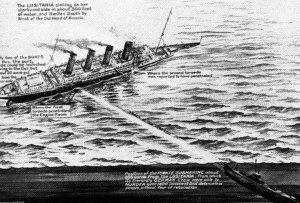
Diagram of that torpedo shot.
One of the many controversies surrounding the sinking of the RMS Lusitania in May 1915 concerned its lack of a naval escort only 11 miles off the coast of Ireland.
Dead Wake‘s exploration of the U-boat side of the story revealed the astonishing news the British Admiralty had a fair idea U-20 was in the neighborhood when the ocean liner was expected. (Read the book for an excellent analysis of the German side of the tragedy)
The U-boats did not remain solely in the Atlantic.
In 1915, Austro-Hungarian and German U-boats menaced the British Dreadnought battleships off the coast of Gallipoli (western Turkey), contributing to the debacle the British Expeditionary Forces suffered in that lengthy campaign.
(Captain Georg von Trapp skippered one of those Austro-Hungarian U-boats)
The U-boats lurked on either side of the Straits of Gibraltar for their prey. Most Allied ships, therefore, sailed through the blacked-out straits at night to avoid detection. The only illumination came from spotlights scouring the waters for stealthy submarines.
Just a few days before Biddy Chambers and her daughter arrived in Port Said, Egypt, in December 1915, a U-boat sank a Japanese freighter and an oil tanker right off the coast.
They sailed past the wreckage.
War requires nerves and emotions of steel to be effective. The toll on civilians, as evidence above, can be heavy as well.
At the same time, it’s hard to understand how any commanding officer could justify sinking a hospital ship, and yet sixteen hospital ships went down during WWI.
The Bess Crawford novel, A Duty to the Dead, by Charles Todd provides a sobering description of one of those sinkings.
On the other hand, you don’t have to read many stories about U-boats crews to recognize the desperation those sailors must have felt living in cramped stinking quarters, terrified themselves that they would never breathe clean air again.
The submarine sailors were just as afraid of being spotted as the ships sailing the waters were of being spotted.
I suppose I’m sympathetic to both sides, still, and perhaps with a different perspective than many.
My family has spent far more time on submarines, you see, than on ocean liners.
Do you ever find yourself cheering for the “wrong” side in a book or movie?
Tweetables
Mixed emotions about WWI U-boats and ocean liners. Click to Tweet
WWI U-boats: admiration and disgust Click to Tweet
The Lusitania, Dead Wake and a desperate submarine. Click to Tweet
The post The U-Boat Dilemma appeared first on Michelle Ule, Author.
March 4, 2016
Finding Winnie: the Pooh Bear’s True History
 This year’s Caldecott award went to a picture book that tells the true story behind a novel: Finding Winnie.
A charming story about the author’s great-grandfather. Finding Winnie describes how he adopted a bear while traveling by troop train from Winnepeg, Canada, to a port from which they sailed to England in the early days of World War I.
The novel?
You probably don’t consider it as historical, but it’s Winnie the Pooh, first published in 1926.

The real boy and his bear
For most of us, Winnie the Pooh is a whimsical joy in the Hundred Acre Wood with a boy, Christopher Robin, and his friends: Tigger, Roo, Kanga, Rabbit, Owl, Eeyore, Tigger and, most of all, Winnie the Pooh himself.
And that’s exactly how it should be as we read the beloved story and its sequels to our children, grandchildren, neighborhood children and spouses.
There’s not much in the Milne stories that sets them in a specific time in history.
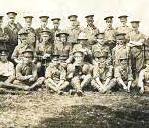
Captain Harry and his unit
And yet, Winnie himself (herself?) was a real bear—and one Christopher Robin Milne knew in childhood at the London Zoo.
But how did a North American brown bear end up in London?
Captain Harry Colebourn brought him there.
That’s the story told in Finding Winnie.
The children in my life loved it.
More than once.
Considering the author, Lindsay Maltick, dealt with a World War I story and made it fun—is a wonder, well deserving of an award.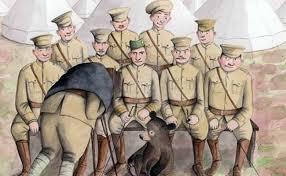
The Caldecott is given for the “most distinguished American picture book for children,” of the year. That means the pictures are important. I’ve included an actual photo and the drawing from the book.
Wonderful.
Illustrator Sophie Blackall did a superb job of showing soldiers, bears, travel, England and even some weather, without depressing or frightening a child.
The colors are a muted pastel, yet vividly tell the story.

The real man and his bear.
Winnie looked charming.
My kids loved seeing the real photos at the end showing where the illustrations came from.
You can read the true story in my blog post, World War I Animals: Winnie the Pooh.
Or, you can get a copy of Finding Winnie to share.
Tweetables
A silly old bear and WWI–all in a picture book. Click to Tweet
The Caldecott goes to Winnie the Pooh’s backstory. Click to Tweet
Finding Winnie; the true picture tale of Winnie the Pooh’s origins. Click to Tweet
Lindsay Maltick tells us about the book on a Youtube presentation here:
The post Finding Winnie: the Pooh Bear’s True History appeared first on Michelle Ule, Author.
March 1, 2016
The Importance of Research Discipline
 I was a year or so into writing a detailed genealogy when one of my distant cousins challenged my research discipline.
“You’re a fine writer, and you concoct very interesting ideas, but it means nothing if you don’t cite the references.”
As a past president of the Sons of the American Revolution, Glenn had spent years researching his family history. He happily shared with me, but wanted me to prove how I had reached my conclusions before he followed me down the rabbit trails.
I had to be disciplined to cite the references–just like in, gulp, geometry all those years before.
I didn’t mind sharing where I got my information, it just had never occurred to me it might be important.
(Geometry students, pay attention. You think it’s about the math–but it’s really about putting together a logical argument.)
I became a fanatic about research discipline after that–a genealogy bore citing stats, references, and sometimes the entire story about how I ferreted out one fact or another.
My family yawned.
My genealogy cohorts cheered–they could trust my research once I showed my discipline in pursuing it.
Modern Research Discipline Techniques

As a matter of fact, there is a point to this.
A camera phone has helped research discipline in the years since I first approached libraries, microfilm, microfiche and fragile documents with paper and pencil (never pen in research libraries).
Now, I take a photo of folders, book title pages (including the spine for the reference number), library catalogue information and even where I park my car–all to help me keep track of information I need to know.
A personal scanner I can attach to my laptop computer also has been invaluable in keeping track of just where I found that tidbit of information.
I use a dedicated notebook for my current project–which is now full–and I can page back to find where I learned obscure facts such as how much YMCA secretaries were paid during World War I.
I also make a point of copying URLs of documents I access on the Internet. I put them into an email, include the quote I want, and send it to myself. I’ve got a folder in my email where I stick all the research and can pull it up when necessary.
Using those same skills I honed so long ago, I can retrieve where I found 1895 mortality tables for Woolwich, England, or what childbirth practices were in 1913.

That’s not my phone
I take my phone and sometimes make voice memos of writing ideas or thoughts on my projects, which I transcribe later.
I also can interview people with that same phone.
I print out copies of documents and read them with different colored highlighters indicating where in the project that quote might go, or ideas I could use elsewhere.
And of course, post it tabs are invaluable–I even use them on library books and then transcribe whatever I want directly into a word document to save on my computer.
The point of all this is, unless I can tell someone where I found the information I’m using, the reference is too easy to challenge and my argument–whether in genealogy or my writing project–falls flat and can be discarded.
Research discipline is important, and in this day and age too easy not to use.
Tweetables
Tools for research discipline. Click to Tweet
The importance of research discipline. Click to Tweet
The truth about Geometry: research discipline practice. Click to Tweet
The post The Importance of Research Discipline appeared first on Michelle Ule, Author.
February 26, 2016
Reading Love Letters
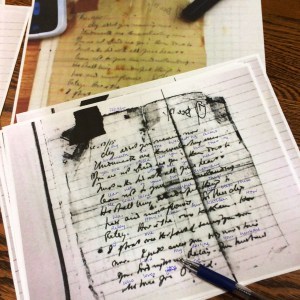 Do you like to read love letters?
Well, certainly if they’re addressed to you.
But what if, as an historian, you’re reading someone else’s love letters, say a husband to his wife during a war?
I’ve written about this issue before and, frankly, it feels intrusive.
The question still remains in my mind: “Is it research or voyeurism?”
Look at the picture above. That’s a copy of the actual letter and a photocopy blown up 150%.
It’s not exactly a love letter, it’s a love note, but you can tell the handwriting is a challenge to someone–me–who is not used to reading it with loving eyes familiar with the hand.
I’m “translating” it because I need to know what’s inside for the book I’m writing. I have to admit I’m squirming, though, knowing how private this couple was.
So I’ll reflect on my own life, instead.
Women for milenium will tell you the joy of receiving love letters from a husband, boyfriend, lover, far from home–particularly during a war.
I remember the shock of getting an envelope in my Connecticut mailbox one afternoon when my husband had been out to sea for too long.
As a submariner, he couldn’t send mail unless he was in port. He disappeared under the water and I generally did not hear from him again until I saw him on the pier at his return.
I was on my own with small boys in an old house in the woods with a car that didn’t always work and no neighbors except the US Naval Subase.
(They weren’t bad neighbors–the Navy never came over to borrow a cup of sugar, but then, the Navy played the Star Spangled Banner at 8 o’clock every morning on loud speakers.)
Anyway, on that day, I opened an envelope addressed to me in a hand I didn’t recognize.
A polaroid photo fell out and a short note:
“Mrs. Ule, I saw your husband and he wanted me to send this to you when I was medivacked home.”

Topside, USS Skipjack; that’s the periscope in camoflauge
My heart lurched and sang.
It was a picture of my husband!
My eyes filled with tears, my mouth gaped in joyous surprise and the excitement that welled through my body is inexplicable.
All I could think was, “he’s alive!”
Of course he was alive, I just hadn’t seen him or heard from him in so long–it was like opening a book I loved and reuniting with a long-lost hero.
A hero just like my guy.
No love letter, but a love photo.
I pressed it to my heart until the boys wanted to see Daddy, too.
I will never forget that moment.
This morning as I sat at the kitchen table deciphering the 100 year old handwriting–which gets easier the more you try to read it–my now retired Navy guy sat at my elbow, kibbutzing.
“What do you think this says?” I tried.
His answer was silly and not really repeatable.
“There are a lot of references to ‘my darling.'”
He smiled.
I may have to dig out a few of those Connecticut love letters later today . . . to remember.
The notes I’m examining today are short and thirteen in number.
Oswald Chambers wrote them while he was in Egypt and dated them.
He sent them home to Biddy in England with instructions to open one a day as soon as she got on the SS Herefordshire to join him in Egypt.
In 1915, the waters around England, France and throughout the Mediterranean Sea, were filled with enemy submarines.
Biddy, her two-year old daughter Kathleen, and her friend Mary Riley, sailed on a steamship out of Liverpool to Port Said with 22 other passengers.
It was a risky trip, but she knew God had called her to join her husband in his YMCA ministry to the ANZAC (Australian, New Zealand Army Corps) troops.
Her husband was thrilled she was coming.
His love letters indicate how much.
They were apart less than three months–which to this “retired” Navy wife doesn’t seem like much at all, even during war.
But those love letters–beckoning, coaxing, thrilling, calling her onwards–would be enough for anyone.
Just like my photo of my guy.
Biddy Chambers outlived her husband by 49 years.
She lived with his letters, notes, words, and lectures every day.
She could remember his love, his affection, his tenderness anytime she opened a piece of paper.
Is it any wonder she never even thought of marrying again?
Write your loved ones a letter. They’ll always be glad you did.
Tweetables
Love letters: historical research or voyeurism? Click to Tweet
The power and reassurance of a love letter. Click to Tweet
When apart why not write love letters to affirm and give hope? Click to Tweet
The post Reading Love Letters appeared first on Michelle Ule, Author.



![[image error]](http://i1.wp.com/commons.wikimedia.org/wiki/File%3A%D0%9A%D0%BE%D1%D0%B5%D0%BB%D0%B5%D0%B2_%D0%9D._%D0._%D0%A1%D0%BE%D1%D0%B5%D1%D1%D0%B2%D0%B8%D0%B5_%D0%B2%D0%BE_%D0%B0%D0%B4.jpg?ssl=1)
![[image error]](http://i0.wp.com/commons.wikimedia.org/wiki/File%3A%D0%A4%D1%D1%8D%D1%D0%BA%D0%B0%D0%B2%D1%8B_%D1%D0%BE%D1%D0%BF%D1%D1_%D1_%D0%B7%D0%B0%D0%BC%D0%BA%D0%B0%D0%B2%D0%B0%D0%B9_%D0%BA%D0%B0%D0%BF%D0%BB%D1%D1%D1%8B_%D1%9E_%D0%9B%D1%8E%D0%B1%D0%BB%D1%D0%BD%D0%B5_25.jpg?ssl=1)