Michelle Ule's Blog, page 44
May 8, 2018
Point of View: God or You?
My idea for my question comes out of the Bible‘s Judges 17:6:
“In those days there was no king in Israel. Everyone did what was right in his own eyes.” (ESV)
 It was a lawless time long ago and the ruler of Israel was God.
Samuel was their prophet and led the people, ultimately making his sons judges.
But those sons were evil, and the leaders decided they’d be better off with a real king, rather than a prophet and his corrupt sons.
Tired of Samuel, they wanted someone they could see, “like the other countries.”
Samuel appealed to the Lord, who replied:
“Obey the voice of the people in all that they say to you, for they have not rejected you, but they have rejected me from being king over them.”
They didn’t care about God’s point of view. They wanted to use their own wisdom to control their nation, and themselves.
So God let them.
It didn’t turn out well.
What is a point of view?
In literature, the point of view is the person through whose eyes the story is told.
One of the first lessons a writer learns is writing in one point of view.
“Head-hopping,” or jumping from point of view as is often done in movies, is called “omniscient point of view,” and can confuse the reader.
It makes more sense to hear the story from one person’s perception, rather than several. You can follow the story and understand better.
(Think how maddening, or completing, it is to hear the same story told by a group of people interrupting each other).
Everyone brings to their own understanding their past, their fears, their biases when it comes to assessing what happened in a given situation.
That’s why justice requires the testimony of several people.
If several people agree on the same story, chances improve it is true.
So what is God’s point of view?
That would be how God sees something.
His vision can best be figured out by reading the Bible.
God never contradicts Himself, or Jesus or the Holy Spirit.
His character remains consistent through eternity.
We can count on it not changing.

Photo by Luca Baggio (Unsplash)
God sees believers through the lens of Jesus’ death and resurrection.
Since He cannot otherwise look upon sin, God can only see us through that “Jesus lens.”
He gives us his point of view frequently in Scripture. Here are four examples.
“For I know the plans I have for you, declares the Lord, plans for welfare and not for evil, to give you a future and a hope.” Jeremiah 29:11 (ESV)
“And we know that for those who love God all things work together for good, for those who are called according to his purpose.” Romans 8:28 (ESV)
“Keep your life free from love of money, and be content with what you have, for he has said, “I will never leave you nor forsake you.”” Hebrews 13:5 (ESV)
“God is not human, that he should lie, not a human being, that he should change his mind. Does he speak and then not act? Does he promise and not fulfill?” Numbers 23:19 (NIV)
If you need more reminders, Officers’ Christian Fellowship provides a PDF on the Character of God.
What difference does it make?
When we run into a problem, trouble, heartache or trial, the overriding point of view can make a big difference in our response.
Do we rely on our own understanding of the situation, or do we acknowledge God may be doing something we don’t know about?
Our reaction to the situation can determine how well we come through it.
The key is deciding whose point of view we will trust–our own or God’s.
That involves faith, of course, along with spiritual discipline.
In the February 8 My Utmost for His Highest reading, Oswald Chambers warns:
“Sanctification [the process of becoming holy] means to be intensely focused on God’s point of view.

God sees each of us within the sweep of eternity. (Photo by adrian on Unsplash)
“It means to secure and to keep all the strength of our body, soul, and spirit for God’s purpose alone.”
As Christians, our desires should be to please God alone, no matter the cost to ourselves.
Rather than a stiff-upper-lip/gut-it-out response to difficulties, choosing to believe in God’s point of view can be a relief.
We just have to turn the prism of our expectations and try to see how God may be looking at the same circumstances.
Or not even that.
We choose to trust the God who created us, to bring to pass that which is good for us and which will bring Him glory.
Practical steps
When distressed, worried, upset, afraid, I can wallow in those emotions.
(And the Lord knows we have emotions!)
But after a while, even I get tired of those emotions–tears and often anger.
I can then (or if you’re better than me, start here), tell God what I’m feeling and why.
He can take it–because He sees me through His point of view, not mine.
He sees beyond eternity to the purposes He has in a given situation.
I then choose–will I trust Him or depend on myself?
It works best if I choose to trust God with the circumstances of my life.
Sometimes, He even gives me a glimpse of what He’s up to.
But I don’t count on it.
Because I worship the God who spans time, and who knows what He is doing.
He also will never leave me nor forsake me. He holds my hand, as it were, as He presses into the future.
Thanks be to God.
Whose point of view do you seek?
Tweetables
Whose point of view do you prefer–God’s or your own? Click to Tweet
If God can create the world, can you trust Him with your circumstances? Click to Tweet
What is God’s point of view about our circumstances? Click to Tweet
The post Point of View: God or You? appeared first on Michelle Ule, Author.


May 1, 2018
The Africa Study Bible
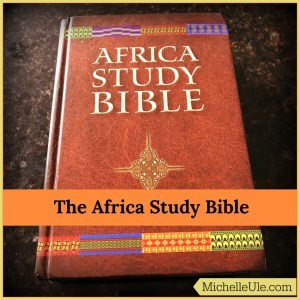 I’ve got an Africa Study Bible on my desk these days.
I’ve been paging through it, gleaning insight and preparing to send it to a missionary I know in Gambia.
It’s interesting and full of different takes on the Bible from a decidedly African view point.
Spiritual information with a cultural interpretation different from mine fascinates me.
I’ve written about them here, here, and here, and even included the concept in my first novella, The Dogtrot Christmas.
Why an African study Bible?
According to Dr. Matthew Elliott, president of Oasis International, Ltd., the idea was first floated at a conference in Ghana.
“They [the participants] had a pastor’s heart and desire for a Bible to deepen faith and build disciples, not just present facts.”
Elliott explained in an interview with Training Leaders International, “if you focus on understanding meaning of a text, it will be very similar to any study Bible in the world. If you focus on discipleship, it is pastoral to Africa.”
Similarly, a survey done in Nigeria revealed that “meanings of words from the United States or the United Kingdom were not always clear for English-speaking Africans.”
While studying the Sermon on the Mount with my own Bible study recently, I pulled up an insight the women found interesting.
“The Sudanese has a proverb that translates: ‘The camel does not know his neck is twisted.’
“This means a certain tribe can view another tribe as thieves, killers and cattle raiders, not recognizing they practice the same sins.
Jesus urges us to deal with our own sins before pointing the blame at others. It is easy to see the sins and mistakes of others without taking note of our own short-comings.
He said we must repent and ask God to give us an honest evaluation of ourselves.”
We don’t have camels where I live. I can see, however, where this proverb might be helpful for people who do. Why not use an example they either might encounter or which is part of their cultural heritage?
Application, not a commentary

Special markings to point out important ideas.
“We are targeting the pastor that maybe has not gone through a full theological education.
In a commentary you comment on the text. In this study Bible, we are doing less interpretation and more application of the text.”
The applications and ideas came from pastors in Africa. By networking through a variety of organizations like Wycliffe Bible Translators, Scripture Union, SIM, CRU and Navigators, for example, Oasis found 350 writers.
People from 30 different African countries provided 30 pages of questions about how to create the study Bible.
“For the most part, they had a pastor’s heart and desire for a Bible to deepen faith and build disciples, not just present facts,” Elliot said.
Input came from seminary presidents, denominational leaders and scholars–with a common goal.
“They were rooted in their belief in the power of God’s Word and the role of a pastor for nurturing the African church.”
Translation, cultural context example
You won’t find anything about polygamy in my Lutheran Study Bible . . .
Oasis used the New Living Translation, English, as the basis for the Africa Study Bible. They sought an easy to-understand version and Tyndale’s NLT seemed to work well.
(Tyndale is the publisher of the Africa Study Bible).
According to Oasis, the Africa Study Bible “brings together 350 contributors from over 50 countries, providing a unique African perspective . . . with over 2400 notes.”
Elliott pointed out elements in the African culture were often closer to the Biblical cultures than those westerners think they understand.
“For example, the story of Esther – it’s the politics of marriage.
We {Westerners] want to think it is more about sexual desire, but it is more about political alliances . . .
You can go through lots of illustrations to see how Africans understand the culture of the Bible more intrinsically than others do.
The version currently for sale in the US and the UK costs $39. Oasis sells it for closer to $20 in Africa.
It’s still a large sum for many, but if the pastor has only one translation, why not use one that focuses on his culture?
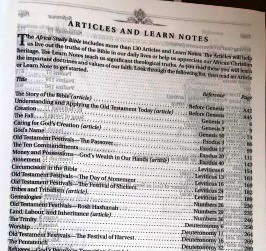
Types of subjects considered within the Bible itself.
You can visit a sample here.
History of Christianity in Africa
Interesting to me as well, was a timeline history of Christianity in Africa.
It started with that Ethiopian eunuch, but sections of the Old Testament took place in Egypt.
(And not just Moses’ experiences with Pharoah).
Why wouldn’t it make sense to incorporate that history into a Bible designed for the people who live there?
Tweetables
WHY read an Africa Study Bible? Click to Tweet
Cultural sensitivity, original ideas and a study Bible specifically for Africa. Click to Tweet
The post The Africa Study Bible appeared first on Michelle Ule, Author.
April 24, 2018
Hancock: Philip and Kathleen, BTC regulars
Sitting under OC’s teaching and living it out in their lives, resulted in a ministry that ultimately spanned three continents.
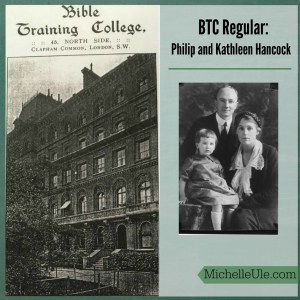
Philip and Gertrude Ballinger Hancock; 1920’s Persia
Like many missionaries, they had to die to themselves and give up dreams.
More than once.
Philip Hancock
Born in Wales the oldest of thirteen children, the 5′ 4″ Philip went to work as a cleaner for the railroad at age fifteen.
His passion for God may have been the result of the 1904-1905 Welsh revival; he yearned to be a missionary.
A missionary society sponsored him at the Bible Training College in London, starting in 1913.
World War I erupted in August 1914. Philip joined the YMCA following the fall 1914 semester and spent several months among the troops on the Salisbury Plain.
(Unverified, but Philip joining the YMCA may have inspired OC to do the same). When Philip’s orders came for Egypt, he gave up plans for a future with another BTC student, Kathleen Ballinger.
Philip and BTC/YMCA friend and colleague Jimmy Hanson arrived in Egypt a week after Biddy Chambers in December 1915.
YMCA director William Jessop used Philip as a roving secretary, particularly along the Suez Canal and on the Sinai Peninsula‘s front lines.
Philip went with the YMCA when the Egyptian Expeditionary Forces took Jerusalem. You can read the story of Philip, stores and camels here.
Kathleen Ballinger
Gertrude Kathleen Ballinger grew up 70 miles away from Philip in Glouchestershire, the daughter of a farmer.
A comely beauty two inches taller than Philip, she arrived at the BTC in 1913 for a few weeks of “spiritual refreshment.”
Kathleen quickly “caught” what OC taught, and decided she, too, had a calling to serve Christ.
With his penchant for nicknames, OC called her “Woodbine”–which helped differentiate her from his wife and daughter! (Woodbine means generous and devoted affection).
She and Philip fell in love but Philip had no money and a calling.
They gave up their dreams of marriage in 1915 when he sailed for Egypt.
Kathleen applied to work with the YMCA in Egypt and returned home to wait.
Egypt
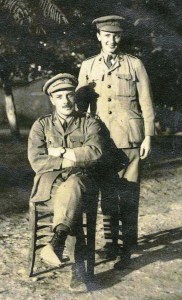
Jimmy Hansen (seated) with Philip Hancock
Kathleen received orders to join the YMCA with her BTC friends Gladys Ingram and Eva Spink in September 1916.
The trio sailed to Egypt together in what OC called the “BTC expeditionary forces.”
Once in country, they journeyed to Alexandria where they joined Miss Ashe to work at a Soldier’s Home along the Mediterranean Sea.
The BTC students often gathered at Zeitoun during their free time.
Whenever Phillip knew Kathleen would be there, he made sure he had business in nearby Cairo so he could visit as well.
Kathleen and Miss Ashe eventually ran a small YMCA hut alongside the Benha railroad station about an hour north of Cairo.
OC visited and wrote about the experience with admiration.
“The hut there is the nucleus of any amount of possibility. They are really roughing it more than any of us, and as usual, are appearing no end encouraged with the very difficulties.”
While at Benha, Kathleen came down with a life-threatening illness and Miss Ashe sent her to Zeitoun for recovery.
Biddy nursed Kathleen back to health and Phillip, realizing how easily he could have lost her, wrote to Kathleen’s father asking for her hand in marriage.
In September, 1917, OC noted in his diary:
“Woodbine and Philip Hancock came to see us this afternoon–engaged to be married! So that is how things are done in Egypt. God bless them, it did us all good to see them.”
The couple wed the following spring (after Oswald’s death), with Kathleen Chambers as flower girl. The couple took up OC’s former ministry at the YMCA hut in Ismailia.
They repatriated to England in 1919.
Off to America and Persia
In 1920, Philip and Kathleen traveled to California where Philip attended San Francisco Theological Seminary.
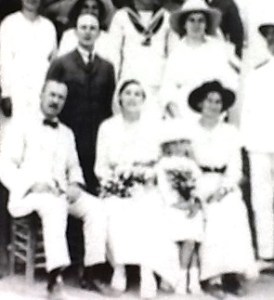
Philip standing behind William Jessop and Kathleen, with Kathleen Chambers as flower girl and Biddy. (Wheaton College)
Their daughter Mary was born there.
Following ordination in 1925, the Hancock family moved to Persia (current day Iran) to work with the East Persia Mission of the Presbyterian Church in America.
Their children Donald and Evelyn were born in Persia during their twelve years at Hamadan and Kermanshah.
Kathleen worked with the women. She wrote about the experience several years later for the BTC Journal, circa 1938.
“The Moslem field, as you know, is not an easy one to work in. But we do praise God for those whom have seen come to Jesus and who have found He makes all things new.
“When you actually see the barriers fall down, superstition, fanaticism and fear give way and peace, hope and joy take their place because of our Lord Jesus, then you wish that at least you had one more life to lay at Jesus’ feet.”
Philip served as an evangelist among boys at a Christian school.
“It was always a great opportunity to rub shoulders with the boys and young men in our schools–to have them come to our home for a discussion class based on the Gospels and the teachings of Jesus.”
He worked in the men’s hospital wards, taught Bible studies and preached in Persian at evangelistic meetings.
The Hancock family’s dream of serving in Persia for the rest of their lives ended in 1935 owing to ill health. They returned to England where Philip spent the rest of his life pastoring Presbyterian congregations.
Back in England
The Hancocks were the only people whose family I was unable to trace during my research while writing Mrs. Oswald Chambers.
A curious series of events, however, enabled me to trace their life to the former St. Andrew’s Presbyterian Church in Middlesex from 1947-1956.
Using Google maps, I discovered the current name of the church and wrote a letter.
Even though Kathleen and Philip left Middlesex 60 years ago, the church secretary found several people who remembered them. They provided me with some of the facts above.
Ultimately, the Hancocks retired to Bath to live near their daughter. Kathleen died in 1977.
Philip, the youngest of the BTC regulars, was the last one to die in 1985 at the age of 93 years old.
Their lives epitomized what OC sought at the BTC.
A 1940 article in the parish newsletter wrote about Philip’s time at the BTC:
“The year and a term in the college under the Principalship of the Rev. Oswald Chambers meant more to him that he could ever express. It proved to be a vital Christian experience that remained with him all his life.”
Well done, good and faithful servants.
Tweetables
How did Oswald Chambers’ students end up in Persia? Click to Tweet
Oswald Chambers students serve God on three continents. Click to Tweet
Every month in 2017, I related the stories about God’s leading and my blessed–and astonished–reactions while writing Mrs. Oswald Chambers
Sign up for my newsletter here, and get your free Ebook..
The post Hancock: Philip and Kathleen, BTC regulars appeared first on Michelle Ule, Author.
April 17, 2018
Jeremiah and Job: on Knowing God’s Will in Advance
Curious how that works out when you daily read through the Bible in three sections, one chapter at a time.
(It’s usually one Old Testament, one Psalm or Proverb and one New Testament reading. This time, I kept going when I finished Proverbs!)
It seems almost unfair to confront those challenging Old Testament books at the same time, and yet, there’s truth here because it’s the Word of God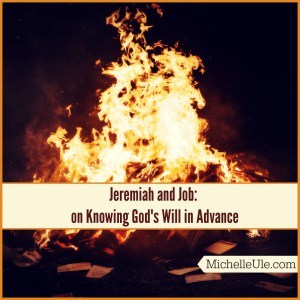 .
.
How would you like tragedy served to you?
“If God told you He would send twelve terrible things into your life this year, would you want them one a month for a year?
“Or, would you prefer to have all twelve hit you in three months and then be trouble-free for the remaining nine?”
I asked a relative that question nineteen years ago. We were in the midst of family troubles.
“I’d rather have them all at once and then be problem free the rest of the year.”
I felt the same way. I reasoned if my life was in total chaos for three months, people would give me plenty of grace.
I’d then have nine months to wallow, er, recover my equilibrium.
That assumed, however, that God gave me the choice–and thus I knew of it in advance–rather than surprising me with it.
I think it would be harder if I didn’t know if or when the pain would end.
Which brings me to Jeremiah and Job.
Jeremiah and Job–knowing and not knowing God behind the anguish
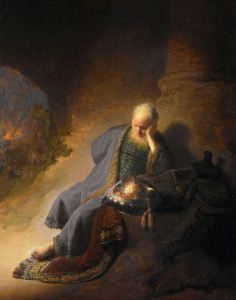
Jeremiah listening for God’s voice–again.
God told Jeremiah he would be a prophet. He told Jeremiah up front that greater trouble than I can imagine was coming.
God promised Jeremiah He would be with him throughout.
I’m not sure Jeremiah had much choice in the matter, but he accepted the difficulties and figuratively put on the prophet’s mantle.
It was horrible. Anguish dogged Jeremiah. He didn’t want to be the one constantly bringing bad news.
King Jehoiakim punished him–often–and even burned the scroll detailing God’s prophecy.
(So Jeremiah wrote it again).
In the case of Job, God negotiated an arrangement with Satan and didn’t say anything to Job.
God depended on Job’s devotion to Him remaining true despite Satan‘s efforts.
Both Job and Jeremiah rested in God’s hands–but He let Jeremiah know trouble was coming ahead of time.
Which life would you prefer?
Just tell me!
How often we think we can endure any crisis if we knew in advance, or understood the reason.
The pain of troubles can feel like more than we can endure.
How often we think we can better live if we know the future.
But, is that really true? Would I live my life so fully if I knew crisis was coming?
(But isn’t it always coming?)
Many people I love are in crisis at the moment. We’ve had more than a dozen deaths in our 250-member church in the last seven months.
One recently widowed friend has a serious medical condition. Her doctor recently gave her wise advice:
“Go home and live your life.”
He’s optimistic about her health, but there wasn’t anything he could do to mitigate possible death.
So, she should live and enjoy her life as if she doesn’t know when she’s going to die.
Because she doesn’t know.
Chances are good, you don’t either.

Photo by Jenn Evelyn-Ann (Unsplash)
What good would it do to know the future?
You already know. One day you will die. Are you prepared? It could happen today.
Knowing the reason
Did knowing God chose him to be a prophet help Jeremiah?
His first response sounded like Moses:
“Ah, Lord God! Behold, I do not know how to speak, for I am only a youth.”
The Lord told Jeremiah not to worry, God would be with him.
“Behold, I have put my words in your mouth. See, I have set you this day over nations and over kingdoms, to pluck up and to break down, to destroy and to overthrow, to build and to plant.”
Armed with those assurances, Jeremiah went forth on a thankless prophet job full of pain, embarrassment, harassment and agony.
He saw his terrible prophecies come to pass, including the destruction of Israel, and wound up in exile in Egypt.
Was it any easier knowing God had ordained it all?
Probably. His pain was physical and emotional–for the many who did not heed his prophecies–but perhaps he could bear it better knowing God would not forsake him.
Job–not knowing
Job didn’t know God had made an arrangement with Satan. He didn’t know God had such confidence in his faithfulness.
His tormentors were his friends and his grief, not to mention the weeping sores. (I lost track of those, the man was physically ailing throughout the book).
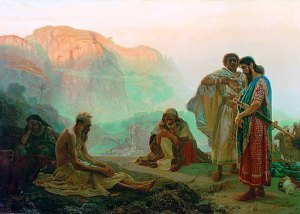
Job and his friends; by Ilya Repin (Wikimedia Commons)
Job berated God with his arguments, maintained his innocence and was bewildered even as he merely wanted to die and be let out of his pain.
Job needed to hang on to what he knew about the God he had long worshipped–his character, in particular.
He argued for his innocence with his friends, who scoffed and accused him–possibly out of fear.
In the end, God showed up and, in what I’ve always thought of as a bittersweet action, returned a family and a wealthy homestead to Job.
Job, of course, knew he would see the lost children again in heaven.
And us?
We weathered our family’s storm, battered, tired and emotional–for years.
We still love each other. God remains in control.
When trouble comes, I try hard to remember Jesus’ words: “In the world you will have tribulation, but be of good cheer for I have overcome the world.”
Jeremiah and Job got to see that.
I will too, someday.
God promised.
Which would you choose? To know the future ahead of time, or walk in the grace that God knows what He is doing with your life?
Tweetables
Jeremiah and Job: Two sides of knowing God’s will. Click to Tweet
You choose: to know a crisis is coming, or find out in the middle? Click to Tweet
Jeremiah and Job: Knowing the will of God, or not? Click to Tweet
The post Jeremiah and Job: on Knowing God’s Will in Advance appeared first on Michelle Ule, Author.
April 10, 2018
How to Find a Church Home
(Thank you, US Navy).
 We’ve honed our experience into a few pointers some of you might find useful.
Prayer, of course, is the key ingredient and you should pray throughout the search.
Combine those prayers with these six things to consider when hunting for a church home.
1. Commitment to the Bible and the Lordship of Christ
We believe that being a Christian means fidelity to the truth of the Bible.
It also means a recognition that Jesus is Lord.
Those two factors are our nonnegotiables. If a church doesn’t reflect those two points, we don’t want to attend.
2. Affiliations
We pay attention to the denominations in our new community, but they are not absolute guarantees of where we’ll settle.
To that end, we’ve attended churches in the following denominations: Lutheran, Missouri Synod Lutheran, Anglican, Calvary Chapel, Navy chapels (twice with Lutheran pastors) and one Independent Bible church.
We come from a liturgical tradition and are more comfortable in a congregation that corporately confesses sin on a regular basis.
We like to sing in the choir and I’m a musician, so the music is important to us.
I also like to celebrate the traditional holidays and therefore liturgical churches suit me better.
3. Current Family situation
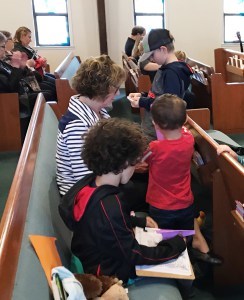 What is your family situation?
During one move we specifically sought a church that had an active youth group. Ours sons were at an age when they needed devout peers.
As it turned out, the church we chose didn’t have a big youth group, but they were hiring a youth pastor the next summer when he graduated.
We went with that church. Ours sons ended up being mentored by one of the pastors in Bible study and it was very helpful in their spiritual walk.
(So don’t be hard over on what you think you need!)
When my husband was actively going to sea, it helped to be in a church with other Navy families.
That Anglican church, pastored by an Army reservist, understood my needs and stepped in time and again.
Since we always lived far from our family, it helped to be in congregations that had many different ages.
Our children regularly were “adopted” and loved by grandparent types, which was very helpful and I’m grateful.
We like smaller churches where people can get to know us and where we can minister.
Multicultural churches are an added plus as well. We loved eating sashimi at our Hawai’ian church!
4. Friends
It can be helpful if your friends suggest churches they’ve attended in your area, or that you join theirs.
My husband befriended a woman at his new job in one town and she recommended the church she attended. We joined it (and became good friends with her).
A non-church going friend suggested Calvary Chapel in Monterey to us with the words, “They believe like you do.”
They did, so we joined the church.
When we left that Calvary Chapel, the pastor advised us to try the sister church at our next duty station. “David needs you.”
That’s where we attended the first Sunday in town. When we shook the pastor’s hand we said, “Bill sent us. He said you need us.”
David laughed. “What does Bill mean?”
We didn’t know, but we ministered at that church home for four years.
5. Pregnancy Counseling Centers and other parachurch ministries
Several times I’ve enlisted the assistance of Pregnancy Counseling Center directors to choose a church home.
We figured we’d start with churches that shared some of our core values before widening the search.
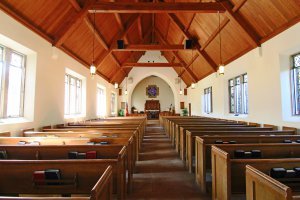
We like smaller, home-like churches. Photo by Debby Hudson (Unsplash)
The other advantage with using a referral from PCCs is, they know what churches will look after the lambs they send for help.
Churches that minister outside of their walls are churches interested in the Kingdom of God at large.
Other parachurch ministries could be good places for clues. BSF, Precepts Bible studies, Awanas, Prison Fellowship programs, to name a few, will give you a sense of the church’s heart for the world.
6. Holy Spirit
Here’s the wild card in the mix.
The leading of the Holy Spirit should be central to the new church home search.
Sometimes your church no longer fits your needs or perhaps it becomes clear you need to worship God in a different setting.
Some people, unfortunately, discover they’re in a toxic (un)spiritual environment. (Don’t throw away God! Just find a new church!)
The Holy Spirit moves where He does for purposes we frequently don’t understand.
So, if the Holy Spirit indicates a surprising church home, try it and see.
In my case, I had a bad experience at one church and didn’t trust the leadership anymore. I knew I needed to go elsewhere.
Photo by Chad Greiter (Unsplash)
The “interim” church was Bible based but the service did not meet my personal needs.
While attending a Billy Graham Crusade training, I bowed my head to pray with the high school auditorium before we began.
Three sentences into the prayer, I opened my eyes and looked to see who was praying in such a rich way.
This pastor’s prayer demonstrated an intimate relationship with God I hadn’t heard recently. I made a beeline after the training to learn what church he attended.
I felt uncomfortable attending the type of church he pastored, but when I discussed it with my husband and a close friend, they both suggested I try it.
That church is the one I dream about and so often wish I was back with all these years later.
I never would have guessed.
But the Holy Spirit knew what I and my family needed.
Thanks be to God.
What do you look for when it’s time to find a new church home?
Tweetable
Six tips for church hunting. Click to Tweet
How to find a new church home. Click to Tweet
When the Holy Spirit moves, He moves and a surprising church becomes home. Click to Tweet
The post How to Find a Church Home appeared first on Michelle Ule, Author.
April 3, 2018
Are You a Holy Busy Body?
I have been in the past, helpfully making suggestions about others’ spiritual life.
I undoubtedly will do it again (and if happens to be you, I apologize in advance).
But, I try very hard NOT to tell people what I think God is saying to them.
After all, I can scarcely figure out what God is saying to me.
How could I possibly know what He’s saying to you?
Oswald Chambers helped me understand this.
He warns us not to be an “amateur providence,” in someone else’s life.
In the August 1 My Utmost for His Highest, he asks:
“Are we playing the spiritual amateur providence in other lives? Are we so noisy in our instruction of others that God cannot get anywhere near them?
We have to keep our mouths shut and our spirits alert.”
Providence refers to playing at God. An amateur providence is a person who is NOT God pretending to be God and advising others about what God is telling them to do.
Or, Chambers warns, playing God with someone else’s life and trying to shield them from the consequences of their circumstances.
A sort of tough love.
I’m the one interpreting “amateur providence” as being a holy busy body.
Taking counsel with others?
God tells us in the Bible to counsel with HIM.
“Come now let us reason together says the Lord.”
And there are other spots where we’re advised about the benefits of counsel from others:

William Stitt (Unsplash)
Counsel suggests you asked for someone’s opinion. If so, they’re a counselor, not a holy busy body.
How do I know what God is doing in your life?
That’s the rub. The only person whose heart, mind and soul I can begin to guess at is me.
I may know you very well, but I don’t know what the Holy Spirit is impressing upon your heart.
I don’t know the ins and outs of your relationship with God.
Who knows what God is working out in your life except Him?
I might be able to make observations about your life based on what you tell me, but I can’t plumb the depths of what the Holy Spirit knows down there in the marrow of your bones.
Chambers used the term “amateur providence,” more than 30 times in My Utmost for His Highest according to Jed and Cecile Macosko.
As most of the lectures came from his time at the Bible Training College, Chambers recognized the temptation many of his students might face on the mission field.
It’s a temptation many in spiritual authority–pastors, Bible study teachers, prayers–face. We have to let God work in your life the way He sees fit.
Biddy chose one of Chambers’ most in-your-face responses to the threat for the November 15 reading (which marked the day Chambers died):
One of our severest lessons comes from the stubborn refusal to see that we must not interfere in other people’s lives.
It takes a long time to realize the danger of being an amateur providence, that is, interfering with God’s order for others.
You see a certain person suffering, and you say—‘He shall not suffer, and I will see that he does not.’
You put your hand straight in front of God’s permissive will to prevent it, and God says—“What is that to thee?”
The pain of NOT being a holy busy body
Chambers spells it out simply in the March 24 reading from My Utmost for His Highest:
“You may often have to watch Jesus Christ wreck a life before He saves it (see Matthew 10:34).”
Yikes! What does that mean?
The hardest prayer for my prayer partner and I to pray is that God will allow our loved ones to hit the bottom sooner rather than later.
Because when they reach the end of their rope, that’s where they’ll find Jesus.
Until we understand the depths of our sin, we can’t recognize our need for a Savior. If we get in the way of our loved ones reaching the breaking point, we can very well thwart Jesus’ work in their life.
That’s a strong statement, but is often the result of well-meaning amateur providences trying to help. 
A reforming holy busy body
Since learning this truth years ago, I remind myself when I’m tempted to “bail someone out,” that I cannot get in God’s way.

Have I got advice for you! Photo by Huy Phan (Unsplash)
I usually turn my angst into a prayer for that loved one, freely acknowledging to God that I’ve got suggestions for how He should resolve the situation.
Because we can tell God anything in prayer, I do so.
I like to think He smiles, particularly when I finish with the real prayer: “thy will be done in this person’s life.”
I don’t want to be a holy busy body, so my concerns, these days, drive me to prayer.
The heart of the God who loves us all best, is where I want everyone to be.
Tweetables
How to tell if you’re a holy busy body or an amateur providence. Click to Tweet
Oswald Chambers’ advice on acting like a holy busy body. Click to Tweet
How to get in God’s way for another with the best of intentions. Click to Tweet
The post Are You a Holy Busy Body? appeared first on Michelle Ule, Author.
March 27, 2018
Gladys Ingram Donnithorne: Bible Training College Regular
The Bible Training College principal had a penchant for nicknames and when three pretty girls arrived in 1913, he renamed them all.
(Kathleen Ballinger became “Bill” and Eva Spinks became “Spinx” or “Spinkie”).
Gladiolus, as a flower, means “sword, strength and integrity.”
It’s an apt description of a determined woman who remained firm in her faith despite a number of challenges throughout the world.
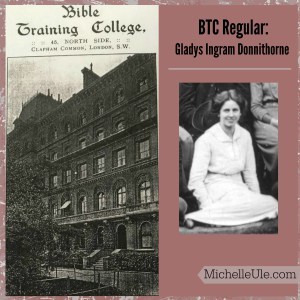 Born in India, Gladys came from a large family. Her father, Thomas Ingram, was a barrister.
The family returned to England after Gladys’ birth and she grew up in Wimbledon, not far from the Donnithorne family. (Four Ingram children eventually married four Donnithorne children.)
Her parents knew William and Evangeline Booth, founders of the Salvation Army.
Gladys’ older brother George became an Evangelical Christian while at Cambridge and met Oswald Chambers. It may have been through George that she later learned of the Bible Training College in Clapham Common.
At the BTC
Gladys entered the BTC in the fall 1913 term to explore becoming a missionary. (One of her brothers worked in India as a missionary).
About Oswald, she wrote:
“He had a great sense of humour and was exceedingly observant, often he seemed to read one’s thoughts before they found expression.
“[Oswald] was so very human and without a trace of ‘religiosity’ about him. He was absolutely real, and there was no division in his life between the sacred and the secular.”
“Gladiolus” also joined several other BTC students on a Yorkshire summer holiday with the Chambers family.
“By living in such close contact with Mr. Chambers and his wife, and by seeing the simplicity of their lives and their unwavering devotion to the Lord Jesus Christ, we learnt many lessons that we can never forget.”
World War I
Like many BTC students, Gladys wanted to join the YMCA work in Egypt. While waiting, she assisted Biddy and swapped letters with Oswald–who was full of advice.
It took nearly a year for permits to come and during that time, she lived with her family in Wimbledon. She spent a great deal of time with the convalescing Vyvyan Donnithorne.
A Chinese scholar and engineer dreaming of missionary work in China, Vyvyan enlisted in the army at the start of the war. A severe leg wound at Loos in January 1916, for which he received the Military Cross, ended his military career.
The two became close, Vyvyan proposed, Gladys accepted and orders came for her to go to Egypt.
Vyvyan gave her a small gold ring and she sailed away with Bill and Sphinx. They didn’t see each other until the end of the war.
Egypt
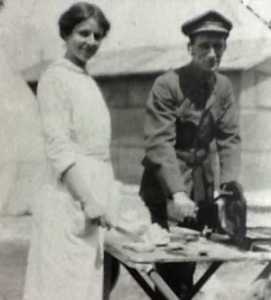
With OC slicing bread (Wheaton)
Once in Egypt, Gladys worked first with Miss Ashe at the Alexandria Soldier’s Home and then at Zeitoun. She sang at the YMCA’s Ezbekiah Gardens camp in downtown Cairo and managed the Zeitoun food canteen.
Of her experiences, she wrote:
“In many ways Zeitoun was a unique Y.M.C.A. centre, because Mr. Chambers was a unique leader.
“Shall we ever be able to forget those mighty meetings in the Devotional Hut? or some of the talks around the supper-table after the work of the day was over?
“Or the blackboard hung in a prominent position announcing the evening meeting, with a daily thought written on it, such as “Beware of anything that competes with loyalty to Jesus Christ,” or, “Be godly in the grubby details,” or, “When God says something never dispute, but do it”?
She was there when Oswald Chambers died and Biddy asked her to sing “Jesus Triumphant,” at the Zeitoun memorial service.
At Christmas 1917, she visited Oswald’s grave with Jimmy Hanson, Eva and Miss Riley. There, they thanked God for their beloved teacher and how his words led them to a deeper walk with Jesus.
Gladys and Eva repatriated to England in January 1919.
Post-World War I
Vyvyan Donnithorne eagerly awaited her return!
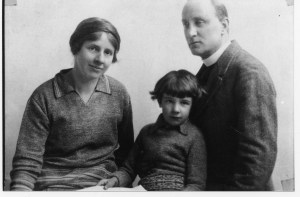
Circa 1926 (Wheaton)
They wed in September, 1919 with Biddy and the other BTC friends in attendance. Shortly thereafter, they sailed to China to begin missionary work in Szechuan.
Their only child, Audrey, was born there in 1922.
In 1925, Red Lantern bandits kidnapped the family while on holiday, along with six other missionaries. The kidnappers marched them through hills and valleys for three weeks, leaving them all insect bitten and hungry.
Ransomed healthy and safe, Vyvyan wrote of the friendly country people they encountered and hoped to return to them with the Gospel!
Life in China became increasingly difficult for missionaries in the 1930s. When Vyvyan became ill in 1942, he went to India for recovery and then could not return to China. Gladys joined him in India the next year and they relocated to Hong Kong, where they lived for the rest of their lives.
Hong Kong Missionary Life
World Vision supported Gladys’s work in the 1960s. President Ted Engstrom wrote that “Aunt Gladys,” worked among the displaced and impoverished people in Hong Kong’s “Forbidden City.”
“Mrs. Donnithorne was not afraid of getting her hands dirty as she ministered to opium addicts, orphaned children and disenfranchised Chinese in the heart of the city.
“Every time I was with her, as she shared her burden and concern, I was deeply moved in my spirit to recognize the sacrifice of this dear lady as she ministered in Christ’s name.”
Gladys also worked with Oxfam, as described in A Cause for Our Times.
“Mrs. Donnithorne did not exactly run a project; whatever she did was the project. A ministering angel by method and instinct, she unearthed pockets of misery on rooftops and in alleyways of the kind the authorities were loathe to admit existed.
“She was prepared to go anywhere, however distressing, moving around among the most pitiful cases to bring a little extra in food or cash . . . Her activity was not particularly orderly or planned; but its sincerity could not be doubted nor that it brought solace into some poverty-stricken lives.”
Gladys seemed to have charmed Oxfam into funding a number of projects for the poor, including refugees to Hong Kong from China in the 1950s and 1960s.
She died in 1977 and is buried beside her husband in Hong Kong.
Final observations
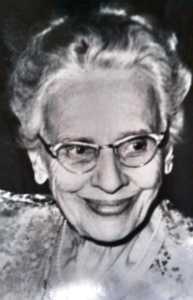
Later in life (Donnithorne family)
Gladys Emma Ingram Donnithorne led a full life devoted to God on three continents, originally inspired by Oswald Chambers’ teachings.
As she reflected in 1933 on her experiences with Oswald in Egypt (as noted above), Gladys wrote:
“The message they bring is living in my heart to-day and is a constant inspiration to me in this far-away part of China.
“And so with those men and women now scattered all over the world who have got to know the Lord through the spoken or written word of His servant, I say—Thank God for Oswald Chambers.”
And thanks to God for his good and faithful servant, Gladys.
Tweetables
How did Oswald Chambers inspire a missionary woman to China? Click to Tweet
The end result of Oswald Chambers’ teaching: World Vision, Oxfam and refugees in Hong Kong. Click to Tweet
How far did Oswald Chambers’ Biblical teaching reach? Click to Tweet
The post Gladys Ingram Donnithorne: Bible Training College Regular appeared first on Michelle Ule, Author.
March 20, 2018
Guidebook Travels with My Friend Rick Steves
He got the moniker after I quoted him one too many times for my impatient kinfolk.
As in, “Mon ami, Rick Steves, suggests we get the Paris Museum Pass.”
They started to say “non”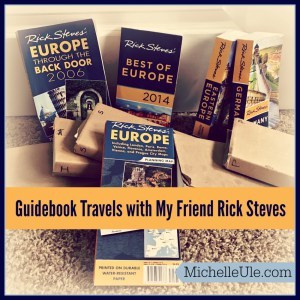 out of spite for hearing him quoted so often, until I read the reason why from the book about Paris.
“Yeah, maybe that is a good idea.”
One good idea after another
Which is why I purchase and read the Rick Steves books whenever we travel to Europe.
“So you take his tours?” my friend asked the other day. “My sister loved his tour.”
Ah, no. We’re “independent travelers.” We just use his books for suggestions and information.
They are invaluable for us–or at least the traveling us like me who needs to know details and great ideas both before and after she lands.
Other members of my family like to “wing it” a little more, so I let them choose the restaurants for dinner.
We all vote on which sights we prefer to see–sort of a democratic way to make sure everyone is happy.
Sometimes it even works.
How not to look like a typical American tourist
I don’t suppose there is a way we can look like anything other than Americans, we’re all a head taller than most people to start.
But the distinctive blue and gold books with Rick Steves splashed across them is a dead giveaway.
Which is why I cover my guide books.
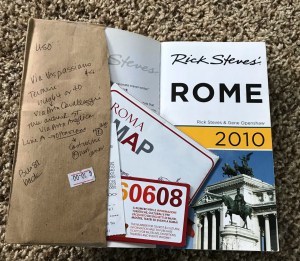 Using skills I acquired in junior high school, I put a brown paper bag book cover on my travel guides.
The plain cover hides the cover and provides a pocket and a handy spot to write notes!
The books are a good size to slip into a commodious pocket, a purse or even a fanny pack.
We rarely tuck them into the backpack because we’re always consulting the maps or reading up on the next itinerary stop.
Most of the big city books like London, Paris and Rome include metro maps–which are also very helpful.
Mark up the books
When we decide to travel somewhere, I purchase a book and start marking it up.
I turn first to the “at a glance” page and highlight what I think we should see, paying close attention to the hours and the days open.
It’s awful to get somewhere and discover the one day you have free to visit a museum is the only day of the week they’re closed.
I pass the list to my accompanying travelers and ask them to choose what they want to see.
From there we work out an itinerary–which is usually busier than they would like.
(Tip to the wise. In Paris, I rose early one morning and left them sleeping. I arrived at the Louvre when it opened and spent the morning tramping through the galleries alone. I met them at Venus de Milo at noon. Everyone was happy.)
In addition to marking up the books, Rick Steves himself suggests tearing it up and only carrying the sections pertinent to your trip.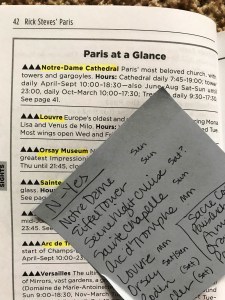
That would be a great idea if you were limiting yourself to one large city, say.
But the books also contain histories, historical time lines and discussions of pertinent social and political information.
Rick and his writers have a wry and practical sense of humor–so the books are fun to read even if you’re not going everywhere!
Types of books and information
The books are all about travel in Europe–Rick has been visiting the continent annually for many years.
For the most part, they’re divided by countries or areas (Eastern Europe, for example). He’s got fat individual guides to big cities like Paris, London and Rome.
You can see the whole list here.
On our last trip to Rome, I downloaded podcasts he’s done on specific sites. We stood in a long line at St. Peter’s and listened to the history of the cathedral on my phone.
Others in line listened in. That list is here.
He’s even got his own Europe App, which I may need to get before I take another trip across the Atlantic!
Recommendations
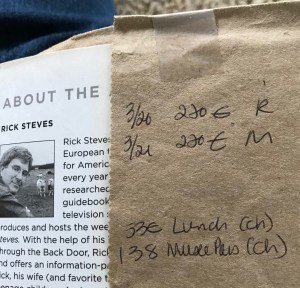
His photo’s in the back of some books.
In addition to recommendations on sights to see, Rick Steves also provides suggestions for budget accomodations, great restaurants, tour guides and even what to pack.
My daughter used her guide to figure out train trips when she traveled on a Eurail pass one year.
Some hotels will give you a discount when you make reservations with them and mention his name.
That got a little sticky one year when my reservation confirmation was made in the name “Rick Steves.”
No, he doesn’t help you that way!
I never travel anywhere without a guidebook and I always do my research before hand.
Whether it’s reading history, an important novel set in a foreign location, or even checking with friends, I know what I’m doing and what I want to see before I arrive.
Carrying Rick in cognito has proven valuable not only for us, but for the friends and relatives we meet along the way.
He’s known things even the natives have never heard before!
I can hardly wait for the next trip and what we’ll learn because of traveling, by guidebook, with my friend Rick Steves!
Tweetables
The best European travel guide books. Click to Tweet
It wouldn’t be Europe without mon ami Rick Steves and his guidebooks! Click to Tweet
Planning a trip to Europe? Here’s where to start. Click to Tweet
The post Guidebook Travels with My Friend Rick Steves appeared first on Michelle Ule, Author.
March 13, 2018
Holy in the Moment and Ginger Harrington
Written out of her personal experience, Holy in the Moment presents practical, intelligent encouragement for those seeking healing for personal fear and anxiety.
The book is insightful, clear and full of ideas that resonated with those of us who don’t have anxiety but long to grow closer to God.
Choosing holiness is the key.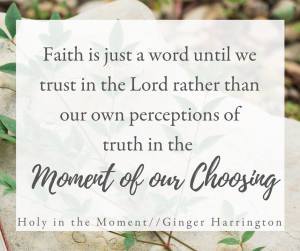
Why?
“Our choices are how we respond to God,” Ginger said. “Faith, love, trust, surrender, and abiding are all practical choices we make each day.”
Who is Ginger Harrington?
A long-time follower of Jesus Christ, Ginger is a blogger, professional speaker, Bible study teacher and ministry leader.
A “retired” military wife like me, Ginger also helped develop a non-profit ministry Planting Roots: Strength to Thrive in Military Life.
(Planting Roots encourages women to plant roots in faith, and to share the gospel wherever God sends them.)
The call to be holy came out of her life.
“As I struggled to find healing for anxiety that often plagued me, God taught me He is the only One who can make me holy and whole.
1 Thessalonians 5:23 in The Message states, “May God himself, the God who makes everything holy and whole, make you holy and whole, put you together–spirit, soul, and body–and keep you fit for the coming of our Master, Jesus Christ.
“The one who called you is completely dependable. If he said it, he’ll do it.”
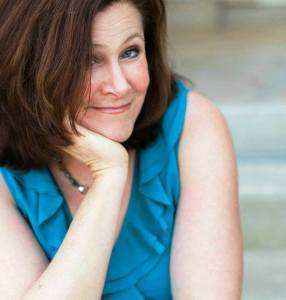
Ginger Harrington
As Ginger clearly articulates throughout her book, he key is choosing to trust, believe, abide, surrender, pray and rest in what Jesus said is true.
“These simple choices make a practical difference in my attitudes, thoughts, feelings, relationship and work.
“It all comes down to the choices we make in the moment. As long as holiness remains a theoretical concept rather than a practical choice, our faith life will suffer.”
Godly choices and being holy.
Throughout Holy in the Moment, Ginger references journal entries.
To be able to write a book about holiness, took years of living.
“God has been writing this message in my life for the past 20 years, which is reflected in my writing and speaking content over time.
For a book like this, a personal life-message, God had to bring me through the process before I could write this book.”
The idea behind Holy in the Moment began with a blog post Ginger wrote in January 2013, based on a single question.
“If we choose holiness in this moment, what difference could it make?”
She focused on making one simple choice that year. God used the “one simple thing at a time,” concept to bring big changes in her life.
How did this insight into being holy change her relationship with God?
“Understanding holiness, the wholeness of Christ in me, settled the dis-ease of my soul. I had lived with consistent fear humming in the background of my days.”
Ginger’s anxiety issues grew out of fear. Like many, she feared rejection, failure, disappointment, loss and change.
(The last two are difficult to avoid in a military family).
“Fear impacted my relationships, self-esteem, security, and relationship with God.
Though I had been growing in my faith for many years, there was a gap I didn’t understand between what I believed and my emotional health.
I still experience anxiety and fear at times, but I’m learning to make different choices.
As God brings my spirit, soul, and body together, my relationship with God grows stronger as well.”
Holy in the Moment: the book
Ginger has a beautiful turn of phrase which made reading her words pure pleasure.
My Kindle edition is filled with highlighted passages! Try this one.
“Daily reading of God’s Word taught me to listen, and it was in the valley of heartbreak and broken dreams where I came to know Jesus more intimately.”
She provides practical steps to apply her principles–in a way that seems doable.
Each chapter ends with bullet point “simple reminders.”
Her simple reminders from the chapter “Moments to Think” includes ideas like:
“The difference between holiness and selfishness narrows to a single thought if you act on it.”
“Think about what you’re thinking about.”
Everything goes back to, points to, or is related to God/Jesus and the Holy Spirit.
“Listening begins with God, and we need to trust Him with the process.”
Ginger writes with a confident, friendly tone that feels as if she’s talking with you.
“Today’s rest and freedom comes from yesterday’s submission.”
Ginger’s goal
“My heart is full in the experience of seeing what God has done in writing the book. Knowing that God is encouraging women and transforming lives through the content is an incredible joy.”
I came away with plenty of notes and things to ponder from reading Holy in the Moment.
Tweetables
Being Holy in the Moment is a matter of choice. Click to Tweet
Choosing holiness in each moment is key to our surrender to Jesus. Click to Tweet
Beautiful turns of phrase and Biblical truth provide holiness in the moment. Click to Tweet
The post Holy in the Moment and Ginger Harrington appeared first on Michelle Ule, Author.
March 6, 2018
Utmost Response: a Daily Reaction to My Utmost for His Highest
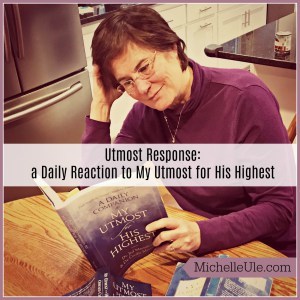 I’ve been writing an “Utmost Response” every day since August.
What is an Utmost Response?
Exactly what it sounds like–a response to that day’s reading in My Utmost for His Highest.
The idea came one morning while praying. Many people have told me that while they like the idea of reading My Utmost for His Highest, it can be hard to understand.
As I thought about the problem, a question slipped through my brain:
“Why not write out a reaction to each day’s reading and post it somewhere for people to join you?
It sounded like an interesting idea.
Several days later, I read a request to discuss the day’s reading on a Facebook page devoted to My Utmost for His Highest.
I liked the idea of minds sharpening minds while discussing Oswald Chambers‘ writing.
So I started writing my response–or explanation– each morning.
I post it there and on my own Michelle Ule, Writer Facebook page. (Click on the link to see today’s Utmost Response–no matter the date when you read this!)
The discipline of writing an Utmost Response.
I generally write my reaction every morning, first thing.
Some days the readings are really hard.
I sit with that cat curled on my lap clicking between the My Utmost for His Highest website and Facebook, trying to figure out what OC (my nickname for him) is saying.
I toggle between the classic version–which I read first since that was Biddy’s original compilation– and the revised version (done by James Reimann several years ago).
Between the two versions I can usually figure out what the reading says.
When I get stumped, I turn to A Daily Companion to My Utmost for His Highest by Drs. Jed and Cecilie Macosko. (You can read my interview with Jed Macosko here and here).
It usually helps, but not always.
Unique angle on the readings
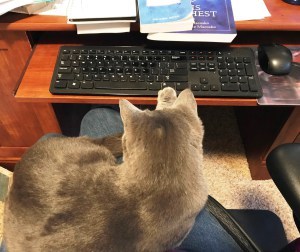
My untrustworthy assistant in the mornings
I bring a unique angle to the readings since I’m Biddy’s biographer and know a lot about the Chambers’ lives.
Sometimes I put the readings into the historical context, which can add some poignancy regular readers do not know.
I have access to photos and include them as makes sense and I always include the link to that day’s reading.
The surprises to me
While I’ve been reading My Utmost for His Highest daily for nearly 20 years, I haven’t always focused on understanding the reading.
They are not Scripture, but my reaction to the readings changes based on what I’m enduring in my life at a given time.
After six months of having to really think about the meanings and explain, I’ve gained a deeper appreciation for the wisdom–of both Oswald and Biddy putting together the devotional.
I am familiar with the sixteen main themes in the devotional, as explained by Dr. Ken Boa, but had never seen them in quite the same clarity before.
OC is very focused on our self-will. The subject comes up over and over again.
I take apart the reading, focus on what strikes me as important and ask others to comment.
I’ll post one here and you can try it yourself.
An Utmost Response
Here’s what I posted on the Michelle Ule, Writer Facebook page for February 6:
The February 6 reading deals with the self-will.
OC challenges us on our self-will throughout My Utmost for His Highest. He believed self-will is a more pervasive influence than even sin.
We sin when we decide (using our self-will) that we want to do something no matter what God thinks/says.
Self-will, therefore, is an attitude of the heart.
You can see how seriously OC views it when he says
“You must be willing to be placed on the altar and go through the fire; willing to experience what the altar represents— burning, purification, and separation for only one purpose— the elimination of every desire and affection not grounded in or directed toward God.”
I’m taking a deep breath reading this, how about you?
The first paragraph outlines what happens if we do not deal with our self-will, ending with the observation,
“If you don’t deal with God on the level of your will first, the result will be only to arouse sympathy for yourself,”
when we go through difficulties.
He warns, “see to it that you don’t wallow in self-pity once the fire begins.”
We’re dealing with the Creator of the Universe. He knows our hearts, minds, souls and bodies to the marrow, to the mitochondria. We can’t hide anything before Him.
He also knows our weaknesses and frailties. It seems to me, we’re asked to be honest and open to where Jesus leads.
Still, this is a sobering message. What do you think?
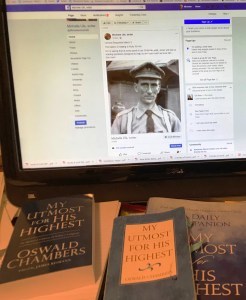
What the point?
I started writing the Utmost Responses to spark discussion with others.
It’s turned into an excellent spiritual exercise for me.
If you’re interested in Oswald Chambers, why not join me every morning?
I’d love to hear what other people think about these readings that have changed my life over the last 20 years.
Tweetables
What is an Utmost Response and where can I join the conversation? Click to Tweet
Is anyone discussing the daily reading from My Utmost for His Highest? Yes. Click to Tweet
A daily examination of My Utmost for His Highest–on Facebook. Click to Tweet
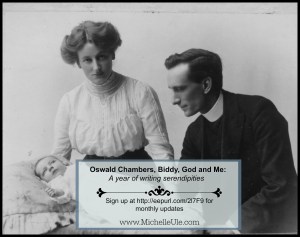 If you’re interested in Oswald and Biddy Chambers, you might enjoy my monthly newsletter.
My free Ebook detailing my experiences writing about the duo, Writing about Biddy and Oswald Chambers, can be yours if you sign up here.
The post Utmost Response: a Daily Reaction to My Utmost for His Highest appeared first on Michelle Ule, Author.