Robyn Paterson's Blog, page 6
February 9, 2021
Designing the Second CTC Cover
When it was time to design the cover for the second book of my Crazy Tricks Club series, I already knew a few things.
First, I was going to be using the same cover designer and style as my first book.
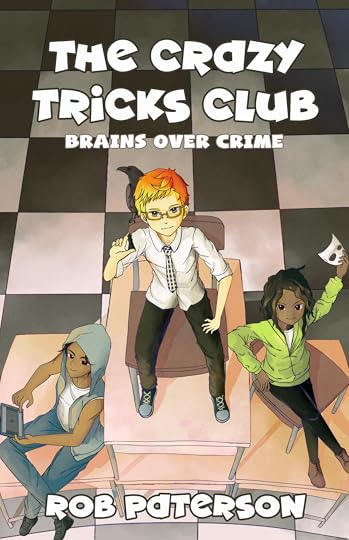
I really loved what my Indonesian cover designer, Lin, had done with the first book, and we’d already designed the lead three characters, so it was obvious to continue with him.
Second, I wanted a more action-oriented cover featuring a scene from the book. While I love the first book...


January 26, 2021
My Awesome New Middle-Grade Series: The Crazy Tricks Club
A new year begins with the launch of a new book series! This is the first book of the Crazy Tricks Club, a fun and fast-paced story about Aiden Fox and the other members of Ridge Hill Jr. High’s Crazy Tricks Club. They’re a secret team of problem solving students who specialize in doing seemingly impossible missions for the mysterious figure known only as Raven.
In the first book, the team must find a way to return their school’s stolen charity drive money. Money they didn’t steal, and wh...
January 13, 2021
How to Write Manga: Revised Edition
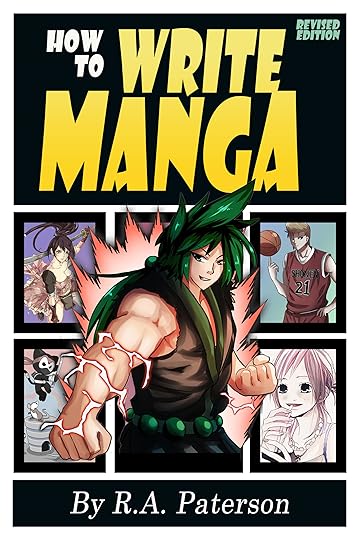
I’ve just released a new revised edition of my How to Write Manga book. If anyone hasn’t had a chance to check it out, it’s a new and updated version of my popular original textbook. And, if you already have an ebook copy of my original, just have it update to the newest version on Kindle and you can have the latest version.
Rob
January 5, 2021
Four Essential Stories to Make Your Writing Stronger

While there are an infinite number of possible stories, the vast majority of them fall into one of four categories. These four “essential” stories are the most basic forms of the stories that humans tell, and by understanding and using them you can quickly put your story into a simple framework that lets you know where your story starts, goes, and finishes. Not only that, knowing these four essential stories lets you weave together more complex stories than just a character doing something a...
Four Primal Stories to Make Your Writing Stronger
While there are an infinite number of possible stories, the vast majority of them fall into one of four categories. These four “primal” stories are the most basic forms of the stories that humans tell, and by understanding and using them you can quickly put your story into a simple framework that lets you know where your story starts, goes, and finishes. Not only that, knowing these four primal stories lets you weave together more complex stories than just a character doing something and get...
October 12, 2020
The Visual Language of Webtoons
Recently I’ve been thinking about webtoons – which is the name given to Korean (and Chinese) style webcomics which have been optimized for reading on mobile devices (ie phones). How do they do it? Well, at first glance it looks like they take the normal panels of a comic book page and then simply present them as one long vertical strip instead of a single page at a time layout.
So instead of this…
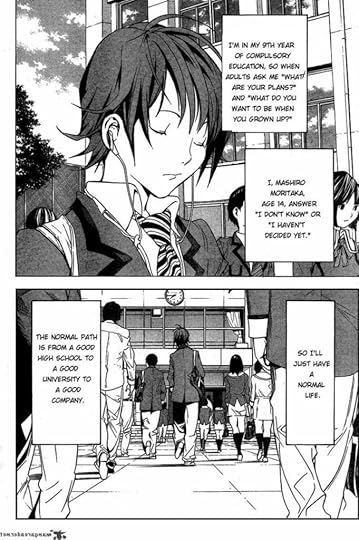 Bakuman, Vol1, Page 1.
A Webtoon looks like this…
[image error]From The Monster Duchess and Contrac...
October 1, 2020
Exploratory Manga – Educational Manga That Take You For A Ride
There are a few less common manga genres that probably deserve more attention than they get, and one of these is the Exploratory Manga.

Now, when I say “Exploratory Manga” you might think I’m talking about stories like Star Trek, Indiana Jones, Uncharted, or other adventure stories where the hero is going into strange new worlds. However, while those do have elements of exploration, I would classify those more as a type of adventuring story.
Instead, what I call Exploratory Manga (and ...
September 7, 2020
The Onion Method: Building Better Stories by Talking to Yourself
Reimena Yee’s Onion Method For Outlining Graphic Novels is one of the more interesting approaches I’ve seen to planning a story in a while. At first I thought it was going to be another take on the Snowflake Method, but I quickly discovered her approach is something very different. Not only that, it’s a more character-centered approach to planning a story than most of what you see online.
In essence, she explains this method as follows:
The Onion Method is a outline method that consis...
June 26, 2020
Mary Robinette Kowal’s Short Story Building Process

I recently posted about how author and writing teacher Mary Robinette Kowal uses the M.I.C.E. Quotient to help focus her stories, but while going through her blog I found that she also has a very refined process she uses for story development that is quite impressive. Below is the question sheet she gives her students (and uses herself) to go through the story creation process.
Write down gee-whiz idea.Where does it happen? – general scenic location.Place – New YorkSetting – DinerStag...
June 25, 2020
How M.I.C.E. can help writers.

A while ago on the Writing Excuses podcast I heard science fiction author Mary Robinette-Kowal discuss one of her personal favorite ways to structure stories, which is called the MICE Quotient. Mary didn’t come up with the idea, author Orson Scott-Card (another hyphenated writer) did, but Mary seems to be its primary evangelist, so I’ll give her credit for making me aware of it.
The MICE Quotient itself has a few parts, but the main part of it works like this – there are basically four di...