Rachel Maddow's Blog, page 3346
August 22, 2013
Liz Cheney's fish tale
Associated Press
We talked a couple of weeks ago about a funny story out of Wyoming, where far-right media personality Liz Cheney is running an uphill Senate fight, and where an errant fishing license has become quite a headache.
U.S. Senate candidate Elizabeth Lynne Cheney posted a $220 bond in Ninth Circuit Court in Teton County on Monday on a charge of making a false statement to procure a fishing license.
A citation/complaint ticket in the court file states that Cheney "fail[ed] to meet residency requirements as required," according to the ticket signed by Wyoming Game and Fish Jackson Supervisor Tim Fuchs.... Cheney signed the ticket twice, once saying she promised to appear in circuit court at 1:30 p.m. Aug. 27 or would forfeit her bond.
I'd love to hear the in-state debate as to whether Cheney is a flight risk.
This is, to be sure, a fairly silly controversy, but it's nevertheless a reminder as to why Cheney is very likely to lose. To briefly recap, Cheney moved from the DC area to Wyoming in May 2012, and quickly applied for a fishing license. Residents are supposed to live in the state for at least a year before qualifying, and Cheney reportedly told a clerk she'd lived in Wyoming for 10 years, which was only off by 10 years.
Why would she go to the trouble? Because as Salon explained, "Wyomingites do not trifle with fishing. According to census data, nearly 40 percent of Wyoming residents are anglers, who spend a cumulative 5.3 million days a year fishing. Fishing expenditures are worth almost $465 million to the state's economy, with much of that coming from tourists.... The state's tourism website uses words like 'ultimate fishing and fly fishing destination' and fishing 'mecca.'"
In other words, if you're a carpetbagger who's eager to pretend you're a local, you'd go out of your way to get a Wyoming fishing license as quickly as possible -- perhaps even taking a shortcut or two.
Liz Brimmer, a Republican strategist in Wyoming, added, "It's a serious misstep. Allegedly poaching in a state where being a resident sportsman is, by law, an earned privilege. Wyoming people will take this very seriously."


Jobless claims climb, but remain low
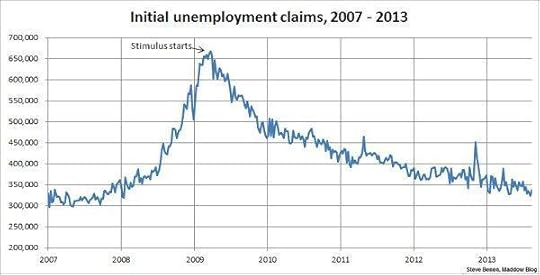
Last week, initial unemployment claims reached a low unseen since before the start of the Great Recession, so no one was especially surprised to see them climb a bit in the newly released figures from the Department of Labor.
The number of people who applied for new U.S. unemployment benefits climbed by 13,000 to 336,000 in the week ended Aug. 17 but remained near a post-recession low, according to the latest government data. Economists surveyed by MarketWatch expected claims to rise to 330,000 on a seasonally adjusted basis. The average of new claims over the past month, a more reliable gauge than the volatile weekly number, fell for the sixth straight week and touched the lowest level since November 2007, one month before the Great Recession started.
To reiterate the point I make every Thursday morning, it's worth remembering that week-to-week results can vary widely, and it's best not to read too much significance into any one report.
In terms of metrics, when jobless claims fall below the 400,000 threshold, it's considered evidence of an improving jobs landscape, and when the number drops below 370,000, it suggests jobs are being created rather quickly. At this point, we've been below 350,000 in 15 of the last 20 weeks.
Above you'll find the chart showing weekly, initial unemployment claims going back to the beginning of 2007. (Remember, unlike the monthly jobs chart, a lower number is good news.) For context, I've added an arrow to show the point at which President Obama's Recovery Act began spending money.
The nation's full faith and credit is not a 'leverage point'
Associated Press
The House Republican leadership
About a week ago, National Review's Robert Costa reported that congressional Republicans are considering an incredibly dangerous new plan: they're prepared to hold the nation's debt limit hostage again, creating a crisis comparable to the one we saw in the summer of 2011, unless Democrats agree to take health care benefits away from millions of Americans.
Earlier this week, Rep. Chris Van Hollen (D-Md.), a prominent member of the House Democratic leadership, said he now sees this scenario as likely. And overnight, Reuters reported that another GOP debt-ceiling crisis appears to be on the way.
Republican lawmakers, who staunchly oppose President Barack Obama's signature healthcare law, are considering using a fall showdown over the country's borrowing limit as leverage to try to delay the law's implementation.
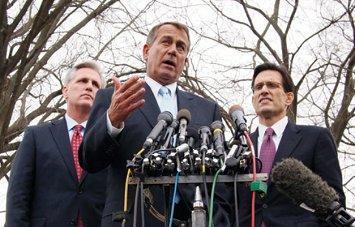
The idea is gaining traction among Republican leaders in the House of Representatives, aides said on Wednesday. An aide to House Majority Leader Eric Cantor said the debt limit is a "good leverage point" to try to force some action on the healthcare law known as "Obamacare." [...]
Republicans are weighing the tactic as an alternative to another approach that would involve denying funding for the law and threatening a possible government shutdown.
In other words, as we discussed last week, GOP leaders are effectively prepared to swap one hostage for another. Over the last several weeks, the message from many Republicans has been, "Help us sabotage the federal health care system or we'll shut down the government," but under this alternate scenario, the new threat is, "Help us sabotage the federal health care system or we'll trash the full faith and credit of the United States and crash the global economy on purpose."
As an objective matter, this is nothing short of madness. As Ezra Klein recently put it, "Trading a government shutdown for a debt-ceiling breach is like trading the flu for septic shock. And Boehner knows it. Republicans will effectively be going to the White House and saying, 'Delay the health-care law or we will single-handedly cause an unprecedented and unnecessary global financial crisis that everyone will clearly and correctly blame on us, destroying our party for years to come.' ... This is not a safe way to govern the country."
What's more, the fact that Cantor's office sees this as a "leverage point" says something important about how Republicans perceive their duties to the nation.
The Majority Leader's unnamed aide would probably be loath to admit it, but by framing the debate this way, he or she is making a concession: President Obama and congressional Democrats want what's best for the country; they don't want to see the country needlessly suffer; so when faced with a hostage standoff, Dems will see Republicans holding a gun to Americans' heads and pay the ransom.
In other words, the GOP sees the nation's fiscal duties as a "leverage point" because they assume Democrats are responsible public officials who want to protect Americans from harm. And I suppose that's not a horrible assumption to make.
The question, however, is why Republicans don't see themselves the same way.
In this scenario, we see congressional Republicans, elected by Americans to do what's right for Americans, threatening to cause deliberate harm to the country they ostensibly represent. They're instigating a hostage crisis, and they're the ones holding a gun to the nation's head, threatening to cause a calamity, on purpose, unless millions of Americans lose their health care benefits.
In this morality play, GOP officials aren't just the villains, acting against the best interests of the United States, they knowingly embrace this role. They seem to be saying to themselves, "Obama isn't as reckless as we are, so maybe we'll get what we want by threatening to hurt the country."
Brian Beutler's thesis is that this is an elaborate bluff, and we can all certainly hope that's the case. But the fact that congressional Republicans are even willing to play such a dangerously stupid, radical game reinforces a simple truth: these GOP lawmakers are less a governing party and more a group of intemperate children who like to play with matches.
Morning Maddow: August 22
A county clerk in New Mexico starts issuing marriage licenses to same-sex couples.
San Diego Mayor Bob Filner makes a deal to resolve a sexual harrassment suit.
Kansas and Arizona unite to sue the federal government so they can require proof of citizenship to vote.
Dallas County joins a lawsuit against Texas' new voter ID law.
Pres. Obama to propose new system for rating colleges and linking that to federal financial aid.
Scott Brown won't run for Massachusetts governor.
Liz Cheney pays the fine for her fishy fishing license.
Lawyer for a Guantanamo prisoner says guards may have played a "50 Shades" joke on his client.
August 21, 2013
Sen. Ted Cruz: 'Canadian terror baby' --a birther satire
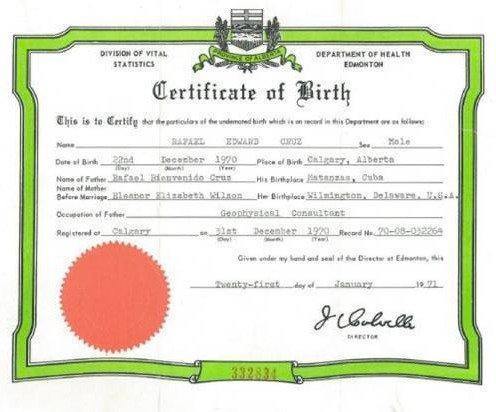
The endless hand-wringing over President Obama’s birth certificate inspired its share of well deserved satire, ridicule, and more satire. Likewise, the emergence of Senator Ted Cruz's Canadian birth certificate has proved to be too juicy a comedy target to pass up, so all hail columnist Jim Schutze of the Dallas Observer for this demonstration of birther ju-jitsu. To wit:
Hey. What kind of country prints its birth certificates in green ink, anyway? We can tell you what kind -- a hippie country. In fact, Canada is a hippie country where children are forced to attend madrassa-like anti-colonial hippie schools that brainwash them into fanatical vegetarianist anti-American belief systems before the age of 4, which was how old Cruz was when his Castroite father moved him to Houston and installed him there as a Canadian terror baby.
Canadian terror? Absolutely. Don't be naive. Canadian terror is insidious precisely because it is so difficult to spot at first. They don't go for the big showy stuff that you can see on the news. With the Canadians, it's all very sneaky and subtle.
Example: Next time you hear Cruz speak, listen very closely to his pronunciation of final syllables ending in o-r, as in the words, labor, harbor or ardor. Hear something a little bit funny going on there? Well, sure you do, and you know why? It's because he's pronouncing them the way he was brainwashed into pronouncing them in his Canadian anti-colonialist veggie-drassa preschool as a child: labour, harbour, ardour. With a silent u.
Remember: wars were fought over that "u." Schutze then cites highbrow academic tomes with titles like "The Impact of Anti-American Sentiment on Canadian English," "Studies in Canadian Literature / Études en littérature canadienne." and "Morley Callaghan and the New Colonialism: The Supreme Individual in Traditionless Society," to "prove" that Canada is a hotbed of sneaky foreigners seething with anti-American rage shamelessly flaunting their own bizarre customs.
....next time you have a spare minute to spend defending the nation of your birth, you might want to take a peek at the menu at "La Canada Pre-School." It includes what the Canadians call "mini-meals" (wouldn't want those kids to grow up too big and strong like the Yanks) such as pasta and applesauce and cheese and crackers and applesauce. The closest the poor little things ever get to honest meat is chicken nuggets and pears. There's not a hamburger within 100 kilometers of them. But, oh, man, they do get them some applesauce!....So in Ted Cruz we have a silent-u pronouncing applesauce-fed product of a fanatically anti-U.S.-colonialist culture whose birth certificate was printed in Canada, a country that speaks French half the time, in green ink. And he's going to be president of the United States? ...We are just getting started, Dear. Believe me. He's not getting oot of it that easy.
Oot-standing.
Forgetting the relevant Katrina detail, eight years later

Associated Press
How much do Louisiana Republicans dislike President Obama? Many of them blame him for the government's tragic response to Hurricane Katrina -- which struck the state more three years before Obama took office.
The latest survey from Democratic-leaning Public Policy Polling, provided exclusively to TPM, showed an eye-popping divide among Republicans in the Bayou State when it comes to accountability for the government's post-Katrina blunders.
Twenty-eight percent said they think former President George W. Bush, who was in office at the time, was more responsible for the poor federal response while 29 percent said Obama, who was still a freshman U.S. Senator when the storm battered the Gulf Coast in 2005, was more responsible. Nearly half of Louisiana Republicans -- 44 percent -- said they aren't sure who to blame.
I realize that 2005 was a while ago, and among Republicans there's some disagreement about the efficacy of George W. Bush's handling of the crisis, but the PPP results really don't make any sense.
So what explains this? There are a couple of things to keep in mind. First, it's possible that after several years in which the political world described all sorts of different developments as "Obama's Katrina," a lot of folks may have gotten confused and started to connect the words "Obama" and "Katrina" in a mistaken way.
Second, let's not underestimate the scope of reflexive GOP opposition to the president, in Louisiana and elsewhere, and the way in which that leads Republican to blame Obama for just about anything. More Louisiana Republicans blame Obama than Bush for the response to Katrina, which obviously don't make sense, but I imagine if PPP asked, a non-trivial number of Louisiana Republicans would also blame the president for 9/11, Watergate, the Hindenburg disaster, the 1919 White Sox, and the U.S. Civil War.
In other words, Louisiana Republicans may say they blame Obama for the response to Katrina, but what they're really saying is they just hate the president and blame him reflexively for everything.
Manning receives 35-year sentence
Three years ago, Bradley Manning leaked sensitive national-security materials, including videos of airstrikes and hundreds of thousands of diplomatic cables, causing an international uproar. Three weeks ago, Manning was convicted on muliple counts, including illegally releasing classified documents knowing they would be accessible to the enemy.
Today, he was dishonorably discharged and sentenced to 35 years in prison.
Manning was convicted on July 20 of 21 criminal counts, including espionage and disobeying orders, for providing 700,000 classified documents to online transparency group WikiLeaks in 2010.
Manning was also given a reduction in rank and a dishonorable discharge, although he will be eligible for parole and will get credit for the three and a half years he has already spent in jail. He is likely to spend only another ten years in prison.
The 25-year-old had faced a possible maximum sentence of 90 years in prison. The prosecution had sought a sentence of 60 years.
Manning's backers have argued that the case will have a chilling effect on future leaks, which I suspect was the point of the 35-year sentence -- a more lenient punishment wouldn't have sent so severe a message to others who may be tempted to divulge classified materials.
While an appeal is already underway, also note that Manning has already spent three-and-a-half years in custody -- all of which will be applied to his sentence -- and with good behavior, will likely be released long before the 35 years are up.
About those 'soaring' premiums...
Associated Press
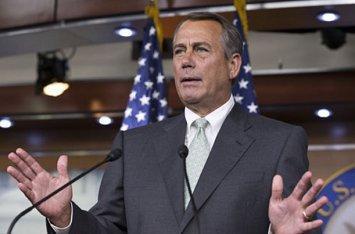
House Speaker John Boehner (R-Ohio) refuses to comment on his own party's government-shutdown scheme, but his office told MSNBC yesterday that Republicans are "looking at all options to reach our ultimate goal of repealing this law that is causing premiums to soar and full-time jobs to disappear."
And this is one of the key reasons why policy debates with Boehner and the House GOP don't go well. It's not that the Speaker has competing ideas that Democrats disagree with; it's that the Speaker has a competing reality that's sharply at odds with everyone else's.
In this case, the notion that the Affordable Care Act is causing "full-time jobs to disappear" is absurd. The claim has been thoroughly debunked and looks sillier all the time -- USA Today reported just this morning, "Small-business hiring and confidence about the future are rising, a signal of the economy's growing strength and diminishing concerns about employee insurance coverage required by the new health care law."
But it's Boehner's apparent belief that health care premiums are "soaring" that's especially amazing.
Premiums for employer-provided health insurance increased by relatively modest amounts for the second year in a row, according to a new survey, further evidence that once-fierce health care inflation might be abating.
For the House Speaker, premiums are "soaring" and the health care law deserves the blame. For those of us who live in reality, premium increases have slowed dramatically, and the health care law very likely deserves the credit.
Is it possible Boehner's office doesn't know what "soar" means? Because this one's not even close.
Indeed, while congressional Republicans insist "Obamacare" isn't "bending the cost curve," the evidence shows the exact opposite.
Matt Yglesias made the case yesterday that the Obama administration deserves the credit for this.
Economic actors are forward-looking. Capital investments take years to plan. You had a big recession in 2008 and 2009 that naturally squeezed spending and depressed investment. And then you had the passage of a law in 2010 that sent a clear signal that the direction of policy is changing. Only some of the cost-cutting measures have been implemented, and a lot of the toothier stuff is still to come down the road. But the law's passage and the president's implementation raises confidence that an era of relative austerity for the health care sector is underway, and people are acting accordingly.
And people looking forward and anticipating cost controls are right to do so. It's notable that while the GOP is still fully committed to Obamacare repeal, they've started writing budgets that assume the Obamacare cost savings take place. Absent those assumptions, they can't make the math work. The previous trajectory of health care spending looked unsustainable, and then we had the passage of a law that tries several dozen different ways of changing the trajectory, and now the health care industry is assuming that the trajectory will in fact not be sustained and is acting accordingly.
Igor Volsky has more along these lines, noting the fiscal impact of the Affordable Care Act's systemic reforms.
Given years of aggressive health care inflation, this seems like one of those figures that would simply never improve -- premiums would just keep getting worse indefinitely. We deal with these kinds of daunting challenges all the time -- the deficit will never disappear; the number of Americans with health care coverage will never improve; carbon emissions will never fall.
But progress is possible and the health care cost curve is, at long last, bending in the right direction. Boehner and his party predicted the opposite would happen -- policy projections aren't their strong suit -- and now they want Americans not to believe their lying eyes.
Wednesday's campaign round-up
Today's installment of campaign-related news items that won't necessarily generate a post of their own, but may be of interest to political observers:
* In Virginia, Republican gubernatorial hopeful Ken Cuccinelli, whose polling probably suggests a significant gender gap, released this new video yesterday highlighting the efforts he made as a University of Virginia undergraduate to combat campus sexual assault. Molly Redden had an interesting piece analyzing the message.
Watch on YouTube* On a related note, a new Quinnipiac poll in Virginia shows Terry McAuliffe (D) leading Cuccinelli by six points among likely voters, 48% to 42%.
* As Rachel noted on the show last night, New Jersey Gov. Chris Christie (R) took one for the team yesterday, appearing at an endorsement event alongside U.S. Senate hopeful Steve Lonegan (R).
* Former Sen. Jim DeMint (R-S.C.), now the head of the Heritage Foundation, argued yesterday that there are congressional Republicans who are afraid to shut down the government over the Affordable Care Act, but "they need to be replaced."
* In Louisiana, the latest survey from Public Policy Polling shows Sen. Mary Landrieu (D) looking surprisingly resilient in her home state, leading Rep. Bill Cassidy (R) by 10 points, 50% to 40%, in a hypothetical 2014 match-up. As for the Republican primary, Cassidy appears to have an insurmountable advantage.
* In North Carolina, right-wing Rep. Virginia Foxx (R) was reportedly interested in running against Sen. Kay Hagan (D) next year, but announced yesterday she will instead seek re-election to the House.
* And in Tennessee, Joe Carr's Republican primary challenge to Sen. Lamar Alexander got off to a rough start yesterday. Not only did his campaign manager quit on the first day, but Carr's campaign materials misspelled "Senate."
'The party is acting as if the entire world is a GOP primary'
Associated Press
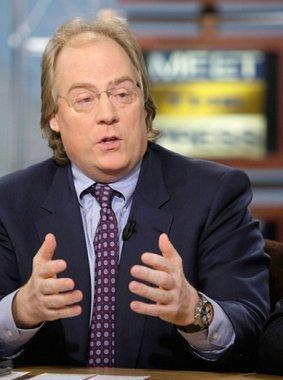
Republican strategist Mike Murphy
It's funny to think back to the spring, when Republican leaders seemed cautiously optimistic about the road ahead. Sure, 2012 clearly didn't work out as planned, but the party had a detailed "autopsy" of what went wrong, a blueprint for getting back on track, a House majority, and a stable of prominent officials eager to claim leadership roles. Talk of "rebranding" was in the air.
And yet, here we are.
"The party is acting as if the entire world is a GOP primary," said Mike Murphy, a prominent Republican campaign consultant. "That is a very dangerous way to operate. We have massive image problems with the greater electorate, and the silly antics of the purist wing are making our dire problems even worse."
That's a good quote, and Mike Murphy is a credible observer from within the Republican mainstream, but what I found most interesting about this line is its broad applicability. When he says his party is "acting as if the entire world is a GOP primary," it's unclear what he's referring to specifically, but it doesn't really matter -- he's likely referring to nearly everything.
* It applies to health care, where Republicans are tearing each other apart over a ridiculous "defund Obamacare" scheme, and where divisions are likely to get worse.
* It applies to immigration, where the Republican establishment would love to see a reform bill pass to advance the party's electoral interests, but where the GOP base and congressional rank and file continue to signal an intention to kill proposed legislation.
* It applies to intra-party primary challenges, where conservative incumbents like Sens. Mitch McConnell (R-Ky.), Lindsey Graham (R-S.C.), and Lamar Alexander (R-Tenn.) are facing Republican opponents in 2014 because they've been insufficiently right-wing.
* It applies to RNC plans for 2016, including debates moderated by right-wing media personalities on networks the party deems acceptable.
In Iowa this week, the co-chairman of the Republican Party in Polk County, Iowa -- the state's most populous county -- resigned and changed his party registration, no longer able to tolerate the GOP's radicalism, "hateful" rhetoric, and "war on science and common sense" (thanks to reader B.D. for the tip).
And there's simply no reason to believe these conditions are going to improve anytime soon.
It's far easier to imagine things getting much worse.
Heritage Action for America has a message for 100 House Republicans: You want to sign freshman Rep. Mark Meadows' letter.
The advocacy group launched a $550,000 online ad campaign Monday that targets GOP lawmakers who haven't yet signed on to the petition being circulated by the North Carolina Republican.
The full text of the letter and final list of co-signers won't be made public until Thursday, Meadows' office told CQ Roll Call. But when it is sent to House Republican leaders, it will demand that they "take the steps necessary to defund Obamacare in its entirety, including on a year-end funding bill like a continuing resolution."
Spokesman Dan Holler wouldn't confirm whether the 133 members not included on Heritage Action's target list are ones who have already signed Meadows' letter, saying only that "a bunch of these folks come from conservative districts, and they have conservative constituents who aren't having their views represented in Washington."
Mike Allen and Jim VandeHei reported in a much-discussed piece last week, "It is almost impossible to find an establishment Republican in town who's not downright morose about the 2013 that has been and is about to be. Most dance around it in public, but they see this year as a disaster in the making, even if most elected Republicans don't know it or admit it. Several influential Republicans told us the party is actually in a worse place than it was Nov. 7, the day after the disastrous election."
And still to come are Republican schemes to shut down the government and cause another debt-ceiling crisis.
This would ordinarily be the point at which party leaders take stock, step up, and try to calm the waters, but the Republican Party doesn't really have any leaders -- it has factions ostensibly led by a House Speaker who no real influence over his own members and a Senate Minority Leader who's so terrified of losing a primary fight that he's scared of his own shadow.
At the grassroots level, the only Republicans who seem to generate any excitement at all are a right-wing Texan who's been in Congress for seven months -- just long enough to make all of his colleagues on Capitol Hill hate him -- and a libertarian Kentuckian who doesn't understand the issues he claims to care about most.
There are structural considerations that may keep the congressional status quo in place for a while -- gerrymandered districts make a Democratic House majority unlikely anytime soon -- but in the meantime, the Republican Party will remain divided against itself.