Rachel Maddow's Blog, page 3344
August 23, 2013
They can't even get dysfunction right

Facebook/RepAaronSchock
This quote made the rounds the other day, and I laugh every time I read it.
[I]n Lincoln, Ill., GOP Rep. Aaron Schock told an audience at a coffee shop that the Democratic-controlled Senate had "sat on their hands" while the House sought to repeal Obama's health care law. "The president right now is doing a very good job of trying to make it look like the House is dysfunctional," Schock said. "Really what we're trying to do is carry out the wishes of the people."
Let's break this down, because even by House Republican standards, this is a real gem.
1. Schock and other House Republicans voted to destroy the federal health care system, taking benefits away from millions of Americans.
2. Senate Democrats thought this was a bad idea, and did not follow suit.
3. The GOP-led House, unconvinced, proceeded to try this same move, over and over again, for a total of 40 times.
4. The Democratic-led Senate worked on other things.
Aaron Schock sees this as proof that President Obama, who has no control over how the House spends its time, is "trying to make it look like the House is dysfunctional."
Hmm. The Republican-led House won't negotiate on a budget, can't pass a farm bill, can't pass an immigration bill, can't pass appropriations bills, can't fix the Voting Rights Act, and generally struggles to complete even routine tasks such as periodically raising the debt limit.
The president isn't making the House look bad; the House is making the House look bad. For that matter, no one is "trying to make it look like the House is dysfunctional"; the House is dysfunctional.


They call it 'hammocking'

TRMSer Anthony Terrell was down in Boone, North Carolina, to shoot the video for the segment about the closing of the on-campus polling location at Appalachian State University and also brought back a bit of campus cultural insight:
At Appalachian State University, the sight of students in trees sitting in hammocks was very common. The students call it "hammocking" and they keep the fabric sling tied to their backpacks for use in between classes and to relax at the end of the day. It's something I wish I thought of when I was in college. Brilliant!
Kobach, Bennett team up for voting-rights lawsuit
Arizona Secretary of State Ken Bennett (R)
Kansas Secretary of State Kris Kobach (R) is known for his far-right antics targeting immigrants. Arizona Secretary of State Ken Bennett (R) is perhaps best known for flirting with the "birther" conspiracy theory and publicly questioning whether President Obama would be on the state ballot in 2012.
Put them together and what do you get? One misguided voting-rights lawsuit.
Kansas is teaming with Arizona on a lawsuit to save controversial laws requiring people to prove they're citizens when they register to vote. [...]
The lawsuit came a week after the American Civil Liberties Union signaled plans to challenge the Kansas citizenship requirement, which has already blocked the registration of more than 15,000 would-be voters.
All of this goes back to a recent Supreme Court ruling, in which the seven-member majority said states can't simply add conditions to the federal voter-registration forms. Federal law doesn't require Americans who hope to register to prove they're citizens, so Arizona erred in making that a condition as part of a Republican anti-immigrant push.
Originally, Kobach envisioned a parallel voter-registration system in which folks would register twice -- once with federal forms, allowing them to vote in federal elections, and then again with state forms, which would require proof of citizenship, and which would allow voters to participate in all other elections.
That, not surprisingly, was deemed utterly ridiculous, so now Kobach and Bennett have a new idea. They're filing suit to require the U.S. Election Assistance Commission to change federal voter-registration forms for Kansas and Arizona so they reflect far-right wishes on proof of citizenship.
And why would Kobach and Bennett pursue this course? Because it's the approach Justice Antonin Scalia recommended.
[D]uring oral arguments in March, Scalia expressed his bafflement that Arizona did not launch a broader assault on the constitutionality of the NVRA form, written by the Election Assistance Commission. The state simply contended in that case that its proof of citizenship law did not violate the federal law. Even Scalia disagreed with that, voting against Arizona in the ruling, but also giving them a valuable tip in his 7-2 majority opinion.
"We hold that [the NVRA] precludes Arizona from requiring a Federal Form applicant to submit information beyond that required by the form itself," Scalia wrote in the June decision. "Arizona may, however, request anew that the EAC include such a requirement among the Federal Form's state-specific instructions, and may seek judicial review of the EAC's decision under the Administrative Procedure Act."
As for the problem Kobach and Bennett are so eager to fix, it doesn't appear to exist -- there is no epidemic of non-citizens registering to vote in Kansas, Arizona, or any other state.
So why bother with federal lawsuits and desperate attempts to change federal forms? Because the far-right drive to make it harder for people to vote apparently has no limits.
Boehner's pollster: even Republicans oppose shutdown plan
Republican pollster David Winston, perhaps best known for his polling work on behalf of House Speaker John Boehner (R-Ohio) and his caucus, asked national survey respondents a simple question: "Some members of Congress have proposed shutting down the government as a way to defund the president's health care law." Folks were asked whether they support or oppose the idea.
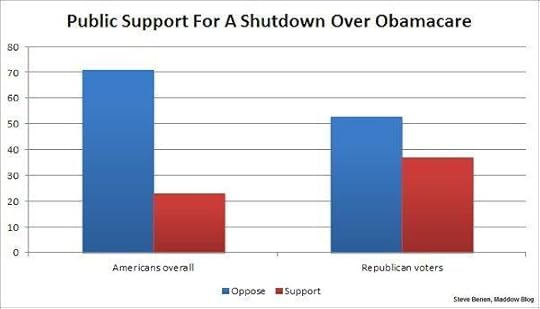
The results really weren't close. The survey, conducted not for a news organization but rather for congressional Republicans themselves, found widespread opposition to the shutdown scheme. Among all Americans, a 71% majority rejected the idea, but just as importantly, a 53% majority of self-identified Republican voters reached the same conclusion.
While the results are interesting, let's also not forget the story behind the story -- this poll was conducted by Boehner's pollster, to better inform congressional Republicans, and then leaked to Byron York, a conservative writer who's widely read in Republican circles.
I mention this because of the larger dynamic. On the one hand, we see Jim DeMint and the Heritage Foundation, along with Ted Cruz, Marco Rubio, and Mike Lee, telling the party, "Don't worry, the shutdown will work out great for us." And on the other, we have Republican leaders quietly whispering, "Don't listen to those guys; they're wrong."
Clearly, there is a group of Americans who would cheer on a shutdown, but the key takeaway here is that Republicans who are pushing this scheme aren't catering to the GOP base; they're catering to a small portion of the GOP base.
Republican campaign strategist Mike Murphy argued this week, "The party is acting as if the entire world is a GOP primary." Shutdown proponents are obviously proving him right.
And just how big is this shutdown caucus? Yesterday, the answer to that question came into focus.
There are currently 233 House Republicans, and about a third of them are on board with the scheme.
The number and names are in: 80 House Republicans representing the most conservative wing of their conference have signed the letter urging leadership to defund Obamacare in any spending bill to float the government past Sept. 30.
The letter, spearheaded by Rep. Mark Meadows, R-N.C., doesn't mention "government shutdown," but that's exactly what that strategy would provoke, given that a repeal by any other name is dead on arrival in the Senate and would not be signed by President Barack Obama.
Eighty is very likely a disappointing total for far-right activists -- indeed, it's a smaller total than I expected -- though Heritage is reportedly lobbying on the letter and the total number of signatories is likely to rise, at least a little.
'God help us if we get a worldwide pandemic'
Associated Press
Most of the political world has given up talking about sequestration cuts, even as they hurt kids, the job market, military personnel, the criminal justice system, firefighters, and others. The policy was designed to hurt the country on purpose; and it's working as planned; but it's apparently not a sexy topic.
At this point, I'm not sure what might persuade the Beltway to give a darn, but Sam Stein talked to Dr. Francis Collins, the director of the National Institutes of Health, about the sequester and the news was not at all good.
An already stagnant budget was made worse this spring when Congress and the White House failed to prevent sequestration. The NIH was forced to cut $1.7 billion from its budget by the end of September, lowering its purchasing power about 25 percent, compared with 2003.
Roughly six months into sequestration, however, the situation is worse than predicted. Internal NIH estimates show that it will end up cutting more than the 700 research grants the institutes initially planned to sacrifice in the name of austerity. If lawmakers fail to replace sequestration at the end of September, that number could rise above 1,000 as the NIH absorbs another 2 percent budget cut on top of the 5 percent one this fiscal year.
"It is so unimaginable that I would be in a position of somehow saying that this country is unable to see the rationality of covering what biomedicine can do," Collins said, in an interview with The Huffington Post. "But I'm not sure from what I see right now that rationality carries the day."
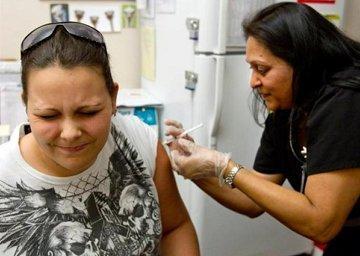
For a real-world example, consider NIH's work on a flu vaccine. "God help us if we get a worldwide pandemic that emerges in the next five years, which takes a long time to prepare a vaccine for," Collins told Stein.
Is there any hope congressional Republicans will change course and be more responsible on this? I'm glad you asked.
Earlier this month, House Speaker John Boehner (R-Ohio) said "none of us like" the sequestration policy. House Majority Leader Eric Cantor (R-Va.) said the sequester "is not the best way to go about spending reductions." House Appropriations Committee Chairman Hal Rogers (R-Ky.) said the sequester is "unrealistic," "ill-conceived," and a policy that "must be brought to an end."
And yet, here we are.
House Speaker John A. Boehner said Thursday that he plans to avert a government shutdown at the end of September by passing a "short-term" budget bill that maintains sharp automatic spending cuts, known as the sequester.
"When we return, our intent is to move quickly on a short-term continuing resolution that keeps the government running and maintains current sequester spending levels," Boehner (R-Ohio) said on a conference call with GOP lawmakers, according to a person on the call.
So, when Boehner insists he doesn't like the sequestration policy, what he means is the exact opposite.
The plan from the Speaker's office is a short-term budget fix, which would leave the sequester intact (despite everything Boehner and GOP leaders have said), and temporarily delay the need for a government shutdown. Soon after, Boehner and Republicans will have created another crisis, in which Washington policymakers will face a budget crisis and a debt-ceiling crisis at the same time.
But this assumes the House GOP leadership can pass a temporary spending measure -- and there's no reason to assume that they can. Democrats who want to undo the sequester will balk, as well Republicans who agree. Meanwhile, most far-right GOP lawmakers will see this move as a surrender, because it neither shuts down the government nor defunds the federal health care system.
My advice for the fall? Buckle your seatbelt.
Attaching a price to climate denialism
Climate deniers -- a misguided club that features a whole lot of congressional Republicans -- realize that their position is effectively cost-free. Sure, they're likely doing irreparable harm to our collective future, but when GOP lawmakers routinely say ridiculous things about climate science, there's no public backlash; there's no drop in contributions; there's no drop in the polls; and there's no real political consequence.
The League of Conservation Voters is eager to change this political dynamic.
Watch on YouTubeAs The Hill reported yesterday, the LCV is launching a new ad campaign targeting several climate deniers in Congress, including this spot going after Rep. Mike Coffman (R-Colo.). It's part of a $2 million ad campaign, which is a significant investment, especially in a non-election year.
Indeed, this is the second phase in the League of Conservation Voters' offensive -- the group launched this spot last week focused on Sen. Ron Johnson's (R-Wis.) rejection of climate science. When the right-wing Wisconsinite complained about an "environmental jihad" against him, the LCV hit him again.
As Greg Sargent recently explained, "It's long been a source of frustration for environmentalists that expressions of rank climate denialism are not anywhere near as politically toxic as crazy comments about abortion, birth control, or immigration have historically proven. Climate denialism does not meet the widespread condemnation that greets the sort of statements on immigration and abortion you hear from the likes of Steve King or Todd Akin (who lost his Senate race as a result)."
The League of Conservation Voters' campaign marks one of the first meaningful, national efforts in recent memory to turn up the heat, so to speak, on those who deny the scientific reality. It's not about winning an election -- Johnson isn't up until 2016 -- it's about changing a conversation, creating political disincentives, and providing a foundation for activism.
More power to 'em.
Obamacare's unwitting fans
Associated Press
Kentucky Gov. Steve Beshear (D)
This anecdote, reported by Jason Cherkis after attending an event in Louisville, speaks to a fascinating larger phenomenon.
A middle-aged man in a red golf shirt shuffles up to a small folding table with gold trim, in a booth adorned with a flotilla of helium balloons, where government workers at the Kentucky State Fair are hawking the virtues of Kynect, the state's health benefit exchange established by Obamacare.
The man is impressed. "This beats Obamacare I hope," he mutters to one of the workers.
"Do I burst his bubble?" wonders Reina Diaz-Dempsey, overseeing the operation. She doesn't. If he signs up, it's a win-win, whether he knows he's been ensnared by Obamacare or not.
Yep, that guy in Kentucky has been told so many times to hate Obamacare that he genuinely believes it's awful. But in Kentucky, a red state with a Democratic governor, implementation of the Affordable Care Act is continuing apace with the creation of "Kynect" -- the state's new health care marketplace. Indeed, as Cherkis explained, "The state had spent millions establishing the exchange, staffing up outreach, and conducting market research that included holding a dozen focus groups in Louisville, Paducah and London."
And as the anecdote helps demonstrate, it's having some success. People don't necessarily realize that new benefits available in Kentucky have anything to do with the federal law they've been conditioned to reject. It's why they're impressed when they hear the pitch from policy experts like Reina Diaz-Dempsey -- the benefits sound like a pretty good deal for folks.
If they think those benefits "beat Obamacare," so be it.
Of course, this does suggest something health care proponents are going to have to get used to: the Affordable Care Act has an Obamacare problem.
As Jonathan Bernstein explained a while back, "The law is going to make health care better for many Americans. A lot of them just won't realize it's the same thing as the Obamacare they hate."
From the very beginning, and certainly before Democrats also adopted "Obamacare" as the shorthand name for health-care reform, Republicans have strongly opposed a fantasy version of the landmark legislation. Whether it was "death panels," or "government takeover," or any number of wacky claims in chain emails, Republican opposition has rarely been focused on what's actually in the ACA.
And no matter how successful reform turns out to be, that's unlikely to change.
See, the funny thing about the Affordable Care Act is that a whole lot of it will either be invisible or, oddly enough, won't be identifiable as "Obamacare." The core of the program is the system of health-insurance exchanges and subsidies, but little or none of these operations will have the words "Affordable Care Act," much less "Obamacare," attached to them.
Quite right. That middle-aged man in the red golf shirt at the Kentucky State Fair may very well get coverage through Kynect, benefit from protections extended to those with pre-existing conditions, and be thankful for the elimination of lifetime caps -- all the while assuming that the dreaded Obamacare is a bad idea.
Or as Bernstein put it, "Fortunately, the Limbaugh self-employed listener will think, I don't have Obamacare; I have the private health insurance I purchased on that StateCare web site. But if the liberals had their way, everyone would be forced to have Obamacare, and ... America would be ruined."
For several years now, it's been the dirty little secret the political world brushes over when talking about health care reform: Americans don't like the law, but they love everything in it, and don't want anyone to take those benefits away.
It's a detail Republicans need to understand. When they vote several dozen times to repeal the reform law, GOP lawmakers assume they'll pay no political price. But the more Americans take advantage of the law, the more voters will balk at a Republican crusade that undermines families' health care security -- whether "Obamacare" polls well or not.
As for Kentucky, Gov. Steve Beshear (D) isn't backing down. The Kentucky Farm Bureau Country Ham Breakfast is usually a non-political affair, but this week, the two-term governor put his platform to good use in support of health care reform his constituents like more than they realize.
Beshear's advocacy ... was striking in its intensity and in how personally he approached the issue, picking up on the idea that many people who don't have health insurance are embarrassed by that and don't talk about it.
The governor compared health insurance to "the safety net of crop insurance" and said farmers need both. He said 640,000 Kentuckians -- 15 percent of the state -- don't have health insurance and "trust me, you know many of those 640,000 people. You're friends with them. You're probably related to them. Some may be your sons and daughters. You go to church with them. Shop with them. Help them harvest their fields. Sit in the stands with them as you watch your kids play football or basketball or ride a horse in competition. Heck, you may even be one of them."
Beshear went on to say that "it's no fun" hoping and praying you don't get sick, or choosing whether to pay for food or medicine. He also said Kentucky is at or near the top of the charts on bad-health indicators, including heart disease, diabetes, cancer deaths, and preventable hospitalizations. He said all that affects everything from productivity and school attendance to health costs and the state's image.
"We've ranked that bad for a long, long time," he said. "The Affordable Care Act is our historic opportunity to address this weakness and to change the course of the future of the commonwealth. We're going to make insurance available for the very first time in our history to every single citizen of the commonwealth of Kentucky."
About half the audience burst into applause at that point while the other half sat on their hands. But he wasn't done. He cited a study that showed the law would inject about $15.6 billion into the Kentucky economy over eight years, create 17,000 new jobs, and generate $802 million for the state budget.
"It's amazing to me how people who are pouring time and money and energy into trying to repeal the Affordable Care Act sure haven't put that kind of energy into trying to improve the health of Kentuckians. And think of the decades that they have had to make some kind of difference," Beshear finished pointedly.
Senate Minority Leader Mitch McConnell (R-Ky.) was there, listening to this, suggesting the governor was talking quite directly to him.
Issa reconsiders the value of personal emails
Associated Press
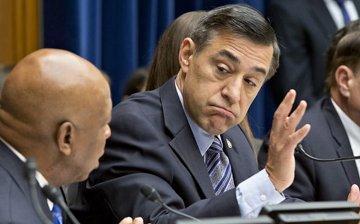
In his capacity as chairman of the House Oversight Committee, Rep. Darrell Issa (R-Calif.) requests and/or subpoenas official correspondence from Obama administration officials all the time. But lately, Issa has taken an interest in something else: officials' personal messages on non-work email accounts.
The House Oversight Committee is demanding that the Internal Revenue Service official at the center of the Tea Party targeting probe turn over any emails from her personal account she might have used to conduct official business.
In a letter sent Tuesday, Chairman Darrell Issa (R-Calif.) said the ongoing investigation indicated that Lois Lerner sent some official documents to her personal email address, which "raises concerns" about whether the committee can fully understand her role in the improper targeting from official emails alone.
Earlier this month, Issa did the same thing with Victoria Nuland, the State Department's spokesperson last fall, as part of his Benghazi crusade. In this case, Issa specifically asked for emails "sent or received using a non-governmental account."
Whether you consider these requests legitimate or not probably depends on whether you take the underlying pseudo-scandals seriously. But a Democratic source brought an interesting angle to my attention yesterday: care to guess who was outraged by Democratic requests for officials' personal emails during the Bush/Cheney years?
If you said Darrell Issa, give yourself a prize.
* In February 2008, Issa told Democrats on the Oversight Committee, "You have no mandate to go peeping tom into every piece of correspondence that people say is private in order to determine whether it might be public."
* Issa also proclaimed, "Mr. Chairman, I have to tell you, I have little doubt that if we asked for the staff members of this committee on both sides of the aisle to provide to us all of their outside information that we would in fact learn a great deal. Mr. Chairman, we don't have that right within this committee, and we should not try to create it."
* Issa went on to argue, "Well, if the chairman thinks that he should have Karl Rove's every thinking, including correspondence with a wife or a girlfriend or an old buddy, because it was done at the RNC and not official work -- sort of this voyeur, peeping tom that you're entitled to everything."
I wonder what changed the chairman's mind? It's hard to even imagine.
'It only gets worse'
One month ago today, we learned that the House Republican Conference had given its members "exceptionally detailed" guides on how best to survive the August recess. The "planning kit" told GOP lawmakers to, among other things, push the IRS "scandal" in the media, despite the fact that there is no IRS "scandal."
And the party is following the plan closely.
Watch on YouTubeYesterday, for example, the National Republican Congressional Committee launched this attack ad targeting Rep. Patrick Murphy (D-Fla.), claiming that when he voted against the latest Obamacare-repeal bill, he voted to "keep the scandal-ridden IRS in charge" of the Affordable Care Act.
Yes, in case you were wondering, the National Republican Congressional Committee really does believe voters are fools. And yes, House Republican leaders really did hold their 40th vote on repealing the federal health care law precisely so the party could create attack ads like this one.
As a substantive matter, the message is demonstrably ridiculous and was debunked months ago. As Jonathan Cohn explained in May, "The IRS scandal has nothing to do with Obamacare but that's not stopping laughable attempts to link them."
Brian Beutler even highlighted the irony: Republican health care measures rely on the IRS every bit as much as the Affordable Care Act does.
But the larger takeaway is that the IRS story is dead and buried, but Republicans need to pretend otherwise.
The list of examples isn't short. Maddow Blog reader J.J. let me know yesterday about this gem published in the Detroit News by Republican Reps. Dave Camp and Candice Miller of Michigan. The headline reads, "Why does the IRS care who you vote for?"
Every American finds dealing with the IRS to be an intimidating experience. That is why recent revelations that the IRS is targeting certain groups with extra scrutiny and harassment, simply because of their political beliefs, is cause for great concern. While President Barack Obama and his supporters have called these actions a "phony scandal," it only gets worse as more evidence comes to light.
I have no idea whether Reps. Camp and Miller actually believe this nonsense. Part of me hopes they know they're not telling the truth, because the alternative is slightly more unnerving -- leading GOP lawmakers, including in this case the chairs of two powerful committees, are struggling to keep up on the basics of current events, and don't see the need to do their homework before writing an op-ed for newspaper publication.
The Camp and Miller piece alleges there were "unusual" email exchanges between the IRS and the Federal Election Commission, which in turn suggests the IRS is guilty of "intimidation and harassment," possibly even keeping tabs on who you vote for. All of this -- literally, the whole thing -- was scrutinized in detail several weeks ago and proven baseless.
Either Camp and Miller know this and repeated the claims anyway in the hopes of keeping a baseless "scandal" alive, or they're clueless. Either way, the Republican efforts to cling to discredited nonsense seems to be getting sillier.
Remember, for the right, the general argument about the IRS story was relatively straightforward: the tax agency, perhaps at the White House's request, targeted conservative groups and made it harder for them to apply for tax-exempt status. The allegations, we now know, have been torn to shreds -- conservative groups weren't targeted; liberal groups faced the same treatment; and none of this relates to the White House in any way.
Sarah Swinehart, a spokesperson for Republicans on the House Ways and Means Committee, responded to the latest revelations this week by saying, "The facts are clear: Conservative groups received more questions, more denials and more delays."
But this isn't true, either. How many conservative groups were "denied" tax-exempt status by the IRS as part of this mess? None. How could organizations on the right have faced "more denials" if the total number of conservative denials is zero?
Even in the House Republicans' government-shutdown scheme, the discredited IRS story is in the mix -- we need to defund the federal health care system, the argument goes, because the tax agency is "publicly known to have deliberately discriminated against conservative entities." Is that true? No. Does it make any sense in this context? Of course not. Do House Republicans care? Apparently, no.
There is no IRS controversy. The sooner congressional Republicans come to terms with this, the easier it will be to stop laughing at them.
Key House Republican asks Holder to back off in Texas
Associated Press
As we discussed yesterday, Attorney General Eric Holder is challenging new voting restrictions imposed by Texas Republicans, hoping to use the remaining provisions of the Voting Rights Act to protect Texans' access to the ballot box. GOP officials, not surprisingly, weren't pleased with the move, but there was one reaction in particular that I found interesting.
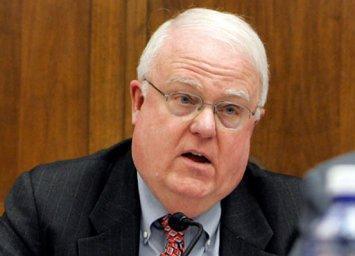
But Mr. Holder's moves this week could endanger that effort, said Rep. F. James Sensenbrenner Jr., Wisconsin Republican, who led the latest reauthorization of the Voting Rights Act in 2006.
"The lawsuit would make it much more difficult to pass a bipartisan fix to restore the heart of the VRA that the Supreme Court struck down earlier this year," Mr. Sensenbrenner said.
He said he had spoken with Mr. Holder and asked him to withdraw the lawsuit.
It's worth noting for context that Sensenbrenner may be a conservative Republican, but he's also earned a reputation as a long-time supporter of the Voting Rights Act. Indeed, among GOP lawmakers, it's probably fair to say the Wisconsin Republican is the VRA's most reliable ally. When Sensenbrenner says he's working on a legislative fix in the wake of the Supreme Court's ruling, I'm inclined to believe him.
That said, for Holder to back off now would be crazy.
Look, I don't blame Sensenbrenner for this, but literally every indication suggests congressional Republicans intend to block efforts to pass a new-and-improved Voting Rights Act. The Attorney General has a simple calculation to make: protect Americans against discriminatory voter-suppression tactics or wait for the House GOP to work in a bipartisan fashion on voting rights.
Can anyone seriously blame Holder for preferring the former to the latter? It seems far more realistic for the A.G. to turn Sensenbrenner's request around and say, "When Congress passes the Voting Rights Act, I'll stop filing these lawsuits, not the other way around."
Remember this story from July?
If House Republicans are interested in patching the Voting Rights Act, they aren't showing it.
"Historically I fully understand why they addressed the situations they did," Republican Rep. Trent Franks of Arizona, who chairs the House judiciary subcommittee that would handle new voting rights legislation, said to reporters after the hearing. "I am just of the opinion today that we should do as the court said and that is to not focus on punishing the past but on building a better future."
As we talked about at the time, most of the Republican members of the panel apparently didn't think the hearing was especially important -- which is to say, they didn't show up -- and the witnesses GOP lawmakers called reinforced fears that the party simply isn't interested in a constructive debate.
The Heritage Foundation's Hans von Spakovsky, for example, was called by Republicans to offer his "expert" testimony on voting rights, despite the fact that von Spakovsky is best known for the loathsome voter-suppression tactics he championed during his tenure in the Bush/Cheney Justice Department. If this is the guy GOP lawmakers are turning to for guidance, the future of the Voting Rights Act is bleak.
Indeed, von Spakovsky assured the Judiciary Committee panel that the "the systematic, widespread discrimination against blacks has long since disappeared" -- a claim we know to be ridiculously untrue.
Sensenbrenner's worthwhile efforts notwithstanding, those waiting for House Republicans to do the right thing on voting rights are going to be waiting a very, very long time.