Rachel Maddow's Blog, page 3341
August 28, 2013
Can a made-up story revive a 'movement'?

Getty Images
The Wall Street Journal has a 2,000-word, front-page piece today, letting the public know that the Tea Party may have struggled for a while, but it's back now. What's more, there was one issue in particular that lit a fire under the so-called movement, getting Tea Partiers back on track.
After a tough 2012 election season, the tea-party movement is on the rebound. [Jenny Beth Martin], head of the Tea Party Patriots, is riding a revival of interest sparked by controversy over the IRS's much-publicized targeting of conservative groups. She says the Patriots, the tea party's largest umbrella group, suffered because of the IRS's refusal to grant it tax-exempt status but now is benefiting from the backlash. Her group's monthly donations, she says, have tripled recently, and its staff has doubled.
The uproar has revived media attention and renewed the intensity of many tea-party supporters.... "This is beyond anger and frustration," she says.... Political operatives on both sides of the aisle acknowledge that the IRS scandal has reinvigorated the tea party.
There are a few relevant details that the Wall Street Journal neglected to mention. The article, for example, didn't let readers know that the "IRS scandal" really isn't a "scandal" at all -- literally every relevant allegation raised by the right has been discredited.
But the larger takeaway is that there seems to be a pattern when it comes to the Tea Party: far-right activists are motivated by misleading claims they don't know to be false. One of the earliest messages from the movement was that activists, outraged by President Obama's economic policies, were "taxed enough already." Obama, at the time, had just approved one of the largest middle-class tax cuts in American history.
Months later, Tea Partiers were eager to condemn the Affordable Care Act because, they said, it constituted a government takeover of the nation's health care system and relied on socialized care. Some even talked up "death panels." None of this was even remotely accurate.
And now the Tea Party has been re-energized by a trumped up controversy that doesn't actually exist. This isn't an impressive track record.
Postscript: I hope I'm not burying the lede here, but there was one tidbit in the WSJ piece that seemed new to me. It's in reference to Jenny Beth Martin, "the woman sometimes described as the tea party's den mother," and what happened after news organizations first started trumpeting the IRS story in the spring.
On the weekend after the news hit, Mrs. Martin appeared on four television networks and released an urgent email fundraising appeal titled: "Project Phoenix: It's time to rise again."
Mrs. Bachmann called Mrs. Martin at home to brainstorm about holding a news conference on Capitol Hill later that week. Mrs. Martin wound up speaking alongside Mrs. Bachmann and other lawmakers calling for an investigation.
When Republican representatives scheduled hearings, Mrs. Martin located what she said were a dozen tea-party victims, prepped them and delivered them within 48 hours to congressional investigators, paying their airfares and hotels, according to several people involved in the process. (emphasis added)
I haven't heard this before. Martin paid Tea Party "victims" to fly to D.C., put them up in a hotel, and arranged for them to talk to congressional investigators? Did she pay for this out of her own pocket, do the Tea Party Patriots have those funds available, or did an unnamed benefactor help pick up the tab?
Admittedly, this may be an unimportant tidbit, but it suggests a level of coordination surrounding this made-up scandal I hadn't heard before.


Another failed drug-test experiment

Getty Images
Remember Florida Gov. Rick Scott's (R) idea of mandating drug tests for welfare applicants? The idea was to save Florida taxpayers' money by forcing drug users to withdraw from the public-assistance system.
The results, however, were a fiasco -- only about 2 percent of applicants tested positive, and Florida lost money when it was forced to reimburse everyone else for the cost of the drug test, plus pay for staff and administrative costs for the program. Making matters worse, the courts rejected the law, forcing its demise.
Naturally, after seeing Rick Scott's experiment fail, other Republican officials elsewhere were eager to follow Florida's example of intrusive, big-government conservatism. Take Utah, for example.
Utah has spent more than $30,000 to screen welfare applicants for drug use since a new law went into effect a year ago, but only 12 people have tested positive, state figures show.
The preliminary data from August 2012 through July 2013 indicates the state spent almost $6,000 to give 4,730 applicants a written test. After 466 showed a likelihood of drug use, they were given drug tests at a total cost of more than $25,000, according to the Utah Department of Workforce Services, which administers welfare benefits and the tests.
Henry Decker added, "[T]he Beehive State spent more than 30 grand to weed out 0.25 percent of those seeking benefits."
In case it's not already obvious, if Utah officials had instead spent that money on job creation and job training, no one would be making fun of them now.
I understand the underlying point of these efforts. For the right, there's an ongoing desire to punish and shame the poor, working from the assumption that if someone is struggling during weak economic times, it's very likely their own fault. Indeed, we've seen a few examples of late of prominent Republican officials suggesting too many jobless Americans are lazy addicts.
But the idea is nevertheless ridiculous. Forcing those who are relying on the safety net to give the government bodily fluids in exchange for benefits is not only legally dubious; it's also ineffective and a waste of money.
And yet, according to the National Conference of State Legislatures, at least 29 other states this year have considered similar proposals.
New Jersey's Lonegan: 'I personally like being a guy'
The U.S. Senate special election in New Jersey is exactly seven weeks from today, and by all appearances, Newark Mayor Cory Booker (D) remains the clear favorite. But far-right former Bogata Mayor Steve Lonegan (R) isn't going to go away quietly.
Booker told the Washington Post this week that he's been dating more, and doesn't care if his bachelor status leads to speculation about his sexual orientation. "[S]ome people who think I'm gay, some part of me thinks it's wonderful. Because I want to challenge people on their homophobia. I love seeing on Twitter when someone says I'm gay, and I say, 'So what does it matter if I am? So be it. I hope you are not voting for me because you are making the presumption that I'm straight.' "
Lonegan wasn't impressed with the comments.
Watch on YouTubeEven by contemporary Republican standards, this was just ugly.
[Lonegan] was asked about Booker's response by Newsmax's Steve Malzberg [Tuesday] afternoon, and said he didn't know if Booker is gay but thought it was "weird" that he was unwilling to answer the question, speculating that maybe "it helps get him the gay vote by acting ambiguous."
But Lonegan was sure of one thing: Steve Lonegan is a real man because "as a guy, I personally like being a guy" and he is certainly not one of those sorts who goes in for things like manicures and pedicures like Cory Booker does!
"I personally like being a guy"? Does Lonegan believe gay men aren't actually "guys"?
Paul Waldman added, "I guess for certain kinds of men, particularly from an older generation (Lonegan is 57), even a mention of homosexuality requires a vigorous assertion of one's own heterosexuality, lest anyone start looking at you funny simply because a cloud of uncomfortable questions is now floating about the room."
Remember, we're not talking about some random figure who shows up in far-right media -- Lonegan is his party's U.S. Senate nominee. Just last week, New Jersey Gov. Chris Christie (R) praised Lonegan, saying, "I am proud to have him as our candidate for the United States Senate.... Steve and I have believed and still believe in so many of the same things."
There's no Obamacare 'tsunami' on the way
The far-right campaign to shut down the government unless Democrats agree to defund the federal health care system isn't going well, but Sen. Ted Cruz (R-Texas) is undeterred. Asked a few days ago how he intends to win this fight, the Texas Republican said there's a "grass-roots tsunami" on the way that will convince lawmakers to follow his lead.
Cruz is likely to be disappointed. The latest report from the Kaiser Family Foundation asked Americans about defunding the Affordable Care Act, and a clear majority disapprove of the idea.
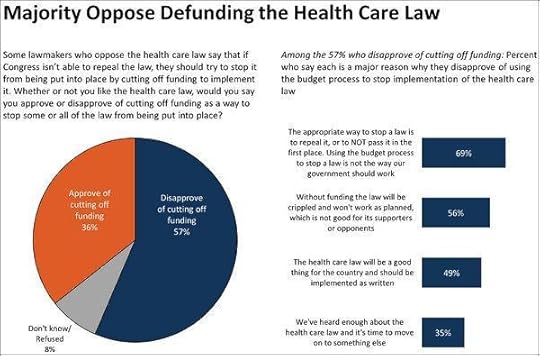
While a 57% majority oppose cutting off funding, only 36% endorse the Republican scheme. This is consistent with other recent polling that found similar results.
As a rule, "grass-roots tsunamis" are rare when they enjoy the support of barely a third of the country.
Of course, Cruz isn't the only one making fanciful health-care claims. RNC Chairman Reince Priebus recently argued, "People know what Obamacare is."
Looking over the KFF results, it's clear that people really don't know what Obamacare is.
From the report:
"Despite saying they've heard about the law from various sources, confusion remains, with more than four in ten saying the law has been repealed or overturned, or being unsure whether it remains the law of the land. And about half say they don't understand how the law will impact their own families."
In all, 44% of Americans don't realize that the Affordable Care Act is, right now, current law. That's discouraging, to be sure, but it may also have policy consequences -- the system relies on public participation, and if Americans believe the law has been repealed by Congress and/or overturned by the Supreme Court, they may not seek the benefits they're entitled to because they'll assume those benefits aren't actually available.
That said, a growing number of people are seeking additional information about the law and how it might help them. That's bad news for Obamacare's opponents, which tend to rely on little more than public ignorance.
August 27, 2013
Boehner vows debt-ceiling crisis won't be 'pretty and polite'
Associated Press
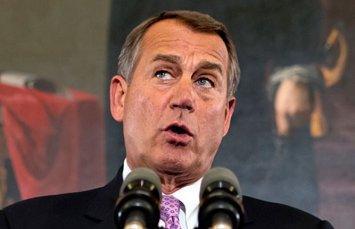
In February, reflecting on the debt ceiling, House Speaker John Boehner (R-Ohio) said he didn't want to jeopardize "the full faith and credit of the United States government." A month later, the Republican leader recommitted himself to the same basic idea: "I'm not going to risk the full faith and credit of the federal government."
Apparently, Boehner has changed his mind, and adopted an alarming posture at an Idaho fundraiser yesterday -- the same day as the Treasury Department warned Congress that the debt-ceiling deadline is just eight weeks away.
House Speaker John Boehner said Monday that getting the GOP-controlled House to agree to raising the U.S. debt ceiling will only come with a bipartisan deal to make cost-saving changes to Social Security, Medicaid, Medicare, farm programs and government pensions. [...]
"I've made it clear that we're not going to increase the debt limit without cuts and reforms that are greater than the increase in the debt limit. The president doesn't think this is fair, thinks I'm being difficult to deal with. But I'll say this: It may be unfair but what I'm trying to do here is to leverage the political process to produce more change than what it would produce if left to its own devices. We're going to have a whale of a fight."
According to the Idaho Statesman's report, Boehner went on to tell Republican donors that they should expect a replay of the 2011 debt-ceiling crisis that did severe damage to the country.
"I wish I could tell you it was going to be pretty and polite, and it would all be finished a month before we'd ever get to the debt ceiling. Sorry, it just doesn't work that way," Boehner said. "If this were easy to do, somebody over the last 20 or 30 years would have gotten it done. We're going to do it this fall."
You'll probably in your life never again hear a House Speaker use rhetoric this reckless and threatening to the nation's wellbeing.
Boehner admitted he's abandoning "fairness" -- how reassuring -- but he feels the need to threaten deliberate harm to Americans anyway.
Part of the problem is the Speaker's willingness to hold us hostage. The other part of the problem is that he doesn't seem to understand the basics of what he's talking about.
Let's unwrap this, point by point.
* "I've made it clear that we're not going to increase the debt limit without cuts and reforms that are greater than the increase in the debt limit." In July, House Republicans abandoned this standard because it didn't make any substantive sense. Yesterday, Boehner stuck to it anyway, for reasons that only make sense to him.
* "I wish I could tell you it was going to be pretty and polite.... Sorry, it just doesn't work that way." Well, it could work that way, and it used to work that way. Between 1939 and 2010, Congress raised the debt limit 89 times. In recent years, many of those votes were cast by a guy named John Boehner. Neither party took Americans hostage; neither party demanded a ransom. That was before the radicalization of the Republican Party, at which point threatening to trash the full faith and credit of the United States on purpose became acceptable.
* "If this were easy to do, somebody over the last 20 or 30 years would have gotten it done." Here, "this" seems to refer to cuts to social insurance programs like Medicare and Social Security. Of course, President Obama has already offered entitlement reforms as part of a balanced compromise, and Boehner has refused to consider any concessions. Worse, the Speaker wants entitlement cuts but hasn't proposed any of his own.
Everything about Boehner's reckless chest-thumping is nonsensical. Last week, Republicans wanted a debt-ceiling crisis over the Affordable Care Act; now it's over Medicare and Social Security. In the spring, Boehner wasn't prepared to jeopardize the full faith and credit of the nation; now he is. In July, House Republicans weren't calling for dollar-for-dollar cuts as part of the so-called "Boehner Rule"; now the Speaker is calling for exactly that.
Throughout the Bush/Cheney era, Boehner supported adding two wars, two tax cuts, Medicare expansion, and a Wall Street bailout to the national debt; now he's prepared to crash the U.S. economy on purpose unless Democrats offer him a debt-reduction plan he deems acceptable.
To reiterate a point from last week, Boehner, who should be slowly preparing to move his party away from the cliff, is instead making matters worse, playing a dangerously stupid game. His comments yesterday reinforce a simple truth: House Republicans are less a governing party and more a group of intemperate children who like to play with matches.
'He's a member of Congress.... There must be something to it'
Associated Press
About a year ago, then-Secretary of State Hillary Clinton was wrapping up an important diplomatic mission in Cairo when her motorcade was confronted with angry protesters, many of whom threw shoes and tomatoes, while using Monica Lewinsky taunts. And why were these Egyptians so upset? Because they'd heard from right-wing extremists in the U.S. that the Obama administration "harbors a secret, pro-Islamist agenda" and backs the Muslim Brotherhood.
None of the claims were true, but there was a problem -- the protesters in the streets of Cairo were relying on comments made by U.S. clowns like Rep. Michele Bachmann (R-Minn.). You know she's ridiculous and not to be taken seriously, and I know she's ridiculous and not to be taken seriously, but all Egyptians heard was that an elected member of Congress' majority party had made provocative claims about U.S. policy in Egypt that many found credible.
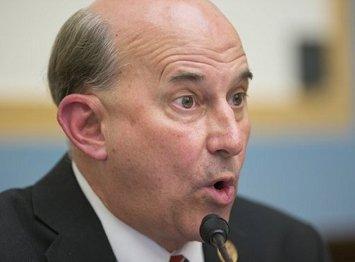
A year later, as Sahil Kapur reports this morning, the problem persists as Rep. Louie Gohmert's (R-Texas) nonsense about the White House and the Muslim Brotherhood, which Americans know to ignore, is "complicating U.S. foreign policy in the region."
Anti-American conspiracy theories are rampant [in Egypt], for a variety of reasons related and unrelated to U.S. foreign policy, and hearing it from a United States congressman lends credibility to the theory that the U.S. is teaming up with the Muslim Brotherhood -- and even Al-Qaeda -- to destroy Egypt.
"I guarantee you nobody in Egypt really knows who Louie Gohmert is or what he's about. So they could very well point to this and say 'Look! He's a member of Congress. This must be serious. There must be something to it,'" said Steven A. Cook, senior fellow for Middle Eastern Studies at the Council on Foreign Relations. "It doesn't help in a political environment where everyone is already angry at us to be fueling conspiracy theories against us. In that way it enables an overall level of hostility toward the U.S."
Shadi Hamid, a Middle East expert at the Brookings Institution, told TPM, "[L]ook, this does provide real ammunition to the conspiracy theorists when you have American sources seemingly verifying what they are saying.... It lends these bizarre theories a new code of legitimacy and amplifies them. When Egyptians see this, they don't realize that just because a U.S. congressman is saying this that it can be wrong or that he can be lying publicly."
Congratulations, far-right activists, your nonsense now has a global reach and is actually influencing international events among those who can't tell the difference between serious policymakers and circus clowns from thousands of miles away.
The TPM report added:
The New York Times reported Monday that the U.S.-Brotherhood conspiracy theory has become "widespread" in Egypt, even to the point of being seen by some as common knowledge. Billboards and posters in Egypt tie President Obama to the Brotherhood and accuse him of supporting terrorism against Egypt. And segments of the pro-military Egyptian media have been playing a YouTube clip of Gohmert speaking on the House floor, spliced with ominous background music, likening the Obama administration's aid to Brotherhood leader Mohamed Morsi's government with assisting terrorists.
Gohmert defended his remarks in a statement to TPM, saying was merely opposing President Obama's policies and that Egyptians "are able to" make that distinction.
But they're not able to. Most fair-minded political observers recognize Gohmert as a national embarrassment more in need of counseling than political power, but it's not realistic to think Egyptians will have a sophisticated understanding of American politics. When they see YouTube clips of elected officials on the floor of our legislative body in Washington, and they hear outrageous conspiracy theories involving Egypt, they haven't the foggiest idea that Gohmert is a few fries short of a happy meal.
Yes, in fairness, it's important to note that many who are inclined to believe absurd conspiracy theories don't really need proof -- that, of course, applies to any country -- and many Egyptians who want to believe in imaginary U.S. support for the Muslim Brotherhood are going to embrace the non-existent ties whether Gohmert talks them up or not.
But the point is, the right-wing Texas congressman, by recklessly spouting garbage, is making it easier for Egyptian conspiracy theorists to persuade others. Gohmert is obviously free to be as foolish as he wants to be, but one can only hope real-world events in Egypt will push him and his cohorts to be a little more responsible.
'A monopoly on stupid comments'
Associated Press
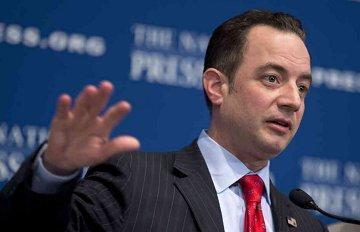
As the nation's attention turns to the 50th anniversary of the March of Washington, Reince Priebus and the Republican National Committee are at least making an effort to show the public the party takes race, diversity, and civil rights seriously. Whether these efforts have merit is a separate question.
Keli Goff reports this morning that Priebus took questions from a handful of African-American journalists following an official RNC luncheon yesterday, and Goff asked the party leader an interesting question.
I asked Priebus, whether in light of the many racially inflammatory comments made by Republican leaders recently (which you can read here, here and here) and the many more made by Republican leaders as a whole since President Obama took office (which you can read here), if he as party leader would consider apologizing on behalf of the party for such rhetoric and setting a zero-tolerance policy so that such rhetoric stops being commonplace. The chairman replied that he has criticized specific Republicans for specific instances of offensive language, most notably when he pressed for the resignation of an Illinois Republican Party leader who made racist and sexist comments about multiracial Republican congressional candidate Erika Harold. But in a baffling turn, Priebus then seemed to insinuate that the GOP doesn’t have any more of a racist rhetoric problem than Democrats.
“Look I don’t think either party has a monopoly on stupid comments,” he told The Root. "I think both parties have said plenty of stupid things and when people in our party say them, I’m pretty bold in coming out and talking about them, whether it be the issue in Illinois [involving Erika Harold] or Todd Akin or a variety of issues.”
When Goff reminded Priebus that one of his predecessors, former RNC Chairman Ken Mehlman, apologized at an NAACP event for Republicans exploiting racial tensions for electoral gain, Priebus responded, "I don't know what the back story is. You're giving me facts and back channel information I'm not aware of."
Nevertheless, the RNC chair's response was unsatisfying for a variety of reasons.
When it comes to race, saying that the parties are effectively the same on "stupid comments" is belied by the facts. Indeed, it's not even close -- Republicans are the party of birthers. They're the party of Rep. Steve "Cantaloupe" King and Gov. Paul "Kiss My Butt" LePage. It was Republican Don Young who talked about "wetbacks" in March, and it was Republican Sarah Palin who talked about "shuck and jive" during the 2012 campaign.
Obviously, plenty of Democrats make plenty of stupid comments all the time, but to hear Priebus tell it, specifically on race, there's nothing especially unique about Republicans' troubles. I think the evidence to the contrary is overwhelming.
What's more, this isn't just about offensive rhetoric; it's about offensive policies. Republican policymakers nationwide continue to approve voter-suppression laws that deliberately target minority communities.
And therein lies part of the RNC's problem: Priebus seems eager to do the right thing so he can expand his party's old, white base, but he just doesn't have anything constructive to offer in the way of solutions. He seems aware of the fact that he has a problem, but doesn't know what to do about it, exactly, except say nice things about outreach.
Priebus will need far more.
Obamacare divides GOP against itself
A few months ago, Noam Scheiber argued that the Affordable Care Act is quietly "killing" the Republican Party. The GOP's "obsession" with the heath care law, he argued, may very well be "the party's undoing."
Three months later, that analysis looks quite sound.
Watch on YouTubeThe Senate Conservatives Fund launched this radio ad yesterday, blasting Sen. Jeff Flake (R-Ariz.) for, as the far-right group put it, failing to "stand up to President Obama and join conservatives in pledging to oppose funding for the implementation of Obamacare."
In other words, Flake doesn't want a government shutdown, so the right is going after him. In all, the Senate Conservatives Fund, created to counteract Karl Rove's project to nominate more electable Republican candidates in GOP primaries, is currently running attack ads against seven senators. All seven are Republicans.
Also yesterday, a far-right outfit called the Madison Project began its own ad campaign in Kentucky, targeting Senate Minority Leader Mitch McConnell (R-Ky.). "Would a self-proclaimed conservative 'leader' be undermining the conservative effort to defund Obamacare in Washington?" the narrator says in the spot. "Absolutely not. But that is exactly what Mitch McConnell is up to now."
At the same time, Tea Party activists have scheduled a rally at House Speaker John Boehner's Ohio office for today, insisting that unless the Republican leader agrees to use the upcoming budget fight to further undermine the federal health care system, they'll start using the word "BoehnerCare" instead of "ObamaCare." One of the leaders of today's protest proclaimed, "If he funds it, he will own it." (As of last week, Boehner signaled he has no intention of following the government-shutdown plan.)
And as the lobbying campaigns intensify, the fissures among congressional Republicans themselves are growing deeper.
National Review's Jonathan Strong reports today that when Boehner told House GOP lawmakers last week that he would not use a short-term continuing resolution to pick a fight over the implementation of Obamacare, the conference call turned "ugly."
Leadership sources say those who spoke up weren't representative of the entire GOP conference. "We haven't seen any indication of a broad groundswell," says a top aide. So far, the division has occurred mainly on the right of the conference, splitting the most hardcore conservatives. In private, many other Republicans are pulling their hair out over the push by Senators Ted Cruz and Mike Lee to use the CR as a do-or-die Obamacare fight.
One example of where the fissure line is: A letter calling on leadership to use the CR to defund Obamacare authored by Representative Mark Meadows split the "Jedi Council," a secretive group of top conservatives helping Boehner sketch a debt-ceiling strategy. Jim Jordan and Steve Scalise signed the letter, while Paul Ryan, Tom Price, and Jeb Hensarling did not.
Another example: A "Repeal Coalition" e-mail list-serv dedicated to the topic of stopping the health-care law, populated by top right-wing wonks at think tanks and on the Hill, has lit up with debate over past weeks, sometimes generating "30 to 40 e-mails an hour," according to one participant (he had to begin filtering the messages to a separate folder). The strategy has deeply split the group, whose existence is dedicated to repealing the law.
Let's put aside, for a moment, the fact that there's a contingent of House Republicans who call themselves the "Jedi Council" -- seriously, guys? -- and keep our eye on the bigger picture. House Republicans are pitted against each other, with no real strategy, no policy alternatives, little public support, and no leadership to speak of.
Brian Beutler's analysis this morning rings true, "[T]his August's congressional recess has been a case study in how minority parties react when faced with opponents they can't defeat. Instead of uniting in common cause against the enemy, they turn on each other. With their backs against the wall, they aim fire to either side, instead of straight ahead."
As we discussed last week, this would ordinarily be the point at which party leaders take stock, step up, and try to calm the waters, but the Republican Party doesn't really have any leaders -- it has factions ostensibly led by a House Speaker who has no real influence over his own members and a Senate Minority Leader who's so terrified of losing a primary fight that he's scared of his own shadow.
And so the GOP implosion continues apace. In terms of practical consequences, don't be surprised if Republican leaders soon discover that they'll need a whole lot of Democratic votes to avoid a government shutdown and/or debt-ceiling disaster -- votes that Democratic leaders may leverage for rewards of their own.
A 'monumental' win for marriage rights in New Mexico
Associated Press
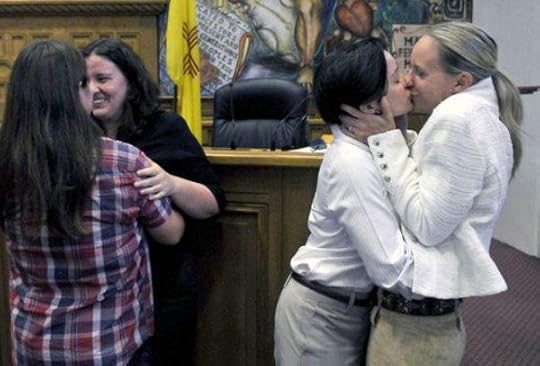
In 49 out of 50 states, marriage equality is either legal or it's not. There's no ambiguity -- under state law, same-sex couples either have the ability to get legally married or they are explicitly prohibited from doing so.
The exception is New Mexico, where marriage equality is neither permitted nor banned. With this in mind, yesterday a state court helped New Mexico take a huge step forward in a court ruling the state ACLU described as "monumental."
A New Mexico judge on Monday declared same-sex marriage legal, ordering the clerk of the state's most populous county to join two other counties in issuing licenses for gay and lesbian couples.
State District Judge Alan Malott ruled New Mexico's constitution prohibits discrimination on the basis of sexual orientation. The Bernalillo County clerk's office in Albuquerque planned to start issuing marriage licenses to same-sex couples at 8 a.m. Tuesday.
The decision came after a judge in Santa Fe directed the county clerk there to begin issuing marriage licenses to same-sex couples on Friday. But Malott's ruling was seen as more sweeping because he directly declared that gay marriage was legal.
The decision came in response to a legal fight launched by a Jen Roper, New Mexico woman with cancer, who wants New Mexico to recognize her longtime partner, Angelique Neuman, on her death certificate. Judge Malott not only agreed, he went further, incorporating a related case in which several same-sex couples sought marriage licenses.
Does this mean marriage equality has come to New Mexico? Not exactly. The case applies to the largest county in the state, but is not binding elsewhere. As the AP report added, it's not clear whether clerks in other counties, which were not involved in the case, "will use the judge's ruling as a signal that they can issue marriage licenses to same-sex couples."
Several Republican state lawmakers are reportedly hoping to stop couples from marrying, filing a lawsuit this morning to block clerks from issuing licenses to same-sex couples. It's not yet clear whether those efforts will delay this morning's ceremonies, but as best as I can tell, barring a last-minute court order, the Bernalillo County clerk's office in Albuquerque wil start issuing marriage licenses in about 40 minutes.
When 'consultation' replaces 'authorization'
Associated Press
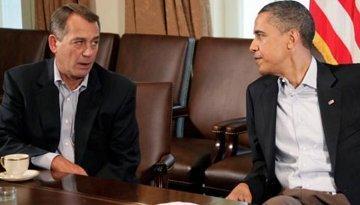
As Rachel explained in detail last night, the prospect of U.S. military intervention in Syria appears increasingly likely, a development that has not escaped Congress' attention. House Speaker John Boehner's (R-Ohio) office published a statement yesterday that struck an interesting note.
"The president is commander-in-chief. With that power comes obligations. One, of course, is to consult with Congress on the options he sees as a viable response. This consultation has not yet taken place, but it is an essential part of the process. And meaningful consultation should happen before any military action is taken."
For those keeping score, there are four sentences in that paragraph, and three of them feature some variation on the word "consult."
And the reason this struck me as interesting is that the House Speaker is setting the checks-and-balances bar awfully low -- Boehner doesn't expect Congress to have any say in whether the United States takes military action in Syria, and he apparently doesn't even intend to have any kind of vote on a congressional resolution on the use of force.
Rather, the Speaker just wants to be kept in the loop. Boehner apparently will be satisfied if the White House picks up the phone and keeps congressional leaders apprised of what the president chooses to do.
In other words, "consult" is weak, in a vague sort of way. If the president "consults" with congressional leaders and lawmakers urge Obama not to intervene in Syria at all, it's apparently within the president's power to say, "That's nice, but Congress isn't especially relevant in this." By Boehner's reasoning, this is fine -- it checks the "consultation" box -- and the president can go ahead and use force as he deems appropriate.
Boehner's statement yesterday added, "[I]f he chooses to act, the president must explain his decision." That's it? That's what the Speaker expects about the use of military force abroad? Boehner is surprisingly easy to please -- once a presidential conversation and explanation are out of the way, Obama can launch military strikes without Congress doing much of anything, this according to the Speaker of the House.
I seem to recall reading a book not too long ago suggesting a more responsible course.
That said, if Boehner were willing to bring the matter to the floor for a vote, I wonder what the outcome might be.
Despite mounting evidence that President Bashar Assad used chemical weapons on his people, many members of Congress still don't see a role for the United States military in Syria.
A raft of Republican and Democratic lawmakers -- including those directly involved in intelligence oversight -- think the U.S. would be wise to take a pass on military intervention in the war-torn country.
Their line of thinking goes like this: Sending in U.S. troops now is too late, too dangerous, too pricey and not guaranteed to be successful. And a bombing campaign won't do enough. There's also the fear that the U.S. does not know who would lead Syria if Assad falls.
This is not to say congressional opinion is one-sided -- many lawmakers support intervention, others are furious that military strikes haven't already happened -- but if Congress were to consider authorizing the use of force, it's not entirely clear the administration would get it.
We probably won't find out, though, because Boehner only expects a consultation.