Rachel Maddow's Blog, page 3339
August 30, 2013
McConnell shouldn't brag about supporting bills he opposed
Associated Press
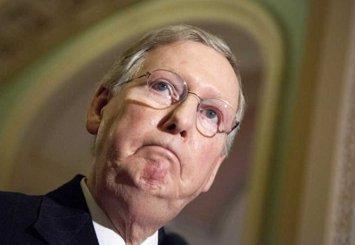
Several weeks ago, Senate Minority Leader Mitch McConnell (R) got caught misleading Kentucky voters about his record on the Violence Against Women Act. This morning, he was even more brazen on the subject (via Joe Sonka).
A press release distributed by Sen. Mitch McConnell's (R-KY) campaign at a "Women for Team Mitch" event on Friday brags about the Senate Minority Leader's support for the Violence Against Women Act, even though McConnell voted against the measure in 1994, 2012, and 2013.
"Mitch was the co-sponsor of the original Violence Against Women Act -- and continues to advocate for stronger polices to protect women. I am proud to call him my senator," the document quotes a voter as saying.
For months, a variety of congressional Republicans have pretended to support the Violence Against Women Act, even after they voted against it, hoping voters and reporters wouldn't know the difference.
But the fact that McConnell has a lot of company doesn't make this any better. His campaign is now trying to give voters the impression that he's championed VAWA, but in reality, McConnell has voted against it repeatedly. Indeed, he voted against it even when he knew with certainty it would pass -- suggesting he opposed the law just to make a point about the depth and seriousness of his opposition.
As for the notion that McConnell "continues to advocate for stronger polices to protect women," let's also not forget that the Senate Minority Leader voted against the Lilly Ledbetter Act and the Paycheck Fairness Act.
If McConnell wants to defend his record, fine. If he wants Kentuckians to find merit in the votes he cast, the senator is welcome to make his case. But the fact that he sees willful deception as the appropriate course is a problem.
Update: Sonka has more, including details on the recent history.


Friday's campaign round-up
Associated Press
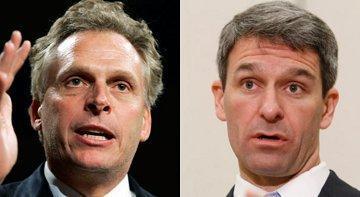
Virginia gubernatorial candidates Terry McAuliffe (D) and Ken Cuccinelli (R)
Today's installment of campaign-related news items that won't necessarily generate a post of their own, but may be of interest to political observers:
* In Virginia's closely watched gubernatorial race, the latest Public Policy Polling survey shows Terry McAuliffe (D) up by seven over Ken Cuccinelli (R), 44% to 37%.
* In related news, an Emerson College poll shows McAuliffe with an even larger advantage over the far-right state Attorney General, 45% to 35%.
* New Jersey Senate hopeful Cory Booker (D) talked to MSNBC's Chris Hayes last night, and responded to offensive rhetoric from Republican Steve Lonegan about his personal life. "The question really should not be am I gay or straight. The question should be, why the heck are you asking the question in the first place? It doesn't make a whit of difference what kind of senator I'm going to be or not," Booker said. "I have affirmed my sexual orientation numerous times over the years. People in my local press world know exactly what that is."
* Rep. Tom Reed (R-N.Y.), after getting caught being late on his property taxes 38 times, used campaign funds to pay off part of his bill -- which he is not allowed to do. Reed later repaid the money and attributed the incident to a "clerical error."
* If Texas State Sen. Wendy Davis (D) decides to pursue a gubernatorial campaign next year, she probably won't suffer from a lack of funds. The Texas Democrat raised $1.2 million over six weeks immediately after her much-discussed filibuster in Austin.
* In New York City's mayoral race, a new New York Times-Siena College poll confirms what other recent surveys show: Bill de Blasio (D) has clearly jumped out in front of the rest of the pack.
* And in California, where Rep. Mike Honda (D) will face a primary challenge from Ro Khanna, a former U.S. Commerce Department official with deep ties to the tech industry, a new PPP survey shows Honda well ahead of his challenger, 49% to 15%.
The 'wonk gap' isn't getting any better
Associated Press
The Kaiser Family Foundation published an interesting report this week on public attitudes on health care, noting among other things that 57% of Americans do not want to defund the Affordable Care Act. This was, of course, not what Republicans and their allies wanted to hear.
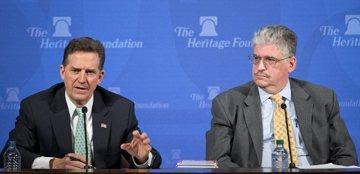
The Heritage Foundation was apparently so despondent with the findings that it lost its reading-comprehension skills -- the right-wing group unveiled a poster on Wednesday, asking folks to join the 57% of Americans who do want to defund "Obamacare." When Heritage was told it simply read the poll wrong, and got the results backwards, the organization made the same mistake again.
Remember, the Heritage Foundation claims to be a think tank. For decades, it has presented itself as an institution committed to conservative research and scholarship. Heritage staffers aren't supposed to be random, mindless hacks; they're supposed to be providing the intellectual framework for modern conservatism.
And now they can't read a poll.
Worse, this wasn't Heritage's biggest setback this week.
Even conservative House Republicans have finally had it with the Heritage Foundation, the conservative think tank that has aggressively pushed Republican congressmen to the right.
National Journal reports that the Republican Study Committee, a group of conservative House members with deep ties to Heritage, has banned Heritage employees from its meetings. They're mad that Heritage tried to kill a farm subsidy bill that Republican House members very much wanted to pass back in July.
We can debate the merits of the underlying agricultural legislation, but in the larger context, the point is that things aren't going especially well for Heritage. It's failed to rally meaningful opposition to the Affordable Care Act; it's had no real impact on the immigration debate it hoped to control; it's new president, former Sen. Jim DeMint, is more often laughed at than listened to; the group has been banned from Republican Study Committee meetings; and it's screwing up rudimentary poll analysis.
And don't even get me started on the Jason Richwine fiasco.
All of this serves as a reminder about the growing "wonk gap."
Indeed, it's not just Heritage making things worse. The Cato Institute, the other major player among conservative think tanks, published a big report last week making the case that low-income Americans on "welfare" are better off than low-income families that actually have jobs.
It didn't take long for the Center on Budget and Policy Priorities' Sharron Parrott to tear it apart.
All of which leads us back to the "wonk gap" thesis that we've been kicking around for a while. To reiterate the argument, as Republicans become a post-policy party, even their wonks -- their sharpest and most knowledgeable minds -- are producing shoddy work that crumbles quickly under mild scrutiny, a problem we don't see on the left.
It certainly happened when Heritage tried to tackle immigration, and again with Cato on "welfare." We see the same dynamic on display on economic and tax policy discussions, in which House Budget Committee Paul Ryan (R-Wis.) is supposed to be a standout for his intellectual rigor, only to find his arguments crumbling in the face of evidence, too.
But it's health care where the wonk gap shines brightest. In 2011, for example, after National Review ran a piece with obvious factual errors about health care policy, Jon Chait noted, "One of the unusual and frustrating aspects of the health care debate is the sheer imbalance of people who understand the issue at all from a technical standpoint. Even the elite policy wonks of the right make wildly incorrect claims about the issue."
Most people are not policy wonks. We really on trusted specialists to translate these details for us. This is true as well of elected officials and their advisors. Part of the extraordinary vitriol of the health care debate stems from the fact that, on the Republican side, even the specialists believe things that are simply patently untrue. As with climate change and supply-side economics, there isn't even a common reality upon which to base the discussion.
Paul Krugman added some related thoughts at the time.
First of all, I don't think this is unique to health care, or especially unusual. Monetary policy, fiscal policy, you name it, there's a gap, although not quite as large as on health.
Second, I'm surprised that Chait doesn't refer to Upton Sinclair's principle: it's difficult to get a man to understand something when his salary depends on his not understanding it. In fact, in general right-wing think tanks prefer people who genuinely can't understand the issues -- it makes them more reliable.
Doesn't this apply to both sides? Not equally. There was a time when conservative think tanks employed genuine policy wonks, and when asked to devise a Republican health care plan, they came up with -- Obamacare! That is, what passes for leftist policy now is what was considered conservative 15 years ago; to meet the right's standards of political correctness now, you have to pass into another dimension, a dimension whose boundaries are that of imagination, untrammeled by things like arithmetic or logic.
I write often about the asymmetry in American politics, and the consequences of a radicalized party in a two-party system. But this wonk gap points to something related but different: it's not just Republicans who've become more extreme and less interested in substance; it's also conservatives who've allowed their intellectual infrastructure to atrophy and collapse.
Credible policy debates are rendered impossible, not because of the chasm between the two sides, but because only one side places a value on facts, evidence, and reason.
Eric Holder steps up, digs in, and breaks out
Associated Press
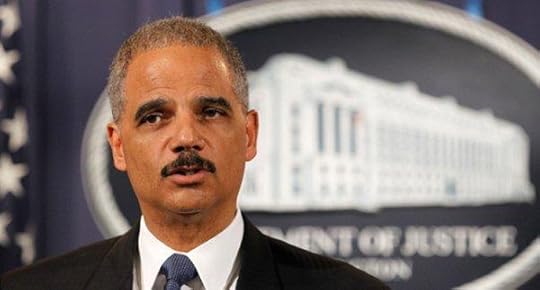
We talked yesterday about Attorney General Eric Holder giving officials in Colorado and Washington a green light on their state measures legalizing recreational use of marijuana, but the story, which Rachel explored in more detail last night, got me thinking about Holder's tenure.
For a typical conservative, I suspect the Attorney General would top the list for his or her least favorite member of President Obama's cabinet. Holder is truly reviled on the right, to the point that calls for his resignation have come from the RNC, many Senate Republicans, and at last count, 122 House Republicans.
But once we get past the partisan sniping and consider the policy breakthroughs, Eric Holder appears to have quietly positioned himself not only as a progressive champion, but as one of the more accomplished attorneys general in recent memory.
Think about some of the recent policies Holder has chosen to tackle: voting rights; sentencing reforms; condemnations of "Stand Your Ground" laws, and of course the drug policy announced yesterday. These are critically important law-enforcement policies, some of which have been neglected and ignored by officials in both parties for years, long in need of leadership -- which Holder is now providing.
Even when the Justice Department arguably went too far in subpoenaing reporters' phone logs as part of a leak investigation, it was Holder who soon after approved reforms to make it more difficult for this to happen in the future through higher search-warrant standards, and ensuring more advance notice for news organizations.
The A.G. isn't just breaking sharply with Justice Department practices in the Bush/Cheney era; Holder is changing the trajectory of regressive policies that have gotten worse for decades.
This certainly isn't to say his tenure has been flawless, but the political world generally only focuses on Holder when Republicans are attacking him, and that's a shame. On a variety of key areas, the Attorney General seems wildly underrated.
August 29, 2013
Links for the 8/29 TRMS
Citations for Thursday's show are listed after the jump.
'They asked a long list of Republicans to come'
GOP leader chose oil industry over MLK marchers
Maryland, Maine, Washington approve gay marriage
All Legal Same-Sex Marriages Will Be Recognized for Federal Tax Purposes
IRS will recognize same-sex marriages, even if states do not
U.S. prison population falls for third year
August 29, 2006 - The Number of Uninsured Americans Is At An All-Time High
Census: Uninsured Numbers Decline As More Young Adults Gain Coverage
Marijuana Arrests in the United States (pdf)
Obama Signs Law Narrowing Cocaine Sentencing Disparities
Holder to order curbs on mandatory minimum drug sentencing
Washington State Prepares For 'Worst-Case Scenario,' A Federal Lawsuit Over Marijuana Legal
Justice Department: Guidance Regarding Marijuana Enforcement (pdf)
Colorado, Washington get OK from feds on marijuana
No federal challenge to pot legalization in two states
Obama Set for Limited Strike on Syria as British Vote No
Fortune 500, 2011: 2. Exxon Mobil
Exxon Mobil profit is just short of record
Exxon to cut off Mayflower housing support
Exxon reverses decision on end to assistance for Mayflower residents displaced by oil spill
Exxon to cut temp housing aid for some evacuees in Mayflower
Latest Data from Mayflower Oil Spill
State health officials to assess health of Mayflower oil spill victims
Mayflower residents to Tim Griffin: "We need help" with oil-related illnesses
Trial Date Set for State of Arkansas vs. ExxonMobil
Thousands Rally During Moral Wednesday Marches
Livermore Scientists Team With Russia To Discover Elements 113 and 115
New super-heavy element 115 is confirmed
Ahead on the 8/29 Maddow show
Tonight's guests include:
Andrea Mitchell, NBC News chief foreign affairs correspondent, host of “Andrea Mitchell Reports”
Dustin McDaniel, (D) Arkansas Attorney General
Here is tonight's soundtrack! (1:57 is where it's at!) And here is executive producer Bill Wolff with a look at tonight's show:
Success of March on Washington a sign of movement's momentum
Last night, Rachel, amply aided by the wonderful recounted history of Clarence Jones, reviewed some of the events in the civil rights movement that lead up to the March on Washington for Jobs and Freedom, showing that the march was not a singular, or even seminal, event, but rather was part of a longer struggle steadily building energy and momentum.
With that in mind, and following on the nice work done by my colleague Traci Lee over on the Bashir Show, I put together the below timeline of some of the significant events in the few years leading up to the March.
The items linked on the timeline are scavenged from the internet, so if you know of a good (free) node to add, let me know and I'll be happy to put it in.
Thursday's Mini-Report
Today's edition of quick hits:
* How are U.S. lawmakers approaching a possible military intervention in Syria? In a predictably divided way.
* Consultation: "The Obama administration was preparing Thursday to present to Congress its intelligence case on the Syrian government's alleged use of chemical weapons, as political objections to a U.S.-led military response increased in the United States and Britain."
* An inexplicable rush: "President Obama is willing to move ahead with a limited military strike on Syria even while allies like Britain are debating whether to join the effort and without an endorsement from the United Nations Security Council, senior administration officials said Thursday."
* Super-sized labor strikes: "The battle to boost the minimum wage escalated Thursday when thousands of workers at hundreds of fast food restaurants in 50 U.S. cities walked off the job to demand decent pay."
* The "black budget" gets a price tag: "U.S. spy agencies have built an intelligence-gathering colossus since the attacks of Sept. 11, 2001, but remain unable to provide critical information to the president on a range of national security threats, according to the government's top secret budget. The $52.6 billion 'black budget' for fiscal 2013, obtained by The Washington Post from former intelligence contractor Edward Snowden, maps a bureaucratic and operational landscape that has never been subject to public scrutiny."
* District Judge G. Todd Baugh: "A Montana judge has come under fire after handing down a 30-day sentence to a former high school teacher convicted of raping a 14-year-old student and for making statements in court that the victim was 'older than her chronological age' and 'as much in control of the situation' as her teacher."
* Guantanamo detention: "The White House announced Thursday that two detainees left the prison at Guantanamo Bay for Algeria, they were the first to be transferred from custody in nearly a year."
* Senate Majority Leader Harry Reid (D-Nev.) wants action on the Voting Rights Act, but he also seems to want to keep expectations in check.
* A first in seven years: "Vice President Joe Biden on Thursday swore in B. Todd Jones as director of the Bureau of Alcohol, Tobacco, Firearms and Explosives (ATF), the Justice Department said in a statement."
* It's one thing for Georgia Insurance Commissioner Ralph Hudgens (R) to try to sabotage the Affordable Care Act, but it's rather brazen to hear him brag about it.
* NFL: "The National Football League has agreed to pay $765 million to settle thousands of player lawsuits over head injuries -- a deal that both sides declared a win for retired athletes with debilitating brain damage."
Anything to add? Consider this an open thread.
IRS will recognize same-sex marriages, even if states do not

Associated Press
I imagine if you're a far-right culture warrior, today is one of those days you probably wish you hadn't gotten out of bed.
The Obama administration's Department of Health and Human Services, for example, announced it will now extend key Medicare benefits to same-sex married couples. Soon after, the Justice Department cleared the way for Colorado's and Washington's marijuana laws to be implemented.
Also today, the White House announced new gun policies on background checks and the re-importation of U.S. military weapons; a California court endorsed a ban on so-called "conversion therapy"; and in case social conservatives weren't quite miserable enough, the IRS will now recognize same-sex marriages, even in states where marriage equality is impermissible.
The U.S. Department of the Treasury and the Internal Revenue Service (IRS) today ruled that same-sex couples, legally married in jurisdictions that recognize their marriages, will be treated as married for federal tax purposes. The ruling applies regardless of whether the couple lives in a jurisdiction that recognizes same-sex marriage or a jurisdiction that does not recognize same-sex marriage.
The ruling implements federal tax aspects of the June 26th Supreme Court decision invalidating a key provision of the 1996 Defense of Marriage Act.
"Today's ruling provides certainty and clear, coherent tax filing guidance for all legally married same-sex couples nationwide. It provides access to benefits, responsibilities and protections under federal tax law that all Americans deserve," said Secretary Jacob J. Lew. "This ruling also assures legally married same-sex couples that they can move freely throughout the country knowing that their federal filing status will not change."
The new policy applies to all federal tax provisions where marriage is a factor, including filing status, claiming personal and dependency exemptions, taking the standard deduction, employee benefits, contributing to an IRA, and claiming the earned income tax credit or child tax credit.
This is no small development. Under the old policy, if a same-sex couple in Vermont gets married, then moves to Florida, they would no longer be treated as married under tax law. Now, no matter where a same-sex married couple lives, that family can take comfort in knowing they'll be treated equally under federal tax law.
Colorado, Washington get OK from feds on marijuana

Associated Press
When voters in Colorado and Washington approved the legalization of marijuana possession for adults, it was a policy breakthrough, but there was a problem: the newly approved state laws conflicted with federal law.
Under the Controlled Substances Act, federal law bans marijuana use, so Colorado and Washington were left wondering whether the Justice Department would intervene and block the measures approved by state voters.
Today, as Ryan J. Reilly and Ryan Grim reported, Colorado and Washington got their answer.
The United States government took an historic step back from its long-running drug war on Thursday, when Attorney General Eric Holder informed the governors of Washington and Colorado that the Department of Justice would allow the states to create a regime that would regulate and implement the ballot initiatives that legalized the use of marijuana for adults.
A Justice Department official said that Holder told the governors in a joint phone call early Thursday afternoon that the department would take a "trust but verify approach" to the state laws.
That last part is important. The DOJ is effectively letting the states know that they can proceed on their current course, but if federal law enforcement has reason to believe in the future that Colorado and Washington are failing to be responsible, the feds can revisit the new policy.
In the meantime, though, that means these states -- and any others that choose to follow their lead -- can move forward on legalization.
After watching the "war on drugs" move in only one direction for the majority of my life, this strikes me as a pretty amazing development. Up until fairly recently, it would have been unimaginable.
The Huffington Post added that Deputy Attorney General James Cole also issued a three-and-a-half page memo to U.S. attorneys outlining eight priorities for federal prosecutors enforcing marijuana laws. These are the areas where prosecutions will continue:
* the distribution of marijuana to minors;
* revenue from the sale of marijuana from going to criminal enterprises, gangs and cartels;
* the diversion of marijuana from states where it is legal under state law in some form to other states;
* state-authorized marijuana activity from being used as a cover or pretext for the trafficking of other illegal drugs or other illegal activity;
* violence and the use of firearms in the cultivation and distribution of marijuana
* drugged driving and the exacerbation of other adverse public health consequences associated with marijuana use;
* growing of marijuana on public lands and the attendant public safety and environmental dangers posed by marijuana production on public lands;
* preventing marijuana possession or use on federal property.
But note that this leaves a whole lot of recreational pot use that federal prosecutors will no longer feel the need to pursue.
Update: Sahil Kapur posted the full memo from Cole.