Rachel Maddow's Blog, page 3338
September 2, 2013
Reading the congressional tea leaves on Syria
Associated Press
The Weekly Standard's Bill Kristol appeared on "Meet the Press" yesterday and predicted that congressional Republicans would, in fact, authorize the use of military force in Syria.
"I think the Republican Party, the party I know a little bit better than the Democrats, will support the president, will do the right thing for the country despite many doubts about the character of the military assault he's about to launch, many doubts about his past decisions as commander in chief.
"I think the Republican Party will step up and do the right thing and support the president against a chemical weapons using terror sponsoring, Iran-backed dictator."
And when it comes to U.S. foreign policy, especially in the Middle East, Kristol's predictions have a solid track record, right?
The congressional process is really just starting in earnest, and it's likely that momentum will swing more than once before lawmakers return to Capitol Hill and cast a vote next week.
That said, members' comments yesterday suggested President Obama's request for congressional approval faces an uphill climb. For every lawmaker who predicted yesterday that a resolution would pass, at least two predicted it would fail. For every member who said they were inclined to endorse the use of force in Syria, at least two said the opposite.
Also note, the divide on Syria does not fall neatly along partisan lines, making predictions that much more difficult.
Part of the challenge is coming to terms with the fact that no one can say with confidence what the Republican Party's general approach to foreign policy really is in the post-Bush/Cheney era. It's not because it's nuanced or rhetorically complex; it's because the party is divided into factions that are so opposed to one another, there is no such policy. We'd have to go back many, many years to find a time when there was this much ambiguity surrounding the GOP's foreign policy worldview.
And over the next two weeks, these intra-party fissures are about to take center stage in a way we haven't seen in a long while.
There will almost certainly be some Republicans who endorse President Obama's call for limited intervention in Syria. But we'll also see sharp disputes between neocons (who'll oppose the resolution because it's not a full-fledged war), the GOP's libertarian wing (who'll oppose the resolution out of an ideological predisposition again intervention abroad), and the party's knee-jerk partisans (who'll oppose the resolution because they reflexively say no to Obama in all instances).
Democrats don't have a walk in the park ahead of them, either. While the party is generally more united on matters of foreign policy than their Republican counterparts, liberal skepticism about the value of intervention in Syria is deep and broad. Congressional Dems may feel a pull to support their president because he's their president, but while the leadership in both chambers will likely endorse the White House's position, I expect a large number of Democratic defections.
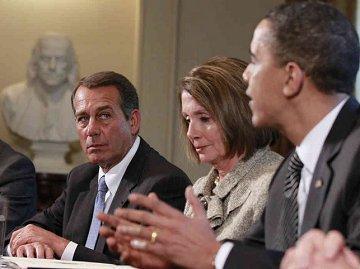
Neither party's leadership, by the way, is likely to "whip" the votes -- whip operations on resolutions like these are quite unusual -- so members in both chambers will be encouraged to simply vote their consciences. If I had to guess, I'd also say House Speaker John Boehner's (R-Ohio) fealty to the so-called "Hastert Rule" won't apply in this case, and a resolution will get a floor vote even if a majority of House Republicans are prepared to vote against it.
That doesn't necessarily mean it'll pass the lower chamber, but it does mean the Speaker won't be in a position to tell the nation and the world, "Sorry, I couldn't bring the resolution to the floor because of a made-up procedural standard."


August 31, 2013
Congress, be careful what you wish for
White House photo
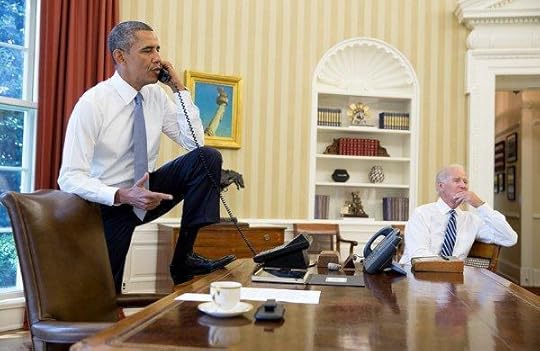
President Obama talks on the phone in the Oval Office with House Speaker Boehner earlier today.
The funny thing about a dog that chases a car? Sometimes it catches the car and has no idea what to do next.
Over the last several days, members of Congress have spoken out with a variety of opinions about U.S. policy towards Syria, but lawmakers were in broad agreement about one thing: they wanted President Obama to engage Congress on the use of military force. Few expected the White House to take the requests too seriously.
Why not? Because over the last several decades, presidents in both parties have increasingly consolidated authority over national security matters, tilting practically all power over the use of force towards the Oval Office and away from the legislative branch. Whereas the Constitution and the War Powers Act intended to serve as checks on presidential authority on military intervention abroad, there's been a gradual (ahem) drift away from these institutional norms.
That is, until this afternoon, when President Obama stunned everyone, announcing his decision to seek "authorization" from a co-equal branch of government.
It's one of those terrific examples of good politics and good policy. On the former, the American public clearly endorses the idea of Congress giving its approval before military strikes begin. On the latter, at the risk of putting too fine a point on this, Obama's move away from unilateralism reflects how our constitutional, democratic system of government is supposed to work.
Arguably the most amazing response to the news came from Rep. Peter King (R-N.Y.), the chair of the House Homeland Security Subcommittee on Counterintelligence & Terrorism, and a member of the House Intelligence Committee:
"President Obama is abdicating his responsibility as commander-in-chief and undermining the authority of future presidents. The President does not need Congress to authorize a strike on Syria."
This is one of those remarkable moments when a prominent member of Congress urges the White House to circumvent Congress, even after many of his colleagues spent the week making the exact opposite argument.
The next question, of course, is simple: now that Obama is putting Congress on the spot, what's likely to happen next? Now that the dog has caught the car it was chasing, what exactly does it intend to do?
Lawmakers, in theory, could cut short their month-long break, return to work, and consider their constitutional obligations immediately. That almost certainly won't happen, at least not the lower chamber -- as my colleague Will Femia reported earlier, House Republican leaders have said they're prepared to "consider a measure the week of September 9th." There are reports Senate Democratic leaders may act sooner, but no formal announcement has been made.
The dirty little secret is that much of Congress was content to have no say in this matter. When a letter circulated demanding the president seek lawmakers' authorization, most of the House and Senate didn't sign it -- some were willing to let Obama do whatever he chose to do, some didn't want the burden of responsibility. Members spent the week complaining about the president not taking Congress' role seriously enough, confident that their rhetoric was just talk.
It spoke to a larger problem: for far too many lawmakers, it's so much easier to criticize than govern. In recent years, members of Congress have too often decided they're little more than powerful pundits, shouting from the sidelines rather than getting in the game.
It's one of the angles to today's news that's so fascinating -- Obama isn't just challenging Congress to play a constructive role in a national security matter, the president is also telling lawmakers to act like adults for a change. They're federal lawmakers in the planet's most powerful government, and maybe now would be a good time to act like grown-ups who are mindful of their duties.
In his first inaugural address, Obama said, "[I]n the words of Scripture, the time has come to set aside childish things." For the last four-and-a-half years, much of Congress ignored this call. Today, members received a striking reminder.
Yes, Congress is a hapless embarrassment. It can't pass a budget; it can't pass a farm bill; and it can barely manage to keep the government's lights on. But institutional responsibilities don't fade away just because radicalized GOP lawmakers are struggling through a post-policy phase.
There is a real possibility that Congress will simply decline to give the president the authorization he seeks. I suspect Obama will get the votes he needs, but note that Sens. John McCain (R-Ariz.) and Lindsey Graham (R-S.C.), two senators who never saw a country they weren't tempted to bomb, issued a statement this afternoon that read:
"We believe President Obama is correct that the Assad regime's use of chemical weapons requires a military response by the United States and our friends and allies. Since the President is now seeking Congressional support for this action, the Congress must act as soon as possible.
"However, we cannot in good conscience support isolated military strikes in Syria that are not part of an overall strategy that can change the momentum on the battlefield, achieve the President's stated goal of Assad's removal from power, and bring an end to this conflict, which is a growing threat to our national security interests. Anything short of this would be an inadequate response to the crimes against humanity that Assad and his forces are committing. And it would send the wrong signal to America's friends and allies, the Syrian opposition, the Assad regime, Iran, and the world -- all of whom are watching closely what actions America will take."
In other words, McCain and Graham realize Obama is eyeing narrow, limited military intervention, and they're outraged -- they want a broader conflict with a massive U.S. role. They may well vote against a measure on Syria because it doesn't go far enough in their eyes.
And that's certainly their right. Others will oppose strikes for progressive reasons. Others still endorse the White House strategy.
The point is, the people's elected representatives will have a debate, which is exactly what it should do. It won't be pretty, but it's how the United States is supposed to operate. Congress has clear responsibilities -- whether lawmakers want them or not -- and it's time they exercise them.
Obama decides to strike Syria, will seek authorization from Congress
Full video:
President Obama says the nation should and will take action against the Syrian government, but not without congressional approval. Watch his full speech.
Transcript of the president's remarks:
Good afternoon, everybody. Ten days ago, the world watched in horror as men, women and children were massacred in Syria in the worst chemical weapons attack of the 21st century. Yesterday the United States presented a powerful case that the Syrian government was responsible for this attack on its own people.
Our intelligence shows the Assad regime and its forces preparing to use chemical weapons, launching rockets in the highly populated suburbs of Damascus, and acknowledging that a chemical weapons attack took place. And all of this corroborates what the world can plainly see -- hospitals overflowing with victims; terrible images of the dead. All told, well over 1,000 people were murdered. Several hundred of them were children -- young girls and boys gassed to death by their own government.
This attack is an assault on human dignity. It also presents a serious danger to our national security. It risks making a mockery of the global prohibition on the use of chemical weapons. It endangers our friends and our partners along Syria's borders, including Israel, Jordan, Turkey, Lebanon and Iraq. It could lead to escalating use of chemical weapons, or their proliferation to terrorist groups who would do our people harm.
In a world with many dangers, this menace must be confronted.
Now, after careful deliberation, I have decided that the United States should take military action against Syrian regime targets. This would not be an open-ended intervention. We would not put boots on the ground. Instead, our action would be designed to be limited in duration and scope. But I'm confident we can hold the Assad regime accountable for their use of chemical weapons, deter this kind of behavior, and degrade their capacity to carry it out.
Our military has positioned assets in the region. The Chairman of the Joint Chiefs has informed me that we are prepared to strike whenever we choose. Moreover, the Chairman has indicated to me that our capacity to execute this mission is not time-sensitive; it will be effective tomorrow, or next week, or one month from now. And I'm prepared to give that order.
But having made my decision as Commander-in-Chief based on what I am convinced is our national security interests, I'm also mindful that I'm the President of the world's oldest constitutional democracy. I've long believed that our power is rooted not just in our military might, but in our example as a government of the people, by the people, and for the people. And that's why I've made a second decision: I will seek authorization for the use of force from the American people's representatives in Congress.
Over the last several days, we've heard from members of Congress who want their voices to be heard. I absolutely agree. So this morning, I spoke with all four congressional leaders, and they've agreed to schedule a debate and then a vote as soon as Congress comes back into session.
In the coming days, my administration stands ready to provide every member with the information they need to understand what happened in Syria and why it has such profound implications for America's national security. And all of us should be accountable as we move forward, and that can only be accomplished with a vote.
I'm confident in the case our government has made without waiting for U.N. inspectors. I'm comfortable going forward without the approval of a United Nations Security Council that, so far, has been completely paralyzed and unwilling to hold Assad accountable. As a consequence, many people have advised against taking this decision to Congress, and undoubtedly, they were impacted by what we saw happen in the United Kingdom this week when the Parliament of our closest ally failed to pass a resolution with a similar goal, even as the Prime Minister supported taking action.
Yet, while I believe I have the authority to carry out this military action without specific congressional authorization, I know that the country will be stronger if we take this course, and our actions will be even more effective. We should have this debate, because the issues are too big for business as usual. And this morning, John Boehner, Harry Reid, Nancy Pelosi and Mitch McConnell agreed that this is the right thing to do for our democracy.
A country faces few decisions as grave as using military force, even when that force is limited. I respect the views of those who call for caution, particularly as our country emerges from a time of war that I was elected in part to end. But if we really do want to turn away from taking appropriate action in the face of such an unspeakable outrage, then we just acknowledge the costs of doing nothing.
Here's my question for every member of Congress and every member of the global community: What message will we send if a dictator can gas hundreds of children to death in plain sight and pay no price? What's the purpose of the international system that we've built if a prohibition on the use of chemical weapons that has been agreed to by the governments of 98 percent of the world's people and approved overwhelmingly by the Congress of the United States is not enforced?
Make no mistake -- this has implications beyond chemical warfare. If we won't enforce accountability in the face of this heinous act, what does it say about our resolve to stand up to others who flout fundamental international rules? To governments who would choose to build nuclear arms? To terrorist who would spread biological weapons? To armies who carry out genocide?
We cannot raise our children in a world where we will not follow through on the things we say, the accords we sign, the values that define us.
So just as I will take this case to Congress, I will also deliver this message to the world. While the U.N. investigation has some time to report on its findings, we will insist that an atrocity committed with chemical weapons is not simply investigated, it must be confronted.
I don't expect every nation to agree with the decision we have made. Privately we've heard many expressions of support from our friends. But I will ask those who care about the writ of the international community to stand publicly behind our action.
And finally, let me say this to the American people: I know well that we are weary of war. We've ended one war in Iraq. We're ending another in Afghanistan. And the American people have the good sense to know we cannot resolve the underlying conflict in Syria with our military. In that part of the world, there are ancient sectarian differences, and the hopes of the Arab Spring have unleashed forces of change that are going to take many years to resolve. And that's why we're not contemplating putting our troops in the middle of someone else's war.
Instead, we'll continue to support the Syrian people through our pressure on the Assad regime, our commitment to the opposition, our care for the displaced, and our pursuit of a political resolution that achieves a government that respects the dignity of its people.
But we are the United States of America, and we cannot and must not turn a blind eye to what happened in Damascus. Out of the ashes of world war, we built an international order and enforced the rules that gave it meaning. And we did so because we believe that the rights of individuals to live in peace and dignity depends on the responsibilities of nations. We aren't perfect, but this nation more than any other has been willing to meet those responsibilities.
So to all members of Congress of both parties, I ask you to take this vote for our national security. I am looking forward to the debate. And in doing so, I ask you, members of Congress, to consider that some things are more important than partisan differences or the politics of the moment.
Ultimately, this is not about who occupies this office at any given time; it's about who we are as a country. I believe that the people's representatives must be invested in what America does abroad, and now is the time to show the world that America keeps our commitments. We do what we say. And we lead with the belief that right makes might -- not the other way around.
We all know there are no easy options. But I wasn't elected to avoid hard decisions. And neither were the members of the House and the Senate. I've told you what I believe, that our security and our values demand that we cannot turn away from the massacre of countless civilians with chemical weapons. And our democracy is stronger when the President and the people's representatives stand together.
I'm ready to act in the face of this outrage. Today I'm asking Congress to send a message to the world that we are ready to move forward together as one nation.
Thanks very much.
Senate Republican Leader Mitch McConnell made the following statement following the President's request for Congressional authorization of the use of military force:
"Today the President advised me that he will seek an authorization for the use of force from the Congress prior to initiating any combat operations against Syria in response to the use of chemical weapons. The President's role as commander-in-chief is always strengthened when he enjoys the expressed support of the Congress."
House Speaker John Boehner (R-OH), Majority Leader Eric Cantor (R-VA), Majority Whip Kevin McCarthy (R-CA) and Conference Chair Cathy McMorris Rodgers (R-WA) today issued the following joint statement.
"Under the Constitution, the responsibility to declare war lies with Congress. We are glad the president is seeking authorization for any military action in Syria in response to serious, substantive questions being raised. In consultation with the president, we expect the House to consider a measure the week of September 9th. This provides the president time to make his case to Congress and the American people."
I understand and support Barack Obama's position on #Syria.
— David Cameron (@David_Cameron) August 31, 2013
Very negative reaction from free syrian army. Saying obama delay will hurt them, calls it backpedaling. #syria
— Richard Engel (@RichardEngel) August 31, 2013
This Week in God
Associated Press
First up from the God Machine this week is a story out of Texas, where a megachurch's leaders are starting to regret preaching against vaccinations.
Officially, measles has been eradicated in the Western Hemisphere, but incidents like these still occur.
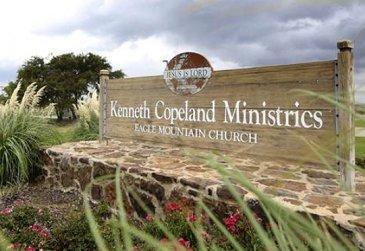
The latest measles outbreak is in Texas, where the virus has sickened 25 people, most of whom are members or visitors of a church led by the daughter of televangelist Kenneth Copeland.
Fifteen of the measles cases are centered around Eagle Mountain International Church in Newark, Texas, whose senior pastor, Terri Pearsons, has previously been critical of measles vaccinations.
The outbreak was started by a visitor to the church who had recently traveled to a country where measles remains common, according to Tarrant County Public Health spokesman Al Roy.
"This is a classic example of how measles is being reintroduced," said William Schaffner, an infectious disease expert and professor at the Vanderbilt University School of Medicine, told USA Today. He added, "This is a sadly misinformed religious leader."
He's referring, of course, to the megachurch's senior pastor, Terri Pearsons, who has advocated faith-healing and questioned vaccines. If her name sounds familiar, she's the daughter of prominent televangelist Kenneth Copeland.
Even now, Terri Pearsons, continues to express misgivings about vaccinations. That said, after the outbreak, she nevertheless said she now believes "children and even adults of all ages need to be immunized now to stop the spread of measles and prevent those potential complications."
Indeed, soon after, the megachurch abandoned its previous positions and began organizing free vaccination clinics, while posting information to its website about other nearby vaccination clinics.
Also from the God Machine this week:
* Arkansas state Senator Jason Rapert (R), perhaps best known for his aggressive social-conservative activism, said this week that he believes it's "more important to do what is right by God" than anything else, which presumably includes doing right by his constituents.
* The far-right Family Research Council, a leading organization in the religious right movement, was apoplectic after the Supreme Court's ruling striking down the Defense of Marriage Act, but is now trying to argue that the court's decision wasn't too big a deal.
* Alabama evangelist Matt Pitt, who has "led thousands of young Christians in high-energy worship services across the United States in recent years," has been arrested on charges of impersonating a law enforcement officer. He's continuing to lead worship services from recordings in a county jail.
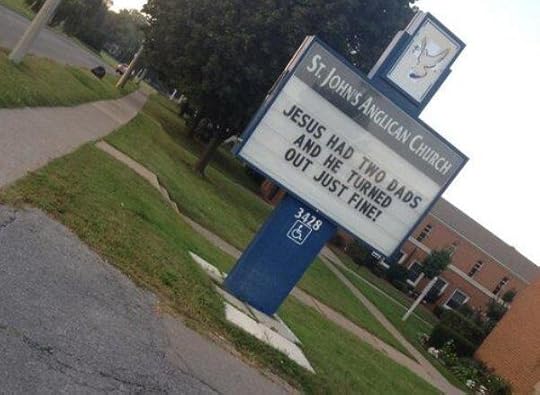
* And a sign in front of St. John's Anglican Church went viral this week, thanks to its simple, progressive message. It reads, "Jesus had two dads and he turned out just fine!"
August 30, 2013
Have a great Labor Day weekend!
There is no Rachel Maddow Show this evening. We hope you're able to enjoy the long weekend.
Friday's Mini-Report
Today's edition of quick hits:
* Not surprisingly, the Pentagon is clearly planning for intervention in Syria.
* Congress: "Will the House return to vote on authorizing President Barack Obama to use military force in Syria? 'The speaker hasn't ruled it out,' says Michael Steel, spokesman for Speaker John A. Boehner, R-Ohio."
* More progress: "A married same-sex couple must be eligible for the same veteran benefits as married heterosexual couples, a federal court ruled Wednesday."
* DOJ: "Financial institutions and other enterprises that do business with marijuana shops that are in compliance with state laws are unlikely to be prosecuted for money laundering or other federal crimes that could be brought under existing federal drug laws, a senior Department of Justice official said Thursday."
* NSA story: "British authorities revealed Friday that NSA leaker Edward Snowden took at least three times as many highly sensitive documents as previously reported, and possibly far more. At a court hearing in London the government told a judge that David Miranda, the partner of Guardian journalist Glenn Greenwald, was carrying 58,000 documents related to British intelligence on electronic devices when he was stopped and searched at Heathrow airport on August 18. The government also said it believed the documents had been 'stolen' from Government Communications Headquarters (GCHQ), the British counterpart of the NSA."
* Economy: "U.S. consumers barely increased their spending in July after their income grew more slowly, held back by steep government spending cuts that reduced federal workers' salaries."
* More on this next week: "The Obama administration and a group of Republican senators abandoned efforts Thursday to hammer out a budget deal and avoid a showdown over the national debt, saying they had failed to resolve their long-standing dispute over taxes."
* Ohio: "Ohioans who buy their own health insurance should see an average out-of-pocket savings on premiums of 21 percent because of taxpayer subsidies under the Affordable Care Act, according to a new study by the Rand Corp., a widely respected think tank."
* It turns out the infamous "47 percent" should now be known as the "43 percent."
* The drop in Medicare costs offers even more good news on health care.
* Pennsylvania Gov. Tom Corbett (R) is sorry about the whole comparing-gay-adults-to-12-year-olds thing.
* Another first: "Justice Ruth Bader Ginsburg will become the first Supreme Court member to conduct a same-sex marriage ceremony Saturday when she officiates at the Washington wedding of Kennedy Center President Michael M. Kaiser."
Anything to add? Consider this an open thread.
Obama preps 'limited, narrow' actions in Syria
President Obama briefly addressed the media this afternoon, soon after Secretary of State John Kerry's remarks, telling reporters that he has not yet made a decision about what the U.S. will do in Syria, but nevertheless sounding like a president poised to take military action.
Speaking briefly before a meeting with leaders of the Baltic states, the president said that he has not made a final decision on how to respond to the reported use of chemical weapons by Syrian president Bashar Assad, but he reiterated that the "wide range of options" being considered by the administration does not include troops in the region.
"In no event are we considering any kind of military action that would involve boots on the ground, that would involve a long-term campaign, but we are looking at the possibility of a limited, narrow act that would help make sure that not only Syria but others around the world understand that the international community cares about maintaining this chemical weapons ban and norm," he said.
Just to reiterate a point from earlier, there's been no indication of what might yet prevent a "limited" military strike at this point. There are no coalition partners the U.S. is awaiting word from; there are no deadlines the Assad regime is expected to meet; there is no report officials are waiting to read; there is no threat that unless Syria does x the U.S. will do y; there is no vote from Congress (or anyone else) that still needs to take place.
The question of whether the Obama administration will strike has apparently been answered.
And while the point seems clear enough -- the president and his team believe Syria needs to be punished for having used chemical weapons to kill its own citizens, including children and unarmed civilians -- we do not yet know what, specifically, the military strikes are intended to accomplish, or even whether it will deter Assad from doing it again.
What's more, pay attention to what "limited" might mean. Obama appears to want to thread a needle -- the strike will be narrow and modest enough to skirt the need for congressional approval, but significant enough to deter Syria in the future.
Those who still get the Iraq WMD story wrong
Associated Press
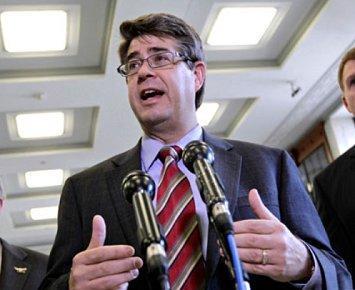
Rep. Lee Terry (R-Neb.)
It was a little jarring to hear Rep. Louie Gohmert (R-Texas) insist that Saddam Hussein "had weapons of mass destruction," and may have moved the stockpiles "over into Syria." I immediately double-checked the date, and sure enough, the comments came yesterday.
To clarify, those making remarks like these in August 2003 were foolish. For anyone, least of all an elected member of Congress, to repeat such things out loud in August 2013 suggests Louie Gohmert may, in fact, be made of wood.
Alas, he's not alone.
Rep. Lee Terry (R-Neb.) said on Thursday that he is against military intervention in Syria, even though his "gut feeling" is that the Syrian government now possesses chemical weapons that came from fallen Iraqi dictator Saddam Hussein.
Terry, who has served in the House since 1999, supported the U.S. invasion of Iraq in 2003. In an interview on Thursday with Omaha radio host Tom Becka, Terry said Syria was a completely different situation.
"The theory then and the evidence was that Iraq was an enemy of the United States and had direct plans in either support of al Qaeda and/or with other weapons that we found out weren't there -- which I still think they were moved to Syria," said Terry. "And it wouldn't surprise me if some of the chemical weapons that have been used by Syria actually came from Iraq."
The Nebraska Republican added, "[W]e all we know that Iraq had ... chemical and biological weapons and then they weren't there."
You've got to be kidding me.
It's painful to realize that there are still members of Congress who are confused about the basics, even now, a decade later.
But in case Reps. Terry and Gohmert see this, let's spell it out: Iraq's WMD stockpiles didn't exist. There's no reason to believe the weapons were moved to Syria since, once again, they didn't exist.
Liz Cheney: 'I am not pro-gay marriage'
Getty Images
As conservative as former Vice President Dick Cheney is, there's one issue on which he's been quite progressive: marriage equality. In fact, Cheney supported same-sex marriage as far back as 2000, when the vast majority of politicians in both parties were still publicly opposed to the idea.
As Cheney said in 2004, "freedom means freedom for everyone" to enter "into any kind of relationship they want to."
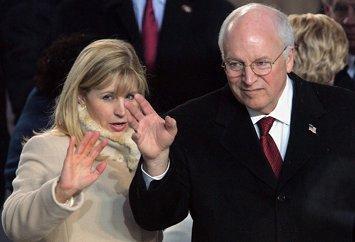
His daughter Liz Cheney, running for the U.S. Senate in Wyoming, apparently disagrees.
Liz Cheney flatly declared on Friday that she is "not pro-gay marriage."
Cheney, a Republican running for the U.S. Senate in Wyoming, made the policy statement after accusing the campaign of incumbent Republican Sen. Mike Enzi of distorting her views on the subject through a campaign push poll.
"I am strongly pro-life and I am not pro-gay marriage," Cheney said in a statement released by her campaign. "I believe the issue of marriage must be decided by the states, and by the people in the states, not by judges and not even by legislators, but by the people themselves."
For context, it's worth noting that Mary Cheney, Liz's younger sister and Dick's other daughter, is openly gay and married her longtime partner just last year.
In other words, Liz Cheney is running on a platform of opposition to her own sister's marriage -- and even her legal right to get married. I've heard of politicians who struggle with "family values," but this is remarkable.
Liz Cheney is to Dick Cheney's right on the one issue about which he's correct.
Kerry makes the case for intervention in Syria
Secretary of State John Kerry delivered forceful remarks this afternoon, making a moral argument for U.S. military intervention in Syria.
As part of the argument, Kerry highlighted an attack launched by the Assad regime last week, resulting in 1,429 deaths, including more than 400 children, which U.S. intelligence officials believe was the result of a chemical-weapons attack.
"Read for yourselves the evidence from thousands of sources," Kerry said. "This is the indiscriminate, inconceivable horror of chemical weapons. This is what Assad did to his own people." To that end, the administration published this unclassified assessment (pdf).
Kerry added, "[T]he primary question is really no longer 'what do we know?' The question is what are we -- we collectively -- what are we in the world going to do about it?"
President Obama himself is expected to speak publicly on this in about 10 minutes. [Update: The president's remarks have apparently been delayed a bit, but are still expected this afternoon.]
At a minimum, we're getting a better sense of the administration's thinking: the evidence is overwhelming, officials say, that the Syrian government is using chemical weapons against its own people. If there are no consequences for such heinous barbarism, Syria will not only continue to use these weapons, but it will also set a precedent that tells the world that chemical weapons can be used with impunity.
With this in mind, the likelihood of a U.S. military strike appears all but certain. Indeed, it's not at all clear what could change President Obama's mind. This isn't a situation in which the White House is issuing an ultimatum -- "Do x or we will act" -- or waiting for an authorization vote, a deadline to pass, or a U.N. report to come out. Rather, this is a dynamic in which the administration appears to simply be waiting for U.N. inspectors to leave Syria so the strike(s) can begin.
It remains unclear why action must happen so quickly, what the strikes would seek to accomplish, what (if anything) would follow the strikes, and what would happen if the Assad regime continues to use chemical weapons in the future even after U.S. intervention.