Rachel Maddow's Blog, page 3336
September 4, 2013
Rumsfeld just keeps talking
Getty Images
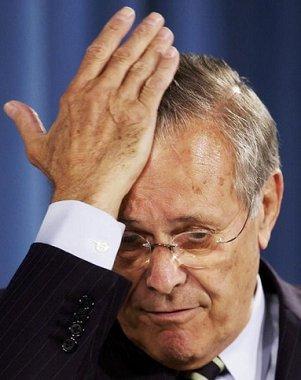
If there's anyone in America who should go enjoy a little quiet time right about now, it's failed former Pentagon chief Donald Rumsfeld. Nevertheless, he just keeps talking, appearing this morning on Fox News (thanks to my colleague Tricia McKinney for the heads-up).
...Rumsfeld, who earned public scorn for his leadership of the Pentagon during the Iraq War, said Obama didn't need to ask Congress for authorization and may have made a mistake in doing so.
"Now, did he need to go to Congress? No. Presidents as commander in chief have authority, but they have to behave like a commander in chief."
He referred to Obama as "the so-called commander in chief," and questioned whether a strike on Syria would be effective given the way Obama has handled it.
Rumsfeld, who seemed generally supportive of intervention in Syria, added that President Obama "doesn't have the kind of support that President Bush had in respect to his military actions."
Yep, he really said that.
Part of me continues to wonder why Rumsfeld is still allowed to speak in polite company. Lance Armstrong isn't asked for his opinions about athletes and performance-enhancing drugs; Miley Cyrus isn't sought out for analysis on public modesty; so why should anyone take seriously what Donald Rumsfeld has to say foreign policy and the use of military force abroad?
And yet ol' Rummy just can't seem to help himself -- he's talking about the incomplete justifications for military intervention; he casually attacks the president's patriotism; and he routinely makes incoherent, self-defeating observations about national security.
Don't go away mad, Rumsfeld. Just go away.


Wednesday's campaign round-up
Today's installment of campaign-related news items that won't necessarily generate a post of their own, but may be of interest to political observers:
* In Virginia's gubernatorial campaign, the Washington Post reported late last week on Ken Cuccinelli's (R) work on family law leading to support from the "fathers' rights movement," which is now the subject of a new attack ad from Terry McAuliffe (D).
Watch on YouTube* Speaking of Virginia, the state GOP is not exactly getting along well with E.W. Jackson, the party's unhinged candidate for lieutenant governor. "I think there's some trust issues there," a Republican strategist said.
* In a surprise move, Republican Carl DeMaio announced that he will not run for mayor in San Diego, and will instead continue his congressional campaign against freshman Democratic Rep. Scott Peters.
* In Wyoming, U.S. Senate candidate Liz Cheney, known for her neocon worldview, announced yesterday she would oppose a congressional resolution authorizing the use of force in Syria.
* In Massachusetts, Republican Charles Baker will run for governor again next year, after losing the same campaign in 2010. To date, there are no other GOP candidates in the race.
* As expected, New Jersey Gov. Chris Christie (R) announced yesterday he will not participate at an upcoming rally featuring U.S. Senate hopeful Steve Lonegan (R) and Sen. Rand Paul (R-Ky.).
* And in New Jersey, former Rep. Jeb Bradley (R) disappointed his party by announcing yesterday that he will not seek any statewide offices in 2014.
McCain balks at Syrian resolution
Sen. John McCain's (R-Ariz.) evolution on U.S. policy in Syria has taken quite a few twists and turns of late, and the Republican senator isn't quite done.
Last week, McCain heartily endorsed the use of military force in Syria. Over the weekend, however, McCain said he could not "in good conscience" support limited military strikes in Syria because he hoped to see a more ambitious military intervention.
Yesterday, McCain seemed to switch gears again, saying it would be "catastrophic" for Congress to oppose a resolution authorizing the use of force, adding that those who vote against the measure would risk undermining "the credibility of the United States."
And then this morning, he risked whiplash by quickly reversing course once more. NBC News' Kasie Hunt, who talked to Rachel last night about developments on Capitol Hill, reported this morning:
Sen. John McCain, R-Ariz., on Wednesday told NBC News that he doesn't support Senate language authorizing President Obama's desired military intervention in Syria because it is too limited.
"In its current form, I do not" support the new draft of the resolution, McCain said. That draft was released late Tuesday; it prohibits combat operations on the ground and limits Obama to a 90-day window in which he could use force against the Syrian regime.
McCain said the resolution doesn't mention his top policy priorities in Syria. "There's no reference to changing the momentum on the battlefield, there's no reference to arming the Free Syrian Army," he said, referencing a Syrian rebel group with which he's worked.
Note, the resolution McCain is balking at is a bipartisan proposal, co-authored by one of his allies, Sen. Bob Corker (R-Tenn.).
The rhetorical acrobatics on display are increasingly silly. It's tough to take McCain seriously when he says on Tuesday that opposing a resolution would have "catastrophic" consequences, only to say he'll personally oppose the same resolution on Wednesday.
That said, this is a piece in a larger puzzle.
It can be difficult to determine McCain's true motivations, but at this point, it's likely that the senator is trying to leverage his position a bit -- he obviously wants U.S. military intervention in Syria, and figures that he can get a more expansive resolution if he withholds his support for a while. The longer he balks, the more the White House and its allies will try to think of new ways to make McCain happy.
And if there's one thing McCain likes, it's attention.
But the lobbying won't happen in a vacuum. If proponents of military strikes alter a resolution to allow for a more expansive military operation, they risk losing progressive support on the other side. Greg Sargent reported yesterday:
In an interview with me today, Dem Rep. Chris Van Hollen -- a key member of the Dem leadership who is also respected by Congressional liberals -- was surprisingly pointed in warning that doing too much to win over the likes of McCain and Graham could end up driving him away, along with many other liberals and Dems.
"You've got some members of Congress, particularly Republicans in the Senate, who would like to use this resolution to open the door to large scale U.S. intervention," Van Hollen told me. "That would be a big mistake. So to the extent that the administration tries to placate those voices, they're going to get a lot of resistance from those of us, like me, who believe the scope needs to be significantly narrowed."
And so, the White House and its allies have a decision to make. Do they (a) blow off McCain in the hopes of securing more mainstream votes, confident that McCain's either bluffing or his vote is unnecessary; or (b) expand the resolution to satisfy McCain, and hope that Democrats go along in the end.
Obamacare to get a boost from Super Bowl champs
Associated Press
In 2006, a Republican governor of Massachusetts -- I believe his name was Mitt Romney -- had just approved a sweeping health care reform plan and needed to inform Bay State residents about new benefits they were entitled to. State officials did the obvious, smart thing: they partnered with the Boston Red Sox and launched a campaign to inform the public.
The team played "a central role" in getting the word out to the public, and it worked like a charm. State residents learned what they needed to know; the uninsured got coverage; and "Romneycare" was a success.
Seven years later, the Obama administration would love to establish similar partnerships to help get the word out on the Affordable Care Act, but that's proven to be quite difficult. Senate Republicans, eager to sabotage the federal health care system out of partisan spite, contacted the NFL, MLB, NBA, NHL, PGA, and NASCAR in July, urging them not to partner with Washington on informing the public about health care benefits.
The unprecedented right-wing lobbying had some effect -- in the months since, both the NFL and NBA informed the White House that it would not help with the public-awareness campaign. Every other sports franchise and league has also stayed on the sidelines.
That is, until yesterday.
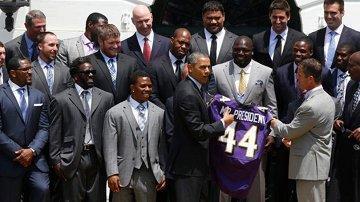
The Super Bowl champion Baltimore Ravens will help Maryland promote new insurance options under ObamaCare, state officials announced Tuesday. It's the first official partnership formed with a sports franchise to encourage participation in President Obama's signature healthcare law. [...]
Maryland's health department said 71 percent of uninsured people in the state watched, attended or listened to a Ravens game in the past year.
This is clearly great news for Maryland, arguably the single most effective state in the nation when it comes to implementing "Obamacare." It will, however, have no effect in the other 49 states.
Perhaps, with the Ravens on board, other sports franchises will get off the sidelines and into the game, so to speak?
'It's a pointed way of saying, 'We don't like you''
Associated Press
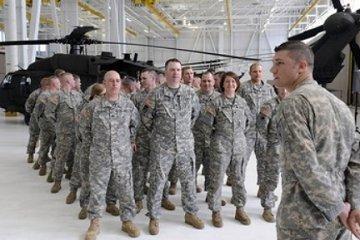
National Guard troops prepare for deployment
For gay men and women serving openly in the U.S. military, progress has come pretty quickly of late, after many years of painful delays. In February, the Defense Department extended new benefits, but the Pentagon couldn't go as far as officials wanted to because of the Defense of Marriage Act.
In the wake of DOMA's demine, the Defense Department quickly endorsed full benefits for same-sex military couples, and in August, the Pentagon went a little further still. As of last week, a federal court even extended veterans' benefits, ruling that married same-sex couples must be eligible for the same benefits as married heterosexual couples.
But the historic progress is not without challenges.
The Texas National Guard refused to process requests from same-sex couples for benefits on Tuesday despite a Pentagon directive to do so, while Mississippi won't issue applications from state-owned offices. Both states cited their respective bans on gay marriage.
Tuesday was the first working day that gays in the military could apply for benefits after the Pentagon announced it would recognize same-sex marriages. The Department of Defense had announced that it would recognize same-sex marriages performed in states where they are legal following the U.S. Supreme Court decision that threw out parts of the Defense of Marriage Act.
Texas and Mississippi appeared to be the only two states limiting how and where same-sex spouses of National Guard members could register for identification cards and benefits, according to an Associated Press tally.
That last part is of particular interest because it undermines the anti-gay argument -- more than a dozen states that ban marriage equality are nevertheless prepared to process applications for benefits from same-sex couples in military families.
The posture from Texas and Mississippi, then, appears unsustainable.
The Associated Press report added:
Pentagon officials said Texas appeared to be the only state with a total ban on processing applications from gay and lesbian couples. Spokesman Lt. Cmdr. Nate Christensen said federal officials will process all applications from same-sex couples with a marriage certificate from a state where it is legal.
Alicia Butler said she was turned away from the Texas Military Forces headquarters in Austin early Tuesday and advised to get her ID card at Fort Hood, an Army post 90 miles away. She married her spouse - an Iraq war veteran - in California in 2009, and they have a 5-month-old child.
"It's so petty. It's not like it's going to stop us from registering or stop us from marrying. It's a pointed way of saying, 'We don't like you," Butler said.
This isn't over.
Ending a filibuster before it starts
Associated Press
At least for now, it appears likely that most of the Senate will support a resolution authorizing the use of military force in Syria. But as Capitol Hill observers know all too well, in the upper chamber, a mere majority is generally insufficient -- could proponents put together a supermajority to overcome a filibuster?
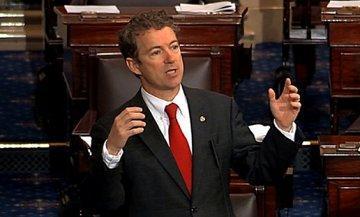
Sen. Rand Paul (R-Ky.), who drew headlines in March with his filibuster marathon, told reporters yesterday, "I can't imagine that we won't require 60 votes on this.... Whether there's an actual standing filibuster, I've got to check my shoes and check my ability to hold my water. And we will see. I haven't made a decision on that."
The decision may not be his to make. Roll Call reports that Senate opponents of military intervention in Syria "might not even get a chance to filibuster."
If Senate leaders take all the proper steps, the resolution to authorize the use of force against Syria might not only jump to the front of the schedule, but it could even short-circuit any filibuster attempts.
The War Powers Resolution of 1973 created a special privileged status for resolutions reported from the Senate Foreign Relations Committee that are in compliance with other legal provisions. The reward for drafting a compliant resolution? The measure becomes the pending business on the Senate floor without debate or the risk of a long series of debate-limiting cloture votes.
The piece added that Senate leaders could use the normal legislative procedures, which would slow things down, and leave more time for arm-twisting and grandstanding. But if Senate Majority Leader Harry Reid (D-Nev.) and other leaders support a resolution to use force, feel like they have the necessary votes, and don't want to give Rand Paul a platform, they'll likely want to take advantage of the alternative avenue*.
And this leads us to the other procedural question hanging over the debate: what about the so-called "Hastert Rule" in the House?
Roll Call had a good piece on this, too.
With Speaker John A. Boehner announcing Tuesday that he supports intervention in Syria, there is one question the Ohio Republican has yet to answer: Would he bring the Syria resolution up for a vote if it didn't have the support of a majority of Republicans? The short answer: Yes.
Boehner has never said he would abide by the rule in all circumstances, and this seems to be an instance where Boehner would bring Syria to a vote regardless of where his conference stands.
A House GOP leadership aide told CQ Roll Call on Tuesday: "Given the Constitutional requirements, and the fact that so many of our members have asked for a vote, I can't imagine it would be an issue."
Putting aside the merits of U.S. military strikes in Syria, applying the "Hastert Rule" in a case like this really would be an international fiasco. While it seems likely that most House Republicans will oppose the measure, as we discussed yesterday, the Speaker really won't be in a position to tell the world, "Sorry, I couldn't bring the resolution to the floor because of a made-up procedural standard."
I don't know if a House majority will support the resolution or not, but if the 218 votes are there, it'll pass, "majority of the majority" notwithstanding.
That said, if Boehner ignores the "Hastert Rule" on this, it'll be the fifth time this year he's chosen to do so.
* Update: Reid is reportedly eyeing the normal legislative procedure, which would certainly increase the likelihood of Paul's filibuster.
Mitch McConnell's muddle
Associated Press
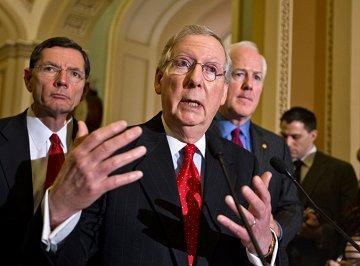
Senate Minority Leader Mitch McConnell (R-Ky.) has found himself in an awkward position. He's an unpopular incumbent facing a credible Republican primary challenger and a credible Democratic opponent. His own campaign staff doesn't really like him, either.
No matter which direction McConnell tries to lead his caucus, the Kentucky Republican risks alienating some key constituency's support, so he's left to just bite his tongue, doing nothing.
Last month, for example, when much of his caucus was at odds over a government-shutdown strategy, Senate Republicans needed some leadership. McConnell went out of his way to steer clear of the fight.
This month, Senate Republicans are at odds over U.S. policy in Syria, and once more, McConnell doesn't want to talk about it.
Only one of the top five members of the bipartisan congressional hierarchy still sits on the fence about launching a punitive strike against Syria: Mitch McConnell, the Senate minority leader.
The Kentucky Republican emerged from the White House on Monday as the only member of the bicameral leadership group still uncommitted to voting in favor of legislation authorizing military action.
McConnell looks to be taking as much time as he can. He's weighing his political considerations back home, where an isolationist stance would provide clear short-term benefit, against the pressures of his leadership role at the Capitol, where he's spent almost three decades as a Republican voice for a hawkish defense posture and an interventionist foreign policy.
This is the point at which congressional leaders try to, you know, lead. But McConnell, now afraid of his own shadow, is struggling to figure out which course will cause him the least amount of trouble. So as literally every other congressional leader takes a side -- in this case, in support of using force in Syria -- the Senate's top Republican is left to effectively declare, "I'll get back to you some other time."
Perhaps McConnell is waiting to announce a position late on a Friday afternoon when he assumes it'll make less news? More to the point, perhaps "Senate Minority Leader" is the wrong title for a lawmaker who feels so trapped, leadership isn't really an option?
Sean Sullivan walked through some of the troubles weighing on McConnell.
For starters, McConnell is facing reelection in 2014 and a primary challenger who has said that the United States should not get involved in Syria. If he argues the opposite view, McConnell would immediately fuel debate and elevate the issue in the campaign.
What's more, fellow Kentucky Republican Sen. Rand Paul (R-Ky.) has come out in full force against military intervention. If McConnell had come out of the meeting Tuesday as supportive of Obama's plan, he would instantly be triggering a story about discord over Syria within the Kentucky GOP delegation. And he would risk alienating Paul's supporters. (Paul has endorsed McConnell's bid for reelection.)
Third, there is some disagreement among Senate Republicans about which stance the United States should take with Syria, and the fault lines are complex.
No wonder McConnell is struggling. It's getting to the point that he no longer remembers his positions on key issues.
September 3, 2013
'We agree with the same red line, actually'
Associated Press
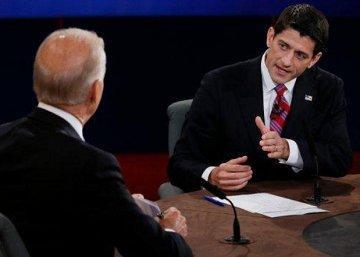
House Budget Committee Chairman Paul Ryan (R-Wis.) issued a statement this afternoon that left his position on Syria unclear, though he complained that President Obama "has some work to do to recover from his grave missteps in Syria."
Curiously, the Wisconsin Republican didn't say what "grave missteps" he disapproves of. When GOP lawmakers generally make this complaint, they're referring to Obama last year declaring Syria's use of chemical weapons a "red line" that the Assad government must not cross.
But Ryan really isn't in a position to make this complaint. As CNBC's Eamon Javers noted today, this was the exchange from last year's vice presidential candidates' debate:
RADDATZ: What happens if Assad does not fall? Congressman Ryan, what happens to the region? What happens if he hangs on? What happens if he does?
RYAN: Then Iran keeps their greatest ally in the region. He's a sponsor of terrorism. He'll probably continue slaughtering his people. We and the world community will lose our credibility on this....
RADDATZ: So what would Romney-Ryan do about that credibility?
RYAN: Well, we agree with the same red line, actually, they do on chemical weapons, but not putting American troops in, other than to secure those chemical weapons. They're right about that.
I mention this in part because, just over the last week or so, it seems the conventional wisdom has coalesced around the belief that Obama was irresponsible last year by making his "red line" remarks, which may have helped lock his administration in to a course of action. Whether or not the president's stated position was the right call is certainly a topic worthy of debate.
But let's not pretend it was a position Republicans broadly disapproved of last year, or really at any time up until two weeks ago. When Paul Ryan declared that his party "agrees with the same line," it's not like there was a great hullabaloo at the time about the congressman's break with GOP orthodoxy.
Public not yet on board with intervention in Syria
If lawmakers intend to take their cues from the public on U.S. policy in Syria, the Obama administration is going to have to hope for a quick reversal of Americans attitudes.
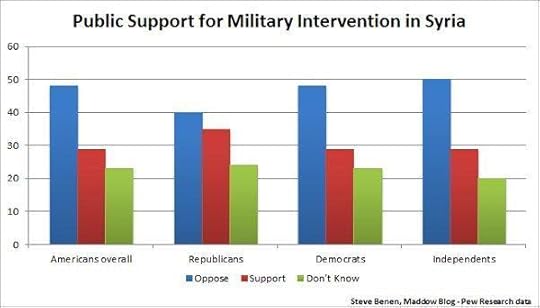
President Obama faces an uphill battle in making the case for U.S. military action in Syria. By a 48% to 29% margin, more Americans oppose than support conducting military airstrikes against Syria in response to reports that the Syrian government used chemical weapons.
The new national survey by the Pew Research Center, conducted Aug. 29-Sept. 1 among 1,000 adult, finds that Obama has significant ground to make up in his own party. Just 29% of Democrats favor conducting airstrikes against Syria while 48% are opposed. Opinion among independents is similar (29% favor, 50% oppose). Republicans are more divided, with 35% favoring airstrikes and 40% opposed.
I put together the above chart to help highlight just how limited the partisan differences really are. Yes, self-identified Republican voters tend to support military intervention slightly more than Democrats and Independents, but generally speaking, notice how similar the reactions are across the board.
As for why a plurality of Americans oppose U.S. military strikes, 74% believe military intervention in Syria are likely to create a backlash against the United States and its allies in the region, while 61% fear a long-term U.S. military commitment there.
The White House's argument -- strikes will be effective in discouraging the use of chemical weapons -- is endorsed by just a third of the country. A majority of Americans believes that the Assad government did, in fact, use chemical weapons, but that doesn't seem to be swaying broader public attitudes.
Boehner: 'I am going to support the president's call for action'
President Obama personally helped lead a briefing for congressional leaders on Syria this morning, and apparently persuaded Congress' top Republican lawmaker. Speaking to reporters just outside the White House this morning, House Speaker John Boehner (R-Ohio) said:
"The use of chemical weapons is a barbarous act. It's pretty clear to me that the United Nations is unable to take action, NATO not likely to take action. The United States for our entire history has stood up for democracy and freedom for people around the world.
"The use of these weapons has to be responded to and only the United States has the capability and the capacity to stop Assad and to warn others around the world that this type of behavior is not to be tolerated. [...]
"I am going to support the president's call for action. I believe my colleagues should support this call for action."
Around the same time, House Majority Leader Eric Cantor (R-Va.) issued a written statement saying he too intends to "vote to provide the President of the United States the option to use military force in Syria."
Does this change the political calculus on Capitol Hill? Probably a little -- but only a little.
We talked this morning about congressional Republicans' reluctance to support the White House's call, largely because the call is coming from a president they hold in contempt. As Byron York put it, "In the end, many will carefully consider all the evidence and then vote their instincts. And that will mean a vote against Barack Obama."
And so long as it was simply a binary dynamic -- voting for or against the president's appeal to use force -- this decision was arguably easier for GOP lawmakers. A defeat for the resolution would undermine Obama's international credibility, but for congressional Republicans, that's a plus, not a minus.
But with Boehner and Cantor endorsing the president's position, GOP lawmakers will obviously have to consider whether to embarrass their own leaders while also embarrassing the president. They might very well do this anyway, but at a minimum, it should give rank-and-file Republicans pause. Indeed, if there's a contingent within the caucus that's inclined to follow the leadership's call, and there's a similarly sized element of House Democrats who'll follow House Minority Leader Nancy Pelosi's (D-Calif.) lead, then the odds of the chamber approving a resolution are probably slightly better now than they were a few hours ago.
Of course, the underlying problem for Boehner is that he doesn't really lead his caucus, at least not in any practical sense. Far-right lawmakers have routinely ignored the Speaker's wishes -- generally with impunity -- making Boehner the weakest Speaker in recent memory. It's not difficult to imagine several dozen GOP lawmakers shrugging their shoulders with indifference after hearing Boehner's comments this morning.
In theory, when dealing with a matter of national security, if a president and the leaders of both House Republicans and House Democrats all agree on the same course of action, it's tempting to think a resolution codifying that course would pass with relative ease. But with Syria, that's hardly a given.