Rachel Maddow's Blog, page 3335
September 5, 2013
So much for 'rate shock' fears
Getty Images
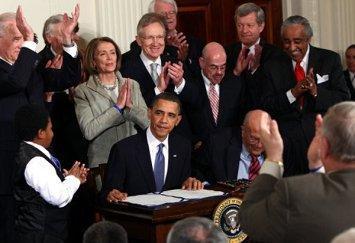
Just last week, National Journal published a much-discussed piece on the federal health care, arguing that President Obama's Affordable Care Act is "looking a bit unaffordable." The piece was immediately embraced by conservative media as proof that the dreaded "Obamacare" was poised to impose unexpectedly high premiums on unsuspecting consumers.
And that was a shame because the National Journal report, as a substantive matter, was a bit of a mess. That said, it was the latest in a series of "rate shock" stories eagerly touted by the right. Is there anything to this?
Nope.
Here's some good news for Americans who are currently uninsured, who currently buy insurance on the individual marketplace, or who think it's possible that at some point over the course of their life they might have to or want to switch jobs -- the premiums charged for insurance plans on the Affordable Care Act exchanges will likely be cheaper than forecast by the Congressional Budget Office.
Since the level of subsidies available to families of modest means is keyed in part to the price of insurance premiums, this is also good news for anyone who pays taxes or uses non-health care public services.
The news comes by way of a new report (pdf) from the Kaiser Family Foundation, which this morning published a comprehensive review -- the most thorough analysis I've seen to date -- of what health care premiums are set to be under the Affordable Care Act. In fairness, the information from some states is still incomplete, making a definitive assessment impossible for now, but the news is nevertheless very encouraging.
As Sy Mukherjee's analysis added, "Many Americans will pay even less than the top-line rates after factoring in government subsidies for their health coverage, with some paying nothing at all for crucial medical coverage."
Wait, "nothing at all"? Is that true? Actually, yes.
As Bloomberg News' report noted this morning, "A 25-year-old New Yorker earning $25,000 a year will pay as little as $62 a month for health insurance next year, and a peer living in Vermont may pay nothing, according to a 17-state survey of premiums under the U.S. health-care overhaul."
And in the larger context, I get the sense the conventional wisdom is that Obamacare implementation is going poorly, but have you noticed all the good news lately? Public-awareness campaigns are generating new support; the public opposes the Republican crusade to defund the law; Medicaid expansion is, well, expanding; there's anecdotal evidence to suggest Obamacare is helping create jobs; even opponents of the law are finding parts they like; and consumers are liking the law's benefits a lot more they expected to.
And now premiums consumers will pay through the exchange marketplaces will be even more affordable than predicted.
So where's this "disaster" we keep hearing about?


Thursday's campaign round-up
Associated Press
Today's installment of campaign-related news items that won't necessarily generate a post of their own, but may be of interest to political observers:
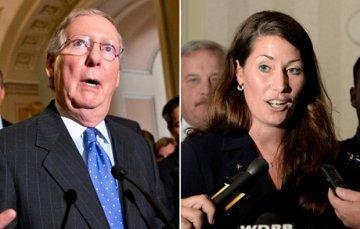
* In a provocative choice of words, a spokesman for the National Republican Senatorial Campaign Committee blasted Kentucky Senate hopeful Alison Lundergan Grimes (D) this week as an "empty dress" who "babbles incoherently."
* On a related note, Democrats pounced after the NRSC comments. "How ironic that Mitch McConnell talks about the importance of women voters to his campaign, and a few days later, his spokesman uses a sexist smear against a strong, smart and capable woman," Sen. Claire McCaskill (D-Mo.) said. "I don't understand these men in the Republican Party. It seems almost impossible for them to open their mouths without insulting women." The DSCC has begun fundraising on the issue.
* Rhode Island Gov. Lincoln Chafee, the Republican-turned-Independent-turned Democrat announced yesterday that he will not seek a second term. The unpopular governor, who only joined the Democratic Party in May, was facing primary challengers he appeared unlikely to defeat.
* As Senate Democratic fundraising bests their Republican counterparts, the NRSC replaced its finance director this week.
* Rep. Kerry Bentivolio (R), a right-wing reindeer herder and conspiracy theorist, picked up a primary opponent this week after local attorney David Trott launched a congressional bid.
* In Tennessee, Kevin Kookogey, a former Williamson County Republican Party chairman, was poised to run a primary campaign against Sen. Lamar Alexander (R) but announced yesterday that he'd skip the race (thanks to my colleague Will Femia for the heads-up).
* And in Montana, former state Sen. Corey Stapleton (R) announced this week that he's ending his U.S. Senate campaign and will instead run for the U.S. House. Stapleton's decision clears the way for Rep. Steve Daines' (R) widely expected Senate bid.
A 'mystifying' approach to a national-security debate
Associated Press
U.S. policy in Syria is complex and deeply serious, and officials on both ends of Pennsylvania Avenue have some difficult, consequential decisions to make. If ever there was a time for politicians to bring the A-game to a debate over foreign policy and national security, this is it.
And yet, this is what we're too often left with.
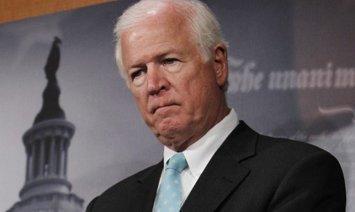
Sen. Saxby Chambliss joins the growing chorus critical of President Barack Obama's "red line" comments, saying the president is failing to lead on the issue.
"What it says to me is that the president gets lost when he doesn't have a teleprompter in front of him, which he obviously didn't last year," Chambliss told "Fox & Friends" on Thursday.
The vice chairman of the Senate Select Committee on Intelligence said Obama's remarks were "mystifying."
Look, maybe you think U.S. military intervention in Syria is wise; maybe you don't. Perhaps you're of the opinion that military strikes would make matters worse; perhaps you believe they'd make matters better. Maybe you think the use of chemical weapons should trigger a military response; may you don't. It's not an easy call.
But can we agree that inane teleprompter taunts from a senator on the Armed Services Committee and the vice chair of the Intelligence Committee aren't exactly constructive right now?
First, the Republican Party's official line as recently as last fall was that the "red line" in Syria on chemical weapons was their position, too. During last year's vice presidential debate, Rep. Paul Ryan (R-Wis.) specifically said, "We agree with the same red line, actually, they do on chemical weapons.... They're right about that."
If the GOP now sees the "red line" as reckless and stupid, the party came to this realization very recently.
And second, where has Saxby Chambliss been, exactly. Obama's reference to the "red line" on Syria's use of chemical weapons came last year, and as best as I can tell, the far-right Georgia senator said nothing. Republican leaders said they agreed with the policy, and again, Chambliss said nothing.
Now that there's a crisis, the senator finds year-old presidential remarks "mystifying"? Was he slow to keep up on current events or did Chambliss just now realize how upset he is?
The point of the childish teleprompter jokes is the Republican way of saying they think President Obama is dumb. Given Saxby Chambliss' background and record, it's a fight the GOP should probably try to avoid.
When Obamacare sabotage turns cruel
Getty Images
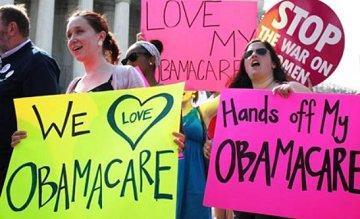
The American health care system, even before the Affordable Care Act was passed, can be quite complicated, and it's easy for American consumers to get confused. The Democratic reform law offers terrific new benefits to the uninsured, and obviously strengthens health security for those who already have insurance, but it doesn't necessarily make the system less complex.
The architects of "Obamacare" anticipated this and planned accordingly. In recent months, the Obama administration has partnered with dozens of local organizations nationwide to hire "navigators." As the name implies, these are folks who've been tasked with helping American consumers "navigate" the new system and sign up for benefits they're legally entitled to. Unsure if you're eligible for your state's exchange marketplace? A navigator can help. Confused about how to choose the coverage plan that's best for you? A navigator can guide you through it.
The problem, as you might have guessed, is that Republican officials are still eager to sabotage the federal health care system and prevent the uninsured from getting coverage in the new system. Their other attempts at sabotage have had mixed results, so GOP lawmakers are now launching an intimidation campaign, going after the navigators in the hopes of making sure those who don't have insurance stay that way.
Republicans in different states are targeting navigators in different ways. In Ohio, navigators are forbidden from comparing and contrasting insurance plans for customers. Why? Just because. In Georgia, navigators are now expected to pass the state insurance-agent test. Republicans in Congress are hoping to bury navigators in a mountain of paperwork, demanding that they produce unrealistic amounts of materials by next week or else.
But Brian Beutler reports this week on a heartless twist on the larger effort.
Last week, as several other outlets reported, Republicans on the House Energy and Commerce Committee sent letters to state agencies and nonprofit groups that received Obamacare "navigator" grants -- organizations that will help educate people about the law and facilitate their enrollment -- seeking an incredibly broad and difficult-to-compile range of information.
The effort's pretty clearly intended to bog down the navigators ahead of enrollment, which could easily reduce the number of people who end up insured under the law. Republicans claim that the inquiry is intended to protect beneficiaries' private information.
But if the goal were to establish best practices for the navigators, they have a strange way of going about it. All of the navigator grant recipients are based in states with federally facilitated exchanges and states partnering with the feds to stand up their marketplaces. Salon's analysis reveals that among these states, Republicans directed their inquiries to organizations in states with the largest uninsured populations.
This is no small detail.
Congressional Republicans aren't just harassing navigators out of partisan spite; these GOP lawmakers are carefully targeting navigators in specific states. The effort could have taken a broader approach and launched a national intimidation campaign, but Republicans instead skipped past navigators helping consumers in states where the rates of the uninsured are already rather low.
And why would the GOP officials do it this way? Probably to get the biggest bang for their sabotage buck -- if the goal is to keep the number of people without access to basic, affordable care as high as possible, then it's logical to try to stop navigators where they're likely to have the greatest impact.
Brian added, "Republicans could easily respond that they targeted organizations in these states because they wanted to protect as many uninsured people as they can. But that would be another way of saying they hope their inquiry slows the enrollment process as much as possible."
Jonathan Cohn added this week, "With the new insurance marketplaces set to open in exactly four weeks, these organizations are scrambling to get ready in time. But now, thanks to the House Republicans, they're also scrambling to answer a committee request for information."
If Americans are forced to go without as a consequence, so be it.
Some are being less subtle than others about their ugly campaign of partisan spite. "Let me tell you what we're doing (about ObamaCare)," Georgia Insurance Commissioner Ralph Hudgens bragged to a crowd of fellow Republicans last month: "Everything in our power to be an obstructionist."
'Everybody around him thinks this is his last term'
Getty Images
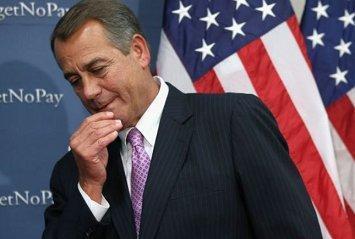
For months, the political scuttlebutt has been that House Speaker John Boehner (R-Ohio) will give up his gavel and retire at the end of this Congress, and for months, Boehner's aides have said the rumors aren't true.
But Ryan Grim and Jon Ward reported yesterday that the Speaker's former aides and a variety of high-level GOP operatives are "increasingly convinced" he will step down after the 2014 midterms. A former Republican leadership aide who is part of Boehner's circle told the Huffington Post reporters, "Everybody around him thinks this is his last term."
Despite the effort by Boehner to tamp down speculation that he will depart the House after the 2014 midterms, multiple cooks in Boehner's kitchen cabinet think the Republican is still strongly considering making his exit just over a year from now.
"I'd be surprised if he did [stay]," said one former senior aide to Boehner, who, like many consulted for this article, spoke on condition of anonymity to protect their relationships. (HuffPost spoke to four top former Boehner aides, two current aides, five former leadership aides close to Boehner's inner circle, and a GOP operative on familiar terms with his circle.)
Part of the trouble, of course, is that Boehner is the weakest House Speaker in recent memory -- he has very little control, or even influence, over what his caucus does -- and the Ohio Republican may lack the support he'd need to hold onto the Speaker's gavel in 2015 and beyond.
"It's probably not up to him," said one GOP operative. "The natural assumption is that he leaves. It's the overwhelming, working assumption as people are making strategy going into 2015 and 2016."
It's obviously difficult to say with certainty whether these assumptions are accurate, but for the sake of conversation, the implications of Boehner's possible retirement are extremely significant. Indeed, the more likely it is that the Speaker will give up his post, the more likely it is that this Congress will be less ridiculous over the next year and a half.
Indeed, I desperately hope the report from Grim and Ward is true, because it means the dream of governing in the near future is not yet dead.
Jon Chait's take rings true.
[I]f Boehner feels liberated to flee the House, then suddenly all sorts of governing possibilities open up. He can lift the debt ceiling and keep the government running. He could sign immigration reform, even cut a deal on the budget. There's probably a majority in the House for all these things -- it's just a majority consisting mainly of Democrats along with a handful of Republicans. Boehner could use that majority and then ride off into the sunset to become a lobbyist, enjoy a huge raise, and play a lot more golf.
Quite right. As longtime readers know, my Grand Unified Theory of Boehner is that the Speaker actually has sound political instincts -- he wants to strike deals, pass bills, and get some stuff done, but none of this has happened in the last three years because House Republicans just won't let him be responsible. It's precisely why Boehner so often looks weak and feckless -- because he's been pushed around by his radicalized members who have no interest in his attempts at "leadership."
The Speaker has gone along with this, letting his followers lead him, because he wants to keep his hands on that gavel. If, however, Boehner is planning his exit, the calculus changes -- with retirement comes freedom. He wouldn't have to be held hostage to his unhinged base; he could abandon the "Hastert Rule"; he could give up on the never-ending series of hostage crises; and legislation could start passing for a change.
Let's not forget, prominent lawmakers are often mindful of history, and want to be remembered for having used their time in power wisely. At this point, Boehner's list of accomplishments as Speaker is literally non-existent. That could change, though, if he's ready to walk away and wants to rack up some successes before he goes.
"But wait," I can hear the skeptics saying. "If Boehner starts governing responsibly, won't House Republicans just revolt immediately and kick him out?"
Maybe they'd try, but as a procedural matter, it's extremely difficult for the House to oust a sitting Speaker during the legislative term.
If Boehner is serious about retirement, I suspect he's aware of this.
Watching Chris Christie abandon his tough-guy persona
Associated Press
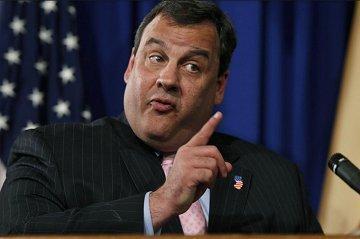
Even those of us outside New Jersey are familiar with the "brand" Gov. Chris Christie (R) has worked so hard to cultivate. He's a straight-talking tough guy, we've been told, who won't let politics get in the way of telling people uncomfortable truths.
At least, that's the persona he used to present. Lately, the New Jersey Republican has been something of a wuss.
In a daring political stroke, Gov. Chris Christie is making a strategic pitch to capture the obese vote in New Jersey. The strategy is designed to make fat people mad at state Sen. Barbara Buono by claiming that she poked fun at the governor's weight.
"For me and for other folks across New Jersey -- many folks -- who are challenged by their weight, the fact that someone running for governor would make derisive comments about someone's physical appearance is really beneath the office she is seeking."
Here's the problem: Barbara Buono, the governor's Democratic challenger, didn't make derisive comments about Christie's weight. She criticized the governor for spending $25 million in public funds on an ad campaign encouraging tourism for the Jersey Shore, only to make himself the star of the taxpayer-financed commercials during his re-election campaign.
"I don't know about you, but seeing Chris Christie frolicking on the beach is not going to drive me to go to the Shore," Buono said.
The point wasn't about the governor's size; it was about Chris Christie using post-Sandy relief funds to promote Chris Christie.
This is the guy who's supposedly cruising to an easy re-election victory?
Christie was asked for his opinion on U.S. policy in Syria, but he ducked the issue. The governor won't take a stand on the immigration-reform effort underway in Congress, either. Sure, these are federal issues, but Christie tackles Washington stories all the time -- just think about how many times he's condemned "Obamacare." So why dodge questions about major issues on the public's mind?
Christie also vetoed a gun-safety measure he asked the legislature to pass because he was afraid of the Republican Party's base. The governor scheduled a Senate special election for a Wednesday in October because he was afraid to be on the same ballot as Cory Booker.
No Profile in Courage Award for you, gov.
Taken together, it's become awfully difficult to see the New Jersey Republican as a tough, no-nonsense leader. What do you want to bet his internal polling shows the gubernatorial race getting more competitive, causing Christie to react poorly to the pressure?
Jobless claims improve, remain near six-year low
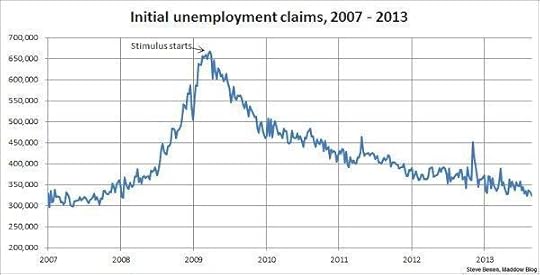
Today's report on initial unemployment claims was widely expected to be good, but the newly released figures from the Department of Labor were even better than expected.
The number of Americans who applied for new unemployment benefits dropped by 9,000 to 323,000 in the week ended Aug. 31, keeping initial claims near a five-and-a-half year low. Economists surveyed by MarketWatch had expected claims to fall to 330,000 on a seasonally adjusted basis. The average of new claims over the past month, a more reliable gauge than the volatile weekly number, fell by 3,000 to 328,500, the U.S. Labor Department said Thursday. That's the lowest level since October 2007.
To reiterate the point I make every Thursday morning, it's worth remembering that week-to-week results can vary widely, and it's best not to read too much significance into any one report.
In terms of metrics, when jobless claims fall below the 400,000 threshold, it's considered evidence of an improving jobs landscape, and when the number drops below 370,000, it suggests jobs are being created rather quickly. At this point, we've been below 340,000 in seven of the last eight weeks.
Above you'll find the chart showing weekly, initial unemployment claims going back to the beginning of 2007. (Remember, unlike the monthly jobs chart, a lower number is good news.) For context, I've added an arrow to show the point at which President Obama's Recovery Act began spending money.
September 4, 2013
When unhinged conspiracy theories become self-defeating
Remember Rep. Joe Wilson (R)? The right-wing South Carolinian has been in the U.S. House for nearly 12 years, and apparently has distinguished himself exactly once: he shouted "You lie!" during President Obama's speech to a joint session of Congress on health care policy.
Apparently, though, Wilson is still on Capitol Hill, and piped up during a House Foreign Affairs Committee today with a question on Syria for Secretary of State John Kerry.
Watch on YouTubeFor those who can't watch clips online, note that Wilson, with a halting cadence, very carefully read a question that someone on his staff apparently prepared for him:
"With the president's red line, why was there no call for military response in April? Was it delayed to divert attention today from the Benghazi, IRS, NSA scandals, the failure of Obamacare enforcement, the tragedy of the White House-drafted sequestration or the upcoming debt limit vote? Again, why was there no call for a military response four months ago when the president's red line was crossed?"
Now, I can appreciate a wild-eyed conspiracy theory as much as the next guy, but even by House GOP standards, this is just stark raving mad. First, the "scandals" Wilson believes in don't exist; things are going fairly well for the Affordable Care Act; and sequestration was Republicans' fault.
Second, think about the point Wilson is trying to make with his deeply silly question: the White House was, the theory goes, overwhelmed in April by scandals and policy fiascoes. To "divert attention" to all of these terrible problems, President Obama did ... nothing.
Wilson's conspiracy theory would at least have internal consistency if Obama had bombed Syria at the time, giving conservatives an opportunity to say the military offensive was timed to be a distraction from domestic difficulties. But Wilson doesn't even have that -- he saying Obama didn't intervene in Syria in April to "divert attention" from made-up controversies, suggesting the congressman doesn't even understand the words of the conspiracy theory someone wrote for him to repeat during the hearing.
Alas, Wilson wasn't alone.
Sahil Kapur reported on a related conspiracy theory from another South Carolina Republican.
Secretary of State John Kerry erupted at Rep. Jeff Duncan (R-SC) after the congressman charged that the Obama administration cannot be trusted to carry out an attack on Syria due to mistakes made in Benghazi and controversies involving the IRS and NSA programs.
"I cannot discuss the possibility of the U.S. involvement in the Syrian civil war without talking about Benghazi," Duncan said, questioning Kerry at a Wednesday hearing.
"The administration has a serious credibility issue with the American people, due to the unanswered questions surrounding the terrorist attack in Benghazi almost a year ago. When you factor in the IRS targeting of conservative groups, the AP and James Rosen issues, Fast and Furious and NSA spying programs, the bottom line is that there is a need for accountability and trust-building from the administration," he said. "The American people deserve answers about Benghazi before we move forward in Syria's civil war."
Kerry dismissed Duncan's garbage rhetoric out of hand.
If the right-wing lawmaker's name sounds familiar, it's probably because Duncan is fond of conspiracy theories about the IRS and firearms; he believes conspiracy theories involving the Census Bureau; and he pushed Glenn Beck's conspiracy theories surrounding the Boston Marathon Bombing in April. He's also a birther.
Secretary of Explaining Stuff
It was one year ago this week when President Obama reflected on former President Bill Clinton's speech at the Democratic National Convention. "President Clinton made the case in the way that only he can," Obama told supporters in New Hampshire. "Somebody emailed me after the speech and said, 'You need to appoint him Secretary of Explaining Stuff.'"
Who better, then, to help make the case for the Affordable Care Act?
"I have agreed to give this talk today because I am still amazed at how much misunderstanding there is about the current system of health care, how it works, how it compares with what other people in other countries pay for health care and what kind of results they get and what changes are actually occurring now and are going to occur in the future," he said. [...]
Clinton touted the benefits of the law that are already in place that have allowed students to stay on their parents' insurance until age 26, along with reforms that require insurance companies not consider pre-existing conditions for 17 million kids. In addition, more than 100 million Americans have seen the lifetime caps on their insurance policies disappear.
He also debunked one of the biggest lies from the right, that the law is leading to an epidemic of employers cutting workers to part-time, by noting that 90 percent of the jobs created since the law passed have been full-time.
"This law has already done a lot of good," Clinton added. "And it's about to make 95 percent of us insured."
The former president, uncharacteristically reading from a prepared text he wrote, also took note of what congressional Republicans have been up to -- though he did so obliquely.
"It seems to me that the benefits of the reform can't be fully realized and the problem certainly can't be solved unless both the supporters and the opponents of the original legislation work together to implement it and address the issues that arise whenever you try to change a system this complex. There are always drafting errors, unintended consequences, unanticipated issues. We're going to do better working together and learning together than we will trying over and over again to repeal the law or rooting for the reform to fail."
Clinton added, in response to misguided Republican forecasts, "So far the direst predictions for adverse consequences have not occurred, and I don't believe [they] will."
And behold, our 51st and 52nd states
JeffersonState.com
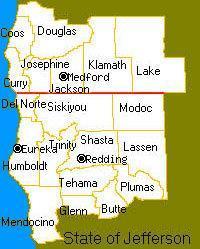
Yesterday in Siskiyou County, California, the board of supervisors voted to issue a declaration of secession from the rest of California. The far-northern county wants to be known as the free state of Jefferson, a land removed from "loony California" and uniting non-loony counties now languishing there and in Oregon (see map at right, not including the Southern California and Nevada counties they'd like to recruit).
Seceding from a state and forming a new one requires the approval of the both the original state and the U.S. Congress. It's almost impossible. Siskiyou County supervisors voted 4-1 to get out of California anyway. The Redding Record-Searchlight relays this from the meeting:
"Many proposed laws are unconstitutional and deny us our God-given rights," said Gabe Garrison of Happy Camp. "We need our own state so we can make laws that fit our way of life."
The State of Jefferson would be our 52nd state, the 51st being the now-aborning North Colorado. In both cases, organizers say their desire to secede stems from the conviction that rural values and rural needs are not represented well in state capitals they consider urban-centric.
It's apparently an appealing frustration. The map for the Colorado-based 51st State Initiative has been growing. Marked in blue below are counties where leader Jeffrey Hare says citizens or officials have shown "significant "support. Yellow is for counties where people are actively working on secession. Green is for counties that already have some kind of popular vote scheduled or have joined the working group. White is for counties in Kansas that might want to come over. And red is for Boulder and Denver, a/k/a not interested.
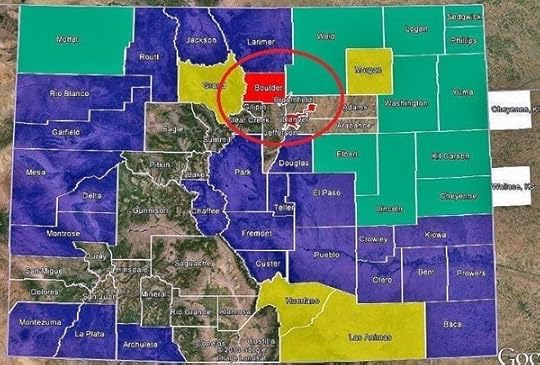
Map from 51stState.org, red circle added.