Rachel Maddow's Blog, page 3334
September 6, 2013
Bush casts a long shadow
Associated Press
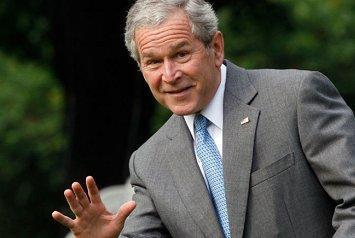
Karl Rove argued this afternoon that President Obama has created a "longing" for a "decisive" George W. Bush. I'm reasonably certain Rove wasn't kidding.
He might as well have been. Bush excelled in being "decisive," which is admirable just so long as we ignore whether those decisions had merit. The problem for the failed former president, however, is that Americans care less about whether a leader makes decisions quickly based on instinct and care about whether a leader makes the right decisions. Pausing to reflect and think through decisions based on evidence is not a bad idea.
In Bush's case, the Republican had a unique ability to decisively make the wrong call in every possible instance that really mattered. He was "decisive" when he chose to ignore warnings about Osama bin Laden in August 2001; he was "decisive" when he brushed off concerns as Hurricane Katrina barreled down on New Orleans; he was "decisive" when he pursued one misguided economic policy after another; and he was "decisive" when he launched a catastrophic war in Iraq based on lies and ideological ambitions.
Why anyone would be "longing" for spectacular failures, resulting from gut decisions made by an incompetent man unprepared for the presidency, is a bit of a mystery.
Indeed, when it comes to U.S. foreign policy, in Syria and elsewhere, current events are still directly influenced by Bush's extraordinary dishonesty, corruption, and mismanagement. The New York Times' Timothy Egan reports today on the former president's "legacy" and its capacity to undermine American interests even now.
Time should not soften what President George W. Bush, and his apologists, did in an eight-year war costing the United States more than a trillion dollars, 4,400 American soldiers dead and the displacement of two million Iraqis. The years should not gauze over how the world was conned into an awful conflict. History should hold him accountable for the current muddy debate over what to do in the face of a state-sanctioned mass killer. [...]
This is cowardice on a grand scale. Having set in motion a doctrine that touches all corners of the earth and influences every leader with a say in how to approach tyrants who slaughter innocents, Bush retreats to his bathtub to paint.
The fact that Karl Rove and his allies even feel justified speaking in public about these issues is evidence of extraordinary chutzpah.
Indeed, many of those responsible for Iraq -- Rove, Donald Rumsfeld, Dan Senor, Paul Wolfowitz, Ari Fleischer, and others -- seem to keep popping up on my television, as if they have some expertise that Americans should find valuable.
They do not.
If you missed this segment from the show the other night, I hope you'll take a minute to check it out. I'll just quote Rachel's wrap up:
"If you're an architect or a conspirator or one of the primary actors in the Iraq war, and arguably the grandest and most craven foreign policy disaster in American history, your opinion is no longer required on matters of war and peace. Please enjoy painting portraits of dogs or something. Printing portraits of yourself in the bathroom, trying to get clean. Please enjoy the forgiving company of your family, your loved ones, and your God.
"But we as a country never ever need to hear from you about war ever again. You can go now."
Rove's talent seems to be bilking billionaires to finance his failed election strategies. Maybe he should leave foreign policy analysis to others.


Putting the goalposts firmly in place
Associated Press
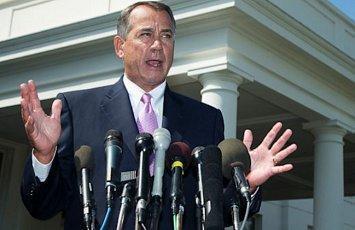
"I am going to support the president's call for action," House Speaker John Boehner (R-Ohio) said on Tuesday, in reference to U.S. policy in Syria. "I believe my colleagues should support this call for action."
In the 48 hours that followed, most of Boehner's colleagues from his own party -- which is to say, the members he ostensibly leads -- announced their intention to ignore the Speaker's suggestion.
By some measures, this might raise doubts about Boehner's leadership abilities. The Speaker's office doesn't see it that way.
Speaker John Boehner's (R-OH) office reiterated Friday that it's President Obama's responsibility to sway the public on the need to strike Syria and warned that lawmakers will represent their constituents.
"The speaker has consistently said the president has an obligation to make his case for intervention directly to the American people," said Boehner spokesman Brendan Buck. "Members of Congress represent the views of their constituents, and only a president can convince the public that military action is required."
Let's put aside, for now, the notion that members of Congress represent the views of their constituents -- an assertion that doesn't seem to apply to how Republicans approach immigration, gun violence, taxes, job creation, entitlements, civil rights, health care, or education.
Instead, let's try to fully appreciate the rules as they've been laid out for the political establishment, because it seems as if the last few days have been devoted to the political establishment and the chattering class planting some goalposts pretty deep.
If congressional Republicans ignore President Obama, it's evidence of Obama failing. If congressional Republicans ignore their own party's leaders, it's still evidence of Obama failing.
If the president bypasses Congress to pursue his national security strategy, he's dictatorial. If he seeks congressional authorization for his national security strategy, he's weak and undermining the stature of his office.
If lawmakers reject a resolution authorizing force in Syria, Obama will struggle to get anything through Congress for the rest of his term. If lawmakers approve a resolution authorizing force in Syria, Obama will struggle to get anything through Congress for the rest of his term.
If the president uses the military to intervene in Syria, Obama will have undermined the credibility of the United States on the global stage. If the president honors a congressional vote against using the military to intervene in Syria, Obama will have undermined the credibility of the United States on the global stage.
I'm starting to think this game is rigged in a heads-I-win; tails-you-lose sort of way.
For what it's worth, while the ultimate outcome on Capitol Hill is in doubt, I'm not at all convinced this is a make-or-break moment for Obama's presidency, and he might as well resign if the votes for his Syria policy don't materialize. Greg Sargent had a compelling piece on the larger context this morning:
If Congress says No, and Obama announces that he will abide by the vote -- arguing that the people have spoken, that democracy and the rule of law will prevail, and that our country will be stronger for it -- then it's very possible that the Dem base will rally behind him.... If Obama heeds Congress, the liberal base -- and liberal lawmakers -- would likely have Obama's back. Independents, who have tilted strongly against an attack, might be supportive, too.
And so, several questions for the political science egghead types and anyone else who cares to answer. Do voters really perceive situations like these in the same terms pundits and Congressional lawmakers do, i.e., in terms of what they tell us about presidential strength or weakness? Do voters really expect presidents to bend Congress to their will, or do they see Congress as its own animal and don't hold presidents accountable for its behavior?
I imagine for many political observers, it's easy to think of political "wins" and "losses" in a sports context -- victories are inherently good and defeats are inherently bad. And if the president goes to Congress seeking authorization for a military strike in Syria, and lawmakers reject the appeal, it would be, by definition, a loss for the president.
But it might simultaneously be a win for democracy that leaves the public with the outcome the American mainstream wants. Voters may well react to news organizations obsessing over "Crushing Presidential Defeat on Capitol Hill," but I'm not convinced the public would reflexively see it that way.
If Congress balks and the White House honors the vote, most Americans would be pleased, not outraged, right?
There's that 'I' word again
It's been two whole weeks since we last heard a congressional Republican publicly talk up the idea of impeaching President Obama for no reason. I guess we were due?
Watch on YouTubeAndrew Kaczynski flagged this clip of Rep. Bill Flores (R-Texas), who joins a large and not-terribly-impressive group of GOP lawmakers in Washington who like the idea of putting the country through an impeachment crisis.
"I look at the president, I think he's violated the Constitution. I think he's violated the law. I think he's abused his power but at the end of the day you have to say if the House decides to impeach him, if the House had an impeachment vote it would probably impeach the president."
As best as I can tell, Flores hasn't substantiated his bizarre allegations about presidential wrongdoing, but it's that last sentence that seems especially interesting to me -- as far as this congressman is concerned, if the House held a vote to impeach President Obama right now, it'd probably pass.
And what, pray tell, would be the basis for this little House Republican crusade? Apparently that doesn't matter -- these folks just like the idea, and whether it makes sense or not isn't important.
For the record, Flores doesn't seem to think the impeachment drive is going to turn out well. Sure, he likes the idea, but the Texas Republican realizes the Senate probably won't remove Obama from office, which means, to his chagrin, impeachment probably isn't worth pursuing.
But Flores' appetite for impeachment, coupled with his belief that the House actually has the votes to pull it off, helps underscore the degree to which many congressional Republicans have gone quite mad.
Just look at the last few weeks. Sen. Tom Coburn (R-Okla.) believes the president is "getting perilously close" to creating a constitutional crisis that would warrant impeachment. Rep. Kerry Bentivolio (R-Mich.) wants to impeach Obama, too, saying it would be a "dream come true."
Rep. Blake Farenthold (R-Texas) is on board with the idea, as is Sen. Ted Cruz (R-Texas). Sen. James Inhofe (R-Okla.), Rep. Todd Rokita (R-Ind.), and Rep. Jason Chaffetz (R-Utah) are ready to draw articles, too.
All of these impeachment endorsements are just from this summer, and don't even include the many GOP lawmakers who pushed the idea in the president's first term.
To reiterate a point from a few weeks ago, for every Beltway pundit who proclaims with a tear in their eye, "Washington would be more effective if Obama showed leadership by reaching out to Republicans, schmoozing them, and offering to work cooperatively with his critics," I hope they're paying very close attention to current events. It is, as a practical matter, awfully difficult for a president to work constructively with radicalized lawmakers who refuse to compromise and cherish the idea of impeachment without cause.
Friday's campaign round-up
Today's installment of campaign-related news items that won't necessarily generate a post of their own, but may be of interest to political observers:
* The far-right Senate Conservatives Fund continues to hammer Senate Minority Leader Mitch McConnell (R) in Kentucky, making a $340,000 ad buy in support of this spot. The ad attacks McConnell for not threatening a government shutdown.
Watch on YouTube* Speaking of Kentucky, McConnell's Republican primary challenger, Matt Bevin, is slamming the incumbent over this week's "empty dress" controversy.
* And in still more Kentucky news, Hollywood exec Jeffrey Katzenberg is reportedly taking a leading fundraising role in trying to defeat McConnell in 2014, and hopes to direct significant resources to Kentucky Secretary of State Alison Lundergan Grimes (D).
* In Virginia's gubernatorial race, a group of laid-off workers are featured in a new Ken Cuccinelli (R) ad, but two of the three people in the spot claim they were misled about the nature of the commercial.
* On a related note, with just nine weeks remaining in the Virginia race, the Republican Governors Association and the Democratic Governors Association have shelled out nearly $10.3 million so far, and they're not yet done.
* In Georgia, former Secretary of State Karen Handel (R) has launched the first ad of the 2014 campaign. It's a radio spot emphasizing the far-right candidate's opposition to health care reform.
* In New York City's mayoral race, the latest Quinnipiac poll shows Public Advocate Bill de Blasio (D) with a big enough lead that he may avoid a runoff.
* And in an apparent attempt to annoy me, former Sen. Scott Brown (R-Mass.) has scheduled another event in Iowa for the fall.
When crass fundraising takes a Grimm turn
Getty Images
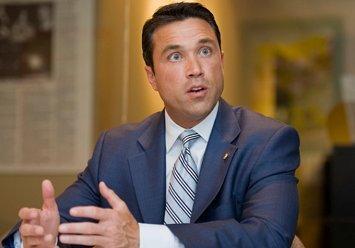
Rep. Michael Grimm (R-N.Y.)
Rep. Michael Grimm (R-N.Y.) announced just days ago that he would support President Obama's call for military intervention in Syria. "We have to keep our word; this is about our credibility," the New York Republican said last weekend. "We can't permit a precedent where there is a use of chemical weapons and there is no response."
Four days later, Grimm changed his mind, and announced yesterday he opposes the policy he'd previously endorsed.
I'll leave it to others to speculate as to why, exactly, the congressman reversed course so quickly and completely, but Grimm appears to have tipped his hand a bit.
Rep. Michael Grimm, a New York Republican, is sending out fundraising emails based on his decision to switch from supporting President Obama's Syria plan to opposing it.
Grimm's campaign list sent out the fundraising call on Thursday with the subject line "Oppose Military Action in Syria."
The fundraising appeal, sent within a few hours of Grimm's newly announced position, asks donors, "Will you stand with me in opposing President Obama's plan with a donation of $25 or more right now?" It adds, "Stand with me today with a donation of $25 or more to strongly oppose military action in Syria."
Terri Lynn Land, a Republican U.S. Senate candidate in Michigan, yesterday tried to pull the same fundraising stunt.
To be sure, there are no laws or ethics rules prohibiting this sort of crass fundraising, and for all I know, there may well be prospective suckers donors out there who respond to these appeals.
But I like to think reasonable, fair-minded observers can agree that this is just cheap and ugly. In Grimm's case, we have an elected member of the U.S. Congress telling constituents and supports (1) Syria used chemical weapons to slaughter civilians; (2) the U.S. is weighing a military response; (3) Grimm flip-flopped over the course of a few days; so (4) send Grimm some cash because ... Obama is bad. Or something.
Pro tip: don't try to exploit a national security crisis involving a chemical-weapons attack to pad your campaign coffers. Just. Don't. Do. It.
Flipping the script on Israel
Getty Images
For nearly five years, the rhetoric from U.S. conservatives about the Middle East has been fairly consistent: President Obama has shown insufficient fealty to our Israeli allies, while Republicans remain steadfast in their unyielding support for Israel, no matter what.
When it comes to U.S. intervention in Syria, the script has apparently been flipped.
President Obama's position on Syria -- punish President Bashar al-Assad for using chemical weapons without seeking to force him from power -- has been called "half-pregnant" by critics at home and abroad who prefer a more decisive American intervention to end Syria's civil war.
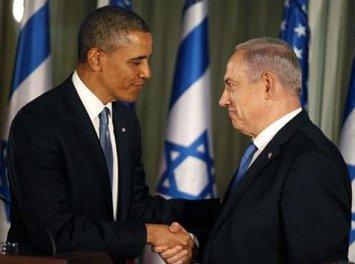
But Mr. Obama's limited strike proposal has one crucial foreign ally: Israel.
Yes, the White House may not have much in the way of international support for the president's preferred mission in Syria, but it apparently has Israel's backing, which as a political matter, should theoretically matter quite a bit.
The powerful pro-Israel lobby AIPAC is planning to launch a major lobbying campaign to push wayward lawmakers to back the resolution authorizing U.S. strikes against Syria, sources said Thursday.
Officials say that some 250 Jewish leaders and AIPAC activists will storm the halls on Capitol Hill beginning next week to persuade lawmakers that Congress must adopt the resolution or risk emboldening Iran's efforts to build a nuclear weapon. They are expected to lobby virtually every member of Congress, arguing that "barbarism" by the Assad regime cannot be tolerated, and that failing to act would "send a message" to Tehran that the U.S. won't stand up to hostile countries' efforts to develop weapons of mass destruction, according to a source with the group.
It creates one of those awkward political dynamics that we don't often see: most congressional Republicans, who've spent years accusing Obama of being secretly "anti-Israel," are prepared to ignore not only the wishes of the House GOP leadership, but Israel's wishes, too.
Postscript: Sometimes when I mention U.S. policy towards Israel, there's some pushback based on confusion, so let's preemptively clarify: I don't think policymakers in Washington should simply do whatever Israel expects of them. I find this more a matter of political curiosity -- the very same politicians who've been so quick to throw around accusations of others being "anti-Israel" are themselves now prepared to ignore the foreign policy approach endorsed by Israel.
Indeed, I can't help but wonder about a hypothetical. If a Republican president were pursuing a military option in the Middle East, Democratic leaders endorsed the policy, and Israel urged rank-and-file congressional Dems to support it, wouldn't it be quite a story if Democrats ignored them?
I have a hunch it would.
Cornyn's convenient change of heart

Associated Press
In March Senate Minority Whip John Cornyn (R-Texas) appeared at an event in Atlanta, and publicly endorsed U.S. intervention in Syria. Then President Obama expressed support for military strikes in Syria, at which point Cornyn reconsidered.
Indeed, in a curious twist, the Texas Republican said this week "many questions are still left unanswered," which led to a meeting with the president in the White House in which Cornyn asked no questions.
All of which leads us to now.
A Cornyn aide said Thursday that the senator currently opposes the Syria resolution, which will be debated on the Senate floor next week.
"If the vote were held today, Sen. Cornyn would vote no," said Megan Mitchell, a spokeswoman for Cornyn.
The immediate significance of this is that Cornyn is the first leading congressional Republican to express opposition to authorizing the use of force. In the House, the top two GOP leaders -- House Speaker John Boehner and House Majority Leader Eric Cantor -- endorsed the resolution earlier this week, while in the Senate, Minority Leader Mitch McConnell is too afraid to say much of anything.
But it's the larger context of announcements like these that stand out.
Kevin Drum had a gem on this yesterday.
There's obviously a bit of hypocrisy on both sides in this affair, but I have to say that watching Republican pols and conservative pundits get on their high horses about Syria has been pretty nauseating. These are guys who mostly have never met a war they didn't like, and until a few months ago were practically baying at the moon to demand that that President Obama stop diddling around and get serious about aiding the rebels and taking out the monstrous Bashar al-Assad. But now? Butter wouldn't melt in their mouths as they talk piously about the value of multilateral support; the need to give diplomacy a chance; the perils of regional blowback; the lessons of Iraq; and the fear of escalation if Assad retaliates. You'd think they'd all just returned from a Save the Whales conference in Marin County.
There are some Republicans who are perfectly serious about their desire not to get entangled in yet another Middle Eastern conflict. But most of them couldn't care less. Obama is for it, so they're against it. It's pretty hard to take.
Bill Kristol published an interesting item this morning, urging his party follow the president's lead on Syria. "The fact is that Obama is the only president we have," Kristol wrote. "We can't abdicate our position in the world for the next three years. So Republicans will have to resist the temptation to weaken him when the cost is weakening the country. A party that for at least two generations has held high the banner of American leadership and strength should not cast a vote that obviously risks a damaging erosion of this country's stature and credibility abroad."
Now, as a skeptic of U.S. intervention, I'm not at all convinced that restraint in Syria will "weaken the country." But what's interesting to me is that Kristol seems to believe congressional Republicans, en masse, can separate their political instincts from their foreign policy worldview.
In recent days, it's been made abundantly clear that they cannot. Putting aside the merits (or lack thereof) of intervention, most congressional Republicans appear to be approaching this debate the same way they approach every debate -- as post-policy partisans who define themselves by their objections to a president they hold in contempt for reasons that are generally incoherent.
September 5, 2013
Thursday's Mini-Report
Today's edition of quick hits:
* Day One at the G-20 summit in Russia: "President Barack Obama and Russian President Vladimir Putin exchanged a tense handshake Thursday to open a summit of the Group of 20 countries -- a meeting meant to focus on economic issues but overshadowed by the crisis in Syria."
Obama's Deputy National Security advisor Ben Rhodes talks about the president's rift over Syria and whether it will impact the summit. Rhodes says the U.S. "does not expect Russia to support actions in Syria."
* Long-distance lobbying: "Even as he makes his case on Syria to world leaders gathered at an international summit here, President Obama plans to call lawmakers back in Washington to urge them to authorize a U.S. military strike aimed at punishing the Syrian government for a devastating chemical weapons attack."
* Briefing: "Lawmakers were shown a gruesome video depicting dozens of people killed by nerve gas as part of a classified, closed-door briefing Thursday laying out the Obama administration's case for action against Syrian President Bashar Assad."
* Pakistan: "A US drone fired two missiles into a compound in northwest Pakistan early Friday killing at least six militants, officials said.... 'It was a US drone strike. Six militants were killed, the death toll may rise,' one security official in Miranshah told AFP."
* Egypt: "A powerful bomb blasted through a convoy of cars carrying the interior minister along a residential street on Thursday, raising fears of a widely predicted turn toward terrorist violence by supporters of Egypt's ousted president, Mohamed Morsi."
* This one surprises me a bit: "The National Security Agency is winning its long-running secret war on encryption, using supercomputers, technical trickery, court orders and behind-the-scenes persuasion to undermine the major tools protecting the privacy of everyday communications in the Internet age, according to newly disclosed documents."
* San Antonio: "Anti-bias protections for gay and transgender citizens in San Antonio passed Thursday over the disapproval of top Republicans in Texas and religious conservatives who packed the City Council chamber and sometimes shamed supporters for comparing the issue to the civil rights movement."
* Labor: "In the largest Walmart protests since the retail giant was struck by a wave of strikes throughout its production line late last year, hundreds of Walmart employees walked off the job and took part in demonstrations in 15 cities Thursday."
* For reasons that I can't explain, BuzzFeed published a 1,300-word piece today quoting a bunch of former Mitt Romney aides who -- get this -- believe that Mitt Romney was right about everything. I ran out of time today before I could tackle the piece point by point, but Jed Lewison and Ed Kilgore dug in.
* Big news for MSNBC prime-time: "Alec Baldwin will join MSNBC as the host of a current events and culture talk show beginning Fridays in October."
Anything to add? Consider this an open thread.
It's always morning in America
Associated Press
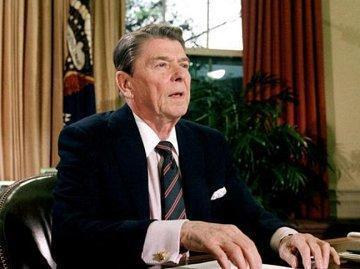
Reagan worship in Republican politics reaches unhealthy levels from time to time -- "Ronaldus Magnus," for example -- though it's generally the result of Reagan fans not remembering the 40th president nearly as well as they think they do.
A few years ago, for example, Sen. John McCain (R-Ariz.) said the Prague Spring in Czechoslovakia was the result of Reagan's historic leadership. That didn't make any sense at all -- the Prague Spring happened in 1968.
Or take today's example, from Rep. Ileana Ros-Lehtinen (R-Fla.), the former chair of the House Foreign Affairs Committee.
"It is against the norms of international standards and to let something like this go unanswered, I think will weaken our resolve. I -- I know that President Reagan would have never let this happen. He would stand up to this. And President Obama -- the only reason he is consulting with Congress, he wants to blame somebody for his lack of resolve. We have to think like President Reagan would do and he would say chemical use is unacceptable."
Look, I realize the 1980s seems like a long time ago, and on Capitol Hill, memories are short. But if prominent members of Congress are going to talk about Reagan and the use of chemical weapons, at a bare minimum, they should have some rudimentary understanding of how Reagan approached the use of chemical weapons.
So long as saying unpleasant-but-true things about Reagan is still legal, let's set the record straight.
The Reagan administration was, of course, quite ambitious when it came to foreign policy and national security. For example, Reagan invaded Grenada without telling Congress he intended to do so; he bombed Libya without congressional approval or consultation; and he illegally sold over 1,000 missiles to Iran to finance an illegal war in Nicaragua.
And as Heyes Brown explained, Reagan also did largely the opposite of what Rep. Ileana Ros-Lehtinen said he did with regards to the use of chemical weapons.
For the majority of the 1980s, Iraq under Sadaam Hussein was locked in combat with the Islamic Republic of Iran in a war that killed more than 100,000 people on both sides. The United States explicitly backed the secular Hussein over the Ayatollah Khomeini's government in Tehran, still smarting from the embassy hostage crisis that had only ended when Reagan took office. That backing not only included the shipment of tons of weapons to support Baghdad, but also looking the other way when Iraq unleashed its chemical weapons stockpiles -- including sarin and mustard gas -- against Iranian civilians and soldiers alike.
Recently declassified documents from that time indicate that not only did the U.S. government know that Hussein possessed these weapons, but "conveyed the location of the Iranian troops to Iraq, fully aware that Hussein's military would attack with chemical weapons, including sarin." President Reagan also remained silent during the Al-Anfal campaign, in which Hussein used poison gas against the Kurdish population in Northern Iraq to put down a revolt against his rule. In what has later been called a genocide, more than 100,000 men, women, and children were killed, nearly 100 times more than the attack that took place outside of Damascus last month.
Indeed, after Saddam Hussein gassed his own people, Reagan dispatched ... wait for it ... Donald Rumsfeld to help solidify the relationship between the Reagan administration and the brutal, murderous Iraqi dictator. Rumsfeld gladly shook hands with Hussein after he used chemical weapons to kill Iraqi dissidents.
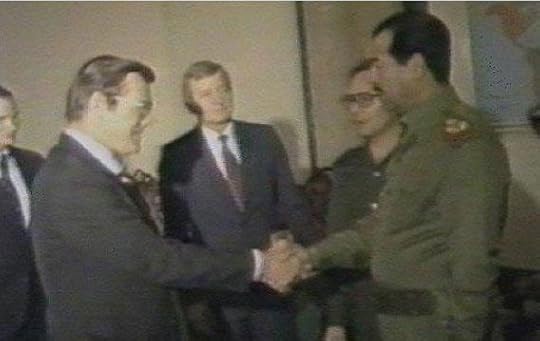
Perhaps some can let Rep. Ros-Lehtinen know.
The wrong Republican to talk about food stamps

Getty Images
Rep. Stephen Fincher (R-Tenn.)
Before Congress broke for its August recess, House Republicans were still refusing to work on a bipartisan farm bill, insisting on punitive efforts that made it vastly more difficult for struggling Americans to eat. A month later, the legislation is still pending.
With this in mind, the New York Times reports today from Dyerburg, Tenn., where reporter Sheryl Gay Stolberg talked to some low-income locals in dire straits. A struggling mechanic hunts doves and squirrels to help feed his family, and limits himself to one meal a day. A woman who left her job skinning hogs at a slaughterhouse when she became ill with cancer also said she only eats once a day.
And then there's their congressman, Rep. Stephen Fincher (R-Tenn.), who's eager to make their lives much more difficult.
"The role of citizens, of Christianity, of humanity, is to take care of each other, not for Washington to steal from those in the country and give to others in the country," Mr. Fincher, whose office did not respond to interview requests, said after his vote in May. In response to a Democrat who invoked the Bible during the food stamp debate in Congress, Mr. Fincher cited his own biblical phrase. "The one who is unwilling to work shall not eat," he said.
Let's unpack this a bit, because I think it's important. First, "The one who is unwilling to work shall not eat" referred to ancient Christians who had stopped working in anticipation of Jesus' Second Coming, not lazy people.
Second, Fincher's constituents who are struggling to get by aren't "unwilling to work"; many of them do work. They nevertheless need to rely on a public safety net to continue to eat their once-a-day meal.
And third, Fincher collected nearly $3.5 million in taxpayer-financed farm subsidies from 1999 to 2012, including roughly $70,000 just last year in the form of direct payments from Washington, paid for by you and me.
So, the guy who's trying to slash assistance for struggling families, arguing that it's necessary to cut spending and let the poor fend for themselves, is also the beneficiary of generous agricultural subsidies? This Tea Party Republican wants the Department of Agriculture to give him and wealthy farm owners more money, while forcing poor families to suffer because they're poor?
Yep.
Let's not overlook this tidbit, either:
But the arguments of Mr. Rector, the Heritage Foundation scholar, are gaining traction with conservatives on Capitol Hill. "I think food stamps have in the Republican mind become the symbol of an out-of-control, means-tested welfare state," Mr. Rector said.
Here in Tennessee, Mr. Fincher embraces that view. "We have to remember there is not a big printing press in Washington that continually prints money over and over," he said in May.
Well, technically there is a big printing press in Washington that continually prints money over and over. It's called the Mint. If he takes the 14th Street Bridge, Fincher passes it every day on his way to work.