Rachel Maddow's Blog, page 3332
September 10, 2013
Syria isn't the only crisis on Congress' to-do list
Associated Press
It seems like a long time ago, but as recently as mid-August there was a spirited fight within the Republican Party about the looming budget crisis. Far-right lawmakers wanted to use the threat of a government shutdown to pressure Democrats into defunding the federal health care system -- an idea destined for failure -- while party leaders balked.
U.S. policy in Syria quickly became the dominant issue on the political landscape, but in the back of our minds, there was an awkward realization: the budget fight had been pushed from the front page, but it hadn't gone away. Indeed, folks stopped talking about this, but nothing had changed -- GOP extremists still demanded a shutdown; the GOP mainstream still hated the idea.
This is coming to a head very soon, and the House Republican leadership has an idea on how to get themselves out of this mess. As Sahil Kapur reports, GOP leaders will make their pitch to the caucus today.
First, the House would pass a continuing resolution to continue funding the government at sequester levels, coupled with an amendment to defund Obamacare. When the package is sent to the Senate, it would be required to vote on the defunding measure first. If the Senate votes it down, and then passes the CR with Obamacare funding, it goes straight to President Barack Obama's desk.
No confrontation. No attempt to force Democrats to back down. No need to go back to the House for a vote on a clean continuing resolution. But conservatives get a vote.
Just to clarify, there would be only one vote in the House -- members would vote for the spending measure, with the anti-Obamacare measure tacked on as a sort of appendage. The Senate, meanwhile, would hold two votes -- one to reject the House package, the other to approve the House package without the healthcare add-on.
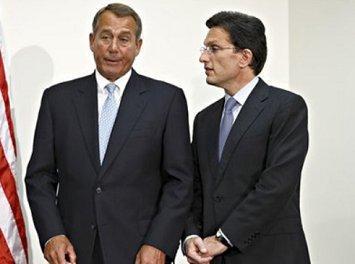
In effect, House Speaker John Boehner (R-Ohio) and the rest of the leadership want to put on a little political theater in the hopes of making their far-right colleagues feel better about themselves. Everyone would know in advance that the Senate would reject the effort to defund the Affordable Care Act, but the plan allows for Republicans to cast this vote with the knowledge that they wouldn't actually have to shut down the government.
It's a win-win, right? Conservatives get to say they voted to "defund Obamacare"; Democrats would get to keep the government's lights on; and GOP leaders would get to placate the radicals among them without any real adverse consequences.
At least, that's the idea. The trouble comes when we take a closer look.
First, there's a very real possibility that right-wing lawmakers won't appreciate feeling patronized by their own leaders, and simply won't accept the plan as a credible solution. Indeed, this isn't just idle speculation: "Conservative Republicans who caught wind of the plan on Monday told The Hill it was unacceptable."
These folks don't want a symbolic, feel-good gesture; these folks actually want to force a budget crisis in the hopes of denying millions of Americans access to affordable health care. Republican leaders are afraid of the fallout of a government shutdown, but rank-and-file Republicans don't give a darn.
And if House Republicans balk at their own leadership's ploy, it means Boehner & Co. will find themselves dependent on House Democratic votes to avoid a shutdown. Do you think Dems might want a little something out of this deal to save the Speaker's butt? Count on it.
Which then leads us to the second problem: under this approach, spending levels are still at sequestration levels. Why is that important? Because the sequester is a painfully stupid and destructive policy that's hurting the country for no reason.
In August, Boehner said "none of us like" the sequestration policy. House Majority Leader Eric Cantor (R-Va.) said the sequester "is not the best way to go about spending reductions." House Appropriations Committee Chairman Hal Rogers (R-Ky.) said the sequester is "unrealistic," "ill-conceived," and a policy that "must be brought to an end."
And yet, the Speaker's plan is to effectively tell the right, "You're not getting the shutdown you wanted, but at least you're getting the destructive sequestration cuts we pretend not to like."
There's a real chance that rank-and-file Republicans oppose the idea because they want to shut down the government, while rank-and-file Democrats balk because they hate the sequester.
All of this will have to be dealt with fairly soon, since the government runs out of money on Sept. 30. Once that's done, we then get to move on to congressional Republicans threatening to crash the global economy on purpose with another debt-ceiling hostage crisis.


McConnell sticks his finger in the wind, makes up his mind
Associated Press
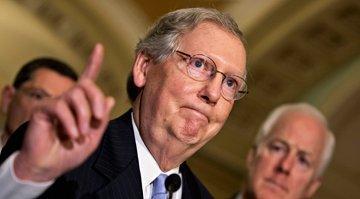
In August, as Senate Republicans argued among themselves over budget strategies, their ostensible leader, Kentucky's Mitch McConnell (R), stayed on the sidelines. Worried that bold stands might hurt his re-election chances, the Senate Minority Leader was too afraid to take a stand.
In September, as GOP lawmakers have argued among themselves over U.S. policy in Syria, McConnell has again been afraid to lead. Yesterday, the Minority Leader didn't even want to be on the Senate floor for fear he might have to take a position on the issue of the day.
This morning, after carefully waiting for his pollsters to tell him what to say pondering the issue for three weeks, McConnell spoke up.
Breaking his silence on Syria, Republican Senate Minority Leader Mitch McConnell revealed Tuesday that he will oppose a resolution giving President Barack Obama the authority to unleash military strikes.
"I will be voting against this resolution -- a vital national security risk is clearly not at play" McConnell said in a speech prepared for delivery on the Senate floor that painted the White House strategy as muddled and rife with "unintended consequences.
McConnell added, "It's not exactly a state secret that I'm no fan of this president's foreign policy."
That's certainly true, though it's also not exactly a state secret that McConnell has spent his congressional career as a hawk, broadly supportive of using force abroad and backing military intervention to address national security crises.
So what changed? In case it's not obvious, McConnell is terrified of losing.
He has a credible primary opponent, an equal credible general-election challenger, and poll numbers that suggest McConnell is one of the least popular senators in the nation. It made for an easy calculus -- the Minority Leader will abandon his foreign policy principles because neither the president nor intervention in Syria are popular. Sure, it's craven to approach U.S. foreign policy this way, but McConnell apparently doesn't care.
This also, incidentally, creates an unexpected intra-party division -- the top two House Republicans (Boehner and Cantor) support the president's position, while the top two Senate Republicans (McConnell and Cornyn) do not.
As Syrian crisis turns, U.S. conservatives rally behind Putin
Associated Press
It's too soon to say with confidence whether the diplomatic solution for Syrian crisis will stick, but if it does, we can probably guess the story the White House will be eager to tell. President Obama took the lead in responding to Syria's suspected chemical-weapons attack and threatened to use military force. At the same time, Obama and his team pointed the way to a political resolution that forced an end to Syria's entire program of chemical weapons, and it was the White House's threats that made diplomacy possible.
That's obviously the most favorable possible spin -- it's also assuming the proposal solution will work, and it may not -- but it's rooted in plausible claims. A longtime Republican strategist told the Huffington Post, "It looks like Obama drew an inside straight here."
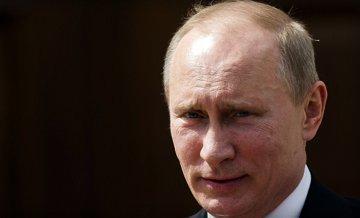
And for the right, the notion that Syria could become a political plus for Obama just won't do. So what's the alternative for U.S. conservatives? Quick, praise Putin!
From the claws of defeat and humiliation, Obama is claiming victory.... The way this was handled was a complete embarrassment and near-disaster, saved only by Vladimir Putin. [...]
Putin comes across as the world leader.
We talked yesterday about the right's affections for Russian President Vladimir Putin, well documented by Eric Boehlert and others. Yesterday, though, as Samantha Wyatt explained, the crush seemed to intensify.
The list is fairly long and well worth checking out. On Fox, for example, Martha MacCallum cheered Putin for "coming to the diplomatic rescue," while Tucker Carlson similarly heralded Putin for "riding to President Obama's rescue" while Russia "humiliates the United States." Charles Krauthammer added that it's Putin's government that's "playing chess here with a set of rank amateurs."
Coming on the heels of other conservatives celebrating Putin, the whole dynamic just seems to be increasingly creepy. When was the last time U.S. Republicans were so vocal about their affections for a former KGB official with an authoritarian streak?
Syria signals stronger support for solution
Associated Press
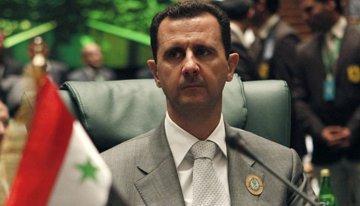
Yesterday, after Russia endorsed Secretary of State John Kerry's suggested course on Syria's chemical weapons, Syria's foreign minister, Walid al-Moallem, quickly expressed support for the idea. The Syrian official did not, however, fully and formally embrace the proposal on behalf of the Assad government.
Today, Syria went further.
Syria confirmed it would accept a Russian-brokered proposal to place its chemical weapons under international control Tuesday, just hours after France announced it would seek a U.N. Security Council resolution seeking a similar plan.
Syria's Foreign Minister Walid al-Moualem told Russia's lower parliament that Damascus had agreed to the plan in order to "remove the grounds for American aggression," according to a report by the Interfax state news agency.
His statement sounded more definitive than remarks Monday, when the Syrian foreign minister said that Damascus welcomed Russia's initiative.
International backing for the idea also appears to be growing -- not only did U.N. Secretary General Ban Ki Moon express support for the possible solution, but Iran and China said they're on board, too. Officials in Britain, France, and Germany soon followed.
Indeed, just hours ago, France moved forward on proposing a United Nations Security Council resolution to help formalize the framework. France, of course, has been one of the world's strongest supporters of President Obama's plans for military intervention in Syria.
Given all of this, there's clearly some diplomatic momentum towards a solution to the crisis, and I imagine there's a temptation among many to start celebrating.
But while I hope this resolution to the crisis comes together quickly, let's not get too excited just yet.
Note, for example, that Russian officials said they're working with Damascus on a "workable, precise and concrete plan." In other words, there is no actual plan as of now, and there's no timetable as to how the plan will come together, and who might have input as to the integrity of the framework.
For all we know, several weeks or months from now, Russia and Syria might announce, "We're still working on it." Needless to say, the U.S. is looking for a more expedited process.
What's more, the New York Times report added that the specificity of diplomatic language always matters, and analysts said Syria's remarks in support of the solution "fell short of an unambiguous pledge by Syria to give up its arsenal."
Indeed, as recently as yesterday, the Assad government wasn't even prepared to acknowledge that Syria's chemical weapons stockpiles exist, despite the international consensus.
For that matter, even if there's international agreement on the pending idea, "even an invasive inspection program can take years to account for chemical stockpiles and never be certain of complete compliance."
So, let's keep the champagne on ice. I'm sure everyone is hoping for the best, and there's reason for cautious optimism, but the crisis is ongoing, high-level meetings will continue in Washington and elsewhere today, and President Obama is still scheduled to deliver a national address this evening from the White House.
The origins of a diplomatic solution
The prospect of Syria giving up its chemical weapons seemingly came out of the blue yesterday. Secretary of State John Kerry made a comment in response to a reporter's question in London yesterday morning, which apparently touched off a series of diplomatic dominoes that offered new hope that U.S. military strikes can be avoided.
But did the idea really come about accidentally? Did Kerry stumble into a solution with an off-hand remark?
Watch on YouTubePresident Obama sat down for six interviews yesterday with major broadcast networks, but there was an exchange with PBS's Gwen Ifill that struck me as especially interesting.
IFILL: John Kerry talked today about a limited, targeted, unbelievably small effort. And now we're hearing news that Russia has a plan, a solution, perhaps, which would allow Syria to take all of its weapons and put it under international control. Is that something that you've had any conversations at all with President Putin about when you were in St. Petersburg last week?
OBAMA: I did have those conversations. And this is a continuation of conversations I've had with President Putin for quite some time. As I said to you the last time we spoke, this chemical weapons ban matters to us, to the United States.
It may be a long while until we know for sure whether the possible solution that seemingly emerged yesterday was serendipity or whether the idea landed on fertile soil after extensive diplomatic legwork. The president's comments to Ifill seem to suggest the latter -- Obama and Putin met privately at the G-20 summit, and the two discussed international control of Syria's chemical weapons. When Kerry spoke, he articulated a goal Russia recognized as a key U.S. priority.
Now, it's almost certainly a stretch to think we're watching 11-dimensional chess play out on the global stage, as entertaining as that may seem.
Please don't send me an email that reads, "Don't you see? Kerry pretended to stumble into a solution, when in fact he was secretly instructed by Obama to make those comments in London, knowing that Russians would hear them and respond favorably because of an arrangement the president struck with Putin in St. Petersburg! It's so obvious!"
As a rule, this just isn't how international diplomacy works outside the movies.
But if this does become the basis for a diplomatic solution -- for now, let's not brush past the "if" too quickly -- I imagine quite a few folks will be eager to share in the credit.
Update: A spokesman for Russian President Vladimir Putin said today that Putin did discuss this plan with Obama at last week's summit.
Where things stand
Getty Images
At this point 24 hours ago, many of us had certain expectations about the crisis in Syria and the status of U.S. policy. Monday, we assumed, would feature a public-relations offensive from the White House, which would be met by skepticism from lawmakers and much of the public, even as the legislative process inched closer to actual votes from lawmakers.
But as the dust settled last night, it was clear that things didn't go according to plan yesterday. For President Obama, this was almost certainly good news.
President Obama on Monday tentatively embraced a Russian diplomatic proposal to avert a United States military strike on Syria by having international monitors take control of the Syrian government's chemical weapons. The move added new uncertainty to Mr. Obama's push to win support among allies, the American public and members of Congress for an attack.
In a series of television interviews with six cable and broadcast networks, Mr. Obama capped a remarkable day of presidential lobbying for military action and a dizzying series of developments at home and abroad. Sergey V. Lavrov, the Russian foreign minister, said early Monday that Syria could avoid an attack by putting its chemical weapons in the hands of monitors and agreeing to ultimately eliminate its massive arsenal of poison gas. It was an idea that was quickly praised by top officials in Syria and some lawmakers in the United States.
"It's possible," Mr. Obama said on CNN of the Russian proposal, "if it's real."
Whether the solution is, in fact, "real" remains to be seen. Those who followed the conflict in Bosnia in the 1990s may recall many instances in which Slobodan Milosevic would promise to give up his heavy weapons, raising hopes for diplomatic solution, but when it came time to deliver, Serbian leaders would obstruct and delay, over and over again. It's certainly possible that Russia and Syria are playing a similar game now.
It's why it made sense when Obama told NBC News' Savannah Guthrie late yesterday, in response to a question about the Russian proposal, "I think you have to take it with a grain of salt initially. This represents a potentially positive development. We are gonna run this to ground."
But the fact that this avenue suddenly appeared at all shook up Washington in ways that were hard to predict at this time yesterday.
Indeed, the Senate vote that was on track for a floor debate is now on indefinite hold.
Senate Majority Leader Harry Reid (D-Nev.) on Monday delayed a vote on using military force against Syria.
Faced with stiffening opposition from Republicans and skepticism from many Democrats, Reid said he would not rush the vote to begin considering the controversial use-of-force resolution.
He insisted he was not delaying action because of a lack of votes.
And while that's not an unreasonable posture to take publicly, the fact remains that Reid couldn't be entirely sure that the votes were in place, either.
But the possibility of a diplomatic breakthrough certainly gave Senate leaders a helpful excuse -- the resolution is on hold, at least officially, while members watch to see how the process continues to unfold.
One thing to keep an eye on is how these developments alter the administration's pitch to Congress. Tommy Vietor mentioned this last night with Rachel on the show -- as far as the White House is concerned, it's the threat of military force that creates the diplomatic opportunities. If Congress wants the chemical-weapons solution to move forward, the argument goes, then lawmakers now have even stronger incentive to authorize the U.S. military intervention, because it will keep the pressure on.
If Congress rejects the president's request for approval, the relevant players can walk away from the table, confident there will be no consequences for failing to negotiate. It's an ironic twist, but expect Obama to tell skeptical lawmakers, "If you want a peaceful resolution to the crisis, give me the authority to strike."
September 9, 2013
Ahead on the 9/9 Maddow show
Tonight's guests include:
Tommy Vietor, former National Security spokesman in the Obama Administration
Rep. Barbara Lee, (D) California, seeking an alternative to military strike in Syria
Here is tonight's soundtrack! And here is executive producer Bill Wolff with a preview of tonight's show:
Monday's Mini-Report
Today's edition of quick hits:
* Secretary of State John Kerry, describing the Obama administration's military intentions towards Syria, described a "very limited, very targeted, very short-term" mission, intended to "degrade" Assad's capacity to deliver chemical weapons. But then Kerry added that the U.S. mission would be "unbelievably small," which raised eyebrows around the globe.
* The transcript of President Bashar al-Assad's interview with Charlie Rose is now available online.
* The full-court press will continue: "President Barack Obama plans to meet with both Senate Republicans and Democrats on Tuesday."
* Starting the clock: "Senate Majority Leader Harry Reid (D-NV) said he's planning on setting an initial procedural vote Wednesday on the resolution to authorize military force against Syria. On the Senate floor, promised that the resolution will get the debate that it deserves."
* Retired Army Gen. David H. Petraeus, former CIA director under President Barack Obama, is urging Congress to back the administration on Syria. When was the last time congressional Republicans blew off advice from Petraeus and Israel on a matter of national security?
* Noting the many GOP lawmakers who were for military intervention in Syria before they were against it, the obvious conclusion is that Republicans changed their minds after President Obama agreed with them.
* Zimmerman: "George Zimmerman's wife Shellie called Lake Mary Police Monday afternoon saying her spouse was arguing with her and her father, and that he had a hand on his gun, according to Police Chief Steve Bracknell."
* Ben Jealous leaves on a high note: "The man who has become the face of the NAACP -- from marches protesting the death of Florida teen Trayvon Martin to vigils for death row inmate Troy Davis in Georgia -- is resigning effective Dec. 31.... In a separate interview with USA Today columnist DeWayne Wickham, Jealous detailed plans to create an 'EMILY's list for people of color.'"
* It seems in those rare instances in which actual voter fraud pops up, more often than not, it's a Republican trying to get away with something.
* And Rush Limbaugh could easily teach a post-grad course in advanced racial trolling: "Limbaugh Dubs Obama's Syria Plan 'Operation Shuck And Jive.'" This kind of ugliness takes real practice.
Anything to add? Consider this an open thread.
Clinton backs Obama, calls Russian offer 'important'
Former Secretary of State Hillary Clinton met with President Obama earlier today, and delivered a brief statement to reporters. Philip Bump published the full transcript, but there were a few elements worth highlighting.
Clinton naturally endorsed the administration's belief that the alleged use of chemical weapons "demands a strong response from the international community led by the United States." She added, as others in the administration have, that Syria's stockpiles remain an ongoing threat: "Whether they are used again against Syrian civilians, or transferred to Hezbollah, or stolen by other terrorists, this is about protecting both the Syrian people and our friends in the region."
And then there was this:
"Now, if the regime immediately surrendered its stockpiles to international control as was suggested by Secretary Kerry and the Russians, that would be an important step. But this cannot be another excuse for delay or obstruction. And Russia has to support the international community's efforts sincerely, or be held to account."
This was in reference, of course, to Secretary of State John Kerry's suggestion earlier that Syria could avoid the threat of violence by giving up his chemical-weapons stockpiles -- an off-hand comment that Russia, Syria, and the United Nations quickly seized upon as a possible diplomatic solution.
Did Kerry accidentally identify a way out of this crisis? Clinton's reference to the developments suggested this is serious, but Reuters reports this afternoon that Kerry called Sergei Lavrov, the Russian foreign minister, to say his suggested solution was not intended to be a diplomatic proposal.
In other words, Kerry made an off-hand comment; relevant international players took it seriously; there were suddenly renewed hopes for a resolution that did not involve U.S. military intervention; and the Secretary of State is now apparently trying to distance himself from the idea he apparently did not want to put on the table in the first place. (Simpsons fans may recall a similar dynamic in an episode in 1991. See, "Pull a Homer.")
That's not encouraging.
Still, accidental or not, Kerry's suggestion is taking on a life of its own, and if Syria, Russia, and the U.N. are serious, the idea may yet produce results. Clinton's willingness to talk about this during her brief comments suggests the administration isn't dismissing the possibility out of hand.
How nonsense enters the bloodstream
Sen. John McCain (R-Ariz.) held a town-hall meeting in Arizona the other day, and was confronted by a constituent who disagrees with the senator on Syria. After claiming to speak for "all Americans," and accusing McCain of "treasonous" behavior, the voter made one especially noteworthy comment.
Watch on YouTubeAfter working through a whole lot of silliness, note that the guy eventually told McCain, "I believe wholeheartedly you do not care about the will and well-being of America or its people. You lied to the American people about the chemical attacks in Syria. The American people know that it was our government that is most likely responsible."
Got that? This Arizonan believes the U.S. government was "most likely responsible" for a chemical weapons attack in Syria, which targeted the side we want to prevail in the Syrian civil war.
And where in the world would this guy get that idea? Because Rush Limbaugh told them to take the idea seriously.
There have long been mutterings that the chemical attack in Ghouta was a false-flag operation. That is, the Syrian opposition actually carried out the attack, hoping that Bashar al-Assad would get blamed and President Obama would retaliate with a huge bombing campaign. But it's just been mutterings. [Tuesday], though, Rush Limbaugh upped the ante, jabbering on air about an article by Yossef Bodansky titled "Did the White House Help Plan the Syrian Chemical Attack?"
Got that? Not just a false flag operation that snookered the idiot-in-chief, but an operation actually put in motion by the White House. Bodansky, an Assad sympathizer who has previously suggested that the 1995 Oklahoma bombing was orchestrated by Iran and that Saddam's WMDs all ended up in Syria, tells a simple story....
I'll spare you the details of the story, but the gist of it has to do with the U.S. coordinating with the Syrian opposition to ... never mind, it's just too dumb to repeat.
But Limbaugh shared all of this with his audience, as did Alex Jones and some right-wing bloggers. And now it's shown up in a senator's town-hall meeting.
If recent history is any guide, members of Congress will start repeating it any day now.