Nancy E. Blanton's Blog, page 9
January 12, 2015
Author branding and Henry VIII: Royal persona
Part 3 in series on personal branding
If England’s King Henry VIII had been an author, who might he have been? Authors, like royalty, can project certain images to create a persona in the minds of their audiences and the general public, to thereby be remembered and gain policy support, or book sales as the case may be.
 As noted in Part 1 of this series, the proliferation of social media apps today make it nearly impossible to project an inauthentic persona. The moment you thought you had created a good one, someone would post an instagram of you carrying out the garbage in your underwear. But King Henry was able to create and project a persona that met his needs, and the
  corresponding author that comes to mind for me is Ernest Hemingway.
As young men, both Henry and Ernest were good looking with athletic physiques. Henry was known for having “an extremely fine calf to his leg,” for example. Both played hard at sports, be it jousting or hunting, and both saw themselves as warriors. Both were interested in education and literature. Both married a few times. Both drank to excess. Both attained a “larger than life” persona that continued long after the men themselves had faltered due to illness and, well, bad behavior.
King Henry’s Brand Persona
 Henry VIII valued education, religion, arts, architecture, innovation and ostentation. He used his physical size to advantage — he was 6’2″ at a time when most men were considerably shorter — and in many cases his portraits show him taking up most of the canvas. In the background of some portraits he was surrounded by the cultural sophistication reminiscent of imperial Rome.
He excelled at sports and held jousting matches, wearing his gilded armor, satin and pearls, as a way of showing his wealth, strength and power to visiting dignitaries.
To promote his campaign for church reformation, he had pamphlets created and broadly distributed, and paid theatrical and minstrel groups to travel the land and portray Catholic priests as devils while he was the defender of the true faith. (Reminds me of the branding road show I once led for employees in various departments, but in my case the past was the devil and the new brand was the hero.)
In architecture, the exterior of buildings included hundreds of busts, the laurel-wreathed heads of emperors, imperial authorities and military heroes, suggesting these heroes were the foundation upon which King Henry’s Tudor dynasty was built.
In art he was featured at the center of huge architectural structures in classical style, in at least one case receiving the water of life and the book of life directly from the angels, a clear reference to his religious persona as head of the Church of England with the divine right of kings.
Later in life, even after a jousting injury and other health conditions changed him dramatically — and even though the noble king was responsible for about 70,000 executions — the glorious persona that he had created still permeated. Fans of the Tudors television series may recall in the last episode just before Henry dies, he orders the portrait artist Holbein to change his latest, and accurate, depiction of declining, sickly Henry into the standing image of the strong, virile (note codpiece), magnificent king he wanted his people to see.
In part, I would say, the success of Henry’s brand persona is that the powerful, charming, man’s man image he created was something the citizens of his time wanted and respected in their king. It was an image that was easy to accept, and easy to follow because it met with their own values, and even in the face of horrible truths it was hard to let go.
Stay tuned for Part 4 of this series, next week: Elizabeth I
 Sharavogue recently won first place for historical fiction in the Florida Writers Association Royal Palm Literary Awards. You can purchase a copy from online booksellers and at the Book Loft on Amelia Island, FL. I will be presenting at the Amelia Island Book Festival Feb. 20-21.


January 5, 2015
Author branding: A royal legacy
Part 2 in series on personal branding
In my last post I talked about some differences between corporate and personal branding, and how values rather than product should be the core driver for the brand. Because kings and queens were probably the first successful users of personal branding, we can learn from their practices.
 In ancient Egypt, if the monuments and pyramids can attest, rulers valued nothing more than a legacy. Not only to be remembered by their people, but also to help open the doors to a prosperous afterlife, something akin to the Christian belief that good folks go to Heaven and get presents at Christmastime.
Way back in history, c. 1479 b.c., Hatshepsut became the sixth pharaoh of the 18th dynasty, one of few women to achieve that post, and she ruled successfully for more than 20 years. So concerned about legacy was this queen, she had an obelisk at Karnak inscribed: “Now my heart turns this way and that, as I think what the people will say — those who shall see my monuments in years to come, and who shall speak of what I have done.”
When her pharaoh husband died and she was named regent to serve while her infant stepson came of age, Hatshepsut saw a unique opportunity and took full advantage of it. She had herself declared king of Egypt. But now, especially because she was a woman in a man’s role, she had to take steps to secure her throne.
She had herself portrayed as a man in the media of the day — stone carvings — complete with false beard, Khat head cloth and shendyt kilt, and looked much the figure of a man, showing strong shoulders, small breasts. (In fact, archaeologist have discovered she was obese, had very large breasts and suffered from a skin disease, the salve for which probably contained toxic chemicals that led to her death.)
She also renamed herself “Maatkare,” basically a combination of words meaning truth, soul and Sun God (Re), suggesting she was in direct contact with the god and thereby legitimately held her throne.
In pursuit of her legacy, she focused on two things: Architecture and art. She built roadways and sanctuaries, erected commemorative obelisks, and carved her immense temple into the limestone cliffs near Thebes, containing more than 100 statues of herself in various religious poses.
Hatshepsut was basically everywhere. Even though her stepson, ascending to power after her death, did everything he could to remove and erase her legacy from history, most of it still remains.
And so, what four things can be learned from Hatshepsut’s strategies for establishing a personal brand?
First, values. For Hatshepsut, they were leadership and legacy.
Second, opportunity. You may not be able to have yourself declared king like Hatshepsut, but in an author’s world, to me this means finding a niche that will allow you to shine, and has subject areas that speak to you (like Re) and can keep you interested. Branding is a long-term relationship.
Third, focus. Hatshepsut did not try to do everything, but focused specifically on a few main things that addressed her values. She promoted trade, which made it easier to obtain the things she needed, like building materials for monuments, and art from all over the world. An author may have a lot of demands on his or her time and resources, and still needs time to write. Don’t participate in every charity, choose one or two that fit your brand values. Don’t try to attend every event or be on every social media platform. Choose the ones that really serve you in some way and fit who you are.
Fourth, endurance. A strong brand will endure. Note that Hatshepsut’s has been around for nearly 3,500 years. Most of us can remember corporate brands we grew up with as kids, even if the company that created it no longer exists. I’ll bet you can think of some authors right now who have amazingly durable personal brands. Their names alone conjure mental pictures. Bronte? Hemingway? Melville? Austen? Dickens? Twain? And the list goes on and on…
Stay tuned for Part 3 next week.
Sharavogue recently won first place for historical fiction in the Florida Writers Association Royal Palm Literary Awards! You can purchase a copy from online booksellers and at the Book Loft on Amelia Island, FL. I will be presenting at the Amelia Island Book Festival Feb. 20-21.


November 3, 2014
Historical accuracy: It’s good to be right
Last year when I started promoting my historical novel Sharavogue, I got several wonderful and very positive reviews on amazon.com, but was looking to spread the news to other readers. I requested a review from another place my book was listed, Indiebound.com. Great people there, but unfortunately I was matched up with an anonymous reviewer who I can only believe is a bitter and lonely individual. I say that not just because I received a bad review, which I did, but because it was unreasonably bad.
Upon reading it, my hands began to shake. I had spent years carefully researching the time, the characters from that time, and all the details. It was the details this reviewer zeroed in on, questioning in a rather nasty tone the book’s title, whether a certain kind of tree was present at the time, and so on, including the basic opening sequence in the book in which Oliver Cromwell arrives in Skibbereen, County Cork, Ireland. The reviewer claimed Cromwell had never traveled that far.

From Cromwell in Ireland, digitized for the British Library (public domain)
Now, since this is historical fiction, and it was at least plausible that Cromwell had visited the village in question, it does not really matter whether he actually did or not as long as I am clear in my author’s note about the places where I have stretched the facts in support of the story. But I had studied Cromwell and found that he did in fact visit Skibbereen. I made two mistakes here.
First, I had found an historical map (above) that actually tracked Cromwell’s progress in 1649, going through and past Skibbereen in southwest Cork. It gave me a premise to work from but, not realizing I might need it later I did not file a copy. If I’d had that copy I could have submitted it to the reviewer to request a revision in the review.
Which leads to my second mistake: engaging with the reviewer. Upon reading the erroneous review I sent back a message to Indiebound pointing out the errors in it based on my research. They sent my message to the reviewer for a response, and the result was a longer and even more erroneous and spiteful version of the original review. Indiebound passed it off as just a difference in opinion.
Happily for me anyway, while researching my new book I came across the map again, from the British Library no less, and saved it in my files.
Readers of historical fiction love a good story intertwined with fact, so that they can learn about historical lives and times as they are entertained. I know, I am an avid historical novel reader myself. But as they used to say, tongue in cheek, when I was in journalism, don’t let the facts get in the way of a good story. Do be as accurate as possible because you will have to defend some of the details. Don’t sweat a minor detail if it helps move the story forward or it doesn’t really matter. And don’t follow my example — keep copies of or document everything you find that might be useful to your story. You never know when it might come in handy. I won’t be sending this map to the reviewer at this late date, but I feel vindicated anyway. And that’s why I say…it’s good to be right!
Get a copy of Sharavogue to learn about Cromwell’s march in Ireland. When he gets to Skibbereen, the village is called “Skebreen” — a shortcut the locals used. Cromwell is real, his march is real, and Skibbereen is real. The protagonist and her companions are fiction. The bridge in question is fictionalized based on undocumented legend, and a good story for sure!


Love those Royal Palms, and the trees too
Since returning to my home state of Florida after 21 years in Seattle, I have delighted in seeing the beach on a regular basis, the beautiful mossy oaks and the majestic royal palms. I did not know when I engaged with the Florida Writers Association I would have such a wonderful Royal Palm surprise in store!

First Place for Historical Fiction
At last week’s FWA annual conference I received the Royal Palm Literary Award, first place for historical fiction, for my novel Sharavogue. It was an honor hoped for but not expected, and I am thrilled to be among so many talented writers who were recognized.
It was my pleasure to be sitting next to my new friend Linda Reynolds, whose unpublished thriller manuscript Spies In Our Midst also won a RPLA — her book to be out later this year. And Mary Ann Weakley, my new friend from the book signing tables, won the RPLA for her memoir, Monastery to Matrimony, A Woman’s Journey.
At the signing tables I also met Nadine Vaughan, who writes children’s books and historical fiction, and lives just minutes away from me. We may be collaborating on some things soon. A shopper at heart, I picked up a copy of The Lantern by my friend Joanne Lewis, as well as The Secret Confessions of Anne Shakespeare by Arliss Ryan. Both of these are intriguing and hooked me on the first page.
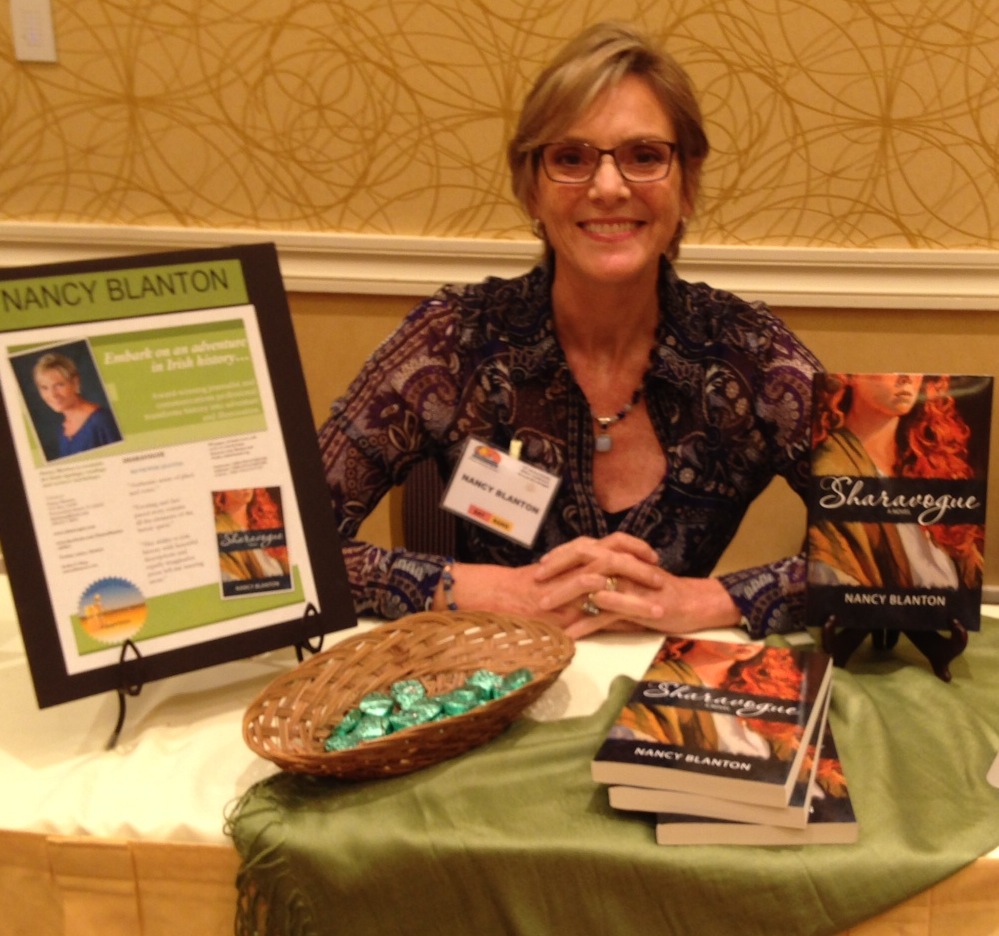
Set up for book signing at the FWA Conference Bookstore
Here is a partial list of the RPLA winners (from NE Florida), provided by Vic DiGenti, FWA Regional Director. For the full list see the FWA website:
Congratulations go out to a host of NE Florida writers who hauled in a large number of RPLA Awards. This includes the Book of the Year Award to M. W. Gordon, whose book Deadly Drifts took first place in the Thriller/Suspense category (Published), and went on to garner the Book of the Year (Published) award for having the highest total number of judges’ points. BTW, Mike was the speaker at last month’s Ponte Vedra FL Writers meeting.
General (Pre-Published) FIRST PLACE –BABE by Elle Thornton
Fantasy (Pre-Published) FIRST PLACE – The Jaguar Key The Eternals: Book One by Kate Maier writing as Katherine Starbird
Science Fiction (Published) Second Place – Lifespan by T. J. Silverio
Women’s Fiction (Pre-Published) FIRST PLACE – Merciful Blessings by Lynn Kathleen (Pen name for Nancy Quatrano and Daria Ludas
Historical Fiction (Published) FIRST PLACE – SHARAVOGUE by Nancy Blanton
Novella (Pre-Published) Second Place – The Magic in the Middle by Mark Reasoner
Thriller/Suspense (Published) Second Place – Power Fade by Keith Gockenbach
Thriller/Suspense (Pre-Published) THIRD PLACE – A Lion in Spring by Kenneth R. Overman
Autobiography/Memoir (Published) FIRST PLACE –Meeting Her Match: the Story of a Female Athlete-Coach, before and After Title IX by Debbie Millbern Powers
SECOND PLACE – From the Inside Out by John David Tinny
THIRD PLACE – A Life of Blood and Danger by Daniel J. Hill.
Educational/Informational (Published) Second Place – Schools: A Niche Market for Authors by Jane R. Wood
Writers conferences and book festivals are such fun and great ways to meet and learn from other writers. They are not great places to sell books, unless they also open and advertise the book fairs to the local reader community. But as I noted recently in another blogger’s post (and I can’t remember which one or I would link), it does not matter how many books you sell at these events, it is about the people you meet and the effort you make to get your name out there. I sold only two books at St. Augustine’s Heritage Book Festival, but one of the readers is a wonderful person who gave me a great review. Was it worth it? You bet!!!
So in addition to the thrill of winning a literary award for Sharavogue, the other benefit is the confirmation that it is important to continue writing. I am working on the prequel and sequel to Sharavogue and my research is uncovering some remarkable stories to tell. Stay tuned…
And mark your calendar for the Amelia Island Book Festival, February 19-21, 2015.


September 16, 2014
Roads into the past
 Roads have always been important to civilizations, from narrow dirt pathways leading to water and food supply, to major super highways that support international trade and industry. In researching the past, knowing the roadways is key to understanding the way communities lived and operated. That’s why I was thrilled recently to discover the Down Survey Project online.
This is an amazing effort called the The Down Survey of Ireland Project, funded by the Irish Research Council under its Research Fellowship Scheme. The 17-month project was completed in March 2013. In short, the project combines digitized versions of surviving maps of Ireland from the 17th century (barony, parish and county level) with historical GIS (including various census and deposition sources) and georeferencing them with 19th-century Ordnance Survey maps, Google Maps and satellite imagery. Got that? Simple, right?
Well, no matter. If you have any interest at all in the history of Ireland, you will be amazed as I was to see the incredible public resource that this project has established.
Just as an example, for my book which begins in 1649, I can look up what landholders were in the area of my research, see exactly where their properties were located and what roads were in existence at the time. The old roads are represented as straight lines in the version I was able to bring up, and I doubt there were too many straight lines back then, but it does give me a general idea of locations and directions for ingress and egress. I’d say, for historical fiction it is a far better information source than my imagination.
Many thanks to the project team Micheál Ó Siochrú, David Brown and Eoin Bailey for creating this remarkable website. And thanks to Micheál Ó Siochrú also for his book God’s Executioner: Oliver Cromwell and the Conquest of Ireland — another valuable resource to me.
For England’s roadways, historical novelist and blogger Patricia Bracewell has produced a four-part series on early English roads, featuring Watling Street, Ermine Street, the Fosse Way, and the Icknield Way. The series includes old maps and photos of present-day trails, and is featured on the English Historical Fiction Authors blog site.
Do you know of similar resources that might be helpful to authors? I’d love to know about them. Please comment.
 Meantime: There are just three days left for my great giveaway of copies of Sharavogue on Goodreads. Sign up here!


August 6, 2014
Reviews & book promotion
I am pleased to say the Historical Novel Society review of my novel Sharavogue has now been posted. I am glad to see it after several months of waiting. HNS reviewers can be tough, and do not hold punches if they don’t like something, so overall this seems to be a positive review.
 By the way, HNS has a conference in London first week of September. I won’t be able to attend but I am sure it will be a great event.
It is wonderful, of course, to see “nicely written” in the first line of the review. The reviewer goes on to summarize the story, and notes that it moves along at a quick pace, “sometimes too quick.” This may be true, I did intend to maintain a momentum, and most of my readers say “I couldn’t put it down” — which is a good thing.
A few other comments about timing and events I believe are subjective, but well taken as I work on the story for the prequel.
So what next? How can I maximize this review? I have shared it on social media. I am one who avoided all but Facebook for a long time because it consumes time that I would rather use in other ways. But it is hard to argue with the reach, if I have no data to actually recognize results in terms of sales. Last week I received a reader review on Amazon. I shared it on FB, and where usually I might get between 15 and 85 views, this one was reshared and drew more than 300 views and several very favorable comments. That was certainly worth the time invested.
My goal as an author is not to sell millions of books, just to sell at least enough to break even and support the next one. But there is no getting around the fact that promotion is hard work, requires constant maintenance, and is at least as much if not more time consuming than writing the actual novel — and far less rewarding!
In a very interesting post, author Eileen Goudge explains why she left her traditional publisher to pursue self publishing. Initially I felt bad for her because it would mean she would have to take on all the promotional work independent writers and publishers have to handle themselves. But Goudge dispels the myth that traditional publishers offer a marketing budget for your book. Apparently authors are on their own anyway, and then are discarded if their book sales are not stellar. Perhaps she is better off not having to play the game of traditional publishers. I wish her great success!


July 16, 2014
Heiress abduction for wealth and status
The abduction of an Irish heiress occurs in my next novel, a prequel to Sharavogue, so I have been looking into this practice which, for men, was a rather acceptable means of elevating one’s station in life. Not surprisingly, the heiress abduction theme has been a favorite for the ages among romance writers and those studying legal history.
On a quick search I came up with historical fiction/romance authors Amanda Scott, Claire Thornton and Paul B. McNulty focusing on this theme, plus numerous scholarly articles. I’m sure there are countless more.
 As part of my research I just finished reading The Abduction of a Limerick Heiress by Toby Barnard. I think the picture on the cover tells the story — the woman as ornament, possession and plaything (according to the fellow on the left with the come-hither finger), but the look on her face suggests she is at times complicit.
In this case, the heiress Frances Ingoldsby is abducted not once, but twice. Her family pulls her away from the first fellow (and she is glad to go because he is already having affairs with household servants). While the fellow claims to have married Frances, her family presumes the marriage illegal and not consummated, and hides her away in a rectory. From there she is again abducted by a fellow of slightly higher standing in the community, Hugh Fitzjohn Massy, who aspires to a gentleman’s status. Massy soon realizes he has his hands full, because Frances is a bit of a belligerent alcoholic, and he requires his entire family to keep her in check and support his scheme.
Soon the agendas of all who believe they have a stake in Frances’s inheritance start playing out, and family members with political standing exert pressure on the lawyers and judges to ensure their own profitable outcome.
With abductions, once the crime had been done in most cases the family did not fight too hard for the woman’s return, because it was assumed the heiress had been, shall we say, “damaged” by the abductor and they would have difficulty finding her a suitable husband once she was back on the marriage market. So it came down to negotiating the best deal for the stakeholders. Poor Frances, treated like the prize pig.
In the end, she willingly marries and has a son by Massy, but in fact the story continues. When Frances dies, the maneuvering begins anew, the same arguments are revived, and the fight is on for her inheritance.
In her book, Stolen Women in Medieval England, Caroline Dunn writes that abductions, sexual violations and elopements were all classified as “thefts” in statute law at the time. (See review by Emma Osborne.) As Julia Pope points out, it was not the victims themselves who were seen as stolen property, but rather the lands and wealth that would be transferred through them. The crime of abduction was taken very seriously, and resulted in courtroom battles and sometimes more violent responses, but the heiress did have a bit of sway. Under 13th century law, if the female victim did not consent to the marriage, or consented after the fact, the criminal punishment remained the same. However, if she had consented in advance of her abduction, no crime had been committed.
Blogger Susanne Saville writes about a more recent event, the 1826 abduction of 16-year-old Ellen Turner in Scotland. Her abductor convinced her that only by marrying him could she save her family from the poor house. Thus, she unwittingly consented, and it took an act of Parliament to annul the marriage. The abductor was convicted of the crime and spent three years in prison.
In the PBS Masterpiece series Downton Abbey there have been two abductions. Between Lady Sybil and the chauffeur Branson, it is actually an elopement because Sybil is consenting, and the family persuades them to return to the castle together where Branson’s status is elevated. In another episode — horrifying to me as a Labrador retriever owner — Thomas the footman abducts Lord Grantham’s dog Isis in hopes of being seen as a hero when he later rescues the dog. Someone else finds and returns Isis, but Lord Grantham, seeing the deeply concerned Thomas after an all-night search, mistakes his fear for loyalty.
The lesson for a storyteller? There are a thousand ways to go with the abduction theme, and all of them can be dramatic and interesting!


June 3, 2014
The Eyes of Anthony van Dyck
Can the eyes in a portrait reveal the secrets in a person’s character, or foretell their fate? Can a portraitist see through a person’s eyes to the fears hidden behind them?
In researching Thomas Wentworth, the first Earl of Strafford, for my next book, I am struck by my subject’s eyes as captured by the eminent artist and portraitist of the period (1640s) Anthony van Dyck. The eyes are both striking and haunting with emotion as if the artist clearly saw through to Wentworth’s inner feelings. And this was the artist’s magic.
Born in Antwerp, Van Dyck studied and painted throughout Europe before he moved to London in 1632, at age 33, to work for King Charles I.
“Van Dyck was now an artist with an international reputation and was widely traveled…He knew the art of pleasing distinguished and demanding patrons; he was equipped with a brilliant technique, and had at his command the whole repertoire of baroque painting. Above all, he possessed extraordinary imaginative powers, and, as a portraitist, an almost unequalled feeling for character and nobility of spirit,” wrote Malcolm Rogers, in Anthony van Dyck 1599-1641, a catalog of work published for the artist’s 400th birthday. 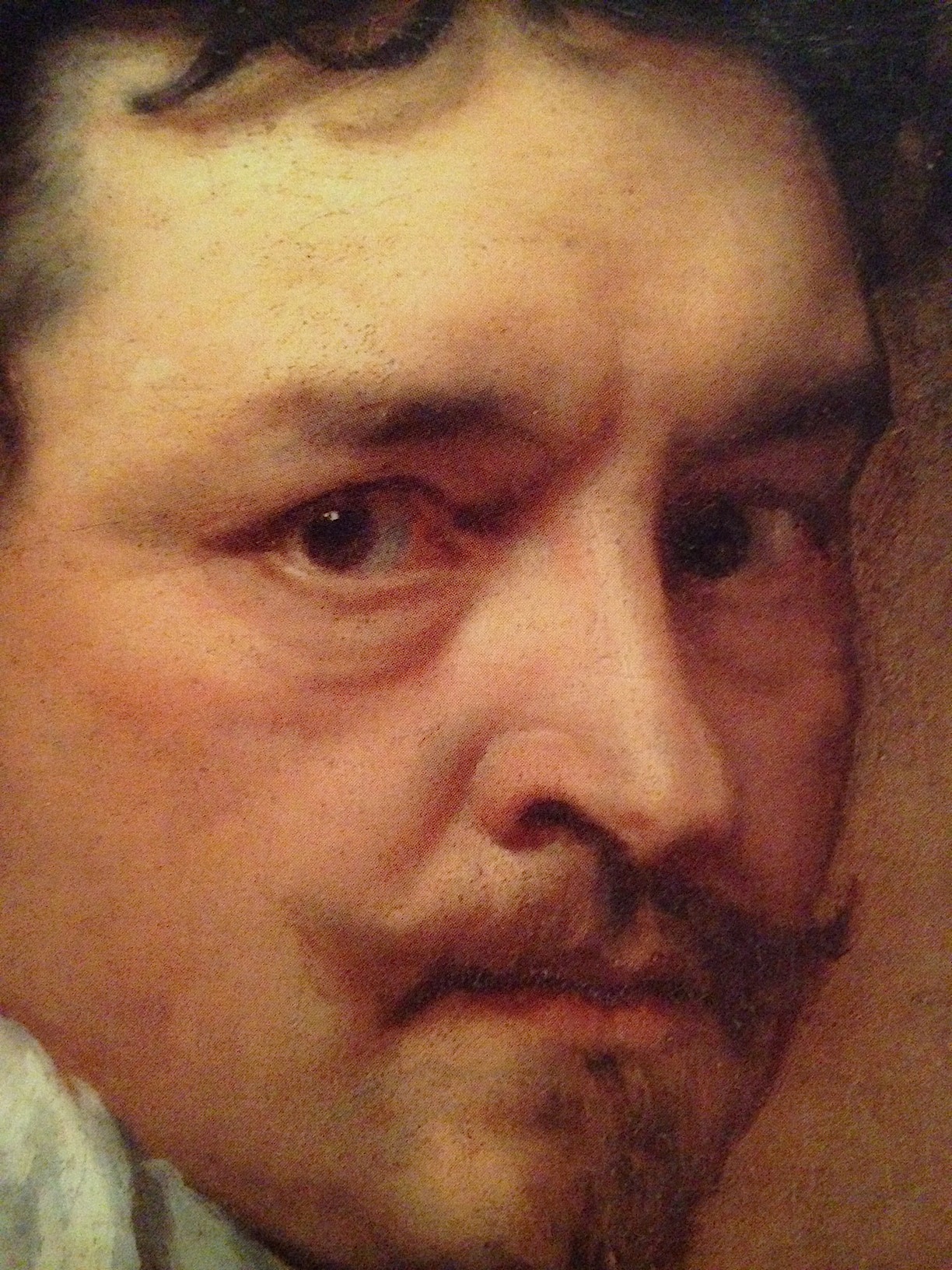
More than nobility, when I look into the eyes of Wentworth, I see anger, distrust, and a heightened fear. Wentworth began life as a commoner and ended as the closest advisor to the king and became Lord Deputy of Ireland. He could not have known at the time the portrait was painted that he would be found guilty of treason by Parliament, for supporting the king’s prerogative over the people’s elected representatives, or that the king himself would sign Wentworth’s death warrant. Wentworth was beheaded in 1641, and those eyes suggest he could see it all coming.
From that portrait, Macaulay’s History of England described Wentworth this way: “That fixed look, so full of severity, of mournful anxiety, of deep thought, of dauntless resolution, which seems at once to forbode and to defy a terribly fate, as it lowers on us from the living canvass of Vandyke.”
As Judy Egerton writes in the same book, “No portraits painted by Van Dyck in England more brilliantly demonstrate his penetrating powers of perception than those of Charles I and Thomas Wentworth, Earl of Strafford, two sharply contrasting personalities.” 
Van Dyck completed many portraits of King Charles I, but no matter the pose, the king’s eyes suggest sad resignation. Here is the king who fought Parliament to preserve the king’s prerogative — basically his right to rule his kingdom through royal blood and divine right, without approval of Parliament — even though it led to a bloody civil war. But his eyes do not show the light of an impassioned leader, and sag as if he would instead close those lids rather than see what was coming. He and his Royalist army lost the civil war and Charles was beheaded in 1649 by a Parliament and the army lead by Oliver Cromwell.
In addition to many portraits, Van Dyck’s paintings of courtly life and other settings do much to chronicle 17th century England. Van Dyck died in 1641 at age 42.


May 14, 2014
Movies for dreamers
 A few days ago I enjoyed watching Ben Stiller’s version of “The Secret Life of Walter Mitty.” It was a story I thought I knew. There were some really silly scenes that gave me a good laugh, and unfortunately planted a song in my head I am still trying to discard: “Ground Control to Major Tom…” Arrgghh.
It also brought up some funny memories for me. My father always called me “the dreamer,” especially after the day he was driving to work and caught me crouching on the sidewalk playing with a bug instead of walking to school. “La ta da ta dah dah, there she goes, the dreamer!” I guess he thought I was a complete loser — he was an accountant so dreaming was not his thing — and didn’t think my imagination would come in handy one day.
When I was little I identified with the 1947 Danny Kaye version of Walter Mitty. Kaye portrayed a sweet person, but very passive, and always getting into predicaments because of his wandering mind. Yeah, been there. Stiller’s version is not quite so passive, and a larger part of the movie focuses on the grand adventures he truly has in trying to track down a photographer played by Sean Penn. It eventually recalls a bit of The Wizard of Oz, when he discovers he had in his possession what he was looking for the whole time, i.e. the ruby slippers. 
Somewhere along the line I finally got the message this guy got: Why the hell not? Let’s go! And as a result have had some pretty good adventures of my own.
I realized that I had never actually read The Secret Life of Walter Mitty, so I downloaded the short story by James Thurber, with an introduction by his daughter Rosemary. First published by The New Yorker in 1939, it gained wide appeal. There are a lot of dreamers out there, or maybe also a lot of people frustrated by the lovable dreamers in their lives. I think n o matter how good a life can be, sometimes we all need a place to go.
A Facebook post today from Seattle’s Hay House quotes Edgar Allen Poe: “Those who dream by day are cognizant of many things that escape those who dream only at night.”
While dreaming, I have to say another movie captured my imagination perhaps even more than Mitty, and that was “About Time,” from Richard Curtis. It’s about being able to travel back in time in your life for do-overs. How many times have I wanted to go back and redo a situation so it comes out better? Hindsight, and all that. Particularly where my father is concerned, I have often dreamed how wonderful it would be if only I could go back and know him better.


April 7, 2014
Writing: Building Story out of Chaos
My reading list right now is has about six legs, so I liken it to a bee flitting all about and drinking up honey. I never know where it is all leading, and frankly it is none of my business at this, the research stage of writing. My job is to soak it in and when I have enough, the empty spaces will fill in and show me how everything is connected. As Jeffrey Rush said as the character Philip Henslowe in “Shakespeare in Love,” strangely enough, it all turns out well. How? “It’s a mystery!”
 Recently, I started The French Mistress by Susan Holloway Scott. I enjoy her books and wanted to learn a little more about what went on in the Restoration years. This is about the relationship between the Duchess of Portsmouth and the amorous King Charles II.
After the Amelia Island Book Festival in February I exchanged books with author Dee Phelps. Her first novel, The Disappointment Room, is set in South Carolina during the plantation era, about an evil mother who hides a disappointing child in an attic room and pretends to her politician husband that the child is dead.
Last week I picked up Winter King, Thomas Penn’s book about Henry VII and the dawn of Tudor England, which was recommended to me by my friend John King. It was published in 2011 but I had not seen it before. The reading is slow-going at first, because of the complexities of family  connections, but fascinating and informative.
As I am now living in the South, I also like to learn about the local area history, so I am studying the Timuqua Indians, from a book by Deon L. Jaccard. The Timuqua were in North Florida for about 4,000 years before the French and Spanish arrived to build forts and colonize. Apparently they were tall, fit, peace-loving people who, to their own downfall, helped the Europeans survive. I should have learned about all of this in high school, but if the story of the Timuqua ever was mentioned to me it fell on deaf ears, I’m sorry to say.
I am eager to get through this material and see where it all goes, but as we writers all know, life happens in the meantime. Yesterday I spent most of the day recaulking a bathroom. Ah well, somehow that may end up having a role in the mystery also. You never really know which part of your experience will ignite the story.
Happy writing!