Nancy E. Blanton's Blog, page 7
January 13, 2016
Five Takeaways from The Martian
 Karl and I watched The Martian on demand last night. We have the book but neither of us had read it yet (so many books, so much research to do, so little time!). It’s the story of an astronaut, Mark Watley (played by Matt Damon). who is stranded on Mars and uses his brain and ingenuity to survive until his crew members return for him.
About halfway through, we were bracing for the painful, horrible, gruesome deaths of those crew members as they went about trying to rescue him. Thank you, Ridley Scott, for taking the high road, letting viewers focus on the magic of the story rather than gratuitous violence and gore.
I woke up thinking about this film and the five takeaways I have from it.
Obstacles happen. Things go wrong.
Prepare. The flight team had considered and prepared for many potential difficulties they might experience on such a mission, and knew their equipment and ship inside and out. Still, life on Mars was beyond their control. They had a contingency plan.
You already have the answers within you. Watley drew from his knowledge of many sciences to survive. Most of us won’t be going to Mars, and won’t have the high level of training he had, but we probably have some learning and experiences to help us through situations we encounter if we use the resources we have.
Ask for help. Watley was brilliant, but no one knows everything, and everybody needs help from time to time. It’s the smart thing to set the ego aside and ask. Using the point and nod technique works just fine if that’s all you have to communicate. My dogs point at the cookie jar, hoping I will nod. Usually I do. It’s all good.
People are more important than missions and money. Okay, partly it was a PR thing–the bureaucrats knew the agency wouldn’t survive if the public learned they’d left a man behind, so they launched the rescue mission. Sacrificing the man seems the more likely thing to happen in reality, and the crew would have had much more difficulty choosing to spend almost two more years in space and away from their families on a risky rescue attempt. But no one would have been able to stomach the deliberate abandonment of Watley. I like to think love conquers all.
What are your thoughts? I’d love to see your comments.
 Please follow this blog if you are interested in updates. Last year my new book on personal branding — Brand Yourself Royally in 8 Simple Steps — was published in paperback and ebook. My new historical novel, The Prince of Glencurragh, is due out in summer 2016.
And please check out my award-winning Sharavogue, a novel of 17th century Ireland and the West Indies, for a fast-paced adventure you won’t soon forget.
My website at nancyblanton.com provides more detail on books and upcoming events. Please visit!


December 30, 2015
IRISH: THE FORGOTTEN WHITE SLAVES
A friend just sent me this article posted a year ago, about Irish slaves. I studied this as a main theme in my novel Sharavogue, but the picture was even uglier than I painted it. Great information here.

http://peoplestrusttoronto.files.wordpress.com/2014/12/9dee9-irish-slaves.jpg

IRISH: THE FORGOTTEN WHITE SLAVES
Source:http://goo.gl/LQ9JTW
They came as slaves: human cargo transported on British ships bound for the Americas. They were shipped by the hundreds of thousands and included men, women, and even the youngest of children.
Whenever they rebelled or even disobeyed an order, they were punished in the harshest ways. Slave owners would hang their human property by their hands and set their hands or feet on fire as one form of punishment. Some were burned alive and had their heads placed on pikes in the marketplace as a warning to other captives.
We don’t really need to go through all of the gory details, do we? We know all too well the atrocities of the African slave trade.
But are we talking about African slavery? King James VI and Charles I also led a continued effort to enslave the Irish. Britain’s Oliver Cromwell furthered…
View original post 873 more words


December 11, 2015
It’s Not the House, It’s the Family.
A lovely little story about family from my writing friend Fran Tunno. Merry Christmas, everyone!

My brother just sent me a story from the Wall Street Journal about a family from Pittsburgh dealing with their first Christmas without their parents. It touched me because it could have been about our family. Their tree from the ’60s looked like a more attractive version of ours, and they had family traditions too. They made jello salads and barbecue ham sandwiches with homemade buns for Christmas, and we are fish cooking/eating maniacs on Christmas Eve.
View original post 608 more words


November 21, 2015
A bitter bit of irony
My dear friend in southwest Ireland, Eddie MacEoin, sent me a picture of the town in Tipperary, Ireland that has the same name as my first novel: Sharavogue. I had hoped to visit there last summer but ran out of time. In Ireland there is never enough time.
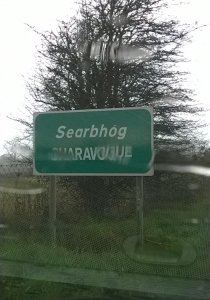
I didn’t name the book after the town, but had stumbled across the name during my research. Its meaning–bitter place or bitter land–captured my imagination, because my book features an Irish girl indentured on a sugar plantation on the island of Montserrat. What a sweet bit of irony to name the plantation Sharavogue?
Well, writers are often the recipients of stinging reviews, whether warranted or not, and one of my reviewers took me to task claiming I had that meaning wrong. One of us is definitely wrong, but I have two good sources that agree, so, I’m just saying (snark…), and I find it a beautiful and mysterious-sounding name reminiscent of Scheherazade.
The quote below is from a biography, The Red Earl, the Extraordinary Life of the Earl of Huntingdon, by Selina Hastings.
“Sharavogue–the name means ‘bitter land’–is situated halfway along the road between Roscrea and Parsonstown (now Birr)…The tiny hamlet of Sharavogue lies on the edge of the Bog of Allen, surrounded by pleasant, well-farmed country, gently undulating and characterised by meadows and small copses, by bushy hedgerows and fast-running streams.”
After such a description, I looked for something following to explain why the town was so named, but there was no answer. Maybe, as Eddie’s picture suggests, it becomes a rather wet and dismal place in fall and winter.
The Sharavogue in my story depicts a time in history when the Irish were even more popular as slave labor than the Africans. As reported by IrishCentral recently, from a blog in Scientific American, the Irish clan system was largely abolished after the Battle of Kinsale at the end of Queen Elizabeth’s reign. The English seized Ulster and sent some 30,000 prisoners of war to be sold as slaves in the colonies of America and the West Indies.
“In 1629 a large group of Irish men and women were sent to Guiana, and by 1632, Irish were the main slaves sold to Antigua and Montserrat in the West Indies. By 1637 a census showed that 69% of the total population of Montserrat were Irish slaves, which records show was a cause of concern to the English planters.”
The Irish slaves were actually cheaper and often received harsher punishments at the hands of planters, according to the article.
The 17th century is rich with stories that had profound effects on the course of history, and yet is is overlooked by many readers and writers. Watch for my new blog series on the 17th century, coming soon!
 Why not embark on an adventure in Irish history? Sharavogue makes an excellent gift for yourself or someone you know who loves historical ficion. Find it at amazon.com, barnesandnoble.com, iBooks and other independent booksellers.
And for any author, artist, consultant or business person looking to stand out among potential customers, consider my latest, Brand Yourself Royally in 8 Simple Steps: Harness the Secrets of Kings and Queens for a Personal Brand that Rules. This is a handbook for personal branding that combines my experience in corporate communications and historical fiction, and will help you define yourself effectively in a competitive market. Available on amazon.com, barnesandnoble, iBooks, Scribd, and Kobo. Visit my website at nancyblanton.com


September 30, 2015
What is a novel, anyway?
As NaNoWriMo approaches (that is, National Novel Writing Month, November 1-30), I thought it a good time to answer a question a dear friend asked of me recently: What is a novel, actually? What defines it compared to other books?
Well, I know what it is, but I have never really articulated it or looked up an official definition.
 According to Writer’s Digest, a novel is “a piece of long narrative in literary prose meant to entertain and tell a story. It is a description of a chain of events which includes a cast of characters, a setting, and an ending. Most publishers prefer novels that are in the 80,000- to 120,000-word range, depending on the genre.”
NaNoWriMo is a non-profit organization that runs what is essentially a month-long writing contest, along with several other programs “to empower and encourage writing and vibrant creativity around the world.” Their goal is for 50,000-word novels, “about the length of the Great Gatsby,” which they believe is a challenging but doable length even for people who work full time and have children.
Some people categorize novels into three categories: literary, mainstream or genre.
Literary tends to deal with large world issues within the context of story. These novels are intended to make you think about these issues in a new or deeper way. Think Hemingway, Orwell or Dostoyevsky.
Mainstream novels? I have yet to find a reasonable definition. Apparently it is a work of fiction that does not fall into the genre categories and also does not deal with issues in a way that would make it literary. Huh? Don’t ask me. I also found a definition that says it is any novel that sells well. Why does that make it a separate category? Because it appeals to a mass audience? Dan Brown’s The Da Vinci Code is part history, part thriller, part suspense, and pretty much everybody read it. So there you go.
Genre novels fall into specific categories such as romance, mystery, thriller, horror, humor, westerns, science fiction, fantasy, and my favorite, historical. There are crossovers, as in one of my favorite novel series, Outlander, which combines well-researched history with romance (Jamie Fraser lovers will know what I mean) and fantasy, because it involves time travel.
Then there’s the novella, which is pretty much what Stephen King says it is. (Just kidding…) It is basically a short novel, falling in the 20,000 to 50,000-word range, and fitting into any of the above categories. Word has it that agents and publishers don’t really know what to do with these things unless you are in fact Stephen King, or someone who has his fan base, and then they would feel secure that they could sell it.
I applaud the NaNoWriMo goals to encourage and stimulate writing, but I must say the idea that a novel can be written in a month is beyond me. Maybe I could accomplish a very rough and simplified first draft (aka outline), but I believe a good novel requires deep thought, research, multiple points of inspiration, writing and rewriting, editing, and then a lot more of the same.
That said, if you are of the mind to try the November writing challenge, I say GO FOR IT, and refer you to a fellow author and blogger Alexandra Sokoloff’s post about October being a good time to prepare. She offers some good tips for getting started.
Happy fall, and happy writing!
Nancy Blanton is author of Sharavogue, the award-winning novel of 17th century Ireland and the West Indies. Find it today on amazon.com, barnesandnoble.com, or iTunes for iBooks. Her second novel is to be published in 2016. Please follow this blog for updates!


September 6, 2015
Historical research goes anorexic
One of the characters in the novel I’m writing now will sicken and die within a year. It’s sad, I know, but life expectancy in the 17th century averaged at around 35 years, so death tends to play a big role in stories from that time.

Cause of death data from 17th century
I had planned for this character to die from tuberculosis or “consumption” as they called it, which was the number-one killer at the time. This research in itself was fascinating, because there exists a list of death causes from the time including the “King’s Evil,” “plague in the guts,” and “teeth and worms.”
But I soon learned that people with untreated TB can suffer for five to 10 years before they succumb. That would not work for this character. Then I stumbled upon an unexpected 17th century disease, anorexia.
Like many people, I had thought anorexia a fairly modern disease that was all about body image. I was wrong on both counts. Physicians were recording anorexic symptoms in the 17th century. And, it is not really about body image, it’s about control:
To understand anorexia you need to remove the misconception and preconception that this mental disorder is entirely about the need to be thin. The following are a few of the other factors that contribute to eating disorders:
A strong desire to feel in control of one aspect of a life that is difficult or out of control, or a need to feel in control of a life that is controlled by others
A strong desire to be perfect
Past emotional abuse or negative comments about image from others
Depression can lead individuals to believe that there is no need to continue eating, or they may get too wrapped up in their depression to remember to eat much
Dancers, performers and athletes are often under great pressure to lose weight so that they can attain levels of unrealistic and perceived perfection
(
http://www.gethelpforeatingdisorders.com/the-mindset-behind-anorexia)In the 17th century, physicians called the symptoms they were seeing “nervous atrophy” or “consumption.” A post by Julie O’Toole covers the documentation in a clinic blog post. In 1689, a doctor describes working with both female and male patients with similar symptoms. He calls it a “distemper” of the nervous system which destroys the nerves and causes a “wasting of the body.”

From a 1689 treatise by Richard Morton, on Google Books
His female patient, who was having “fainting fits,” tried all of his remedies, including aromatic bags and plasters applied to the stomach, to no avail. She eventually tired of his treatments and begged to let nature take its course.
She died three months later.
The male, son of a clergyman, “fell gradually into a total want of appetite, occasioned by his studying too hard and the passions of his mind.” He advised the patient to abandon his studies, take the country air, and go on a milk diet. The patient regained his health at least temporarily, but was not cured of the disease.
I am fascinated by this case study, and it opens up new thinking for me. The character in my story is likely to suffer similarly to the female patient, but I now have a better way of describing the mindset of this disease, to present it more accurately to readers. It also adds an interesting layer of complexity to the story that I had not realized before, and I can’t wait to unravel it.
I also have two dear friends whose daughters nearly lost their lives to this terrible disease. Fortunately, those girls were able to overcome it. The fear and pain the families suffered was unimaginable. Through story, readers can gain a better understanding of the impacts of this disease.
The book underway has the working title of Glencurragh, and is slated for publication in 2016.
In the meantime, read Sharavogue, a novel of 17th century Ireland and the West Indies, available on amazon.com, barnesandnoble.com, indiebound.com, and also on iTunes for iBooks.
It’s a fast-paced historical adventure with a strong female lead. Happy reading!


August 25, 2015
Research: spiritual and sneaky
Bestselling author James Patterson says, with the vast availability of content on the Internet today there are “no excuses” for not doing research when writing a novel. And I say, why would you bother writing without it?
I cannot see the thrill of writing pure fantasy that comes only from my own head, without any anchor or reference to real life. For me, writing is a learning experience, and the thrill of finding something through research also is my inspiration. In historical fiction it is critical, and is the best part of the writing process. I become a detective in finding minute bits of information hardly anyone cares about, and then a weaver, binding it into the story to create a rich fabric. The process is nothing less than magical, and the bonus is that the reader also learns something new but hardly even notices it.
 Doing the research and then sharing it also can (and should) be a spiritual experience.
Years ago I had the honor to hear Father Noel Burtenshaw speak on spirituality at an event on St. Simons Island, Georgia. He’d been fascinated by seeing the redwing blackbirds in the marsh grass on his way across the bridge, this little black bird with a beautiful bit of red on its wings. Being a man of religion, he immediately thanked God for the wonder of such a creature. Then he turned to his wife.
“Did you see the redwing blackbird?” he said, thereby sharing the experience with her.
And then for the audience, he made the sign of the cross by lifting his hand to the sky (thanking God) and then extending it to his side (sharing with his wife in the car beside him).
Discovering something new, appreciating things in the world, and then sharing them with others is a spiritual act.
This week I was thrilled to stumble across something new in my research. It was the “1641 Depositions” from Trinity College Library in Dublin. I was so excited! There are 8,000 depositions from landowners and rebels all over Ireland giving testimony about the causes and events starting the Irish rebellion against Protestant English in the year 1641. I was grateful for it, because it informs my work in new ways. Immediately I shared this with my husband. He returned a blank look, and somewhat sad eyes, as if to say, “you poor crazy person.”
But I know the spiritual joy I will feel as writer, weaving these tidbits into my prose, adding authenticity to my story, and then sharing them by slipping them stealthily into sentences for the readers. It is fun to be both spiritual and sneaky.
Heh heh heh.
Embark on your own sneaky Irish adventure by reading Sharavogue, winner of the Royal Palm Literary Award for historical fiction. Available from online booksellers:


August 2, 2015
Chaos in Ham House
Last night my sister Daphne and I watched the movie, A Little Chaos, with Kate Winslet as Sabine, a 17th century landscape architect, and Alan Rickman as King Louis XIV. It was rather a lovely fiction about a the building of an outdoor ballroom at Versailles Palace (apparently the ballroom was real, but the screenplay was TMU: totally made up.)
In addition to enjoying just about anything set in the 17th century, we were thrilled to see familiar floors, archways, hallways and yes, the magnificent stairway we had seen when we visited Ham House last fall. This house and garden are part of the National Trust located just about 10 miles from London at Richmond-upon-Thames, Surrey.
 Ham House is a beautiful place, and I could not get enough of it, literally. Before visiting London I had corresponded with Lucy Worsley, a brilliant person who had recommended Ham as an excellent experience of a 17th century manor house. I had looked it up and thought I had all the details right, my two sisters and I took the train, but when we arrived at Richmond we got caught in a rain shower and ducked into a pub for a while. I thought we still had plenty of time because the place wouldn’t close until 5 pm, and we arrived before 3.
And our arrival was heroic, because my sister Gayle had worn her high-heeled boots that day. She swore they were comfortable to walk in, but we had about 1.5 miles to walk from Richmond, on a dirt path. It was a gorgeous day along the river, but poor Gayle could hardly enjoy it. And when we arrived for our tickets, the agent told us in fact we were late, because the shop would be open until 5 pm, but sorry, the house was closing at 3 pm.
She took pity on us (must have seen three very distressed faces) and said we could just take a quick run through if we would hurry. We did! The floors, the walls, the green closet, the fabulous library, the 
gallery, the kitchen and so on. And then the chapel. And the magnificent carved staircase.
Thank goodness when they escorted us from the house I bought the books from their store, because when I saw certain scenes in the movie, particularly the house where landscaper Monsieur André Le Nôtre lived with his very naughty wife, I knew we had been there. The same floors, the same corridors, the arches, the front entry and gate. And the unmistakable balustrade carved with trophies of arms, with carved baskets of flowers on the newels.
Why did they use a house outside of London when the movie is set outside of Paris? My guess is because it was probably less expensive, and also because the Duke and Duchess of Lauderdale lavishly decorated the house to show their high position in rich 17th century society.
 I may be whining a bit here, as I wished to linger a while in the halls at Ham House, and absorb the feel of it, maybe see if a ghost or two might tap me on the shoulder. But alas, we had to leave. My poor sister could barely walk back to Richmond, but the Clark’s Shoe Store did benefit because she could not go another step in those boots and bought a lovely pair of patent leather flats. I wonder, if we had been shopping the in the 17th century, would they have been satin slippers instead?
The movie was interesting, mildly entertaining, but lovely for the cast (who does not love Alan Rickman?), the costumes and, of course, the wonderful settings. My only criticism would be that poor Kate’s wardrobe was drab by Louis XIV standards, and her hair was just as messy when she was going to court as when she was working in the garden. Disappointing. But it was truly a thrill to see on the screen the wonderful place we visited, and remember setting foot on those stairs.
Ham House also serves as the model for a location in my upcoming prequel to Sharavogue, working title Glencurragh. Read Sharavogue and follow this blog for information on new books coming soon. Sharavogue is available on amazon.com, barnes&noble, iTunes for iPad, or Google books.


July 3, 2015
All that Jazz in Waynesville
And what it has to do with writing

Jazz Cats promo poster
Just over a week ago I was in Waynesville NC to hear the Jazz Cats play at a local night spot, the Classic Wineseller. This trio features my cousin Bonnie Rossa on flute and vocals, Brad Keller on piano, vocals and keyboard bass, and Jean Bolduc on drums. Because of their tremendous talents, experience and the synchronicity between them that only a long-term friendship could create, as I heard them play I deeply felt the music in a whole new way.
Of all things music is emotional, and I have had it bring me to tears — as when a pianist Michael Yanette plays Someone to Watch Over Me, that became a song of love between my cousin and her father, or the Jazz Cats play Autumn Leaves that my own father loved to sing around the house or in the car. But never before have I known music to lift me up, stir my blood and send it soaring as it did when the trio played Icarus.
Why had I never heard this before? Or had I heard but never listened? Composed by Ralph Towner and recorded by Paul Winter in 1973, it was mostly intended for strings and Winter’s soprano sax. About two minutes into the song the emotion really begins to build. I have listened to a couple of Winter’s recordings which are great, but I find I prefer the Jazz Cats version using flute, piano and drums. Somehow it feels less restrained. When I saw them play, I think the three of them were caught up in the joy of the music and the feeling of flight, and took the audience with them.

From left, Jean Bolduc, Brad Keller, Sharon Elsasser, Bonnie Rossa
What has this to do with writing? Well, music tells a story. And what author does not want to write like the wind, get caught up in the emotion of the story they are telling and lift their readers up in exactly the same way? Most of the time writing is like slogging through the mud, but then that joyful inspiration comes and you cannot stop your fingers from skipping across they keyboard (nor would you try). You are flying. You are flying.
And, because the main character of the book I am writing is someone who dreams of soaring in a way, to elevate his life and claim his heritage, this song of Icarus helps me think about and experience what he feels when he dreams of his future.
Music can be such an inspiration, and I forget that sometimes. Thank you Jazz Cats for lifting me up.
Nancy Blanton is the author of Sharavogue, an award-winning novel of 17th century Ireland and the West Indies. She is at work on two more novels, and also has published a children’s book, The Curious Adventure of Roodle Jones. Find her books on amazon.com, barnesandnoble, and ibooks.


June 15, 2015
Brown bread and other weighty matters
 I returned recently from a week’s visit to Ireland to research my new book, working title Glencurragh, set in County Cork. While there, I was fortunate to stay with friends in the Bandon area. We had several wonderful meals together and each featured the traditional brown bread of Ireland. On parting, my friends gave me a book, The Complete Irish Pub Cookbook, knowing how much I like pub grub and in particular the bread.
Note: While both versions are made with baking soda,
Irish Soda Bread is white, while Irish Brown Bread is made
with whole wheat flour and is brown.
The photo above is my first attempt at it from the book’s recipe, using white and whole wheat flour, oatmeal, baking soda & salt, buttermilk and a bit of molasses (in place of treacle which wasn’t available where I shop). Though slightly burned on top it is still chewy and delicious, especially slathered generously with Kerrygold Irish Butter. Do I need to write anything else here?
Well, you may be pleased to know Americans are not the only ones who enjoy eating first, and then worrying about their weight after. In the kitchen of my friends Teresa and Eddie, there was talk about who weighed how many stones. I had not realized that, with the metric system firmly in place, people still talked about weight in the ancient way, in terms of stones. Apparently it is common practice in Ireland, the UK and parts of Europe.

Some weighty friends from Cloghane
A standard measure is according to a standard market item, wool (everyone has an Irish wool sweater, right?), and a stone’s measure of wool equals 14 pounds. So that would mean I weigh, oh, well, you know, several stones anyway.
But it seems there is more than one stone to consider. For example, if I am measuring sugar or spices in England, a stone equals 8 pounds. If I measure glass, a stone equals 5 pounds. But in Belfast, a stone’s weight of flax equaled 16.75 pounds. And if I was in County Clare, my stone of potatoes might weigh 16 pounds in summer and 18 pounds in winter. Don’t ask me why, I’m just an American and I haven’t a clue. (Clues from Irish and UK readers welcomed.)
Thomas Jefferson once proposed that the United States adopt a decimal system for both currency and units of measurement. He got the nod on the first idea as we know, but not so much on the second. Although the idea of “getting stoned” did pick up some currency.
And in case you were wondering (you weren’t but…), a sack is a unit of wool weighing 28 stone, which thankfully weighs a whole lot more than me. Much more valuable details can be found here.
Stay tuned! As the jet lag fog continues to lift there’ll be more stories from my visit to the Emerald Isle.
In the meantime, embark on your own Irish adventure by reading Sharavogue, winner of the Royal Palm Literary Award for historical fiction. Available from online booksellers: