Nancy E. Blanton's Blog, page 5
October 17, 2016
Tracking the Prince: Carrick on Suir, Ormonde Castle
Part 4 in a series featuring sites I visited in Ireland while researching my second novel, The Prince of Glencurragh. See Part 1 , Part 2 and Part 3.
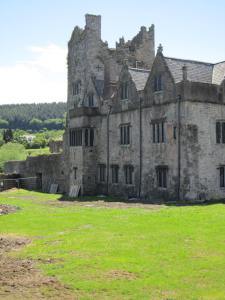 It is always thrilling to be in Ireland, although during my research trip there were some disappointments. The greatest of these was finding Carrick on Suir, (now known as Ormonde Castle to distinguish it from the town), closed for renovations for the entire year. My advance research somehow did not disclose this, so upon arrival, all I could do was walk around all sides, take pictures, and use my imagination.
[As of this writing, the castle remains closed to visitors due to renovations, but is scheduled to reopen in June, 2017.]
Situated along the River Suir on the east side of the village in County Tipperary, this castle exudes history. It is remarkable for being Ireland’s only unfortified manor house from the Tudor period, and for the quality of plasterworks within. On the river side you see a classic 14th century castle with two towers, east and west, but then it is knitted together on the upland side with a majestic Tudor mansion. (See a tour video here.)
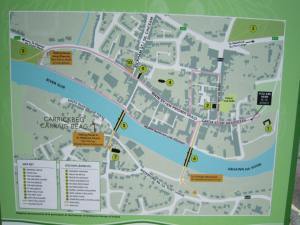
Map of Carrick on Suir shows bend in the river, and castle on far right (black outline)
Carrick means bend or knot, and may have originally referred to the location along a bend in the river, but there is also a famous “carrick knot,” a rope knot having open-ended loops, symbolizing the nautical knot used by boatmen who worked along the river.
The most charming feature of this castle is the mullioned Tudor windows with their many small panes known as “quarries.” There are so many of these beautiful windows, and at one point I could see light all the way through to the opposite side of the house. It’s a rare thing to see a castle that so embraces the daylight. (For more about the history of windows in Ireland, see this wonderful site.)
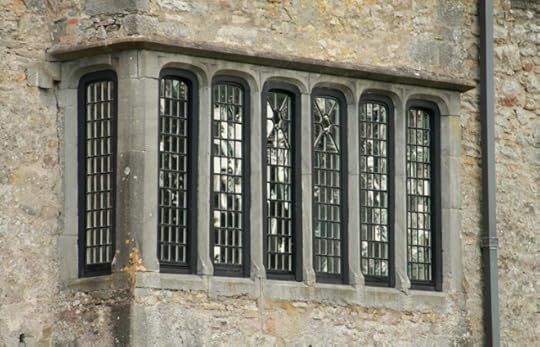
Closeup of mullioned windows, from Lambstongue.ie
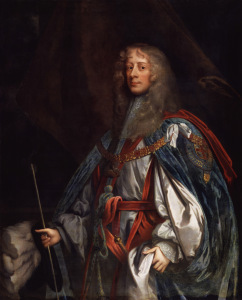
James Butler, 12th Earl of Ormonde and first Duke of Ormonde
Built by Thomas Butler, the 10th Earl of Ormonde (and Queen Elizabeth’s cousin), in the 1560s, the manor house became the preferred residence of James Butler, 12th Earl of Ormonde, later the first Duke of Ormonde, during the 17th century. This is truly saying something, for the Butlers were the second-largest landholders in Ireland and their properties included more than 30 manors and houses. Among their holdings was the famous Kilkenny castle, the seat of power for the Butler family.
The story goes that, shortly before Thomas died, four-year-old James was playing behind the earl’s chair. The old man held the child between his knees and prophesied, “My family shall be much oppressed and brought very low; but by this boy it shall be restored again, and in his time be in greater splendor than ever it has been.” Later events proved the earl’s prophesy to be true, for when James ascended to the earldom he became known as a valiant and honest man, was highly respected by all sides and, among other things he founded the woolen industry. James led the Irish confederates against Oliver Cromwell’s Parliamentary forces in the mid-17th century, and subsequently lost much of the family’s property and wealth, but it was restored during the restoration of King Charles II, and James was created Duke of Ormonde for his loyalty and service to the crown.
Ormond Castle interiors were known for their magnificent plasterwork, and for grand tapestries adorning the walls of the great hall. In my book, The Prince of Glencurragh, a scene takes place in Ormonde Castle, where the Earl, James Butler, receives young messenger Aengus O’Daly who is awestruck by the beauty of the hall and these tapestries, and humbled by the many representations of royalty and power. (I saved a couple of interior images to my Pinterest page on Ireland, but can’t post them here. Follow me there for these and other images.)
Thanks to C.L. Adams’s Castles of Ireland, CarrickonSuir.info, lambstongue.ie, Heritage Ireland, and Wikipedia.
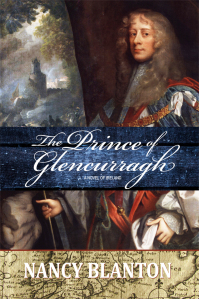 An heiress, a castle, a fortune: what could go wrong?
The Prince of Glencurragh is available in ebook, soft cover and hard cover from online booksellers.
https://books2read.com/u/4N1Rj6
http://www.amazon.com/Prince-Glencurragh-Novel-Ireland-ebook/dp/B01GQPYQDY/
See all of my books and other information at
nancyblanton.com



October 10, 2016
Tracking the Prince: Barryscourt
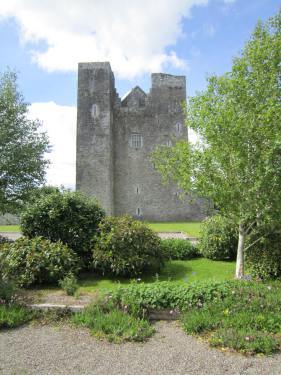 Excitement was to be replaced by disappointment when I first reached the gates of Barryscourt Castle in Carrigtwohill, County Cork. Driving solo from Cashel, I got a bit lost in the vicinity—often there are not good signs, if any, to indicate castle locations—but a petrol station attendant smiled and told me I was just a few blocks away. When I parked, two workmen told me the castle was closed for renovations, but the owner was in the adjacent house and I could tour the gardens briefly if I liked.
As of this writing, the Heritage Ireland website says the castle is closed “until further notice,” so if you want to see the interiors, you may have to rely on other visitor photos, such as the ones in this TripAdvisor site.
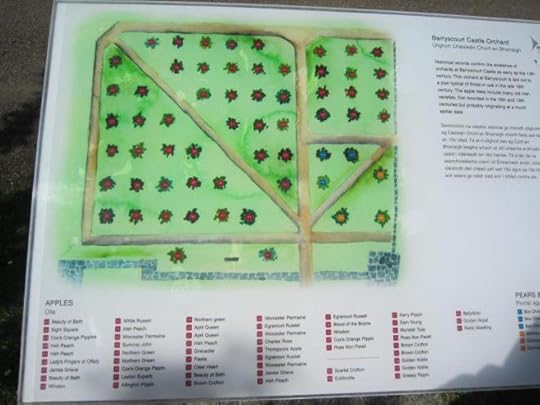 Consequently, there is no scene in The Prince of Glencurragh that is set in Barryscourt Castle. I circled the great Norman tower twice as if hoping to find a secret passage, and then focused on the magnificent garden. Plaques were placed about so that I could identify the plants within the castle walls, a feature that is extremely helpful to an author who lives in another country and manages best with the silk plant variety.
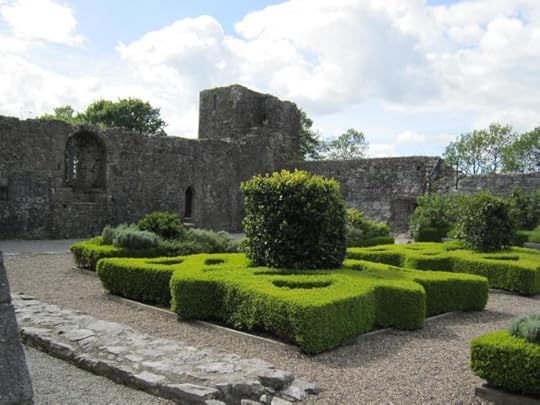 The original castle was built in the 12th century, and the structure I saw was dated for about 1550. The architecture is described as a typical tower house with courtyard and outer bawn or curtain wall, and a “drop-the-prisoner-in-from-the-top” type of dungeon. From the grounds, the castle has the look and feel of the ancient and romantic. I could almost feel the long courtly gown about me, sense the workers bustling in the yard, and imagine stepping through the great wooden door and then ascending a stone stairway to a room in the tower warmed by fire.
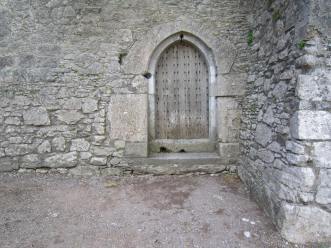 Here had been the seat of the noble de Barry family, to whom King John in the 12th century awarded baronies in South Munster province in return for service in the Norman invasion of Ireland. In this time, English landholders often intermarried with the Irish and relished their autonomy, so far removed from the king’s influence. In later years, when Henry VIII wanted to exert his authority, the Barrys supported the Desmond Rebellions. In 1680 they set fire to Barryscourt themselves rather than see it captured by Sir Walter Raleigh and his English troops. But the Barrys later submitted, and Queen Elizabeth pardoned them after the rebellions were suppressed. Barryscourt was repaired, but external walls still bear the scars of cannon fire.
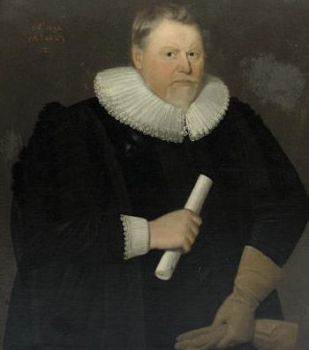
David Barry, 1st Earl of Barrymore, 1636
In The Prince of Glencurragh, my focus is on David, the first earl of Barrymore, who fell to obscurity after the Desmond wars, and was rescued from it by the Earl of Cork who saw a noble-blooded match for his young daughter, Lady Alice. David would later build Castle Lyons, a reputedly beautiful castle that became the Barry seat in 1617, but burned down in 1771. In the novel, this earl has promised to support the protagonist, narrator, and two Barry relatives in their abduction of an heiress for the protagonist to wed.
The Barrymore titles in Ireland became extinct after the death of the last earl in 1823. But the name is not extinct at all to Americans, who are familiar with the names if not the theatrical careers of Maurice, his children Lionel, Ethel, and John, grandson John, and great-granddaughter Drew. While they might have owned castles, these Barrymores are not descended from the Irish clan. Born in British India, Maurice Blyth took his stage name Barrymore as his surname when he immigrated to the United States from England in 1874.
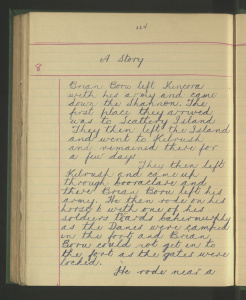 Perhaps as consolation for not getting to tour Barryscourt, in my research I stumbled across this site, http://www.duchas.ie/en, which is digitizing the national folklore collection of Ireland. It’s not an easy browse for gems, i.e. no photo gallery, but you can find handwritten accounts of people, events and places from Ireland’s own. I downloaded part of a story about Brian Boru, the famous Irish king of the 10th century, written by a schoolgirl, and realized even her cursive handwriting is a treasure, soon perhaps to go the way of tower house castles, and my mother’s shorthand.
Thanks to C.L. Adams’s Castles of Ireland, Castlelyons Parish website, Heritage Ireland, and Wikipedia.
An heiress, a castle, a fortune: what could go wrong?
The Prince of Glencurragh is available in ebook, soft cover and hard cover from online booksellers.
https://books2read.com/u/4N1Rj6
http://www.amazon.com/Prince-Glencurragh-Novel-Ireland-ebook/dp/B01GQPYQDY/


October 3, 2016
Tracking the Prince: Rock of Cashel
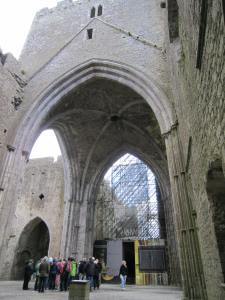 After a cup of tea and a lemon bar in Kanturk, I proceeded east on the N72/N8 to the town of Cashel (from the Gaelic caiseal meaning stone fort), in County Tipperary. I’d been to Cashel with my family when I was 14 years old, to see the great Rock of Cashel: “a maze of architectural ruins spanning many centuries” according to the Irish Cultural Society.
I remembered little about this historical site except that the great cathedral was enormous, the structures intimidating, and all built on a rock promontory rising more than 300 feet high to overlook miles of lands that surrounded it. Impressive story, yes, and unforgettable architecture, to be sure, but now I needed specifics about its history, its layout and many more details.
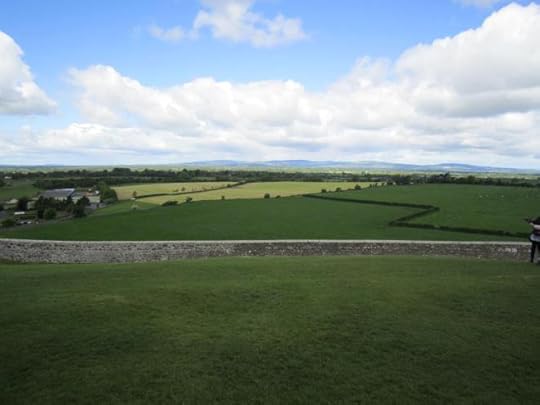
The view from The Rock of Cashel (author’s photo)
Centrally located in the southern half of Ireland, legend has it that the promontory was created when the Devil took a bite out of a nearby mountain and the great chunk of rock fell from his mouth. Structures at this location date back to the fourth century, and later the Rock of Cashel became the seat of the Munster kings, including Brian Boru who in the 10th century unified all of Ireland under his rule—until 1014 when Vikings killed his son and him at Clontarf.
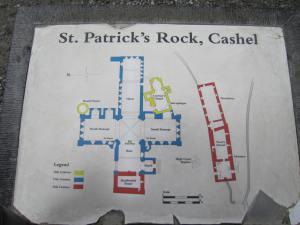
Cashel is also called St. Patrick’s Rock, where the saint converted a pagan king to Christianity around 450 AD
The round tower, built in 1101, was designed for protection from Vikings, with its door 12 feet off the ground and a ladder that could be pulled inside in case of attack. Cormac’s tiny chapel was started in 1127.
In the late 13th century, the site was deeded to the Catholic Church, and Saint Patrick’s Cathedral was built on the foundation of an older one. After King Henry VIII split from the Catholic Church and established the Church of England, he appointed his own bishops, as did his daughter Queen Elizabeth in later years.
“
In the wind swept silence one can feel the spirit of the ancient chieftains, kings and bishops of Ireland who once lived and worked here.”
–James Conroy
After the English civil war when Parliament emerged victorious and King Charles I was beheaded, Oliver Cromwell brought his army to Ireland to crush the Irish rebellion once and for all. Starting in Drogheda in 1649, his march was brutal and bloody, and the cruelty of it remains controversial even today. Cashel was one of several villages sacked by Cromwell’s troops. When Catholic soldiers and town’s people sought refuge in the cathedral, Cromwell recognized no sanctuary, ordered his troops to pile turf around the cathedral and set it afire, killing all within.
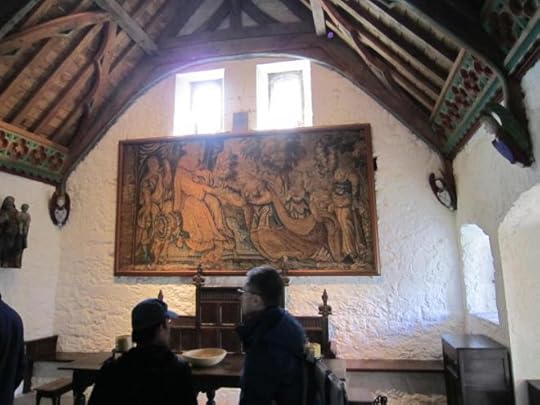
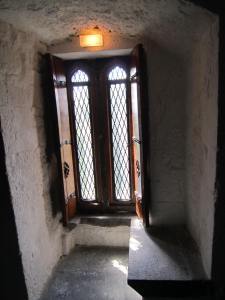 Across the courtyard from the cathedral is the vicar’s choral, including kitchen and dining hall for the men who assisted with cathedral services. This has been restored to serve as a museum. The dining hall is quite beautiful with dark ceiling beams, leaded windows and window seats, trestle table and tapestry. This choral became the setting for the mid-point scene in The Prince of Glencurragh, when the earls of Clanricarde, Ormonde and Cork come together to meet with the Lord Deputy of Ireland, Thomas Wentworth, who quickly takes control. Where the roof joins the walls, the decorative under-purlins are carved angels who look down on all below, and whose facial expressions add their own silent commentary.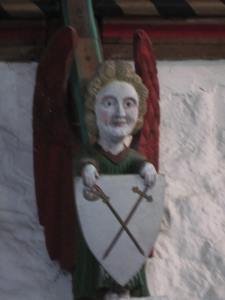
In the mid 18th century the Archbishop had the cathedral’s roof removed. Its lead content was considered valuable in that it could be used for ammunition, and alchemists of the time believed it possibly could be transformed into gold if the right process or catalyst was applied, because both gold and lead have similar properties. That controversial move left the site useful only as a tourist attraction. As this, however, the site is quite successful. Cashel is one of the top three centers of Irish culture.
For beautiful architecture, you may also want to visit the Dominican Friary tucked on the backstreets of the town of Cashel.
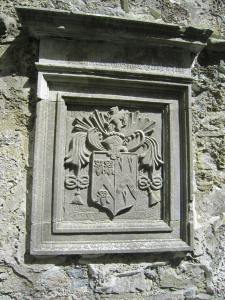 And a side note: While in Cashel I tried to visit Bothán Scór, a peasant cottage known locally as “Hanley’s,” that traces its history back to 1623. I hoped to see an accurate example of cottage life from that time. The tiny thatch-roofed cottage had a single window but it was blocked, preventing my view inside. You can see the cottage from the street, but according to the tourist office only one man has a key to the door, and they were unable to find him before I had to leave the town. This was the first of a few unfortunate missed opportunities during my travels. If you go and are able to see it, please tell me about it!
Thanks to The Irish Cultural Society of the Garden City Area; the Heritage and Tourist Office; Wikipedia; no thanks to the car park for Bailey’s Hotel!
An heiress, a castle, a fortune: what could go wrong?
The Prince of Glencurragh is available in ebook, soft cover and hard cover from online booksellers.
https://books2read.com/u/4N1Rj6
http://www.amazon.com/Prince-Glencurragh-Novel-Ireland-ebook/dp/B01GQPYQDY/
See all my books and sign up for the newsletter here.


September 26, 2016
Tracking the Prince: Kanturk Castle
Today I begin a series featuring sites I visited in Ireland while researching my second novel, The Prince of Glencurragh. This book takes place in mid-17th century Ireland, when castle towers are losing their significance and the order of the day for the rich and powerful is a grand, fortified manor house that demonstrates their wealth and importance.
I had mapped out 15 locations prior to my trip, so the series will cover each of these. Readers of The Prince can follow along using the map included in the book. I ended up using nearly all of the locations in some way, whether as an actual location for a scene in the story, or to inform something else.
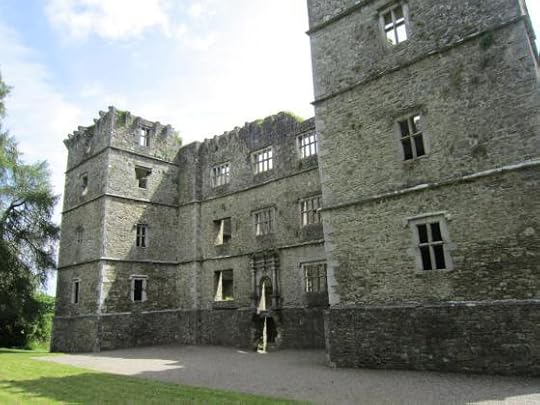 Kanturk Castle was my first stop after arriving in Shannon. The structure inspired my vision for Castle Glencurragh, a fictitious castle near Skibbereen, County Cork, which is the dream and ambition of the protagonist.
Kanturk Castle is situated in north County Cork, just off the N72 about nine miles west of Mallow, along the Dalua river, a tributary of the Blackwater. It is named for the nearby market village Kanturk that existed centuries before the castle. While the name sounds exotic and mysterious, it actually means “the boar’s head” (from the Gaelic Ceann Tuirc).
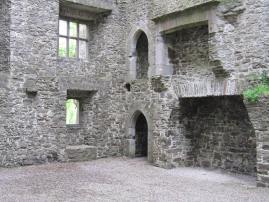 To me, the remarkable thing about this enormous and beautiful fortified manor house, and why I felt compelled to see it, is that it was the envy of all who saw it during construction, and yet it was never completed.
Built by Dermot McDonagh MacCarthy starting around 1609, it is rectangular with corner towers standing five stories high. It is filled with magnificent fireplaces on each floor, large mullioned windows, arched doorways and a striking main entrance with Ionic columns on each side.
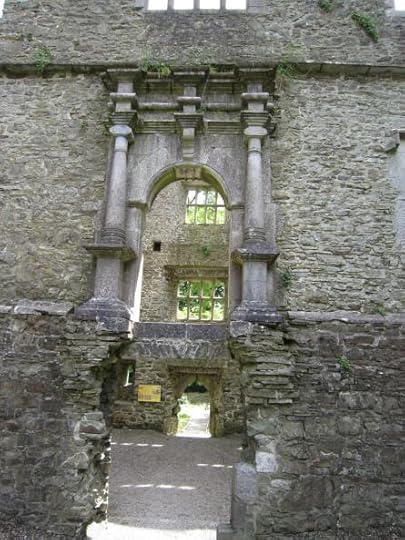 (For a very detailed account of the castle with far better photos than mine, please see The Irish Aesthete.)
One legend about the castle is that all the stonemasons happened to be named John, and so originally the castle was known as Carrig-na-Shane-Saor (the Rock of John the Mason). Another story I came across was that during construction, MacCarthy needed free labor, so he and his men snagged travelers passing by, put them to work as slaves, and would not release them until they had worked on the castle for a year.
Why the castle was never completed remains something of a mystery. Some accounts claim that English settlers were concerned that the size and fortification of the castle signaled more rebellion from the Irish, and the Privy Council of England halted construction. MacCarthy was so incensed, he had the blue tiles on the castle roof torn away and thrown into a stream. Other accounts hold that MacCarthy simply ran out of money to continue.
When MacCarthy’s son, Dermot Oge, succeeded him, Kanturk and the lands around it were heavily mortgaged. Dermot and his own son were killed during a Cromwellian battle in 1652, and at the end of the confederate war Kanturk Manor was awarded to Sir Phillip Perceval, an English Protestant. Sir Phillip’s descendant, Sir John Perceval, was a successful parliamentarian, named Baron of Burton, County Cork, in 1715, Viscount Perceval of Kanturk in 1722, and Earl of Egmont in 1733.
And this brings me to a very personal connection to the story.
In 1932, Kanturk was donated to the National Trust by Lucy, Countess of Egmont, the widow of the 7th Earl of Egmont who was killed in a car crash in England. Her conditions were that the castle be kept as a ruin, as it was at time of hand-over. It is designated as a national monument.
When I visited, I saw a lovely, well-kept place where the locals walk their dogs, just as I often walk my dogs along a beautiful street with a beautiful name: Countess of Egmont—on an island more than 4,000 miles away.
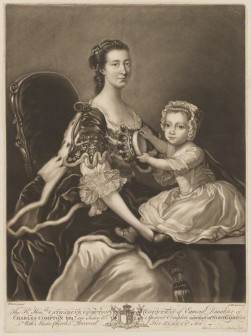
It turns out that Sir John Perceval, the 5th Baronet of Kanturk and the 2nd Earl of Egmont, obtained a king’s grant for properties in northeast Florida during a brief period around the 1770s, when Spain ceded the lands to Britain in an exchange for lands elsewhere. Amelia Island was then called Egmont Island, where the Earl and Lady Egmont owned a large indigo plantation. The island was later renamed Amelia in honor of the daughter of King George II of England.
The portrait:
Catherine Perceval (née Compton), Countess of Egmont; with Charles George Perceval, 2nd Baron Arden;
by James Macardell, after Thomas Hudson, mezzotint, published 1765, NPG D2382
Thanks to: History from Mr. Patrick O’Sullivan’s summary on Historic Kanturk website (Kanturk District And Community Council); Britain-Ireland-Castles.com; The Irish Aesthete; and the Amelia Island Museum of History.
An heiress, a castle, a fortune: what could go wrong?
The Prince of Glencurragh is available in ebook, soft cover and hard cover from online booksellers.
https://books2read.com/u/4N1Rj6
http://www.amazon.com/Prince-Glencurragh-Novel-Ireland-ebook/dp/B01GQPYQDY/


September 5, 2016
Looking into Dublin Castle
The first time I visited Dublin Castle, I was just 14 years old. My family was a long way from our Florida home, and I was so consumed by the excitement of it all that now I hardly remember it. (I do remember my sister plopping me into a bathtub after I consumed way too much mead.)
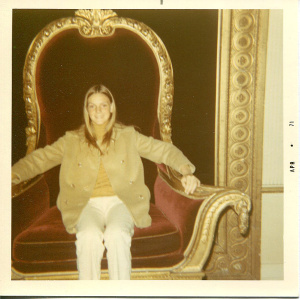 Now I wish I’d had a better head on me, for the castle will be the primary setting for my next book. Research already had begun last month when my sister unearthed this picture of me on the throne. Is it any wonder that I’m drawn to Irish history as much as I’m drawn to write?
What tourists see today is not the Dublin Castle of my story, however. Founded by King John in 1204 for the defense of the city, the original castle had a circular tower and strong walls around a broad square that was filled with wooden structures for the business of castle daily life. But most of this was lost to fire in 1684.
The tower survived, and around it a new Georgian Palace was built to house government offices and activity, house the Lord Deputy, and host state dinners and other events.
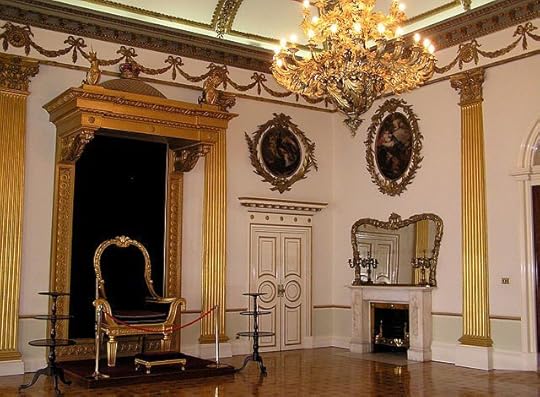
The throne room looks unchanged except for the rope that now keep kids like me off the velvet cushions (Wikimedia Commons)
Today the castle is quite a sprawling complex that even offers a conference center. Visitors can tour historic State Apartments, including St. Patrick’s Hall, the throne room, dining room, bedrooms, and state corridor. They can also seem some remnants of Medieval life, and much more of modern life.
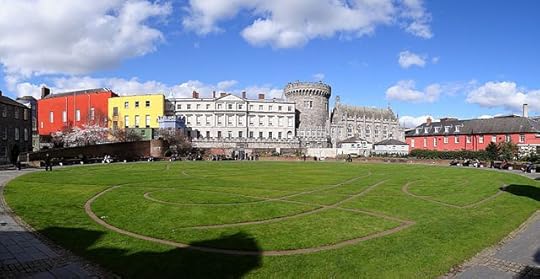
Dublin Castle, back view with garden. (Wikimedia Commons)
But I will be looking for the Castle of the 1630s and 40s, just prior to the Great Rebellion of 1641. The story I’m researching centers on the Lord Deputy of Ireland, Thomas Wentworth, the First Earl of Strafford. He was vice regent for King Charles I, and did much to fill the king’s treasury during his tenure in Ireland, but managed to enrich himself at the same time. He offended many a powerful earl in the process, and this ultimately led to his downfall and execution in 1641.
The resulting book will be a sequel to The Prince of Glencurragh, a novel published last month:
As the son of a great Irish warrior, Faolán Burke should have inherited vast lands and a beautiful castle, Glencurragh. But tensions grow in 1634 Ireland, as English plantation systems consume traditional clan properties, Irish families are made homeless, and Irish sons are left penniless. Encountering the beautiful heiress Vivienne FitzGerald, Faolán believes together they can restore his stolen heritage and build a prosperous life. Because the Earl of Cork protects her, abduction seems to be his only option.
But Vivienne has a mind of her own; the adventure that begins as a lark takes a dark turn, and plans go awry. Faolán finds himself in the crossfire between the four most powerful men in Ireland—the earls of Clanricarde, Cork, Ormonde, and the aggressive new Lord Deputy of Ireland—who use people like game pieces. With events spiraling beyond their control, what will become of Faolán, Vivienne, and the dream of Glencurragh?
Available in hard cover, soft cover and e-book.
Sign up for the Goodreads Giveaway now through Sept. 10. Or, purchase it today and embark on the adventure!


August 29, 2016
Giveaway: The Prince of Glencurragh
Sign up today on Goodreads and be eligible to win one of six free copies of The Prince of Glencurragh, my latest novel of 17th century Ireland. This book is a fast-paced adventure filled with action, romance, intrigue and terrible obstacles. Here’s a piece from the hard cover book flap:
Is it possible to reclaim a dream once it is lost to the mists of memory?
Aengus O’Daly is what every good storyteller should be: observant, thoughtful, and inspired by love. He tells the story of his best friend Faolán Burke, both valiant and true, who tries to restore the world of his father’s dreams.
Had he lived to build it, Sir William Burke’s Castle Glencurragh would have been a wonder to all who beheld it. But when he died, all that remained of the castle were a few scattered stones and the indelible image in the mind of his ten-year-old son.
But in 1634 as the boy comes of age, the real world is not the one Sir William knew. As the English plantation system spreads across the province of Munster, Irish families will lose their homes unless they accept the Protestant faith. Farms that have been in their families for centuries now are given to English soldiers as rewards for service.
Even the great stone castles, once both the bounty and protection of the strongest clans, now have fallen against the power of the siege and cannon. Aengus says, “The day of the castle already was gone, be we refused to know it.”
With his whole being, Faolán believes all can be made right again, with perseverance, his love by his side, and with the right and perfect plan.
The Prince of Glencurragh is set in 1634 prior to the great rebellion of 1641. It is a stand-alone prequel to my first novel, Sharavogue, which won first place for historical fiction in Florida’s Royal Palm Literary Awards. Both books are available on amazon.com and barnesandnoble.com. Visit my website for more info, at nancyblanton.com.
The Giveaway ends September 10, 2016.


August 21, 2016
Dreams and disasters in 17th century Ireland
Today’s post is reblogged from a guest post on Mary Anne Yarde’s blog, “Myths, Legends, Books and Coffee Pots,” (maryanneyarde.blogspot.com). In honor of the official publication of my new novel, The Prince of Glencurragh, this story is about life in 17th century Ireland.
Rife with conflict, disaster, invention and sweeping change, there is not a century in history more fascinating and remarkable than the 17th.
In the words of J.P. Sommerville, University of Wisconsin history professor, the 17th century is “probably the most important century in the making of the modern world. It was during the 1600s that Galileo and Newton founded modern science; that Descartes began modern philosophy; that Hugo Grotius initiated international law; and that Thomas Hobbes and John Locke started modern political theory.”
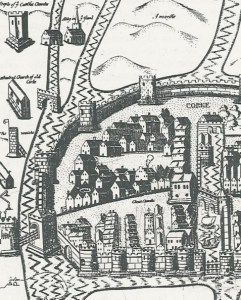
Image of a walled town from the Cork City Library
At the same time, the century produced an unprecedented synergy of disaster, as described by Robert Burton in 1638: “War, plagues, fires, inundations, thefts, murders, massacres, meteors, spectrums, prodigies, apparitions…and such like, which these tempestuous times affoord…” And all of that during the first few decades.
Some historians believe the changes and difficulties of this century resulted in part from a global climate change. The “Little Ice Age,” extending from the 16th to 19th centuries, delivered a particularly cold interval in the mid-17th century.
England in the 1630s recorded great floods, widespread harvest failure, intense cold winters, wet and cold springs, and drought in summer so excessive that “the land and trees are despoiled of their verdure, as if it were a most severe winter.” Such conditions would have been seen in Ireland as well.
These natural forces so affected human activity as to upset the existing social, economic and political equilibrium. People facing cold, famine, and grave uncertainty are likely to behave in more desperate manner.
Ireland in particular faced considerable unrest as the lands, traditional clans and centuries-old way of life were forever altered.
Life in Ireland
In 1603, Queen Elizabeth I died, leaving her throne and kingdom to James I. Her military forces in Ireland had delivered a crushing blow to end the Desmond rebellion in the southwest province of Munster.
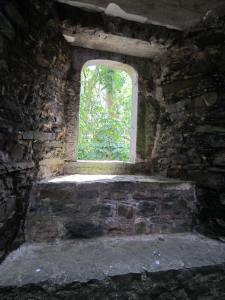
Inside a castle ruin, Kanturk, Co. Cork
The English saw Ireland as underutilized and ripe for exploitation. They sought to improve on Irish farming methods by settling their own more efficient farmers, and thereby increasing crown revenues.
The Earl of Desmond was among the Irish gentry who held castles, manor houses and vast tracts of land. They were mostly of Norman or Saxon roots, descending from distinguished families or clans who had obtained grants from Henry II in the 12th century. They resented the crown’s efforts to take control of their long-held dominions and displace their Irish tenants: typically subsistence farmers who paid rents either in food or in coin from the goods they sold. Often these tenants lived in one-room houses constructed of mud and grass, with no windows and a single door that served as both the entry and chimney.
Lord Deputy Arthur Grey seemed to defeat Queen Elizabeth’s purpose with his cruelty and scorched earth tactics. He left the province devastated, little more than a wasteland that would require years to recover, and was later removed from his position for excessive brutality—but, he had cleared the way once and for all for English settlement.
In a land already compromised by drought, the remaining Irish faced terrible famine, plague, disease, homelessness and oppression. Lands that had been owned and passed down through generations by traditional clans, especially Irish Catholic, were confiscated and granted to English military officers as reward for their service. Survival for the Irish was tenuous and choices were few. Some restoration took place in the coming years, but a fury simmered below the obedient surface.
In 1625, Charles I succeeded his father and extended his policies, filling his treasury through increased taxation and monopolies to his favorites, and expanding plantation in Ulster. When civil war erupted in England, Irish clans welcomed the distraction. They organized and rebelled again, retaking confiscated lands and ousting the English settlers, often violently.
When Parliament was victorious in the civil war, it took control of England and all of its business, and shocked the monarchies of the world by executing King Charles in 1649.
Parliamentary army leader Oliver Cromwell now turned his attention to Ireland, cutting an unrelenting swath of brutality, destruction and death across the island. Towns were leveled, people massacred, and terror wrought with full force. One estimate claims 618,000 Irish deaths from fighting or disease—an astounding 41 percent of the pre-war population.
Surviving Irish were relocated to rocky hills that served better for grazing sheep than growing crops. Some joined armies and fought in foreign wars; some became pirates. Some were sent to workhouses where they likely died; some escaped to colonies in America. Cromwell deported many to the West Indies where they perished from slave labor and tropical disease.
Irish Catholics were forced out of the Irish Parliament, while Catholic Mass and the Irish language were outlawed. Catholics were banned from holding office, Catholic clergy were expelled from the country, and Catholic landowners were stripped of their properties. An estimated one-third of the Irish-Catholic population was killed or deported.
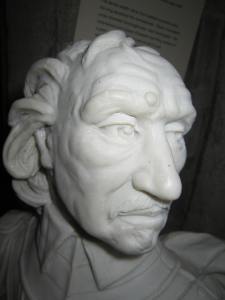
Bust of Cromwell from the Cromwell Museum, Huntingdon.
On the heels of this work, Cromwell was elevated to “Lord Protector,” England’s uncrowned king, and he established his famed Commonwealth. Oppression of Ireland was severe and would be seen by historians as genocide. But by the time of Cromwell’s death in 1658, England had tired of his Puritan influences, and his son proved a weak successor. Charles II was brought back from his exile in France and monarchy was restored.
While somewhat kinder and more tolerant toward the Irish who had supported his return, including the Earl of Ormonde who had led the royalists in the Irish Confederacy, the plantation of Ireland continued. Known as the Merry Monarch, Charles II restored some of the gaiety that had been lost to England, and smoothed the way for new thought, invention and discovery in the latter part of the century as the Age of Enlightenment was dawning.
(Geoffrey Parker’s Global Crisis was a valuable source for this post)
The Prince of Glencurragh is set in 1634 prior to the great rebellion of 1641. It is a stand-alone prequel to my first novel, Sharavogue, which won first place for historical fiction in Florida’s Royal Palm Literary Awards. Both books are available on amazon.com and barnesandnoble.com. Visit my website for more info, at nancyblanton.com.


August 14, 2016
Sex Appeal and the Earl of Ormonde
Today’s post is reblogged from a guest post on Mary Anne Yarde’s blog, “Myths, Legends, Books and Coffee Pots,” (maryanneyarde.blogspot.com). In honor of the official publication of my new novel, The Prince of Glencurragh, this story is about one of my inspirations.
While researching 17th century Ireland for my historical novel, The Prince of Glencurragh, I was stopped in my tracks by an arresting portrait of James Butler, the 12th Earl of Ormonde and the 1st Duke of Ormonde.
Ascending to earldom in 1634 at just 24 years of age, this earl became the Royalist leader of the Irish confederate forces in 1649, uniting the old English nobility, Catholics, and Irish rebel soldiers in a passionate stand against English dominance that was doomed to failure under the boot of Oliver Cromwell and his army.
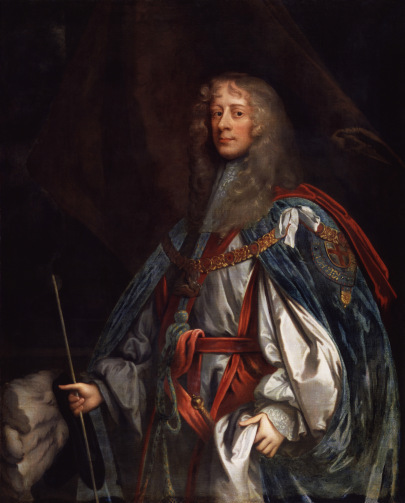
1st Duke of Ormonde by Sir Peter Lely (circa 1665) Public domain, Wikimedia Commons.
The portrait captures an older Ormonde, looking magnificent in ceremonial robes as he is created the first Duke of Ormonde. He wears white satin trimmed in red and blue. Delicate hands grasp lance and sword; his jaw is proud, his eyes soulful and knowing. The long golden locks affirm his noble stature and remind me of a young, proud-faced Roger Daltrey, out to change the world in his own particular way – perhaps with similar sexual energy but without Daltrey’s penchant for fisticuffs.
No less appealing would have been James’s enormous wealth and power. He was born into a family tracing back to the Norman Invasion in the 12th century. His ancestor, Theobold Walter, was named Chief Butler of Ireland, and thus the name stuck as a surname and reminder to everyone of the family’s prominence and favor under King Henry II. The family seat became the great Kilkenny Castle from which they controlled the vast kingdom of Ormonde (basically including counties Waterford, Tipperary and Limerick).
Ormonde landholdings in southwest Ireland were second only to the Desmond earldom by the 14th century. Rivalry and skirmishes between the two earldoms escalated into a private war in the 1560s, one that infuriated Queen Elizabeth I, and in part led to the first Desmond Rebellion in 1569.
When James’s father Thomas died in a shipwreck in 1619, James became the nine-year-old heir to his grandfather Walter Butler, the 11th Earl of Ormonde, and was given the courtesy title of Viscount Thurles. Walter was a devout Catholic, much to the dismay of King James I who schemed for Protestant control of Ormonde estates, imprisoned Walter for eight years, and sent James to be schooled as a Protestant by the Archbishop of Canterbury.
When the earl was released in 1625, most of his estates were restored to him. James went to live with him at his house in Drury Lane, London.
While in London, James learned the Irish language, which was to serve him well later in life; and also met his cousin Elizabeth Butler, daughter of Sir Richard Preston, Earl of Desmond. Their marriage in 1629 ended the long-standing feud between the two families.
When his grandfather died five years later, James became the earl. In 1642, he was named the Marquess of Ormonde; and, after living with the king in exile during the Commonwealth years, in 1661 Charles II created him the first Duke of Ormonde.
But wait, there is even more to Ormonde’s appeal. Most of my research has focused on James’s early life, and my favorite story thus far is about his first attendance of the Irish Parliament in 1635. The new Lord Deputy of Ireland, Thomas Wentworth, called the Parliament under King Charles I’s authorization, and was proud to have Ormonde on the roster.
In his biography of Wentworth, C.V. Wedgwood describes James Butler as a “high-hearted” nobleman: “Handsome, intelligent and valiant, he was also to the very core of his being a man of honor: loyal, chivalrous and just.”
And let’s not leave out dauntless (aka cheeky). When Wentworth ordered that the wearing of swords in Parliament would not be permitted, Ormonde told the official who tried to take his that the only way he’d get the sword was if it was “in his guts.” Wentworth summoned Ormonde before his council to answer for this behavior, and Ormonde arrived with his earl’s patent from the king. He threw it on the table. The king had made him earl, he said, and for anyone less than the king he would not ungird his sword.
“Wentworth [who was not yet an earl] conceded the force of the argument,” Wedgwood wrote.
Appealing as he was, Ormonde was not always everyone’s hero in life. As the Protestant in the family, he avoided the land confiscations that Catholic family members still suffered, and he was not above evicting Irish tenants if he believed he could earn higher rents from English ones. Still, when Ormonde died in 1688, he was lauded by poets of his time and was buried in Westminster Abbey.
In my novel, Ormonde is featured as a contemporary of the main characters who brings his significant power and influence, his chivalrous mindset, and his own agenda to the story, along with a fierce belief in fairness, justice, and love.
The Prince of Glencurragh, published in July 2016, is the story of an Irish warrior who abducts a young heiress to help restore his stolen heritage and build the Castle Glencurragh. He is caught in the crossfire between the most powerful nobles in Ireland, each with his own agenda. It is the stand-alone prequel to my first historical novel, Sharavogue, which begins with the arrival of Cromwell in Ireland, and follows the protagonist to her indenture on an Irish sugar plantation on the island of Montserrat, West Indies.
My books are available on amazon.com and barnesandnoble.com. You can find more information and links on my website, nancyblanton.com


June 28, 2016
Brand up and be counted
How can you distinguish yourself from other authors in an ever-expanding sea? Read my guest post today on Where Writers Win, all about brand positioning for authors:
Based o n my book, Brand Yourself Royally in 8 Simple Steps.
For more information, visit my website,


June 17, 2016
Dreams and Disasters in 17th Century Ireland
What was life like in 17th century Ireland?
See my guest blog post one Mary Anne Yarde’s blog, Myths, Legends, Books & Coffee:
http://maryanneyarde.blogspot.co.uk
And if you love what you read, you can pre-order my ebook set in the time period, on amazon.com, and it will be delivered to you in mid-July. Soft and hard cover books available in August.