
Peter Hitchens's Blog, page 154
August 26, 2016
Radio 4's Debate on Prison
This debate can now be heard here
www.bbc.co.uk/programmes/b07pj2pk
It lasts 45 minutes, and is obviously edited down from a far longer recording. I make no complaint ( if I cannot take a joke, I shouldn't have joined). I merely point out the difference in nature between my contributions and those of practically everyone else who took part.
These are, in my view, twofold. My use of language is incomparably more direct and concise than that of my fellow panellists or of the presenter. Two the principal concern of everyone else on the programme was the effect of prison on its inmates. While this is a matter of importance (and I did not and do not ignore it) this is far less important than its effect on potential wrongdoers, who are deterred from wrong by fear of prison, and on those many people who will become victims of crime if prison fails to deter - and who will be spared this horror if it succeeds.
I continue to be impressed by the lack of self-seeking in Erwin James's attitude towards his past crimes. And I am sorry we had no time to touch on the subject of prison suicides, a dreadful scourge, and a reflection the despair these places create in many of those confined to them for long periods.
I have also noticed that my unchallengeable factual statement, that most of those in prison are habitual criminals *long before they get there*, a truth which undermines about 90% of the liberal case in itself is (like my unchallengeable factual statements on the non-existent war on drugs) simply ignored by my opponents and never acknowledged, addressed or rebutted.
Such is debate in modern Britain, where moral conservatism is regarded as shocking, counter-intuitive and transgressive (note the point in the debate where my argument about the abolition of the presumption of innocence in many sexual offence cases is dismissed as tangential) .
***AS a footnote, I might add that I was telephoned this morning by an arm of the BBC this morning and asked if I would comment on the French ban on 'Burkinis'. When I said ( as any reader of mine would have expected) that I strongly deplored the ban and that he state has no business telling people what to wear, I could feel the researcher's interest waning down the phone line. Oh, actually, no, they didn't want me after all. As a 'right-wing' person, I had been assumed to have a crude and oppressive view. When I failed to provide one, I had no further use for them.


August 21, 2016
PETER HITCHENS: Gold for Synchronised Sunburn and self-delusion goes to...
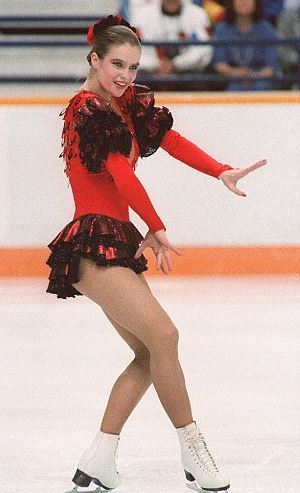 Imagine a country that isn���t very successful, but wants to boost its image in the world. Its economy is rocky, its cities grubby and run-down. Its education system isn���t much good.
So this country spends huge sums of scarce money and great effort to find young men and women who can win medals in international sporting competitions.
It carefully chooses sports where the competition is weak. It relentlessly drives the chosen athletes. And it works. At home and abroad, its image is transformed.
Its national media go into hysterics over each medal.
The people at home forget for a moment the dreariness of their lives.
The anthem plays and the flag flies high.
The country I am thinking of is East Germany, the self-styled ���German Democratic Republic���. You may remember the superb figure skater Katarina Witt, who won Winter Olympic gold medals in 1984 and 1988, and a pile of other awards for her ghastly country in the years just before it collapsed in a cloud of rust.
What did her triumphs prove? Nothing much, except that state power can achieve sporting success. In which case, what is so joyous about it?
If sport is about anything, surely it is about individual achievement, not plans, budgets and political prestige.
What could be further from the burning individual talents and grit celebrated in Chariots Of Fire than some Ministry of Sport fulfilling its medal plan?
But what, deep down, is the difference between this episode and Sir John Major���s dash for Olympic gold which has now paid off in Brazil?
In fact, I think our state-sponsored medal programme may be worse in some ways than East Berlin���s because, as a free society, we had the power to question it and we didn���t.
It might also be worth recalling that Sir John���s much-praised initiative was financed mainly by the Lottery ��� in which a British government for the first time actively encouraged gambling, especially among the vulnerable poor, the main payers of this tax on false hope.
Indeed, Sir John���s legacy of gambling and debt, forced on students in the universities he so wildly expanded, may be his main memorial.
You may say, quite rightly, that I am jaundiced because I couldn���t care less about sport. My sympathies in Rio lie mainly with the empty, wet seats, which beautifully sum up my view of the Olympics.
But even if I were an enthusiast for Underwater Motorcycling, Bovine Ballet or Synchronised Sunburn, or whatever it is we currently lead the world in, I���d still have the same misgivings.
This is what failed and powerless countries do to make themselves feel better.
It is an illusion, and when it ends, things will be worse than they were before.
Tragic Victims of our deal with the devil
 Who can fail to be moved and grieved by the sight of a small child in distress? But please do not let your emotions stop you thinking.
The picture of the shocked Aleppo survivor, Omran Daqneesh, like that of the drowned child Alan Kurdi last year, should not be allowed to enforce a conformist opinion on the world.
The death of Alan Kurdi did not mean that it was wise to fling wide the borders of Europe (as Germany���s Angela Merkel now well knows).
The rescue of Omran Daqneesh should not make us side with the bloody and merciless Syrian rebels.
Why is Aleppo a war zone in the first place? Do you know? I will tell you. Syria was a peaceful country until it was deliberately destabilised by Saudi Arabia and its fanatical, sectarian Gulf allies, consumed with hatred for the Assad government and, above all, its ally Iran.
Worse, this monstrous intervention was supported by the USA, Britain and France, all sucking up to the Saudis for oil, money and arms contracts.
In the hope of bringing down Assad, we made a devil���s bargain with some of the worst fanatics in the Middle East, people who make Anjem Choudary look like the Vicar of Dibley.
We know of Britain���s role for certain because of the very strange case of Bherlin Gildo, a Swedish man accused by British authorities of attending a terror training camp in Syria. His trial collapsed in June 2015 because his defence lawyers argued that the terror groups he was accused of supporting had been helped by British intelligence.
The Assad state, as you might expect, defended itself against its attackers, helped in the end by Iran and Russia.
And the war which followed was the ruin of Syria, whose innocent people found their peaceful cities and landscape turned into a screaming battlefield, as it still is.
If you are truly grieved by the picture of poor little Omran, just be careful who you blame.
Anjem Choudary, broadcasting���s favourite Islamist loudmouth, was and is a vain, bloviating, blowhard fraud, another boozy drug-taking low-life posing as a serious person. He found a role and fools to indulge him, many in the same media who now queue up to rejoice at his imprisonment.
But I do not feel safer from terror now that he is locked up. Worse, I feel less safe from Chairman May���s sour-faced surveillance state, which takes a dim and narrow view of free speech and liberty. Choudary has been locked up not for what he did but for what he said. Claims he influenced anyone into crime are thin. Even the sneaky wording of the Terrorism Act, in which he was charged with ���inviting��� support for IS, is suspicious.
It sounds like ���inciting���, and is meant to, for incitement to terror and murder is a real crime, even in free countries. But it isn���t the same as ���inviting���, a much weaker word. You may gloat that Choudary is eating Islamic porridge. But be careful what you gloat over. A law as loose as this could easily be used against anyone the state doesn���t like. I predict that it will be, too.
By the way, I spent several hours last week circling Government offices trying to find out how many such charges there have been ��� the CPS sent me to the Justice Ministry, they told me to call the Home Office, who sent me back to the CPS. This pathetic pass-the-parcel evasion suggests they don���t care much. This stuff is propaganda, not genuine security.
A few days ago I took part in a recorded BBC debate on prisons, What Point Prison?, which will be transmitted on Radio 4 at 8pm on Wednesday. There was a startling exchange on capital punishment between me and Erwin James, a penitent convicted murderer much admired by liberals, who has now become a distinguished writer on prisons. You may be surprised at what he said.
August 19, 2016
"Now we are few, once we were lots and lots" -Trotskyist Reminiscences
Some readers may be interested in this 'Spectator' article in which I recall the internecine futility of Trotskyist sectarian politics
http://www.spectator.co.uk/2016/08/take-it-from-an-ex-trot-labour-neednt-worry-about-trotskyists/
August 16, 2016
The Hijab versus the Bikini
I am always risking wilful understanding, and have grown to expect it and to be used to it. But it can also be frustrating. A few months ago I commented on the use of a hijab-wearing model by a British advertiser, and said this was significant, as it was. I was subjected to all kinds of thought-police interrogations whose aim was clearly designed to make me confess to some shameful phobia and (quite irrelevantly, since Islam is not an ethnic group but a religion which all may join) ���racism���.
I confess that I became so scornful towards these questions that I said less than I would have done had they asked me intelligent things.
As I am old enough to remember when most Englishwomen covered their heads in public, often with not-very-elegant headscarves tied savagely beneath their chins as they bent to face the drizzle and the east wind, I find all kinds of odd emotions stirred by the sight of the scarf���s return on our formerly bare-headed streets. I certainly don���t feel an unmixed hostility, more a curiosity and a sort of respect.
I don���t know, and cannot tell, how much of the Muslim scarf-wearing is voluntary and how much is forced on women by husbands, imams and indeed the Islamic sisterhood, which ��� having embraced the veil in various forms for whatever reason ��� is no doubt anxious to see others do the same. It���s a kind of conformism. Squads of veil-wearers take to the streets in some Muslim cities, cheerily urging uncovered women to adopt the hijab or the niqab.
Having grown used to it in London, I���m not even especially bothered by the severity of the niqab, the full-face veil with a narrow slit for the eyes , so often wrongly described as a burqa. On a visit to Kashgar in Chinese Turkestan I encountered the most extreme form of veiling, where the women���s heads seem totally covered with fairly thick cloth (they must be able to see out, but it is not obvious how) , and they look shockingly like walking corpses in their shrouds risen from the tomb. That I did find worrying and hard to look at.
But I also wrote the words below about a visit to Iran (to the Shrine city of Mashhad, where I was hospitably invited into several homes where some women were uncovered but others remained veiled). In the case I describe the woman involved, a schoolteacher articulately and rather fiercely defended her style of dress to me. I tried to reflect this in what I wrote:
��� There is more than one Iran, and even the passionately Islamic version should not be dismissed with scorn or distaste, though some of it remains baffling or repellent to us. One of the most articulate and intelligent people I met was a young schoolteacher, the mother of a young child. It was clear that her relationship with her husband was that of an equal. Yet as we discussed propaganda in the classroom, I was greatly struck by her extraordinary, medieval, night-black robes, so intensely sombre that they darkened the well-lit room in which we sat and so emphatically, ferociously modest that they represented an unspoken, passionate argument against secular modernity and all its works.���
In writing that I did not alter by one jot or tittle my absolute opposition to Islamic ideas of marriage or of the legal status of women. These can and do exist independently of any dress code. Nor do I believe that women are necessarily oppressed or repressed by modesty, provided that they choose it for themselves. On the other hand I remain totally unconvinced by those left-wing Western feminists who try to claim that the Muslim dress code is ���liberating���. It certainly isn���t in their terms, and I believe they say this for the same reasons that Ken Livingstone and other British male leftists try to suck up to Islam. They think Islam is just a squad of voters which can be appeased into supporting the left���s project forever.
But it is not. It is a very serious, very determined religion and if, one day , English women find themselves compelled to cover themselves in black shrouds to venture on to the street, it will be because a) we completely rejected any Western philosophy or religion which might have helped us pull back from the wilder bits of the sexual revolution, so ceding that task to Islam, and b) we did not understand just how determined, uncompromising and tough a religion can be , because we no longer have one of our own.
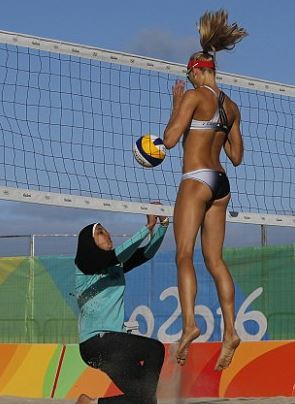
I was thinking of the Mashhad schoolteacher when I wrote my brief few sentences about the Egyptian beach volleyball player Doaa Elghobashy . She says ( see http://www.bbc.co.uk/news/magazine-37009324 ) that her headwear is her own choice, and she seems to have had to battle a bit with the Olympic authorities to be allowed to wear it. Her team-mates remained bare-headed.
I am against this being a divide between the Muslim world and the West. I don���t see why Western women shouldn���t object for their own reasons to the near-nakedness that (in some cases) they now come under pressure to adopt in certain circumstances. Is it really so empowering and liberating? Is it truly voluntary? If we can ask this about the hijab, we can surely ask it about the Beach Volleyball bikini.
I am also convinced that the ���West��� will grow tired of the moral and sexual revolution, which has now been taking place without pause for about 50 years. Such moral counter-revolutions have happened before in human history, or how did the Victorian age come about? And it is almost bound to happen again. Who will lead it? Last time it was people such as John Wesley, whose work came to fruition in Victoria���s reign. If we don���t find his successor, it will be imams who do so.
August 14, 2016
An appearance on LBC on the subject of drugs
Some of you may wish to listen to this appearance I made yesterday on the London commercial news radio station LBC, on the subject of drugs. I had followed an ex-police officer who claims there is 'prohibition' and advocates drug decriminalisation.
http://www.lbc.co.uk/listen-peter-hitchens-says-decriminalising-drug-use-disgusting-idea-135356
An Interview on Current Politics
Some readers may wish to watch this recent interview I gave to Sebastian Cheek of New Media Central.
A speech on BBC impartiality....
This rather long-ago speech has recently emerged on YouTube. I thought some of you might be interested.
https://www.youtube.com/watch?v=q9y37GMLRC0
PETER HITCHENS: Grammar wreckers KNEW they would make our schools worse
This is Peter Hitchens's Mail on Sunday column
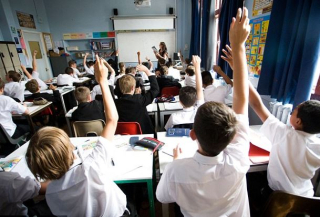 Here's why the quarrel about grammar schools never ends: it is not really about schools, but about what sort of country this should be.
Grammar schools stood for adult authority, for discipline, for tradition, for hard work first and reward afterwards, and for self-improvement. They also tended to assume that boys and girls were different, and so educated them apart from each other. I like these things, but many don���t.
Old-fashioned Labour saw the point of this. They realised that it helped the poor become better-off and to have better lives and more power. They created a peaceful revolution that changed Britain for the better. Labour councils used to build new grammar schools and be proud of them.
But the modern liberal Left don���t like any of these ideas. They would rather teach children how to have sex than teach them to believe in God. Especially they don���t think parents or teachers should have any authority over the young. The State should be trusted to tell them what to think. They should look to the State for any improvement in their lives.
They don���t like the idea that there are fixed things that you just have to learn ��� which is why the teaching of languages and sciences is shrivelling in our schools. The people who smashed up more than a thousand of the best state secondary schools in the world didn���t do it to make education better. They knew it would make it worse for bright children.
In one case, that of Sir Graham Savage, they openly admitted this. They did it to make the country more ���democratic���, more like the USA. They have made it like the worst bits, but very unlike the best bits.
How odd it is to recall that in my childhood there was a thing called the ���brain drain���, which meant British scientists being lured away to the USA because they weren���t educating enough of them. And in those days a set of English A-levels was said to be equal to an American university degree. It isn���t so now. The enemies of grammars really should stop lying about the subject to get their way.
They moan about those who don���t get into grammars. But what about the huge numbers who can���t get into good comprehensives, and are dumped in vast bog-standard comps which are, in reality, worse than the old secondary moderns.
 Of course selection for any school has losers as well as winners. But we have selection in our supposedly comprehensive schools. It is mainly done through the secret privileges (fake religious belief, close knowledge of feeder schools etc) exercised by sharp-elbowed, well-off parents. How is this better than selection by ability?
A 2010 survey by the Sutton Trust found that comprehensive schools in England are highly socially segregated. In fact, the country���s leading comprehensives are more socially exclusive than the remaining grammar schools.
Both the 164 (then remaining) grammars and the 164 most socially selective comprehensives drew pupils from areas where about 20 per cent of children were from poor homes. But the supposed comprehensives were more socially selective, taking only 9.2 per cent of their pupils from poor homes, while the grammars took 13.5 per cent. Who���s democratic now?
In fact, most of the remaining grammars are so besieged by middle-class commuters hiring tutors that their entry figures are utterly distorted. If we still had a national grammar system they would be far fairer than the top comprehensives are.
I wish I thought Theresa May really wanted to restore grammars. This has been successfully done in the former East Germany. But I fear that this is just a token move to try to hold on the support of the many voters who want to see this change. Even so, it is a good deal better than nothing, and a sign that this dreadful national error may one day be reversed.
A modest victory for decency
 Islam���s real challenge to Western society is not terrorism. With a bit of resolve and common sense we can always defeat this filthy thing, and most Muslims would (in my view) be as happy as us if we did.
No, the challenge comes from Islam���s near-total monopoly on things we used to value quite a bit and then totally gave up ��� female modesty being one of them. And yes, I know that plenty of other things, much more controversial, come with the package.
Pictures of Egypt���s veiled and covered Doaa Elghobashy, right, competing against bikini-clad Western opponents in the Olympic beach volleyball, are very thought-provoking.
You don���t have to go more than 100 years back to find Western women who would have had much more in common ��� in attitudes and dress ��� with Ms Elghobashy than they did with her near-naked rivals.
I often wonder if our society will sicken and tire of its seemingly endless relaxation of rules. Such things have happened before. If it does, the Muslim religion may be very well-positioned to lead the counter-revolution. I don���t want this to happen. I just think it might.
*****
Shouldn���t we have a formal ceremony, with parchment documents, trumpets and heralds, to declare that the ���war on drugs��� is over? Then at least Sir Richard Branson would stop claiming tediously and inaccurately that we groan under a cruel regime of prohibition.
If the Government still seriously disapproves of illegal drugs, explain this: EU enthusiast and hereditary Labour politician Will Straw (son of Jack) has been awarded a CBE, a heavyweight mid-ranking honour one down from a knighthood, aged 36, despite being caught (aged 17) trying to sell cannabis to a newspaper reporter. Indeed, for many people this event is the most memorable thing about him.
He went on to boast that he had carried on smoking the drug for the next nine years.
There was a bit of a fuss about the award ��� but it wasn���t about the illegal drugs.
Stop pretending we are actually trying to do anything about this.
*****
Of course judges should not swear in court, especially at defendants. Justice is not emotional revenge, but a cold, rational process where we all try to keep our feelings out of it.
Judges hold the keys to the prisons. They can change a convicted person���s life utterly. To wield such power, they have to be cool and self-controlled.
In fact the person Judge Patricia Lynch swore at is pathetic, fat and lonely ��� a dismal life probably made worse by taking State-approved ���antidepressant��� drugs, the failed panacea of our age. Stupid four-letter words are all that is left to such people.
Her Majesty���s judges shouldn���t stoop to such sad things. Only two kinds of people use this language in public. The powerful, who employ it to bully, and the inadequate, who have no other way of expressing themselves.
If you want to comment on Peter Hitchens, click on Comments and scroll down
August 12, 2016
Send Not to ask for Whom the Bell Tolls. It Tolls for Thee. Thoughts on a Injustice
Wait for it - a new disclosure on the Bell case
I shall explain here two recent developments in the George Bell affair, a disclosure by the Sussex Police (you���ll have to read to the end to find this) and a retreat by the Church of England itself, both brought about by sustained and persistent pressure. But first, a bit of background).
I know that my campaign to win justice for a long-dead Bishop is a cause many of my readers find obscure and incomprehensible. I can only say that, when I first engaged in it last year, it pretty much took over my life during a short holiday in Paris and Amsterdam late last October. It continued to occupy much of my waking time for many months afterwards, invading my thoughts whenever I finished a task.
Around noon each day I would go in search of a railway station or similar place, in the hope of finding the latest edition of ���The Times��� (to which I do not have an electronic subscription) to see if they had printed my letter protesting against their report. I was so furious when I realised that several newspapers and the BBC had treated an allegation against Bishop George Bell as a proven charge that I had to act. I thought ���The Times��� which still at least claims to be a journal of record, would feel obliged to publish my brief epistle. They didn���t.
The best way to Annoy Me
This, as my regular readers might guess, only served to increase my determination. I kept at it. Fraser Nelson at the Spectator, a courageous and individual editor, greatly helped the cause by publishing an article on the case. Eventually, articles defending George Bell and the presumption of innocence (some by me, some by others) appeared in every newspaper, national and local, which had carried the original story. The BBC accepted that it had wrongly imputed guilt to the Bishop. But none of the papers has ever corrected the original stories, which I still regard as inaccurate, describing Bishop Bell as a child molester without qualification. The Independent Press Standards organisation (IPSO) and the Scott Trust (which claims to be the independent tribunal governing The Guardian) have completely failed to enforce what I regard as proper standards of reporting. The simple principle, that nobody is guilty of a crime until he has been proven to be before an independent jury, just doesn���t apply to the dead ��� even as in this case when the accusation is solitary, ancient, uncorroborated and anonymous. My quest was never for compensation, was entirely disinterested personally. Yet I could get nowhere, however clearly I made the point that the distinction between accusation and conviction was absolute and a matter of fact, and that several papers and simply ignored it.
I can see why in some cases the cloud of witnesses against the accused is so great that it is at least reasonable to act as if some sort of trial had been held. I would never wish George Bell or his case to be linked in the public mind with such a person as ���Sir��� Jimmy Savile, a person whose reputation, such as it was, was of no great value to the country. But abusers seldom have only one victim, and the Bell case has been so widely publicised ��� locally and nationally - that I think there is some significance in the absence (so far) of any other accusation against him in the 10 months since the charge was first revealed.
A Prickly Occasion
Why did I bother with all this? I had, a few years before, nominated Bishop Bell for BBC Radio 4���s ���Great Lives��� series, a slightly prickly occasion as I was then on rather poor terms with its presenter Matthew Parris.
http://www.bbc.co.uk/programmes/p01705q9/p01704t1
I think both of us simply decided to put the issue behind us, Matthew probably because he had forgotten about it and me because I can seldom keep up a grudge for very long (I had thought that Matthew had misrepresented me on a public occasion. I still do. But it matters less now).
George Bell is important to me for two reasons.
Not a Pacifist
First, because I have come to be more and more convinced that the bombing of German civilians by British forces in the Second World War was morally wrong and should not have taken place. In the course of many arguments with readers about this, I am often chided with the words ���You weren���t there at the time!���. To these, I could reply that George Bell was (indeed, bombs fell close to his Brighton home during the war, and he was no pacifist. His chaplain in the late 1940s, a decorated Naval veteran, has attested to this, and two of his brothers died in the trenches in the 1914-18 war) .
Bell is also innocent of being any kind of Nazi sympathiser. He had loathed and known about the foul actions of Hitler far longer than most, and more effectively than many. He was one of the most enduring friends of the German resistance to Hitler, a constant help to those seeking refuge from Nazi persecution, including many Jews who had converted to Christianity. He was also in touch with those who eventually tried to assassinate Hitler in the ���July Plot���, and secretly told Anthony Eden of this plan. He had first tasted unpopularity when, in the early months of war, he spoke up for German refugees from Hitler, many of them anxious to fight against their own country, who were stupidly interned by Winston Churchill in a frenzy of suspicion and war panic. Bell always knew the difference between a German and a Nazi, however high emotions were running. And, at the time, knowledgeably, rationally and at some cost to himself, he opposed the bombing of civilians. Thus I could say to my pro-bombing critics: ���George Bell was there at the time. And he was against it���.
Secondly, he matters because, in an era when the Church of England is regarded as a shambling relic, unclear on any major issue, George Bell showed how an established, Broad Church could and should speak with an uncompromising moral voice, and how even its comfortable leaders, lapped in the peace and tranquillity of ancient cathedral closes, could speak uncompromisingly for justice against injustice.
But it think his old Church, with its modern political obsessions, has forgotten him. I also think it does not understand English law. This is common. Until I researched my book ���A Brief History of Crime���, I only had a sketchy grasp of the working of the jury system and the significance of such things as the presumption of innocence. I knew the effect of these things on reporting rules, as all trained journalists must. But then again, I was never involved in publicly accusing (let alone condemning) anyone for a serious crime.
Bishops don't understand the Law
The C of E seem genuinely to have thought that it was personally offensive and cruel *to the accuser* to question an accusation. They seem genuinely to have the idea that an accusation of child abuse has a special status in law, such that the accused has to prove his innocence.
This is quite understandable. You could easily get that impression from the actions of the police and the courts.
This was the origin of the Bishop of Chelmsford���s untrue statement in the House of Lords in this debate
https://hansard.parliament.uk/lords/2016-06-30/debates/16063032000573/HistoricalChildSexAbuse
that ���some in the George Bell Group ���had made hurtful comments about [George Bell���s accuser]. None had . The claim was untrue. But it took weeks of correspondence with the Bishop and questioning of the C of E press office, which joined in uninvited by me, to achieve the following:
Shifting their Ground
The press office began to shift their ground when they said ���In answer to your question, I can clarify that when Bishop Stephen said in the House of Lords that ���some in the Bell Group had made hurtful comments��� about ���Carol���, it would have been more precise to say that these were comments that she found hurtful. I know Bishop Stephen is happy to be quoted as such, and also happy to acknowledge that he did not intend to suggest that legitimate questions about this case could not be posed by all sides. I hope that was apparent by the tone and content of the rest of his speech where he endeavoured to take seriously and listen carefully to the concerns being raised. Of course in this process people get hurt, even if no hurt was ever intended.���
This was obviously untenable. To say that somebody was allegedly upset by the impersonal challenging of her testimony by others is utterly different from saying that those others had made objectively hurtful remarks about her. It is not a ���clarification��� to shift from one to the other, but a complete alteration in meaning, which by implication reveals that the words spoken were not true.
And it did not stand. Soon afterwards I received this communication ��� [The Bishop of Chelmsford] acknowledges that what he actually said was mistaken, hence the clarification explaining what he meant to have said but he stands by everything else in the speech. He is happy to be quoted on all of that. When the new parliamentary term begins he promises to look into how a proper clarification can be produced.���
I shall, all may be sure, be looking out for this ���clarification��� at the earliest practicable moment. The Hansard account badly needs to be corrected.
The other things he said were expressions of opinion, and standard Lambeth Palace boilerplate (which mainly consists of a refusal to discuss the details of the secret kangaroo court which condemned George Bell without hearing any defence of him and then decided to publicise this condemnation.
The C of E, I noted, was highly sensitive about the way I approached this episode. Yet I have never seen it complain about the way that media reported its October 22 document as if it had declared George Bell guilty ��� when it had not done so. I defy anyone to find an unequvocal declaration of guilt in the document : https://www.churchofengland.org/media-centre/news/2015/10/statement-on-the-rt-revd-george-bell-(1883-1958).aspxhttps://www.churchofengland.org/media-centre/news/2015/10/statement-on-the-rt-revd-george-bell-(1883-1958).aspx
Indeed, the Bishop of Durham again speaking in the House of Lords http://www.publications.parliament.uk/pa/ld201516/ldh, said at one stage ���In fact, if noble Lords read very carefully the statements that have been put out, they will see that there has been no
declaration that we are convinced that this took place.���
Not Very Noble
Having read it carefully, despite not being a Noble Lord, I absolutely agree with him about this. There was no such declaration in the October 22 statement, even though it was mysteriously reported in several different places as if there had been. How on earth did so many people reach the same wrong impression? Coincidence Theory helps here. Not much else does.
When I publicised this, the Bishop made a strange episcopal U-turn, described here
Lo, it was a ���clarification���! ���Clarification��� seems to be this particular office���s favourite euphemism for backtracking. : ���'Recent media comment regarding Bishop George Bell has focused on my recent contributions made in the House of Lords in response to a question on the Church���s actions in this matter. On reflection I believe my words were not as clear as they could have been and I welcome this opportunity to provide further clarity.'(my emphasis).
As before, the words to be ���clarified��� are perfectly clear already. This is in fact a murkification. It runs : ���Almost three years ago a civil claim was made, raising allegations of abuse by George Bell, the former Bishop of Chichester.
���In response to the claim independent legal and medical reports were commissioned and duly considered. The evidence available was interrogated and evaluated. This led to a decision to settle the claim and to offer a formal apology to the survivor. This decision was taken on the balance of probabilities - the legal test applicable in civil claims.' (PH notes, this is twaddle, the procedures fell far below the level of a civil case, see below) .
'The church therefore, having evaluated the evidence before them, accepted the veracity of the claims before them.' (my emphasis). (PH notes, if this is so, they did not say so anywhere in the October 22 statement). It is also worth noting that the Bishop���s U-turn was announced in his name by the C of E press office, not by the Bishop himself, whose own press office seemed tom know nothing about it at the time and referred queries to Lambeth. The C of E, despite knowing of my interest in this matter, and of my direct interest in the Bishop of Durham���s original statement, did not send the release to me. I found out about it from other journalists to whom it had been sent.
I also asked at the time :
���If the decision was taken on a civil basis why (and how) were the Sussex police recruited to say publicly they would have arrested the late Bishop? The police do not arrest the objects of civil tort claims, even when they are alive.���
This was in response to the Church���s claim, made defensively some time after the original denunciation, that their finding against George Bell was on a civil basis (���balance of probabilities���) rather than the criminal one (���beyond reasonable doubt���). This wasn���t true anyway. A civil hearing requires the judge to hear both sides of the case, and the defendant or his lawyer can cross-examine witnesses against him. Bell had no lawyer representing his sole interests at the hearing. And the burden of proof still rests on the plaintiff. The secret judges in this case who ���found no reason to doubt��� the claims against George Bell disqualified themselves by this statement. In English law there is *always* reason to doubt any accusation.
Why Were the Police Involved at all - in a civil case?
But if it *was* a civil case, why were the police involved?
Almost every time I took the case up with neutral observers, or with media who had reported accusation as fact, they cited the police statement that they would have arrested George Bell as crucial in persuading them that there was a serious case against him.
This is so in terms of propaganda. But it simply isn���t so in law. An arrest is proof of nothing and is worthless as evidence. Alas, far too few people know this.
So I began to ask how it was that the police were involved at all, in a case alleging crimes committed more than 60 years earlier, against a man who had been dead for more than half a century, and (even if guilty) was no longer any danger to anyone, his ashes having been long ago buried. As far as I could discover, their only statutory duty in the case ( and the Police are a statutory body, who exist by virtue of law) was to record it. Also, had George Bell been alive, they would not have been allowed to name him for fear of prejudice. Practice would have dictated something along the lines of ���Sussex Police last night notionally arrested a 132-year-old Chichester man on suspicion of child-abuse���. But they did name him. They were allowed to, or rather they would not have got into trouble if they had, because he was dead. But they didn���t have to and they could easily not have done so. I have never really got an explanation of this.
I had resolved by this time that I would pursue everyone involved in this business by any lawful or official method available. I put in an official complaint to Sussex Police, on behalf of Bishop Bell���s niece, Mrs Barbara Whitley, who was and remains extremely annoyed by the way in which her uncle���s name has been dragged through the mire . The complaint was rejected - by the Sussex Police, and I was flatly informed (and this is, infuriatingly and surprisingly correct) that this sort of complaint could go no further, and certainly could not be referred upwards to the Independent Police Complaints Commission.
Now, I am not an enthusiast for Police and Crime Commissioners (PCCs). But I felt there was nothing to be lost in approaching Katy Bourne, the PCC for Sussex, and I have to say that she impressed me by her interest and sympathy. And eventually she achieved the remarkable statement that has been partly reported , amongst other places , here:
http://www.bbc.co.uk/news/uk-england-sussex-36986118
It is all quite accurate as far as it foes, and I can quite see why ther BBC and local newspapers, and ���The Times��� (which briefly noted the event) have taken this line:
Sussex Police is to "apologise" for distress caused to the niece of Bishop George Bell by a media release about alleged abuse by the cleric.
It follows a complaint by journalist Peter Hitchens about the revelations.
The force said it was apologising to Barbara Whitley because police did not contact any living relatives of the bishop to let them know an inquiry was to be made public by the Church.
It said it was not apologising for the investigation or the statement itself.
In a letter to Mr Hitchens, Det Supt Jeremy Graves, head of the force's professional standards department, said the force would apologise to Ms Whitley.
"The distress caused to Barbara Whitley is of course regrettable and I know that Katie Perkin [head of corporate communications] plans to personally write a letter of apology to her," he wrote.
He continued: "With hindsight the matter could have been managed more sensitively but it was complicated by the fact that the release was generated by the diocese with whom we should have been working more closely."
He said the issue of the impact of media statements on people connected with suspects was difficult to manage.
But he said: "I am satisfied there was no intention to confuse or cause distress."���
They missed the story. Here it is
But the actual letter, which is in an awkward format and difficult to transcribe in full, contains a *much* more interesting segment. It is quite clear that the police involvement was drive not by their desire but by the Church, in the shape of the Chichester diocese:
���My understanding���, wrote Detective Superintendent J.D. Graves,
���is that the Diocese of Chichester notified Sussex Police that they planned to release a statement to the media. It was never our intention to be proactive (my emphasis); in other words, there was no intention to release a police statement about the alleged criminality of Bishop Bell (my emphasis). However, we were asked by the Diocese to make a statement as they had decided to make this information public and so we provided them with a statement for inclusion in their press release on the basis that once the Diocese published their statement a natural consequence would be a media request to the police for comment���.
It later repeats ���the press release was driven by the Diocese���.
I leave it to readers to draw what conclusions they may wish to from this revelation. All I can say is that it makes me all the more determined to pursue this matter until justice is done. Other cases of injustice have other pursuers, and that is good. I have gained and found many allies in this pursuit, several of whom have done huge and sterling work. I am by no means alone. But I am uniquely committed to this cause. Something is very wrong here.
August 11, 2016
All Schools Are Comprehensive. But Some Are More Comprehensive Than Others
Feeble and Dubious
AS we are about to find out, thanks to Theresa May's feeble and dubious leak of plans to, just possibly, maybe, (but probably not) allow some more grammar schools to be created, without actually committing herself to creating them, the Grammar School argument is often extremely one-sided.
This is because it is so important. It is in fact the real ���Clause Four��� of British politics, the absolutely non-negotiable demand by the Left, that the state schools should be absolutely directed by egalitarian social engineering, with education a poor second. And when I say egalitarian, I mean not equality of opportunity (for comprehensives absolutely do not provide that, even if they work), but equality of *outcome*.
Blatant Hypocrisy
I have said many times here before that there is no *educational* argument for comprehensive schools. Their advocates almost always seek to evade them for their own children, either by blatant hypocrisy or by sending them to schools which are secretly selective which allow them to escape the comprehensive experience, as undergone by the poor and powerless.
The opponents of academic selection generally ignore or distort the case for grammar schools -yet these people dominate educational journalism. Here���s an example
As usual, the writer believes that ���resources��� are the basic answer to educational problems, and is uninterested in the way in which schools are organised and therefore how those resources are spent. The article tediously repeats research on the *existing rump* of grammar schools in England, concentrated in commuter belt areas, and concludes from this ( absurdly and illogically) that an evenly-spread national system of academic selection would have the same effect.
Top Comps are Highly Socially Selective
For example, this oft-repeated citation: ���A recent study by the Sutton Trust found that, of the 164 grammar schools still open in 2014, 119 had fewer than 3 per cent of students eligible for free school meals; the national average across all state schools was 18 per cent. That is not a figure representative of a system that promotes radical social mobility.���
Note the 119, by the way. These will be those grammars within easy reach of large concentrations of middle-class parents reasonably anxious to avoid private secondary school fees which can cost nearly a quarter of a million pounds per child in pre-tax. income.
What about the other 46?
But this is why such research always ignores the last fully-selective system in the UK, in Northern Ireland, where outcomes for children from poor homes are demonstrably better than they are in mainland comprehensive systems.
Social Segregation in the name of Equality
By contrast (as so often I am grateful to Geoffrey Warner for the research there is ���[A] Sutton Trust report of March 2010 which stated that ���Comprehensive schools in England are highly socially segregated and the main reason for this is their admissions and selection processes rather than their location���[Moreover] the country���s leading comprehensives are more socially exclusive than the remaining grammar schools���[R]esearchers found that the country���s top 164 comprehensive schools took only 9.2% of children from income deprived homes although they drew pupils from areas where about 20% were income deprived. The 164 remaining grammar schools, also drawing their pupils from areas where 20% were income deprived, were found to be more inclusive, admitting 13.5% of children from poor homes.���
See note 27 in this document
http://www.suttontrust.com/wp-content/uploads/2010/03/120100312_mobility_manifesto2010.pdf
The actual report is here
http://www.suttontrust.com/wp-content/uploads/2010/03/Worlds_apart.pdf
My thanks to the Sutton Trust for providing it from their archives.
It points out : 'Both the 164 grammars and the 164 most socially selective comprehensives drew pupils from areas where about a fifth of children were income deprived, but the comprehensives were the more socially selective taking only 9.2% compared with the grammars 13.5%. Nearly all (97.7%) of the pupils in grammars attained five good GCSEs including English and maths compared with 66.7% in the comprehensives.
Just as interesting is this later report
���which includes this information: ���England���s highest performing comprehensive schools and academies are significantly more socially selective than the average state school nationally and other schools in their own localities, according to a new report by the Sutton Trust today.
The average rate of free school meal (FSM) eligibility and uptake at the top 500 comprehensives ��� all have more than 69% of pupils achieving five good GCSEs in 2012 ��� is just below half the national average figure, 7.6% compared to 16.5%, and 15.2% in their respective local authorities. There are nearly 3,000 comprehensive schools nationally. FSM is a measure of the overall social selectivity of a school.
95 per cent of the top 500 comprehensives have a smaller proportion of their pupils on free school meals than their local areas, including almost two thirds (64%) which are unrepresentative of their local authority area, with gaps of five or more percentage points.���
My recent essay ���Why is Selection by Wealth Better than Selection by Ability?��� (to be found on p.167 of a book published recently by the think-tank Civitas) deals in some detail with these arguments and can be found here
Branded as failures - by postcode
It shows that thousands of children each March are branded as failures on National Offer Day, when, thanks to their parents' poverty or lack of sharp elbows, they are relegated to second or third-rate schools. Somehow, this Game of Homes and selection by chequebook does not offend the egalitarians who moan that selection by ability is unfair.
http://www.civitas.org.uk/content/files/theselectiondebate.pdf
What We Lost after 1965
There is also, of course, the evidence of the past, the wealth of working class and lower middle-class talent propelled into public service, education, business, science, politics and the arts by the free grammar school system which existed from 1944 to 1965. I saw the last flowering of it, not realising that what I saw would never be repeated. I think most of my fellow-undergraduates in my year at the University of York, who arrived there in the autumn of 1970, had been educated in grammar or direct-grant schools.
But examining the past can also be misleading, if done without sufficient knowledge or wit. People who believe the past was like the present assume that the main aim of secondary education in the 1950s and 1960s was to get pupils into University. It was not. Especially before the Robbins Report, which created plate-glass universities such as mine, university was a rarity.
Nobody ever said Grammar Schools could cure every social ill
For example, this ���The Gurney-Dixon report of 1954 found that, in their heyday, only a tiny proportion of grammar school students from an unskilled working class background ever gained entry into university. The same report found that, of the tiny proportion of working class students that attended a selective school, two-thirds left without achieving three O-levels.���
Our very knowledgeable contributor Geoffrey Warner has commented on this as follows :��� It's odd that the author refers to the "tiny proportion" of working class children attending grammar schools at the time of the Gurney-Dixon Report when the report itself gives it at over 60%! What Gurney-Dixon was concerned about was "Early Leaving", the title of the report. Few working class children took A levels and went on to university because (a) there were plenty of jobs for school-leavers at the age of 16 and (b) the culture of the time was quite different from what it is today. Thus, when my cousins reached that age, they were told by their parents that the time had come for them to leave school and start contributing to the family budget. These days they would almost certainly have gone on to university. The fact that grammar schools can and do send working class children to university these days is illustrated by the following figures I obtained from the Higher Education Statistics Agency. In Northern Ireland, where there are still plenty of grammar schools, 38% of university entrants come from the four lowest social classes; in England, where there are still a few grammar schools, the percentage is 33.4%. In Wales and Scotland, where there are none, it is 32.6% and 27.2% respectively.
Here is Table J from the Gurney-Dixon report , which can be accessed in full here
http://www.educationengland.org.uk/documents/gurneydixon/gurneydixon.html
Occupational background of pupils at maintained and direct grant schools.
And here is Table K
Comparison of pupils' achievements at beginning and end of their grammar school life (maintained grammar schools only).
The report comments
���It will be seen that the improvement between 11 and 16 which has raised many pupils from the bottom selection group to the highest academic categories is most common (amounting to 48.3 per cent) among those from professional and managerial occupations, while the corresponding deterioration which has caused many who were placed in the top selection group at 11 to be found by 16 in the lowest academic categories is most common among the children of unskilled workers (54.0 per cent) and semi-skilled workers (37.9 per cent). There are, of course, plenty of pupils whose fathers are of professional or managerial standing who were in the lowest selection group at 11 and are still in the lowest academic categories at 16. Similarly, among the children of semi-skilled or unskilled workers 46.8 per cent and 29.6 per cent respectively of those who were in the top selection group at 11 were also in the highest academic categories at 16-18.
Table K is concerned solely with actual academic achievements. It might perhaps be suggested that the poor showing of children from the homes of semi-skilled and unskilled workers was caused largely by their family tradition being against a long school life and certainly against a sixth form career; that if they had not had a high proportion of very early leavers their academic performance might have been similar to that of other social groups.���
These are deep waters, and take us into the nature versus nurture argument, a vast tropical jungle of debate, from which no traveller returns. I myself have never asserted that the purpose of grammar schools was to lift large numbers of talented children from very poor homes, where the parents��� occupations are unskilled, books absent and enthusiasm for education scanty, and send them to lives of high education, culture and achievement. It would be lovely to be able to do so, and a Christian duty where possible.
But it is by its nature unlikely. Only small numbers could be expected to make such a huge transition against all the influence of home and background, in any system.
The true difference lies around the bottom edge of the middle, among those who, given a chance, will prosper, and, if neglected or forced to sink or swim in mixed-ability classrooms, will fail or never realise their potential. Such households could never have afforded private education even before its fees were pushed upwards to suit oligarchs rather than the suburban middle classes.
So to say that grammar schools fail to raise the poorest in large numbers is not really much of a criticism.
University wasn't the main goal till very recently
The ���Independent��� article also asserts : ���In the 1960s, the Robbins report showed that, while the working class community represented 26 per cent of the overall grammar school intake, just 0.3 per cent achieved two A-levels or more.
That is a record of abject failure on the stated goals of the grammar system: social mobility and academic attainment.
But a letter to the paper the following day ( from Dr John Doherty of Stratford-upon-Avon) made this point: ���Liam Young cites the 1963 Robbins Report to show that the grammar system failed to promote social mobility and academic attainment. In truth, the report found that children of skilled manual workers at grammar school who stayed on to age 18 were as likely (65 per cent) to get two A-Levels as children of professional and managerial parents (67 per cent). Children of manual workers appeared less successful than children of the same ability in other social groups in obtaining the qualifications for entry to university largely because they left school earlier and did not take A Levels.���
The grammar schools are often blamed, by their critics, for failing to cure ills they never claimed or sought to to cure. Grammars couldn���t make poor parents richer, so their children were under as much pressure as always to leave school and start earning as early as possible. They couldn���t and shouldn���t have sought to reduce the life-chances of the more fortunate boys and girls that went to them, and it is neither surprising nor distressing that those pupils often did better than those who had come from bookless, poor homes. This article seems to blame grammar schools for having existed in an age when there were not many universities, whereas there were a lot of responsible white-collar jobs open to people who had never been to university.
The Gurney-Dixon report, by the way, is eloquent on the huge differences in grammar school provision, varying from 10% of places in some areas to 44% in others. It is shocking that so few grammar schools were built in areas that lacked them, between 1994 and 1964, and equally shocking that so few technical schools were built . I now have some figures on this. By 1958, there were only 279 Technical Schools in England and Wales by 1958, with 95,000 pupils. There were at this time roughly 1,290 grammar schools. Far too few Secondary Moderns, the third leg of the tripod, offered even ���O��� levels to their pupils, let alone ���A��� levels, though some did. But the faults of the system did not lie in the existence of grammar schools as such, or in academic selection. Selection by postcode and feigned religion, which has now succeeded academic selection, has been far more ruthless.
I���d add to this a recent BBC Radio 4 ���Analysis��� programme. This is often rather a good slot, but I have my doubts about this one, which you can listen to here. http://www.bbc.co.uk/programmes/b07knmpc
Was There Really a Revolt Against Selection?
I was especially struck and rather annoyed by this passage:
������Professor Alison Wolf (presenter)
������Fewer and fewer parents found this [the selective system) tolerable. They wanted the best schools for their children and selection withered. What is truly surprising is where this happened. It wasn���t in Labour strongholds and it started well before comprehensives became national policy
���It all started instead in the leafy shires with Tory councils.
Peter Mandler: ���This is a period of rapid demographic growth especially in school-age children, new houses and new schools are having to be built and it was very difficult to for any local authority to build a new housing estate and to build two separate schools because it just looked like apartheid and so many Conservative authorities just made the pragmatic decision to build comprehensives or to try to fudge the issue.���
AW: Local authorities made their own decisions about whether, how and when to reorganise������ ���
I wrote to professors Wolf and Mandler and am still in correspondence with them. I said ���I understood that (outside such special places as Anglesey where demographic conditions prevented a selective system) the London County Council pioneered comprehensive schooling ( an idea originally developed by Graham Savage in the 1920s) for dogmatic egalitarian reasons, in the 1940s. I also believed that Leicestershire postponed academic selection to 14 but retained grammar schools until Circular 10/65 placed great pressure on all LEAs to abolish selection (a recent House of Commons Education committee survey shows the great bulk of grammar schools, which had been rising in numbers to about 1,200 in 1965, falling only after that date) This circular hardly left LEAs to ���make their own decisions��� in any but the most formal sense.
I have yet to find (it may be there, but I haven���t located it) any substantial independent evidence for a pre-1965 suburban or leafy shires parental revolt against selection by ability. It is true that, by the early 1960s after more than a decade of Tory government, many local authorities had (as they do) come under the control of the Opposition party, which was Labour, by then dogmatically committed to comprehensive schools. So there were probably quite a lot of schemes for going comprehensive in being by 1964, though not implemented. And the Tory government itself was never especially committed to grammar schools, indeed Macmillan���s last Education Minister, Edward Boyle, was more or less a social democrat and by no means opposed to the comprehensive ideal. It is also the case that many grammar schools had originally been built by Labour councils, and that much of the Labour Party had at the very least reconciled itself to grammar schools since the 1930s.
Above all, the real nature of comprehensives , as it would take shape, was virtually unknown either to those who clamoured for them or to those whose children would go to them. Labour spoke absurdly of a ���grammar education for all��� . The early comprehensives continued to ape grammar schools with teachers in gowns and mortar-boards, honours boards and religious assemblies, features which would soon prove impossible to maintain, not least because the new schools in many cases became so huge.
Anthony Crosland, the privately-educated man who would in the end destroy the grammar schools, showed in his 1956 book ���The Future of Socialism���, that he had no idea what he was doing. He dismissed warnings that such schools would be vast, that they would have mixed-ability classes, that standards would be lower, that brighter children would be held back to the pace of the slowest ( all this is discussed in the chapter ���the Fall of the Meritocracy��� in my book ���The Cameron Delusion���). All utterly wrong.
But still they do not admit it. Is it because our elite, political and journalistic, are so wedded to egalitarianism for others while not experiencing it for themselves? I think so.
���All Animals are Equal. But some Animals are More Equal Than Others���
George Orwell. Animal Farm.
Peter Hitchens's Blog

- Peter Hitchens's profile
- 299 followers

