
Marylee MacDonald's Blog: Writing and Caregiving, page 2
January 10, 2020
Ten Questions for James M. LaRossa Jr. | A Son’s Heartfelt Homage
In this column I’m asking subscribers to share their knowledge about writing, publishing, and marketing their books. I’m calling it “Ten Questions.” Thank you, James M. LaRossa Jr., for allowing us to share in the excitement about your newly released book, Last of the Gladiators.–Marylee MacDonald
James M. LaRossa’s Author Insight: “Not until I wrote Last of the Gladiators could I remember my father in his youth, when he could pick me up off the floor and hug the guts out of me. Rediscovering those years was one of the greatest gifts of my life.”
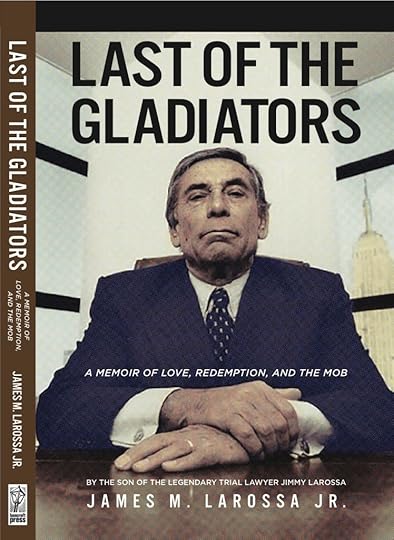
Follow James M. LaRossa Jr. on Goodreads. In a recent five-star review lauding Last of the Gladiators, Timothy C. wrote about the book:
“Exceptionally compelling, intriguing, honest, irreverent and insightful. It is an inside view of lives and worlds rarely afforded to the general public. It is also a beautiful biography of the intertwined lives of a giant of a father and a devoted son. I loved it. Clearly written from the heart with a very talented pen.”
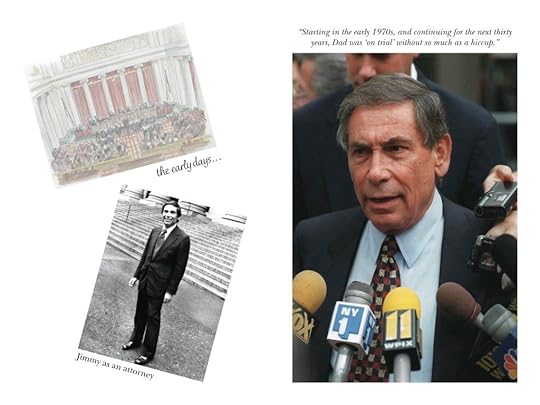
James M. LaRossa Jr. is a publisher, journalist, third-generation New Yorker, and the oldest son of legendary trial lawyer Jimmy LaRossa. In 2010, after finding his father near death, the author stole him in secret from the New York Presbyterian Hospital to a waiting Medevac jet. The duo spent the next five years in a place where few would look for two die-hard New Yorkers: a coastal town in the South Bay of Los Angeles, aptly named Manhattan Beach. While the son cooked his father his favorite Italian dishes and kept him alive using the most advanced medical equipment and drugs, father and son documented their notorious and cinematic life together as equal parts biography and memoir. Last of the Gladiators is that story.
MM A book begins as an idea in the writer’s imagination. Eventually, this grain of sand turns into a pearl. What was the grain of sand that fired your imagination?
JLR The idea for this book was more like an avalanche than a grain of sand. Over the many decades watching my father’s incredible life unfold, friends and family had advised me to write a book about him. A year after he died, I wrote a one-page synopsis which would eventually become the preface of the book. I sent the page to a family friend who showed it to producers at Netflix and HBO. Both jumped at the project. Before I could dive into a TV series, however, I wanted to establish the “real” story of my father’s life. The first draft of LOTG was 90,000 words and poured out of me in seven months.
MM How did you approach turning your initial idea into a manuscript and, eventually, a book? Did you take classes, read books, or just plunge in?
JLR I had spent four years in the writing department at Sarah Lawrence College writing fiction. Truth be told, I had never been comfortable writing alone for long periods of time, so the collaborative nature of journalism was attractive to me. I worked as a journalist in Rome and in New York City. Once I began to write Last of the Gladiators, any fear of solitary work was gone. I was off and running.
MM Authors today have many options when it comes to publication. Did you work with an agent, find a publisher through other means, or self-publish your book?
JLR Bruce Bortz, publisher at Bancroft Press, accepted the manuscript before I could even query agents. Bruce is a lawyer and he knew my father. He seized the book very quickly.
MM What is the biggest single lesson you learned during the writing process?
JLR For the first time in my life, it dawned on me that I could make a living writing books.
MM What would you advise others who are still at the idea stage?
JLR Start blocking dialogue—sounding out the way your characters sound. You might even want to talk the dialogue through. By the time you can hear the way your characters sound, you will have discovered many of the other elements of the book.
MM Were there any writing tools you’d recommend? Did you use apps like Grammarly, Scrivener, or another outliner to help you structure your book?
JLR No, I wrote the book in Word. The thing about writing is that you may have a brainstorm, but you can’t find your computer, your phone is off, and it’s just not worth it. I kept stacks of legal pads and pens around my house so I could scribble down thoughts at a moment’s notice.
MM Was it hard to decide on a cover, or did you or your publisher hire a professional designer?
JLR I am a journal publisher and am used to designing covers. The publisher used a professional designer for the interior.
MM Who is your ideal reader? Who would particularly enjoy your book/s?
JLR At first glance, Last of the Gladiators looks like a very masculine book with mob themes. That might help sell books, but it is not a macho mafia book. At its core, Last of the Gladiator is a love story between a father and son in which both find redemption. It’s a story that women would like. I hope that female readers will pass the book on to male friends. Last of the Gladiators is a “sensitive” book that won’t scare men away. The father/son relationship is, as well, very off-beat and comic.
MM How do you connect with readers? Do you like to do live events, such as book fairs or library talks, or have you found readers through social media and online groups, such as Goodreads?
JLR All of the above. I’m a pretty good public speaker. I like social media—I get to keep up with old and new friends—many of whom bought Last of the Gladiators.
MM What has been your greatest reward in undertaking this publishing journey? (This doesn’t have to be a financial reward.)
JLR I was my father’s caregiver the last five years of his life. He was in a wheelchair and on oxygen. His body was broken completely and that’s the way I thought of him. Not until I wrote Last of the Gladiators, however, could I remember my father in his youth, when he could pick me up off the floor and hug the guts out of me. Rediscovering those years was one of the greatest gifts of my life.
Check out the James M. LaRossa Jr.’s Amazon author page at https://www.amazon.com/James-M.-LaRossa-Jr./e/B07X6PC623/


December 4, 2019
Find Readers and Get Amazon Reviews
New authors need to find readers who will leave Amazon reviews, but if you’re a new author, how do you do that? Your friends may not understand why authors live and die by the quantity and quality of Amazon reviews. And, certainly, as a new author, you can’t be expected to have the name recognition of a Diana Gabaldon or an email list of rabid fans.
Authors who are brand new to publishing soon discover that the marketplace is flooded by new authors and new books. Readers are discerning. They want “social proof” that a book is worth their investment of time. Reviews on Amazon, Goodreads, and Barnes and Noble lend this kind of social proof. That’s why it’s essential for authors to take an active part in getting reviews.
New authors struggle to find readers for their books. Six months ago, authors could enlist the help of friends and family, but Amazon recently changed its policy on who is allowed to leave a review. This makes it all the more important for authors to reach out to folks who are both avid readers and who are comfortable posting reviews.
The Friends-and-Family Approach to Amazon and Goodreads Reviews
Five years ago a new author could send out an email to friends and family and expect that a small percentage would buy the book. A smaller fraction would leave a review. Then, said author would be mystified as to why their supposed “supporters” didn’t follow through.
Friends and family members don’t follow through because writing a review sounds formal and kind of daunting. They’re scared and don’t know what to say. Or maybe they simply can’t figure out the mechanics of posting a review. A bigger problem is that Amazon recently changed its terms of use. Even if your friends and family members review your book, Amazon may not post the review. Here’s a YouTube video by Amy Collins explaining this change.
.embed-container {
position: relative;
padding-bottom: 56.25%;
height: 0; overflow: hidden; max-width: 100%;
}
.embed-container iframe,
.embed-container object,
.embed-container embed {
position: absolute;
top: 0;
left: 0;
width: 100%;
height: 100%;
}
Amy Collins posts transcriptions of her Free Advice Friday sessions at https://amysadvice.com, and she is a terrific resource for authors. She’s generous with her advice and always up to date on what’s happening in the book industry. As you can see from her video, the old strategy of relying on friends to post Amazon reviews is not going to work as effectively as it once did. The key to success right now is to find reviewers who have no traceable connection to you.
Luckily, Amazon is not the only game in town. There are other places where the number and quality of reviews has the potential to help you find readers. Goodreads, the largest online book club in the world, is a community that offers a lot of potential to indie authors.
Of course, I wanted folks to leave reviews on Amazon, but even more, I wanted them to leave reviews on Goodreads. To make life easy for my erstwhile supporters, I created a step-by-step handout with screenshots to walk people through Goodreads’ posting procedure. If you’d like the handout, you can download it here.
Booksprout as a Tool to Get Goodreads and Amazon Reviews
If you are a new author without an email list, you may have to give away a certain number books in order to create that all important “social proof.” https://Booksprout.co is a free tool that allows you to upload your book to a database of avid readers. You must be able to upload an electronic file (.mobi, .pdf, or .epub). Ideally, this would all happen before your book goes live on Amazon, but if your book is already published, then Booksprout gives you the option of putting in links for Amazon, Goodreads, and the like.

Booksprout.co allows authors to upload their books to an audience of avid readers.
In my opinion, the best way to use Booksprout is to use their reader base to help you find typos in Advance Reader Copies (ARCs) of your book. You can also recruit your favorite reviewers to help with your next book launch.
Bookfunnel Can Help Authors Who Want to Sell Direct to Readers
Another site, https://Bookfunnel.com, can sidestep Amazon completely. Its signup portal has two options. One is for readers, and the other is for authors. The idea is that Bookfunnel will connect the two. If you intend to upload a book, make sure you enter through the “author” portal.

If you intend to join as an author, make sure you enter through the author portal.
Both Bookfunnel and Booksprout allow you to do cross promotions with other authors, and this is a great way to build up an email list. In a cross-promotion I ran with another author, I found a fifty percent success rate. In exchange for a downloadable copy of my chapbook, The Rug Bazaar, I collected 250 email addresses.
Readers’ Favorite Posts Reviews to Goodreads and Barnes and Noble
One of my favorite sites is Readers’ Favorite. Any author can submit a book and obtain one free review. The book can be a pdf or an ebook. I sent them a pdf of my forthcoming short story collection, Body Language, and was heartened by Erin Nicole Cochran’s review. While one review is always free, an author can obtain as many as five reviews. All of my reviews came back as five-star reviews, and this gave me confidence that there are people out there who will enjoy my books. After a book is published and the author uploads the ISBN number, Readers’ Favorite automatically posts the reviews to Barnes and Noble and Goodreads. Amazon’s terms of use prevent them from posting to Amazon, but authors can still use excerpts from the review on their book page.
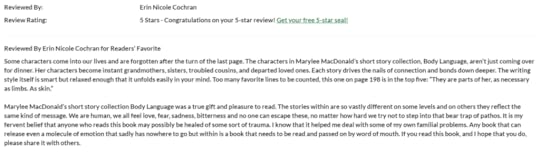
A Readers’ Favorite review can give an author some indication of whether their book will be well received or not.
Following the first review, an author can also “gift” a book through Amazon by buying the book from Amazon and then uploading the “gift” link to Readers’ Favorite. That allows Amazon to see the review as a verified purchase, and those reviews will then be allowed by Amazon.
Choosy Bookworm’s Readers Post to Amazon and Goodreads
One more site that’s worth mentioning is Choosy Bookworm. I love this site and its companion Read and Review program.
Although Choosy Bookworm and Read and Review cost money, this service will net you readers and boost your review numbers. An additional benefit is that their procedures conform to Amazon’s terms of service.
For most authors the issue of “discoverability” is a hurdle. How is your book supposed to be “discoverable” in that vast Amazonia ocean? Choosy’s Read and Review program has found readers who are more than willing to read and review books by self-published authors or authors published by independent presses. Their posting policy conforms to Amazon’s terms of service, so you will get reviews on Amazon and Goodreads. In addition to these benefits, they also have a marketing service that, for a small fee, emails info about your book to potential readers.
In a previous post, I’ve written about getting reviews, but since then, the landscape has changed. Bookbub, which used to be easier to get into, is now more difficult, more expensive, and may not be cost-effective for authors in certain genres.
I’d love to know what’s working for you right now. Please share your info in the comments.
November 9, 2019
The Gurus of Author Marketing
We authors need to finish writing our books, but then what? The next step is figuring out how to let the world know our books exist. Where can self-published authors gain the skills to develop a following of avid readers? If that’s you, then you would be wise to begin developing your marketing skills just as soon as you can. Here are four self-publishing gurus who rank high on my list. I’ll try to give you a flavor for the differences between them and the kinds of skills you’ll learn in their courses.
Mark Dawson’s Self-Publishing for Authors 101
Mark Dawson, an indie author who writes thrillers, has teamed up with James Blatch to produce professional, step-by-step courses that walk you through the nuts and bolts of author marketing. Their “Self-Publishing Formula” channel on YouTube has 8.6 million subscribers, and will give you an idea of what these two entrepreneurial authors have up their sleeves. Their interviews with other authors are always inspiring and packed with “lessons learned.”
While you will benefit from their interviews and discussion of trends in publishing, you will benefit even more from their paid courses.
I’d suggest you start with the SPF free List Building for Authors course. By the end of it, you’ll know if you have the stick-to-it-iveness to not just sign up for a course, but to implement it. If you don’t finish this course, then don’t waste your time buying the others.
Mark’s Ads for Authors’ course shows you how to use Facebook’s audience-creation tools to locate readers likely to be interested in the kinds of books you’ve written. It’s detailed and techie, and he goes through the material with lightning speed. However, if you’ve written, or are writing, a series, you will benefit by learning how to “retarget” your readers and create lookalike audiences. If you’re trying to design your own covers, you definitely need the course taught by Mark’s cover designer, Stuart Bache.
All three of the above courses are rolled into their flagship course, Self-Publishing 101. Add yourself to the email list, and they’ll let you know when the course reopens. The cost is roughly $397.
Nick Stephenson’s Your First 10,000 Readers
Also an author who has figured out a great deal about operating in the online world, Nick Stephenson is a fun guy with a ton of energy. He’s just getting into the YouTube thing, but already I’m enjoying his lighthearted, but info-packed, uploads.
Nick is very big on showing authors how to format their books so that the end of the book will entice potential readers to buy the next one, and he has a fabulous Facebook group where members do joint giveaways in other to boost one another’s sales.
Nick’s flagship course is called Your First 10,000 Readers, and at $597, it is a bit steep. Think about how many books you’d have to sell to make back that investment. While you’re considering it, you might want to read this extensive review. If you’re in the writing game for the long haul, this could be money well spent.
Joseph Michael Nicoletti’s 30 Day Writer Bootcamp
The guy who, in my opinion, really nailed it with his Scrivener courses, is Joseph Michael Nicoletti. Learn Scrivener Fast helped me double my output and streamline the process of moving from manuscript to finished book. That course runs $297.
But, that’s not all. This guru just came out with a new approach, “30 Day Writing Boot Camp.” The course runs $197, and it’s designed for writers who need help getting their books completed. Joseph goes into details about how to format books, find beta readers, and hire editors.
The course is supplemented with checklists and timelines that will help you keep track of the publication process. It would be especially valuable for writers who want to hold themselves accountable for getting their books out of their heads and into the marketplace.
Bryan Cohen’s Amazon Ad School
For a long while, I’ve been wondering how to sell more books on Amazon. Because I’ve had Bryan Cohen write some book descriptions for me (his book-blurb-writing company is Best Page Forward), I got wind of a new course he’s offering.
Initially, he did this course for free. It’s called the “Amazon 5 Day Author Profit Challenge, and his strategy is to teach authors to bid low and pay only for clicks, not sales. By the end of five days, my sales, which had flat-lined, were picking up. I was actually making money. Of course, what he hoped was to recruit folks for his paid class, Amazon Ad School. The course costs $397 and is far more detailed than anything offered elsewhere.
In addition, Bryan is one of the most dedicated teachers you’ll ever find. He’s truly passionate about teaching, and that comes through in Ad School’s private Facebook group. People in that group post questions about problems they’re running into, and he’s right back at them with an answer.
The People I Haven’t Mentioned
Honestly, I think the only people making money these days are the folks who’ve figured out how to tap into the relatively new phenomenon of social media. There are many other gurus I could have mentioned, folks who have well designed courses and who work hard to help us get where we want to go. However, for authors who see themselves writing more than one book, and who intend to self publish, the four “internet gurus” listed above provide the best value for the money. Learning through a structured course is a great deal easier than trying to pick up bits and pieces on your own.
October 27, 2019
Fire in Sonoma County, the “New Normal”
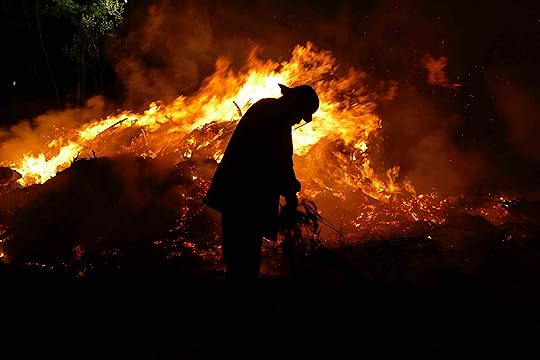
Firefighters from throughout California have come to battle the rapidly spreading Kincade fire.
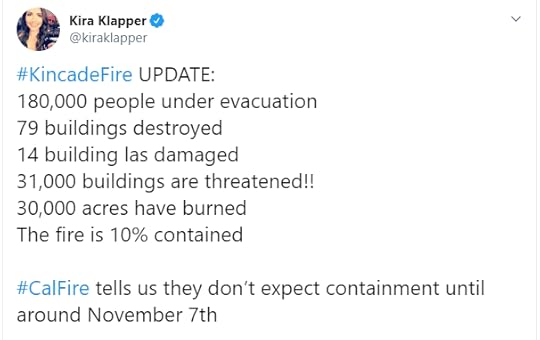
The Kincade fire is 10 percent contained. The fire began on October 23, 2019, and for three days winds have sent flames hopping through the beautiful grasslands of the wine country. Attempting to prevent loss of life, fire departments ordered mandatory evacuations. Three of every five residents in Sonoma County have sought safety in shelters. The Sonoma County Fairgrounds, five blocks from my house, is one of the evacuation sites. Today, I walked over there to find out what, exactly, happens during an evacuation, but just for some perspective first, here are some statistics Tweeted out by NBC morning anchor Kira Klapper (@KiraKlapper)
Sheltering at the Sonoma County Fairgrounds
The Sonoma County Fairgrounds is located near the intersection of Highway 101 and Highway 12. Because Sonoma County is agricultural, the Fairgrounds has facilities to house large animals. In the parking lot I saw many horse trailers, but when I walked back by the animal pens, I saw llamas, pigs, and couple of burros. The Fairgrounds was the first evacuation center set up for those fleeing the fire in Geyserville. It soon filled up as residents of Windsor and Healdsburg were ordered to leave.
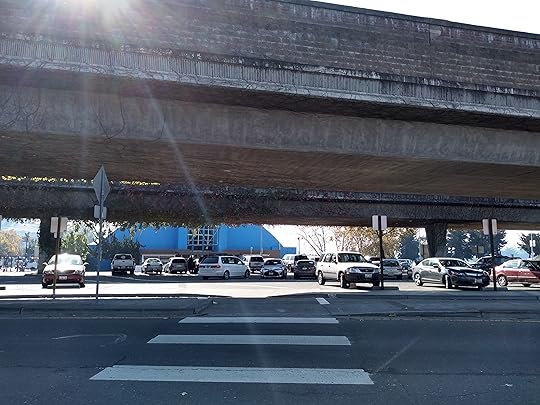
The parking lots at the Sonoma County Fairgrounds were full to capacity, and there were many cars parked under Highway 12, the highway that leads to Sebastapol, where the fire is expected to spread.
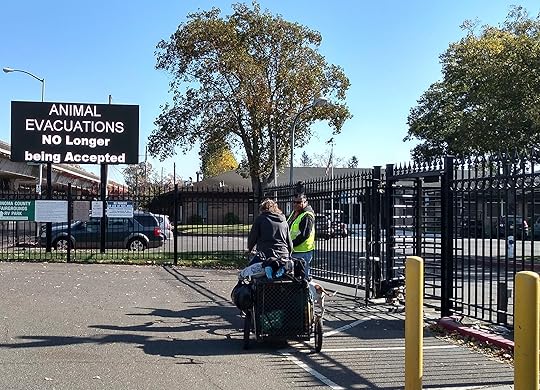
Fire affects animals, and so when people receive cell phone messages that evacuation is imminent, they must load up their horse trailers and transport their animals to a place that can safely house them. Luckily, the Fairgrounds has such facilities, but they were full to capacity. This homeless man stopped to converse with a guard.
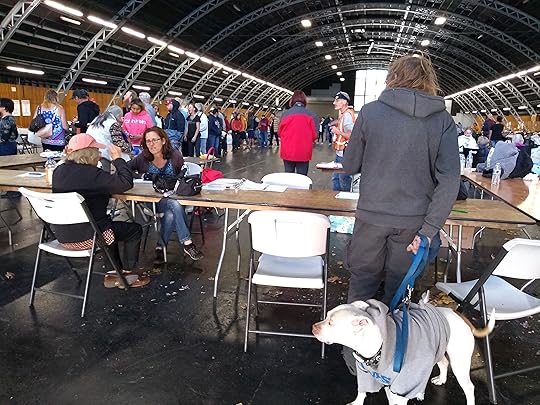
Inside the Fairgrounds, tables are set up to take down basic information and get evacuees water, a blanket, and a cot if one is available. All of this is staffed by Red Cross volunteers.
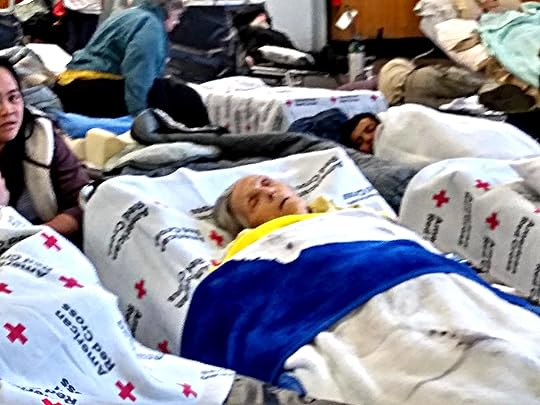
Half of the space inside the Fairgrounds’ main building was set up for evacuees from nursing homes. The beds provided by the Red Cross had padded mattresses, and the patients’ caregivers were there watching over their charges.
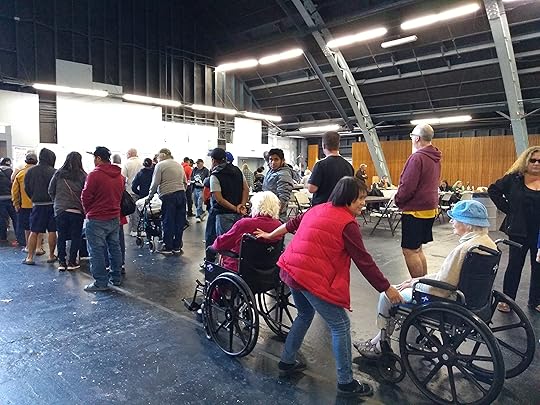
Evacuees stood in line to get a single slice of pizza. They were told to take the food to the dining room, rather than to their cots. Many of those at the Fairgrounds were elderly and frail. Many others were Hispanic, homeless, or poor. The atmosphere inside the building was subdued, with people quietly talking and waiting patiently for their food.
The Veterans’ Building: Filled to Capacity with Fire Evacuees
Normally on a Saturday, the parking lot of the Veterans’ Building houses a farmers’ market, but the fire has interrupted harvest season, and now, the Veterans’ Building is where people come to charge their cell phones or get a cot for the night. The logistics of dealing with all the evacuees falls to the Red Cross.
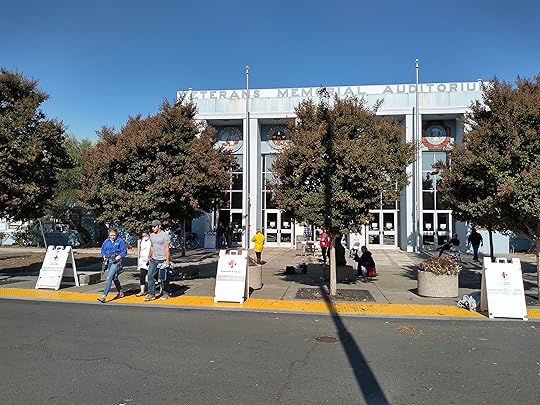
Across the street from the Fairgrounds, the Veterans’ Building had also been turned into a shelter, but a sign on the door indicated it was full.
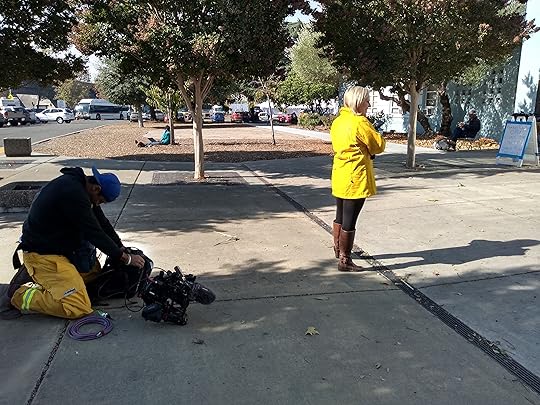
Getting ready to broadcast a live report, a news cameraman squats and tries to fix a broken cable while the on-air reporter in the yellow jacket tries to tell the folks back in the studio why there’s a delay. Behind them, parked at the edge of the lot, were a number of out-of-service city buses, and they may been standing by in case it was necessary to move the evacuees further south to Marin County.
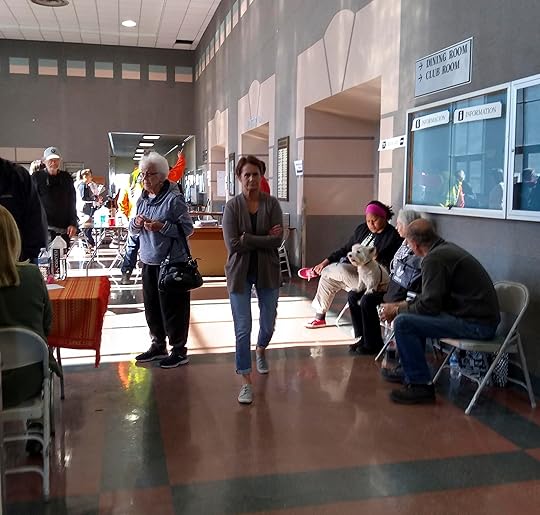
When the Sheriff’s Dept. and Fire Dept. issued evacuation orders, people were told to bring their pets, preferably on a leash or in a cage. Two years ago the fire spread so rapidly and the warning system was so bad that evacuees didn’t know they could bring their animals. The woman hold her dog in her lap is undoubtedly comforted by knowing her pet is safe.
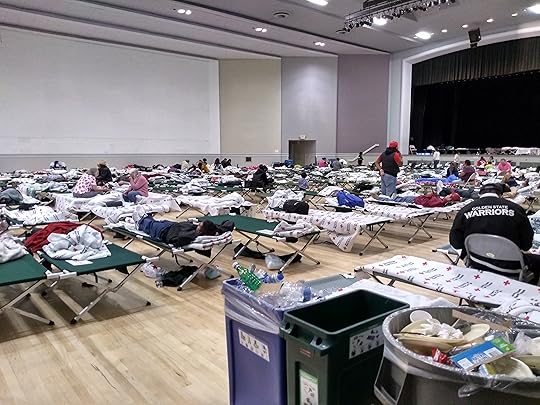
The mood inside the Veterans’ Building was subdued. Many folks were just lying on their cots and staring up at the ceiling. Others were checking their cell phones.
Firefighters from around California Battle the Blaze
Fire crews have come from all over California to help battle the blaze. Prisoners, too, have been put to work for $1/hour, not a very good deal for them, considering the danger and strenuous nature of the work. Firefighters estimate the fire will not be contained until November 7.
So what caused this inferno? PG&E, the electric utility, claims that it’s the unusual wind events, and indeed, last night was terrifying with winds from 70 to 90 miles an hour. What happens in such high winds is that the power lines swing, possibly leading to arcing. The arcing sets off fires in trees near the power lines. Today in Lafayette, just on the other side of San Pablo Bay, a completely different fire began because high winds caused a power pole to topple. Now, residents of Lafayette are fleeing the fire.
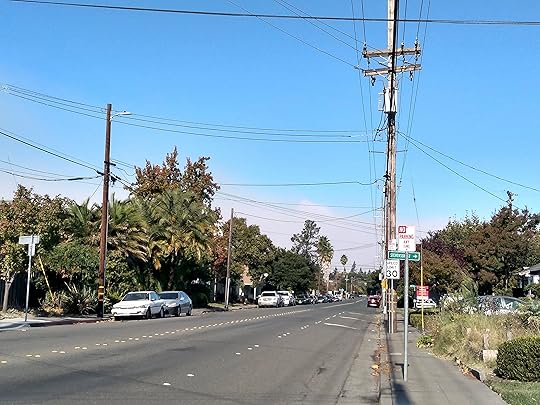
When the wind picks up, power lines swing like jump ropes, leading to arcing. An aging infrastructure and a mishmash of above-ground power and phone lines are evident the Luther Burbank Gardens Historic District, my neighborhood. Rising about the trees at the end of the street is smoke from the fire further north. Fortunately, the wind was blowing smoke the other way. Two years ago, the smoke was so thick it was hard to breathe.
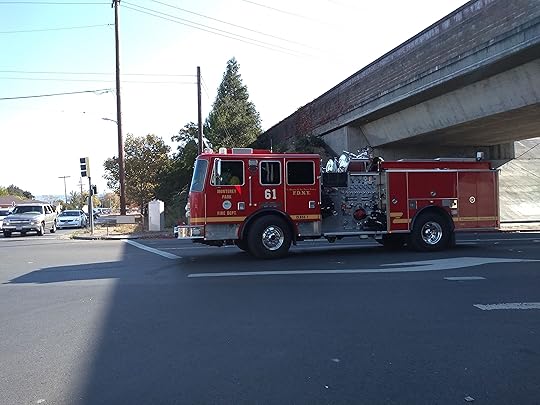
This fire truck came from Southern California, Monterey Park, a community adjacent to East Los Angeles. I think it’s safe to say that every resident of Sonoma and Napa Counties is grateful for the assistance.
Facing the Unknown
It’s now 7:30 pm, and the wind is picking up again. My neighbor’s stepladder is banging and rattling against the garage (my writing space). The winds last night were so bad that I thought someone was breaking into my house, and throughout the night, my cell phone lit up with new Nixle alerts. That’s the emergency warning system. Several times my phone sounded like a tornado siren. That was the signal for some community or other to evacuate, and the adrenaline rush, as well as the frequent alerts, made it impossible to sleep.
As the wind speed increases, I’m suddenly coughing. My throat burns. It’s going to be another long night, I fear, and one of those times when a natural event strips away the illusion that we are in control of our lives. Welcome to the new normal.
The post Fire in Sonoma County, the “New Normal” appeared first on Marylee MacDonald.
October 23, 2019
Ten Questions for Haley Belinda
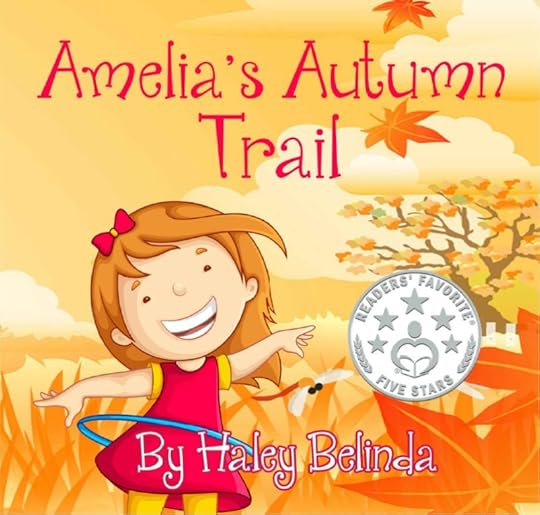
In this column I’m asking subscribers to share their knowledge about writing, publishing, and marketing their books. I’m calling it “Ten Questions.” Thank you, Haley Belinda, for allowing us to share in your excitement about your new book release, Amelia’s Autumn Trail.–Marylee MacDonald
Haley Belinda’s Author Tip: “The most important lesson I learned is to edit, rewrite, edit, and edit again. Be confident and let your words flow.”
Haley Belinda is the author of eight children’s books, two books of poetry, and a crime fiction novelette. Her poetry book Poetic Piece: A Compilation for All is also in hardback. Haley’s highly rated children’s books are beautifully illustrated and feature story lines that appeal to early or reluctant readers. Her poetic love story, “After The Absolute” is a unique blend of memoir and verse. Haley has always done some writing, but her main career was nursing until illness changed her direction in life. She calls this change toward becoming a writer “the best positive to pull out of a negative.”
Follow her on Goodreads. https://www.goodreads.com/author/show/17013819/
MM A book begins as an idea in the writer’s imagination. Eventually, this grain of sand turns into a pearl. What was the grain of sand that fired your imagination?
HB I now have a good few pearls, ha-ha! So, which pearl shall I discuss? Originally, it was when I went through a tough divorce. I wrote down my feelings every day and realized I was writing poetry. I then started to write poems on many different subjects and enter competitions. I was awarded a “Poets Society” pin, but I had a long period of writer’s block as Fibromyalgia consumed all my time. I began to have a remission and thought about writing some of the children’s stories I had made up for my own kids when they were little, and that brought about a series of books with a protagonist named Amy. One book led to the next and so on. I have had an ambition to write a novel since my teen years, and I always thought my debut novel would be a romance. I have been nurturing a title that has been in my mind for a long time, and I have just finished it, so we’ll see how that goes.
MM How did you approach turning your initial idea into a manuscript and, eventually, a book? Did you take classes, read books, or just plunge in?
HB With my children’s books I plunged in, but I wanted to make sure I put out quality that I was confident in, so within the last few years I have attained several Level 3’s in writing. These include demonstrating proficiency in children’s writing, fiction, crime fiction and poetry.
I have increased my reading, too. I believe both go together. I have always read, but depending on where I have been in my life, the needle on the meter moved to whatever I was focused on at the time. For example, when I worked as a nurse, I read a lot on the subjects I needed for my profession. As a teen, I read romance, and later, I read children’s books for the kids and grandkids. I’m a very eclectic reader, and enjoy whatever takes my fancy.
MM Authors today have many options when it comes to publication. Did you work with an agent, find a publisher through other means, or self-publish your book?
HB I have not yet worked with an agent. I wouldn’t rule that out, but I have neither been introduced to a reputable agent or had one cross my path. Some publications have come about because I submitted directly to magazines. Others I have self-published. Most of what I’ve written is available through Amazon and Ingram. Going with Ingram made it possible for potential book-buyers to order the book through their local bookstore.
MM What is the biggest single lesson you learned during the writing process?
HB The most important lesson I learned is to edit, rewrite, edit, and edit again. Be confident and let your words flow.
Every author has a unique style. Some readers will like your books. Some will not. And try and be patient. When I finish a book, I often can’t wait to see it in print, and yet the refining stage at the end is paramount.
MM What would you advise others who are still at the idea stage?
HB Don’t rush, plan your work and write something everyday. There is more to writing than the pen to paper, but write, write, write and read, read, read.
MM Were there any writing tools you’d recommend? Did you use apps like Grammarly, Scrivener, or another outliner to help you structure your book?
HB I use Grammarly now, but with that program, you need to be mindful that the suggested change is correct for the context. Scrivener is an excellent tool for breaking things into sections or having a few projects going at one time. I also have Plottr, but am not using that as much at the moment. It’s a good tool for story structure.
MM Was it hard to decide on a cover, or did you or your publisher hire a professional designer?
HB I have used a professional illustrator mostly for the children’s books. I have done some myself. Usually the poetry books are designed by me. I will use a pro designer when I finish my crime novels and am ready to publish them.
MM Who is your ideal reader? Who would particularly enjoy your book/s?
HB I guess that would depend on which of my works we are speaking of. With the children’s books, the ideal reader would be 3-7-years. I like to think my poetry is simplistic, so will appeal to individuals who like rhyming meter. The crime stories are the detective type and usually deal with murder, but they do not have as much gore as some crime novels, so I wouldn’t term them horror.
MM How do you connect with readers? Do you like to do live events, such as book fairs or library talks, or have you found readers through social media and online groups, such as Goodreads?
HB I am not very well known, yet! I mainly use social media and wouldn’t dismiss libraries and book fairs as a way to meet readers; however, at the moment, my health doesn’t allow me to consider live events. I am on Goodreads and have done the odd giveaway.
MM What has been your greatest reward in undertaking this publishing journey? (This doesn’t have to be a financial reward.)
HB Accomplishment! I would say my biggest reward is completing my books and courses in spite of fibromyalgia. (The condition causes brain fog which makes concentration extra hard.) Jumping over the hurdle of the disease has empowered me to do more. I was proud when I received a Bronze Medal in last years Readers’ Favorites International Book Awards. I hope this year will be as productive. I hope my books help and entertain my readers as much as I have enjoyed writing them.
Check out Haley Belinda’s blog at https://authorhaleybelinda.net or her Amazon author page at https://www.amazon.co.uk/Haley-Belinda/e/B072TP62GN.
Facebook https://facebook.com/haleybelinda7
Twitter https://twitter.com/haleybelinda7
Pinterest https://www.pinterest.co.uk/haleybelinda1/
Instagram https://instagram.com/haleybelinda7
October 10, 2019
Living and Writing Off the Grid
Today is Day 2.5 of the massive power outage that has affected 700,000 people in Northern California, and we are living off the grid. In an effort to reduce wildfire events, and in anticipation of high winds and dry conditions that would send the region into the “red flag alert” phase, PG&E began announcing that they would selectively cut power, starting around midnight on Monday night.
On Monday, as I drove around Santa Rosa looking for supplies that would help me weather this outage—which PG&E said it anticipated might last five days—I spoke to a number of people who seemed oblivious to what it might mean if their power got cut off. One guy at REI, the camping goods’ store where I bought a portable solar panel and inverter (to charge my electronics) said, “Oh, yeah. I guess me and my wife can cook on my backpacking stove.” He’d made no other preparations and didn’t even know if the store would open the following day.
Disaster Preparedness
Actually, a power outage is a good drill for what might potentially happen if an earthquake strikes. Having grown up in the Bay Area and lived through the massive fires that swept through Northern California a year ago, I knew that disaster could strike any time. One reason I joined KQED, San Francisco’s premier public radio station, was to get their sign-on bonus, a “disaster preparedness” kit. However, when I actually looked inside it, I found five foil-wrapped dinner packets, a tiny box of matches, a box of candles, an orange plastic whistle (to blow in case you’re trapped in rubble), and a tiny first-aid kit. Worthless, in general; however, the kit did contain one crucial item—a portable radio that can either recharge from solar power or by turning a hand crank.
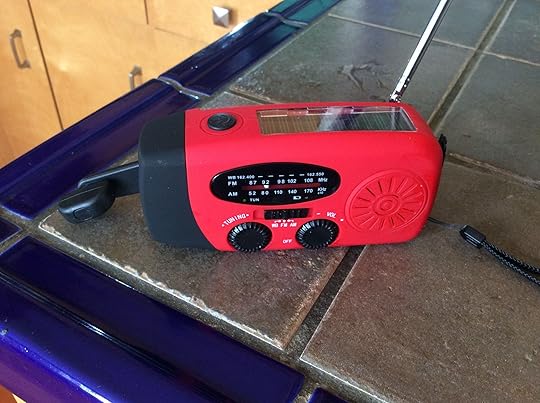
This cheap, little Chinese-made radio has proven to be one of my most essential survival tools. It came with my disaster preparedness kit, but there’s no brand name on it. Its key feature is a crank on the back that let’s you recharge the battery, and the solar panel on top that allows you to charge the radio during daylight hours.
A radio, turns out, is a necessity. I’ve been listening to the local Sonoma County public radio station KRCB. They are doing a great job—a yeoman’s job—of keeping listeners updated with accurate information. They did the same thing last year during the Santa Rosa fire, and their service was invaluable. This year, with the PG&E outage, they are providing information about resumption of service. PG&E’s own site can’t do that because it’s down—overwhelmed with too many people seeking information. And, the other way that residents here are urged to get accurate information, NIXLE, an emergency alert system that sends text messages to your cell phone, is alternately annoying and terrifying. That’s because it relentlessly sends announcements like the following:
“NAPA COUNTY OES: Red Flag warning extended through 5 pm today. Wind advisory in effect till 3 pm. NIXLE.us/BCMJC Reply with a friend’s # to forward.”
SONOMA COUNTY SHERIFF Advisory: Important public safety information and resources. NIXLE.US/BCMYJ Reply with a friend’s # to forward.
Come on, people! This information is not clear. What action am I supposed to take? What does it mean? Why would I forward this to a friend? How does it tell me when or if my power will get turned back on? Meanwhile, I am sitting out on my patio, where there is just the teeniest, tiniest little breeze, and thinking this is the first time I’ve felt wind of any kind in the past 2.5 days.
Survival Gear
So, here’s my setup. I’m cooking on my old Coleman car-camping stove. I like it because it has two burners and two propane bottles, and it can blast heat under a pan of water and have it boiling in no time.
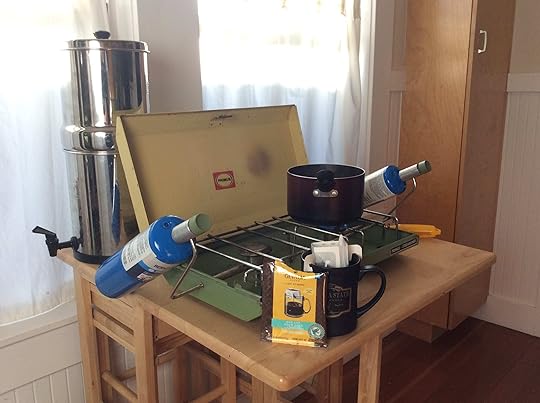
The big urn is for filtered drinking water. Prior to the outage, PG&E was saying that drinking water might be interrupted for people in the East Bay, and I wasn’t sure whether Sonoma County would be affected or not. With one pot of boiling water, I can use Gevalia’s pour-over, single-cup coffee packets and have enough hot water left to wash my breakfast dishes.
It turns out that Sonoma County does have water. However, I don’t have hot water. My house has a tankless, on-demand water heater, and the morning shower is pretty bracing. Turns out the water heater needs an electrically-fired spark before it starts producing hot water.
To my surprise, the 80-year-old floor furnace is unaffected by the power outage. The thermostat has two AA batteries, and that’s enough to tell the furnace that the house has dropped below an acceptable temperature. If there had been an earthquake, however, I would have turned off the main gas line outside, simply to avoid the danger of a house fire.
Solar Panels and an Inverter
Apart from the radio and the stove, the most useful survival tool I’ve found has been a YETI 400 battery pack/inverter. This device connects to two collapsible solar panels. There’s even a handy carrying case. The solar panels have a cord that attaches to the battery pack and recharges it, even while I’m drawing current with my computer.
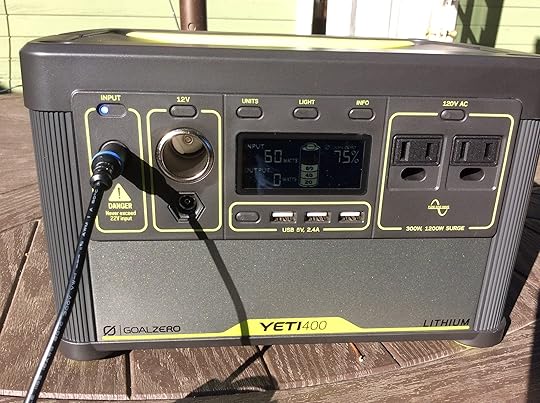
This YETI 400 battery pack/inverter can be charged by plugging it into the wall or attaching it to solar panels.
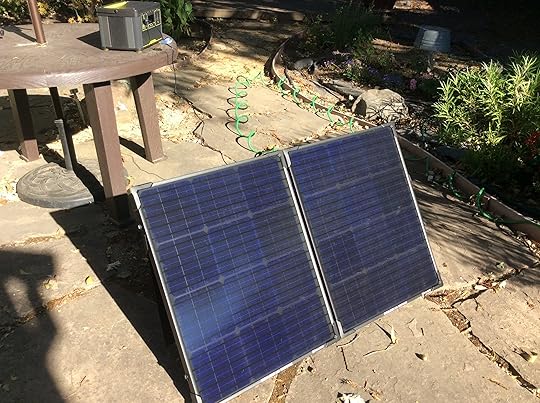
Two collapsible solar panels have their own carrying case. It takes 2 to 3 hours to fully charge the inverter.
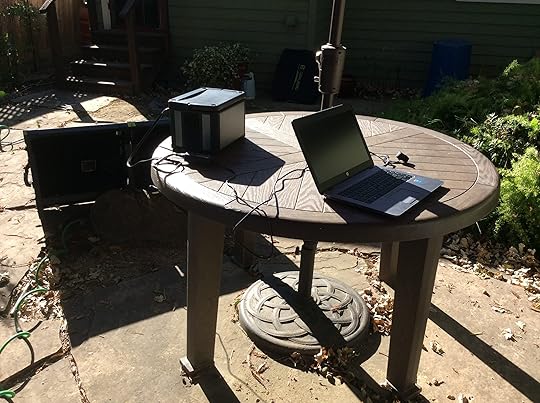
Here’s my off-the-grid office. I must charge the inverter during daylight hours, but it’s a snap to plug the solar panels into the inverter and let the sun create electricity.
The model I have (roughly $600, plus the cost of the panels) will do 3 to 5 laptop recharges before it must be recharged itself. During the power outage, I had a laptop, iPad, and cell phone plugged in at the same time. The battery pack fully charged them and still had 76% of its capacity left. The inverter is so easy to set up that a child could do it. (The battery pack can also be charged by plugging it into a working electrical outlet. Before the power outage, I made sure the inverter was fully charged because I wasn’t sure how the whole solar panel thing would work.)
What Have I Learned?
I’ve learned how dependent I am on the internet. The power outage means my home WiFi doesn’t work—no power to the router. Hence, the only way I can connect is by my iPad or cell phone. And, today, I had a further thought about this. If the disaster-response folks are primarily using the internet to keep their customers informed, the lack of access to charging stations is a big problem. Santa Rosa did set up charging facilities at the Veterans’ Building across from the Sonoma County Fairgrounds, but the center was only open during the day, and you can imagine the lines.
Apart from the above measures, designed to help me cope with the immediate challenges of food, water, and electricity, I’ve found that there’s nothing I could do about the food in my refrigerator. After two days, the refrigerator compartment was almost at room temperature. Prior to the power outage, I froze water in empty milk containers, hoping these blocks of ice would keep the food in the freezer from going bad. When the power came back on tomorrow, I saw that these solidly frozen blocks of ice had been effective. Meanwhile, in anticipation of a future disaster, I will make sure I have canned or freeze-dried staples. In a true disaster, it’s likely I’d be without power for more than two or three days, and it’s impossible to restock the larder. Grocery stores were closed. You couldn’t refill your gas tank because gas stations had no power. Also, none of the traffic lights were working. NIXLE was warning people to stay off the road.
On the positive side, my neighborhood was very quiet. I heard almost no noise from passing traffic. I learned to adjust my daily schedule to the sunlight. I slept until after dawn and went to bed with a book on my Kindle. I ate dinner to the light of my grandmother’s old oil lamp. (FYI, you’d be well advised to buy an oil lamp and lamp oil prior to a disaster. Lamp oil is hard to find, and luckily, I was able to grab a couple quarts at Friedman’s, my local garden/home improvement store.
Though there’s much to be said for the ambiance of lamplight, it’s hard on the eyes.
And, as far as the writing was concerned, I did as much editing as I could on paper. I was very glad that before the power outage, I had taken the time to print out full manuscripts. In the long run, this period of quiet and lack of distraction, may have proven to be a boon to the creative process.
The post Living and Writing Off the Grid appeared first on Marylee MacDonald.
October 2, 2019
Judith Starkston’s Fantasy Trilogy
In this feature I’m asking authors to share their knowledge about writing, publishing, and marketing their books. I’m calling it “Ten Questions,” and I’m hoping the feature will be valuable for readers who are curious about the “behind the curtain” aspects of what it takes to bring a book into the world. It’s always a special pleasure to participate in an author’s book launch, to know how long it took to write the book and what went into the research. Thank you, Judith Starkston, for allowing us to share in your excitement about your new book release, Sorcery in Alpara. –Marylee MacDonald
A curse, a conspiracy and the clash of kingdoms. A defiant priestess confronts her foes, armed only with ingenuity and forbidden magic.
Follow her on Facebook. https://www.facebook.com/judy.starkston
Judith Starkston’s PRIESTESS OF ISHANA is available free on Amazon Oct 2-6 in anticipation of the Oct 14 launch of the next book in the series, Sorcery in Alpara. An award-winning historical fantasy, Priestess of Ishana draws on the true-life adventures of a remarkable but little-known Hittite queen who ruled over one of history’s most powerful empires.
Judith Starkston’s Author Tip: “I found as I learned the craft that pacing was both the hardest part to get right and the most essential. If readers aren’t compulsively drawn through my story, it doesn’t matter how beautiful my writing is and all the rest (though I work hard to get all that nailed).”
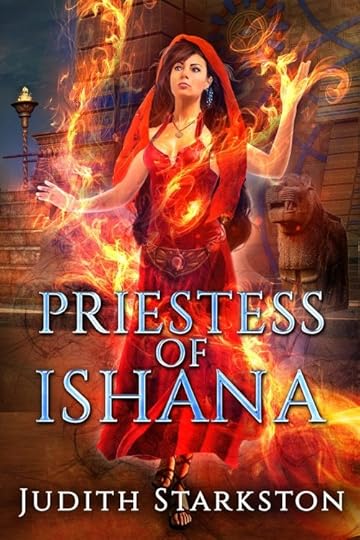
The Priestess of Ishana is the first book in Judith Starkston’s fantasy trilogy about the ancient Hittite Empire.
Judith Starkston is the author of three books of historical fantasy based on the Bronze Age Hittites—an empire of the ancient Near East nearly buried by the sands of time. Her books take “a quarter turn to the fantastic,” to borrow Guy Gavriel Kay’s phrase, and give full expression to the magical religious beliefs of these historical people. She immerses her readers in the authentic Hittite world while also creating spell-binding stories of fantasy and magic in the Bronze Age.
MM A book begins as an idea in the writer’s imagination. Eventually, this grain of sand turns into a pearl. What was the grain of sand that fired your imagination?
JS When I was researching my first book, Hand of Fire, set in the Trojan War, I made a startling side discovery—a queen I’d never heard of who ruled for decades over an empire I’d barely heard of, despite my training and degrees as a classicist. It was the Hittite empire, of which, it turns out, Troy was a part. The queen was Puduhepa (whom I call Tesha in my fiction–the Hittite word for “dream”). I’m particularly interested in the theme of women as leaders, so I was hooked. The Hittite empire could be called the forgotten empire, but fortunately, recent archaeology and the decipherment and translation of many thousands of clay tablets have filled in parts of the lost history. I use shifted names in my series, such as Hitolia for the Hittite empire, to cue my readers to how much I have to fill in imaginatively from those fragmentary records. We do now have many Hittite letters, prayers, judicial decrees, treaties, religious rites and a variety of other documents. All that juicy primary source material, an extraordinary female ruler, and an ancient world that totally intrigued me all became my grain of sand for Priestess of Ishana and Sorcery in Alpara.
MM How did you approach turning this idea into a manuscript, and eventually a book? Did you take classes, read books, or just plunge in?
JS I did a great deal of research in a couple of university libraries and built my own personal library of resources. Just as important, I traveled to the archaeological sites, landscapes and museum collections of the Hittite world—that is in modern Turkey. The Hittite empire of the Bronze Age (my novels are set around 1275 BCE) spread also into what is now Syria and Lebanon. I had already taken a lot of classes and workshops about the writing craft—a process that never stops because developing my writing is a constant growth not a static goal.was considering which of many plot ideas I would use for my writers’ critique group, and I thought this would be a lot of fun to write. I wondered what if someone came to the party with murder in his heart and poison in his pocket? From there, I just plunged in.
MM Authors today have many options when it comes to publication. Did you work with an agent, find a publisher through other means, or self-publish your book?
JS I published my first book through a small press, but have since gotten my rights back. I’ll just say that wasn’t a happy experience. Later I signed with a great agent and he took my next series out to market. In the end, I decided to publish it myself. Editors loved my manuscript, but they clearly didn’t see dollar signs in a historical fantasy series based in the Hittite empire. There certainly isn’t a booming market in Hittite books—write WWII if you want to go with the current trend for bestsellers. But that’s what I write and I want to keep writing this series for a long time to come, so I decided that handing my rights over to a publisher that could kill at will wasn’t part of my life plan. I love to write and readers are enthusiastic about my fiction, so I’ll build my readership over time. That has been working very well. It means learning a lot about every aspect of publishing and marketing, but I enjoy the challenges.
MM What is the biggest single lesson you learned during the writing process?
JS Write regularly—every day if you can—and don’t be afraid to learn new things, whether that is a new approach to the actual writing craft or a marketing approach or whatever it might be. Be open to new skills and always listen with an open mind to criticism.
MM What would you advise others who are still at the idea stage?
JS Write at least a little bit every day and give yourself permission to write “bad words.” What do I mean by that? Just write and don’t worry whether it’s crap or not. Later you can go back and edit or trash if need be. I find that it is often the days when I think I’m writing the worst that I discover on later read, I’ve written some of my best. And you can only fix words that are actually on the page.
MM Were there any writing tools you’d recommend? Did you use apps like Grammarly, Scrivener, or another outliner to help you structure your book?
JS I use Scrivener and like that program very much. It allows me to see my manuscript from the bird’s eye view and to jump between scenes and chapters easily. All that is especially useful in the editing stage, but even in the drafting stage, being able to open Scrivener to the very place I left off the day before—no hunting and waiting—is an advantage over a big Word doc. I use a couple approaches to outlining and organizing my manuscripts. One is very character/theme/pacing driven, Libbie Hawker’s book Take Your Pants Off. The other, very plot and pacing driven, is a storyboarding technique that means I’ve got each of my books laid out on a three-sided board like we all used for our school science projects. It’s explained in Alexandra Sokoloff’s Screenwriting Tricks for Authors. You’ll notice in both the word “pacing.” I found as I learned the craft that pacing was both the hardest part to get right and the most essential. If readers aren’t compulsively drawn through my story, it doesn’t matter how beautiful my writing is and all the rest (though I work hard to get all that nailed). A good story is hard to put down—that’s something we all intuitively know. The corollary is that if a story is hard to get through, it isn’t very good!
MM Was it hard to decide on a cover, or did you or your publisher hire a professional designer?
JS I have no talent or vision in the graphic arts department, so my approach to covers is to research and hire the best designer for my particular style/genre of book. I love my book cover artist, Heather Senter. My covers are dramatic, eye-catching and immediately tell readers that my books are fantasy with strong historical world-building. She shows me draft ideas all through the process so that I can say yes or no to them. I could never imagine beforehand the amazing designs she creates, but each has felt exactly right.
MM Who is your ideal reader? Who would particularly enjoy your book/s?
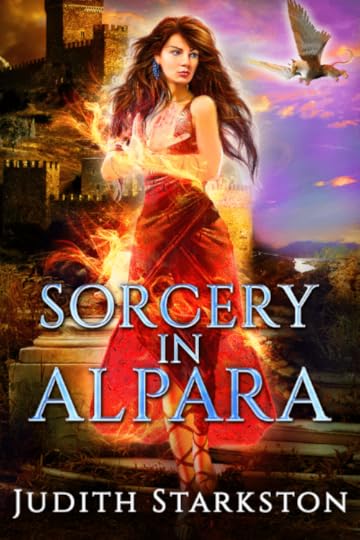
Sorcery, magic, political intrigue, and a compelling love story in the ancient Hittite (Hitolian) Empire are what give this fantasy series its broad appeal. Sorcery in Alpara officially goes on sale on October 14.
JS All the marketing gurus say that I should have a very specific answer to that question, but I don’t. When I’m writing, my audience is someone like me, a book I’d want to read. That’s the only brain and heart I have full access to. But when I go to events, whether book signings, library events, Comicons, reader conferences and the like, I look out and see a delightfully diverse crowd, across the age, race, culture, gender spectrums. And that’s true of my online interactions, also. I would have guessed that my books, heavy on strong female characters, would appeal more to women than men, and I would have guessed that those women would be mostly middle-aged, but that’s not turning out to be true. And thank goodness for that! I enjoy the diversity. So when I’m supposed to “target” my marketing, I’m always at sea, but, on the other hand, I have great conversations with my readers.
MM How do you connect with readers? Do you like to do live events, such as book fairs or library talks, or have you found readers through social media, Goodreads, or Amazon?
JS I do enjoy live events and do as many as fit in my schedule. Online, I have created a community that is interested in the ancient world, archaeology and history, and is open to both historical fiction and historical fantasy based in the distant past. On my website I write a weekly blog that highlights what’s the latest in archaeological discoveries and connects my readers to other historical fantasy and historical fiction authors they’d enjoy. That’s my “brand” on Facebook and Twitter, as well. My newsletter is the best place for readers to hook into my community.
MM What has been your greatest reward in undertaking this publishing journey? (This doesn’t have to be a financial reward.)
JS The long hours at my desk lost in the world that I write in the company of my characters.
For more about Judith Starkston’s trilogy, read on:
“What George R.R. Martin’s Game of Thrones did for the War of the Roses, Starkston has done for the forgotten Bronze Age Hittite civilization. Mystery, romance, political intrigue, and magic…” -Amalia Carosella, author of Helen of Sparta
Priestess of Ishana, ebook ASIN B07KNYWT36, $2.99, Paperback ISBN 978-1-7328339-2-0, $15.99, buy link https://amzn.to/2DXpdXt
Sorcery in Alpara, ebook ASIN B07X9XD849, $2.99, Paperback ISBN 978-1-7328339-4-4, $15.99 buy link https://amzn.to/319vuIj
Hand of Fire, ebook ASIN B07HMD4TC1, $2.99, Paperback ISBN 978-1732833906, $15.99, Buy link: https://amzn.to/2KOb6a0
Facebook https://www.facebook.com/judy.starkston
Twitter https://twitter.com/JudithStarkston
The post Judith Starkston’s Fantasy Trilogy appeared first on Marylee MacDonald.
February 28, 2019
Fictional Settings: Mare Island
Many writers begin with character, but often as not, my stories begin with fictional settings. I get to know my characters by seeing how they behave at work. Do they eat out or sit at their desks? Do they pack a lunch box? Is it black or aluminum, or does it have a cartoon logo? Does the lunch box contain a thermos of coffee or hot soup? Would my character be considered a “blue collar worker” or “skilled tradesperson” or a manager? “Lunch” says a lot about a character’s habits and social standing. If that’s so, then how does this fictional setting influence the character’s hopes, uncertainties, and regrets? An author who describes a character eating lunch at work reveals a lot about that person’s life.
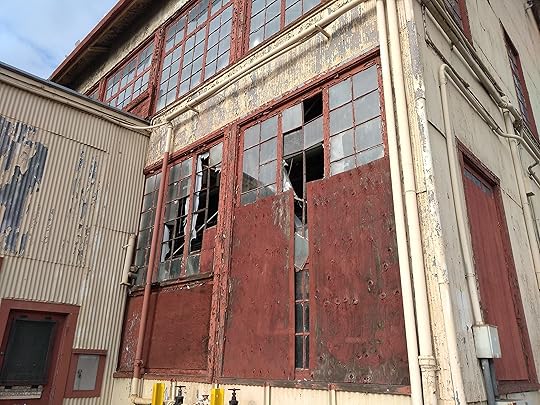
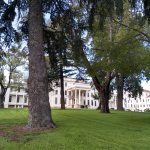
What would this building have looked like when it was new? The big windows would have let in plenty of light, and the now-rusting steel doors would have made the building secure.
Most of us spend eight hours a day away from home. Work colleagues–and the dangers or satisfactions inherent in our workplaces–affect our well being. If we feel beaten down at work, that spills over into how we behave at home. Yet, much of our modern fiction focuses largely on the drama inherent in family life (or the claustrophobic drama going on inside the character’s thoughts). Many writers place eighty to ninety percent of the action in the family sphere.
What if we turned that on its head? What if work became eighty percent of a novel’s focus? Certainly, an author would need a pretty big landscape to make work feel that important. I would submit that Mare Island Naval Shipyard might be a fictional setting worth such an attempt.
What Is Mare Island Naval Shipyard?
Mare Island Naval Shipyard is located in Vallejo, California, just on the edge of San Pablo Bay. Fifty thousand people once worked here. From the age of the industrial ruins, I would have guessed the shipyard to have been a response to the bombing of Pearl Harbor. However, it’s much older than that.
Mare Island’s original 956 acres were purchased by the Navy in 1853. The first ship built there was the Saginaw, a wooden sloop-of-war built in 1858. Over the years the shipyard expanded. However, all 5000 plus acres of Mare Island were taken out of service on April 1, 1996. Now, the site is being “repurposed” and its land distributed to government agencies and housing developers.
If you live in the Bay Area, go see it before it’s gone. There’s no guard at the gate. No one’s checking your ID. Stroll about past the old Navy hospital and the officers’ quarters. Check out the chapel’s Tiffany windows.
A Perfect Fictional Setting
If you’re a bird watcher, bring a birding guide and binoculars. Photographers, bring your cameras. If you’re a writer bring a notebook.
Mare Island, with its giant cranes, empty warehouses, and massive drydocks, would make a terrific fictional setting for a novel about the people who once worked here.
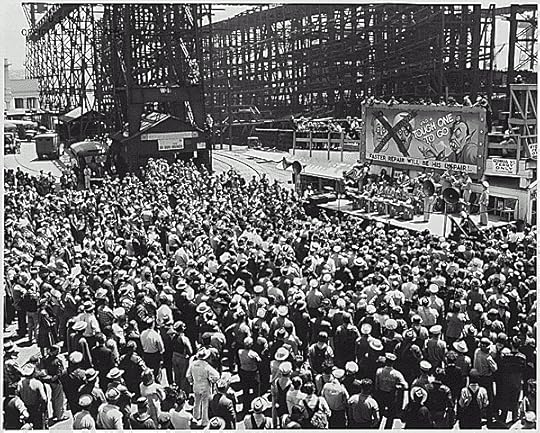
A bond rally by workers at Mare Island raised enough money to pay for an entire submarine.
In 1935 the USS Henley, a destroyer, was built at Mare Island. During World War II, the focus shifted to submarines and landing craft. Through the sale of war bonds, Mare Island’s patriotic workforce raised enough money to pay for an entire submarine. But, there’s more to this tale. Mare Island was also the site of persistent racial discrimination.





Books Set in Mare Island
I was overjoyed to discover that I’m not the only author fascinated by this haunting, evocative relic of our industrial past. Here are three books worth checking out.
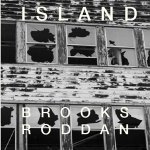
Author Brooks Rodden has written a nonfiction book called Mare Island. The book was inspired by his discovery of this industrial “ghost town.” A beautifully produced book, Rodden has provided stunning original photography as well as historical tidbits and the author’s own responses to the site.
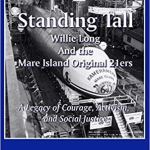
Also nonfiction is Standing Tall: Willie Long And the Mare Island Original 21ers: A Legacy of Courage, Activism, and Social Justice by Jake Sloan. The book is about the racism and work conditions in Mare Island. “In 1961, there were an estimated one thousand plus African-Americans working at Mare Island Naval Shipyard.” For decades, they had suffered under systematic, discriminatory working conditions in hiring, training, pay, and promotions.
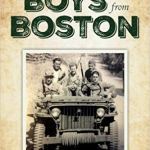
Gary Cullen’s The Boys from Boston, another nonfiction book, explores what happens when a town is “invaded” by young army troops.
“The famed 211th Coast Artillery Anti-Aircraft Regiment from Boston, Massachusetts arrived into the City of Vallejo a few days after the 1941 attack on Pearl Harbor. Its job: to protect Mare Island Naval Shipyard and the City of Vallejo from any further Japanese attacks.”
Thankfully, that never happened. These are true stories about the soldiers, their work, and the women they married.
What about you? Have you discovered any hidden gems about World War II or the working life? Please share in the comments.
The post Fictional Settings: Mare Island appeared first on Marylee MacDonald.
January 23, 2019
Chickens On A Kauai Beach
Think of all the metaphors we have for chickens:
“It’s chicken feed.”
“He’s a chicken.”
“Running around like a chicken with its head cut off.”
“Cocky”
“Strutting like a banty rooster”
This last phrase came from my Missouri grandma. Long before the term “backyard chickens” was coined, she raised these domestic birds in our backyard. I grew up gathering eggs from the “layers” and chasing headless hens. When the laying hens stopped producing eggs, we ate chicken fricassee, chicken and dumplings, and fried chicken.
Chickens in Kauai
On vacation with my son and his family in Kauai, I never expected to see chickens, but there they were, pecking through the dead leaves of a tropical jungle and strutting on Tunnel Beach. If they didn’t have such an aura of “chicken-ness” about them–the bead-black eyes, the pea brain processing only one thought (Eat!)–I’m sure bird watchers would marvel at the auburn birds.
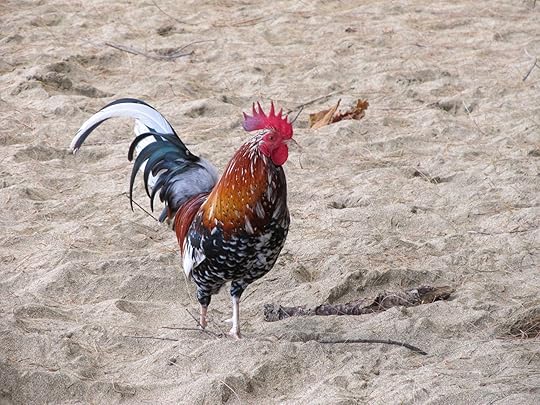
But chickens in Kauai aren’t rare. I overheard a German visitor say, “If I called my friends at home and held my cell phone up to the sound of that rooster, they’d think I was in a barnyard.” So true. But why had the birds taken over Tunnel Beach? Why were there chicks in the Wal-Mart parking lot?
The locals say these chickens came with the original Polynesian settlers. Others say cock-fighters imported them. A third tale cites Hurricane Iniki as the cause, claiming the storm freed the captives of a chicken farm. The birds are so ubiquitous that even the local Humane Society doesn’t bother rounding them up. Nor are these birds part of Audubon’s yearly bird count.
This just goes to show you that even in “paradise,” you find the most surprising things. As to the perennial question, “Why did the chicken cross the road?” We saw one strutting casually across the highway. My son rolled down his window and shouted, “Why did you do it?” The chicken had no answer. It reached the other side and resumed its pecking. One day it will show up in a story.
What moments of family lore have made it into the stories you tell again and again at the dinner table? When you look back on family vacations, do you recall bits of conversation and details that might make it into a story?
The post Chickens On A Kauai Beach appeared first on Marylee MacDonald.
One Person’s Paradise
What’s “paradise” for me could well be purgatory for someone else. This thought occurred to me when I was traveling in Kauai with my son and his family, and it’s at the emotional core of one of my short stories, “Almost Paradise.”
People often ask writers whether their stories are autobiographical of not. Often there’s an element of autobiography, a place visited or an insight about life that winds up at the core of a fictional tale. Here’s how a small, real life incident led to an important insight that helped me revise a story set on an entirely different island.
Fixer Uppers
To begin with you should know that I once worked as a carpenter, and when comes to old buildings, I’m sort of like people who are suckers for rescue dogs. I was in Kauai on vacation. Driving down a one lane road, my son passed the ramshackle plantation buildings on the outskirts of Hanapepe Town. The town is undergoing a resurgence, but many of its buildings have rusty metal roofs. Fixer-uppers! At one point in my life, there was nothing I liked better than a cheap property where a little sweat equity would make a difference. I did a windshield survey.
Scraping the paint would take a year, but the wooden shacks had made it through the hurricane of ’92. I saw myself standing with a can of glazing putty, my nail apron buckled around my hips. Despite the minor problem of telling my husband I’d bought an abandoned building in Kauai, I had to reckon with my age. I wasn’t thirty anymore or even forty. But, hey, I wouldn’t have to do the work at once. I could take afternoons off and snorkel. When I needed a break, I could stroll across the concrete bridge to the art galleries and curio shops. If I felt too wiped out and had to take off an entire day, I could write in a coffee shop and finish my novel. Eventually, I could turn my rehabbed building into a writers’ retreat.
“What a paradise!” I said.
“I don’t think it’s a paradise,” a little voice chimed from the back seat.
Alisa, my granddaughter, sounded certain of her opinion.
My son looked in the rear view mirror. “Why don’t you think it’s paradise?”
“For one thing, the buildings look rundown.”
“Alisa!” her mother said.
“That’s just what I think,” she said.
“I love this place,” her mother said. “The trees and mountains are beautiful. When your dad retires, we want to move here.”
“I love the beach,” her older sister Erika said.
“I don’t like the beach,” Alisa said.
“That’s because you won’t go in the water,” Erika said.
“The water’s cold and the wind blows all the time.”
“Wasn’t there one beach you liked?” my son said. (We had been to several.)
“I guess Poipu was okay,” Alisa said. “The sand was warm. On all the other beaches, it was wet.”
Poipu hadn’t been perfect either. Digging for shells, Alisa had unearthed a cigarette butt.
Alternate Lives
A day later, it struck me that one person’s paradise is another’s purgatory. As her parents and I imagined ourselves into alternate lives in Kauai, she imagined herself back where she felt most at home: in snowy New England, going to school, going to her dance classes, and hanging out with her friends.
As a writer I love the idea that we all drag emotional baggage with us, sometimes even to the point where we make ourselves miserable. It’s funny how some folks, even those with great physical or psychological challenges, manage to find joy and comfort in the familiar, while others feel most alert and alive in a place that’s strange and new.
My story “Almost Paradise” centers around the idea of two people traveling to the same place, but having vastly different experiences of it. The place is Thailand and the travelers are first cousins. Chicagoans, one has a birthmark, but has found his niche stocking candy machines near Wrigley Field. The other has failed at almost everything, and now he’s trying to start a new career as a tour guide. His cousin is the guinea pig, and off they go to Koh Chang island. You can read excerpts and meet one of the characters in the book by downloading Postcards Home.
What about you? Are you a person who thrives on the new and unfamiliar, or are you most content in your ordinary surroundings?
The post One Person’s Paradise appeared first on Marylee MacDonald.
Writing and Caregiving

- Marylee MacDonald's profile
- 373 followers

