
Heidi Anne Heiner's Blog, page 92
April 25, 2014
63 Cent Ebook: Beauty and the Beast by Hannah Howell
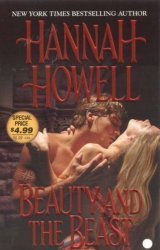

Beauty and the Beast
by Hannah Howell is currently 63 cents in ebook format. Beauty and the Beast is one of the most popular romance novel tropes and this one appears to deliver on the theme.How much can you buy these days for 63¢?
Book description:
On the eve of her wedding to the heir of Saiturn Manor, the stunningly beautiful Gytha is shocked to learn that her betrothed, a man she barely knew, is dead. Now she must marry the new heir, Thayer Saiturn, a battle-hardened knight known as the Red Devil.
With a face scarred in battle and a heart broken in love, Thayer has no interest in marriage. But not even the Red Devil can break the promise his foster-father made years ago and soon finds himself married to a woman whose exquisite beauty and sweet innocence intrigue him. But can his new bride look beyond his scars to find a hidden passion and undying love locked deep inside him?


April 24, 2014
2014 Hugo Nominee: Six-Gun Snow White by Catherynne M. Valente
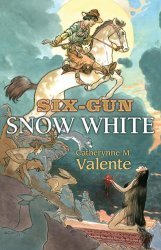

The 2014 Hugo Nominations have been announced and one is fairy tale related!
Six-Gun Snow White
by Catherynne M. Valente has been nominated for Best Novella. Congrats!The above image links to the hardcover, limited edition book which is already out of print and costly. The good news is that the novella is available for preorder in ebook format with a May 15th release date. There's no cover art for it yet, but I am partial to the original cover by Charles Vess (wonderful artist and a nice one, too!) and hope it will reappear in some form on the ebook version.
Book description:
From New York Times bestselling author Catherynne M. Valente comes a brilliant reinvention of one the best known fairy tales of all time. In the novella Six-Gun Snow White, Valente transports the title s heroine to a masterfully evoked Old West where Coyote is just as likely to be found as the seven dwarves.
A plain-spoken, appealing narrator relates the history of her parents--a Nevada silver baron who forced the Crow people to give up one of their most beautiful daughters, Gun That Sings, in marriage to him. With her mother s death in childbirth, so begins a heroine s tale equal parts heartbreak and strength. This girl has been born into a world with no place for a half-native, half-white child. After being hidden for years, a very wicked stepmother finally gifts her with the name Snow White, referring to the pale skin she will never have. Filled with fascinating glimpses through the fabled looking glass and a close-up look at hard living in the gritty gun-slinging West, readers will be enchanted by this story at once familiar and entirely new.
New Book: The Bravest Princess: A Tale of the Wide-Awake Princess by E. D. Baker
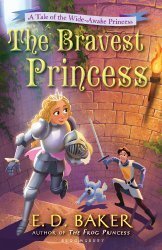

The Bravest Princess: A Tale of the Wide-Awake Princess
by E. D. Baker was released this month. This is third book in her series about Sleeping Beauty's little sister, following The Wide-Awake Princess and Unlocking the Spell. The latter book is also bargain priced in hardcover right now and makes a lovely gift. I am fond of it for using Snow White and Rose Red for inspiration.This new book uses Snow White for plot inspiration. It should be a happy read for your favorite young reader and even yourself. Baker plays well with fairy tales.
Book description:
Sleeping Beauty's younger, non-magical sister, Annie, still can't rest while trouble in the kingdom threatens her good friend, Snow White. Snow White's evil stepmother has disappeared, and her father wants her married off right away--but who should she choose? How can she tell which prince is best? It's Annie and her good friend Liam to the rescue! A hilarious and and fantastical romp through a fairy tale landscape from beloved author E. D. Baker.
April 23, 2014
New Book: West of the Moon by Margi Preus
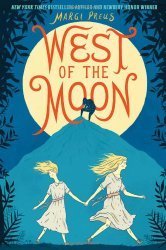

West of the Moon
by Margi Preus was released this month. The novel borrows from several fairy tales, primarily Norwegian, such as King Valemon, The Twelve Wild Ducks, Soria Moria Castle, and, of course, East of the Sun, West of the Moon.Can I just say my Norwegian blood is clamoring for me to read this? But I am trying to finish my own books right now? This one will hopefully be of interest to my niece Leighton this summer and we can then read it together. I'm a quarter Norwegian after all. Which makes her an eighth.
Book description:
In West of the Moon, award-winning and New York Times bestselling author Margi Preus expertly weaves original fiction with myth and folktale to tell the story of Astri, a young Norwegian girl desperate to join her father in America.
After being separated from her sister and sold to a cruel goat farmer, Astri makes a daring escape. She quickly retrieves her little sister, and, armed with a troll treasure, a book of spells and curses, and a possibly magic hairbrush, they set off for America. With a mysterious companion in tow and the malevolent “goatman” in pursuit, the girls head over the Norwegian mountains, through field and forest, and in and out of folktales and dreams as they steadily make their way east of the sun and west of the moon.
Praise for West of the Moon
FIVE STARRED REVIEWS
"Like dun silk shot thought with gold, Preus interweaves the mesmerizing tale of Astri’s treacherous and harrowing mid-nineteenth-century emigration to America with bewitching tales of magic. A fascinating author’s note only adds to the wonder."
--Booklist, starred review
"Norwegian history, fiction and folklore intertwine seamlessly in this lively, fantastical adventure and moving coming-of-age story."
--Kirkus Reviews, starred review
"Enthralling and unflinching, this historical tale resonates with mythical undertones that will linger with readers after the final page is turned."
--School Library Journal, starred review
"Astri is like a girl out of a fairy tale, and the native folktales that Preus weaves through the narrative serve as guides, lessons, and inspiration for her."
--Publishers Weekly, starred review
"Several Norwegian folktales are seamlessly integrated into the fast-paced, lyrically narrated story, which features a protagonist as stalwart and fearless as any fairy-tale hero."
--The Horn Book Magazine, starred review
April 22, 2014
New Book: Original Bavarian Folktales: A Schönwerth Selection: A Dual-language Book by M. Charlotte Wolf


Do you remember the media hype a few years ago about the lost German fairy tales? I posted about the story at Five Hundred New Fairytales Discovered in Germany and Maria Tatar Discusses Franz Xaver von Schönwerth if you need your memory jiggled.
Well, now 150 of the tales have been translated for your reading pleasure by Dr. M. Charlotte Wolf. Better yet, they are offered side-by-side with the original German for those of you who enjoy that sort of thing. I do. I have a few other books in the dual-language series by Dover. The other great news is that Dover is a thrifty publisher so the book is well-priced for just about everyone--no academic pricing here although the book is a fine academic tome--don't let the price let you think otherwise. It should entice you to pick up this collection since it is about the the price of a lunch at a sit-down restaurant.
I asked Dr. Wolf to share some insider information about the book with us along with her favorite tales in the collection. Thanks to her for sharing with us! I have a review copy of the book to peruse and will share more later, but wanted to share this now with you.
From M. Charlotte Wolf:
I would like to announce the upcoming publication of my book, Original Bavarian Folktales: A Schönwerth Selection: A Dual-language Book. The Kindle version is already available (March 2014) and the print version will be published in May.
The book contains 150 fairy and folk tales culled from a three-volume scholarly work by Franz von Schönwerth and published in the 1850s. In the introduction to Original Bavarian Folktales, readers will find footnoted critical material on the German and East Bavarian stories as well as Schönwerth and his legacy. The tales of giants, witches, death, mermaids, dwarfs, the wind, the sun and the moon, and other subjects are grouped thematically.
Franz Xaver von Schönwerth collected a treasure trove of material, traditions and tales, about the people of the East Bavarian region known as Upper Palatinate. In folklorist circles he is mainly known for his 3-volume work Aus der Oberpfalz: Sitten und Sagen, 1857 – 1859 (From the Upper Palatinate: Traditions and Tales, 1857-1895). Schönwerth’s famous contemporary Jacob Grimm, one half of the famous Grimm Brothers, was much impressed by Schönwerth’s work, and his all-around positive review in a letter he sent to the Bavarian folklorist in late September of 1858, may have been based on the realization that the much younger man was indeed a kindred spirit. While both the Grimm Brothers and Schönwerth collected tales during the 19th century, there is a distinct disparity between the different set of tales. This may also be because the Grimm Brothers frequently softened the message of tales they thought too violent for children, whereas Schönwerth had tried to preserve the tone and flavor of the Upper Palatinian stories along with their simplicity. These differences become most evident in tales that appear both in the Brothers Grimm and the Schönwerth collections, such as the widely known tale “The Gallant Tailor” (German, „Das tapfere Schneiderlein“), published in the 1857 edition of the Grimm Brothers' Kinder- und Hausmärchen (KHM). In Original Bavarian Folktales, Schönwerth’s version is called “The Tailor and the Giants” (German, „Der Schneider und die Riesen“).
In the Grimm version, the story begins with a detailed description of the purchase of sweet compote, tells of the flies that “landed on it in droves” (KHM 111), relates the tailor’s win over the seven flies with one stroke (as the tailor tells it!), and ends with the following words, “You are such a [tough] guy?[…] The entire world shall hear of this!” (KHM 111).
In Schönwerth’s version, the tailor is a much humbler lad who one day finds in the forest a red silk sash on which appear the words, “Seven with one stroke; who can match that?” which he picks up and ties around his waist. The two stories then follow two obviously similar threads, but the Grimm version is more refined and built on much more dialogue, whereas the Schönwerth recounts it as it may have been told by a story teller to a group or crowd of listeners, in a much more narrative style and involving little dialogue. In the Grimm version, the tailor survives by using his wits and boasting of seeminlgy heroic deeds, while in the Schönwerth version we learn of the tailor‘s acts of true heroism.
But like Schönwerth’s Sitten und Sagen, the inspiration for the publication of Jacob Grimm’s Deutsche Mythologie and the Grimm Brothers’ Kinder- und Hausmärchen, was a shared focus on the importance of folk traditions. Schönwerth and the Grimm Brothers preferred the preservation of everyday culture of rural and small-town Germans, to keep alive traditions that reflected a Germanic folk-culture reaching back into a distant past.
As a true romantic, among my favorite Schönwerth tales is the story of a wager between King Solomon and the Devil (story 145). The story ends with the words: “Those who belong together will come together, even if the Devil has to gather them in his wheelbarrow.” I found the story appealing because not only is the Devil not depicted as the “bad guy” this time, but moreover, he even appears as an, albeit reluctant, matchmaker for two young lovers.
April 21, 2014
New Book: Spellbound: The Fairy Tale and the Victorians by Molly Clark Hillard
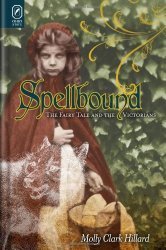

Spellbound: The Fairy Tale and the Victorians
by Molly Clark Hillard was released a few weeks ago. I haven't seen a copy to review it yet, but it looks very interesting. The sections devoted to Sleeping Beauty and Little Red Riding Hood are especially compelling for me as well as the conclusion about Andrew Lang. Table of contents is listed below the book description.Book description:
“In her promising new book, Molly Clark Hillard clearly shows how seemingly authorless fairy tales affected the way many Victorians saw the world. She argues that, though nostalgia for a world that probably never existed played a part in the Victorian reception of fairy tales, they were also intricately bound up in Victorian ways of thinking about politics, finance, and manufacturing.” —Elizabeth Wanning Harries, Helen and Laura Shedd Professor Emerita of Modern Languages, Smith College
“As Molly Clark Hillard convincingly reveals, the Victorians managed to make the fairy tale central to their understanding of their own progressive modernity by asserting its antiquated qualities, all while celebrating their modern distance from such things as fairy tales. I predict her book will have a broad relevance in fields from children’s literature studies and the emerging field of interdisciplinary childhood studies to nineteenth-century and comparative literature.” —Troy Boone, University of Pittsburgh
In examining the relationship between fairy tales and Victorian culture, Molly Clark Hillard concludes that the Victorians were “spellbound”: novelists, poets, and playwrights were self-avowedly enchanted by the fairy tale, and, at the same time, literary genres were bound to the fairy tale, dependent upon its forms and figures to make meaning. But these “spellbound” literary artists also feared that fairy tales exuded an originative power that pervaded and precluded authored work. Victorians resolved this tension by treating the form as a nostalgic refuge from an industrial age, a quaint remnant of the pre-literacy of childhood and peasantry. However, Spellbound: The Fairy Tale and the Victorians demonstrates that fairy stories, rather than operating outside of progressive modernity, significantly contributed to the language and images of industrial, material England. Hillard challenges the common critical and cultural misconception (originating with the Victorians themselves) that the fairy tale was a quaint and quiescent form.
Through close readings of the novels of Dickens, Eliot, and Charlotte Brontë; the poetry of Tennyson and Christina Rossetti; the visual artistry of Burne-Jones and Punch; and the popular theatricals of dramatists like Planché and Buckingham, Spellbound opens fresh territory into well-traversed titles of the Victorian canon. Hillard reveals that these literary forms were all cross-pollinated by the fairy tale and that their authors were—however reluctantly—purveyors of disruptive fairy tale matter over which they had but imperfect control.
Molly Clark Hillard is assistant professor of English at Seattle University.
Table of Contents:
Introduction: Nostalgia, Literacy, and the Fairy Tale 1
Part 1. Matter
1 The Novelist and the Collector 23
2 Pickwick Papers and the End of Miscellany 38
3 The Natural History of Thornfield 50
4 Antiquity, Novelty, and The Key to All Mythologies 61
Part 2. Spell
5 Sleeping Beauty and Victorian Temporality 77
6 Keats on Sleep and Beauty 82
7 “A Perfect Form in Perfect Rest”: Tennyson’s “Day Dream” 92
8 Burne-Jones and the Poetic Frame 108
Part 3. Produce
9 Fairy Footsteps and Goblin Economies 131
10 The Great Exhibition: Fairy Palace, Goblin Market 138
11 Rossetti’s Homeopathy 154
Part 4. Paraphrase
12 Little Red Riding Hood Arrives in London 173
13 Little Red Riding Hood’s Progress 179
14 Little Red Riding Hood and Other Waterside Characters 197
Conclusion: Andrew Lang, Collaboration, and Fairy Tale Methodologies 217
Notes 225
Bibliography 253
Index 266
April 19, 2014
Bargain Ebook: The Hero's Guide to Saving Your Kingdom by Christopher Healy
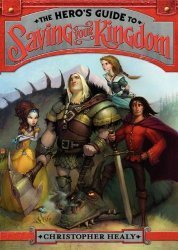

The Hero's Guide to Saving Your Kingdom
by Christopher Healy is on sale for $1.99 in ebook format. The third book in the seriess--The Hero's Guide to Being an Outlaw --is released April 29th and I preordered it months ago. It is a fun series and my niece adores it. Here's an inexpensive way to try the series.
Book description:
Prince Liam. Prince Frederic. Prince Duncan. Prince Gustav. You’ve never heard of them, have you? These are the princes who saved Sleeping Beauty, Cinderella, Snow White, and Rapunzel, respectively, and yet, thanks to those lousy bards who wrote the tales, you likely know them only as Prince Charming. But all of this is about to change.
Rejected by their princesses and cast out of their castles, the princes stumble upon an evil plot that could endanger each of their kingdoms. Now it’s up to them to triumph over their various shortcomings, take on trolls, bandits, dragons, witches, and other assorted terrors, and become the heroes no one ever thought they could be.
Christopher Healy’s Hero’s Guide to Saving Your Kingdom is a completely original take on the world of fairy tales, the truth about what happens after “happily ever after.” It’s a must-have for middle grade readers who enjoy their fantasy adventures mixed with the humor of the Diary of a Wimpy Kid books. Witty black-and-white drawings by Todd Harris add to the fun.
April 15, 2014
Gold E. Lahks Commercials
I have to admit that the fairy tales in advertising posts are some of my favorites to share. I missed this one for Hyatt Hotels until today because I haven't been actively looking for these as much of late. The campaign was launched in October 2013, so it's not too old.
Whenever I post fairy tale related advertising I also wonder what makes me love them so much--especially well-done campaigns like this one--and I think that it is comforting to see fairy tales used as part of pop culture. When they are used in advertising, it is proof that the well-known tales are still part of our public awareness and consciousness. Since they often use humor, too, they are just fun to watch. I appreciate cleverness. Even when it's trying to sell me something.
About the campaign:
This one’s too big… This one’s too small… This one is just right. Thanks to Hyatt Place, you’ll be seeing a familiar childhood character in the media these days. Goldilocks is back – but this time as Swedish, blond-haired character named Gold E. Lahks!
Using the tagline, “You’ll Know It’s Right When You See It,” the new advertising follows Gold E. Lahk’s search for a hotel that’s the perfect fit until he lands upon Hyatt Place. It’s all inspired by feedback we receive from our guests that, as Hyatt Place, we get it right for today’s multitasking travelers in both overall experience and our practical amenities. Just this year, guests helped Hyatt Place receive recognition from J.D. Power as highest in guest satisfaction among upscale hotel chains.
Here's another one, too:
April 14, 2014
Folktales of the Jews



Tonight marks the beginning of Passover and I am making charoset for the first time in my life as I attend a seder this week. No, I'm not Jewish myself but have a great respect for the culture and religion.
With my thoughts in that direction this week, along with a hundred others, I wanted to share my favorite set of Jewish folklore. This is not a set for beginners, thanks to price and size of the collection, but it is highly recommended if you have a more than passing interest in Jewish folklore. And, to be fair, these books altogether still cost less than smaller academic volumes of other folklore titles, so these may not be suitable for the casual folklore pocketbook, but they are well within reasonable price for the field of study. And any fine university library should include these, too.
The commentary and organization is also very helpful if you are interested in more than a light reading of stories although that is certainly possible with these.
Those outside the culture tend to think of Jews as one group, but this collection of tales aptly demonstrates the diversity and richness of a complex set of cultures and beliefs that fall under the label of Jewish. Using folklore, of course, which if you're here, you must be interested in, right?
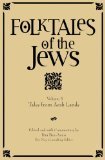
Folktales of the Jews, Vol. 1: Tales from the Sephardic Dispersion
Thanks to these generous donors for making the publication of the books in this series possible: Lloyd E. Cotsen; The Maurice Amado Foundation; the National Endowment for the Humanities; and the National Foundation for Jewish Culture.
Tales from the Sephardic Dispersion begins the most important collection of Jewish folktales ever published. It is the first volume in Folktales of the Jews, the five-volume series to be released over the next several years, in the tradition of Louis Ginzberg's classic, Legends of the Jews.
The 71 tales here and the others in this series have been selected from the Israel Folktale Archives (IFA), named in Honor of Dov Noy, at The University of Haifa, a treasure house of Jewish lore that has remained largely unavailable to the entire world until now. Since the creation of the State of Israel, the IFA has collected more than 20,000 tales from newly arrived immigrants, long-lost stories shared by their families from around the world. The tales come from the major ethno-linguistic communities of the Jewish world and are representative of a wide variety of subjects and motifs, especially rich in Jewish content and context. Each of the tales is accompanied by in-depth commentary that explains the tale's cultural, historical, and literary background and its similarity to other tales in the IFA collection, and extensive scholarly notes. There is also an introduction that describes the Sephardic culture and its folk narrative tradition, a world map of the areas covered, illustrations, biographies of the collectors and narrators, tale type and motif indexes, a subject index, and a comprehensive bibliography. Until the establishment of the IFA, we had had only limited access to the wide range of Jewish folk narratives. Even in Israel, the gathering place of the most wide-ranging cross-section of world Jewry, these folktales have remained largely unknown. Many of the communities no longer exist as cohesive societies in their representative lands; the Holocaust, migration, and changes in living styles have made the continuation of these tales impossible. This volume and the others to come will be monuments to a rich but vanishing oral tradition.
Folktales of the Jews, Vol. 2: Tales from Eastern Europe
Thanks to these generous donors for making the publication of the books in this series possible: Lloyd E. Cotsen; the Maurice Amado Foundation; National Endowment for the Humanities; and the National Foundation for Jewish Culture.
The second volume in a literary landmark Folktales from Eastern Europe presents 71 tales from Ashkenazic culture in the most important collection of Jewish folktales ever published. It is the second volume in Folktales of the Jews, the five-volume series to be released over the next several years, in the tradition of Louis Ginzberg's classic, Legends of the Jews. The tales here and the others in this series have been selected from the Israel Folktale Archives at The University of Haifa, Israel (IFA), a treasure house of Jewish lore that has remained largely unavailable to the entire world until now.
Since the creation of the State of Israel, the IFA has collected more than 20,000 tales from newly arrived immigrants, long-lost stories shared by their families from around the world. The tales come from the major ethno-linguistic communities of the Jewish world and are representative of a wide variety of subjects and motifs, especially rich in Jewish content and context.
Each of the tales is accompanied by in-depth commentary that explains the tale's cultural, historical, and literary background and its similarity to other tales in the IFA collection, and extensive scholarly notes. There is also an introduction that describes the Ashkenazic culture and its folk narrative tradition, a world map of the areas covered, illustrations, biographies of the collectors and narrators, tale type and motif indexes, a subject index, and a comprehensive bibliography. Until the establishment of the IFA, we had had only limited access to the wide range of Jewish folk narratives. Even in Israel, the gathering place of the most wide-ranging cross-section of world Jewry, these folktales have remained largely unknown. Many of the communities no longer exist as cohesive societies in their representative lands; the Holocaust, migration, and changes in living styles have made the continuation of these tales impossible. This series is a monument to a rich but vanishing oral tradition.
Folktales of the Jews, Volume 3: Tales from Arab Lands
Thanks to these generous donors for making the publication of the books in this series possible: Lloyd E. Cotsen; The Maurice Amado Foundation; National Endowment for the Humanities; and the National Foundation for Jewish Culture
Tales from Arab Lands presents tales from North Africa, Yemen, Lebanon, Syria, and Iraq in the latest volume of the most important collection of Jewish folktales ever published. This is the third book in the multi-volume series in the tradition of Louis Ginzberg’s timeless classic, Legends of the Jews.
The tales here and the others in this series have been selected from the Israel Folktale Archives (IFA), named in Honor of Dov Noy, at The University of Haifa, a treasure house of Jewish lore that has remained largely unavailable to the entire world until now.
Since the creation of the State of Israel, the IFA has collected more than 20,000 tales from newly arrived immigrants, long-lost stories shared by their families from around the world. The tales come from the major ethno-linguistic communities of the Jewish world and are representative of a wide variety of subjects and motifs, especially rich in Jewish content and context.
Each of the tales is accompanied by in-depth commentary that explains the tale's cultural, historical, and literary background and its similarity to other tales in the IFA collection, and extensive scholarly notes. There is also an introduction that describes the culture and its folk narrative tradition, a world map of the areas covered, illustrations, biographies of the collectors and narrators, tale type and motif indexes, a subject index, and a comprehensive bibliography.
Until the establishment of the IFA, we had had only limited access to the wide range of Jewish folk narratives. Even in Israel, the gathering place of the most wide-ranging cross-section of world Jewry, these folktales have remained largely unknown. Many of the communities no longer exist as cohesive societies in their representative lands; the Holocaust, migration, and changes in living styles have made the continuation of these tales impossible. This series is a monument to a rich but vanishing oral tradition.
This series is a monument to a rich but vanishing oral tradition.
April 7, 2014
Ikea's Lufsig: Wolf Eats Granny
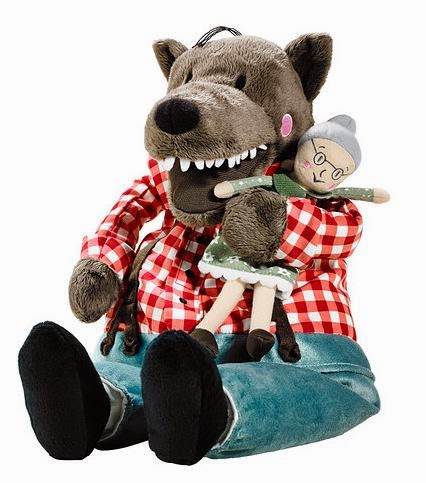
So a few weeks ago I was in Ohio and stopped into the Ikea there--because there isn't one in Nashville! silly Ikea!--and didn't really expect to walk out with anything fairy tale, but I did.
Above is the Lufsig, a wolf doll with a little grandma. Now, this seems odd at first--and second and third--especially since there is no accompanying Red Riding Hood to make a set. Nope, this is just a wolf and granny.
But the kicker--and my niece Leighton and I discovered this after a little play instead of reading labels--is that the WOLF CAN EAT GRANDMA. Yes, the toy is designed to stuff grandma down the wolf's gullet. But never fear, his shirt unbuttons and you can rescue grandma. So the child gets to be the huntsman or even Red Riding Hood in this scenario and rescue the granny from the wolf's belly.
It's deliciously sick and is being marketed as empowering to children. I'll let you decide.
Toy description:
Your child can have fun recreating the fairytale by rescuing the grandmother from the wolf’s belly, safe and sound.
But wait! There's more! I am late to the game--and many of you perhaps have already heard about this toy--but this has also become a sell-out hit in Hong Kong. From How the Ikea Wolf became a political hero in Hong Kong:
In Hong Kong, a kids' big bad wolf soft toy with the characteristically friendly-sounding Swedish name "Lufsig" has become an unlikely symbol of political dissent. Lufsig has sold out in the territory's three Ikea stores, has racked up over 46,000 "likes" on its own Facebook page and was last seen being chucked at Hong Kong's chief executive CY Leung during a town hall meeting.
I didn't know this. But now I am even happier that this toy came home with me. It almost didn't. "You don't need another fairy tale toy," I told myself. But it was so wonderfully perverse and giggle worthy done up in cuteness for a $10 price tag. I couldn't resist.
And so Lufsig has been grinning at me from across my office--granny halfway down his gullet--for two weeks now. He's become one of my favorite fairy tale toys. I didn't used to be this grotesque, but fairy tales will do that to you. If you're reading the right ones.
I've been putting off this post, by the way, because I wanted to take some pictures of my wolf eating granny--I prefer her going down feet first although the head first is more comical in some ways. But I keep not having my camera and stuff convenient. Go ahead and search for images--there are plenty out there--Lufsig Ikea will be sufficient.

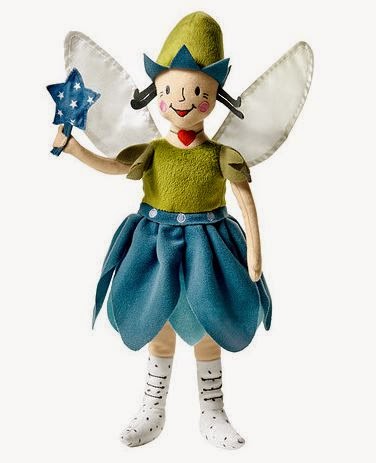
And this was part of Ikea's Soft Toy Campaign which raises money for children's education programs. There was apparently a set of Billy Goats Gruff, too, but darn it! They weren't in the Ikea I visited. The fairy was there, but Leighton got to take home that one and it matched her room perfectly colorwise. I want those goats since that is my go to story for sharing with children. My other niece, Kensie, currently adores it when she's not singing songs from Frozen.
Heidi Anne Heiner's Blog

- Heidi Anne Heiner's profile
- 44 followers
Heidi Anne Heiner isn't a Goodreads Author
(yet),
but they
do have a blog,
so here are some recent posts imported from
their feed.

