
Cynthia Morris's Blog, page 36
November 29, 2016
Escape the cul de sac of creative doubt
You’re riding the wave of creative fulfillment with a project, getting it done and feeling great about it. Then you turn a corner and find yourself in a dark cul de sac of doubt. Your joy is replaced with questions:
Will anyone care about this?Is this any good?Wouldn’t it be better to just drop it and relax a bit?If you’re like me, this happens on almost every project, and especially on the ones that feel particularly vulnerable or meaningful.
I have been circling in the cul de sac of doubt with my latest project, my annual review. I’ve been working on it steadily for the last few weeks and am approaching the final 20% of the writing.
This last part of any creative process is always plagued with these doubts. We’re faced with our limitations and fears and it seems like such a better idea to just ditch the thing like a bad cold.
Even though I have been here many times, the fears seem as potent as always. Even though I know better than to abandon something this close to the finish line, it’s oh so tempting.
Here’s what I am doing to cope with the cul de sac of doubt:
I move between working on the writing and working on gathering the visual imagesI take myself to various cafés to work on the writing helps me stay focused on the projectI ask myself what could improve the writing, challenging myself to make an even better product.And finally, I recommitted to finishing the project. When we want to ditch something, it’s offering us a chance to re-center ourselves on why we are doing it. I decided that I was going to finish the annual review to the best of my ability and put it out there in mid-December as planned.
The fears and doubts will still be there, stronger than ever as I approach the publication date. I know that. But I will not let my inner critic and fears decide what I do and what I create. I hope you don’t, either. Keep going until the joyful end.
The post Escape the cul de sac of creative doubt appeared first on Original Impulse .


November 24, 2016
Happy Thanksgiving, sip by sip!
Giving thanks with each sip, every day. I’m so grateful for my life and my art and the people in my life who love me and contribute to me. Happy Thanksgiving, everyone!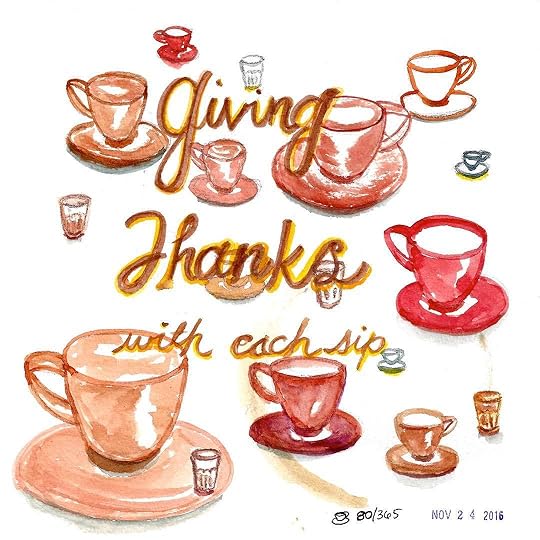
Photo taken at: Denver, Colorado
The post Happy Thanksgiving, sip by sip! appeared first on Original Impulse .
November 16, 2016
Keep On Creating

#76 of my 365 Cups series
I’m leading a coaching group, Write On, and last week many of the members found themselves waylaid from their writing goals. This is normal – a big shift or surprise can put us into shock mode. In this state of intense emotion, it’s hard to focus.
Massive upheaval can also bring our inner critic out into the light. I know I faced doubts about the annual review I am writing. Isn’t this selfish? Shouldn’t I be doing more important things? How privileged of me to be writing about my year.
These doubts made me want to abandon my work.
And yet I know that hiding is not my true path. My path is to share what I know about the creative process so that others are emboldened to do their creative work.
Even in times of uncertainty, fear and upheaval, we MUST keep creating. Yes, there is a time to process what we are feeling and thinking, but what better way to do that than through our art and our writing?
If you need a few pointers on how to stay focused on your work, here are some thoughts.
• Limit your consumption of media and others’ opinions.
• Begin your day with your own work, not others’.
• Let your body lead – listen to its needs and honor them.
• Watch out for self-sabotage tendencies – binging on food, drink or media will not serve you.
• Connect with loved ones.
• Access nature and other things that nurture you.
• Do your creative work.
There will be days when you cannot think, focus, sit still or create. Those are the days where you can do small bits of your project. Remind yourself of your original impulse for this project. Lay out the outline of your book in index cards. Look up links for things you want to share. Tidy up and clean the studio space. Do something, no matter how small, to stay connected to your creating.
It’s never been more clear that we must keep making. We cannot let anything – either external forces or internal fears – stop us from what is inside us and what must be expressed. Each of us has a voice and a role to play, and there is no longer any time to believe that we don’t matter.
Please, do not let your inner critic or your fears win the day. Do not let a day pass without feeding your creative fire. Write. Make. Speak. Inspire.
We need you.
The post Keep On Creating appeared first on Original Impulse .
October 30, 2016
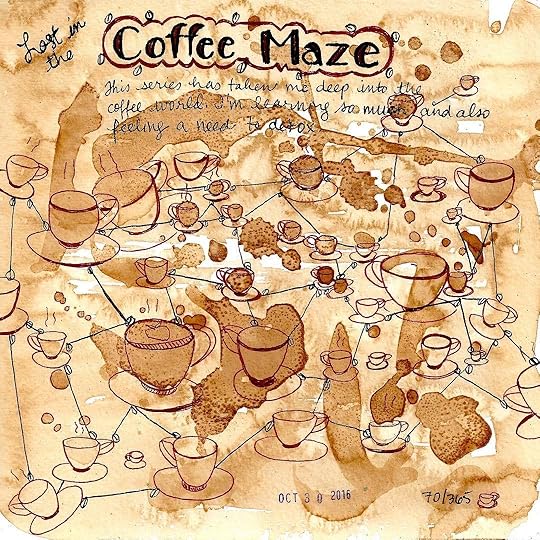
Lost in the coffee maze!
Since I’ve been doing this 365 cup series I’ve consumed a lot of coffee. I’ve also learned a lot about coffee and some days I feel like I’m in the coffee maze. Soon I will be adding other beverages to my daily mix.
The post Lost in the coffee maze! appeared first on Original Impulse .
October 25, 2016
Annual Review Webinar goodies

This is what it looks like when I am working on my annual review
Thanks to everyone who signed up for the annual review webinar – all 138 of you, and all 38 who were able to make it to the live call.
Handout for the webinar Here is a link to the annual review Dropbox folder where you can access the video and audio files for the webinar. You must download the video to watch the full thing or watch it on Dropbox mobile.Access the webinar recordings here.Listen to the recording below. http://www.originalimpulse.com/wp-content/uploads/2016/10/AnnualReviewWebinar.mp3Below are links to some of my previous annual reports.
201020132015The post Annual Review Webinar goodies appeared first on Original Impulse .
October 18, 2016
I stink, you stink, and here’s why…
I stink, you stink and here’s why.
Sometimes I get to the end of the day or week and think, what did I do? My mind searches for some meaningful action and all I can think of is the many times I refreshed my email inbox or the times I popped over to Facebook and Instagram to see who was loving me.
I think, well, I stink. This week stunk.
Happen to you, too?
It turns out this ignorance of what we did is completely common. In her book The Progress Principle, Teresa Amabile shares how her research revealed that people who kept consistent track of what they did at work were happier and more satisfied with their work. People tracked their thoughts and feelings on a daily basis, and Amabile discovered that seeing and acknowledging these small wins contributed to a greater sense of satisfaction.
Sounds good, right? You probably already know that having a relationship with your inner self through writing gives you a greater sense of satisfaction and control in your life.

Cueillez des aujourd’hui les roses de la vie – Gather today the roses of your life
But what if you don’t pay attention to your daily and weekly small wins? You can go around feeling like you kinda suck. Any negative thing that happens to us – a harsh word from a boss or colleague, a negative review (or no review) or your work, a nasty altercation in traffic – these negative things carry more weight than positive instances.
This is known as the ‘negativity bias’. Negative things weigh more for us than positive episodes. We can get 20 stellar reviews and one negative review of something we produced, and we can only focus on the one negative review.
So what? Why does this matter for us in our attempts to write or create things that matter to us?
If we don’t celebrate and savor the good things, if we don’t take time out of busy-ness to notice our wins both big and small, we don’t gain the boons from our efforts. When we simply rush to the next thing, we lose out on the power of our efforts.
Even though I know this, I was guilty of missing out on the impact of my efforts this year. A couple of instances:
I presented at the major conference for illustrators this year, ICON9. This was a massive win for me as an artist and speaker. But once it was over, I only could focus on the fact that I wasn’t as humorous as I wanted to be. By the next week, I had moved on to the next project.
It was only a month later that I recalled the event and realized, holy crap! That was a big deal. I scheduled a webinar to share what I had learned from the process. I am still gleaning insights into what that meant for me and for my art career.
Late last year, I concocted the idea to spend a solid amount of time away from home in my own self-designed artist residency. I planned and saved to be able to focus the bulk of my efforts on my art.
It was great and I had a blast. But afterward, I had other things to focus on (aforementioned speaking gig). The juicy insights and rewards from my residency weren’t very potent in my mind. I even forgot that I had spent two months in Paris making art.
But I woke up to my forgetfulness one day and decided, again, to host a webinar. It was in the sharing of my experience that I was able to sit down and reflect on what I had done and what I could glean.
By pausing to reflect on both of these situations, I was able to see myself at a distance and to recognize what it took to pull off those things. Seeing the qualities and skills I put into play gave me fuel for other projects.
If we never pause to reflect, we can forget our wins and feel that we aren’t making any real progress. Without reflection, we operate at a loss, and our days can feel less satisfying. We never arrive where we want to be if we don’t pause to notice – omg, I am already there.

Keeping journals helps the reflection process go smoothly
Amabile recommends an ongoing process of reflection to glean the glory from our small daily wins. I love that, and I also advocate doing an annual review. You don’t have to be a small business owner to draft your own annual report, celebrating your wins, assessing your failures and gleaning the goodness from it all so you can make an even better year next time.
So…next time you think, “I suck, I didn’t get anything done this week/month/year” please stop to assess what’s actually true. I bet you don’t suck at all.
How has a reflection process helped you be a more successful creative?
Join us next week for my no-cost webinar: Empower Your Year with an Annual Review, Tuesday, October 25th. Reserve your seat here.
The post I stink, you stink, and here’s why… appeared first on Original Impulse .
I suck, you suck, and here’s why…
I suck, you suck and here’s why.
Sometimes I get to the end of the day or week and think, what did I do? My mind searches for some meaningful action and all I can think of is the many times I refreshed my email inbox or the times I popped over to Facebook and Instagram to see who was loving me.
I think, well, I suck. This week sucked.
Happen to you, too?
It turns out this ignorance of what we did is completely common. In her book The Progress Principle, Teresa Amabile shares how her research revealed that people who kept consistent track of what they did at work were happier and more satisfied with their work. People tracked their thoughts and feelings on a daily basis, and Amabile discovered that seeing and acknowledging these small wins contributed to a greater sense of satisfaction.
Sounds good, right? You probably already know that having a relationship with your inner self through writing gives you a greater sense of satisfaction and control in your life.
Cueillez des aujourd’hui les roses de la vie – Gather today the roses of your life
But what if you don’t pay attention to your daily and weekly small wins? You can go around feeling like you kinda suck. Any negative thing that happens to us – a harsh word from a boss or colleague, a negative review (or no review) or your work, a nasty altercation in traffic – these negative things carry more weight than positive instances.
This is known as the ‘negativity bias’. Negative things weigh more for us than positive episodes. We can get 20 stellar reviews and one negative review of something we produced, and we can only focus on the one negative review.
So what? Why does this matter for us in our attempts to write or create things that matter to us?
If we don’t celebrate and savor the good things, if we don’t take time out of busy-ness to notice our wins both big and small, we don’t gain the boons from our efforts. When we simply rush to the next thing, we lose out on the power of our efforts.
Even though I know this, I was guilty of missing out on the impact of my efforts this year. A couple of instances:
I presented at the major conference for illustrators this year, ICON9. This was a massive win for me as an artist and speaker. But once it was over, I only could focus on the fact that I wasn’t as humorous as I wanted to be. By the next week, I had moved on to the next project.
It was only a month later that I recalled the event and realized, holy crap! That was a big deal. I scheduled a webinar to share what I had learned from the process. I am still gleaning insights into what that meant for me and for my art career.
Late last year, I concocted the idea to spend a solid amount of time away from home in my own self-designed artist residency. I planned and saved to be able to focus the bulk of my efforts on my art.
It was great and I had a blast. But afterward, I had other things to focus on (aforementioned speaking gig). The juicy insights and rewards from my residency weren’t very potent in my mind. I even forgot that I had spent two months in Paris making art.
But I woke up to my forgetfulness one day and decided, again, to host a webinar. It was in the sharing of my experience that I was able to sit down and reflect on what I had done and what I could glean.
By pausing to reflect on both of these situations, I was able to see myself at a distance and to recognize what it took to pull off those things. Seeing the qualities and skills I put into play gave me fuel for other projects.
If we never pause to reflect, we can forget our wins and feel that we aren’t making any real progress. Without reflection, we operate at a loss, and our days can feel less satisfying. We never arrive where we want to be if we don’t pause to notice – omg, I am already there.
Keeping journals helps the reflection process go smoothly
Amabile recommends an ongoing process of reflection to glean the glory from our small daily wins. I love that, and I also advocate doing an annual review. You don’t have to be a small business owner to draft your own annual report, celebrating your wins, assessing your failures and gleaning the goodness from it all so you can make an even better year next time.
So…next time you think, “I suck, I didn’t get anything done this week/month/year” please stop to assess what’s actually true. I bet you don’t suck at all.
How has a reflection process helped you be a more successful creative?
The post I suck, you suck, and here’s why… appeared first on Original Impulse .
October 11, 2016
Third Time’s a Charm: Interview with author Jonathan Fields
My friend and mentor Jonathan Fields has come out with his book How to Live a Good Life. I’ve been part of Jonathan’s world since I stalked him and wanted to hire him to help me publish my novel Chasing Sylvia Beach. Back in 2011 when said stalking was happening, I had no idea that I would become a participant in his Good Life Project Immersion program and go on to become a faculty member of the GLP team.
Jonathan did help me with my novel, but he also helped me with so much more. Before I knew him personally, I saw the savvy and successful businessman. I remember being on one of his free Tribal Author calls. When he said ‘There’s never been a better time to be an author’ I shouted with joy. Here was someone finally focusing on how much creativity and power we have, instead of how challenging it is to get a book published.
As I came to know Jonathan more, I have seen more than just his savvy. I’ve seen his deep care and commitment to the creative process. I’ve witnessed how much he contributes to those around him – helping us have more self-awareness, more self-confidence and more joyful action.
His book, How to Live a Good Life, brings much of what he has been teaching and learning into one place. Insights from his research, from his podcast interviews and from his role as a perpetual student are bundled into this book that I know will change many lives.
After more than four years deeply immersed in Jonathan’s world, I can say that I have definitely benefited from his business savvy and that my business is stronger for it. But the real benefit of learning from Jonathan is that he continually points me toward being and expressing more of me. To full-on, unabashed sharing of my gifts. To recognizing that all of me, even the goofy parts, deserve a turn on the stage. When you pick up a copy of his book, look for me in the chapter Dance Like No One’s Watching.
Jonathan agreed to an interview for us, and while there is a lot I could ask about the contents of the book, I wanted to focus on his unexpected path to writing How to Live a Good Life. Enjoy this conversation about sticking with it even when you don’t know how.
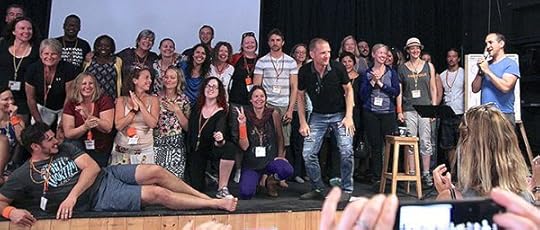
Not your typical author photo, this is a picture of us at Camp on the last day. It’s amazing to me the community of fun and loving world-shakers that Jonathan and his wife Stephanie have built. Jonathan has the mic in this picture…look for me among my peeps, happy with my tribe. Photo credit: Gregory Berg of Enso Photography
Cynthia Morris Thanks, Jonathan, for agreeing to share your experience with your writing process. You know we all love those peeks behind the curtain. So your process of writing your book didn’t go according to plan. Can you tell us what happened?
Jonathan Fields Haha. It was quite an odyssey! First, the book I sold my publisher was a completely different book, but after researching it more deeply, I realized the data was all over the place. Translation, it would be an “interesting romp,” but in the end, probably a pretty unsatisfying read. So, I went back to the publisher, told them where I was at, said I didn’t want to write it, but that there was another book I was ready to write.
That new book would be called How to Live a Good Life. They got it, and were on board with the new direction. I went off, did a nuanced deep-dive into psychology, philosophy and more, then wrote the manuscript and turned it. Waiting for an answer. Waiting. Waiting. #ergggg!!! Finally, it came. “This is not it,” my editors said. Oh. Okay. We had a meeting, discussed where is went off course and how to bring it back.
Then, I went off on my own and wrote an entire new second manuscript. Feeling better about it, I turned it in. And, waited for a reply. Again. Finally, it came. “This isn’t it, either. And, we don’t know what to tell you.” Noooooo! This is not what any author wants to hear, especially after switching books, then having already written two manuscripts.
What I realized is that I was writing with a new publisher, and this was a very different type of book than I’d ever written before. More straight up human potential/personal growth, not career, business or entrepreneurship. I didn’t understand what that genre demanded. So, we hit pause. I went and read the top selling books in the space over the last decade. Finally, it clicked, I understood the approach.
I reworked the table of contents to conform with this new structure and showed it to my publisher. They loved it, but I wasn’t sure I wanted to write “that” book. So, I told them I’d write the first few chapters to see how we all felt about it. A few weeks later, I turned the first four chapters in. They loved it. And, to my surprised, I really enjoyed writing in this new style. It was so much lighter and easier to read, yet fiercely actionable.
From then on, we were off to the races! But, wow, did it take some soul searching to get there.
CM What went through your mind and heart at the third draft?
JF Hehe. I’m a New Yorker, what really went through my mind and heart would not be polite to share. lol!
There were definitely moments where I considered just packing it in and giving back my advance. But, something inside of me kept me in it. Funny enough, it nothing to do with “sunk costs.” It wasn’t that I’d already spent so much time on it.
As an entrepreneur, I’ve learned that you cannot guide your future decision based on what you’ve invested in a project to date. You have to look at it fresh and ask, “knowing what I now know, would I still want to make this happen?” My answer remained a solid yes. There was something inside that had to get out.
CM You’ve described writing this book as ‘brutally hard’. I’m curious to know what helped you stay committed to this book even though it put you through the wringer.
 JF I sometimes wonder if what really kept me in it was the challenge of trying to write to a new form, to be creative and compelling under what, for me, was a new and pretty alien set of constraints. A new way to write. The challenge was to take a vast amount of information and figure out how to convey in a way that “felt” super easy to engage with, was simple to understand and that inspired action.
I like a challenge, so I went for it. And, once I got comfortable, maybe the biggest surprise was that it was actually a much easier process than the approach that’d guided my writing during the first two books. In fact, once I had the book mapped out and got into a real rhythm, I ended writing close to a chapter a day.
I also used a technique I first heard about in a 1958 interview in The Paris Review with Ernest Hemingway. “You always stop when you know what is going to happen next,” he told his partner in conversation, George Plimpton. That’s what I did. I would never end a writing day with a finished chapter. No matter how challenging, I’d always begin the next one and write enough so that, when I came back the next day, I could dive right in.
Coincidentally, in a past life as a lawyer, I spent a year working at the mega-firm that Plimpton would eventually found, Debevoise & Plimpton, some 4-plus decades after the interview with Hemingway took place. And, one of my favorite things about being a writer now is that I am no longer bound by the rigid formulas of the law.
CM As a coach, illustrator and author, I know that this process of needing to do several drafts is more the rule than the exception. You know this firsthand, too, but I’m curious to know if there’s any research or information you came across in writing Uncertainty or How to Live a Good Life that might help people to accept the fact that many drafts might be necessary.
JF One of the things I discovered is that your best work rarely, if ever comes on the first go-around. If you look at the process of ideation, it usually unfolds in three phases. The first attempt gets all the obvious ideas on the table. With rare exception, they’re not great. Obvious does not equal creative or innovative. Sadly, a good many people stop here and tell themselves, “good enough is good enough.”
A few push into the second phase. Here you return to the table and begin to dig deeper. You toil, grumble, write, map, outline, draw, argue, sweat, caffeinate and probably say things that’ll get you in trouble. But, better ideas start to form. You deepen into empathy and see different patterns. Still, at the end of the day, the ideas are better, but you know deep down, they’re neither the best solution, nor are they representative of what you’re truly capable of. Still, at this point, the process becomes so grueling, most people just give up. They settle.
A rare few push through to the third phase. Here, you wipe the slate clean, you force yourself to stand in a place of uncertainty. You question every alleged truth and assumption and, hard as it is, keeping working. Sometimes, the big breakthrough comes from this toiling. But, more often than not, it comes when you now step away, create space and just let it come. That’s what eventually happened with my book. It only came together after I worked, struggled fiercely, then stepped away and committed to living in the abyss long enough for the real answers to emerge.
CM Now that the book is done and you have a bit of distance, what do you love about it?
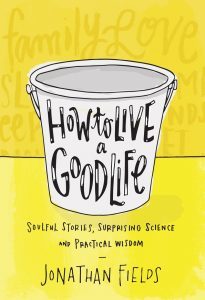
JF Haha, the cover! Truly, I asked a friend, Caroline Winegart, to create it and I’ve loved it since the moment I saw it. Beyond that, the thing I love is the very same thing that scares me most about it. It is the most personal thing I’ve ever written. The level of sharing is new for me, and it both makes me nervous, but also most excited. The other thing is that it is this weird blend of the easiest read and the most actionable book I’ve ever created. And, my greatest hope is that people won’t just read the book, they’ll do it!
CM What’s your dream or intention for the book? If it were out there doing its job, what would you want to see for people after reading this book?
JF That it serves as the inciting incident in people’s lives. That it open the door to possibility, then guides them as they take the daily steps to make the journey from flatlined to flourishing. To rediscover meaning and movement, grace and ease, peace and connection, vibrance and vitality. Seriously, I want people to DO this book.
CM Anything else you want to share?
JF Just that you rock. I’ve also seen you as a mentor and a mensch, but I’ve loved being in your orbit as you’ve taken your seat as a true artist. You inspire me. And, oh my God, what an incredible example you set for a life well-lived.
Thanks so much for allowing me to spend some time with you and your community!
CM Now I’m blushing! Thank you JF! Thanks so much for being so generous with your time and your process, Jonathan.
To pick up a copy of his book, click here. Here’s something really special: if you order a book or several copies by October 18th, you will be part of the program to plant a tree for each book sold. How cool is that?! Become a Good Life Ambassador here.
The post Third Time’s a Charm: Interview with author Jonathan Fields appeared first on Original Impulse .
Interview with author Jonathan Fields
My friend and mentor Jonathan Fields has come out with his book How to Live a Good Life. I’ve been part of Jonathan’s world since I stalked him and wanted to hire him to help me publish my novel Chasing Sylvia Beach. Back in 2011 when said stalking was happening, I had no idea that I would become a participant in his Good Life Project Immersion program and go on to become a faculty member of the GLP team.
Jonathan did help me with my novel, but he also helped me with so much more. Before I knew him personally, I saw the savvy and successful businessman. I remember being on one of his free Tribal Author calls. When he said ‘There’s never been a better time to be an author’ I shouted with joy. Here was someone finally focusing on how much creativity and power we have, instead of how challenging it is to get a book published.
As I came to know Jonathan more, I have seen more than just his savvy. I’ve seen his deep care and commitment to the creative process. I’ve witnessed how much he contributes to those around him – helping us have more self-awareness, more self-confidence and more joyful action.
His book, How to Live a Good Life, brings much of what he has been teaching and learning into one place. Insights from his research, from his podcast interviews and from his role as a perpetual student are bundled into this book that I know will change many lives.
After more than four years deeply immersed in Jonathan’s world, I can say that I have definitely benefited from his business savvy and that my business is stronger for it. But the real benefit of learning from Jonathan is that he continually points me toward being and expressing more of me. To full-on, unabashed sharing of my gifts. To recognizing that all of me, even the goofy parts, deserve a turn on the stage. When you pick up a copy of his book, look for me in the chapter Dance Like No One’s Watching.
Jonathan agreed to an interview for us, and while there is a lot I could ask about the contents of the book, I wanted to focus on his unexpected path to writing How to Live a Good Life. Enjoy this conversation about sticking with it even when you don’t know how.
Not your typical author photo, this is a picture of us at Camp on the last day. It’s amazing to me the community of fun and loving world-shakers that Jonathan and his wife Stephanie have built. Jonathan has the mic in this picture…look for me among my peeps, happy with my tribe.
Cynthia Morris Thanks, Jonathan, for agreeing to share your experience with your writing process. You know we all love those peeks behind the curtain. So your process of writing your book didn’t go according to plan. Can you tell us what happened?
Jonathan Fields Haha. It was quite an odyssey! First, the book I sold my publisher was a completely different book, but after researching it more deeply, I realized the data was all over the place. Translation, it would be an “interesting romp,” but in the end, probably a pretty unsatisfying read. So, I went back to the publisher, told them where I was at, said I didn’t want to write it, but that there was another book I was ready to write.
That new book would be called How to Live a Good Life. They got it, and were on board with the new direction. I went off, did a nuanced deep-dive into psychology, philosophy and more, then wrote the manuscript and turned it. Waiting for an answer. Waiting. Waiting. #ergggg!!! Finally, it came. “This is not it,” my editors said. Oh. Okay. We had a meeting, discussed where is went off course and how to bring it back.
Then, I went off on my own and wrote an entire new second manuscript. Feeling better about it, I turned it in. And, waited for a reply. Again. Finally, it came. “This isn’t it, either. And, we don’t know what to tell you.” Noooooo! This is not what any author wants to hear, especially after switching books, then having already written two manuscripts.
What I realized is that I was writing with a new publisher, and this was a very different type of book than I’d ever written before. More straight up human potential/personal growth, not career, business or entrepreneurship. I didn’t understand what that genre demanded. So, we hit pause. I went and read the top selling books in the space over the last decade. Finally, it clicked, I understood the approach.
I reworked the table of contents to conform with this new structure and showed it to my publisher. They loved it, but I wasn’t sure I wanted to write “that” book. So, I told them I’d write the first few chapters to see how we all felt about it. A few weeks later, I turned the first four chapters in. They loved it. And, to my surprised, I really enjoyed writing in this new style. It was so much lighter and easier to read, yet fiercely actionable.
From then on, we were off to the races! But, wow, did it take some soul searching to get there.
CM What went through your mind and heart at the third draft?
JF Hehe. I’m a New Yorker, what really went through my mind and heart would not be polite to share. lol!
There were definitely moments where I considered just packing it in and giving back my advance. But, something inside of me kept me in it. Funny enough, it nothing to do with “sunk costs.” It wasn’t that I’d already spent so much time on it.
As an entrepreneur, I’ve learned that you cannot guide your future decision based on what you’ve invested in a project to date. You have to look at it fresh and ask, “knowing what I now know, would I still want to make this happen?” My answer remained a solid yes. There was something inside that had to get out.
CM You’ve described writing this book as ‘brutally hard’. I’m curious to know what helped you stay committed to this book even though it put you through the wringer.
JF I sometimes wonder if what really kept me in it was the challenge of trying to write to a new form, to be creative and compelling under what, for me, was a new and pretty alien set of constraints. A new way to write. The challenge was to take a vast amount of information and figure out how to convey in a way that “felt” super easy to engage with, was simple to understand and that inspired action.
I like a challenge, so I went for it. And, once I got comfortable, maybe the biggest surprise was that it was actually a much easier process than the approach that’d guided my writing during the first two books. In fact, once I had the book mapped out and got into a real rhythm, I ended writing close to a chapter a day.
I also used a technique I first heard about in a 1958 interview in The Paris Review with Ernest Hemingway. “You always stop when you know what is going to happen next,” he told his partner in conversation, George Plimpton. That’s what I did. I would never end a writing day with a finished chapter. No matter how challenging, I’d always begin the next one and write enough so that, when I came back the next day, I could dive right in.
Coincidentally, in a past life as a lawyer, I spent a year working at the mega-firm that Plimpton would eventually found, Debevoise & Plimpton, some 4-plus decades after the interview with Hemingway took place. And, one of my favorite things about being a writer now is that I am no longer bound by the rigid formulas of the law.
CM As a coach, illustrator and author, I know that this process of needing to do several drafts is more the rule than the exception. You know this firsthand, too, but I’m curious to know if there’s any research or information you came across in writing Uncertainty or How to Live a Good Life that might help people to accept the fact that many drafts might be necessary.
JF One of the things I discovered is that your best work rarely, if ever comes on the first go-around. If you look at the process of ideation, it usually unfolds in three phases. The first attempt gets all the obvious ideas on the table. With rare exception, they’re not great. Obvious does not equal creative or innovative. Sadly, a good many people stop here and tell themselves, “good enough is good enough.”
A few push into the second phase. Here you return to the table and begin to dig deeper. You toil, grumble, write, map, outline, draw, argue, sweat, caffeinate and probably say things that’ll get you in trouble. But, better ideas start to form. You deepen into empathy and see different patterns. Still, at the end of the day, the ideas are better, but you know deep down, they’re neither the best solution, nor are they representative of what you’re truly capable of. Still, at this point, the process becomes so grueling, most people just give up. They settle.
A rare few push through to the third phase. Here, you wipe the slate clean, you force yourself to stand in a place of uncertainty. You question every alleged truth and assumption and, hard as it is, keeping working. Sometimes, the big breakthrough comes from this toiling. But, more often than not, it comes when you now step away, create space and just let it come. That’s what eventually happened with my book. It only came together after I worked, struggled fiercely, then stepped away and committed to living in the abyss long enough for the real answers to emerge.
CM Now that the book is done and you have a bit of distance, what do you love about it?
JF Haha, the cover! Truly, I asked a friend, Caroline Winegart, to create it and I’ve loved it since the moment I saw it. Beyond that, the thing I love is the very same thing that scares me most about it. It is the most personal thing I’ve ever written. The level of sharing is new for me, and it both makes me nervous, but also most excited. The other thing is that it is this weird blend of the easiest read and the most actionable book I’ve ever created. And, my greatest hope is that people won’t just read the book, they’ll do it!
CM What’s your dream or intention for the book? If it were out there doing its job, what would you want to see for people after reading this book?
JF That it serves as the inciting incident in people’s lives. That it open the door to possibility, then guides them as they take the daily steps to make the journey from flatlined to flourishing. To rediscover meaning and movement, grace and ease, peace and connection, vibrance and vitality. Seriously, I want people to DO this book.
CM Anything else you want to share?
JF Just that you rock. I’ve also seen you as a mentor and a mensch, but I’ve loved being in your orbit as you’ve taken your seat as a true artist. You inspire me. And, oh my God, what an incredible example you set for a life well-lived.
Thanks so much for allowing me to spend some time with you and your community!
CM Now I’m blushing! Thank you JF! Thanks so much for being so generous with your time and your process, Jonathan.
To pick up a copy of his book, click here. Here’s something really special: if you order a book or several copies by October 18th, you will be part of the program to plant a tree for each book sold. How cool is that?! Become a Good Life Ambassador here.
The post Interview with author Jonathan Fields appeared first on Original Impulse .
September 27, 2016
Easily manage all your great ideas
So many great ideas ready to be captured
There’s a lot inside you. Books. Blog posts. Essays, and then there’s that class you want to teach. Oh, and poetry, too.
Ring true? If you’ve been bitten by the writing bug, chances are there is a never-ending stream of ideas you want to write.
One of the biggest challenges we face is knowing what to write, and when. How to prioritize all of our great ideas? It’s going to be different for everyone, but as a seasoned writer’s coach, I have some ways to help focus enough so we can write what we want.
First you want to get clear on why you are writing and what you want for your writing. Is it for yourself only? For your loved ones? Or do you have publishing goals you want to meet?
Get clear on what you want for your writing. Now, check out this handy exercise from my book Create Your Writer’s Life.
1) Make a list of ten things you want to write.
These could be specific (an article about ADD) or broad (honest journal pages every day). They can be short term (a birthday letter to Vicki) or long term (a novel about real people).
2) Assess your list.
Decide which items you want to focus on. Go through the list. Make a check next to the projects you will work on in the next year.
Repeat this process, using the following units of time. What will you work on in the next:
six monthsthree monthsnext monthExample of a list of writing projects:
Yoga article √√• Artist profile article √√
• Artist technique article √√
• NPR piece √√
• Letter to Sara √√√
• Daily journal entries √√√√
• Novel √√
• Nonfiction book √√√√
• Essay about ex √√√
By looking at the number of checks next to each item, you can easily see which projects have the highest priority. The more checks, the higher the priority. The nonfiction book has four checks, which indicates that I want to work on it this month. Journaling also has four checks, indicating that that is also a priority now.
The yoga article and artist profile article, with two checks each, are not as important now, but I would like to get to them in the next six months. Now I have a clear sense of what I will work on now, and what will come afterward. The list propels me from ideas into action.
The items that have the most checks carry the most juice and energy for you now. Begin today.
Before you plunge in with your project, take some time to get familiar with it. Brainstorm it. Mind map it. Draw it in colors. Feel free to outline it. Know that it will change as you work on it, but this is the initial getting-to-know you phase.
Warning! Don’t get stuck in the planning process. Often we don’t have the whole thing mapped out and need to plunge into the writing even when we don’t have everything figured out. I’ve seen clients drain their enthusiasm for a project by outlining it to death.
Ask yourself these questions:
What’s important about this project?
What will be different for me when I am done with it?
I’d love to know how this process worked for you. Feel free to share your experience on the Original Impulse blog.
Now that you are clear about what to write, let’s get that in ink! Join us to write every day in October and by the end of the month you will be glowing and gloating about all the process you’ve made.
The post Easily manage all your great ideas appeared first on Original Impulse .


