Tonya Plank's Blog, page 24
January 4, 2011
Guggenheim to Live-Stream "Giselle Revisited" January 9th
Super cool! The Guggenheim has just announced it is going to live-stream its upcoming January 9th Works & Process program, Giselle Revisited, a discussion with Pacific Northwest Ballet artistic director Peter Boal and others from PNB about the company's new production of Giselle. Of course excerpts will be performed, by principal dancers Carla Korbes, Carrie Imler, SLSG fave Seth Orza, and soloist James Moore (who I also remember liking the last time PNB performed here).
The discussion / performance will be live-streamed direct from the Guggenheim beginning at 7:30 p.m. on Sunday, January 9th, at this web channel: http://www.ustream.tv/channel/worksandprocess. The Winger's Candice Thompson will lead an online discussion, so people watching via the live-stream will be able to chat with each other in real time.
Click on the link below to see the full press release.
Works & Process, the performing arts program at the Guggenheim, to live stream Pacific Northwest Ballet – Giselle Revisited ON Sunday, January 9, 7:30pm
For over 25 years and in over 300 productions, Works & Process has offered audiences unprecedented access to our generation's leading creators and performers. Each 80-minute performance uniquely combines artistic creation and stimulating conversation and takes place in the Guggenheim's intimate Frank Lloyd Wright-designed 285-seat Peter B. Lewis Theater. With performances often sold out, Works & Process on Sunday, January 9, 7:30 pm, for the first time, will live stream the sold out performance Pacific Northwest Ballet – Giselle Revisited. In this program Pacific Northwest Ballet dancers will perform excerpts from Peter Boal's new staging of Giselle, prior to the production's June 2011 premiere at McCaw Hall in Seattle. Giselle, widely acknowledged as the greatest ballet of the Romantic era, will feature reconstructed choreography utilizing Stepanov notation circa 1899-1903 and French sources from the 1840s and 1860s. Artistic Director Peter Boal will discuss the production with dance scholars Doug Fullington and Marian Smith. Excerpts will be performed by PNB dancers Carrie Imler, Carla Körbes, James Moore, and Seth Orza.
The Winger's Candice Thompson will moderate the real-time online chat. The video will be automatically archived and can be shared and viewed in social networks.
To see the performance live online visit http://www.ustream.tv/channel/worksandprocess.
PANEL
Peter Boal
Doug Fullington
Marian Smith
PERFORMERS
Carrie Imler, Principal
Carla Körbes, Principal
James Moore, Soloist
Seth Orza, Principal
More About the Production
The sources utilized for PNB's Giselle include a repetiteur believed to have been prepared in Paris, circa 1842, to assist in the staging of Giselle in St. Petersburg that year. The repetiteur includes detailed information relating to the action of the ballet and how it relates to the score by French composer Adolphe Adam. Another primary French source is a complete notation of Giselle likely made in 1860s Paris by Henri Justamant. This elaborate notation recently surfaced in a private collection in Germany and has now been published. The other important source is a choreographic notation made in St. Petersburg, circa 1899-1903. This notation was made using the Stepanov notation system developed in St. Petersburg in the early 1890s. The production represents French choreographer Marius Petipa's version of Giselle that was based on the original Paris production, choreographed by Jean Coralli and Jules Perrot. The Stepanov notation of Giselle was used in the West for historic stagings by Paris Opéra Ballet and the Vic-Wells Ballet (now the Royal Ballet). The notation is now housed at the Harvard Theatre Collection.
In collaboration with Peter Boal, who will oversee the entire staging, Marian Smith will focus on the French sources and their use for the action of the ballet, and Doug Fullington will reconstruct choreography using the Stepanov notations. This production marks the first time an American ballet company will base a production on Stepanov notation as well as the first use in modern times of the rare French sources for Giselle.
Pacific Northwest Ballet, one of the largest and most highly regarded ballet companies in the United States, was founded in 1972. In July 2005, Peter Boal became Artistic Director, succeeding Kent Stowell and Francia Russell, Co-Artistic Directors since 1977. The Company of forty-six dancers presents more than 100 performances each year of full-length and mixed repertory ballets at Marion Oliver McCaw Hall and on tour. The Company has toured to Europe, Australia, Taiwan, Hong Kong, Canada and throughout the United States, with celebrated appearances at Jacob's Pillow and in New York City and Washington, DC. Under the direction of Mr. Boal, PNB has continued to expand and diversify its repertory to include works by Ulysses Dove, Jiri Kylian, Susan Marshall, Benjamin Millepied, Mark Morris, Victor Quijada, Susan Stroman, Twyla Tharp, Christopher Wheeldon and others. Founded in 1974, Pacific Northwest Ballet School, under the direction of Francia Russell since 1977 and now under Mr. Boal's direction, is nationally recognized as setting the standard for ballet training and offers a complete professional curriculum to over 950 students. PNB and PNBS also provide comprehensive dance education to the greater Seattle area and reach over 10,000 adults and children each year through DanceChance, Discover Dance and other outreach programs and activities.
Works & Process at the Guggenheim
For over 25 years and in over 300 productions, New Yorkers have been able to see, hear, and meet the most acclaimed artists in the world, in an intimate setting unlike any other. Works & Process, the performing arts series at the Guggenheim, has championed new works, offered audiences unprecedented access to our generation's leading creators and performers, and hosted post-show receptions for the audiences and artists to continue the discussion. Each 80-minute performance uniquely combines artistic creation and stimulating conversation and takes place in the Guggenheim's intimate Frank Lloyd Wright-designed 285-seat Peter B. Lewis Theater. Described by The New York Times as "an exceptional opportunity to understand something of the creative process," Works & Process is produced by founder Mary Sharp Cronson.


Is Ballet A Dying Art?
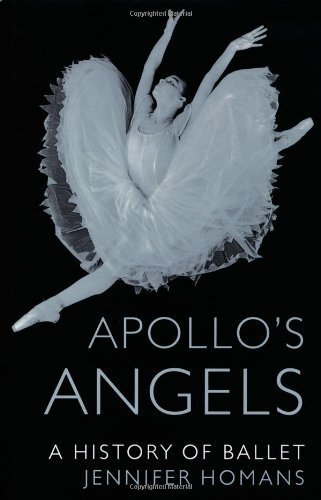
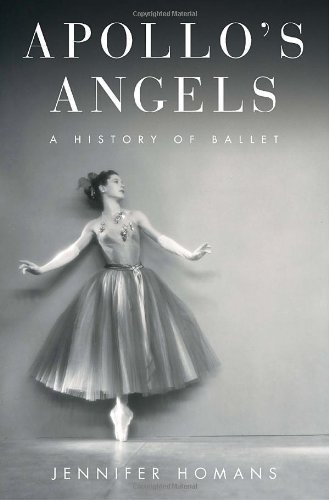
I must confess I haven't yet read Jennifer Homans' acclaimed but controversial history of ballet, Apollo's Angels. I'm working hard on my second novel and have been knee deep in prison and cop memoirs and haven't had time for much outside reading. I hope to read it soon though.
In the meantime, I have read some of the reviews, including Laura Jacobs' in the WSJ and Toni Bentley's in the NY Times. The two reviews focus on very different aspects of the book so it's interesting to read both of them. Bentley says Homans is best on Balanchine (both Bentley and Homans danced with him). But Jacobs find the earlier sections enlightening as well.
The controversial aspects of the book seem to be toward the end when Homans argues that, for various reason (but according to Bentley many of them being that Balanchine has passed and his legacy is not being kept alive), ballet is a dying art.
I don't want to go on too much since I haven't yet read the book, but I will say that ballet seems to be alive and well in many European and Latin American countries. I do notice a real influx of visitors to my blog whenever the big European stars perform with ABT. I don't think Roberto Bolle, Alina Cojocaru and Natalia Osipova fans think ballet is dying and certainly not because Balanchine is no longer with us. Ballet may be less popular in this country since the Baryshnikov era passed though, and it remains to be seen whether movies like Mao's Last Dancer and Black Swan can do anything to revive it. I'm doubtful but want to be hopeful. I think it's more likely that Natalie Portman marrying Benjamin Millepied will draw audiences to ballet than the actual movie will.
But then I recently ran across this interview with Homans over at the Ballet Bag, a London blog. At the beginning of the post, the writers say audiences there have been dwindling a bit and they're worried about the future of the art form as well. Which scares me.
Anyway, has anyone read the book?
Another thing I wanted to call attention to is the book cover. The top one is the British cover, the second the American. Which do you guys like better, and think will sell more books? Just about every single time I see a European cover beside an American cover, I like the European better. But maybe it's just me.
Paula Abdul's "Live to Dance" Premieres Tonight
Hey everyone, as faithful SLSG reader Jonathan reminded me (what would I do without such people  ), Paula Abdul's new TV show, Live to Dance, premieres tonight, January 4th. Check the official site for times.
January 2, 2011
Sample Sunday: Sophie's First Day in Court
Hey everyone,
So for this week's Sample Sunday, I'm putting up the first part of Swallow's Chapter 3. This is where Sophie (a lawyer suffering from Globus Hystericus, the feeling of an imaginary ball lodged in your throat) has her first courtroom argument, and where the ball (whom she personifies as "FB") first causes problems with something other than eating. A fellow student in one of my first writing classes whose writing I greatly admired and opinion I respected (and who now works for the PEN American Center) said this is where Swallow really began to come to life for him. So, here it is.
By the way, I just want to thank you all, and everyone who's supported my writing – both the book and this blog – over the past year. The book sold a total of 3,232 copies in its first year out there in the world, and I've been told that's fairly decent for a first novel, especially one that's self-published, and especially one that's more literary than commercial. So, including the several hundred I've given out to readers who've won giveaway contests around the blogosphere and to all the wonderful bloggers and professional reviewers who've been so kind by reviewing it, there are nearly 4,000 people out there who've read (or have at least downloaded) Swallow. I had absolutely no idea what to expect this time last year – and, to be sure, I'm definitely far behind many self-published authors who've sold over a hundred thousand in a year – but I'm really overjoyed with the 4000 readers I've had – especially since, going by the reviews, a good many of them are liking and getting something out of the book. So once again, thank you thank you thank you!
Okay, here's the beginning of chapter three:
Three
Not Exactly Audrey
I knew how horribly oral arguments could go from having watched, in preparation for this day, oodles of them given by my colleagues — mostly by my supervisor Jeannie. Jeannie was in her mid thirties, with radiant red hair shimmering half-way down her back, gorgeous green eyes, and, regardless of what she was saying, always sparkled with never-can-fail attitude, though I was realizing more and more that appellate PDs almost always do – fail to win their cases, that is. Well, we were asking the court to reverse the convictions of people who, at least on the record, could sometimes appear rather unsavory. Anyway, the justice presiding on my panel today — grandfatherly Justice O'Grady — absolutely adored Jeannie. After she'd finished an argument once, he'd pronounced with the proudest of grins, "As always from you, Ms. Davis, excellent argument. Well reasoned, persuasively analyzed, and eloquently rendered. And as always, the Court thanks you."
"You won!" I'd squealed as we left the courthouse.
She'd laughed. "Sophie, you're so cute. That was actually the kiss of death."
"Death?"
"Yep. What he really meant was: 'your client's an evil crack-head and if you think for one second we're letting him out to spread more of his poison throughout our fine city, you'd better think again. But don't you take it personally dear; you did as well as you could for the bastard.'" She'd laughed.
Okay, I'd thought. I guess you can get jaded with this job at some point.
I knew I wouldn't be able to eat well in the morning regardless of FB. But I had to force myself to eat a little lest I run the possibility of keeling over with hunger pangs at a quite inopportune time. So I set my alarm for extra early to have plenty of time for the ever so melodramatic production of breakfast. I fixed a tiny bowl of Cocoa Pebbles, figuring their size would make them relatively easy, and, being a childhood favorite, soothing to boot. But no such luck: saliva disintegration took just as long and I ingested just as little.
Funny thing about food, I was beginning to realize, is that, when it took me so long to finish, I was just as full after eating only about twenty percent of what I'd usually eat. I remembered my Calcuttan bean-pole of a yoga instructor once telling Francie and me that this was the ideal way to consume in order to achieve healthy digestion, slow metabolism, and that ever-elusive but so highly coveted female goal: low body fat. But when we'd put it to the test afterwards at a Belgian bistro with Croque Madames and Dutch chocolate waffles — and failed ridiculously — we determined that such a feat must require something our American socio-biological make-ups simply lacked. Of course, it could have been our choice of food. Regardless, we resigned ourselves to the fact that gustatory nirvana never would be ours. Hmmm, things seemed to be changing for me every day…
So, the defendant, the subject of my first argument, was this very polite elderly Jamaican immigrant named Joseph White who'd been convicted of drug possession with intent to sell. I didn't think he was a drug dealer at all, but simply unlucky enough to be in the proverbial wrong place at the wrong time. Police had stormed his daughter's apartment to search for drugs, and he was sitting on the living room couch talking to his son-in-law, after his grandson, whom he'd come to see, went to bed. The couch was next to a bookcase whose shelves were loaded with small glassines containing "a white rocky substance" and a scale. Yes, someone in that apartment had a lovely little crack business going, but I strongly believed it wasn't Mr. White.
But the law says he can be convicted of possession with intent to sell just because he was in a room where the contraband was in open view, even though no one saw him so much as touch the stuff and he had a totally innocent reason for being there. I argued in my brief that the search warrant said a confidential informant had been in the apartment three times and saw two black guys in their twenties with long dreadlocks weighing and packaging the crack. That description fits the son-in-law to a T, but certainly not bald, 73-year-old Mr. White. At trial, the defense attorney asked the judge to make the informant testify so he could tell the jury what the people looked like whom he saw. But the judge didn't want to jeopardize the informant's identity by making him testify in open court. And his testimony, the judge said, wasn't necessary since Mr. White could be found guilty of possession just because he was in the same room with the drugs in open view. In my brief, I argued the judge's ruling was wrong: the jury should have been able to hear from the informant that he saw other men packaging those drugs for sale. I think that would have been crucial information in determining whether Mr. White himself was guilty. He was on trial, after all, not the son-in-law.
I'd had it pounded into me ad nauseam by my colleagues that you're not supposed to get attached to the client or let yourself feel too strongly for his innocence because you can get too emotionally involved in his plight and get really upset when you lose. Which I understood. But I also felt that there wasn't much of a point to doing a job you weren't really compassionate about. And it was hard because Mr. White was the sweetest, most nonviolent man and so not a big-time drug dealer. And I felt like his situation was the result of something a family member did. Like he had any control over whom he associated with by virtue of biology.
Cedric, the doorman of Stephen's building, was on duty bright and early. He was the strangest-looking man: ghostly pale skin, no eyebrows, and could honestly be anywhere in age from 20 to 55. And he always shot me the nastiest glares — at least I perceived them that way. Nearly made me cry when I'd met him while visiting Stephen one weekend during school, with his slow, full up and down followed by a decidedly disapproving frown delivered straight to my eyes. Of course I was a dowdy backpack-bedraggled student then. But even after I moved in and started wearing more polished business attire, he kept it up. And he always gave Stephen a polite "Mr. Walsh" address, accompanied by a professional nod, but never a greeting for me. Not that I'd want him calling me "Ms. Hegel" though; I'd feel so silly I'd surely laugh. But I could have done without the "dear lord, what troglodyte has moved in and desecrated my building" look.
So, professional and polished though I thought I was, Cedric's admonishing up and down frown that continued through my entire journey from the elevator, around the lobby corner and out the front glass door, should've come as no surprise. But it still unsettled me, as always.
Next to our building was a frame shop. Through the window you could see a huge mirror framed with brilliant gilding, where I often took a quick peek at myself to ensure I wasn't as hideous as Cedric would have me believe. One of the first things I noticed about New York was that mirrors are everywhere — on the streets, in restaurants, in the lobby of every building. Stephen always said they're to create the illusion of space, which I'm sure is part of it, but I think they really exist to encourage the vanity that IS this city. Well, fully-acclimated participant in the Vanity Fair was I: I stood squarely in front of the mirror, squinting at myself through the metal bars of the gate still latched securely over the front windows since the shop hadn't yet opened for the morning. My long brown hair was held neatly behind my ears by a pink silk scarf whose edges daintily brushed my shoulders, evenly-trimmed bangs grazed my big Audrey eyebrows, cat-eyed knock-off Chanel sunglasses looked deceptively posh, tiny pearls on earrings matched those on necklace, scarlet raincoat was as of yet unwrinkled, facial t-zone as of yet un-shiny, pumps as of yet unscuffed. I looked just fine. Cedric could eat it.
I sauntered into the courthouse an hour early. The courtroom doors weren't open yet, so I darted straight back to the lawyers' lounge — the supposedly cozy waiting area with couches and the like. Having thought, comfy chairs or not, how much I'd be freaking out when I was here for my first argument, I'd dubbed this the "freak out lounge." And freaking out I was. I slinked into a couch cushion, unbuckled my briefcase, and began reading my already memorized outline.
Nearly an hour later, the bailiff popped his ruddy face into said "freak-out lounge" to say the courtroom doors were now open and calendar call was in fifteen. I decided to sit in the front row, where I had an ideal preview of which justice would sit in which elephantine black chair, as indicated by their nameplates. I'd seen everyone on this panel before, except newly appointed Justice Adele Parks, who, according to the nameplates, would sit second from left. I began another read-through of my outline, when I saw Jeannie breezing over, all confident smiles.
"Hiya," she said patting my shoulder. "How ya doin'?"
"Ugh, Okay," I said rolling my eyes. "Nervous."
"You're gonna be great. I know it, you know it," she laughed, shaking her head at my absurdly over-highlighted outline. "I'm going to sit in back. Pretend I'm not there. You're gonna knock 'em dead," she said, giving my shoulder one final pat, before skating off.
"All rise, all rise," the bailiff cried, and I felt like I was going to lose the few Cocoa Pebbles I ate.
The justices glided in in their flowing black capes. There was wizened Justice O'Grady first, followed by short, bald, angry-looking Justice Boyd, then haggard Justice McKinley, who appeared to have just climbed out of bed, and lastly Parks, the only woman on my panel, who I was hoping would be a liberal, underdog-sympathizing ally, even if her sympathy was for the new, nervous female lawyer. She had batty eyelashes, flowing black hair, a flawlessly lipsticked mouth, and was about fifty years younger than the others.
"People versus Joseph White," O'Grady hollered before I could even take a breath and brace myself.
I walked to appellant's podium, careful not to trip over nothing — like my own feet — not because I'm usually clumsy, but weird things seem to happen when I sense a plethora of eyes on me. The Manhattan Assistant District Attorney, ADA Claudia Gromes — a fiftyish woman with grayish brown hair tied into a taut bun, and dressed in a matronly navy suit, approached the podium next to mine, looking very unafraid, very serious, very mature. I hoped I wasn't too much of a contrast. All butter-fingers, I fumbled a bit with my outline before getting it into position on the podium, then looked to Justice O'Grady for his "Thou Shalt Begin" cue. He nodded.
"May it please the Court." My voice was shaking but not as badly as I'd expected. "I am Sophie Hegel, from the New York City Public Defender's Office, and I represent appellant Joseph White." So far so good.
I began my argument, trying to space my words and look into the justices' faces, unnerving though they may be. Boyd, whose feet couldn't reach the floor nor head the headrest, spun around repeatedly in his mammoth chair. McKinley couldn't curtail continual wide-mouthed, tonsil-revealing yawns. And O'Grady remained face-down, looking into an open notebook, head resting in open palm, a pen in hand, appearing to be completely immersed in a doodle.
I was becoming dejected over how uninterested they seemed in my client's case when Parks pounced.
"Counselor, a C.I. only need testify if his testimony is pertinent to the ultimate issue in the case."
Her voice was so loud and authoritative, so final. She seemed to glare at me. I wondered what I'd done.
"Well, here the infor…" I began.
Suddenly I felt him, FB, raising his knuckly little head. This was the first time I'd sensed him when not eating. It confused me.
"Excuse me. I'm sorry," I said. "Uh, in this case, the informant's testimony would have been probative of whether other people had dominion and control…" My voice was weakening.
"No, no, counselor," Parks blasted. "The test is whether the C.I.'s information is probative of the ultimate issue – which is whether your client had constructive possession of the drugs that were found, after all, right in front of him."
Okay, female judges are not more sympathetic. I succumbed to a stupid stereotype.
"Well, Your Honor…" I said hoarsely, struggling to force words out around FB. "This goes to the ultimate issue, which is appellant's possession. If others were seen packaging the drugs on other dates, then he didn't have…" I realized I was talking loudly, but I had to get the words out.
"We're not talking about other dates. We're talking about on this date, the date on which your client was arrested, on which date he was found by the police to be within a number of inches from a bookcase containing — containing what? Dostoevsky?" A snicker emanated from the back of Boyd's chair, which in its current rotation, was presently facing the back of the room. "Shakespeare?" she continued. Laughs now from the courtroom audience. O'Grady's face sank deeper into his hand, and he shook his snowy head. I felt my face redden. "No. Containing what? Containing five entire shelves of crack, another of empty Ziplocs and a scale. The jury can find your client constructively possessed the drugs by testimony regarding the amount of space between him and the contraband."
I couldn't believe she was so hostile, even using sarcasm, in court. I opened my mouth, trying to ignore FB's pulsing, hoping he'd let me get through this. "Um, well it was…" I was still hoarse. "The testimony was…" I had to get the words out. "RELEVANT," I unintentionally shouted, "to whether…"
"But counselor, the test isn't simple RELEVANCY."
Oh no, the way she highlighted the last word indicated she thought I was challenging her by raising my voice.
"It's whether it's PROBATIVE of the ULTIMATE ISSUE," she continued. "We can't allow our C.I.s' confidentialities to be compromised for any little reason. The term 'confidential' means something, does it not?"
More stifled laughs from behind me. She was so angry, seemed to take this so personally. And I was becoming the same. Someone's freedom wasn't just "any little reason."
"Yes, Your Honor, but…" I squeaked, sounding like a child's squeezable doll, which is exactly how I felt.
"Counselor, we have your argument. We'll take it under advisement. Please be seated," O'Grady said, now peeking up and looking exhausted.
I knew you weren't supposed to keep talking after the presiding judge told you to sit. I obeyed, feeling dumb, powerless, and deeply sorry for having botched Mr. White's case.
"Thank you, Your Honors." I tried to smile. O'Grady gave me a conclusive nod. I could already see the written decision affirming Mr. White's conviction, Parks authoring.
December 31, 2010
SLSG's Dance Highlights of 2010
Instead of trying to remember which were my favorite performances of the year, I'm just going back through my blog archives from January of this year and linking to the most memorable posts. More fun that way! A lot happened in a year…
January
Pacific Northwest Ballet made their debut at the Joyce; it was my first time seeing them live.
The Post's Page 6 announced that you know who and you know who are dating, and the ridiculous homewrecker attacks began.
Baryshnikov and Annie Liebovitz starred in a very cool Louis Vuitton ad.
February
I totally fell for New York City Ballet's Sleeping Beauty.
…and Mark Sanchez
I found myself quoted in Colin Jarman's book, Dancing With the Quotes.
I also fell for Sara Mearns's Odette in Peter Martins's Swan Lake.
On a personal note, my former judge, the esteemed Honorable Sylvia Pressler, passed away.
The Kings of Dance came to town.
Morphoses shocked the ballet world by announcing that Christopher Wheeldon was leaving the company.
March
My friend's organization, Art for Change, held a benefit for Haiti after the earthquake.
Rasta Thomas's Bad Boys of Dance announced that Danny Tidwell and SYTYCD's Jacob Karr were joining the company.
Corella Ballet Castilla y Leon finally made their NYC debut!
I found myself actually getting press for liking Kate Gosselin – or for not hating Kate Gosselin rather – on Dancing With the Stars.
I fell for Keigwin + Company's Runaway.
I was delighted to receive an email from NYCB ballerina Yvonne Borree's aunt regarding of all things, my novel.
April
I had my first experience as a dance writer panelist! Thank you, Marc, from TenduTV!
Tiler Peck appeared on Dancing With the Stars in a Travis Wall routine, which everyone was so excited about. But it ended up amounting to not a whole lot…
Roberto Bolle danced a naked Giselle, in Italy of course.
May
New York City Ballet opened their spring season with premieres of Millepied's Why Am I Not Where You Are and Ratmansky's Namouna, both of which I liked, though Ratmansky's had to grow a bit on me.
Baryshnikov returned to the stage.
I greatly enjoyed ABT's new production, Lady of the Camellias, though most critics panned it.
June
ABT celebrated Alicia Alonso's 90th birthday with three all-star Latin American casts (plus Natalia Osipova) dancing in Don Quixote.
Yvonne Borree gave her farewell performance at NYCB.
Bill T. Jones won a Tony for best choreographer for Fela!
Philip Neal gave his farewell performance at NYCB.
Natalia Osipova was mugged right outside of Lincoln Center.
Two of the greatest ballerinas in Europe – Osipova, and Alina Cojocaru – gave back to back Sleeping Beauty performances at ABT.
Albert Evans gave his farewell performance at NYCB.
Tap great Savion Glover made headlines by voicing his annoyance with Alastair Macaulay's NY Times criticism of him – onstage, during a show.
Conductor Maurice Kaplow gave his farewell performance with NYCB.
Darci Kistler officially ended the era of the Balanchine-trained dancer with her farewell performance with NYCB.
July
Carlos Acosta announced his retirement from ballet and his foray into modern dance.
Alex Wong, probably the second greatest contestant ever on SYTYCD was injured and unable to finish the show.
My friend, Taylor Gordon, was profiled as a freelance ballet dancer in a New York Times article
Alvin Ailey American Dance Theater's beloved Denise Jefferson passed away.
Nilas Martins retired from NYCB oddly sans fanfare, sans criticism, sans a performance.
August
I interviewed tWitch about his role in the movie Step It Up. Fun fun interview!
I had a blast covering Ailey Camp.
I nearly fell over when Wendy Perron, esteemed E-I-C of Dance Magazine recommended Swallow on Twitter!
September
NYCB began their excellent "See the Music" series.
October
I loved Ashley Bouder's Serenade.
Emerging Pictures's awesomely exciting Ballet in Cinema series began with the Bolshoi's Flames of Paris.
This cool new Lincoln Center-area street art sprouted up.
One of my favorite posts of the year, though it received no comments, was about Anne Fortier's novel, Juliet. I jokingly daydreamed about it being made into a film, and which of my favorite ballet stars might take the lead.
November
ABT made an historic visit to Cuba and oh how I wished I could have gone with them.
I think I was the only person in the entire dance world to sympathize with Bristol Palin on Dancing With the Stars.
I had a blast covering New York So You Think You Can Dance auditions.
All of a sudden Black Swan was everywhere.
Nearly fell over again upon hearing Riccardo Cocchi and Yulia Zagoruychenko took the world Latin ballroom title – making them the first U.S. couple ever to do so.
December
My take on SugarPlumpGate.
Black Swan finally premiered which I didn't love but was happy to have ballet brought back into the spotlight.
I was in awe of Alvin Ailey's 50-dancer Revelations, staged in honor of the 50th anniversary of that dance. I also loved several other dances in their City Center season – Ailey's Cry, Ronald K. Brown's Dancing Spirit, and Geoffrey Holder's The Prodigal Prince - just to name a few.
Robert Wilson / Roberto Bolle's Perchance to Dream exhibit in Chelsea was a lot o' frightening fun.
ABT's new Nutcracker premiered, which I really enjoyed, almost as much as the Bolshoi's.
Portman and Millepied revealed they are now engaged and expecting.
I had great fun, despite the crazy snowstorm, going down to Wall Street and covering Judith Jamison's ringing of the closing bell at the NYSE.
Pretty busy year.
Happy New Year, everyone!
The Last Days of the Lincoln Square Barnes & Noble
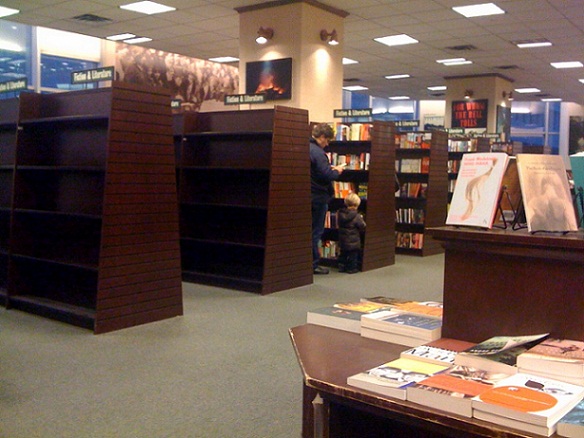
It's so sadly empty in there. I guess this is what a large bookstore looks like when it doesn't order any new books for several months.
Anyway, there are lots and lots of books – and other items – on clearance. This is the last weekend of the B&N Lincoln Square's existence, so, happy raiding.
December 28, 2010
Judith Jamison Rings Closing Bell at NYSE
Yesterday I attended Judith Jamison's ringing of the closing bell at the New York Stock Exchange. It was the first time I'd ever actually been inside NYSE and it was a really cool experience. So glad Alvin Ailey invited us to attend!
It wasn't really a huge ceremony. There were no spoken introductions, though there was a line of ticker tape that read that Judith Jamison of Alvin Ailey American Dance Theater would ring the closing bell in celebration of the 5oth anniversary of Mr. Ailey's Revelations. So, if you were in Times Square watching the screens or watching on TV or on the NYSE website, you probably saw that. But inside the NYSE, she was simply escorted in by several NYSE press people, led up to the podium, and at 4:00 p.m., when the stock exchange closes for the day, she led a round of applause for the traders, who joined her in applause, and then she rang the bell, which lasted for several seconds. Afterward, Robert Battle (incoming artistic director), who accompanied her up to the podium, lifted a little gavel and softly struck in on the podium a couple times. Also with Jamison and Battle were Masazumi Chaya (associate artistic director of AAADT) and Sylvia Waters (artistic director of Ailey II.) The ceremony was over pretty quickly.
They let me take some pictures though:
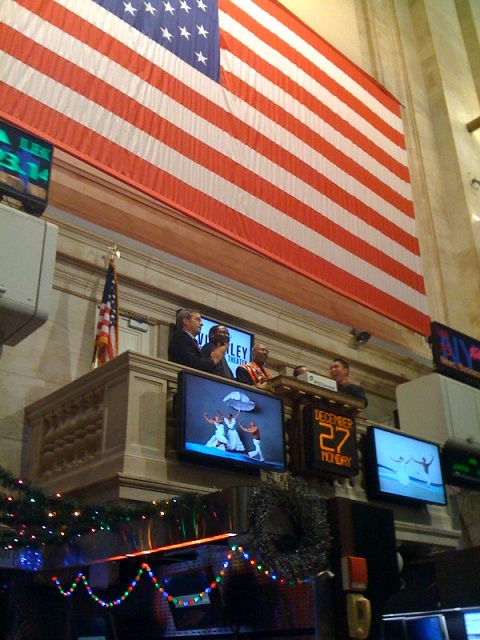
From right: Chaya, Waters, Jamison, Battle, and the NYSE guy. This is right before the bell.
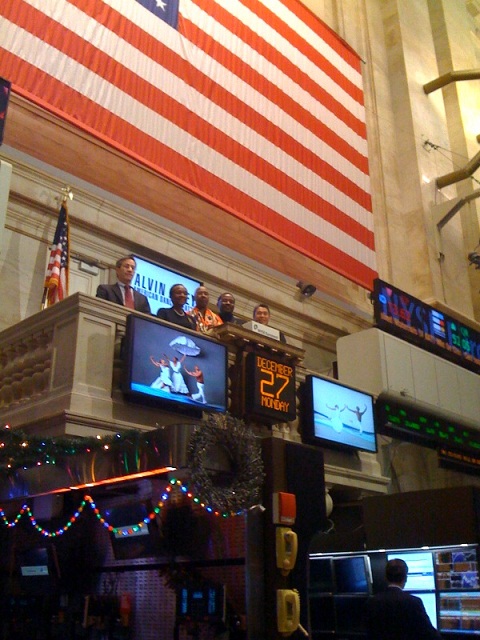
They posed for the press cameramen, who asked Waters to change places with Battle.
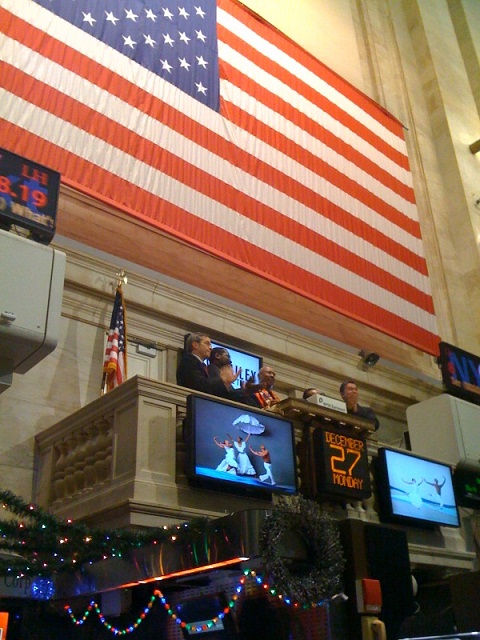

This is before the ringing of the bell. The NYSE people let me take some general pictures of the inside.

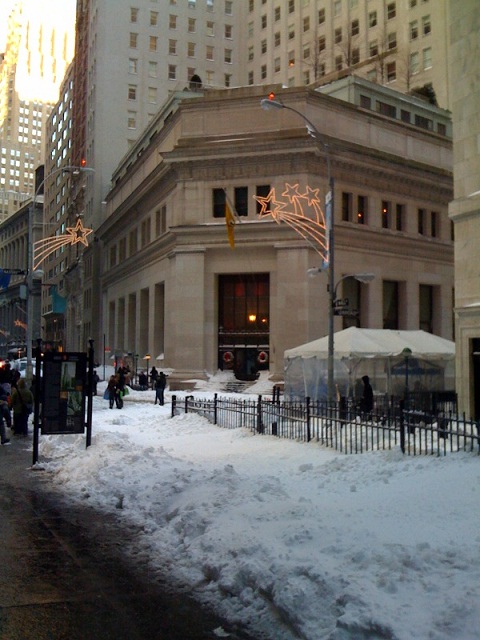
And these are from outside, around the corner, around Wall Street.
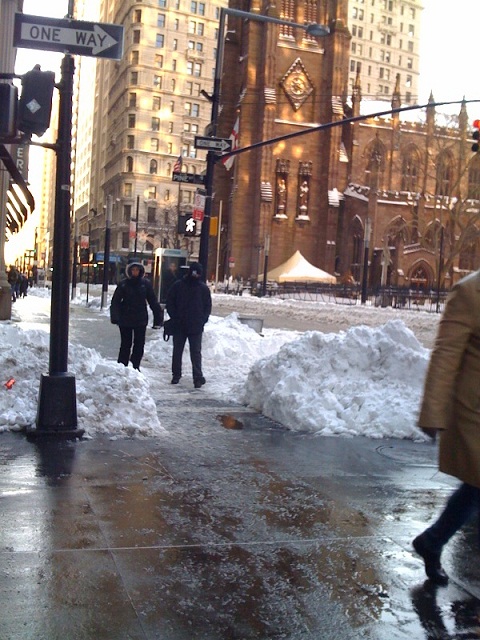
We had a snowstorm the day before and for some reason New York was pretty shut down by it. At NYSE I learned that only about half of the traders were in that day. And, my bank was closed, my post office was closed, most of the coffee shops in the area that I used to frequent when I worked down there, were closed, the New York Public Library was closed. The subway stations were dangerous to get into as the steps hadn't been de-iced. My own sidewalk wasn't de-iced and it was hard to get from my building to the subway. I was nearly snowed into my building, as we have a few steps leading down to our entrance and those weren't de-iced until later in the day. My street wasn't cleaned and cars not realizing that would drive down and get stuck right in the middle of the street. For two days I kept hearing cars screeching and screeching to free their tires from the clumps of snow. It was bizarre. I mean, yeah, it snowed, but I've lived in New York for 17 years now and we've had far more severe snowstorms than this. And I've never seen the city have such a problem handling it. Maybe it's just that we haven't had a snowstorm in a while.
Anyway, things are better today – now the snow is melting in to a sludgy mess, but at least it's just dirty water and not ice.
Even trudging through the snow, though, I'm so glad I went down there. Thank you again to Alvin Ailey for inviting bloggers to apply for press passes and to NYSE for allowing us in.
December 27, 2010
December 26, 2010
Page 99 Test for This Week's Sample Sunday
I hope everyone had a good Christmas. I did. Went to a friend's to make mulled wine and roasted chestnuts but somehow neither happened. My friend ended up taking me out for a massage, which I seriously needed (especially after spending all morning listening to my next door neighbor's four unsupervised children run, scream, wail, jump off of his bed loft, and repeatedly ram themselves into the walls of his approximately 200 square foot apartment, nearly sending several of my paintings crashing to the floor). Then when we got back to her apartment, another friend came over with a bottle of vintage Scotch, which was lovely, and which, for the same aforesaid reason, I desperately needed. But somehow we just didn't get a whole lot of cooking done after that…
Anyway, I almost forgot about Sample Sunday this week. (This is a new promotion for authors on Twitter, to link to a sample passage from one of their books.) I recently uploaded page 99 of Swallow for the newish Page 99 Test site (wherein readers rate how likely they'll be to buy your book based on a random page somewhere in the middle), but I didn't realize you couldn't access the site without signing up for an account. So, I'm pasting my page 99 into the body of this post instead. Here it is:
Okay, I made it worse. I decided to cut my losses and just shut up.
We found Stephen in the next room examining a sketch of Rodin's sculpture of a woman with her legs splayed in the air.
"This is the ideal woman," he nodded.
"She's upside down," I said.
"Well, obviously. I mean the proportions. Fleshy womb, generous hips, well proportioned-breasts…" He sounded lost in a dream. I cocked my head to try to see her right-side up as Stephen became interested in a Gauguin Polynesian princess. From what I could tell, her body seemed very unlike mine.
I followed Thom's laughter to some advertisements. There was a hilarious turn-of-the-century one of a woman riding witch-like not a broom, but an uncorked, exploding champagne bottle. Another, more contemporary one, depicted a naked woman, her back to the viewer, but head cocked over shoulder, demurely smiling, sitting at an outdoors picnic with two fully clothed men and a stereo. Caption read, "We could all use a bit of romance in our lives." Like, buy the stereo, get the woman included. There were naked women selling sports cars, men's cologne, everything under the sun. This room could have gone on forever and a day.
I saw Stephen shaking his head at something. I walked up. It was an advert featuring a naked female model being sprayed playfully by a hose. Honestly couldn't tell exactly what it was advertising though. Tap water? Didn't think so.
December 24, 2010
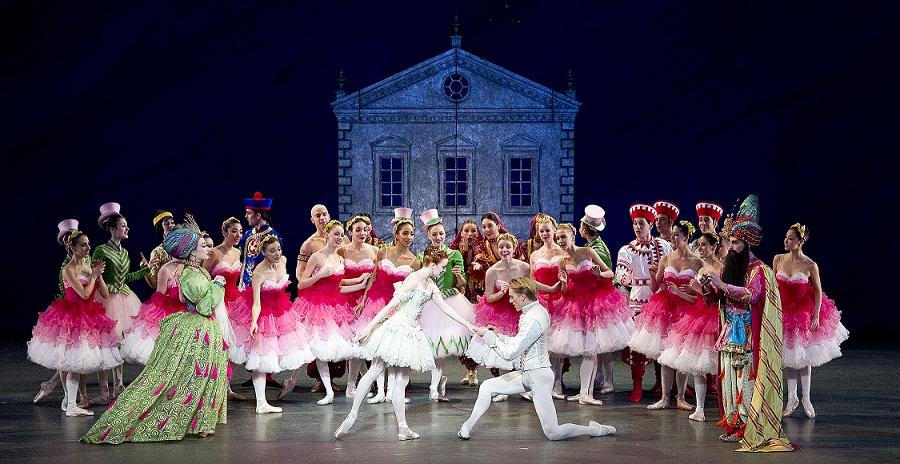
Photos of ABT's New Nutcracker
As promised, here are some photos of Ratmansky's new Nutcracker for ABT.
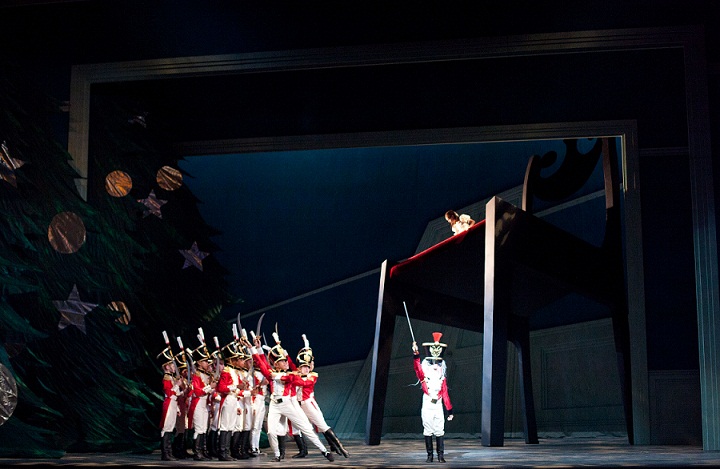
I forgot to mention in my last post how much I loved the Alice in Wonderland-like high chair for Clara to sit atop to watch the mice / nutcracker & soldier battle scene. Really brilliant sets. Richard Hudson is a genius.
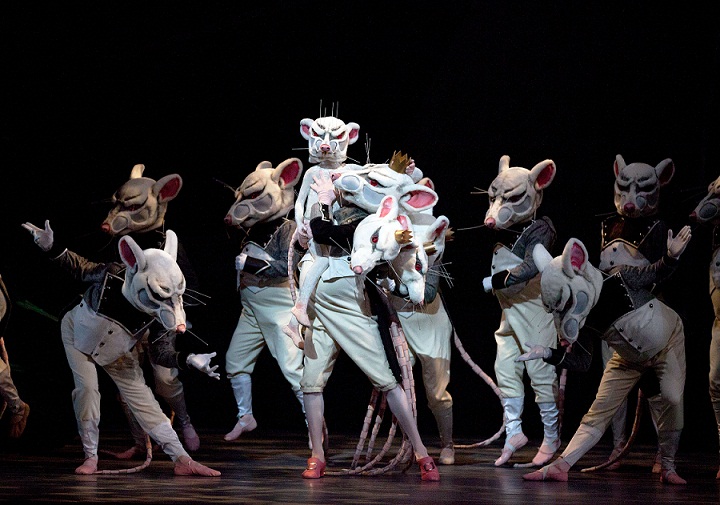
The battle scene and the many-headed mouse king.

The mischievous little mouse (Justin Souriau-Levine) holds the nutcracker doll.
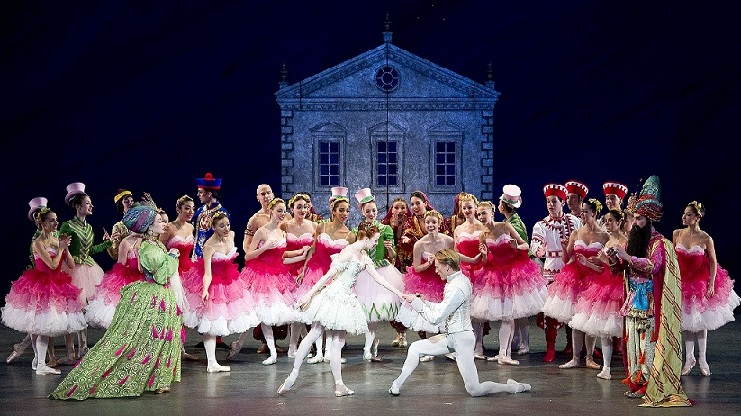
David Hallberg and Gillian Murphy as the Nutcracker Prince and grown-up Clara. I forgot to mention that they do get married in this version.
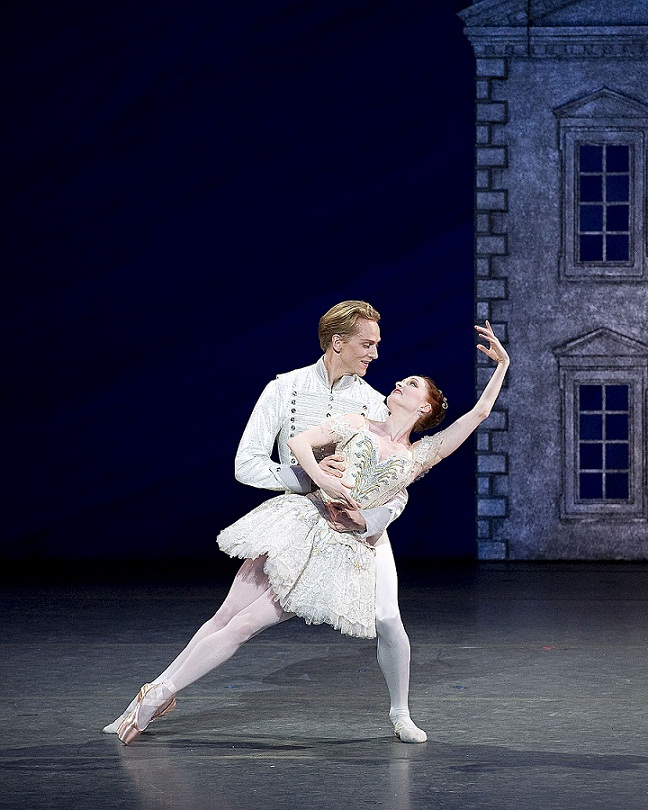
David and Gillian in the final pas de deux.
Top four photos by Rosalie O'Connor; bottom two by Gene Schiavone, courtesy of ABT.