
Tonya Plank's Blog, page 19
March 19, 2011
Don't Forget Royal Danish's Live-Stream Via Guggenheim
Hey you guys,
I'm on a legal assignment with some really crazy hours, so sorry I've kind of had to drop off the face of the earth for a while! Anyway, just wanted to remind you all that the Guggenheim is live-streaming their Works and Process with the Royal Danish Ballet this Sunday and Monday nights, at 7:30 p.m. I'll be working and not watching, but the good thing about the live-streams is that they're archived  See my prior post for the Guggenheim's ustream website.
Hope to have time soon to blog and respond to all your excellent comments on my post about NYCB and Twitter!


March 15, 2011
NYCB Wants To Monitor Its Dancers' Social Media Posts
The dance twittersphere is currently aflutter over this Wall Street Journal article. It seems to have started with some tweets by NYCB corps dancer, Devin Alberda, gently poking fun at NYCB benefactor David Koch, at A.D. Peter Martins' recent drunk driving arrest, and mock-criticizing one of the yellow-face characters in Martins' Magic Flute for its racial connotations. I've seen some of Alberda's blog and twitter posts and have often found him to be clever and funny but have also sometimes wondered, hmmm, is that going too far? Actually, I've seen blog posts (other than Alberda's) and thought, wow, I wonder what such and such artistic director would think if he saw that. But then I don't think any less of the company, maybe just the dancer. And since I don't want to know more, I don't return to that blog. So, really, no harm done there.
Anyway, NYCB is now in negotiations with the dancers' union to attain the ability to monitor the dancers' tweets and Facebook and other social media posts. If the union gives them the right to do so, according to the article, they'll be one of the first performing arts organizations to have that power.
It's an interesting issue because, on one hand, it's never smart to publicly criticize your boss of course, but what about when arguing that a certain stereotype in a certain ballet carries racist connotations is tantamount to such a criticism? In part, it's a free speech issue, which somehow makes the issue seem especially problematic for an arts organization. I mean, in interviews artists will sometimes speak openly about something deemed offensive in a piece they perform (opera, a play, a ballet, etc.), though usually not as snidely as Alberda. But some on Twitter are also saying companies have the right to control their "brand" and many companies do such monitoring.
Others are saying Twitter and blogs are good for ballet because it's such a rarefied, insular art form, it can only help for the public to have greater access to dancers' daily lives via these popular platforms. But if the blogs and tweets are monitored, then it seems like they're controlled, and not authentic. I've read dancer blogs before where it's obvious a dancer is just a PR spokesperson for the company, and I don't take them seriously at all. I usually read once or twice then never return. And it also makes me think the company's using the dancer. So, maybe, if the posts are going to be heavily monitored, it would have the same effect on the public as not allowing them at all.
And what about dancers attacking critics? And what about the whole system of patronage, which ballet largely operates under? What if a dancer says something that has the potential to anger a patron?
Very complicated issue. Any thoughts? It's a good article.
March 14, 2011
Baryshnikov in Japan
Here's a video of Baryshnikov and Gabriella Komleva performing Don Quixote in Japan when the Kirov toured there in 1971. Thank you to "Ballet Lover" for finding it and posting it in the comments of my Bolshoi / Don Quixote post.
What a treat! (there's another one of him dancing the same pdd even earlier, in 1969, in that same comment). It's interesting because the athletics exhibited by today's dancers are so much more astounding (one thing I'd forgotten to mention about the Bolshoi's DQ is that in those thrilling one-handed overhead lifts, Vasiliev would not only stand on one leg when doing them, but would go on releve as well, making the audience go nuts with applause) but this older version is still so glorious. In a way that I can't exactly put my finger on it seems to have even more grandeur. You know what I mean? I'll post the other video "Ballet Lover" linked to as well, so you can see what I mean. (This one's with Lyudmila Semenyaka.) I wonder where they're performing in this one?
Also in regards to Japan, my friend Marie, who comments here frequently and has begun writing a lot about ballet on her own blog – her family owns and operates a Buddhist monastery in Northern Japan. So please keep her in your thoughts right now. She wrote a really beautiful book, Picking Bones From Ash, which recently came out in paperback and Kindle, which takes place largely in Japan. I read it before I knew Marie very well, and I really loved the book; it really made me want to visit Japan.

"Sassy Gay Friend Saves Black Swan" Video
So this video was posted on Huffington Post. It's by the Second City people. Viewers seem to be liking it. When I saw the title I expected it to be really funny. But I don't find any humor or intelligence whatsoever. Do you guys? What am I missing?
March 10, 2011
Larry Keigwin's "Exit"
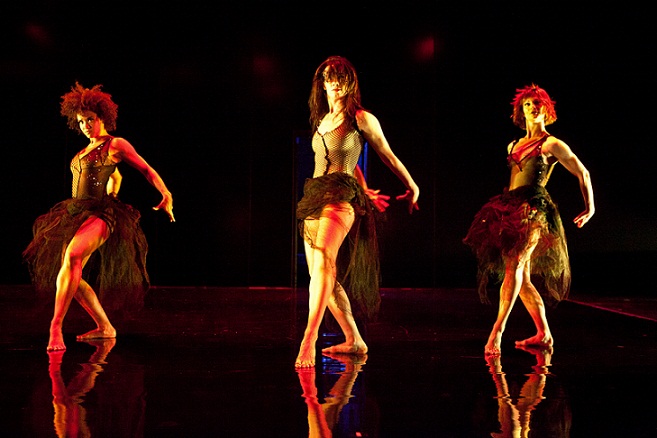
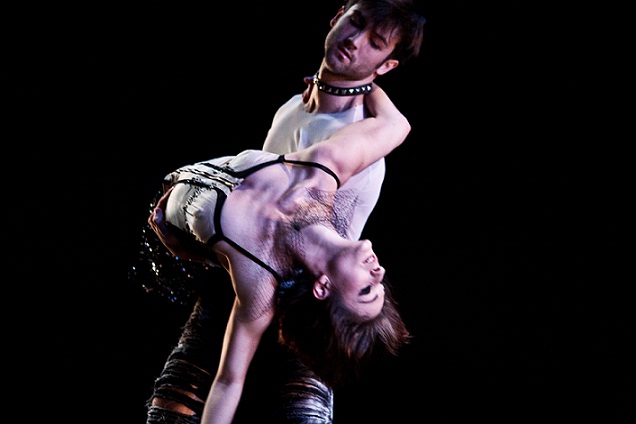
Larry Keigwin's Exit had its world premiere on Tuesday night at the Joyce in Chelsea. Above two photos by Matthew Murphy. (Top: dancers are, l-r: Kristina Hanna, Liz Riga, Ashley Browne; Bottom photo: Aaron Carr and Ashley Browne). The two photos below are by Christopher Duggan.
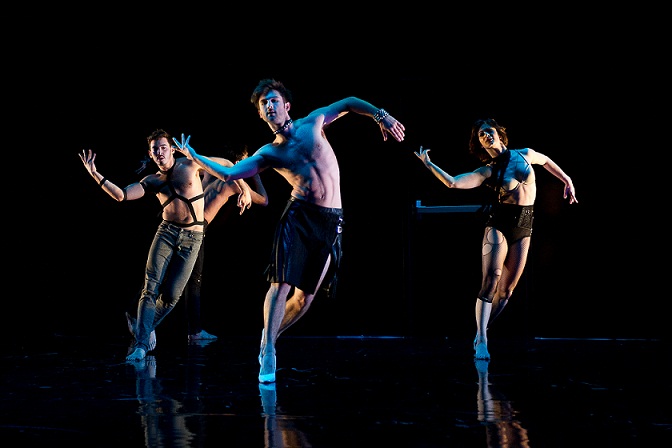
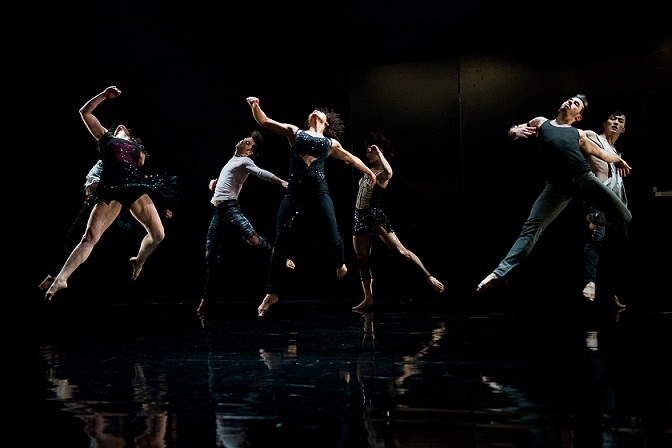
I really enjoyed it, and didn't want it to end, which is the way I usually feel with Keigwin + Company. My friend, who hadn't seen the company since the wacky Kabaret at Symphony Space, loved it. It was abstract dance but there were little stories that took place between the seven dancers (three women and four men). The music, composed by Jerome Begin and Christopher Lancaster, was an intriguing blend of industrial and contemporary classical, with an amusing Patsy Cline-esque piece thrown in. The dance, which was an hour long and had a kind of club feel too it, was classic Keigwin – containing by turns hints of violence, humor, sadness, intensity, always loads of energy. He made good use of a back wall and its doorway (he often has dancers running up or along a wall, and there was a little of that here as well).
My favorite part of Exit was the most humorous – where two men, once an item, are having a little spat and Aaron Carr comes breezing through the door in the back wall dressed in black leather jock strap and high heels miming Patsy Cline-esque lyrics and acting like a total diva. It was hard to take your eyes off Carr (he's the dancer in the center of the third photo, by the way – though dressed differently there) but I think the two men continued their spat then made up while he was diva-ing around. Later, all the dancers don the high heels but now in the dark only the white pumps are visible and the dancers playfully prance around like they've discovered a new toy. Amazingly, the men could move really well in them!
I was sad to see that Nicole Wolcott is no longer with the company (I'd forgotten she left) but Liz Riga (the dancer in the middle of the top photo above) has taken her place as my favorite in the company. Loved the way she'd whip her head about, her long black hair flying wickedly, and the way she'd forcefully strike out at her partner during the darker moments. And I love her size!
But actually all of the dancers Keigwin chooses are compelling in one way or another, and they each have their own unique thing, which is one of the things I so love about him. You never confuse the dancers with each other – they're all different shapes and sizes and each exhibit their own sense of humor and beauty and creative energy.
Anyway, Exit is a lot of fun. Go see it – tix start at only $10! It's showing through March 13th at the Joyce.
PS: DAMN! I just re-read my "review" of Keigwin Kabaret written almost four years ago now. What a horribly boring writer I've become! I don't know what happened. I think it's because critics started linking to me and I started feeling like I had to sound professional. Or maybe it's that I got old. Or maybe that I stopped dancing myself. Anyway, I've become a horrendous bore! I'm sorry!
March 9, 2011
Jacques D'Amboise at Barnes & Noble Tonight
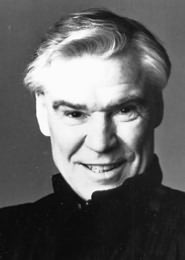
Former NYCB dancer Jacques d'Amboise (photo above by Eduardo Patino) will read from his new memoir, I Was a Dancer, at the Upper East Side Barnes and Noble (86th and Lex) tonight (March 9th) at 7 p.m.
Here's Macaulay's review of the book.
I haven't read it yet, but am adding it to my long list. First, I must finish a YA book by a Canadian author that I agreed to review.
Mr. d'Amboise was also at Symphony Space recently talking about the book (as a Facebook friend pointed out to me), but I appear to have missed it. Did anyone go?
If the Symphony Space d'Amboise event happened last night, I was at Keigwin + Company at the Joyce, for Exit, making its world premiere. Review coming soon!
Roberto Bolle's Proust Questionnaire
How fun – it's Roberto Bolle answering Vanity Fair's Proust Questionnaire, in Italian, with English subtitles.
March 7, 2011
The Bolshoi's Don Quixote
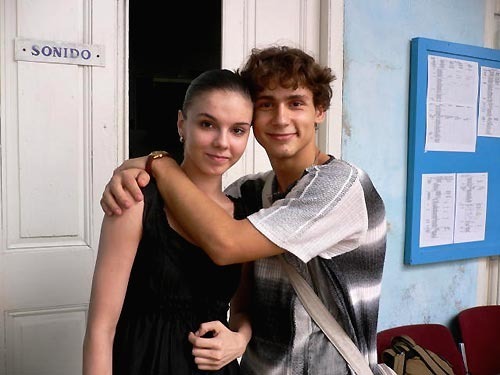
So who went to the live-streaming yesterday? The Manhattan showing was such a blast. Daniil Simkin, ABT soloist and Natalia Osipova's friend, was there, and I saw Marc Kirshner from TenduTv and several critics. And Evan McKie, principal at the Stuttgart Ballet, who many of us know from the Winger, was tweeting from Stuttgart or Canada or wherever he was. He was very informative too! I tweeted a bit under the hashtag #DonQLive – after I found out we were using that hashtag; I also tweeted about the performance without the hashtag earlier.
Anyway, I loved it. As always, I loved Osipova, though my friend who went with me, a longtime Gelsey Kirkland fan, pointed out that though she has excellent technique and athletic ability, she was lacking in artistry, particularly in her ability here to evoke a Spaniard. It's true, and funny, because that kind of thing used to drive me nuts – when ballet dancers would perform straight ballet without any culturally specific accent (see my harping here on Paloma Herrera's Bayadere). I remember when Angel Corella and Paloma Herrera used to be THE couple to see in Don Q in America, and of course they danced it perfectly. But then the next set of dancers – whoever it was I saw after them, all I could think was, couldn't they have taken some Flamenco, some Paso Doble? But somehow at some point, I stopped being bothered by it.
But, Osipova also doesn't have the gracefulness of some of the others, like Yekaterina Shipulina as the Queen of the Dryads, and Chinara Alizade in the third act Grand Pas variation. I am beginning to notice that one – Alizade – more and more in these Bolshoi showings and I really like her.
Osipova is more of an athlete and my friend said she'd have made a great ice skater, or some kind of Olympian. Which is true. But I still think she adds so much to the ballet and creates so much excitement with all of the astounding things that she can do. The theater in Manhattan was more packed than I've ever seen it – nearly, if not completely full – and people were ooohing and aaahing during intermissions and afterward and were applauding throughout – like when, before the performance, the camera showed her backstage warming up.
Here she is in the Act One variation:
But it was Ivan Vasiliev who really wowed the audience – or at least he did as much as she. I'd seen him in Flames of Paris too and he was fabulous in that as well, but this is a larger role and so he stood out to me more here. He kept taking these flying leaps, sometimes with a turn thrown in, and he got amazing height on them, especially given that he's pretty short. He definitely has the muscular legs of a jumper. And he always landed so solidly, which not everyone who jumps that high does. And his form was perfect. And he had the flirty, slightly mischievous character down perfectly. And he had the Spanish flair, for the most part at least. So, he's perfect, in a word! I don't know if there's been a dancer since Baryshnikov who's danced such an exciting Basilio. Bring him to NYC, Kevin McKenzie!!
Here is he dancing on his own in the studio:
I also loved Andrei Merkuriev as Espada, the matador, though I don't know if anyone will ever outperform my Marcelo Gomes in that role, imo  But Merkuriev just did incredible things with that cape – I've never seen anyone – not in ballet or Paso – whip a cape around with such speed like that.
There were many more character dances than in ABT's production. It was hard for me to keep straight who danced which one because in the program it wasn't broken down by act and I can't tell the difference between, for example, what was called the Spanish Dance, and the Bolero. If Anna Leonova danced the lyrical Flamenco-like solo, then I loved her. I thought she was beautiful and knew how to work the dress and her arms and hands and everything. It might have been Kristina Karasyova though, or one of the three listed under "Spanish Dance." I also liked Anna Antropova as the gypsy dancer. Ditto for her. They might have been the same dancer, actually…because those dances were in different acts… Oh who knows.
Anyway, it doesn't matter because I liked everyone and thought they danced beautifully. Honestly, this company is absolutely astounding. I don't think there's anyone in it who's not only an excellent dancer but compelling to watch in one way or another as well. If you ever get a chance to see the Bolshoi, don't miss it.
One more thing – about the third act Kitri variation. I've noticed when Osipova dances with ABT, she changes that variation from the one ABT usually does, and so I wasn't at all surprised that she did the same here. I've always liked her version BETTER because she does those traveling passees at the speed of blasted light, and they look so much better on her than the hopping on pointe. But my friend thought the other version, which Gelsey Kirkland apparently did, was harder and more artistic. But then Evan McKie told me via Twitter that Natalia's is the version the Russians usually do. So maybe it's not an issue of changing the choreography to suit the dancer but just the dancer performing the version she knows best. Anyway, I tried to look up Gelsey on YouTube and could only find the final scene pas de deux with Baryshnikov; they don't have the variations. But here's what I'm talking about: first video is the ABT version, starring Nina Ananiashvili, second is Osipova:
Which do you guys like better, or do you like them both the same?
Anyway, the next Bolshoi live-stream will be Coppelia, coming up at the end of May. The next live-stream from Emerging Pictures will be the Paris Opera Ballet's Coppelia, coming up on March 28th. Visit the Ballet in Cinema website for times and theaters. These are such a blast!
Above photo of Vasiliev and Osipova from here.
March 4, 2011
Two Live-Streams This Sunday: Natalia Osipova in Bolshoi's Don Q, and Guggenheim's YAGP Judging Panel Program

Live-streaming, either over the internet or into movie theaters, seems to be the in thing these days, fortunately, for those of us who can't travel the world to see top companies perform and / or afford to attend all of these panel discussions and performances.
This Sunday, March 6th, there are two live-streamed ballet events. The first, at 11:00 a.m. ET is the Bolshoi's production of Don Quixote starring Natalia Osipova and Ivan Vasiliev, which will be live-streamed from Moscow into theaters all over the world. I wrote a little about that at the bottom of this post.
As I said before, if you haven't seen Osipova, this is your chance. She's one of the most athletically astounding ballerinas around right now, she's a huge star in Europe, and this is THE role that she's most known for (since it really showcases such athletics). In Manhattan, the performance will be shown at the Big Cinema at 59th Street between 1st and 2nd Avenues, and I think it costs $25. Check the Emerging Pictures' Ballet in Cinema website to search for showplaces and showtimes in your area.
Above image of Osipova and Vasiliev by Genaro Molina from .
Then, later in the evening, at 7:30 ET, the Guggenheim will live-stream online via their ustream channel their Works & Process program on judging in the important Youth America Grand Prix. This program is free, and, again, you can participate in the live chat online on that channel.
For more info on the Guggenheim's program and participants, click below to see the full press release:
How Judges Judge – Youth America Grand Prix
Sunday and Monday, March 6 and 7, 7:30pm
Youth America Grand Prix is America's first and the world's largest student ballet scholarship competition. Join YAGP jury members Gailene Stock, Director of the Royal Ballet School; Franco de Vita, Director of the Jacqueline Kennedy Onassis School at American Ballet Theatre; and Adam Sklute, Artistic Director of Ballet West, to gain an insight into the selection process and watch as they critique dancers' performances during an impromptu ballet competition, on stage, simulating a ballet scholarship competition and what happens in casting and dance auditions at dance companies and schools around the world. Each panelist will comment on each student's performance and will give the audience a rare insight into their evaluation process. The panelists will also share the criteria which they use to select dancers to join their schools on scholarship. Audience members will be able to follow along with their own scoring sheet.
The program will be presented in anticipation of YAGP's annual Gala, "Stars of Today Meet the Stars of Tomorrow" at NY City Center on March 22, 2011, featuring YAGP winners and invited guest stars from around the world.
Panel
Franco de Vita
Adam Sklute
Gailene Stock
Sergey Gordeev, moderator
Student Dancers
Aran Bell , Hannah Bettes, Derek Dunn, Miko Fogarty, Nayara Lopes, Drew Nelson, Gaya Bommer Yemini, Sam Zaldivar
Students will dance classical and modern pieces along with solos and pas de deux which will be interspersed with judge's commentary.
LOCATION
Peter B. Lewis Theater
Solomon R. Guggenheim Museum
1071 Fifth Avenue at 88th Street
Subway – 4, 5, 6 train to 86th Street
Bus – M1, M2, M3, or M4 bus on Madison or Fifth Avenue
TICKETS
$30 General
$25 Guggenheim Members
$10 Students (25 and under with valid student ID)
(212) 423-3587, M-F, 1–5 PM or visit worksandprocess.org
Youth America Grand Prix (YAGP) is a non-profit educational organization that is America's first and the world's largest student ballet scholarship competition, founded in 1999. Each year, YAGP conducts regional semi-final competitions throughout the United States and around the world in Brazil. Mexico, Japan and Italy, where the jury members select the most talented and promising students for the YAGP Finals held in New York City in March or April of each year. At the YAGP NYC Finals, Directors and representatives of the world's leading dance academies annually present over $250,000 in scholarships to their schools to talented young students. Called the "internet of the dance world," YAGP represents a global network of opportunity connecting dancers, teachers, schools and companies all over the globe. Leading dance professionals from around the world are involved in Youth America Grand Prix, and the competition has gained major recognition in American media and from government agencies, including personal commendation from the office of the mayor of New York City, Michael Bloomberg, for its contributions to the cultural life of American and New York City in particular. Since its inception, Youth America Grand Prix has become an internationally known meeting place for dance students and teachers, where they can exchange their ideas, share experience and learn the most up-to-date information on a variety of issues in ballet and contemporary dance. Since its inception, 25,000 young dancers have participated in YAGP worldwide competitions and workshops, over $2 million dollars have been awarded in scholarships to the world's leading dance schools, and over 250 YAGP Alumni are now dancing with some 50 companies around the globe, including American Ballet Theatre, New York City Ballet, San Francisco Ballet, Boston Ballet, Stuttgart Ballet, Paris Opera Ballet, Eifman Ballet of St. Petersburg, and many others. For more information, visit www.yagp.org.
Franco De Vita is the Principal of American Ballet Theatre's Jacqueline Kennedy Onassis School; and co-author of the ABT National Training Curriculum. Prior to joining ABT, Mr. De Vita was Dean of Faculty and Curriculum at Boston Ballet School. He has taught at such renowned institutions as ABT, Boston Ballet, Alvin Ailey American Dance Theater and Hartford Ballet. Mr. De Vita co-directed the Hamlyn School in Florence, Italy, and is a renowned authority on the Cecchetti Method. As a performer, Mr. De Vita performed principal roles in many European companies, including Florence's Maggio Musicale, Aterballetto and Le Ballet Royal de Wallonie. Mr. De Vita is a regular member of the jury panel at the YAGP Finals in New York City and at YAGP's regional competitions around the world.
Adam Sklute was named Artistic Director of Ballet West in March of 2007. Prior to that time, he served as Associate Artistic Director of The Joffrey Ballet, where he started his career as a dancer in the mid 1980's. Under Sklute's leadership, Ballet West has garnered increased national and international exposure. In 2008, Ballet West appeared at Washington D.C.'s Kennedy Center for the Performing Arts as part of its Ballet Across America Festival. An Adjunct Professor of dance at the University of Utah, Sklute actively oversees Ballet West's Academy, teaching regularly and developing and focusing its syllabus with the Academy faculty. Mr. Sklute is a regular member of the jury panel at the YAGP Finals in New York City and at YAGP's regional competitions around the world.
Gailene Stock had a 16 year professional career as a dancer with The Australian Ballet, The National Ballet of Canada and Royal Winnipeg Ballet. She subsequently held the position of Director of the National Theatre Ballet School, Victoria, Australia for eight years and The Australian Ballet School for nine years, before taking on the role of Director of The Royal Ballet School in London in 1999. In 1997, Ms. Stock was awarded the Order of Australia for services to the art of ballet. Internationally acclaimed, her knowledge and experience is regularly sought in the dance community worldwide. She has participated as a jury member in many international competitions and served as President of the Jury at Prix de Lausanne in Switzerland and at Youth America Grand Prix in New York.
Aran Bell began his training at age four in Seattle, WA with Michiko Black, continued training at Central Pennsylvania Youth Ballet, and is currently studying with Denys Ganio in Rome, Italy. Aran was the winner of the Hope Award (Best Overall in the Pre-Competitive Age Division, ages 9-11) at the YAGP Finals in 2009 and 2010.
Hannah Bettes began taking jazz classes at the age of seven at The Dance P.A.D. and received her ballet training at Central Florida Ballet. She placed in the top twelve at 2009 YAGP Finals in NYC and progressed to YAGP's Final Round in 2010. Hannah has trained at the School of American Ballet for two summers, and is currently a New Artist at the Next Generation Ballet in Tampa under the direction of Peter Stark.
Derek Dunn has been a student in the Rock Academic Program Alliance and pre-professional dance program at The Rock School for Dance Education since 2009. He won the Bronze Medal in the Junior Men's Division at the 2010 USA International Ballet Competition in Jackson, Mississippi, the Junior Gold Medal at the 2010 YAGP NYC Finals and the 2009 Scholarship Award to the American Ballet Theatre Summer Intensive, and was awarded scholarships to attend the Kirov Academy of Ballet summer sessions in 2007 and 2008.
Miko Fogarty trains with Viktor Kabaniaev in the Professional Program at the Westlake School for the Performing Arts in San Francisco. Miko won the Hope Award at the YAGP Semi Finals in 2008 and 2009, and she placed in the top 12 at the YAGP NYC Finals in the Pre-competitive Category. Most recently, Miko won the bronze medal in the Junior Category at the YAGP 2010 NYC Finals.
Nayara Lopes began studying dance at the Guairá Theater School of Dance in Curitiba, Puerto Rico. Nayara was a full-scholarship student at the American Ballet Theatre's Jacqueline Kennedy Onassis School for two years, studying under Franco De Vita, and is currently a dancer with Orlando Ballet II. Most recently, she was awarded the Senior Grand Prix Award at the YAGP Regional Semi-Finals in Columbia, SC, and will be competing at the YAGP 2011 NYC Finals.
Drew Nelson began taking ballet classes with American Repertory Ballet and trained at Princeton Dance and Theater Studio with Susan Jaffe and Risa Kaplowitz. He has also attended the School of American Ballet and and Jacqueline Kennedy Onassis School at ABT. Drew was featured in the dance documentary for TLC (The Learning Channel), "My Life as a Child." In 2010, he trained at The Royal Ballet School at Covent Garden on scholarship, and was a finalist at the YAGP NY Finals. He currently is a New Artist at Next Generation Ballet in Tampa under the direction of Peter Stark.
Gaya Bommer Yemini began dancing in 2003 at her mother's school, Nadine Bommer Dance Academy, Israel and has studied at Balleto di Toscana, Italy and The Ailey School Summer Program, New York. Most recently, Gaya won first place in the Contemporary Junior Category and second place in the Classical Junior Category at the YAGP 2011 European Semi-Finals in Paris. Gaya will be studying at the Princess Grace Academy of Classical Dance, Monaco on a summer and full-year scholarship in 2011-2012.
Sam Zaldivar is currently training under former Pittsburgh Ballet Principals, Dmitri Kulev and Jennifer Langenstein Kulev. He was the recipient of the Grand Prix Award in Junior Men's Category at the YAGP 2009 and 2010 Regional semi-finals, the Silver Medal in Junior Age division at the YAGP 2009 NYC Finals and, most recently, the Grand Prix Award in the Junior age division at the YAGP 2010 NYC Finals. Sam performed at the International Ballet Festival of Miami in the 2009 and 2010 and at YAGP's "Peter the Great" Galas celebrating a legendary ballet teacher, Peter Pestov, held in New York City and in Moscow, Russia.
Works & Process at the Guggenheim
For over 25 years and in over 350 productions, New Yorkers have been able to see, hear, and meet the most acclaimed artists in the world, in an intimate setting unlike any other. Works & Process, the performing arts series at the Guggenheim, has championed new works, offered audiences unprecedented access to our generation's leading creators and performers, and hosted post-show receptions for the audiences and artists to continue the discussion. Each 80-minute performance uniquely combines artistic creation and stimulating conversation and takes place in the Guggenheim's intimate Frank Lloyd Wright-designed 285-seat Peter B. Lewis Theater. Described by The New York Times as "an exceptional opportunity to understand something of the creative process," Works & Process is produced by founder Mary Sharp Cronson.
Lead funding provided by The Peter Jay Sharp Foundation with additional support from The Brown Foundation, Inc., of Houston, The Christian Humann Foundation, Leon Levy Foundation, and Rockefeller Brothers Fund, Inc.
This program is supported by public funds from the New York State Council on the Arts, a state agency, and New York City Department of Culture.
Nikolaj Returns!: And The Guggenheim Will Live-Stream His Royal Danish Ballet

Nikolaj Hubbe, former beloved NYCB principal of course, will be returning to NY with the Royal Danish Ballet, of which he is now the artistic director. The company will be performing over the summer, but first, they'll be showcased at the Guggenheim, in a Works & Process event, on March 20th and 21st. He'll be one of the panelists, talking about the rep the company will be performing – ballets by the founder of RDB August Bournonville, by Jorma Elo and by Hubbe himself – with excerpts from those dances performed. The event is already sold out, so the Guggenheim is generously live-streaming both nights free on their ustream channel. Again, as with other W&P live-streams, you can participate in an online chat on the aforesaid ustream channel, and you can also follow discussions on Twitter, using hashtag #RDB or by following @worksandprocess.
For more info on the program and on the company, click on the link below.
Above image from here.
Watch the livestream, both nights at www.ustream.tv/channel/worksandprocess
Join the conversation on Twitter @worksandprocess and #RDB
Candice Thompson of The Winger and DIY Dancer will guest moderate the online chat that accompanies the livestream on March 21 @diydancer
Prior to their American tour in May and June 2011, Royal Danish Ballet dancers will perform excerpts from the repertory. Artistic Director and former New York City Ballet principal Nikolaj Hübbe will share his vision for the company in a discussion moderated by John Meehan, Professor of Dance at Vassar College. Dancers will perform highlights from August Bournonville's The Jockey Dance, La Sylphide, A Folk Tale, and Bournonville Variations, plus Nikolaj Hübbe's new staging of Napoli, and Jorma Elo's Lost on Slow.
For more information on The Royal Danish Ballet and their 2011 United State tour, please visit: http://www.kglteater.dk/ustour11.
PANEL
Nikolaj Hübbe
John Meehan
CAST
Susanne Grinder (Principal)
Gudrun Bojesen (Principal)
Amy Watson (Principal)
Kizzy Matiakis (Soloist)
Jean-Lucien Massot (Principal)
Thomas Lund (Principal)
Ulrik Birkkjær (Principal)
Nikolaj Hansen (Soloist)
Alban Lendorf (Soloist)
Alexander Stæger (Soloist)
PROGRAM
Excerpts from Bournonville Variations
Music: Bournonville schools arranged by Martin Åkerwall
Danced by Alban Lendorf, Ulrik Birkkjær, Thomas Lund, Nicolai Hansen, Alexander Stæger
Excerpts from Lost on Slow
Music: Antonio Vivaldi
Choreography: Jorma Elo
Costumes: Annette Nørgaard
2nd movement
Danced by Kizzy Matiakis, Amy Watson, Jean-Lucien Massot
4th movement
Danced by Jean-Lucien Massot
The Jockey Dance
Music: C. C. Møller
Choreography: August Bournonville
Costumes: Jens-Jacob Worsaae
Danced by Thomas Lund, Alban Lendorf
Excerpts from A Folktale
Music: N. W. Gade, J. P. E. Hartmann
Choreography: August Bournonville
Pas de sept
Danced by Gudrun Bojesen, Susanne Grinder, Kizzy Matiakis, Amy Watson
Ulrik Birkkjær, Nicolai Hansen, Alexander Stæger
Excerpts from La Sylphide
Music: H. S. Løvenskiold
Choreography: August Bournonville
Costumes: Mikael Melbye
The Window Scene
Gudrun Bojesen, Ulrik Birkkjær
The Death Scene
Gudrun Bojesen, Ulrik Birkkjær
Excerpts from Napoli
Music: E. Helsted, H. C. Lumbye, H. S. Paulli, Ole Bull
Choreography: Nikolaj Hübbe
Costumes: Maja Ravn
Pas de Deux from 1.act
Susanne Grinder, Alexander Stæger
The Tarantella
All
Bournonville Variations
The Bournonville style has always been an integrated part of the Royal Danish Ballet's training programme and repertoire, ever since the day of Bournonville. The Bournonville style is clearly definable and is recognizable by the gracious performance of each step, the softly rounded arms, the direction of head and torso and the natural, joyous expression in the dance. The six Bournonville Schools were created by one of Bournonville's successors, Hans Beck and the schools were handed down from generation to generation with the changes and embellishments that come naturally with an oral tradition.
Lost On Slow
Set to music by Vivaldi and danced by a stunning cast of three women and three men. With geometric sharpness and quick isolation of body parts, the dancers go through a tempest of arbitrary gestures, tightly woven motifs, and doll-like maneuvers. The soft-slippered, ornate tutu-ed ballerinas slither in and out of the arms of their male counterparts in striking stances–sometimes frozen, sometimes trembling. It is a sophisticated, macabre dialogue of tongue-in-cheek mime/modern dance and human puppetry.
The Jockey Dance comes from Bournonville's last ballet From Siberia to Moscow (1876); various European rivers are characterized in a divertissement constructed a little in the style of the grand Russian ballets with which Bournonville had become acquainted during his trip to Russia a few years earlier. Two jockeys represent the British love of horse racing and, moreover, symbolize the river Thames. From Siberia to Moscow was last seen on stage in 1904. In 1929 The Jockey Dance was included in Bournonvilleana and in 1949 in Salute for August Bournonville. In 1979, with the help of film footage shot by Peter Elfelt at the beginning of the 20th century, Niels Bjørn Larsen reconstructed The Jockey Dance for a group of young soloists from the Royal Danish Ballet.
La Sylphide
La Sylphide is Bournonville's only tragic ballet.. La Sylphide was created in 1832 by Filipo Taglioni for his daughter the dancer Maria Taglioni at the Paris Opera. Bournonville saw the ballet in Paris in 1834, and two years later he staged his own version in Copenhagen with Lucile Grahn as the Sylph and himself as James. Bournonville commissioned the composer Herman Severin Løvenskiold to compose a new, original score. La Sylphide is a breakthrough work in European Romantic ballet. The young Scotsman, James, is split between the world he knows and the dream of a different, more tempting and dangerous life.
Napoli, Act III
This is the gripping tale of the charming Teresina and the poor fisherman Gennaro, whose love is challenged by the seductive sea daemon Golfo and his naiads, is homage to love. Additionally, it is a timeless story about youth and dreams. Napoli is one of the most important principle works of the Royal Danish Ballet's unique legacy.
Napoli is not just Bournonville's main work, but also among the most prominent works in the entire international ballet repertoire. The celebratory dance of the third act has with time become the hallmark of the Royal Danish Ballet. This new staging of Bournonville's masterpiece takes us back to a decaying Napoli in the 1950s.
LOCATION
Peter B. Lewis Theater
Solomon R. Guggenheim Museum
1071 Fifth Avenue at 88th Street
Subway – 4, 5, 6 train to 86th Street
Bus – M1, M2, M3, or M4 bus on Madison or Fifth Avenue
TICKETS (SOLD OUT)
$50 General
$40 Guggenheim Members
$25 Students (25 and under with valid student ID)
(212) 423-3587, M-F, 1–5 PM or visit worksandprocess.org
Works & Process at the Guggenheim
For over 25 years and in over 350 productions, New Yorkers have been able to see, hear, and meet the most acclaimed artists in the world, in an intimate setting unlike any other. Works & Process, the performing arts series at the Guggenheim, has championed new works, offered audiences unprecedented access to our generation's leading creators and performers, and hosted post-show receptions for the audiences and artists to continue the discussion. Each 80-minute performance uniquely combines artistic creation and stimulating conversation and takes place in the Guggenheim's intimate Frank Lloyd Wright-designed 285-seat Peter B. Lewis Theater. Described by The New York Times as "an exceptional opportunity to understand something of the creative process," Works & Process is produced by founder Mary Sharp Cronson.
Lead funding provided by The Peter Jay Sharp Foundation with additional support from The Brown Foundation, Inc., of Houston, The Christian Humann Foundation, Leon Levy Foundation, and Rockefeller Brothers Fund, Inc.
This program is supported by public funds from the New York State Council on the Arts, a state agency, and New York City Department of Cultural Affairs.



![[image error]](http://img2.imagesbn.com/images/72430000/72434846.JPG)

