Lisa M. Collins's Blog, page 15
June 14, 2013
Interview with Nancy Hansen — Prophecy’s Gambit
Interview with Author Nancy Hansen

author of Prophecy's Gamit
6/15/2013
I was wondering where you get your story ideas?
I get them from the Ether. Once a year in the spring, the Ether Bunny comes hopping along with his basket, and brings me a new batch…
Seriously, they come from all around me. I see things in the news, or read something online, maybe overhear a conversation, and it sparks an idea. Since I write a lot of series characters, both in short stories and novel length work, I know those people pretty well. So it’s just a matter of finding a situation for Character X to be in, and getting her or him out of it. The adventure is in the getting from beginning to conclusion.
What is the usual process for your fiction writing? Are you a plotter or a pantser?
Depends on what I’m working on. Generally speaking, I’m a fly-by-the-britches type of writer as long as I am doing something original. I’ll get an idea—and in my head that looks like a movie trailer scene—and then think of how I’m going to use it and with whom. Now and then, I’ll just sit down and start typing something that sounds interesting and take it from there, because a story started randomly is better than no story at all. When I’m working with someone else’s intellectual property, then I will tend to plot it out ahead of time.
I get stuck now and then, but I’ve learned not to fight it. I always have multiple projects going, so I can just boot up something else and get my mind off it. If I don’t get any ideas after a day or so off, I’ll email or chat with a writing pal, and see what input I can get. Oftentimes I solve the issue as I’m explaining it.
After you’ve written long enough, you get a feel for the rhythm of a piece. You know when to insert something exciting, or wind it down and have an introspective moment. In pulp, you don’t want to slow the pace too often or for too long, so I tend to straddle the line between that frantic linear plot of a true pulp story and the kind of writing I’m used to doing.
Once you have an idea that sparks your imagination do you research your idea or do any world-building exercises, or do you just begin to write and see where the Muse takes you?
I used to do a ton of world building, because I had to know everything about the characters and where they live before I started something new. These days, I tend to forge right ahead with the writing, and do the research as I go along. The exception might be when I’m working on something that has a specific region or era involved, because I need a strong sense of when and where this is taking place, and what kind of language or backdrop will make the story sound genuine. If I’m writing in something like an anthology that has had other contributors in the past, I’m going to want to read as much of what’s been done as I can manage to get a feel for how others handled the character(s) and setting. Continuity is important in group work.
What is your daily writing like?
What I do really varies because I have other things going on in my life, but I do try and get something accomplished early in the day whenever I can. I feel a lot more enthusiastic about sitting down at the keyboard if I’m not all burned out by other tasks. Unless I’m starting a brand new project, each session starts with a reread of whatever material I might have worked on last time, and I’ll do some tweaking as I go along. When I get past that, most times I’ll have an idea of what kind of scene I need next. I tend to work my way through in scenes, knowing basically where the entire piece is going but not how I’m getting there. I always try and quit while I still have something left, even on the days when the juices are flowing well.
 One thing I can’t stress enough in this digitally connected age is to focus on the writing while you’re doing it. It’s so easy to get caught up in playing with the phone and other gadgets, checking email and social networking sites, texting, etc. When I am writing, that’s where my mind needs to be, so I stay offline except for having Dictionary.com and Google up for help and research reasons. I still get off on a tangent now and then, but I’m far less distracted than I would be if I was chatting on Facebook or reading newsletters. I’ve switched my day around lately so that I get to the writing first and then go online. I’ve had to convince myself I don’t need to read every urgent email and cute meme poster that comes across my screen.
For all it is an art, you have to approach writing time with some self-discipline if you expect to get anything done. It’s like any other job; you go to your station and do what’s required of you at some appointed time. It’s just a darn lot more interesting!
Are you a full time writer? If so when did you make the decision and what factors led to the decision? If you are not a full time writer…Is your plan to one day being a full time writer?
Yes I am, in the respect that I’m not otherwise working outside the home. I was a stay-at-home mom when I started to noodle around with the idea of writing, and of all the things I tried to do in those years, it worked best with my home life. I love being creative, but not having to drag myself and my wares all over the place. Back when my kids were young, that was strictly out of the question. Now that I’m an empty nester, I can concentrate on getting work done, and no one in this older adult household freaks out if the laundry and dishes pile up a bit and dinner is fix-it-yourself. Writing is also very flexible because there is no set hour of the day when you have to do it. So if I have a morning appointment I can write in the afternoon, if someone stops by, I can set it aside for a bit.
Eventually I hope to get to the point where I can somewhat support myself via writing. That’s been my biggest complaint, that the royalty checks down at this level are very small and infrequent. So the focus for now has been on building a readership for my work.
Can you tell us about your experience working with your current publisher? (Any other publishers?) (And/Or your self-publishing experiences?)
I’ve been with Pro Se Press since their inception back in 2010, as both a staff writer and an editor. I had over 20 years worth of material in mothballs, including a huge fantasy novel I’d been shopping around to the mainstream publishers with no luck, and so I was thrilled to finally have an outlet for all that work. I auditioned with a couple of short stories that wound up in the magazines and we were off and running without looking back. I think I overwhelmed poor Tommy Hancock’s inbox that year and the next with a perfect storm of short stories that just kept trickling in as I opened up old files and finished pieces that had been languishing for years. Many of them were set in the same world, which eventually led to my getting my own imprint, Hansen’s Way. I still have other, non-related series that appear in the Pro Se Presents digests that we do now, and you will see my name popping up in various other Pro Se projects, such as the Pulp Obscura line and some of the open anthologies. I’ve watched Pro Se go from a tiny little indie publishing house to a windmill of offerings in mixed media. It’s a bit overwhelming, and I kind of feel lost in there somewhere.
I have done both magazine and book editing for Pro Se too. My ability to shift my focus from a mainstream POV to that of what a pulp book needs to be has helped immensely while working with authors who have come in from the outside with a great concept but a treatment that needs paring down. I had to take an 850 page fantasy doorstop of my own and turn it into a three book series that lost the plodding plot and focused more on action and adventure. It’s been a task, but so far FORTUNE’S PAWN and PROPHECY’S GAMBIT have done quite well. Having mastered that sort of conversion, I find it interesting to work with other authors struggling to rein in a piece that has the same kind of pulp appeal but it too unwieldy for Pro Se to print as is.
In the New Pulp world, you wind up working alongside other people with ties to different companies, and so you hear about projects that interest you. I’ve done an anthology story each for Airship 27 (Sinbad-The New Voyages Volume 1) and Mechanoid Press (Monster Earth), and I’ve been invited into yet another antho with a steampunk backdrop. So opportunities have been coming, and I will take on outside projects that interest me.
Self-publishing is something I’ve been looking into for a while now, and once we get caught up financially around here, it’s a definite route I’ll take. The big advantage is having complete creative control, but it does have a learning curve and takes some cash input, and that’s a sore spot right now.
What is your current release and (without spoilers) tell us about the new book or series.
Oh… this is going to be hard to do! The latest novel length release was PROPHECY’S GAMBIT back in January, and the latest short piece was my story The Bells of Saint Ferdinand in THE NEW ADVENTURES OF SENORITA SCORPION which came out in March. Both of those are Pro Se books.
PROPHECY’S GAMBIT is another Terran World adventure in the northern frontier of a land of magick and intrigue, where swordplay and wizardry vie with mistrust, soothsaying, and malevolence from all directions. This is the sequel to FORTUNE’S PAWN and it was released under my Hansen’s Way imprint. It’s the middle book in this opening series, and continues the story of red haired, blue eyed Callie; the orphan girl with the streak of stubborn independence who still has no idea she is destined to give birth to a savior. As a young adult now, and a mother-to-be, she still gets herself in plenty of trouble! The world around her is seething with unrest. Friends and foes come from all directions and are sometimes hard to distinguish. Fate plays its own games, and sometimes people die…
Senorita Scorpion was a classic pulp character written by Les Savage, and the Pro Se continuing adventures version was released through the Pulp Obscura line. This was the first western I had ever read as well as the first I’ve ever written, so it was quite a challenge. It appealed to me because she’s one of the few female lead characters I’ve seen in the classic pulp era, and promoting strong and independent women is something I do a lot of in my own tales. Once I had the background research done, the story came together for me, and it’s been well received.
I will have other Pro Se work coming out this year. I have a tale in another Pulp Obscura anthology as well as one each in the first Tall Pulp anthology and the second Pulptress collection. I should have a story or two in Pro Se Presents as well; they have a couple of my SILVER PENTACLE offerings, a third SONG OF HEROES tale, and I just started a third KEENER EYE story as well.
THE SILVER PENTACLE series is a sort of post apocalyptic mash-up where nuclear and mechanized warfare over dwindling petroleum supplies have destroyed the environment and killed off much of the population. The rapture is over, and it created rifts in time and space, letting creatures and beings from history and mythology bleed back through to earth. The older, less influential deities have come back to vie for whomever is left—including some rather malevolent beings looking to build an army of minions. Insert in there the assembling of a quartet of elemental super beings led by an androgynous minor deity bent on saving earth from itself. Add in a global treasure hunt to find artifacts of power, and you’ll have the weirdest storyline I’ve conceived to date.
THE SONG OF HEROES takes place in a modern day setting. The series chronicles the exploits of a scum busting immortal with a quartet of half-life helpers that can be summoned by a bracelet she wears and can never remove. Lorelei the Siren is paying for her past sins of luring sailors to her death via her enchanting voice. She is now condemned to a rather dreary continual reappearance somewhere on earth, ridding the world of evil doers both mortal and immortal. Her ‘heroes’ are far from exemplary either, for they’ve all been killers in their own right at some point in their pasts. One of my audition pieces for Pro Se was Lori’s Lament, the first Song of Heroes tale that introduced her and the hero Sir Reginald the paladin from the Crusades era.
 As for my imprint, I have another new anthology done that has been turned in. It’s in the same Terran World the rest of the imprint books are set in, but a different area and group of characters. So while my sword & sorcery fantasy backdrop material will be familiar to those who have read FORTUNE’S PAWN, PROPHECY’S GAMBIT, TALES OF THE VAGABOND BARDS, and/or THE HUNTRESS OF GREENWOOD, the one coming up is filled with brand new tales within which the characters and setting are unique. Without giving too much away, let’s just say that if you had a chance to start your own flying cavalry, wouldn’t you consider abdicating the throne to do so? Someone did, and the five stories in this anthology will take us from the beginning of THE WINDRIDERS OF EVERICE until they establish themselves as a force to be reckoned with. This one is fairly kid friendly too, as there are children involved in the action, so I kept the violence and the adult situations as PG 13 as possible. I’m hoping we’ll see it debut sometime before summer’s end, but I honestly have no idea when.
I’m also working on another novel, which was supposed to be the seminal, stage-setting short story of another anthology for the imprint, before it took on a life of its own. Yet another Terran World setting, with a quartet of remarkable youngsters who become heroes in their own right. You will find at least one beloved character from FORTUNE’S PAWN and PROPHECY’S GAMBIT crossing over into this one. I’m just writing the big climatic scene, so I hope to have this SUDARNIAN CHRONICLES novel edited, turned in, and in print by the end of the year. I haven’t chosen a definite title for this one, but this will also be appropriate for all but the youngest readers.
The final sequel in the trilogy that started with FORTUNE’S PAWN and PROPHECY’S GAMBIT will be titled MASTER’S ENDGAME, and it will sew up all the plot lines I’ve been interweaving in the two books. Since Prophecy’s Gambit was late being published and didn’t come out last fall as I’d hoped, I’m putting this one on the back burner for now and hoping to have it ready for sometime early next year. Most of MASTER’S ENDGAME is previously written material, I just need to update and organize it. Another novel series following Callie and her little one is planned for 2015 and beyond. That also has been started and I do know where it’s going.
I have at least one more brand new anthology series to introduce in 2014 as well, a spin off from the VAGABOND BARDS called BY THE WAYSIDE TALES.
I should have some other things for Pro Se as well, there is a children’s adventure series with some interesting companion creatures where I’ve partnered with two other writers. Look for my name with other publishers too, because if a concept interests me and I have the time, I will tackle just about anything. I’ve been privileged to be invited in on some very interesting projects!
Can you tell us about some of your other writing and any appearances or signings that you have planned?
Writing and editing takes up a lot of my time, and finances have been a bit tight these last couple years. I had hoped to make it to Pulp Ark 2013, but for both health and monetary reasons was forced to cancel. Conventions are just too expensive for me to travel to right now, so I’m altering my focus toward trying to build a local following while continuing to network and promote my work online. Certainly having material in print with multiple publishers has helped spread the word. Readers who pick up a book with one of my stories and enjoy it will tend to go looking for more by me. One thing I will say for the New Pulp publishers is they are generous in allowing me to cross-promote my established work published by their indie peers.
I should mention here that I have been writing a biweekly column called “SO, WHY PULP?” for the New Pulp blog at http://www.newpulpfiction.com/ since December 1, 2011. I just hit the 41st column this past Thursday. I was asked to get involved, and I have yet to miss a deadline.
Right now there is a lot of competition in the New Pulp field, let alone indie publishing as a whole. Books are coming out fast and furiously—many of which are advertised and promoted on social and other online networking sites, as independent publishers don’t have much if any budget for advertising. I’m finding my offerings get lost in the crowd, and my inability to attend conventions is not helping. While I can’t afford to travel a lot, what I can do is start a grass-roots following here in New England that will hopefully spread over time and gain new readers. Fellow author/editor Lee Houston Jr. and I have been putting our heads together trying to line up more local appearances and get the word out that way. We have some things in the works that I can’t go into right now…
I’ve also just volunteered myself to write a monthly column about rural country life for my town’s newsletter. This gives me a chance to introduce myself to a brand new audience who might just be interested enough to go look for my books once they’ve read some of my nonfiction work. My proposal was snapped up with profuse thanks for volunteering my time and expertise, and my first column, an introductory autobiographical piece mentioning among other things that I am a published author, should be in the June issue along with a picture of me. It’s a different kind of writing and that’s good because it’s important to stretch your talent like that. I’ll owe them another, more topical piece by the 15th of this month, and I just finished writing the first draft of that. I’m expecting that to lead to a book signing at the local library, which I’d share with Lee, as we both hope to fill a table and bring folks in. We’re also hoping to get one scheduled at R.J Julia independent book store in Madison Connecticut, which does like to promote local authors—and they also have an Espresso book printing machine and offer self-publishing advice. Hopefully one appearance will lead to another and we can kind of snowball what we are doing into some additional sales.
Besides interviews like this, I have done panels and Skyped podcasts, and appeared on a local radio morning program with Lee to promote our writing as well as New Pulp as a whole. I’m always willing to do more of those, and I never run out of things to talk about, so if someone wants me on their program anytime in the future, contact me via Facebook or G+.
As an author what inspiration or advice would you give to a writer who is working to make the transition to Author?
I’m full of advice, I’ve made every mistake in the book and some nobody had thought of yet. Writing is a skill, getting published is magic, and being read and enjoyed is when it becomes an art.
So stick with it! Never give up, no matter how tough it gets. Learn to write to an audience as well as from your heart, and don’t be so wrapped up in your work that you can’t cannibalize and rewrite something to a changing standard. Do keep writing, even if it just sits in files for now. It took me over 20 years to get published, and then they expect something from you on a regular basis. I am drawing upon my old inventory now to flesh out anthologies and fill pages of novels. I go through my notes and work out stories based on a few lines I scribbled down way back when I had no idea if anyone but me would ever read them. So if all you have is a few finished pieces and a backlog of notes and starts, you’re ahead of most people sitting down to stare at a blinking cursor. The more you write, the better you get, and more the habit of writing becomes ingrained.
Always handle yourself like a professional—that was the hardest lesson for me to learn. If you do, it will open doors for you. Don’t be so devastated by sharp criticism or a bad review that you give up or retort publically, even if that’s how the news came to you. It’s painful; but hold your nose and thank the person for their input, then go have a good cry/kick an inanimate object/drown it in adult beverages. Eventually you will get something out of it because each flop is a learning experience, though you have to get a distance from it to see that. I’ve certainly had my share of those! Treat your fellow writers, editors, publishers, readers, and reviewers like human beings, and expect there will be delays, missed opportunities, and other disappointments. Give a newbie a hand up or some helpful advice, and support your peers as much as possible—don’t view everybody as cutthroat competition that has to be beaten to get ahead. Cheer them on or at least sit by quietly and let them have their day without trying to steal some of their thunder. Remember, a rising tide lifts all ships. Don’t expect the public to fall at your feet; it takes time to catch on. Certainly celebrate the triumphs and handle the defeats with grace, but get back to work.
Never let a lack of education or experience sway you from writing. I am a two time high school dropout with no college whatsoever, and I do just fine. That’s what they make dictionaries and thesauruses for, so that we can understand words and find interesting ways of expressing ourselves. When it gets too crazy, and you feel like you don’t have a clue what you’re doing, that’s the time to look back and realize how far you’ve already come.
The switch from hobbyist writer to published author comes with varying amounts of hard work, chances taken, and plain old dumb luck. The friends you make along the way might just be the ones who leave the door open far enough so you can get a toe in too. That’s what happened to me!
Who is your favorite author, and can you recommend a book or series by that author?
I have to pick just one? LOL! I have several favorites to read, but I’m open to a lot of ideas. It’s important to be well read within the genre(s) you want to write in, but also outside of them as well. You can learn a lot from writing well outside your own chosen genre or style, so do be a diverse reader.
I’d have to cite J.R.R. Tolkien as my all time favorite, because I’ve read THE HOBBIT and THE LORD OF THE RINGS Trilogy five times, the last time to my sons when they were old enough to appreciate it. We savored them slowly over the course of a year, a chapter or so a night. They were so taken with the books, they both insisted on writing papers about Tolkien for school—for the same teacher no less, albeit two years apart. If you have never read Tolkien, start with THE HOBBIT and then move on to the trilogy. It’ll make more sense that way. For your fantasy fix, I’d also recommend just about anything by Andre Norton, CJ Cherryr, and David Eddings. Anne McCaffrey’s Pern books, Marion Zimmer Bradley’s The Mists of Avalon, Lloyd Alexander’s Prydain Chronicles, and Fantasy/Sci Fi writer Joel Rosenberg’s (not Joel C. Rosenberg) Guardian of the Flames and Keepers of the Hidden Ways series were things I devoured. Those authors and works were foundations for me in learning to craft a tale. I’ve read a few Terry Pratchett Discworld and Piers Anthony Xanth novels and I’d highly recommend those for a good take on how fantasy can be hilarious. Humor is something pulp never seems to quite get…
I’ve read Robert E. Howard’s pulp work to get that breathless pacing down, Hemingway to learn how to say a lot with few words, and John Steinbeck to bring pathos and humanity to the forefront against a big background. Even William Shakespeare, if you can get past the archaic language, could tell a rousing good story cobbled together from history and make it appeal to the masses.
My latest discovery is a Jim Butcher Dresden Files book, which I’m picking away at, and want to read more of that series. Ohhh, is that ever good! Such wry humor, and so engaging. I also have some Patrick O’Brian seafaring tales I am dying to get into. I don’t read as much as I used to, because my eyesight is bad, and there are not enough hours in a day.
Read often, and widely, and the whole world will open up to you.
If you would like more information about Nancy Hansen you can find her books on Amazon, and updates about her writing on Google+, Facebook and on her blog.



June 11, 2013
Interview with Van Allen Plexico — Legion I: Lords Of Fire
Van Allen Plexico is a professor of Political Science and History at Southwestern Illinois College, writer and editor for WhiteRocketBooks, Swarm Press, and Airship 27 Productions.
Interview with Author Van Allen Plexico

author of Legion I: Lords Of Fire
6/11/2013
LC: I was wondering where you get your story ideas?
VAP: When I was younger I worried about running out of story ideas. Now, I seem to have so many that I worry I might die of old age before getting all of them down in print! I think it’s a matter of two things. One is exposure to great ideas in print, in film, television, and so on. When I see a good idea in any kind of story, it sort of gets stashed away in the back of my mind; eventually enough little ideas bounce around in there that a few stick together and form one (hopefully) good new idea! The other factor is gaining confidence as a writer. Once you become more confident of your abilities to construct a decent story, I believe your brain sort of automatically learns how to sort those little ideas better, for future use, and you therefore develop more (and better) ideas of your own as a result.
LC: What is the usual process for your fiction writing? Are you a plotter or a pantser?
VAP: I’m generally known (or accused) of being a dedicated plotter. It’s true that I write very long and somewhat detailed outlines and breakdowns of my stories and novels. Part of that, though, is just so that I don’t forget anything by the time I actually get to write it. I keep things loose enough that I’m always getting surprised by my characters and by unexpected twists in the plot. I think a healthy combination of those two approaches is the best route.
On some occasions I’ve been able to see cover art or interior before the writing was done, and getting to look at a visual representation of your characters can be very helpful in creating additional “focus” for story, character, and descriptions.
LC: Once you have an idea that sparks your imagination do you research your idea or do any world-building exercises, or do you just begin to write and see where the Muse takes you?
 VAP: It totally depends on the story and especially the setting. When I’m writing something set in the past, such as a pulp story from the 1930s, I do a lot of research. That approach generally pays off; I discovered the SS rocket-planes I used in my two Griffon stories, for example, while researching some other technical point.
For more future-oriented works such as HAWK or LORDS OF FIRE, I generally rely on my own pretty comprehensive knowledge of SF tropes and existing stories and characters to work out the best way to design or depict something new, from galactic empires to starship designs to weapons and communications devices.
The only real “exercises” I ever do are writing short chapters or stories with my characters that I may or may not use in the actual book, mainly just to help get a handle on them as characters and what they would do/how they would react in various situations. It can be annoying to write something like that and then throw it out, but it beats writing a boring character or not writing anything at all while you puzzle over that character!
LC: What is your daily writing like?
VAP: I wish it could be daily! I write at every opportunity, though my motivation varies depending on how well a project is going. If I’m on a roll and a book is coming along smoothly, I will sneak away to the computer at every opportunity, day and night. In general, I try to carve out an hour here and there, and schedule larger blocks of time (sometimes at Barnes and Noble or at a restaurant) for major chunks of writing. I also constantly write story notes to myself on my iPhone and email them to myself during the day.
LC: Are you a full time writer? If so when did you make the decision and what factors led to the decision. If you are not a full time writer…Is your plan to one day being a full time writer?
VAP: I doubt I’ll ever be successful enough at writing to do nothing else but write for a living. Being a college professor, though, does mean that I have probably more opportunities than most folks to sit down and write—and I’m very grateful for that. Semester breaks are particularly good, as you can imagine! I suppose when the day comes that I can retire from my regular job, I will suddenly start cranking out a half-dozen novels a year. That would be wonderful.
LC: Can you tell us about your experience working with your current publisher? (Any other publishers?) (And/Or your self-publishing experiences?)
VAP: The New Pulp publishing world is interesting; it’s still very young and very informal. Consequently, I’ve been able to work with a number of publishers in only a few years. Permuted Press (a zombie/horror label) started a superhero imprint a few years back and signed my first three Sentinels novels for that line. Airship 27 introduced me to the more “classic” pulp stuff, and I’ve written everything from SF to 1930s air combat to Sherlock Holmes for them. They’re terrific. Pro Se does so much good stuff every month, and I’ve been privileged to do a bit of work for them, as well. My own imprint, White Rocket Books, allows me total creative freedom for myself as well as the opportunity to publish stories and novels from other writers whose work I enjoy (such as Mark Bousquet, James Palmer, Bobby Nash, Sean Taylor, and Jeff Deischer, to name but a few). Consequently, these days, my first loyalty is to White Rocket, but I do try to keep my hand in with other publishers in the field when I can. Every company is slightly different and there are always challenges along with the rewards, but I’ve yet to have what I’d call a really “bad” experience.
LC: What is your current release and (without spoilers) tell us about the new book or series.
VAP: My most recent fiction book is LEGION I: LORDS OF FIRE, which is the first book in “The Shattering” series. A stand-alone SF novel, it also provides a great deal of backstory for the universe of my earlier novel, HAWK: HAND OF THE MACHINE. In HAWK, the main character, a far-future lawman, awoke to learn that the galaxy had been “shattered” by a horrific invasion and subsequent apocalyptic warfare, and Hawk has to deal with the aftermath. In LORDS OF FIRE, we see the events that led up to that “Shattering.” It’s the story of Marcus Ezekial Tamerlane, an officer in the 1 Legion, nicknamed the Lords of Fire, and the disastrous consequences that befall him and the galaxy after the Emperor of Mankind leads an expedition through a cosmic portal into a neighboring dimension. Both books also tie into the world of my earlier novel, LUCIAN, as the gods of that book are still around and still up to bad things, mostly.
LC: Can you tell us about some of your other writing and any appearances or signings that you have planned?
VAP: My best-known books are the SENTINELS superhero novels; the seventh volume in the series, METALGOD, came out at the end of last year. They’re action/adventure novels with a heavy “cosmic” SF theme, but with the flavor of 1970s-80s Marvel comics such as the AVENGERS. Each book contains interior illustrations by Chris Kohler.
My next appearance will be at the Alabama Phoenix Festival in Birmingham, Alabama on May 24-26. I will be doing a book-signing event at a bookstore in Birmingham the day before, both for my New Pulp and also my nonfiction sports books that I co-author with John Ringer. After that, we’re probably looking at DragonCon in Atlanta at the end of August, and Archon St Louis in October. I’m also doing the Georgia Literary Festival in November.
LC: As an author what inspiration or advice would you give to a writer who is working to make the transition to Author?
VAP: I think it just requires a combination of passion and discipline. If you don’t love writing—if you don’t love the act of creating your own characters and stories, from start to finish—then obviously you won’t have the internal drive to keep at it until you succeed. And if you don’t have the discipline to treat it like “work” (while still allowing your passion to keep it “fun”) then you won’t ever finish anything.
It generally takes a long time and a lot of work to write a full-length novel. One of the hardest things to do is to keep working on something once the initial fire and passion for it fade—as it almost always will, at some point. You have to develop the mind-set that you can continue to find interesting and challenging things about the project, beyond that first rush of enthusiasm.
You also have to remind yourself that everyone in the world has slightly different tastes, and that includes editors and publishers. Don’t be too discouraged by early rejections. Keep at it, and keep refining your skills. And read a lot—especially things outside of the field you mainly like to write in. If you only read in the field you want to write in, you’re far less likely to come up with anything original to say. If you read in other fields, you stand a better chance of stumbling across new concepts and new approaches that maybe nobody has ever tried in your chosen field before. For example, the key ideas that sparked LORDS OF FIRE came from my reading a three-volume history of the Byzantine Empire!
LC: Who is your favorite author, and can you recommend a book by that author?
VAP: I have so many favorite authors and they change from time to time, but my single absolute favorite is Roger Zelazny. I dearly love the Amber novels, and nothing else has been so influential on what or how I write. I am always so amazed by the way he combined SF and pulpy fantasy concepts along with an almost lyrical “prose poetry” stylistic approach.
I recently guest-hosted the RevCast from RevolutionSF.com to lead a discussion of my favorite Zelazny novel (and thus my favorite novel, period)—NINE PRINCES IN AMBER.
Probably the other great Zelazny book to start with, if you don’t want to immediately journey down the ten-volume Amber series, is LORD OF LIGHT. It’s a wonderful stand-alone novel about the crew of a crashed starship. They have replicated the Hindu pantheon and are exploiting the descendants of the passengers. Everything’s great for them—until Buddha shows up!
If you would like more information about Van Allen Plexico you can find his books on Amazon, and updates about his writing on Twitter, Facebook , White Rocket Books, Podcast, and on his website.



May 30, 2013
Interview with Bobby Nash — Frontier
From his secret lair in the wilds of Bethlehem, Georgia, 2013 Pulp Ark Award Winner for Best Author, Bobby Nash, writes a little bit of everything including novels, comic books, short prose, novellas, graphic novels, screenplays, media tie-ins, and even a little pulp fiction just for good measure.
Between deadlines, if such a thing truly exists, Bobby is a part-time extra in movies and television. He is also the co-host of the Earth Station One podcast.
Interview with Author Bobby Nash

author of Frontier
5/30/2013
LC: I was wondering where you get your story ideas?
BN: I wonder that too. HA! HA! In all honesty, I’m not really sure where they come from. I usually fall back on the “anywhere and everywhere” answer because sometimes I’ll see or hear something that sparks an idea and other times an idea will simply come to me unbidden, perhaps from something my subconscious has been playing around with. Wherever they come from, I’m glad they do.
LC: What is the usual process for your fiction writing? Are you a plotter or a pantser?
BN: I generally work up a plot in my mind, sometimes I write it down, sometimes I don’t. I generally know where my story starts and ends, especially in terms of longer pieces like a novel. With short stories, sometimes I wing it and just start writing. It all depends on how well I know the characters. I know the important beats (I call them signposts) I need to hit and I start at one signpost and head toward the other. In that respect, I do plot, but I also leave it open enough to allow for the characters and story to move into unexpected directions, which has sometimes led me into interesting story points I hadn’t originally considered. The pantser part of me likes that freedom to improvise and swing directions if need be. What I don’t do– can’t do– is outline. Outlining a story takes the thrill out of it for me when it comes time to do the actual writing.
LC: Once you have an idea that sparks your imagination do you research your idea or do any world-building exercises, or do you just begin to write and see where the Muse takes you?
BN: It varies. There is something exciting about having an idea grab you so fully that you just sit down and start writing. It’s a fantastic feeling and I love it when it happens. Unfortunately, as I do this writing thing for a living, I don’t always have the luxury of working on new ideas as they hit me because I have deadlines on other projects and those have to be completed on time. Sometimes inspiration can be damned inconvenient when I’m on deadline for another story.
Research is important. I write pulp stories set in the past fairly often and there is always some research involved. I have to remember when things were invented and the like. Sometimes Lance star’s life would be easier if he had a cell phone. Ha! Ha!
LC: What is your daily writing like?
BN: I try to write daily and for the most part I’m successful. Some days the words flow better than others, but I aim for 2,000 words a day. More is always better, and it sometimes happens, but 2,000 is a good day for me. Plus, there’s the daily writing-related work like updating websites, promotion, marketing, correspondence, interviews, social media, and the like. Doesn’t go toward word count, but is still an important part of the job.
LC: Are you a full time writer? If so when did you make the decision and what factors led to the decision. If you are not a full time writer…Is your plan to one day being a full time writer?
 BN: I am, although I can’t say I fully make a living doing it yet. I was laid off from my job of almost 15 years back in 2009 and I tried making a go at writing full time. I love it. Writing is a feast or famine type job so sometimes you have these long droughts where, even though you’re still working away, income trickles to a slow crawl. I recently took a temp job to help pay the bills, but it also cuts deep into the writing time. I recently returned to writing full time and am out there looking for paying gigs so I can keep the bills paid. Somewhere in all that I’m working on deadline projects as well as my novels.
LC: Can you tell us about your experience working with your current publisher? (Any other publishers?) (And/Or your self-publishing experiences?)
BN: I work with multiple publishers at any given time as well as the novels I release myself. I enjoy working with publishers. Doing the production, layout, and deisgn work is not my favorite part of the job. When I publish my own novels, I handle all of that, but working with publishers, they have people who handle that part so I can focus on writing. I’ve been fortunate to work with some great publishers, editors, and artists. I love the collaboration. There have been a few less than great experiences, but the good far outweighs the bad.
LC: What is your current release and (without spoilers) tell us about the new book or series.
BN: The latest release is called Frontier. Published by my imprint, BEN Books, Frontier is a collection of sci-fi themed stories I’ve written over the years that either have been out of print for awhile, are part of an obscure book, or were unpublished. It was a fun collection to put together.
The next release to come is The Avenger: Roaring Heart of the Crucible, an anthology from Moonstone Books featuring the pulp character, The Avenger and Justice, Inc. I have a story in this anthology. It is my first time writing this character. In my story, “Lone Justice” Richard Henry Benson, The Avenger, rides to the rescue when a material witness calls from the safe house where he’s been stashed. Terrified, he’s convinced the man he’s set to testify against has found him.
LC: Can you tell us about some of your other writing and any appearances or signings that you have planned?
BN: I love attending conventions, writer conferences, and signings. I don’t get to do them as much as I’d like, but I have a great time getting out there and meeting readers, writers, and anyone interested in my work. I have a list of my upcoming appearances at http://www.bobbynash.com under the Appearances tab.
LC: As an author what inspiration or advice would you give to a writer who is working to make the transition to Author?
BN: You have to decide what direction you want to go with your writing and make a plan. Some writers want to work strictly for publishers while others want to self publish. Some writers want to write for fun and others look to make it a career. Decide which path is the right one for you. If you decide to pursue writing as a job, then the best advice I can give is to treat it like a job. That means hitting deadlines, sometimes it means sleepless nights, or it could mean weekends at home instead of out having a good time with family and friends. Study your options and make sure you’re ready. Writing is a fun and rewarding job, but it can also be long hours and frustration as well.
LC: Who is your favorite author, and can you recommend a book by that author?
BN: Not sure if I have a definitive favorite author or not. This is one of those where my answer could change from day to day. Today, an author whose work I’m really enjoying is Michael Connelly. His Harry Bosch and Lincoln Lawyer novels are great reads. Ask me again tomorrow and I might have a different answer.
 If you would like more information about Bobby Nash you can find his books on Amazon, and updates about his writing on Twitter, Facebook and on his website.
http://ben-books.blogspot.com
www.lance-star.com
http://pinterest.com/bobbynash
www.esopodcast.com


May 27, 2013
Interview with Alex S. Brown — Southern Haunts
Alexander S. Brown is a Mississippi author who was published in 2008. His first book, Traumatized, is a short story collection that has received rave reviews from horror fans throughout America. Although, Brown began as a horror author, he has recently published two young adult steampunk tales, which can be found in the anthologies, Dreams of Steam 2: Brass and Bolts, as well as, Clockwork Spells and Magical Bells. His poem, “Maters” was later published in the magazine, Midnight Screaming Volume 3, #4. Brown says there are more works on the way as he plans to write a series of novels chronicling the lives of residents in a town that is damned. Eventually, he will pen a fantasy/horror trilogy.
Interview with Editor Alex S. Brown

Southern Haunts
5/27/2013
I was wondering what makes a collection of stories come together for a great anthology?
Personally, I believe a great anthology comes together when a specific theme is followed. The composer of the anthology might open a submission call for fictional ghost stories inspired by actual locations. The composer might go a step further by requesting that the stories are Southern or Southwestern based while maintaining historical elements. Even with the specifications detailed in the guidelines, the composer might receive stories that are dramatic, suspenseful, frightening, and even comedic, which is exactly what we received with Southern Haunts: Spirits that Walk Among Us. Although the genres of the stories differ, we are pleased to note that each tale lives up to the guidelines. The authors used their creativity to think “outside the box” and didn’t simply limit themselves to horror alone.
As an editor, describe the feeling you get when you read a piece of well-crafted fiction?
Excited. I consider well-crafted fiction to be original while featuring relatable characters and tangible settings. Personally, I don’t mind a slow burner. If you can catch my attention with the first sentence, then I am interested to the end of the story.
Are you also a writer or publisher? If so, can you tell us about your work?
Besides being a co-editor for the Southern Haunts books, I am an author. I am quite diverse and I specialize in horror and steampunk. I have written both adult and young adult fiction.
What is your daily writing/reading time like?
Hectic. As much as I would like to keep a schedule, I have to write, edit, and read whenever I get a chance, which might be 3 p.m. or 3 a.m. Either way, I try not to miss a chance to be productive.
Are you a full-time writer/editor? If so, when did you make the decision and what factors led to that decision?. If you are not a full-time author, is it your plan to one day be one?
Currently, I am not full-time. I plan to be eventually, but currently I have a part-time day job and spend more time writing than I do actual working. I hope in the next few years to be able to write full-time.
Can you tell us about your experience working with your current publisher?
 Working with Dark Oak Press (Kerlak Publishing), Seventh Star Press, and Pro Se is an absolutely wonderful experience. These publishers assist me with advice and suggestions that simply cannot be provided by a vanity press. These three publishers allow me the freedom to create while they provide constructive criticism. I honestly am not certain what I would do without them.
What is your current release and (without spoilers) tell us about the new book or series.
Southern Haunts is an anthology of ghost stories all based in the South and Southwest. Although they are fictional, they are inspired by actual locations. The tales are adult and young adult friendly. Audiences can expect a sequel next year.
Can you tell us about some of your other writing and any appearances or signings that you have planned?
I write young adult steampunk stories that have been published in the Dreams of Steam series by Kimberly Richardson. I also have a steampunk short in Clockwork Spells and Magical Bells edited by Hericka R. Raymer. Upcoming adulterated work includes my first horror novel, Syrenthia Falls, which will be published by Dark Oak Press in the Fall of 2013. Also, Pro Se Publishing is releasing a special edition of my short story collection, Traumatized, which will be enhanced with illustrations by artist Robert K. Seventh Star Press has granted me the opportunity to publish a fantasy/horror trilogy that I am currently writing and next year they will publish Southern Haunts 2: Demons in the Darkness.
I am currently attending local signings and nearby conventions. My tour is as follows:
Bayou Con: Lake Charles, LA, June 28-30
Lorelei Books: Vicksburg, MS, July 13 from 1-3 p.m.
Vicksburg Warren County Public Library: Vicksburg, MS, July 27 from 12-4pm
Pensacola Paracon: Pensacola, FL, August 16-18
Backwoods Con: Louisville, MS, September 27-29
Memphis Comic and Fantasy Convention: Memphis, TN, November
As an author/editor, what inspiration or advice would you give to a writer who is working to make the transition to author?
Write, write, write, and when you are done writing then edit, edit, edit. Before you approach an author, your work should be complete and near perfect.
Attend as many conventions as you can. Meet authors, editors, and publishers. Compliment them on their work. A lot of times by doing this you will learn of open submissions and publishers who are currently looking for new work. When you explain your story, only give a one minute spiel. If you have successfully sparked an interest, the person will inquire further about your work.
After your work is published, your publisher will market your work, however, this does not mean you should slack with marketing. Whenever you have a chance, you should market your work. Sometimes, spending 10 minutes a day doing online marketing can do wonders.
Who is your favorite author and can you recommend a book or series by that author?
Currently, I am conflicted by three really fantastic authors. I absolutely love Stephen King, Clive Barker, and John Ajvide Lindqvist. I would suggest Gerald’s Game by Stephen King, The Thief of Always by Clive Barker, and Let Me In by John Ajvide Lindqvist.
Click here for the lint to a Rafflecopter giveaway from Seventh Star Press.
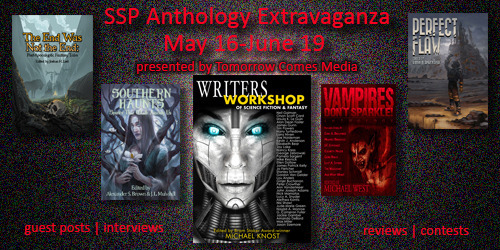

Amazon Links for Southern Haunts:
Softcover Link: http://www.amazon.com/Southern-Haunts-Spirits-That-Among/dp/1937929124
Kindle Link: http://www.amazon.com/Southern-Haunts-Spirits-Among-ebook/dp/B00BWUXMX4
Social Media Links for Seventh Star Press
Facebook: http://www.facebook.com/seventhstarpress
Twitter: http://www.twitter.com/7thstarpress
Website: http://www.seventhstarpress.com
Blog: http://seventhstarpress.blogspot.com


May 25, 2013
Interview with Cat Rambo — Near + Far
Interview with Author Cat Rambo

author of Near + Far
5/25/2013
Cat, I was intrigued by the Ace double format of Near + Far. I was wondering where you get your story ideas?
Story ideas can come from anywhere: something I’ve observed, a phrase, an image, a dream, or even an incident in my own life. For example I saw a cashier about to step on a pen in a store and thinking about that led to a flash piece, “At the Core.” Other story ideas are reactions to stories I’ve read, sometimes recently, more often far in the past. Those take a lot of forms: amplifications and contradictions, celebrations and rebuttals. “Long Enough and Just So Long,” which appeared in Lightspeed Magazine, is a reply to a Heinlein story that I loved but which bugged me, “The Menace From Earth.”
What is the usual process for your fiction writing? Are you a plotter or a pantser?
My process has changed in recent years: I do a lot more planning beforehand. I do a lot of my writing by hand, and may do a free write about a story before I started, in order to see if anything interesting emerges.
I still, though, try to let the story grow organically. I find a too detailed outline leaves me unwilling to write the story, as though all the interesting parts had been done already and only the drudgery was left.
Once you have an idea that sparks your imagination do you research your idea or do any world-building exercises, or do you just begin to write and see where the Muse takes you?
Usually I start and see where it ends up. Sometimes though, some research is needed because it’s going to shape the story. For example, I’m working on a military fantasy story right now, involving a Roman soldier stationed at Hadrian’s Wall. That’s something I know very little about, and so I’ve been doing a good bit of research for it.
 What is your daily writing like?
I go out in the morning to get my huge latte from Jitters Coffee. Then I come home, look at my email to make sure nothing needs answering immediately, and get started. My goal each day is 2000 words of new fiction, which I don’t always hit, particularly when I’m in the middle of revising things.
Are you a full time writer? If so when did you make the decision and what factors led to the decision. If you are not a full time writer…Is your plan to one day being a full time writer?
I am a full-time writer. In 2005, I left my job technical writing for Microsoft because I decided if I wanted to be a writer, I needed to get started. So I went off to Clarion West that summer. Since then, my spouse has been kindly paying the mortgage while I work on freelancing, which is a somewhat sporadic financial existence.
Can you tell us about your experience working with your current publisher? (Any other publishers?) (And/Or your self-publishing experiences?)
My current publisher is the best! Tod McCoy of Hydra House Books put a lot of work into the most recent collection, and it shows. It is a beautiful book, I loved working with him on both the book as well as the marketing and publicity, and I would highly recommend Hydra House Books to anyone.
I’ve dabbled in self-publishing, but have not found it particularly fruitful. I’ve also been a part of an interesting shared world project, the Fathomless Abyss, which is an experiment in collective self-publishing.
What is your current release and (without spoilers) tell us about the new book or series.
The most recent book is Near + Far, from Hydra House. It’s a book done in the old Ace double format, where you flip the book over and find a new book on the other side. One side is all near future short stories, and the other is all far future short stories. It’s nothing but science fiction stories. I hope to do a similar volume with all fantasy.
Can you tell us about some of your other writing and any appearances or signings that you have planned?
Right now, I’m finishing up what I hope is the final rewrite of a fantasy novel, tentatively titled The Moons of Tabat as always, I’m working on several short stories and a novella for the Fathomless Abyss project, A Cavern Ripe with Dreams. I have short stories forthcoming in a number of anthologies, including Clockwork Phoenix Four, Beyond the Sun, The Other Half of the Sky, and Glitter and Mayhem. Convention appearances this year include SpoCon, WorldCon, SteamCon, and Orycon.
As an author what inspiration or advice would you give to a writer who is working to make the transition to Author?
Patience, persistence, and a thick skin are qualities every writer should cultivate. Keep a number of lines in the water, by which I mean have more than one project in the works. But the best advice I can give anyone is don’t be a jackass. The writing world is an astonishingly small one, particularly with the connections created by social networks.
Who is your favorite author, and can you recommend a book by that author?
Oh, I have so many favorite authors! I’ll recommend one that I often draw on for examples when teaching, Dorothy Dunnett. she’s not a speculative fiction author, but a historical one. She is so good at so many things, including seeding information into the narrative without drawing attention to it and writing dialogue with accompanying gestures on the part of the characters that tell so much about them. The best starting point is the first book of the Lymond Chronicles, The Game of Kings.
Cat, I want to thank you for coming by the blog, and Congratulations on your Nebula nomination for “Five Ways to Fall in Love on Planet Porcelain“.
If you would like more information about Cat Rambo you can find her books on Amazon, and updates about her writing on Twitter, Facebook and on her website:
Books:
Eyes Like Sky and Coal and Moonlight
The Surgeon’s Tale (with Jeff VanderMeer)
You can keep up with Cat online:
Headshot photo credit: On Focus Photo
Cover design for Near + Far by Tod McCoy


May 16, 2013
Interview with Adam Lance Garcia — The Green Lama
Adam Lance Garcia, one of the youngest New Pulp writers, exploded onto the scene in 2009 with his first novella Green Lama: Horror in Clay. Written as a gift for his father, Horror in Clay was nominated for Best Short Story in the 2009 Pulp Factory Awards. Adam’s follow up novel, Green Lama: Unbound, took away two 2010 Pulp Factory Awards: Best Novel of the Year and Best Interior Art (thanks to the artwork of his frequent collaborator, Mike Fyles).
Hailing from Brooklyn, New York, Adam was raised on on high quantity of golden age comic books, movie serials, and Star Wars. Adam credits this atypical upbringing to his passion for writing.
He is currently at writing several licensed properties at a number of publishers, including Moonstone Books, Pro Se Productions, and Airship 27 Productions as well as working on his original graphic novel Sons of Fire with artist Heidi Black.
.
Interview with Author Adam Lance Garcia

author of The Green Lama
5/16/2013
I was wondering where you get your story ideas?
I’ll avoid the fairly standard reply of “everywhere,” even though that’s fairly true. Elements for my next few novels were born in dreams; “Richard Knight: Crimes of the Ancients” was inspired by an unrealized relationship with a fantastic young woman; even a broken headphone started my mind working. Sometimes a simple word or sound can push the snowball down the hill. Most recently a story appeared fully formed as I boarded the subway for no reason that I can determine.
Most importantly my stories come from a very true emotional place, just with a lot more guns and punching. I’m a terrible liar, and that can come through the page, so I always ground these stories—and more importantly the characters—in a real place. A conversation between Sotiria and Caraway and Green Lama: Unbound was a real conversation I once had, with all heartbreak and hurt that came with it.
If there isn’t truth in the words then they are meaningless.
What is the usual process for your fiction writing? Are you a plotter or a pantser?
A little bit of both. For short stories I often fly by the seat of pants.
For novels, I always write out a treatment to simply lay out the major plot points, the signposts for where the story will go. But once I start diving into the actual pages, I intentionally ignore the treatment and let the characters take over, which is at once thrilling and aggravating, especially when they decide to turn left when I really, really want them to turn right. I sometimes write bits of scenes, dialogue or notes far ahead of myself that are eventually absorbed into the story—or sometimes are used in later stories. I usually find I end up at the same destination I planned, but never on the planned route.
 Once you have an idea that sparks your imagination do you research your idea or do any world-building exercises, or do you just begin to write and see where the Muse takes you?
It depends on the idea. I’ve been researching and world-building a project I’ve had bubbling in the back of my head for several years now. Others I just dive in and write it. Though the Muse and I similar get into arguments.
What is your daily writing like?
Depends on the day. Some days it’s a sprinkling here and there, other days, I’m bound to the computer plowing through page after page. I’m not one of those writers who can pump out a thousand to three thousand words a day – though Lord knows I wish I was. I’m a lot more methodical, working over small sections over and over and over again before I move forward, a process that increases as the story grows. I call it “scrubbing,” which looks ridiculous when I write it down.
Can you tell us about your experience working with your current publisher? (Any other publishers?) (And/Or your self-publishing experiences?)
I personally really enjoy working with publishers and editors. I know a lot of people have found success in self-publishing, but I’ve always enjoyed collaboration, having my work proofed, questioned and edited. I can sit in a darkened room by myself and think everything I write is genius, but if I’m not able to convince my editors, then I need to get back to work. Plus it allows me to focus on my writing and not on all the work surrounding production, sales, etc.
 What is your current release and (without spoilers) tell us about the new book or series.
There’s a lot of stuff I can tell you about, and some things I can’t.
I’ll have two short stories coming in Pro Se Press’s Foster Fade: Crime Spectacularist anthology: “Dead Men’s Guns” and “The Black Rock Conspiracy.” I absolutely loved writing these characters and hope to do more with them.
I also did a short story for Barry Reese’s next Tales of the Rook volume entitled “Night Out.” Barry’s created such a fascinating legacy character, and I was particularly excited to tell a tale with the third Rook, Emma Davies.
I think what a lot of my readers will be most excited to hear about is a number of fully licensed projects for a certain hooded hero coming out from a major pulp publisher. I would love to tell you more, but they’ll kill me if I did.
Can you tell us about some of your other writing and any appearances or signings that you have planned?
Right now I’m doing a lot of work on licensed properties, but—with a few exceptions—I’m hoping to shift my focus into more original work and maybe move away from what can be defined as pulp.
One major project I’m working on is an original graphic novel called Sons of Fire with amazing young artist Heidi Black. It’s essentially Smallville meets Breaking Bad. It’s a huge departure from what I’m normally associated with, but features a lot of themes I’ve been playing with for the past few years.
Unfortunately, I won’t be making any appearances anytime soon; I have way too much work to catch up on. But if you’re ever in the New York City area I’m sure you might see me racing to the subway.
As an author what inspiration or advice would you give to a writer who is working to make the transition to Author?
Read. Read like it’s your job. Read every day and outside your comfort zone, outside the genre you’re writing. You’re writing a horror story, read a mystery. You’re writing a sci-fi story, pick up some classic literature. Every new author, new style, new genre you pick up with help inspire you and bring something fresh to what you’re writing. You’ll discover new ways to tell a story, new ways to approach characters, new ways to approach language. It will make your work stronger and help you stand out from the crowd.
Just as importantly, write every day, even if it’s just a word or a minor edit, you need to set aside time to work on your craft, that’s only way you’ll get better. And never be afraid to try something new. If you only ever written adventure stories, try a character piece. Never written a mystery? Now’s the time to start.
And perhaps most importantly, be open to criticism. If you dare put words to page, you must expect to be judged intensely and deeply. Learning what works and what doesn’t will only make you a better and stronger writer.
Who is your favorite author, and can you recommend a book by that author?
I would say anything Neil Gaiman puts to page is worth your time and dedication. He’s incredibly prolific and eclectic, and sprinkles his stories with so many amazing—and profound—themes and ideas, you’d be hard-pressed not to find something you can grab on to. In the mood for a relatively straightforward adventure? Stardust or Neverwhere. Need to sink your teeth into a dense novel exploring myth and faith? American Gods. Want to read a bunch of great short stories that show his full range? Smoke & Mirrors or Fragile Things. Not a reader? Watch The Doctor’s Wife. Like comics? Sandman. Like radio? There’s a new adaptation of Neverwhere. Gaiman will never steer you wrong, and more importantly, he’s the nicest guy in the world.
If you would like more information about Adam Lance Garcia you can find his books on Amazon, and updates about his writing on Twitter, Facebook and on his website.



May 13, 2013
Interview with Jen Mulvihill — Southern Haunts
Born in Hollywood and raised in San Diego, CA, J.L. Mulvihill has made Mississippi her home for the past fifteen years. Her debut novel was the young adult title The Lost Daughter of Easa, an engaging fantasy novel bordering on science-fiction with a dash of steampunk, published through Kerlak Publishing.
She is also the Co-editor of Southern Haunts, the spirits that walk among us, which includes her story, Bath 10, based on Hot Springs, Arkansas and haunted, healing, spring waters. Also she released her short story, The Book, from Dreams of Steam IV-Gizmos, A steampunk thriller revolving around a mysterious antique book.
Interview with Author Jen Mulvihill

Co-editor of Southern Haunts
5/13/2013
I was wondering where you get your story ideas?
Lisa, thank you so much for having me here first of all, I love having the opportunity to talk to people about my writing. I get some of my story ideas from my dreams which mean I have some pretty wild dreams. My first novel, The Lost Daughter of Easa, started out as a nightmare I had of being chased through the woods by a giant spider. The dream was so scary I could not get it out of my head, and the more I thought about it, the more it started to develop into a story.
Some of my ideas come from my observations of the world around me. I sort of see things in a different perspective I guess. For instance if there is a bowl of fruit on the table most people would see the bowl and think about whether or not they are allowed to eat the fruit, what kind of fruit it is and if the fruit is ripe. Maybe some people don’t even think that far, ha ha I’m not sure. But for me it’s different; I see a bowl of fruit on the table and I think who did that bowl belong to? Did an evil witch put that fruit in a bowl to tempt me? Maybe there is a curse on the fruit and everyone who eats it will turn into a zombie. Maybe that fruit used to be people and a mad scientist turned them into fruit with some strange chemical and now someone will eat those poor people. See the difference? I’m not sure why I think like that, I just do. Everything has a story behind it. My family and friends tell me I’m just not right. I’m not sure what they mean by that but maybe it has something to do with this thought process of mine.
I used to watch the Ray Bradbury Theater television series when I was a kid and in the beginning of the show the camera would zoom into his office where he writes and he would narrate as the camera did this saying, “what shall we write about today,” or something like that. The camera would span across an eclectic office. There were all sorts of things in his office and when the camera finally stopped on one item that item would be the focus of the day’s story. I thought that was the coolest thing ever. I now have an eclectic office of my own where I surround myself with not only books of all genre but also strange knick knacks and a collection of dragons and art work I have purchased over the years. I love it. So sometimes I get my inspirations from just looking at the items in my office, or my little corner of the world as I like to call it.
What is the usual process for your fiction writing? Are you a plotter or a pantser?
I am both. When I am working on a series such as the Authora series or the Steel Roots series, I have to be a plotter because there is so much involved in the stories. There are so many characters and places in Authora I have to have one of those tri panel boards like the ones you use for a science project? I have to use one of those with sticky notes all over it with the names of the characters, where they live, and how they connect to other characters in the story or the history. So when I say I use a story board, I literally use a story board.
However, when I write a short story, I have to admit I write by the seat of my pants and I just let that story flow on out of head, down my arms, through my fingers into the keys and onto the computer screen. But, I cheat a little because I do plot a little but in my head. I will mull the story over in my head for a few days before I actually write it out. But I don’t write an outline or anything of that sort for my short stories.
I think everyone is different in this though. Every writer does what works best for them and this is just how things work best for me. It does not mean this is the way one should do it by any means. When it comes to writing I don’t think too many rules and regulations should be put upon an author. If the story comes out good, does it really matter how it was done? Writing is a form of art I am certainly not going to go tell Leonardo Da Vinci how to paint any more than I will tell James Hilton how to write.
Once you have an idea that sparks your imagination do you research your idea or do any world-building exercises, or do you just begin to write and see where the Muse takes you?
Oh, yes I’m big on research. I research everything to the smallest detail. Why you ask? Because I believe that everything, even fiction, should be believable so when I research I look for the most plausible angle so I can create the most believable story. To me that is what makes a good story.
What is your daily writing like?
Well I’m a full time mom, wife, and I have a 40 hour a week job, and I have promotions to handle for my books, so my writing is when and however I can squeeze it in. When I am hot on a novel I usually end up writing at least an hour or three each night and as much time as I can fit on the weekends. Unfortunately with the mom schedule it can be hard to set a precise time for writing. My kids are older but they are very involved and I don’t want them to feel I am neglecting them. But, that means the housework tends to get put off. I am fortunate to have a supportive husband who helps out though. When I finish a project I tend to take a little time off before I jump back into writing. Some people say you should write every day and maybe that is true to help keep you frosty. I just think you should not go more than a week without writing something creative. But again that is coming from someone who is very, very busy. Are you a full time writer? If so when did you make the decision and what factors led to the decision? If you are not a full time writer…Is your plan to one day being a full time writer?
I would really like to have the luxury of being a full time writer but at the moment I have to keep my job especially now that I have to put one of my kids through college. Right now I am building a platform for my writing career so that one day I will be able to transition over easily, and then I will be able to write full time. I want to be sure that there will be enough of a demand for my writing before I give up the day job. That’s the plan anyway.
Can you tell us about your experience working with your current publisher? (Any other publishers?) (And/or your self-publishing experiences?)
 I am very blessed to be with two wonderful publishers right now. Dark Oak Press, also known as Kerlak out of Memphis and Seventh Star Press out of Louisville, KY. Allan Gilbreath of Dark Oak Press took the chance on my first novel and I am very grateful for that. Since then I have enjoyed working with him and Kimberly Richardson at Dark Oak on other projects. I have some short stories in the Dreams of Steam anthologies Kimberly edits. I also have a few other projects in the works with Dark Oak, projects that are often born out of conversations and mayhem at the conventions I attend. There is never a dull moment when I go to a convention with Dark Oak and Allen and Kimberly are there.
I have known Stephen Zimmer from Seventh Star Press about as long as I have known the Dark Oak/Kerlak press. Stephen and I have often sat and discussed projects and ideas but it was last year he came to me and asked me if I had any young adult projects I was working on besides the Elsie Lind series. I told him I had an idea for a young adult steampunk series so he told me to write up a proposal and submit it. I was sort of taken aback when they accepted it because it was an idea I had only been mulling around in my head for about a year. Once I got into the story I became very excited as the characters came to life and the plot opened up to me. Now I can hardly wait until the first book comes out. The story is so unique and written from a completely separate perspective than the other series. I enjoy working with Seventh Star Press a great deal; they are so encouraging and supportive, like a family.
Recently I co-edited an anthology with author Alexander S. Brown, Southern Haunts, The Spirits That Walk Among Us. Seventh Star Press took the book on and since it came out last March it has been a big hit. The book is such a big hit that Seventh Star has already asked Alexander to do another Southern Haunts book. I won’t be editing that book since I have so many other projects on the table right now but I will be submitting a story.
So far my experiences with both publishing houses have been extremely pleasant and educational, and I‘ve got nothing but love all the way around.
What is your current release and (without spoilers) tell us about the new book or series.
My new novel, The Boxcar Baby from the Steel Roots series will be coming out in June from Seventh Star Press. I’m very excited about this book and series. It’s about a fifteen-year-old girl who was found as a baby in a boxcar. The man who adopted her and raised her as his own is now missing and she has to find him. Aided only by a motley gang of friends and a map she found hidden in her papa’s spyglass which has clues written on it, AB’Gale Steel train hops her way across the United States in a desperate attempt to find her papa and put her life and family back the way it was. This great American adventure takes place in an alternate steampunk dystopian world.
Can you tell us about some of your other writing and any appearances or signings that you have planned?
Lisa, last March I had a new short story called The Book, in the Dreams of Steam IV – Gizmos released out of out of Dark Oak Press/Kerlak. It’s a steampunk thriller where I send three publishers to steampunk hell. It takes place in Memphis and I will not tell you anymore than this, if you anagram the names you will find out who they are. Of course it is all in good fun.
At the same time Gizmos came out the anthology Southern Haunts, The Spirits That Walk Among Us which I mentioned earlier I co-edited with Alexander S. Brown was released out of Seventh Star Press. I also have a short story in this book called Bath 10 which is a real chiller and based off the bathhouses of Hot Springs, AR. The anthology has 15 other fantastic authors in it and all the stories are fictional but based on real places thought to be haunted.
The next events I will be attending will be Mobicon May 17-19 in Mobile Alabama where I am one of the guest authors http://www.mobicon.org/
I will also be a guest at the Alabama Phoenix Festival May 24-26 in Huntsville Alabama, http://www.alabamaphoenixfestival.com/
I will at a book signing with several Imagicopter authors at Cups in Brandon, MS on June 1, 2013 from 11am -1pm and then that same day I will be at another book signing at Bay Window Books in Pearl, MS from 2pm to 4pm.
Then my biggest most exciting event is that I will be attending Comic Con July 18-21, 2013 in San Diego, CA as a professional. I can hardly wait I am so excited about this http://www.comic-con.org/cci.
Also in October 18-20 I will be attending as a regional guest at one of my favorite conventions Contra Flow http://www.contraflowscifi.org/
As an author what inspiration or advice would you give to a writer who is working to make the transition to Author?
I would suggest to inspiring authors try to attend some of these speculative/science fiction/fantasy conventions where they offer a writing program and learn as much as you can from other authors. My first convention was MidSouth Con in Memphis, TN. This convention is held every March and has writing panels geared toward the college so it’s highly educational. Don’t just attend any convention though, do some research to see who will be there and what sort of programing they offer. Writing conventions can be very expensive but if you can afford to go to one you probably should try that as well. I also recommend reading a lot. Whatever genre it is you choose to write, read it first so you understand what you are writing. I would also recommend research and get your facts straight even if it’s fantasy, making it believable makes the story all the more readable and interesting.
Who is your favorite author, and can you recommend a book or series by that author?
Oh wow, favorite author? That is really hard because I have so many that I like. Ok well J.R.R. Tolkien I guess is my all-time favorite but that’s a given, I probably don’t even have to tell anyone what to read when it comes to his writing. No one writes like that anymore.
My next favorite would have to be Terry Brooks, I have only read The Shannara series, and I have started to read the Magic Kingdom series. Anne McCaffrey and the Riders of Pern series had a big influence on me, as well as Neil Gaiman. My favorite story is Neverwhere. I have read a lot of his writing and I love Stardust too but Neverwhere, hands down is a fantastic story.
I would also like to recommend some of the classics like Edgar Rice Burroughs; The Princes of Mars series was my favorite. Anything by Ray Bradbury I don’t think the man could write a bad story, I am very sorry I did not get the chance to meet him he was an incredible writer. Robert Heinlein, I loved Stranger in a Strange Land. Oh and Isaac Asimov, those are some classic science fiction writers. Michael Crichton I think was an absolute genius and it is a great loss to the literary world when he died.
Ok so everyone has heard of these authors but here are a few that maybe you have not heard of but also are fantastic authors and have some great series that I have read and enjoy: D. A. Adams and his Brotherhood of Dwarves series. Usually dwarves are written in as comic relief or sidekicks but this series puts a whole new meaning to dwarves. Also Stephen Zimmer has two really good series he writes but the one I am reading now is the Rising Dawn Saga, totally epic. David Blalock is an amazing author too with my favorite Ascendant which is part of the Thran Chronicles. I read Ascendant and then found out that he had been writing these books for a while so I just got a hold of the other six books and I can’t wait to dive into them.
If you like Vampires Galen and Dark Chances by Allan Gilbreath has a badass vampire who does not sparkle. If you are into horror then Alexander S. Brown’s Traumatized is brilliant with a variety of physiological horror and so does Kimberly Richardson for that matter in Tales of The Goth Librarian. Michael West’s Poseidon’s Children is one of those nail biting but you can’t put it down books and Jimmy Gillentine’s Of Blood and The Moon is a fast pace but fantastic story; he just released the sequel to it, Crossroads.
I’m sorry I better stop now because really I could go on and on about books and authors, like I said before it’s hard to pick a favorite when there are just so many fantastic authors out there.
Thank you Lisa for the interview and I hope I have answered all the inquiring minds satisfactorily.
Thank you Jen! If you would like more information about Jen Mulvihill you can find her books on Amazon, and updates about her writing on Twitter, Facebook and on her website.
http://home.comcast.net/~mulvijen/site/
http://www.seventhstarpress.com/j-l-mulvihill/
https://www.facebook.com/mulvijen
https://twitter.com/JLMulvihill
http://www.goodreads.com/author/show/5145690.J_L_Mulvihill
http://www.literaryunderworld.com/Lost-Daughter-of-Easa-9781937035051.htm


May 2, 2013
Interview with Diane Graham — I am Ocilla
She has been a waitress, a car saleswoman, a real estate wannabe, and had grandeur dreams of growing up to be a mom. Never in a million years did she expect to be a writer, but children do this awesome thing with a person’s imagination.

Interview with Author Diane Graham
author of I am Ocilla
5/02/2013
Diane, I was intrigued by the idea of your book, I am Ocilla, being written in first person present tense. That is truly unique so it got me wondering where you get your story ideas?
Oh, man. I can get ideas from the silliest things. As a matter-of-fact, it is a must for most of my fiction writing. Examples of that are dotted through I Am Ocilla in spades. Most of the characters and story ideas are based on real life flipped on its ear. I’ll give you one example. In the book, there is a species called Krakens. They are not giant squids, like normal lore. They are dragon-men. That idea originated from my eldest son. When we were building our house, it was very hot on the mountain. We had lost a lot of weight and my son’s britches were hanging; exposing a few inches of proper plumber. My daughter said if he was going to keep it hanging around, it should at least have a name. She dubbed it Mr. Kraken. My son obliged the ridiculousness by placing sunglasses at the top-backside of his pants and doing a voice skit for Mr. Kraken. The name stuck. When it came time to develop his character, Kraken it was. He loves dragons and wanted his character to be a dragon. So my silly made it work.
What is the usual process for your fiction writing? Are you a plotter or a pantser?
I do a lot of pondering, but when it comes time to pour it on the pages, I pants it all the way.
Once you have an idea that sparks your imagination do you research your idea or do any world-building exercises, or do you just begin to write and see where the Muse takes you?
I do research to make sure names are lined up like I want and I research lore for fairy tales. But I like changing the normal interpretations of fantasy lore to suit my way of seeing them.
 What is your daily writing like?
I’m going to shake a few people up here. I do not write every day. I write when I want to. I write when my mind feels like it will explode if I don’t empty it. That may translate into months of little sleep and tens of thousands of words or that may translate into nothing for six months. I don’t beat myself up over that…ever. I refuse to make something I love so very much into work.
Are you a full time writer? If so when did you make the decision and what factors led to the decision? If you are not a full time writer…Is your plan to one day being a full time writer?
Thankfully, I am a kept woman. My husband of 22 years provides me the freedom to do what I want and I still have three out of five children at home that I homeschool. Writing is not something I do as a job. It is simply part of who I am.
Can you tell us about your experience working with your current publisher? (Any other publishers?) (And/or your self-publishing experiences?)
I am currently with Splashdown Books. Grace Bridges and team are splendid. Splashdown allows a lot of flexibility to its artists that larger houses don’t.
W hat is your current release and (without spoilers) tell us about the new book or series.

Grace Bridges and Diane Graham in Star Trek uniforms. 
I Am Ocilla is my debut novel through Splashdown Books. It is written in first person /present tense. That’s a tricky POV to write in and takes some getting used to for the reader. You are in the moment and you are in Ocilla’s head. In the beginning, she knows not a thing but her name. You find most everything out as she does.
Open your heart and mind to the simplicity and complexity of a name.
I know only my name. Beyond that is confusion, a void where fantasy and reality swirl together. Fairies, Giants, Elves, Dwarves, ancient Keepers, and…Dragons? A dark soul threatens the Five Kingdoms, but I am powerless to stand against him, overwhelmed by phantom memories, broken and lost.
Somehow, I must live. I must find my purpose. There are friends to love and battles to fight.
I know my name. Perhaps that is enough.
I am Ocilla.
This is my story.
Can you tell us about some of your other writing and any appearances or signings that you have planned?
I could, but then I may have to kill you, and that is just rude. You were kind enough to invite me here. What would my Momma think? As far as appearances? I’ll be at a grocery in eastern Oklahoma every other Tuesday of the year. Of course, I’ll be shopping, but I’ll be there. I’m kind of in the middle of nowhere, so book signings are not in my norm.
As an author what inspiration or advice would you give to a writer who is working to make the transition to Author?
 Write with your bones and a passion. Believe in what you are doing and it will show in your work. Always open yourself to learning from other writers. That will hold true no matter how long you write and no matter how many books you get published. Read, listen to music, and watch the wonderful world around you God created.
Who is your favorite author, and can you recommend a book by that author?
That isn’t even a fair question. I am a bit biased, but I am rather found of my Splashdown colleagues. Have you read Robynn Tolbert’s Star of Justice, Kat Heckenbach’s Finding Angel, Keven Newsome’s Winter? How about Paul Baines’ Alpha Redemption or Caprice Hokstad’s Dukes Handmaid? Then there is always Kerry Nietz from MLP? The list is too long, but that is a good start for anyone that loves speculative fiction.
Thank you Diane!
If you would like more information about Diane Graham you can find her books on Amazon, and updates about her writing on Twitter, Facebook and on her website.
Website: http://dianemgraham.com/
Facebook: Diane Graham Author Page
New Author Fellowship: http://newauthors.wordpress.com/diane-m-graham/
Amazon author page: Diane Graham
Splashdown Books: http://www.splashdownbooks.com


April 25, 2013
Interview with Fred Warren — The Seer
Fred Warren retired from the Air Force after 24 years of service, and still serves proudly as a defense contractor. His first novel, The Muse, a modern fantasy tale of inspiration both divine and diabolical, hit the streets in November 2009. A short-story anthology called Odd Little Miracles followed in July 2011, and his latest book, The Seer, a sequel to The Muse, was published in November 2011.
Interview with Author Fred Warren
author of The Seer
4/25/2013
Fred, I loved The Muse, so I am so looking forward to reading The Seer. The Muse was unlike other speculative fiction that I had read before, so I was wondering where you get your story ideas?
Anywhere and everywhere. At one time or another, I’ve used memories, pictures, music, poetry, dreams, movies, scripture, or a snippet of conversation as my starting point. I find a lot of inspiration from things I see or random thoughts that run through my head when I’m traveling to and from work. I was driving along a lonely stretch of Kansas highway one day and saw a railroad track that paralleled the road at the base of some rolling hills. I imagined a circus train stalled on that track and wondered what the passengers might find hidden from view on the other side of those hills. That was the beginning of a short story called “Rubes.” What they found was very strange and wonderful, and it wasn’t something I’d expected to find in the middle of nowhere on the Kansas prairie.
What is the usual process for your fiction writing? Are you a plotter or a pantser?
I avoid plots, and I always wear pants. Seriously, I like to leave the door to creativity as wide-open as I can, but sometimes I’ve needed to lay out some milestones in a story’s plot to keep myself on track. So, I’d say I’m a pantser by instinct and a plotter as necessary.
Once you have an idea that sparks your imagination do you research your idea or do any world-building exercises, or do you just begin to write and see where the Muse takes you?
It depends on the story. If it involves a setting and characters with which I’m familiar, I’ll usually just begin writing and let the story develop organically. That was my approach to The Muse. I enjoy writing that way because it’s full of surprises and the characters often take on a life of their own, which helps steer the story in interesting directions. I write better when I’m having fun. For longer or more complex stories, I’ll sometimes sketch out a rough outline, compile some character summaries, and do some outside reading to get my bearings, but I still prefer to let details emerge rather than determine them beforehand. If I was defining a very alien world completely from scratch, I’d spend more time laying out the geography, flora, fauna, physics, culture, etc., at the beginning because I’ll need to bring my reader into that unfamiliar world very quickly without much help from our common experience of life.
What is your daily writing like?
Irregular. Since I’m working around my work and family schedule, which is turbulent, I usually write when the time and inspiration coincide, though I try to write something every day, whether it’s simply jotting down some story ideas or dashing out a blog post. I travel frequently with my job, and that often provides the opportunity for uninterrupted writing in a quiet setting.
Are you a full time writer? Is your plan to one day become a full time writer?
No, I have three children, two dogs, and a mortgage, so I don’t anticipate giving up my day job any time soon. I might consider it if my books were selling well enough, but I can’t plan on hope. The current scope of my writing fits within my available free time, so that’s good enough for now. Can you tell us about your experience working with your current publisher?
Grace Bridges of Splashdown Books is a joy to work with. She’s all about taking risks and innovating, and she has a unique creative vision. Grace is an Irish lass who’s worked in Germany and lives in New Zealand–her travels have broadened her perspective on life and literature. Since she runs a small, independent press, there’s opportunity for lots of personal contact and exchange of ideas, which I find very helpful. I didn’t actually find Grace, she found me. She reads broadly, and if she finds a writer she likes, she’ll invite them to submit a manuscript, rather than having writers seek her out with their stories. I’d been circulating my first draft of The Muse among some friends and colleagues for critique, and a copy found its way into her hands. She liked it and asked if she might publish it. The Muse was my first novel. Before that, I’d written a variety of short stories that were published in print and online magazines, and I still consider myself primarily a short story writer.
What is your current release, and (without spoilers) tell us about the new book or series.
The Seer is a sequel to The Muse that takes up the story several years later. Where The Muse was a story about inspiration, imagination, and the love between a husband and wife, The Seer is about dreams, destiny, and the love between a father and daughter. There’s another adventure in the world of imagination, but it’s a little darker and more personal this time.
Can you tell us about some of your other writing and any appearances or signings that you have planned?
Splashdown Books has published a collection of my short stories called Odd Little Miracles, which includes a mix of science fiction, fantasy, and even a little horror. Extreme plastic surgery, alien invasions, magical beekeepers, gravity-defying English teachers, monster hunts, lost colonies, side shows, divine intervention, deals with the devil, genius, and madness…it’s all there.
I’m also writing within an ongoing shared-world microfiction project sponsored by Splashdown Books called Avenir Eclectia. It’s the epic tale of a lost space colony struggling to survive on and around a hostile world. The colony consists of the Avenir, a generational spaceship turned orbital habitat, circling Eclectia, a barely-habitable planet subject to violent seismic forces. We’re building the world and the culture of this colony as we go, in vignettes of between 500 and 1000 words or so, with a dozen different authors. It’s been fascinating to watch the story develop. You can find it online at http://www.avenireclectia.com .
As an author, what inspiration or advice would you give to a writer who is working to make the transition to Author?
Focus on writing the best stories you can. Don’t be distracted by pressures to write according to the prevailing fashion or in lockstep with a particular message. Engage the reader. Stimulate their emotions, intelligence, and imagination. Give them an opportunity to laugh now and then. Create characters worth knowing, places worth visiting, and adventures worth living. The rest will follow.
Who is your favorite author, and can you recommend a book by that author?
It’s hard to pick just one. Mark Twain formed some of my earliest and most treasured memories of great literature with The Adventures of Huckleberry Finn, and in the realm of speculative fiction, I love the poetry and vivid imagery Ray Bradbury brought to science fiction and fantasy. Something Wicked This Way Comes is probably my favorite of his novels. A couple of writers who have impressed me more recently are George Bryan Polivka, with his piratey Blaggard’s Moon and the Trophy Chase trilogy, and Ken Liu, whose short story, “The Paper Menagerie,” won the Nebula, Hugo, and World Fantasy awards last year, the first work of fiction ever to do so. You can read it at: http://bit.ly/yphhz3

Thank you Fred!
If you would like more information about Fred Warren you can find his books on Amazon, and updates about his writing on Twitter, Facebook and on his website.
Website: http://frederation.wordpress.com
Publications: http://frederation.wordpress.com/publications
Twitter: @frederation
Amazon author page: http://amzn.to/XdiLBR
Splashdown Books: http://www.splashdownbooks.com


April 21, 2013
Healthy Writer: Thoracic Mobility
Hello Desk Jockeys or Cubical Warriors, today we are going to be talking about gaining mobility in the mid-back region. As the video one below points out, pain in one area of the body does not necessarily mean that the origin of the pain is in the same place that it manifests. Simply said if you neck hurts it may be due to the loss of mobility in a different region. The body works as a system each part working in conjunction with the ones around it. For example if you forearm tendon is tight and tender you will most like have pain in the elbow and wrist. Why? The systems on either side of a weak one have to work twice as hard to make simple movements.
In my endeavors to gain more mobility or flexibility in my back and shoulders I started using a foam roller. Now if you have never heard of a foam roller it may sound a bit quirky, but now I swear by mine. In video two you will see one of the workouts that I do for my thoracic mobility. You can purchase a roller at most local sports shops or online at Amazon.

Foam rolling is a self-myofascial release (SMR) technique often used by athletes and physical therapists to improve soft tissue flexiblity. The technique can be effective for most muscle regions throughout the spine, chest and gluteus. Rolling the foam roller under or across each muscle group and pausing at tender or tight areas by maintaining pressure for 30 to 60 seconds can release the trigger points, and relax the tender areas. But I must warn you…use of a foam roller the first time can be painful. You will be working on trigger points that may have been tight for years. Those areas will feel more like rocks and you will think that the area may never relax. IT WILL. Trust the process and go slowly.
Here is the regimen that I have discovered works best for me. I have found that if I use the exercise from video one before I do video two and roll out my back I have less pain and the muscles relax twice as fast. I suggest doing the exercise from video one 10 times, then do the full rollout from video two twice. When you are done you back will be tender. Take things slowly and rest for bit before you get back to your daily chores. I would repeat this workout 3-4 times a week, but it can be done daily without harm.
One of the great things about foam rollers is that you can use them after strenuous workouts to stretch and relax overworked muscles from your neck down to your feet. This helps tremendously in reducing Delayed Onset Muscle Soreness (DOMS). But if you don’t get a roller video one is an excellent start for your Thoracic Mobility. Here is a link to several videos on YouTube for uses of the foam roller.
Video One:
Video Two: