
Hal Young's Blog, page 51
November 3, 2011
Baby, You Can Drive My Doll
 Several years ago, a friend of ours decided to eliminate gender stereotypes from her children's upbringing. When her daughter was born, Mom bought trucks and construction toys for the child to play with. When a son came along, she bought him a baby doll.
As it turned out, her kids weren't buying it—neither one of them.
Much to Mom's dismay, her little boy would drive the hapless doll around on its stomach making vroom-vroom sounds. His big sister, on the other hand, did pretend to drive the little trucks around the carpet, all while narrating a story of archaic domesticity: "Mommy's putting the baby in the car seat, and they're going to the grocery store!"
Though raised in a very up-to-date, trend-conscious family, these young children had a natural bent toward traditional gender roles. Sometimes gender "stereotypes" aren't an evil invention of a patriarchal world but instead reflect tendencies built into us by a loving God. And we can use those tendencies—in fact, we ought to use them—to improve our homeschooling effectiveness.
What about the stereotype that boys like science and girls don't? Maybe it's not the subject but the way it's presented. When researchers in Luxembourg asked a group of eighth- and ninth-grade students what they thought of a suggested science program for the coming year, they found that girls were more interested in science when scientific concepts were presented within the context of real-life feminine topics. Likewise, boys were more interested in science when scientific concepts were presented within the context of masculine topics:
Girls showed considerably more interest in topics such as "how a laser is used in cosmetic surgery" and "how to calculate the probability of a miscarriage" than in topics such as "how to calculate the force a rocket needs to take off" and "how to calculate the probability of a car accident." One of the authors . . . said that girls were more interested in social and real contexts such as the decline of forests, whereas boys clearly found mechanics and technology more compelling.
[image error]When you introduce a scientific principle in your home school, can you think of different ways to apply it to appeal to your children? Let's say you want to discuss heat, the expansion of gases, and their relationship to pressure. It's equally valid to think of the forces exerted by steam in a locomotive boiler or a pressure cooker. The physical quality of fluid viscosity works the same with motor oil or vegetable oil. Ultrasound imaging is used for both non-destructive testing of mechanical parts and non-surgical diagnosis of soft-tissue injuries. In fact, when we show our children that scientific concepts–God's physical laws–work the same on the kitchen counter as they do at Cape Canaveral, they will grow to appreciate the wonderful consistency of His creation.
How about the stereotype that girls like to read, and boys don't? Sadly, there is plenty of statistical evidence for this school of thought. Boys are in fact reading less and getting less benefit from it than ever before. Last year I interviewed several school and public librarians who were stocking their shelves with dozens, even hundreds, of Japanese comic books in a desperate attempt to get boys to read something. Anything. One librarian told me, "A solid quarter to third of what I circulate is graphic novels," mostly to boys. The catalog of the public libraries of Charlotte, N.C., lists more than 600 titles of manga alone.
This is not just an American concern. The Paris-based Organisation for Economic Co-operation and Development found that in 2009 girls were, on average, a full year ahead of their male classmates in reading proficiency in every one of the sixty-five countries studied.
However, the problem may be that librarians and teachers have misjudged what is appropriate reading for boys. Sociologist Morris Massey describes schoolboys on a playground arguing about the wingspan, airspeed, and engine thrust of the different airplanes flying overhead, then dejectedly leaving recess to go string beads indoors. No teacher would assign such technically advanced information for second-graders, but the kids will eagerly dig it out for themselves if the subject grabs their attention.
We've seen this over and over with our six sons. If they have a personal passion for a subject, they will willingly plow into the most remarkable books. We've had sons who researched transcripts of Constitutional debates in our state in order to write a script for a video project. (It didn't hurt that they won a prize for it!) Our children have acquired startling amounts of information about reptiles, fish, European military history, web design, and application programming simply because they had an interest these subjects.
Maybe instead of assigning predigested textbooks and anthologies, you can point your young learners to popular histories, biographies, and topical books from the adult section of the library—the same ones you might read to feed your own curiosity. Well-written novels like historical fiction by G. A. Henty and first-person accounts by explorers, missionaries, generals, and presidents introduce history in an engaging way (and beef up kids' vocabulary, too). Practical manuals on subjects like carpentry, electrical wiring, or yard maintenance will provide them with hands-on application of physics, chemistry, and geometry.
We must be alert to the unique character God has built into each one of our children. Maybe Susan wants to learn biology by studying horses and wildflowers, while Robert prefers to think about dinosaurs and amoebas. Or maybe it's the other way around. The key is to embrace the student for the unique person he or she is, not for the demographic others may think they represent.
———-

Along with his other projects and duties, Hal is the editor of Apologia Educational Ministries's monthly newsletter, Apologia World. This article originally appeared in the October 2011 issue.


November 1, 2011
So, do your guys play sports?
Yes, they do. We keep it to one team sport a year — We need to have a life other than sports! — but we just love that our guys play football for the Homeschool Football League.
Football seems to be a sport that our guys are good at and we love the spirit and principle of the league.
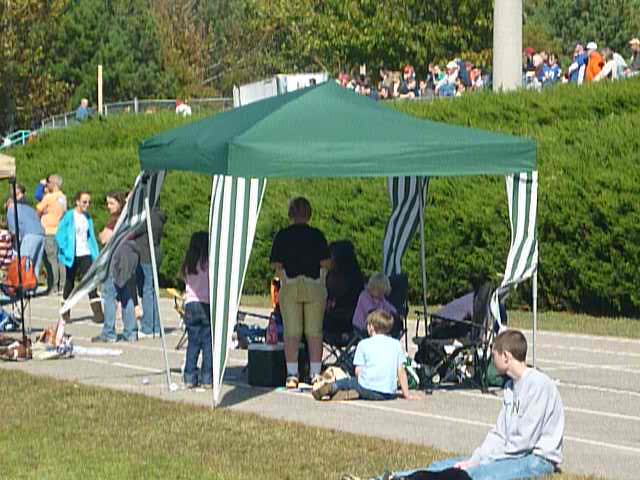 A major principle of the league is that family is important. Practices are two long nights a week, but all levels of one team (varsity, junior varsity, youth and mighty mite) practice at one location, so families aren't separated. Games are on Saturdays and again, all the levels of one team play all the levels of another — so families just make a day of it at the park – bring tents, picnics, toys, etc and spend the day watching football games. Great fun for everyone.
We love the spirit that Coach Earl Pendleton has achieved in the League, too. Parents, coaches and players are expected to act like Christians. Flatten someone in a tackle? After the whistle, give him a hand up. Player injured? Everyone takes a knee and prays for him. Talk back to a ref? You're ejected from the game. One referee told one of our boys that the refs compete to officiate at our games. He said they love the attitudes – no one ever cusses them out, players just say, "Yes, sir," and comply. All that and hard-fought football, too? A ref's dream come true!
An added bonus of football is that our guys are just plain easier to get along with when they are using up all that testosterone and energy on the field!
Read Chapter Six of Raising Real Men to see why boys want to compete on just everything or check out our workshop, Ballistic Homeschooling, to see how that attitude can motivate boys to get their schoolwork done.
October 29, 2011
Bringing an Old Celebration to New Life
Are you as surprised as we were to find out that Reformation Day has been celebrated as a holiday in the church since at least 1567? We were delighted to find out that rather than sanitizing a holiday that celebrated death, our enemy, we could enjoy a holiday to remember true heroism — a man who faced death and thereby opened the door for many to find life!
Martin Luther was a young German law student when he underwent a remarkable religious conversion. Taking a bolt of lightning as a warning from God, he left the university and entered the Augustinian order as a monk. From there, his restless search for peace with God led him to the Bible, then a doctorate in theology, then a teaching position with the tiny University of Wittenberg in German Saxony.
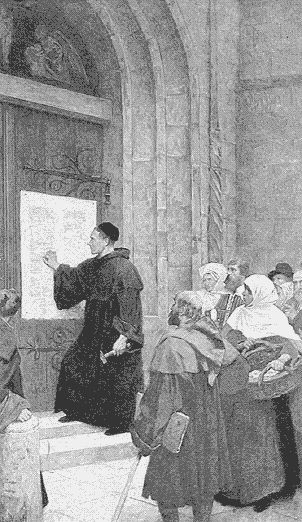 Attempting to address certain abuses in the medieval Catholic Church, the young Dr. Luther posted a challenge to other scholars to debate a number of practices he questioned. On October 31, 1517, he nailed the notice to the door of the university church, a common practice itself since the broad heavy doors were routinely used as bulletin boards. He chose the Eve of All Saint's Day, or All Hallow's Eve, to post the theses because that was a festival day which would see the church full of the scholars he wanted to discuss these things with. The list of propositions known as "The 95 Theses" lit a firestorm of controversy that quickly spread across Germany and central Europe. Luther had attracted the attention not only of academics and churchmen like himself, but the wrath of Pope Leo X and the Holy Roman Emperor, Charles V, as well!
Called before the Imperial Diet at the town of Worms*, Luther was challenged to withdraw his proposals and repudiate his writings. In the front of everybody's mind was the memory that the Czech reformer, Jan Hus, had made many of the same propositions decades earlier — and was burned at the stake in consequence.
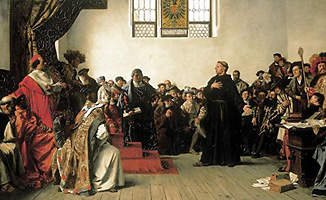
Luther's response, after begging a recess to consider the Emperor's demand, followed a sleepless night of anxious prayer. When called for his answer the next dawn, Luther replied:
Since then Your Majesty and your lordships desire a simple reply, I will answer without horns and without teeth. Unless I am convinced by Scripture and plain reason–I do not accept the authority of popes and councils, for they have contradicted each other–my conscience is captive to the Word of God. I cannot and I will not recant anything, for to go against conscience is neither right nor safe.
Here I stand. I cannot do otherwise. God help me. Amen.
Knowing what had happened to others who raised the issues he had, Luther stared death in the face and stood on the word of God – never mind Pope or Emperor. In fact, he was declared outlaw by the Emporor and faced:
Confiscation and loss of body and belongings and all goods, fixed and movable, half of which will go to the Lord, and the other half to the accusers and denouncers. With other punishments as given more fully in the present edict and mandate.
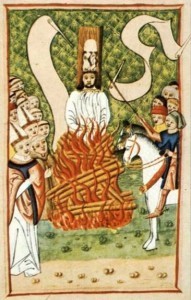
Jan Hus Burned at the Stake
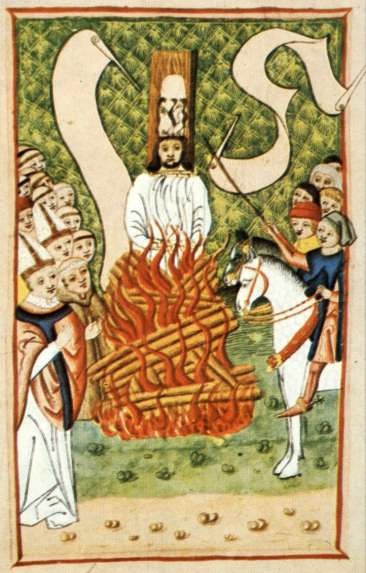
Notice loss of body — that's called martyrdom — that's what he faced. Among other things. What an incredible, gutsy thing to do. It's one of our favorite events in history.
What was Luther's philosophy that put him in such conflict with the Church of the day? One way to summarize it is called the Five Solas:
Sola Scriptura – Scripture Alone
Solus Christus – Christ Alone
Sola Gratia – Grace Alone
Sola Fide – Faith Alone
Soli Deo Gloria – The Glory of God Alone
All of that flowed out of Luther's realization of the meaning of "the just shall live by faith."
For by grace you have been saved through faith, and that not of yourselves; it is the gift of God, not of works, lest anyone should boast. Ephesians 2:8-9
Here at the Youngs', we make a big deal out of Reformation Day (October 31). It's a great time to teach our children the heroism of the fathers of our faith as well as our sure foundation: salvation by grace through faith in the substitionary death of the God-man Jesus Christ. That means that as God made flesh, He was infinite in nature and had no sins of his own to die for, so could die for the sins of all his people, taking the death they deserved on Himself. What a rich truth!
On Reformation Day, we eat German, usually bratwurst, sauerkraut and hot German potato salad, then troop into the den to watch Martin Luther, a terrific B&W documentary made in 1954 and starring Niall MacGinnis as the reformer. The movie was filmed at the actual location of some events, and they did a good job finding actors who actually looked like Luther, Charles, and Pope Leo. And the scene at Worms is classic!
(The DVD is available from several places, but and is now available streaming from Netflix.)
During breaks we love to sing hymns of the Reformation like A Mighty Fortress is Our God, written by Martin Luther, Now Thank We All Our God, written by a Lutheran pastor during the Thirty Years War (one of the Reformation Wars) after a dreadful seige that saw him officiating at 50 funerals a day, and We Gather Together, written after a victory in the battle between the Reformed population of the Netherlands and the might of Spain, whose General Alva slew men women and children alike as heretics, unworthy of keeping his word towards.
And we do have a concession to the candy-intensive holiday … we play "Pin the Theses on the Wittenberg Door." We draw big fancy wooden doors on brown paper with a different treat written on each panel. We use Post-it(TM) notes for the Theses. Everybody wins, which the boys don't mind as long as they get lots of candy!
Our friends are getting in to the spirit of things, too. One year friends of ours came in the middle of the night and stuck a copy of the Theses on our door with a bag of candy and a sign, "You've been nailed!"
Instead of justifying Christians participating in a holiday that is in no wise holy, why not celebrate a real Christian holiday this year?
*I've always loved thinking about "The Diet of Worms," but to be fair, it's pronounced "Vorms" in German.
Read Part One of our thoughts on the holiday here.
October 28, 2011
Somebody's Behind the Mask
Someone's Behind the Mask
[image error]Oddly enough, we were on the way to church when the subject of Halloween costumes came up. Our approach to the event has been contrarian from the start—everything from handing out really good candy with tracts, through simply turning off the porch light to the wonderful solution we finally came to (we'll tell you about that tomorrow). Our kids have a vibrant (sometimes feverish) imagination all year long, so dressing up and playing a role are nothing unusual in our household. We unbend a bit on the issue of candy—Dad likes it too, you know—though I'll confess sometimes our kids find marshmallow pumpkins and caramel corn in their Christmas treats.
But there is a practical question, quite apart from the trick-or-treat and bags-of-candy aspect. If you leave aside the more grown-up temptation to put don a mask and do anonymous mischief, what prompts our kids and particularly our boys to choose certain types of costumes and identities to put on?
"I think I know," I said, moving into the turn lane. "I wondered the same thing about grown men wearing a hat with a superhero logo on it, and it's the same as wearing an NFL jersey. Boys, and men, want respect. They want to be associated with the concept of strength, power, and capability, and if they can't get respect, they'll settle for being feared.
"I think the spooky costumes are a way of saying, 'I'm not afraid of ghosts, but you should be afraid of me—Boo!'"[image error]
Working along that line of thought, I realized it has some interesting implications in how we parent our boys.
For one thing, how should we respond to that craving for respect in a boy? First, it's our sons' duty to learn obedience toward God-ordained authority. Jesus was the Son of God, but as a young man He submitted Himself to being governed by human parents: "And he went down with them and came to Nazareth and was submissive to them … and Jesus increased in wisdom and stature and in favor with God and man," the Gospel of Luke says of the twelve-year-old Jesus (2:51-52). Our sons do need to recognize that they have a place, and it's not one of equality with their parents.
But even while we do that, we the parents can recognize his desire to be respected, even at a young age. Some people laugh about the "fragile male ego," but it's not really a laughing matter. A great deal of a man's self-identity is wrapped up in his reputation. A good name is to be chosen rather than great riches (Proverbs 22:1).
As a practical matter, we try to be careful how we speak to our sons, especially in front of others—even family members. They need correction and even discipline from time to time—if you are left without discipline, then you are illegitimate children and not sons (Hebrews 12:8)—but as much as possible, we try to administer the correction in private. And when we need to just give them verbal direction, we try not to belittle them. Someone said that a small dog is just as big inside as a big one; I think it applies to boys in some ways, too.
That desire to be associated with strong examples is not a bad thing. Paul tells believers to "put on the Lord Jesus Christ" (Romans 13:14) and to "Be imitators of me, as I am of Christ" (1 Corinthians 11:1 and several other places). So we try to get our boys really good examples to follow. The world and its media recognizes brute strength and the force of will; do your sons have examples of manly gentleness, humility, duty, and moral as well as physical courage?
[image error]This time of year, coincidentally, is the birthday of the Reformation. We always take time to talk about Martin Luther and his willingness to lay down his life for the sake of truth. "My conscience is captive to the Word of God," he told the Emperor, "and to go against conscience is neither right nor safe … I cannot and I will not recant. Here I stand; I can do no other; God help me." There's a great B&W movie about him that we've probably watched twenty times. (You can also get it streaming on Netflix.)
Another example, not so famous, is the American historian Francis Parkman. He had to overcome incredible, painful illness and disability, to carry out his scholarly work documenting the history of the early American West. Theodore Roosevelt, a man of great character himself, dedicated one of his books to Parkman, and tells his story in Hero Tales from American History, a change from the stories of explorers and soldiers. Roosevelt also talked about John Quincy Adams' long fight against slavery, serving as a Congressmen after he finished his term as president. (You can hear both of these stories on part 3 of our Hero Tales audiobook – see below!)
So as you see the little goblins in the streets this week, take a minute and think about the children underneath the masks. What are they thinking (besides "Who's got the best candy," I mean)? Are they looking for someone to follow? Or making a statement about what they'd like to be? Those can be some very interesting openings for you to follow up as a parent.
ARE YOU LOOKING FOR HEROES? THESE RESOURCES CAN HELP!
Where Is Roy Rogers When You Need Him? is our workshop about our boys' need for heroes and role models, and ideas about where to find them. $5 on CD, or $4 for mp3 download.
NEW! Hero Tales from American History – Part 3
The next volume of our popular audiobook series from the book by Theodore Roosevelt and Henry Cabot Lodge. Hear the dramatized stories of the backwoods general who beat the British army – a former president's fight against slavery – the suffering scholar of the American West – and the opening battles of the War Between The States! Introductory price only $5 (Regular price $7) To be released in November!

Or you can order the whole set – from the birth of George Washington to the War Between the States – for just $15 (Save $6 and get free shipping, too!)
October 27, 2011
Boo to All That!
Some Seasonal Thoughts
"What is it that drives people to dress like that for Halloween?" my wife asked me.
She wasn't talking about little girls dressed like ballerinas and fairies, but folks of any age play-acting the monster variety. Why, indeed, would anyone want to pretend to be a zombie, a vampire, or a ghost for a few hours?
We'd had this conversation many times before, and we always return to our original answer: because of the symbolism, we don't do Halloween. I know, and we've explained to our kids, 99 out of 100 people don't give it a second thought, and that may be more like 9999 out of ten thousand. Still, we try to be people who follow the Lord with some conscious thought about what we're doing and what we're communicating.
And the usual Halloween routine communicates a couple of ideas which are polar opposites and both wrong.
The first idea is that there's nothing to the idea of demons, witches, and all the monstrosities we associate with the holiday. All superstition and ghost stories, they say. Nothing more than play acting at Halloween, all just good clean fun.
There's a problem with that. Even if that's true, it's all just a game, people don't just assume the fantastic shapes, the Frankensteins and werewolves of old black-and-white movies. They're dressing in a lot of too-real ideas like victims of domestic violence and survivors of gruesome accidents and criminals of all sorts. Worse yet are the sick sexual fantasies, the pornographic teases of "naughty school girls" and wayward French housemaids and such. You can't let the kids look at costume catalogs.
Even if these things are not real, there are people who think they are. Joe Leaphorn, the Navaho police detective featured in Tony Hillerman's mystery stories, often encounters stories of "skin-walkers," the shape shifters of Navaho legend. Leaphorn says in one of the early novels, "I don't believe in skin-walkers, but I believe in people who do." What he meant was that whether such things exist was immaterial; there are unmistakably real people who do believe in them and because of that belief, do things which have a real impact on those around them.
Missionaries encounter this all the time. Whether the local witch doctor or shaman has real spiritual power or not is somewhat beside the point; if the local people believe he has power, they fear him and defer to his will. The missionary has to overcome the social power this figure wields in order to free the people to follow Christ—the real spiritual power.
On the other hand, we shouldn't make light of real tragedy and real sin—don't sugar coat it—as if it's all a game. R.C. Sproul Jr. observed that erecting toy tombstones in your yard isn't a laughing matter; death is real, and for many of us, a very, very bad prospect. It's not a joke.
The second idea is that ghoulies and ghosties are real, but it's okay to pretend about them. The Bible sort of squelches that for us.
Consider that when God established His people in a formal way, in the national identity of Israel, He explicitly told them to stay away from that stuff and the people that practice it:
There shall not be found among you … anyone who practices divination or tells fortunes or interprets omens, or a sorcerer, or a charmer or a medium or a necromancer or one who inquires of the dead, for whoever does these things is an abomination to the Lord. (Deuteronomy 18:10-12 ESV)
In fact, He made it a capital offense to follow these teachings (Leviticus 20:27) or consult with those who do (Leviticus 20:6). It's one of the reasons He wiped out the ancient Canaanites and gave their land to the Jews.
It's interesting that He doesn't suggest that these people are truly powerful—He simply says we have to avoid it all. For them (and us), it's a prostitution, seeking after forbidden spirituality when you've already met the source of true spiritual power, no different than seeking sexual adventures outside of your marriage—except this time you're cheating on God, and you can't sneak around on Him.
It kinda takes the fun out of Harry Potter and Ouija boards.
The other option is that spiritual things are real, both good and bad. And if you believe the Bible and believe what Jesus Himself said, you have to take that as given.
Are there bad spirits in every tree and stone beside the road? I don't see any evidence of it in Scripture or nature. But it's plain to me that besides the evil that men do, there are spiritual forces, even personal ones, we need to take seriously. Jesus wasn't playing make believe or joshing along the cultural superstitions when He confronted demons: there are many incidents in the Gospels where Jesus displayed his power over them, casting out unclean spirits which had oppressed individuals a variety of ways. [1] Jesus never backed away from correcting misunderstandings and human additions to God's word, even in the face of mob violence and physical threat to Himself, but He never "corrects" the "mythological" view that evil spirits are at work in some people's lives. Instead, He defeats them, then teaches His people to understand their nature (see Luke 11:14-26, for example) and how to combat them (Mark 9:28-29, Matthew 17:19-21) He took it seriously, as did the apostles.
If we believe the Bible, and we believe Jesus, then we need to believe that whatever nonsense and mythologies humans may have created in addition to the truth, there is a fundamental reality—there are beings and powers we need to be aware of and avoid, not toy with. Christ has overcome them on earth, and God overrules them throughout the universe, but we need to keep out of their reach just the same.
And for that reason, well, let's just say we don't get into the spirit of Halloween.
(More tomorrow, on why boys in particular may be attracted, and what that suggests about our parenting them!)
[1] If you're interested, you can check out Matthew chapters 8, 9, 12, 15, and 17; Mark 1, 5, and 7; and Luke 4, 8, 9, and 11, for a start.
October 25, 2011
We few, we happy few, we band of brothers"
Today is St. Crispin's Day, my son informs me, the 596th anniversary of the Battle of Agincourt.
[image error]
King Henry V at the Battle of Agincourt in 1415, John Gilbert (1817-1897)
King Henry V of England was hopelessly outnumbered by the approaching French Army, but he stood firm and roused his troops, commending them to the hands of God and each other, and led them to a decisive victory that was the beginning of the end of the dominance of the nobility in warfare. For centuries, the heavily armored knights on horseback fielded by the nobility of each land were the overwhelming force of warfare. Henry, instead, placed his English longbowmen in the forefront of battle — and defeated the French horse! Some say the "V for victory" sign descended from the victory salute of the two stringfingers of the longbowmen in response to a French before-battle threat to cut off the string fingers of all the longbowmen after they won.
[image error]
Winston Churchill saluting V for Victory
If that sign means peace, it's a peace after a hard fought victory!
Shakespeare immortalized this episode in the Hundred Years War in his play Henry V. His rendition of the St. Crispin's Day speech is a perfect example of manly leadership. Gather your sons, explain the desperate situation of King Henry, then listen to these stirring words together:
That fought with us upon Saint Crispin's day.
Henry V, William Shakespeare
October 17, 2011
A New Look at Sibling Relationships
This morning over breakfast we had a very enlightening discussion. We asked the question,
"What purpose do you think God had in making you big brother to your little brothers and sisters? What do you think He wants you to accomplish in their lives?"

"Keep them safe."
and
"Why do you think God gave you as little brother or sister to your older brothers? What role do you think you should play in their lives?"

"Share memories."
Our six year old daughter was the first to respond, it's usually easier for girls to think about relationships, it's the way they are wired, but everyone eventually participated.

"Show them how it's done."
I was very interested to see their encouraging response when right after we broke up, a younger sibling cut himself with his pocketknife and got an emergency trip to the doctor. You know, telling about a missionary who gave himself an appendectomy wouldn't have occurred to me as a way to calm down a boy getting stitches (guys really are different than girls  , but it sure worked! Glad we had that talk!

"Teach them to love the Lord."
October 10, 2011
Carnival of Homeschooling
 The longer we homeschool, the more we realize that homeschooling isn't merely about spelling, math and history. It's really about Life, the Universe and Everything, but not quite the way Douglas Adams meant it! It seems like when you start to homeschool, the scales fall from your eyes and you realize all the many, many things you need to teach your children. That's why a homeschooling blog carnival is so very interesting! Welcome to the October 11th edition of the Carnival of Homeschooling! For your visual pleasure, we are including a series of photographs taken by our son, Matt, at Prairie State Park in Missouri.
Life is one of the biggest challenges – and blessings – of homeschooling for us, how about you?
 There's just so much to do and so often we don't feel like we're doing it all well. Today's Carnival of Homeschooling has some help! Jenny Herman is pretty convicting for us plugged-in parents in Limiting "Tomorrow's Homeschooler" posted at Home Educating Family Publishing, though maybe I should have saved this one for the end! If you're in computer angst, check out Jacqui's post with Tech Tip #88: 20 Techie Problems Every Student Can Fix « Ask a Tech Teacher posted at Ask a Tech Teacher.
The house seems overwhelming for most of us at some time or another. Mrs. White encourages us to get up and get busy with Only Rich People Have Clean Houses posted at The Legacy of Home and Angela Gray faces the challenges of Autumn head-on in It's That Time Again – Team Gray! posted at team Gray!.
And Gidget encourages us in these difficult times to get our children involved in Giving in Order to Get posted at Homeschooling Unscripted.
Sometimes You Need School Stuff – Great tips, inspiration and ideas
Gina Glenn challenges us to focus on what's important in The Tyranny of Tidbits! posted at A Cherished Keeper.
Nancy Kelly intrigues and inspires us with My Calendar of Firsts posted at Sage Parnassus, while Jenny Herman uses schedules to help her son on the autism  spectrum in Back to School with a Simple Schedule | Many Hats Mommy posted at Back to School with a Simple Schedule.
Adam Faughn shares Children's Project: Bible Time Line posted at The Faughn Family of Four. I really enjoyed seeing his family's unique timeline — my younger ones could really get into this!
Jamerrill Stewart posted this Free Literature Based Civil War Study at Holy Spirit-led Homeschooling | Living the Life of Faith.
Lisa presents Memory Monday posted at Golden Grasses and Denise tells us How to Conquer the Times Table, Part 5 posted at Let's Play Math!. Also, with regard to teaching math, Alexander Bogomolny presents Thought provokers to start a class with posted at CTK Insights.
Jennifer posts a very interesting Lesson 14: Dairy – Cheese, butter, milk, curds & whey, buttermilk, yogurt posted at Nutrition for Healthy Kids, while Aunt B reminds us to keep our children safe with Fire Safety for Homeschool at Homeschool 4 Free.
Great things to think about – or discuss
Nancy Flanders talks about The Cooperative Toddler posted at Parenting Squad and Kelly, a public school teacher planning to homeschool, reflects on Keeping Curious: Retaining Our Love of Learning posted at The Homeschool Co-op.
 Darlene Franco is looking to the future in Life on the Franco Farm: Message to My Daughter posted at Life on the Franco Farm and Barbara Frank presents a guest post by Rachel Poling, who's already there in "Debt-free College Grad at 19″ on Thriving in the 21st Century.
Christian musician Stephen Bagasao brings up some important issues in The Death of Steve Jobs: The Real Story posted at Stephen Bautista Music.
Pamela presents Relaxing Family Yoga…. Well….Not Really posted at Blah, Blah, Blog and Alasandra wants to explain that homeschoolers are diverse in NOT a Republican Foot Soldier at Alasandra's Homeschool Blog.
Henry Cate, the father of this Carnival, asked one of his daughters what she liked about homeschooling and wrote A benefit to homeschooling – the flexibility at Why Homeschool and Linda Dobson reminds us all our sacrifice is worth it in Yes, You May Have to Give Up Some THINGS to Homeschool posted at PARENT AT THE HELM.
Matt Binz, Lee Binz's dh, Mr. Homescholar posts a video blog on how parenting sons changes as they get older. It's Raising Boys v. Raising Men at The Homescholar Record.
And Mike Smith of HSLDA, wanted to me to tell you something: "Melanie, tell the moms that the legend has it that Notre Dame's star player in the 1920′s, George Gipp, lay dying in a hospital, his famous coach visited him and the last words of dying Gipp to Rockne were, "When the boys are up against it and they seem to have no where to turn, just tell them to win one for the Gipper." Ronald Regan played Gipp in the movie. When the moms' backs are against the wall and they can't see light at the end of the tunnel and all hope is gone, tell them, "God didn't call them to raise their children for Harvard but for Heaven.. Focus on that and God will take care of the rest." We've certainly found that to be true – the more we focus on Christ, the more satisfied we are with what we're seeing in our sons, whether the Lord takes them to a top university to shine for Him or whether we just see it in doing a messy job for the family cheerfully.
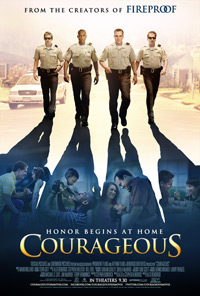 Our final contribution is our own. Tonight Hal's mother took us all out to the movies. The ladies went to see Dolphin's Tale (I'll review it in a few days) and Hal took the boys to see Courageous. It impacted him so much he came right home and wrote a review of it for you. Read it here!
Thank you for joining us for the Carnival of Homeschooling today – be sure to share it with others! While you're here, we hope you'll take a moment to sign up for our newsletter (you'll get one of our most popular downloads free once we add your email if you do!), like us on Facebook, and check out our book (Raising Real Men was Christian Small Publishers Book of the Year this year!) and other resources. Thanks for stopping by!
Hal & Melanie

Review: "Courageous"
Not many movies had me in tears in the opening sequence. "Courageous" did.
I'm not an "early adopter" of whatever comes down the road–I think I didn't upgrade to Windows 95 until Windows 98 came out. Movies are a little different, and there's only ten days left in the theater schedule for this one. My two-word recommendation: GO NOW. The extended recommendation: GO NOW, AND TAKE YOUR SONS.

"Courageous" is the story of five men in a small Georgia town, each of them grappling with issues of fatherhood–their relationship with their fathers as boys, and their own performance as dads now that their turn has come. Each of them has issues to confront, and some are seriously troubled; there are situations with divorce and joint custody, abandonment, unwed parents and absentee fathers. The central character, a sheriff's deputy named Adam Mitchell (played by Alex Kendrick), is a basically decent man with a defective relationship with his son and obvious favor for his younger daughter. He is wrenched into facing his complacent–and inadequate–approach as a father; his soul searching spreads to his friends, and you see how God's grace and a commitment to honor Him in their roles as fathers and men plays out in different families, situations, and temptations.
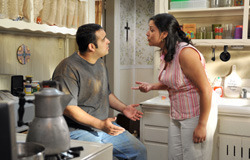 There are discussions, examples, and warnings on a range of family issues. How can a man reconnect with a son who's become alienated toward him? What can a father do to protect his daughter's heart? How do you hold on to faith in a loving God in the face of death, poverty, fear, and shame? What can you do when the father is absent–or when you find yourself in that role?
None of these can be explored in detail in the short compass of a feature film, but the important thing is the basic themes and principles which are displayed: Fathers are critically important for a child, especially a son. A man has to take responsibility for his wife, his children, and his own actions. God expects a lot from us as men–and He will provide the guidance and strength we need. And a father must "Never let go of the wheel," as one character learns to his sadness–not to tyrannize his family (this is never implied, even in the more defective families shown), but to keep guiding them toward the place God would have them go.
Four of the men are sheriff's deputies, and this is a way to explore the problems fatherlessness is creating in many communities–gang membership, drug use, and generations of irresponsible behavior. It also shows how no one is immune to similar problems; Adam is faithful to his wife, a generally upright man, at least nominally Christian, but through conflict with his son and distraction of his high-pressure, dangerous occupation, is slipping into patterns of the absent father even while he's home every evening. This is important to emphasize; it's too easy to point to the illegitimacy rate and criminality in some areas, or the infidelity and worldliness wrecking other families, and say, "Thank you, Lord, that I am not like other men." More often, we need a prophet Nathan to catch our lapels and say, "Thou art the man."
The film has some pretty intense action sequences–they're deputies, after all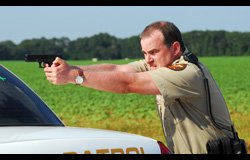 –and sometimes there are children in danger (none are ever shown hurt). There is a pretty brutal gang initiation scene and some serious fights between the deputies and suspects. One suspect is wounded in a shootout (it didn't seem to slow him down much!) and there is a very little bit of blood after a fight scene (about the level of a bruise and a busted lip). My nine-year-old son has a sensitive spirit and a few scenes made him uncomfortable, but okay with Dad's arm around him. He did say he was glad the movie was made from a Christian perspective, so he knew it would turn out okay.
Frankly, there were several scenes which caught me emotionally. As someone once told me, and as I told my sons afterward, once you're a husband and father, you never read the newspaper the same way again–any time a woman or child is in danger, it tears at you in a way you never knew as a single guy. And the conflicts these men come through are pretty familiar territory for us guys.
 One that doesn't play much part here is sexual. There are things in the backstory of some characters — one confesses he had "a hookup with a cheerleader" in college and when he told her to "take care of it," she chose not to have an abortion. One man mentions his father "had an affair" and another that his parents never married–in fact, that his father had six children with three different women, and he never met him. However, there isn't any overt sex in the movie–some quiet expressions of affection like the kids might see in the kitchen, but nothing to hide their eyes from. I thought I heard one profanity in the climactic scene, and it was indistinct enough I probably misheard it; again, not something I'd worry over.
There is a presentation of the gospel during the film, but I think the power of "Courageous" is more for waking up the sleepy, lackadaisical men in the pews rather than direct evangelism. On the other hand, an awful lot of people in our part of the country (here deep in the "Bible Belt") who consider themselves Christian never seem to engage with Christ's real calling on their lives, so maybe being challenged to live what they claim to believe will show them where they're missing.
My recommendation–go see it with your teenagers, and if you miss it in the theater, get the DVD. It's a good film. It may be too intense for younger children (and some of the older girls might find it distressing) but for the older ones, it's worth seeing and discussing. Kudos to Sherwood Pictures for another well-made, thought provoking experience.
September 29, 2011
Review: Moonfinder by Jay Ryan
We cherish children's books in our family. When you have eight children, the books that you've read to every single child enter the family lore, with phrases from them bringing a smile years later. "Good night to the old lady whispering 'Hush!'"

Swan Boats in Boston Public Garden by Daderot
We've gone so far as to sit in Boston's Public Garden reading a copy of Make Way for Ducklings purchased at the Corner Bookstore, then riding the swan boats afterward. How sweet to hear that little guy in my memory, since he's all grown up now, shouting with joy, "Mama, it's Mr. Mallard!" as a fine drake swam by.
Moonfinder by Jay Ryan is one of our kind of books. I love books that are gentle and sweet and memorable for young children. I also love books that stretch their minds and spark interest in finding out more about the world. Moonfinder is just our kind of book.
In Moonfinder, a young boy is led by his father to learn to watch for the moon and to understand why it changes phases. The family relationships between David and his father, mother and siblings is portrayed in just the right way – happy, secure, joyful. Just right!
The lovely paintings, which are also by Jay, are pleasant and peaceful and full of joy. 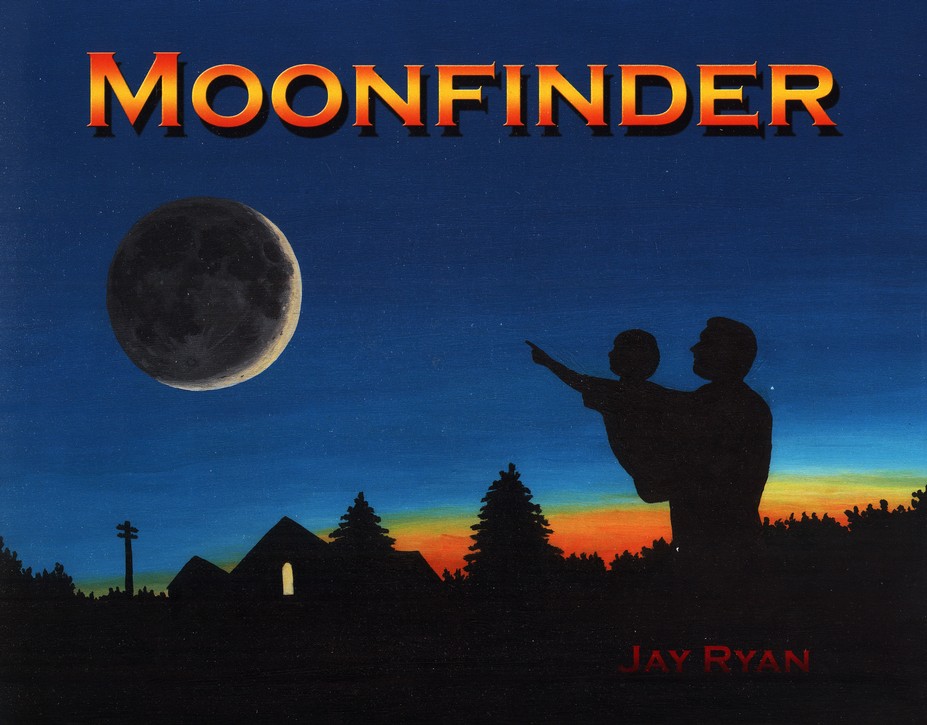 I especially love the facial expressions – so delightful! They are just right for reading to young children. My two year old, though the information was a little much for her was so delighted with the paintings she absolutely demanded I read the book to her. Our six year old was fascinated by the explanations and tried to figure out exactly how the moon worked. Our nine year old enjoyed reading it to his younger siblings, especially the science behind it all.
Jay Ryan is the author of Signs and Seasons: Understanding the Elements of Classical Astronomy, an astronomy curriculum we'll be reviewing soon, and that is yet another thing that told me I'd love this children's book even before I opened it. Have you ever wondered why the old Landmark books are so, so good that they haven't been matched in decades? It's because they are each written by an expert in that field, instead of some so-called expert in children's books. There's something irresistible about a fanatic! In my experience, no one can pass on the joy and essense of a kind of knowledge better than someone who's made it a passion.
Moonfinder is a beautiful book that is sure to become a picture book classic. Beautiful paintings, science, family life, and nature study all combine to make a volume both boys and girls will love. This is one you need on your shelves! Highly recommended.
Moonfinder by Jay Ryan, Fourth Day Press, 8.5 x 11, Full Color Hardcover, 32pp. Buy here from the author's site to keep great books coming out!
We received a free copy of Moonfinder in return for our always honest review.



![[image error]](http://www.raisingrealmen.com/wp-content/uploads/2011/11/Rocket-at-Kennedy-Space-Center-Stock-Exchange-ID-466650.jpg)
![[image error]](http://commons.wikimedia.org/wiki/File:Candy_corn_squircle,_2006.jpg)
![[image error]](http://www.raisingrealmen.com/wp-content/uploads/2011/10/Captain-Marvel-costume.jpg)
![[image error]](http://upload.wikimedia.org/wikipedia/commons/1/1d/Diet_of_Worms.jpg)
![[image error]](http://www.raisingrealmen.com/wp-content/uploads/2011/10/King_Henry_V_at_the_Battle_of_Agincourt_1415-by-Gilbert.png)
![[image error]](http://www.raisingrealmen.com/wp-content/uploads/2011/10/Churchills-waving-the-V-for-victory-sign.jpg)