Michael Reist's Blog, page 2
March 29, 2017
Transitioning – The Mother of All Battles

Having counselled hundreds of families over the years, here is the top 10 list of problem-causing times in the day.
Coming off screens (In fact, this one is often related to all the rest)
Waking up and getting out of bed
Getting out the door in the morning
Getting ready for bed
Falling asleep
Coming to the table for dinner
Leaving to go somewhere
Leaving somewhere to come home
Starting homework
Mondays (or the first few days back after a longer holiday)
What do all of these moments have in common? Each one involves a TRANSITION from one area of focus to another. Research shows that boys find it harder to transition between tasks than girls do. Boys are more prone to hyper-focusing which makes disengaging from an activity much harder.
10 Things you can do to prevent battles?
Give warnings: “We’re leaving in 15 minutes…We’re leaving in 10 minutes…We’re leaving in 5 minutes.”
Allow for delays: If you know you have to be out the door by 8:15, make it very clear that you have to be out the door by 8:00!
Mental rehearsal: “This is what’s going to happen today.” Walk your child through events the way you want them to go. Let kids in on the plan. They want to know what is going to happen.
Anticipate transitions: Know what your family’s “problem times” are and be ready to manage them rationally – without letting your emotions take over.
Discuss the problem: Talk about the “problem times” when everyone’s in a good mood, not in the heat of the moment, and have a plan. Keep revisiting and tweaking the plan if it’s not working. It’s a family issue, not just a Mom and Dad issue. Nobody likes fighting.
Physical re-directing / Minimal talking: With younger children, simply take them by the hand and lead them where you need them to go. No need for a narrative, lectures or giving reasons. With older children, lead – don’t follow. Be the first one with your coat on, out the door and in the car. They will follow.
No transitioning with the phone or tablet still playing: “I’ll hold that while you get your coat and shoes on.”
Watch for natural breaks: TV has half-hour and one-hour intervals – screens are continuous. Find the natural breaks in the game. Some games cannot be paused. Your child means it when he says, “I just have to kill one more guy.” Ask, “How much longer?” and decide if that will work. With YouTube videos, look to see where the slider is at the bottom of the screen. If it’s too long, tell the child to move it forward.
Use a timer: Some kids simply do not have a strong sense of time. What does 15 minutes mean? A digital timer that counts down works wonders. It provides the child with a visual indicator of time passing.
Unplug WiFi: “If you can’t control yourself, I will have to control you for you.” As a last resort, turn off the WiFi.
Remember empathy on the one hand – you know what it’s like to have to leave something you’re enjoying. But remember firm and fair as well. Life has its demands, and sometimes we need to be firm and fair about what needs to happen – for the good of everyone.
Tweet


March 8, 2017
We Can Change the World by Changing the Way We Raise Boys
Parenting is not just a personal project to make sure my own kids turn out all right. It is a social project that can change the world.

Parenting is about the little things we do, but it is also about the larger ideas we hold to be true. In fact, the two are connected. The tips, tricks and strategies we use are influenced by the bigger ideas we hold. These core beliefs can be those that were passed on through our parents or those we have chosen for ourselves.
One of the biggest ideas that informs our parenting is our idea of gender.
Many of the problems we see in the world today can be traced back to the way we raise boys.
we build women’s shelters and offer self-defense classes for women
we build prisons that are filled with men
we watch corporate CEO’s (mostly men) turn a blind eye to the environmental damage they are causing
we accept food banks – largely used by women and children
we watch men start and carry on the business of war
But we never look upstream and ask where all this is coming from. It comes from a system that is perpetuated by the way we raise boys.
Most men operate on two emotions – anger and fear. The emotion most repressed is the desire for love – transformed into a futile search for sex and power. Boys and men are seldom given the opportunity to practice behaviours that girls and women take for granted:
touch
crying
empathy
nurturing behaviour of all kinds
Around the world, women were and are oppressed. Men are repressed. Women are denied access to political and financial power. Men have been denied access to their own emotional lives.
In the past 50 years we have changed the way we raise girls. They are becoming stronger, more confident and well-educated than ever before. A big idea that found its way into parenting. One problem remains: they can’t find men they want to marry.
As girls and women have surged forward, men and boys have pulled back. They have retreated into cyberspace – mainly video games and pornography. We are losing a generation of boys.
For thousands of years, men ruled the world. That is quickly coming to an end. Women are moving into positions of power and having an influence on culture they never had before. Women in the West have surpassed men in educational attainment levels and employment levels. Men are confused, angry and frustrated. They feel they have lost something.
What can we do differently?
Encourage boys in non-traditional jobs. This is not just an ideological goal. It is an economic necessity. Women make up 77% of those working in healthcare and education – two of the fastest growing job sectors. Men make up 73% of those working in heavy industry and manufacturing – two of the fastest shrinking job sectors. Globe and Mail, 2017
Modelling, allowing and encouraging emotional expression. Boys and men have deep emotional lives, but are socialized to repress them. This could be reversed by parents, teachers and role models of all kinds – with words and hugs.
When men take care of children, the world will change. Children allow us to live out our natural empathy, nurturing behaviour and joy. Men who take care of children are more well-rounded people.
Men do not have to give up their masculine nature. They have to redefine it. They don’t need to be warriors for territory and power over others. They can be warriors for peace, the environment, social justice and equal rights.
Men do not need to become more like women. They need to become more fully human, more in touch with who they are, free to achieve their human potential, including the full range of emotional expression.
Social change happens one person at a time. When we change the way we raise boys, we will change the world.
Tweet
February 1, 2017
Marijuana, Stress and School….. It Takes a Village
When I started teaching over 30 years ago, some kids would smoke pot on weekends with their friends. As time went on, kids began to smoke pot near school grounds during school hours. In the last five years or so, kids started coming to school high in the morning and staying high all day.

All behaviour is logical. What is the logic behind this behaviour? Kids are medicating themselves for stress, and the source of the stress is school.
I received the following email from a concerned mother:
“The number of parents in my neighbourhood whose boys all started smoking pot at the grade 8-9 transition is heartbreaking and nobody wants to talk about it or for anyone to know, but at the same time we all feel helpless. I feel like its time school started to be recognized as part of the issue as it does take a village.”
Most schools have smoking areas – designated spaces for kids to smoke which are technically off school property, where school administrators have decided to give up on the battle against smoking, or, to put it another way, have abdicated their responsibility to be part of the village that we need to help raise our teenagers. Smoking areas become convenience stores for marijuana and other harder drugs.
But closing down the smoking area wouldn’t really get at the root of the problem. Kids are self-medicating for stress, and they would just find other places to use. The deeper question is why are these kids hurting so much? Having worked closely with thousands of teenagers over several decades, I have seen one major factor change kids’ lives:
Kids need to connect with adults who really care about their welfare. Not professionals keeping “professional distance” from kids. Walk through any school and you will find teachers at their computers. You will see few adults interacting with kids. When they do, it is often for punitive reasons. We need adults who are willing to connect with the whole child – head, heart and hands. Guest speakers and “Wellness Days” are not enough. Kids need mentors.
School is a class system. There are first, second and third class students. The first class students are those for whom the system works and who benefit from the rewards it offers. (These students often go on to become teachers.) Second class students just pass through the system unnoticed. They don’t cause trouble. They don’t talk back. They don’t like school, but they put up with it. Finally, there are the kids for whom school does not work. They are called lazy, bad or defiant when really they are just being honest. They hate school and are not afraid to say so. They act out or drop out.
A growing number of kids find school a competitive place where you either have it or you don’t. You are constantly being judged for your performance in subject areas that don’t interest you. One size fits all. No accommodations are made for learning differences. You must “get with the program.”
What can parents do?
Show this article to your child’s teachers and school principal and challenge them to discuss the topic at their next staff meeting – to get involved in kids’ lives – to be part of the village.
Listen to your child. Don’t lecture, punish or shut them down. They need someone they can talk to. Don’t close the door. Always be on the side of your child. Consequences for misbehaviour are fine, but not at the expense of your relationship.
Encourage your kids to find mentors wherever they can – coaches, teachers, relatives, tutors – anyone who cares about kids. I have seen many kids’ lives turned around by the influence of just one caring adult.
Adolescence is a time when kids break from their parents in order to discover their own identity. Parents want to help, but often feel shut out and helpless. It’s not the fault of the parent. It’s the nature of the developmental stage. This is another reason we need a village – other adults who will step in and care.
Tweet
December 7, 2016
Difficult child. Interesting adult.
When you’re feeling frustrated about your child’s behaviour, just remember, your difficult child is going to grow up to be an interesting adult.

Wayne Dyer said, “When you change the way you look at things, the things you look at change.”
Qualities that are difficult in a child might serve him well as an adult.
Stubborn = strong-willed, sets goals and works toward them
Defiant = is confident enough to speak honestly to authority figures
Disorganized = is more interested in the big picture, not a details person
Doesn’t listen = focuses well on his own projects, is able to ignore distractions
Argumentative = intelligent, passionate, excellent verbal skills
“Difficult” is in the eyes of the beholder. A difficult child is not a problem to be solved but a mystery to be understood.
All behaviour is logical. What is the deeper meaning behind the difficult behaviour?
I want more freedom and control in my life. This doesn’t mean letting them have everything they want. It means giving them more freedom and control – within boundaries.
I feel that no one “gets” me. What does it mean to “get” a child? It means to feel empathy for them. It means to really listen to what they’re saying and take them seriously.
I have energy I need to burn off. Get outside. Move. Exercise.
I’m bored. I don’t feel challenged. This is especially the case with highly intelligent children.
I need more attention from Mom and Dad. Some children need more attention than others – within the same family. If they can’t get it in positive ways, they will get it in negative ways. Give to each according to their needs. You cannot spoil a child with love.
We think of children as difficult when they do not behave in ways we like. We need to provide them with two things: freedom within structure.
The 4 F’s of discipline:
Few: Your list of rules should be short. These are your non-negotiables, your battles worth fighting. Put them up on the fridge door. Review them periodically.
Fair: Talk about these rules as a family. What are the logical reasons behind them? Let your kids participate in this discussion rather than decreeing from above. Decide in advance what the consequences will be – ideally with buy-in from your kids.
Fast: When a rule is violated, follow the “Act, don’t yak!” rule. Simply impose the consequence. No need for long sermons or lectures. Make sure the consequences have a reasonable time limit (for example, one day without the iPad), so that you can start fresh again.
Firm: Listen to the push back then let it go. It’s my job to set boundaries. It’s your job to push back against them. We’re both doing our job.
The daily struggle to meet the needs of a “difficult” child will be just that, a daily struggle. Take one day at a time. At the end of a bad day, rebuild the interpersonal bridge by making nurturing contact with the child. The next day, push the reset button – no grudges or references to the past. Most of all, have a sense of humour. Maybe you don’t even have a difficult child – maybe you’re a “difficult parent.” lol

Tweet
October 26, 2016
10 Tips for Talking with Your Son

Mother: “How was your day?” Son: “Fine.”
Boys, especially adolescent boys, sometimes find it hard to put their thoughts and feelings into words. It’s not that they don’t have complex thoughts and deep feelings; it just takes longer for them to formulate them into words.
Boys can feel overwhelmed by the verbal ability of adults, especially mothers and female teachers who generally find it easier to articulate their thoughts and feelings. They shut down because they just don’t feel they can keep up.
Here are some strategies to help mothers talk to their sons:
1. Keep it simple. The fewer words you use the better. Some mothers feel the more ways I say it, the better it will get across. The opposite is true. The more ways you say it, the more overwhelming it becomes and the boy shuts down. “He doesn’t listen” might mean “He has chosen to stop listening because there are just too many words, and they have become white background noise.”
2. Give time. Ask your question and wait. Don’t rephrase it. Don’t embellish it. Don’t offer possible answers. Allow the boy time to process what you’ve asked, to formulate his answer and then express it. These three steps take time. The question you ask after school might not get answered until bedtime.
3. Give space. Boys talk better when they can move around. This might mean rolling around on the floor or tossing something up in the air over and over again. That’s OK!
4. Be quiet. Boys are comfortable with silence. Sitting quietly with a boy creates a vacuum which he can fill. Silence gives the boy a chance to initiate topics that are important to him – that you may not even have thought to ask about.
5. Practice non-verbal communication. There are other ways of communicating with boys besides talking. One of the most powerful is doing something together. Girls relate face-to-face. Boys relate shoulder-to-shoulder. Drawing. Lego. Cooking.
6. Eye contact is not necessary. “Look at me when I’m talking to you.” Women find eye contact promotes connection. This is not so for boys. Boys find eye contact invasive and threatening. They prefer to look away or be doing something while they are talking. The best conversations often happen in the car because there is no eye contact.
7. Be ready for his “talking mood” moments. Boys will talk when they are ready. Be available when this happens. It can happen when you least expect. Grab onto these moments. He may not be ready to talk when you are. You be ready when he is.
8. Avoid “stress talk” moments. A stressed female wants to talk. A stressed male does not want to talk. In moments of high stress, emotion dominates over logic and the conversation is not going to be very productive. Better to say, “We’ll talk about this later when we’ve both calmed down.”
9. Verbal redirecting versus physical redirecting. When a young child is hyper-focused or overstimulated, words do not register. Parents increase the amount of talk (verbal re-directing), it doesn’t work and the parent becomes more and more frustrated. Sometimes it’s best to just take the child gently by the hand and lead him where you need to go (physical redirecting).
10. The don’t freak out rule. When our kids tell us something disturbing – something they did or saw or simply thought about, don’t freak out. You want your child to feel free to tell you anything. When we freak out, we send a message to our kids. “Don’t tell me anything that might upset me.”
Why do men and boys find it harder to express their feelings than women and girls do? The reasons are found in both nature and nurture. To help our boys express their feelings, we need to understand their unique ways of communicating.
Tweet
September 28, 2016
I never knew I was stupid until I went to school

Before I went to school, I just lived my life. I liked myself. Life was good. When I went to school, everything became about levels and scores and grades. Everyone started measuring my performance and comparing me to others. Now I’m the stupidest kid in the class. I’m stupid because I don’t know the answer, but I’m also stupid because I get in trouble.
By the second or third week of school, the honeymoon ends for too many kids – especially boys. I have had a number of calls and emails from mothers who have just received their first “call home” of the year. Their son is “having trouble.”
It’s never the school or the teacher who is having trouble – it’s always the boy.
All behaviour is logical. If you put a squirmy boy in a room and ask him to sit still for long periods of time holding a pencil, he is going to react. His behaviour is normal.
His behaviour appears as a problem for two reasons – the environment is not hospitable to his nature and the expectations of the adults around him are not realistic. “He should be able to sit still and focus on a worksheet for 15 minutes.” No he shouldn’t. The yardstick I suggest for a child’s natural attention span (for things they are not particularly interested in) is their age in minutes. If a child is interested in the task (think video games) this attention span can go up to hours.
Kids’ academic performance suffers when they are frustrated and stressed – not being able to move, not being accepted for who they are and how they naturally act.
When boys cannot move in appropriate ways, they will move in inappropriate ways.

Liam was bored and frustrated by a morning of worksheets, so standing in line, he playfully pushed the boy in front of him – just to have some fun, human connection, stimulation, anything! He ended up standing in the office while the principal called his mother to report on his “bad behaviour.”
“Is he standing there with you now listening to this?” asked the mother.
“Yes,” replied the principal.
“Well, I don’t think it’s appropriate that he be subjected to this humiliation.”
“Well, he’s just got to learn that this kind of behaviour will not be tolerated,” replied the principal.
He will learn that, and he will learn some other lessons as well: I am bad.
This place doesn’t work for me. Everyone else (especially the girls) seem to be able to do all this. I must be stupid.
Adults like to say the child is “making bad choices.” Young boys are naturally impulsive. They act first and think later. The impulse control center develops later in boys than it does in girls – thus making girls appear more compliant.
The other place where the “trouble” comes is in reading and writing – skills which generally develop later in boys than they do in girls. When boys have trouble with reading and writing, they compare themselves to others in the class and conclude “I’m stupid.”
The solutions are simple:
Allow squirming (if it’s not negatively affecting anyone else)
Allow standing up while doing school work
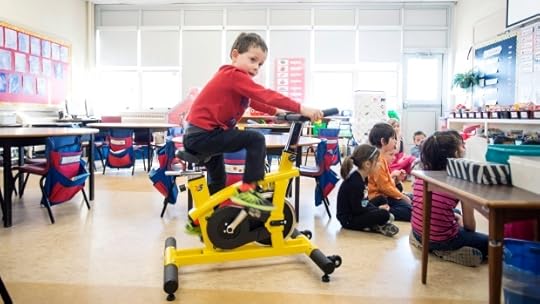
Create opportunities for movement
Anticipate and manage impulsive behaviour
Understand the developmental differences between boys and girls
Show empathy and compassion for boys who are struggling in school
Don’t shame, punish or medicate normal boy behaviour
Here’s a simple idea! One School Council made this their fundraising activity.
Stationary Bikes in the Classroom. CBC The Current
Tweet
August 24, 2016
Four Promises to Myself for a New School Year
There are a couple of things I want to do differently this year. Now is the time to decide what they are.

1. I will not let homework ruin our family evenings.
Life is too short to let homework ruin my relationship with my kids. If I had to bring home that much work from work, I wouldn’t be happy doing it either. My child is right. They’ve put in 6 or 7 hours at school. Why should they have to do another hour or two?
Show empathy. Don’t take the side of school. Be on your child’s side – literally. Many kids work better with an adult sitting beside them redirecting their focus. That’s OK. They haven’t developed “regulation of attention” for things they find boring. They will.
In case of emergency, download this tip sheet: Homework Tips for Extreme Non-Compliance
2. I will use this change of routine to change our family’s routine around screen time.
During the summer, I let a lot of things go. I forgive myself. With the new school year starting I have the chance to re-introduce some limits.
Researchers recommend a maximum of one hour for a single session of game play and a maximum of 2 hours of screen time for every 5 hours of free time. That might boil down to an hour before dinner and an hour after dinner. Homework must be done first. No screens a half hour before bedtime. No screens in bed. Be firm, fair and consistent. Discuss these limits at a family meeting (dinner) before school starts,
Download this template which I’ve posted previously. Video Game Schedule. Edit it to suit your own situation and post it on the fridge door.
3. I will keep the spirit of summer alive.
Why does going back to school mean not having any more fun? Life doesn’t need to be binge and purge. Let’s have some kind of fun every day – however small! We still have our weekends. Every weekend I will do something fun with my kids and something I enjoy myself – however small!
Adults talk about having a healthy work-life balance. Kids need a healthy school-life balance. For children, life means play – and play doesn’t have to just mean screen time. It can also mean getting outdoors. Fall is a great time for hiking or biking local trails. Google “trails in your town.”
4. I will not let school define my child.
I will not let test marks, report cards or teacher comments make me think my child is somehow a failure or I am somehow a failure. My child is not a “student” to me. This is my baby. I love him no matter what. There is no judgement school could pass on him that would make me love him any less. He is perfect. School measures people with marks and “comments.” I only have one way of measuring my child – by how much I love him.
I work with many kids who have been “labelled.” There is nothing wrong with having a child’s cognitive exceptionality identified, but no label or assessment can sum up a child’s nature. All children are gifted with a unique nature. Honour the nature of your child.
Tweet
July 13, 2016
What Your Child Means When They Say “I Hate You!”
When children become angry and frustrated with us, it usually has to do with issues of power and control.

We are always trying to strike a balance between controlling and managing our children on the one hand and giving them the freedom to decide for themselves on the other.
All children are looking for autonomy. They want to be their own boss. This is a good thing. We want to raise children who are self-starting, self-directing and self-regulating. How do we get there? By giving our children freedom of choice and the responsibility that comes with it.
All behaviour is logical. A parent’s job is to try to figure out the logic behind a particular behaviour.
When kids say, “I hate you” it could simply mean they feel a loss of power and control. In this situation all they have left is their “attitude” – which they express through words and actions.
Viktor Frankl, the great Austrian psychologist who survived the concentration camps of Nazi Germany said,
“Everything can be taken from a man but one thing: the last of human freedoms – to choose one’s attitude in any given set of circumstances, to choose one’s own way.”
This is what kids are doing when they say “I hate you.” They are choosing an attitude that will leave them with some remaining sense of power and control in a situation where they feel they have none. It can be seen as a positive and healthy reaction to the limitations they honestly feel.
The only question parents have to ask is: Are the limitations I am imposing on my child reasonable – or are they arbitrary? Are they for the benefit of the child, or am I just satisfying my own need for power and control?
Barbara Coloroso suggests three questions parents can ask themselves when deciding to say yes or no:
Is it harmful to yourself?
Is it harmful to someone else?
Does it violate a moral code?
“I hate you.” Big words for big feelings.
These words are not to be taken as an overall assessment of your relationship. They are the child’s way of dealing with strong feelings. The wise adult needs to understand what’s behind these words, not punish them, fear them or feel guilty about them. Your child doesn’t hate you. Your child loves you and feels safe enough to tell you what they really feel.
What is the appropriate response?
“I can see you’re angry. I understand your frustration, but this is a decision I have to make.”
When the child has a meltdown on the kitchen floor or runs into their room and slams the door, we just have to wait until the storm passes. Let the child have their feelings. There is nothing to be cured, stopped, solved or punished. It’s messy for a while, but it will pass. Deep down the child knows you care.
But the most important fundamental question remains: Are your limitations fair and reasonable or are they an arbitrary exercise of your own power and need for control? Could you just as well have said yes or arrived at some kind of compromise? Freedom teaches responsibility. Excessive control teaches learned helplessness and passivity.
Tweet
June 2, 2016
What is the one thing all men want?

Men want what women want – love. Love does not mean sex. It means connection. Where does the myth come from that “men only want one thing” meaning sex?
It comes from the way we raise boys.
Boys start out as touchers and feelers and lovers. Over time, they slowly learn to shut all this down.
Girls and women are permitted, even encouraged, to be nurturing. The words “male” and “nurturing” are seldom used together. Boys and men are raised to be uncomfortable with touch, with their own feelings and the feelings of others.
As they grow into adolescence, all desire for love, connection and touch become reduced to genital sex. This is how you show love, and you can only “do it” with women. All other expressions of nurturance become suspect.
Sebastian Junger, in his book, Tribe: On Homecoming, says the thing men value most in war is not the pleasure of killing other people but the pleasure of close connection with other men. Men bond in battle in a way they bond nowhere else. Soldiers report that their main goal in combat is to protect and take care of each other. He believes the high rate of PTSD and suicide among veterans is caused by the loss of deep connection upon returning home to the isolation all men experience in North American culture.
A panel of five authors who have all closely studied the life of Donald Trump and each written a major biography about him was asked “What really motivates Donald Trump? What is he looking for?” All five authors answered the same way in one word – love. He was raised by an emotionally absent father, sent to an authoritarian military school at an impressionable age, and has been looking for attention, affirmation and love ever since.
To say that men are only interested in sex is like saying women are only interested in hair and make-up.
Men have as broad a range of interests as women do, but they share one deep core need with women – the need to connect. And not just with women, but with other men and their own children.
When this need is not met, men’s lives are reduced to a lonely, harsh world of one upmanship. They turn to work, money and possessions to find meaning. They numb themselves with video games, alcohol and drugs.
We need a men’s liberation movement lead by men who are able to express love in all the ways women do. Men need to claim their capacity for nurturance.
Media and popular culture depict men as violent, irresponsible, sex-obsessed predators. Men need to talk back to these images of themselves and redefine what it means to be a man – kind, nurturing, loving.
When your son shows sensitivity and nurturing behaviour, honour it. It is not weak or feminine. It is one of his greatest strengths. It’s what will make him resilient. Shutting down emotions and acting tough do not make a person stronger. They make a person weaker.
Tweet
May 11, 2016
10 Things Every Boy Would Like to Say to His Mother

1. I love you
I don’t say this in words because I don’t think words have that much power. I prefer actions. When I do something nice for you that means I love you. Usually I just think it or feel it and that’s enough for me. I forget that you want to hear it. Sorry about that. I’ll learn this when I get older. In the meantime, trust me – I love you. How could I not? You’re my mother!
2. I need to move
Don’t always be worried that I’m going to hurt myself or break something or make you look bad by being so squirmy. I need to move, and my movements are not always predictable. That’s the way I’m made. Work with it. I’m not going to bang into anything or anybody. Stop worrying. Enjoy my need for movement. It’s how I enjoy life. It makes me happy to move.
3. Don’t freak out
When you yell, I get scared and nervous. When I tell you something and you yell, it reminds me not to tell you things. I keep them to myself because I’m afraid you’ll freak out. I want to be able to tell you everything, but I need you to be able to handle it without scaring me. When you’re stressed, I get stressed.
4. Sometimes you talk too much
You’re better at words than I am. Words take me a bit of time and energy. I like short sentences. I can take that in. But sometimes you talk in paragraphs – many paragraphs – and I just can’t take all that in. At the beginning, I think I know what you’re saying, but after all those words come out, I’m not sure what the point is anymore.
5. Sometimes I need to talk back
I want to be my own boss. This doesn’t mean I’m bad or stubborn. You’re your own boss. I want to be like you someday. I don’t talk back unless I feel there’s a good reason. Don’t shut me down. Help me to be honest, and help me to think through my anger. I will need to talk back to people in my life when I don’t like what they’re doing. Let me practice with you.
6. School IS boring sometimes
Don’t worry when I say this. It doesn’t mean I’m going to be a failure. It’s just how I feel. I’ll learn to deal with it, but it’s nice to be able to say it out loud. I can’t say it at school. Don’t try to talk me out of this feeling or convince me that I’m wrong. Just listen.
7. I need to hug and snuggle
I don’t always ask for it, and I don’t even know sometimes that I need it, but I do. Like I said before, words don’t have that much power for me. Actions – especially touching – is super powerful. That’s how I know I’m loved. That’s how I know I’m worth something. Words can lie. It’s hard to lie with a hug.
8. Don’t criticize my video games
I don’t criticize your interests or hobbies. I like to see when you are passionate about something and know a lot about it. That’s how video games are for me. Let me tell you about them. They’re interesting and fun. I will admit that sometimes I do need help getting off them. They just pull me in and I can’t do it myself.
9. Take care of yourself
When you’re happy and healthy, Mom. I feel more happy and healthy. I love to hear you laugh. It makes me relax. When you take care of yourself, it’s like you’re taking care of me somehow. When you focus too much on taking care of me, you seem worried and stressed, and I feel like there’s something wrong – either with you or me. I’m not sure.
10. When I act like I’m embarrassed by you, don’t take it seriously
I might not admit it, but there is a part of me that likes when you do things that nobody else does. I feel like adults are all acting the same way sometimes, and at school, all the kids have to act a certain way. When I see you being different or standing up for something, it makes me happy. It’s you being you – and it makes me realize that I can be me.
Tweet