
Andrew Bolt's Blog, page 1893
January 24, 2011
Let the shampoo run free again
These floods will have a silver lining for Cate Blanchett, who can at last reach for the Sunsilk again. Not like four years ago:
THE drought has hit so hard that even one of the world's most glamorous women is doing it tough, resorting to not washing her hair.
Oscar-winning actress Cate Blanchett yesterday visited drought-ravaged North Pine Dam, north of Brisbane, to promote a new Australian Conservation Foundation online campaign whoonearthcares.com.
"I actually have little races with myself, thinking 'Oh no, I'm not washing my hair. I only need to have a two-minute shower'," Blanchett revealed.
Blanchett and Australian Conservation Foundation director Don Henry visited the dam – presently at just 16 per cent of capacity – to see the effects of the drought and to share her passionate views about climate change.
(Thanks to reader Matthew.)


New Premier is a bottler
Tim Blair exposes the new Tasmanian Premier as an environmental criminal. The Greens' support may be at risk.
Anyone in East Timor actually want Gillard's promised centre?
At what stage does Julia Gillard admit defeat of her ludicrous promise and switch to Plan C?
ANOTHER senior East Timor leader has questioned Prime Minister Julia Gillard's plan to build a regional centre to process asylum seekers in East Timor, suggesting Australia would be a better place.
Jose Luis Guterres, East Timor's deputy Prime Minister, told the Portuguese newsagency Lusa that perhaps it would be better if the centre was built elsewhere than his country.
"Why not in Australia itself, which has an immense territory and available resources?" Mr Guterres said… All of East Timor's political parties have said they oppose the centre being built in their country, including the ruling coalition's four parties.
The Government is lucky: only two boats have arrived so far this year and none are reported to have sunk. But if that luck runs out…
(Thanks to reader Steve.)
UPDATE
Coalition immigration spokesman Scott Morrison:
Ever since Julia Gillard announced her election fix of a proposal in July last year the rejections have come thick and fast:
- East Timor Prime Minister Xanana Gusmao's "what plan?" response to Gillard's Lowy Institute speech
- The East Timorese Parliament's two unanimous votes to reject the proposal
- Former East Timor deputy Prime Minister Mario Viegas Carrascalao's rejection of the plan
- Kevin Rudd's decision to abandon the proposal and hospital pass it to Minister Bowen
- East Timor's Council of Ministers declaration that all talks on asylum seekers including the Timor proposal would be deferred to the Bali process
- Malaysian Deputy Prime Minister Muhyiddin Mohd Yassin's statement in November that "we need more information"
- The Indonesian immigration department director general's description of the proposal as a 'refugee magnet'.
MTR today, January 24
- Why Gillard's flood levy is actually a levy to bail Labor out instead.
- A flood levy might kill Gillard's other planned tax, to "stop" global warming. (Fancy that: one tax to stop global warming, another to pay for the floods the global warmists didn't predict.)
- So what if the Queen hasn't yet met the parents of her grandson's fiance?
- New Victorian Planning Minister Matthew Guy on freeing up more land for housing fast. Isn't it amazing that we could be short of land in such an underpopulated continent?
- The miner who (allegedly) told Gillard where to go when she asked him to join the Government's new flood advisory group.
- Our new VC winner says fighting the Taliban in Afghanistan is about stopping terrorism from reaching us. Interesting that the soldiers are are in far less doubt about the value of this war than are many journalists. And his family breakground sure breaks another media stereotype - of the soldier as a demoralised, broken soldier, swept off some mean street to fight a rich man's war.
Listen here.
(No comments until moderators on deck.)
Spot man's fingerprint now
How much warming is left since 1998 if we take out the La Nina and El Nino effects?
Er, warming?
(Thanks to reader Neville. No comments yet.)
UN sees few disasters that don't fit its warming script
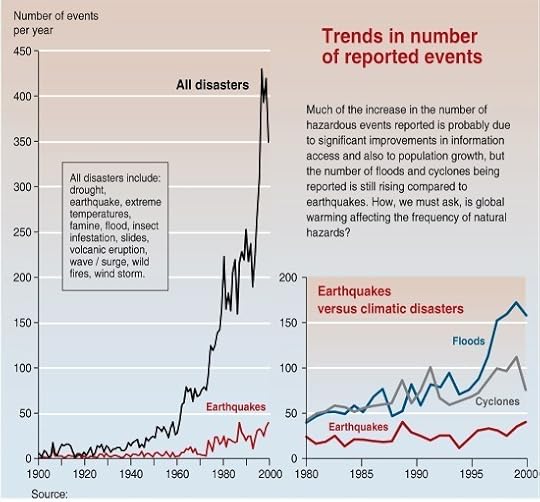
Wow. This world's mad climate sure has got dangerous, if you believe this graphic from the warmist United Nations Environment Program.
Its Trends in Natural Disasters web page asks:
The statistics in this graphic reveal an exponential increase in disasters. This raises several questions. Is the increase due to a significant improvement in access to information? What part does population growth and infrastructure development play? Finally, is climate change behind the increasing frequency of natural hazards?
The answers to the first two questions are, of course, "in large part" and "a lot", as Professor Roger Pielke Jr and Dr Indur Goklay's work suggests.
But then the UNEP blithely goes on to assume there is indeed "increasing frequency of natural hazards". But, as hauntingthelibrary notes to its astonishment, the UNEP's graphic suggesting this rise starts in 1900, when (if you believe it) we had close to zero natural disasters, followed by none at all the following year.
Can this be remotely likely?
Again, UNEP does hint on its graphic the obvious explanation: that we don't have "access to information" about disasters then that we do these days, when the whole world learns instantly about a flood in Pakistan or an earthquake in Baku.
But, wait. There is one other factor to consider that isn't canvassed by the UNEP. It's that the researchers responsible for this graphic didn't even bother to properly check what natural disasters there have been in 1900 and 1901 that might contradict their preferred theory that climate change is making the weather wilder.
My evidence? It's that with just half an hour of internet searching I have found several obvious natural disasters that clearly weren't all counted on a graphic that is woefully, incompetently incomplete. They include some far more devastating that anything that's occurred recently:
The deadliest natural disaster in U.S. history was the hurricane that ripped into the rich, port city of Galveston, Texas, on September 18, 1900. The category 4 storm devastated the island city, killing 1 in 6 residents and destroying most of the buildings in its path.
And:
In 1900, drought in India blamed for 250,000 to 3 million deaths.
And:
The Yellow River had flooded again in 1898, and in 1900 northern China suffered a severe drought. Some religious Chinese blamed the natural catastrophes on the foreign religion in their country.
And:
In Buenos Aires, Argentina, a heat wave [in 1900] continued into its second day. The New York Times reported that "There were 219 cases of sunstroke here Sunday, of which 124 cases were fatal. The thermometer on Saturday registered 120 degrees in the shade, with 93 of 120 cass fatal."
And:
1900: The early part of this year saw one of the most complete monsoon failures in the north of Australia, especially in normally wet Cape York Peninsula where the year proved the driest on record at many stations. In February, a major heatwave and dust-storms hit southeastern Australia.
And:
July 1901 saw high temperatures in the Middle West [of the US] that resulted in 9,508 heat deaths.
And:
Ukraine has experienced years of famine… Crop failures and hunger led to great unrest among the peasantry in 1901–7 and stimulated emigration.
And:
But we know that [Australia's] Federation Drought was especially wretched, wreaking some of its worst, most heartbreaking havoc between 1901 and 1902 .
And:
Minor flooding occurs in [Tasmania's] Huonville on a regular basis… Severe floods occurred in 1901...
And:
An almost 110-year-old record of river flow was broken when 1.034 million cusecs of water passed the Chashma barrage [in Pakistan] on Sunday afternoon. The flood has played havoc with lives and property in upstream Khyber Pakhtunkhwa and Punjab. An irrigation expert told Dawn that the highest flow recorded previously at the point was in 1901 when it reached about 900,000 cusecs. A large part of Khyber Pakhtunkhwa had been affected at that time as well.
And:
Kelut volcano has been the location of some of Indonesia's most deadly eruptions... In 1901 ash fell at Jakarta and Serang 650 km from the volcano.
And:
In 1901 and 1902, 'famine' is reported from [Papua New Guinea's] Rigo District and Goodenough Island, a 'complete crop failure' was reported from Milne Bay and the sago swamps at Cape Nelson burned.
More from hauntingthelibrary here.
(No comments until moderators on deck.)
January 23, 2011
Chomsky: vote Republican and humans will become extinct
Noam Chomsky, climate catastrophist, on how the US mid term elections threaten to wipe out the human race:
YOU could almost interpret it as a kind of a death knell for the species. One of the reasons is because [the new Republicans coming to congress] are global warming deniers. Almost all that means the powerful house committees, like science and technology and so on, are in hands of people who think there's nothing to it or at least claim that they think that, but what they actually think is another story. If this was happening in some small country, in, you know, maybe Monaco or something, it wouldn't matter much, but when it's happening in the richest, most powerful country in the world, it's a danger to the survival of the species.
Hmm. On reflection:
If I said the elections are a death knell, I went too far. But I think it's fair to say that they do threaten that outcome.
Alarmist watch: Monbiot's prediction of no animal feed by 2012
Just one year to go to check on the accuracy of this prediction, passed on by warming alarmist George Monbiot in 2002:
Within as little as 10 years, the world will be faced with a choice: arable farming either continues to feed the world's animals or it continues to feed the world's people. It cannot do both.The impending crisis will be accelerated by the depletion of both phosphate fertiliser and the water used to grow crops. Every kilogram of beef we consume, according to research by the agronomists David Pimental and Robert Goodland, requires around 100,000 litres of water. Aquifers are beginning the run dry all over the world, largely because of abstraction by farmers.
(No comments under moderators on deck.)
Maybe she realises she's just not a PM
David Burchell on the shrinking of Julia Gillard:
Labor's pervasive loss of self-confidence and conviction is mirrored in Prime Minister Julia Gillard, whose demeanour, the longer she has occupied her post, seems to have become steadily less spontaneous and more mechanical, with a dirge-like quality that seems to mimic her party's sense of political stiffness and decay.
Much of the new-found enthusiasm for Anna Bligh is perhaps really a negative comparison with the Prime Minister, who seemed so awkward in her performance of official sympathy during the Queensland floods, even as the Premier revelled in her re-absorption into everyday life.
Nowadays Gillard's speeches seem punctuated by an uncomfortable tincture of self-embarrassment, as though the sentiments sound hollow even to her own ears - even though it is her own severe honesty that forces her to focus on the exercise of mere political competence.
A flood levy, a carbon tax… How many more taxes does Gillard want?
If the Government hadn't famously wasted billions already, it could win this argument fairly easily:
Opposition finance spokesman Andrew Robb yesterday slammed the mooted extra tax slug as "an opportunistic attempt to fill the coffers". (Treasurer) Wayne Swan said he was "working through all the options" and would be "sketching out some preliminary estimates of the economic and fiscal impact of the floods" in a speech in Brisbane this Friday…
"There is plenty of fat in the budget and there's plenty of opportunity to do what Campbell Newman is saying," Mr Robb said. The Coalition believes that up to $15 billion of stimulus funds remains unspent.
A levy is almost certain, given how desperate the Gillard Government is to meet its solemn promise to return the Budget to surplus by 2013 - and given how unlikely its new mining tax is to raise the billions on which it was counting. To fail to return to surplus would be to confirm the Coalition taunts the Labor had frittered away the billions the Liberals had left it and could never be trusted to balance the books.
But a levy - a new tax - would make it even more politically dangerous for Julia Gillard to honor her other big promise, to put "a price on carbon". Is she really able to get away with not one great big new tax, but two?
I doubt it. And it's a fair bet that Tony Abbott has worked this out in deciding to fight Gillard's levy. This isn't just about how to pay for Queensland's rebuilding, but how to stop a carbon tax.
MEANWHILE, Victorian Premier Red Baillieu manages to pick a fight not just with his federal Liberal colleagues but his very impressive deputy:
Mr Baillieu seemed open to the idea on Friday, saying he would ''leave it to Julia Gillard and her government'' to decide on the introduction of a one-off levy to help pay for the clean-up and reconstruction of regions devastated by flooding in the eastern states.
''I don't think it will be helpful for us to be attempting to call the shots from Victoria,'' he said.
That was Saturday. Yesterday:
Liberal Premier Ted Baillieu again refused to back the stance taken by his federal colleagues and his own deputy, Peter Ryan, expressing opposition to a levy.
Mr Baillieu denied he had offered a different position, saying "You are not correct" when asked why he had not supported his federal leader's stance.
"I have simply said this was a matter for the commonwealth."
Andrew Bolt's Blog

- Andrew Bolt's profile
- 5 followers


