
Chris Abouzeid's Blog, page 37
July 25, 2013
Managing Multiple Narrators
The idea of writing a novel with many narrators began growing in my mind years ago. I blame it on Faulkner, specifically on The Sound and The Fury, which I read at an impressionable age. “Caddie smelled like trees.” Yes, that may have been the line that suckered me in. The beauty, the puzzle-like complexity of fitting the various stories and voices together. And it didn’t look that hard. How about this ENTIRE CHAPTER from As I Lay Dying: “My mother is a fish”? I mean, REALLY.
I suspect this was all hanging around in the back of my mind when I made the step from short story writer to novelist. Like the teenager with artistic aspirations who looks at Jackson Pollock and says, “Nothing to it,” I remembered the mother and the fish and thought, “How hard can it be?”

Okay, so I was wrong. Instead of teasing out one line chapters, I ended up battling a three-headed novel. Think Cerberus frothing at all mouths. Think Hercules chopping at the Hydra. On the bright side, I have learned a few things, and I’d like to pass them along to anyone out there who’s feeling Herculean.
My lessons of the Hydra:
1. MAKE FRIENDS WITH THE SALT MINE.
More narrators means more work. No question. You need to know each of your narrators very well. Think out each of their back stories, mannerisms, quirks, fears. Know everything about how each one views the world, looks, moves, ties shoe laces.
2. FIND THE VOICE. ER, I MEAN, THE VOICES.
Of course, a strong voice is something that every novel needs. In a novel with multiple narrators, the work is doubled (or tripled or quadrupled or… well, I’ll stop there.) If you’re like me, you have a “home voice”, a voice in which you feel quite comfortable. Great. A place to start. Now you have to find homes for the narrators with whom you may not be so comfortable. You may want to make lists (or Excel spreadsheets, depending on how many narrators we’re talking about) of the narrative characteristics of each voice. Does Jezebel use a lot of contractions, slang, obscenities? Okay, then maybe Francoise should not. Take note of things like sentence structure and try to differentiate. May I suggest only ONE run-on-sentencer per book?
3. THE BRAIN IS THE SEXIEST ORGAN.
I wrote that just to keep your attention.
HOWEVER, distinguishing the brains of your characters – their habits of thoughts and interests — is an easy way to help your reader differentiate them and feel comfortable with each. Does Charro think about food all the time? Fine. So that’s her thing. Not that your other narrators can’t ever fondle a french fry or covet some chocolate cake, but you might want to exercise restraint with regard to how often you indulge them. Perhaps Sven is a daydreamer, and other characters need to nudge him back to earth. Clementine? Uh HUH. That girl always has one eye out for a good-looking man. Her sister Emma, not so much. Emma likes her solitude and feels a bit splenic when she sees that someone has unsorted the spice rack. So, think carefully about what a particular character notices, obsesses over, ignores.
4. SEPARATE WHITES, DARKS AND BRIGHTS.
By which I mean, watch for the bleed – one voice bleeding into another. Especially that “home” voice, the one that comes most easily to you. That voice is the serpent in your little fictional Garden of Eden, sliding along, appearing out of nowhere . . . So easy and inviting. Revise with an eye on the serpent.
5. TRICKS.
A few other devices I found helpful.
a) Music. I listen to music while I write and developed a “play list” for each narrator. For example, one of my narrators is Brazilian. I listened to Brazilian music only when I wrote his sections.
b) Word clouds. Vocabulary is another way to differentiate voices. Your character from Maine calls his orange soda “tonic” while his friend in Atlanta quaffs an orange coke. You can use a word cloud generator to see if the vocabularies of your narrators are distinct. And then weed and replant accordingly.
c) Write/revise in narrator clumps. It may help to write or revise all the sections of a particular narrator together. More consistency.
So there you have it, a few of my suggestions for taming the beast.
(from the re-run collection)



July 23, 2013
Sneaky Writer-Parent’s Guide to Summer Travel (without making your kids feel captive to your novel research)
On Mondays and Fridays in the summer, I take the kids on mystery excursions.
I made them mysteries not because I’m especially imaginative or clever, but because with an age range of 3-12, it’s hard to please them all. Keeping them in the dark about where we’re going gives me the best shot at avoiding a mutiny before they’re belted in. And makes them partners in research for my novel, even if they don’t realize it.
If I’m going to be a stay-at-home writer-mother of a large family, I decided awhile back, I’d have to get creative about incorporating the writing part (which is essentially solo) with the kid part (which is a lot of togetherness). I’ve worked them in and around book tour. Why not field trips to places I want to check out for research?
The key is making it interesting, kid-friendly. Last week, we visited two destinations that had long been on my radar screen, historic and cultural attractions west of Boston. Not always the easiest of sells, but when I asked them at the end how they’d rate each day on a 10 scale, they gave them an 8.
Here are the kinds of things I do to get them into it, and behind it.
1. Dial up the drama
The first was the Fruitlands, the farm where Louisa May Alcott’s father moved the family as part of a utopian vegan-spiritual community experiment. Whatever your philosophical bend, I think it’s fair to call the commune a spectacular failure, since momma Alcott fled with the children after seven months, near to starving.
Melodrama might not be so good for fiction, but it’s great for traveling with kids. So I pulled out the stops in describing the hardship to the kids. (They couldn’t KILL anything that had a LIFE FORCE, or use anything that had SUCKED the life force from a living creature. They were FREEZING COLD in the winter, and sat in the DARK at night because they couldn’t use candles.)
This worked to some extent, but even juicy details of deprivation have their limitations. It’s history, after all. There’s always a part of them that wishes I’d surprise them with an arcade, a 3D movie, or some Willy Wonka-worthy candy pigout. So I found other ways to turn up the suspense and get them invested. First, using….
2. Anticipation
As with all our trips, they must head out knowing nothing. After we start driving, they are granted a Yes-No question every five minutes. This time, the five-year-old smartypants asked right off the bat, “Is it a museum?”
Now, this is a trick question on his part. He knows museums can come in all shapes and sizes and many are spectacularly interesting for kids. But nevertheless, if I said yes, it would give them license to moan and groan. Then I’d lose the upper hand — always dangerous when animals and children smell fear — and have to woo them back in small kiss-up ways. So instead of answering directly, I said instead, “No, it’s a….
3. …. and then pressed Play.
I had downloaded a dramatic reading of LITTLE WOMEN from Audible.com, a version that included dialogue and a little narration, but essentially read like a play, with different animated actors on all the voice parts. And it was only 90 minutes long, so they could get the whole story from beginning to end in the our trip, plus a taste of the world and influences upon young LMA, for context.
Sadly, they recognized it as foreign matter pretty quickly, not Harry Potter or Wimpy Kid. The story’s mannerly conversational style and persistently Pollyanna outlook betrayed it as a classic, and before long, they’d surreptitiously plugged into YouTube on the oldest boy’s iPhone.
4. Confiscate the contraband
I confiscated the iPhone, knowing they’d never give LITTLE WOMEN a chance otherwise. I can be a despot about my field trips.
5. Yes to group tour
We drove first to Concord — to Orchard House, where the Alcotts lived after Fruitland — and a surprising thing happened on the small group tour. The kids quieted and listened to the tour guide in a way they might not have for me alone (aren’t they always better behaved for strangers than with us parents?) They showed that they knew the names of the LITTLE WOMEN characters (the audiobook had soaked in!), and were curious about how the life experiences corresponded to the girls who lived in these rooms.
Young Louisa wanted privacy to be creative away from her siblings? Oh, they got that. And they loved the detail that she tilted a “mood pillow” a certain way on a couch to signal she wanted to be left alone with her writing. They were also impressed that she single-handedly supported the family with her serialized stories, and then her novels. And sent her sister to Europe to study art.
After Fruitlands, the kids remarked upon the discrepancy between the way the family lived in Concord (comfortable wealth and culture) and the farm (austerity). For better or worse, I doubt they’ll ever now go vegan.
When we got back in the car, I didn’t restart the audiobook immediately, and my oldest child asked me to turn it on.
I beamed quietly from the front seat… I might be a despot, but I’m not a gloater.
Later that week, I took them to the Museum of Russian Cultural Icons, an art collection compiled by a businessman who traveled to the USSR frequently in the ‘80s, which is where/when my next novel is set.
This was going to be iffy, depending upon how the museum was stocked and presented. But three things made all the difference:
1. Look online to see if they have well-curated displays
 The minute we walked in, I exhaled my relief. Although small, this was a polished museum — not a jumble of artifacts — with thorough, interesting placards, many telling Russian folk tales. If the “shiny God-head pictures” fell short in holding their interest, multimedia presentations around the rooms and coloring stations picked up the slack. There was a temporary visiting matryoshka doll exhibit — which was fantastic, illustrating Russian folk tales and myths — as well as a scavenger hunt. The kids drew pictures of their own icons and matryoshka nesting dolls.
2. Find a few kid-friendly activities
It’s amazing how kids will scout trivia and turn into downright historical campers to get a rubber bracelet that says MUSEUM OF RUSSION CULTURAL ICONS. Interactivity is key. At Fruitlands, there’d been gigantic sculpture competitions throughout the grounds, and the kids could vote on their favorite piece, a poll that went toward choosing the next artist-in-residence. (A little frightening that my kids had a voice in that.) At Fruitlands’ Native American Art Gallery, they had a spear-throwing lesson. The value of this cannot be overstated.
3. Food
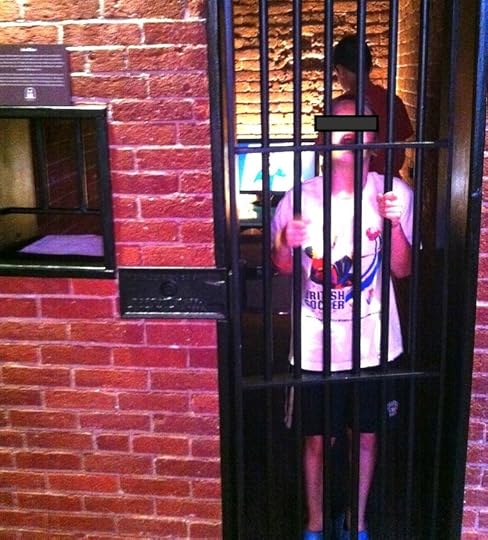
In the basement, a Russian Tea Room had been built into the foundations that had once been a jail, including the original brick cells. The café was essentially a tiny self-serve cafeteria, but a wall of samovars gleamed like exotic weapons in a torture chamber instead of mere tea urns.
And the novelty factor of chocolate bars with a Cyrillic label?
They might have been Soviet pork rinds for all we knew. But to the kids it was the exotic stuff of fantasy, foreign treats. A Russian Wonka bar wrapped in a golden ticket.

July 22, 2013
Collective Amnesia: Why Are Teen Girls Losing Their Memories?

My teenage daughter was the first to point out this epidemic to me: Teen girls—all over the world, in the present, the past, the future—are losing their memories. Sometimes it’s total amnesia, sometimes it’s partial memory loss. Sometimes it’s due to a physical accident or mental trauma, sometimes it’s something far more sinister. But any way it happens, it’s a serious problem.
What’s the source of this epidemic? YA authors, of course. Yes, the same people who gave us infestations of wizards and hordes of vampires, who filled the galaxy with dystopian worlds. Now they’ve hit us with the worst plague yet: memory loss.
“All these books have some girl who lost her memory,” my daughter said to me when I handed her a stack of summer reading. I hadn’t noticed it, but as soon as she pointed it out, I realized she was right. Memoirs of a Teenage Amnesiac tells the story of…well, a teenage amnesiac, a girl who has lost her memory due to head trauma.  Slated is about a teen girl whose memory is deliberately wiped out by the state because she has committed a crime. False Memory is about a girl who wakes up in a mall with no memory of who she is. When she goes postal on a mall cop, it’s pretty clear she does not have a normal past. Cinder and its sequel Scarlet feature a futuristic cyborg girl who’s only missing parts of her memory, but those parts turn out to be critical not only to her but to the entire planet. (Not too much pressure, huh?) Arclight is about a girl in a dystopian society who was rescued from the deadly Shades, but has no memory of her time among them. Then there’s The Adoration of Jenna Fox about a girl who awakens from a coma and has no memory of anything before her accident. And, of course, Unremembered, which is about a girl who survives a plane crash and….wait for it…has no memory of who she is or what happened. In fact, she wasn’t even listed as a passenger on the flight.
 The list goes on and on, and it’s getting longer by the day. Which brings us to the question, why all the memory loss? Does it just provide a quick entry to plot—take away someone’s memory and boom, everyone wants to know who, what, where, when, how, why? It’s certainly effective. But if it were just a convenient plot device, you would expect the number of amnesiacal novels to be split 50-50 between male and female characters. And they’re not. It’s girls, almost always girls.
 Is this a subtle form of sexism? Do authors subconsciously view memory loss as a distinctly female vulnerability? Would a guy who wakes up with no memory seem as tragic or conflicted as a girl who wakes up with no memory? There shouldn’t be any difference, but again, if there’s no difference, why are there so many more girls losing their memories?
Secrets are the other component of this epidemic. The characters don’t just suffer from memory loss. There are always secrets behind their memory loss. Things have happened to them that they need to remember or, more commonly, things have happened that people want them to forget. Sometimes they have hidden powers—ones that are being blocked by someone or something, ones that may be helpful or fatal to them, ones that, in a few cases, are even being encouraged. Often the novel is less about the tragedy of memory loss and more about the “specialness” behind the memory loss—what has been blocked or masked, repressed. And inevitably, the character retrieves her memory, defeats those who wanted to keep her in darkness, and proves that the human mind is more powerful than any external force.
 Which brings up an interesting possibility. Maybe all these characters are losing their memories because this is, in essence, what society does to real girls. It says “Don’t be who you want to be. Remember nothing. Do nothing. Be nothing.” Maybe these YA novels aren’t creating a fictional tragedy so much as addressing a real one: the systematic depersonalization of young girls as they enter into adulthood, the sociological bombardment of their psyches to the point where it becomes impossible for them to remember who they are and what they’re capable of.
Viewed in that light, maybe this rash of girls losing their memories doesn’t represent an epidemic of vulnerability, but a wave of transcendence. YA authors aren’t saying “Girls are so fragile, their identities can be wiped out at the drop of a hat.” They’re saying “Remember who you are. Remember what you want. And be who you are. Only then will you be as powerful as you can be.”
That’s something we could all stand to remember.
What do you think? Does the wave of YA novels about girls losing their memories bother you, inspire you, neither?
Give Me Plot, or Bore Me To Death
(Originally published February 2, 2012)
The summer before I started college, I went to a concert by John Cage, an avant-garde American composer. I had read his book and was captivated by his brilliance—his attempts to explode the boundaries of music by incorporating ambient noise and the element of chance into musical performance. He stepped onstage at the Decordova Museum’s outdoor amphitheater, and I leaned forward in the audience, ready to be awed by this iconoclast.
He began his performance, showing random slides and playing equally random notes according to the I Ching. I was excited–I’d never seen anything like it. But after a few minutes, a funny thing happened: I got bored. Really bored.
Sitting through a John Cage performance wasn’t even a tenth as interesting as reading about one. It turned out that no melodies and no structure meant no emotion, no direction, no climax, no resolution, and for me, no reason to keep listening. The sun was setting, the mosquitoes were out, and I was getting chomped. After twenty minutes, I got the general idea, and I left.
In college, I went on to study literature. I had discovered, while writing a high school paper on Edgar Allen Poe, the field of literary theory. Now I majored in the study of it, drawn to its philosophical, analytical nature, and how literature could challenge our assumptions about reading. I read novels with unreliable narrators, or narrators who broke convention by being self-conscious and self-referential, destroying the fictive dream. Plot was never central, or even important, in these books or in our classroom discussions. Concepts were—the concepts of time, story, memory, reality, and “memesis,” a word my department head pronounced repeatedly and very beautifully.
And again a funny thing happened: I started not finishing books. The pages blurred in front of my eyes, endlessly the same. And somewhere between Derrida and a book postulating that the pen was a metaphorical penis I started losing my reverence for theorists who never wrote fiction and fiction writers who thought themselves above plebian concerns like characterization and plot. I wrote my thesis about the most traditionally written, un-experimental book in twentieth century French literature—Les Mandarins, Simone de Beauvoir’s thinly disguised autobiography. And when I graduated, the first thing I read was Shogun, by James Clavell. I loved it. I was enraptured, swept along, kept up several nights in a row. It was the most I’d enjoyed reading in years.
I realized that different folks love reading for different reasons. And while the trappings of a story interest me, it is the story’s emotional experience that I really love, and that kind of experience does require unassaulted “mimesis,” characterization, and plot. I actually emerged from the ivory tower with a higher appreciation of popular fiction than I’d had before. Because now I knew for sure that I would much rather stay up late engrossed in a good thriller or “chick lit” book than prop my eyes open with toothpicks to read some prize-winning, earth-shatteringly beautiful, anti-chronological description of someone’s belly button. I was shocked to hear a prominent author at a writing seminar describe genre writing as “crap.” It didn’t make me want to read her books, at all.
I don’t read for the sake of the words, any more than I listen to music for the sake of the notes. I’m not looking for a solely intellectual or aesthetic experience. Sure, I’d like intellectual stimulation as I go. Open my mind. Shock me. Dazzle me with beauty and originality. But, please–if you want my attention, take me somewhere. I’d rather listen to Lady Gaga than to John Cage. Give me a melody, emotion, direction.
Otherwise, I’m walking out.
July 19, 2013
Friday Faves: Summer Ennui Edition

It’s summer. The heat is hot. The kindles are melting. My cat is cranky. So, in celebration of summer, here are some hot links to keep you cool. Or cool links to…it’s too hot to be clever!
Big news this week if you happen to be J.K. Rowling or a fan of her adult output. She published a crime novel called The Cuckoo’s Calling under the pseudonym Robert Galbraith. When news broke, sales of the book predictably skyrocketed. It’s been getting some good notices. Malcolm Jones at The Daily Beast weighs in.
22 libraries in Florida’s Miami-Dade County are scheduled to close due to government cuts. GalleyCat has the skinny on how you can help.
In largeheartedboy’s Book Notes series “authors create and discuss a music playlist that relates in some way to their recently published book.” This week’s Book Notes features Austin Grossman, author of Soon I Will Be Invincible.
Over at Salon, Karen E. Bender writes about what great writing can teach us about Trayvon Martin: “One of the great privileges of being a writer is the opportunity to see the world as specific—to embrace the complex universe that is each character. To just call a character ‘the black guy” or the “the Jewish guy” is problematic because it really tells us nothing about the person. The vague description depends on a reader’s assumptions of what these words mean. I believe much biased thought actually evolves from this imprecision, because it is about the mental ease of a label. It is easier to try to label a person or group than to wrap your mind around the dizzying variation that resides in each human. But as writers, that is our duty.”
The Grub Street Daily offers up Ethan Gilsdorf on writing the killer pitch letter (or, query letter). “Your goal: to get them (agents, editors) to read beyond that first paragraph (what we in the biz call “graf”) and into the heart of your query letter.”
If you’re a Kickstarter addict and want to help an author out, Red 14 Films, a film company specializing in book trailers, has a Kickstarter campaign to fund production of trailers for four authors to highlight their latest works. The authors are Jason Ockert (Neighbors of Nothing), Matt Bell (In the House Upon the Dirt Between the Lake and the Woods), Scott Dominic Carpenter (This Jealous Earth), and Monica Drake (The Stud Book).
Finally, The Millions updated their Roberto Bolaño Syllabus to include the latest in a string of posthumous work, The Unknown University. If you’re new to Bolaño or gave up keeping track of the English translations flooding the market since his death, this syllabus will help you catch up. It categorizes each of his books as either essential, merely excellent, or necessary for completists only.
Well, you know what the music means. Keep cool you crazy, wonderful BTMers! I’ll see you around. Unless you see me first…
July 18, 2013
Interview with Tim O’Brien: “It’s the sound of conclusion”

By Sonya Larson
It’s been two decades since Tim O’Brien’s new work of “fictional memoir” was first published, and since then The Things They Carried has risen to an unparalleled classic of Vietnam literature. Few other works have explored the war and its implications so hauntingly—as one soldier’s experience, as a necessity of story-telling, as truth compromised by violence.
The Things They Carried won France’s prestigious Prix du Meilleur Livre Etranger and the Chicago Tribune Heartland Prize; it was also a finalist for the Pulitzer Prize and the National Book Critics Circle Award.
Now, Houghton Mifflin Harcourt is re-releasing The Things They Carried on its twentieth anniversary. Beyond the Margins spoke to O’Brien from his Los Angeles hotel room as he tours the country to promote his book once again. He’ll be in Cambridge tonight, March 25th, 7:00pm, at the First Parish Church Meetinghouse, courtesy of Harvard Bookstore.
Congratulations on the re-release of the book [The Things They Carried]. Does it seem like it’s been twenty years since you wrote it?
Thank you. In some ways it does, yes. In other ways, it feels like yesterday. A little combination of both.
Where were you writing it at the time? What were you doing?
I was in Boston. I was living in Cambridge, actually, and I finished the book in Boxford, which is a town outside of Boston.
The form of the book itself broke convention in many ways. Of course it deftly explores the line between fiction and memoir. Were you at all concerned that readers might not understand or dislike what you were doing?
No, I really wasn’t concerned. I thought those who would get it would get it, and those who wouldn’t would be very literal-minded, and probably wouldn’t like any book that has any complication or ambiguity to it. So, I guess I didn’t really worry about that at all. I worried about trying to make the best book I could make.
What came first– the idea for the story, or for the form? Or were they one and the same?
That’s a good question; I’m not sure I have an answer. These things intertwine and overlap, and there was really no point where I made a decision regarding the book’s form. Or anything else, really. It occurred in the course of the writing. Something would happen with a sentence or a paragraph or a plot twist, and it would ring a bell. You tuck those things away as a writer. So the form of a book congealed over the first year or year and a half of writing it. I knew early on that I wanted to write a book that was fiction, full of invention and made-up incidents, but also a book that would feel to readers as if it may well be real, almost as if it had the sound of memoir. I knew that from the beginning. But finding a way of doing it took almost a year and a half of writing it.
At what point did the book start to gel in that way that you envisioned it?
I suppose the crucial chapter was the chapter called “How to Tell a True War Story,” which is at the center of the book. That chapter directly addresses those questions, almost in an essay form. It explores issues of what’s true, degrees of truth, varieties in which truth comes, and how it evolves. What’s true one day may be untrue the next. And that’s life. Someone can say, “I love you” one day and say “I don’t love you” the next, and both days be telling the truth, because the truth has changed.
In a situation that’s so full of uncertainty and ambiguity and horror– such as a war– there’s that feel of fluidity to truth. The old truths, such as “Thou shalt not kill,” become untrue. You’d better kill, or they’ll court-martial you. You have to. It’s patriotic and good to kill. And what one assumes your whole life to be true– that you shouldn’t be doing this stuff—is suddenly sanctioned, and noble, and sublime and all rest. And that can turn your mind upside-down.
What’s true and what’s not true? Questions like that: what’s true about yourself. Are you a good person? You think so. Until a moment at war when something terrible happens and you pull the trigger. You begin to reassess the truth about yourself. And the book as a whole is a kind of investigation of that, and stories revolve around that very issue that you brought up. And that’s what I mean by the form of the book coming out of the about-ness of the stories. And in different ways each of the chapters of the book deals with a facet of this very issue, what we call truth in its elusive and fluid nature.
I’ve always thought that the form works particularly well because the book deals with Vietnam, a war fraught with questions of what is true, and who has authority to confer truth. It’s almost as if the only way to portray that war truthfully is to do so in this form.
I think that’s true. And it’s the same if you go through a bad marriage, or a love affair that’s gone badly, or a childhood with an alcoholic father, no money in the house and absent parents. There are all kinds of ways in which one could write a similar book that would not have been taken place in a setting of war. It’s the same stuff, which in the end comes percolating out. I guess in a situation of crisis very fundamental questions are asked about identity, such as, is there a god? What’s true in this world of ours? Things that had been taken for granted and assumed for so long are suddenly undercut in ways that send you spinning.
I think that’s partly why the book has endured, that it strikes people. It’s not just a story about war. Readers take it very personally in their own lives. I’ve received letters from people with terminal illnesses, for example, who feel as if their absolutes– their bedrock that they had counted on for so long– was then sucked out from under them, who also feel the burden of things they have carried through illness or divorce, their imprisonment or whatever is in their background. But I think that’s part of the book’s longevity. It’s partly a story about what happens to men in a war, but more deeply it touches people to actually look at their own lives and childhoods. The reason that book ends not in the war, but with little Linda dying of brain cancer, is that that chapter is meant to move away from war to the lives of all of us.
Does this book stand out to you as one of your favorites personally?
I wouldn’t say it’s my favorite. I have four or five that I like best in different ways—they’re like children, in a way. I love them in different ways and for different reasons. But I think Cacciato [Going After Cacciato] is just as good a book, I think Tomcat in Love is just as good, and I think In the Lake of the Woods is too. But in the end that’s my opinion. Every author has a group of books that they feel is of equal merit, but that doesn’t mean readers feel that way.
Which story or stories in The Things They Carried means the most to you, or that you believe in the most, if there is one?
Well, again that’s hard. They’re like children—it’s so hard to say. I wouldn’t have left anything in the book—I would have taken it out—if I felt it wasn’t worth the reader’s time to read it, and if my heart wasn’t moved by it. Even the smaller stories that are not much talked about—they’re necessary to the fabric of the book. It wouldn’t feel cohesive without them. It would be like looking at a person’s face, and you’d have the eyes and the mouth, but you wouldn’t have any jaw. The eyes and the mouth would look funny, no matter how beautiful the eyes were. Just a lot of neck, and it would all look very peculiar, like a Cheshire cat. I can’t say I have favorites.
Do you remember a particular story or stories that were left on the cutting room floor, so to speak?
Not chapters or stories. I left paragraphs, sentences. If you were to pick them off the floor and glue them together, they would probably be four or five time longer than the story. But it wasn’t a particular story or a chapter. Or even a scene. What was cut was much of language that wasn’t good enough.
How did you know that the book was finished?
Sort of like a song. You feel a crescendo or finality that’s indisputable. It’s the sound of conclusion. The way you can tell from someone’s voice when they’ve said good-bye for the last time. They’ve said good-bye twelve times before, but you know from the sound of the voice that that good-bye is the final one. And I don’t mean that in a mystical way or a mysterious way; I think there really is a sound of conclusion when one feels that that’s it. And the line that ends The Things They Carried, “trying to save Timmy’s life with a story,” it has the sound of everything that I wanted the reader to feel.
Are you excited about coming to Boston next week? How long did you live here?
I lived there for about twenty years—I lived in Cambridge technically. I’m in L.A. now, midway through the book tour, but I’m really looking forward to coming to Boston. I really feel like I have a home there.
I read that your publisher is re-issuing the book in hardcover and softcover, e-book and Kindle. It’s the greatest effort that’s been put behind a backlisted book since, well, forever, in this new digital age. Is it overwhelming? What’s that like?
It’s really nice. I mean the book has sold so well over the years; it’s read at so many high schools and colleges that I’m not sure of the magnitude [of change] this will make. It’s been there forever and I hope it will stay there. But what’s nice is that the publisher is really going all out—the publisher didn’t have to do this. They could have printed it and sold it and it would have done perfectly fine. But it’s a kind of homecoming—the book was originally published by Houghton Mifflin in hardcover, and then the license went to Broadway for paperback, which is a division of Random House. After the license expired I brought it back to Houghton Mifflin, so in that sense it feels as if the book is back home.
In preparing for this interview I asked a number of people what questions they might want to ask you, and a number of people contacted me who are currently high school teachers. A couple of them said, I am teaching this book this very week in my class! How do you feel about knowing that so many high schools are teaching this book now?
I have a lot of feelings. I’m really glad—that’s one feeling. I’m delighted. Partly because the book is about writing itself and about story-telling. It’s not just about war. A lot of the book is about what stories are for, and what they do for us. How they carry the ghosts of people around and their memories. They’re about our fathers and mothers and hometowns and boyfriends and girlfriends and wives and children. When you tell a story those people are not physically with you, but they’re with you in a different kind of way. The way they’re with you in a dream, or in a daydream, or in just a quick recollection of your father’s face over a dinner table. The body’s not with you but there’s something there.
In high school, students respond to that, and they write you a letter. They say it reminds me of this, and gives me a sense of peace, or whatever they may say– it makes you feel good. It’s also nice that adults are reading the book. It’s one of those very rare occasions when you feel that you’re reaching not just a specialized audience, but you’re reaching a very diverse audience that takes the book in different ways and has different meanings to people beyond what you would expect.
How has becoming a father affected your writing? Do you find yourself drawn to different themes?
In a lot of ways it’s made it a lot harder! I love my boys a lot and I want to give them all the time I can. If one of the boys comes into my office and wants to play, I play. Whereas before, if someone came in, I’d say, Get lost, I’m writing.
But that’s good. I could never write another word, and I could devote all my energy to my two little boys and I would be a very content guy, because I love them so much, and I would give up anything for them. Including what I have valued most, which is writing. But at the same time, I get good stuff coming out of it. Anecdotes about their lives go into my writing. Words that come out of their mouth are fresh and strange, and combinations of words are very peculiar. And that’s what writing is: a combination of words. So it’s made it hard in some ways to write, but also, I wouldn’t give it up for anything.
Several years ago I saw you speak at the Wisconsin Book Festival. Someone in the audience stood up and asked you for your best writing advice, and I still remember clear as day what you said. You said, “Don’t write bejeweled sentences.” Do you still believe in that?
I do. I don’t think good prose is decoration. It’s like getting a pretty girl and seeing her put all her rouge on, and false eyelashes, and all that stuff that’s chemical and not human. And I feel that way about prose that feels artificially ornate. It’s not that I’m against a good adjective or a good adverb. I’m for it. But I’m only for it if it’s functional and necessary to the sentence. I don’t like decorations hanging off of stories like on a Christmas tree. I think it’s that that I was objecting to.
Did you write at all while you were a soldier in Vietnam?
I did a little. I can’t say a lot, but probably thirty pages handwritten on notepaper. I did it enough to kind of open the door for when I came back to America and began writing seriously. So if I hadn’t begun over there it would have been very hard to start. But at the end of a day, when other guys were horsing around, or waiting for dark to come, they would sort of talk and laugh, and I would sit at the foxhole and I might write a page or two about what had happened that day or the day before.
I wanted to ask about recent literary works that have emerged in the last few years, works written by soldiers stationed in Iraq and Afghanistan. Have you read any of these books? What is your sense of how those works compare to those written by soldiers stationed in Vietnam?
I have read a number of books and magazine articles by veterans of Iraq and Afghanistan. I’ve read some really, really good ones, and– as there were in Vietnam– there are some really, really bad ones. By and large really great writing from all wars comes a good time afterwards, when a person has had the time to let material develop and form itself, so that it’s not rhetorical. So that it’s not so heavily autobiographical. The great works to come out of World War II, the great American works to come out of it, took years and years. The Naked and the Dead, Slaughterhouse Five, and Catch-22. They didn’t come the year after the war was over, and I don’t think you can expect that with any war.
It’s a bit like writing about cancer; there needs to be time. You need to find a way to transcend the tendency to put in every little detail. Just because it felt so important, it may not be important to the reader. And time is needed for imagination to come into play and to work with the material, to shape a story that may not be wholly in the real world, but only partly. I’ve read some really fine things that have come out of Iraq, and I’m sure even better things will come out in the years ahead.
Do you feel that there is a different concern in these pieces, given that there hasn’t been an official draft for these wars?
Yeah, there’s a different kind of person who finds himself or herself in Iraq. A person who voluntarily joins the military. And that kind of person is a different person than someone who’s dragged in kicking and screaming as I was, who wants no part, who hates bullets and guns, and doesn’t like sleeping in the dirt. That kind of person is probably going to bring a different mentality and a different temperament; just a wholly differently mindset to war. I’m curious to discover what, in the years ahead, an all-volunteer army will show us. What kind of books will come out of people who intentionally go into the armed forces.
A lot of people question whether this country will ever even be able to have a draft again, given the public backlash during Vietnam. And books like yours, I think, have reinforced the sense that a lot of people may not want to go, and that it’s okay that a lot of people may not want to go. Do you have thoughts about that– that your book has contributed to a national psyche that is resistant to a draft?
Boy, that’s a great question, though I don’t know the answer to it. If there is an answer, I’m not the guy who has it. In the end, I’m just a story-teller, and I don’t mean that in any deprecating sense; I think it’s a grand thing to be. But I’m no sociologist or historian. I’m a person who’s trying to write stories that will get into people’s hearts and their stomachs. And get people to participate in moral crisis and moral outrage and moral hurt. Not just read about it abstractly in a newspaper or see a five-second clip on television.
A book has a way of immersing you in a time and a place and the physical stuff around you. And if you’re lying in bed and you’re reading the book, you’re kind of in it, or at least I am, if the book’s any good. That’s such a different experience from reading non-fiction. The way you feel with a work of fiction if it gets to you, and if you like it, you’ll feel you’re kind of in the book and you’re rooting for the character– you’re almost identifying with that character– and that’s my way of hoping that I can make people feel something that they haven’t felt before.
I’ve tried to pinpoint what exactly it is about your work that seems to be—I don’t know any other way to say it—seems to be written from the inside out, in a way that I don’t often see in other works, fiction or nonfiction. There’s a kind of soulfulness and a sense of urgency that I think is rare. Which authors writing now do you think have those kinds of qualities, that you search for in your own writing, and that you look to put down in your stories?
Again, that’s a good question. I think it depends on where you are in your life, and it depends as much on the reader as it does on the writer himself or herself. I think it wouldn’t be fair, for example, to say to a writer, “You’ve got to write another The Things They Carried.” It would be like asking me to write another Ulysses. One book is itself, and it’s going to remain itself, and I think most writers ought to try to find their own means of looking at their own worlds. How do I tell a story about what happened to me, or what do I worry about out in the world? That’s such a personal passion, a personal concern for the world around you, and then you try to find your own individual ways of dealing with the material, of shaping it, of entertaining people with a story about it, and of wrestling with the underlying human struggles and so on.
Books that are being written today that appeal to me are very rarely books about war. They have to do with the world we’re living in now. Testimony about 9/11—there are some wonderful books about that. And there have been some wonderful works of non-fiction about the era of terrorism and uncertainty as to America’s place in the world. They’re fresh, those books. They’re good. But they have very little relation to the way that I write. Yet they’re wonderful books.
You often appear at the Joiner Center workshop in Boston, and I know you’ve taught at Bread Loaf and other places. Do you feel it’s important to be a mentor to new writers? Do you feel it helps your own work?
I do a little teaching, and it feels important in a number of ways. For one thing, you can get people to read. My students read a lot—things they wouldn’t ordinarily read, probably. And if nothing else, it widens their horizons and it exposes them to different ways of telling stories, and it may change, if only marginally, their standards of excellence. What’s good, what’s bad. What sounds good, what sounds bad.
I teach grammar in my writing courses—I make them learn it. So many come ill-prepared! And I don’t mean that all your characters have to speak grammatically, but I think you have to know it. The same way a mathematician has to know how to add before he can do astrophysics. And in order to do certain characters you have to know grammar. If you want to have some highly-educated English professor as your main character, I’m not going to believe he’s highly educated if he makes errors.
I try to talk about grace and rhythm of sentences and pacing, and the kind of music that underlies prose, that varies radically of course, the way that jazz varies from classical. But I try to talk about rhythm and its importance to a sentence, and not just how it’s important to a sentence, but how it’s important to the story as a whole. It gives a feel to the tenor of a story, to its sadness or its mystery, or its love, or whatever it is—the sentences. All the things like plot and character, they all ride on sentences, on language. They have to—there’s nothing else to ride on except those twenty-six letters in our alphabet. You’ve got nothing else, period. That and punctuation marks.
So I try to make students aware of that. It’s easily forgotten. They try to talk about plot and theme and character, but to get at any of that stuff you have to write sentences. You have to use those twenty-six letters. And I try to make them acutely aware of that, because it will give them the experience to get at the material they want to get at.
Yeah, it does seem like an under-taught topic.
It is. It’s so hard to teach.
You’re trying to teach someone how to have a musical ear.
Sometimes it’s like starting from scratch. A lot of my students– even though they’re MFA students and they’re thirty years old– their grounding in language is not always very good. They don’t pay much attention to it. And I don’t think you can write a very good book if you don’t pay attention to your own sentences.
Do you read any literary magazines regularly?
I do. I read whatever comes across my desk; if someone sends me a magazine I’ll read it. I don’t subscribe to much of anything, except the newspaper, because I get sent so much stuff—books for blurbs and that sort of thing. So I’ve got stacks and stacks and stacks of stuff to read. But if someone sends me a story and asks me to read it, I’ll read it.
Are there any journals in particular that you feel are publishing quality fiction?
There are so many; that’s part of the problem. There’s a wealth of great stories and great magazines. I judged the O. Henry prize two years ago, and I was reading stories from The Paris Review and Tin House and places I’d never heard of. The stories were really good; it was hard to choose a winner. I also read mass national magazines like The New Yorker and so on.
There aren’t as many outlets as there was when I began writing. So many magazines have closed or have stopped publishing fiction. But I’ve seen enough stories come across my desk that are really good that I’m not too worried about it. Somehow they find an outlet, on the Internet or whatever. It will finally get to me if it’s any good.
A number of readers think of you as a “Vietnam writer.” I know that in a number of your books Vietnam is only a backdrop, if it’s there at all. Does that bother you at all, having that label?
I can’t say it does. I have written about Vietnam and it’s important to me, and yet I hear from enough people with no interest at all in Vietnam and still like my work. It’s a little like getting Toni Morrison on the line and saying, “Does it bother you being labeled as a black writer?” And she’d probably say, “Well, I’m black, and it’s been my subject matter my whole career, and I hope I’ve reached beyond it.” And she has. Or like Conrad, who has reached beyond the ocean. And Faulkner had Mississippi. I have Vietnam.
And yet all of us in different ways have used it as a launching pad or a starting place, but in the end I don’t think Faulkner was writing just for Mississippians, and I’m certainly not writing just for people who went through the war in Vietnam. It’s more a vessel that contains the human heart in times of crisis and anguish and joy and everything else that’s kind of a vehicle. It’s not really the subject matter, per se. But I can’t say it bothers me much, no.
What were the books that were most instructive to you as a writer?
It depended on my stage of life. When I was younger, it was The Hardy Boys and Wonder Books, and fairy tales. And then it became the moderns—Hemingway and Faulkner and Dos Passos, Fitzgerald. And I’ve gone through stages—my Nabokov stage has been a building block, not just in my writing alone but in the person I am. I’ve learned to appreciate things I probably wouldn’t have appreciated when I was seventeen, or twenty-two, or whatever the age. That’s how life works. It’s an accretion, and things supplement one another, they become something different. So it’s really a lifetime’s worth of reading that’s stored up inside me.
What are you working on now, if I may ask?
I’m writing a book being an older father, and the squeeze on the soul that that brings to you when you start thinking, “What are things going to be like ten years from now? Will I still be around? Will I still be able to play basketball?” All those ‘what if’ questions. You have this four-year-old kid who loves you and may not have you. The horror, that there’s this kid you love so much, and yet your utter helplessness in the face of biology. I’m writing about love, not of the romantic sort, but for these little boys who one day will go out on their first date, and I’m going to want to go along with a shotgun. But then you have to let go. That sort of thing. The age-old story that could be a Hallmark card, or it could be really good.
What career might you have had if you hadn’t become a writer?
Boy, I don’t know. It’s hard to imagine. I think from the time I was a little boy—maybe eight or nine years old– I dreamed about being a writer, and wanted it. Even though in college I didn’t major in English; it seemed too wild and impossible a dream. And I suppose I thought that being from small-town Minnesota that writers come from big cities. I was just a cow town kid. But I never, in any serious way, thought about what else I would do. You have to remember that when I graduated from college—well, some kids knew what they wanted to do, but I didn’t. And then the draft came along and I was in Vietnam and began writing and haven’t stopped. So there was never really an occasion to say, Well, what am I going to do? I was just already doing it.
Sonya Larson is Program Manager at Grub Street.
This post first ran on Beyond the Margins on March 25, 2010.
July 17, 2013
Opening Lines, Opening Doors

Guest post by Charles Garabedian
“That secretary of yours got me so upset,” Susan said as I walked into the examination room. “She yelled at me for being fifteen minutes late and didn’t even say hello.” I’ve been Susan’s pediatrician for many years, so she felt comfortable expressing herself freely. Those first words from the secretary served a one-two punch that ruined Susan’s morning, and mine.
I was editing yet another draft of my novel Ivy House at the time, and went home that day to take another look at my first sentence on page one. Susan’s encounter with my secretary made me realize even more how impactful first words were in forming impressions. Similar to pickup lines in a bar: Hi there, you must be a light switch because you keep turning me on, might repulse, while: You’re so beautiful, you made me forget my pickup line, might sound more genuine, generate a giggle, and stimulate a conversation.
Nearly every book I’d read and every class I’d taken on the craft of writing, taught me the importance of that opening line and what it must do—grab the reader’s attention, establish mood and atmosphere, enlighten the reader as to the type of story, entice the reader to want to know more, haul the reader into another world, and encourage the reader to ask questions. So needless to say, I spent the next few weeks agonizing over my first sentence, revising and revising, to make it obeyed those rules.
I kept in mind that literary agents and editors received hundreds of manuscripts every year, and knew that something needed to hook their attention to get them to decide on choosing one over another from the slush piles. And let’s say a novel made it through to an agent and then an editor. The next process would typically involve marketing and sales, which also relied on a hook, something to capture the browsers in bookstores and the people at home on the Internet checking sample excerpts.
First lines have allured us from time immemorial. Curiosity led me to take a look at older fiction such as The House of the Seven Gables written in 1851. “Halfway down a bystreet of one of our New England towns stands a rusty wooden house, with seven acutely peaked gables, facing towards various points of the compass, and a huge, clustered chimney in the midst.” Hawthorne’s description of the house makes one ask: who lives there, why is it rusty and apparently neglected, and who is narrating? It evokes a sense of mystery.
And in the 1821 novel, The Spy: a Tale of the Neutral Ground, James Fenimore Cooper’s first line also raises questions. “It was the close of the year 1780 that a solitary traveler was seen pursuing his way through one of the numerous little valleys of Westchester.” Who is the traveler, why is he alone, and why is he traveling in this particular valley?
First sentences don’t need to be lengthy. In fact sometimes the shorter the sentence, the stronger the impact. Take for example the first sentence of Stephen King’s Cujo: “Once upon a time, not so long ago, a monster came to the small town of Castle Rock, Maine.” Right from the start, there’s an aura of mystery, a sense of foreboding. It raises questions as to the type of monster, where it lives, and what it attacks.
When the first sentence strikes hard and the reader gobbles the bait, his/her eyes get reeled to the next sentence and to the next, and eventually the paragraph, the page, and finally the chapter. Bingo. Mission accomplished.
I studied other examples in modern fiction as I continued to revise my own first line. Author Jenna Blum’s Those Who Save Us: “The funeral is well attended, the New Heidelburg Lutheran Church packed to capacity with farmers and their families who have come to bid farewell to one of their own.” Who is the deceased, what are the circumstances surrounding the death, what is the significance of a German-named town, and how may Germany itself figure into the book? The mention of a funeral raises curiosity as to how death and respect for the dead will play out in the story.
“Happiness at someone else’s expense came at a price,” the first line in The Comfort of Lies by Randy Susan Meyers is another good example. A reader can’t help but wonder who does what to whom. It sets the theme for a story about complicated relationships and the ramifications of one’s actions.
In William Trevor’s Felicia’s Journey, the first line, “She keeps being sick,” raises questions about the identity of this person, why she is sick, and who is letting us know?
“They shoot the white girl first,” is the first sentence in Toni Morrison’s Paradise. Once again, the reader is left wondering who the girl is, why she is shot, who shoots her, and what role race may play in the novel.
Finally, in Kent Haruf’s, Benediction: “When the test came back the nurse called them into the examination room and when the doctor entered the room he just looked at them and asked them to sit down.” This first line heightens curiosity about what news the doctor will deliver, who the patient is, and what circumstances bring them to the office. The tone is somber, the atmosphere unsettling, and the reader is immersed in a situation wanting to know more.
Though these first sentences vary in length, style, tone, and detail, they all achieve one common goal—grabbing the reader’s attention and making him/her want to keep turning pages. As writers, we all wish for our readers to care about our characters, to hate them or love them, and to continue the journey to find out what happens at the end. We want our readers to suspend reality for the moment and transport themselves into another world, into the lives of other people, and perhaps gain an understanding of other philosophies, cultures, and the peculiarities of human behavior. But for this to happen, our readers need to latch onto something that intrigues them from the beginning, something that sparks an interest right from the start—the opening line.
Like me, have you agonized over your first lines, too? Do you have any that come to mind from recent novels? I’ll be curious.
Photo by mrsdkrebs.
 Charles Garabedian is a fiction writer represented by agent Carolyn Jenks at the Carolyn Jenks Agency. He has been a member of the Grub Street Writers’ Center in Boston for many years. His debut novel, Ivy House, was conceived during the center’s Master novel workshop mentored by New York Times bestselling author, Jenna Blum. Charles lives in Boston and enjoys playing tennis, kayaking, and spending time with family. Since 1993, he has been a pediatrician in Concord, Massachusetts.
July 16, 2013
Death and Writing: What’s the Connection?

By Laura Harrington
I know, I know, what’s my excuse for dwelling on death in July, for heaven’s sake? Not even the dog days of August, but bright beautiful July? The truth is, that’s just me, and yes, I know it’s weird. And also, this week, I lost two elderly friends. Which makes me think about mortality even more than usual.
Okay, we all know we’re going to die. But most of us, I’m guessing, rarely pay much attention to the one thing in life that is guaranteed. Why not? And how does this relate to our writing?
A decade ago an artist friend of mine shocked me when she said, “When I realized that I’m going to die, I asked myself what do I really want to work on?”
And even though I do occasionally (sometimes frequently) contemplate my own mortality, she forced me to ask a critical question: If I only have 10 working years left, (20, 30, you fill in the blank) what do I want to do with those years?
Virginia Woolf, facing her 50th birthday in January of 1932, wrote in her diary:
“I am in one of those lassitudes and ebbs of life when I cannot heave another word on to the wall. My word, what a heaving The Waves was, that I still feel the strain!
“Can we count on another 20 years? I shall be 50 on 25th, Monday week, that is: and sometimes feel that I have lived 250 years already, and sometimes that I am still the youngest person in the omnibus. And I want to write another four novels: Waves, I mean; and the Tap on the Door; and to go through English literature, like a string through cheese, or rather like some industrious insect, eating its way from book to book, from Chaucer to Lawrence. This is a programme, considering my slowness, and how I get slower, thicker, more intolerant of the fling and the rush, to last out my 20 years, if I have them.”
We all know that she didn’t have 20 more years. She was dead at 59.
I’ve always identified with Virginia Woolf; she was the first of my literary heroes. I am 59, the age Woolf was when she put those stones in her pockets and walked into the river. My mother began her decline into dementia when she was 62. My father-in-law dropped dead from a heart attack at 63. The question of how many more years I will have is vibrantly real to me. I do not suppose that my mother’s fate will be mine, although that idea did terrorize several years of my late twenties.
And yet …
Waking up – or being jolted into awareness of our mortality – is a gift. How we choose to spend our precious time is a gift as well. Can you write a book a year? Good for you. Do you want to? Do you want to write the book you think will sell? Or do you want to write the book that feels so risky you haven’t even told your best friend about it yet? Do you want to try writing a children’s book? A screenplay? Long-form journalism? Do you long for time off? Like Woolf, do you long to go through all of English or Cuban or African literature?
What are the criteria we use when choosing what we will write? How much do our careers, our “platform,” our audience, our readers, our own expectations, those of our agent or editor or spouse, impact our decisions?
Do we have so many voices in our head that they drown out the small, inner voice of who we are, the artist we believe and hope ourselves to be? What is the work that we must do, that we are called to do? And when will we begin it?
The composer John Cage famously said, “Begin anywhere.”
What are we waiting for?
July 14, 2013
Home: Real, Sung or Imagined

My youngest son, age 10, was a little nervous about spending a week at Boy Scout camp. He knew the scouts don’t prissy around with luxury items like cabins and food that anyone might actually want to eat. But that wasn’t what worried him. It was the homesickness.
My husband and I made a plan. At scout camp, the troop parents are expected to help staff the campsite; I would go down and stay over the first night, my husband would do the last night, and our older son, an Eagle Scout, would do a night in the middle.
As it turns out, this was a really bad plan.
That first afternoon and evening, every time I thought he was starting to settle in, he’d take one look at me and well up. The next morning was even worse. At the mess hall, over a breakfast of pancakes that tasted like sweetened dish sponges, he could barely hold it together.
“I’m right here!” I wanted to say to him. How could he be sad with his mother actually sitting 3 feet away from him—and what would it be like when I left? Mushrooms of anxiety were starting to grow in my own stomach, and no, it wasn’t the pancakes. After a tearful goodbye, I spent the whole ride home lobbing up prayers that he would be okay, that other kind parents and kids would somehow comfort him.
And that is exactly what happened. I got texts from the other parents. Apparently, once I left, the big neon sign blinking “HOME, HOME, HOME” over my head left with me. He began to hang out with the other scouts, practice his knot-tying and tell fart jokes just like everyone else.
A couple of days later, when his big brother came back from his stint at camp I practically tackled him. “How is he?” I demanded.
“He cried.”
“What?!” I’d been so sure that was behind us. “Do you think it was harder with you there?”
“Yes.”
“How do you know?”
“Because he told me so. He said, ‘I keep thinking about how you’re going home without me.’”
Home. I guess it’s nice to know that he loves it so much. I never really felt that way myself growing up. In fact, I couldn’t wait to jump ship. Home was not the full fridge, people keeping regular hours, generally predictable and happy place my kids know. I was always certain of my parents’ love, but beyond that, a lot of it was pretty much up for grabs.
Thus, I wasn’t really prepared for my reaction to seeing Paul McCartney in concert last week. Flooded with memories from my childhood, I found myself slightly teary, uncharacteristically nostalgic for a place I had so often found fault with. My mother rarely had anything in the way of disposable income, but when she did, she bought records—cool stuff like Steve Wonder and Joni Mitchell and, yes, The Beatles. We played them so continuously it’s a wonder they didn’t disintegrate into black vinyl dust.
I sang my way through my childhood, and those songs became a sort of home for me.
Books, too, became a home. I read every single Laura Ingalls Wilder book, secretly longing for the solidity of Ma and Pa, the sweet smell of baking pies, the warmth of a never-dying fire, and the safety of a fortress-like log cabin.
My own children trend toward dystopian fiction, which I still can’t quite get over. Why would they want to read book after book and post-apocalyptic misery, even if things eventually work themselves out in the end (sort of, after a serious stretch of gruesomeness, and in a still vaguely anxiety-ridden way)?
But maybe my husband and I have sown the seeds of their literary tastes by providing a home that is so contrary to all of that. So predictable and safe, despite the vicissitudes of childhood and adolescence. So comfortable, despite the fights over underperformed chores, over-consumed junk food, and whether it’s absolutely necessary for us to call the parents of their party-throwing friends “just to touch base.”
When my husband went down for that last night at scout camp, our son was having a blast. He’d made friends, learned all the kooky scout songs, and was happily filthy. He could enjoy himself knowing that his dad wouldn’t be going home without him.
He says he definitely wants to go back next year. I will not be joining him. I will be home, making sure the fridge is full and the home fires are burning (or the AC is cranked up) when he returns.
Maybe I’ll even throw on some Beatles tunes and bake a pie.
July 11, 2013
Bald and Brave Friday Faves
I think we’ll have to call this the post of unmatched socks — from bald and brave to repay-the-advance bake sales. Here are some interesting links from this week for your edification and enjoyment.
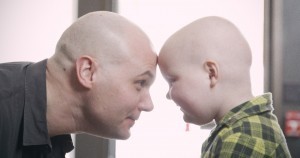
1. I met folk musician Alastair Moock seven or eight years ago when he became my son’s guitar instructor. For a few years we went to Alastair’s home every week for lessons, and during that stretch, Alastair and his wife, writer Jane Roper, welcomed beautiful twin girls – Clio and Elsa — into their family. Almost exactly a year ago Clio was diagnosed with leukemia — that’s the bad news. The good news is that she seems to be doing very well, as is her entire family. It’s no surprise that Alastair and Jane turned to their respective creative endeavors to cope with this new reality. Jane wrote movingly and with great honesty about their experiences on her blog while Alastair sang, played and composed songs for Clio. Just this week he released an album born of these experiences called Singing our Way Through: Songs for The Bravest Kids in the World. The songs, written for kids with cancer, are lively, funny, honest, and inspiring.
Check out this video of his song When I Get Bald, co-starring Clio. Bet you can’t get through it without smiling, crying – or both.
2. So I am on social media vacation for the summer. Facebook I don’t miss so much, but Twitter… For example, while at the grocery store today I saw a bag of popcorn boldly labeled “WHOLE GRAIN!!” That’s ridiculous, I thought. All popcorn must be whole grain… right? How else would it pop, right? I looked to my right and left, hoping to find someone to laugh with me about how ridiculous to the “whole grain” thing was – but nobody in the aisle seemed interested in chatting. Twitter, I thought. Twitter would be interested.
I mention this because a) I miss Twitter and b) I came across an article in the Atlantic on how many of us are sharing photographs of the most important moments of our lives – just-born babies, weddings, etc. – on Twitter. It’s pretty incredible, as are some of the photos included in the article.
3. Interesting factoid about the growth of digital books: genre fiction may prove to be the biggest winner.
From Wired magazine:
“In the last few months… Random House and HarperCollins launched their first digital-only imprints, and all of them focused on genre fiction. Random House announced the sci-fi/fantasy line Hydra, mystery line Alibi, ‘new adult’-targeted Flirt and romance-centric Loveswept, while Harper Collins created the digital mystery imprint Witness in April. Although this focus on genre fiction might seem counter-intuitive according to traditional print publishing sales, Random House VP and digital publishing director Allison Dobson says there’s a simple reason for it: The digital audience wants different things.”
4. Publishing Perspectives asks: “Is Vikram Seth the First Casualty of the Random House/Penguin Merger?” In case you missed it, he’s been asked by the new publishing megahouse (mansion?) to return the advance on his novel Suitable Girl, which is under contract and was due in June.
“One publishing ‘insider’ quoted by The Times noted that Penguin Random House’s dramatic step is a clear demonstration of the dilemma facing publishers worldwide: ‘Worldwide, but especially in Europe, the publishing world is in a state of crisis. The focus now is on commercial books that can be churned out quickly and cheaply. The space for literary books has shrunk rapidly.’”
His advance was $1.7 million.
Happy Friday, everyone!
Chris Abouzeid's Blog

- Chris Abouzeid's profile
- 21 followers

