
Michael Hiebert's Blog, page 9
April 23, 2013
Mind Mapping: Kicking Creativity Block in the Backside
 We’ve all been there; it’s one o’clock in the morning and we’ve been staring at the computer screen now for three hours and the view hasn’t changed. Just that big white rectangle with your name and address in the top left corner and the words Untitled centered about a third of the way down the page. You want to start writing, but you have no idea where to go.
Or maybe it’s even worse. Maybe you’re halfway through your novel and things were going great up until a week or so ago; you were making incredible progress. And then, everything just ground to a halt as you crept up onto that midway point that a lot of authors like to call the “muddle in the middle” (if you are having problems with the “muddle in the middle” see my previous posts on the Hero’s Journey where I describe a solution to this… my take on the journey has no muddle in the middle. Instead, there is a midpoint Climax, giving you a goal to write to and away from).
Or maybe you have just plumb run out of original ideas and you need something more. Everything you’re coming up with right now feels old and staid and stereotyped, as though you’ve seen it a thousand times.
Well, the solution might just lie in mind mapping. What is mind mapping? It’s a relatively recent technique in radical thought development that allows you to free associate things very quickly. It does this by structurally laying out the information in a linear fashion where connections are formed between similar ideas. Because of the way the information in a mind map is stored, it is also a good method to store your notes from your research you do for your next novel.
A Google search on the web will uncover many mind mapping software products available, most for around a price of $200, but there are two that worth mentioning that are free. One is freemind (http://freemind.sourceforge.net/wiki/index.php) and the other is freeplane (http://freeplane.sourceforge.net/wiki/index/php). Freeplane seems to be an offshoot from freemind and has a few more bells and whistles, making it the better choice, I believe, although both programs seem pretty solid and are compatible with each other, so feel free to try them both out.
You don’t need a computer program to mind map, though. You can do it the old fashioned way, with just a paper and a pen. Actually, different colored pens will come in handy if you have access to them. Mind maps are unique in that, when they are finished, they can almost resemble works of art.
The way you go about creating one is like this. First you come up with your initial idea. It doesn’t have to be an incredibly great idea, just an idea you want to run with. For instance, this morning, while testing out the software programs I just described, I tried this procedure using the idea “Train.” So you write down the word “Train” in the center of your paper and circle it. This is your root idea.
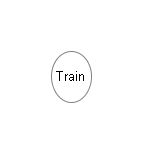
Now, as quickly as you can, you free associate any words that come to you based on the word “train.” It doesn’t matter if they don’t really seem to have any connection to a train at all. Just write them down. In my case, the next word I thought of was “robbery”. So I wrote down “robbery” beside “train,” circled it, and drew a line between them. Now you free associate words with “robbery”. I came up with “bank,” then “cowboys,” then “hoodlum.”
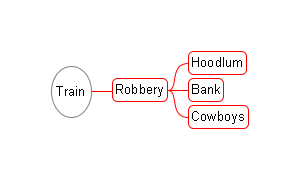
Notice how some of the words connect better with different root words in my map? Just connect the ones you feel have the strongest connection. Keep brainstorming. Keep “train ” in mind. For some reason, “train” brought up “rain” for me, so I started a new set of child nodes that connected to “train” that included mountains, which brought Switzerland to mind.
Soon this was what my mind map looked like:
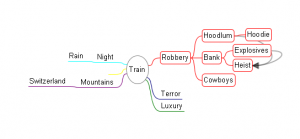
Now this isn’t necessarily finished. A mind map isn’t necessarily ever finished. It’s finished when you feel you’ve exhausted all usable free associated words that are going to help you kick start your imagination into gear. Usually, you’ll feel when you reach the point where the map starts working. At first, putting down words will be a struggle. Then, about fifteen minutes into the process, the floodgates open, and the words pour out faster than you can get them down. This is actually a very small mind map I made for demonstration purposes only. I could’ve kept going for another 30 words in about five more minutes at the point where I stopped.
While you are putting down words, you can reorganize the ones you have on the page, grouping like words together and connecting them interdependently of their child nodes or their parent nodes. For instance, in my graph, “explosives” and “heist” are connected to “bank” but they’re also connected to “hoodlum.” This is where your different colored pens come in handy. With the software programs, you can automatically make every node a different color if you like or create “clouds” of nodes—bunches of nodes tied together by a surrounding cloud rendered any of a few different ways.
So what do you do once you’re satisfied you have exhausted your mind of everything you can think of to do with your initial idea and all avenues leading off of it? You sit back, and start looking at the overall connections and how they lump together. Your mind has probably already started to see the problem in a different way. This is the power of mind maps; they make you think from different angles.
For instance, a story idea that immediately sprung to mind from my mind map was that a luxury train full of high ranking royalty travelling through the Swiss Alps falls victim to a good ol’ fashioned train robbery. Perhaps one of the royals onboard the train has in her possession a piece of priceless jewelry. Since the perpetrators are dressed as cowboys, the victims onboard believe, at first, that it’s part of some sort of theatrical period piece. Meanwhile, in another part of the city, a major bank falls victim to a terrorist attack designed to look like a heist but is really just an act to distract everyone from the train robbery and keep the police busy. The attack on the train happens on a rainy night up in the mountains.
Okay, it’s not the greatest idea, but it’s an idea I didn’t have before I started and I literally spent ten minutes generating it. And I didn’t spend any time conceiving my original idea, “train.” I just picked the first word that popped into my head. You, of course, would pick your very special idea that was near and dear to your heart.
One last thing. You want to keep the ideas on the mind map simple. Don’t write down sentences. Try to keep it to single words, if at all possible. If you can’t, make the phrases as short and concise as possible. Do use symbols and pictures if those help you. Don’t forget to use colors. These all appeal to different parts of the imagination and will be of aid in generating ideas.
The main thing, though, is don’t take the process too seriously. Have fun with it. Whether you do it on paper or with one of the computer programs I described above, mind mapping is entertaining and enjoyable.
It definitely beats staring at that white screen of death on your computer monitor until one in the morning. Let me tell you that.
Michael out.


April 17, 2013
Copy Editing Your Own Work: Closing the Gap to Professionalism
 Right now, apart from an inability to get your book on the shelves of major book stores, the big sword in the side of Indy authors is that their books are seen as inferior mainly because, for a long time, they were inferior. The problem with making it easy for anybody to put out a book on anything any way they want to at any time is that a lot of people will do just that. And a lot of people did.
But the dust is settling, and, like it usually does, the cream is rising to the top (I know, I know–something else also floats, but in this case, it’s the cream).
One of the big differences I’m seeing between the Indy books published today and the ones that were being published even just a year or two ago is that today authors are taking the editing process much more seriously. They’ve realized there’s actual money to be made if they can convince the public that they are credible. So real actual honest-to-goodness copy editors are being employed. This is a wonderful improvement over the pile of carp (that was intentional) the industry got flooded with when POD publishing first came into existence. It’s not even uncommon nowadays for Indy authors to hire their own publicists, that’s how much the industry has flip-flopped.
But hiring copy editors and publicists cost money and the whole attraction to Indy publishing (other than the fact that you don’t have to plead and beg the gatekeepers in New York to let you in) is that it didn’t cost you much to get your foot in the door. So the question is, can you do these things yourself? I’m going to table the question of being your own publicist for another day, and talk about copy editing right now. The fact is, copy editing is a craft much like writing and because it’s a craft, if you really want to learn it, you can. But it takes work.
I was a terrible editor when I decided I wanted to learn to copy edit. Now I consider myself a fairly good copy editor. I wouldn’t say I am exceptional. I actually do hire myself out and copy edit other people’s work, but I don’t charge the same amounts as some of the spectacular copy editors out there because I know I am still learning a little of my craft. But I am getting better all the time. The key to being a good copy editor, I discovered, is to first read up on everything you can about it (there’s a lot more to it than looking for misspelled words… there’s a lot more to even just proofreading than that), and then practicing. And practice a lot. I copy edit every manuscript my writing group submits to me each fortnight as though I was being paid to do so because I consider it practicing my craft.
And when someone tells you that you messed something up, have the ego set aside and listen to them and learn. When I first started doing this, I didn’t even get my lays and lies right. I’m quite serious. There are still some parts of the English language I trip over, but I know where to go to look them up when I run into them. Ah, that’s another thing you need. Good reference material. I have two dictionaries: Websters Third International and Websters Eleventh, along with the Chicago Manual of Style 16, Garner’s Modern American Usage, Chambers Slang Dictionary, and myriad books on punctuation and grammar that I’ve read and reread countless times. Even Copy Editing for Dummies is on my bookshelf. It’s actually not a bad book.
Whether I’m copy editing my own work or someone else’s, I work exactly the same way.
If the manuscript is going to go on to be published and not just stay in manuscript form, the first thing I do is turn on Track Changes.
Then I search and replace any coding in the manuscript that needs to be changed. For instance, when I write, I use straight quotes and double dashes as em-dashes. I underline instead of italicize. So it’s now that I replace straight quotes with smart quotes, double dashes with em-dashes, underlined words with italics. Anywhere I have a single quote and a double quote side by side (just search for “‘ and ‘”) I slip a small non-breaking space in between them (ALT + 8201 in Word). I search through the document checking all the single quotes to see if any are backward apostrophes because smart quotes are actually quite dumb. I replace any ellipses that are three consecutive periods or the ellipse character with three periods separated by non-breaking spaces between them with one non-breaking space before them and one breaking space after them.
That fixes most of the coding issues. I generally mark up the front matter pages, just blocking out what will go where as far as Half Title, Full Title, Copyright Page, Dedication Page, etc.
Once the manuscript is in working order, the next thing I do is start a Style Sheet. The Style Sheet drives everything. It is where I first list all of the rules I am going to follow for this manuscript that may not be obvious (i.e.: anything opposing or not in the Chicago Manual of Style). I then go through the manuscript three times. Each time I do, I am looking for different things.
The first time, I am reading just to get a feel for the work (if it’s your own work, you probably think you already have a feel for it, but trust me–go through it three times) and to fill in parts of the style sheet. Anything that is written on a sign or on a button or anything like that gets set in smallcaps and is listed on the Style Sheet in a specific section along with the page number it appears on.
Any place name or other proper noun (other than people) gets put on the Style Sheet along with the page number of the first time it’s used. If there is something discerning about the place that might be important to the story, that goes on the Style Sheet with it.
Characters get their own section on the Style Sheet. The page number of when they first appear is listed along with any description that is given or continues to show up as the book progresses. Any dates that turn up with interesting information about that character gets written down.
If there is anything quoted in the manuscript from external sources, they get listed in the Style Sheet and will have to be dealt with later, potentially researched to see if there are copyright issues and permission is needed to include them.
Also, during this first pass, I start to develop a timeline for the story. For some stories, this is easier than others. It’s important that the timeline works. You can’t have a character shoot another character on Thursday and then in another scene a month later flashback to buying the gun two days after the shooting occurred. Keeping the timeline straight is one of the hardest jobs of copy editing.
Of course, if I see any blatant spelling or grammatical errors during this pass I will fix them.
The second pass is when I look at the actual grammar, punctuation, and spelling more closely. If I am unsure of any word I come to in the manuscript I look it up in the dictionary to see if it’s spelled correctly. Then I write it down in the Style Sheet in a special section for words that I’ve looked up. Also in this section go any foreign words, etc. Usually, after finishing copy editing a three hundred and fifty word novel, I will have four or five pages of words I looked up to double check the spelling of. I’m not the greatest speller in the world. You don’t need to be a good speller to be a good copy editor.
Commas are something you’ll find yourself doing a lot of work with. Two independent clauses separated by a conjunction should almost always have a comma before the conjunction. Also, unless the author vehemently is against it, I unilaterally use the serial comma. So I’m always sticking in that third comma in any list. Many times authors get semicolon usage wrong, too. It pays to learn how to use the semicolon and will only take you thirty minutes of study to learn it properly. Fixing semicolon misuses and comma splices are another area where much of my time can be spent.
If a sentence is awkward, I comment that it is (nicely, if it’s not my own manuscript) and leave it for the author to fix. If there’s a simple word missing or a tense problem, I generally just fix it and move past it. The rule is: intrude as little as possible on the author’s work. You do not want your presence as an editor to be felt in the writing at all.
Once I’m through the second pass, the copy editing job is pretty much done. There are probably a lot of copy editors that would, at this point, give the manuscript back to the writer. I do a third pass because of my inexperience. I just want to make sure I catch everything. I take a little break between passes two and three. I think it’s important to get a bit of distance before diving in again.
Usually on my third pass I manage to find a few things I happened to miss on the first and second. Not much, though. The odd missing period. Not usually too many spelling errors. Generally if I find anything at all at this point, it’s punctuation errors, not-so-obvious dangling modifiers, things like that.
The last thing I do is search and replace double spaces for a single space. I do this multiple times until Word comes back with zero replacements. Then I know the whole thing is properly single spaced.
At this point, the copy editing is complete. I might go on to put the manuscript into a POD-ready format to be published, but that’s another blog post for another day.
Michael out.
April 15, 2013
Double Book Launches: Half the Work, Half the Cost, Twice the Fun
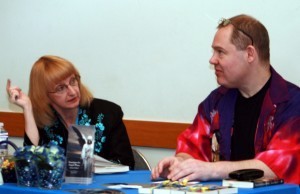
On Saturday I officially had the launch for my short story collection Sometimes the Angels Weep and I did it in what I consider to be a very unique way—I teamed up with someone else who also had a new novel to launch (Annie Daylon, releasing Castles in the Sand) and we did a double book launch together. It turned out to be a brilliant success, so I thought I would share some of the reasons why I think it was a success and what we did right and what, if anything, I might do differently if I ever do it again.
First, we didn’t make very many mistakes. There’s very little to criticize about this event. It went pretty near spot on perfect from set up to tear down. We even achieved roughly the attendance figures we hoped we’d achieve.
Okay, so how did we do it?
First, I think one of the advantages we had were built into the two of us in what we brought to the table. We both have expertise in many things related to throwing an event such as this, but nearly none of it overlapped. I am a tech guy with ADHD and OCD who can work with tiny little developmental details (as long as they have something to do with me touching a keyboard or putting a pen to paper), and Annie is a strategic planner to the Nth degree who is exceptional at running from point A to point B to point C in order to get things done in a certain time frame—something I am almost incapable of. She handled all the food and decorations and made a ton of executive decisions on anything involving that sort of stuff.
Our books are Indy books (very high quality Indy books that have been exceptionally edited. You would never know they were Indy books unless I told you, which I am doing). I designed most of the inside and outside of the books and got them ready for publishing (both the POD and Ebook versions). These are the kinds of things I am good at.
I do a bit of graphic design, so I put together the poster for the launch. If you go to the Special Events section of my site, you’ll see a small version of the poster along with some pictures from Saturday. The poster was a great success. We managed to find a local printing company (let me rephrase that—my partner managed to find a local printing company) that has exceptionally low rates. Once she managed to get me their number, I picked up the ball and uploaded all the art from my house. We did bookmark giveaways and the posters. To this day, I haven’t actually stepped foot in the printer’s. Just virtually.
We decided we wanted to have a PowerPoint Literary Trivia show (the sort of thing you see nowadays in movie theatres before the film starts) playing between our readings with a relaxing classical music soundtrack. I was in charge of putting that together. It wasn’t easy. Getting Isaac Asimov to dissolve from a mush of pixels into sharp focus over a transition of four frames with questions is tougher than you think. So is finding forty-five minutes worth of trivia and images to go along with it. Then there was an issue with PowerPoint not being able to cue up songs which I solved by ripping my CD and making the tracks one big long MP3 file that the presentation plays from the beginning of the slideshow.
What all this meant though, was that there was complete separation in our jobs and we knew exactly who did what. It simplified everything. There was no stepping on each other’s toes. As I mentioned, she could comfortably make executive decisions knowing I would probably be okay with them because she knew better than I did when it came to her stuff just like I knew better than she did when it came to mine.
The launch was on Saturday at one o’clock at the public library. The library opened at ten. We had three helpers with us in the morning when we showed up and, again because we both knew exactly what our responsibilities were, we were able to quickly get our parts set up and put in place. The room was decorated and ready to go within an hour and a half and it looked exceptional. The librarian was blown away by how we’d managed to transform it into our own reading / signing / selling / launching haven.
There is an expense when putting together a book launch, and it’s not small. In fact, I’m sure very few Indy authors manage to make money at their launches. We both did. And the main reason we did is because the expense of having a double launch is not double the expense of a single launch. I’m not even sure it’s any higher. If anything it might be a bit lower because you have someone else searching out deals for things and also bringing in their circle of friends to mingle with your circle of friends and potentially doubling the number of guests you’ll get at your event. And friends like to cross-pollinate we found out which means, potentially, buying more of your books.
Annie and I both did two twenty-minute readings, and before our readings, the room was very segregated I noticed. Her friends bought her books, my friends bought mine. I was signing “To XXX” where XXX was almost always someone I knew. But once we read, that completely changed up and it was like almost instantly I was being given books to sign by people I didn’t know. So a lot of my sales ended up coming from people she had brought in and vice versa. And of course, there were people neither of us knew who had come in from the publicity we’d done (again that had been her domain, sending press releases to all the local papers, contacting the radio stations, etc.) and the posters we’d plastered around town.
Reading is one of those things you either love to do or hate to do. I like reading, but I get nervous, so I have to practice a lot before a show. Once we had set up in the room, I spent the next hour and a half before the doors opened going over the pieces I was going to read. As it turned out, my work paid off—my readings went off without a hitch. As usual, I was very relieved once they were done. But in one of those “I sort of feel let down that it’s over now” kind of ways, you know?
So what would I do differently if I did it again? Not much. I’d be hard pressed to find a better writer to work with. Annie is amazing. The one thing we made a mistake on was the food. We over-estimated the amount of treats people would eat. Our launch was three hours long and we had two cupcake stands we rented full of bars and mini-muffins and other snacks. One would’ve been plenty. I think over-estimating food is a common mistake, though. But the cupcake stands weren’t cheap, so that’s a lesson learned.
One thing we did that I highly recommend was to have a photographer on hand for the entire three hour event snapping photos. I’m lucky because my girlfriend’s fifteen year old niece is a pretty good photographer (who wants to be a great one) and I have pretty good equipment. So I gave her my gear for a few weeks to practice with and then let her go to town at the launch and she did the whole thing for a ridiculously low price. Mainly because she’s fifteen and doesn’t know any better. Shh. Don’t tell her.
Having gone through the process and realizing in hindsight how hard it would’ve been to do it all myself (not to mention how costly it would’ve been—I would not have even broken even with my book sales, I would have lost money), I highly recommend trying a double book launch for your next title. Even if you have to hold back your release a month or so to line up with a fellow writer the upside is well worth the patience it will take to sit on your masterpiece. And you’ll have someone else to share that great memory with.
Michael out.
February 23, 2013
Book Launch!
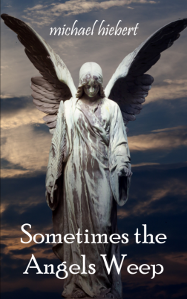 I’m finally having my proper book launch for my short story book “Sometimes the Angels Weep.” Some of you already have this book. If you do, it doesn’t matter… keep reading.
The launch is going to be a double launch. My friend, Annie Daylon, is also launching her new book, “Castles in the Sand,” then too.
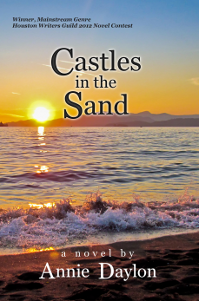 It would be great if as many people as possible could come out and show support for us. I’ve never done a launch before and I’m kind of nervous. I’ve only read in public twice, believe it or not. The launch is happening on Saturday, April 13th., from 1-4pm at the Chilliwack Library. There will be food and coffee and stuff. Plus, both Annie and I will be doing two readings each from our books.
Did I mention there will be food?
If you haven’t got a copy of my book yet, now would be a good opportunity to get one because a part of all proceeds is going to support literacy. If you DO have a copy and it’s not signed, bring it along and I’ll sign it for you. If you have a copy and it’s signed, come out anyway (and bring the book to make it look like you bought one because that always looks better) because it will be fun and you can listen to a reading. There’s a chance it might even be a good reading.
Annie reads really well.
Like I said, I’ve read twice.
And I don’t want to hear anybody grumbling and using “Chilliwack being so far away” as an excuse because it’s really not that far. :)
Oh, and in case it wasn’t obvious without being stated, feel free to bring along any friends, family, or even some people you don’t really care for.
February 1, 2013
This Has Nothing to Do With God (Except Everything, Really)

I need to start this post by making one thing vitally clear: this is not a blog post about religion. It is about mythology. Mythology, according to Webster’s Third New International Dictionary comes from the Greeks and is defined as a. an allegorical narrative: MYTH, PARABLE b. a body of myths: as the myths dealing with the gods, demigods, and the legendary heroes of a particular people in stories that involve supernatural elements. whereas religion, according to the same tome, is defined as the personal commitment to and serving of God or a god with worshipful devotion, conduct in accord with divine commands esp. as found in accepted sacred writings or declared by authoritative teachers.
Okay, so the distinction isn’t exactly a clear cut line, I’ll agree, but it’s important to know the difference. I found this out the hard way recently while, on Facebook one late evening, I was having a conversation that started out with about four people and wound up with just me and another talking about… well I thought we were discussing mythology. Apparently she thought we were discussing religion. And somehow between the two of us I managed to offend her to a crazy degree. Which, of course, was never my intent.
It is a very fine line, though. Because if a religion doesn’t happen to be the one you follow, it’s pretty much a mythology to you. But if I tell you your religion is a myth, you will defend it, even though, quite literally, all religions are myths. They are all stories about gods that involve the supernatural. It doesn’t matter whether or not they’re true. We’re not arguing here. I’m not trying to upset anyone. I’m trying to bring everyone together, in fact.
This was actually the point I was trying to make the other night.
If you start to study archetypes (and these, as I’ve said before, go back at least as far as Plato), you begin to see patterns in the collective unconscious that enter your psyche before you’re born. These patterns show up in many places such as our dreams and our fables but the one place they show up more than anywhere else is in our religions. The commonality between religions around the globe that sprouted up thousands of miles away from one another and hundreds of years apart is staggering.
Just take a look at some of the staples of good religious stories (and again, when I say story, I am not saying the story isn’t true… I’m using it as a catch all for each religion). Virgin births abound in many religions, Christ being one of the last. Buddha had three temptations five hundred years before Jesus did. The death and resurrection is pretty much a universal theme not only in every religion across the board but it’s also an integral part of the Hero’s Journey. Almost all of our stories, modern and ancient, contain a version of some sort of death and resurrection.
When I look at all of this does it make me want to be an atheist? No. It makes me see the world a different way. It makes me see that if all of these myths (and let’s just for the sake of convenience call them myths–the Buddha Myth, the Hindu Myth, the Christ Myth, the Tao Myth–each one of them are all telling us the same thing. If you look at them long enough you will see differences on top, but underneath they all point the same direction.
They all point inward.
Even the ones that, on the surface, don’t seem like they should. Jesus said, “Neither shall they say Lo here or lo there for behold the kingdom of God is within you.”(Luke 17:21). The Buddhists say you can’t find nirvana until you have found liberation from your self. Nirvana is the Buddha nature within all of us. The Hindus believe that the spirit–the true “self” (called the ātman)–is eternal. The goal of life is to realize that one’s ātman is identical to Brahman, the supreme soul. Whoever becomes fully aware of the ātman as the innermost core of one’s own self realizes an identity with Brahman and thereby reaches liberation. For Taoists, they seek “the way” which is natural, spontaneous, eternal, nameless, and indescribable. It is at once the beginning of all things and the way in which all things pursue their course. The Tao also is something that individuals can find immanent themselves.
And so it goes. With all religions it’s the same basic mythology. The trappings are different, the gods or God is different, but ultimately the direction you are being pointed is inward.
The problem is, much of the rest; much of what we are taking as literal isn’t meant to be taken literally at all. Like all mythologies religion deals heavily in archetype and metaphor. The symbols are there to help lead you in the right direction, not for you to dwell on and accept as fact. They are tools to put your mind in states that will bring you toward that place called God. If that’s what you call it. Or Nirvana. Or the Universal Power. Or the Tao.
If people realized this, and understood that (and I think it was Joseph Campbell who said this) touching all religions is like touching different parts of an elephant while blindfolded, there would be a lot less bloodshed on this planet. There would be a lot less misunderstanding. I think things would make a lot more sense.
What does this mean to you and your writing? After all, this is a writing blog.
It means your writing is pretty damn important. You can move people’s minds. You can change them. And if you have the power to change people’s minds, you can change the world.
Michael out.
January 15, 2013
Animal Archetypes: Finding Your Story’s Theme
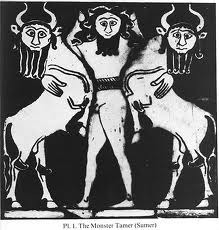
I’ve already discussed Jungian archetypes and how they can improve the characterization of your writing by helping you develop well-rounded characters. What I haven’t discussed is animal archetypes. The ancient shaman of the world knew about animal archetypes. Each animal represents a set of its own attributes and, taken metaphorically, these attributes can be translated into an archetypal theme for stories. Having an archetypal theme for your story is good because it gives it a primal foundation. It makes it ring true on a subconscious level. It gives your story that sense of “wonderment” we’re all looking for when we read.
Stories, like all mythology, and all art for that matter, are just metaphors. They are attempts to know the unknowable through a language that falls short of being able to explain it. Poetry probably comes closest. We want to experience the eternal in a world where time gets in the way because, as Joseph Campbell likes to put it, time and the eternal are opposites. Time sweeps away the eternal. The eternal can only exist now and it can only exist everywhere and nowhere. Time exists then and there. There is no eternal in time. So, in giving your stories an archetypal theme, you’re trying to give your readers a glimpse into the eternal.
You should ask yourself: Does my story have an archetypal theme? If it doesn’t, should it? If your answer is yes, you might be able to find one through an animal archetype that plays well against your Hero’s Journey. The theme is basically the lesson that the hero will learn throughout the story. Having this theme doesn’t change anything we’ve talked about. In fact, we’ve already touched on it, in a way, by saying the protagonist and the world at the beginning of the story must be flawed and, by the end of the story, they both must be flawed differently or no longer flawed. This change is the theme of your story. What you want to do is make this theme, or lesson, as archetypal (or primal, or as humanly subconscious) as possible.
So let’s look at a few animal archetypes and the themes they bring to mind. Remember when reading the attributes of the archetype that we’re talking in metaphor. Generally speaking, these archetypes reflect the way your protagonist will be at the end of your story, so you would want to start the story with your would-be hero flawed against the traits described in the archetype.
There are many, many animal archetypes to draw on, each one offering a different archetypal lesson. For now, I am only listing a handful. I’ve mixed male and female pronouns in these descriptions, but any of these archetypes can work with any gender of protagonist.
Ant Ants are hard workers who work well with others. They are willing to sacrifice their lives for the good of the community. They are industrious.
Bear The Bear is a protective mother with hidden strength. She is patient and can hibernate through winter storms. She looks inward to seeks answers and learns to know herself.
Butterfly The Butterfly transforms into a thing of almost divine grace. She becomes balanced and develops the ability to fly. What starts off as slow and grounded winds up as a thing of utter beauty and fragility. Butterflies stay focused on the outcome and the process.
Cougar The Cougar has strong leadership skills. He moves with grace and speed and often makes his way unseen. He has achieved balance and self-assurance.
Dog The Dog has learned how to love unconditionally. She will freely forgive. She seeks companionship and love and serves selflessly.
Goat The Goat knows how to build strong foundations. He is sure of foot and independent. He has great willpower. He helps others get over their insecurities. The Goat is the self-help guru.
Hawk The Hawk can move between the divine and the present world freely. He knows the Truth. He can see beyond the veil of the eternal. The Hawk is one with the Spirit. He awakens us to our creativity and our life purpose.
Lion The Lion has tremendous leadership qualities. He displays fearlessness. He enforces structure within the family, yet is gentle and fair. He shows great patience.
Monkey The Monkey acts in unpredictable ways but always with a certain power and grace that is true only to him. He has superb observational clarity and can see things that are hidden from others. Monkeys form families and get along well in communities.
Owl The Owl is wise. He can shed insight on issues for others. Generally, the Owl prefers to be alone, but will come to the aid of others when required. He has the ability to see into the shadows.
Raven The Raven is the explorer of the unknown. He is the wildcard of the animal kingdom, surrounded by mystery. He is at once, both destroyer and rebuilder. Sometimes he can have elements of the Trickster archetype. When the Raven speaks, it is often in riddles, but with the feeling that he is very learned, most likely from direct experience with the unknown.
Scorpion The Scorpion teaches constant vigilance and how to deal with intensity, whether it be environmental, physical, or spiritual. She is a master of self-defense and is always prepared for battle. Her size is misleading, for, although she is a small creature, her ability to “slip through the cracks” allows her many advantages. She works well as a spy or a secret agent.
Snake The Snake is associated with rebirth; the shedding of one’s skin and it coming back; also, the symbol of the snake swallowing its own tail makes the circle which is the perfect symbol of life and regeneration. The Snake is able to see the truth in people. She is the guardian of sacred places and the keeper of hidden knowledge. She represents power and life force. She is able to directly use the energies of the earth.
Tiger The Tiger has extreme focus and patience. He has the ability to look inwards and possibly act as a healer (the Tiger’s orange coloring symbolizes vitality and regeneration). He has courage, power, strength, willpower, and is an extreme source of energy. He is able to use tactics to his advantage.
Turtle The Turtle is self-reliant. She can awaken her senses on both the physical and spiritual levels. She has self-determination, inner-wisdom, and inner-knowledge. She is focused.
Wolf The wolf is the Teacher archetype. He guards you as he teaches you, sometimes strongly, sometimes gently, but always with love. He can teach you about rituals, how to establish order and harmony within your own life. He is able to heal. The Wolf knows that discipline within a group creates true freedom. He knows how find new paths and take new journeys. He is able to maintain perfect balance. He is loyal, and independent. Although he prefers to be alone, he is able to aid others when the need arises.
There. That’s a few just to give you the idea of how they work. Each of these animal archetypes bring with them an archetypal message or lesson that is truly primal. It is something that, if your hero learns it from example, will ring true with your readers on a psychic level. Because that’s where the strength of the archetype lies. In the subconscious. And thusly, in the eternal.
“And where we had thought to find an abomination, we shall find a god; where we had thought to slay another, we shall slay ourselves; where we had thought to travel outward, we shall come to the center of our own existence; where we had thought to be alone, we shall be with all the world.”
- Joseph Campbell, Hero with a Thousand Faces
Michael out.
January 8, 2013
Close to the Broken Hearted: Making Progress, Killing Cats
I hit page eighty-nine of the new book today. I have until September to finish it, so, on the surface it would appear I’m in good shape. However, looking at my outline, I’m only on scene eight of forty so if things continue in this fashion I am going to be way over any sort of realistic word count. As it was, today I had to shuffle some things around because I was sort of still in the first act eighty pages in! Now I am finally officially out of Act I.
I say officially because, since it’s a mystery, there’s no true dividing line between Act I and Act II. There’s actually probably three or four different Act II entry points that sort of overlap each other. I did this on purpose so it wouldn’t be obvious to the reader what was going on (you’d have to know the story to understand, but it’s not an “A body turned up. Act I over. Enter Act II.” kind of book. It’s more “There’s something sneaky going on and I wonder who’s behind it? And several different events transpire that could signal potential suspects that lead us into the major action.” kind of book).
But so far, I’m happy with it. The writing is tight. It doesn’t have the nicely gift-wrapped shape that book one did, unfortunately. This story sort of sprawls a bit. The first book was a dream to write (thank God because I had to write most of it during and following a major separation with my ex-wife, and probably wouldn’t have been able to if the plot hadn’t been so cut and dried). Not that this one isn’t fun to write, it is. It’s just requiring more thought. Plus, I have to make sure everything jibes with book one which is taking more time than just pulling things out of my exterior bottom brain as I like to do.
Also, this book contains a lot of historical information about my mythological little town of Alvin, Alabama, and I’m trying to make it as factual as possible. So it’s requiring that nasty thing called research, which also slows me down. Mostly I’m writing at night and doing the rest by day. Sort of like Batman, if Batman were writing instead of punching out Gotham’s criminals all night, and looking things up on Wikipedia instead of running a billion dollar company throughout the day.
Actually, it’s nothing like Batman.
Something funny happened while writing today that I didn’t realize until after I’d written it. Blake Snyder has this great series of books called Save the Cat! which are on writing screenplays (but they also apply to novel writing… if you’re a writer, read ‘em, they’re fantastic!). The title is in reference to your hero needing to be shown to be a good person, and so to do this you should have a “save the cat” scene or something like it early on in your story.
Well, what’s funny is today I killed a cat. Actually, it was practically a kitten.
Right at the end of page eighty-nine. Splat! Cat dead. As soon as I did it, I looked up at my bookshelf, saw the Snyder books standing there, and started laughing. I guess I fail the Blake Snyder final exam, but I’m sorry, Snowflake the Cat had to die. It was crucial to the plot.
I won’t tell you how he dies. You’ll only hate me for it.
Anyway, that’s it. Just an update. More for my benefit than anyone else’s I guess. :)
Michael out.
Rites of Passage, from the Womb to the Feminine Divine
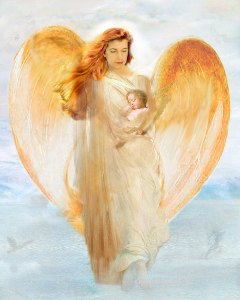
In all my discussions involving the Hero’s Journey, I’ve mentioned over and over that this isn’t an invention of the writing community, it’s something that’s built into our psyche. It’s been there for thousands of years. But I haven’t really explained why.
Most of the information I’ve been drawing from for my posts on the Hero’s Journey can be traced back, ultimately, to research done by the great mythologist Joseph Campbell and the psychologist Carl Jung. They were, by far, the greatest contributors to the work of archetypes and mythic structure and how it all relates to our lives. Carl Jung did much work on dream theory, putting together a roadmap of subconscious symbols consistent in what he called the “collective unconscious.” Joseph Campbell deeply explored the commonality of certain themes throughout all world religions and mythologies, painstakingly mapping them out in exquisite detail.
Campbell liked to say that the Hero’s Journey was man’s quest to the feminine divine. But what, exactly, did he mean by that? He also said it was the journey from the womb to the tomb and back again. Understanding both these concepts will take you a long way in strengthening your understanding of story structure. It will also illustrate the reason our lives here in the West are so vastly different than of those in the East because, as I’ve said before, to understand the Hero’s Journey and Jungian archetypes is to understand the journey of life. This is why it’s embedded into your brain: the Hero’s Journey is part of who you are. It’s how we live our lives. Or at least, how we are meant to.
Freud was pretty obsessed with Oedipus complexes, but he had his reasons. Humans are the only animals born unfinished; we need to cling to our mothers after birth in order to survive. We also feed from the breast longer than any other animal on the planet. According to Mr. Freud, due to these reasons and others, we become extremely attached to our mothers as a symbol of great love and bliss. She is our source of nurturing without whom we would not survive. Being separated from the mother during this early time in life can be a cause of great anxiety for us.
It’s also because of this that the father becomes our first source of frustration. We see him as an enemy trying to come between us and our mother. Freud said this anger we build toward our fathers, like the attachment and longing for our mothers, is something subconscious that stays part of us as we grow older, unless it is expunged one way or another.
Carl Jung would call a child at this stage of development the Initiate archetype. The Initiate has not been separated from his mother. He still longs for her, for he is still a boy. As a boy he seeks acknowledgement, thinks he’s the center of everything. He is ruled by his emotions, and he refuses to take responsibility for his actions. He also thinks he will live forever; there is no fear of death.
When the Initiate embarks on the Hero’s Journey and answers the Call to Adventure (entering the new world of Act II), the sequence of ordeals he faces that slowly rise in complexity toward the Climax in Act III is actually a Rite of Passage–it’s a journey from boyhood to manhood. It’s the way he breaks away from his attachment to his mother and becomes part of the father tribe. To once again quote Joseph Campbell, the Rite of Passage is a way “for the individual to die to the past and be reborn to the future.”
The reason the quest is a journey from the womb to the tomb and back again is that by the time the Initiate is finished along the path, he has become a man. He no longer thinks he will live forever. He has stared into the eyes of death and seen it first hand and now knows he’s mortal. He no longer longs for his mother but seeks feminine relationships. This is why it’s a quest toward the feminine. But why the divine? Joseph Campbell equaled the feminine with the divine, saying all women were symbols of the goddess. When asked why it was always the Hero’s Journey he was discussing and what, exactly, was the Heroine’s Journey, Campbell replied, “The heroine has no journey, for she is already perfect.”
Jung spoke of the journey toward the feminine in a slightly different manner, using terms of the archetypes Animus and Anima. The Animus archetype is the unconscious male personality existing in both the male and female, and the Anima archetype is the unconscious female personality existing in both the male and female. These are most prevalent in dreams and can become major factors in how people act out under times of stress. In terms of the Hero’s Journey, the male Animus quests for his unconscious inner anima. This quest, according to Carl Jung, proceeds in four distinct phases.
The first phase of discovering the anima comes in the form of the Eve archetype (as taken from the Biblical Eve); the emergence of the male’s object of desire. From here, it progresses to the Helen archetype (named after Helen of Troy). In this phase, women are viewed as capable of worldly success and of being self-reliant, intelligent and insightful, even if not altogether virtuous. This phase shows a lack or respect for women’s virtues and a general view of them lacking faith or imagination. The third phase is the Mary archetype (named after the mother of Jesus). At this stage, females now seem to possess virtue (although it may be in an esoteric and dogmatic way). The final stage of discovering the anima arrives in the form of Sophia (named after the Greek word for wisdom). With this phase, comes complete integration, and females are now seen as particular individuals who possess both positive and negative qualities. The most important aspect of this final level is that the anima has now developed enough complexity so that no single object can fully contain it.
Whether you go by Joseph Campbell’s explanation or Carl Jung’s, the end result is the same. After completing his quest, the Initiate is no longer a boy–he has become a man. And as a man, he has broken away from his ties to his mother, faced death and returned from the ordeal, and now seeks female companionship. He’s gone from the womb to the tomb and back again. He knows he is part of a greater whole. He has joined the tribe of other men, and he takes full responsibility for his own actions.
If you look back at my previous posts on the Hero’s Journey and thee act structure, you’ll find that this follows everything else I’ve said exactly, including the “God moment” in the five point Climax I described. But you should understand that this also follows our real lives. This is how we’re meant to grow up. The reason we think in Hero’s Journey terms is because we’re supposed to go through a Rite of Passage.
The problem is, as time goes by, that is happening less and less.
Now, to go off on a tangent a bit, and get slightly political, I think one of the problems we have in western society is we’ve pretty much lost the concept of the Rite of Passage. We have given up on the rituals of our forefathers, and that’s a bad thing, because they existed for a reason. They were there because they played an important role in our progression from children to adults.
As a society, we almost promote the concept of remaining children instead of becoming adults, and it’s dangerous. At the very least, without a Rite of Passage, one’s place in the world can become challenging and confusing when we grow up because, to some degree, we are still children. Some teenagers will, simply through instinct, self-initiate a Rite of Passage, and we’re seeing this all the time. It shows up in the form of street gangs and drugs and things like that. You don’t see nearly as much of these sorts of things in cultures where they still perform rituals at certain ages to define the line between children and adults. Furthermore, studies have shown that lack of a Rite of Passage can lead to self-esteem issues, which of course can lead to things like eating disorders, bullying, and even suicide.
Anyway, sorry to throw some personal views into a post on writing tips, but I thought it was a good place to put them. I won’t make it a habit.
At the very least, let me know your thoughts on the matter.
Until next time,
Michael out.
January 7, 2013
A Look Back at 2012: What I Read. At Least Some of You Won’t Be Surprised.
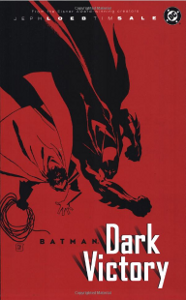
Many authors, it seems, are posting their 2012 reads on their blogs and I decided to do the same. I did read a few novels, however, by far the majority of what I read were, in one form or another, comic books. So, following Annie Daylon’s lead, I’m going to post a list of all the graphic novel anthologies I read, along with a short review of each.
Note, these are just the compilations. I did read quite a few single issues, too. Mostly the Avengers vs. X-Men storyline that spilled over into, like, seven different titles. I managed to keep up for about three months until it hurt my pocket book too much. The other big series I read the first four or five books of and really liked was Brian K. Vaughan’s newest title, Saga. The problem with that one was that it’s hard to find anywhere that carries it. The only place I know of is way out in Surrey which is over an hour from where I live and, by the time I got round to getting there, they were always sold out or had jumped the price on the current issue by two or three bucks. So I gave up.
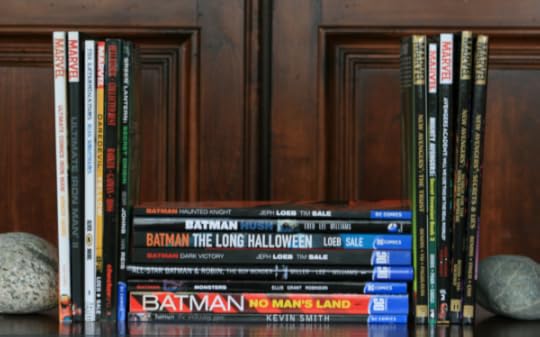
Anyway, in no particular order, here are the graphic novel compilations I read in 2012. Again, I did read some fiction. But I will argue to the grave that some of the comic writing out there is better than a lot of the fiction writing out there. Of course, a lot of the comic writing out there is utter shite, so there’s always that argument coming back at me.
Batman: Dark Victory by Jeph Loeb & Tim Sale. This was my introduction to Jeph Loeb’s writing and Tim Sale’s artwork and I was sold from page one. They are both amazingly talented. So much so, I can’t believe I never stumbled on them before. I love the way Tim Sale draws the Dark Knight.
Batman: The Long Halloween by Jeph Loeb & Tim Sale. When I find a comic writer (or any writer, for that matter), I tend to read deeply into his stuff. I think I’ve read everything Neil Gaiman, Warren Ellis and Garth Ennis have ever produced. When I finally finished it was very sad, because I felt like I was running out of good writers (they really are hard to find in comics). Then along comes this team. I read The Long Halloween after Dark Victory and I’m not sure even now which order they were supposed to go in. There are discrepancies all over the place. I still love the storylines in both and they stand alone well. Again, the artwork is superb.
Batman: Haunted Knight by Jeph Loeb & Tim Sale. I was actually disappointed in this volume. I think it must have been an early project for the two collaborators. Sale’s artwork wasn’t as good as in the other books I’d read, and the three stories (which were unconnected) didn’t grab me at all.
Batman: Hush by Jeph Loeb & Jim Lee. I ordered this one off Amazon with great anticipation. Having found a fantastic writer, and knowing in advance how fantastic an artist Jim Lee is, I figured it couldn’t miss. I wasn’t disappointed. It’s weird comparing Jim Lee’s art to Tim Sale’s. They are complete opposites. Tim Sale is like a minimalist and Jim Lee draws every freaking detail in a scene. They are both gods. Small g.
Batman: The Widening Gyre by Kevin Smith. I may as well get the Batman stuff out of the way first. This was my year to read Batman comics. I wasn’t much of a fan before 2012, but this year I was so inspired I wrote my YA book Darkstone: The Perfection of Wisdom with Batman in the back of my mind. It shows a bit. Hopefully not “let’s sue him” a bit. This story was great. I love Kevin Smith. I’ve seen all his movies and read a lot of the comics he’s written. The Widening Gyre is actually a sequel to another Batman graphic novel he wrote called Cacophony that I haven’t read, but on the advice of the guy working at the comic store, I bought this one instead. I’m glad I did. It’s mainly a love story. Until you hit the super surprise at the end. Then it’s no longer such a love story. It’s a Kevin Smith story 100%.
Batman & Robin the Boy Wonder by Frank Miller. Being a huge Miller fan, I had great expectations for this book that it simply didn’t live up to. It’s basically a redone (or, probably, expanded is a better word) origin story of Robin, and there are some cool parts, but there are also parts where I felt Batman acted completely out of character. It didn’t stand up to the rest of Frank Miller’s work, things like Year One and The Dark Knight Returns which I consider to be some of the best stuff done to date in the industry.
Batman: Monsters by Warren Ellis (or so the cover says). I bought this book because the cover said Warren Ellis wrote it. It actually contains six unrelated comics, one of which was written by Warren Ellis. Because Warren Ellis is almost as good as Shakespeare, his story is fantastic, of course. But the other five are terrible.
Batman: No Man’s Land by Assorted authors. I ordered this off Amazon because of the reviews and because it was the first of a number of volumes and because it was huge (it’s almost an inch thick). I was running out of things to read and, I thought, if it’s good, I’ll have something to keep me going for a while. Unfortunately, it wasn’t very good. The idea is that Gotham has been wiped out by an earthquake and is considered “No Man’s Land.” It’s not even part of the United States anymore. Gangs have taken up in the streets. Cool idea, right? For about forty pages. Then it starts to be the same thing over and over and over. I can’t imagine reading another volume of this. It took me a month to get through the first one.
Daredevil: Yellow by Jeph Loeb & Tim Sale. So I’m done listing Batman stuff, but still have a Jeph Loeb and Tim Sale graphic novel to mention. This was strong work. Not as strong as their batman stuff, but I wasn’t disappointed. Again, it was an origin story, retold from a different angle. There seems to be a trend in comics in going back to origin stories lately.
Clive Barker’s Collected Best: Hellraiser by Alex Ross, Neil Gaiman & Mike Mignola. Well with an all-star lineup like that, how can you go wrong? This features a long series of stories based on the Hellraiser movie franchise. If you liked the movies, you’ll like this.
Green Lantern Secret Origin by Geoff Johns. I bought this because it was almost free. Again, it was another origin story. Even worse, it was a tie-in to the movie. Need I say more?
The Exterminators: Bug Brothers by Simon Oliver & Tony Moore. One of the weirdest concepts I’ve ever seen actually get turned into a product and sold. I can just imagine the conversation they had before making this. “Let’s do a comic about cockroaches.” “Don’t we need superheroes?” “Nah, the roaches will be kinda like the heroes.” “Sounds great! Pass the bottle, hey?” The funny part is, once you actually get into the thing, it’s not that bad. It held my interest. I’m not sure I’ll go out and buy volume two, but I didn’t mind it. I was in a Facebook conversation with about ten British guys shortly after reading it and they loved it like it was some kind of religion, so I think the thing actually has a following. Maybe there’s a moral here somewhere.
Ultimate Iron Man II by Orson Scott Card. What can I say? It’s Iron Man. It was written by Orson Scott Card. It was pretty darn good. Not fantastic. It wasn’t Ender’s Game or Speaker for the Dead, but it was better than some of Card’s other novels.
Iron Man: Armor Wars by Warren Ellis. This is similar to what I just said about Orson Scott Card. Warren Ellis writing Iron Man can’t be bad. It wasn’t super fantastic. It felt like he was doing it for the paycheck, but even non-super-fantastic Ellis is better than most writers at their pinnacle.
Avengers Academy: Will We Use This in the Real World by Christos Gage. While reading all the AvsX issues, I got to know some new writers. One of them was Christos Gage doing Avengers Academy. I think he’s pretty young, but he has the potential to become great. This compendium was solid. The storyline kept my interest and made sense. That’s good enough for an almost unknown author, in my opinion.
The Mighty Avengers: Secret Invasion by Brian Michael Bendis. Brian Michael Bendis is right up there with Warren Ellis as one of my favorite comic book writers, especially when it comes to superhero stuff. I love his work on Ultimate Spiderman. Yet, this issue failed to be spectacular. In fact, without actually opening it, I can’t recall a single thing about the plotline right now.
The New Avengers: The Trust by Brian Michael Bendis. Another Avengers title penned by Bendis and another one where I am having problems recalling the story. I know one of the two had something to do with spiderwoman backstabbing the rest of the group and losing her powers. At any rate, neither of these are his best work. Maybe Bendis shouldn’t be writing Avengers. Personally, I’d like to see him go back to doing Powers, that was unbelievable. Although, I hear House of M is really good.
The New Avengers: Secrets & Lies by Brian Michael Bendis. I hate having to keep slamming Bendis, but none of these stories have stuck with me, so I can’t really give them good reviews. This actually might be the spiderwoman backstabbing book.
The New Avengers: Search for the Sorcerer Supreme by Brian Michael Bendis. Okay, finally one Bendis Avengers comic I can say was a good read. This one had me on the edge of my seat, and the dialogue was great, in true Bendis fashion. I only bought these last half dozen or so graphic novels because of Bendis’s name on the cover, that’s how much of a fan I am. So if you’re looking for a great comic book writer, don’t let these reviews turn you away from him, just pick up an Ultimate Spiderman instead or one of the Powers compilations that have been coming out. They’re utterly fantastic.
And that’s my 2012 in comics. If any of you out there have any comic recommendations or recommendations of comic book writers I might not know who are good, please, please, please send them my way. If I had to choose my favorite from this entire list, I’d have to say it was probably the first one I mentioned: Batman: Dark Victory, but that might just be because I was so blown away about finally finding a new writer and artist team that I loved.
Michael out.
Solidifying Your Stories: Places to Get More Information
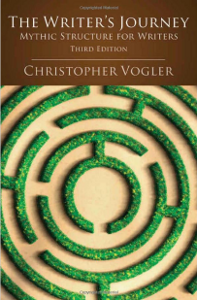
I thought I would list my top fifteen favorite books that touch on the subject of mythic structure. You’ll see that many of these books have the words “movies” or “screenwriting” in the title. Don’t let that scare you off. As I’ve discussed in previous posts, the ideas they present apply just as much to your novel writing as they do to writing for the screen. In fact, reading books about screenplay construction is, in some ways, more helpful (for me, anyway) than reading books about novel writing because movies wear their underlying structure so much more obviously on their sleeves.
Rest assured, though, once you learn the concepts, they travel freely over into whatever type of writing you do and will automatically adapt to the extra complexity needed when constructing a novel.
The books are sort of listed in order of how I perceive them as being effective, although I would really recommend anyone seriously interested in improving their stories to study every book on this list.
Author
Title
Vogler, Christopher
The Writer’s Journey
Snyder, Blake
Save the Cat!
Campbell, Joseph
The Hero with a Thousand Faces
Field, Syd
Screenplay
McKee, Robert
Story
Wellman, Wendell
A Writer’s Roadmap
Bell, James Scott
Plot & Structure
Bonnet, James
Stealing Fire from the Gods
Campbell, Joseph
The Masks of God (DVD set)
Field, Syd
The Screenwriter’s Problem Solver
Voytilla, Stuart
Myth and the Movies
Snyder, Blake
Save the Cat! Strikes Back
Snyder, Blake
Save the Cat! Goes to the Movies
Field, Syd
The Screenwriter’s Workbook
Kress, Nancy
Beginnings, Middles & Ends
That’s it for today’s post. Just passing on some information that has dramatically helped me improve the quality of my work over the years. I hope it might help you, too.
Michael out.
Michael Hiebert's Blog

- Michael Hiebert's profile
- 99 followers

