Emily Smucker's Blog, page 4
March 18, 2023
Gardening, Furniture Restoration, and an Estate Sale Bonanza (Emily Smucker Vlogs Episode 4)
This week’s YouTube video is up! Enjoy a small glimpse into our lives as we garden, fix up the table we found on the curb, and grab some awesome craft supplies and tools at an Estate Sale down the street.


March 11, 2023
Touring Houston—Art Museum, NASA, and More Curbside Treasures (Emily Smucker Vlogs Episode 3)
My brother Matt works at NASA’s Johnson Space Center, so this week we took a tour. We also visited the Houston Museum of Fine Art. Phoebe’s dad, Tom, was in town, so that’s why we did all the fun things!
Remember, I post a new vlog every Saturday morning at 9am ET (Although it might take a few more hours for me to post it on the blog here.)
March 4, 2023
HUGE Goodwill Outlet Haul! (Emily Smucker Vlogs Episode 2)
Hello folks! In this week’s vlog, Phoebe and I go to the Goodwill Bins and come home with lots of stuff. Enjoy that story, plus a few more adventures, in the video below!
Remember, new vlogs come out every Saturday morning at 9 am EST! If you want to see them instantly, you can always subscribe directly to my YouTube channel.
For now, I hope you enjoy the video!
February 25, 2023
I Started A Weekly Vlog Series!
Hey hey!
Recently people have been asking about my life in Texas. After all, I haven’t updated my blog since I moved here, and I’ve barely even posted on Instagram.
The truth is, I don’t feel like blogging or Instagramming. But I do feel like making YouTube videos! So I decided, you know what? I don’t serve social media. Social media serves me. I’m gonna make YouTube videos.
For the foreseeable future, I plan to make weekly vlogs about things I’m making, decorating my room, and fun excursions I’m taking. I’ll post them at 9am Eastern on my YouTube channel.
But for now, enjoy my first vlog below!
November 9, 2022
The Reality TV Show Experience
 The Drive
The fall leaves were at their best stage of orange as I drove north through the misty sunrise. I knew I was supposed to eat a hearty breakfast before I came, so I tried to nibble a muffin, my stomach in knots.
Today was the day. I was going to be on America’s Next Great Author (ANGA), a new reality TV show about writers.
Well, sort of. Right now we were just filming the pilot. (I explained the format in my previous blog posts here and here, if you need to do a quick skim to refresh your memory.)
But I’d never done anything like this before, and as much as I tried to convince myself to calm down, my stomach didn’t listen.
I was wearing a new dress I’d made myself. Shoes I’d mutilated to remove the Adidas label because they’d told us not to wear brand names. A new headcovering I’d clipped from the corner of a thrift store scarf and carefully hemmed. A face cream that was supposed to reduce my rosacea.
I was ready.
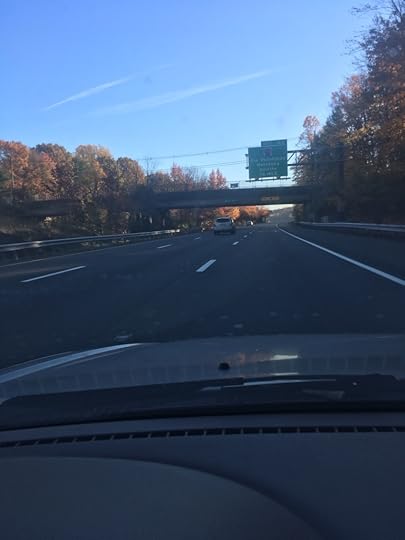
Ready, yet inexplicably nervous. I’d been trying not to take the whole thing too seriously because I don’t do the best with stress. But getting up at 6 am for the long drive to Newark didn’t help matters.
Still, Sunday morning may be the only time it’s easy to drive to Newark, NJ. I navigated through the deserted streets until I found the nearly-empty parking lot, and then, with a bit of time to spare, I brushed my teeth and spat in the bushes.
Then, gathering my yellow coat, a very small purse, and the papers I needed, I walked down the street to the library where the filming was taking place.
And there they were—a long line of authors in their Best and Brightest outfits, excitedly chatting in the morning sunshine.
The WaitI registered at the little table, handing over my appearance release and showing a photo of the negative Covid test I’d taken that morning. They handed me a name tag in a plastic sleeve. Then I walked to the back of the line and waited.
We really waited for quite a while. An hour, I think. Maybe they were still setting up inside, I don’t know.
But we were all writers, easily entertained by other human beings, so we gabbed contentedly. Sam told me about a book she was reading that explained how to understand and pursue your true desires. Jeremy told stories about people puking in his Uber.
“Do you know most of the people here already?” I asked Sam.
“Yeah, I met most of them at the meet-and-greet yesterday,” she said. All the people who flew in Saturday had a chance to hang out and meet each other, but I’d missed it. One of the drawbacks of driving up.
There were a lot of people involved with this operation, and I tried to figure out where everyone belonged. The people in line with me were all writers. Someone said there were 75 of us—apparently, out of the 100 semi-finalists, 25 were unable to make it, which makes sense considering we were responsible for our own transportation and lodging.
I think the other well-dressed people wandering about were all producers, though it was difficult to tell because their name tags looked exactly like contestant name tags. I recognized David and Arielle. They were our mentors leading up to the show, filming helpful YouTube videos and doing a live Q and A. David also did a one-on-one mentoring session with each of us to help us polish our pitches.
Actually, as I was registering, David greeted me and we took a selfie. The producers, especially David and Arielle, were just like that the whole time—acting like they knew us because they’d watched our submissions so many times they felt like they did. Which was really nice because it lent a bit of familiarity and comfort to a brand-new situation.
There was also an ASL interpreter, immaculately dressed in a chic black outfit. One of the writers was deaf.
And finally, there was a whole group in well-worn black t-shirts who held cameras and microphones and whom I assumed to be the film crew. It was so funny how you could easily tell who expected to be on camera and who didn’t. The latter, of course, was dressed far more comfortably.
Some filming happened that first hour, though the camera was barely on me. David went along the line asking people questions and hyping us up, and that part was filmed.
And then finally, things got moving, and we all gathered in front of the library like we were posing for a giant group picture. Kwame Alexander crossed the street and we all cheered.
Kwame, a Newbery-Medal-winning author, was the host of the show. He hyped us up too. “Repeat after me,” he yelled. “I am the greatest!”
“I am the greatest!” the crowd shouted back.
“Not because I am better than anyone else”
“Not because I am better than anyone else”
“But because no one else is better than me!”
“But because no one else is better than me!”
Well, it’s probably a good thing I was in the back of the crowd because my Mennonite modesty would never allow me to shout a phrase like “I am the greatest.” So I just stood there silently and slightly awkwardly like I do when people recite the pledge of allegiance or sing that song that goes “his blood atones for all our race.”
After that, properly hyped and ready to go, we trooped into the library.
The LibraryOld libraries are so interesting; a mix of timeless beauty and utilitarian practicality.
The Newark Public Library is such a place. Worn marble steps and stone arches right next to a folding table and stackable chairs. Rows and rows of beautiful hardback books with call numbers taped to their spines. Gorgeous murals. Paper posters advertising current library events.
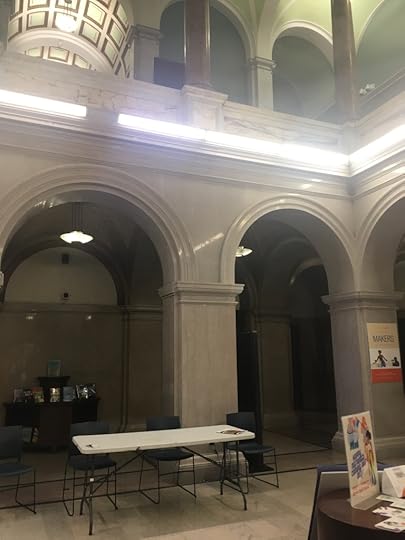
We went inside, up the stairs to the second floor, through a small-ish room, and into an area full of computers where the film crew hung out.
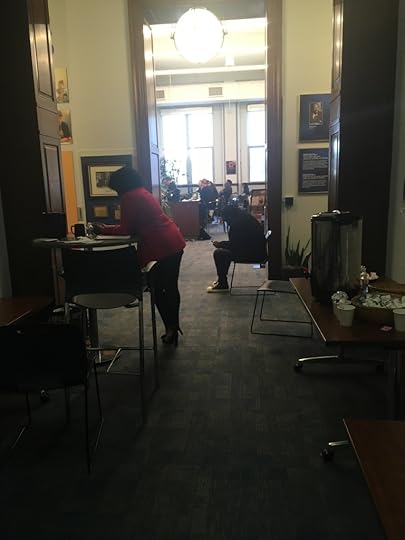

Then, turning left and walking past the film crew area, we found ourselves in a long room full of chairs. All the writers found seats, while the producers and film crew rushed about. I plonked myself down near the water cooler and watched a crew member hang an “America’s Next Great Author” banner over the fireplace.

“Hey,” said the writer next to me. “I’m Maz.”
“Maz?”
“Like Jazz, with an M.”

We talked about our backgrounds and writing projects. Maz told me that his book is a memoir about being a Muslim child in Chicago during the Iranian hostage crisis.
We were indoors instead of outdoors, yet still we waited and waited for things to begin. It was wonderful. I drank water and met writers. Inman, behind me, was a sci-fi writer. Nadia sat at the end of my row. Fascinatingly enough, she’d also attended Oregon State University.
My purse was full of beef jerky and crackers. I should have eaten them, because I was no longer nervous.
But I didn’t.
And Then It BeganOut of the 75 semi-finalists that showed up, only 20 of us were going to be able to pitch our book to the judges.
“Do you really think they’re going to pick the 20 finalists randomly?” Sam had asked me as we’d stood in line.
“I don’t know,” I’d said. “That’s what they said at the live Q and A, but if you’re trying to make this into a TV show, wouldn’t you hand-pick the most interesting people?”
And sure enough, once things got going, David and Arielle told us that they weren’t choosing the finalists randomly after all. They’d hand-picked 20 people to pitch.
I wasn’t upset about this at the time. But later when I told family and friends about it they were confused and indignant. You mean they made everyone else fly out there knowing full well they weren’t going to let them pitch?
I assumed there was an explanation but I didn’t know what it was, so last week I had an email exchange with the producers and they kindly explained the process to me.
Turns out that at the time of the live Q and A, they were planning to choose the finalists randomly. David and Arielle have held many Pitchapaloozas over the years at bookstores and writer’s conferences, and the process has always been the same: Out of a group of writers, 20 people are randomly selected to pitch.
Of course, this is the first time they’ve ever done a Pitchapalooza as part of a TV show.
Other contest-type TV shows, like American Idol, hold open auditions in cities—auditions which are so massive that most people don’t even get to meet producers or judges. Also, some people are selected just so they’ll humiliate themselves on camera.
Wanting to go a different, more wholesome and supportive route, the ANGA production team decided to choose 100 semi-finalists from online submissions. That way there’d be few enough people so they could meet them all, but enough people to ensure that at least 20 would be able to make it.
They assumed that most of the people who ended up coming would be within driving distance of Newark. But when they started getting RSVPs from all over the country, they decided to add things to the event to make it more like a writer’s conference, so that everyone would get help on their book-publishing journey even if they didn’t get to pitch.
So they arranged a number of networking events, added a writer’s conference component for after the Pitchapalooza was over, and gave us free copies of their books on how to write and publish.
But then, between the live Q and A and the filming, they started thinking about the limitations of randomly drawing people to pitch. What if they only drew romance novel writers? Then only romance novel writers would hear useful feedback from the judges, and sci-fi writers wouldn’t get as much out of the experience.
So they hand-picked 20 people to pitch, making sure a wide variety of genres were represented so that everyone could take away something useful even if they didn’t get to pitch. But since the list of who was coming and who wasn’t kept fluctuating, they didn’t finalize the list until everyone was checked in.
The PitchapaloozaThe panel of judges sat up front. Some of them were bestselling authors and in general they seemed like Very Important People but since I couldn’t see or hear super well from my position near the back of the room, the only judge I can identify, besides David, was author Jason Reynolds.
Kwame Alexander hosted the show. He would come to the front of the room and say something like, “she’s a small-town mayor who loves to knit and wrestle alligators in her spare time. Give it up for Jessica Whitlock! And we’d all cheer as Jessica Whitlock came forward.
(This is just an example. There was no Jessica Whitlock. I remember very few details about the people he called up, except that he made them all sound like they had Main Character Energy.)
Then “Jessica Whitlock” would stand at the podium and, in one minute, pitch her book.
And when she was done, the judges would offer feedback on what was working and what could be improved.
Then she’d go into a different room to get personally interviewed, and Kwame would call up the next finalist.
I wanted to pitch. I’ve always wanted to pitch, although I’ve tried to be realistic about my chances. You all know how theatrical I can be. I love public speaking. I didn’t expect to win, but I wanted to stand up there and say things.
But one by one, they called people up, and it was never me.
It’s hard to describe how horrible I felt.
Part of this was just Emily Disease. I’d gotten up too early, I hadn’t eaten enough, and I was peopled out. There were crackers and beef jerky in my purse but I didn’t want to start merrily munching on camera. I had to pee, but I didn’t want to be in the bathroom if they called my name. I was thirsty, but there was a camera between me and the water cooler, and I felt weird walking in front of it.
This makes it sound like I was stuck in the Pitchapalooza for ages, but it really wasn’t that long. Maybe an hour and a half or two hours.
But during those two hours I slowly descended into deeper and deeper misery.
There was something really horrible about not getting chosen. Like being a kid when the athletic kids are picking teams, and every time thinking “maybe I’ll get picked next” but you never are.
I thought about Sam’s book. The one about understanding your true desires. At the time it had seemed a bit silly, yet here I was, getting in touch with my true desires after all.
I’d tried not to take it too seriously, but right now, it mattered so much to me. I didn’t want to pitch for the fun of it, I wanted to be chosen. I wanted non-Mennonite people to care about Mennonite stories. I wanted recognition outside the Mennonite world.
But they called number 18, number 19, number 20…and then it was all over.
And I was not picked.
Reflections on RejectionIt took me a while to process all of this. Why I cared so much. Why it hurt so much.
I drove down to Texas in the days after the show, and when I stopped at my cousin Jason’s house in Tennessee, we talked for hours about our lives and our writing projects. Jason is also a writer but, unlike me, he’s been to writer’s conferences.
“It’s the same way at writer’s conferences,” he said. “At home you can be realistic, and tell yourself it doesn’t matter that much…no matter what happens you’ll gain feedback that will make you a better writer. But then you get to the conference and it feels like the only thing that matters is being accepted by an agent. I’ve heard grown men crying in the bathroom.”
Then he pulled out the best analogy: it’s like asking someone out.
You can tell yourself that it’s okay if they say no…the world won’t end. Other romantic prospects exist. But when you’re rejected, in that moment it feels like the only thing that matters.
Crowning a WinnerThe one bright spot in my misery was hearing some of my new friends get called up to pitch. Especially when Maz got chosen. I cheered like crazy.
Also, the people who did pitch had amazing, fascinating stories. It was fun to imagine reading their books in the future, and very interesting to hear the professional judges offer feedback.
But when all 20 finalists had pitched, the atmosphere in the room was heavy, somber, sad. 55 of us were utterly dejected. Kwame and the judges started telling stories about how many times they’d been rejected before they’d found success, trying to cheer us up and encourage us to keep on with our writing.
“I didn’t even realize I cared about pitching that much,” Inman told me later.
“Me neither,” I confessed.
The judges bipped off through the stacks to confer with each other and choose a winner, and the film crew started filming some audience shots. Then there was a bit more waiting and chatting time, before the judges came back and Kwame announced that the winner was…Joi Miner!
I hadn’t met Joi yet but I rooted for her anyway. She was exuberant and kind and she radiated, well, pure joy. I went and talked to her after everything was over, and she was lovely.
 The Aftermath
It was now about 1 pm. The Pitchapalooza was over. “There’s lunch across the hall, and then come back in here for a special surprise!” the producers told us.
“Actually, we’ll just tell you the surprise now. We’re holding a mini writer’s conference.”
Then we were dismissed. I didn’t know what to do first. Eat? Use the bathroom? I sat down at a lunch table with a bunch of finalists and a producer, and they had interesting things to say about the interviews and such but I was mostly focused on my own misery.
I mean, physical misery. I was so hungry it hurt, and the pain didn’t immediately dissipate as I stuffed my face and tried to talk to Autumn through an exhausted brain fog.
9 times out of 10 I can eat a small breakfast and be perfectly fine until mid-afternoon, although I don’t normally do it. But every once in a while I get inexplicably ravenous, and today was one of those days.
I needed some air and space. After eating and using the bathroom I took a walk to my car. And I tried to sort things out in my brain.
I could just leave, except I wasn’t fit to drive. Should I take a nap in my car? Maybe I just needed some tea.
Yes, that was it. I had food in my system and a bit of alone time, now. I’d be fine if I could only get some tea.
So I stuck a tea bag in my purse and went back to the library.
And then, something odd and beautiful happened.
As I walked back into the main room, a woman said to me, “I really liked your pitch.”
I looked at her with the most what the bunnyslipper expression. “But…I didn’t get to pitch,” I said…although I don’t remember if I said it out loud or just with the confused wrinkle between my eyebrows.
“Oh, sorry, I’m one of the producers,” she said. She explained that she and the other producers had watched our submission videos so many times they felt like they knew us. She said that she’d spent a lot of time on a farm growing up, and she really thought I should do something with my story.
A Quick Explanetory InterjectionI’m realizing, as I’m writing this, that I ought to include my pitch in this blog post. Because you guys have no idea what I’m talking about when I mention my pitch/book/project.
But I did something embarrassing and maybe unethical that’s keeping me from sharing it.
See, on the combine last summer I got a random book idea: What if there was a teenage Mennonite combine driver who had to figure out how to bring the harvest in alone when her uncle/boss had an accident similar my dad’s that puts him out of commission?
This was around the time I heard about America’s Next Great Author, so I decided to pitch this book idea.
Unfortunately, I only had a few days to write the pitch, because I wanted to film it in front of my combine and I was about to fly east. I needed a main character name. It had to be Mennonite. It had to be memorable.
So I stole a real person’s name.
I intended to ask her for permission, and I’m going to as soon as I can psyche myself up. If she doesn’t want me to use it I’ll pick something else. But I barely know her and it just feels weird and awkward.
But in the meantime, I don’t want to post my pitch here because I’m sure some of you will recognize the name.
Tea DesperationBy the time I made my way into the room for the writer’s conference portion, I was so tired the world seemed vague and hazy.
I needed tea.
There was a coffee cart in the little in-between room, but no hot water. So I took a cup and my own tea bag over to the water cooler, but the tab for hot water was broken off.
I tried to fix it with a bobby pin, but it didn’t work.
Welp, so much for that. I sat down. I tried to focus on the speaker’s advice. I began to doze.
This is crazy. I need tea. I will acquire tea by any means necessary.
Thus, I went wandering around the library in search of hot water. And for a while, I found only disappointment. One water cooler was empty. There was a room in the library labeled “cafe,” but it was just vending machines. One of them was a coffee-dispensing machine, and I thought it might give me hot water, but I couldn’t get it to turn on.
But finally, I found a water cooler with functional hot water in a back room in a dark corner where I’m not sure I was supposed to be but there were no “keep out” signs and I promise I just got water and left.
Anyway. I suppose I could have choked down some coffee and acquired caffeine that way. But tea has a psychological effect on me as well as a caffeination effect. When I have tea, I feel like everything is going to be okay now.

And things were much better after that. Revived by tea, I fully enjoyed listening to the Q and A with some of the producers who had lots of writing and publishing experience to dispense.
The End Is NearThat was the end of the planned events at the library, but the producers arranged another networking meetup where everyone who didn’t get to pitch could get together that evening and pitch to each other.
But like the networking events on Saturday, I wasn’t able to go as I had a long drive ahead of me.
So I made the most of the library time. I talked to Inman for a while, and then I introduced myself to Joi and we talked for a bit. But people were leaving, and I saw Kwame coming toward us, looking like he was trying to clear the room.
Now I hadn’t talked to Kwame yet, partly because I always thought he’d be too busy, and partly because I was a little star-struck. Growing up I didn’t know what an Oscar or a Grammy was, but I knew exactly what the Newbery metal was because we always bought books with the gold Newbery winning or silver Newbery honor stickers on the front. That’s how I found all my favorite authors. That’s the award I wanted to win someday.
In some ways, it’s the only award that really impresses me.
So when I saw Kwame coming towards me, and I knew I was going to leave soon, my better sense took over and I decided to talk to him.
I introduced myself and said that it was awesome to meet a Newbery award winner. That it had always been my dream to win that award. And he said it was never his dream, but it changed his life.
And then he started saying nice things about my writing, which completely took me off guard. I did not expect him to know who I was.
I don’t know why…I mean he was a producer as well as the host and had looked over the materials quite a bit in order to choose semi-finalists and finalists. So I guess it makes sense.
But in my head, Newbery Winner=Important Person, and Important Person=Not Knowing Who I Am. This math always adds up to Kwame not knowing me from Adam, and so I was quite startled to realize this was not the case.
So ultimately, while I left the event with the heaviness of not being chosen, I also felt the surreal joy of my work being recognized and appreciated by someone I percive as Very Important.
At the beginning of the day Kwame had told us to yell that “no one else is better than me,” but I don’t think that’s true. The ones who were finalists over me were better than me. But after talking to Kwame I felt like I was close…like I could achieve something if I just kept at it, tried a little harder, put in more effort. Really went for it.
Going HomeThe drive back from Newark took over 4 hours along narrow roads through random small towns. Nothing like the easy breezy drive up. But I didn’t mind so much. I wanted time to think.
Well, I had plenty of time to think. Because after resting on Monday, I spent the next three days driving to Texas to move in with my brother Matt and SIL Phoebe.
That’ of course, is another story for another day.
But after spending so much time thinking, and now writing, about my day, I am left deeply grateful for it, as well as rejuvenated and motivated to keep writing. And that maybe I have a chance to be successful at fiction.
Thank you all for following along on my journey. When I posted on Instagram about not being able to pitch, so many of you sent me messages and reactions of disappointment. And it just made me realize how many people I have supporting me and cheering for me, and I don’t want to take that for granted.
Thank you so much.
***
Order my book:
Print Version
Kindle Version
Follow me on:
Instagram: @emilytheduchess
Twitter: @emilysmucker
Facebook: facebook.com/emilysmuckerblog
YouTube: youtube.com/emilysmucker
TikTok: @emilytheduchess
Patreon: patreon.com/emilysmucker (This is where I post bonus blog posts, about more personal/controversial subjects, for a subscription fee of $1 a month [or more if you’re feeling generous]. I try to post twice a month.)
October 18, 2022
A Wild Week in Lancaster City: Car Accident, Locking Myself Out of the House, and More TV Show Info
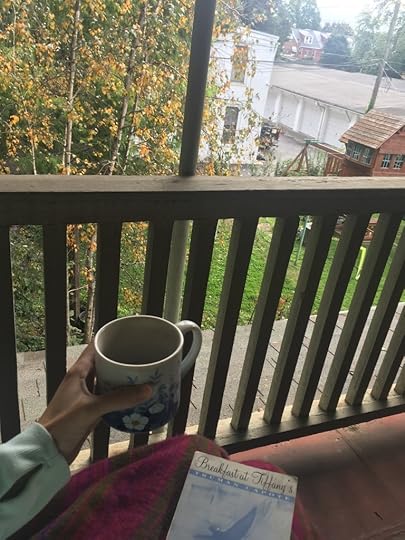
So far I’ve been having a beautiful time in Lancaster city. The wild Autumn breezes whip the leaves along the sidewalk as I walk to the nearest coffee shop. I admire the houses I pass—cozy brick structures, but instead of identical row houses, they all have interesting unique designs.
But I’ve had my stressful moments too.
The (Very Minor but Very Weird) Car AccidentLast week as I was driving right through the heart of the city, some crazy lady hit my car.
I was stopped at a stoplight, in the middle lane, when whomp! Someone merged right into me from the left turn lane. I don’t know how she didn’t see me. I wasn’t even in her blind spot—I was in front of her.
The light turned green but I couldn’t move because her car was stuck on my mirror. And when she finally dislodged herself I still wasn’t sure what to do because there was no place to pull over. But I didn’t want to block the street, so I pulled forward to the stoplight, which was red again.
She drove behind me and pulled up beside me in the right lane. We rolled our windows down. “Get out and see if there’s any damage,” said the woman behind the wheel.
So I got out to check, but I didn’t look too closely. I didn’t want to hold up traffic again. “It looks fine,” I told her. “Are you okay?” I added, just to be nice.
“I’ll check,” said the woman. But I didn’t care about her car, so I drove off when the light turned green again and decided that that was the end of that.
Well what do you know, a few blocks later she pulled up next to me again, motioning me to stop. I pulled off on a side street. She pulled up next to me, double parked, and got out. “My car is damaged,” she said, pointing to the long black scrape where her car had gotten stuck on my mirror.
“I mean, you hit me,” I said.
“Do you have good insurance?”
“Sure, we can exchange insurance information if you want to,” I said. As I got out of my car I noticed that my door scraped a bit from a small dent. “I guess it would be good to have your insurance information just in case this dent ends up being costly to fix.”
But as soon as I started asking for her insurance information, she said “no, it’s okay, it’s okay,” and refused to give it to me.
So yeah…very sketchy.
I don’t mind about the dent—my car is already dented—but it certainly doesn’t help my driving anxiety. I flinch now when I see people merging. It feels like anyone could just plow into me for no reason.
The Onions that Locked Me Out of the HouseLater that day I went grocery shopping at Strasburg Marketplace, where I found pre-chopped onions. I like onions but I don’t like chopping them, so I thought this was wonderful and bought some.
Spoiler alert: it wasn’t wonderful.
These onions had the strongest onion smell I’ve ever smelled. Every time I cooked with them, the smell pervaded the whole house. I opened doors. I ran the stove fan. But onion smells still dominated.
Not wanting to throw them out completely, I decided to make a rice and bean bowl and toss some raw onions on top. But I ate on the back porch, and I didn’t even open the container of onions until I was completely outside with the door shut.
Now the onion smell would never get into the house.
And, as it unfortunately turned out, neither would I.
Yes, the doorknob was locked, able to be twisted from the inside but not the outside, and I hadn’t realized it.
I had no keys and no shoes—just my cellphone, a pair of socks, dirty dishes, and a container of onions.
My roommate was at work and not answering her phone. I had a vague memory of her telling me how to find the spare key, but I searched through the yard and didn’t find it.
And then I was attacked by mosquitos. In half a minute I had eight giant, dime-sized bites up and down my arms and legs. I fled the yard, out onto the front sidewalk where there were no more mosquitos, and there called my friend Esta asking if I could come hang out at her place.
She picked me up, and there I hung out until my roommate came home.
More About the TV ShowIn my last post, I talked about being a semi-finalist for the pilot of a potential new reality TV show called America’s Next Great Author.
Well, on Tuesday, all the semi-finalists were invited to a live Q and A. Now that that’s happened, I have a bit more information to share.
The difference between the pilot and the TV showIf America’s Next Great Author ever gets picked up as a reality TV show, this is how it will go:
In cities across America, writers will be invited to participate in “pitchapaloozas,” where they stand onstage and “pitch” their book idea to a live audience. Similar to something like American Idol, only instead of singing, writers have one minute to make you care about their book.
Each “pitchapalooza” will have a winner, and six winners will then live together in a house for a month. Most of the show will be about the winners as they each try to write a book during that month, and also do various interesting/creative writing exercises. If they successfully write a book in a month, they will get their book published!
They’re aiming for a fun/kind/creative/supportive vibe, like The Great British Baking Show.
For the pilot, they’re doing a mini version of this. 100 semifinalists (including me) are participating in a pitchapalooza, filmed in Newark NJ. The winner will receive $2,500 and stay for a second day of shooting. I’m not exactly sure what will happen that second day, but they’re trying to do some things to replicate how things might be in the TV show when the winners are all in a house together.
With this footage, they’ll make a pilot, which will give networks an idea of what a full TV show could look like.
HOWEVER
We found out that being in the pilot offers no guarantee that we’ll be in the TV show. If the show gets picked up, we’ll all have to completely re-apply and re-pitch our books if we want to be on it.
They initially told us that whoever wins this pilot pitchapalooza would be “featured” in the TV show if it gets picked up. A lot of us thought “featured” meant “be one of the six writers in the house.” But no…turns out it just means…some of your footage will be in the show? I’m not sure.
I could tell a number of people were disappointed about that.
How the Pitchapalooza will workEven though there are 100 semi-finalists, only 20 people will get to pitch their book.
They invited more people than they needed, just in case some people wouldn’t be able to show up. Also, part of the tension that will make the show interesting is the way that all of us semi-finalists in the audience will be on the edge of our seats, wondering if we’ll get called to pitch next.
At this point no one, not even the show producers, knows who will be pitching. The names will be chosen randomly while we all sit in the audience hoping to hear our name.
The judges will choose a winner from the 20 pitches, based entirely on the strength of the pitch.
What Not to WearWe also went over what we should and shouldn’t wear. Basically, we can’t wear logos or mascots because of licensing issues. And some prints, like polka dots and stripes, show up weirdly on camera, so we were advised to avoid them.
Which is cool except I was 100% planning to wear my favorite blue dress, and it has polka dots.

This blue dress has been my go-to dress for over 10 years. It’s comfortable—no tags, buttons, or zippers. It’s also “my color” and looks good on me. Perfect. Case closed.
But it has polka dots!
And I really didn’t have a plan B. Most of my interesting clothes are skirts that I pair with black shirts, and black just seems so boring if I’m gonna be on camera. I also have limited options since I left some of my clothes in Oregon.
I’m nervous about buying something new because I’m so picky about how clothes feel. Being on camera, and the pressure of pitching my book, is just too stressful of a thing to do in uncomfortable clothes.
But then I had an idea:
My poor blue dress is struggling these days. It still looks great from a distance, but up close it’s covered in snags, some of the dots are wearing off, the interfacing has dissolved, and the facing tends to flop out the back.
I’d already been thinking of trying to clone it—I just didn’t have the “push” to get it done.
Well, now I did.
Making My Dress for the Big CityMy friends Esta and Janessa are really into color analysis right now. You know how back in the day that book Color Me Beautiful was all the rage, and people would talk about how they can’t wear this particular shirt because they’re an Autumn, not a Spring?
Well apparently color analysis is coming back in style, and I’m not mad about it.
So I asked the two of them if they could help me find fabric that’s my color, and they agreed! Saturday morning we set out for Zinck’s Fabric Outlet.
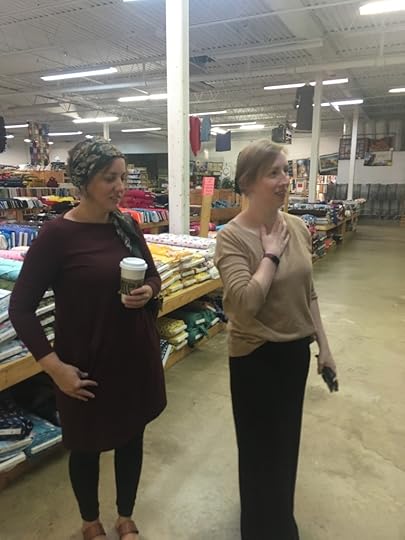
Essentially they draped me in lots of fabrics, and we set aside the ones that looked especially nice. The lighting was not ideal—harsh and florescent—but they were still able to pinpoint a selection of colors that looked nice on me.
Here are some of the best ones:
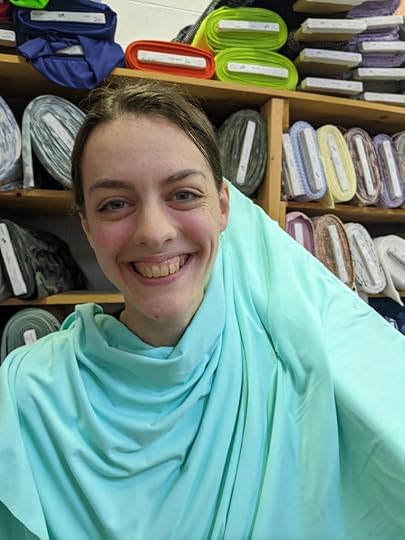
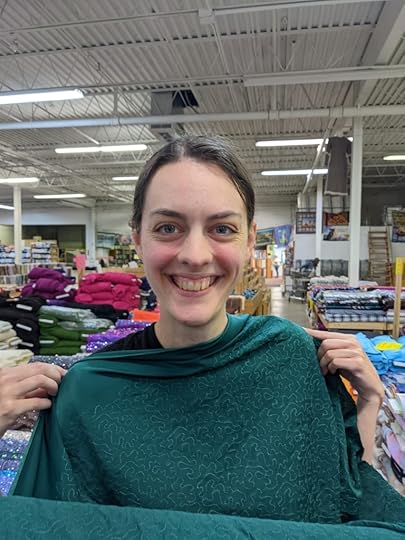
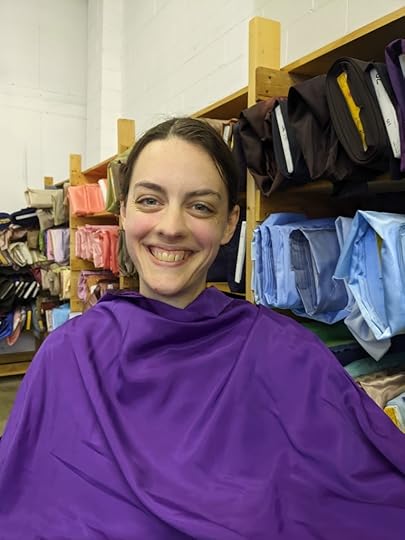
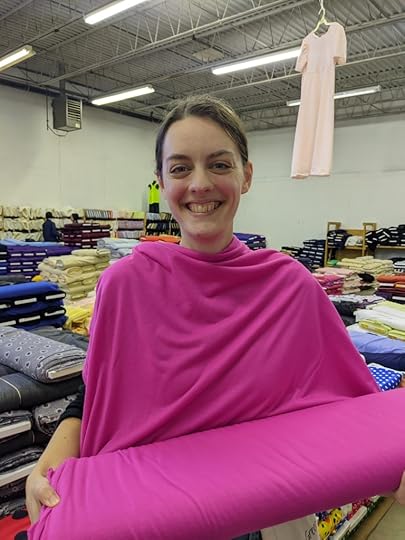
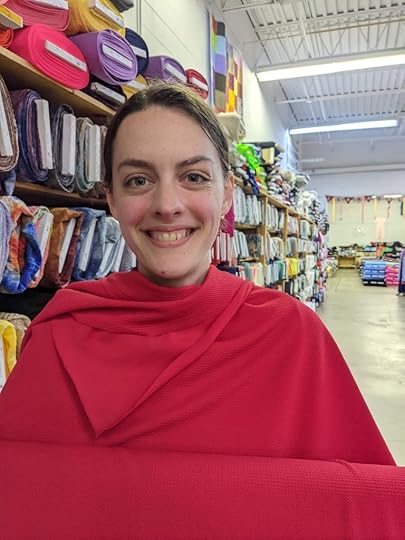
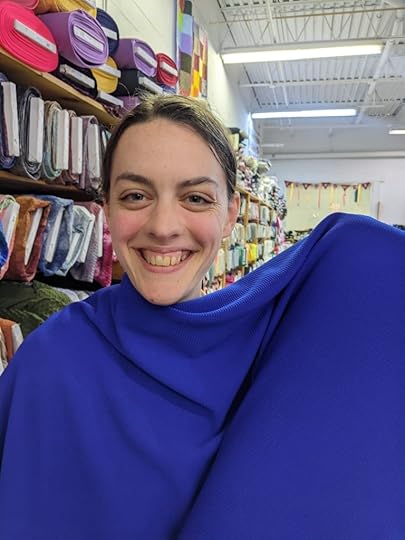
Janessa mostly took reference photos of the colors that looked nice, not the ones that looked bad, but here’s one photo where you can see the contrast. The green below was not my color.
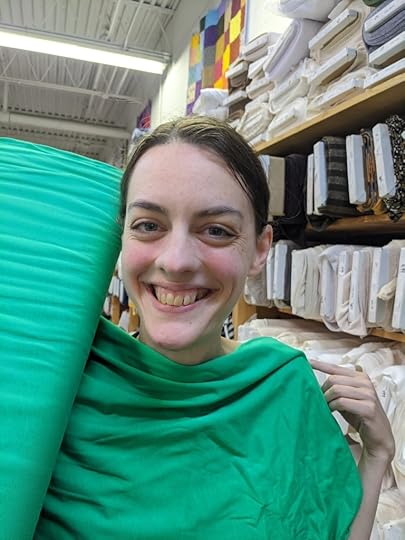
Ultimately my favorites were the royal blue, the royal purple, the mint green/light aqua, and the deeper green. After that I narrowed it down by fabric type. The royal blue had the most similar weight and stretch to the original dress, so that’s what I bought, as well as thread and elastic.
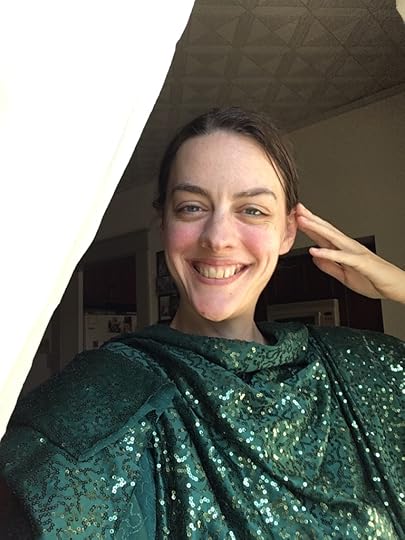
You can’t see it in the picture because I’m showing the wrong side, but the deeper green is actually covered in sequins. Not only would a full dress of that fabric be quite “extra,” but I’m afraid I’d find it uncomfortable.
However, I was fascinated by it and decided to get a couple yards as backup. My plan is to make a t-shirt-like blouse and pair it with my pleated black skirt. If it is comfortable and looks better than the blue dress, or if I don’t get the blue dress done, I’ll wear the green shirt instead. Otherwise, I’ll take it along in the off chance that I win the whole thing and need an outfit for Day 2.
Here’s what the sparkly side looks like.
 Doing It for the Plot and Content
The other day Jenny was telling me about her life, and said she was doing something “for the plot and content.”
“I don’t know what that means!” I said. “Is that Gen Z slang?”
“It’s part Gen Z slang, part inside joke with Kathrine and I,” said Jenny. She explained that if you “do something for the plot” it’s something you do because you imagine your life as a story that needs a better plot, and “doing something for the content” means you’re doing it to have interesting things to tell your long-distance friends when they call.
I kinda feel like I’m doing this TV pilot for the plot and content.
It’s marketed with a “we can make your dreams come true!” energy similar to, say, American Idol, like you’re supposed to come on the show desperate for the publishing deal that could change your life.
And I love that for people who thrive on that sort of thing, but that’s way too much stress and pressure for me. I want to have fun and make connections, but most of all I think I just want to know what it’s like to film a TV pilot.
I still really want to be one of the twenty people who gets to pitch. What an incredible experience! I really enjoy performance and public speaking so the thought of pitching makes me really excited, as well as nervous of course.
October 30 is the day! Unless I have to sign some funky nondisclosure agreement or something, I’ll tell you all about it later.
Meanwhile, I’ll plan to post about it on Instagram while I’m there, and also provide updates on clothing preparation and such. I’ve never cloned a dress before so…yeah who knows how this will go.
***
Order my book:
Print Version
Kindle Version
Follow me on:
Instagram: @emilytheduchess
Twitter: @emilysmucker
Facebook: facebook.com/emilysmuckerblog
YouTube: youtube.com/emilysmucker
TikTok: @emilytheduchess
Patreon: patreon.com/emilysmucker (This is where I post bonus blog posts, about more personal/controversial subjects, for a subscription fee of $1 a month [or more if you’re feeling generous]. I try to post twice a month.)
October 6, 2022
HUGE Life Update: A Secret Trip, Several Moves, and Auditioning for a TV Show/Contest
 Part 1: The Nomad
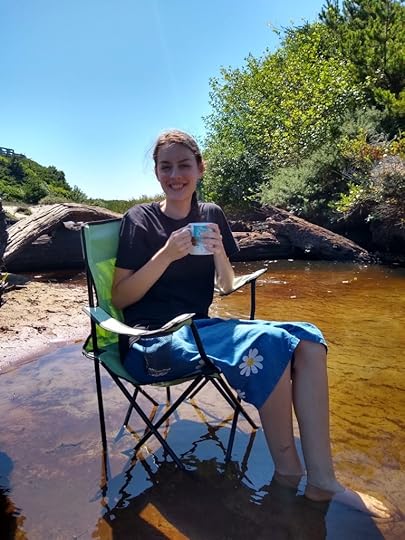
I left Virginia last June. Moved away for good, not just for the summer. I thoroughly enjoyed living with Jenny, but it quickly became apparent that Virginia is not the place for me.
I drove my car to Pennsylvania, parked it there, and then flew to Oregon to work in the harvest for the summer. After two months in Oregon, I flew back to Pennsylvania, got my car, went to a staff retreat, and then drove to Philadelphia.
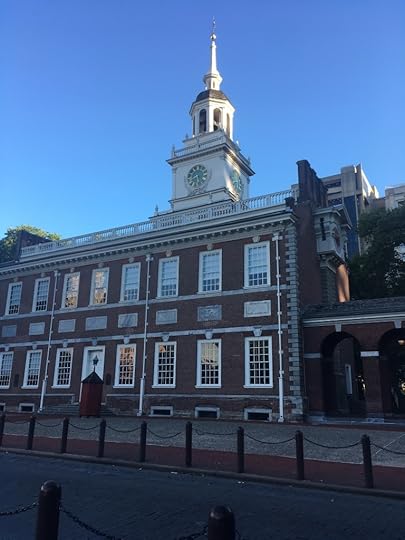
I’m not sure if it’s correct to say that I “went” to Philadelphia or “moved” to Philadelphia. I intended it to be a move but it didn’t quite work out that way. I stayed for five weeks, and one day I hope to go back, but for now that’s it. Instead, I’m moving to Houston for a while to live with Matt and Phoebe.
I call my trip to Philadelphia my “secret trip” because although many fascinating things happened while I was there, I didn’t blog or post on social media (except BeReal) about any of them. And I’m not planning to, although I did make a lengthy Patreon post about my trip, why I went in the first place, and why it didn’t ultimately work out.
 Part 2: The TV Show
When I was in Oregon over the summer, my middle school writing teacher tagged me in a post on Facebook about a reality TV show for writers. A few days later my mom sent me the same thing. Intrigued I clicked the link.
Essentially, there’s a group of people trying to start a reality TV show called “America’s Next Great Author.” But before they can make the show, they need to film a pilot to show to the networks and, I don’t know, prove that authors are interesting enough for a TV show I guess.
Anyone could audition for the pilot—all you had to do was send in a one-minute video of yourself pitching a book, along with a bio about yourself and the first ten pages of your book. They’d choose 100 semifinalists to come to New Jersey to film the pilot.
For the pilot, they’d choose twenty finalists to pitch their book in front of a live audience, and then one person would win $2,500 and be guaranteed to be featured in the TV show if it ever gets picked up.
It all sounded like a very interesting experience, and I decided to audition with an idea I’d dreamed up on the combine.
See, it occurred to me that if Darrel ever had an accident in the middle of harvest similar to my dad’s, no one would really know how to run the farm. I began to wonder how much of the harvest I could still bring in if I was abandoned out in the field, and then I wondered how a brand-new combine driver would deal with it.
I started imagining all kinds of innovative ways characters might come together to figure things out, and it was a fun thought experiment as I drove.
Actually auditioning for the show, though, required me to step back and figure out the themes and arc of the story, which was a good thing for me as I have a tendency to just dive into new stories willy-nilly and then abandon them.
It’s also good for me to have deadlines in my life sometimes.
The deadline to send in my material was September 15, but I wrote the pitch before I left Oregon so I could film it in front of my combine. Then when I got to Philadelphia I wrote the first ten pages and submitted the whole thing the day it was due.
I’d find out on October 1 if I was a semifinalist, and filming was scheduled to take place on October 30 in New Jersey.
That made things a bit complicated when Philadelphia didn’t work out and I decided to move to Houston. Houston is pretty far away from New Jersey, but Pennsylvania is pretty close, so I decided to stay in the northeast at least until October 1.
I left Philadelphia September 26, planning to spend a week with my cousin Annette in Lancaster. I didn’t know what I’d do if I did become a semifinalist, but I hoped I could figure something out.
October 1st, last Saturday, I refreshed my email over and over. And then I saw it.
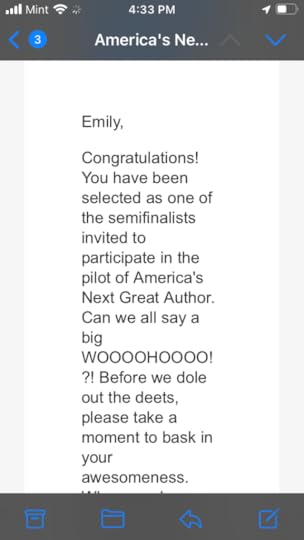
EEEEEEEEEK!!!!!!!
I was so excited. A little stressed too. Now where was I gonna live? But Lancaster is no Philadelphia. I contacted some friends and they contacted their friends, and in less than 24 hours I had multiple options for places I could live in Lancaster for a month.
 Part 3: Why Am I So Happy?
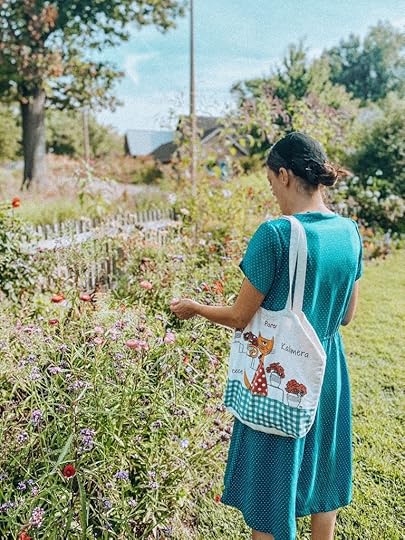
It occurred to me the other day that maybe I don’t actually want the things I think I want in life.
This summer I ran into an old friend who told me, “I’m jealous of your life, it sounds so exciting!”
I immediately burst into tears. Because right then my life didn’t feel exciting, it felt dreadful.
I never really wrote on this blog about how difficult Virginia was for me, although I talked about it on Patreon sometimes. With the smaller audience I have over there, I sometimes feel more comfortable being vulnerable.
But here, on my public blog, I didn’t have the courage.
In essence, I was deeply lonely. And I harbored a terrible fear that I’d be lonely no matter where I went in life. I didn’t want to be nomadic. I didn’t want an exciting life, really…I just wanted to settle down somewhere that felt like home.
At least, that’s what I thought I wanted.
But I realized the other day that though the past few months have been extremely stressful, and while it’s been hard to make any headway with writing projects since I keep moving all the time and trying to adapt to different schedules, ever since I left Virginia I’ve been happy. I was happy in Oregon over the summer. I was happy in Philadelphia. I am happy now, in Lancaster City. And as far as I know I’ll still be happy when I move to Houston.
Maybe I don’t crave stability as much as I thought I did?
Because I keep making anti-stability life choices.
I think deep down I like living an exciting life. I want stability eventually, but it has the be the right sort of stability. And I’m happier pursuing the right sort of stability than I am settling down with the wrong sort of stability.
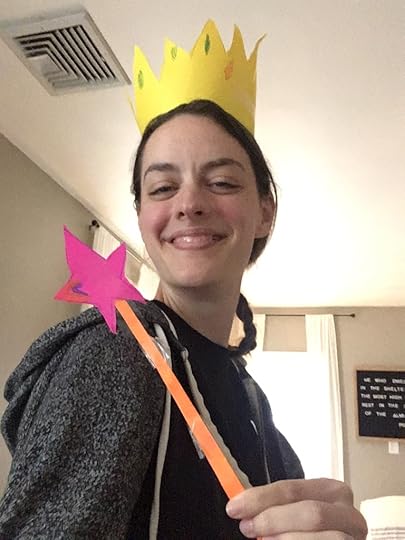 Part 4: The Plan
I don’t like drifting around without a plan. So I have a plan now, which involves saving for a few years and buying a house. I feel cautious even writing those words, because the thing I want most in the world is a house, and I don’t want to, I don’t know, jinx it I guess.
For now, I’m in Lancaster City for a month. Then I’ll drive to Newark NJ on October 30 to film the TV Pilot which as far as I know no one but network executives and such will ever see (sorry). (I could be wrong about this as I’m just a little Menno girl who knows nothing about TV, lol.)
Then I’ll take a looooooong trip to Houston…not as far as Oregon but pretty far still.
And after that I’ll probably live in Houston for a decent amount of time, saving moolah. But who knows, really. Life is chaotic.
Anyway, there is a life update for you! Now maybe I can get back to blogging about the random interesting things that happen to me.
***
Order my book:
Print Version
Kindle Version
Follow me on:
Instagram: @emilytheduchess
Twitter: @emilysmucker
Facebook: facebook.com/emilysmuckerblog
YouTube: youtube.com/emilysmucker
TikTok: @emilytheduchess
Patreon: patreon.com/emilysmucker (This is where I post bonus blog posts, about more personal/controversial subjects, for a subscription fee of $1 a month [or more if you’re feeling generous]. I try to post twice a month.)
August 24, 2022
A Day in the Life of a Combine Driver (Featuring a Fire)
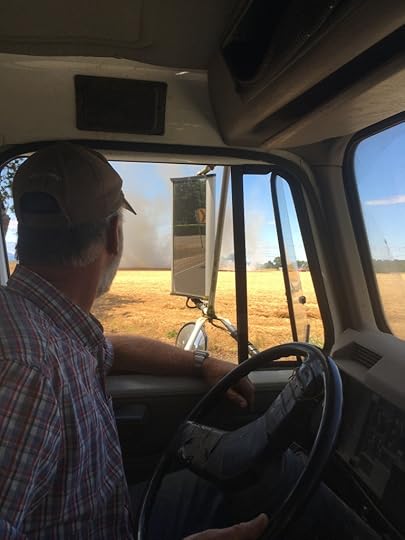
Note: This is a post about July 22, although I just finished it now. So it’s a month out of date, but it describes an actual day I experienced on the combine.
7:53 AM – I wake up. The sky is gray, so I know I’ll be starting work late. I got to bed late last night and I am still tired, so I go back to sleep.
8:30 AM – I wake up again. This time I get out of bed and make myself some tea and toast. As I pass the sewing room, mom tries to chat with me, but I just grunt a reply because I haven’t had my tea yet.
8:49 AM – Darrel sends me a text saying I’ll start work at 11:45. That gives me a nice chunk of time to relax before starting my day at work. I watch a little YouTube, chat with mom after I had my tea, and write in my diary about the interesting dream I had last night. I also do a little laundry and pack my lunch, but overall I’m pretty slow and relaxed.
I should explain that Darrel, my boss, is my dad‘s first cousin. His farm originally belong to my great-grandfather, as did my dad‘s grass seed cleaning business. My uncle Steve’s business is on that chunk of land as well, so at my job I’m likely to run into assorted relatives from time to time.
Also, I live really close to work.
11:25 AM – I get another text from Darrel saying that we won’t start until 1:00. This may seem like short notice but I was pretty sure this was gonna happen because the sky outside was still gray.
I don’t know how farming works with other crops, but with grass seed, we don’t get started until it’s sufficiently warm to dry out the crop. When the seeds are dry they thresh out better. It’s also important to have dry seed so it doesn’t spontaneously combust bus when you store it in piles.
Oregon nights get chilly, so it always takes a bit until we can get started for the day. I know it’s technically about temperature and humidity, not cloud cover, yet I always start later on cloudy mornings, and the time I start is typically correlated pretty well with the time the sun comes out.
11:50 AM – since I have a little extra time, I decide to do a bit of work for LifeX Marketing. I’m taking a break from my marketing copywriting job while I harvest, but I sometimes still do a bit of work if I have time.
I also eat some leftover soup from last night’s supper.
12:50 PM – I take my packed lunch out of the fridge, put it in my backpack, and rush off to work.
Back in June when I came to Oregon for the summer I left my car back east, assuming I could ride a bike to work and borrow a car if I need to go anywhere else.
Well unfortunately, we’re a bit low on cars right now. Mom, Dad, and Ben all have cars, but there are no extras floating around. Then Steven needed to borrow Mom‘s car for a bit while he was in the process of buying another one, making the situation even worse.
When I talked to Mom about borrowing a family bike for the summer, she informed me that all our bikes were old and falling apart, and she got rid of them. She’s been planning to buy some more but hasn’t yet.
For a minute there, I thought I was stuck with the following options:
Walking to workDigging in the barn to see if Matt and Phoebe had left a hoverboard behind. And then learning how to ride it.But then I asked Darrel if he had an extra bike lying around and he found one for me.
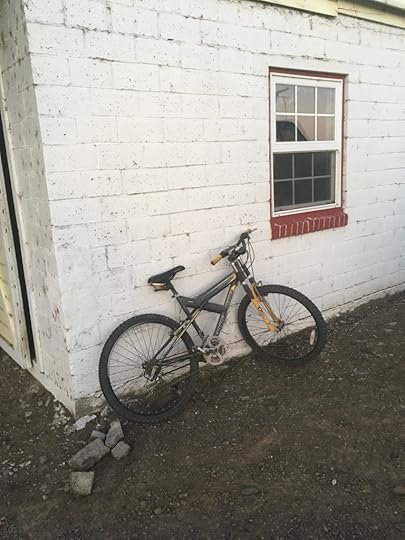
I really enjoy biking to work, actually. It’s so close that it doesn’t take much time or energy but I like getting a little bit of exercise every day.
12:58 PM – I get to work.
I never quite know how things are gonna go until I get there. Sometimes I’m supposed to take a farm vehicle to the field we’re working in, and sometimes I’m supposed to stay at the house for a bit and pick blueberries. Sometimes Darrel tells me this information himself, and sometimes his wife Simone fills me in on what’s going on.
 It’s not a blueberry farm, but they do have a few bushes for their own personal use
Today when I arrive, Darrel is at the house. We get in the pickup and drive the back way to the shop, where he gets on the combine to take it to the field and I follow with the pickup.
A note about “the back way.”
One thing I never really thought about until I started working on farms is the way that so much land is not accessible by roads. Since all houses and businesses are built along roads, it feels like roads go everywhere. But they don’t, especially if there’s some geographical weirdness like a bend in the creek that doesn’t have a bridge over it.
So farmers create these little dirt and gravel roads to access their fields.
“The back way” is one such road.
Growing up I didn’t realize that this was its purpose, and I thought it was just a shortcut between my dad’s business and my cousin Stephanie‘s house. Also, we used it to access “the deep hole,” which was the only proper swimming hole along this section of the creek, and where I used to go swimming with my cousins.
I’m not even sure why it was called “the back way.” That’s just what we all called it.
Now, of course, I drive the back way all the time because it connects the house, the shop, and most of the fields.
1:09 PM – I start combining. Usually, Darrel has the combine all ready and I just hop on and go, while he drives off to do whatever farmers do all day. But today he wants to drive a round on the combine first.
I’m not 100% sure why, but I think he’s trying to get a feel for how well the grain is feeding through.
As we slowly make our way around the field, Darrel driving and me in the buddy seat, he tells me about how he doesn’t actually have a moisture tester. Typically he just keeps an eye on when the other farmers start for the day, and then we start too.
1:14 PM – We spot a plume of smoke in the sky. Where is it coming from? We speculate. Surely they wouldn’t be burning trash at the warehouse in hot dry weather like this? Darrel calls Simone and asks if she knows anything about it. She doesn’t.
We continue around the field.
Then Simone calls Darrel back. I can’t hear what she’s telling him, but Darrel immediately throws the combine into third gear and roars out of the field as fast as he can.
“Kenneth’s field is on fire!” he tells me.
My uncle Kenneth owns numerous fields, but due to the location of the smoke, I knew exactly which field is burning: The one right across the road from my house.
Darrel says we’re going to get in the water truck and drive over to see if we can help. I feel a bit like a firefighter as we sprint from the combine to the pickup, drive the pickup over to the shop, and then run from the pickup to the water truck. But the water truck doesn’t go very fast, which feels very frustrating in the heat of the moment.
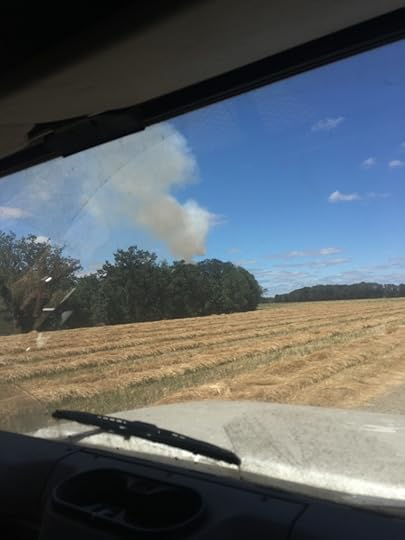
We go back up the back way, past my dad’s warehouse and my uncle Steve’s pellet mill, and over the bridge to the main road. As we pass the office, my cousin Randy comes running out.
“You want to hop in?” Darrel asks.
“Do they need more help? We were going to bring our water truck but we heard they had it contained.”
“I don’t know, I’m just heading over to see,” says Darrel.
“Well, let me know if they need more help.”
“Okay.” And we drove off again.
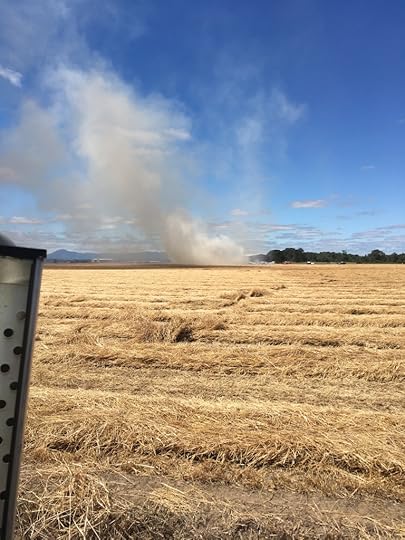
When we drive up next to the field and can see the fire well, I’m very relieved to see that:
A: It is not that large, and
B: It is nowhere near my house
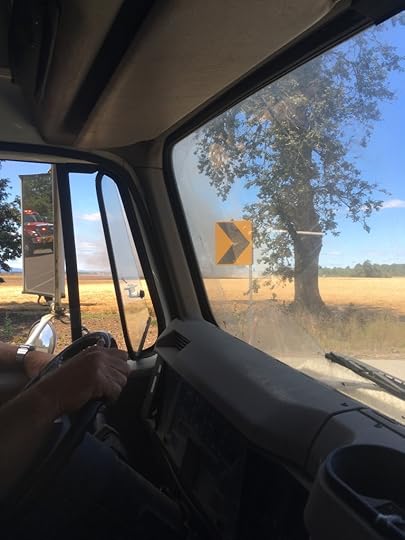
A firetruck pulls up behind us, flashing its lights, and we pull off to let it pass. Multiple firetrucks are in the field. “It looks like they have it contained,” says Darrel.
He’s nervous about driving his truck into the field since it’s not very high off the ground, so with the fire seemingly under control, we turn around and head back.
“The field hasn’t even been harvested yet,” says Darrel. “The fire must have been started from the railroad tracks.”
However, when I tell this to my family group chat, mom writes back and says “Lois said it started in Leroy’s field and his truck is on fire.”
(But amazingly, by the time everything was said and done, Leroy’s truck was still salvageable and most of Kenneth’s crop was saved as well.)
1:42 PM – We go back to the field we’re combining. I take a picture of the exact location where we sped out earlier.
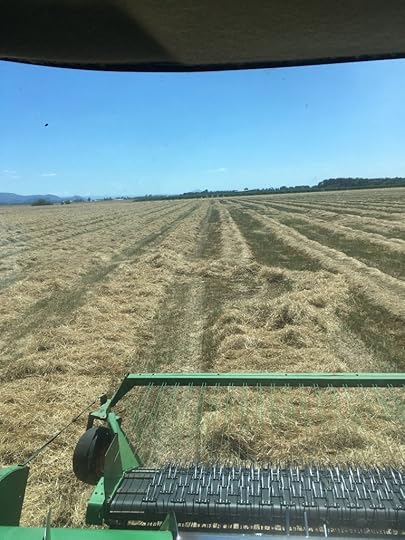
I ask Darrel to tell me exactly what to do if I ever start a fire. It’s still my biggest combining fear, though in eight years of combining I’ve never started a fire.
When I get back around the field, Darrel gets off and I continue on.
“This has been an exciting day,” I think. “Maybe I should write a blog post about a day in the life of a combine driver.” I pull out my phone, open my WordPress app, and begin writing this blog post using voice-to-text.
When I tire of that I do some other activities, such as:
Listening to a Dear Hank and John podcastWriting a novel in my headThinkingListening to music on the radioWhen people ask me what I do on the combine for hours on end, they often assume I listen to podcasts and audiobooks. Which would be an excellent use of my time if only I could make myself focus.
The truth is, my mind wanders to such an alarming degree when I’m listening to things that I pretty much only listen to podcasts if they’re a bit silly, and audiobooks if I’ve read them before.
That way it doesn’t matter when I completely miss big chunks due to a wandering mind.
Mostly I just spend my time thinking.
It occurred to me one day that as long as I’m alone, I’m never bored. I get bored in public places like church, waiting rooms, and airplanes. But never when I’m truly alone.
The hours tick by, and the field gets smaller and smaller.
Suppertime approaches. Sometimes I ask for a break at suppertime to go home and eat, but other times I don’t bother. Today is one of those “don’t bother” days. I packed a lunch in the morning but ended up being home at lunchtime, so now I eat my packed lunch for supper.
Including a banana. I don’t like bananas, but I’m trying to learn to like them because they’re such a handy fruit if you’re packing a lunch.
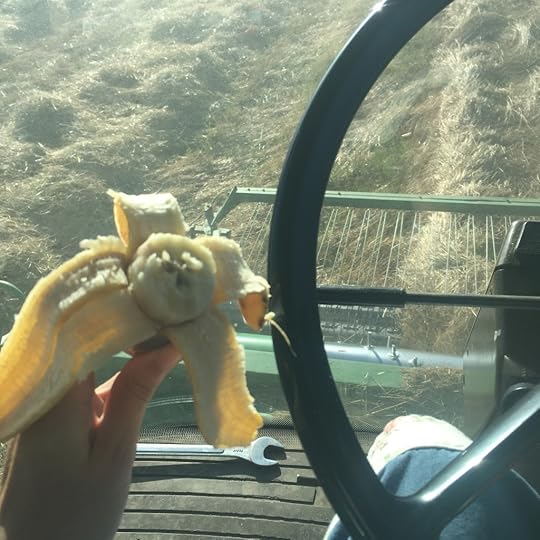
7:52 PM – I finish the field I’m in.
As I dump the last of the seed into the seed truck parked in the field, I give Darrel a call. “I’m done with the field,” I say.
“Okay,” he says. “You know that place where there’s that extra patch of seed? Drive there and wait for me.”
There’s a small bit of ground between this field, the hazelnut orchard, and the ditch, kind-of part of this field and kind-of not. Like an extra thumb. I don’t know how to describe it. Let me just add a google maps image.

So I park next to this thumb and wait there in the golden hour.
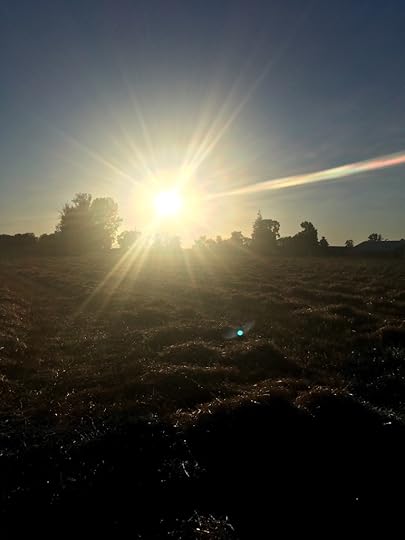
Different farmers do things differently when it comes to end-of-the-day protocol. The first farmer I ever worked for had me drive the combine back to the shop every evening. The next farmer had me park at the edge of the field, and wipe the dust off the windshield while I waited for the engine to cool down.
But Darrel typically takes my place at the end of the day, drives for a round or two until he determines that it’s too cool to keep working, and then parks the combine himself.
Usually I work until 8:30 or 9, but Darrel lets me off a bit early today. He’s going to just finish up the last thumb himself. He tells me to walk out to the middle of the field to fetch the seed truck, and that Simone will meet me at the edge of the field with the pickup.
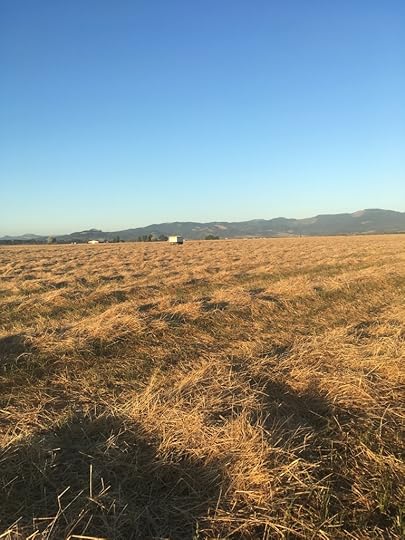
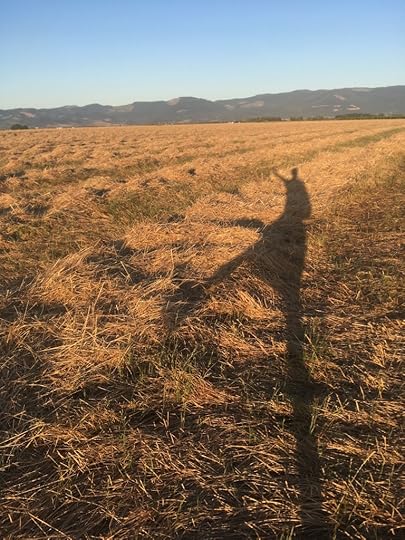
I enjoy the walk through the field. The world is beautiful. But I do get a small sliver in my leg from walking through all that straw.
This, by the way, is the same truck I once drove into the ditch. It’s relatively easy to drive, though, once you get the hang of it. Especially if there aren’t any ditches around.
I drive to the edge of the field, and sure enough, Simone is waiting with the little white pickup. We switch places. I get into the pickup and drive up the back way to the house, and she takes the seed truck too…I’m not sure where.
8:19 PM – I am done for the day. I get on my bike and ride home.
8:30 PM – I get home and dig around in the fridge for supper leftovers. Then I get on my computer and mess around online. I post on Facebook about how there are more redheaded female protagonists than redheaded male protagonists, which is one of the things I pondered on the combine today.
When the temperature falls, I go outside and sit in the hot tub, easing my aching muscles. It still feels strange that we are fancy hot tub people. (We got it so Dad could exercise and potentially regain muscle activity after his accident.)
Finally, after my soak, I get into my PJs, read a little Daniel Deronda, and go to bed.
Thus ends the day in the life of a combine driver.
Was it a typical day? Yes and no. The fire was unusual, and yet unusual things are not uncommon. One day you might have a major breakdown, the next day a friend might come and ride with you, and the next you might drive a truck in the ditch or something.
Overall it’s my favorite summer job, full of sunshine, wildflowers, and plenty of time for a wandering mind.
***
Order my book:
Print Version
Kindle Version
Follow me on:
Instagram: @emilytheduchess
Twitter: @emilysmucker
Facebook: facebook.com/emilysmuckerblog
YouTube: youtube.com/emilysmucker
TikTok: @emilytheduchess
June 26, 2022
Unexpected Travels
I’ve done a lot of traveling in the past few weeks. Some of it was planned, and some of it was unexpected. This is a post about the unexpected parts.
It all began when I decided to come to Oregon for a good chunk of the summer and work in the harvest again. As you can guess if you’ve flown in the past month or two, tickets were a mess—expensive, inconvenient, and canceled at the last minute.
The only halfway decent tickets I could find gave me a 9-hour layover in Phoenix, which I planned to redeem by crashing at a friend’s house and exploring the city. But after arriving at the airport, discovering that my first flight was canceled, and being re-routed hither and yon by a less-than-enthusiastic American Airlines lady, I ended up with a 5.5-hour layover in Los Angelos instead.
Is 5.5 hours long enough to leave an airport and explore a city? Not really—not when you’re tired and hauling your luggage with you. But when I looked up the LA weather and saw that it was nice and decently cool, and when I looked on Google Maps and saw that there was an In-N-Out Burger right next to the airport, I came up with a plan:
I was going to walk to In-N-Out Burger.
Have you ever left an airport on foot before? I never had. Frankly, airports don’t seem set up for it, and I was worried that I’d have to dash across busy roads or yank my suitcase through grassy medians.
But it’s possible. Google Maps found the proper sidewalks for me, and I walked to In-N-Out, right next to the airport but still 1.4 miles away.
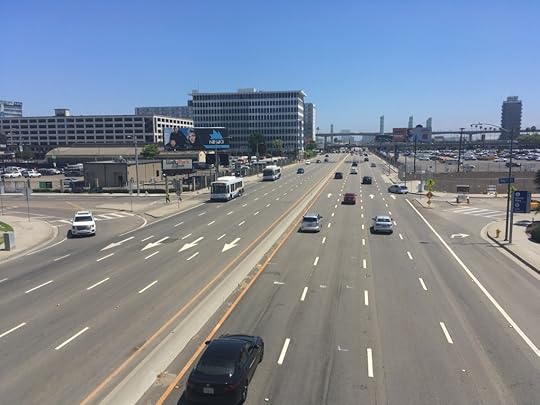
It occurs to me now that the hype surrounding In-N-Out may be an Oregon-thing rather than an everywhere-thing.
In-N-Out is a California-based burger chain, and for some reason it’s a big deal. A few years ago they opened a location in Oregon, an hour north of where my family lives, and it was a Whole Thing. Every time I passed it I saw a drive-through line that you wouldn’t believe, stretching on and on until I couldn’t even see where it ended. My sister and her friends would drive all the way there just to get burgers even though, as I mentioned before, IT WAS AN HOUR AWAY.
So while I was never willing to make the hour drive and sit in the Mennonite-funeral-procession-length drive-through line just for a burger, I was willing to make a 1.4 mile walk hauling my heavy backpack and even-heavier rolling carryon when I was in LA with nothing better to do.
Now, you’re probably wondering: is it over-hyped?
Frankly, I was in no position to make that call. After my 5+ hour flight and long walk hauling luggage over overpasses in the California sunshine, that burger and fries was the best thing that had ever happened to me: It was filling, affordable, and delicious. Airport food could never.
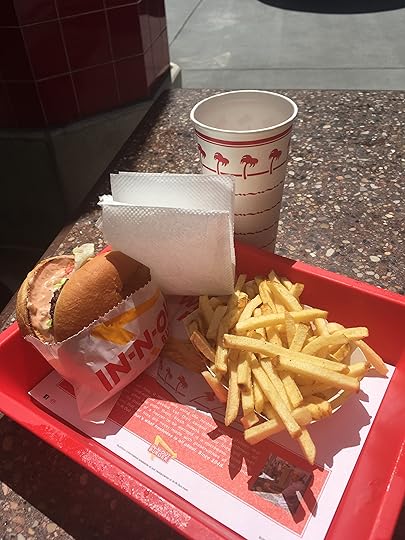
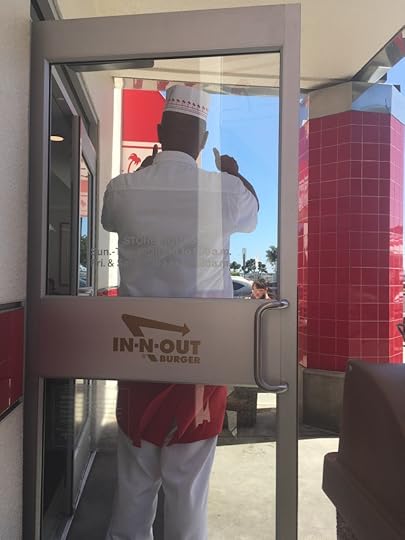
Also, I appreciated the fun vibe. Very 1950s, with all the employees in red aprons and little hats. They seemed to be having fun, and one employee in particular walked around hyping people up about the food and taking care of their trash with the most cheerful enthusiasm I have ever seen from a restaurant employee (except maybe those hyper-enthusiastic Dutch Bros kids).
There was a little park across the street, perfectly situated to watch airplanes flying in. So after eating, I went over there and dozed in the grass like a homeless person for a while.
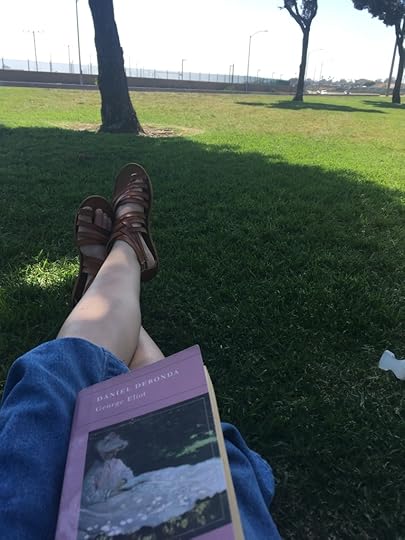
Much more pleasant than an airport floor, I must say.
Overall, my tiny unexpected stop in LA was lovely, although I was quite sore from luggage-hauling when I got home. But I took care of that by soaking in the hot tub.
The same morning I discovered that my flight to Phoenix was canceled and got re-routed to LA, I also found out some really horrible news: my cousin Conrad’s month-old son, Damien André, had passed away suddenly. Devastating news, and compounding pain on a family that’s already endured so much this year, when Conrad’s brother Austin was kidnapped in Haiti.
Almost as soon as I got home my family was busy figuring out which of us could make it to the funeral and how to get there. Conrad and his wife Rhonda live in northeast Washington, which despite being the state directly above Oregon was still an 8-hour drive away.
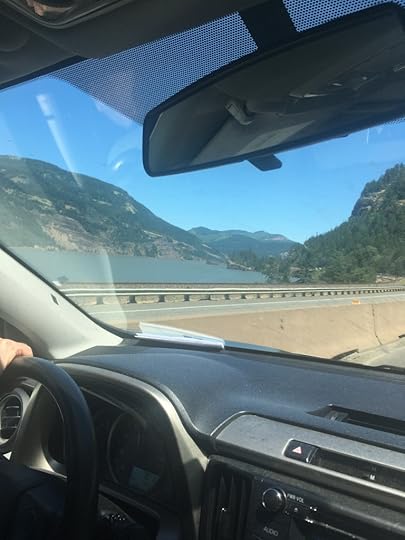
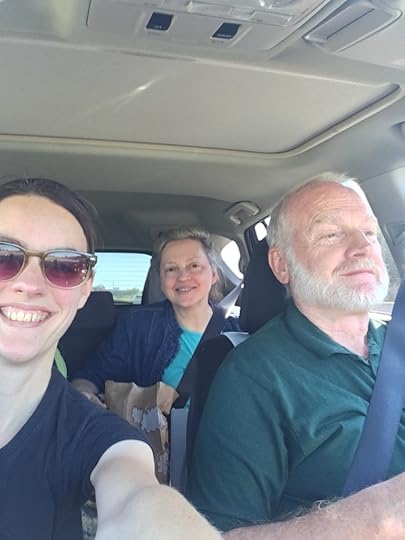 This is us after 5.5 hours with 2.5 hours left to go.
Thankfully my Aunt Geneva lived near and was willing to give us a place to stay, so we drove up Friday, spent the night at her house, went to the funeral Saturday, and then came home. There were evidently multiple events happing near Spokane that weekend, so hotels were extremely expensive, and some of my relatives got up insanely early to drive there and back in the same day.
Anyway, I have nothing to say about the funeral except that it is really, really awful for a baby to die, his mother sitting there with empty arms.
I saw Austin at the funeral and gave him a big hug of course. He is here, he escaped, he is alive, and yet his wee little nephew Damian isn’t and I, frankly, don’t understand the ways of God.
Anyway, hopefully that’s the end of my unexpected travels for a little while yet. In a week or so I’m gonna park myself in a combine and spend the summer driving around in rectangles, solving the world’s problems and working out some novel plots in my head.
April 29, 2022
How to Communicate Kindness

Note: This was originally posted a year ago on my Patreon, but today I decided to share it on my main blog to close out the April Blogging Challenge
In the past year especially, I’ve seen a lot of online posts about racism. Inevitably, someone in the comments will say something to the effect of, “whatever, I’m just going to treat everyone kindly no matter what their skin color is.”
I’ve been thinking a lot about this idea, because if it’s that easy, then why are so many black people hurt by well-meaning white people?
This idea actually goes way beyond race. I mean, why did well-meaning people say hurtful things to me when I struggled with illness or singleness? They thought they were being kind. Why didn’t it feel like kindness?
Here’s the difficult truth: sometimes kindness is like a language that doesn’t translate. You can feel, in your heart, like a kind person, but if you don’t communicate it well, it’s like saying “I care about you” in English to a Korean woman. If the message isn’t received and decoded by her, it’s meaningless, no matter how sincerely you meant it.
In this article, I’m going to provide eight ways in which you can more effectively communicate kindness. This is not an exhaustive list, just a few things that I’ve discovered, either from my own life or from listening to others express their frustrations.
But I want to be clear, from the start, that this is not about changing your heart, it’s about changing your communication style. I’m writing this with the assumption that you are not racist or sexist, that you believe all people are equally valuable, and that you genuinely want to treat everyone kindly.
With that being said, here are some ways to better communicate kindness.
1. Defer to people’s expertiseThis is something that I’ve heard women, single people, and ethnic minorities all complain about. Certain people, often (but not always) confident married white men, get asked for their opinions and expertise in a way that other types of people don’t. Often there will be someone else in the room—maybe a woman, a shy single man, a black man, or a “weird” person—who has studied this topic in depth, but their expertise gets overlooked.
If you’re part of a group that is having a discussion or making a decision, you should look around the room and think, “who is actually the expert here?” And then you should ask that person what they think.
2. Ask people about their livesThis is somewhat basic, but important. It’s good to have a fair idea about what people do for work, what they went to school for, and what their most passionate hobbies are.
Not only will this make them feel seen, but it will make you better able to defer to their expertise. And it benefits everyone—if you know who’s passionate about interior decorating, for instance, you’ll know who to call when the church bathrooms need to be re-done.
3. Believe peopleOver and over, I’ve heard people who’ve experienced trauma, abuse, etc say that one of the most traumatic parts of the whole experience was not being believed.
Now, it feels weird to say “believe people” as a blanket statement, because, I mean, we’ve all been lied to at times. We all know that some people use lies to manipulate and destroy others, and we don’t want to be a part of that.
My mom has become really good at believing people, to the point that many people end up trusting her and sharing things with her that they don’t tell anyone else. So I asked her how I should phrase this section.
She told me that when people tell her things, she always starts off by fully believing everything they say. Since she’s not a judge and jury, there’s no obligation to be skeptical or to need to figure out absolutely for sure if this is true or not. So she just believes.
Later, if she finds out other information, she can always adjust her thoughts on the matter.
(I will also add that Mom does not gossip about things people tell her, and I feel like when lies are destructive it’s usually because people are spreading those lies through gossip.)
4. Let people define what is hurtful to them.As someone who struggled with chronic illness and depression, I found it hurtful when people would say, “God will never give you more than you can handle.” If you said this to me, and I called you out on it, your first response would probably be defensiveness. It would feel, to you, like I thought you were a terrible person. And you’d hate to feel like a terrible person. So your mind would rush to rationalize yourself, and you’d say something defensive like, “I was just trying to help.”
But the truth is, as the one who is struggling, I’m the one that gets to define what words are hurtful, not you. You haven’t gone through that, so you don’t get to decide what is and what isn’t hurtful for a chronically ill person to hear.
This is true for so many things. If an Indigenous person is hurt that you once dressed up in feathers and fringe on “Pilgrims and Indians day” at school, they’re allowed to find that hurtful. If a woman is hurt when you say “you’re being too emotional,” she’s allowed to. If a man is hurt when you use the term “toxic masculinity,” he’s allowed to feel that way.
Our defensive reaction comes because we don’t want to be terrible people. But the good news is, when most people say “that hurt me,” they’re not saying “you’re a terrible person.” They’re not saying you did it on purpose. Actually, they’re probably assuming that you have a good heart, or else they probably wouldn’t even bother.
Furthermore, you can still validate other people’s feelings and allow them to be hurt even if you did nothing wrong.
Short story time: When I worked for the school newspaper in college, I once made a lady very angry with something I wrote in the paper. I had no clue how to handle it. I didn’t think I’d done anything wrong.
The journalism advisor told me, “you just go to her and ask her how she felt, and then nod along and be sympathetic while she tells you how terrible it was.”
“But then what?” I said. “Do I have to issue a retraction or something?”
“Oh no, of course not,” said the advisor. “You didn’t do anything wrong.”
This was the first time I realized that I can validate someone’s hurt feelings without admitting wrongdoing, and it was revolutionizing for me. The angry lady ranted to me, and I said “that sounds hard,” and then it was all over.
5. Sit with wordless painSome people are talented at this, and some people (aka me) are naturally terrible at this. But one of the kindest things you can do to someone who is suffering is be there for them without being able to “fix” it in any way. Often our minds rush to “comforting” platitudes like “God will never give you more than you can handle,” “he’s in a better place,” etc. Practice showing up and shutting up. Practice sitting with discomfort.
6. Simply apologizeThe frustrating thing about life is that there is literally no way to always say and do the right thing. For instance, I found the phrase “God will never give you more than you can handle” to be hurtful, but some people legitimately find it comforting.
Sometimes you will hurt people out of your own pain, and sometimes out of your own ignorance. Sometimes you’ll say or do something that would be completely innocent to 99.99% of people, but it will trigger a wounded person in a way that seems completely irrational. Sometimes people just are extremely sensitive. Sometimes people demand an apology out of their own entitlement, or because they’re trying to manipulate you.
But in most cases, a simple apology is the easiest way to communicate kindness. No explanation or defensiveness, just “I’m sorry I hurt you.” Apologizing doesn’t even always mean that they are “right” and you are “wrong.” It just acknowledges that their hurt was real and legitimate, even if you privately think it might be a bit irrational.
7. Give people opportunities to say what they thinkIn a group setting, take note of who speaks and who doesn’t. Particularly pay attention if people get talked over, interrupted, or seem like they’re just about to say something when someone else cuts in with their idea.
Then, be the one to say, “I think Sandy had something to say,” or, “what do you think, Bill?” or, “You kind-of interrupted Sandy,” or “Sorry we rushed ahead to a new idea, Bill, were you finished with what you were trying to say?”
Now, some people are observers more than talkers, and might not appreciate being put on the spot. But in general, showing in a group setting that you care about people’s perspectives, even if they’re not elbowing their way into the spotlight, is a great way to communicate kindness.
8. ListenI’m realizing, now that I’m at the bottom of this list, that most of the things I listed are forms of listening. It makes sense I guess—listening is the oft-forgotten key to good communication.
So that’s the thought I’ll end with: the key to communicating kindness is to have a stance of listening. Zip your lips and open your ears. People want to feel heard, and the kindest thing you can do is listen to them.
***
This post, as I noted above, was originally posted on Patreon. I have a Patreon account where I post bonus material–typically stuff that’s more personal or controversial, that I’m not sure I want to share with the entire world.
I want my work to be accessible to every income level, so I only charge $1 a month. If you wish to support me with more you can edit your amount at any time, but everyone receives the same articles.
I typically post twice a month, but occasionally I only post once a month. Once a post has been up for a year, I remove it.
Highlights from last year that are still up on my Patreon include:
Adoption vs. Abortion, and Other Things on My MindFinding a ChurchIs “Lord of the Rings” Sexist?Eight Misconceptions Mennonites Have about the Head Covering***
And with that, the April Blogging Challenge is over! Much thanks to Mom and Phoebe for doing it with me.
***
Order my book:
Print Version
Kindle Version
Follow me on:
Instagram: @emilytheduchess
Twitter: @emilysmucker
Facebook: facebook.com/emilysmuckerblog
YouTube: youtube.com/emilysmucker
TikTok: @emilytheduchess