
Judyth Vary Baker's Blog
April 17, 2017
Antonio Veciana says Lee Harvey Oswald was CIA!
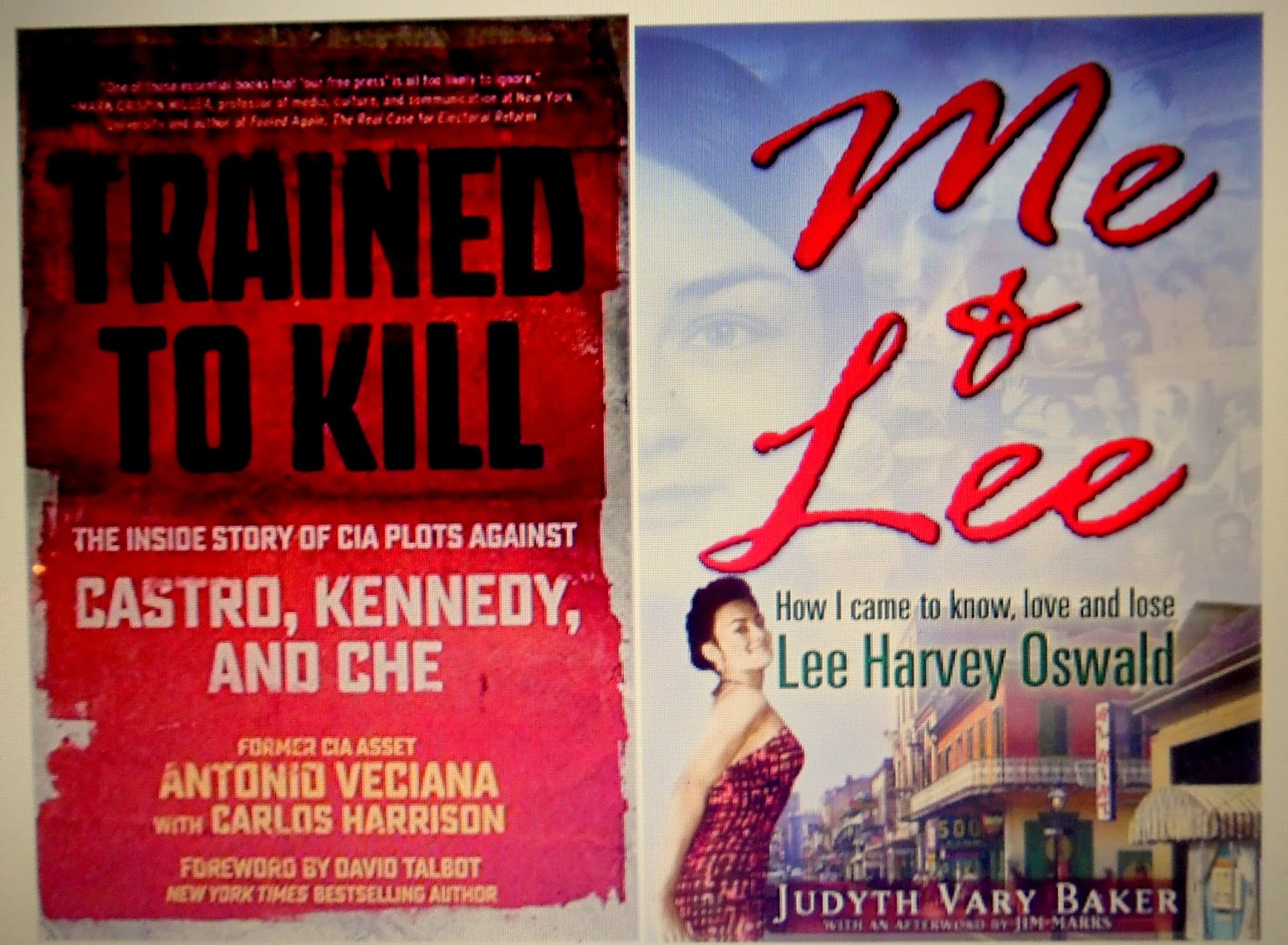 Antonio Veciana says Lee Harvey Oswald was CIA! His book "Trained to Kill: The Inside Story of CIA Plots against Castro, Kennedy, and Che" is now available (Skyhorse Pub.). Veciana, a leader of the CIA's Operation 40, has finally admitted that David Atlee Phillips was his CIA handler - and Lee Harvey Oswald's handler as well. "The truth is coming out," says Judyth Vary Baker, whose book "Me & Lee" goes into more detail than Veciana's (hers is 608 pages, with documents and witnesses). Veciana says he and Oswald met with Phillips in Dallas in Sept, 1963. Veciana, who was shot in the head after testifying to the HSCA, refused to give Phillips' real name until 2013. At last he has openly verified what Baker first revealed in 1999. In 2003, Baker stated Phillips was Oswald's handler in the History Channel Documentary "The Love Affair" (#8 in the series "The Men Who Killed Kennedy."). "You will enjoy reading Veciana's 232 page book," Baker says, "but you will also enjoy getting all the dots connected with ME & LEE" (Trine Day). Both books are available at Amazon.com.

March 25, 2017
NIXON AND "THE BAY OF PIGS THING""Tape Reveals Nixon Knew About Kennedy Assassination
On June 17, 2014, journalist Jefferson Morley placed a very important NIXON TAPE online at his JFK Facts site, writing "The 42nd anniversary of the Watergate burglary reminded me of Richard Nixon’s obsession with the “whole of Bay of Pigs thing.”
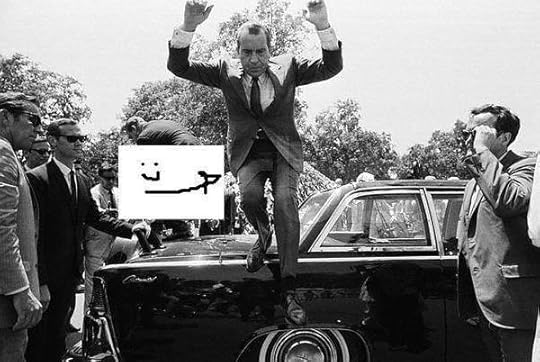 Nixon cavorting on JFK's (rebuilt) Limo after he became PresidentH.R. Haldeman, White House chief of staff for Nixon, wrote in his memoirs that he had come to the conclusion that his boss used the phrase as a kind of coded reference to the assassination of President Kennedy. A tape of a conversation between Nixon and CIA director Richard Helms in October 1971 lends credence to the notion. Listen to the tape, published online by Luke A. Nichter, a history professor at Texas A&M University."
"Nixon, it is clear, was interested in what he called the ‘Who Shot John?’ angle.
You can listen to a shorter version (it is unedited, just cut off after the relevant part, so you'll hear a lot of squeaking of Nixon's desk chair and noise muffling some of it. such as when Nixon, who has been talking to his aide John Erlichmanm apparently rises and greets Helms, who enters the room, but it's the "real deal.")
Morley continues:
" ‘The Dirty Tricks Department’
Before Helms arrives, Nixon’s aide John Erlichman tells the president Helms has been stonewalling his request for documents about the Bay of Pigs. Erlichman makes it clear that he didn’t tell Helms his real purpose. “I was kind of mysterious about it,” he explains.
But they think they have leverage on Helms. At one point Ehrlichman says, “Helms is scared to death of this guy [Howard] Hunt we got working for us because he knows where a lot of the bodies are buried,” This is spoken eight months before Hunt and six other men were arrested at the Watergate office complex for breaking into the offices of the Democratic National Committee.
When then CIA director arrives, Nixon offers some typically awkward and forced small talk about baseball player Ted Williams and then gets down to business. He says he wants to address the “sensitive” issue of the documents he is seeking. He assures Helms that he fully supports what he calls “the dirty tricks department.”
“I know what happened in Iran and I know what happened in Guatemala and I totally approve of that. I know what happened with the planning of the Bay of Pigs,” he says.”The problem was not the CIA. My interest there is solely to know the facts.”
When Helms doesn’t say much, Nixon presses his case by reminding Helms he is the president.
“First. This is my information,” he says, “Second, I need it for a defensive reasons, for a negotiation.”
When those arguments elicit no response. Nixon tries another justification: He needs the information to protect the CIA. In making his case, Nixon talks about what might be in the records and he utters these words (at around 17:00 in the file):
"What does it mean? The reference to ‘Who shot John” can only be a reference to Kennedy’s assassination. It seems clear that Nixon thought that the CIA records on the Bay of Pigs might contain information about who was behind the assassination. This indicates, at a minimum, that Nixon did not have confidence in the official theory that Kennedy was killed by one man alone. It suggests that he thought the CIA knew more about JFK’s assassination than it let on. And, it is quite clear, that If the CIA’s actions did become an issue, Nixon would protect “the Dirty Tricks Department.”
Nixon never got the documents he wanted. After the arrest of the Watergate burglars on June 17, 1972, Nixon tried to enlist Helms in a cover-up. In a meeting on June 20, Nixon said an investigation of the burglary could “open up the whole Bay of Pigs thing,” causing the usually unflappable Helms to shout, “This has nothing to do with the Bay of Pigs!”
In his posthumous memoir, Helms claimed that he did not know what Nixon was referring to. But if he remembered the conversation of October 10, 1971, he knew exactly what Nixon was talking about."
Note: we owe a debt of gratitude to Luke A. Nichter, who is much more than "a history professor at Texas A&M University" as Morley describes him. Nichter is "a noted expert on Nixon's 3,451 hours of secret White House tapes. He is a New York Times bestselling author or editor of six books... the editor, with Douglas Brinkley, of The Nixon Tapes: 1971-1972 (Houghton Mifflin Harcourt) and...a former founding Executive Producer of C-SPAN's American History TV, launched during January 2011 ...Luke is a recognized advocate for government openness, having filed more than 1,000 Freedom of Information Act (FOIA) requests for the purpose of opening historically important records to public access — work that has been officially endorsed by the American Historical Association. He has an ongoing petition before Judge Royce Lamberth of the District Court for the District of Columbia — In Re: Petition of Luke Nichter, Case No. Misc. 12-74 — which has unsealed thousands of pages of government records in the custody of the National Archives and Records Administration.
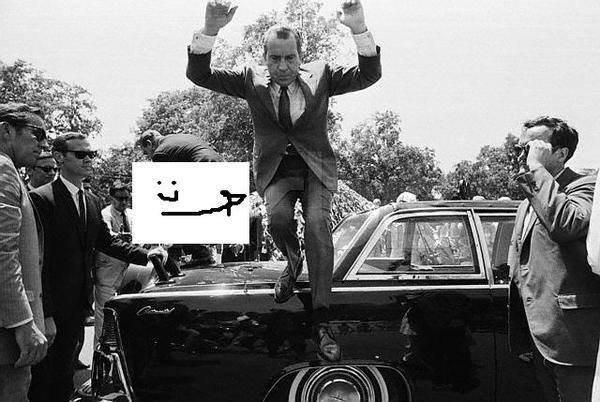 Nixon cavorting on JFK's (rebuilt) Limo after he became PresidentH.R. Haldeman, White House chief of staff for Nixon, wrote in his memoirs that he had come to the conclusion that his boss used the phrase as a kind of coded reference to the assassination of President Kennedy. A tape of a conversation between Nixon and CIA director Richard Helms in October 1971 lends credence to the notion. Listen to the tape, published online by Luke A. Nichter, a history professor at Texas A&M University."
 "Nixon, it is clear, was interested in what he called the ‘Who Shot John?’ angle.
You can listen to a shorter version (it is unedited, just cut off after the relevant part, so you'll hear a lot of squeaking of Nixon's desk chair and noise muffling some of it. such as when Nixon, who has been talking to his aide John Erlichmanm apparently rises and greets Helms, who enters the room, but it's the "real deal.")
Morley continues:
" ‘The Dirty Tricks Department’
Before Helms arrives, Nixon’s aide John Erlichman tells the president Helms has been stonewalling his request for documents about the Bay of Pigs. Erlichman makes it clear that he didn’t tell Helms his real purpose. “I was kind of mysterious about it,” he explains.
But they think they have leverage on Helms. At one point Ehrlichman says, “Helms is scared to death of this guy [Howard] Hunt we got working for us because he knows where a lot of the bodies are buried,” This is spoken eight months before Hunt and six other men were arrested at the Watergate office complex for breaking into the offices of the Democratic National Committee.
When then CIA director arrives, Nixon offers some typically awkward and forced small talk about baseball player Ted Williams and then gets down to business. He says he wants to address the “sensitive” issue of the documents he is seeking. He assures Helms that he fully supports what he calls “the dirty tricks department.”
“I know what happened in Iran and I know what happened in Guatemala and I totally approve of that. I know what happened with the planning of the Bay of Pigs,” he says.”The problem was not the CIA. My interest there is solely to know the facts.”
When Helms doesn’t say much, Nixon presses his case by reminding Helms he is the president.
“First. This is my information,” he says, “Second, I need it for a defensive reasons, for a negotiation.”
When those arguments elicit no response. Nixon tries another justification: He needs the information to protect the CIA. In making his case, Nixon talks about what might be in the records and he utters these words (at around 17:00 in the file):
“The ‘Who shot John?’ angle. Is Eisenhower to blame? Is Kennedy to blame? Is Johnson to blame? Is Nixon to blame? Etc, etc. It may become, not by me, a very vigorous issue but if it does, I need to know what is necessary to protect frankly the intelligence gathering and the Dirty Tricks Department and I will protect it. I have done more than my share of lying to protect you, and I believe it’s totally right to do it.”(NOTE: The reference to "Kennedy" probably means Bobby Kennedy, who was involved in assembling anti-Castro wipe-out campaigns, the resources of which were able to be diverted to kill his own brother. Morley continues:
"What does it mean? The reference to ‘Who shot John” can only be a reference to Kennedy’s assassination. It seems clear that Nixon thought that the CIA records on the Bay of Pigs might contain information about who was behind the assassination. This indicates, at a minimum, that Nixon did not have confidence in the official theory that Kennedy was killed by one man alone. It suggests that he thought the CIA knew more about JFK’s assassination than it let on. And, it is quite clear, that If the CIA’s actions did become an issue, Nixon would protect “the Dirty Tricks Department.”
Nixon never got the documents he wanted. After the arrest of the Watergate burglars on June 17, 1972, Nixon tried to enlist Helms in a cover-up. In a meeting on June 20, Nixon said an investigation of the burglary could “open up the whole Bay of Pigs thing,” causing the usually unflappable Helms to shout, “This has nothing to do with the Bay of Pigs!”
In his posthumous memoir, Helms claimed that he did not know what Nixon was referring to. But if he remembered the conversation of October 10, 1971, he knew exactly what Nixon was talking about."
Note: we owe a debt of gratitude to Luke A. Nichter, who is much more than "a history professor at Texas A&M University" as Morley describes him. Nichter is "a noted expert on Nixon's 3,451 hours of secret White House tapes. He is a New York Times bestselling author or editor of six books... the editor, with Douglas Brinkley, of The Nixon Tapes: 1971-1972 (Houghton Mifflin Harcourt) and...a former founding Executive Producer of C-SPAN's American History TV, launched during January 2011 ...Luke is a recognized advocate for government openness, having filed more than 1,000 Freedom of Information Act (FOIA) requests for the purpose of opening historically important records to public access — work that has been officially endorsed by the American Historical Association. He has an ongoing petition before Judge Royce Lamberth of the District Court for the District of Columbia — In Re: Petition of Luke Nichter, Case No. Misc. 12-74 — which has unsealed thousands of pages of government records in the custody of the National Archives and Records Administration.
July 3, 2016
LEE HARVEY OSWALD NEVER BOUGHT A MAIL-ORDER RIFLE: Steven Gaal Explains
THIS ESSAY BY STEVEN GAAL REVEALS HOW LEE OSWALD WAS FRAMED AS THE 'OWNER' OF A RIFLE HE NEVER ORDERED
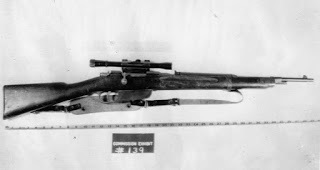 (As posted at The Education Forum in rebuttal to Warren Commission defenders)
Purchasing the Rifle
---------------------------------------
It has long been held that a key piece of evidence in the guilt of Lee Oswald is documentation that he bought a Mannlicher-Carcano rifle and the .38
 YES, '7.65 mm MAUSER' HAS BEEN STAMPED on some Mausers!
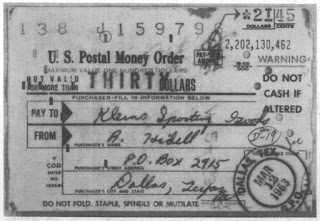
pistol. In his possessions was a found a receipt dated March 12, for the money order he allegedly used to purchase the rifle (no receipts were ever found for the pistol in his belongings). The purchase amount was $21.45. This was for one rifle with a four power scope, but no clip or bullets. The letter had a postmark of 10:30 AM. So, Oswald had a window of 8:30 AM to 10:30 AM to purchase the money order and mail it off.
 One important fact to remember is Oswald’s post office box was authorized for his name only. He ordered everything under his alias, A. Hidell. Any piece of mail coming to his box with the alias would be marked “addressee unknown, return to sender.” Keep this in mind for as we shall see later, the box plays an important role in Oswald’s acquiring of the weapons.
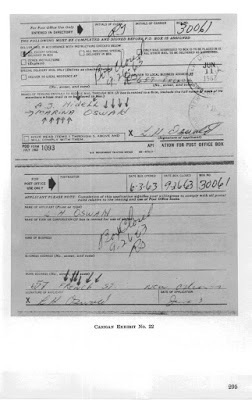 NO 'HIDELL' ON LEE'S P O BOX IN DALLAS
Another hitch is that Oswald’s work records show he was employed that morning at Jaggars-Chiles-Stovell with no absences. The nearest post office was 11 blocks away. A long walk back and forth for a man with no car. Even more curious is the postmark date has zone 12 listed on it. Zone 12 was roughly two miles away in downtown Dallas. Since it was established that the money order was purchased in zone 3, who would buy a money order at one office and then travel two miles to another one to mail it? Plus, Oswald didn’t have the time even if he had a friend to drive him there and back.
The order arrives at Klein’s Sporting Goods in Chicago the next morning and was sent via Airmail. Very good for pre-FedEx days! Kline’s reportedly deposited the money order in its bank account on March 13. However, under closer inspection the money order is missing many of the bank routing stamps which would show its path through the banking system. Only the endorsement stamp of Klein’s is there; it’s missing the stamps from the First National Bank of Chicago, the Federal Reserve Bank of Chicago, and finally, the Federal Postal Money Order Center in Kansas City. None of those three routing stamps are on the back of the money order. The stamps have to be there to show that each bank pays only once, if not you have a mess on your hands. Other money orders that Oswald bought, such as the ones he used to pay off his State Dept. loan, all have these routing stamps. So this is most unusual and never investigated by the Warren Commission, the FBI, or any other agency. It certainly gives weight to the idea that Oswald’s payment never made it through the banking system.
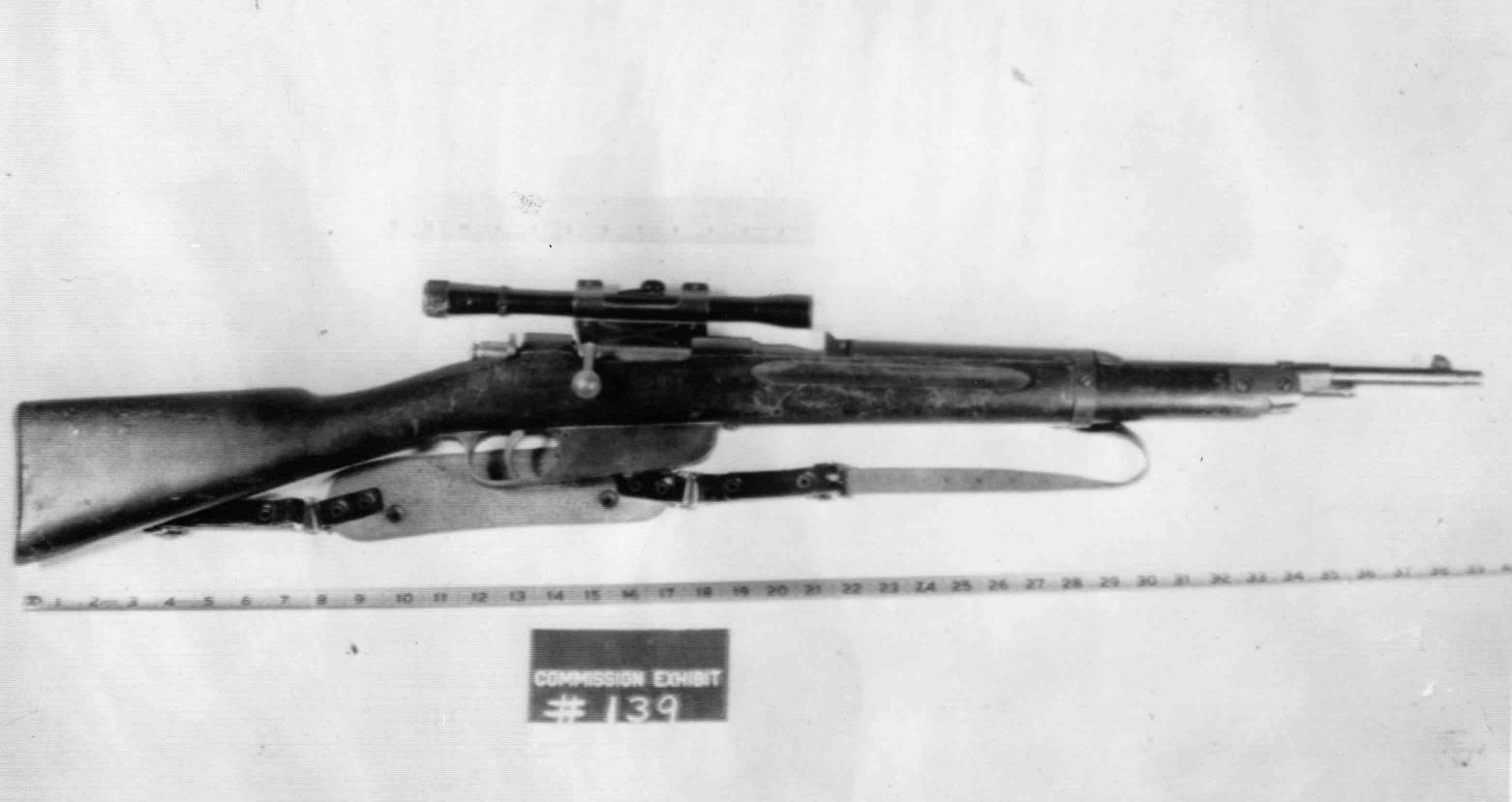
One problem with case and which is largely ignored, was in the spring of 1963 Klein’s only selling the 36” model of the Mannlicher-Carcano. This is clearly shown in ads they had running in various sporting magazines. The rifle found on the sixth floor near the sniper’s nest was a the 40” model. Kline’s was not selling that model in March of 1963.
Adding to that, the FBI went through Klein’s microfilm records and found no sale of a Mannlicher-Carcano with a serial number of C2766 for March of 1963 or any month in that year. They went back a year and never found one sold with that matching serial number in 1962 either. It seems to have disappeared from the inventory.
However, there are several accounting records with the amount of $21.45 listed. One entry is for March, 1963, but another for February 15th. One is listed under the heading, “checks.” But checks are a different type of financial instrument than a money order and should not be listed under that heading. There is also a listing for “other banks” but what banks are those? There is no serial numbers identified for the amount of $21.45. It could be C2766 or somebody else’s order. It should be noted that Klein’s went out of business in 1973 and it’s remaining financial records were destroyed. Also, many accounting records on microfilm disappeared while in FBI custody (Armstrong, p.475).
What is known is Klein’s received a shipment of rifles (carton #3766) and Mannlicher-Carcano, C2766, in that shipment. Also, it was stated by Louis Feldsott, President of Crescent Firearms (wholesaler) in a sworn affidavit to the Warren Commission that he found a record of a sale of a Mannlicher-Carcano, C2766 to Klein’s Sporting Goods, Inc., for June 18, 1962.
Affidavit of Louis Feldsott, President of Crescent Firearms.
June of 1962 is an important date. It’s the same month Oswald, his wife and child, traveled back to the USA from the Soviet Union. His DOD ID card expires that year (sidebar–his mother’s tax returns are sealed from 1956, ending in 1962.). Apparently, one must conclude that somebody created false paperwork to connect Oswald to the
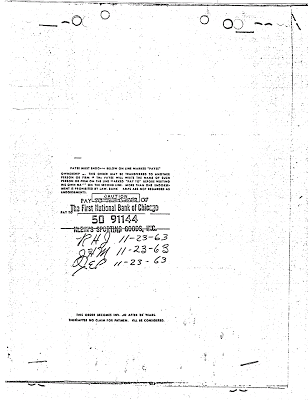 back of money orderrifle, from Klein’s Sporting Goods accounting to bogus money order missing it routing track.
(It should be noted the original money order was found in the National Archives by one of the employees there, Robert Jackson. Jackson was never interviewed by the FBI in regards to how he found it. How it made it there is unknown. Oswald’s receipt was found in his personal possessions but that is suspect because of the all the difficulties already mentioned.)
The Controversy With Post Office Delivery
It’s been implied by some researchers, such as John Armstrong (Harvey and Lee) that Oswald’s P. O. Box was authorized for his name only and any mail arriving with another name, in this case his Hidell alias, would result in a return to sender. This makes getting his gun shipment to him problematic to say the least. The Warren Commission knew this and simply stated in the final report that, “It is not known whether the application for post office box 2915 listed ‘A. Hidell’ was a person entitled to receive mail at this box.” They had the original application, published in evidence volume 19, page 286. While it lists Lee Oswald as the applicant there is no authorization for mail under his name only.
There are other issues at play to further complicate this besides the mail box. One of the postal regulations at the time required that anybody purchasing a firearm had to fill out and sign a 2162 form. Not only the buyer but the seller as well. This form was to be kept on file for four years. This form was never found on either end, from buyer or shipper. The FBI never requested it and Klein’s never volunteered a copy. Dallas Postal Inspector Harry Holmes told the Warren Commission that it basically didn’t matter than Oswald could have received the rifle under his alias. Interestingly, Holmes had been monitoring Oswald’s mail for up to a year since he was receiving subversive materials in the mail (i.e., FPCC and other communist literature) but couldn’t tell the Warren Commission that Oswald had received a package with a gun in it. Why didn’t he know? Oswald’s box was basically flagged. Oddly, Holmes apparently never mentioned that Oswald would have to have filled out the aforementioned 2162 form if that were the case.
All indications are that Oswald did not pick up the rifle package at the Post Office in Dallas. There is no paperwork to prove it and no witnesses to the fact.
The Smith & Wesson Pistol
If the weirdness with rifle is not enough, enter the .38 caliber pistol that Oswald allegedly used to kill Dallas police officer J. D. Tippet. Sold from Seaport Traders, Oswald took order of a snub nosed Smith &Wesson .38. Before he could order it he would be required under Texas law to get a “certificate of good character” from either the Justice of the Peace or a District Court Judge. This would be hard to do since he was ordering the pistol under his Alek Hidell alias. Imagine applying for a certificate verifying your character using a phony name! Apparently, he never did. The certificate would have to have been shown to the shipper before the firearm was released to the buyer.
Like the Mannlicher-Carcano, there is not a lot of solid documentary proof that Oswald bought the pistol. There is one invoice (#70638) saying the gun was shipped COD via Railway Express Agency to a A. J. Hidell. This particular invoice is a copy--the original was never obtained by the FBI. It also states that it was shipped to his post office box address which of course can’t be done and was shipped to REA office for pick-up. The FBI could have checked the bank records of both Seaport Traders and REA but never did.
When a shipment would arrive at REA it was common procedure to send a postcard alerting the buyer the gun had arrived. Once again, since Oswald had a post office box authorized in his name only, he would never have seen the postcard. It would have been marked “returned to sender” like his rifle should have been. Researcher John Armstrong looked into this in great detail and found that a phone call would determine if an order arrived at REA. No ID was required to show up and pay the COD charge and retrieve the package. Anybody could have appeared at the office and paid for the pistol.
There are no receipts of any kind that were found in Oswald’s personal belongings. No invoices, no postcard alerting the arrival of the shipment, no receipt for paying of COD charges...nothing. Oswald obtained a leather holster and bullets for it but no receipts for any of those items either.
----------------------------------------------
In Summary
Here are the major points covered:
•Post office box address only authorized for his name Lee Oswald. Anything sent with another name (as the rifle allegedly was) would be marked return to sender.
•Money Order not marked with proper routing stamps proving his path through the banking system.
•Work records at Jaggars-Chiles-Stovell show Oswald was employed at the time the MO was allegedly purchased and mailed.
•No finger prints found on the MO or the order coupon.
•MO eventually found in the National Archives in Washington, DC rather than the final resting place in Kansas City, MO.
•No 2162 form ever found from the buyer or the shipper.
•Oswald ordered the 36” model but apparently possessed the 40” model not for sale at Klein’s Sporting Goods at the time of sale.
•Klein's financial records did not list a sale of a rifle with C2766 in March of 1963 but instead, June of 1962–when Oswald could not possibility have ordered it and spent part of that month out of the country.
•No “certificate of good character” acquired for use in receiving the .38 handgun.
•Both the rifle and pistol are different models than the ones he ordered.
How do we resolve all of this? Evidently, somebody else bought the guns and fabricated a false paper trial linking it all to Oswald. The missing routing stamps on the back of money order indicate that it was most likely never deposited in Klein’s bank account and even the VP of the company could not verify it was deposited. Oswald’s work records show he never left work the morning of March 12 when he is supposed to have mailed the order to Klein’s for the rifle. When means he couldn’t have done it. In regards to the .38 revolver, that is even more murky and nearly undocumented. Only one receipt is in existence and it is a copy. Oswald himself may not have been aware of the set up that was going on behind his back. If he did he never told a soul. The guilty man has been framed once again.
------------------------------------------------------------------
Sources: Newman, John, Oswald and the CIA; Armstrong, John, Harvey and Lee; McKnight, Gerald, Breach of Trust; Warren Commission Report; Douglass, James, JFK and the Unspeakable; www.ctka.net (Probe Magazine article archive); www.history-matters.com [slightly edited for spelling by JVB]
Edited by Steven Gaal, 26 May 2015 - 11:52 PM.
LEARN MORE AT http://www.judythbaker.blogspot.comREAD ABOUT THE REAL LEE HARVEY OSWALD IN JUDYTH'S BOOK ME & LEE. LEARN MORE BY ATTENDING THE JFK ASSASSINATION CONFERENCE IN DALLAS
 (As posted at The Education Forum in rebuttal to Warren Commission defenders)
Purchasing the Rifle
---------------------------------------
It has long been held that a key piece of evidence in the guilt of Lee Oswald is documentation that he bought a Mannlicher-Carcano rifle and the .38
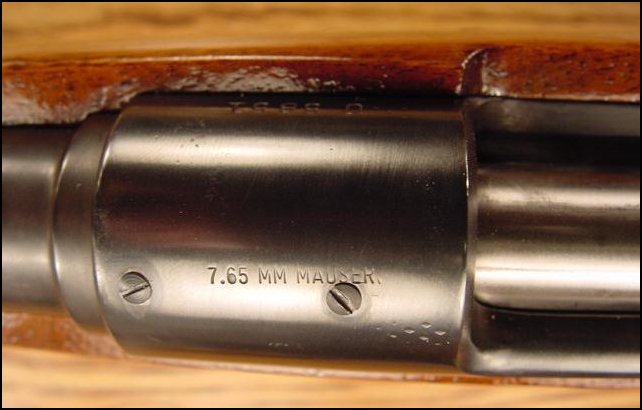 YES, '7.65 mm MAUSER' HAS BEEN STAMPED on some Mausers!
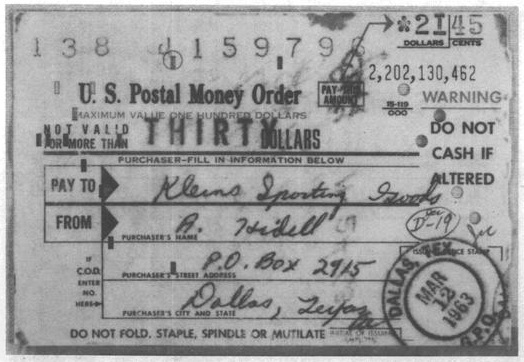
pistol. In his possessions was a found a receipt dated March 12, for the money order he allegedly used to purchase the rifle (no receipts were ever found for the pistol in his belongings). The purchase amount was $21.45. This was for one rifle with a four power scope, but no clip or bullets. The letter had a postmark of 10:30 AM. So, Oswald had a window of 8:30 AM to 10:30 AM to purchase the money order and mail it off.
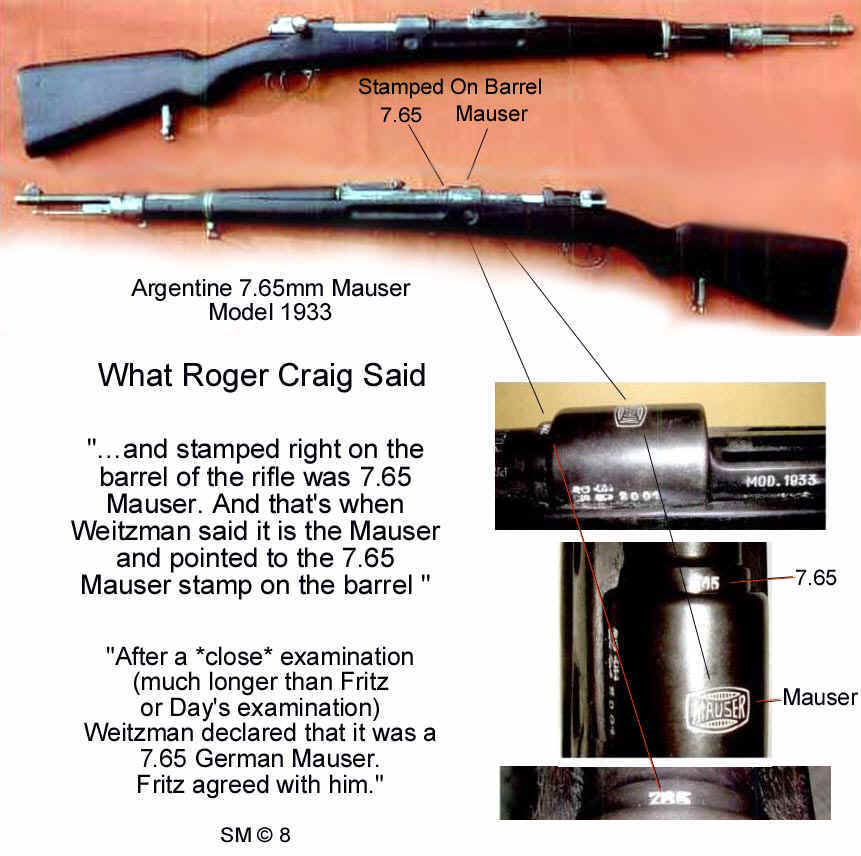 One important fact to remember is Oswald’s post office box was authorized for his name only. He ordered everything under his alias, A. Hidell. Any piece of mail coming to his box with the alias would be marked “addressee unknown, return to sender.” Keep this in mind for as we shall see later, the box plays an important role in Oswald’s acquiring of the weapons.
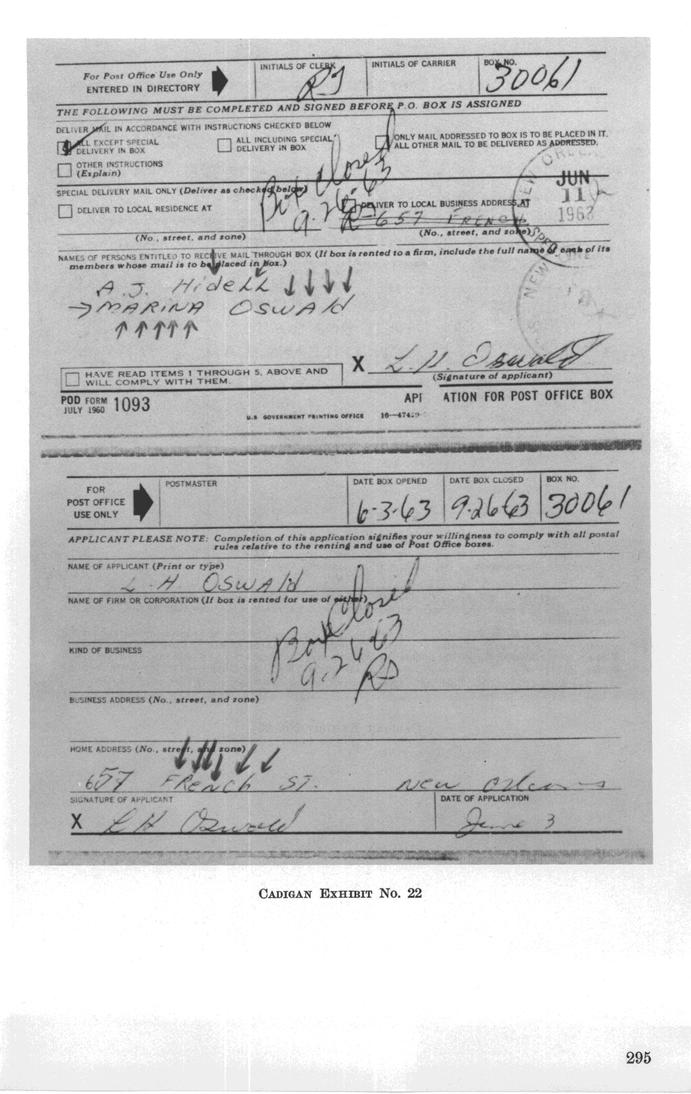 NO 'HIDELL' ON LEE'S P O BOX IN DALLAS
Another hitch is that Oswald’s work records show he was employed that morning at Jaggars-Chiles-Stovell with no absences. The nearest post office was 11 blocks away. A long walk back and forth for a man with no car. Even more curious is the postmark date has zone 12 listed on it. Zone 12 was roughly two miles away in downtown Dallas. Since it was established that the money order was purchased in zone 3, who would buy a money order at one office and then travel two miles to another one to mail it? Plus, Oswald didn’t have the time even if he had a friend to drive him there and back.
The order arrives at Klein’s Sporting Goods in Chicago the next morning and was sent via Airmail. Very good for pre-FedEx days! Kline’s reportedly deposited the money order in its bank account on March 13. However, under closer inspection the money order is missing many of the bank routing stamps which would show its path through the banking system. Only the endorsement stamp of Klein’s is there; it’s missing the stamps from the First National Bank of Chicago, the Federal Reserve Bank of Chicago, and finally, the Federal Postal Money Order Center in Kansas City. None of those three routing stamps are on the back of the money order. The stamps have to be there to show that each bank pays only once, if not you have a mess on your hands. Other money orders that Oswald bought, such as the ones he used to pay off his State Dept. loan, all have these routing stamps. So this is most unusual and never investigated by the Warren Commission, the FBI, or any other agency. It certainly gives weight to the idea that Oswald’s payment never made it through the banking system.
One problem with case and which is largely ignored, was in the spring of 1963 Klein’s only selling the 36” model of the Mannlicher-Carcano. This is clearly shown in ads they had running in various sporting magazines. The rifle found on the sixth floor near the sniper’s nest was a the 40” model. Kline’s was not selling that model in March of 1963.
Adding to that, the FBI went through Klein’s microfilm records and found no sale of a Mannlicher-Carcano with a serial number of C2766 for March of 1963 or any month in that year. They went back a year and never found one sold with that matching serial number in 1962 either. It seems to have disappeared from the inventory.
However, there are several accounting records with the amount of $21.45 listed. One entry is for March, 1963, but another for February 15th. One is listed under the heading, “checks.” But checks are a different type of financial instrument than a money order and should not be listed under that heading. There is also a listing for “other banks” but what banks are those? There is no serial numbers identified for the amount of $21.45. It could be C2766 or somebody else’s order. It should be noted that Klein’s went out of business in 1973 and it’s remaining financial records were destroyed. Also, many accounting records on microfilm disappeared while in FBI custody (Armstrong, p.475).
What is known is Klein’s received a shipment of rifles (carton #3766) and Mannlicher-Carcano, C2766, in that shipment. Also, it was stated by Louis Feldsott, President of Crescent Firearms (wholesaler) in a sworn affidavit to the Warren Commission that he found a record of a sale of a Mannlicher-Carcano, C2766 to Klein’s Sporting Goods, Inc., for June 18, 1962.
Affidavit of Louis Feldsott, President of Crescent Firearms.
June of 1962 is an important date. It’s the same month Oswald, his wife and child, traveled back to the USA from the Soviet Union. His DOD ID card expires that year (sidebar–his mother’s tax returns are sealed from 1956, ending in 1962.). Apparently, one must conclude that somebody created false paperwork to connect Oswald to the
 back of money orderrifle, from Klein’s Sporting Goods accounting to bogus money order missing it routing track.
(It should be noted the original money order was found in the National Archives by one of the employees there, Robert Jackson. Jackson was never interviewed by the FBI in regards to how he found it. How it made it there is unknown. Oswald’s receipt was found in his personal possessions but that is suspect because of the all the difficulties already mentioned.)
The Controversy With Post Office Delivery
It’s been implied by some researchers, such as John Armstrong (Harvey and Lee) that Oswald’s P. O. Box was authorized for his name only and any mail arriving with another name, in this case his Hidell alias, would result in a return to sender. This makes getting his gun shipment to him problematic to say the least. The Warren Commission knew this and simply stated in the final report that, “It is not known whether the application for post office box 2915 listed ‘A. Hidell’ was a person entitled to receive mail at this box.” They had the original application, published in evidence volume 19, page 286. While it lists Lee Oswald as the applicant there is no authorization for mail under his name only.
There are other issues at play to further complicate this besides the mail box. One of the postal regulations at the time required that anybody purchasing a firearm had to fill out and sign a 2162 form. Not only the buyer but the seller as well. This form was to be kept on file for four years. This form was never found on either end, from buyer or shipper. The FBI never requested it and Klein’s never volunteered a copy. Dallas Postal Inspector Harry Holmes told the Warren Commission that it basically didn’t matter than Oswald could have received the rifle under his alias. Interestingly, Holmes had been monitoring Oswald’s mail for up to a year since he was receiving subversive materials in the mail (i.e., FPCC and other communist literature) but couldn’t tell the Warren Commission that Oswald had received a package with a gun in it. Why didn’t he know? Oswald’s box was basically flagged. Oddly, Holmes apparently never mentioned that Oswald would have to have filled out the aforementioned 2162 form if that were the case.
All indications are that Oswald did not pick up the rifle package at the Post Office in Dallas. There is no paperwork to prove it and no witnesses to the fact.
The Smith & Wesson Pistol
If the weirdness with rifle is not enough, enter the .38 caliber pistol that Oswald allegedly used to kill Dallas police officer J. D. Tippet. Sold from Seaport Traders, Oswald took order of a snub nosed Smith &Wesson .38. Before he could order it he would be required under Texas law to get a “certificate of good character” from either the Justice of the Peace or a District Court Judge. This would be hard to do since he was ordering the pistol under his Alek Hidell alias. Imagine applying for a certificate verifying your character using a phony name! Apparently, he never did. The certificate would have to have been shown to the shipper before the firearm was released to the buyer.
Like the Mannlicher-Carcano, there is not a lot of solid documentary proof that Oswald bought the pistol. There is one invoice (#70638) saying the gun was shipped COD via Railway Express Agency to a A. J. Hidell. This particular invoice is a copy--the original was never obtained by the FBI. It also states that it was shipped to his post office box address which of course can’t be done and was shipped to REA office for pick-up. The FBI could have checked the bank records of both Seaport Traders and REA but never did.
When a shipment would arrive at REA it was common procedure to send a postcard alerting the buyer the gun had arrived. Once again, since Oswald had a post office box authorized in his name only, he would never have seen the postcard. It would have been marked “returned to sender” like his rifle should have been. Researcher John Armstrong looked into this in great detail and found that a phone call would determine if an order arrived at REA. No ID was required to show up and pay the COD charge and retrieve the package. Anybody could have appeared at the office and paid for the pistol.
There are no receipts of any kind that were found in Oswald’s personal belongings. No invoices, no postcard alerting the arrival of the shipment, no receipt for paying of COD charges...nothing. Oswald obtained a leather holster and bullets for it but no receipts for any of those items either.
----------------------------------------------
In Summary
Here are the major points covered:
•Post office box address only authorized for his name Lee Oswald. Anything sent with another name (as the rifle allegedly was) would be marked return to sender.
•Money Order not marked with proper routing stamps proving his path through the banking system.
•Work records at Jaggars-Chiles-Stovell show Oswald was employed at the time the MO was allegedly purchased and mailed.
•No finger prints found on the MO or the order coupon.
•MO eventually found in the National Archives in Washington, DC rather than the final resting place in Kansas City, MO.
•No 2162 form ever found from the buyer or the shipper.
•Oswald ordered the 36” model but apparently possessed the 40” model not for sale at Klein’s Sporting Goods at the time of sale.
•Klein's financial records did not list a sale of a rifle with C2766 in March of 1963 but instead, June of 1962–when Oswald could not possibility have ordered it and spent part of that month out of the country.
•No “certificate of good character” acquired for use in receiving the .38 handgun.
•Both the rifle and pistol are different models than the ones he ordered.
How do we resolve all of this? Evidently, somebody else bought the guns and fabricated a false paper trial linking it all to Oswald. The missing routing stamps on the back of money order indicate that it was most likely never deposited in Klein’s bank account and even the VP of the company could not verify it was deposited. Oswald’s work records show he never left work the morning of March 12 when he is supposed to have mailed the order to Klein’s for the rifle. When means he couldn’t have done it. In regards to the .38 revolver, that is even more murky and nearly undocumented. Only one receipt is in existence and it is a copy. Oswald himself may not have been aware of the set up that was going on behind his back. If he did he never told a soul. The guilty man has been framed once again.
------------------------------------------------------------------
Sources: Newman, John, Oswald and the CIA; Armstrong, John, Harvey and Lee; McKnight, Gerald, Breach of Trust; Warren Commission Report; Douglass, James, JFK and the Unspeakable; www.ctka.net (Probe Magazine article archive); www.history-matters.com [slightly edited for spelling by JVB]
Edited by Steven Gaal, 26 May 2015 - 11:52 PM.
LEARN MORE AT http://www.judythbaker.blogspot.comREAD ABOUT THE REAL LEE HARVEY OSWALD IN JUDYTH'S BOOK ME & LEE. LEARN MORE BY ATTENDING THE JFK ASSASSINATION CONFERENCE IN DALLAS
June 25, 2016
LEE HARVEY OSWALD: HE WASN'T A DEADBEAT!
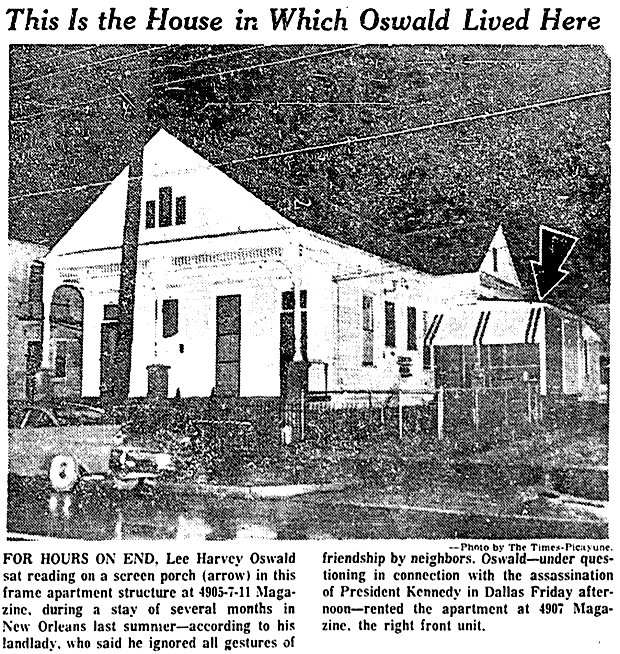 This is what 4905 Magazine St. looked like in 1963. It is the small apartment with overhead sunscreens and the fenced-ij front yard, set back from the road. At the front it is gated, and you can see the white mailbox there for 4905. The big part of the house to which it is attached held 4907 (to the right--note the big white mailbox) and 4909 to the left. Behind it was 4911.
All four addresses had their own mailboxes (even though Lee used 4907 for mail, he did so to protect his Russian-born wife and child... my critics try to say that Lee had no mailbox of his own. This was not true, though he did not place that address on his correspondence. 4907 was EMPTY until mid-July, when Mr. and Mrs. Eric Rogers moved in. Mrs. Rogers was ill and could do very little. Lee paid Mr. Rogers' utility bill, which went up about 30% after Mr. and Mrs. Rogers moved in. Prior to that, lee used 4907 as a kind of office, as it was vacant (*I have that reference from the Polk Directory).
When Lee left in September, the Rogers' utility bill went in the red by mid-month, and Lee was later accused by the Warren Commission of being a deadbeat for not paying it, even though we know from the Rogers' testimony that they continued to live in the apartment and were still there in 1964 when they were interviewed by the Commission. They obviously had to start paying that utility bill themselves. My critics try to say that Lee never paid the utility bill for thje Rogers and that I have blackened the Rogers' name. Rogers did not get a job until the end of September, when he began working for Meal-a-Minute.
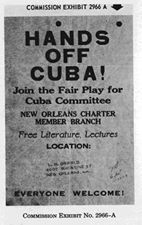
Lee did not use the address of 4907 publicly until he began handing out FPCC Hands Off Cuba flyers at the Trade Mart, as I recall. He was not about to put 4905 on them, where his wife and child lived in that set-back apartment that was all safely fenced in. But from the beginning -- even when vacant-- all mail to the Oswalds came to 4907. This was at the height of the Cold War, and mail from the USSR, The Daily Worker, etc. was coming to that vacant apartment and was not connected in the postman's mind to 4907. Then the Rogers moved in. However, Lee still kept his mail coming to 4907, but obviously, the Rogers needed to have some incentive to keep receiving such mail. Their utility bill got paid and they allowed the mail to come to their address.
This simple arrangement is not believed by my critics. According to them, for some reason unknown to normal people, they insist that all mail to 4905 AND 4907 went ONLY to 4907, the vacant apartment, . When the Warren Commission asked Mr. Rogers about this mail problem. Rogers had this to say: Mr. Liebeler.
You lived right next door to Oswald?
Mr. Rogers.
My apartment was in the front and my window was fight next--near his apartment.
Mr. Liebeler.
You met Oswald and came to know him? Did you ever meet him?
Mr. Rogers.
No; I never met him. He didn't bid the time to anyone.
Mr. Liebeler.
Did you talk to him or anything?
Mr. Rogers.
No; never did.
Mr. Liebeler.
Did you know what his name was?
Mr. Rogers.
Just by mail coming in the box on the front.
Mr. Liebeler.
Did you ever talk to his wife?
Mr. Rogers.
She spoke Russian. She did bid the time of day, that's all, but he didn't. He wouldn't bid the time to no one.
Mr. Liebeler.
Mr. Liebeler.
Now do you remember anybody else that visited Oswald at his apartment?
Mr. Rogers.
Probably at the time they had this--you know--Fair Play for Cuba, something like that. I think they were radio interviewers, I think. Looked like local people. Didn't look like--heard him saying something about wanting to play on radio. That's all."
NOTE THAT ERIC ROGERS KNEW ABOUT "FAIR PLAY FOR CUBA." HOW? At one point Lee plastered some signs all over his porch and Mrs. Garner told him to take them down. But he uses 'radio interviewers' -- plural-- when only one person ever admitted coming to Lee's apartment. He had to ask at Eric Rogers' home, because the only address he had was for 4907.
Later in the same testimony, Eric Rogers says that a mailman 'brought a big package in" for Lee Oswald-- He says it this way:
Mr. Liebeler. Did you ever see any rifle or firearms of any type in his possession at that time?
Mr. Rogers. No; I never. We did see one time some the mailman brought a big package in. I wouldn't say what it was, of course. I guess they checked that through the mail.
Mr. Liebeler. When was that?
Mr. Rogers. It was in the summer, some time before he left, somewhere around that time.
The words "Brought a big package in" sounds like a delivery to the door of the Oswald's, having to go through the fenced-in yard straight to their apartment. Rogers guesses that "they checked that through the mail."
Mr. Rogers accidentally shows that he knows a lot about Lee getting ready to move, for he says this:
Mr. Rogers. He left that following evening. I figured he was moving. I don't know. If he was moving, he was supposed to tell the landlord.
Mr. Liebeler. Did he talk to the landlord about it?
Mr. Rogers.
No; but she knew about it. He didn't talk to her. He didn't talk to nobody. He would give you the money and wouldn't say nothing. He was quiet himself, that's all.
HOW DID MR. ROGERS KNOW THAT LEE DIDN'T TALK TO THE LANDLORD, BUT SHE 'KNEW ABOUT IT'? Any comments?
Marina and Ruth Paine used the 4907 address to writ to each other. All Russian materials came to 4907. The flyers said 4907. Yet it is certain that lee lived at 4905. I contend that he could have had his mail directed to 4905 but did not do so to protect his family. This is also why he placed "4907 Magazine Street" on the Hands Off Cuba flyers..
My critics try to say that all mail came to 4907 anyway and that the utility bill paid for 4907 was really for 4905.
I was there and I hope that common sense will guide you as to the real reason that the utility bill went into the red by the end of September when Lee left. The bill was NOT for BOTH 4907 AND 4905 as these people try to tell you. Lee paid the bill because he was using the vacant apartment as an office. By having the Rogers move in, Lee was able to place '4907' on the flyers without having to use 4905 instead. Lee paid the utility bill at 4907 in May, June, July, August and part of September, even though Eric Rogers said this:
Mr. Liebeler.
When did you move there?
Mr. Rogers.
It was around in the in July, around July.
These people have to prove that the Rogers paid their utility bill for 4907 for at least 2 weeks in July, for all of August, and of course for all of September all the way to July 21, 1964 when Eric Rogers stated that he was still living at 4907. Instead, they insist that Lee Oswald paid on 4905 by paying for the 4907 utility bill. It seems that "anything goes" no matter how absurd, if only it can be used to discredit me. SEE THE ATTACHED STATEMENT THAT LEE OSWALD WAS RESPONSIB LE FOR THE UTILITY BILL AT 4907, EVEN THOUGH THE ROGERS WERE LIVING THERE, AND THAT HE LEFT THE BILL AT 4907 UNPAID IN SEPTEMBER, AND THEREFORE WAS A DEADBEAT, below...
For objecting to this false statement, I am attacked on Facebook and online with posts defending poor old Mr. Rogers as a truth-teller. Sure he was. Just as Kerry Thornley was. Just as Marina Oswald was. Just as Ruth Paine was..
I won't be here forever to defend the truth. Share this. Pass it on! It matters! This is an example pof how facts that prove who lee Oswald really was are being twisted right before our eyes, today, by armchair 'researchers' who basically object to everything I say, but who themselves do nothing to to exonerate that innocent man. They are obstructing justice for our fallen president, and with my last breath, i come against that.
To those of you who read this: SAVE IT, SHARE IT, AND SHOW TO INTELLIGENT PEOPLE.
thank you for whatever you do to spread the truth.
JVB
Comments
 Reuel Smith also, what about the statement "he would give you the money.."?
 Judyth Baker yes... Lee said he gave the Rogers money for watching out for Marina and his little girl, in that people came to THEM inquiring for Lee, due to THEIR address being printed on the HANDS OFF CUBA flyers. See this:
May 9, 2015
Lee Harvey Oswald did not have Aspergers: Correcting an Armchair Diagnosis
Lee Harvey Oswald did not have Aspergers: Correcting an Armchair Diagnosis
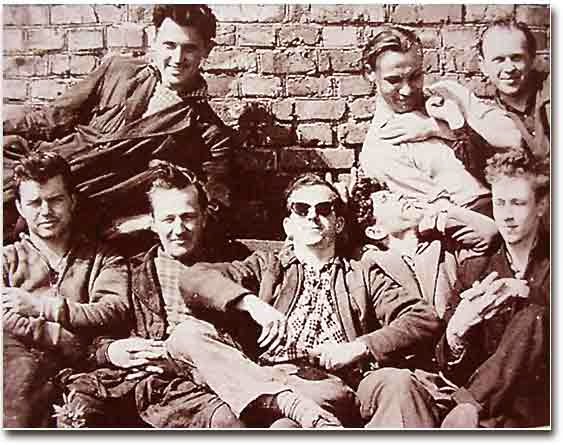 Lee Harvey Oswald in Minsk with fellow factory workers
 Greg Parker, an Australian blogger with a long interest in the Kennedy assassination, conducted an armchair diagnosis on Lee Harvey Oswald. He decided that Oswald had Aspergers, a neurobiological disorder linked to autism. He's wrong.
Some common symptoms include the inability to show feelings for others (empathize), finding comfort in doing repetitive things, having trouble recognizing common social signals such as a frown or a hint to 'go away', and being unable to form meaningful relationships outside a range of narrow, often obsessive interests that can create expertise in a particular scientific field, such as mathematics or chemistry.
To begin with, as for Lee's not having the ability to empathize, let me explain that Marina Oswald, in Patricia McMillan's book Marina and Lee, which is CIA-approved, revealed that Lee (who was devoted to JFK) cried when baby Patrick,born premature to John and Jackie Kenedy, died of hyaline lung disease.
It's also on record that Lee also cried when he got the small birthday cake Ruth Paine made for his 24th birthday (Marina and Lee, p. 474). Lee told me he cried because "That was the last birthday cake I'll ever have." Now, slips such as Lee's crying over his birthday cake shows that he could feel deep emotions, though he was a courageous man who exhibited considerable self-control when under arrest for Kennedy's murder.
Other symptoms of Aspergers:
• Inability to listen to others
• Inflexible thinking [Parker misuses this important diagnostic benchmark]
• Repetitive routines provides feelings of security [Parker misuses this important diagnostic benchmark]
• Stress when their routine suddenly changes [Parker wrote: "Adherence to routines and schedules, and stress if expected routine is disrupted (Oswald was a prolific writer of “to do” lists)." Fact: While there are a few 'to do" lists in Lee's busy life, try and find them.
• Inability to think in abstract ways (Parker says: "some evidence that this applied to Oswald" without citations. Lee had no problem whatsoever to think in abstract ways. For example, Lee wrote in his Historic Diary, "7.00 P.M. I decide to end it. Soak wrist in cold water to numb the pain. Than slash my left wrist. Than plaun wrist into bathtub of hot water. I think "when Rimma comes at 8. to find me dead it wil be a great shock. Somewhere a violin plays as I watch my life whirl away. I think to myself. "how easy to die" and "a sweet death, (to violins) about 8.00 Rimma finds me unconcious (bathtub water a rich red color)[spelling mostly not corrected to display his dyslexia]
• Specialised fields of interest [But this is true of many people who aren't Aspies]
http://psychcentral.com/lib/symptoms-of-aspergers-disorder/000877
Many photos of Lee were taken by friends -- more than usual for the era. Note how many of them show Lee smiling, or with his arms around a woman, or goofing off in the center of a batch of men, such as the famous photo of Lee in sunglasses, taken outside the factory at Minsk.
Lee had a number of affairs and conquests before marrying Marina. That he made a number of friends in the Marines, one of whom recently (Botelho, Santa Ana) contacted a friend of mine and who stated, for the record, that Lee was friendly, intelligent and prone to joking, who handled himself well, though he was being picked on by one of the officers unfairly. Botelho said that a lot of his testimony was cut out from what he told the Warren Commission and never got published. However, another Marine (Felde) said Lee "kept to himself" and read "quality books" a lot. Kerry Thornley was in between, describing Lee as friendly, but then suddenly breaking off contact with him. We need to look beyond statements made by the Marines because Lee was only a 17-year-old teen when he joined the Marines, barely of legal age. He had a lot of adjusting to do. Felde was only with Lee in Boot Camp.
As a young adult, upon his return from the USSR to the USA, Lee had the burden of keeping Marina sufficiently isolated so she could not be accused of being a spy. Lee's CIA-connected 'best friend' in Dallas, George de Mohrenschildt, said he didn't defend Lee as he should have to the Warren Commission in his book I AM A PATSY! (HSCA ), and added that Lee would not have betrayed him as he had betrayed Lee, commenting that Lee would have been a fearless and loyal friend, whereas he, de Mohrenschildt, was in comparison a craven coward.
Lee did have dyslexia, which is common to many people, but found among males of above-average intelligence.
Because "Aspies" can have real problems learning how to read, some people think those with dyslexia instead have Aspergers, which is one of the errors Greg Parker makes in his blog.
Lee had dyslexia. The reason he could often spell better was because he used a dictionary (and for some FPCC letters I was there, and he consulted me on spelling some words).
Note that Lee had no developmental delays, and was always a bright and cheerful child until his mother moved them to New York, where he lost his entire family support system after going to the defense of his obstrusive and rude mother, who was, according to Lee, being yelled at by John Pic's wife (Pic was out on duty at the time, I believe... Marguerite had moved herself and lee into the tiny apartment Pic and his wife shared with her parent(s) who were temporarily away. After weeks there, it was obvious Marguerite was there to stay. Lee drew apenknife on Pic's wife when, he told me, she threatened to hit his mother. At any rate, he was quite defensive of his mother and they got kicked out. It was a hard and lonely time for Lee. So, what did he do? Curl up in a corner? No. He took to riding the subways and trains, spending time in libraries, and avoiding school. He loved animals. It's not surprising, therefore, that Lee's favorite haunt was the Bronx Zoo, where he was arrested for truancy.
In New York, Lee avoided school, had some emotional problems in his isolation, wore the wrong (Southern style) clothes and was mocked and got into fights due to being the new kid and having a New Orleans accent, which Lee quickly erased. Unlike most Aspies, Lee had a terrific facility for learning a language --as evidenced by his ability to pick up Russian, a very difficult language, so fast that at the end of about a year and a half practicing and learning Russian, when Marina met him at a dance, she thought Lee was a Belarus native (she was new in town from Leningrad and had moved in with her uncle's family, very small and crowded apartment, so they were anxious to get her married off). The Belarus variety of Russian was not as elegant as proper Russian and Belarus-born George DeMohrenschildt said Marina chided Lee for his occasional 'errors'--which irritated George, who declared Lee had the best command of Russian he had ever known in a foreigner--and he taught Russian to college students in classes for college credit.
So--Lee was very good at language, had some psychological issues when he was uprooted and thrust into a new world in New York, where he ended up briefly in an institution for juveniledelinquents, where, lee told me, staff and the bigger kids regularly abused newcomers, including him.
So young Lee had some emotional problems at that key time in his life--age 11-13--when he was entering puberty--a rough time for all adolescents.
I think he did very well, with the poor parent he had to live with.
Here are the primary factors to consider with Aspergers.
Asperger's syndrome, also called Asperger's disorder, is a type of pervasive developmental disorder (PDD). PDDs are a group of conditions that involve delays in the development of many basic skills, most notably the ability to socialize with others, to communicate, and to use imagination.
http://www.webmd.com/brain/autism/mental-health-aspergers-syndrome
Greg Parker claimed that Lee "avoided eye contact' and that was evidence that he had Aspergers. [Parker wrote: Oswald could not make eye contact with Ruanne Kloepfer on her visit to the Oswald residence in Sept, 1963.] But Parker should have looked at Hugh Murray's report -- in his book review of Me & Lee--a little more closely, where he described this singular event. Murray says Kloepfer also said Lee made a pass at her in the kitchen, which is why he wouldn't make eye contact with her when they returned to the living room, where her sister, mother and Marina were. Her statement that Ruth Paine drove up in the station wagon, fresh from her trip East, just as they were leaving, cannot be true if Ruth Paine is telling the truth, because Paine testified to the Warren Commission that "I was impressed with the role that Lee took of the general host, talking with them, looking over some slides that one of the daughters had brought of her trip, recent trip to Russia, showing sights that they recognized, I guess, in Moscow.
Mr. JENNER - That the girls recognized?
Mrs. PAINE - No; that Lee and Marina recognized of Moscow, or Lee did, at least. And he was very outgoing and warm and friendly..."
Parker says: "Hampered conversational ability (some evidence that this applied to Oswald)..." and "Inability to manage appropriate social conduct (some evidence that this applied to Oswald)..." Parker also says, "Even affected people who are high achieving and academically or vocationally successful have trouble negotiating the ‘hidden rules’ of courtship. Inappropriate sexual behaviour can result. (despite not being able to make eye contact with Ruanne Kleopfer, she nevertheless felt he was flirting with her – despite Marina being home at the time)..." Parker takes the flawed statement of Ruanne Kloepfer as fact, even though her sister said that Ruanne never left the room and the event did not occur:
"Because Marina was pregnant, Ruanne went to help Lee. That is when Lee came on to Ruanne. That is when she became furious. They return to the living room. In her email, Karol [Ruanne's mother]denies that that occurred. She asserts that they were all in the living room for the full hour of the visit...[however] according to Karol, [Ruanne] continually berated Lee for preparing to leave his pregnant wife and child." [ http://hughmurray.blogspot.com/2013/0... -- his uncomplimentary assessment of me, here, contains numerous misinterpretations of my statements and my book, but that's for another time. ].
Ruth Paine mentions nothing negative whatsoever in her description of how Lee was treated or how he behaved with the Kloepfers--a rare occurrence indeed. It's my opinion that Paine would have mentioned anything negative that happened if she could, for she doesn't seem to fail to mention anyone criticizing Lee elsewhere. But Parker takes the claims of Ruanne to support not one but two of his claims:
(1) "...a person with Asperger's syndrome aged in their 20s typically has the sexual codes of conduct befitting a teenager...[they] have trouble negotiating the ‘hidden rules’ of courtship. Inappropriate sexual behaviour can result...(2) (despite not being able to make eye contact with Ruanne Kleopfer, she nevertheless felt he was flirting with her – despite Marina being home at the time).."
Parker ignores Ruth Paine's WC statement that Lee Oswald was "very outgoing and warm and friendly" to the Kloepfers and that she was "impressed with the role Lee took of the general host." He conveniently forgets that Lee was able to get Marina's promise to marry in two weeks, ignores de Mohrenschildt's description of Lee impressing the socks off a beautiful cultured Japanese musician at George's party, where Marina was the one acting like a child, and of course denies that I ever met Lee, though I remain devoted to him.
In an affront I cannot stomach, Parker says "Problems with controlling feelings such as anger, depression and anxiety (some evidence that this applied to Oswald)..." as "evidence" of Aspergers, when in every instance, we find Lee's worst behavior is almost always associated with his inability to get along with Marina. Considering how common this problem is between couples from different cultures, and how opposite their personalities were, Parker should have looked elsewhere before applying this criterion, considering the fact that Lee, under considerable stress, being yelled at by reporters when under arrest, not only makes eye contact with everyone he can, but under interrogation, he remained in control of his emotions. Said Dallas Police Investigator Jim Leavelle, the man who brought Lee out double-handcuffed when Lee was shot by Jack Ruby: “He was very polite, calm and collected,” Leavelle said...“I said later that I wouldn’t want to be that cool and calm after shooting two people.” Leavelle said he was struck by one thing that came from Oswald’s mouth: “I didn’t shoot anybody.” [ http://www.nydailynews.com/news/national/jfk-assassin-article-1.1514569]
So, let's review:
"...a person with Asperger’s may engage in long-winded, one-sided conversations without noticing or caring about the listener’s interest. They also often lack usual nonverbal communication skills, such as engaging in eye contact with others they’re talking to, or failing to react and empathize with other people’s stories and conversation... They may have a hard time “reading” other people or understanding humor."
http://psychcentral.com/lib/symptoms-of-aspergers-disorder/000877
As for understanding humor, George de Mohrenschildt introduces us to Lee as a man who loved to tell jokes (they were usually wry jokes). He recounts back-and-forth jokes between them, especially about life in the Soviet Union. Lee had a great sense of humor and liked to tease me, as can easily be seen in Me & Lee where he wouldn't tell me the ending of the science fiction story about 'The Last Male."
Let me stress that high intelligence and the ability to concentrate on something are attributes of many Aspies. But that's also true of many other people who are utterly normal. http://www.asperger-advice.com/asperger-symptoms-in-adults.html
Nevertheless, Parker faults Lee for achieving excellence in spoken Russian, writing, "When a person with Asperger’s Syndrome learns a foreign language, there can be a remarkable ability to pronounce the words as spoken by a native speaker." Well, guess what. There are thousands of people who can do the same thing who do not suffer from Asperger's. The US Military has designed a test that identifies the best learners of language as relying on "working memory, associative memory and implicit learning" -- these abilities are found in second language learners across the spectrum.
Lee told me his responsibility was to erase his accents, to protect his identity as working for the CIA, so he could not be traced as coming from a particular area. I've had doctoral level training in linguistics and can assure you that Lee had a natural ear for learning Russian. However, he had a harder time with Spanish and was much slower acquiring any real proficiency in it. Why? Lee wasn't motivated to learn it ahead of time because we originally planned to be living in Latin American countries for a long time. Motivation turns out to be important in attaining a new language. Hence, Lee's hard-gained fluency in Russian was not due to an Asperger's-driven compulsion, but was because he was preparing to be a dedicated Cold War operative, penetrated the Soviet Union, and there perfected, by dint of hard work, his command of the language.
John Armstrong [Harvey and Lee, p. 11, 247, 339,etc.] erroneously says Lee spoke Russian fluently from childhood because he was born into a Hungarian family, and did not dare speak it in the USSR. He says the Russians had no record of Lee speaking Russian even though Lee's friend in Minsk, ErnstTitovets, tells us that Lee had a Russian tutor assigned to him to help him earn Russian.
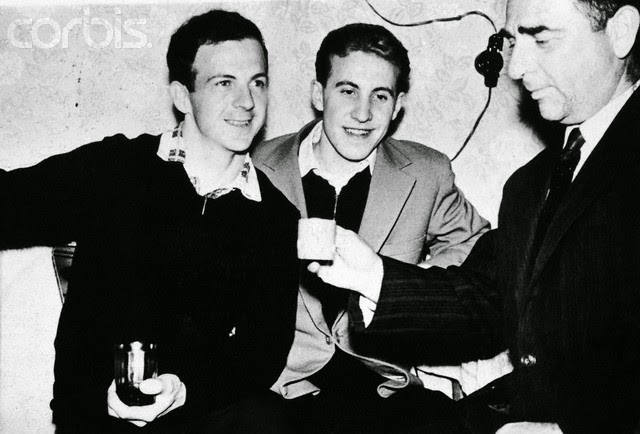 Lee, to left, in Minsk. Hardly anti-social. This mess of a "Russian speaking Harvey" from childhood is due to Armstrong's making much ado about an anonymous phone call describing his uncle and father as communist Hungarians... apparently in Armstrong's world, all Hungarians living in the USA spoke Russian fluently, though nobody in my extensive Hungarian family did. In 2013 and 2014, Ernst Titovets, the no-nonsense scientist that he is, stated vehemently to listeners at the JFK AssassinationConference in Arlington, Tx --and elsewhere -- that Armstrong misquoted him and numerous others in Minsk when he claimed Lee spoke no Russian while in Minsk (because he feared to reveal his fluency). Titovets got red in the face with anger and disgust as he denied that Lee "never" spoke Russian. It was a marvel to behold.
 And it weakens Parker's insistence that Lee was so fluent in Russian because "some" Aspies can learn languages easily and well without an accent.
Lee's fluency in Russian came from study and long practice: so important were his flash cards in Russian, Spanish and English --that was to help him overcome his dyslexia--that all three boxes were found in his tiny room on Beckley Avenue. Lee used to hold a Russian flash card up so I could see what was on the back, and I would correct him if he pronounced the word incorrectly. Once Lee and I met at Tulane's music listening rooms, where he had accessed a Russian language record, which we played in one of the small private rooms. This record had the "classic" highly-cultivated kind of Russian accent that Lee preferred to the one he had learned in Minsk. By no means did Lee do this in ay obsessive manner. For example, we kissed in the relative privacy of the music listening room! )
 As Lee entered training to become a spy and a fake defector, he had to change his ways. He stopped drinking and smoking, though he continued his sexual activities with pretty Japanese women at clubs in Tokyo, his forays there apparently subsidized by the CIA/ONI, since he was dating very expensive consorts. Lee had to get 'dirtied up' because as a "happy" Marine he had no basis for defecting. And if he had defected with a good record, including improving his shooting score as other Marines usually did, Lee could have been executed as a danger to the nation. Hence, we see Lee thrown into the brig after pouring beer over his Sergeant's head (there's that sense of humor--he had to get in trouble, so why not be silly about it?) after having previously shot himself in order to get in trouble for having an unauthorized firearm (a Derringer). Maybe Lee was just showing off to me about shooting himself on purpose, in a way to make it look like an accident. Only weeks before he would have been discharged, Lee suddenly was basically discharged (remained in the reserves) so he could go home on a hardship basis and 'take care' of his mother, who had sustained a nose injury weeks earlier from a box of candy falling on her face at the store where she worked (Marguerite successfully sued). Lee spent no more than three days with his mother and a day or so with Robert, his brother, before going to New Orleans --the first leg of his journey as a (fake) defector. He, supposedly 'dissatisfied' with the USA (after a year of studying Russian) entered the USSR via routes known fully only to Intelligence sources (see http://www.democraticunderground.com/discuss/duboard.php?az=view_all&address=125x298715 ) after which, when his Visa wasn't renewed, this intrepid young fellow sliced his left wrist and just about killed himself (because his Soviet tour guide, Rimma, was, he told me, "about half an hour late." In his "Historic Diary" Lee says, of course, that Rimma was right on time.)
I was surprised that Parker didn't mention the high suicide rate of Aspies as part of his thesis. While Aspies have a high suicide rate, this necessary severing of a vein (5 stitches required, but the scar, noted in Lee's autopsy, was slight) was never intended to kill. Never again in the rest of his life did Lee ever exhibit suicidal tendencies. His ploy worked. He was soon released from the hospitals' mental ward as no threat, and it was decided it would look very bad to deport Lee Oswald after such a dramatic gesture.
Not content with misrepresenting Lee's patriotism as some kind of obsession (ignoring the fact that Lee adulated Herbert Philbrick, of I Led Three Lives Fame, who pretended to be a communist for the FBI) Parker also says that Lee, as an Aspie, cultivated "Specialised fields of interest or hobbies. (Oswald memorised the Marine Manual at age 15 (sic) and had an ongoing special interest in political movements and learning languages)..." which he called "persistent preoccupation with parts of objects" to make it qualify as an obsession, thereby placing Lee as an Aspie [however lightly afflicted] with narrow interests and obsessive-compulsive behavior.
[Apparently Parker was cognizant of http://www.ninds.nih.gov/disorders/asperger/detail_asperger.htm]
Half the readers of this article, assumed intelligent, have probably "...had an ongoing special interest in political movements and learning languages..." -- "symptoms" Parker grabs to label Lee Oswald. Though "memorizing the Marine Manual" may seem obsessive to some, this was his mother's statement, not Lee's, and constitutes hearsay. (Marguerite said: "Lee, at age sixteen, read his brother Robert's Marine Manual back and forth. He knew it by heart.")
Upon such 'evidence' Parker builds his case.
Probably one of the outstanding things I've noticed, in one of my grandchildren who has Aspergers, is that he makes straight A's in school but is trapped in a world where repetition is important. Now, there's a difference between habit and repetition. Lee had a habit of bathing every day, which in 1963 was somewhat unusual. Repetition is another matter. My teenage grandson will play the same video game over and over. He won't stop to even eat, unless ordered to quit. He never picks up his clothes: disorder follows wherever he goes. He is a genius in engineering, but his handwriting is all but unreadable, in large letters forcefully written, sometimes making the pen go right through the paper. He loves his computer--though he is likely to step on it and ruin it because he never picks up anything. He doesn't like to travel and avoids new things.
Parker used the "repetition" card like this: "It was reported by the likes of Mike Paine and others that Oswald was inflexible in discussions on politics and when cornered would simply repeat the same arguments." Oh, dear. How "Aspie" of him!
In fact, Lee was known for his political knowledge, his lack of patience with rote thinking, and his wide range of interests, from classical music and chess to politics and travel. George de Mohrenschildt wrote that Lee savored the idea of making a long trek into the wilderness of Latin America, just asGeorge and his wife Jeanne had done.
Since the "Aspie" fear of change or travel doesn't fit Lee that well, we will look next at Parker's charge that Lee's handwriting was "messy" in his attempt to convince us that Lee was an undiagnosed Aspie. However, in almost every case, where there's enough writing to judge, Lee's cursive writing is largely legible and flowing, as seen in his V.T. Lee FPCC letters:

Lee Oswald's handwriting (left)compared to a typical sample from an Aspie (below) whowrites better than my teenaged grandson.
While we agree that Lee was a "unconcerned about neatness" in the Marines. His rifle was almost never well cleaned (so much for his so-called obsession with cleaning and dry-firing the Carcano in New Orleans, according to Marina, which nary a neighbor ever saw, though she said Lee did this on their screened porch at 4905 Magazine St., day after day, which porch faced a road heavy with traffic). That doesn't mean he had Aspergers.

On the contrary, after leaving the Marines, in both the USSR and in the USA to follow, Lee was consistently described as "clean cut" , neatly dressed, and well groomed. In the anti-Oswald book Marina and Lee, on p. 480, Lee's landlady "...describes him as spotless. He never kept anything cluttered."
Parker isn't finished, though. He wrote that Lee was an Aspie, since "...When the partner expresses frustration or becomes upset that they’re given no help of any kind, the person with Asperger's syndrome is typically baffled. Tension in the relationship often makes their symptoms worse. (Marina often complained he did not help enough)..."
I'd like to know when. It was Marina who often did very little housework (People change: I do not mean to imply that Marina is like that now). Testimonies show that when Marina stayed at friends' homes in dallas/Fort Worth, because of their mutually violent relationship, where she got the worst of it, Marina neglected her baby, failed to clean up after herself, slept until noon and was "slovenly." She was a young mother and got pregnant again, so we must give her leeway, but there's no doubt that Lee helped out a great deal. He cooked meals often, washed clothes, even ironed diapers (here he is, ironing diapers):
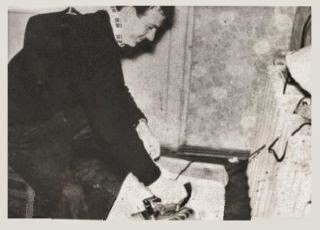 I was astonished to see one more accusation: that Lee was no good at just about anything having to do with being a sociable person. We should never confuse Lee's reluctance to make friends when he returned to the US with the need for him to keep nosy people from discovering his covert tasks. I am a living witness to the fact that Lee forged strong friendships with Dr. Mary Sherman and David Ferrie in New Orleans. See my books
Me & Lee
(608 pages, incl. photos and documents) and David Ferrie: Mafia Pilot (over 500 pages, the first biography ever published on Ferrie).
I was astonished to see one more accusation: that Lee was no good at just about anything having to do with being a sociable person. We should never confuse Lee's reluctance to make friends when he returned to the US with the need for him to keep nosy people from discovering his covert tasks. I am a living witness to the fact that Lee forged strong friendships with Dr. Mary Sherman and David Ferrie in New Orleans. See my books
Me & Lee
(608 pages, incl. photos and documents) and David Ferrie: Mafia Pilot (over 500 pages, the first biography ever published on Ferrie).But the number one way to prove that Lee did not have Aspergers is the fact that he tenderly loved little Junie and baby Rachel and was a good father. This was obvious to all. De Mohrenschildt said Lee would gaze lovingly at his little daughter and would get upset if Marina spanked her.
Aspies usually want to learn how to get along in better in the world, but don't know how without guidance. They often will try to improve their social skills if they understand their condition. They usually want people to like them and don't want to hurt other people's feelings, which they can do on a regular basis (One Aspie I know, when angry, would spit --without even thinking-- in other people's faces. It's not the way to win friends and influence people). Many Aspies have milder symptoms. If you think you might have Aspergers because of having difficulty understanding others, or because you recognize some of the problems discussed here, consider taking this test: http://aspergersquiz.com/
One of the problems women married to Aspies have is their inability to remember to interact meaningfully with their children, though when aware of the problem, they will make efforts to do so because Aspies are capable of love. Stated one Aspie's wife: "He does love us. He didn’t want the family to fall apart. [After he learned that he had Aspergers] He went right out and found a therapist who works with adults with Aspergers. He’s far from perfect but he’s honestly trying. He’s even apologized to the kids for not being more involved while they were growing up. I can’t ask for more than that.”
http://psychcentral.com/lib/adult-aspergers-the-relief-of-a-diagnosis/0006706
Lee was so closely involved with his children that one of the last things he asked Marina to do, when she was talking to him in jail by phone and they looked at each other through glass walls, was to remember to get new shoes for Junie.
That's not Aspergers.
Greg Parker has done a disservice to the research community by propagating his ill-researched theory.
April 14, 2015
'CANCUN'- 'KANKUN' PART TWO: PROOF THAT CANCUN EXISTED IN 1843
'CANCUN'-'KANKUN' PART TWO: PROOF THAT CANCUN EXISTED IN 1843
THE BIG ACCUSATION WAS THAT CANCUN DID NOT EXIST IN 1963.
THIS WAS SUPPOSED TO 'PROVE' I DID NOT TELL THE TRUTH.
The Catherwood Map, 1843
In 1963, a map was printed -- dating from 1843--- in a book that was available to me and Lee, about the Yucatan. Look carefully at the map and you can clearly see why Lee and I considered Cozumel as a drop-off point for me, since our goal was to hike to Chichen-Itza, and after that, to go on to .Merida However, there was supposed to be an old railroad we could walk along all the way, starting from the Cancun/Kankun area, so we wouldn't get easily lost. Our final decision was to have me dropped off on a hard, sandy beach near the village of "Kankun" (spelled that way on the first map we saw). It was also spelled "Cancun" on other maps.
According to the trolls who follow me around and who write articles based on each other's versions of what I actually have said, Cancun supposedly did not exist until the 1970's.
On this 1843 map, "Cancun" can be seen above the 21 degree line.
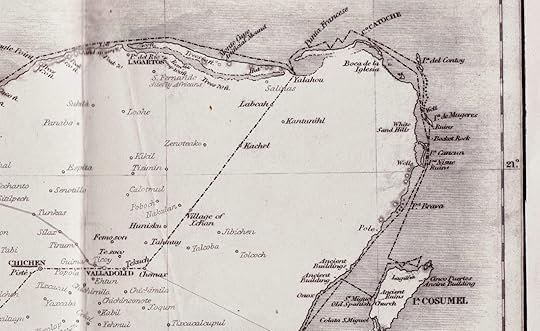
Note that two trips by boat were made to the village (see dotted lines). The map was drawn no later than 1843 and was published in 1963 in the book Incidents of Travel in the Yucatan by John L. Stevens, through Dover Pub. Inc, NY. A friend kindly sent this book, for which I'd been searching for years.
Also note "CHICHEN" -- to the left. It is underlined, indicating ruins were observed at that site. One of the dotted lines shows the route that tourists took all the way back in 1843 from the coastline to reach Chichen Itza. The map below this one is a larger part of the same map. It shows that from Chichen Itza, you can trek on to Merida. That was our plan, and Lee and I studied such maps to plan our jungle adventure.
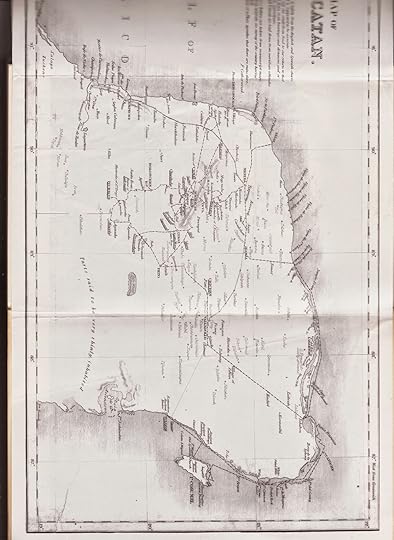
Read George de Mohrenschildt's account of how Lee desired to make a long jungle trek just as George and his wife had done. I had been fishing since age 3 and loved the outdoors. To us, it was the perfect way to escape the problems we had encountered. The dotted lines show the various routes of treks taken by Stephens, Catherwood and Cabot in the early 1840's. Catherwood drew the map. You can't miss the village of Cancun. The outcry that Lee and I were going to meet at a village that did not exist will no doubt be replaced with another outcry based on some other groundless objection. Please copy this material: the Internet may not be free or uncensored in the future. (Thank you)
NOTE: I NEVER said Lee and I planned to meet in a fine hotel in Cancun, and then get married. I have repeatedly corrected such mis-statements for years now. The Cancun matter was an insertion by my literary agent that was missed by Dr.Platzman, who was writing a book (Deadly Alliance) using my emails and phone calls. Originally, I'd only said "Mexico" until the agent insisted on my being more specific. He then inserted "Cancun" in Dr. Platzman's manuscript, who took the blame for allowing it to remain in the manuscript. But it was my fault, too. A section of dialogue that I later wrote, and take responsibility for, includes several phrases indicating that we would meet in Cancun. I wrote it that way to make sure people could find the area on the map. Certainly Lee and I did not plan to even spend the night in that area. We would have set off immediately for the abandoned railroad we'd read about. God forgive me if that wasn't made clear enough. The comment Lee made about a "fine hotel" meant, to me, that it could be located "anywhere" -- most logically, on our way to Chichen-Itza. For HOW does one describe a general area on a present-day map, near Cancun, without mentioning Cancun? My suitcase was packed with survival equipment! I described the area where I was going as a place I'd be afraid to go to, except I knew Lee would be there. Does that sound like a pleasure resort?
Since Lee often made wry jokes, I had no way of knowing if he was serious or not about our staying in a 'fine hotel.' It made absolutely no difference to me. Was it 'definitely' a joke? I don't know and never did.
Lee never mentioned Merida as a meeting place. He spoke of Merida in other contexts. I decided this must have been the 'city' in the Yucatan where we hoped to marry - on my own, as he mentioned we would be flying from the city where we would marry on from there to the Cayman islands. When, later, I learned that flights from Merida to the Cayman Islands were known to occur, I then assumed the city was Merida.
One statement made was that "Judyth and Oswald actually planned to meet in Belize, Mexico - 350 miles from present-day Cancun. (Note: There was no Belize in 1963; it was called British Honduras until years later.)" In actuality, we planned at one time to meet in BELIZE CITY, Honduras.
At one point in our plans, we planned to meet near present-day Belize. [THAT IS, BELIZE CITY]I have no idea how to describe the location without using the word Belize. Do you? I have no idea what the location was called in 1963. It was the first place we were interested in while making our plans. We had guessed that this was the secret site where the film NIGHT OF THE IGUANA had been made, and thought there might be some vestige of civilization remaining behind after the film had been shot. The place had been described in the newspapers as spectacularly romantic. Later, we changed the meeting place nearer to where the ruins of Chichen Itza were located. Later, a statement was made that
"Judyth and Oswald actually planned to meet in Puerto Vallarta, Mexico - well over a thousand miles from present-day Cancun."
In fact, as we explored various possibilities, Lee and I changed our proposed meeting place several times as the situation developed. For example, the murder of Alexander Rorke, a pilot Lee trusted, changed the proposed meeting place. Our plans were not set in stone.
This whopper was also published: "Judyth and Oswald actually planned to marry in the Cayman Islands of the Caribbean; Cancun was just a stopover."
In actuality, Lee and I planned to both divorce and then marry - in Mexico. Exploration of ancient Mayan ruins and a visit to a large city in the Yucatan were additional possible plans. After marriage, final destination was probably going to be the Cayman Islands after things became more dangerous.
There are other false accusations: here are a few of them: "On November 22, 1963, Judyth and a number of her co-workers set up chairs and watched the assassination of John F. Kennedy on television." On November 22, I observed my boss, Mr. Mays, and several others bring in stools to watch the TV at noon. They exhibited what in my mind was undue interest, keeping the TV on past lunchtime, which was an hour ahead of Dallas time. Several chairs already in the lab were also used. I didn't help set up anything. What we did watch, of course, was the constant news that was on TV from about 2:00 PM our time, onwards. The assassination itself was never televised. The events of the day of the assassination were observed on TV at PenChem.
Hewre's another: "Oswald's friend George De Mohrenschildt knew about the assassination ahead of time, and had agreed to help take care of Oswald's wife and children afterwards." In actuality, George DeMohrenschildt was asked by Lee to help Marina and his children in case something happened to him long before any of the events transpired in Dallas. I never said George had anything to do with the assassination itself. I have only guessed at the extent of George's knowledge, since Lee said he had confided in him; I was asked my opinion and gave it. It was almost immediately misinterpreted.
How about this one? "Judyth has proof that Oswald was innocent of John F. Kennedy's assassination; she presented it to filmmaker Nigel Turner and he filmed it for his documentary, The Men Who Killed Kennedy: The Love Affair." In fact, it is I, myself, who stands as a witness that Lee Oswald was innocent of John F. Kennedy's assassination, since he expressed to me his potent grief and anger over the plot. I presented proof of having known Lee Oswald well enough that it was reasonable to assume that he might have confided these matters to me. In fact, he did so.
The next accusation was that "Beyond her word, Judyth has no evidence regarding anything related to John F. Kennedy's assassination." What I do present, of course, is my knowledge of Lee and my relationship to him up to 37 1/2 hours before the assassination. Read the book Me and Lee and decide for yourself if I have enough evidence. Talk to me, while I'm still alive. See with your own eyes what materials I saved--and I do not own that many things, but kept these. Above all, if I wanted to 'make money' or wanted attention, all I had to do was to say Lee DID kill JFK. All my witnesses and evidence would be VERY popular with the press. Movies would be made. I'd be praised for 'proving' a Lone Nut killed JFK. But it's not true. I cannot be influenced. I live in exile and have to continually correct [usually deliberate] misrepresentations of what I've actually said, done and lived. My life is not easy, but I am at peace. let the "critics" keep throwing stones. It is not I who lives in a glass house.
THE BIG ACCUSATION WAS THAT CANCUN DID NOT EXIST IN 1963.
THIS WAS SUPPOSED TO 'PROVE' I DID NOT TELL THE TRUTH.
The Catherwood Map, 1843
In 1963, a map was printed -- dating from 1843--- in a book that was available to me and Lee, about the Yucatan. Look carefully at the map and you can clearly see why Lee and I considered Cozumel as a drop-off point for me, since our goal was to hike to Chichen-Itza, and after that, to go on to .Merida However, there was supposed to be an old railroad we could walk along all the way, starting from the Cancun/Kankun area, so we wouldn't get easily lost. Our final decision was to have me dropped off on a hard, sandy beach near the village of "Kankun" (spelled that way on the first map we saw). It was also spelled "Cancun" on other maps.
According to the trolls who follow me around and who write articles based on each other's versions of what I actually have said, Cancun supposedly did not exist until the 1970's.
On this 1843 map, "Cancun" can be seen above the 21 degree line.

Note that two trips by boat were made to the village (see dotted lines). The map was drawn no later than 1843 and was published in 1963 in the book Incidents of Travel in the Yucatan by John L. Stevens, through Dover Pub. Inc, NY. A friend kindly sent this book, for which I'd been searching for years.
Also note "CHICHEN" -- to the left. It is underlined, indicating ruins were observed at that site. One of the dotted lines shows the route that tourists took all the way back in 1843 from the coastline to reach Chichen Itza. The map below this one is a larger part of the same map. It shows that from Chichen Itza, you can trek on to Merida. That was our plan, and Lee and I studied such maps to plan our jungle adventure.

Read George de Mohrenschildt's account of how Lee desired to make a long jungle trek just as George and his wife had done. I had been fishing since age 3 and loved the outdoors. To us, it was the perfect way to escape the problems we had encountered. The dotted lines show the various routes of treks taken by Stephens, Catherwood and Cabot in the early 1840's. Catherwood drew the map. You can't miss the village of Cancun. The outcry that Lee and I were going to meet at a village that did not exist will no doubt be replaced with another outcry based on some other groundless objection. Please copy this material: the Internet may not be free or uncensored in the future. (Thank you)
NOTE: I NEVER said Lee and I planned to meet in a fine hotel in Cancun, and then get married. I have repeatedly corrected such mis-statements for years now. The Cancun matter was an insertion by my literary agent that was missed by Dr.Platzman, who was writing a book (Deadly Alliance) using my emails and phone calls. Originally, I'd only said "Mexico" until the agent insisted on my being more specific. He then inserted "Cancun" in Dr. Platzman's manuscript, who took the blame for allowing it to remain in the manuscript. But it was my fault, too. A section of dialogue that I later wrote, and take responsibility for, includes several phrases indicating that we would meet in Cancun. I wrote it that way to make sure people could find the area on the map. Certainly Lee and I did not plan to even spend the night in that area. We would have set off immediately for the abandoned railroad we'd read about. God forgive me if that wasn't made clear enough. The comment Lee made about a "fine hotel" meant, to me, that it could be located "anywhere" -- most logically, on our way to Chichen-Itza. For HOW does one describe a general area on a present-day map, near Cancun, without mentioning Cancun? My suitcase was packed with survival equipment! I described the area where I was going as a place I'd be afraid to go to, except I knew Lee would be there. Does that sound like a pleasure resort?
Since Lee often made wry jokes, I had no way of knowing if he was serious or not about our staying in a 'fine hotel.' It made absolutely no difference to me. Was it 'definitely' a joke? I don't know and never did.
Lee never mentioned Merida as a meeting place. He spoke of Merida in other contexts. I decided this must have been the 'city' in the Yucatan where we hoped to marry - on my own, as he mentioned we would be flying from the city where we would marry on from there to the Cayman islands. When, later, I learned that flights from Merida to the Cayman Islands were known to occur, I then assumed the city was Merida.
One statement made was that "Judyth and Oswald actually planned to meet in Belize, Mexico - 350 miles from present-day Cancun. (Note: There was no Belize in 1963; it was called British Honduras until years later.)" In actuality, we planned at one time to meet in BELIZE CITY, Honduras.
At one point in our plans, we planned to meet near present-day Belize. [THAT IS, BELIZE CITY]I have no idea how to describe the location without using the word Belize. Do you? I have no idea what the location was called in 1963. It was the first place we were interested in while making our plans. We had guessed that this was the secret site where the film NIGHT OF THE IGUANA had been made, and thought there might be some vestige of civilization remaining behind after the film had been shot. The place had been described in the newspapers as spectacularly romantic. Later, we changed the meeting place nearer to where the ruins of Chichen Itza were located. Later, a statement was made that
"Judyth and Oswald actually planned to meet in Puerto Vallarta, Mexico - well over a thousand miles from present-day Cancun."
In fact, as we explored various possibilities, Lee and I changed our proposed meeting place several times as the situation developed. For example, the murder of Alexander Rorke, a pilot Lee trusted, changed the proposed meeting place. Our plans were not set in stone.
This whopper was also published: "Judyth and Oswald actually planned to marry in the Cayman Islands of the Caribbean; Cancun was just a stopover."
In actuality, Lee and I planned to both divorce and then marry - in Mexico. Exploration of ancient Mayan ruins and a visit to a large city in the Yucatan were additional possible plans. After marriage, final destination was probably going to be the Cayman Islands after things became more dangerous.
There are other false accusations: here are a few of them: "On November 22, 1963, Judyth and a number of her co-workers set up chairs and watched the assassination of John F. Kennedy on television." On November 22, I observed my boss, Mr. Mays, and several others bring in stools to watch the TV at noon. They exhibited what in my mind was undue interest, keeping the TV on past lunchtime, which was an hour ahead of Dallas time. Several chairs already in the lab were also used. I didn't help set up anything. What we did watch, of course, was the constant news that was on TV from about 2:00 PM our time, onwards. The assassination itself was never televised. The events of the day of the assassination were observed on TV at PenChem.
Hewre's another: "Oswald's friend George De Mohrenschildt knew about the assassination ahead of time, and had agreed to help take care of Oswald's wife and children afterwards." In actuality, George DeMohrenschildt was asked by Lee to help Marina and his children in case something happened to him long before any of the events transpired in Dallas. I never said George had anything to do with the assassination itself. I have only guessed at the extent of George's knowledge, since Lee said he had confided in him; I was asked my opinion and gave it. It was almost immediately misinterpreted.
How about this one? "Judyth has proof that Oswald was innocent of John F. Kennedy's assassination; she presented it to filmmaker Nigel Turner and he filmed it for his documentary, The Men Who Killed Kennedy: The Love Affair." In fact, it is I, myself, who stands as a witness that Lee Oswald was innocent of John F. Kennedy's assassination, since he expressed to me his potent grief and anger over the plot. I presented proof of having known Lee Oswald well enough that it was reasonable to assume that he might have confided these matters to me. In fact, he did so.
The next accusation was that "Beyond her word, Judyth has no evidence regarding anything related to John F. Kennedy's assassination." What I do present, of course, is my knowledge of Lee and my relationship to him up to 37 1/2 hours before the assassination. Read the book Me and Lee and decide for yourself if I have enough evidence. Talk to me, while I'm still alive. See with your own eyes what materials I saved--and I do not own that many things, but kept these. Above all, if I wanted to 'make money' or wanted attention, all I had to do was to say Lee DID kill JFK. All my witnesses and evidence would be VERY popular with the press. Movies would be made. I'd be praised for 'proving' a Lone Nut killed JFK. But it's not true. I cannot be influenced. I live in exile and have to continually correct [usually deliberate] misrepresentations of what I've actually said, done and lived. My life is not easy, but I am at peace. let the "critics" keep throwing stones. It is not I who lives in a glass house.
February 11, 2015
KERRY THORNLEY: MASTER OF PRANKS AND LIES
Kerry Thornley: Master of Pranks and Lies
 Kerry Thornley
"I'm not the only one to have exposed Kerry Thornley's lies about Lee Harvey Oswald and Thornley's activities in New Orleans." JVB
With Kerry Thornley now neatly revered as the founder of a religion based on a spoof, a series of articles has appeared to "vindicate" Kerry Thornley as a truthful man whose testimony about the Kennedy assassination can be trusted.
A vision of "Thornley as truthteller" is now being invoked to discredit me as a witness, part of a project to do so that began in January, 2015 with some Facebook posts full of jeers, which then evolved to threats to sue me, to call the FBI, and even kill me.
This is the first of a series of articles exposing, point by point, why Kerry Thornley is being raised to the status of a saintly truth-teller, and how the truth can set you free from any such belief.
I saw Thornley twice in May, 1963 --once on May 8, and once on May 28. (See Me & Lee: How I came to know, love and lose Lee Harvey Oswald, Trine Day, 2011, p. 256-257 and p. 318 ). Using Thornley's lies to discredit me is creating havoc. By accepting Thornley's lies as "truth" they are then being used by "Lone Nutters" and Warren Commission defenders to discredit other truthful witnesses and honorable researchers who have rejected those same lies.
"Kerry Thornley: Master of Pranks and Lies" is the first of a series of articles written to correct the disinformation.
Example One:
Let's begin with a few of Thornley's statements published in the late 1990's that these 'researchers' don't want you to read. They want you to believe Thornley, so that you will accept all of Thornley's statements about his time spent in New Orleans in 1963. That's when Thornley wants us to believe that he never met the man -- Lee Harvey Oswald-- who was also living there, about whom Thornley was writing his first book, The Idle Warriors. Thornley says he never saw Lee Oswald in New Orleans in May and he never saw Lee Oswald in New Orleans in September, even though witnesses such as myself have stated otherwise.
After reading a portion of this interview, below, ask yourself if this is a man you would trust to tell the truth concerning what he knew about Lee Harvey Oswald and the Kennedy assassination:
Kerry Thornley, interviewed by "Working Class Hero Magazine":
K.T.: It’s like fate, the conspiracy. There were Nazi breeding experiments which I think Oswald and myself may have been products of.W.C.H.: Similar to the CIA mind control experiments?K.T.: That was involved also, but it was a little more complicated than that. The North Koreans had some enormously sophisticated mind control technology. As it turns out members of North and South Korea’s government were part of the Japanese (column?). During the war, they were getting this technology from the Japanese, it was stuff the Germans developed unbeknownst to American Intelligence. I believe I was being mind controlled by them even before I went into the military. Then the CIA got a hold of me up until the Kennedy assassination.W.C.H.: Controlled in what manner?K.T.: Well, it’s spooky; very hard to believe.W.C.H.: Like the Russian ESP experiments?K.T.: Very strange. They could influence my choice of words, so that it would sound like I was speaking in intelligence code. Things that I didn’t realize even existed. And I think back on arguments I had with my parents, and I remember how “freaked out” they were at the time. It was like, all of a sudden one day I started speaking these double entendre sentences. Like a type of “cant” language.W.C.H.: Like doublespeak?K.T.: Yeah, exactly! Precisely! And my parents thought I was a “genius” (laughs) of some kind, to have figured all of this out by myself. Then later on they deduced I was being mind controlled. Also Dulles went nuts trying to figure out how the Koreans got a hold of such sophisticated techniques. Then when I got into the marines, I think Delgado at Yale planted something in my head at that point. I believe one of the purposes of the Kennedy assassination was to get those of us who had been torn out of the clutches of the Japanese by the CIA., back into the hands of the Japanese. (laughs) (emphasis by JVB)(from Working Class Hero Magazine )
It can be argued that the Hero interview was conducted later in his life, by which time Th0rnley had gone mad, but that we can still trust his statements in the 1960's as utterly truthful and reliable, including everything Thornley told the Warren Commission, the Secret Service, Jim Garrison, etc. So let's look at a few examples from this time period:
1965: Thornley helps write and publish Discordia Principia, a clever spoof-- also a kind of religion-- based on the true importance of chaos over order. Reading just the selection below will give you the flavor of the whole text
5th edition introduction: by Kerry Thornley, Discordian Society Co-founder ( also known as "Lord Omar Khayyam Ravenhurst") wrote: "Every few thousand years some shepard inhales smoke from a burning bush and has a vision or eats moldy rye bread in a cave and sees God. From then on their followers kill one another at the slightest provocation. Haunted houses called temples are built by one side and torn down by another - and then bloody quarrels continue over the crumbling foundations.
Organized religion preaches Order and Love but spawns Chaos and Fury.
Why? Because the whole Material Universe is exclusive property of the Greco-Roman Goddess of Chaos, Confusion, Strife, Helter-Skelter and Hodge- Podge. No Spiritual power is even strong enough to dent Her chariot fenders. No material force can resist the temptation of Her Fifth Intergalactic Bank of the Acropolis Slush Fund for Graft and Corruption.
All this was revealed to me in an absolutely unforgettable miraculous event in 1958 or 1959 in a bowling alley in Friendly Hills or maybe Santa Fe Springs, California, witnessed by either Gregory Hill or Malaclypse the Younger or perhaps Mad Malik or Reverend Doctor Occupant or some guy who must have vaguely resembled one or another of them.
With the help of a Chaosopher’s Stone I found the Goddess Eris Discordia in my pineal gland (on Cosmic Channel Number Five) and ever since I have known the answers to all the mysteries of metaphysics, metamystics, metamorhpics, metanoiacs and metaphorics. (Before that I didn’t even know how to install a plastic trash can liner so it wouldn’t fall down inside the first time somebody threw away garbage.) You, too can activate your pineal gland simply by reciting the entire contents of this book upon awakening each morning, rubbing sandalwood paste between your eyes each evening upon retiring, banging your forehead against the ground five times a day, refraining from harming cockroaches and meditating (defined as sitting around waiting for good luck). When your pineal gland finally lights up you will never again, as long as you live, have to relax."(REF http://www.globalgrey.co.uk/principia-discordia/ )
JVB: "I find such writing a pleasant diversion. It doesn't reflect madness --it's more along the lines of genius. But as support for Kerry as a truth-telling being, it falls flat on its face."
It's a fact that the last thing Kerry Thornley wanted in 1963-1969 was to get identified in the Kennedy assassination as a co-conspirator along with Lee Harvey Oswald. However, by the mid-sixties his book The Idle Warriors, which was a hit piece on Lee Oswald as a former friend in the Marine, had sold 17,000 copies. Thornley, who had lived in New Orleans both in April and September of 1963,when Lee Oswald had also lived there, would contend that he never met the man about whom he was writing.
Here's an example of what Thornley told Garrison's Grand Jury in 1968, after a witness, Barbara Reid, insisted she had seen Thornley and Lee Oswald together in a bar in New Orleans in September, 1963. See if you can believe Thornley as he denies meeting Lee Oswald (however some "researchers" swallow what you are about to read as "truth"):
Thornley, to Garrison's Grand Jury: "... I am saying Barbara is suggesting, she is saying, well maybe you didn't recognize him, he came walking in and of course there is always the other consideration that I was revising the book at that time and he could have come walking in, and she convinced me that this is what probably happened, he came walking in and sat next to me and we were talking to her and she made this comment on my voice and she went back to her conversation and I went back to mine . . . ."
So... Kerry says he was 'revising' his book about Lee Oswald at that time, Barbara said Lee came in and sat down next to Kerry, but somehow, Kerry didn't recognize him, even though Barbara Reid did. and somehow, "she convinced me that this is probably what happened...."
The Grand Jury also got this:
Q. Did she see you with Oswald? A. I don't think she did because the next day I started asking people . . . .
Which prompted this remark:
Q. You don't think so? A. I don't know whether it was Oswald, I can't remember who was sitting there with me, I don't think it was Oswald for two reasons, the first thing is if I could remember who it was then I could say definitely, in view of the fact that . . . . . Q. I understand those facts, but in view of the fact that you were writing a novel about him, I should think you would recognize him. A. Yes, this was Barbara's theory.... First of all, the next day I started saying to people Barbara is sure she saw me with Oswald in the Bourbon House. That is the first thing. I kept asking people.
(This sounds like a concerned man who started asking people after the assassination if they remembered seeing him with Lee Oswald.)
Q. Did you ask them if they saw you at the Bourbon House with Oswald? A. I said Barbara is sure she saw me at the Bourbon House with Oswald, I don't know whether that is true or not but she is sure she saw me there and she has convinced me that she saw me.
Kerry Thornley Makes a Slip-up
Oddly, Thornley also told the Grand Jury that he thought he might have seen Marina Oswald, Lee's wife, recently, as she was waiting for a bus.
GARRISON: Have you ever met Marina? THORNLEY: Not that I know of, I thought I saw her standing waiting for a bus when I got off here, but Moe said he was sure it wouldn't be her because she wouldn't be alone."
Did Thornley say this just in case "somebody" might have seen him interacting with Marina, at the bus stop? Might she have recognized him? After all, I'm not the only witness who has stated that Thornley and Marina Oswald knew each other.
His comment was made during the session after lunch when Thornley was questioned by Jim Garrison himself:
GARRISON: But you did not meet her in 1963? THORNLEY: Not that I know of. [This is the second time Thornley says "Not that I know of" which keeps the possibility open, in case another witness might speak up and disagree, later.] This is the thing. The French quarter is such a small place you see each other even though there are a lot of people and you pass somebody on the street and not recognize them, of course I would not have recognized her then because I would not have known who she was...
Thornley seems to realize that he said too much. Another example of Thornley's shadow-boxing has to do with yet another statement to Garrison's Grand Jury:
Q. Were you aware that Oswald was in New Orleans approximately a week before you left? A. No, in fact I was not aware of that until you say it now.
Thornley wants us to believe that he "was not aware of that" --the very dates when Lee Oswald was in New Orleans -- which was one of the most persistent questions that he was being asked by everybody, including the Grand Jury.
After all, Thornley was asked if he was aware that Lee was in New Orleans at the same time Thornley was by the Warren Commission itself, way back in May, 1964:
Mr. JENNER. It follows, I take it, that you were never aware that he was in New Orleans when you were there?
Mr. THORNLEY. No; I wasn't.
Therefore, we can see that he is lying to Garrison. Nevertheless, some "researchers" find it useful to insist that Thornley told only the truth.
More About Thornley's Beliefs
In 1964, Thornley wrote a letter to his friend Adam Gorightly, where Thornley says he was a Marxist who was "...about ready to look up a friend in San Francisco who belonged to the Communist Party and ask him what I could do to speed up the revolution, when I picked up Atlas Shrugged [by Ayn Rand] as a good, long book to read at sea. Well, by the time I set foot on U.S. soil again I knew i'd happened upon a genius. It took me about two years to work out and adjust to my new philosophy, but I knew it'd be worth bit. it is." (from pp. 42-43 of The Prankster and the Conspiracy ).
What were Th0rnley's earlier religious and political beliefs? Thornley, well known for trying practically every drug known to man, was raised a Mormon.
In his introduction to his Discordian religion, Thornley writes: "When in 1968 I first declared myself a Saint, Gregory Hill said, "That's impossible," insisting, "Only dead people can be Saints," adding, "and fictional characters," guessing, "You are neither one." But it happened that, although I was no longer a believer, I was still on the membership roles of the Church of Jesus Christ of Latter Day Saints...Me and all the other Mormons were already Saints - and some of us living ones - no matter what he said. Nowadays only the Mormons have more Saints than the Discordian Society. But we plan to catch up with them."
Thornley's Lies About Lee Harvey Oswald
We should look closely at those who insist that Thornley needs to be 'vindicated.' Thornley's lies about Lee Oswald pervade Warren Commission defenders' books. For example, Norman Mailer (Oswald's Tale, New York, Random Books, 2007, p.357) said Thornley stated Oswald had rejected Christianity, saying, "the best religion is Communism." He obtained that remark from Thornley's testimony to the Warren Commission.
Lee told those interrogating him after Kennedy was shot, "What religion am I? I have no faith. I suppose you mean, in the Bible. I have read the Bible. It is fair reading, but not very interesting. As a matter of fact, I am a student of philosophy and I don't consider the Bible as even a reasonable or intelligent philosophy. I don't think of it." Since the police reported that Lee Oswald was a Communist and openly proud of it (which was a lie) they would also have mentioned that "the best religion is Communism" had Lee mentioned such a thing. It would have proven what kind of evil man he was. But he didn't, so they didn't.
Thornley went on to tell the Warren Commission much more that he thought would please them:
Mr. THORNLEY. It became obvious to me after a while, in talking to him, that definitely he thought that communism was the best--that the Marxist morality was the most rational morality to follow that he knew of. And that communism was the best system in the world.
WC E 25, VOl. XVI: Lee Oswald, having experienced both systems, wrote a speech, from which I quote here (errors corrected):
"We have lived into a dark generation of tension and fear.
But how many of you have tried to find out the truth behind the cold-war cliches? I have lived under both systems; I have sought the answers, and although it would be very easy to dupe myself into believing one system is better than the other, I know they are not.
I despise the representatives of both systems: whether they be socialist or Christian democracies, whether they be labor or conservative, they are all products of the two systems."
The chummy relationship between the Warren Commission's Jenner and Thornley is demonstrated here:
MR. JENNER: We occasionally have been off the record, not often, and I have talked with you on the telephone. Is there anything that was said between us in the course of our telephone conversations or in any off-the-record discussions that you think is pertinent to the Commission's assignment of investigating the assassination of President Kennedy that I have failed to bring onto the record?
MR. THORNLEY: No, sir; I think we have very thoroughly covered it.
Anyone going through Kerry Thornley's Warren Commission testimony will find references to Lee as a communist, dressing in a slovenly manner with scuffed shoes, baiting his superior officers, and being over-emotional, with a 'smirk' on his face.
Thornley, who was only slightly taller than Lee, describes Lee as much shorter than himself. He describes Lee at the proper weight, which would have meant that Lee was short and fat! It's probably the strangest part of Kerry Thornley's testimony to the Warren Commission. Thornley's inability to correctly describe Lee even as to height is rather shocking:
MR. THORNLEY: Physically, I would say he was slightly below average height. Had, as I recall, gray or blue eyes. Always had, or almost always had a petulant expression on his face. Pursed-up lip expression, either a frown or a smile, depending on the circumstances. Was of average build, and his hair was brown, and tending to, like mine, tending to bald a little on each side.MR. JENNER: Above the temple. What would you say he weighed?MR. THORNLEY: I would say he weighed about 140 pounds, maybe 130.MR. JENNER: How tall was he?MR. THORNLEY: I would say he was about five-five maybe. I don't know.MR. JENNER: How tall are you?MR. THORNLEY: I am five-ten.MR. JENNER: Was he shorter than you?MR. THORNLEY: Yes.
Thornley could say absolutely nothing about Lee personally: he didn't even know Lee's father was dead, that Lee came from Texas, or if he had graduated from high school. Thornley never played a single game of chess with Lee. He never stepped into his living quarters. Thornley didn't even know that Lee liked classical music.
EXAMPLE: MR. THORNLEY: Well, I don't recall us ever having a private serious discussion.
Once, Jenner has to 'catch' Thornley from admitting that he had seen Lee Oswald as a civilian (in other words, that Thornley had seen Lee in New Orleans). Here's where the 'catch' is made:
MR. JENNER: What habits did he have with respect to his person -- was he neat, clean?MR. THORNLEY: Extremely sloppy.MR. JENNER: Extremely sloppy?MR. THORNLEY: He was. This I think might not have been true of him in civilian life.MR. JENNER: You don't know one way or the other?MR. THORNLEY: No; but I do have reason to believe that it wasn't true of him in civilian life.MR. JENNER: You don't know one way or the other?
(Jenner knows it would be disastrous to let it slip that Thornley had met Lee Oswald when they were both civilians.)
EXAMPLE: MR. JENNER: Did you think it went beyond that, this unkemptness or this sloppiness?MR. THORNLEY: It did go beyond that, because he seemed to be a person who would go out of his way to get into trouble, get some officer or staff sergeant mad at him. He would make wise remarks. He had a general bitter attitude toward the Corps. He used to pull his hat down over his eyes so he wouldn't have to look at anything around him and go walking around very Beetle Bailey style.
A Brave Man Tells a Different Story About Lee Harvey Oswald (Compare to Kerry Thornley's version)
Lee's Group Leader, Nelson Delgado, said he was threatened with death for stating the truth about Lee Harvey Oswald. He was even shot in the shoulder. In this video, he tells us that he moved to England with his family because he feared he would be killed by the FBI.
( https://www.youtube.com/watch?v=hTb8Z... )
From Delgado's Testimony to the Warren Commission:
[CONTEXT: Delgado previously explained that both of them had supported Castro over the dictator, Batista, and that Lee Oswald wanted to help free the Cuban people.]
Mr. DELGADO -... He spoke Russian pretty good, so I understand.
Mr. LIEBELER - How do you understand that?
Mr. DELGADO - He tried to teach me some Russian. He would put out a whole phrase, you know. In return for my teaching him Spanish, he would try to teach me Russian. But it's a tongue twister.
Mr. LIEBELER - You didn't have any understanding of the Russian language?
Mr. DELGADO - No...You have to have a desire to use this language, you know, and I had no need to learn Russian. And just the reverse of him. He wanted to learn Spanish. He had some idea of using Spanish later on. I'm sure if this hadn't happened, he probably would be over there now, if he hadn't been already.
Mr. LIEBELER - In Cuba, you mean?
Mr. DELGADO - Yes.
Mr. LIEBELER - Do you have any reason to believe that he has been in Cuba?
Mr. DELGADO - Well, a guy like him would find--would have no difficulty in getting into Cuba. They would accept him real fast.
Delgado shows that he was an actual friend who wanted to see Lee Oswald again, when he makes this comment:
Mr. LIEBELER - You never met Oswald at any time while you were in Germany?
Mr. DELGADO - No. I wanted to---I knew that he was over there going to school, and I can't for the life of me recall where I got the scoop that I thought he was going to some school in Berlin, and I was thinking of going over there, to see if I could find him, but I never did follow through. There was too much red tape.
Here's more that's positive about Lee from Delgado, and it includes information I can agree with, about Lee's high intelligence (IQ tests back then did not take into account dyslexia, as they would today):
Mr. LIEBELER - Just how well do you think Oswald learned to speak Spanish during the time that he was associated with you in the Marine Corps?
Mr. DELGADO - He could meet the average people from the streets and hold a conversation with them. He could make himself understood and be understood...
Mr. LIEBELER - Did you think Oswald was an intelligent person?
Mr. DELGADO - Yes; I did. More intelligent than I am, and I have a 117, supposedly, IQ, and he could comprehend things faster and was interested in things that I wasn't interested in: politics, music, things like that, so much so like an intellectual. He didn't read poetry or anything like that, but as far as books and concert music and things like that, he was a great fan.
Delgado also doesn't take the bait that Liebeler offers:
Mr. LIEBELER - This FBI agent says that you told him that Oswald became so proficient in Spanish that Oswald would discuss his ideas on socialism in Spanish.
Mr. DELGADO - He would discuss his ideas, but not anything against our Government or--nothing Socialist, mind you.
While Delgado agreed that some officers thought little of Lee, and some, such as an Officer Funk, picked on Lee habitually, Delgado asks to go on record to correct a lie made by an officer to Life Magazine:
Mr. DELGADO - May I go on the record, because there was a statement I read in Life Magazine?
Mr. LIEBELER - Go ahead.
Mr. DELGADO - And it's erroneous.
Mr. LIEBELER - What did it say?
Mr. DELGADO - It is quoting a Lieutenant Cupenack, and he made a statement there in Life... saying he was Oswald's commanding officer, Oswald was on the football team... that is the only true fact in the whole statement that he made. Also that he [Lee] had a run-in with a captain that was on the football team, and because of this argument he went off the team... Lieutenant Cupenack was a supply officer. He seldom came in contact with Oswald. .. ... I just couldn't see why a big agency like Life would not check into the story and let something like this, you know, get out. I mean it's all well, you know, to go along and believe what the fellow did, but bring out the truth... And right now he is an instructor of philosophy or psychology in Columbia University, I think it is, something like that.
Mr. LIEBELER - This lieutenant?
Mr. DELGADO - Right. I just thought it funny, him saying that he was commanding officer over Oswald; that he had a lot of trouble with Oswald. ..a supply officer hardly ever comes in contact with the troops, and to say that a lieutenant is going to override a lieutenant colonel is ridiculous.
Delgado noted that a hated officer--Funk-- and Lee Oswald didn't get along at all, and that Funk picked on him; in response, Lee would resist obeying him:
Mr. DELGADO - He [Lee] had nothing to do with him. Always tried to find fault. The man had a lot of faults. He was very sloppy.
Mr. LIEBELER - Who?
Mr. DELGADO - Funk. And he had a tendency to---he was very--very bad leader, in my opinion, because NCO's in the Marine Corps, you carry a sword, and we loved to see him carry a sword, because when you salute him, he brings the sword up to here (indicating) like this, and one of these days it's going to happen, because the blade would be swinging next to his ear, and we're all waiting for that thing to happen. That's what I remember about Funk. He wasn't there too long.
Delgado describes Lee concerning anger management (There is no doubt that Lee was prone to gripe. Delgado says "Oz" was obedient if asked to do something, but would argue if he was ordered to do it. ):
Mr. DELGADO - ....he never got into arguments with me. He liked to talk politics with one fellow particularly, Call, and he would argue with him, and Oswald would get to a point where he would get utterly disgusted with the discussion and got out of the room. Whenever it got to the point where anger was going to show, he would stop cold and walk out and leave the conversation in the air.
Mr. LIEBELER - He never got mad at anybody?
Mr. DELGADO - Not physically mad, no.
Mr. LIEBELER - Did you ever know him to get into a fight with anybody at Santa Ana?
Mr. DELGADO - No.
Compare this with what Kerry Thornley told the Warren Commission:
MR. THORNLEY: ...he seemed to be a person who would go out of his way to get into trouble, get some officer or staff sergeant mad at him...
(later) MR. JENNER: To what did you attribute this inability of his to maintain reasonably cordial or at least military-service family relations with his fellow marines?MR. THORNLEY: Well, at the time I just thought -- well, the man is a nut
To the very end, regarding Delgado, Liebeler did his best to try to elicit support for a final "lone nut" and "crazy" statement from Delgado. After all, they had been successful in guiding Kerry Thornley into making such a statement.:
Mr. LIEBELER - Did you ever think that he was mentally unbalanced?
Mr. DELGADO - He never got real mad where he'd show any ravings of any sort, you know. He controlled himself pretty good.
Mr. LIEBELER - If you can't remember anything else about Oswald, I have no more questions
A Little about Kerry Thornley's Later Life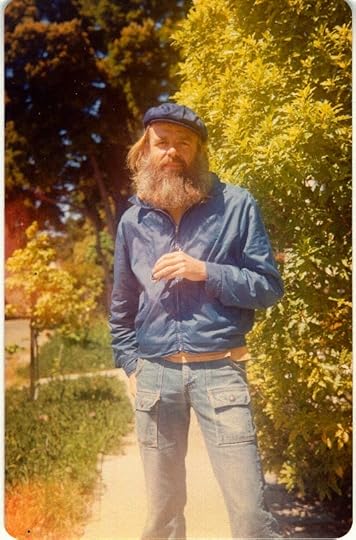
From Thornley's "unofficial official site":In 1965,
Thornley published another book titled Oswald, generally defending the "Oswald-as-lone-assassin" conclusion of the Warren Commission, which met with dismal sales. In his later years, Thornley became convinced that Oswald had in truth been a CIA asset whose purpose was to ferret out suspected Communist sympathizers serving in the Corps.
In January 1968, New Orleans district attorney Jim Garrison, certain there had been a New Orleans-based conspiracy to assassinate John F. Kennedy, subpoenaed Thornley to appear before a grand jury once again, questioning him about his relationship with Oswald and his knowledge of other figures Garrison believed to be connected to the assassination. Garrison
charged Thornley with perjury after Thornley denied that he had been in contact with Oswald in any manner since 1959. The perjury charge was eventually dropped by Garrison's successor Harry Connick, Sr.
Thornley claimed that, during his initial two-year sojourn in New Orleans, he'd had numerous meetings with two mysterious middle-aged men named "Gary Kirstein" and "Slim Brooks". According to his account, they had detailed discussions on numerous subjects ranging from the mundane to the exotic, and bordering sometimes on bizarre. Among these was the subject of how one might assassinate President Kennedy, whose beliefs and policies the aspiring
novelist deeply disliked at the time.
Later, the former Marine came to believe that "Gary Kirstein" had in reality been senior CIA officer and future Watergate burglar E. Howard Hunt, and "Slim Brooks" to have been Jerry Milton Brooks, a member of the 1960s right-wing activist group, "The Minutemen". Guy Banister, another Minutemen member in New Orleans, had been accused by Garrison of involvement in
the assassination and was connected to Lee Harvey Oswald through the Fair Play for Cuba Committee leaflet. Thornley also claimed that "Kirstein" and Brooks had accurately predicted Richard M. Nixon's accession to the presidency six years before it happened, as well as anticipating the rise of the 1960s counterculture and the subsequent emergence of Charles Manson and what became his cult following. This led Thornley to believe that the US
government had somehow been involved, directly or indirectly, in creating and/or supporting these events, personages and phenomena.
In the wake of this period, Thornley came to believe (among many other things) that he had been a subject of the CIA's LSD experiments in the MK-ULTRA mind-control research program. While skeptics may dismiss as conspiracy theory some of his later notions – such as having been a product of occult-based Nazi Vril selective breeding programs – his claims regarding
participation in such highly-classified US government mind-control programs and foreknowledge of the John F. Kennedy assassination are consistent with the time period, his residences, and the nature and locations of his military service."
Spartacus tells us, under Thorney's biography, that "...in 1992 Thornley appeared on a television programme, A Current Affair. He confessed that he had been part of a conspiracy to assassinate John F. Kennedy. However, he did not give the names of his fellow conspirators.Kerry Wendell Thornley died in 1998. He had been working on a book with the journalist Sondra London. The book, Confession to Conspiracy to Assassinate JFK was published in 2000."
This is the man whose version of events in New Orleans is being depicted as truthful and reliable by several self-styled 'researchers' who want you to believe, so you will then discard the testimonies and statements of witnesses such as myself. (I'm taking risks to bring the truth to you.)
The next article will address the issue of whether or not Lee Harvey Oswald and Kerry Thornley met in New Orleans in May, 1963, and why it matters.
 Kerry Thornley
"I'm not the only one to have exposed Kerry Thornley's lies about Lee Harvey Oswald and Thornley's activities in New Orleans." JVB
With Kerry Thornley now neatly revered as the founder of a religion based on a spoof, a series of articles has appeared to "vindicate" Kerry Thornley as a truthful man whose testimony about the Kennedy assassination can be trusted.
A vision of "Thornley as truthteller" is now being invoked to discredit me as a witness, part of a project to do so that began in January, 2015 with some Facebook posts full of jeers, which then evolved to threats to sue me, to call the FBI, and even kill me.
This is the first of a series of articles exposing, point by point, why Kerry Thornley is being raised to the status of a saintly truth-teller, and how the truth can set you free from any such belief.
I saw Thornley twice in May, 1963 --once on May 8, and once on May 28. (See Me & Lee: How I came to know, love and lose Lee Harvey Oswald, Trine Day, 2011, p. 256-257 and p. 318 ). Using Thornley's lies to discredit me is creating havoc. By accepting Thornley's lies as "truth" they are then being used by "Lone Nutters" and Warren Commission defenders to discredit other truthful witnesses and honorable researchers who have rejected those same lies.
"Kerry Thornley: Master of Pranks and Lies" is the first of a series of articles written to correct the disinformation.
Example One:
Let's begin with a few of Thornley's statements published in the late 1990's that these 'researchers' don't want you to read. They want you to believe Thornley, so that you will accept all of Thornley's statements about his time spent in New Orleans in 1963. That's when Thornley wants us to believe that he never met the man -- Lee Harvey Oswald-- who was also living there, about whom Thornley was writing his first book, The Idle Warriors. Thornley says he never saw Lee Oswald in New Orleans in May and he never saw Lee Oswald in New Orleans in September, even though witnesses such as myself have stated otherwise.
After reading a portion of this interview, below, ask yourself if this is a man you would trust to tell the truth concerning what he knew about Lee Harvey Oswald and the Kennedy assassination:
Kerry Thornley, interviewed by "Working Class Hero Magazine":
K.T.: It’s like fate, the conspiracy. There were Nazi breeding experiments which I think Oswald and myself may have been products of.W.C.H.: Similar to the CIA mind control experiments?K.T.: That was involved also, but it was a little more complicated than that. The North Koreans had some enormously sophisticated mind control technology. As it turns out members of North and South Korea’s government were part of the Japanese (column?). During the war, they were getting this technology from the Japanese, it was stuff the Germans developed unbeknownst to American Intelligence. I believe I was being mind controlled by them even before I went into the military. Then the CIA got a hold of me up until the Kennedy assassination.W.C.H.: Controlled in what manner?K.T.: Well, it’s spooky; very hard to believe.W.C.H.: Like the Russian ESP experiments?K.T.: Very strange. They could influence my choice of words, so that it would sound like I was speaking in intelligence code. Things that I didn’t realize even existed. And I think back on arguments I had with my parents, and I remember how “freaked out” they were at the time. It was like, all of a sudden one day I started speaking these double entendre sentences. Like a type of “cant” language.W.C.H.: Like doublespeak?K.T.: Yeah, exactly! Precisely! And my parents thought I was a “genius” (laughs) of some kind, to have figured all of this out by myself. Then later on they deduced I was being mind controlled. Also Dulles went nuts trying to figure out how the Koreans got a hold of such sophisticated techniques. Then when I got into the marines, I think Delgado at Yale planted something in my head at that point. I believe one of the purposes of the Kennedy assassination was to get those of us who had been torn out of the clutches of the Japanese by the CIA., back into the hands of the Japanese. (laughs) (emphasis by JVB)(from Working Class Hero Magazine )
It can be argued that the Hero interview was conducted later in his life, by which time Th0rnley had gone mad, but that we can still trust his statements in the 1960's as utterly truthful and reliable, including everything Thornley told the Warren Commission, the Secret Service, Jim Garrison, etc. So let's look at a few examples from this time period:
1965: Thornley helps write and publish Discordia Principia, a clever spoof-- also a kind of religion-- based on the true importance of chaos over order. Reading just the selection below will give you the flavor of the whole text
5th edition introduction: by Kerry Thornley, Discordian Society Co-founder ( also known as "Lord Omar Khayyam Ravenhurst") wrote: "Every few thousand years some shepard inhales smoke from a burning bush and has a vision or eats moldy rye bread in a cave and sees God. From then on their followers kill one another at the slightest provocation. Haunted houses called temples are built by one side and torn down by another - and then bloody quarrels continue over the crumbling foundations.
Organized religion preaches Order and Love but spawns Chaos and Fury.
Why? Because the whole Material Universe is exclusive property of the Greco-Roman Goddess of Chaos, Confusion, Strife, Helter-Skelter and Hodge- Podge. No Spiritual power is even strong enough to dent Her chariot fenders. No material force can resist the temptation of Her Fifth Intergalactic Bank of the Acropolis Slush Fund for Graft and Corruption.
All this was revealed to me in an absolutely unforgettable miraculous event in 1958 or 1959 in a bowling alley in Friendly Hills or maybe Santa Fe Springs, California, witnessed by either Gregory Hill or Malaclypse the Younger or perhaps Mad Malik or Reverend Doctor Occupant or some guy who must have vaguely resembled one or another of them.
With the help of a Chaosopher’s Stone I found the Goddess Eris Discordia in my pineal gland (on Cosmic Channel Number Five) and ever since I have known the answers to all the mysteries of metaphysics, metamystics, metamorhpics, metanoiacs and metaphorics. (Before that I didn’t even know how to install a plastic trash can liner so it wouldn’t fall down inside the first time somebody threw away garbage.) You, too can activate your pineal gland simply by reciting the entire contents of this book upon awakening each morning, rubbing sandalwood paste between your eyes each evening upon retiring, banging your forehead against the ground five times a day, refraining from harming cockroaches and meditating (defined as sitting around waiting for good luck). When your pineal gland finally lights up you will never again, as long as you live, have to relax."(REF http://www.globalgrey.co.uk/principia-discordia/ )
JVB: "I find such writing a pleasant diversion. It doesn't reflect madness --it's more along the lines of genius. But as support for Kerry as a truth-telling being, it falls flat on its face."
It's a fact that the last thing Kerry Thornley wanted in 1963-1969 was to get identified in the Kennedy assassination as a co-conspirator along with Lee Harvey Oswald. However, by the mid-sixties his book The Idle Warriors, which was a hit piece on Lee Oswald as a former friend in the Marine, had sold 17,000 copies. Thornley, who had lived in New Orleans both in April and September of 1963,when Lee Oswald had also lived there, would contend that he never met the man about whom he was writing.
Here's an example of what Thornley told Garrison's Grand Jury in 1968, after a witness, Barbara Reid, insisted she had seen Thornley and Lee Oswald together in a bar in New Orleans in September, 1963. See if you can believe Thornley as he denies meeting Lee Oswald (however some "researchers" swallow what you are about to read as "truth"):
Thornley, to Garrison's Grand Jury: "... I am saying Barbara is suggesting, she is saying, well maybe you didn't recognize him, he came walking in and of course there is always the other consideration that I was revising the book at that time and he could have come walking in, and she convinced me that this is what probably happened, he came walking in and sat next to me and we were talking to her and she made this comment on my voice and she went back to her conversation and I went back to mine . . . ."
So... Kerry says he was 'revising' his book about Lee Oswald at that time, Barbara said Lee came in and sat down next to Kerry, but somehow, Kerry didn't recognize him, even though Barbara Reid did. and somehow, "she convinced me that this is probably what happened...."
The Grand Jury also got this:
Q. Did she see you with Oswald? A. I don't think she did because the next day I started asking people . . . .
Which prompted this remark:
Q. You don't think so? A. I don't know whether it was Oswald, I can't remember who was sitting there with me, I don't think it was Oswald for two reasons, the first thing is if I could remember who it was then I could say definitely, in view of the fact that . . . . . Q. I understand those facts, but in view of the fact that you were writing a novel about him, I should think you would recognize him. A. Yes, this was Barbara's theory.... First of all, the next day I started saying to people Barbara is sure she saw me with Oswald in the Bourbon House. That is the first thing. I kept asking people.
(This sounds like a concerned man who started asking people after the assassination if they remembered seeing him with Lee Oswald.)
Q. Did you ask them if they saw you at the Bourbon House with Oswald? A. I said Barbara is sure she saw me at the Bourbon House with Oswald, I don't know whether that is true or not but she is sure she saw me there and she has convinced me that she saw me.
Kerry Thornley Makes a Slip-up
Oddly, Thornley also told the Grand Jury that he thought he might have seen Marina Oswald, Lee's wife, recently, as she was waiting for a bus.
GARRISON: Have you ever met Marina? THORNLEY: Not that I know of, I thought I saw her standing waiting for a bus when I got off here, but Moe said he was sure it wouldn't be her because she wouldn't be alone."
Did Thornley say this just in case "somebody" might have seen him interacting with Marina, at the bus stop? Might she have recognized him? After all, I'm not the only witness who has stated that Thornley and Marina Oswald knew each other.
His comment was made during the session after lunch when Thornley was questioned by Jim Garrison himself:
GARRISON: But you did not meet her in 1963? THORNLEY: Not that I know of. [This is the second time Thornley says "Not that I know of" which keeps the possibility open, in case another witness might speak up and disagree, later.] This is the thing. The French quarter is such a small place you see each other even though there are a lot of people and you pass somebody on the street and not recognize them, of course I would not have recognized her then because I would not have known who she was...
Thornley seems to realize that he said too much. Another example of Thornley's shadow-boxing has to do with yet another statement to Garrison's Grand Jury:
Q. Were you aware that Oswald was in New Orleans approximately a week before you left? A. No, in fact I was not aware of that until you say it now.
Thornley wants us to believe that he "was not aware of that" --the very dates when Lee Oswald was in New Orleans -- which was one of the most persistent questions that he was being asked by everybody, including the Grand Jury.
After all, Thornley was asked if he was aware that Lee was in New Orleans at the same time Thornley was by the Warren Commission itself, way back in May, 1964:
Mr. JENNER. It follows, I take it, that you were never aware that he was in New Orleans when you were there?
Mr. THORNLEY. No; I wasn't.
Therefore, we can see that he is lying to Garrison. Nevertheless, some "researchers" find it useful to insist that Thornley told only the truth.
More About Thornley's Beliefs
In 1964, Thornley wrote a letter to his friend Adam Gorightly, where Thornley says he was a Marxist who was "...about ready to look up a friend in San Francisco who belonged to the Communist Party and ask him what I could do to speed up the revolution, when I picked up Atlas Shrugged [by Ayn Rand] as a good, long book to read at sea. Well, by the time I set foot on U.S. soil again I knew i'd happened upon a genius. It took me about two years to work out and adjust to my new philosophy, but I knew it'd be worth bit. it is." (from pp. 42-43 of The Prankster and the Conspiracy ).
What were Th0rnley's earlier religious and political beliefs? Thornley, well known for trying practically every drug known to man, was raised a Mormon.
In his introduction to his Discordian religion, Thornley writes: "When in 1968 I first declared myself a Saint, Gregory Hill said, "That's impossible," insisting, "Only dead people can be Saints," adding, "and fictional characters," guessing, "You are neither one." But it happened that, although I was no longer a believer, I was still on the membership roles of the Church of Jesus Christ of Latter Day Saints...Me and all the other Mormons were already Saints - and some of us living ones - no matter what he said. Nowadays only the Mormons have more Saints than the Discordian Society. But we plan to catch up with them."
Thornley's Lies About Lee Harvey Oswald
We should look closely at those who insist that Thornley needs to be 'vindicated.' Thornley's lies about Lee Oswald pervade Warren Commission defenders' books. For example, Norman Mailer (Oswald's Tale, New York, Random Books, 2007, p.357) said Thornley stated Oswald had rejected Christianity, saying, "the best religion is Communism." He obtained that remark from Thornley's testimony to the Warren Commission.
Lee told those interrogating him after Kennedy was shot, "What religion am I? I have no faith. I suppose you mean, in the Bible. I have read the Bible. It is fair reading, but not very interesting. As a matter of fact, I am a student of philosophy and I don't consider the Bible as even a reasonable or intelligent philosophy. I don't think of it." Since the police reported that Lee Oswald was a Communist and openly proud of it (which was a lie) they would also have mentioned that "the best religion is Communism" had Lee mentioned such a thing. It would have proven what kind of evil man he was. But he didn't, so they didn't.
Thornley went on to tell the Warren Commission much more that he thought would please them:
Mr. THORNLEY. It became obvious to me after a while, in talking to him, that definitely he thought that communism was the best--that the Marxist morality was the most rational morality to follow that he knew of. And that communism was the best system in the world.
WC E 25, VOl. XVI: Lee Oswald, having experienced both systems, wrote a speech, from which I quote here (errors corrected):
"We have lived into a dark generation of tension and fear.
But how many of you have tried to find out the truth behind the cold-war cliches? I have lived under both systems; I have sought the answers, and although it would be very easy to dupe myself into believing one system is better than the other, I know they are not.
I despise the representatives of both systems: whether they be socialist or Christian democracies, whether they be labor or conservative, they are all products of the two systems."
The chummy relationship between the Warren Commission's Jenner and Thornley is demonstrated here:
MR. JENNER: We occasionally have been off the record, not often, and I have talked with you on the telephone. Is there anything that was said between us in the course of our telephone conversations or in any off-the-record discussions that you think is pertinent to the Commission's assignment of investigating the assassination of President Kennedy that I have failed to bring onto the record?
MR. THORNLEY: No, sir; I think we have very thoroughly covered it.
Anyone going through Kerry Thornley's Warren Commission testimony will find references to Lee as a communist, dressing in a slovenly manner with scuffed shoes, baiting his superior officers, and being over-emotional, with a 'smirk' on his face.
Thornley, who was only slightly taller than Lee, describes Lee as much shorter than himself. He describes Lee at the proper weight, which would have meant that Lee was short and fat! It's probably the strangest part of Kerry Thornley's testimony to the Warren Commission. Thornley's inability to correctly describe Lee even as to height is rather shocking:
MR. THORNLEY: Physically, I would say he was slightly below average height. Had, as I recall, gray or blue eyes. Always had, or almost always had a petulant expression on his face. Pursed-up lip expression, either a frown or a smile, depending on the circumstances. Was of average build, and his hair was brown, and tending to, like mine, tending to bald a little on each side.MR. JENNER: Above the temple. What would you say he weighed?MR. THORNLEY: I would say he weighed about 140 pounds, maybe 130.MR. JENNER: How tall was he?MR. THORNLEY: I would say he was about five-five maybe. I don't know.MR. JENNER: How tall are you?MR. THORNLEY: I am five-ten.MR. JENNER: Was he shorter than you?MR. THORNLEY: Yes.
Thornley could say absolutely nothing about Lee personally: he didn't even know Lee's father was dead, that Lee came from Texas, or if he had graduated from high school. Thornley never played a single game of chess with Lee. He never stepped into his living quarters. Thornley didn't even know that Lee liked classical music.
EXAMPLE: MR. THORNLEY: Well, I don't recall us ever having a private serious discussion.
Once, Jenner has to 'catch' Thornley from admitting that he had seen Lee Oswald as a civilian (in other words, that Thornley had seen Lee in New Orleans). Here's where the 'catch' is made:
MR. JENNER: What habits did he have with respect to his person -- was he neat, clean?MR. THORNLEY: Extremely sloppy.MR. JENNER: Extremely sloppy?MR. THORNLEY: He was. This I think might not have been true of him in civilian life.MR. JENNER: You don't know one way or the other?MR. THORNLEY: No; but I do have reason to believe that it wasn't true of him in civilian life.MR. JENNER: You don't know one way or the other?
(Jenner knows it would be disastrous to let it slip that Thornley had met Lee Oswald when they were both civilians.)
EXAMPLE: MR. JENNER: Did you think it went beyond that, this unkemptness or this sloppiness?MR. THORNLEY: It did go beyond that, because he seemed to be a person who would go out of his way to get into trouble, get some officer or staff sergeant mad at him. He would make wise remarks. He had a general bitter attitude toward the Corps. He used to pull his hat down over his eyes so he wouldn't have to look at anything around him and go walking around very Beetle Bailey style.
A Brave Man Tells a Different Story About Lee Harvey Oswald (Compare to Kerry Thornley's version)
Lee's Group Leader, Nelson Delgado, said he was threatened with death for stating the truth about Lee Harvey Oswald. He was even shot in the shoulder. In this video, he tells us that he moved to England with his family because he feared he would be killed by the FBI.
( https://www.youtube.com/watch?v=hTb8Z... )
From Delgado's Testimony to the Warren Commission:
[CONTEXT: Delgado previously explained that both of them had supported Castro over the dictator, Batista, and that Lee Oswald wanted to help free the Cuban people.]
Mr. DELGADO -... He spoke Russian pretty good, so I understand.
Mr. LIEBELER - How do you understand that?
Mr. DELGADO - He tried to teach me some Russian. He would put out a whole phrase, you know. In return for my teaching him Spanish, he would try to teach me Russian. But it's a tongue twister.
Mr. LIEBELER - You didn't have any understanding of the Russian language?
Mr. DELGADO - No...You have to have a desire to use this language, you know, and I had no need to learn Russian. And just the reverse of him. He wanted to learn Spanish. He had some idea of using Spanish later on. I'm sure if this hadn't happened, he probably would be over there now, if he hadn't been already.
Mr. LIEBELER - In Cuba, you mean?
Mr. DELGADO - Yes.
Mr. LIEBELER - Do you have any reason to believe that he has been in Cuba?
Mr. DELGADO - Well, a guy like him would find--would have no difficulty in getting into Cuba. They would accept him real fast.
Delgado shows that he was an actual friend who wanted to see Lee Oswald again, when he makes this comment:
Mr. LIEBELER - You never met Oswald at any time while you were in Germany?
Mr. DELGADO - No. I wanted to---I knew that he was over there going to school, and I can't for the life of me recall where I got the scoop that I thought he was going to some school in Berlin, and I was thinking of going over there, to see if I could find him, but I never did follow through. There was too much red tape.
Here's more that's positive about Lee from Delgado, and it includes information I can agree with, about Lee's high intelligence (IQ tests back then did not take into account dyslexia, as they would today):
Mr. LIEBELER - Just how well do you think Oswald learned to speak Spanish during the time that he was associated with you in the Marine Corps?
Mr. DELGADO - He could meet the average people from the streets and hold a conversation with them. He could make himself understood and be understood...
Mr. LIEBELER - Did you think Oswald was an intelligent person?
Mr. DELGADO - Yes; I did. More intelligent than I am, and I have a 117, supposedly, IQ, and he could comprehend things faster and was interested in things that I wasn't interested in: politics, music, things like that, so much so like an intellectual. He didn't read poetry or anything like that, but as far as books and concert music and things like that, he was a great fan.
Delgado also doesn't take the bait that Liebeler offers:
Mr. LIEBELER - This FBI agent says that you told him that Oswald became so proficient in Spanish that Oswald would discuss his ideas on socialism in Spanish.
Mr. DELGADO - He would discuss his ideas, but not anything against our Government or--nothing Socialist, mind you.
While Delgado agreed that some officers thought little of Lee, and some, such as an Officer Funk, picked on Lee habitually, Delgado asks to go on record to correct a lie made by an officer to Life Magazine:
Mr. DELGADO - May I go on the record, because there was a statement I read in Life Magazine?
Mr. LIEBELER - Go ahead.
Mr. DELGADO - And it's erroneous.
Mr. LIEBELER - What did it say?
Mr. DELGADO - It is quoting a Lieutenant Cupenack, and he made a statement there in Life... saying he was Oswald's commanding officer, Oswald was on the football team... that is the only true fact in the whole statement that he made. Also that he [Lee] had a run-in with a captain that was on the football team, and because of this argument he went off the team... Lieutenant Cupenack was a supply officer. He seldom came in contact with Oswald. .. ... I just couldn't see why a big agency like Life would not check into the story and let something like this, you know, get out. I mean it's all well, you know, to go along and believe what the fellow did, but bring out the truth... And right now he is an instructor of philosophy or psychology in Columbia University, I think it is, something like that.
Mr. LIEBELER - This lieutenant?
Mr. DELGADO - Right. I just thought it funny, him saying that he was commanding officer over Oswald; that he had a lot of trouble with Oswald. ..a supply officer hardly ever comes in contact with the troops, and to say that a lieutenant is going to override a lieutenant colonel is ridiculous.
Delgado noted that a hated officer--Funk-- and Lee Oswald didn't get along at all, and that Funk picked on him; in response, Lee would resist obeying him:
Mr. DELGADO - He [Lee] had nothing to do with him. Always tried to find fault. The man had a lot of faults. He was very sloppy.
Mr. LIEBELER - Who?
Mr. DELGADO - Funk. And he had a tendency to---he was very--very bad leader, in my opinion, because NCO's in the Marine Corps, you carry a sword, and we loved to see him carry a sword, because when you salute him, he brings the sword up to here (indicating) like this, and one of these days it's going to happen, because the blade would be swinging next to his ear, and we're all waiting for that thing to happen. That's what I remember about Funk. He wasn't there too long.
Delgado describes Lee concerning anger management (There is no doubt that Lee was prone to gripe. Delgado says "Oz" was obedient if asked to do something, but would argue if he was ordered to do it. ):
Mr. DELGADO - ....he never got into arguments with me. He liked to talk politics with one fellow particularly, Call, and he would argue with him, and Oswald would get to a point where he would get utterly disgusted with the discussion and got out of the room. Whenever it got to the point where anger was going to show, he would stop cold and walk out and leave the conversation in the air.
Mr. LIEBELER - He never got mad at anybody?
Mr. DELGADO - Not physically mad, no.
Mr. LIEBELER - Did you ever know him to get into a fight with anybody at Santa Ana?
Mr. DELGADO - No.
Compare this with what Kerry Thornley told the Warren Commission:
MR. THORNLEY: ...he seemed to be a person who would go out of his way to get into trouble, get some officer or staff sergeant mad at him...
(later) MR. JENNER: To what did you attribute this inability of his to maintain reasonably cordial or at least military-service family relations with his fellow marines?MR. THORNLEY: Well, at the time I just thought -- well, the man is a nut
To the very end, regarding Delgado, Liebeler did his best to try to elicit support for a final "lone nut" and "crazy" statement from Delgado. After all, they had been successful in guiding Kerry Thornley into making such a statement.:
Mr. LIEBELER - Did you ever think that he was mentally unbalanced?
Mr. DELGADO - He never got real mad where he'd show any ravings of any sort, you know. He controlled himself pretty good.
Mr. LIEBELER - If you can't remember anything else about Oswald, I have no more questions
A Little about Kerry Thornley's Later Life

From Thornley's "unofficial official site":In 1965,
Thornley published another book titled Oswald, generally defending the "Oswald-as-lone-assassin" conclusion of the Warren Commission, which met with dismal sales. In his later years, Thornley became convinced that Oswald had in truth been a CIA asset whose purpose was to ferret out suspected Communist sympathizers serving in the Corps.
In January 1968, New Orleans district attorney Jim Garrison, certain there had been a New Orleans-based conspiracy to assassinate John F. Kennedy, subpoenaed Thornley to appear before a grand jury once again, questioning him about his relationship with Oswald and his knowledge of other figures Garrison believed to be connected to the assassination. Garrison
charged Thornley with perjury after Thornley denied that he had been in contact with Oswald in any manner since 1959. The perjury charge was eventually dropped by Garrison's successor Harry Connick, Sr.
Thornley claimed that, during his initial two-year sojourn in New Orleans, he'd had numerous meetings with two mysterious middle-aged men named "Gary Kirstein" and "Slim Brooks". According to his account, they had detailed discussions on numerous subjects ranging from the mundane to the exotic, and bordering sometimes on bizarre. Among these was the subject of how one might assassinate President Kennedy, whose beliefs and policies the aspiring
novelist deeply disliked at the time.
Later, the former Marine came to believe that "Gary Kirstein" had in reality been senior CIA officer and future Watergate burglar E. Howard Hunt, and "Slim Brooks" to have been Jerry Milton Brooks, a member of the 1960s right-wing activist group, "The Minutemen". Guy Banister, another Minutemen member in New Orleans, had been accused by Garrison of involvement in
the assassination and was connected to Lee Harvey Oswald through the Fair Play for Cuba Committee leaflet. Thornley also claimed that "Kirstein" and Brooks had accurately predicted Richard M. Nixon's accession to the presidency six years before it happened, as well as anticipating the rise of the 1960s counterculture and the subsequent emergence of Charles Manson and what became his cult following. This led Thornley to believe that the US
government had somehow been involved, directly or indirectly, in creating and/or supporting these events, personages and phenomena.
In the wake of this period, Thornley came to believe (among many other things) that he had been a subject of the CIA's LSD experiments in the MK-ULTRA mind-control research program. While skeptics may dismiss as conspiracy theory some of his later notions – such as having been a product of occult-based Nazi Vril selective breeding programs – his claims regarding
participation in such highly-classified US government mind-control programs and foreknowledge of the John F. Kennedy assassination are consistent with the time period, his residences, and the nature and locations of his military service."
Spartacus tells us, under Thorney's biography, that "...in 1992 Thornley appeared on a television programme, A Current Affair. He confessed that he had been part of a conspiracy to assassinate John F. Kennedy. However, he did not give the names of his fellow conspirators.Kerry Wendell Thornley died in 1998. He had been working on a book with the journalist Sondra London. The book, Confession to Conspiracy to Assassinate JFK was published in 2000."
This is the man whose version of events in New Orleans is being depicted as truthful and reliable by several self-styled 'researchers' who want you to believe, so you will then discard the testimonies and statements of witnesses such as myself. (I'm taking risks to bring the truth to you.)
The next article will address the issue of whether or not Lee Harvey Oswald and Kerry Thornley met in New Orleans in May, 1963, and why it matters.
February 8, 2015
MARY FERRELL DID NOT DENOUNCE JUDYTH VARY BAKER--HEAR HER TAPE RECORDING HERE
GET THE FACTS, QUESTION THE RUMORS!MARY FERRELL DENIES 'DENOUNCING' JUDYTH VARY BAKER(Note; an enhanced version of this damaged tape recording is being made. )The first few minutes of this recording are hard to hear, because the recorder was damaged and it's all I had at the time, but it gets better after i removed the recording from my purse. The tape recorder was damaged while I was hospitalized after a so-called 'accident' where i was hit by a car----came back from the hospital to find my apartment vandalized. and many things damaged, including the tape recorder. However, it still worked--sort of!
Mary, concerned when she had not heard from me, invited me to visit her. I brought the tape recorder because the 'Mary Ferrell denounces Judyth' email had been circulating and I wanted Mary on tape to reply to that problem.
Mary did not know that an email she sent to friends after becoming angry with me had been 'enhanced.' She was now sorry she'd ever sent it. While standing at her bed, Mary said she had never denounced me and she gave me permission to tape her. Mary had previously been angry because I had asked her about a fake name Mary had used when she was taking a college course in Ohio. She just exploded at me. Later that night, she sent an angry email out saying she had washed her hands of me. File at top shows Mary M. Ferrell is "now" 'Mrs. Mary Dean' with a new address in Hollansberg, Ohio instead of 1120 North McNeil, Memphis, Tenn. Mary was furious at me for bringing this to her attention, and when she discovered that her daughter, Carol An had told me this was a fake name Mary had used, she was extremely upset with Carol Ann, who from that time on detested me for getting her in trouble. Mary later forgave me when I reminded her that I would never have asked Mary about it if I had intended anything malicious, and that I had intended originally to give her the files back, but after the email came out, now i had to keep them to prove what had started the whole thing.
The fake name was something Mary never wanted the public to know, for personal reasons. Now time had passed, and Mary had called, asking why I had not come to visit. I told her she had hurt my feelings. Mary at once gave me her security gate code and called the nurse to make sure my name was still on the visitor's list, because her daughter, Carol Ann, had erased some names there. We had no problem with the nurse, who found my name on the visitor's list, as well as the name of my sister and my friend Debbee.
The email that Mary Ferrell sent out to several people turned out to have what Mary indicated was a falsified attachment. This tape recording contains Mary's denial that she wrote the email in its present form or the attachment to the email. After all, the email began with her expression of 'regret' that she was 'washing her hands' of me. Mary said she didn't recognize the email in its present form (the next blog will show the contents of the email). Later, after reading a transcript of the tape recording, Jim Marrs also visited Mary and she repeated what she told me, my sister and a friend. She refused to be taped again, however, saying she was being pressured to stay away from me. Later, Mary called me and said Robert Chapman, David Lifton, and Debra Conway wouldn't leave her alone unless she sent out another email confirming the so-called denunciation. This she also refused to do. By this time Mary was suffering from cancer that would soon kill her, and we never talked again. Carol Ann would later claim that i must have found the files in the garbage --or took them when i was helping to move Mary to her assisted living apartment from her dangerously cluttered home on Holland in Dallas. Mary in fact had given me a tall stack of Life Magazines. I did not find the files until later--they were stuck between some of the copies. Mary gave me other nice things, as well. She gave me both her sons' Catholic Missals, because mine had been stolen. She also gave me some of her dead son's art that I admired, such as these two cars:
As for the falsified email, it has been circulated again recently as "evidence" -- with no mention of the tape recording's existence. The persons who circulated the email were unaware that Jim Marrs, along with others, visited Mary after this recording was made and obtained the same answer from her. Martin Shackelford , who testified before the ARRB, did tell a small group of researchers about Marrs' visit. The foundation of the long attachment seems to have been composed of earlier emails Mary had told me about, where she had questioned various matters to discuss with Lifton and others. However, Mary had already been satisfied with my replies. She then endorsed me and my book by writing the note you can see below. That does not look like a 'denunciation'-- and the people sending around the falsified email do not mention the note, shown below, to recipients. I sent the original note to the publisher, but before doing so, of course made a copy for my records. I later sent a copy to Dr. Howard Platzman for his records. For some reason, making a copy of the note was supposed to be one of Mary's objections, in that long list of patched-together objections, which makes no sense. Here is the copy: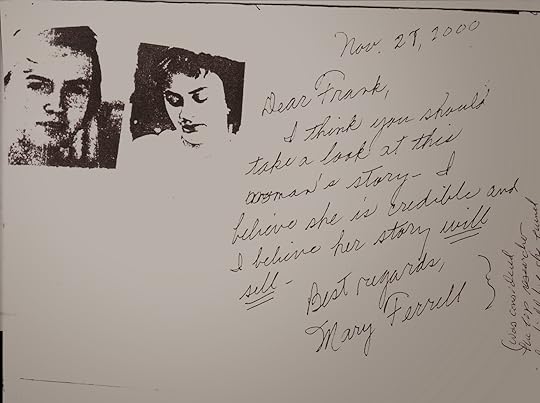
In fact, the email show questions Mary and I discussed --questions that had been answered one by one. What Mary had sent out was apparently 'enhanced' by [pieces of these emails pasted together in a set of paragraphs called "judyth.doc." Now, Mary had given me access to a file she called "Judyth.doc." That file had information about me that she had wanted to add to her Chronology. She complained that Debra Conway refused to sell Mary's Chronology if that information was not removed. This was information such as, when I met Lee, where i lived, that we worked together at Reily Coffee, and so on. All of this information had to be removed after a four-month standoff between Mary and Debra Conway. "I want the money," Mary said. "I'm too old to argue with them." And so the information was removed. However, Mary gave me a PERSONAL COPY of her chronology with the information still intact there. Here is a photo of that disk:
I saved a copy of the header that John Mcadams sent around ti 'prove' the authenticity of the email, but when it was pointed out that the header had some unsavory problems -- those who understand headers can see the problems with the TIME stamps --- the header was removed and a HAND_TYPED header was created by Dave Reitzes. The header, which is not shown by those who have circulated the email, speaks volumes to those who can understand it in its entirety. Here it is: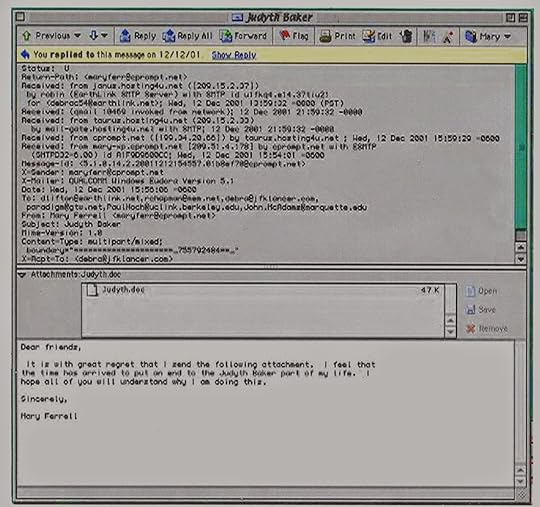 According to Mary, all she wrote was a simple sentence saying she regretted it, but the 'Judyth Baker' part of her life was over and everyone should understand. Mary evidenced surprise when we showed her the printout. She said she didn't write the attached material we showed her. Her email was sent to David Lifton, Robert Chapman, Debra Conway, John McAdams and one other. Those who understand headers will note that all starts well: there is no problem, once you account for time zones, until you hit the timestamp of "12 Dec. 2001 10:59:02." While glitches could happen back then with timestamps. 11 hours behind the two previous PST stamps seems inexplicable. If the email had been held up because it was being altered, an attempt to turn back the timestamp might have thrown it back too far and it could not be fixed. No email, by the way, can be proven to be authentic after such a long time period, but the header gives us a hint that it was not authentic.
Jim Marrs, whose updated, new edition of Crossfire: the Plot that Killed Kennedy, came out in 2013 for the 50th anniversary of Kennedy's assassination, went on in 2010 (and thenceforth) to endorse Me & Lee, writing its Afterword. Edward T. Haslam, author of Dr. Mary's Monkey, wrote its Foreword. Me & Lee was published in 2010 (hardcover) and 2011 (softcover). Me & Lee is also available as an audiobook from Trine Day publishers Amazon, Barnes & Noble, etc.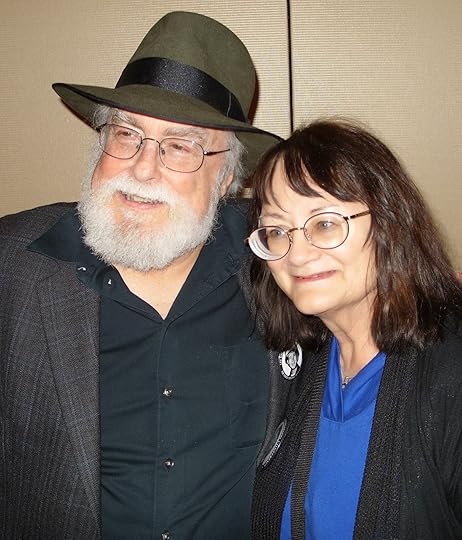 Jim Marrs and Judyth Vary Baker
JFK Assassination Conference Dallas-Arlington,
22-23-24 November, 2014
Mary, concerned when she had not heard from me, invited me to visit her. I brought the tape recorder because the 'Mary Ferrell denounces Judyth' email had been circulating and I wanted Mary on tape to reply to that problem.
Mary did not know that an email she sent to friends after becoming angry with me had been 'enhanced.' She was now sorry she'd ever sent it. While standing at her bed, Mary said she had never denounced me and she gave me permission to tape her. Mary had previously been angry because I had asked her about a fake name Mary had used when she was taking a college course in Ohio. She just exploded at me. Later that night, she sent an angry email out saying she had washed her hands of me.
 File at top shows Mary M. Ferrell is "now" 'Mrs. Mary Dean' with a new address in Hollansberg, Ohio instead of 1120 North McNeil, Memphis, Tenn. Mary was furious at me for bringing this to her attention, and when she discovered that her daughter, Carol An had told me this was a fake name Mary had used, she was extremely upset with Carol Ann, who from that time on detested me for getting her in trouble. Mary later forgave me when I reminded her that I would never have asked Mary about it if I had intended anything malicious, and that I had intended originally to give her the files back, but after the email came out, now i had to keep them to prove what had started the whole thing.
The fake name was something Mary never wanted the public to know, for personal reasons. Now time had passed, and Mary had called, asking why I had not come to visit. I told her she had hurt my feelings. Mary at once gave me her security gate code and called the nurse to make sure my name was still on the visitor's list, because her daughter, Carol Ann, had erased some names there. We had no problem with the nurse, who found my name on the visitor's list, as well as the name of my sister and my friend Debbee.
The email that Mary Ferrell sent out to several people turned out to have what Mary indicated was a falsified attachment. This tape recording contains Mary's denial that she wrote the email in its present form or the attachment to the email. After all, the email began with her expression of 'regret' that she was 'washing her hands' of me. Mary said she didn't recognize the email in its present form (the next blog will show the contents of the email). Later, after reading a transcript of the tape recording, Jim Marrs also visited Mary and she repeated what she told me, my sister and a friend. She refused to be taped again, however, saying she was being pressured to stay away from me. Later, Mary called me and said Robert Chapman, David Lifton, and Debra Conway wouldn't leave her alone unless she sent out another email confirming the so-called denunciation. This she also refused to do. By this time Mary was suffering from cancer that would soon kill her, and we never talked again. Carol Ann would later claim that i must have found the files in the garbage --or took them when i was helping to move Mary to her assisted living apartment from her dangerously cluttered home on Holland in Dallas. Mary in fact had given me a tall stack of Life Magazines. I did not find the files until later--they were stuck between some of the copies. Mary gave me other nice things, as well. She gave me both her sons' Catholic Missals, because mine had been stolen. She also gave me some of her dead son's art that I admired, such as these two cars:
As for the falsified email, it has been circulated again recently as "evidence" -- with no mention of the tape recording's existence. The persons who circulated the email were unaware that Jim Marrs, along with others, visited Mary after this recording was made and obtained the same answer from her. Martin Shackelford , who testified before the ARRB, did tell a small group of researchers about Marrs' visit. The foundation of the long attachment seems to have been composed of earlier emails Mary had told me about, where she had questioned various matters to discuss with Lifton and others. However, Mary had already been satisfied with my replies. She then endorsed me and my book by writing the note you can see below. That does not look like a 'denunciation'-- and the people sending around the falsified email do not mention the note, shown below, to recipients. I sent the original note to the publisher, but before doing so, of course made a copy for my records. I later sent a copy to Dr. Howard Platzman for his records. For some reason, making a copy of the note was supposed to be one of Mary's objections, in that long list of patched-together objections, which makes no sense. Here is the copy:

In fact, the email show questions Mary and I discussed --questions that had been answered one by one. What Mary had sent out was apparently 'enhanced' by [pieces of these emails pasted together in a set of paragraphs called "judyth.doc." Now, Mary had given me access to a file she called "Judyth.doc." That file had information about me that she had wanted to add to her Chronology. She complained that Debra Conway refused to sell Mary's Chronology if that information was not removed. This was information such as, when I met Lee, where i lived, that we worked together at Reily Coffee, and so on. All of this information had to be removed after a four-month standoff between Mary and Debra Conway. "I want the money," Mary said. "I'm too old to argue with them." And so the information was removed. However, Mary gave me a PERSONAL COPY of her chronology with the information still intact there. Here is a photo of that disk:
I saved a copy of the header that John Mcadams sent around ti 'prove' the authenticity of the email, but when it was pointed out that the header had some unsavory problems -- those who understand headers can see the problems with the TIME stamps --- the header was removed and a HAND_TYPED header was created by Dave Reitzes. The header, which is not shown by those who have circulated the email, speaks volumes to those who can understand it in its entirety. Here it is:
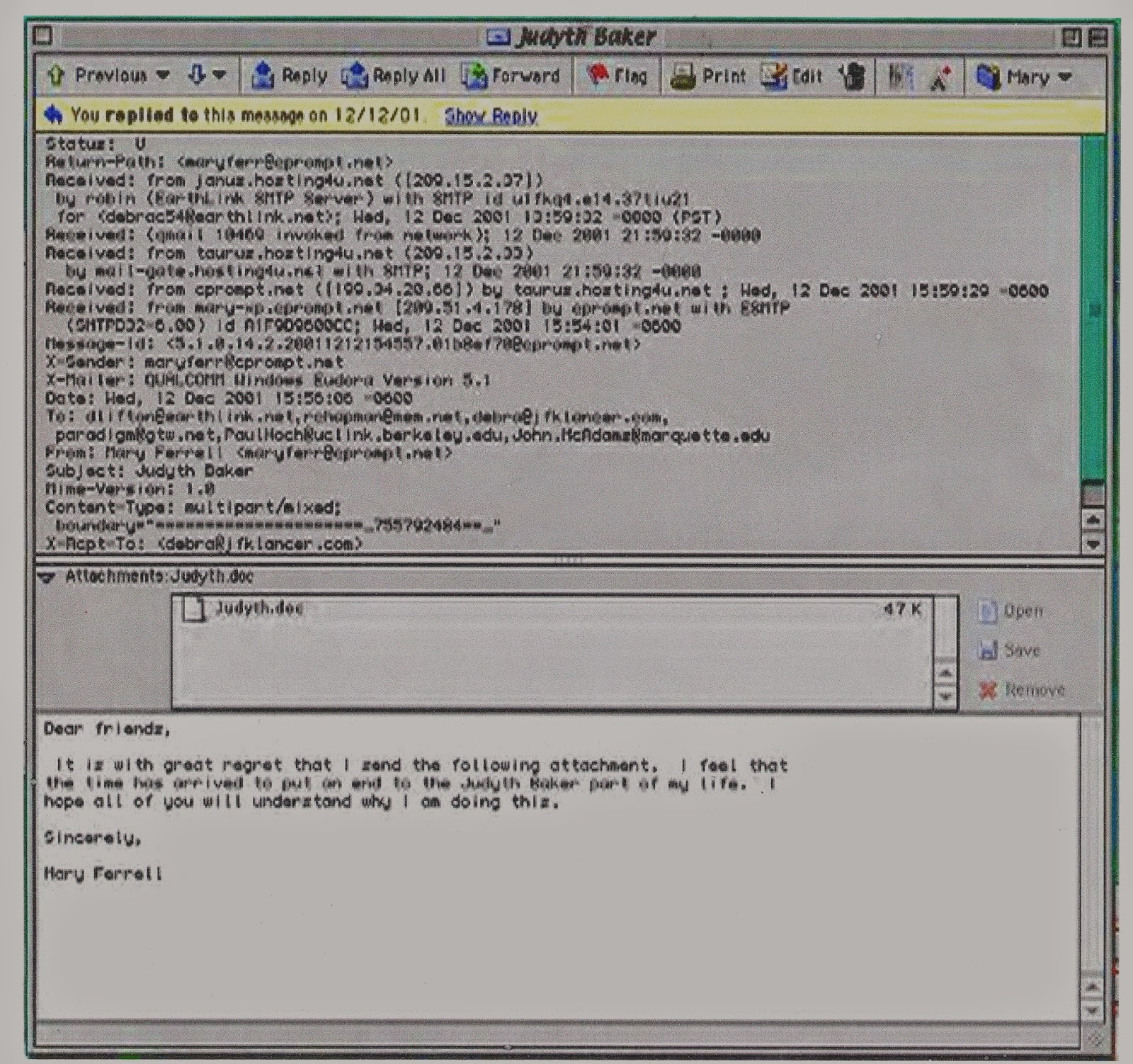 According to Mary, all she wrote was a simple sentence saying she regretted it, but the 'Judyth Baker' part of her life was over and everyone should understand. Mary evidenced surprise when we showed her the printout. She said she didn't write the attached material we showed her. Her email was sent to David Lifton, Robert Chapman, Debra Conway, John McAdams and one other. Those who understand headers will note that all starts well: there is no problem, once you account for time zones, until you hit the timestamp of "12 Dec. 2001 10:59:02." While glitches could happen back then with timestamps. 11 hours behind the two previous PST stamps seems inexplicable. If the email had been held up because it was being altered, an attempt to turn back the timestamp might have thrown it back too far and it could not be fixed. No email, by the way, can be proven to be authentic after such a long time period, but the header gives us a hint that it was not authentic.
Jim Marrs, whose updated, new edition of Crossfire: the Plot that Killed Kennedy, came out in 2013 for the 50th anniversary of Kennedy's assassination, went on in 2010 (and thenceforth) to endorse Me & Lee, writing its Afterword. Edward T. Haslam, author of Dr. Mary's Monkey, wrote its Foreword. Me & Lee was published in 2010 (hardcover) and 2011 (softcover). Me & Lee is also available as an audiobook from Trine Day publishers Amazon, Barnes & Noble, etc.
 Jim Marrs and Judyth Vary Baker
 JFK Assassination Conference Dallas-Arlington,
22-23-24 November, 2014
STREET CAR TICKETS -- Me & Lee -- and Evidence that M...
STREET CAR TICKETS -- Me & Lee -- and Evidence that Marina Oswald was Threatened with Deportation
 The value of a street car ticket is that it shows a definitive date and time. When kept in the possession of a witness for over fifty years, it helps provide support that the witness was present at that date and time on that streetcar. The streetcar tickets I saved from the St. Charles Streetcar in New Orleans in the spring and summer of 1963 are among many such unusual records and mementos I kept only between the dates of 1960 and 1963. By themselves they may seem to mean little, but in context with the other records which were also kept, plus documents, and access to the historical record concerning Lee Oswald, they provide support for my testimony, which is largely recorded in
Me & Lee; How I came to know, love and lose Lee Harvey Oswald.
In New Orleans, where we met April 26, 1963, Lee and I moved into our apartments within a week of each other: I on May 4, 1963, and he on May 10, 1963. Lee arranged this for me after I was ejected after a police raid from a single room that turned out to be a "mansion of ill repute" on St. Charles. I now lived close to Lee's apartment at 4905 Magazine St., residing at 1032 Marengo St. 1032 Marengo was a mere six minute walk to the Napoleon Branch Library, the approximate halfway point, where Lee and I met most often.
The value of a street car ticket is that it shows a definitive date and time. When kept in the possession of a witness for over fifty years, it helps provide support that the witness was present at that date and time on that streetcar. The streetcar tickets I saved from the St. Charles Streetcar in New Orleans in the spring and summer of 1963 are among many such unusual records and mementos I kept only between the dates of 1960 and 1963. By themselves they may seem to mean little, but in context with the other records which were also kept, plus documents, and access to the historical record concerning Lee Oswald, they provide support for my testimony, which is largely recorded in
Me & Lee; How I came to know, love and lose Lee Harvey Oswald.
In New Orleans, where we met April 26, 1963, Lee and I moved into our apartments within a week of each other: I on May 4, 1963, and he on May 10, 1963. Lee arranged this for me after I was ejected after a police raid from a single room that turned out to be a "mansion of ill repute" on St. Charles. I now lived close to Lee's apartment at 4905 Magazine St., residing at 1032 Marengo St. 1032 Marengo was a mere six minute walk to the Napoleon Branch Library, the approximate halfway point, where Lee and I met most often.
That spring and summer, Lee and I lived just one bus stop apart: most mornings in May through July, Lee got on the bus across the street from his 4905 Magazine St apartment. The bus stopped next at Marengo and Magazine, and I would get on.
Between May 9 and July 19 Lee and I also rode the Magazine bus home from work. Many times, we would actually travel past our apartments and get off down at Audubon Park at 6500 Magazine St. Later, we'd take the bus returning toward town so that Lee got off first, then I did. This bought us an extra hour or so, which we needed for the many afternoons when we were delayed getting home, at which time we'd get off at the regular stops but wouldn't seem to be arriving "late,"
Lee usually got home by dark, but dark in the summer in New Orleans is not 6:00 PM. According to Marina, when questioned by the Secret Service and FBI, Lee never spent a night away from home except the night he spent in jail on August 9-10. This is not true, as we know from other records, but Marina tried as hard as she could to cooperate with what was wanted. While it is true that the Warren Commission told Marina that Marina was not in danger of deportation even if she refused to testify (WC Vol, p. 80), Marina brings up in her testimony to the Warren Commission that she had been previously told that her failure to cooperate could result in deportation:
MARINA: "... the agents of the Secret Service and the FBI, they asked me many questions.... Sometimes the FBI agents asked me questions which had no bearing or relationship, and if I didn't want to answer they told me that if I wanted to live in the country, I would have to help in this matter, even though they were often irrelevant... that is the FBI"
Therefore, we cannot trust everything Marina felt she had to tell the FBI and Secret Service, let alone the Warren Commission, which could only speak for itself. Nor did marina feel 'safe' testifying before the Warren Commission, despite their reassurances. We know that present at Marina's testimony to the Warren Commission were two interpreters: one was William D. Krimer, from the Department of State. The other was Leon I. Gopadze, whom Robert Oswald, Lee's brother, described as knowing that FBI agent James Hosty had harshly interrogated and threatened Marina with deportation in late November soon after Lee had been shot, if she did not cooperate. It was now only January.
Who was Leon I. Gopadze?
Harold Weisberg tells us that as a translator of Russian, he was "Marina's shadow" who allowed the Warren Commission to question Marina under the pretense that she had not been under oath previously and therefore had sometimes lied to the FBI and the Secret Service, but now (with all the correct answers figured out for her) Marina was now going to tell everybody only the truth. Weisberg's book, Whitewash, is worth a quiet read: you may end up infuriated with what he tells you. Gopadze was the Secret Service Agent who had allowed James Hosty of the FBI to interrogate Marina harshly and to twice threaten her with possible deportation if she did not cooperate. Robert Oswald stated that Marina had cooperated in every sense, and that he had even intervened due to the harshness of Hosty's interrogation. Now, Gopadze is sitting here before the Warren Commission as a "second" interpreter but he says nothing to support Marina. She must realize that he is not her friend. Robert Oswald in his own testimony (WC Vol. 1, p. 410) tells us about the threats:
Mr. OSWALD. ...this particular one agent... she had an aversion to speaking to him because she was of the opinion that he had harassed Lee in his interviews, and my observation of this at this time, at this particular interview, was attempting to start-- I would say this was certainly so. His manner was very harsh sir.
Mr. JENNER. Harsh towards Marina?
Mr. OSWALD. Yes, Mr, it most certainly was. And by the tone of conversation by Marina to Mr. Gopadze, who was interpreting----
Mr. JENNER. In your presence?
Mr. OSWALD. In my presence. And the tone of the reply between this gentleman and Mr. Gopadze, and back to Marina, it was quite evident there was a harshness there, and that Marina did not want to speak to the FBI at that time. And she was refusing to. And they were insisting, sir. And they implied in so many words, as I sat there--if I might state--with Secret Service Agent Gary Seals, of Mobile, Ala. ... we were perhaps just four or five feet away ... and it came to my ears that they were implying that if she did not cooperate with the FBI agent there, that this would perhaps--I say, again, I am implying--in so many words, that they would perhaps deport her from the United States and back to Russia.
I arose and called Mr. Mike Howard of the United States Secret Service into the back bathroom, and stated this to him. And I also stated that I realized there was some friction here between the United States Secret Service and the FBI to the extent that I was of the opinion that they did not want the FBI at that time to be aware of the tape recording that had been made of Marina N. Oswald, that she had been interviewed, in other words, by the United States Secret Service before the FBI arrived at the location.
Mr. JENNER. You mean that the Secret Service did not want the FBI to know that they had taped an interview with Marina?
Mr. OSWALD. Yes, sir.
Mr. JENNER. What was his response?
Mr. OSWALD. He said, "Robert, I cannot tell you what to do."
I did ask him if he would go over there to speak to him, and kind of tone it down--if they were going to get anything out of her, they would not get it that way. And he said he would speak to her. Approximately, at this time, the telephone rang, and he had to speak on the telephone.
I returned to my chair at the table where we were... opening mail, and again for the second time, the same implication was brought out.
Mr. JENNER. By the FBI agents?
Mr. OSWALD. Yes, air.
Mr. JENNER. To Marina?
Mr. OSWALD. Yes, sir.
Mr. JENNER. In your presence?
Mr. OSWALD. Yes, sir.
Mr. JENNER. They spoke English?
Mr. OSWALD. Yes, sir.
Mr. JENNER. Was the interpreter whom you named--was he participating?
Mr. OSWALD. Yes, sir. It was from the FBI agent [Hosty] ...to Mr. Gopadze, to Mrs. Oswald, from Mrs. Oswald back to Mr. Gopadze to the other gentleman.
Mr. JENNER. Proceed.
Mr. OSWALD. On the second occurrence of this implication, of the same implication, I arose again, and Mr. Howard was walking across the room, and I stopped him, and I told him for the second time, or requested for the second time that he please say something to them about that.
Mr. JENNER. Did you speak loudly enough to be overheard?
Mr. OSWALD. No, sir. I just asked Mr. Howard to please inform the FBI that she had, to the contrary, been very cooperative from the time she had been out there, up until their arrival. And, again, I referred to Mr. Howard the reference there of perhaps the friction, or the condition that I assumed, that they did not want the FBI aware of the tape recording at this time. And his reply to me, he said, "Robert, do what you want to do. You certainly absolutely are free to say anything you want to say."
Mr. JENNER. And did you?
Mr. OSWALD. I certainly did, sir.
Mr. JENNER. What did you say? You went over to the agent?
Mr. OSWALD. Yes, sir; I went over to Mr. Brown, the agent I knew, who was sitting at the end of the coffee table--it was a large round coffee table. And I sat there, and I spoke to him without saying so much about--anything about the tape recording. I did say to him--and I was shaking my finger at him, sir, I might say that-- that I resented the implications that they were passing on to Marina, because of her apparent uncooperative attitude.
Mr. JENNER. Supposed, you mean?
Mr. OSWALD. Yes, sir. And that I knew for a fact that she had been very cooperative and highly cooperative. And I returned to my chair at the table. (Ref: WC Vol. 1 p 410) .
So Marina was under stress to say what was wanted.
As a witness, my heart goes out to Marina. I have also faced stress, including death threats, and know how ugly it can get.
In my case, I saved what I could. The streetcar tickets were saved because they were very special to me, and because Lee and I planned to marry, I kept them as souvenirs about our love affair.
There were originally four ticket stubs, but I thought only two survived the vandalism, burglaries, and a 'removal' of files from a locker. The first streetcar ticket I saved was dated Sunday, April 28, two days after I met Lee. This one is still in a safe place. At that time, I was already feeling strongly attracted to Lee, and Robert was in Florida; I wasn't married yet, and Lee had told me he was considering getting a divorce from his wife. As the ticket shows, Lee and I got on the street car between 8:45 and 9:00 AM. We took part of our trip to Lee's aunt's home in Metairie by streetcar; then, we transferred to a bus.
 Below is what I thought was the only other surviving ticket of the original four, dated July 6, 1967. It shows a trip "to" or "from" an area that includes Tulane University, the logical destination or departure point, at no later than 3:30 PM.
This streetcar ticket concerns hours I spent with Lee on this date. Originally, all I could find for this date was a single entry: "Washing and ironing today - also journals," The entry was apparently never updated.
In my book, Me & Lee, even though I had the streetcar ticket, which was originally in the book's manuscript, the oversight was never corrected and the streetcar ticket was replaced with a photo of the interior of Tulane's library. In any new edition of the book, I'll ask that this bit of evidence (and others that were left out of the first edition, such as various references and sources) will be put back in.
First of all, this streetcar ticket was issued on a Saturday. Under ordinary conditions, Lee would have been home with his family, but as you can see elsewhere in Me & Lee, this was not always the case. Keep in mind that this is early in July.
An indication as to how often Lee was not with Marina -- at least in July --- can be gathered from a Dec. 1, 1963 FBI statement (p. 2) where Jesuit scholar Robert Fitzpatrick was interviewed about his speaking to Marina Oswald on July 26, 1963, at the time she had accompanied Lee and his family to the Jesuit House of Studies, at Spring Hill College, in Mobile, Alabama. "[Fitzpatrick] stated Mrs. OSWALD said her husband was presently out of work and they were having a difficult time financially. He said she told him OSWALD is away from home a great deal and she did not know any of his associates or any of his activities." Marina's complaining to Fitzgerald about Lee's being "away from home a great deal" and that "she did not know any of his associates or any of his activities" was ignored by the Warren Commission.
New Street Car Ticket Stub Found for July 6, 1963
While going through science fair ribbons, which I haven’t looked at individually since 1961, I found one of the lost St. Charles streetcar tickets. It was for Saturday morning, July 6, 1963. Lee and I had boarded the St. Charles streetcar at 8:45 AM that morning. (I've enlarged it a little so it can be more easily read):
I had scattered evidence of my being with Lee where I thought Robert would never look. As for streetcar tickets, I only saved tickets involving me and Lee that were very special, so this means I was with Lee on a ‘special’ day. Indeed it was, as this was a Saturday, which Lee usually spent with his family. However, he was free from work at Reily’s due to the 4th of July holiday on Thursday. Lee spent the 4th with his family, so this must be why we felt we could have that Saturday together. Since the first streetcar ticket is cut at 8:45 AM, we probably went to the Tulane Library. No doubt we ate lunch together somewhere. The second streetcar ticket shows we started the return trip at just before 3:30, meaning Lee was home no later than 4:00, in time for him to take Marina, as he usually did on Saturdays, to the branch library on Napoleon (now known as the Children's Resource Center). It takes 8 minutes to walk to the library, says Google Maps, from 4900 Magazine St. Since there were no Russian books there for Marina to read, for her it was just a chance to look at a Life Magazine. The library was open until 5:00. The FBI reported that on July 6, 1963, Lee borrowed One Day in the Life of Ivan Denisovich , by Alexander Solzhenitsyn, and The Hornblower and The Hotspur, by C.S. Forester from the Napoleon Branch Library. (Both were renowned writers.) For July 13 in Me & Lee there was no entry. This was the weekend that Lee would have stayed home with Marina for sure, as it was right after her birthday. REF: http://www.history-matters.com/archiv...
 The value of a street car ticket is that it shows a definitive date and time. When kept in the possession of a witness for over fifty years, it helps provide support that the witness was present at that date and time on that streetcar. The streetcar tickets I saved from the St. Charles Streetcar in New Orleans in the spring and summer of 1963 are among many such unusual records and mementos I kept only between the dates of 1960 and 1963. By themselves they may seem to mean little, but in context with the other records which were also kept, plus documents, and access to the historical record concerning Lee Oswald, they provide support for my testimony, which is largely recorded in
Me & Lee; How I came to know, love and lose Lee Harvey Oswald.
In New Orleans, where we met April 26, 1963, Lee and I moved into our apartments within a week of each other: I on May 4, 1963, and he on May 10, 1963. Lee arranged this for me after I was ejected after a police raid from a single room that turned out to be a "mansion of ill repute" on St. Charles. I now lived close to Lee's apartment at 4905 Magazine St., residing at 1032 Marengo St. 1032 Marengo was a mere six minute walk to the Napoleon Branch Library, the approximate halfway point, where Lee and I met most often.
The value of a street car ticket is that it shows a definitive date and time. When kept in the possession of a witness for over fifty years, it helps provide support that the witness was present at that date and time on that streetcar. The streetcar tickets I saved from the St. Charles Streetcar in New Orleans in the spring and summer of 1963 are among many such unusual records and mementos I kept only between the dates of 1960 and 1963. By themselves they may seem to mean little, but in context with the other records which were also kept, plus documents, and access to the historical record concerning Lee Oswald, they provide support for my testimony, which is largely recorded in
Me & Lee; How I came to know, love and lose Lee Harvey Oswald.
In New Orleans, where we met April 26, 1963, Lee and I moved into our apartments within a week of each other: I on May 4, 1963, and he on May 10, 1963. Lee arranged this for me after I was ejected after a police raid from a single room that turned out to be a "mansion of ill repute" on St. Charles. I now lived close to Lee's apartment at 4905 Magazine St., residing at 1032 Marengo St. 1032 Marengo was a mere six minute walk to the Napoleon Branch Library, the approximate halfway point, where Lee and I met most often.That spring and summer, Lee and I lived just one bus stop apart: most mornings in May through July, Lee got on the bus across the street from his 4905 Magazine St apartment. The bus stopped next at Marengo and Magazine, and I would get on.
Between May 9 and July 19 Lee and I also rode the Magazine bus home from work. Many times, we would actually travel past our apartments and get off down at Audubon Park at 6500 Magazine St. Later, we'd take the bus returning toward town so that Lee got off first, then I did. This bought us an extra hour or so, which we needed for the many afternoons when we were delayed getting home, at which time we'd get off at the regular stops but wouldn't seem to be arriving "late,"
Lee usually got home by dark, but dark in the summer in New Orleans is not 6:00 PM. According to Marina, when questioned by the Secret Service and FBI, Lee never spent a night away from home except the night he spent in jail on August 9-10. This is not true, as we know from other records, but Marina tried as hard as she could to cooperate with what was wanted. While it is true that the Warren Commission told Marina that Marina was not in danger of deportation even if she refused to testify (WC Vol, p. 80), Marina brings up in her testimony to the Warren Commission that she had been previously told that her failure to cooperate could result in deportation:
MARINA: "... the agents of the Secret Service and the FBI, they asked me many questions.... Sometimes the FBI agents asked me questions which had no bearing or relationship, and if I didn't want to answer they told me that if I wanted to live in the country, I would have to help in this matter, even though they were often irrelevant... that is the FBI"
Therefore, we cannot trust everything Marina felt she had to tell the FBI and Secret Service, let alone the Warren Commission, which could only speak for itself. Nor did marina feel 'safe' testifying before the Warren Commission, despite their reassurances. We know that present at Marina's testimony to the Warren Commission were two interpreters: one was William D. Krimer, from the Department of State. The other was Leon I. Gopadze, whom Robert Oswald, Lee's brother, described as knowing that FBI agent James Hosty had harshly interrogated and threatened Marina with deportation in late November soon after Lee had been shot, if she did not cooperate. It was now only January.
Who was Leon I. Gopadze?
Harold Weisberg tells us that as a translator of Russian, he was "Marina's shadow" who allowed the Warren Commission to question Marina under the pretense that she had not been under oath previously and therefore had sometimes lied to the FBI and the Secret Service, but now (with all the correct answers figured out for her) Marina was now going to tell everybody only the truth. Weisberg's book, Whitewash, is worth a quiet read: you may end up infuriated with what he tells you. Gopadze was the Secret Service Agent who had allowed James Hosty of the FBI to interrogate Marina harshly and to twice threaten her with possible deportation if she did not cooperate. Robert Oswald stated that Marina had cooperated in every sense, and that he had even intervened due to the harshness of Hosty's interrogation. Now, Gopadze is sitting here before the Warren Commission as a "second" interpreter but he says nothing to support Marina. She must realize that he is not her friend. Robert Oswald in his own testimony (WC Vol. 1, p. 410) tells us about the threats:
Mr. OSWALD. ...this particular one agent... she had an aversion to speaking to him because she was of the opinion that he had harassed Lee in his interviews, and my observation of this at this time, at this particular interview, was attempting to start-- I would say this was certainly so. His manner was very harsh sir.
Mr. JENNER. Harsh towards Marina?
Mr. OSWALD. Yes, Mr, it most certainly was. And by the tone of conversation by Marina to Mr. Gopadze, who was interpreting----
Mr. JENNER. In your presence?
Mr. OSWALD. In my presence. And the tone of the reply between this gentleman and Mr. Gopadze, and back to Marina, it was quite evident there was a harshness there, and that Marina did not want to speak to the FBI at that time. And she was refusing to. And they were insisting, sir. And they implied in so many words, as I sat there--if I might state--with Secret Service Agent Gary Seals, of Mobile, Ala. ... we were perhaps just four or five feet away ... and it came to my ears that they were implying that if she did not cooperate with the FBI agent there, that this would perhaps--I say, again, I am implying--in so many words, that they would perhaps deport her from the United States and back to Russia.
I arose and called Mr. Mike Howard of the United States Secret Service into the back bathroom, and stated this to him. And I also stated that I realized there was some friction here between the United States Secret Service and the FBI to the extent that I was of the opinion that they did not want the FBI at that time to be aware of the tape recording that had been made of Marina N. Oswald, that she had been interviewed, in other words, by the United States Secret Service before the FBI arrived at the location.
Mr. JENNER. You mean that the Secret Service did not want the FBI to know that they had taped an interview with Marina?
Mr. OSWALD. Yes, sir.
Mr. JENNER. What was his response?
Mr. OSWALD. He said, "Robert, I cannot tell you what to do."
I did ask him if he would go over there to speak to him, and kind of tone it down--if they were going to get anything out of her, they would not get it that way. And he said he would speak to her. Approximately, at this time, the telephone rang, and he had to speak on the telephone.
I returned to my chair at the table where we were... opening mail, and again for the second time, the same implication was brought out.
Mr. JENNER. By the FBI agents?
Mr. OSWALD. Yes, air.
Mr. JENNER. To Marina?
Mr. OSWALD. Yes, sir.
Mr. JENNER. In your presence?
Mr. OSWALD. Yes, sir.
Mr. JENNER. They spoke English?
Mr. OSWALD. Yes, sir.
Mr. JENNER. Was the interpreter whom you named--was he participating?
Mr. OSWALD. Yes, sir. It was from the FBI agent [Hosty] ...to Mr. Gopadze, to Mrs. Oswald, from Mrs. Oswald back to Mr. Gopadze to the other gentleman.
Mr. JENNER. Proceed.
Mr. OSWALD. On the second occurrence of this implication, of the same implication, I arose again, and Mr. Howard was walking across the room, and I stopped him, and I told him for the second time, or requested for the second time that he please say something to them about that.
Mr. JENNER. Did you speak loudly enough to be overheard?
Mr. OSWALD. No, sir. I just asked Mr. Howard to please inform the FBI that she had, to the contrary, been very cooperative from the time she had been out there, up until their arrival. And, again, I referred to Mr. Howard the reference there of perhaps the friction, or the condition that I assumed, that they did not want the FBI aware of the tape recording at this time. And his reply to me, he said, "Robert, do what you want to do. You certainly absolutely are free to say anything you want to say."
Mr. JENNER. And did you?
Mr. OSWALD. I certainly did, sir.
Mr. JENNER. What did you say? You went over to the agent?
Mr. OSWALD. Yes, sir; I went over to Mr. Brown, the agent I knew, who was sitting at the end of the coffee table--it was a large round coffee table. And I sat there, and I spoke to him without saying so much about--anything about the tape recording. I did say to him--and I was shaking my finger at him, sir, I might say that-- that I resented the implications that they were passing on to Marina, because of her apparent uncooperative attitude.
Mr. JENNER. Supposed, you mean?
Mr. OSWALD. Yes, sir. And that I knew for a fact that she had been very cooperative and highly cooperative. And I returned to my chair at the table. (Ref: WC Vol. 1 p 410) .
So Marina was under stress to say what was wanted.
As a witness, my heart goes out to Marina. I have also faced stress, including death threats, and know how ugly it can get.
In my case, I saved what I could. The streetcar tickets were saved because they were very special to me, and because Lee and I planned to marry, I kept them as souvenirs about our love affair.
There were originally four ticket stubs, but I thought only two survived the vandalism, burglaries, and a 'removal' of files from a locker. The first streetcar ticket I saved was dated Sunday, April 28, two days after I met Lee. This one is still in a safe place. At that time, I was already feeling strongly attracted to Lee, and Robert was in Florida; I wasn't married yet, and Lee had told me he was considering getting a divorce from his wife. As the ticket shows, Lee and I got on the street car between 8:45 and 9:00 AM. We took part of our trip to Lee's aunt's home in Metairie by streetcar; then, we transferred to a bus.
 Below is what I thought was the only other surviving ticket of the original four, dated July 6, 1967. It shows a trip "to" or "from" an area that includes Tulane University, the logical destination or departure point, at no later than 3:30 PM.
This streetcar ticket concerns hours I spent with Lee on this date. Originally, all I could find for this date was a single entry: "Washing and ironing today - also journals," The entry was apparently never updated.
In my book, Me & Lee, even though I had the streetcar ticket, which was originally in the book's manuscript, the oversight was never corrected and the streetcar ticket was replaced with a photo of the interior of Tulane's library. In any new edition of the book, I'll ask that this bit of evidence (and others that were left out of the first edition, such as various references and sources) will be put back in.
First of all, this streetcar ticket was issued on a Saturday. Under ordinary conditions, Lee would have been home with his family, but as you can see elsewhere in Me & Lee, this was not always the case. Keep in mind that this is early in July.
An indication as to how often Lee was not with Marina -- at least in July --- can be gathered from a Dec. 1, 1963 FBI statement (p. 2) where Jesuit scholar Robert Fitzpatrick was interviewed about his speaking to Marina Oswald on July 26, 1963, at the time she had accompanied Lee and his family to the Jesuit House of Studies, at Spring Hill College, in Mobile, Alabama. "[Fitzpatrick] stated Mrs. OSWALD said her husband was presently out of work and they were having a difficult time financially. He said she told him OSWALD is away from home a great deal and she did not know any of his associates or any of his activities." Marina's complaining to Fitzgerald about Lee's being "away from home a great deal" and that "she did not know any of his associates or any of his activities" was ignored by the Warren Commission.
New Street Car Ticket Stub Found for July 6, 1963
While going through science fair ribbons, which I haven’t looked at individually since 1961, I found one of the lost St. Charles streetcar tickets. It was for Saturday morning, July 6, 1963. Lee and I had boarded the St. Charles streetcar at 8:45 AM that morning. (I've enlarged it a little so it can be more easily read):
I had scattered evidence of my being with Lee where I thought Robert would never look. As for streetcar tickets, I only saved tickets involving me and Lee that were very special, so this means I was with Lee on a ‘special’ day. Indeed it was, as this was a Saturday, which Lee usually spent with his family. However, he was free from work at Reily’s due to the 4th of July holiday on Thursday. Lee spent the 4th with his family, so this must be why we felt we could have that Saturday together. Since the first streetcar ticket is cut at 8:45 AM, we probably went to the Tulane Library. No doubt we ate lunch together somewhere. The second streetcar ticket shows we started the return trip at just before 3:30, meaning Lee was home no later than 4:00, in time for him to take Marina, as he usually did on Saturdays, to the branch library on Napoleon (now known as the Children's Resource Center). It takes 8 minutes to walk to the library, says Google Maps, from 4900 Magazine St. Since there were no Russian books there for Marina to read, for her it was just a chance to look at a Life Magazine. The library was open until 5:00. The FBI reported that on July 6, 1963, Lee borrowed One Day in the Life of Ivan Denisovich , by Alexander Solzhenitsyn, and The Hornblower and The Hotspur, by C.S. Forester from the Napoleon Branch Library. (Both were renowned writers.) For July 13 in Me & Lee there was no entry. This was the weekend that Lee would have stayed home with Marina for sure, as it was right after her birthday. REF: http://www.history-matters.com/archiv...
November 30, 2014
THE SHOW WAS COAST TO COAST, AND LISTENERS FINALLY HEARD ...
THE SHOW WAS COAST TO COAST, AND LISTENERS
FINALLY HEARD SOME TRUTH ABOUT THE REAL LEE
HARVEY OSWALD AND THE REAL DAVID W. FERRIE.
 DAVID W. FERRIE -- SKILLED PILOT, LINGUIST, CANCER RESEARCH ASSOCIATE AND PATRIOT--HE PRETENDED TO HATE JFK AND GATHERED INFORMATION ABOUT THE IMPENDING ASSASSINATION.
BOTH BOOKS, PUBLISHED BY TRINE DAY, ARE FILLED WITH HUNDREDS OF PHOTOS AND DOCUMENTS REVEALING THE PLAYERS, MOVERS AND SHAKERS IN THE KENNEDY ASSASSINATION.
 LEE OSWALD -PROUD MARINE AT AGE 17-PATRIOT TO THE END!
ORDER AN AUTOGRAPHED COPY OF ME and LEE: HOW I CAME TO KNOW, LOVE AND LOSE LEE HARVEY OSWALD by clicking here. You can also order unsigned books from TRINE DAY BOOKS, BARNES and NOBLE, OR AMAZON.COM! THIS IS THE BOOK THAT HAS OPENED THE EYES OF THOUSANDS TO THE TRUTH ABOUT THE FALSELY ACCUSED ASSASSIN. LEE WAS EXACTLY WHO HE SAID HE WAS --A PATSY-- AND I MEMORIZED HIS WORDS, SAVED DOCUMENTS, FOUND WITNESSES TO PROVE IT, BECAUSE I LOVED HIM, AND KNOW WHAT HE SACRIFICED, TRYING TO SAVE KENNEDY.
"PLEASE TELL MY LITTLE GIRLS I WAS A GOOD GUY," LEE BEGGED OF ME. I HAVE KEPT MY PROMISE.
YOU CAN OBTAIN AN AUTOGRAPHED, HARDCOVER, FIRST PRINTING EDITION OF ME and LEE BY ORDERING THROUGH PAYPAL AT THIS WEBSITE! (see Paypal button)
A CALL FOR VINDICATION!JOIN ME IN DEMANDING THAT A WORLD COURT BE CONVENED TO EXONERATE LEE HARVEY OSWALD AND TO FOCUS ON THE US GOVERNMENT COVER-UP OF THE TRUTH, INCLUDING VICE PRESIDENT LYNDON B. JOHNSON'S INVOLVEMENT !
WANT TO LEARN MORE? VISIT http://judythbaker.blogspot.com/ !!!!!!
FINALLY HEARD SOME TRUTH ABOUT THE REAL LEE
HARVEY OSWALD AND THE REAL DAVID W. FERRIE.
DAVID W. FERRIE -- SKILLED PILOT, LINGUIST, CANCER RESEARCH ASSOCIATE AND PATRIOT--HE PRETENDED TO HATE JFK AND GATHERED INFORMATION ABOUT THE IMPENDING ASSASSINATION.BOTH BOOKS, PUBLISHED BY TRINE DAY, ARE FILLED WITH HUNDREDS OF PHOTOS AND DOCUMENTS REVEALING THE PLAYERS, MOVERS AND SHAKERS IN THE KENNEDY ASSASSINATION.
LEE OSWALD -PROUD MARINE AT AGE 17-PATRIOT TO THE END!ORDER AN AUTOGRAPHED COPY OF ME and LEE: HOW I CAME TO KNOW, LOVE AND LOSE LEE HARVEY OSWALD by clicking here. You can also order unsigned books from TRINE DAY BOOKS, BARNES and NOBLE, OR AMAZON.COM! THIS IS THE BOOK THAT HAS OPENED THE EYES OF THOUSANDS TO THE TRUTH ABOUT THE FALSELY ACCUSED ASSASSIN. LEE WAS EXACTLY WHO HE SAID HE WAS --A PATSY-- AND I MEMORIZED HIS WORDS, SAVED DOCUMENTS, FOUND WITNESSES TO PROVE IT, BECAUSE I LOVED HIM, AND KNOW WHAT HE SACRIFICED, TRYING TO SAVE KENNEDY.
"PLEASE TELL MY LITTLE GIRLS I WAS A GOOD GUY," LEE BEGGED OF ME. I HAVE KEPT MY PROMISE.
YOU CAN OBTAIN AN AUTOGRAPHED, HARDCOVER, FIRST PRINTING EDITION OF ME and LEE BY ORDERING THROUGH PAYPAL AT THIS WEBSITE! (see Paypal button)
A CALL FOR VINDICATION!JOIN ME IN DEMANDING THAT A WORLD COURT BE CONVENED TO EXONERATE LEE HARVEY OSWALD AND TO FOCUS ON THE US GOVERNMENT COVER-UP OF THE TRUTH, INCLUDING VICE PRESIDENT LYNDON B. JOHNSON'S INVOLVEMENT !
WANT TO LEARN MORE? VISIT http://judythbaker.blogspot.com/ !!!!!!


